Slashdot Mirror
Domain: universetoday.com
Stories and comments across the archive that link to universetoday.com.
Comments · 355
-
I thought they restarted production back in March
I thought NASA struck a deal with DOE back in March to do 2 kilos per year of Pu-238 back in March. Did it get de-funded or something? http://www.universetoday.com/100875/u-s-to-restart-plutonium-production-for-deep-space-exploration/
-
Re:Why are they using LED lights?
As AC says, ISS rotates around the earth every 90 minutes. However, the orbit it maintains in relation to the sun is variable: "For the next few days, the International Space Station (ISS) will be orbiting Earth in constant sunlight, as its orbit lines up with Earth’s day-night terminator." Taken from: http://www.universetoday.com/67280/iss-will-be-in-constant-sunlight-the-next-few-days/
Sometimes it has 24/7 sunlight, but it normally does not. Plants like conditions to simulate day and night from their region. In a sense, they have sleep cycles, similar to animals. When they have 16 hours of sunlight a day, they believe it is summer, and grow. When they have 14 hours they think it is autumn and produce veggies. During some orbits you could use window shades, and timing everything perfectly to open and shut them. If you are in an orbit that switches between sunlight and darkness for 45 minutes at a time, then your plants can probably survive. But, if you expect to feed people, then you need optimal growth conditions. -
Re:Why is that surprising?
Or is it that Axial tilt tends to be more likely aligned perpendicular to the plane of the Galaxy due to small, but real gravitational influences on those stars as they orbit around the galaxy center?
(Galaxy Rotation period is about 225 million earth years).
Would whirling a fully gimbled gyroscope around your head on a string have any effect on the orientation of the gyroscope's axis?
-
Re:False Flag
And "God did it" is still a reasonable (if unlikely) reason for the Big Bang happening in the first place.
Apples and oranges. Who (or what) is responsible isn't the same thing as "via what mechanism".
The absolutely best they can claim is that the devil
Most creationists don't believe that the devil was responsible for creation.
or maybe God himself, to "test" us -- ie: make sure we don't try to use the big old brains He gave us
Perhaps God did it to give us all something to do with our "big old brains" while we're here on this planet? Most people who "do science" seem to enjoy it. Figuring out how something was done is still interesting, even if you leave out the question of who did it. Why does it matter if "God did it" or "it happened from a random chance accident of random molecules" when one is studying how DNA works?
accuracy within 1% is a reasonable accuracy in many cases
Claims of accuracy require a known correct value. It is precision that deals with repeatability and consistency between numbers of unknown accuracy.
If you seek across the world wild web, you'll find places that give the age of the universe ranging from 16+-5, 12.0+-1.5, 13.7+-0.2, and 9-11 GYears. Over the last few hundred years of that process, scientists have told us that the Earth is 2 GY, between 20 and 400 MY, 22MY, 200 MY, 56 MY, 50-150 MY. Radiometric dating has given answers from 1.3 GY to 3.8 GY. And now, with dedicated certainty, 4.54 GY, ref here.
I don't see anyone having their "big old brains" limited by anything, in fact, lots of "big old brains" have been having a lot of fun working on this. And there is nothing inherent in the statement "God did it" that stops people from being scientists and seeking knowledge.
-
Re:If this was possible...
Private spaceflight occurs mainly in Russia.
I thought Russia's industry was a state-owned company that was spun off into a private entity. That's not exactly the same as a private company building itself up from nothing. They're also having a lot of problems.
The USA developed the basics of the Internet backbone, but look at the current customer situation (which is all that matters, really), you can have 100mbps symmetrical in Japan, Slovakia, Estonia for 10-15$/month. In the USA you can have 10mbps with a 300GB cap for 40$/month. Again, your greed impedes innovation. A lot, most, of the optic fiber dropped in the oceans are operated by foreign countries.
This is all totally irrelevant: we're talking about technical innovation here, not business plans and operations. I could go start my own ISP, but that doesn't make me an innovator, it makes me someone who bought some off-the-shelf equipment and put it into use. It's great those other countries are providing internet service so cheaply, and I wish our ISP situation here wasn't so fucked up, but they're not innovators, just like your local car mechanic is not an innovator in the realm of automotive engineering. The innovators are the people/companies who designed and engineered the equipment those ISPs use, and while a lot of that has moved to Asia in recent years, much of the original design work (such as the Ethernet standards) was done by American companies. Dropping an optical cable into the ocean doesn't take innovation, it just requires buying an optical cable from someone and renting a boat. Laying transoceanic cables is a mature technology (they've been doing that for many decades now), and you're not an innovator of optical cables when all you do is buy it from someone else.
As far as HTC and Samsung, there's not all that much innovation going on there; they make Android (and Windows) phones, so they're getting their software from someone else, namely Google and MS, both American companies, and all the ICs they use are mostly designed by American companies.
-
Shades of the US "Genesis" sample return probe...
which plowed into the desert floor without deploying any parachutes because a G-switch was installed backwards...
http://www.universetoday.com/73/genesis-accident-report-released/
-
Re:Too bad for any life
What part of your ass did you pull your figures from? Universe today says it has another 1.1 billion left, Wikipedia saysThe Sun is about halfway through its main-sequence stage, during which nuclear fusion reactions in its core fuse hydrogen into helium. Each second, more than four million tonnes of matter are converted into energy within the Sun's core, producing neutrinos and solar radiation. At this rate, the Sun has so far converted around 100 Earth-masses of matter into energy. The Sun will spend a total of approximately 10 billion years as a main-sequence star."
Where did that 350 million years come from?
-
Re:The Nuclear Con Job
Science says that global warming is natural. It's just on a very long term. In about 600 million years, Earth will be toast. Mars may be livable though.
-
Re:Too bad for any life
If there was life there that escaped the current destruction it had to have left millions (or billions) of years ago (since the star has been a white dwarf for a long time and has been being obnoxious to its inner planets for a long time also). That means they would have likely colonized near space (not at all limited to our own solar system). Keep in mind that even the Voyager probes, which aren't even designed to go to other stars will reach nearest stars on the order of 100,000 years. And systems using ion drives and deliberately timed gravity assists could put that in the range of 30,000 years for something to spread out, or a few hundred with nuclear drives of the right type. See for example the summary here http://www.universetoday.com/15403/how-long-would-it-take-to-travel-to-the-nearest-star/.But of course we see no sign of anyone from a nearby system doing much.
Moreover, if they've had millions of years to spread out, that means that projects like Dyson spheres and ring worlds are obvious things to do. Systematic searches have been done and we're very certain we don't see any Dyson spheres in 300 parsecs (about 1000 light years) http://home.fnal.gov/~carrigan/infrared_astronomy/Fermilab_search.htm. While we can't be as certain, near ring worlds would likely have been noticed by Kepler. Other forms of engineering projects on that scale would be noticed, especially because this is in our back yard. This makes it unlikely.
In this case, the extremely close nature of the system, and the system's current state means that we can make with a high confidence much higher than just "we saw nothing."
Who says we'd even notice them with a 150 year delay between their actions and our ability to perceive them?
I'm not sure what you mean by this. The presence of a delay doesn't interfere with noticing things. It isn't like it is 1 second goes by, wait a 150 years, and then another 1 second goes by. There's just a fixed 150 year delay (just as there's an 8 minute delay from the sun).
-
Re:how does 2013 compare to the 1980's?
Maybe because the carbon dioxide levels were actually well above today's levels during the Jurassic?
-
Re:Project Orion rebooted
I was assuming that an Orion ship would have to be built either on a Lagrange point space station and launched from there.
As for ion drives, what I'm reading doesn't inspire confidence:. That article claims an ion drive based on current tech would take around 81000 years to get to alpha centuari, whereas Orion would only take 85 years. Not a subtle difference there. I also read something that claims ion drives have a theoretical top speed of 200,000 mph which of course is much too slow. Compare 200,000 mph to the theoretical limit of a 'practical' Orion powered ship: around 54 million mph.
It sounds to me like ion drives are waiting for a fundamental breakthrough to be useful for practical sized ships and long journeys. An Orion powered ship doesn't require any fundamental breakthroughs. They probably could have built one in the 60s. We could at least test a scaled down version launched from the moon to refine the pusher plate system. There is a lot of engineering work that would need to be done, but that is very different from waiting for a fundamental breakthrough.
-
Re:No time to train?!
You are right to point out the quibble of "no time to train the crew" is straining at a gnat.
But you are having some trouble in trying to swallow the camel. Project Apollo cost $200 billion in current dollars to solve a much easier problem (an 8 day trip) compared to a year-and-a-half trip with an enormously larger delta-vee requirement (if you come back). Perhaps, in a similar national level high priority crash project, like the U.S. undertook in the "space race" it could be done in not much longer than 8 years. But you are looking at something exceeding the cost of Apollo.
Yes, I know Mars One claims they have a plan for a one-way trip that will only cost 6 billion: "The six billion figure is the cost of all the hardware combined, plus the operational expenditures, plus margins." (Emphasis added.)
But they also claim "This plan is built upon existing technologies available from proven suppliers." apparently blissfully unaware of the fact that (as rudy_wayne posted above) that no one knows how to build a workable re-entry system http://www.universetoday.com/7024/the-mars-landing-approach-getting-large-payloads-to-the-surface-of-the-red-planet/ . I guess if you wave away all of the really hard problems its all quite easy.
They also don't address the costs of maintaining the colony in perpetuity - it saves on the really hard problem of return but creates a permanent multi-billion dollar annual obligation to the Earth to keep their colony of four people alive.
-
Re:No humans
What's his net worth? I found something quoting $200 million, which would be well short of the cost of even an unmanned Mars mission. He'll have to get other investors.
Lots of other investors.
And why would you invest billions for an unmanned mission, which has already been done several times? This sounds an awful lot like someone with a big ego and some money to waste.
He really needs to read this before spending any money.
-
Re:*Sigh* Pedants...
I'm just annoyed that there's no link to actual images of the fires from orbit, like these ones.
Besides which...
Australia Is On So Much Fire, You Can See It From Orbit
Can't you usually see it from orbit when it's not in fire, too?
-
View from Space
The summary somehow leaves out anything related to the headline - the view of the fires from space. Didn't even bother linking to the relevant NY Times article. Okay then.
For the real good stuff, though, check out the high res images in the Universe Today coverage, which showcases several of the images directly from Cmdr Hadfield's twitter feed. -
Re:Solutions for charged particles
Would this be useful? "Eleven months later and it looks like the British team have found their answer. In results just published in the journal Plasma Physics and Controlled Fusion, they have devised a system no bigger than a large desk that uses the same energy as an electric kettle." Read more: http://www.universetoday.com/20671/ion-shield-for-interplanetary-spaceships-now-a-reality/#ixzz2GqilqIy1
-
Re:Poor definitions
For some reason I always had it in my head that Mars was larger than Venus.. maybe 3/4ths the size of Earth... but it's actually 1/10th the size of earth. the second smallest in the solar system. http://www.universetoday.com/14888/mars-mass/
-
Re:It is 2012.....
The Vatican is open to the possibility of alien life, if you're implying that this would threaten them. Indeed, there's no solid reason they should be threatened by it.
I'm afraid this article calls for a slightly more critical eye, in any case. Look at the URL. Now, look at the URL of any of the link in TFA. See something odd?
-
Re:darn!
-
Makes my head hurt, just thinking about it...
The imager can see 12th magnitude stars. It has both high resolution and high sensitivity, but no moving parts. A decade ago it was state of the art stuff. But physics is still physics. At twice the radius, a pixel will get one fourth the light flux, so will need four times longer exposure. That means four times fewer images. However, doubling the CPA also means half the slew rate, so it may not be so bad.
The original article: http://www.space.com/18087-pluto-moons-rings-risk-new-horizons.html
The craft: http://www.space.com/1800-horizons-voyage-edge-solar-system.html
The telescope (LORRI): http://www.universetoday.com/566/new-horizons-telescope-sees-first-light/ -
Re:The importtant things
– Both Saturn V and the shuttle launch system were designed to handle failure of at least one engine
Yes, and at least one Apollo launch had an engine failure (Apollo 13). At the time it didn't seem like too big a deal, but they could have lost the mission and the crew.
-
Re:What NASA needs.
Let's see what kind of materials are available on the moon before we send the robotic rocket factory there.
Perhaps you've been living under a rock since the 1960's, but this has already been done:
The outermost layer of the Moon is called the crust, which extends down to a depth of 50 km. This is the layer of the Moon that scientists have gathered the most information about. The crust of the Moon is composed mostly of oxygen, silicon, magnesium, iron, calcium, and aluminum. There are also trace elements like titanium, uranium, thorium, potassium and hydrogen.
Ref: http://www.universetoday.com/20583/what-is-the-moon-made-of/
-
Re:What about the radiation burst?
Does this theory at all reduce the chance that when the Warp Drive ship arrives at its destination that it will emit a huge gamma ray burst? This planet destroying side effect would sure put a damper on any kind of arrival party for the warp drive ship.
Hoho! It's going to get money from the DoD then...
-
What about the radiation burst?
Does this theory at all reduce the chance that when the Warp Drive ship arrives at its destination that it will emit a huge gamma ray burst? This planet destroying side effect would sure put a damper on any kind of arrival party for the warp drive ship.
-
Re:2020?
The power of the plutonium RTGs continually declining is one issue, as already noted. Another issue is the finite amount of hydrazine on board for what little maneuvering may need to be done. See the last paragraph of this page and this article.
-
Re:Yes
So you'd relocate the school to Mars?
-
Re:There is one problem...
That problem is that there is no way to create a lunar-centric orbit where the upper terminus of the ribbon hovers over a fixed position.
Actually a Lagrange point would do fine for that. L1 is about 58,000 km from the moon towards the earth.
-
Re:Space elevator orbiting the moon?
No, you hang it from a satellite that is in geostationary orbit around the moon. No lagrange point needed.
The moon rotates once every 28 days, not 24 hours. Too lazy to calculate the numbers, but I think a lunastationary orbit would have a ridiculously long radius. Not practical. Better do do what the GP suggests: put the upper part at Lagrange point.
There is some additional information in this article.
-
Re:Great summary
It's from a robot, so unless there is a mirror, you won't see the robot.
So there's a mirror on mars?
-
Lunar Golf
Wonder what the odds are on a hole in one: http://www.universetoday.com/71067/tumbling-boulders-leave-trails-on-the-moon/
-
Re:exploring for the sake of exploring
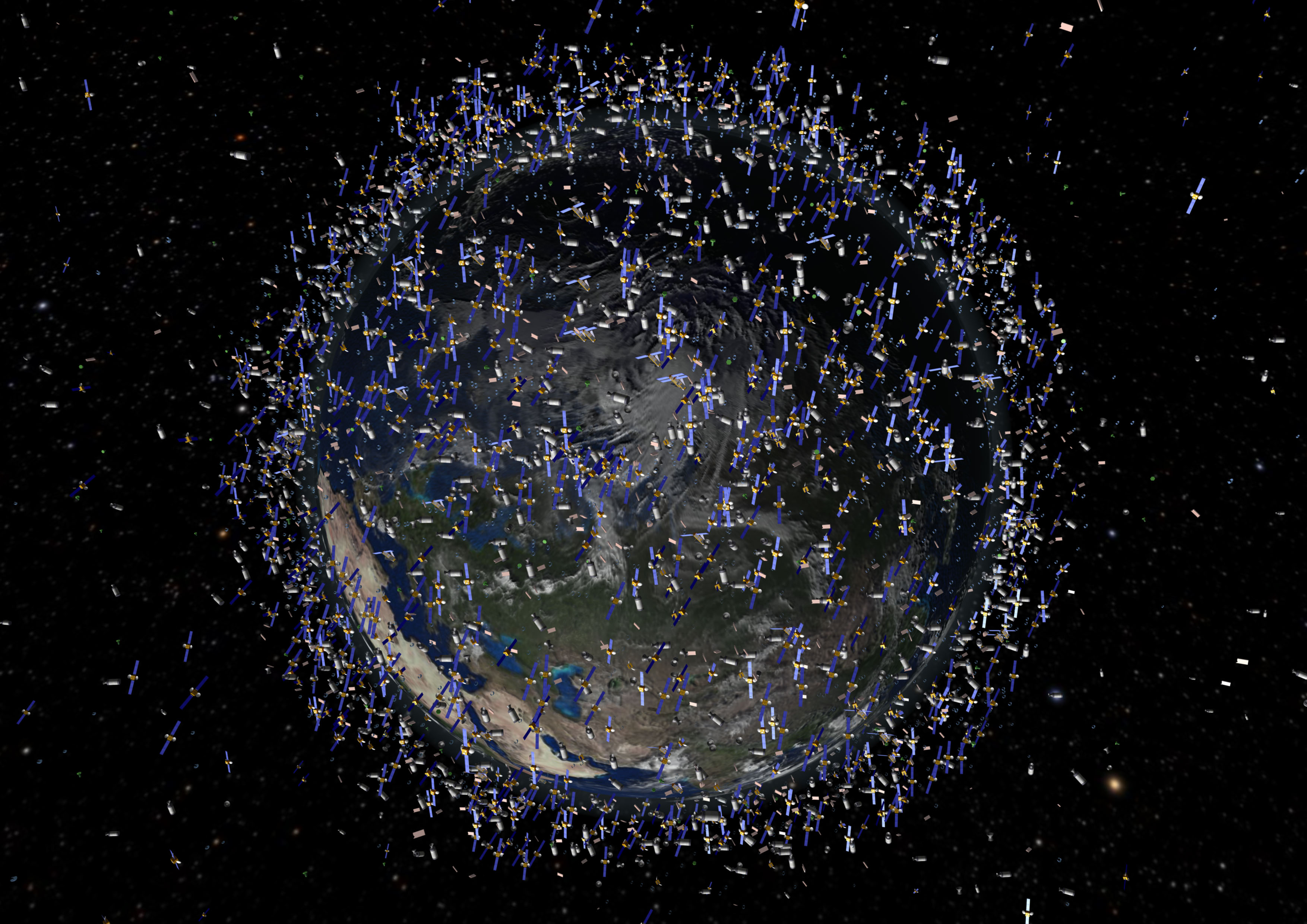
The total cost of LEO MAPPING SATELLITE is much higher. Zillions times higher, because the eventual cost of cleaning the orbit from millions pieces of space junk should also be included:
http://www.universetoday.com/wp-content/uploads/2008/04/space-debris-3-polar-orbit.jpg
A LEO satellite lasts couple of years and then it is one more piece of junk around the planet. Shall we send more and more of them into space? -
Re:exploring for the sake of exploring
An artificial satellite lasts how long? Sometimes several days, sometimes couple of years, but no longer than 10 years.
Have you seen this image?
http://www.universetoday.com/wp-content/uploads/2008/04/space-debris-3-polar-orbit.jpg
These are hundreds of thousands of pieces of space junk around the planet. This is not stupid?
Digital camera and super-computer themselves are not big, but the telescope is. So what? Expensive? Like what? Like 3 days of war?
I speak of an extended WiFi as a figure of speach. I mean that these real-time HD photos of Earth from the moon shall not be put in a drawer in some agency, but shall be available for distribution via clear API to all taxpayers, to make our world better. -
Re:A bit late don't you think?
This is incorrect. Here is a live feed. Kicks off at 6PM Pacific time.
-
All well and goodBut we are still hopeless at spotting these things for instance today Asteroid 2012KA will pass within 224000 Kilometres of earth http://www.universetoday.com/95202/asteroid-2012-ka-to-buzz-earth-on-may-17/ the scary thing is it was only discovered yesterday!!!
So what are we going to do when one the size of texas comes heading for DC I mean aside from putting marshmallows on extremely long sticks
-
Re:Probably lost the sale, too!
Because an astronaut on Mars with a shovel can do more in 10 minutes than two robotic rovers can do in a year.
So you're from the John Henry school of space exploration? Distance from Earth to Mars:
"What you want to do is launch the spacecraft so it goes around the Sun to meet Mars," says Moriba Jah at NASA(slashcode fuckup)s Jet Propulsion Laboratory, a navigator on the Mars Reconnaissance Orbiter. "We give it the least amount of energy possible and let the Sun's gravity do as much as it can for us."
Cab fare to the corner store not included. From Flight to Mars: the Return Trip:
If astronauts from Earth ever land on Mars, they must choose between waiting over one year for the right conditions to occur, or else taking a more direct but less economical ride home.
The economical trip home is another 200 plus days in space, necessitated if some future administration comes up a bale of metric astrobucks short of heroic funding levels. 200 days out, ten minutes of geological work, then a year tending the Moisture Evaporators while munching through a Walmart barge of NASA MRE rations, followed by another 200 days home.
The mechanical tortoise is looking good. If only it could fly planes.
Imagine, you live in a civilization that can build R2D2 or assemble a Death Star in space, but Greedo's blaster can't lock onto the biggest ego this side of Andromeda from three feet out. Space logic. The worst logic ever.
-
Some article links...
...since the one in the story appears dead.
Expectation of extraterrestrial life built more on optimism than evidence
http://www.rdmag.com/News/2012/04/General-Science-Expectation-Of-Extraterrestrial-Life-Built-More-On-Optimism-Than-Evidence/Is the search for ET pie-in-the-sky fantasy?
http://www.futurity.org/science-technology/is-the-search-for-et-pie-in-the-sky-fantasy/We Really Hope ET is Out There, But There’s Not Enough Scientific Evidence, Researchers Say
http://www.universetoday.com/94838/we-really-hope-et-is-out-there-but-theres-not-enough-scientific-evidence-researchers-say/ -
Re:Lolz
hmmmm, if only somebody could discover a power source that could be tapped from anywhere in the solar system.
I agree though, it would be easier developing better access to such power sources before the age of cheap oil comes to a complete conclusion.
Of course, I expect peoples' views on fission will change rapidly once the oil's gone. -
Re:Visible from ?
Mars has meteor showers too, [oblig]you insensitive clod[/oblig]
-
Re:If It Is Fact ...
-
Re:This may be a very bad sign- Great Filter?
Strongly disagree. It very much is in the surprising category. Back of the envelope calculations made fifty years ago suggested that life and intelligent life should be much more common than they are. (That's why this is the Fermi question, he did essentially make a Fermi calculation). Since Fermi's time, the situation, if anything has gotten more extreme not less so. We know that planets are common, and planets in the habitable zone are not rare See for example, this estimate that gives that about a third of sun-like stars have planets in the habitable zone http://arxiv.org/PS_cache/arxiv/pdf/1109/1109.4682v1.pdf. While there's some criticism of that estimate http://blogs.discovermagazine.com/badastronomy/2011/09/29/new-study-13-of-sun-like-stars-might-have-terrestrial-planets-in-their-habitable-zones/ even critics agree that that's about the right order of magnitude. . And that's just sun-like stars. This is part of a much larger pattern where stable, Earth-like conditions are increasingly common. For example, for a long time, it was claimed that an Earth-like planet would need a large moon to stabilize the climate and weather enough for life but we now know that that's probably not the case http://www.universetoday.com/91331/life-on-alien-planets-may-not-require-a-large-moon-after-all/. Recent work suggests that red dwarf stars have much broader habitable zones than previously thought http://www.newscientist.com/article/mg21228374.400-most-common-stars-are-more-lifefriendly-than-thought.html. And all of this is just for Earth-like, carbon-based life operating at temperatures close to those we are used to.
We also shouldn't expect intelligent life to be at or near our own tech level. As a species we are very young. The probability that other intelligent life if is out there is at our tech level is small. If humans are any indication, species which form civilizations can likely take to the stars in the blink of an eye as far as age of stars are concerned. Let's use a hypothetical examples. Humans as a species have been around for around million years (there are definitional issues but this seems like an ok approximation). Now, even if it took another 3000 years to develop effective interstellar travel, that's still about the same amount of time. Traveling then at about a thousandth the speed of light, that would take around 10 million years to spread through the Milky Way. So if intelligent life even remotely like us is out there, we should expect it to have already spread out. But we don't see that.
At a related level, we see no indication of large scale engineering projects. We see no Dyson spheres, or Matrioshka brains or anything else that would be visible to us through our telescopes. And this applies not just to our own galaxy but to neighboring galaxies such as Andromeda. The entire universe looks to our eyes completely natural. And note that while humans have only come up with a few ideas for stellar engineering and similarly largescale projects, we've only been thinking about it for fifty years. This strongly suggests that there are no old civilizations in our neighboring galaxies. Put all of that together and you get that at a galactic level, there's no signs of intelligent life in our entire local cluster. That should be shocking.
-
Re:Face it
Ahem. *bullshit*.
The heliopause, which has not yet been reached by Voyager 1 is apparently 23 x 10^9 km from earth. Alpha Centauri, the nearest star to our sun is 4.366 light years away which is 4.1306 x 10^13 km away.
If it has taken 38 years for Voyager 1 to reach the Heliopause, it would take 1,795.9 times as long to reach Alpha Centauri at that speed which comes out to something like 68,000 years. I'm assuming a couple of things of course:
* the speed so far is roughly the speed it will continue to travel
* it can escape the sun's gravitational well.Suppose we are somehow miraculously able to accomplish the following:
* we send a system powerful enough to transmit an intelligible signal to us across 4.5 light years of space
* we somehow manage to travel 100 times faster than Voyager 1You're still talking about roughly 680 years for it to get there. There might be some tiny relativistic effects that come into play, but I doubt they would alter the situation much. Are you sending humans? If so, you have to dramatically increase the weight of the vehicle to accommodate life-sustaining water/air/energy in which case you also need shit loads of propellant if you want to slow down on the other end. Forget entirely about the difficulty of insuring the survival of roughly 20 generations of humans against the problems of cosmic radiation and health and reproductive problems related to roughly a millenium spent weightless and getting fried by space rays.
-
Re:Why?
MESSENGER surely did get a stamp -
-
Re:I am not worried about it
its rather nice having 62 degree days in the last weeks of January when it should be -3, let our children's children figure it out, they need to have something to do anyway as we keep doing it all for them as it is
Of course it's just coincidence that we are having this unseasonably warm weather at the same time as the sun has exhibited increased sunspot activity.
Pure Coincidence!LK
-
Isn't any discussion about exoplanets+life mute?
How many suns exist?
From: http://www.esa.int/esaSC/SEM75BS1VED_index_0.html :"there are something like 10**11 to 10**12 stars in our galaxy"
From: http://www.universetoday.com/36610/how-many-galaxies-have-we-discovered/ :
"Astronomers think that there are hundreds of billions galaxies in the universe"
Ok, so estimate 500 billions - thats 500 000 000 = 5 x 10 ** 8
That would be 5 * 10 ** 19 = 50 000 000 000 000 000 000 possible stars/suns
That's a number beyond human comprehension and applying any statistical probability will return a true chance.
So - be assured that "we" are not alone and with current means can never visit other planets within one person's life-span.
What the heck! In the meantime, the basis for live as it was existing up to now on this planet the human race is going down the tube! -
Challenge 1: LandingWe can't fucking land more than about tonne on that planet.. Forget the time and the <50% success rate of achieving orbit and landing a probe. We could land on either Phobos or Deimos no problem. Mars has just enough atmosphere to really screw things up.
To even consider going to Mars we first need to send at least 5 rockets full of supplies and land them literally next to each other. We also need to park another 2 or 3 in orbit to hold fuel for Mars Orbit Docking in order to dock and go home within a reasonable time frame. Aldrin's free transfer trajectory is great but unsuitable for human passage.
Get the supplies and contingency machines in place, then think about it. But first figure out how to drop 5 tonnes safely to a very particular spot on the surface. Now do it repeatedly. Because that's what landing on Mars requires.
-
Re:Black Holes aren't hard to see because the suck
Say, what happens when two black holes collide?
When I'm curious about something I google it.What Happens When Supermassive Black Holes Collide?
by Fraser Cain on February 29, 2008As galaxies merge together, you might be wondering what happens with the supermassive black holes that lurk at their centres. Just imagine the forces unleashed as two black holes with hundreds of millions of times the mass of the Sun come together. The answer will surprise you. Fortunately, itâ(TM)s an event that we should be able to detect from here on Earth, if we know what weâ(TM)re looking for.
-
That approach is impossible
An example might be to create a software program that outputs every possible combination of notes permissible under the rules of standard musical notation, then file copyright on it.
Okay, let's take a look at the math for what you propose.
Our incredibly limiting assumptions will be:
1) Ignore harmony and focus solely on melody
2) Melody is defined as single note per beat
3) Only deal with songs <= 4 minutes long
4) Since this is a geek site we should cover electronica, so we need to represent tempo up to 150 bpm
5) 8 octaves are available
Taking Western notation, we will map the 12 notes per octave (ie. lettered notes plus sharps and flats) * 8 octaves. We will also represent silence for one beat as one "note". Therefore, there are 97 notes in this representation.
150 beats/min * 4 minutes = 600 beats. This implies that there would be 97^600 possible songs. Call it order of 10^1200 possibilities. (what's multiplying by an extra few billion times between friends?) This is a reasonable approximation for "infinity" for all practical purposes, as there are presumed to be "only" around 10^82 particles in the entire observable universe.
Yes, I have made some trivializing assumptions with how to model the permutations here, but don't forget that we have also simplified the model to exclude many aspects of music (multiple notes played simultaneously, longer songs, etc), which would cause the number of permutations to explode. -
Moon may not be necessary.
There's recent evidence that a large moon to stabilize may not be necessary. See http://www.universetoday.com/91331/life-on-alien-planets-may-not-require-a-large-moon-after-all/ for a summary and http://www.sciencedirect.com/science/article/pii/S0019103511004064 for the actual paper. The issue is that while the lack of a moon will result in less stability in general the level of wobbling will be small and slow. There's also been in general growing evidence that habitable planets are more common than one might think otherwise. One recent study indicates that around a third of all sun-like stars have a planet in the habitable zone. http://blogs.discovermagazine.com/badastronomy/2011/09/29/new-study-13-of-sun-like-stars-might-have-terrestrial-planets-in-their-habitable-zones/ http://arxiv.org/PS_cache/arxiv/pdf/1109/1109.4682v1.pdf (keep in mind that being in the habitable zone is not sufficient for life. Our system has three planets in that zone, Earth, Mars and Venus, and only one of them supports complex life.) There's also been recent work which shows that for red dwarf stars there habitable zones are much larger than was previously expected (essentially water ice preferentially absorbs light from just the right wavelengths that red stars emit so that the outer zone is longer).
In general, the Fermi question is a serious concern. It is a concern not just for the deep implications it has but for the practical implications for our survival. In particular, it is possible that there's a lack of intelligent life out there because life finds ways to wipe itself out. Carl Sagan for example was worried that an explanation for the Fermi paradox was that species inevitably kill themselves with nuclear war before they get off their home planets. That particular worry seems less founded right now, but other worries, like exhaustion of resources, bad nanotech and others exist. Worse, if there is such a set of very risky technologies, they have to arise quickly so that species which encounter them don't generally have time to even anticipate the risk enough. Also, if this is a common problem then that means that it needs to arise soon in our future, say the next hundred years. That's because the technology has to arise in general before one stars spreading out to space. I suspect that intelligent life is rare due to the all the difficulties, not due to civilizations destroying themselves. But the possibility that self-elimination is the problem is deeply disturbing. More resources need to be put into dealing with existential risk.
-
Dark matter is supported by other evidence too
Recall that the effect on the rotation of galaxies is not the only observation ever made that supports the dark matter theory. There was an article on Slashdot a while ago - I couldn't find it here but I found another summary of the same findings. Astronomers observed a region where two galaxies had collided and found gravitational lensing occurring in a region of space where the visible matter was not located.
-
Re:Maybe the "natural world"If not a simulation, would you believe a hologram: