Slashdot Mirror
Domain: uspto.gov
Stories and comments across the archive that link to uspto.gov.
Stories · 664
-
Google Patents Country-Specific Content Blocking
theodp writes "Today Google was awarded US Patent No. 7,664,751 for its invention of Variable User Interface Based on Document Access Privileges, which the search giant explains can be used to restrict what Internet content people can see 'based on geographical location information of the user and based on access rights possessed for the document.' From the patent: 'For example, readers from the United States may be given "partial" access to the document while readers in Canada may be given "full" access to the document. This may be because the content provider has been granted full rights in the document from the publisher for Canadian readers but has not been granted rights in the United States, so the content provider may choose to only enable fair use display for readers in the United States.' Oh well, at least Google is 'no longer willing to continue censoring [their] results on Google.cn.'" -
US Dir. of Citizen Participation Patents the News
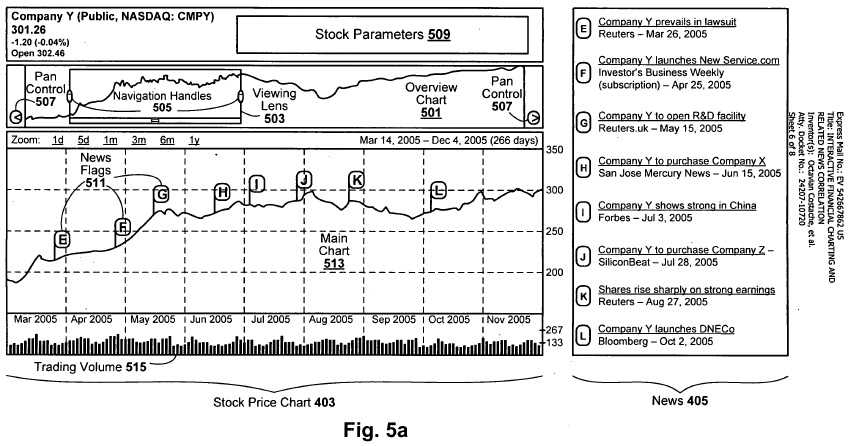
theodp writes "Ex-Googler and now White House Director of Citizen Participation Katie Stanton is charged with promoting open public dialogues. Last Thursday, Stanton and Google snagged a patent on displaying financial news. Google explains that Stanton's invention — Interactive Financial Charting and Related News Correlation — will 'facilitate and encourage the user's use and understanding of financial information,' which does jibe nicely with Stanton's appointment to Obama's New Media Team. Too bad it'll be encumbered by a Google patent until 2027." -
Google Deducing Wireless Location Data
bizwriter writes "When it comes to knowing where wireless users are, the carriers have had a lock on the data. But a patent application shows that Google is trying to deduce the information based on packet headers and estimated transmission rates. This would let it walk right around carriers and become another source of location data to advertisers." -
USPTO Grants Google a Patent On MapReduce
theodp writes "Two years ago, David DeWitt and Michael Stonebraker deemed MapReduce a major step backwards (here are the original paper and a defense of it) that 'represents a specific implementation of well known techniques developed nearly 25 years ago.' A year later, the pair teamed up with other academics and eBay to slam MapReduce again. But the very public complaints didn't stop Google from demanding a patent for MapReduce; nor did it stop the USPTO from granting Google's request (after four rejections). On Tuesday, the USPTO issued U.S. Patent No. 7,650,331 to Google for inventing Efficient Large-Scale Data Processing." -
IBM Patenting Airport Profiling Technology
An anonymous reader writes "InformationWeek's Wolfe's Den reports that IBM has filed a dozen applications to patent a sophisticated airport security system which supports passive software-based profiling of potentially dangerous passengers off of pre-programmed rules. The setup uses a collection of sensors — video, motion, biometric and even olfactory — in terminals and around the airport perimeter, to supply raw data. 'These patents are built on the inference engine, which [analyzes sensor data and] has the ability to calculate very large data sets in real time,' says co-inventor Roger Angell. A small grid of networked computers delivers the necessary processing power. Two applications go one better than Israeli-style security, analyzing furtive glances to detect, according to the title of the patent application, 'Behavioral Deviations by Measuring Eye Movements,' as well as measuring respiratory patterns." -
Google Seeking Patent On Ads For Street View
theodp writes "CNET reports that Google is 'musing' about placing ads in Street View. The search giant reportedly floated the idea in a presentation to marketing and ad agency types in Europe a few months back. So will virtual billboards be popping up in Google Street View? A Google rep said the company had no current plans to put ads in Street View, but you might want to take that with a grain of salt. On Thursday, the USPTO revealed that Google is seeking patent protection for Claiming Real Estate in Panoramic or 3D Mapping Environments for Advertising. From the patent application: 'The street view display server can locate an ad image within the image database and overlay the region of interest with the associated ad image.' Connect the dots, and it sure sounds like a plan, doesn't it? Selling the Brooklyn Bridge is a pretty good scam — selling a view of it is even better!" -
Microsoft Patents DRM'd Torrents
Anonymous Crobar writes "Microsoft has received a patent for a 'digital rights management scheme for an on-demand distributed streaming system,' or using a P2P network to distribute commercial media content. The patent, #7,639,805, covers a method of individually encrypting each packet with a separate key and allowing users to decrypt differing levels of quality depending on the license that has been purchased." -
USPTO Awards LOL Patent To IBM
theodp writes "Among the last batch of patents granted in 2009 was one for IBM's Resolution of Abbreviated Text in an Electronic Communications System. The invention of four IBMers addresses the hitherto unsolvable problem of translating abbreviations to their full meaning — e.g., 'IMHO' means 'In My Humble Opinion' — and vice versa. From the patent: 'One particularly useful application of the invention is to interpret the meaning of shorthand terms ... For example, one database may define the shorthand term "LOL" to mean "laughing out loud."' USPTO records indicate the patent filing was made more than a year after Big Blue called on the industry to stop what it called 'bad behavior' by companies who seek patents for unoriginal work. Yet another example of what USPTO Chief David Kappos called IBM's apparent schizophrenia on patent policy back when he managed Big Blue's IP portfolio." -
Google Might Get Into Hosted Gaming Via YouTube
bizwriter writes "A recent patent application from Google describes a way to provide 'the collaborative generation of interactive features for digital videos, and in particular to interactive video annotations enabling control of video playback locations and creation of interactive games.' Get into the description and you find it's about building games on top of video submissions, making it sound that Google plans to extend its YouTube site into an associated gaming site." -
New USPTO Test Could Limit Software-Based Patents
bizwriter writes "The high tech industry has been waiting for a Supreme Court decision in the Bilski case to decide fundamental questions, like when you can patent software. But there's a new test from the Board of Patent Appeals and Interferences (PDF) that just became precedential, meaning that it offers new grounds on which the US Patent and Trademark Office can deny patents on machines that use mathematical algorithms." -
Microsoft Seeks Patent On Shaming Fat Gamers
theodp writes "A newly disclosed Microsoft patent application — Avatar Individualized by Physical Characteristic — takes aim at fat people, proposing to generate fat avatars in gaming environments for individuals whose health records indicate they're overweight, limiting their game play, and even banning them. From the patent application: 'An undesirable body weight could be reflected in an overweight or underweight appearance for the avatar. Only requisite health levels are allowed to compete in a certain competition level. A dedicated gamer could exercise for a period of time until his health indicator gadget shows a sufficiently high health/health credit in order to allow reentering the avatar environment.' Linking one's gaming avatar to one's physique, explains Microsoft, will produce healthy and virtuous behaviors in individuals. Microsoft also proposes shaping gaming experiences by using 'psychological and demographic information such as education level, geographic location, age, sex, intelligence quotient, socioeconomic class, occupation, marital/relationship status, religious belief, political affiliation, etc.'" -
BetaNet Sues Everyone For Remote SW Activation
eldavojohn writes "Not to be out patent trolled by Eolas, a mystery company named 'BetaNet, LLC' is suing: Adobe Systems, Inc, Apple, Inc., Arial Software, LLC, Autodesk, Inc.,, CARBONITE, INC., Corel Corp., Eastman Kodak Co., International Business Machines Corp., Intuit, Inc., Microsoft Corp., McAfee, Inc., Oracle Corp., Rockwell Automation, Inc., Rosetta Stone, Inc., SAP America, Inc., Siemens Corp. and Sony Creative Software, Inc. for infringement of their patent entitled Secure system for activating personal computer software at remote locations. And of course, this was filed in our favoritest of favorite places: Marshall, TX (Texas Eastern District Court)." -
Microsoft Invents Price-Gouging the Least Influential
theodp writes "In the world envisioned by Microsoft's just-published patent application for Social Marketing, monopolists will maximize revenue by charging prices inversely related to the perceived influence an individual has on others. Microsoft gives an example of a pricing model that charges different people $0, $5, $10, $20, or $25 for the identical item based on the influence the purchaser wields. A presentation describing the revenue optimization scheme earned one of the three inventors applause (MS-Research video), and the so-called 'influence and exploit' strategies were also featured at WWW 2008 (PDF). The invention jibes nicely with Bill Gates's pending patents for identifying influencers. Welcome to the brave new world of analytics." -
USPTO Asking For Ideas To Enhance Patent Quality
dtmos writes "Tired of seeing poor-quality patents issued? Have a great way to solve the problem? Well, here's your chance to be part of the solution. The USPTO has issued a Request for Comments on Enhancement in the Quality of Patents (PDF), seeking public comment on ways to improve 'the process for obtaining the best prior art, preparation of the initial application, and examination and prosecution of the application.' Comments should be sent to patent_quality_comments@uspto.gov by February 8, 2010." -
US Patent Office Fast Tracks Green Patents
eldavojohn writes "A new initiative is being piloted where 'green' patents are given special priority over other patents in the backlogged system. David Kappos (Under Secretary of Commerce for Intellectual Property and Director of the USPTO) said, 'Every day an important green tech innovation is hindered from coming to market is another day we harm our planet and another day lost in creating green businesses and green jobs. Applications in this pilot program will see a significant savings in pendency, which will help bring green innovations to market more quickly.' The details of how you qualify for a green patent (PDF) are available with patent blogs offering opinions on this initiative." -
US Patent Office Fast Tracks Green Patents
eldavojohn writes "A new initiative is being piloted where 'green' patents are given special priority over other patents in the backlogged system. David Kappos (Under Secretary of Commerce for Intellectual Property and Director of the USPTO) said, 'Every day an important green tech innovation is hindered from coming to market is another day we harm our planet and another day lost in creating green businesses and green jobs. Applications in this pilot program will see a significant savings in pendency, which will help bring green innovations to market more quickly.' The details of how you qualify for a green patent (PDF) are available with patent blogs offering opinions on this initiative." -
Federal Appeals Court Tosses Spam Patent
Zordak writes "US patent 6,631,400 claims a method of making sure enough people get your spam. A federal district court had overturned the patent as anticipated and obvious, and not drawn to patentable subject matter. The Federal Circuit, the appeals court which hears patent matters, upheld the finding of obviousness, thus invalidating the patent." -
Google Patent Reveals New Data Center Innovations
miller60 writes "'Google is seeking to patent a system that provides precision cooling inside racks of servers, automatically adjusting to temperature changes while reducing the energy required to run chillers.' The cooling design uses an adjustable piping system featuring 'air wands' that provide small amounts of cold air to components within a server tray. The cooling design, which could help Google reduce the power bill for its servers, reinforces Google's focus on data center innovation as a competitive advantage. Check out the patent application and a diagram of the system." -
Amazon Scores Gift-Delivery Patent
theodp writes "In May, the USPTO rejected Amazon.com's patent claims (PDF) for its Method and System for Placing a Purchase Order Via a Communications Network (a 1-Click spin-off). At the time, a USPTO Examiner cited Bilski, explaining that elements of CEO Jeff Bezos' gift-delivery invention 'may be performed largely within the human mind,' coming to essentially the same conclusion a NY Post reporter arrived at in 2002. But Amazon's attorneys have worked their legal wordsmithing magic (PDF), convincing the USPTO that 'obtaining delivery information for a gift from one or more information sources other than the gift giver and recipient' is indeed novel and patentable. A Notice of Allowance for the patent was mailed to Amazon on November 17th, just in time for Holiday Season injunction-giving!" -
Google Patents Displaying Patents
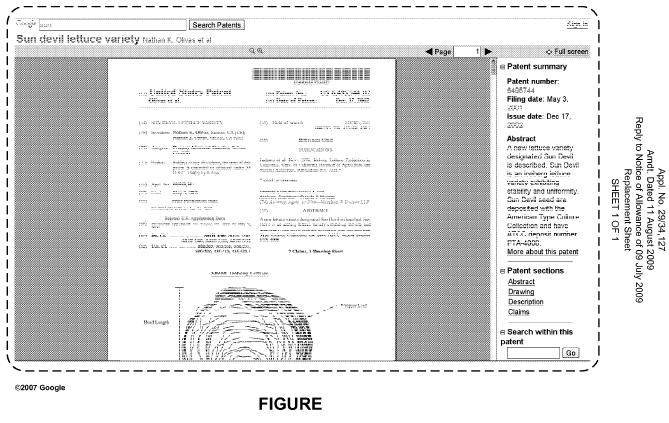
theodp writes "Google has actually managed to patent displaying patents. The USPTO issued US Patent No. D603,866 to six Google inventors for their 'graphical user interface for display screen of a communications terminal.' Among the six inventors is the guy who introduced Google Patents. Ironically, Google Patents can't seem to find the new Google patent for Google Patents." -
Microsoft Patents Sudo's Behavior
Foofoobar writes "Just when you thought all was safe on the crazy patent front, Microsoft has come out of the obvious patent closet to file patent number 7617530, which basically duplicates the functionality of 'sudo' which is found in all Linux systems. PJ over at groklaw has a wonderful writeup on the entire fiasco." -
Amazon Patents Changing Authors' Words
theodp writes "To exist or not to exist: that is the query. That's what the famous Hamlet soliloquy might look like if subjected to Amazon's newly-patented System and Method for Marking Content, which calls for 'programmatically substituting synonyms into distributed text content,' including 'books, short stories, product reviews, book or movie reviews, news articles, editorial articles, technical papers, scholastic papers, and so on' in an effort to uniquely identify customers who redistribute material. In its description of the 'invention,' Amazon also touts the use of 'alternative misspellings for selected words' as a way to provide 'evidence of copyright infringement in a legal action.' After all, anti-piracy measures should trump kids' ability to spell correctly, shouldn't they?" -
Patent Claim Could Block Import of Toyota's Hybrid Cars
JynxMe writes "Paice is a tiny Florida company that has patented a way to apply force to a car's wheels from an electric motor or internal combustion engine. Paice thinks that Toyota is infringing on its technology, and is going after the automaker in court. The legal spat became much more serious for Toyota this week, when the US International Trade Commission decided to investigate the matter. In the worst-case scenario for Toyota, the commission could ban the hybrid Camry, third-generation Prius, Lexus HS250h sedan and Lexus RX450h SUV." -
Apple Wants Patents For Crippling Cellphones
theodp writes "Evil is in the eye of the beholder, but there's certainly not much to like in the newly-disclosed Apple patent applications for Systems and Methods for Provisioning Computing Devices. Provisioning, says Apple, allows carriers to 'specify access limitations to certain device resources which may otherwise be available to users of the device.' So what problem are we trying to solve here? 'Mobile devices often have capabilities that the carriers do not want utilized on their networks,' explains Apple. 'Various applications on these devices may also need to be restricted.'" -
Microsoft Awarded Patent For Peer-To-Peer DRM
An anonymous reader writes "Music DRM might not be as dead as previously thought. InformationWeek reports that Microsoft has been awarded a digital-rights management patent for a distributed DRM system that works over peer-to-peer networks and uses encrypted public and private keys as the licensing mechanism. The author claims that patent number 7,594,275, entitled simply 'Digital rights management system,' is significant because, while centralized music stores like iTunes don't use DRM anymore, the Microsoft patent makes it possible that peer-to-peer networks could reemerge in the future as a viable, albeit protected, source of content." -
IBM's Patent To "Capture Expert Knowledge" With Games
theodp writes "Robert X. Cringely offers his take on IBM's patent-pending way to suck knowledge out of experts and inject it into younger, stronger, cheaper employees, possibly even in other countries. IBM's 'Platform for Capturing Knowledge' relies on immersive 3-D gaming environments to transfer expert knowledge held by employees 'aged 50 and older' to 18-25 year-old trainees, even those who find manuals 'difficult to read and understand.' It jibes nicely with an IBM White Paper (PDF) that advises CIOs to deal with Baby Boomers by 'investing in global resources from geographies with a lower average age for IT workers, such as India or China.' While Cringely isn't surprised that Big Blue's anyone-can-manage-anything, anyone-should-be-able-to-perform-any-job culture would spawn such an 'invention,' he can't help but wonder: When you get rid of the real experts, who is going to figure out the new stuff?" -
IBM Patents Tweeting Remote Control
Fluffeh writes "IBM has applied for a patent on a network-enabled smart remote control that sends out a message to Twitter, Facebook or a blog when you start watching a TV show." Hopefully this launches an exciting patent landgrab of devices that are socially enabled. Your car can tweet when you leave your garage. Your dishwasher can tweet when the load is done. Your skillet can tweet when your eggs are burnt. And they say innovation is dead. -
i4i Says OpenOffice Does Not Infringe Like MS Word
I Don't Believe in Imaginary Property writes "After the permanent injunction barring Microsoft from selling Microsoft Word, many armchair lawyers and pundits wondered how the ruling would affect OpenOffice. The company with the patent, i4i, believes that OpenOffice does not infringe upon it. But lest anyone think that therefore ODF will win out over OOXML, keep in mind that Microsoft has its own broad XML document patent, which issued just two weeks ago, having been filed in December 2004, and they're telling the Supreme Court to apply the Bilski ruling narrowly, so that it doesn't invalidate patents like theirs (and i4i's). After all, unlike most companies and individuals, Microsoft can afford $290 million infringement fines. Then again, given that Microsoft's new patent has only two independent claims (claim #1 and claim #12), and both of those claims 'comprise' something using an 'XML file format for documents associated with an application having a rich set of features,' maybe they wouldn't be that hard to work around if you just make sure any otherwise infringing format is only associated with an application lacking in the feature richness department." -
Microsoft Patents XML Word Processing Documents
theodp writes "Embrace. Extend. Patent. On Tuesday, Microsoft was granted US Patent No. 7,571,169 for its 'invention' of the Word-processing document stored in a single XML file that may be manipulated by applications that understand XML. Presumably developers are protected by Microsoft's 'covenant not to sue,' so the biggest question raised by this patent is: How in the world was it granted in light of the 40-year history of document markup languages? Next thing you know, the USPTO will give Microsoft a patent for Providing Emergency Data in XML format. Oops, too late." -
Microsoft Patents XML Word Processing Documents
theodp writes "Embrace. Extend. Patent. On Tuesday, Microsoft was granted US Patent No. 7,571,169 for its 'invention' of the Word-processing document stored in a single XML file that may be manipulated by applications that understand XML. Presumably developers are protected by Microsoft's 'covenant not to sue,' so the biggest question raised by this patent is: How in the world was it granted in light of the 40-year history of document markup languages? Next thing you know, the USPTO will give Microsoft a patent for Providing Emergency Data in XML format. Oops, too late." -
IBM Uses Call-Detail Records To Identify "Friends"
theodp writes "Big Blue may know what you did last summer. Or at least who you called. In a move out of the NSA's playbook, IBM Research has been scrutinizing the call-detail records of 'one of the largest mobile operators in the world' (PDF). By analyzing who calls whom, and for how long, IBM claims its patent-pending snooping software can now identify circles of 'friends' who tend to exhibit the same profit-threatening behavior. 'We believe that our analysis is a first of its kind that exploits the underlying social network in a telecom call graph,' boasted a team of IBM researchers and a UMD prof. For now, IBM seems to have focused on using the info to see if your friends are churners, so you can be dealt with pro-actively lest you follow their lead and bolt. However, IBM suggests its SNAzzy data mining technology (Social Network Analysis for Telecom Business Intelligence) has a bright future, noting it 'is also capable of analyzing any kind of social network or graph, not just telecom networks.'" -
IBM Uses Call-Detail Records To Identify "Friends"
theodp writes "Big Blue may know what you did last summer. Or at least who you called. In a move out of the NSA's playbook, IBM Research has been scrutinizing the call-detail records of 'one of the largest mobile operators in the world' (PDF). By analyzing who calls whom, and for how long, IBM claims its patent-pending snooping software can now identify circles of 'friends' who tend to exhibit the same profit-threatening behavior. 'We believe that our analysis is a first of its kind that exploits the underlying social network in a telecom call graph,' boasted a team of IBM researchers and a UMD prof. For now, IBM seems to have focused on using the info to see if your friends are churners, so you can be dealt with pro-actively lest you follow their lead and bolt. However, IBM suggests its SNAzzy data mining technology (Social Network Analysis for Telecom Business Intelligence) has a bright future, noting it 'is also capable of analyzing any kind of social network or graph, not just telecom networks.'" -
IBM Seeks Patent On Digital Witch Hunts
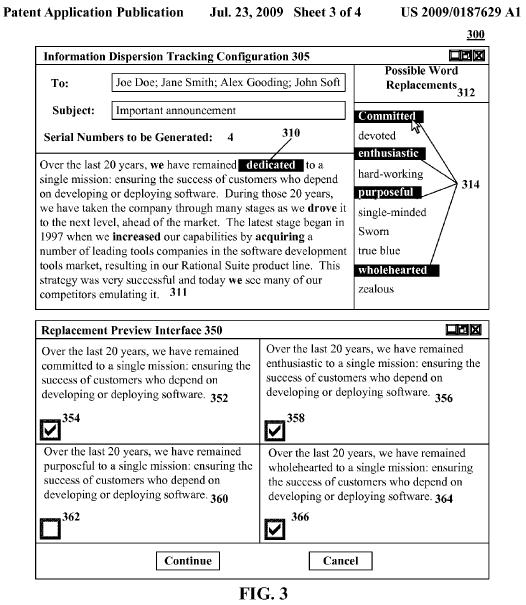
theodp writes "Should Mark Zuckerberg want to identify a snitching Facebook employee, Elon Musk wish to set a trap for loose-lipped Tesla employees, or Steve Jobs want to 'play Asteroid,' they'll be happy to know that a new IBM 'invention' makes it easier than ever to be paranoid. In a newly-disclosed patent application for Embedding a Unique Serial Number into the Content of an Email for Tracking Information Dispersion (phew!), Big Blue describes how it's automated the creation of Canary Traps with patent-pending software that makes ever-so-slight changes to e-mail wording to allow you to spy on the unsuspecting recipients of your e-mail." -
Touchpad Patent Holder Tsera Sues Just About Everyone
eldavojohn writes "Okay, well, maybe not everyone but more than twenty companies (including Apple, Qualcomm, Motorola and Microsoft) are being sued for a generic patent that reads: 'Apparatus and methods for controlling a portable electronic device, such as an MP3 player; portable radio, voice recorder, or portable CD player are disclosed. A touchpad is mounted on the housing of the device, and a user enters commands by tracing patterns with his finger on a surface of the touchpad. No immediate visual feedback is provided as a command pattern is traced, and the user does not need to view the device to enter commands.' Sounds like their may be a few companies using that technology. The suit was filed on July 15th in the favoritest place ever to file patent claim lawsuits: Texas Eastern District Court. It's a pretty classic patent troll; they've been holding this patent since 2003 and they just noticed now that everyone and his dog are using touchpads to control portable electronic devices." -
Amazon Wants Patent For Inserting Ads Into Books
theodp writes "Three Amazon inventors set out to correct what they felt was a real problem: that 'out-of-print or rare books ... typically do not include advertisements ... the content is fixed and, therefore, has not been adapted to modern marketing.' Their solution is spelled out in newly-disclosed Amazon patent applications for On-Demand Generating E-Book Content with Advertising and Incorporating Advertising in On-Demand Generated Content. From the patent apps, here's what the future of reading may look like: 'For instance, if a restaurant is described on page 12, [then the advertising page], either on page 11 or page 13, may include advertisements about restaurants, wine, food, etc., which are related to restaurants and dining.' So, what would a delightfully-tacky-yet-unrefined Hooters ad do for your Hemingway experience?" -
Amazon Wants Patent For Inserting Ads Into Books
theodp writes "Three Amazon inventors set out to correct what they felt was a real problem: that 'out-of-print or rare books ... typically do not include advertisements ... the content is fixed and, therefore, has not been adapted to modern marketing.' Their solution is spelled out in newly-disclosed Amazon patent applications for On-Demand Generating E-Book Content with Advertising and Incorporating Advertising in On-Demand Generated Content. From the patent apps, here's what the future of reading may look like: 'For instance, if a restaurant is described on page 12, [then the advertising page], either on page 11 or page 13, may include advertisements about restaurants, wine, food, etc., which are related to restaurants and dining.' So, what would a delightfully-tacky-yet-unrefined Hooters ad do for your Hemingway experience?" -
Boingo Awarded a Patent For Hotspot Access
Boingo has scored a patent for accessing a Wi-Fi hotspot by a mobile device. The patent, no. 7,483,984, was issued in January, but Boingo only started talking about it recently. The patent application was filed in December 2002. According to the company, the methods covered by the patent include: "...accessing wireless carrier networks by mobile computing devices, where a client software application hosted by the device accesses carrier networks using wireless access points. For example, when a computer — or netbook, smartphone or any other Wi-Fi-enabled device — is in a location where there are multiple signals, the patented technology looks at each signal and alerts the user which signal will work, showing the signal as an understandable name and ID for the user.The patent covers all wireless technologies and spectrums, as well as any mobile device that access wireless hotspots." The company is not saying anything about whether or how they will attempt to wield this patent. -
Obama Taps IBM Open Source Advocate For USPTO
langelgjm writes "President Obama has announced his intent to nominate David Kappos, a VP and general counsel at IBM, to head the US Patent and Trademark Office. This move is particularly notable not only because of IBM's much friendlier attitudes towards open source compared with some of their rivals, but also because Kappos himself is open source-friendly: 'We are now the biggest supporters of the open source development project,' explains David. 'Admittedly this policy is not easily reconcilable with our traditional IP strategy, but we are convinced that it is the way to go for the future.' Not just a lawyer, Kappos earned an engineering degree before working in the legal field. Kappos has been described as 'critical of the American approach to patent policy.' Given his background, could this mean a new era for US patent policy?" -
Microsoft Seeking Hot-Or-Not Patent
theodp writes "In its just-disclosed patent application for the Online Personal Appearance Advisor, Microsoft describes the 'invention' of its three Microsoft Research employees in these words: 'The contributor uploads self images for viewing and rating (or voting) by viewers who choose provide an opinion on different fashion and/or cosmetic looks of the contributor.' So what do you think — is Microsoft's invention really Hot or Not?" -
Microsoft Files For 3 Parallel Processing Patents
theodp writes "Microsoft may have been a Johnny-come-lately when it comes to parallel programming, but that's not stopping the software giant from trying to patent it. This week, the USPTO revealed that Microsoft has three additional parallel-processing patents pending — 1. Partitioning and Repartitioning for Data Parallel Operations, 2. Data Parallel Searching, and 3. Data Parallel Production and Consumption. Informing the USPTO that 'Software programs have been written to run sequentially since the beginning days of software development,' Microsoft adds there's been a '[recent] shift away from sequential execution toward parallel execution.' Before they grant the patents, let's hope the USPTO gets a second opinion on the novelty of Microsoft's parallel-processing patent claims." -
Microsoft Files For 3 Parallel Processing Patents
theodp writes "Microsoft may have been a Johnny-come-lately when it comes to parallel programming, but that's not stopping the software giant from trying to patent it. This week, the USPTO revealed that Microsoft has three additional parallel-processing patents pending — 1. Partitioning and Repartitioning for Data Parallel Operations, 2. Data Parallel Searching, and 3. Data Parallel Production and Consumption. Informing the USPTO that 'Software programs have been written to run sequentially since the beginning days of software development,' Microsoft adds there's been a '[recent] shift away from sequential execution toward parallel execution.' Before they grant the patents, let's hope the USPTO gets a second opinion on the novelty of Microsoft's parallel-processing patent claims." -
Microsoft Files For 3 Parallel Processing Patents
theodp writes "Microsoft may have been a Johnny-come-lately when it comes to parallel programming, but that's not stopping the software giant from trying to patent it. This week, the USPTO revealed that Microsoft has three additional parallel-processing patents pending — 1. Partitioning and Repartitioning for Data Parallel Operations, 2. Data Parallel Searching, and 3. Data Parallel Production and Consumption. Informing the USPTO that 'Software programs have been written to run sequentially since the beginning days of software development,' Microsoft adds there's been a '[recent] shift away from sequential execution toward parallel execution.' Before they grant the patents, let's hope the USPTO gets a second opinion on the novelty of Microsoft's parallel-processing patent claims." -
IBM Wants Patent For Regex SSN Validation
theodp writes "What do you get when you combine IBM contributors with the Dojo Foundation? A patent for Real-Time Validation of Text Input Fields Using Regular Expression Evaluation During Text Entry, assuming the newly-disclosed Big Blue patent application passes muster with the USPTO. IBM explains that the invention of four IBMers addresses a 'persistent problem that plagues Web form fields' — e.g., 'a social security number can be entered with or without dashes.' A non-legalese description of IBM's patent-pending invention can be found in The Official Dojo Documentation. While IBM has formed a Strategic Partnership With the Dojo Foundation which may protect one from a patent infringement lawsuit over validating phone numbers, concerns have been voiced over an exception clause in IBM's open source pledge." -
Microsoft Gaming Patents — Where They're Going
An anonymous reader writes "BNET looked at some patents which suggest that Microsoft might be thinking about an integrated game console/set-top box. Quoting: 'Patent 20080167128 is for watching television on a game console, while patent 20080167127 covers switching a gaming console between various media, including television, video, music, and games, and even using the console as a set-top box. Clearly Microsoft has been interested in controlling the living room, and combining media, gaming, and set-top functions in a single device would make a great deal of sense.' There are also hints of mobile gaming that support the current round of rumors about a combination Xbox-Zune. " -
Microsoft Gaming Patents — Where They're Going
An anonymous reader writes "BNET looked at some patents which suggest that Microsoft might be thinking about an integrated game console/set-top box. Quoting: 'Patent 20080167128 is for watching television on a game console, while patent 20080167127 covers switching a gaming console between various media, including television, video, music, and games, and even using the console as a set-top box. Clearly Microsoft has been interested in controlling the living room, and combining media, gaming, and set-top functions in a single device would make a great deal of sense.' There are also hints of mobile gaming that support the current round of rumors about a combination Xbox-Zune. " -
Microsoft Patents the Crippling of Operating Systems
theodp writes "On Tuesday, Microsoft was granted US Patent No. 7,536,726 (it was filed in 2005) for intentionally crippling the functionality of an operating system by 'making selected portions and functionality of the operating system unavailable to the user or by limiting the user's ability to add software applications or device drivers to the computer' until an 'agreed upon sum of money' is paid to 'unlock or otherwise make available the restricted functionality.' According to Microsoft, this solves a 'problem inherent in open architecture systems,' i.e., 'they are generally licensed with complete use rights and/or functionality that may be beyond the need or desire of the system purchaser.' An additional problem with open architecture systems, Microsoft explains, is that 'virtually anyone can write an application that can be executed on the system.' Nice to see the USPTO rewarding Microsoft's eight problem-solving inventors, including Linux killer (and antelope killer) Joachim Kempin, who's been credited with getting Microsoft hauled into federal court on antitrust charges." Sounds like the mechanism by which Microsoft sells one version of Vista to all users, and lets users upgrade to higher-tier flavors of the OS after cash changes hands. -
Microsoft Trying To Patent a 'Magic Wand'
theodp writes "Newly-disclosed USPTO documents show that Microsoft is seeking patent protection for a 'Magic Wand,' a device with various gizmos and sensors that can manipulate and interact with its environment, including video and holographic images, while using biometrics to connect with the user. 'Even the most pragmatic individual,' explains Microsoft, 'would have trouble arguing against the merits or utility of, say, a magic wand that actually worked to control or communicate with objects or components in an associated nearby environment.' No doubt. The inventors include CXO/CTO J Allard, and Sr. Researcher Andy Wilson." -
IBM Patents Changing Color of E-Mail Text
theodp writes "Last week, the USPTO granted IBM a patent for its 'System and method for comprehensive automatic color customization in an email message based on cultural perspective.' So what exactly did the four Big Blue inventors come up with? IBM explains: 'For example, an email created in the US in red font to indicate urgency or emphasis might be mapped to a more appropriate color (e.g., blue or black) for sending to Korea.' IBM took advantage of the USPTO's Accelerated Examination Program to fast-track the patent's approval. BTW, if you missed the 2006 press release, IBM boasted it was 'holding itself to a higher standard than any law requires because it's urgent that patent quality is improved.'" -
IBM Patents Changing Color of E-Mail Text
theodp writes "Last week, the USPTO granted IBM a patent for its 'System and method for comprehensive automatic color customization in an email message based on cultural perspective.' So what exactly did the four Big Blue inventors come up with? IBM explains: 'For example, an email created in the US in red font to indicate urgency or emphasis might be mapped to a more appropriate color (e.g., blue or black) for sending to Korea.' IBM took advantage of the USPTO's Accelerated Examination Program to fast-track the patent's approval. BTW, if you missed the 2006 press release, IBM boasted it was 'holding itself to a higher standard than any law requires because it's urgent that patent quality is improved.'" -
How Google's High Speed Book Scanner De-Warps Pages
Hugh Pickens writes "Patent 7,508,978, awarded to Google, shows how the company has already managed to scan more than 7 million books. Google's system uses two cameras and infrared light to automatically correct for the curvature of pages in a book. By constructing a 3D model of each page and then 'de-warping' it afterward, Google can present flat-looking pages online without having to slice books up or mash them onto a flatbed scanner. Stephen Shankland writes that the 'sophistication of the technology illustrates that would-be competitors who want to feature their own digitized libraries won't have a trivial time catching up to Google.' First, a book is placed on a flat surface, while above it, an infrared projector displays a special mazelike pattern onto the pages. Next, two infrared cameras photograph the infrared pattern from different perspectives. 'The images can be stereoscopically combined, using known stereoscopic techniques, to obtain a three-dimensional mapping of the pattern,' according to the patent. 'The pattern falls on the surface of (the) book, causing the three-dimensional mapping of the pattern to correspond to the three-dimensional surface of the page of the book.'"