Slashdot Mirror
Domain: utexas.edu
Stories and comments across the archive that link to utexas.edu.
Comments · 1,356
-
Re: a reputable team
I guess many people don't recognise anyone's name except for a couple of really high-profile guys like Braben, Molineux or Carmack.
http://rtf.utexas.edu/faculty/...
He's not a complete duffer though, seems he has done stuff. That seems fair enough to me, even though I would like to see credit given for the rest of the team behind those games.
-
Re:Lua[0]?
I'll leave this here: http://www.cs.utexas.edu/users/EWD/transcriptions/EWD08xx/EWD831.html
Tables in Lua, overall, was a bit of an adjustment.
I've been working on a
Having to switch between the two keeps you on your toes.https://hyperplaneinteractive.com/blog (alpha available by logging in and visiting Account page)
Screenshots: http://imgur.com/a/p6Obn -
Re:Lua[0]?
there are some reaons why starting with zero might be better:
-
Re:Already commented on this elsewhere
but it does seem like important stuff in a flood plain
Fukushima wasn't in a flood plain.
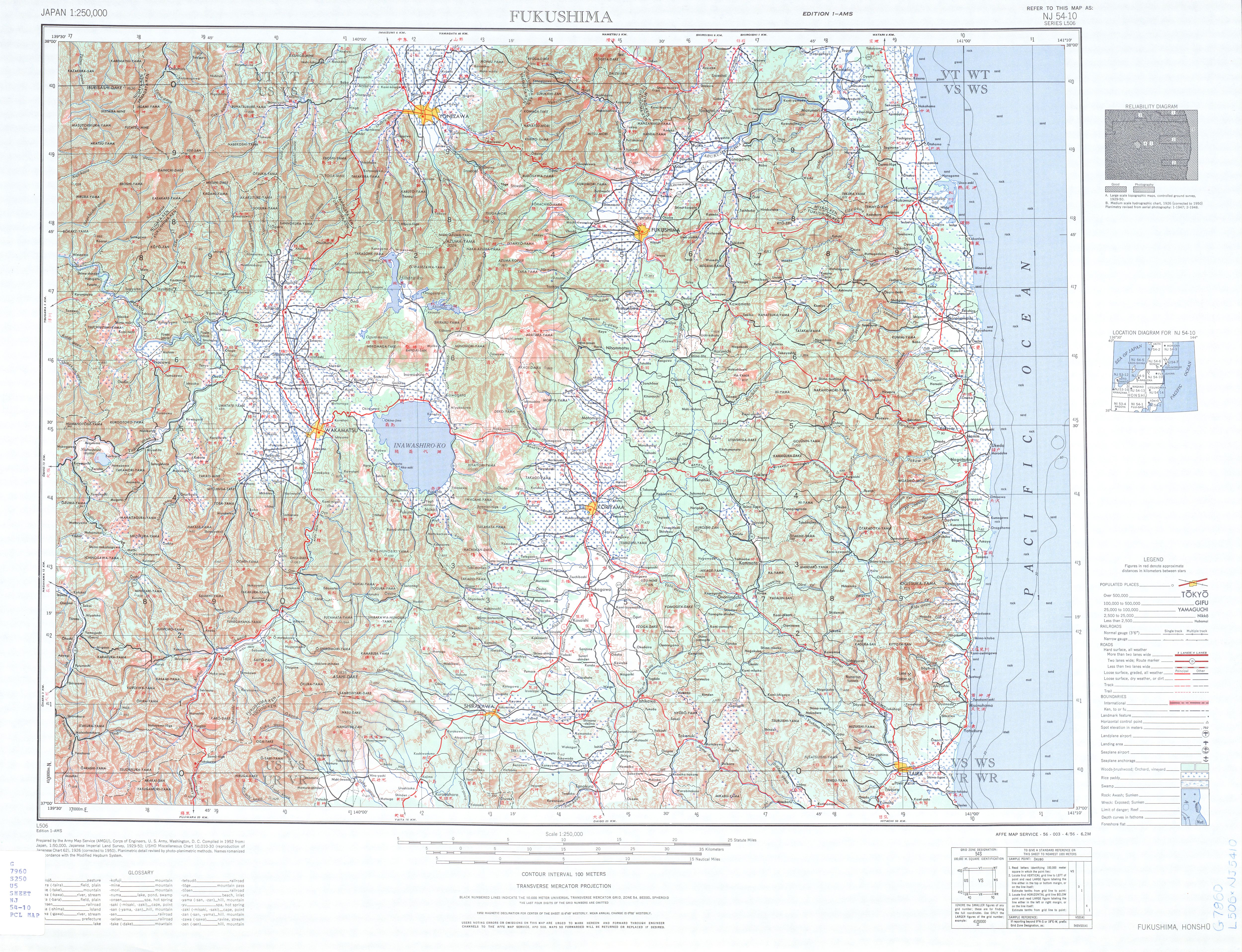
Yes it is. Take a look at this US Army topo map (the latitude is (37.427 degrees, its on the coast). It is on an extended flood plain stretching along the coast, created by several rivers (Takase, Maeda, Kuma. Tomioka, etc.) . The whole area is a sea-level marsh consisting of soil deposited by these rivers at flood.
The problem wasn't glaring except in hindsight.
Because, you know, no one had ever seen a tsunami in Japan before. Oh wait, tsunami is a Japanese word. That doesn't seem quite right, does it?
Japan had fifteen of them since 1900, before Tohoku (the slightly dated linked list misses the 2007 Niigata tsunami).
-
Re: what's wrong with cherry picking?
-- As far as i'm concerned they can all goto hell.
There's got to be a better way!
http://www.cs.utexas.edu/~EWD/transcriptions/EWD02xx/EWD215.html
-
Re:Transparent?
WTF?
Climate change deniers?
FFS. SIGH
re: You mean like no warming in 17.5 years?
There has been plenty of warming in the last 17.5 years. The warming of the surface air temperature has been marginal, (but not statistically significantly "no warming" as you appear to be claiming.) The best you can correctly and scientifically say, is that there might be a reduction in the rate of warming of the surface air temperature.
The oceans have warmed. As can be seen from the direct measurements, if you're into science, but if you're not, it's clear and obvious from sea level rise which is primarily thermal expansion.
Ice sheets have lost mass.
re: They make models that show doom, and don't match up with reality.
No they don't. They make models that investigate the climate.
Some aspects match with reality well. Some aspects require finer modelling. (And there are probably some physical processes that are not fully understood either, especially with respect to cloud formation).
Sure, all (I think) models have a double-Intertropical Convergence Zone. That doesn't mean that they aren't useful. Quite the opposite. The most exciting phrase to hear in science, the one that heralds the most discoveries, is not "Eureka!" but "That's funny...". And so work on the DICZ progresses. Science advances. We learn more stuff.
Claiming "Models don't match reality! All this science must therefore be rubbish!" is the call of the Luddites. Einstein didn't overthrow Newton, he built upon his work, and Newton did upon the giants upon whose shoulders he stood. This is how science works.
re: Then they redo the models to match the previous few years and again show doom.
I'll keep this response more concise: Bullshit.
re: Sorry you don't understand this and believe their lies while calling those who tell the truth liars.
Really? That's your claim? The scientists are lying to you?
FFS, mate, think about that for a while and get back to me on how likely it could be. -
Pauli Exclusion [Re:Negative mass is weird]
Ah, the
Pauli exclusion
principle. IANA physicist, but I've never been happy with this here thingy.
Fortunately, your happiness is not relevant to whether physics works.
...
Oh, BTW - this is just one of many examples where science does, in fact, depend on pure faith.No, this is one of the many examples where science depends on pure observation. The Pauli exclusion principle was first arrived at from observations, and only somewhat later was the theoretical basis-- the spin-statistics theorem-- worked out.
-
Re:Underwater volcanoes, not CO2
Underwater volcanoes, not climate change, reason behind melting of West Antarctic Ice Sheet
Your article: Underwater volcanoes, not climate change, reason behind melting of West Antarctic Ice Sheet. Original release from UT Austin: Researchers Find Major West Antarctic Glacier Melting from Geothermal Sources. Your article: "Melting of a major glacier system in western Antarctica may be caused by underwater volcanoes, and not by global climate change, according to new research." Source article: " Thwaites Glacier, the large, rapidly changing outlet of the West Antarctic Ice Sheet, is not only being eroded by the ocean, itâ(TM)s being melted from below by geothermal heat". Tech times: Completely fucking full of shit, do not cite again. Not logging in: Anonymous cowardice, completely understandable in light of your poor citation. Slashdot: Still badly in need of unicode support, like every other goddamned website of our time.
-
Re:All wars ...
And this is why we need to get the fuck off this rock. The Universe is a very large place with a very quantity of resources--all getting further away. In the end, it won't be pretty anyhow, but in the intervening time, we might as well do our thing. The resources of Earth will only sustain us for so long. The only real question left is: do we die here or expand outward, eventually to form disconnected colonies?
As Dijkstra explained:
A very useful measure is —called after its inventor— the "Buxton Index". John N. Buxton discovered that the most important one-dimensional scale along which persons are or institutions to be compared, can be placed is the length of the period of time in the future for which a person or institution plans. This period, measured in years, gives the Buxton Index.
The great significance of the Buxton Index is not its depth, but its objectivity. The point is that when people with drastically different Buxton Indices have to cooperate while unaware of the concept of the Buxton Index, they tend to make moral accusations against each other. The man with the shorter Buxton Index accuses the other of neglect of duty, the man with the larger one accuses the other of shortsightedness. The notion of the Buxton Index takes the moral flavour away and enables people to discuss such differences among themselves dispassionately. There is nothing wrong with having different Buxton Indices! It takes many people to make a world. There is clearly no moral value attached to either a long or a short Buxton Index. It is a useful concept for dispassionate discussion.
Go ahead and make your space nutter comments now.
-
Re:What's amazing is that...
The paper is freely available online and you can see distance and speed estimates on the bottom row of charts at page 13: http://www.as.utexas.edu/~ivan...
This star is thought to have been following a fairly predictable orbit over the last 4 billion years, which is one of the reasons why they're able to point to it as a potential sibling of the Sun. That is the researchers think that there is a decent probability that it has based on a simulation.
-
Re:Wow - talk about missing the point.
As for why the Empire subsequently declined, here's a handy list: 210 Reasons for the decline of the Roman Empire. No concrete in there, the Republic being brought to an end by overzealous monument building would be covered by "Hubris" though, I suppose.
-
Re:Endorsed By President Reagan?
That's quite a trick! Seeing as Ronald Reagan has been dead for ten years, was a Ouija board involved?
Apparently, Ronald Reagan did endorse this idea in 1985. I stand...errr...sit corrected. Please ignore my initial comment. That is all.
From the 1985 speech:
The number of taxpayers who need to itemize would be reduced to 1 in 4. We envision a system where more than half of us would not even have to fill out a return. We call it the return-free system, and it would be totally voluntary. If you decided to participate, you would automatically receive your refund or a letter explaining any additional tax you owe. Should you disagree with this figure, you would be free to fill out your taxes using the regular form. We believe most Americans would go from the long form or the short form to no form.
-
Re:Same as the US TLAs
Yep. The real head of the cartels is this person:
-
University of Texas another good source
The Perry-Castañeda Library Map Collection at the University of Texas at Austin is another good source for map scans; most are in the public domain. According to their FAQ, out of the ~250,000 maps they have, 54,751 are scanned and online.
-
Re:Scientists warned of global warming for decades
You are the revisionist, and you remain a liar. Citing a secondary source is simply repeating someone else's lie, but it leaves you a liar nonetheless. Here is the speech: http://www.lbjlib.utexas.edu/j... Scientific American says, "When a report on climate change hit the U.S. president's desk,
-
Even cooler - the annotation was done on a *real*
Genome annotation (finding all the interest features in the sequence) is really computationally intensive, due in large part to the number of separate (often sub-optimally written) algorithms that have to be chained together and interpreted. My team at the iPlant Collaborative worked with the authors of a popular open-source annotation tool called "MAKER" to get it running at scale on the 302 TFLOP Lonestar 4 supercomputer, which in turn was used by the pine team to do in a few hours what used to be 6 months of painstaking bioinformatics. In another month or so, this algorithm will be available via REST API allowing, literally, "Annotation As A Service".
-
Obligatory Dijkstra
On the cruelty of really teaching computing science (EWD 1036)
Computer code is not bricks. It's completely different. So, your analogy based on bricks is not valid.
There was a better analogy I read somewhere. Programming is like building only if you're in some insane universe where you make one little slip-up and the entire structure turns into a black hole. But I don't remember who wrote that.
-
Actually, infrastructure is already fixable
Using methane pipelines to ship hydrogen is as easy as just doing it.
Gas pipelines are run through compression plants and separation plants. membranes separate the gas compounds already- getting the hydrogen sulfide out on the basis that it is a larger molecule, shunting it out while sending the "sweet" gas methane on down the line. The membrane technology has recently been made more exact and cheaper by research at U of Texas:
http://membrane.ces.utexas.edu...The same technology can separate the tiny hydrogen molecule out at an earlier step for very little cost increase to the plant.
We have a huge methane infrastructure in place- something CNG has been capitalizing on. All you have to do is offer the same rates to the pipelines that methane does- transport based on CFM to a destination. I can't imagine any pipeline owner saying "no, I refuse to double my profits AND get my foot in the door of a whole new energy field at the same time." At least, not without a LOT of bribery from opponents to offset those profits.
Source: I worked for a 5 state pipeline owner handling their SCADA setup. I am no petroleum engineer, but I have a decent grasp of their operations and setup.
-
Re:I has a sad
I share your dislike of TCL, but it's not the worst language I have used. That dubious honour belongs to SNOBOL.
SNOBOL was designed over half a century ago, before people knew any better. It makes heavy use of gotos, global variables, and even assembly-language like fields.
If you ever have to maintain a SNOBOL code base, I suggest you just port it to a real language like AWK or Python. You will likely pick up speed on the pattern matching and your sanity will be much improved.
-
Re:Care to publish your source?
-
Re:Worth it.
It's true that there's a lot of ridiculous hype and grandstanding about this, but either way, people are getting a chance to be introduced to programming in an interesting way, and possibly learning from it.
Now it's time for the angry hordes to come tell us why we're wrong and why this is horrible.
As you wish.
The Hour of Code was teaching the outdated, sequential type of programming that Dijkstra was complaining about back in 1975. It was already problematic back when most computers had a single processor, but it's completely inadequate in an increasingly parallel world. Any student who wishes to make sense of a concurrent program, or a monadic program, will have to unlearn bad habits and start again.
-
What do people see as "creative thinking"?
Honestly, creativity is overrated in our age because with scientific research over the last century a lot of good ideas have been already been flushed out. They simply are not practiced. The problem is not that people avoid creativity, it's they want their own creativity to manifest, not yours. This is true even in the face of peer reviewed, expertly written material.
Geniuses do not create new things, they copy things that already exist (I got this from Edward Tufte). Basically, they observe and then they apply intelligent design to what already exists to improve the status quo, in a way then does not rock the boat, but improves things gradually. Gradual improvement is all we are really capable of anyways, because you cannot observe and improve things without seeing the problems first.
However, this is what is seen as "creativity" by those who do not understand it, because understanding usually requires in depth abstract thought and an extremely good memory to put together the pieces of the puzzle together.
What is really easy is these people who are trying to be "creative" in their own right and ignoring the status quo making things horrible for those around them and creating very detrimental products of their creativity.
i.e. "Let's take advantage of people's superstitious nature." (forced spread and manipulation of religion, just glance at the inquisition...), "Let's issue to much currency and not protect the people, we'll make a huge profit in the end either way." (Several banks throughout history, perhaps bit coin will be the same, we'll see.), "Let's guess how much we are going to make based on business plans that have not come to fruition, and budget that way." (Enron) "Let's time our employees and pay them less, so they need more government assistance and assistance from family members. It's the job that is worthwhile to them." (Good Will) "Let's pay our employees so little and squeeze as much money out of them as possible instead of paying them what we can afford and investing into their futures. This way they go on welfare." (Walmart) "Let's do massive scale Agriculture" (Humanity)
I suppose I could throw in experts being told what to do by their bosses despite plenty of push back. If you have not experienced this, you should try getting a degree or specializing in something. Everyone is an expert except the practitioner and student of their discipline.
As far as I know, ALL of these things go against conventional wisdom, or did at some point in time. These things were never observed to be good, they were just done, they were created by creative people. Created against the tried and true wisdom established before hand.
- -Religion as a Form of Control (who needs real leadership and organic social structure, we have no control then.)
- -Banks (Specie Circular crisis)
- -Speculative Budgeting (Enron did this, and I remember in the documentary, they even coined a term for it, maybe I even got it right. Bull markets come to mind too, i.e. Taking out loans for investing, because how can you lose, right?)
- -Not Investing into People (If you have not watched the Good Will clip that demonstrates this, you should. However, this is how employers are treating people across the board in my experience so far. Walmart is another "great" company.)
- -Mass Scale Agri
-
Herb Sutter wrote about this 8 years ago
There is no free brunch.
er, LUNCH. Lunch.
-
Dijkstra
Dijkstra taught us why numbering should start at zero:
www.cs.utexas.edu/users/EWD/transcriptions/EWD08xx/EWD831.html
-
That "birthday loop" has the wrong upper end
If you are going to teach idiomatic loops, do it correctly. It's not
for (i=0; i<=3; i++)
but
for (i=0; i<4; i++)
Note that in the second, idiomatic version your actual number of lines appears.
Note also that the two conventions are strongly related.
-
Re:seems like we have an identifiable pattern.
Also, as some of the articles on this story mention:
"“What’s interesting is we have an example in Cogdell field, but there are other fields nearby that have experienced similar CO2 flooding without triggering earthquakes,” said Frohlich, associate director of the Institute for Geophysics, a research unit in the Jackson School of Geosciences. “So the question is: Why does it happen in one area and not others?”"
It doesn't always trigger earthquakes. Usually *nothing* happens of any significance. That's why they're studying this example, to understand why it might be in an issue in some cases, and in others it isn't.
-
Re:Evolutionary pressure to not sleep?
A higher order species that has brains that can "cleans" itself without requiring sleep would have so much evolutionary advantage that they would rapidly take over the entire planet (sort of like flowering plants). Why hasn't 3+ billion years of evolutionary produced such a species?
Obviously because the advantages of sleep outweigh the disadvantages. Evolution is very tidy that way, and there is no such thing as a "higher order" species -- merely one better adapted to its niche. The very notion is simply humanocentrism. We can hardly compete with the humble tardigrade for adaptability, for example.
It's interesting to note that as far as we know, all animals sleep. Some give it up for certain periods in their life (e.g. migrating birds, baby orcas & dolphins), and some do it with half a brain at a time (e.g. dolphins & orcas again), but none avoid it their entire lives. Even ants sleep.
It would be interesting to see if all animals have channels like these. If so, then this may represent a fundamental need that all creatures with a central nervous system need. It would be interesting to see if animals without one (e.g. sponges & jellyfish) sleep too. Interestingly, it seems that the latter do sleep.
-
Re:WWW
So the networking protocols were invented in the US, the hardware was invented in the US, and the most commonly used markup language was created by a British Physicist while subcontracted to work at a Swiss research lab. FTFY
You forgot about the protocol known as the Hypertext Transport Protocol, running atop of one of those US-developed protocols (which were at least inspired by work done in France); that protocol was created by a British physicist working at a European research lab located in Switzerland.
-
Re:Very limited indeed
There is more to it though than just parallelization and vectorization. Are you familiar with cache blocking? If not, here is a great paper on the subject. This is something the compiler won't do for you as it transforms the algorithm. Our library can do this (gives you approx. 2x speedup). The library can do this because it knows more about the problem domain compared to a (generic Fortran) compiler.
-
Re:I don't get it
Anonymity != Privacy because we're in the age of big data where large data sets can be cross-correlated to profile an individual. From stores that track your cell phone while you're shopping to big chain stores figuring out you're pregnant, big data techniques are invading your privacy in more and more ways. If you think that anonymous data collection is safe, it's still data collection and despite people's best efforts, we are of course creatures of habit and your repetitive habits allow people to build fingerprints about you. If you have enough data points, even anonymous data points, you can build a profile of an individual, their habits, their likes, their dislikes and where they go on the Internet. If you can take that profile and match it against an individual using other correlating data you've been identified. This has been proven for example in the 2007 Netflix prize competition where anonymous movie reviewers were tracked down. There's lots of examples on this and over the past few years, techniques have become much better at picking individuals out of anonymous data sets.
More chilling is a study released this year showed that using in analyzing anonymous cell phone tracking data, 95% of 1.5 million individuals could be identified.What this means that as long as companies are able to collect data about you, whether tagged or anonymous, you're still being tracked somewhere and that is no guarantee that your privacy is protected. What has to happen to provide privacy is to stop all of the tracking and I don't see companies nor governments giving up that mechanism anytime soon.
-
Very limited indeed
I took a look at TFA and followed up by reading the description of LibGeoDecomp:
If your application iteratively updates elements or cells depending only on cells within a fixed neighborhood radius, then LibGeoDecomp may be just the tool you've been looking for to cut down execution times from hours and days to minutes.
Gee, that seems like an extremely limited problem space, and doesn't measure up at all to the title of this Slashdot submission. It might really be a useful tool, but when I clicked to this article I expected to read about something much more general purpose, in terms of 'bringing Legacy Fortran to Supercomputers'.
Correct. We didn't try to come up with a solution for every (Fortran) program in the world. Because that would either take forever or the solution would suck in the end. Instead we tried to build something which is applicable to a certain class of applications which is important to us. So, what's in this class of iterative algorithms which can be limited to neighborhood access only?
- cellular automata
- stencil codes
- Lattice Boltzmann methods for computational fluid dynamics (technically a subclass of stencil codes)
- Particle in cell codes
- Short-ranged n-body simulations
It's interesting that almost(!) all computer simulation codes fall in one of the categories above. And supercomputers are chiefly used for simulations.
By the way, regarding the use of the word 'codes': I don't think English is the first language of this developer. Cut some slack.
Thanks
-
Re:Post it to Slashdot!
Yes, I'm aware of Chapel. This is a good example for the current state of generic auto-parallelization:
It would be the perfect thing to put into this FAQ... "here's the alternatives... ___
That's a great suggestion. I've updated the FAQ to include this. Thanks!
Also, I second the comment below about Fortran, especially if you can provide a simple example -- If you're targeting scientists that don't want to learn new libraries or new languages, that would be critical.
I've compiled a quick example on how Fortran kernels can be used from within the library. It's not perfect but should get people started.
Users of my library are mostly scientists who want to simulate something big, without having to spend months learning
...one of these other libraries? (facepalm)
To be fair: learning any of these tools (LibGeoDecomp, Physis, whatever) greatly reduces the effort for parallelizing a simulation code, even IF you already know MPI and/or CUDA. Not to mention if you DON'T know either.
OpenMP and MPI and CUDA and so on
Providing CUDA functionality to existing Fortran code without learning CUDA would be a godsend to many people, and people who use GPUs in science are absolutely the most open to new ideas.
This appears to be really tricky. Currently there is no freely available CUDA capable Fortran compiler, which is efficiently a show stopper for us. PGI is probably the only vendor to do so. We have a PGI license and could probably build some interface on top of Fortran CUDA, but then: who would use it? Very few, if any. I'd delay this until s/o clamors for it.
And as best I understand it, there is no point in combining OpenMP and MPI anymore -- for years MPI has been sufficiently fast on shared memory systems to be indistinguishable in performance -- the advantage to OpenMP is just ease of use.
Right. There is one benefit though: if your code can exploit the shared CPU caches. There are such algorithms for stencil codes, e.g. in this paper.
And finally, one thing that seemed bizarre after looking at your website for a while... there is no list of people involved. One can guess from looking at the publication list and such, but there is no "Developers: John Public, Jane Smith" anywhere.
Good point. Since I'm so involved with the project, this is something I never looked for. I'll add it to the website, too. Thanks!
-
Re:So try to tell your boss he should adopt this
Is something like windows longhorn that much better?
The longhorn is a sacred totem animal to many. The longhorn is srs bzns.
In contrast, no one could take a suicidal squirrel seriously. Squirrels, regardless of their sense of self-preservation, and not srs bzns.
-
Re:Good
No more
No more red lights at all! http://www.cs.utexas.edu/~aim/
Autonomous Intersection Management
(Awesome traffic intersection simulation on that page)
-
Re:whitespace
What I don't get is that there aren't more people complaining about the syntax for functions like range(), where the lower limit is inclusive, but the upper limit is exclusive. Can anyone explain to me how that makes sense?
See "Why numbering should start at zero" by Edsger W. Dijkstra: http://www.cs.utexas.edu/users/EWD/transcriptions/EWD08xx/EWD831.html
-
To answer your questionMcDonald Observatory, Fort Davis, Texas. Comparable isolation, but only about 7000 ft altitude.
Techician jobs range from about $20,000 to $35,000For example:
https://utdirect.utexas.edu/apps/hr/jobs/nlogon/120716015331 -
Re:Prior art again Bill!
I guess the Swedish Chef is in patent violation?
-
Re:Earth also has the potential
The two are not linked. If we move off fossil fuels, our net CO2 emissions are cut to virtually zero, regardless of population (in fact, increased population acts as a carbon sink) or energy usage. Given enough cheap, carbon-free energy to distill seawater and power hydroponic stacks, we can support a far larger population if required.
Then all we have to worry about is excess waste heat, which will be a huge problem in 300-400 years. Though limiting ourselves to solar-derived energy can help a lot here.
-
If you don't have a family
Look into getting a PhD or at least an MS in the science you're interested in. In my (pretty limited, admittedly) experience, the developers who do the heavy lifting on scientific codes are PhDs. At the same time, very few (almost 0) freshly minted science or engineering PhDs have any experience developing software in a production environment, so as long as you aren't terrible at interviewing, I think you'd be a shoe-in at a national lab or a company that does this kind of work after you finish.
FYI, because you probably don't know this, getting a PhD in a hard science or engineering is usually free (to you). In fact, they even pay you to do it. The stipend will be a half or a third or a quarter of what you're making now, but it's enough to live on. The challenge of course is that with little or no educational background in geology or whatever, it's going to be harder, though not impossible, to get into a good PhD program. At the very least, they will expect you to take a few undergraduate courses in the beginning to give you the baseline knowledge that most of your classmates will arrive with. And I would urge you to shoot for a top 10 or 20 department. On the BS level, where you got your degree doesn't matter much (again, in my experience). Where you get your PhD matters a lot more. Of all places, academia should be a meritocracy, but in reality, people with PhDs can be really petty about these things, and your lineage matters. At the very least, many places that would hire someone like you only directly recruit at a limited number of schools, and those schools tend to be the best ones.
Another thing you might consider to help you get around this lack of science background is applying to an applied math program that has a scientific emphasis. I had a friend at The University of Texas who was in the computational science and applied math program there, and his research was about computational fluid dynamics. Maybe dig around on their website, or the websites of similar programs, to see if any of the faculty have research collaborations with geologists.
-
QUIC; We were first!
-
Re:Nothing does
about what the right way is
Your statment makes it sound like there is a right way and a wrong way, I don't accept that there is one right way. There are good ways and not so good ways for every problem.
The right way for one problem or problem domain will not necessarily be the right way for another. For example, too many people still inaccurately cite the "gotos are bad" http://www.cs.utexas.edu/users/EWD/transcriptions/EWD02xx/EWD215.html as saying no code should ever use gotos. What Dijkstra was saying was don't over use them if you don't need them. But there are some things that are just easier with a goto (such as avoiding massively nested if/then clauses).
So COBOL does the job it was designed for and does it well. Some people don't like the fact it isn't hip or cool or the syntax is not to your liking, ok, personal preferneces. But if you came to me and said you wanted to replace a big long running COBOL application I'd require you to first provide me a plan that shows a CBA and a way of proving out equivalent scalability, capability and stability.
The idea that old technology is somehow bad technology just because it predates many theories is wrong. Sometimes old stuff can actually be good stuff if it is doing the job it was intended to do.
-
Re:A complicated answer to a simple problem
The use of COBOL cripples the mind; its teaching should, therefore, be regarded as a criminal offence. -- Dijkstra
So I say any company that wants to send their employees to a COBOL class should be sent to jail for torture and reckless endangerment.
By that logic, as a result of off-shoring initiatives, several major US corporations have technically declared war on the nation of India.
-
A complicated answer to a simple problem
The use of COBOL cripples the mind; its teaching should, therefore, be regarded as a criminal offence. -- Dijkstra
So I say any company that wants to send their employees to a COBOL class should be sent to jail for torture and reckless endangerment.
-
Re:Size is deceptive...
About 1500 square feet according to the article here: http://texaspetawatt.ph.utexas.edu/overview.php
There are much smaller and more efficient ways to generate X-rays. But GeV x-rays take some doing.
-
Re:it's just a watering down for increased bottom
-
Re:It's not about age.
Design patterns are a fine way to communicate what you've done with other people. OOP is a decent way to make your programs modular. That's great, but you can't go around saying every program that doesn't use design patterns or OOP is a lousy program.
There are other ways of looking at it too. If John Backus was right, and John Backus was no intellectual lightweight, then the programming industry has been barking up the wrong tree for the last 30 years. Dijkstra might say that you, since you've used lousy programming languages all your life, now have your mind warped beyond all saving. You wouldn't recognize good code if it hit you on the head. -
Re:It's completely ideological.
This is a PDF mirror of the scribd link
ZFS: THE LAST WORD IN FILE SYSTEMS by Bill Moore
http://www.cs.utexas.edu/users/dahlin/Classes/GradOS/papers/zfs_lc_preso.pdf -
Re:recovery, not prevention.
For instance, I could say that Hitler was an artist, who had an accomplished military career, as well as a career in politics (which must mean he was popular, right?)
Well, he did win the popular vote, so I fail to see the problem here.
but looking through that Wikipedia article makes it fairly clear that his father was abusive, and he joined the military to get away from him. These two facts scream "predisposition to violence" to me, and I think most other rational thinking people.
And unfortunately, you'd be very wrong. There is no such thing as a "predisposition to violence". There are risk factors, but these are not predictive at an individual (micro) level, only at a macro level. Or put another way, if I run into a crowd and start shooting a gun into the air, I cannot predict how any particular individual will react in that situation... but I can predict to a reasonably high accuracy what the group will do.
Your comment, on the other hand, is your own statement of belief.
Statement of belief #1, by Dr. Michael Koenigs of the University of Wisconsin-Madison Neuroscience Training Program. His conclusion? I'm right, you're wrong.
The informally-named Connally Commission also concluded that the brain lesion likely played a role in his violent impulses. This report was produced under the direction of the office of the Governor of Texas, and was prepared by medical experts with the sole purpose of answering the question I outlined earlier.
I could go on, if you'd like. Wikipedia is not the only citation I can provide, just the easiest.
I'm afraid I have to point out that the burden of proof lies with you,
*punt* Your turn.
-
Selective memory and selective outrage
The following human rights problems continued: isolated unlawful killings and use of excessive force by security forces, sometimes with impunity; poor prison conditions; arbitrary arrest and detention; corruption and other abuses by security forces; a high number of pretrial detainees; and corruption and denial of due process within the judicial system. President Correa and his administration continued verbal and legal attacks against the independent media. Societal problems continued, including physical aggression against journalists; violence against women; discrimination against women, indigenous persons, Afro-Ecuadorians, and lesbians and gay men; trafficking in persons and sexual exploitation of minors; and child labor.
I don't know if that claims are true. Probably they are since all those problems are endemic to almost all the countries of Latin America, we differ sadly only in a matter of degree but:
Do you know that Mexico is and has been for the last 6 years the most dangerous country for the press, when not in only in Latin America, in the whole world? Do a Google search about Regina Martínez (RIP), Lydia Cacho, Carmen Aristegui and Anabel Hernández for starters. The mexican bloodbath with at least 100,000 organized crime related murders, 26,000 disappeared on the official count. The two men with a key responsibility for all of this, former president Felipe Calderón and the former head of the Mexican Federal Police, Genaro García Luna are living happy in the USA. Calderón "teaching" in Harvard, Genaro García Luna has spend the last 3 years issuing death treats to Anabel Hernández; she and her family are under around the clock protection by the police of Mexico City, see:
After years of threats, Mexican journalist fights to keep armed protection: By Anabel Hernández
The former president is a staunch catholic conservative that is against abortion, condoms, gays and marriage equality; the current mexican President, Enrique Peña Nieto, sent police to rape a gay teacher:
http://www.youtube.com/watch?v=prBKa_TaE3I
Also, the police when he was governor of Mexico state gang raped several women, -allegedly 47 victims, 26 documented in the National Human Rights Commission report- including spanish and chilean citizens:
2006 civil unrest in San Salvador AtencoI have a equatorian friend that dislikes Correa. But, at least, his personal experience doesn't match mine; in my workplace a forensic team recovered from the foundations of and old building the bodies of victims of the mexican dirty war sponsored by Kissinger; my grandmother, uncles and a cousin were almost killed in one illegal house search 5 years ago by the Army, and just last week I had to park a few blocks of my house my car because my street was closed by a police roadblock for a day. Fortunately, nothing serious happened.
-
Re:Topsoil-based fuels are wrongheaded in every wa
without knowing the comparable energy, pesticide and water inputs it's a bit tough to determine whether there's any economic advantage
Here's a study from 2008 which gives that very information.
"From extensive analysis holding all things equal between the feedstocks, sugar beets is a much more efficient feedstock. Sugar beet ethanol loses only 51.1% of the energy it provides, whereas corn loses 90.35% of the energy in the production of the ethanol."