Slashdot Mirror
Domain: w3.org
Stories and comments across the archive that link to w3.org.
Comments · 6,785
-
Re:Opera just feels... oddUmm, thats only innovative in that it's presenting a UI for the
<link>
elements, which have been around since HTML 2.
Mozilla has had a link toolbar since 2001. And Firebird users can get one here.
-
Standards compliance, damn it!
Geez, forget clean "design"!
I'd settle for standards compliant sites. If you start there, it's harder to screw up your precious "design", unless tempted by using flash and javascript, and the like.
People, your next stop is the W3C.
z -
Re:Why does Opera get so much play on Slashdot?
circa 2005:
Bob: I bet you use Opera don't you?
Bart: I certainly do. Version 10.0 finally supports CSS style sheets. I bet you don't even know what that is, trendmonkey.
You don't have to wait that long. Opera supports CSS today.
Not very surprising, considering that the CTO at Opera was the guy that proposed CSS in the first place. -
Re:Clean Design?
I don't know why you say 'tentatively', but it validates as HTML 4.01 strict , and if you visit with a compliant browser, that asks for xhtml 1.1, you are served xhtml 1.1 with a content-type of application/xhtml+xml. I'd welcome you to show me how it doesn't validate.
You probably saw html 4.01 content if you visted with konqueror, opera, or IE. Mozilla requests application/xhtml+xml as a higher priority than text/html. -
Re:Clean Design?
I don't know why you say 'tentatively', but it validates as HTML 4.01 strict , and if you visit with a compliant browser, that asks for xhtml 1.1, you are served xhtml 1.1 with a content-type of application/xhtml+xml. I'd welcome you to show me how it doesn't validate.
You probably saw html 4.01 content if you visted with konqueror, opera, or IE. Mozilla requests application/xhtml+xml as a higher priority than text/html. -
not a GNU problem, though, because...To summarise:
The proposed royalty free policy says that any royalty-free licence...
may be limited to implementations of the Recommendation, and to what is required by the Recommendation;
The Free Software Foundation says that such a limit infringes a clause of the GPL:
7. If, as a consequence of a court judgment or allegation of patent infringement... conditions are imposed on you... that contradict the conditions of this License, they do not excuse you from the conditions of this License.
The example seems OK. A limited licence that allows you to use patented algorithms to implement a standard does not prohibit anyone from writing or distributing code that implements the standard. So far so good.If you cannot distribute so as to satisfy simultaneously your obligations under this License and any other pertinent obligations, then as a consequence you may not distribute the Program at all.
For example, if a patent license would not permit royalty-free redistribution of the Program by all those who receive copies directly or indirectly through you, then the only way you could satisfy both it and this License would be to refrain entirely from distribution of the Program.
But the limit would prohibit someone who received the code from modifying it to go beyond just implementing the standard. And the GPL does grant that right to anyone who receives the code. And it prevents you from denying the right to anyone who might receive the code.
But I'm not sure the GPL makes you responsible for guaranteeing that right to every third party -- it just prevents you from removing it yourself. So maybe you can distribute the code after all, since it is not you who may (or may not) restrict recipients from carrying out their rights under the GPL.
You are no more responsible for patent owners' potential litigation against recipients than you are for any other independent factor that might prevent a recipient from modifying the source - like a lack of money, time, tools, or clues. Patent owners' litigation against recipients is no more pertinent to a distributor than any other independent factor.
After all, there are lots of other laws that restrict the reuse and modification of GPL'd code (in spite of clauses of the GPL). You aren't allowed to use it for illegal purposes, for a start. And if that restriction (on the recipient) doesn't prevent you from distributing the code, then nor can patent restrictions (on the recipient) prevent distribution.
Moreover, code GPL'd in a software-patent-free jurisdiction could already be distributed to one where patents might prevent use or modification of the code -- and it's hardly the intent of the GPL to prevent distribution of code in Scandinavia, just because US laws may be a bit of a mess. Otherwise the GPL could be stymied by the existence of a single perverse jurisdiction anywhere in the world.
Of course you should probably talk to a lawyer if any of this matters to you. What do I know?
And in some jurisdictions this might degenerate into wrangling about the intent of those who used the GPL (and/or the intent of the GPL, which may not be the same thing). There are lots of ways this could go. That's why the GPL's absolute purity seems a bit too fundamentalist for me, though I see its advantages too.
-
Re:Gripe
It's also not a website. W3C can't tell what it is, and a quick look at the source tells me it full of problems, numberone on my list being an extreeme over-use of javascript.
-
Clean Design?
This site is broken in a very recent build of Mozilla Firebird. I find it horrid. I hate the floating bar at the top. There is no content in the middle area, probably because it doesn't validate.
I am very displeased with the website's designer. This is all before I have even had a chance to explore the rest of the site. Sorry, your 10 seconds is up. Next Link..... -
So what? There are two XForms projects as well.
I've said this before...
W3C cames up with XForms - The Next Generation of Web Forms in 2002, but XForms - a GUI toolkit for X has existed for a long time (initially here). -
Re:Great article!
My only complaint about the article is that his condemnation of XSLT isn't rabid and acidic enough for my tastes.
I've used it to great effect. It does what it says it does. Combined with XPath, the syntax makes my eyes hurt, but it's stunningly effective.
I think I'd rather see s-exps or even Python's indentations than a sea of angle brackets, but the choice of XML for syntax actually makes sense.
-
Re:I think a more important matter...I used to pronounce it like the peanut butter, but there's a potential confusion with the JPEG File Interchange Format dos entesion
So, I agree and use the hard G now when pronouncing GIF.
-
what are you talking about?The Win95 shell imitates NeXTStep in its appearance far more than it does MacOS,
Exacly what features of the Nextstep does win95 offer? "windowblinds"? Sure, if you download a serious modification. 95 shipped with the clumsy three button junk from win3.1 plus an extra button and a pannel. A root menue anywhere on the screen? Nope. The way it resizes windows? Nope. Menues that you can leave up on the screen? Nope. Can you name one feature that is not simply part of any GUI? I'm not going to go into the tremendous difference in the unerlying systems but just look at the apearances alone.
Nextstep was made from MacOS and was better. Windoze never did much more than follow along the GUI path, never evolving much from the first one they made. The evolution and lines of influence are clear when you look at screen shots from each.
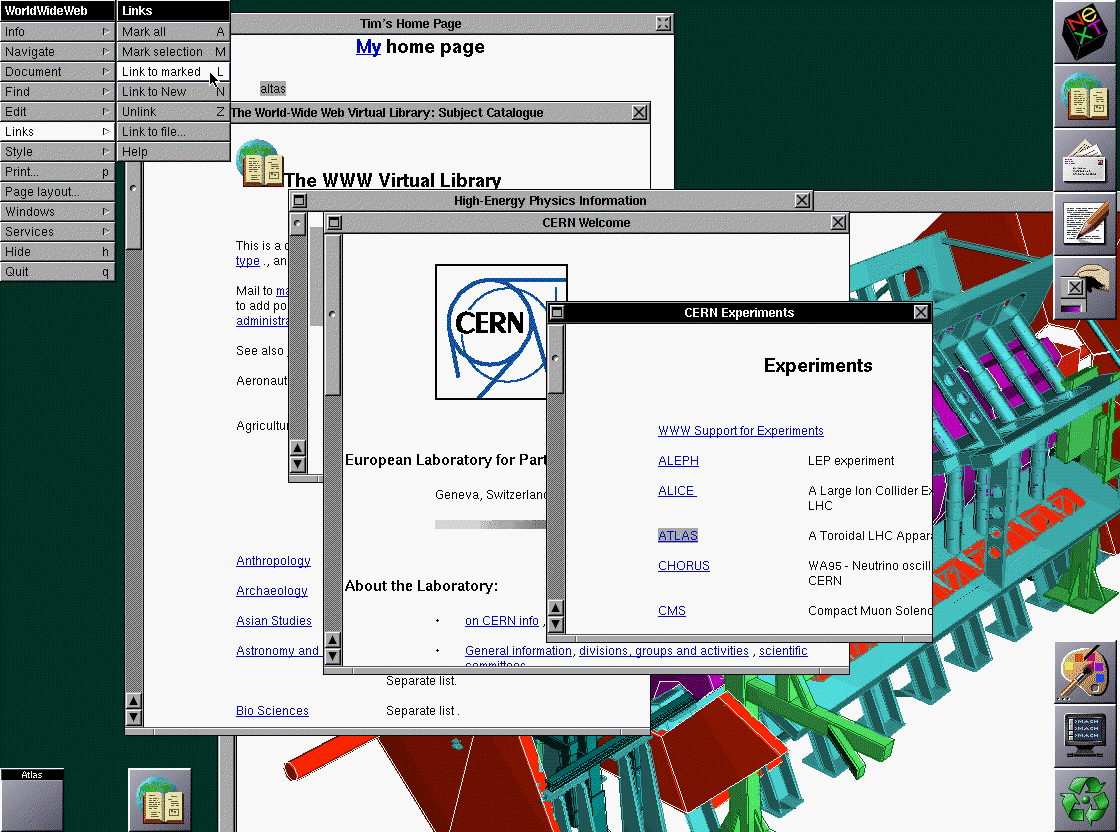
For those of you not familiar with Next, check out this 1993 screen shot of the first web browser. The client was developed in 1990. There are many free implementations of the Nextstep such as Window Maker today. It still kicks any GUI Microsoft has ever made. After using a reasonable window manager on X, few people can go back to the M$ GUI confines.
For those of you fortunate enough to have missed Windoze 3.1, here is a little screen shot from 1993 or so when Netscape became one of the first available browsers for Windoze. 95 added the X button on the top right, so I suppose you could say it coppied Nextstep in one way. Here is a typical Win95/98 desktop. Windoze XP (screen shot to compare), is more of the same and annoying as all hell.
Please don't compare reasonable software, such as Nextstep or Sun's Common Desktop Environemnt, to junk from Microsoft. People might get the idea that one was better than it is or that the other sucks in ways it never did.
-
what are you talking about?The Win95 shell imitates NeXTStep in its appearance far more than it does MacOS,
Exacly what features of the Nextstep does win95 offer? "windowblinds"? Sure, if you download a serious modification. 95 shipped with the clumsy three button junk from win3.1 plus an extra button and a pannel. A root menue anywhere on the screen? Nope. The way it resizes windows? Nope. Menues that you can leave up on the screen? Nope. Can you name one feature that is not simply part of any GUI? I'm not going to go into the tremendous difference in the unerlying systems but just look at the apearances alone.
Nextstep was made from MacOS and was better. Windoze never did much more than follow along the GUI path, never evolving much from the first one they made. The evolution and lines of influence are clear when you look at screen shots from each.
For those of you not familiar with Next, check out this 1993 screen shot of the first web browser. The client was developed in 1990. There are many free implementations of the Nextstep such as Window Maker today. It still kicks any GUI Microsoft has ever made. After using a reasonable window manager on X, few people can go back to the M$ GUI confines.
For those of you fortunate enough to have missed Windoze 3.1, here is a little screen shot from 1993 or so when Netscape became one of the first available browsers for Windoze. 95 added the X button on the top right, so I suppose you could say it coppied Nextstep in one way. Here is a typical Win95/98 desktop. Windoze XP (screen shot to compare), is more of the same and annoying as all hell.
Please don't compare reasonable software, such as Nextstep or Sun's Common Desktop Environemnt, to junk from Microsoft. People might get the idea that one was better than it is or that the other sucks in ways it never did.
-
Re:phoenix/firebird bugYou expect any browser to display that "M$HTML" tag soup with crazy amounts of JS?
The so-called "webpage" is totally blank unless JS is enabled. I then enabled JS. Frankly, I prefered the version without JS enabled. Initial observations: some characters are replaced by question marks (as they do not exist in the default character encoding), the page has no useful content and the layout sucks.
No character encoding is sent with the page or included in the page and it has no doctype.
After working out the character encoding and putting in the doctype of HTML Transitional (as that is the most lax one and any old crap passes), I validated it. Enjoy! 621 errors including non-SGML characters (they exist?)
Now look at the CSS - yes all of the plethora of CSS - argghhh.
That is not a webpage. It is crap.
BTW, it looks like a bug has been filed. In fact there are hundreds of tech evangilism bugs for ESPN.
-
Re:Is it me...
it's because whoever prepared the interview uses the <i> tag before the <p> tag, and doesn't bother to close the <p> tags.
this causes problems because of the vagueness of how unclosed <p> tags work. one possible interpretation is to call it a singleton element that means put a paragraph here, much like how <br> works. the other way is to implicitly close each paragraph at the start of the next paragraph.
under the first interpretation, this html is valid, and should render with all the intended text italicized. under the seccond, the html is malformed, and the <i> tag would be implicitly closed at the beginning of the next paragraph, because the enclosing tag is closed.
i couldn't find a refenrence in the html 4 specs as to which interpretation is correct, but xhtml requires the closing tag, and the list of differences between html 4 and xhtml implies that the second interpretation is correct. of course, since IE doesn't enforce structure of documents, it ought to render as intended in IE, instead of rendering according to the specs.
-
Re:Is it me...
it's because whoever prepared the interview uses the <i> tag before the <p> tag, and doesn't bother to close the <p> tags.
this causes problems because of the vagueness of how unclosed <p> tags work. one possible interpretation is to call it a singleton element that means put a paragraph here, much like how <br> works. the other way is to implicitly close each paragraph at the start of the next paragraph.
under the first interpretation, this html is valid, and should render with all the intended text italicized. under the seccond, the html is malformed, and the <i> tag would be implicitly closed at the beginning of the next paragraph, because the enclosing tag is closed.
i couldn't find a refenrence in the html 4 specs as to which interpretation is correct, but xhtml requires the closing tag, and the list of differences between html 4 and xhtml implies that the second interpretation is correct. of course, since IE doesn't enforce structure of documents, it ought to render as intended in IE, instead of rendering according to the specs.
-
Re:Mozilla: CRASHED
what does the legend tag do?
baisicly its a deprecated attribute which says where the legend of a fieldset is supposed to be diplayed -
Re:"Putting" the vuln in?
Something that a lot of people seem to forget is this:
If it were possible to guarantee the production of bug-free code -- hell -- if it were possible to guarantee that a product was buffer-overflow-free, don't you think it would've been done by now? The tricky thing about bugs is that bugs are tricky things. Just because they're obvious in hindsight doesn't mean that they should've been obvious at the time of authoring.
And what about HTML? If you strictly (and I mean strictly) follow the specs for HTML, very few websites today are correct. Neither opensource.org nor Linux.com validate properly. Given the laziness of the average netizen, the problem of properly parsing HTML becomes much more difficult. -
Re:"Putting" the vuln in?
Something that a lot of people seem to forget is this:
If it were possible to guarantee the production of bug-free code -- hell -- if it were possible to guarantee that a product was buffer-overflow-free, don't you think it would've been done by now? The tricky thing about bugs is that bugs are tricky things. Just because they're obvious in hindsight doesn't mean that they should've been obvious at the time of authoring.
And what about HTML? If you strictly (and I mean strictly) follow the specs for HTML, very few websites today are correct. Neither opensource.org nor Linux.com validate properly. Given the laziness of the average netizen, the problem of properly parsing HTML becomes much more difficult. -
Re:Only MICROSOFT and CISCO? That's it?!?!
"To date, I've understood a "Royalty Free" patent license to mean "Available for use for the stated purpose (i.e., to implement the standard) without need to pay royalties"."
But there can be other conditions.
Not without violating the notion of "available for use". This comes down to how "Royalty Free License" is defined, and I agree it would be stupid to define it in such a way as to permit abuse of the type you suggest.
Look at "5. W3C Royalty-Free (RF) Licensing Requirements", here.
Microsoft demonstrated this to Sun recently with an RF license that Sun simply could not sign.
You're making up bogeymen. Just be sure the definition of "Royalty Free" is correct for it's intended purpose, and even Microsoft will have to abide by them, especially as they will have a much harder time violating the spirit of a license they provide, given the PR cost, and the hordes that would surely pounce, let alone the possible legal consequences.
I would rather stick with an IP regime that actually achieves the objectives of an open and unencumbered (including royalty free) standard than have a license whose terms meets the demands of the noisiest OSS advocates but ends up with an encumbered standard.
OK, thanks for confirming you had no point in the first place. -
Crasher warning
I just noticed that the tantek.com link I posted above crashes Webcore-based browsers. After posting the comment from OmniWeb 4.5 (which uses KHTML Webcore) I clicked on the link. OmniWeb crashed.
Since I'm using a "Sneaky Peek" version of OmniWeb, I thought that maybe it was just a bug in the beta code. I tried the same link in Safari and it crashed too.
I assumed that since this was a page on Tantek Çelik's site the CSS would be valid. The page flunks the HTML validator at w3c.org because of a misplaced noscript tag. - I wouldn't expect that to crash a browser.
Must be a WebCore bug. Kind of ironic given the topic.
-
Re:IE for the Mac is not IE for Windows
The HTML rendering engine (code-name Tasman) in IE/Mac was the first browser to fully support CSS1 and DOM level 1.
To see just how proud the IE/Mac team was of their accomplishment, try typing "about:Tasman" in the IE location bar. Looks a bit like the notorious Acid Box Test page, doesn't it?
-
Re:A new way...
you either have body tags or you have frameset tags, the one you use depends on the type of html document you have
No, the specification says you need a body element or a frameset element, you don't need to use a tag to create an element though.
7.5.1 The BODY element
Start tag: optional, End tag: optionalThe following is a valid HTML 4.01 Strict document, feed it in to the validator if you want conformation.
<!DOCTYPE html PUBLIC "-//W3C//DTD HTML 4.01//EN">
<title>Demo of a Valid Document</title>
<h1>Demo of a Valid Document</h1>
<p>This is a valid HTML 4.01 Strict document. Note the lack of
<body> tags.</p> -
Re:A new way...
nope
you either have body tags or you have frameset tags, the one you use depends on the type of html document you have
HTML 4.01 Spec
7.1 Introduction to the structure of an HTML document
An HTML 4 document is composed of three parts:
1. a line containing HTML version information,
2. a declarative header section (delimited by the HEAD element),
3. a body, which contains the document's actual content. The body may be implemented by the BODY element or the FRAMESET element.
-
Re:Why oh why XML?
Wait! Hold on, back up. HTML is XML
No, XHTML is XML. HTML is an application of SGML.
http://www.w3.org/MarkUp/ -
Prior art ?
Netscape 2.0 enabled framesets and was introduced March 1996.
It was added to HTML 4 at least as early as Dec. 1997.
A note on frames with CSS dated 08-Jun-1996 exists also.
The article mentions having an invention date at least as early as May 1996
Even the patent is completely silly, but the dates are wrong, March happend before May in the year 1996, didn't it ? -
Prior art ?
Netscape 2.0 enabled framesets and was introduced March 1996.
It was added to HTML 4 at least as early as Dec. 1997.
A note on frames with CSS dated 08-Jun-1996 exists also.
The article mentions having an invention date at least as early as May 1996
Even the patent is completely silly, but the dates are wrong, March happend before May in the year 1996, didn't it ? -
Re:Does anybody use frames any more?
The advantage to frames lies in being able to reload parts of your page without reloading other parts. IE has some proprietary extensions that let you do this (in a much better way than frames, too), but I'm not aware of anything in the standards that do.
The latest standard is XFrames, which is still in draft limbo. The idea is to keep the advantages but fix the problems with frames, for example by stopping them breaking bookmarking. -
Re:Is this legal?Frames are an open standard by w3c.SBC does not own it since they did not develop it. Is this tactic that SBC is using legal?
The whole point of the wc3 existance is to prevent this and encourage innovation and a level playing field on the web.
Sbc claims sounds borderline fraudulant.
Its like the equilivant of me pointing at your car, claiming ownership and then demanding you pay me to use it or i will sue. You can not claim something unless you developed it or bought it. No exceptions!
Patents are designed to protect investments of bussinesses who do R&D as well as encourage arts and sciences of individuals. Since no R&D happened at SBC they should of not been granted a patent. If there is no law on this then we need to talk to our representatives on this. Because someone can claim anything they like and if they have big pockets then they legally (steal) it.
SBC also is the assh*le who is corrupting our state governments for deregulation and screwing our tax dollars. The other baby bells are mostly silent. They are being paid for by the government and our tax dollars to install fiber under our streets and they will not turn it on unless the market is deregulated and all competition is wiped out. They are the Microsoft and the RIAA of the telecommunication industry.
They are using our own tax dollars to screw us over and monopolize communication.
-
Re:Prior art
More prior art: Netscape submitted a frames proposal to a W3C working group in September 1995.
-
Re:Netscape
-
Re:Usenet still has value
Well, yeah. This was 1993, Usenet basically was the entire fucking Internet. At least the part of it used to socialise and communicate with peers. The world wide web was only starting to take off. The W3C history of the web notes for October '93: "Over 200 known HTTP servers." Wahey.
-
Re:Wait. It gets even better...
how do you put angle-brackets in your post without Slashdot trying to interpret them as HTML?
The same way you get them to show up in html documents w/o your <browser> interpreting them.
Check it out. -
Object Oriented Programming
Simula-67
and
Smalltalk
(a historical comparison of both)
Also the first web server: CERN httpd
combined with the first web browser
(history of the WWW) -
Re:Let's just accept it...Oh, relax. I was trying to be funny. It's actually kind of up in the air which is better, although both are miles ahead of IE. Each has support for things the other browser doesn't. One thing Opera supports that I'd like to see in Gecko is automatic counters.
The reason I use Mozilla instead of Opera, though, other than Opera's strange interface, is Mozilla's far superior DOM support and extensibility. -
Re:Why not?
Tom, I don't want to be overly critical, and I realize that aesthetics are pretty subjective, but I find their webpage much more intuitively navigable than your snoot site.
-
Re:Screenshota big FYI for people not used to HTML or
The purpose of a hyperlink is to make it easy for people to navigate to pages / resources of interest, without doing a "copy-paste" of a page's content onto the URL bar of their browser.
Below is an example of a HTML hyperlink anchor.
<a href="http://www.interesting-site.com/featured-sl
a shdot-content.html">words related to content</a>
See not that hard, now was it? Perhaps we could all try to use this "new" piece of technological gizmo? -
Re:Screenshota big FYI for people not used to HTML or
The purpose of a hyperlink is to make it easy for people to navigate to pages / resources of interest, without doing a "copy-paste" of a page's content onto the URL bar of their browser.
Below is an example of a HTML hyperlink anchor.
<a href="http://www.interesting-site.com/featured-sl
a shdot-content.html">words related to content</a>
See not that hard, now was it? Perhaps we could all try to use this "new" piece of technological gizmo? -
Way to go!
The Quanta Plus page claims HTML validity and even sport a "Valid HTML" button, but the site doesn't actually validate.
Their front page is generally pretty weak. I have no real idea what their software does. Is it a text editor? A web IDE? A WYSIWYG page-churner? All of the above? All I see is a verbose attempt at associating their project with PHP, Apache and Linux, and at saying their software is the best - but doesn't really say what it's best at or what it's better than. Even worse, looking at the links, I have no idea where I should go next to know more about the product. The Documentation perhaps? That's the first place I'd go after downloading the product. But before that I'd need a reason to download their software, wouldn't I?
All I know is that they've failed to interest me in their product. That's pretty abysmal - a project about web development that fails it's own web development!
-
Re:Isn't lynx older?
Answering my own question, lynx isn't older than Mosaic, but there were other programs, both GUI and text mode, before Mosaic. Looks like the Web is actually 13 years old.
In fact, I was around in 1,994, and remember that Mosaic was greeted as the first easy-to-use browser, succeeding less user-friendly antecessors.
-
Ten years of browsing? Try Twelve
Before Mosaic there was Tim Berner-Lee's WWW browser, available for NeXT workstations.
A few years ago I had the following exchange with Paul Kunz of Stanford University, in an effort to determine who could claim to have been the first in North America to have used the web. Bottom line: probably him, but I was probably second. Paul did a rather extensive search through the rather small but tightly-knit NeXT community, and found no earlier claims.
> Well, I can claim to having HAD a browser earlier than you, though
> I'm not sure about USING it. Here's the story: I got my NeXT slab in
> March 1991. This was NeXT's entry-level 8/108 25MHz slab. Like many
> other people, I soon found the 108MB HD to be very tight, given
> NeXTSTEP's requirements. Later that spring, my father (Emilio
> Pagiola of CERN, whom you know) visited me at Stanford, and he
> brought me a 200MB HD. Since my father was also a NeXT user, he had
> loaded the disk with a variety of available software for NeXTSTEP,
> and since he was an early user of the web, this software included
> Tim's browser. So I had a browser sometime in late spring 1991 -- I
> can check my old datebooks for the exact dates, if you like.
PK: Well seems you had a web brower on your machine at a time when the
PK: Web wasn't made public outside of CERN yet.
> Our offices were wired in the fall of 91, IIRC. At some point soon
> thereafter, I did try out the www browser. There was very little if
> anything to browse, of course. Basically CERN's seminar schedule
> and the like. And so, since I needed the disk space, I deleted the
> browser.
PK: I demonstrated the web browser at SLAC before the end of
PK: September. Not sure of the exact date, but it was immediately on
PK: my return from CERN.
> I only started using the web permanently when the first omniweb
> browsers started coming out in 1993 or so.
PK: The president of the Omni company worked for me one summer on
PK: HippoDraw just before his senior year at U Washington.
> So, I seem to have HAD a browser before you, but may or may not have
> USED one before you.
PK: Seems I used the browser before you, but you had one on your
PK: machine. I didn't pay any attention to the Web, even after public
PK: announcement until I saw a demo on that trip.
-
Ten years of browsing? Try Twelve
Before Mosaic there was Tim Berner-Lee's WWW browser, available for NeXT workstations.
A few years ago I had the following exchange with Paul Kunz of Stanford University, in an effort to determine who could claim to have been the first in North America to have used the web. Bottom line: probably him, but I was probably second. Paul did a rather extensive search through the rather small but tightly-knit NeXT community, and found no earlier claims.
> Well, I can claim to having HAD a browser earlier than you, though
> I'm not sure about USING it. Here's the story: I got my NeXT slab in
> March 1991. This was NeXT's entry-level 8/108 25MHz slab. Like many
> other people, I soon found the 108MB HD to be very tight, given
> NeXTSTEP's requirements. Later that spring, my father (Emilio
> Pagiola of CERN, whom you know) visited me at Stanford, and he
> brought me a 200MB HD. Since my father was also a NeXT user, he had
> loaded the disk with a variety of available software for NeXTSTEP,
> and since he was an early user of the web, this software included
> Tim's browser. So I had a browser sometime in late spring 1991 -- I
> can check my old datebooks for the exact dates, if you like.
PK: Well seems you had a web brower on your machine at a time when the
PK: Web wasn't made public outside of CERN yet.
> Our offices were wired in the fall of 91, IIRC. At some point soon
> thereafter, I did try out the www browser. There was very little if
> anything to browse, of course. Basically CERN's seminar schedule
> and the like. And so, since I needed the disk space, I deleted the
> browser.
PK: I demonstrated the web browser at SLAC before the end of
PK: September. Not sure of the exact date, but it was immediately on
PK: my return from CERN.
> I only started using the web permanently when the first omniweb
> browsers started coming out in 1993 or so.
PK: The president of the Omni company worked for me one summer on
PK: HippoDraw just before his senior year at U Washington.
> So, I seem to have HAD a browser before you, but may or may not have
> USED one before you.
PK: Seems I used the browser before you, but you had one on your
PK: machine. I didn't pay any attention to the Web, even after public
PK: announcement until I saw a demo on that trip.
-
Re:Isn't lynx older?
> Everybody knows Mosaic was the first HTTP-HTML browser.
Then everybody is wrong.
-
Re:WorldWideWeb written in Obj-C on NeXT?
Unfortunately the most important part of the source code is missing
WorldWideWeb homepage
original WorldWideWeb docu
WorldWideWeb source code -
Re:WorldWideWeb written in Obj-C on NeXT?
Unfortunately the most important part of the source code is missing
WorldWideWeb homepage
original WorldWideWeb docu
WorldWideWeb source code -
Re:WorldWideWeb written in Obj-C on NeXT?
Unfortunately the most important part of the source code is missing
WorldWideWeb homepage
original WorldWideWeb docu
WorldWideWeb source code -
Re:timeline
URL for the seminar: http://www.w3.org/Talks/CompSem93/Overview.html
-
Re:Uhh...
Tim's web browser was called "WorldWideWeb"
W3.org -
timeline
Here's a history provided by w3. (Note: mozilla alpha released in February 1993. Already 50 HTTP servers in existence.)
Here's a really cool seminar given at CERN in Feb 1993 on the potential of the web browser. -
Re:Get real
OK, let's talk some REAL reform... Let's take a step backwards to the days when things actually WORKED:
Think HTML 2.0
http://www.w3.org/MarkUp/html-spec/html-spec_toc .h tml
WHAT IF we incorporated a new concept into the WWW: An "Information-Focused" web that was incorported into existing HTTPD server software, that REQUIRED all pages it served to be fully HTML 2.0 compliant - (or they wouldn't be served), without any of the bandwidth-wasteing junk like Flash/Shockwave/Java/Script/Etc...
OK, now you're probably laughing. But think about it... It would be GREAT for web sites that should be information-oriented (news & tech support-type sites, as opposed to entertainment-oriented MTV.com stuff). Simple HTML code, simple formatting, simple (preferably small) images only where necessary. All in a format that not only displays perfectly on "any browser" - but also on a tiny cell phone/PDA screen.
If the IETF/W3 would just agree, this could work ALONGSIDE existing web sites. Maybe agree that all such sites on a server should be prefaced with "h2" or something quick and simple like that - as in h2.domain.com (Kind of an alternative to providing a "text-only" version of a site.) So that way, if you want the regular, bandwidth and hardware-hungry site with all the bells & whistles, just go to www.domainname.com - but if you wanted to access "Just the Facts" without all the junk, you'd go to h2.domainname.com
Yeah, I know this is more a pipe dream than anything else. But the difference is it would be totally simple to implement. All it would take is the user community's desire to do it, and a little cooperation from Apache coders...
Any cooperative Apache coders out there?