Slashdot Mirror
Domain: wa5znu.org
Stories and comments across the archive that link to wa5znu.org.
Comments · 46
-
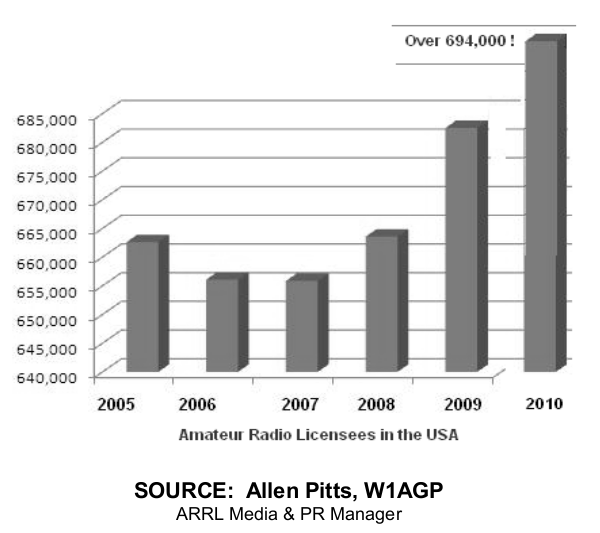
Ham radio has been growing consistently since 2007
The number of US amateur radio operators has been growing consistently since 2007. In fact, except for a period of a few years at the start of the web era, it's grown consistently since its inception.
A lot of nerdy people got into ham radio in the early 1990's because they wanted to do packet radio, which came from Aloha Net, the same project in the 1960's that begat packet networks and eventually TCP/IP and friends. When those folks moved over to the wired internet, and let their ham licenses lapse, the ham population declined. But in the past few years it's been growing again, partially due to crossover from DIY/MAKE people interested in everything from bouncing microwave signals off the moon to building their own radios out of a handful of transistors to GPS tracking with Arduino shields and RF transmitters.
Here's a graph:
http://wa5znu.org/2011/01/ham-census/2005-2010-chart.png
Leigh/WA5ZNU
-
A123 is already doing pretty well
A123 and Valence offer Lithium Nano Phosphate and Lithium Iron Phosphate cells that can source current at up to 60 times their total amp-hour rating and still deliver 100% of their energy rating, and have excellent safety compared to existing Li-Ion and LiPoly cells. A123 has $350M to spend, and deals with DeWalt/Black and Decker on sale now, and Chevy Volt on the table. It's going to be hard for Stanford to catch up.
Nevertheless, I'm quite excited about all these new Lithium battery technologies and have written a brief article about them for enthusiasts. I think there will be tremendous competitive pressure from these deals and developments, and 2008 will see a big change in batteries, relegating Lead Acid and Nickel Metal Hydride increasingly to niche application status. -
Build your own computer that's inside the Voyager
The Voyager uses three computers whose CPUs are RCA 1802. The 1802 was (and still is) made in a rad-hardened ceramic DIP.
You can build your own 1802 computer, thanks to a retro kit, which updates the 1976 Popular Electronics $99 COSMAC Elf project. We built one of these, and chose not to get the full kit, but instead spend months chasing down parts. I'd got for the full kit if I did it again. -
Works here on earth too
>On Earth, radio waves occur naturally during lightning strikes, which cause electrons in the atmosphere to oscillate and release the waves. These radio waves bounce back and forth between the Earth's surface and its ionosphere, the high-up region of the atmosphere filled with electrically-charged particles.
I do this myself on earth a lot. It's lot of fun to experiment.
In the past month, I was able to bounce a radio wave of approximately 20 meters to 40 meters in length from California to Hawaii, Mexico, Australia, the Bering Sea, Pacific Islands, Vladivostok, Khabarosk (Russia 20km from Chinese border, where they had the chemical spill a couple of years ago), and South Africa.
Some of this was with off-on keying of an RF carrier, and some with digital-signal processing software running on Linux (both extremely weak signal modes originally designed for bouncing signals off the Moon, and more conversational modes.) -
Works here on earth too
>On Earth, radio waves occur naturally during lightning strikes, which cause electrons in the atmosphere to oscillate and release the waves. These radio waves bounce back and forth between the Earth's surface and its ionosphere, the high-up region of the atmosphere filled with electrically-charged particles.
I do this myself on earth a lot. It's lot of fun to experiment.
In the past month, I was able to bounce a radio wave of approximately 20 meters to 40 meters in length from California to Hawaii, Mexico, Australia, the Bering Sea, Pacific Islands, Vladivostok, Khabarosk (Russia 20km from Chinese border, where they had the chemical spill a couple of years ago), and South Africa.
Some of this was with off-on keying of an RF carrier, and some with digital-signal processing software running on Linux (both extremely weak signal modes originally designed for bouncing signals off the Moon, and more conversational modes.) -
Works here on earth too
>On Earth, radio waves occur naturally during lightning strikes, which cause electrons in the atmosphere to oscillate and release the waves. These radio waves bounce back and forth between the Earth's surface and its ionosphere, the high-up region of the atmosphere filled with electrically-charged particles.
I do this myself on earth a lot. It's lot of fun to experiment.
In the past month, I was able to bounce a radio wave of approximately 20 meters to 40 meters in length from California to Hawaii, Mexico, Australia, the Bering Sea, Pacific Islands, Vladivostok, Khabarosk (Russia 20km from Chinese border, where they had the chemical spill a couple of years ago), and South Africa.
Some of this was with off-on keying of an RF carrier, and some with digital-signal processing software running on Linux (both extremely weak signal modes originally designed for bouncing signals off the Moon, and more conversational modes.) -
Works here on earth too
>On Earth, radio waves occur naturally during lightning strikes, which cause electrons in the atmosphere to oscillate and release the waves. These radio waves bounce back and forth between the Earth's surface and its ionosphere, the high-up region of the atmosphere filled with electrically-charged particles.
I do this myself on earth a lot. It's lot of fun to experiment.
In the past month, I was able to bounce a radio wave of approximately 20 meters to 40 meters in length from California to Hawaii, Mexico, Australia, the Bering Sea, Pacific Islands, Vladivostok, Khabarosk (Russia 20km from Chinese border, where they had the chemical spill a couple of years ago), and South Africa.
Some of this was with off-on keying of an RF carrier, and some with digital-signal processing software running on Linux (both extremely weak signal modes originally designed for bouncing signals off the Moon, and more conversational modes.) -
Works here on earth too
>On Earth, radio waves occur naturally during lightning strikes, which cause electrons in the atmosphere to oscillate and release the waves. These radio waves bounce back and forth between the Earth's surface and its ionosphere, the high-up region of the atmosphere filled with electrically-charged particles.
I do this myself on earth a lot. It's lot of fun to experiment.
In the past month, I was able to bounce a radio wave of approximately 20 meters to 40 meters in length from California to Hawaii, Mexico, Australia, the Bering Sea, Pacific Islands, Vladivostok, Khabarosk (Russia 20km from Chinese border, where they had the chemical spill a couple of years ago), and South Africa.
Some of this was with off-on keying of an RF carrier, and some with digital-signal processing software running on Linux (both extremely weak signal modes originally designed for bouncing signals off the Moon, and more conversational modes.) -
Works here on earth too
>On Earth, radio waves occur naturally during lightning strikes, which cause electrons in the atmosphere to oscillate and release the waves. These radio waves bounce back and forth between the Earth's surface and its ionosphere, the high-up region of the atmosphere filled with electrically-charged particles.
I do this myself on earth a lot. It's lot of fun to experiment.
In the past month, I was able to bounce a radio wave of approximately 20 meters to 40 meters in length from California to Hawaii, Mexico, Australia, the Bering Sea, Pacific Islands, Vladivostok, Khabarosk (Russia 20km from Chinese border, where they had the chemical spill a couple of years ago), and South Africa.
Some of this was with off-on keying of an RF carrier, and some with digital-signal processing software running on Linux (both extremely weak signal modes originally designed for bouncing signals off the Moon, and more conversational modes.) -
Works here on earth too
>On Earth, radio waves occur naturally during lightning strikes, which cause electrons in the atmosphere to oscillate and release the waves. These radio waves bounce back and forth between the Earth's surface and its ionosphere, the high-up region of the atmosphere filled with electrically-charged particles.
I do this myself on earth a lot. It's lot of fun to experiment.
In the past month, I was able to bounce a radio wave of approximately 20 meters to 40 meters in length from California to Hawaii, Mexico, Australia, the Bering Sea, Pacific Islands, Vladivostok, Khabarosk (Russia 20km from Chinese border, where they had the chemical spill a couple of years ago), and South Africa.
Some of this was with off-on keying of an RF carrier, and some with digital-signal processing software running on Linux (both extremely weak signal modes originally designed for bouncing signals off the Moon, and more conversational modes.) -
Works here on earth too
>On Earth, radio waves occur naturally during lightning strikes, which cause electrons in the atmosphere to oscillate and release the waves. These radio waves bounce back and forth between the Earth's surface and its ionosphere, the high-up region of the atmosphere filled with electrically-charged particles.
I do this myself on earth a lot. It's lot of fun to experiment.
In the past month, I was able to bounce a radio wave of approximately 20 meters to 40 meters in length from California to Hawaii, Mexico, Australia, the Bering Sea, Pacific Islands, Vladivostok, Khabarosk (Russia 20km from Chinese border, where they had the chemical spill a couple of years ago), and South Africa.
Some of this was with off-on keying of an RF carrier, and some with digital-signal processing software running on Linux (both extremely weak signal modes originally designed for bouncing signals off the Moon, and more conversational modes.) -
Works here on earth too
>On Earth, radio waves occur naturally during lightning strikes, which cause electrons in the atmosphere to oscillate and release the waves. These radio waves bounce back and forth between the Earth's surface and its ionosphere, the high-up region of the atmosphere filled with electrically-charged particles.
I do this myself on earth a lot. It's lot of fun to experiment.
In the past month, I was able to bounce a radio wave of approximately 20 meters to 40 meters in length from California to Hawaii, Mexico, Australia, the Bering Sea, Pacific Islands, Vladivostok, Khabarosk (Russia 20km from Chinese border, where they had the chemical spill a couple of years ago), and South Africa.
Some of this was with off-on keying of an RF carrier, and some with digital-signal processing software running on Linux (both extremely weak signal modes originally designed for bouncing signals off the Moon, and more conversational modes.) -
Experiment with the ionosphere from your own home!
You can bounce radio signals off the ionosphere with fairly simple equipment, if you have a ham radio license you can do it too. The interesting thing is that not everything is known about the ionosphere. For example, an open question is whether Long-Delayed Echoes exist or not, or whether they are just Backscatter, or if they are real.
-
Re:Triangulation to locate sources?
On September 2, 2006 I heard my own signal, a good fraction of a second later, twice in the span of a few seconds.
-
Elecraft K2
It looks like it's about 20:1 for actual responses, so I'll add mine.
I built an Elecraft K2 (more pix). Mine looks pretty much like the one in the picture.
A couple of weeks ago I went to Amsterdam and used it on Saturday and Sunday and got my radio to signal to Bulgaria, Russia, Italy, Montenegro, Poland, and England. (OK, some of these were also with another kit, a handheld KX1, but it's smaller and took only a weekend to build; more info, magazine article with more pix) -
Elecraft K2
It looks like it's about 20:1 for actual responses, so I'll add mine.
I built an Elecraft K2 (more pix). Mine looks pretty much like the one in the picture.
A couple of weeks ago I went to Amsterdam and used it on Saturday and Sunday and got my radio to signal to Bulgaria, Russia, Italy, Montenegro, Poland, and England. (OK, some of these were also with another kit, a handheld KX1, but it's smaller and took only a weekend to build; more info, magazine article with more pix) -
Re:Why do we care?
-
Re:IAARE
>For example, if I can only get 50% of the way to the Shannon limit using hardware in a real-world environment, could I boost that number by ignoring symbols that are indistinguishable and just let error correction (like reed-solomon) take care of the missing parts?
Yes, it's called "coding gain" and it can be measured in dB. If you want to get the results you would have had with twice as much signal to noise ratio, you need 10*log(2)=3dB coding gain. Unfortunately, putting in forward error correction reduces the data rate or increases the bandwidth, so you need to make sure you're coming out ahead.
If you're interested in experimenting with these topics, try reading about ham radio digital modes for HF (3-30Mhz). The cost of entry is low, and with open source software such as gMFSK it's possible to do your own experimentation. You might start with this historic article that started a new set of experimentation on a phase-shift keying modulation scheme called PSK31, which packs all the power into a tiny 31Hz wide bandwidth. You can read a less technical description, or read about other modulation techniques using multiple carriers (MFSK, Olivia, which uses Walsh functions for FEC and can be copyable with low power in noisy conditions).
For a long overview of HF digital mode performance in practical circumstances, see this paper from the Radio Society of Great Britain.
There's also plenty going on in UHF as this 900 Mhz work is doing, but it's a little harder to experiment there, but if you are already comfortable building 802.11 equipment and have the skills necessary there, there's plenty to do. Some hams recently conducted Earth-Moon-Earth bounce communcations using 47GHz (which I heard one of the 24GHz pioneers say would never happen!).
And at the other end of the spectrum, US, Australian, and European hams are experimenting with LF in the 137KHz region (under special license in the US) and have made super-slow communications across the oceans. There are challenges here as well, and the data rates are extremely low, not unlike the 76KHz signal that we used to send to our nuclear submarines underwater, which I think is roughly one bit (a repeated "don't-blow-it-up don't-blow-it-up don't-blow-it-up...). -
A few interesting things
-
Hamcasting
I also listened to the shuttle mission live on my VX2R handheld (about the size of an iPod), courtesy of NA6MF, the NASA Ames amateur radio club retransmitting their internal audio feed on 145.585 MHz.
And just for funsies, I made a sample PodCast RSS of W1AW Morse code practice. -
ATV
I've been watching the shuttle mission on the K6BEN amateur TV repeater near San Jose, which is on 421.25Mhz, the same as cable (not broadcast) channel 57, through my VCR and with a Yagi I made from a magazine article. The NASA Ames Amateur Radio Club is providing the feed with a 1.2GHz uplink to the repeater. They also have shuttle audio on two meters, and I can receive that with my VX-2R HT.
-
Re:NASA-TV on 145.585 in SF bay area
> Direct from NASA-TV, retransmission of audio 145.585 in the south San Francisco bay area. Video is also retransmitted on the K6BEN-ATV video repeater.
I saw it this morning using the Yagi I built from a magazine article and hooked to my VCR set to cable channel 57.
And the 145.585 Mhz audio feed was working great, too! We listened to it at lunch at work. -
Ham radio text messagingThere's a couple of ham radio text messaging type things.
- One, called PSK31, uses less bandwidth than a morse code signal (31Hz), and uses a computer soundcard to audio encoding and decoding. You can read more about it here. You can talk around the world with 5 Watts on HF (high frequency, 14.070 MHz, in this case). There are other, similar, digital modes available for keyboard-to-keyboard communications (synchronous, non face-to-face) that have different radio propagation and bandwidth characteristics, as well as image transmissions modes that work on HF, which propagates world-wide, and you can read about those in the PDF presentation above as well.
- The other, APRS , uses VHF and UFH (usually 144.39 MHz in the US), and because of the shorter range, uses a store-and-forward packet technology. This mechanism is more like SMS in that it is asynchronous, non-face-to-face, and in that it uses a network of repeaters and packet forwarding systems, and message lengths are limited.
There used to be a wider ham packet network, back before the ARPANet became the Internet; this piggybacks on the technology and uses it for short message, position reporting, and weather reporting. Check out APRSWorld.net for open-source software for the network side of this. (The radio side is already taken care of in the Linux kernel, and in various Windows packages. There is also a client program called XASTIR.
-
Re:Positive Image
-
Re:Positive Image
-
Re:Not a good idea if unlicensed...
>Am I required to speak in English? Can I talk with my Navaho friends and relatives in our language? What if I am Private Charlie Whitehorse?
You are not required to speak English but you must ID in English.
You must also not speak with the intent of obscuring the meaning of your communications.
There's plenty of fun to be had... I talked to the arctic circle and Antarctica using a radio that fits in a waist pack and a few AA batteries. -
Re:Not a good idea if unlicensed...
>Am I required to speak in English? Can I talk with my Navaho friends and relatives in our language? What if I am Private Charlie Whitehorse?
You are not required to speak English but you must ID in English.
You must also not speak with the intent of obscuring the meaning of your communications.
There's plenty of fun to be had... I talked to the arctic circle and Antarctica using a radio that fits in a waist pack and a few AA batteries. -
Re:Not a good idea if unlicensed...
>Am I required to speak in English? Can I talk with my Navaho friends and relatives in our language? What if I am Private Charlie Whitehorse?
You are not required to speak English but you must ID in English.
You must also not speak with the intent of obscuring the meaning of your communications.
There's plenty of fun to be had... I talked to the arctic circle and Antarctica using a radio that fits in a waist pack and a few AA batteries. -
Re:High-power RF interference
>If nothing else, shouldn't the FCC be responsible for managing the spectrum in such a way that these kinds of problems do not happen?
They do manage the spectrum. What they don't manage is the receiving devices...
There is a curious problem here caused by the "free market" philosophy taken so to heart by the public at large, the government, and the FCC recently.
The problem is that the TV probably doesn't meet the consumer's needs for keeping out unwanted (and off frequency) RF. The FCC would argue that the manufacturer has sold a TV that doesn't meet the consumer's needs, and the consumer ought not buy it, just like they wouldn't buy one without a remote control or with a volume control button that's in the back and has to be set with a screwdriver. In other words, the TV is not of good engineering design, and the FCC doesn't care -- they think you should care.
So, take the FCC's lead and call the manufacturer of your TV, the person who installed your stereo speakers, etc. and complain to them.
The dual of this is that if you own a device that makes RF noise and someone else complains, your only recourse is to turn your device off. Although you can sometimes hope for FCC intervention, if you want the manufacturer to fix it, you have to go back to them as a consumer. It's only rarely that the FCC goes back to the manufacturer for you, and when they do, it is usually only in an egregious case and with lots of legwork by someone else, and it makes headlines.
The sad thing is that it's much easier to get the FCC involved to tell your hapless neighbors to turn off their broken device than it is to get them to make the manufacturer fix it.
If you buy a washing machine (like mine) that generates noise, you may be stuck with a lot of work to try to get it fixed.
Or, you can write your congressperson and ask that the US adopt stricter EMC (electro-magnetic compitability) requirements such as the European EC requirements. -
Re:don't forget the RockMite
>I can't see a little mint tin transceiver putting out more than a few hundred mW, and with a tiny antenna at 20 meters,
I worked Finland from California with an 8ft antenna and a 4.5W transmitter on 20M recently, and it was no big deal. In a few years, when sunspots start up again, 500mW on 10M will get you Europe with some regularity. -
1000 Miles per watt award
The 1000 miles per watt award is fairly easy to get. I exceeded it twice recently, when I worked ES5MC in Estonia from California with 4.5 watts with my Elecraft KX1 and a pack of AA batteries and a 28ft wire in a tree in central California, and OH9SCL in Santa Claus Land (Rovaniemi Finland, news, news) with the same radio from a parking lot by the San Francisco Bay.
-
1000 Miles per watt award
The 1000 miles per watt award is fairly easy to get. I exceeded it twice recently, when I worked ES5MC in Estonia from California with 4.5 watts with my Elecraft KX1 and a pack of AA batteries and a 28ft wire in a tree in central California, and OH9SCL in Santa Claus Land (Rovaniemi Finland, news, news) with the same radio from a parking lot by the San Francisco Bay.
-
Fun StuffI've been a ham since I was 7, but was inactive from the college years until recently. There's a tremendous number of things to do, from building your own low-power and medium-power equipment to computer-connected stuff, to Microwave (10 GHz is popular, and the 3.5 GHz band is getting more interesting these days too) and VLF (how about a signal on 176 KHz?).
Personally, I've ejoyed the following lately:
- PSK-31 -- a cheap soundcard-based text-to-text mode that uses only 31Hz of bandwidth and goes around the world on 5 watts
- XML for Ham Radio -- I've started a consortium to develop XML standards for ham radio, starting with an extensible logging format, and working with everyone from QRZ and eQSL.cc on the server side to xlog for Linux and Ham Radio Deluxe for Windows and others.
- RPSK -- a TCP/IP based protocol for remote operation of a PSK station with a Java applet client and a hiptop client. (The antenna is not hooked up right now so don't expect the applet to work.)
- HFPack -- portable and picnic table operation with HF radio; I talked to Estonia with an Elecraft KX1 and about 4.5 Watts
- An RSS feed for APRS -- working with APRSWorld I developed an APRS to RSS converter to help HFPackers let people know where and when they are operating, so people can listen for them.
- Kit building -- I have built an Elecraft K2, one of the most sensitive ham transceivers in the world, their KX1 (one of the smallest and most featureful), a Small Wonder Labs PSK-20 specific to PSK on 14.070 MHz, and a variety of American QRP Club and Four-State QRP Club kits. For more power, I built an 50 Watt HF Amplifier in a group project and am working on a 100W one.
- CW -- I learned Morse Code at 5 so it was easy to pick back up after a couple (ok, a few) decades of disuse, and it's been a blast as well.
Check it out and take a look at my Ham Web Log for more stuff.
-
Fun StuffI've been a ham since I was 7, but was inactive from the college years until recently. There's a tremendous number of things to do, from building your own low-power and medium-power equipment to computer-connected stuff, to Microwave (10 GHz is popular, and the 3.5 GHz band is getting more interesting these days too) and VLF (how about a signal on 176 KHz?).
Personally, I've ejoyed the following lately:
- PSK-31 -- a cheap soundcard-based text-to-text mode that uses only 31Hz of bandwidth and goes around the world on 5 watts
- XML for Ham Radio -- I've started a consortium to develop XML standards for ham radio, starting with an extensible logging format, and working with everyone from QRZ and eQSL.cc on the server side to xlog for Linux and Ham Radio Deluxe for Windows and others.
- RPSK -- a TCP/IP based protocol for remote operation of a PSK station with a Java applet client and a hiptop client. (The antenna is not hooked up right now so don't expect the applet to work.)
- HFPack -- portable and picnic table operation with HF radio; I talked to Estonia with an Elecraft KX1 and about 4.5 Watts
- An RSS feed for APRS -- working with APRSWorld I developed an APRS to RSS converter to help HFPackers let people know where and when they are operating, so people can listen for them.
- Kit building -- I have built an Elecraft K2, one of the most sensitive ham transceivers in the world, their KX1 (one of the smallest and most featureful), a Small Wonder Labs PSK-20 specific to PSK on 14.070 MHz, and a variety of American QRP Club and Four-State QRP Club kits. For more power, I built an 50 Watt HF Amplifier in a group project and am working on a 100W one.
- CW -- I learned Morse Code at 5 so it was easy to pick back up after a couple (ok, a few) decades of disuse, and it's been a blast as well.
Check it out and take a look at my Ham Web Log for more stuff.
-
Fun StuffI've been a ham since I was 7, but was inactive from the college years until recently. There's a tremendous number of things to do, from building your own low-power and medium-power equipment to computer-connected stuff, to Microwave (10 GHz is popular, and the 3.5 GHz band is getting more interesting these days too) and VLF (how about a signal on 176 KHz?).
Personally, I've ejoyed the following lately:
- PSK-31 -- a cheap soundcard-based text-to-text mode that uses only 31Hz of bandwidth and goes around the world on 5 watts
- XML for Ham Radio -- I've started a consortium to develop XML standards for ham radio, starting with an extensible logging format, and working with everyone from QRZ and eQSL.cc on the server side to xlog for Linux and Ham Radio Deluxe for Windows and others.
- RPSK -- a TCP/IP based protocol for remote operation of a PSK station with a Java applet client and a hiptop client. (The antenna is not hooked up right now so don't expect the applet to work.)
- HFPack -- portable and picnic table operation with HF radio; I talked to Estonia with an Elecraft KX1 and about 4.5 Watts
- An RSS feed for APRS -- working with APRSWorld I developed an APRS to RSS converter to help HFPackers let people know where and when they are operating, so people can listen for them.
- Kit building -- I have built an Elecraft K2, one of the most sensitive ham transceivers in the world, their KX1 (one of the smallest and most featureful), a Small Wonder Labs PSK-20 specific to PSK on 14.070 MHz, and a variety of American QRP Club and Four-State QRP Club kits. For more power, I built an 50 Watt HF Amplifier in a group project and am working on a 100W one.
- CW -- I learned Morse Code at 5 so it was easy to pick back up after a couple (ok, a few) decades of disuse, and it's been a blast as well.
Check it out and take a look at my Ham Web Log for more stuff.
-
Fun StuffI've been a ham since I was 7, but was inactive from the college years until recently. There's a tremendous number of things to do, from building your own low-power and medium-power equipment to computer-connected stuff, to Microwave (10 GHz is popular, and the 3.5 GHz band is getting more interesting these days too) and VLF (how about a signal on 176 KHz?).
Personally, I've ejoyed the following lately:
- PSK-31 -- a cheap soundcard-based text-to-text mode that uses only 31Hz of bandwidth and goes around the world on 5 watts
- XML for Ham Radio -- I've started a consortium to develop XML standards for ham radio, starting with an extensible logging format, and working with everyone from QRZ and eQSL.cc on the server side to xlog for Linux and Ham Radio Deluxe for Windows and others.
- RPSK -- a TCP/IP based protocol for remote operation of a PSK station with a Java applet client and a hiptop client. (The antenna is not hooked up right now so don't expect the applet to work.)
- HFPack -- portable and picnic table operation with HF radio; I talked to Estonia with an Elecraft KX1 and about 4.5 Watts
- An RSS feed for APRS -- working with APRSWorld I developed an APRS to RSS converter to help HFPackers let people know where and when they are operating, so people can listen for them.
- Kit building -- I have built an Elecraft K2, one of the most sensitive ham transceivers in the world, their KX1 (one of the smallest and most featureful), a Small Wonder Labs PSK-20 specific to PSK on 14.070 MHz, and a variety of American QRP Club and Four-State QRP Club kits. For more power, I built an 50 Watt HF Amplifier in a group project and am working on a 100W one.
- CW -- I learned Morse Code at 5 so it was easy to pick back up after a couple (ok, a few) decades of disuse, and it's been a blast as well.
Check it out and take a look at my Ham Web Log for more stuff.
-
Fun StuffI've been a ham since I was 7, but was inactive from the college years until recently. There's a tremendous number of things to do, from building your own low-power and medium-power equipment to computer-connected stuff, to Microwave (10 GHz is popular, and the 3.5 GHz band is getting more interesting these days too) and VLF (how about a signal on 176 KHz?).
Personally, I've ejoyed the following lately:
- PSK-31 -- a cheap soundcard-based text-to-text mode that uses only 31Hz of bandwidth and goes around the world on 5 watts
- XML for Ham Radio -- I've started a consortium to develop XML standards for ham radio, starting with an extensible logging format, and working with everyone from QRZ and eQSL.cc on the server side to xlog for Linux and Ham Radio Deluxe for Windows and others.
- RPSK -- a TCP/IP based protocol for remote operation of a PSK station with a Java applet client and a hiptop client. (The antenna is not hooked up right now so don't expect the applet to work.)
- HFPack -- portable and picnic table operation with HF radio; I talked to Estonia with an Elecraft KX1 and about 4.5 Watts
- An RSS feed for APRS -- working with APRSWorld I developed an APRS to RSS converter to help HFPackers let people know where and when they are operating, so people can listen for them.
- Kit building -- I have built an Elecraft K2, one of the most sensitive ham transceivers in the world, their KX1 (one of the smallest and most featureful), a Small Wonder Labs PSK-20 specific to PSK on 14.070 MHz, and a variety of American QRP Club and Four-State QRP Club kits. For more power, I built an 50 Watt HF Amplifier in a group project and am working on a 100W one.
- CW -- I learned Morse Code at 5 so it was easy to pick back up after a couple (ok, a few) decades of disuse, and it's been a blast as well.
Check it out and take a look at my Ham Web Log for more stuff.
-
Fun StuffI've been a ham since I was 7, but was inactive from the college years until recently. There's a tremendous number of things to do, from building your own low-power and medium-power equipment to computer-connected stuff, to Microwave (10 GHz is popular, and the 3.5 GHz band is getting more interesting these days too) and VLF (how about a signal on 176 KHz?).
Personally, I've ejoyed the following lately:
- PSK-31 -- a cheap soundcard-based text-to-text mode that uses only 31Hz of bandwidth and goes around the world on 5 watts
- XML for Ham Radio -- I've started a consortium to develop XML standards for ham radio, starting with an extensible logging format, and working with everyone from QRZ and eQSL.cc on the server side to xlog for Linux and Ham Radio Deluxe for Windows and others.
- RPSK -- a TCP/IP based protocol for remote operation of a PSK station with a Java applet client and a hiptop client. (The antenna is not hooked up right now so don't expect the applet to work.)
- HFPack -- portable and picnic table operation with HF radio; I talked to Estonia with an Elecraft KX1 and about 4.5 Watts
- An RSS feed for APRS -- working with APRSWorld I developed an APRS to RSS converter to help HFPackers let people know where and when they are operating, so people can listen for them.
- Kit building -- I have built an Elecraft K2, one of the most sensitive ham transceivers in the world, their KX1 (one of the smallest and most featureful), a Small Wonder Labs PSK-20 specific to PSK on 14.070 MHz, and a variety of American QRP Club and Four-State QRP Club kits. For more power, I built an 50 Watt HF Amplifier in a group project and am working on a 100W one.
- CW -- I learned Morse Code at 5 so it was easy to pick back up after a couple (ok, a few) decades of disuse, and it's been a blast as well.
Check it out and take a look at my Ham Web Log for more stuff.
-
Fun StuffI've been a ham since I was 7, but was inactive from the college years until recently. There's a tremendous number of things to do, from building your own low-power and medium-power equipment to computer-connected stuff, to Microwave (10 GHz is popular, and the 3.5 GHz band is getting more interesting these days too) and VLF (how about a signal on 176 KHz?).
Personally, I've ejoyed the following lately:
- PSK-31 -- a cheap soundcard-based text-to-text mode that uses only 31Hz of bandwidth and goes around the world on 5 watts
- XML for Ham Radio -- I've started a consortium to develop XML standards for ham radio, starting with an extensible logging format, and working with everyone from QRZ and eQSL.cc on the server side to xlog for Linux and Ham Radio Deluxe for Windows and others.
- RPSK -- a TCP/IP based protocol for remote operation of a PSK station with a Java applet client and a hiptop client. (The antenna is not hooked up right now so don't expect the applet to work.)
- HFPack -- portable and picnic table operation with HF radio; I talked to Estonia with an Elecraft KX1 and about 4.5 Watts
- An RSS feed for APRS -- working with APRSWorld I developed an APRS to RSS converter to help HFPackers let people know where and when they are operating, so people can listen for them.
- Kit building -- I have built an Elecraft K2, one of the most sensitive ham transceivers in the world, their KX1 (one of the smallest and most featureful), a Small Wonder Labs PSK-20 specific to PSK on 14.070 MHz, and a variety of American QRP Club and Four-State QRP Club kits. For more power, I built an 50 Watt HF Amplifier in a group project and am working on a 100W one.
- CW -- I learned Morse Code at 5 so it was easy to pick back up after a couple (ok, a few) decades of disuse, and it's been a blast as well.
Check it out and take a look at my Ham Web Log for more stuff.
-
Fun StuffI've been a ham since I was 7, but was inactive from the college years until recently. There's a tremendous number of things to do, from building your own low-power and medium-power equipment to computer-connected stuff, to Microwave (10 GHz is popular, and the 3.5 GHz band is getting more interesting these days too) and VLF (how about a signal on 176 KHz?).
Personally, I've ejoyed the following lately:
- PSK-31 -- a cheap soundcard-based text-to-text mode that uses only 31Hz of bandwidth and goes around the world on 5 watts
- XML for Ham Radio -- I've started a consortium to develop XML standards for ham radio, starting with an extensible logging format, and working with everyone from QRZ and eQSL.cc on the server side to xlog for Linux and Ham Radio Deluxe for Windows and others.
- RPSK -- a TCP/IP based protocol for remote operation of a PSK station with a Java applet client and a hiptop client. (The antenna is not hooked up right now so don't expect the applet to work.)
- HFPack -- portable and picnic table operation with HF radio; I talked to Estonia with an Elecraft KX1 and about 4.5 Watts
- An RSS feed for APRS -- working with APRSWorld I developed an APRS to RSS converter to help HFPackers let people know where and when they are operating, so people can listen for them.
- Kit building -- I have built an Elecraft K2, one of the most sensitive ham transceivers in the world, their KX1 (one of the smallest and most featureful), a Small Wonder Labs PSK-20 specific to PSK on 14.070 MHz, and a variety of American QRP Club and Four-State QRP Club kits. For more power, I built an 50 Watt HF Amplifier in a group project and am working on a 100W one.
- CW -- I learned Morse Code at 5 so it was easy to pick back up after a couple (ok, a few) decades of disuse, and it's been a blast as well.
Check it out and take a look at my Ham Web Log for more stuff.
-
Fun StuffI've been a ham since I was 7, but was inactive from the college years until recently. There's a tremendous number of things to do, from building your own low-power and medium-power equipment to computer-connected stuff, to Microwave (10 GHz is popular, and the 3.5 GHz band is getting more interesting these days too) and VLF (how about a signal on 176 KHz?).
Personally, I've ejoyed the following lately:
- PSK-31 -- a cheap soundcard-based text-to-text mode that uses only 31Hz of bandwidth and goes around the world on 5 watts
- XML for Ham Radio -- I've started a consortium to develop XML standards for ham radio, starting with an extensible logging format, and working with everyone from QRZ and eQSL.cc on the server side to xlog for Linux and Ham Radio Deluxe for Windows and others.
- RPSK -- a TCP/IP based protocol for remote operation of a PSK station with a Java applet client and a hiptop client. (The antenna is not hooked up right now so don't expect the applet to work.)
- HFPack -- portable and picnic table operation with HF radio; I talked to Estonia with an Elecraft KX1 and about 4.5 Watts
- An RSS feed for APRS -- working with APRSWorld I developed an APRS to RSS converter to help HFPackers let people know where and when they are operating, so people can listen for them.
- Kit building -- I have built an Elecraft K2, one of the most sensitive ham transceivers in the world, their KX1 (one of the smallest and most featureful), a Small Wonder Labs PSK-20 specific to PSK on 14.070 MHz, and a variety of American QRP Club and Four-State QRP Club kits. For more power, I built an 50 Watt HF Amplifier in a group project and am working on a 100W one.
- CW -- I learned Morse Code at 5 so it was easy to pick back up after a couple (ok, a few) decades of disuse, and it's been a blast as well.
Check it out and take a look at my Ham Web Log for more stuff.
-
Ukraine has a research station in Antarctica too
Yesterday I talked to Paul Budanov at Akademik Vernadsky Station on Galindez Island in Antarctica. Paul is there for the year, and is an amateur radio operator in addition to his scientific duties. I was using 25 Watts from my house, but I heard a friend talk to to Paul from his bicycle in Redding, California.
-
1000 Miles per watt award
In ham radio, there's a 1000 miles per watt award that's not particularly hard to get....I made 1842 miles per watt (Palo Alto, California to Sakhalin Island in Russia) using a data modulation called PSK-31 and a wire antenna on my roof, and just over 1000 miles per watt from San Luis Obispo, CA to Estonia using CW: 5700 miles with 4.5 watts to a 28 foot wire thrown from a second-story window into a small tree, running on a pack of AA batteries.
-
1000 Miles per watt award
In ham radio, there's a 1000 miles per watt award that's not particularly hard to get....I made 1842 miles per watt (Palo Alto, California to Sakhalin Island in Russia) using a data modulation called PSK-31 and a wire antenna on my roof, and just over 1000 miles per watt from San Luis Obispo, CA to Estonia using CW: 5700 miles with 4.5 watts to a 28 foot wire thrown from a second-story window into a small tree, running on a pack of AA batteries.
-
1000 Miles per watt award
In ham radio, there's a 1000 miles per watt award that's not particularly hard to get....I made 1842 miles per watt (Palo Alto, California to Sakhalin Island in Russia) using a data modulation called PSK-31 and a wire antenna on my roof, and just over 1000 miles per watt from San Luis Obispo, CA to Estonia using CW: 5700 miles with 4.5 watts to a 28 foot wire thrown from a second-story window into a small tree, running on a pack of AA batteries.
-
Palo Alto Field Day and Ham Instant MessagingI will be helping out at the "Get On The Air" station
at the Palo Alto Amateur Radio Association field day. Non-hams are welcome to come to the GOTA station in Saturday after 11AM and get on the air.
I will be helping demonstrate something called "PSK-31" which is
kind of amateur radio Instant Messaging. With your laptop
computer and a small radio running on AA batteries and a piece of wire,
you can talk halfway around the world, instantly.
Read all about it at my PSK presentation for non-hams. And if you are in the Bay Area, come check us out, or
one of the other area Field Day sites such as