Slashdot Mirror
Domain: washington.edu
Stories and comments across the archive that link to washington.edu.
Comments · 1,905
-
Re:great job guys
wow it's almost as if they had a century to figure out how to remove a useless organ under two inches of skin!
Oh wait, they did? Yet they still perform a medical theater show trying to find ways to avoid the simple operation?
https://psnet.ahrq.gov/webmm/c...
https://westjem.com/case-repor...
http://www.washington.edu/news...
Yeah, it's from 2001, but what happens when they miss appendicitis and fill you up with antibiotics because they decided it was something else? -
Re:easy
Here's the thing:
What is destroying the planet are a) humans, lots and lots of humans and b) progress, industrialisation, travel
Or, in other words: Our life, and the things that make it cute.
(Posting anonymously because I am moderating)
This is what I thought until I went to a statistics seminar last week by the UN's climate modeling team. They now expect that 75% of the population growth by 2100 to be in sub-Saharan Africa, but this growth will only produce 6% of the emissions growth. The result is that population only accounts for 2% of the variance in emissions projections.
The other 98% is split almost evenly between increasing affluence and technological efficiency. These two basically cancel each other out, so the only reliable way to reduce emissions on top of the projected technological progress is to reduce consumption. Or you can just hope that some sort of magical technological breakthrough occurs (e.g. cheap fusion).
The good news is that economic carbon intensity seems to reach a peak in any given country and then decline steadily. But to avoid accusations of "alarmism", they assumed that all countries that had not peaked would peak immediately (because that gives the most rapid reduction). I think that is unrealistic, so their model is probably underestimating emissions by 2100. But that is how denialism skews policy making.
-
Re: Show me the numbers
The anecdote is just to express scepticism and call for real evidence.
Can you give me the citations that prove that the evidence is not real? Well, Ask any ye shall recieve.
https://www.ncbi.nlm.nih.gov/p...
https://www.ncbi.nlm.nih.gov/p...
http://depts.washington.edu/op...
These are just a few of many available citations. Your challenge is to refute them since you appear to know that these reports are not real.
-
Re: Al Gore isn't somebody you go to for science
Correct - satellites measure air temperature, which is more accurate than surface temperatures which are affected by urban changes. For example, the USHCN network - the largest and "best" network of temperature monitoring systems - has less than 3% of its stations completely within operational specifications. Most (70%) are accurate to just +/- 2 deg C at best.
And the "average" they calculate is simply taking the peak and the minimum and averaging them together. Now, I don't know where you live, but I've lived in places where it wasn't uncommon to have a day be 75 deg F from 6 AM to 9 PM - then a cold front move in and drop the temperature to 30 degrees by midnight. Was the average really 52 deg F? Nope. Likewise, starting the day, working up to 65 deg F, then having a cold front move in by 10 AM and dropping the temperature below 40 deg F from Noon on - was that really 52.5 deg F? Nope.
How about adding sea surface temperatures to land temperatures? Interpolating over 1000 km away? Is that more accurate than a satellite and radiosonde record - both of which closely agree - taken over a larger, more evenly spaced section of the Earth?
-
Re:Duh.. this is RFID.
That's not at all what it is. But it is.
There's no RFID chip being printed within a 3D printed object.
The tech uses gears with special spacing on teeth to wind a spring with mechanical motion being the power source.
What they don't get into is the fact there has to be something conductive to transmit the encoded info to the wifi receiver.
This gets more to the core of their tech which I think could be pervasive, especially in hospitals and nursing homes.
-
Re:Deja vu
You are right this is the same guy with backscatter but a different mechanical situation for his 3D-printed backscatter antenna switches. He has got a paper gold mine going here, if he can just keep dreaming up yet another 3D-printed backscatter antenna switch prototype.
-
U.Washington radar page just changed from G.Maps
After years of faithful map overlay on the local public University's weather map had to be replaced because of this shift by Google. https://atmos.washington.edu/w...
-
Re:Given that we know oceanic emissions create sto
-
Re:Does not compute
Courts can't compel Cloudflare to collect information, they can only compel them to turn over the information which they already have. Cloudflare says:
While we need some logging to prevent abuse and debug issues, we couldn't imagine any situation where we'd need that information longer than 24 hours. And we wanted to put our money where our mouth was, so we committed to retaining KPMG, the well-respected auditing firm, to audit our code and practices annually and publish a public report confirming we're doing what we said we would.
Columbia Pictures Industries v. Bunnell:
Since information copied in RAM could be the basis of legal liability, the magistrate court in Bunnell reasoned it should also qualify as electronically stored information for the purposes of discovery. Although RAM may be more temporary than other forms of computer memory, the Bunnell Court concluded that RAM should also be included as a type of storage appropriate for production during discovery.
-
Re:why fb users are dumb
Targetting [sic] liberals doesn't even pay for itself, as they tend to cross reference and notify each other that a story is fake, and you only get a few hits.
As much as 'liberals' (as our American cousins employ the word) like to believe this, the (necessarily) recent work suggests otherwise: (Stewart et al).
-
Re:Someone said once...
First I want to point out that you are the first person here to actually link to the study. Well done! I like you so much I don't even want to argue. But we ought to discuss something, otherwise the whole thing is for naught.
The paper you linked to says that although model resolution has increased (basically, computing power), the range of projected temperature change has not narrowed. I don't disagree with that.
The IPCC report is merely a compilation (albeit a useful one) based on studies that have been published. Since AR5, a number of new studies have come out that the IPCC report was not able to take advantage of (because they didn't exist). This one showing that the models overestimate, for example, and this one trying to explain the overestimation are enough to give you an example.
So now it is on you. How do you integrate those two studies I linked to into your worldview? -
Re:Climate Models
Whenever I read the words 'climate model', I generally replace them in my head with the words 'wildly inaccurate climate model'. Scott Adams has some interesting things to say [dilbert.com] about the subject
Forget Scott Adams, look was Nature has to say on the subject: models have overestimated warming. Again, a more recent study, models have overestimated warming. There will be plenty of work in the next decade to figure out why.
I personally believe humans definitely do influence climate,
What you believe is utterly irrelevant.
-
Re:Theories are falsifiable, global warming is not
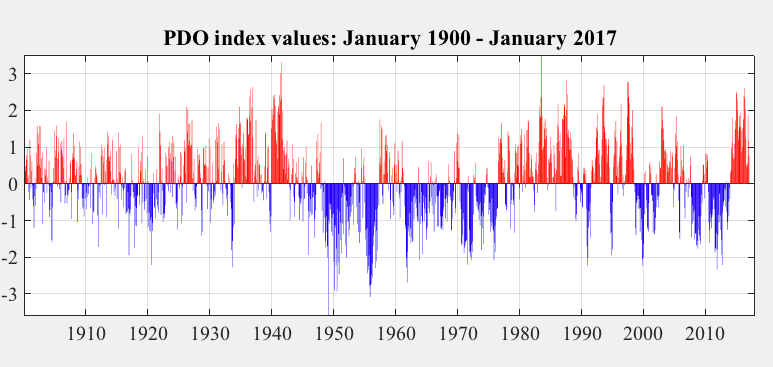
It's not quite compelling if you zoom out his graph for the PDO index.
http://research.jisao.washingt...
As you can see, the index since 2000 has been mostly negative, while we continued record high temperatures.
https://data.giss.nasa.gov/gis...
> it's hard to say things are warmer by 0.03 deg C when your tolerance/error bar is 1 deg C).
Things are warmer by more than 1 deg C, and the error bar is about 0.1 deg C.
-
Re:Call me...
Not really the same, and barely ML, but you reminded me of the work that Steve Brunton is doing. Pretty sweet ideas in physical law discovery for complex systems.
http://faculty.washington.edu/... -
Re:Take that Karl Marx
But you can't deny it's a lot more laissez-faire than the Nordic model.
How little you know.... http://www.heritage.org/index/...
For a little background, that site favors less regulation when it comes to the economy, and if they didn't like a particular country's state of regulation, you'd see it show up. Having said that, they do a pretty thorough job in their measurements, and you can poke through their data if you'd like. As you can plainly see, it places the Nordic countries as being roughly the same as the US.
You've obviously never tried to run a business before if you think the US is AT ALL laissez-faire.
What's that? Just throwing money at a problem without actually changing the underlying socioeconomic model that caused the issue in the first place doesn't fix the problem? Who could have predicted??
And what about the socioeconomic model is different in their case? It's really all the same thing.
I can pick 5 things straight off the bat that haven't been improving:
1. Cost of housing [inflationdata.com].
This doesn't tell you much. The cost of housing has always varied depending on what incomes look like in any given region. What matters, depending on how you look at it, is either the housing opportunity index or the housing affordability index. The HOI, which roughly measures what your mortgage rate would be vs your income, currently sits roughly where it was between 1990 and 2003 at about 60. It went down to about 40 during the 2006 bubble, and went up to around 75 when the market bottomed out, and then has returned back to 60. The HAI measures how affordable the median house price is for the average household, with 100 normalized to mean that the average household has exactly enough income to afford the median priced house. Right now, that index sits at 150ish, which means that the average household makes 50% more than enough to afford the median priced house in their region, though around 2011 it was much higher, but again, this was after the housing crash.
So to put it another way, while housing prices are in fact up, they're no less affordable.
https://www.nahb.org/en/resear...
https://fred.stlouisfed.org/se...In other words, it's very much a moot point.
2. Healthcare costs [killingthebreeze.com].
/facepalm That's not health care costs, that's health care spending.
And if you bother to pay attention, you'll notice that it's increasing globally, practically in lock-step. And the cause of this isn't what you no doubt think it is based on your comment about housing (increased pricing) rather it's because people are adopting bad habits, i.e. being more sedentary, consuming more alcohol, sugar, etc. And this has nothing at all to do with lower incomes or anything like that, rather it's because of the opposite: They can afford be more sedentary, afford more booze, and afford more twinkies. This is one of those things that could be fixed by behavioral/cultural changes, not socioeconomic ones.
Oh, and there's this:
http://www.washington.edu/news...
3. Income inequality [forbesimg.com]. The majority of wages have stagnated while only those at the top have seen their wages increase. Stagnant wages combined with increasing the living costs above is leaving far more lower and middle income families in a precarious position.
I found the Bernie fan! But actually this is highly misleading, and in many ways its an outright farce. I'll show you some hard numbers later, but first, I'm going to give you a lesson in economics:
-
Re:Those were the days.
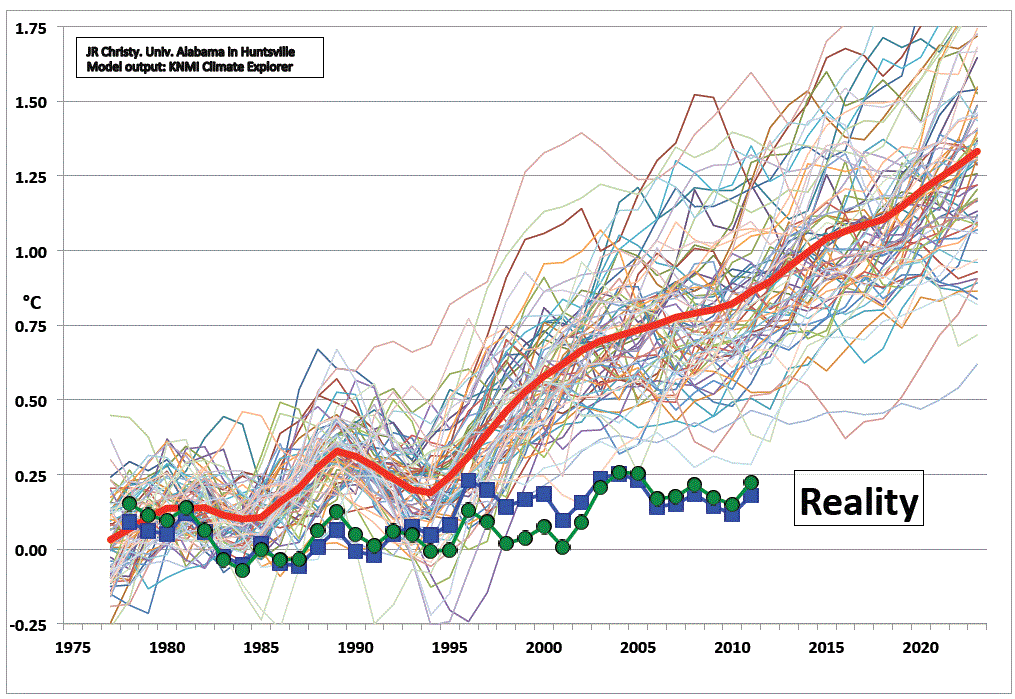
everything is happening faster than expected by all but the most pessimistic models. (Even most of them are being outpaced by reality.)
Wow no, the opposite, the models over-estimate, as multiple studies have shown. Graph.
-
Earlier
Earlier experiments used a partition to separate the left and right visual fields. One experiment I recall reading about was done like this: On one side of the partition they would place an implement, such as a fork. They would then have the subject pick up the implement in one hand and ask them to identify it, and do various things with it. The results were markedly different depending on which side of the partition, and therefore which eye and which hand, were engaged.
Here is some general information on the early experiments.
-
Re:Holy shit, stop the insanity
-
No...you can read the paper here:
-
Re:Battery-free? Really?
So it's able to harvest enough power from radio signals to power the phone *in real time*? Including the screen?
I could understand a technology like this being used to *charge* phones, passively, but they would still require a battery. What happens if you momentarily enter a shielded area that radio waves cannot penetrate? Your phone just instantly dies? That would be terrible.
I *really* hope this is just marketing idiocy, and there is, in fact, a battery incorporated into the design of these devices.
What screen? This isn't a smart phone, it's a very, VERY basic cell phone. No screen included: http://batteryfreephone.cs.washington.edu/
-
Better Links
NYT Link: https://www.nytimes.com/reuter...
Research web site: http://batteryfreephone.cs.was...
Research paper: https://homes.cs.washington.ed...
-
Better Links
NYT Link: https://www.nytimes.com/reuter...
Research web site: http://batteryfreephone.cs.was...
Research paper: https://homes.cs.washington.ed...
-
Re:So what's a good desktop email client?
I might be more incline to go with Alpine email client. I used Pine for several years when I only had a dial-up UNIX account. Not sure if Alpine can handle a dozen email accounts.
-
An amazing probability of failure
They have 170,000 * 500,000 faces, for a total of 85,000,000,000 comparisons. If you have a 99% chance of sucess (ie, NOT identifying grandma as a wanted terrorist), then a 1% failure rate will give you 850,000,000 wrong comparisons.
In tests with football-crowd-sized sets of people, the very best recognizers hit 80% and the worst were below 20% accurate. See http://www.washington.edu/news...
How many people will be pulled out of line, I wonder, before the police notice that the're getting an larger number of false positives than they were prepared to handle? I wonder if it will identify everyone who shows up as a terrorist (:-))
--dave
[The German federal security service noticed this many years ago, when they tried to scan airports with a former employer's product] -
Re:My experience
You have to remember that for many, "reality" is an illusion created by the visual cortex part of your brain. Since it takes time for your brain to decode the input from your visual senses in the visual cortex, in a way your conscious mind is interpreting the recent past as "now". Of course there are always "reactionary" processing from our reptilian brain that work on a faster pace (sound, touch, involuntary reflexes, etc) and these occasionally intrude on our quaint visual cortex consciousness view of "now" to give us the misguided impression that we can somehow anticipate the future (maybe a second or so, the feeling of deja vu or flinching before your see something).
There is evidence that psychedelic drugs like LSD allow for additional intrusions from other parts of the brain into the visual cortex in an often uncoordinated or hallucinatory fashion which leads some to speculate that generates feeling of some sort of break with reality, or one-ness with universe as these novel interactions are interpreted by the visual cortex. Unfortunately, there is also some evidence that LSD also inhibits connections between the visual cortex and the parahippocampus which plays an important role in memory encoding. This might explain why memories of LSD trips are often fleeting leaving only vague impressions in their wake...
If you associate the normal visual cortical view of "reality" as consciousness, maybe you might think of this psychedelic state which causes this disjoint amalgamation of signals in the visual cortex as some sort "higher" or "altered" consciousness, but given the apparent difficulties of recording and learning about perceptions that could be potentially distilled from this state, it's a stretch to say that any specific intrinsic knowledge about the mechanics of self perception could be learned or gained this way, but certainly for many it might enable a different way of looking at things (which might give you insight into something that you know about already or bridge many facts/skills/ideas you already have together into something clever or novel).
As with many systems, it's generally very difficult to discover the nature of the system from within the system, but maybe a researcher armed with MRIs (and neural lace?) might be able to learn something about you and your thought processes by studying you when are tripping. That whole idea of somehow an untrained individual unlocking the knowledge of the universe crap while tripping is not bloody likely...
On the other hand, just like the allegory of the caves, I suspect some that partake in LSD somehow develop the impression that it opens them up to a different type of perception of reality from which they do not want to return, but the sad fact is that it is simply a different reality, not "the" reality (you still don't "see" anymore than your senses, you just have a different take on them, a different perspective so to speak). Your brain is still looking a shadows on the cave wall (but maybe multi-colored and fancy with sound and light
-
Re:Not a huge surprise
Oh, they've been around for much longer than 15 years
Some time in the 1950s after Bürolandschaft, furniture manufacturers managed to convince companies that cubicles increased productivity over the old, open, desks arranged in rows offices [they did increase the furniture maker's profits]
-
Re:Not a huge surprise
they've been around for at least 15 years now
Oh, they've been around for much longer than 15 years. That photo is actually a pretty nice layout with standing drafting tables. Picture a bare room of similar dimensions with row after row of 6 foot metal desks. And the rows are so close together that if you need to get up from your desk, 10 people have to suck in their guts and pull their chairs forward so you can squeeze by to the aisle.
Now, imagine that every fifth person is the idiot nephew of some big shot manager. Who thinks work is all about running sports pools and gabbing about last weeks Seahawks game.
-
Re:What about zoom out ?
-
Yelling "Fire" IS LEGAL
You are not allowed to yell "Fire" in a crowded theater.
This oft-cited sentiment was first verbalized by a Supreme Court Justice in 1919. The case was not about any actual fire or theater, but about a man distributing leaflets and otherwise agitating against World War I draft. The protester was trying to defend his speech by the First Amendment and failed.
As later anti-draft protests — and the legal reaction to them — made clear, such speech is now not only legal, but commendable.
There is a distinct difference between free speech and publishing opinions and instigating hate and crimes.
As the 1919 case I cited above makes regretfully if abundantly obvious, the difference is not at all "distinct", and the country's top legal minds can very well err on the side of oppression. That later-amended decision passed by SCOTUS unanimously...
Even today, a sizable portion of Americans — plenty of lawyers among them — would consider Donald Trump's speech "hateful" and "inflammatory", making it most tempting for the party at the helm of the Executive branch to prosecute him, thus helping their own candidate win. Do you really want a country like that? Oh, wait.... You probably do...
-
Magic Leap tech hunt
I did some digging on the interwebs looking for the real tech behind Magic Leap, surprisingly, I found that they actually do have the key people who invented core pieces of technology, when put together results in a high resolution high frame rare light field display, in other words, digital holography movies where your eye or any camera can actually focus on the near and far objects in a display.
Start by googling the keywords "scanning fiber technology", follow the trail of clues from there and you will quickly realize the tech they have is real and it works. I'll just list a few clues below:
* Scanning Fiber Endoscope, Eric Seibel, Ph.D. 2013, https://www.youtube.com/watch?...
But this is a camera not a display! Yes, the scanning fiber tech works both ways, you can put light sensors or light sources on the other end
* Eric Seibel - Research Professor at University of Washington's Department of Bioengineering, http://www.me.washington.edu/r...
Check out his selected publications on "New displays are a fiber scanned microdisplay and a true 3D display that mimics the natural conditions of depth perception by adding both accommodative cues as well as stereographic cues." first author is Schowengerdt, B.T. who now works for Magic Leap.
* True 3D Displays, https://depts.washington.edu/h...
* 3D Displays using Scanning Laser Projection. SID Symposium Digest of Technical Papers 2012, http://imgur.com/a/IRZK7
* Ultra-High Resolution Scanning Fiber Display for HMDs, DoD Air Force grant, 2013, to Brian Schowengerdt, Magic Leap, https://www.sbir.gov/content/u... -
Magic Leap tech hunt
I did some digging on the interwebs looking for the real tech behind Magic Leap, surprisingly, I found that they actually do have the key people who invented core pieces of technology, when put together results in a high resolution high frame rare light field display, in other words, digital holography movies where your eye or any camera can actually focus on the near and far objects in a display.
Start by googling the keywords "scanning fiber technology", follow the trail of clues from there and you will quickly realize the tech they have is real and it works. I'll just list a few clues below:
* Scanning Fiber Endoscope, Eric Seibel, Ph.D. 2013, https://www.youtube.com/watch?...
But this is a camera not a display! Yes, the scanning fiber tech works both ways, you can put light sensors or light sources on the other end
* Eric Seibel - Research Professor at University of Washington's Department of Bioengineering, http://www.me.washington.edu/r...
Check out his selected publications on "New displays are a fiber scanned microdisplay and a true 3D display that mimics the natural conditions of depth perception by adding both accommodative cues as well as stereographic cues." first author is Schowengerdt, B.T. who now works for Magic Leap.
* True 3D Displays, https://depts.washington.edu/h...
* 3D Displays using Scanning Laser Projection. SID Symposium Digest of Technical Papers 2012, http://imgur.com/a/IRZK7
* Ultra-High Resolution Scanning Fiber Display for HMDs, DoD Air Force grant, 2013, to Brian Schowengerdt, Magic Leap, https://www.sbir.gov/content/u... -
Re:Closure and Threads...
It's the other way round: closures shot dynamic binding dead. In general, lexical scoping is better for programming languages than dynamic scoping, in both theory and practice.
There's lots of information on the Internet about this but here's a quick link: https://courses.cs.washington....
Javascript has both lexical and dynamic scoping: 'this' is dynamically scoped and everything else is lexical. While 'this' is used extensively in Javascript, it's really a mistake. You can do all the useful 'this'-style things with closures alone, and it's easier to reason about.
-
Re:Why?
Overview: http://web.stanford.edu/dept/n...
The conclusion - men are pigs. From the article, the first and foremost reason : Overt sexism, unwanted attention and sexual harassment create hostile working conditions.
The biggest problem in our workplace between men and women was the men were concerned that by saying the wrong thing, they were going to be fired. So communications with women were very guarded. That certainly isn't a friendly situation, but completely understandable. If you don't have a reason to talk to someone who can have you fired, you probably won't.
A lack of role models for women in technical fields is discouraging. "When faculty members are looking for the next person to win a Turing Award, which is computer science's Nobel Prize, they tend to look for people like the last ones who won such awards. This usually involves looking in the mirror,” Roberts said.
Seriously? a lack of women in technical role models? Here's 90 of them http://womenshistory.about.com... Here's 90 of them http://discovermagazine.com/20...
http://www.mnn.com/leaderboard... Some random ted talks, all by female scientists: https://www.youtube.com/watch?... https://www.youtube.com/watch?... https://www.youtube.com/watch?... https://www.youtube.com/watch?... https://www.youtube.com/watch?... https://www.youtube.com/watch?... https://www.youtube.com/watch?... https://www.youtube.com/watch?...
https://www.youtube.com/watch?... https://www.youtube.com/watch?... https://www.youtube.com/watch?...
And if you want yound ladies to have especially physically attractive role models there's always : https://science.jpl.nasa.gov/p... a physicist/Astronomer who manages to not look like the stereotype egghead.
So all I have to say, if Herr Professor hasn't found female role models to present to his students, well - that is his fault not menarepigs
His study is the typical "women are weak" model, where any negativity causes tehm to seek other careers, which presumably have no sexism and all men are perfect gentlemen. He can rail on about his women's school model for a million years, but it won't cure the problem.
Study on one aspect: https://depts.washington.edu/s...
So the problem appears that if a female encounters any stereotype that she disagrees with, it completely destroys her interest.
Movie: http://www.bigdreammovement.co...
I should come up with a list of links to copy/paste, that lot was just a quick Google search.
So - does this mean that there was something wrong with any woman who did not allow herself to be intimidated out of a science career that she was passionate about, but the passion was killed by anyone that didn't give her positivity?
I don't know specifically
-
Re:Why?
Overview: http://web.stanford.edu/dept/n...
Study on one aspect: https://depts.washington.edu/s...
Movie: http://www.bigdreammovement.co...
I should come up with a list of links to copy/paste, that lot was just a quick Google search.
-
Honor him every five year til the end of time_t
I intend to honor him on my twitter feed every five years until 2038 to allow him four more honors. Then my plan is to curse the day he was born before 1970 leading to a signed time_t!
Also, every 5 years, the anti-forward of the Unix Haters Handbook should be read aloud.
UHH is available for free at: http://homes.cs.washington.edu/~weise/uhh-download.html
-
Re:Cannot happen in earth, period.
Leftist global warming myths again run amok but the facts are as follows:
"However, Venus is closer to the sun than Earth and receives far more sunlight. As a result, the planet's early ocean evaporated, water-vapor molecules were broken apart by ultraviolet radiation, and hydrogen escaped to space. With no water left on the surface, carbon dioxide built up in the atmosphere, leading to a so-called runaway greenhouse effect that created present conditions."
Wrong. Venus has an albedo of 0.8 meaning it reflects 80% of the light from the sun. 2643W/m2 * 20% = 530W/m2. Earth has an albedo of 0.3, so it reflects about 30% of the light from the sun. 1370W/m2 * 70% = 959W/m2. Venus has about twice as much incident light, but reflects most of it. Earth absorbs roughly TWICE as much energy from the sun as Venus does. The difference in temperature is caused by the greenhouse effect.
-
Re:Looking at the wrong branch of physics to trash
Those quantities are certainly mathematical dimensions. What is meant by 'hidden dimensions' is hidden spatial dimensions, i.e. directions, orthogonal to the perceived three. I've not kept up with the field, but last I recall these were theorized to be rolled up on very small scales. So something could move 'in the purple direction' by ±1e-9m at most - moving +2 being the same as moving -1 in a simplified version, as it's rolled up like a straw (iirc there are far more complicated shapes suggested for these dimensions).
One possibility of detecting these is if gravity isn't confined to the normal three dimensions, then at small scales it will not obey an inverse square law, but will 'bleed off' into the other small dimensions. Tests have been made to submillimeter scale, but that's far larger than I believe has been posited for the size of the extra dimensions.
-
Re: Nothing surprising hereWell, I'm getting good confirmation of my understanding - which you share to some degree - that there was a hange in grass abundance in the not-too-distant past. From http://www.ucmp.berkeley.edu/t...
The Miocene Epoch, 23.03 to 5.3 million years ago,* was a time of warmer global climates than those in the preceeding Oligocene or the following Pliocene and it's notable in that two major ecosystems made their first appearances: kelp forests and grasslands. The expansion of grasslands is correlated to a drying of continental interiors as the global climate first warmed and then cooled.
That's just a bit confusing - is it a "first appearance" of grasslands, an "expansion of grasslands, or possibly an appearance followed by an expansion. Also note that they're careful to talk of the ecosystem "grassland" rather than specific grass species.
A book on palaeopedology (the science of studying ancient soil deposits ; do I need to point out that changing from (say) open forest to grassland will affect soil structure in ways that will be detectable?) talks on the changes in spore abundance, with diagrams. See particularly fig 20.3 on p.303.
Ah, I'd forgotten about that. C3 versus C4 plants. The Neogene transition from C3 to C4 grasslands in North America: assemblage analysis of fossil phytoliths I'd forgotten bout the C3-C4 transition. (I'm not a plants or fossils person - more high grade metamorphics for me. Plus shit-bagging for pay.)
The rapid ecological expansion of grasses with C4 photosynthesis at the end of the Neogene (8-2 Ma) is well documented in the fossil record of stable carbon isotopes. As one of the most profound vegetation changes to occur in recent geologic time, it paved the way for modern tropical grassland ecosystems.
This was a major change. There was discussion a couple of years ago about using genetic engineering to copy the C4 carbon fixation path from grasses into other crop plants for IIRC a 20% improvement in efficiency. Worth considering, but a lot of work, and not popular with the Greens.
... this broadly synchronous change, long after the evolutionary origin of the C4 pathway in grasses. To date, these hypotheses have suffered from a lack of direct evidence for floral composition and structure during this important transition.
And the paper I'm quoting then provides evidence of the change. The paper is open access, so you cn sweat it as much as you like, but the clearest indicator of change I can see is a decline in tree cover in their study area through the time interval - fig 4-A
The increase in abundance of grasslands in the Miocene is well established, even if the actual families of grasses evolved much earlier. Which does rather raise the question of why it took so long between evolution of the grasses and the development and increase of the grassland ecoystems of the world. That's a good question.
-
Re:Democratization
Our corporate friends tried to privatize that too.
We just need to make the internet an ad hoc network, impossible to shut down or censor. This client/server setup is too easy to manipulate and is wide open to many attack vectors.
-
Re:Yes, if you're on your phone for nine hours a d
The exact opposite occurs, RF absorption in this case is based on physical dimensions.. A larger mass==worse, especially more than 40mm or more per dimensional vector. This also applies to hard radiation, smaller animals can tolerate higher radiation exposures, because much of radiation passes through tiny animals without impacting DNA, and other critical cellular functions.
As for 9 hours day for a 2 year old rat verses 1 hour a day fora human who has a lot more than 9x the lifespan.
As for low signal, that's a function fo the experimental animal's small mass in general, and a similar issue for brain size..
-
Over a decade?
This was hinted at much longer than a decade ago:
"The idea that Europa and other ice-covered bodies in our solar system might possess an ocean of liquid water under a crust of ice was first proposed by John S. Lewis in his paper Satellites of the Outer Planets: Their Physical and Chemical Nature (which appeared in Icarus, vol.15, 1971)." (source: https://www.math.washington.ed...)
And I recall Carl Sagan talking about life on Europa in his Cosmos television show, back in the 80s.
But astrobiology has come a long way since then. I'm halfway through Nick Lane's "The Vital Question" and he goes into detail about the mechanisms which can form complex cellular structures given nothing but alkaline water, hydrocarbons, rock (to supply catalysts), and an energy source.
-
Re:What makes Microsoft Exchange so damn special?
My thought was that for a single user (ie, minus any of the group/shared functionality of Exchange or other groupware concepts) IMAP wouldn't have been a terrible way to interact with remote data storage.
It's been done. It was done long ago. It did not blunt the momentum of other solutions.
Here's the docs for Pine's remote address book, as one implementation: https://www.washington.edu/pin...
Here's a huge list of ways to share/copy/sync/etc address books to/from Thunderbird: http://kb.mozillazine.org/Shar...
The ones that won for address books are LDAP and CardDAV.
Calendaring is quite different and separate from email, except in sending/receiving invites, so it's always a separate system. The invite stuff is solved with CalDAV and/or iCalendar. -
Re:No winners here.
a kernel module is not a derivative work unless it contains some significant portion of kernel source code above and beyond any data types and function names contained in the headers. Galoob v. Nintendo made this pretty clear
Whaaat??? Galoob v. Nintendo did nothing of the sort, the court found that a "product that allowed users to alter codes transmitted between video gaming console and game cartridge did not infringe console manufacturer’s exclusive right, under federal copyright law, to create derivative works". Your interpretation is wildly creative.
A central point that will be argued is whether a work that relies substantially on the interfaces of the Linux kernel is a derivative work. Though I haven't researched it deeply, my impression is, that's a pretty solid yes.
I would suggest this article from the software pluralism site on University of Washington School of Law's website. After you read it, I think you'll come to the same conclusion—that a filesystem that exists on other platforms cannot possibly, by any stretch of the imagination, be considered a derivative work of the Linux kernel, and thus cannot be tainted by the kernel's GPL license in any way, shape, or form. As a result, the Software Freedom Conservancy's conclusions are likely in error.
The arguments there did not persuade me, and neither did your presumptive conclusion. You're clearly aware of the importance of the derivation question, but imho, your interpretation is incorrect and likely to fail. It's enough for only part of the work to be derivative to constitute a violation.
Your link provides little in the way of case law and a lot in the way of speculation. You might consider doing a little more research yourself, perhaps focusing on the GPL paragraph 5 observation that "nothing else grants you permission to modify or distribute the Program or its derivative works". Canonical proposes to distribute the Zfs binary and Linux binary together. Their argument that the GPL v2 grants them the right to do this is very leaky indeed.
In any case, settling the question will be a source of endless entertainment. After all this work, we deserve some entertainment, don't we?
[1] Title 17, Chapter 1, Section 117a(1)
Eek, a straw man that conflates copying with derivation. Let's just forget about that.
-
Re:No winners here.
Wow, I'm just floored by the lack of understanding I see here. Look, a Linux kernel module is just a chunk of memory saved on disk along with some information needed to fix up the bytes that need to change in order to run it at some particular place in memory. To load it, Linux just copies the contents of the module from and does the necessary fixups. There is no question whatsoever that the result of that is a single binary. That's just basic computer science. Very very basic. Very very very basic.
Technically, yes, but legally speaking, that's not actually the case. When we talk about a single binary, we're talking about a single binary in non-ephemeral form. At least in the U.S., copyright law[1] grants a very broad exemption for ephemeral copies of software that exist solely in memory, and solely for the purpose of executing code. Under U.S. law, executing a program is not legally considered making a copy, so that ephemeral copy is not a copy, which means that the single binary does not exist, for legal purposes.
As a result, merely linking a kernel module does not cause it to be a derivative work of the kernel. More to the point, a kernel module is not a derivative work unless it contains some significant portion of kernel source code above and beyond any data types and function names contained in the headers. Galoob v. Nintendo made this pretty clear.
For further reading, I would suggest this article from the software pluralism site on University of Washington School of Law's website. After you read it, I think you'll come to the same conclusion—that a filesystem that exists on other platforms cannot possibly, by any stretch of the imagination, be considered a derivative work of the Linux kernel, and thus cannot be tainted by the kernel's GPL license in any way, shape, or form. As a result, the Software Freedom Conservancy's conclusions are likely in error.
-
Re:We need to lose about 80% of the population, st
Why in the world is this modded +5 Insightful? Climate scientists have drawn a link between climate change and smog. And last I checked, "climate" referred to long term weather patterns. When the government has to issue several dozen smog alerts for a single city within a single year, that's climate.
-
Re:WRONG!
We could eliminate about 75% of the marketing and advertising industry at the bottom of the ocean, and society would benefit substantially,
As they say, half of advertising spending is wasted, but nobody knows which half.
-
Re: And what if we were just colder 160 years ago
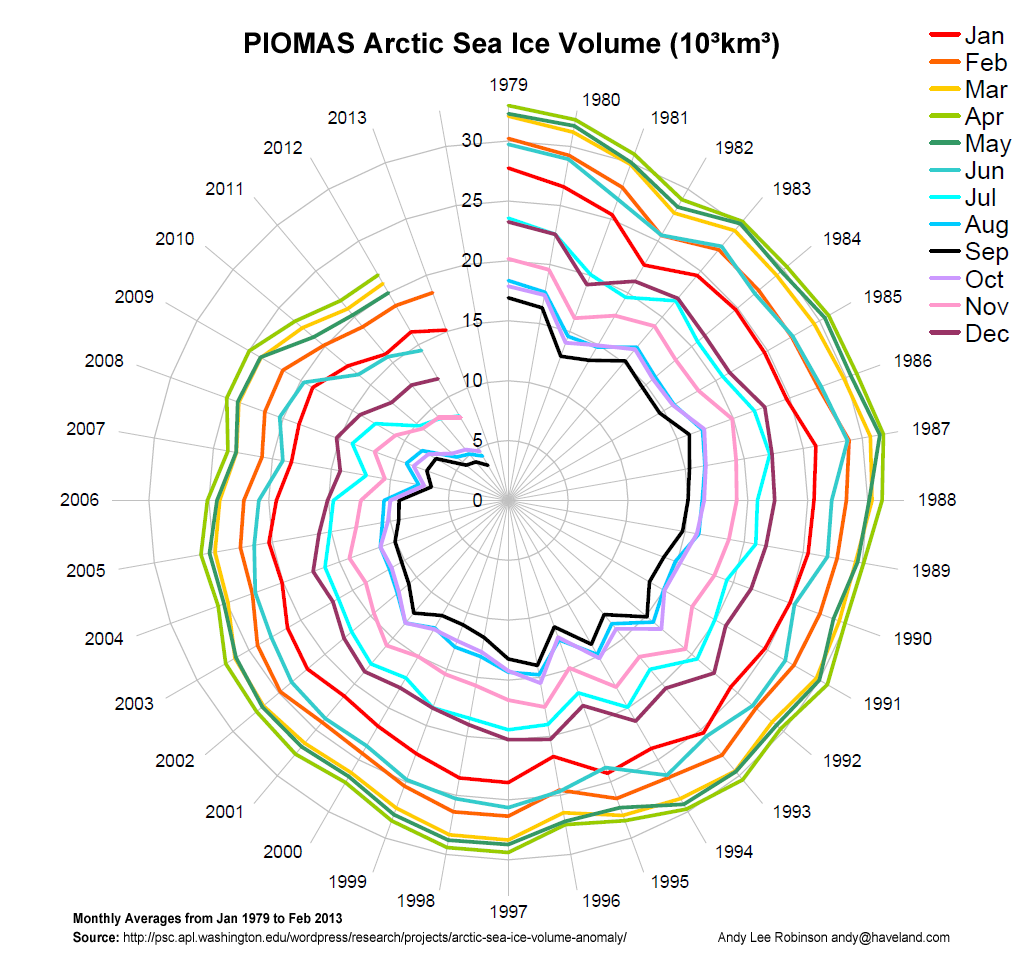
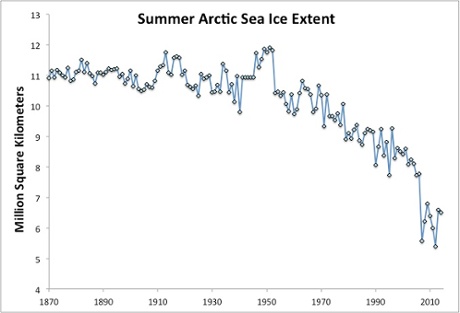
Neither the Arctic ice extent (area), nor volume, is roughly equal to the mean of the last few decades.
I really don't get what either of you is arguing, you're both making false claims.The infamous death spiral graph, showing monthly volume from 1979 to 2015:
http://skepticalscience.com//p...Summer ice extent from July to September (the minimum period) from 1870 to 2014 (as mention above, 2015 is the 4th lowest extent, in between 2011 and 2008):
http://static.guim.co.uk/sys-i...Average monthly extent from 1979 to 2015:
https://polarbearscience.files...ice volume trend graph 1979-2014:
http://psc.apl.washington.edu/... -
English is not Spanish
heuristic rules that don't reflect well probabilistic attacks
In English, the direct object ("probabilistic attacks") immediately follows the verb ("reflect"), as in "heuristic rules that don't reflect probabilistic attacks well". The adverb ("well") is placed either immediately before the verb or after the direct object.
See this page for more explanation. Please don't consider this an attack on your grammar, but rather a gentle nudge in the right direction. What you wrote may sound good in a Latin language like Spanish, but to a native English speaker, it's butchered.
-
Love the old news
http://courses.cs.washington.e...
Personal area networks using you as the cable. 1996 pretty sure this wasn't even the first.
-
Re:Here's the problem
"We reserve the authority to restrict distribution and sue you if you don't follow our requirements" How do you do that? With a license.
How do you enforce said license? With copyright law.
I recall someone saying that companies can be wary of a 'bare license'. They prefer to have a purchase contract accompany a commercial software license, which elaborates inter-party financial or other penalties for violation, rather than relying on local and federal laws for enforcement.
I couldn't find the original reference, but this document describes some of the legal and situational differences between a bare license and one accompanied by a contract.