Slashdot Mirror
Domain: wikimedia.org
Stories and comments across the archive that link to wikimedia.org.
Comments · 6,832
-
Re:Two things...
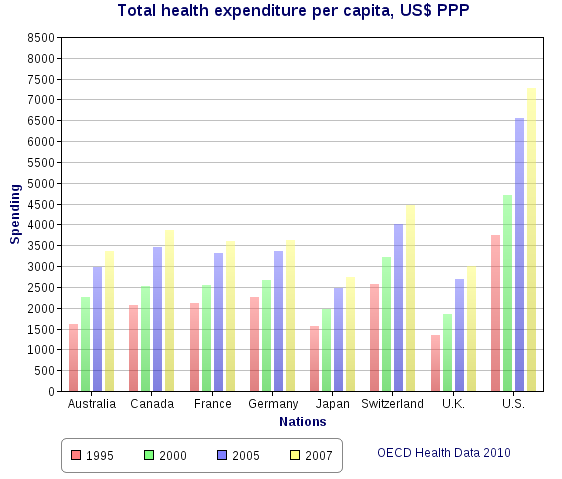
http://upload.wikimedia.org/wikipedia/commons/8/80/Total_health_expenditure_per_capita%2C_US_Dollars_PPP.png
Historical data tells approximately the same story. Everybody's health care costs have gone up by about the same percentage, regardless of country. US costs started higher, and they remain higher. -
Delphi method
I think Wikipedia moderation should use https://secure.wikimedia.org/wikipedia/en/wiki/Delphi_method
-
Re:Two things...
Additionally, that slow depreciation is what allows the US to stay competitive.
Really ? In that case I'm curious what the trade balance would have looked like in the last decade if they hadn't been so competitive.
-
Re:Clear now: A common open CAD data structure nee
Well, there are a few "open" CAD data formats that could be used:
1. STEP (ISO10303)
2. CGM (ISO/IEC8632)https://secure.wikimedia.org/wikipedia/en/wiki/ISO_10303
https://secure.wikimedia.org/wikipedia/en/wiki/Computer_Graphics_MetafileHTH
AC -
Re:Clear now: A common open CAD data structure nee
Well, there are a few "open" CAD data formats that could be used:
1. STEP (ISO10303)
2. CGM (ISO/IEC8632)https://secure.wikimedia.org/wikipedia/en/wiki/ISO_10303
https://secure.wikimedia.org/wikipedia/en/wiki/Computer_Graphics_MetafileHTH
AC -
Re:Easy reason
More and more, huge tracts of Wikipedia make it look like the online compendium of popular culture, rather than a place to find out about possibly obscure but real world topics, inventions or discoveries.
This is precisely the problem with deletionist mentality. Wikipedia does not have a "real world balance" policy. People write about things they are familiar with and knowledgeable about, and so popular culture, by definition, will receive a disproportionate amount of attention.
It is not up to administrators to pass judgement on the "validity" of topics in some effort to maintain an ideology.
http://meta.wikimedia.org/wiki/Wiki_is_not_paper -
Re:ooo ooo!
It is a fine idea, but like so many fine ideas, IT DOES NOT WORK, in the real world.
I'm not going to go into why people won't make the same mistakes as you did in a different market, let's look at some more quantifiable stuff:
-
Re:References, all the way down
If(1) you(2) have(3) to(4) cite(5) every(6) single(7) word(8) and(9) punctuation(10),(11) the(12) articles(13) are(14) going(15) to(16) get(17) hard(18) to(19) read(20).(21)
We're dead of we have to recursively cite parentheses.
https://secure.wikimedia.org/wikipedia/en/wiki/Malicious_compliance
-
Re:Easy reason
I think the breaking point came when new sister projects essentially stopped being developed. I spoke up as bluntly as I could put it when the New Project Policy page on the Wikimedia Meta project was declared an obsolete historical page. Mind you, that page has not been made historical because a new policy was developed to replace it, but rather because no new Wikimedia projects are being developed.
Essentially, the Wikimedia Foundation killed the leavening yeast that helped to cause the projects to grow along with the people who had the creative energies to make things happen. When you do that, the project dies. Those people move onto other things when that happens, and indeed they have. You now have Facebook, Twitter, YouTube, and many other "social network" sites that didn't exist when Wikipedia was starting out. The fact that those in charge really don't care that the spark of energy which built Wikipedia in the first place is gone and that they killed that spark speaks volumes about why Wikipedia is losing contributors and participants.
Jimbo didn't help by essentially killing Wikibooks and Wikiversity either, but that is another completely different story even though it is a variation on the theme here. You don't drive away those who have the creative spark, particularly from volunteer organizations. You can and must treat volunteers differently.
-
Re:Easy reason
I think the breaking point came when new sister projects essentially stopped being developed. I spoke up as bluntly as I could put it when the New Project Policy page on the Wikimedia Meta project was declared an obsolete historical page. Mind you, that page has not been made historical because a new policy was developed to replace it, but rather because no new Wikimedia projects are being developed.
Essentially, the Wikimedia Foundation killed the leavening yeast that helped to cause the projects to grow along with the people who had the creative energies to make things happen. When you do that, the project dies. Those people move onto other things when that happens, and indeed they have. You now have Facebook, Twitter, YouTube, and many other "social network" sites that didn't exist when Wikipedia was starting out. The fact that those in charge really don't care that the spark of energy which built Wikipedia in the first place is gone and that they killed that spark speaks volumes about why Wikipedia is losing contributors and participants.
Jimbo didn't help by essentially killing Wikibooks and Wikiversity either, but that is another completely different story even though it is a variation on the theme here. You don't drive away those who have the creative spark, particularly from volunteer organizations. You can and must treat volunteers differently.
-
Re:Easy reason
Wikipedians hold meetups in pubs from time to time:
http://commons.wikimedia.org/wiki/Category:Meetups_in_London
-
Re:Easy reason
This may be an unpopular theory, but I think Wikipedia's shrinking community has little to do with the admins behavior. I've only personally heard about their poor behavior from 3rd, 4th, or 5th hand accounts. But that's purely anecdotal and a side-tangent.
I think the reason the community is shrinking is because Wikipedia, at least the English version, is complete. I'm not implying that there isn't more information that can be added, but as far as the sum of human knowledge goes, I'd guess that they have gotten past that "magic" 95% marker for easily acquired knowledge. Most of the remaining work to be done is article maintenance, and filling in mundane details of niche articles or emerging fields. The days when 5th graders wrote articles on your home town or park near you is gone. My quaint home town article for Rockford, MI (a town with less than 5000 people) is nearly 3 pages long! (I can't believe there was enough to even fill in 1 page, after the generic census data...),
This isn't a bad thing. It's the natural evolution of such a site. Wales should pat himself on the back and congratulate the community for his contribution to society as a whole. Wikipedia is a job well done and has moved our world forward in a positive direction, in what is becoming a rarer achievement every day. -
Re:Openness
Most of their products are also either so crippled (Chronium) or limited by other means (Android and HW makers drivers) that they're practically unusable for real use or development.
Really. What about all the third-party manufacturers making Android devices without a license from Google (Archos comes to mind, although in retrospect they might have a license... point is they don't need one)? Or how about CyanogenMod or other modifications for Android based on the OSS part? Lots of people use them, and they work on lots of phones. That is precisely the advantage of OSS that you claim Google doesn't allow. And what "stripped parts"? According to Wikipedia, the entire Android OS made by Google, including the telephony part, is OSS. The only closed source part is the Marketplace, and that should have obvious reasons. (also, it isn't technically part of the OS) Honeycomb, of course, isn't OSS ATM, but again, they have good reasons for that.
Android is most absolutely not closed-source like its competitors. Seriously, is iOS open in absolutely any way whatsoever? What closes Android down on phones are Samsung etc. locking down the phone in hardware. HTC, IIRC, allows their phones to load custom firmware with no modifications or hacking needed. I know you keep saying "Google isn't the geeky company they used to be", but honestly, I've never seen you offer any real evidence of that.
As for Chrome/Chromium, well, there you have a point. Google is an odd kind of open source company. Their business doesn't depend upon releasing code and community development, like many such companies do (Red Hat, Mozilla, etc.) they do it more because they want the community to have it than anything else. And that, IMO, makes them even more of a geeky company than others that are more concerned with being open sourced because they rely on it. Google releases open source whenever it is practical for them to do so, but they don't rely on open source development like many companies do (or not in the same way) which leads me to suspect that releasing the source code is more an act of good faith than anything else.
-
Re:Don't forget.....
Change your sports tastes. I stopped watching Baseball and started watching Soccer. I get an AMAZING amount of all I can eat free HD soccer and Rugby from FTA satellite that is brain dead easy to install. Costs nothing but the $199 receiver and the $99.00 dish and pointer and a weekend to install it.
https://secure.wikimedia.org/wikipedia/en/wiki/Free-to-air
http://www.gosatellite.com/ is where I shop... as well as
http://www.sadoun.com/Works great, and is wife friendly as well. Plus if you are not a typical american it opens up a TON of international programming as well.
-
Re:Tor?But your dog isn't (I assume) a political activist. Facebook doesn't go out of its way to track down accounts with false names, but if someone complains that your account has a false name, it will be suspended until you provide legal documentation of the name, such as a passport or driver's license.
This has happened, and continues to happen, to activists around the world. Michael Anti, the Chinese journalist, was one high-profile case. There's a Facebook fan page about him, but he's no longer allowed to have a Facebook account.
-
Re:Where is the cash?
this article is interesting (I'm not able to check the validity).
some highlights:
- Sweden tried to implement a neutral Scandinavian block but failed ultimately as Denmark and Norway joined the NATO.
- Finland signed a treaty of friendship with the Soviet Union and regarded itself as strictly neutral. The US used the status of Finland as example for a successful co-existence with the SU while still remaining independent and neutral.
- While exporting of strategic goods and technology to neutral states was forbidden the US included the neutral countries in the economical import/export networkA Wikipedia article claims that "the U.S. promised to provide military force in aid of Sweden in case of Soviet aggression. Knowledge of this guarantee was by the Swedish governments kept from the Swedish public until 1994, when a Swedish research commission found evidence for it" - unfortunately without source.
-
Re:Inefficient
I said most of that in my original post - I do my washing in the house, and use a tumble dryer. Almost all of my food is cooked at home. Heating is gas, that adds about another 50% to my total household energy consumption. Electric heating is insanely wasteful, pretty much no one in the UK uses it except for occasional top-ups (e.g. fan heater in a cold room), and the topic at hand was electricity usage, not total energy usage, so I didn't include that.
If you want to move beyond anecdotes and see some actual statistics, let's look at per capita energy consumption. The US average is about double the UK average, and we're at the high end of consumption for Europe - France and Germany consume less, with a similar standard of living.
-
Re:So They're Either Lazy or Stupid
There's also a level of semi anonymity. My real name isn't actually mooingyak (I bet that made you gasp).
And this is what is most galling about Facebook (and now Google+)... they're not only against anonymous activity, but also pseudonymnous identities as well. Pseudonyms have been used for centuries as a way of having an identity that is separate from your physical being. Most gamer luminaries have psuedonyms. Here are some of the more famous pseudonyms:
- George Orwell
- Ayn Rand
- Banksy
- Joseph Stalin
- Voltaire
I would venture to say that pseudonymous contributions can have a higher signal to noise ratio than both anonymous and fully attributed ones simply because contributors are both divorced from their personal identity yet still have a vested interest in maintaining decorum (through the use of social means and moderation - ie,
-
Re:So what.
The study said that the average IQ for IE users was 80. If they'd said 95, then it might have been plausible, but 80 means functionally illiterate and basically unable to function in society.
According to the Wikipedia page on Intelligence quotient, modern IQ tests define the median result of a standard sample as 100 points, with a standard deviation of 15 points. 95 percent of the population have scores that fall within two standard deviations of the mean, meaning they fall between 70 and 130 points.
The bell curve from the article is here.
-
Re:Rosetta Stone Chinese, anyone?
Every comrade knows, Soviet Russian SLFP are bigger than American SLFP. Soviet Russian SLFP are biggest SLFP! Sing to the Motherland home of the FREE!
-
Re:How was this going to work?Thanks for the correction, but that really leaves me wondering about the following statement from Wikipedia from which I had based my original thoughts from:
https://secure.wikimedia.org/wikipedia/en/wiki/Americium#Production_of_other_elements
"Americium is a starting material for the production of other transuranic elements and transactinides – for example, 82.7% of 242Am decays to 242Cm and 17.3% to 242Pu. "I guess this transition only happens if you irradiate it with an external neutron source?
-
population is logistic, not expnential!
No kidding! Population is a Logistic Curve, not an exponential one. It only looks exponential because we haven't hit the inflection point yet (for the total world population anyway; developed nations have hit the inflection point and Japan is at the asymptote).
-
Re:Too much rhetoric over the wrong things.
It's not just software patents, that's bullshit. Patents are bad in all fields of technology, full stop.
Just look at Edison's patent trolling. Or how US patents of Wright brothers made the US the only side of WW1 without planes usable in war. Or the effects of patents on medicine.
-
low-res images are the best!
How can they possibly be misinterpreted! https://secure.wikimedia.org/wikipedia/en/wiki/Cydonia_(region_of_Mars) The human senses are the least reliable form of identification. They're programmed to see certain things, and to fit an image into their expectations when they're not.
-
Re:Sad new paranoid world
I thought about this too. We have such a broken education system to the point that its because a bureaucratic paper pushing institution and a poster child for election campaigns.
I think I understand the intent of this law but teachers can often inspire their students to reach for great achievements if they're allowed to interact with their students and not have to treat them like drones. The type of teacher I'm talking about are ones like Erin Gruwell. -
Venezuela
The nationalizing trend started in the 60ies, about the time Opec formed; many countries found out they could earn much more by controlling the business directly, and in many, the private (often foreign) companies paid very little (or none) of taxes/royalties for extraction/processing/distribution/export, etc.
That was the case of Venezuela, for a hundred years, US corporations extracted the best lighter Oil and burned immense natural gas reserves and even heavier crude in the way. In 1975 the whole industry was nationalized, but it was done to benefit the foreigners and corrupt politicians of the time, because their (many decades long) permits were about the expire a few years later and the nation would not need to pay them to leave.
The current Venezuelan oil is heavier, and less valued because it needs more effort in processing, which is why Venezuela has so many (not very profitable) refineries, even in the USA.
Venezuela opened foreign private and state owned corporations the chance to form joint ventures with PDVSA to extract the heavier oil in the Orinoco belt, with the State owning a portion of shares, and higher royalties per barrel export. Only 2 US corporations left the zone when a previous deal was made void, everyone else stayed and even more came (from Asia and elsewhere).
Big state owned oil corporations are nothing new and will not go anytime soon. It is far more lucrative for most countries to have it that way. Political tensions with Venezuela are a decision of US administration, in line with their global policy for domination clashing with nationalistic positions (daring not let US corporations milk away all the profits). Nothing new and widely know outside USA for decades, if not centuries.
-
Venezuela
The nationalizing trend started in the 60ies, about the time Opec formed; many countries found out they could earn much more by controlling the business directly, and in many, the private (often foreign) companies paid very little (or none) of taxes/royalties for extraction/processing/distribution/export, etc.
That was the case of Venezuela, for a hundred years, US corporations extracted the best lighter Oil and burned immense natural gas reserves and even heavier crude in the way. In 1975 the whole industry was nationalized, but it was done to benefit the foreigners and corrupt politicians of the time, because their (many decades long) permits were about the expire a few years later and the nation would not need to pay them to leave.
The current Venezuelan oil is heavier, and less valued because it needs more effort in processing, which is why Venezuela has so many (not very profitable) refineries, even in the USA.
Venezuela opened foreign private and state owned corporations the chance to form joint ventures with PDVSA to extract the heavier oil in the Orinoco belt, with the State owning a portion of shares, and higher royalties per barrel export. Only 2 US corporations left the zone when a previous deal was made void, everyone else stayed and even more came (from Asia and elsewhere).
Big state owned oil corporations are nothing new and will not go anytime soon. It is far more lucrative for most countries to have it that way. Political tensions with Venezuela are a decision of US administration, in line with their global policy for domination clashing with nationalistic positions (daring not let US corporations milk away all the profits). Nothing new and widely know outside USA for decades, if not centuries.
-
Venezuela
The nationalizing trend started in the 60ies, about the time Opec formed; many countries found out they could earn much more by controlling the business directly, and in many, the private (often foreign) companies paid very little (or none) of taxes/royalties for extraction/processing/distribution/export, etc.
That was the case of Venezuela, for a hundred years, US corporations extracted the best lighter Oil and burned immense natural gas reserves and even heavier crude in the way. In 1975 the whole industry was nationalized, but it was done to benefit the foreigners and corrupt politicians of the time, because their (many decades long) permits were about the expire a few years later and the nation would not need to pay them to leave.
The current Venezuelan oil is heavier, and less valued because it needs more effort in processing, which is why Venezuela has so many (not very profitable) refineries, even in the USA.
Venezuela opened foreign private and state owned corporations the chance to form joint ventures with PDVSA to extract the heavier oil in the Orinoco belt, with the State owning a portion of shares, and higher royalties per barrel export. Only 2 US corporations left the zone when a previous deal was made void, everyone else stayed and even more came (from Asia and elsewhere).
Big state owned oil corporations are nothing new and will not go anytime soon. It is far more lucrative for most countries to have it that way. Political tensions with Venezuela are a decision of US administration, in line with their global policy for domination clashing with nationalistic positions (daring not let US corporations milk away all the profits). Nothing new and widely know outside USA for decades, if not centuries.
-
Unconstitutional
$10 says this law doesn't trump the freedom of Association that enshrined in the US Constitution. It will fall with the first challenge.
https://secure.wikimedia.org/wikipedia/en/wiki/Freedom_of_association#United_States_Constitution
-
Re:Is this even possible?Its possible is you are building an RTG reactor. Its not much more than using the Seebeck effect (temperature differential) to generate electricity.
Radioisotope thermoelectric generator
https://secure.wikimedia.org/wikipedia/en/wiki/Radioisotope_thermoelectric_generator -
Re:Yeah, and I am a Pony
This looks a lot like sparse voxel octrees. As a concept, SVO is nothing new at this point, and id has been considering using it as part of their id Tech 6 engine.
A sparse voxel octree is basically a hierarchical structure for points in 3D space. The advantage of using a hierarchical structure is that you can stop looking at any time, and so zooming works very well: you just traverse the tree until you get so far down that further detail won't be visible, then you render. If the player moves closer, that simply means you'll go further down the tree, but you'll cover a smaller space so the load doesn't really change.
Now, the sparse voxel octree both gives and takes away. It enables detail at all scales, but since the structure is hierarchical (log n insertion and deletion, AFAIK), moving large numbers of points about is going to be really hard, not to mention actual deformation or changes of the objects themselves. One would probably use an SVO to show world detail: landscapes and "3D textures" - and then use simple polygon skeletons for collision detection, moving critters around, etc.
Sparse voxel octrees work, and they work very well on the kind of static-but-detailed data shown in the demos, so it seems quite likely that's what they're doing. But sparse voxel octrees aren't New And Revolutionary Unique Technology only available to the Australians here. Here's an nVidia demo, another demo (not by nV), and an example of the kind of tricks you can do by combining SVO and procedural generation. -
Re:...and...?
Yes, patents bad, boo hoo. When you're a small independent startup, sure, let's talk about how crappy patents are. When you're a billion dollar a year mega corporation, pay the damn licensing fees.
I fear you misunderstand the patent system. There generally aren't licensing fees, and if there are then they're guaranteed to be exorbitant as IP owners can charge what they wish. If you can get the patent granted, than you can do whatever you wish with both the patent subject and the people unlucky enough to have implemented it. Read up about submarine patents and you'll understand what I mean.
-
Internet usageThis is a statistic I watch. Mostly I am curious about Android usage, as well as other mobile usage, versus desktop usage. I'm also interested in desktop Linux usage.
Alexa shows Wikipedia to be the 7th most popular site on the web. Wikipedia is unique in that it is one of the few top sites not run for profit. Consequently, they allow open traffic analysis of their web traffic to some extent, which I have found very useful. Here is what operating systems hit Wikipedia web sites in June 2011. They have that data for May, April and so forth. I made a chart from the data a few months ago on my blog.
For June in Wikipedia, XP was 36-37% of traffic. Vista was about 13% of traffic. Windows 7 was 29-30% of traffic. Mac plus iPhone plus iPad was 12% of traffic. Android was 1.4% of traffic, and Ubuntu was 0.5% of traffic.
-
Re:No doubt.
just? IANAtoxicologist but this sounds - uhm - unhealthy
-
Re:Could Someone Help Me Out With This?
Either you have to raise taxes or cut spending.
...OR you "print" more money and hand it to the MIC so they can spend it at todays value, before the rest of the population cottons on that it must be devalued. Don't worry, all that printed cash eventually "filters downs" to weaker hands, forming bubbles here and there like in the housing market. Take a course that explains it with references: one of many (worth starting at chapter 1 but if your in a hurry)....
-
Re:Warning, grave danger ahead.
Plus: why the hell is he going to the GNU project? unless he signed copyright over to them (which of course he likely couldn't do since it was likely WFH), they can't and won't do anything. He needs to call FSF (GNU's parent org) -- after he reads up on WFH, and assuming he still believes he retains copyright to the work in question...
-
Re:The Moon
With all the NIMBY politics, it seems cheaper to just drop the stuff on the moon.
Tried already. Had a nasty unintended consequence. https://secure.wikimedia.org/wikipedia/en/wiki/Space:_1999
-
Re:It's the risk you take
I can think of three explanations for this post:
- Your standards are so high that you think oak cabinets with silver handles instead of platinum are shitty.
- You're in McMurdo and the price includes shipping.
- Someone saw you coming.
My first guess would be option 3, although with a name like Scott 2 seems plausible too...
-
Blocking JavaScript does not defeat ETAGs
JavaScript is not needed at all: an etag header can be used to track you across different sites by including say a
Example:
- run your favorite HTTP proxy debugger (FiddlerTool if using Windows)
- Run Chrome or Firefox
- Clear the cache
- Disable javascript completely
- Browse to http://meta.wikimedia.org/images/wikimedia-button.png
- Close and restart the browser
- Browse to http://meta.wikimedia.org/images/wikimedia-button.png
In the first request, the response header has ETag: "97a-494505e0c46c0"
In the second request, the request header has If-None-Match: "97a-494505e0c46c0" - this acts like a cookie.
If the "tracking" server receives a request with no If-None-Match: header, it replies with the file and sets the ETag to a unique value (exactly equivalent to the "cookie" value). If the server receives a request with the If-None-Match:, the value can be used to track the user... for example the server takes the If-None-Match: value, and returns back the image with the same etag value, and *also* set a cookie with that value in the response header!
-
Blocking JavaScript does not defeat ETAGs
JavaScript is not needed at all: an etag header can be used to track you across different sites by including say a
Example:
- run your favorite HTTP proxy debugger (FiddlerTool if using Windows)
- Run Chrome or Firefox
- Clear the cache
- Disable javascript completely
- Browse to http://meta.wikimedia.org/images/wikimedia-button.png
- Close and restart the browser
- Browse to http://meta.wikimedia.org/images/wikimedia-button.png
In the first request, the response header has ETag: "97a-494505e0c46c0"
In the second request, the request header has If-None-Match: "97a-494505e0c46c0" - this acts like a cookie.
If the "tracking" server receives a request with no If-None-Match: header, it replies with the file and sets the ETag to a unique value (exactly equivalent to the "cookie" value). If the server receives a request with the If-None-Match:, the value can be used to track the user... for example the server takes the If-None-Match: value, and returns back the image with the same etag value, and *also* set a cookie with that value in the response header!
-
Re:Zero outsourcing jobs moving to Pakistan
I'm sure one might have said the same about India 15 years ago as well. Remember, both were originally one country, until the British empire split the two and later three.
https://secure.wikimedia.org/wikipedia/en/wiki/Partition_of_India
-
Re:"We want to spam all your customers at will..."
There's Tahoe, which is pretty much what you described.
-
Re:And that is how patents are promoting progress.
Since VP8 is somewhat older than H.264 I find that chain of events vert hard to believe... In fact I considered it logically impossible.
Really? From Wikipedia:
The standardization of the first version of H.264/AVC was completed in May 2003
Also from Wikipedia:
The development of the codec[VP8] was announced by On2 Technologies on September 13, 2008 to replace its predecessor, VP7.
And again:
On2 Technologies announced TrueMotion VP7 in January 2005.[1] The public release of VP7 codec software was available in March 2005
And going further:
The VP6 codec was introduced in May 2003.[1] In October 2003, On2 officially released its TrueMotion VP6 codec.[2]
So, VP6 was developed at the same time the final H.264 standard was published. VP7 and VP8 were developed years later.
-
Re:And that is how patents are promoting progress.
Since VP8 is somewhat older than H.264 I find that chain of events vert hard to believe... In fact I considered it logically impossible.
Really? From Wikipedia:
The standardization of the first version of H.264/AVC was completed in May 2003
Also from Wikipedia:
The development of the codec[VP8] was announced by On2 Technologies on September 13, 2008 to replace its predecessor, VP7.
And again:
On2 Technologies announced TrueMotion VP7 in January 2005.[1] The public release of VP7 codec software was available in March 2005
And going further:
The VP6 codec was introduced in May 2003.[1] In October 2003, On2 officially released its TrueMotion VP6 codec.[2]
So, VP6 was developed at the same time the final H.264 standard was published. VP7 and VP8 were developed years later.
-
Re:And that is how patents are promoting progress.
Since VP8 is somewhat older than H.264 I find that chain of events vert hard to believe... In fact I considered it logically impossible.
Really? From Wikipedia:
The standardization of the first version of H.264/AVC was completed in May 2003
Also from Wikipedia:
The development of the codec[VP8] was announced by On2 Technologies on September 13, 2008 to replace its predecessor, VP7.
And again:
On2 Technologies announced TrueMotion VP7 in January 2005.[1] The public release of VP7 codec software was available in March 2005
And going further:
The VP6 codec was introduced in May 2003.[1] In October 2003, On2 officially released its TrueMotion VP6 codec.[2]
So, VP6 was developed at the same time the final H.264 standard was published. VP7 and VP8 were developed years later.
-
Re:And that is how patents are promoting progress.
Since VP8 is somewhat older than H.264 I find that chain of events vert hard to believe... In fact I considered it logically impossible.
Really? From Wikipedia:
The standardization of the first version of H.264/AVC was completed in May 2003
Also from Wikipedia:
The development of the codec[VP8] was announced by On2 Technologies on September 13, 2008 to replace its predecessor, VP7.
And again:
On2 Technologies announced TrueMotion VP7 in January 2005.[1] The public release of VP7 codec software was available in March 2005
And going further:
The VP6 codec was introduced in May 2003.[1] In October 2003, On2 officially released its TrueMotion VP6 codec.[2]
So, VP6 was developed at the same time the final H.264 standard was published. VP7 and VP8 were developed years later.
-
Optimal viewing
Our eyes have much higher single viewing capacity than most require. Video overloads us with information so we can't distinguish the difference even with much lower resolution.
Just looking at this image and move back until it stops moving, this gives you the optimal range we can see to. -
Re:Who cares about TVs? Give me HUXGA instead
Check out the IBM T220 from 2001. It doesn't have the ~326 DPI you wanted, but with 204 DPI and a WQUXGA resolution (3840×2400 pixels) I can guarantee you it looks pretty damn awesome compared to the common 90-120 DPI displays today.
Unfortunately however, it is not manufactured anymore.
-
Re:How Good is "Good Enough?"
Exactly. And in terms of DPI, we are not even close to where we were 10 years ago. Granted, an IBM T220 did cost as much as a car, but having actually used one for some time, I have a hard time being impressed by HDTV.
-
The Second Law of Public Relations
... is: never admit failure. Just talk about what a wonderful success whatever you're being asked about has been. If the product really is a failure, keep talking about its success until the people who make the decisions get around to canceling it. After that, if you're asked about it, dismiss it as yesterday's news and change the subject to what wonderful successes your other products are.
The Mac Cube, for instance, was a major stinkburger. Did Apple ever say anything to that effect publicly? Nope. They were always bright and sunny about how well the Cube was doing, until the day they killed it. At which point inquiries about the failure of the Cube were answered with glittering stories of how well their other Macs were selling.
In other words -- what a company's spokesperson says about the success or failure of something like a DRM system is meaningless. They will always say it is a great success. The only way to learn the truth is to watch whether the company puts more effort and money behind it, or less.