Slashdot Mirror
Domain: wikipedia.org
Stories and comments across the archive that link to wikipedia.org.
Stories · 7,048
-
Androids at China's Robot Expo
eldavojohn writes "China's 2006 Robot Expo has wrapped up. Even though there is little information on it online, there has been much attention given to Zou Renti's android. It seems that everyone cool is making androids of themselves these days. There's a decent article on the state of androids in Japan but unfortunately, the concentration isn't on functionality, it's on fooling the humans the robot interacts with: "The key to a successful android, according to Dr. Ishiguro, is both very humanlike appearance and behaviour. One of his early android creations was cast from his then four-year-old daughter. While it looked like her, it had few actuators and its dull facial expressions and jerky movements proved so uncanny that the girl later refused to go to her father's lab because her scary robot double was lurking there." The latest robot he's built has 42 actuators, allowing it to wow many spectators at the expo. I wonder how much longer it will be before we see Blade-Runner-like cases on the evening news?" -
Software To Authenticate Paintings
eldavojohn writes, "There's a new software tool out and about called Authentic which analyzes paintings to determine if they are indeed authentic works of the artist. If you don't think this is a serious problem to tackle, some experts estimate up to 15 percent of 'original prints' sold at auction houses are actually fake. From the article: 'By dividing 145 digitized paintings into pixels and analyzing the colors of each and how they compared with nearby pixels, the system was able to spot patterns unique to the painter. The software also showed Van Gogh's use of complementary colors (PDF) increased during his most active period from 1885 to 1890, according to the study published in Pattern Recognition Letters... In tests, Authentic performed as well as 15 human volunteers who were each given a small segment of a painting to study.' I've heard of many tools that analyze texts to verify the author but this is an extra dimension and a new frontier for pattern recognition. Tacking on another dimension, how much longer until we are able to analyze video in the same way?" -
YouTube's Plans for a Google-Owned Future
eldavojohn writes "Reuters is reporting on Time Warner's approach to YouTube's copyright problems. There has been much speculation that Google will be sued immediately over copyrighted material on YouTube but this is a case of Time Warner actually approaching Google to work out a deal on this issue. It appears artists and labels will have the choice when digging into Google's pockets either through a business deal or lawsuit. Which will they pick?" Meanwhile, the AP is reporting on the possible development of a technology to automatically screen content as it is posted to YouTube, which may sidestep some of these issues and disappoint users. -
This Rare Friday the 13th
Juha-Matti Laurio writes to point out a Washington Times story about how special this particular Friday the 13th is. The digits in the numerical notation for the date add up to 13 — whether you write it in the US or the European form. From the article: "The phenomenon hasn't happened in 476 years, said Heinrich Hemme, a physicist at Germany's University of Aachen who crunched the numbers to find that the double-whammy last occurred Jan. 13, 1520." -
North Korea Air Sample Shows Radiation
Apocalypse111 writes, "According to CNN.com, air samples taken over North Korea have not yet shown any radiation from the event on Monday that North Korea claims was a nuclear test. This is not definitive proof that the event was non-nuclear, as it may either have been so small and deep that it did not let any radioactive debris escape, or perhaps the North Koreans sealed the site." Furthering speculation over whether North Korea has actually exploded a nuclear device, vk38 writes to point out a (free) article in today's Wall Street Journal claiming that the blast could have been set off by exploding fertilizer (ammonium nitrate). The article points to the Texas City disaster of 1947, in which 7,700 tons of ammonium nitrate exploded in the hold of a ship with the estimated power of 2 to 4 kilotons of TNT.
Update: 10/14 08:03 GMT by Z : The story at CNN has been updated: "A preliminary analysis of air samples from North Korea shows 'radioactive debris consistent with a North Korea nuclear test,' according to a statement from the office of the top U.S. intelligence official." -
Hans Reiser Arrested On Suspicion of Murder
Many readers wrote about the arrest today of Hans Reiser, author of ReiserFS, by Oakland, CA police on suspicion of murdering his estranged wife. From the San Francisco Chronicle: "Hans Reiser, 42, was taken into custody at 11 a.m., hours after Oakland police and FBI technicians searched his home in the Oakland hills. His estranged wife, Nina Reiser, 31, has been missing since Sept. 3, when she dropped off the couple's son and daughter at his home on the 6900 block of Exeter Drive... Police made the arrest based on circumstantial evidence and have not found Nina Reiser's body, [Hans Reiser's attorney] Du Bois said. 'I have no idea what the circumstantial evidence is,' he said. 'When I hear what the evidence is against him, I'll make a decision as to whether he'll talk to them.'" kimvette writes, "While the disappearance (and possible murder) of his wife is tragic, Linux users will wonder where this will leave Reiser 4. If Reiser is found guilty, will Novell or IBM pick up the pieces and finish up Reiser 4 for inclusion in the kernel or is this the end of the Reiser filesystem project? Will there be any future for the Reiser filesystem, and if Hans is found guilty and the project is continued, will the project be renamed to avoid notoriety?" -
Black Hole Observed by X-Ray Satellite
eldavojohn writes "Scientists at JAXA and NASA used the Japanese Suzaku satellite to collect data and observations at a distance nearer to a black hole than we've ever been. From the article: 'The observations include clocking the speed of a black hole's spin rate and measuring the angle at which matter pours into the void, as well as evidence for a wall of X-ray light pulled back and flattened by gravity. The findings rely on a special feature in the light emitted close to the black hole, called the "broad iron K line," once doubted by some scientists because of poor resolution in earlier observations, now unambiguously revealed as a true measure of a black hole's crushing gravitational force.' Suzaku also has been providing images and data of super novas and their activities. It's always nice to see national space agencies working together, it almost gives me hope that the world might one day be united in space exploration." -
Wii Will Have an Updatable Linux OS
eldavojohn writes "There's bits and pieces of information floating around that revolve around Iwata Asks interviews on Nintendo's website. What I found interesting was the tidbit about the updatable operating system: 'Wii is the first system from Nintendo that we can continue to be involved in (via operating system updates) after the customer buys it. This means that Wii will greatly expand and diversify the ways in which people will enjoy games in the future.' The Wii is reported to operate on top of a proprietary form of the Linux kernel, although there are already efforts to make a GNU/Linux for the console. So, the answer to the age old question is that it already runs Linux." -
Survey of Super Massive Black Holes Completed
eldavojohn writes "NASA has announced the completion of a survey of nearby supermassive black holes. Every galaxy that revolves around a supermassive black hole within 400 light-years of our own galaxy has been cataloged. From the article: 'Called active galactic nuclei, or AGN, these black holes have masses of up to billions of Suns compressed into a region about the size of our solar system. The all-sky census, performed using NASA's Swift satellite over a nine-month period, detected more than 200 nearby AGN.' I'm starting to feel very lucky to have grown up in the Milky Way Galaxy." -
Should Developers Switch to GPLv3?
Isaac IANAL asks: "Victor Loh of ExtremeTech writes about the General Public License version 3's clause, which requires releasing digital signature keys — in other words, the software should be able to retain interoperability when modified. The article raises an objection, citing Linus Torvalds, that the so-called TiVoisation clause would inhibit open-source adoption in embedded devices among entities such as governments, health care providers, and finance firms. The issue has been discussed on Slashdot many times before. If you're a developer for a platform that needs to run signed code, could you use software under the GPLv3, or does the GPLv3 (at its current, unreleased state) truly inhibit your control as a developer over your device?" -
Another Millenium Problem May Have Been Solved
S3D writes "After recent verification of the proof of the Poincaré conjecture, another of the Clay Institute's Millenium Problems may have been solved. This new solution is for Navier-Stokes equations under physically reasonable conditions. Navier-Stocks equations describe the motion of fluid substances such as liquids and gases. Penny Smith has posted an Arxiv paper entitled 'Immortal Smooth Solution of the Three Space Dimensional Navier-Stokes System' which may prove the existence of such solutions." -
Another Millenium Problem May Have Been Solved
S3D writes "After recent verification of the proof of the Poincaré conjecture, another of the Clay Institute's Millenium Problems may have been solved. This new solution is for Navier-Stokes equations under physically reasonable conditions. Navier-Stocks equations describe the motion of fluid substances such as liquids and gases. Penny Smith has posted an Arxiv paper entitled 'Immortal Smooth Solution of the Three Space Dimensional Navier-Stokes System' which may prove the existence of such solutions." -
Another Millenium Problem May Have Been Solved
S3D writes "After recent verification of the proof of the Poincaré conjecture, another of the Clay Institute's Millenium Problems may have been solved. This new solution is for Navier-Stokes equations under physically reasonable conditions. Navier-Stocks equations describe the motion of fluid substances such as liquids and gases. Penny Smith has posted an Arxiv paper entitled 'Immortal Smooth Solution of the Three Space Dimensional Navier-Stokes System' which may prove the existence of such solutions." -
Google Subpoenas Microsoft & Yahoo
eldavojohn writes "Mercury News is running a story reporting that Google has filed subpoenas with Microsoft and Yahoo, in relation to their legal battles with publishers and authors. Google faces charges of massive copyright infringement surrounding its online book project. The company claims that Microsoft and Yahoo have taken the exact same steps in acquiring print-related rights. Google therefore wants to show that 'everyone is doing it.'" From the article: "McGraw-Hill Cos. and the Authors Guild, along with other publishers and authors, contend that a Google project to digitize the libraries of four major U.S. universities, as well as portions of the New York Public Library and Oxford University's libraries, ignores the rights of copyright holders in favor of Google's economic self-interest ... Is the library of the future going to be open? Or will it be controlled by a couple of big corporate players?" -
Interactive Fiction Competition 2006 Voting Begins
An anonymous reader writes "Voting for the 12th annual Interactive Fiction Competition (IF Comp) has begun! Standout entries this year include a new game from acclaimed writer (and previous IF Comp winner) Emily Short, an interactive moebius strip, the requisite bible game(s) and a game about making games. A full list is available on the IF Comp website, and eToychest kicks off their IF Comp coverage with an interview with Stephen Granade, the competition organizer." -
Illumninatus! Author Needs Our Help
Criceratops writes, "Almost every fringe-geek worth their salt has read 'The Illuminatus! Trilogy,' or at least the 'Principia Discordia,' and much of the enlightenment therein came from Robert Anton Wilson. On the eve of 'Xena' being officially named Eris, Douglas Rushkoff's blog reveals that the extremely ill Mr. Wilson can't make his rent. Another testimony to how our society refuses to reward those who enrich it... but not if we can help it!" -
Yakuza Review
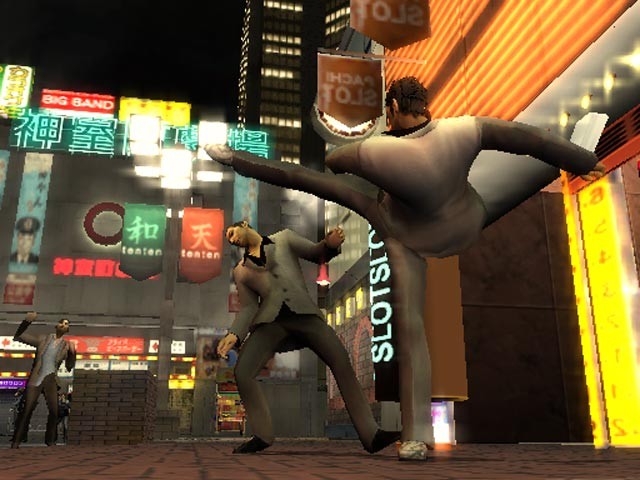
In the age of months-early previews, reviews the day the game ships, and opinionated bloggers, it's always really nice to find something unexpected in a videogame. I went into Yakuza expecting something like GTA in Japan, and was very pleasantly surprised. I've been frustrated by this before, but here Amusement Vision presents an engrossing story strung together by a bare minimum of gameplay ... and it completely works. Yakuza is a Japanese gangster story with a uniquely cultural outlook, some very different minigames, and a zen-simple but highly enjoyable combat mechanic. If storytelling and character development mean as much to you as framerate and polygon counts, read on for my impressions to see if this title is for you.- Title: Yakuza
- Publisher: Sega
- Developer: Amusement Vision
- System: PS2
What follows is a surprisingly deep story. A tale that begins with a fairly straightforward structure quickly twists and turns, involving money, women, and the power structure of the Yakuza clans. Behind all this, the numerous stories that make up daily life in a little corner of Tokyo take place. Given the setup, you'd think the story would be dominated by swearing gangers, domestic violence, and bad voice acting. With the exception of the cursing gangers, there's little overly cliche about this tale. The story takes a lot of time to establish the humanity and character of the gameworld's inhabitants. Kazuma in particular is a surprisingly broadly written and human protagonist; along with busting in teeth and staring down hardened killers, he is not above escorting little girls to safety and searching out dog food for a starving puppy.
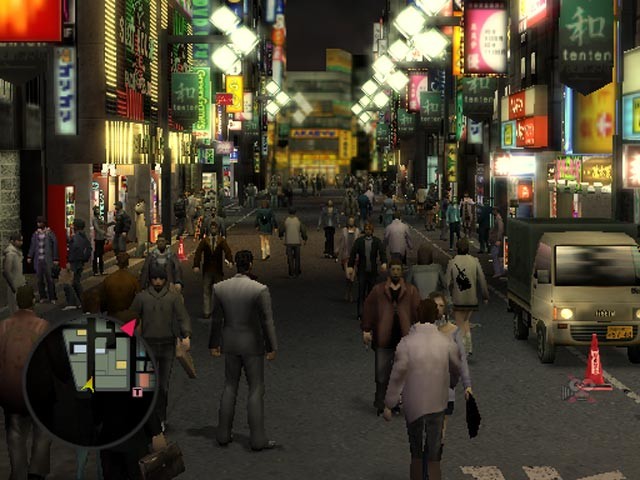
Where the story struggles, unfortunately, is where it dictates gameplay. There are many story elements that require simple fetch quests. After the first few chapters or so, you're going to wish they were more willing to mix up the story-based gameplay. These runs through the city streets also highlight an unflattering result of the game's slick look: load. As you move from street to street within the district, you'll experience 'pregnant pauses', as the game caches art assets for the next area of the city. Actual load screens only occur when transitioning from in-engine play to cutscenes, but they too are just a little too long to be comfortable. Load times aside, these excursions into the Kabukicho district of Tokyo are beautiful and help to establish the character of the area. They're also well documented; an arrow points the way to a glowing part of your mini-map. The rich environment of the city also allows you access to a number of very unique minigames, such as batting cage practice, ring fighting, and what is essentially a girlfriend simulator. Each of these elements play a small part in the overall game, but even then I thought they could have been thought out a little more fully. That said, they're highly appreciated diversions from the main storyline. How often in a game do you find yourself thinking "Would this virtual woman like perfume or jewelry better?" or "Should I order her the champagne or tell a dirty joke?"
The ring-fighting is essentially just the game's fighting mode opened up for consistent cash prizes. Thankfully, though it is simple, Yakuza's combat is robust enough to be enjoyable. For most of the game, you'll find yourself engaged in combat at specific plot-dictated moments. You can also be accosted in the streets, facing down younger Yakuza thugs or street gangers. Initially, these combat sequences feel rote and repetitive. During the first few fights, you're mostly going to be mashing the square button. The catch, here, is that you'll be plowing through the plot as well, the game's story hooking you in. Just as you realize that you actually care about the story's characters, you're going to find that the combat gameplay has grown as well. As the story progresses, you can choose to level up different aspects of Kazuma's fighting prowess. Unlocking new levels of his body results in a longer lifebar, and higher levels in technique opens up new moves and combos. It's no Soul Calibur, to be sure, but the solid mechanics and ever-changing backgrounds do a lot to save what could have been throwaway gameplay.
From an artistic perspective, Yakuza is superlative. Sweeping camera moves as you travel allows for dramatic reveals of the Kabukicho district. At night, your eyes are drawn to the stark contrasts of dark buildings and blazing neon. The rain-slicked streets and swarms of consumers make for a vivid backdrop against which to play out Yakuza's story. Character art and animation is top-notch, with Kazuma in particular a study in how to make a protagonist memorable. The voice acting is highly skilled as well, lending a great deal of credibility to what could have come off as an over-the-top melodrama. Unfortunately, from a technical perspective, Yakuza is yet another in a long line of games that illustrates where the PS2 is in its life cycle. The worst offender is the aforementioned loading lag, which makes it harder to seamlessly navigate the game's beautiful world. I also found myself wishing there weren't quite so many jaggies filling my screen. The title's overall look and sound is top-notch, and another testament to the double-edged sword of an end-of-lifecycle console.
With Yakuza, Amusement Vision and Sega have released a high quality experience. It's definitely not for everyone; it's not 'hardcore', there is far from 100+ hours of gameplay, and the action is considerably more sedate than some might like. This team has created a great game by doing what many others consider the antithesis of the medium: aiming small. Characters are set in a single district of Tokyo (just a few blocks on each side), and placed in a story that explores the humanity of men made to do inhumane things. There are no space pirates to slay or worlds to save; it's just one man, and the people he cares about. Yakuza sets that stage perfectly, and makes you give a damn about the players. My only real and lasting complaint about this game is its length; it's only about ten hours long. With the announcement of Yakuza 2, even that frustration falls to the wayside. It may not be 'next-gen' in terms of visuals or gameplay, but Yakuza transcends the generations with its quietly competent storytelling. I can only hope some of the titles coming to the Wii, 360, and PS3 make an effort to do some looking back, as we plunge forward into the next age of gaming. -
Citizen Journalism Expert Jay Rosen Answers Your Questions
We posted Jay Rosen's Call for Questions on September 25. Here are his answers, into which he's obviously put plenty of time and thought. This is a "must read" for anyone interested in the growing "citizen journalism" movement either as a writer/editor or as an audience member -- and please note that Rosen and many others say, over and over, that one of the major shifts in the news media, especially online, is that there is no longer any need to be one or the other instead of both.
1) Where do you see newspapers' role in this?
by Stick_Fig
First off, my credentials: I'm the former employee of an experimental newspaper, Bluffton Today, located in Bluffton, South Carolina. It's an exciting place, let me tell you. The focus has been on reverse publishing but at the same time tempering blogs with traditional journalism. The staff still writes articles; they still edit heavily. They use the web only to the degree where it doesn't dip into libel and slander and builds on its strengths. My question to you is, do you think Bluffton is on the right track? It felt like, in the 15 months I was there, they definitely were, but I'm a biased party. I left thinking, "If only newspapers did more of this..." I know what I'm betting the farm on in my career, and it isn't tired, boring, traditional journalism. It isn't the straight and narrow of blogs, either. Rather, I feel that it's important to look at both sides and find how they can work together, because God knows there's some 60-year-old editor somewhere who won't look at Bluffton as anything more than a gimmick. I'm gonna be that guy in the newsroom fighting the good fight to get more untraditional voices into the the paper in more places than the editorial page.
Rosen:
Bluffton Today (Bluffton, SC is near Hilton Head Island) did several things that were important to try in 2005. They said the editorial engine would be the online edition; it would "produce" the printed paper. This is the opposite of how newspapers did things for the first ten years of their Web lives. They just re-purposed the content from the print edition, and called that an "online newspaper."
By reversing what's primary in production you change head sets in the newsroom because a professional newsroom engineers everything--including the talents of its employees--around the production ordeal. The "daily miracle" it was once called, because making the newspaper required such a fantastic act of just-in-time coordination. Many things had to be routinized for the miracle to occur. (Including ideas about journalism and the user's place in it.)
Steve Yelvington of Morris Digital Works, who worked on the Bluffton Today site, called it an "inversion" because content would flow from the Web to print rather than vice versa. The editorial engine should be the more interactive one, in which more of the community can participate. The goal was a virtuous circle. "Community conversation feeds professional journalism. Journalism feeds conversation. And around, and around." I think there is something to that idea.
How well it works is for people in Bluffton to address. I like that Bluffton Today tried to go Lessig on the news industry. It ditched the read only platform and re-built on read/write. Yelvington said at the launch: "Everyone gets a blog. Not just staffers, but everyone in the community. LeMonde (France) and the Mail and Guardian (South Africa) are doing this, too." Giving everyone a blog may be an obvious idea. But it's a different track. "Everyone gets a photo gallery. Everyone can contribute events to a shared public community calendar...." The site was built on Drupal technology. It had free classifieds. It was different.
If the experience of doing Bluffton Today has tempered some of that initial boldness, that's as it should be. I'm not surprised that the staff still writes articles; they still edit heavily. A web-to-print, highly-interactive, low barrier to entry, read-write, everyone-contributes newspaper is still a daily production headache. Articles, photos, headlines, and ads have to come together. Unedited, the site would have almost no value, although it can have unedited parts with high value.
"It isn't tired, boring, traditional journalism. It isn't the straight and narrow of blogs, either. It's important to look at both sides..." I agree with that, Stick. My new adventure, NewAssignment.Net, is a hybrid site for that reason. (Pros and amateurs collaborate on reporting projects.) In January of 2005 I wrote Bloggers vs. Journalists is Over for the same reason.
Bluffton today was a first wave attempt at innovation. Today initiatives like that face some second wave facts. Bringing capacity online does not itself create activity, so if you're counting on user activity, you better come with more than nifty new capacity. Create more writers and suddenly you may need more editors. "The conversation feeds journalism, journalism feeds the conversation" is a powerful idea, but we are several steps away from knowing how it works to create a live, intelligent filter in the newsroom.
There's just a long way to go. But yeah, you were on the right track working for those guys. Deeply so.
2) How to Get More Respect
by NewYorkCountryLawyer
I am convinced that online media have made a huge contribution to getting out the truth when the corporate media are seeking to suppress the truth. While there are a growing number of people aware of this phenomenon, reports in the 'blogosphere' just do not get the same respect and currency received by reports in the 'major' or 'corporate' media. What do we, as a community, need to do to enhance the respect internet journalists receive in the world at large?
Rosen:
Well, "suppressing" the truth is not how I see the failures of modern journalism, or of our current press. I think it's bigger than that.
Bob Woodward, who is in the news this week, is at the top of the reporting game, an industry unto himself. In two books, Bush at War and Plan of Attack, he failed to tell the truth about the Bush White House because his methods were not up to the obstacle they met: an administration that had broken through all the reality checks normally placed on a president and his closest aides. One by one these measures came under abnormal stress. The policy-making process used by presidents got subverted. The normal channels for sounding out opinion were just disowned. The intelligence community came under extreme stress when asked to supply facts for a decision already made.
A Congress controlled by the same party was expected to go along, which meant accepting the president's definition of reality. Oversight got evacuated. The normal tensions with the press were driven deeper: keep them back, keep them out, tell them nothing, tear them down. If someone does break a story from inside you immediately punish and isolate anyone who spoke to the reporter. You make them disown their words. You make them repent.
This is the story Woodward missed because he got inside it, so to speak. Ron Suskind, one of the few in Washington who did not miss that story, called it "the retreat from empiricism." To me, it's the big narrative yet to come out about the Bush White House. Attack Without a Plan was too crazy to be credible to Woodward. So he wrote Plan of Attack instead. I haven't read his new book yet, just the reviews and excerpts. But from early accounts, State of Denial is his attempt to get back the ground he lost, despite having the best access.
Woodward didn't "suppress" the story. Rather, he couldn't imagine it. Those are the kinds of failures that interest me. Sometimes things are suppressed. Often, the truth eludes professional journalism because no one thought to look for it. I welcome your question, What do we, as a community, need to do to enhance the respect internet journalists receive in the world at large? My first answer is: we have to look for it.
You know how, when you've really mastered something and there's a news account of it, the news story will invariable get several (basic) things wrong? Eliminate the several things and respect will rise. If you want to inform the world of something, grok it before you rock it is a good simple rule.
Correct ourselves early and often. Correct the reporting in the major media, early and often. Fact check your own ass first, then your neighbor's. We should major in transparency; the "major" media will take a minor in that. Diversity of outlook in the reporters ultimately improves the reporting. The blogosphere has advantages there, especially as it does more reporting.
I think we have to accept that Big Media, which isn't going anywhere, is society's default legitimacy-distribution machine. But that doesn't mean it works well. The machine itself can lose legitimacy without exactly falling apart. If you're an upstart publisher of news and you suck at it, Big Media will try to ignore you. If you're an upstart publisher of news and you're really good at it, Big Media will try to ignore you. Then when you assume the shape of a writes-itself story--first bloggers to go to the political conventions!--Big Media will over-cover you, spreading a small bit of understanding over lots and lots of stories. Six months later it's time to debunk the trend they missed, then over-hyped and finally misdescribed. It's not personal. It's protective. It's also cheaper than figuring out what's going on.
We can win a lot of points for Net journalism just by being the opposite of that.
3) What about mob-rule journalism?
by Chas
What sort of safeguards are in place to do fact-checking and prevent false/obviously slanted mob-rule style reports from being propagated as fact?
Rosen:
People hear phrases like "an experiment in open source reporting" and they see it immediately: What's open to the wisdom of the crowd is vulnerable to the actions of the mob. Wanting to be helpful, the volunteer may slant reports without realizing it. Through the portals marked "citizen," the paid operative can also go. How do you prevent all of that?
To me this is a puzzle with many pieces. It won't have one solution; it will take many overlapping systems working together. I can't tell you--yet--how we're going to build a fact-checking and verification system into NewAssignment.Net. But I can tell you that the site will fail without one, so we'll have to try to figure it out, with help from a lot of people. To simply pass along unchecked reports received from strangers over the Net would be fantastically dumb. To discount the possibility of people trying to game the system would be dumb, too; the more successful the site is, the more probable the gaming is. Not to mention spam, duplication, all kinds of junk.
What sort of safeguards are in place? Here are my answers so far. You tell me what is missing or cracked in this foundation:
One: The editors are full time on it. Assignments flow through editors several times before they are published by NewAssignment.Net. That's the pro-am way. It's an editor's job not to be gamed, not to publish bum facts. Everything that goes out has the editor's name on it. It's not an answer to everything--this reliance on "good editors"--but it's a proven system, a simple one, and a start.
Two: Users Self-Police. I'm not sure "community" is the right word for the eventual users of New Assignment. People use that term too loosely, in my opinion. But if NewAssignment.Net develops a base of active, loyal and intelligent users, it's not unreasonable that they can help police the site, especially if they understand that verifiying information and preventing fraud are basic to everything we're trying to do. And so a second answer, after editors, is a culture among users: catch errors, catch mistakes, catch fraud and manipulation. A mob mentality has to be met by something stronger; if you attract the right kind of users, that can happen. It would be foolish to think it will just because you're counting on it.
Three: Given enough eyeballs, all facts can be checked. I think there is every chance of developing a special subgroup of users who are effective fact checkers of the larger base of contributors, including new and casual contributors. One thing we are definitely going to do is see whether retired journalists and ex-journalists will volunteer to work with other natural born sticklers and operate our fact-checking system, which not only has to work, but eventually be better than industry standard. I don't know yet what that system will look like, or how systematic it will be. One of my advisers is interested in this puzzle and working on some ideas, assisted by a professional fact checker who emailed me offering to help. That's how we are going to solve this. Social scientists call it "muddling through."
Four: The site itself has to make verification easy. I mean in the way it is built and meant to operate. For example, editors have to be able to sort the raw from the initially verified from the double checked. This is one of the challenges for the developers of the New Assignment site, which will be Chapter Three. It's a new partnership--here's an about page for them--formed by Zack Rosen, who is my nephew, one of the originators of Dean Space and the co-founder of CivicSpace on the Drupal platform; and Josh Koenig, a co-founder of DeanSpace who started Music for America, a non-profit. They are both Drupal developers, active in that community. The third partner is Matt Cheney, who is trained as a librarian and worked as a researcher at National Center for SuperComputing Applications.
They're going to build the site with open source tools. Josh Koenig has a post up about the New Assignment project. It promises an Open Practice model: "posting tutorials, video screen casts, interviews, and write ups as our own work progresses and as we research others." Verification and fact-checking have to become open practices themselves. The developers understand that.
Five: The one percent rule.. Experience suggests a small slice of users will do most of the volunteer work. According to the one percent rule in social media, which is more of a tendency than a law, "if you get a group of 100 people online then one will create content, 10 will 'interact' with it (commenting or offering improvements) and the other 89 will just view it." This bears on the verification puzzle because we're not talking about "checking" vast hordes of people. If regular contributors provide most of the contributions, their reputations for reliability can accumulate at the site. In a well-designed system that will happen.
Six: How have others solved the problem? You tell me: has creating a reliable system of volunteer contributors ever been faced before on the Web? Did it prove unsolvable? I would expect NewAssignment.Net to look at prior cases first and find the key lessons.
4) Money
by truthsearch
Do you believe that as money flows into civic journalism that it'll change the equation? Obviously there are some people who's primary goal is to become famous and/or make money through more open journalism. Will the large community of contributors flush out those with less altruistic intentions? I guess I'm really asking will civic journalism be self-correcting as it gets bigger? Or is there a way it may become just as corrupted as much of the current mainstream professional journalism?
Rosen:
I doubt there's any incorruptible system, just different kinds of pressures, with greater and lesser freedoms for the journalists involved. We can certainly hope for a self-correcting system, but it's not likely to happen on its own.
There's nothing wrong with seeking recognition for great work. People who want to be become famous or make a salary through the more open forms in Net journalism aren't the enemy. Not at all. But they are going to have to work with users under conditions that build trust and permit collaboration. It's hard for me to see how the bad actors will succeed at that, but I am not discounting it, either.
Here's a site called Sportingo. It says it's a "new type of sports media company," which is "focused on telling the story from the fans' perspective." Users can write articles, which will be "professionally edited." They can rate and comment on articles written by peers.
Sportingo will own all the content published on the site. There are no plans to pay contributors. The company is for-profit. Tal Rozow, the marketing manager, told me that that "Sportingo authors aiming for a professional writing career will be able to benefit from having by-lines appearing on our website." He said he's confident that a strong network of independent sports writers will emerge at the site, and maybe that will happen. But I'm not sure it's a system designed to build trust among all the players involved.
Everyone I have consulted about open source projects of any kind has stressed one thing over and over: the importance of understanding what would motivate people to contribute to the gift economy of the project. You have to get that right, they say. Ultimately I believe a non-profit foundation is a more secure one. If there are profits and they are extracted by the owners, not distributed to co-creators; that's a problem. If there are profits and they go into doing more and better journalism, that's different.
5) What's wrong with other extant examples?
by crush
I'm assuming that you evaluated and rejected some of the other high-profile citizen journalism outfits that predate the founding of your own project. Off my head I can think of:
* The Indymedia network is one of the longest standing examples of an attempt to have a large citizen journalist network.
* The Pacifica Network (especially the Democracy Now show)
* The New Standard
What was it that you found lacking in the above and why did you decide to start a new project instead of reforming and adapting one of the above? Do you think that your decision to accept corporate sponsorship (which is rejected by the Pacifica Network) will see your organization's focus inevitably drift toward the anodyne ineffectiveness of e.g. NPR?
(And of course, how could I forget WikiNews?)
Rosen:
There's nothing "wrong" with these prior examples. I admire them all. I was especially pleased to see that the New Standard met its do-or-die fundraising goal last week. That site is an experiment with reader-supported, totally independent, strenuously-factual reporting. High standards of verification are meant to prevail. I think the New Standard has a lot in common with professional journalism, except it rejects the political economy of commercial news media entirely. It's run as a collective among those who do the work. I am thrilled that it will remain around, because we need to try lots of solutions to how to fund serious reporting. Just as I'm thrilled that Independent Media Center and its collectives around the world keep humming. I agree with Chris Anderson that what blogging begat--citizen journalism--Indy Media begat, too.
I didn't "evaluate and reject" the New Standard, Indy Media, Pacifica and Wiki News. Nor is it my place to decide they need fixing. They don't. The people who founded those organizations deserve a lot of credit for creating something new and daring-- and genuinely alternative. They inspired me. So did lots of others. (New West, for example, or Witness.org.) NewAssignment.Net is really about a single proposition: that if journalists and networks of users can report stuff together that neither could easily do alone, the public sphere will benefit and the site will build trust. I think there's room for that.
My decision to accept $100,000 from Reuters means we'll have an editor who can test the possibilities in networked journalism, as Jeff Jarvis calls it. My job is to make sure that Reuters has no influence on that person. The company has said it will have no editorial control, and no claim on the content. I agree: it won't. I think we can persuade users that it works as advertised. But people are free to draw their own conclusions about what the gift means, and I'm sure they will.
6) Plagiarism and Ethics?
by goombah99
Lately there's been a few incidents of Plagiarism in the news, not to mention some wholesale ethical breaches of faked stories (e.g. Blair at the NY times and "a million Little pieces"). But the thing is, the reason those are news is that they are both exceptional and something that is specifically drummed in to any professional journalist not to do. Indeed, breaking this taboo is probably even more of a sin to the the fellow journalists than to the general public because of this entrenched ethic.
Yet we know that on college campuses, where we can measure the phenomenon, plagiarism is comparatively rampant. So evidently the common man cannot restrain himself.
It seems to me this is a serious issue for any new journalism form with a low barrier to entry and a high degree of anonymity for the author. How does this ethos get enforced in such a realm?
A related question is the ethical division of commentary and news. We know that's become a problem in the media for some outlets where management has a thumb on the content. But the traditional news organs, especially newspapers, still refrain for the most part. Indeed, the NY times just went so far as to remove the typeset justification from any article that contained any sort of analysis or opinion, reserving the justified typesetting for only traditional factual journalism stories so the difference is apparent to the reader from the start. How do we reinforce that ethos in the untrained journalist?
Rosen:
When people plagiarize they do it for a particular self-interested reason: to meet a deadline, get an unwanted task out of the way, get their full time salary with limited work. These motivations will probably be rarer in the New Assignment model. Why volunteer for a project only to cheat at it?
"The common man cannot restrain himself." Sorry, I don't trust that kind of language. Beyond that making stuff up is not a way to develop a base of users on the Web; people aren't that dumb! You speak of a "low barrier to entry and a high degree of anonymity for the author." But for most users the higher the anonymity factor for the author, the higher the barrier of trust.
What some people can't seem to get over is that other people can say any damn thing they want on the Internet! How can you trust any of it? is their natural reaction to all open systems. Closed systems--and professional journalism is one--develop trust in one way. Open systems have to do it a much different way. Expecting one to look like the other is unreasonable.
We aren't going to learn much about this puzzle by asking how the "common man" can be trained to imitate his betters in the news media. I refer you to sociologist Raymond Williams, who once said, "There are no masses, there are only ways of seeing people as masses." It is these ways of seeing that are retrograde. But they show up in the most surprising places.
7) Scale
by FuturePastNow
First, I'll admit that I haven't read much about citizen journalism other than Jeff Jarvis' [buzzmachine.com], but as a non-blogger thinking of getting in to it, I was wondering:
Much of the discussion seems to be about getting out from under the control of "gatekeepers" like publishers and media owners. Yet, while the internet is less concerned with money, it has its own form of currency: popularity, in the form of the link.
Doesn't this just turn the highest-traffic sites into new gatekeepers? Especially as the number of blogs increases, the gap between "rich" and "poor" expands?
I suppose what I'm really asking is, it's hard enough to get noticed today- how will someone just starting out get noticed ten years from now?
Rosen:
Ten years from now? Jeez, I have no idea what the world of media access will be like then. But anyone who is just starting out in self-publishing should consult Clay Shirky's Power Laws, Weblogs, and Inequality, so as not to become prematurely disillusioned by discovering its truths later on.
Certainly there are new gatekeepers. (Slashdot itself is one. But does it work the same way the old system did?) Traffic-wise, there's still rich and poor. (But is this list as static as that one?) Hierarchies have not gone away. (And who said they would?) Inequality has not disappeared. (But did you really think it could?)
You still have to fight to be noticed, good work can still go unnoticed. Life online is not entirely fair, or completely different. There's a new attention economy to replace the old. The sooner we reconcile ourselves to these common sense conclusions, the easier it will be to see what is actually different today.
Here are some things that stand out for me: Amateurs have joined professionals and they own a part of "the press." An audience that was once connected "up" to Big Media but not across to each other is now connected both ways. The cost for like-minded people to locate each other and collaborate has fallen dramatically. The tools of media production have been widely distributed, and broad distribution of content is no longer impossible for small, upstart producers. For professionals, they're not required to affiliate with Big Media in order to operate as a journalist, though most will. They can be stand alones and independents. The people formerly known as the audience (as I call them) are now a productive force to be reckoned with, and Big Media has just started that reckoning. The Net has new ways of distributing attention, which have taken their place alongside the old.
Still, there's a long way to go before we can say that our media system has been made more democratic, responsive and responsible.
8) What impact would this have on national elections?
by StressGuy
The Electoral process seems to be more of a "marketing contest" and marketing takes bags and bags of money. There's commercial time, signs, billboards, radio, etc. Let's face it, a commercial is, at most 90 seconds to tell me why I should vote for you - hardly enough time. So, all we see are glittering generalities or, all to often, "don't vote for the other guy" spots.
If "Citizen Journalism" takes off, do you see this as a way that candidates without the massive financial resources normally required to sustain a traditional campaign could actually compete? Could this make the "third party candidates" a credible threat? Could this actually serve to "level the playing field"?
Rosen:
We should be cautious here. I think the most we can say is that a system that was almost entirely closed and self-sustaining--in which a handful of people raised the money, took the polls, handled the candidates, made the ads, narrated the campaign and talked about the candidates on TV--has been disrupted. The people who ran it are not as confident as they once were in their ability to manage things and get the outcomes they want. Their party has been crashed, but it's not "over." Nor is it "ours."
It's possible that insurgent candidacies--not backed by current players in the system--will have an easier time of it in the years ahead, just as insurgent news providers have more of an opening now. That's as far as I would go on the leveled field.
9) Dilution of Protection
by ObsessiveMathsFreak
How long before corporations and wealthy individuals start employing goons, lawyers and wiretaps, a la HP, to threaten and intimidate citizen journalists with no real legal recourse? If faced with this, should a citizen journalist just back off and let the guilty win? How can the protections now enjoyed by the fourth estate be extended to citizen journalism without diluting them?
Rosen:
As a matter of law and public policy, I think "fourth estate" protections should focus on significant acts of journalism, not people in pre-fab categories or the kind of organization that surrounds the giver of news. All those who are engaged in the act of informing a broader public of what's going on deserve to be under the First Amendment umbrella that protects the press. The press itself is composed of amateur and professional wings.
But that's no answer to goons with lawyers who threaten to sue. Citizen journalists are definitely vulnerable there, which makes you realize why we have big media organizations in the first place. We have to be more creative. Robert Cox, head of the Media Bloggers Association (I am a founding member of the group) has shown that "an orchestrated campaign by bloggers to defend a fellow blogger in what appears to be a frivolous lawsuit" can work. That's encouraging but not a complete answer, either. Legal intimidation will happen, and I'm sure there will be times when the bad guys will win.
10) Blogging
by From A Far Away Land
When asking a primary source for information, I find that telling them I'm doing so to create a report on my blog tends to make them clam up, or continue to be unwilling to provide information that ought to be publicly available. What technique or phrases should I use to convince the interviewee that I both have a legitimate use for their information, and the right to obtain it?
Rosen:
Sometimes you have a right to obtain information from a primary source. Sometimes it's not a matter of your rights but their decision to recognize you and cooperate. If search costs are high for making an informed decision about whether to trust a blogger who shows up with questions, sources will seek to reduce costs by using reputation and even stereotype (bloggers: ugh) as proxies.
I don't think there's a proper technique or a magic phrase that will solve this problem. There's only one solution I can see. Send the guy the URL for the "about" section of your site. That page ought to persuade potential sources that legitimate use will be made of their information. It should tell them what you are up to, and why. The site itself, the reporting and commentary there, is the best reason any source has to cooperate. Ah, but how do you convince them to take the time and look?
There's at least one way. Break a story so that the source's world is talking about it and next time around the source will speak to you-- and go to your About page. I asked Dean Wright of Reuters what the biggest obstacle for NewAssignment.Net will be when it launches. "The same one that the more minor players in the mainstream media have: getting your calls returned," he said. "Then when you complete a project and publish, you may find that other media outlets are reluctant to pick up your stories." The only answer to that is "do some compelling projects that cannot be ignored."
NewAssignment.Net will try to take that advice. It will do stories developed by users into assignments that are given to journalists. It could also do stories developed by journalists and divided into parts for users to assign themselves. (Mechanical Turk meets the Center for Public Integrity.) I hope it will do stories where teams of users and journalists figure out the division of labor together.
Sometimes the network will be the knowledge producer, the journalist the enabler. Other times the journalist will be the producer, and the network the enabler. Pro-am journalism is not inherently better than am-pro. Amateur users could in some cases do it all themselves, with editors watching and giving the green light in stages. Different combinations beg to be tried. It's unwise to say in advance that we know how it will work, or that it can't. -
Citizen Journalism Expert Jay Rosen Answers Your Questions
We posted Jay Rosen's Call for Questions on September 25. Here are his answers, into which he's obviously put plenty of time and thought. This is a "must read" for anyone interested in the growing "citizen journalism" movement either as a writer/editor or as an audience member -- and please note that Rosen and many others say, over and over, that one of the major shifts in the news media, especially online, is that there is no longer any need to be one or the other instead of both.
1) Where do you see newspapers' role in this?
by Stick_Fig
First off, my credentials: I'm the former employee of an experimental newspaper, Bluffton Today, located in Bluffton, South Carolina. It's an exciting place, let me tell you. The focus has been on reverse publishing but at the same time tempering blogs with traditional journalism. The staff still writes articles; they still edit heavily. They use the web only to the degree where it doesn't dip into libel and slander and builds on its strengths. My question to you is, do you think Bluffton is on the right track? It felt like, in the 15 months I was there, they definitely were, but I'm a biased party. I left thinking, "If only newspapers did more of this..." I know what I'm betting the farm on in my career, and it isn't tired, boring, traditional journalism. It isn't the straight and narrow of blogs, either. Rather, I feel that it's important to look at both sides and find how they can work together, because God knows there's some 60-year-old editor somewhere who won't look at Bluffton as anything more than a gimmick. I'm gonna be that guy in the newsroom fighting the good fight to get more untraditional voices into the the paper in more places than the editorial page.
Rosen:
Bluffton Today (Bluffton, SC is near Hilton Head Island) did several things that were important to try in 2005. They said the editorial engine would be the online edition; it would "produce" the printed paper. This is the opposite of how newspapers did things for the first ten years of their Web lives. They just re-purposed the content from the print edition, and called that an "online newspaper."
By reversing what's primary in production you change head sets in the newsroom because a professional newsroom engineers everything--including the talents of its employees--around the production ordeal. The "daily miracle" it was once called, because making the newspaper required such a fantastic act of just-in-time coordination. Many things had to be routinized for the miracle to occur. (Including ideas about journalism and the user's place in it.)
Steve Yelvington of Morris Digital Works, who worked on the Bluffton Today site, called it an "inversion" because content would flow from the Web to print rather than vice versa. The editorial engine should be the more interactive one, in which more of the community can participate. The goal was a virtuous circle. "Community conversation feeds professional journalism. Journalism feeds conversation. And around, and around." I think there is something to that idea.
How well it works is for people in Bluffton to address. I like that Bluffton Today tried to go Lessig on the news industry. It ditched the read only platform and re-built on read/write. Yelvington said at the launch: "Everyone gets a blog. Not just staffers, but everyone in the community. LeMonde (France) and the Mail and Guardian (South Africa) are doing this, too." Giving everyone a blog may be an obvious idea. But it's a different track. "Everyone gets a photo gallery. Everyone can contribute events to a shared public community calendar...." The site was built on Drupal technology. It had free classifieds. It was different.
If the experience of doing Bluffton Today has tempered some of that initial boldness, that's as it should be. I'm not surprised that the staff still writes articles; they still edit heavily. A web-to-print, highly-interactive, low barrier to entry, read-write, everyone-contributes newspaper is still a daily production headache. Articles, photos, headlines, and ads have to come together. Unedited, the site would have almost no value, although it can have unedited parts with high value.
"It isn't tired, boring, traditional journalism. It isn't the straight and narrow of blogs, either. It's important to look at both sides..." I agree with that, Stick. My new adventure, NewAssignment.Net, is a hybrid site for that reason. (Pros and amateurs collaborate on reporting projects.) In January of 2005 I wrote Bloggers vs. Journalists is Over for the same reason.
Bluffton today was a first wave attempt at innovation. Today initiatives like that face some second wave facts. Bringing capacity online does not itself create activity, so if you're counting on user activity, you better come with more than nifty new capacity. Create more writers and suddenly you may need more editors. "The conversation feeds journalism, journalism feeds the conversation" is a powerful idea, but we are several steps away from knowing how it works to create a live, intelligent filter in the newsroom.
There's just a long way to go. But yeah, you were on the right track working for those guys. Deeply so.
2) How to Get More Respect
by NewYorkCountryLawyer
I am convinced that online media have made a huge contribution to getting out the truth when the corporate media are seeking to suppress the truth. While there are a growing number of people aware of this phenomenon, reports in the 'blogosphere' just do not get the same respect and currency received by reports in the 'major' or 'corporate' media. What do we, as a community, need to do to enhance the respect internet journalists receive in the world at large?
Rosen:
Well, "suppressing" the truth is not how I see the failures of modern journalism, or of our current press. I think it's bigger than that.
Bob Woodward, who is in the news this week, is at the top of the reporting game, an industry unto himself. In two books, Bush at War and Plan of Attack, he failed to tell the truth about the Bush White House because his methods were not up to the obstacle they met: an administration that had broken through all the reality checks normally placed on a president and his closest aides. One by one these measures came under abnormal stress. The policy-making process used by presidents got subverted. The normal channels for sounding out opinion were just disowned. The intelligence community came under extreme stress when asked to supply facts for a decision already made.
A Congress controlled by the same party was expected to go along, which meant accepting the president's definition of reality. Oversight got evacuated. The normal tensions with the press were driven deeper: keep them back, keep them out, tell them nothing, tear them down. If someone does break a story from inside you immediately punish and isolate anyone who spoke to the reporter. You make them disown their words. You make them repent.
This is the story Woodward missed because he got inside it, so to speak. Ron Suskind, one of the few in Washington who did not miss that story, called it "the retreat from empiricism." To me, it's the big narrative yet to come out about the Bush White House. Attack Without a Plan was too crazy to be credible to Woodward. So he wrote Plan of Attack instead. I haven't read his new book yet, just the reviews and excerpts. But from early accounts, State of Denial is his attempt to get back the ground he lost, despite having the best access.
Woodward didn't "suppress" the story. Rather, he couldn't imagine it. Those are the kinds of failures that interest me. Sometimes things are suppressed. Often, the truth eludes professional journalism because no one thought to look for it. I welcome your question, What do we, as a community, need to do to enhance the respect internet journalists receive in the world at large? My first answer is: we have to look for it.
You know how, when you've really mastered something and there's a news account of it, the news story will invariable get several (basic) things wrong? Eliminate the several things and respect will rise. If you want to inform the world of something, grok it before you rock it is a good simple rule.
Correct ourselves early and often. Correct the reporting in the major media, early and often. Fact check your own ass first, then your neighbor's. We should major in transparency; the "major" media will take a minor in that. Diversity of outlook in the reporters ultimately improves the reporting. The blogosphere has advantages there, especially as it does more reporting.
I think we have to accept that Big Media, which isn't going anywhere, is society's default legitimacy-distribution machine. But that doesn't mean it works well. The machine itself can lose legitimacy without exactly falling apart. If you're an upstart publisher of news and you suck at it, Big Media will try to ignore you. If you're an upstart publisher of news and you're really good at it, Big Media will try to ignore you. Then when you assume the shape of a writes-itself story--first bloggers to go to the political conventions!--Big Media will over-cover you, spreading a small bit of understanding over lots and lots of stories. Six months later it's time to debunk the trend they missed, then over-hyped and finally misdescribed. It's not personal. It's protective. It's also cheaper than figuring out what's going on.
We can win a lot of points for Net journalism just by being the opposite of that.
3) What about mob-rule journalism?
by Chas
What sort of safeguards are in place to do fact-checking and prevent false/obviously slanted mob-rule style reports from being propagated as fact?
Rosen:
People hear phrases like "an experiment in open source reporting" and they see it immediately: What's open to the wisdom of the crowd is vulnerable to the actions of the mob. Wanting to be helpful, the volunteer may slant reports without realizing it. Through the portals marked "citizen," the paid operative can also go. How do you prevent all of that?
To me this is a puzzle with many pieces. It won't have one solution; it will take many overlapping systems working together. I can't tell you--yet--how we're going to build a fact-checking and verification system into NewAssignment.Net. But I can tell you that the site will fail without one, so we'll have to try to figure it out, with help from a lot of people. To simply pass along unchecked reports received from strangers over the Net would be fantastically dumb. To discount the possibility of people trying to game the system would be dumb, too; the more successful the site is, the more probable the gaming is. Not to mention spam, duplication, all kinds of junk.
What sort of safeguards are in place? Here are my answers so far. You tell me what is missing or cracked in this foundation:
One: The editors are full time on it. Assignments flow through editors several times before they are published by NewAssignment.Net. That's the pro-am way. It's an editor's job not to be gamed, not to publish bum facts. Everything that goes out has the editor's name on it. It's not an answer to everything--this reliance on "good editors"--but it's a proven system, a simple one, and a start.
Two: Users Self-Police. I'm not sure "community" is the right word for the eventual users of New Assignment. People use that term too loosely, in my opinion. But if NewAssignment.Net develops a base of active, loyal and intelligent users, it's not unreasonable that they can help police the site, especially if they understand that verifiying information and preventing fraud are basic to everything we're trying to do. And so a second answer, after editors, is a culture among users: catch errors, catch mistakes, catch fraud and manipulation. A mob mentality has to be met by something stronger; if you attract the right kind of users, that can happen. It would be foolish to think it will just because you're counting on it.
Three: Given enough eyeballs, all facts can be checked. I think there is every chance of developing a special subgroup of users who are effective fact checkers of the larger base of contributors, including new and casual contributors. One thing we are definitely going to do is see whether retired journalists and ex-journalists will volunteer to work with other natural born sticklers and operate our fact-checking system, which not only has to work, but eventually be better than industry standard. I don't know yet what that system will look like, or how systematic it will be. One of my advisers is interested in this puzzle and working on some ideas, assisted by a professional fact checker who emailed me offering to help. That's how we are going to solve this. Social scientists call it "muddling through."
Four: The site itself has to make verification easy. I mean in the way it is built and meant to operate. For example, editors have to be able to sort the raw from the initially verified from the double checked. This is one of the challenges for the developers of the New Assignment site, which will be Chapter Three. It's a new partnership--here's an about page for them--formed by Zack Rosen, who is my nephew, one of the originators of Dean Space and the co-founder of CivicSpace on the Drupal platform; and Josh Koenig, a co-founder of DeanSpace who started Music for America, a non-profit. They are both Drupal developers, active in that community. The third partner is Matt Cheney, who is trained as a librarian and worked as a researcher at National Center for SuperComputing Applications.
They're going to build the site with open source tools. Josh Koenig has a post up about the New Assignment project. It promises an Open Practice model: "posting tutorials, video screen casts, interviews, and write ups as our own work progresses and as we research others." Verification and fact-checking have to become open practices themselves. The developers understand that.
Five: The one percent rule.. Experience suggests a small slice of users will do most of the volunteer work. According to the one percent rule in social media, which is more of a tendency than a law, "if you get a group of 100 people online then one will create content, 10 will 'interact' with it (commenting or offering improvements) and the other 89 will just view it." This bears on the verification puzzle because we're not talking about "checking" vast hordes of people. If regular contributors provide most of the contributions, their reputations for reliability can accumulate at the site. In a well-designed system that will happen.
Six: How have others solved the problem? You tell me: has creating a reliable system of volunteer contributors ever been faced before on the Web? Did it prove unsolvable? I would expect NewAssignment.Net to look at prior cases first and find the key lessons.
4) Money
by truthsearch
Do you believe that as money flows into civic journalism that it'll change the equation? Obviously there are some people who's primary goal is to become famous and/or make money through more open journalism. Will the large community of contributors flush out those with less altruistic intentions? I guess I'm really asking will civic journalism be self-correcting as it gets bigger? Or is there a way it may become just as corrupted as much of the current mainstream professional journalism?
Rosen:
I doubt there's any incorruptible system, just different kinds of pressures, with greater and lesser freedoms for the journalists involved. We can certainly hope for a self-correcting system, but it's not likely to happen on its own.
There's nothing wrong with seeking recognition for great work. People who want to be become famous or make a salary through the more open forms in Net journalism aren't the enemy. Not at all. But they are going to have to work with users under conditions that build trust and permit collaboration. It's hard for me to see how the bad actors will succeed at that, but I am not discounting it, either.
Here's a site called Sportingo. It says it's a "new type of sports media company," which is "focused on telling the story from the fans' perspective." Users can write articles, which will be "professionally edited." They can rate and comment on articles written by peers.
Sportingo will own all the content published on the site. There are no plans to pay contributors. The company is for-profit. Tal Rozow, the marketing manager, told me that that "Sportingo authors aiming for a professional writing career will be able to benefit from having by-lines appearing on our website." He said he's confident that a strong network of independent sports writers will emerge at the site, and maybe that will happen. But I'm not sure it's a system designed to build trust among all the players involved.
Everyone I have consulted about open source projects of any kind has stressed one thing over and over: the importance of understanding what would motivate people to contribute to the gift economy of the project. You have to get that right, they say. Ultimately I believe a non-profit foundation is a more secure one. If there are profits and they are extracted by the owners, not distributed to co-creators; that's a problem. If there are profits and they go into doing more and better journalism, that's different.
5) What's wrong with other extant examples?
by crush
I'm assuming that you evaluated and rejected some of the other high-profile citizen journalism outfits that predate the founding of your own project. Off my head I can think of:
* The Indymedia network is one of the longest standing examples of an attempt to have a large citizen journalist network.
* The Pacifica Network (especially the Democracy Now show)
* The New Standard
What was it that you found lacking in the above and why did you decide to start a new project instead of reforming and adapting one of the above? Do you think that your decision to accept corporate sponsorship (which is rejected by the Pacifica Network) will see your organization's focus inevitably drift toward the anodyne ineffectiveness of e.g. NPR?
(And of course, how could I forget WikiNews?)
Rosen:
There's nothing "wrong" with these prior examples. I admire them all. I was especially pleased to see that the New Standard met its do-or-die fundraising goal last week. That site is an experiment with reader-supported, totally independent, strenuously-factual reporting. High standards of verification are meant to prevail. I think the New Standard has a lot in common with professional journalism, except it rejects the political economy of commercial news media entirely. It's run as a collective among those who do the work. I am thrilled that it will remain around, because we need to try lots of solutions to how to fund serious reporting. Just as I'm thrilled that Independent Media Center and its collectives around the world keep humming. I agree with Chris Anderson that what blogging begat--citizen journalism--Indy Media begat, too.
I didn't "evaluate and reject" the New Standard, Indy Media, Pacifica and Wiki News. Nor is it my place to decide they need fixing. They don't. The people who founded those organizations deserve a lot of credit for creating something new and daring-- and genuinely alternative. They inspired me. So did lots of others. (New West, for example, or Witness.org.) NewAssignment.Net is really about a single proposition: that if journalists and networks of users can report stuff together that neither could easily do alone, the public sphere will benefit and the site will build trust. I think there's room for that.
My decision to accept $100,000 from Reuters means we'll have an editor who can test the possibilities in networked journalism, as Jeff Jarvis calls it. My job is to make sure that Reuters has no influence on that person. The company has said it will have no editorial control, and no claim on the content. I agree: it won't. I think we can persuade users that it works as advertised. But people are free to draw their own conclusions about what the gift means, and I'm sure they will.
6) Plagiarism and Ethics?
by goombah99
Lately there's been a few incidents of Plagiarism in the news, not to mention some wholesale ethical breaches of faked stories (e.g. Blair at the NY times and "a million Little pieces"). But the thing is, the reason those are news is that they are both exceptional and something that is specifically drummed in to any professional journalist not to do. Indeed, breaking this taboo is probably even more of a sin to the the fellow journalists than to the general public because of this entrenched ethic.
Yet we know that on college campuses, where we can measure the phenomenon, plagiarism is comparatively rampant. So evidently the common man cannot restrain himself.
It seems to me this is a serious issue for any new journalism form with a low barrier to entry and a high degree of anonymity for the author. How does this ethos get enforced in such a realm?
A related question is the ethical division of commentary and news. We know that's become a problem in the media for some outlets where management has a thumb on the content. But the traditional news organs, especially newspapers, still refrain for the most part. Indeed, the NY times just went so far as to remove the typeset justification from any article that contained any sort of analysis or opinion, reserving the justified typesetting for only traditional factual journalism stories so the difference is apparent to the reader from the start. How do we reinforce that ethos in the untrained journalist?
Rosen:
When people plagiarize they do it for a particular self-interested reason: to meet a deadline, get an unwanted task out of the way, get their full time salary with limited work. These motivations will probably be rarer in the New Assignment model. Why volunteer for a project only to cheat at it?
"The common man cannot restrain himself." Sorry, I don't trust that kind of language. Beyond that making stuff up is not a way to develop a base of users on the Web; people aren't that dumb! You speak of a "low barrier to entry and a high degree of anonymity for the author." But for most users the higher the anonymity factor for the author, the higher the barrier of trust.
What some people can't seem to get over is that other people can say any damn thing they want on the Internet! How can you trust any of it? is their natural reaction to all open systems. Closed systems--and professional journalism is one--develop trust in one way. Open systems have to do it a much different way. Expecting one to look like the other is unreasonable.
We aren't going to learn much about this puzzle by asking how the "common man" can be trained to imitate his betters in the news media. I refer you to sociologist Raymond Williams, who once said, "There are no masses, there are only ways of seeing people as masses." It is these ways of seeing that are retrograde. But they show up in the most surprising places.
7) Scale
by FuturePastNow
First, I'll admit that I haven't read much about citizen journalism other than Jeff Jarvis' [buzzmachine.com], but as a non-blogger thinking of getting in to it, I was wondering:
Much of the discussion seems to be about getting out from under the control of "gatekeepers" like publishers and media owners. Yet, while the internet is less concerned with money, it has its own form of currency: popularity, in the form of the link.
Doesn't this just turn the highest-traffic sites into new gatekeepers? Especially as the number of blogs increases, the gap between "rich" and "poor" expands?
I suppose what I'm really asking is, it's hard enough to get noticed today- how will someone just starting out get noticed ten years from now?
Rosen:
Ten years from now? Jeez, I have no idea what the world of media access will be like then. But anyone who is just starting out in self-publishing should consult Clay Shirky's Power Laws, Weblogs, and Inequality, so as not to become prematurely disillusioned by discovering its truths later on.
Certainly there are new gatekeepers. (Slashdot itself is one. But does it work the same way the old system did?) Traffic-wise, there's still rich and poor. (But is this list as static as that one?) Hierarchies have not gone away. (And who said they would?) Inequality has not disappeared. (But did you really think it could?)
You still have to fight to be noticed, good work can still go unnoticed. Life online is not entirely fair, or completely different. There's a new attention economy to replace the old. The sooner we reconcile ourselves to these common sense conclusions, the easier it will be to see what is actually different today.
Here are some things that stand out for me: Amateurs have joined professionals and they own a part of "the press." An audience that was once connected "up" to Big Media but not across to each other is now connected both ways. The cost for like-minded people to locate each other and collaborate has fallen dramatically. The tools of media production have been widely distributed, and broad distribution of content is no longer impossible for small, upstart producers. For professionals, they're not required to affiliate with Big Media in order to operate as a journalist, though most will. They can be stand alones and independents. The people formerly known as the audience (as I call them) are now a productive force to be reckoned with, and Big Media has just started that reckoning. The Net has new ways of distributing attention, which have taken their place alongside the old.
Still, there's a long way to go before we can say that our media system has been made more democratic, responsive and responsible.
8) What impact would this have on national elections?
by StressGuy
The Electoral process seems to be more of a "marketing contest" and marketing takes bags and bags of money. There's commercial time, signs, billboards, radio, etc. Let's face it, a commercial is, at most 90 seconds to tell me why I should vote for you - hardly enough time. So, all we see are glittering generalities or, all to often, "don't vote for the other guy" spots.
If "Citizen Journalism" takes off, do you see this as a way that candidates without the massive financial resources normally required to sustain a traditional campaign could actually compete? Could this make the "third party candidates" a credible threat? Could this actually serve to "level the playing field"?
Rosen:
We should be cautious here. I think the most we can say is that a system that was almost entirely closed and self-sustaining--in which a handful of people raised the money, took the polls, handled the candidates, made the ads, narrated the campaign and talked about the candidates on TV--has been disrupted. The people who ran it are not as confident as they once were in their ability to manage things and get the outcomes they want. Their party has been crashed, but it's not "over." Nor is it "ours."
It's possible that insurgent candidacies--not backed by current players in the system--will have an easier time of it in the years ahead, just as insurgent news providers have more of an opening now. That's as far as I would go on the leveled field.
9) Dilution of Protection
by ObsessiveMathsFreak
How long before corporations and wealthy individuals start employing goons, lawyers and wiretaps, a la HP, to threaten and intimidate citizen journalists with no real legal recourse? If faced with this, should a citizen journalist just back off and let the guilty win? How can the protections now enjoyed by the fourth estate be extended to citizen journalism without diluting them?
Rosen:
As a matter of law and public policy, I think "fourth estate" protections should focus on significant acts of journalism, not people in pre-fab categories or the kind of organization that surrounds the giver of news. All those who are engaged in the act of informing a broader public of what's going on deserve to be under the First Amendment umbrella that protects the press. The press itself is composed of amateur and professional wings.
But that's no answer to goons with lawyers who threaten to sue. Citizen journalists are definitely vulnerable there, which makes you realize why we have big media organizations in the first place. We have to be more creative. Robert Cox, head of the Media Bloggers Association (I am a founding member of the group) has shown that "an orchestrated campaign by bloggers to defend a fellow blogger in what appears to be a frivolous lawsuit" can work. That's encouraging but not a complete answer, either. Legal intimidation will happen, and I'm sure there will be times when the bad guys will win.
10) Blogging
by From A Far Away Land
When asking a primary source for information, I find that telling them I'm doing so to create a report on my blog tends to make them clam up, or continue to be unwilling to provide information that ought to be publicly available. What technique or phrases should I use to convince the interviewee that I both have a legitimate use for their information, and the right to obtain it?
Rosen:
Sometimes you have a right to obtain information from a primary source. Sometimes it's not a matter of your rights but their decision to recognize you and cooperate. If search costs are high for making an informed decision about whether to trust a blogger who shows up with questions, sources will seek to reduce costs by using reputation and even stereotype (bloggers: ugh) as proxies.
I don't think there's a proper technique or a magic phrase that will solve this problem. There's only one solution I can see. Send the guy the URL for the "about" section of your site. That page ought to persuade potential sources that legitimate use will be made of their information. It should tell them what you are up to, and why. The site itself, the reporting and commentary there, is the best reason any source has to cooperate. Ah, but how do you convince them to take the time and look?
There's at least one way. Break a story so that the source's world is talking about it and next time around the source will speak to you-- and go to your About page. I asked Dean Wright of Reuters what the biggest obstacle for NewAssignment.Net will be when it launches. "The same one that the more minor players in the mainstream media have: getting your calls returned," he said. "Then when you complete a project and publish, you may find that other media outlets are reluctant to pick up your stories." The only answer to that is "do some compelling projects that cannot be ignored."
NewAssignment.Net will try to take that advice. It will do stories developed by users into assignments that are given to journalists. It could also do stories developed by journalists and divided into parts for users to assign themselves. (Mechanical Turk meets the Center for Public Integrity.) I hope it will do stories where teams of users and journalists figure out the division of labor together.
Sometimes the network will be the knowledge producer, the journalist the enabler. Other times the journalist will be the producer, and the network the enabler. Pro-am journalism is not inherently better than am-pro. Amateur users could in some cases do it all themselves, with editors watching and giving the green light in stages. Different combinations beg to be tried. It's unwise to say in advance that we know how it will work, or that it can't. -
Going Pink For October
Matthew Oliphant is inviting anyone and everyone to turn their Web sites pink during October, which is National Breast Cancer Awareness month. Nearly 150 sites have done so as of this writing. And by the way, guys can get breast cancer too. -
Television For an Audience 45 Light Years Away
beebopdebop writes, "The Irish Times notes that Europe goes intergalactic tonight with the broadcast of a program conceived for aliens and broadcast towards a point 45 light years away in the direction of the Big Dipper. The two naked hosts will present their own unclothed bodies as examples of our physical embodiments, and will tell about daily human existence. Music, art, and our own personal messages will be transmitted as well as discussions from sociologists, scientists, and space experts. This project is the brainchild of the French-based Centre National D'etudes Spatiales and is rooted in seriousness as a natural extension of the gold-plated ambassador disks of Pioneer 10. Those of us wishing to be included can still post messages to be sent into space via a CNES antenna. We will have to wait 90 years to learn whether or not some lifeform was listening." -
High Temperature Bose-Einstein Condensation Observed
ultracool writes "Two separate research groups claim to have observed Bose-Einstein condensation (BEC) in quasiparticles at much higher temperatures than atomic BEC — one at 19 Kelvin and the other at room temperature. The 19 K BEC was composed of half-matter, half-light quasi-particles called polaritons, and the room temperature condensate was composed of 'magnons' (packets of magnetic energy). There is some skepticism among physicists as to whether these really are BECs. If they are true BECs, these experiments are the first evidence of them in the solid state." Just in case you need a brush up on BEC, like I did, check out the Wikipedia article on Bose-Einstein condensation. -
Intel Previews Potential Replacement for Flash Memory
GeeksAreSexy writes "Eweek has an article up about the invention of a new kind of nonvolatile memory technology that could one day replace traditional flash memory. Unlike traditional flash memory, chips using this new technology will be able to execute code with performance, and sustain millions of read/write cycles without dying." From the article: "This is a case in which 'Necessity is the mother of invention' is very true. We were forced to look for something else, completely different. That's why we decided to invest in PCM ... There are definitely limits to what you can do with our current flash methodology. There needs to be a complete quantum leap somewhere along the line to push everything forward. We believe PCM are going to be that quantum leap." -
Mesons Flip Between Matter and Antimatter
steve writes "A team of over 700 physicists at Fermilab's Tevatron accelerator have observed the B-sub-s meson oscillating between matter and antimatter states at 3 trillion times a second. From the Fermilab press release: 'Immediately after the Big Bang some 13 billion years ago, equal amounts of matter and antimatter formed. Much of it quickly acted to annihilate the other, but for little-understood reasons, a bit more matter than antimatter survived, providing the universe with the planets, stars and galaxies visible today.' The Standard Model predicted the oscillation, and Fermilab has been working for 19 years to confirm it. The announcement is good press for Fermilab, which is pushing Congress to build a new 18-mile-long International Linear Collider." -
Verizon To Pump $18B Into FiOS
larytet writes, "LightReading reports that Verizon will invest $18B into FTTH. The company says its fiber-based service will become profitable after four years, and expects by then to have 7 million customers using FiOS for Internet access." For perspective, have a look at Bruce Kushnick's book $200 Billion Broadband Scandal. His site has a page detailing phone company promises of fiber since 1993. We have been paying for these undelivered promises for years. By now we should have 86 million homes wired with FTTH at 100 Mbits/sec. -
Verizon To Pump $18B Into FiOS
larytet writes, "LightReading reports that Verizon will invest $18B into FTTH. The company says its fiber-based service will become profitable after four years, and expects by then to have 7 million customers using FiOS for Internet access." For perspective, have a look at Bruce Kushnick's book $200 Billion Broadband Scandal. His site has a page detailing phone company promises of fiber since 1993. We have been paying for these undelivered promises for years. By now we should have 86 million homes wired with FTTH at 100 Mbits/sec. -
Space Elevator vs Wildlife
An anonymous reader writes "The longest test yet of the technology that might one day lead to space elevators has revealed some unusual problems. From the article: "There were several unexpected encounters with wildlife. More than a dozen insect egg colonies had been laid on the tether and curious bats flew around the balloons, apparently attracted by the sound made by the tether's vibrations. Late in the test, swallows were also seen swooping down on the balloons, possibly to sip the morning dew on their surfaces." Maybe all the critters just want to go to space too." -
The Man Who Literally Saved the World
99luftballon writes "Today is an important anniversary for Russian hero Stanislav Petrov, the Soviet missile commander who saved the world from nuclear destruction in 1983. Sadly there are plenty of other examples of this kind of thing. How long will we keep getting lucky?" -
500 Miles on a 5-Minute Recharge?
ctroutwi writes "In the wake of rising gasoline costs there have been plenty of alternatives seen on the horizon. Including Hybrids, Biofuels, fuel cells and battery powered all electric cars. CNN has recently posted a story about a company (EEStor) that plans on offering UltraCapacitor storage products. The claim being that you charge the ultracapacitor in 5 minutes, with approximately $9 of electricity and then drive 500 miles." -
Open Source Router on Par With Cisco, Users Say
Jane Walker writes "On a mission to avoid paying top dollar for Cisco routers, two users say Vyatta's Open Flexible Router is a viable alternative to the proprietary norm. Find out about the pluses and minor hassles involved in deploying this alternative." This probably won't surprise the users of (much lower end) networking gear like the famously hackable Linksys WRT54G, which — like a number of internally similar routers — can be reconfigured with one of several open-source firmwares to do things impossible with the hardware as delivered. -
Ask an Expert About the Future of 'Citizen Journalism'
People ranging from Doc Searls to J.D. Lasica to Dan Gillmor to Craig Newmark have talked about how "citizen journalism" is supplanting and/or augmenting professional reporting. (FYI: One of the groundbreaking moments in "citizen journalism" happened right here on Slashdot.) This week's interviewee, NYU professor Jay Rosen, is not only a long-time proponent of civic journalism, but has now started NewAssignment.net with seed money from Craig Newmark, a $10,000 grant from the Sunlight Foundation and, last week, $100,000 from Reuters. Jay Rosen is obviously not just an academic or theoretician, but is actually doing things, which means he can answer almost any question you may have about citizen (or civic) journalism. Usual Slashdot interview rules apply.
Here are some links to articles you may want to read before you post your question(s), if only to avoid duplication:
Web Users Open the Gates
By Jay Rosen
washingtonpost.com
Monday, June 19, 2006
'Blogosphere' spurs government oversight
By Richard Wolf
usatoday.com
September 11, 2006
Open Source Journalism
By Richard Poynder
poynder.blogspot.com
March 28, 2006
Who killed the newspaper?
The Economist
August 24, 2006
AMATEUR HOUR -Journalism without journalists.
by Nicholas Lemann
The New Yorker
July 31, 2006
U.S. Government Should be Focus of Investigative Reports
by Mark Glaser
PBS.org/mediashift
September 7, 2006
-
Ask an Expert About the Future of 'Citizen Journalism'
People ranging from Doc Searls to J.D. Lasica to Dan Gillmor to Craig Newmark have talked about how "citizen journalism" is supplanting and/or augmenting professional reporting. (FYI: One of the groundbreaking moments in "citizen journalism" happened right here on Slashdot.) This week's interviewee, NYU professor Jay Rosen, is not only a long-time proponent of civic journalism, but has now started NewAssignment.net with seed money from Craig Newmark, a $10,000 grant from the Sunlight Foundation and, last week, $100,000 from Reuters. Jay Rosen is obviously not just an academic or theoretician, but is actually doing things, which means he can answer almost any question you may have about citizen (or civic) journalism. Usual Slashdot interview rules apply.
Here are some links to articles you may want to read before you post your question(s), if only to avoid duplication:
Web Users Open the Gates
By Jay Rosen
washingtonpost.com
Monday, June 19, 2006
'Blogosphere' spurs government oversight
By Richard Wolf
usatoday.com
September 11, 2006
Open Source Journalism
By Richard Poynder
poynder.blogspot.com
March 28, 2006
Who killed the newspaper?
The Economist
August 24, 2006
AMATEUR HOUR -Journalism without journalists.
by Nicholas Lemann
The New Yorker
July 31, 2006
U.S. Government Should be Focus of Investigative Reports
by Mark Glaser
PBS.org/mediashift
September 7, 2006
-
IBM's Interest in Red Flag Linux
eldavojohn writes "For those of you unfamiliar with Red Flag Linux, it's an OS for the growing Chinese community of Linux users. Interestingly enough, IBM is looking to support Red Flag Linux as the next distribution of Linux that its more than 300 applications will run on. Support from a huge vendor like IBM certainly raises the rate of adoption of a distribution of Linux so this is certainly good news for Red Flag Linux and also the Chinese open source users. IBM currently supports Red Hat and SUSE Linux, which creates twice as much testing for each of their applications. Will Red Flag Linux cause them to require three times the amount of normal testing?" -
DARPA Sponsoring Limb Regeneration Research
fragmentate writes "Wired News is reporting: 'In response to the hundreds of soldiers coming home from war with missing arms or legs, Darpa is spending millions of dollars to help scientists learn how people might one day regenerate their own limbs. Prosthetics are getting better all the time, but they will never be as good as the limbs we were born with. So two teams of scientists at 10 institutions across the country are competing to regrow the first mammalian limb ... The researchers' first milestone is to generate a blastema — a mass of cells able to develop into various organs or body parts — in a mammal.' Apparently this is a relatively new area of research, even Wikipedia's stub on blastemas is very terse." -
Alan Cox's Exploding Laptop
Bowie J. Poag writes to mention a page put up to commemorate the explosion of Alan Cox's laptop. From the article: "Alan was on the other side of the room from the laptop. I was elsewhere. He yelled out, I ambled towards the room in my own good time, and then I heard 'Fire! Real fire! Call the fire brigade, now!' and I speeded up a bit. From Alan subsequently, I gather there was an explosion and flying pieces of laptop, and a fireball, and a couple of fires started where (presumably) boiling battery landed, and one fragment smashed an LCD monitor. And then there was smoke and smell (there is still smell) and smoke alarm wailing and firemen and sirens and paramedics (happily unneeded) and police and a man with a notebook asking questions for the fire report.'" -
Movietally and Understanding Web 2.0 Design
haym37 writes "Ajit Jaokar over at the Open Gardens blog has an article up on a growing service called movietally. The service allows users to tag the movies they've seen and receive automatic recommendations for movies they might like to see. He describes it as a 'textbook case of web 2.0 design' and goes into detail about the fundamental principles of web 2.0 design and how movietally relates to them. The interesting part about all of this is that, according to the article, the founder is only fifteen years old and created it in under a month." -
Could You Be Addicted to the Internet?
Billosaur writes "Over at The Register, Dr Stephen Juan has this interesting article on Internet Addiction Disorder (IAD). Apparently this has been around since at least 1995 and there are those lobbying for it to be included in the DSM-IV. While some people use the Internet a lot for work or to keep in touch with family & friends as well as banking and bill-paying, it's interesting to thing that some people actually become addicted. There's still a lot of controversy over the diagnosis, whether this is true addiction or not. There is more detailed information available in this paper from Viriginia Tech." -
Mathematician Claims New Yorker Defamed Him
An anonymous reader writes, "Last month the New Yorker ran the article 'Manifold Destiny' (slashdotted here), by Sylvia Nasar, author of 'A Beautiful Mind.' Now a renowned Harvard mathematics professor, Dr. Shing-Tung Yau, is claiming the article defamed him. His attorney wrote the New Yorker a letter (PDF) threatening that Yau will have 'no choice but to consider other options' if Nasar, her co-author, and the New Yorker fail to undo the damage done." -
Mathematician Claims New Yorker Defamed Him
An anonymous reader writes, "Last month the New Yorker ran the article 'Manifold Destiny' (slashdotted here), by Sylvia Nasar, author of 'A Beautiful Mind.' Now a renowned Harvard mathematics professor, Dr. Shing-Tung Yau, is claiming the article defamed him. His attorney wrote the New Yorker a letter (PDF) threatening that Yau will have 'no choice but to consider other options' if Nasar, her co-author, and the New Yorker fail to undo the damage done." -
Paypal Co-Founder Backs Anti-Aging Research Prize
Baldrson writes, "Anti-aging researchers, via The Methuselah Mouse Prize or M-Prize, are receiving an additional $3 million incentive to stop and reverse aging. Researchers win M-Prize money in increments by breaking longevity records for mice or reversing their aging. The philanthropic donation comes from Peter Thiel, co-founder and former CEO of PayPal. Mr. Thiel has pledged to match each dollar donated to the M-Prize with his own 50 cent contributions up to $3 million." The M-Prize was created by Aubrey de Grey, a controversial biomedical gerontologist in Cambridge, England. -
Paypal Co-Founder Backs Anti-Aging Research Prize
Baldrson writes, "Anti-aging researchers, via The Methuselah Mouse Prize or M-Prize, are receiving an additional $3 million incentive to stop and reverse aging. Researchers win M-Prize money in increments by breaking longevity records for mice or reversing their aging. The philanthropic donation comes from Peter Thiel, co-founder and former CEO of PayPal. Mr. Thiel has pledged to match each dollar donated to the M-Prize with his own 50 cent contributions up to $3 million." The M-Prize was created by Aubrey de Grey, a controversial biomedical gerontologist in Cambridge, England. -
Paypal Co-Founder Backs Anti-Aging Research Prize
Baldrson writes, "Anti-aging researchers, via The Methuselah Mouse Prize or M-Prize, are receiving an additional $3 million incentive to stop and reverse aging. Researchers win M-Prize money in increments by breaking longevity records for mice or reversing their aging. The philanthropic donation comes from Peter Thiel, co-founder and former CEO of PayPal. Mr. Thiel has pledged to match each dollar donated to the M-Prize with his own 50 cent contributions up to $3 million." The M-Prize was created by Aubrey de Grey, a controversial biomedical gerontologist in Cambridge, England. -
Happy Talk Like A Pirate Day, Me Hearties
nmb3000 writes "Avast, me maties! Today be th' International Talk Like a Pirate Day! Fer today only, ye lubbers no worthy 'nough t' enjoy th' noble vocation o' Pirate can join th' ranks! Firs' ye'll need t' lern t' talk like a pirate, then find yer pirate name, doonload yer ringtones, an' finally sling back some grog. Be smart aboot it, fer today's th' day ninjas fear...ever'one's a pirate! Arrrr!" -
Was the 2004 Election Stolen?
jZnat writes, "In June Rolling Stone ran an article by Robert F. Kennedy Jr. delving into the statistical improbability that Bush won the 2004 election based on massive amounts of evidence that support a Republican-sponsored election fraud across the country, particularly in Ohio. The GOP used a number of tactics in its fraudulent campaign including ballot-stuffing, denying newly registered voters (particularly in urban and minority precincts) their voting privileges via illegal mailings known as caging lists, inane voter registration requirements, preventing thousands of voters from receiving provisional ballots, under-providing Democrat-majority precincts with voting machines thus creating enormous queues of voters, faulty machines (particularly from Diebold) that skewed results in the GOP's favor, mostly unnoticed ballot-stuffing and fraud in rural areas, and a fixed recount that was paid for by the Green and Libertarian parties that essentially supported the initial fraudulent numbers." From the article: "'Ohio was as dirty an election as America has ever seen,' Lou Harris, the father of modern political polling, told me." -
Was the 2004 Election Stolen?
jZnat writes, "In June Rolling Stone ran an article by Robert F. Kennedy Jr. delving into the statistical improbability that Bush won the 2004 election based on massive amounts of evidence that support a Republican-sponsored election fraud across the country, particularly in Ohio. The GOP used a number of tactics in its fraudulent campaign including ballot-stuffing, denying newly registered voters (particularly in urban and minority precincts) their voting privileges via illegal mailings known as caging lists, inane voter registration requirements, preventing thousands of voters from receiving provisional ballots, under-providing Democrat-majority precincts with voting machines thus creating enormous queues of voters, faulty machines (particularly from Diebold) that skewed results in the GOP's favor, mostly unnoticed ballot-stuffing and fraud in rural areas, and a fixed recount that was paid for by the Green and Libertarian parties that essentially supported the initial fraudulent numbers." From the article: "'Ohio was as dirty an election as America has ever seen,' Lou Harris, the father of modern political polling, told me." -
"How to Talk Like a Pirate" Film
An arrr-nonymous reader writes, "With International Talk Like a Pirate Day mere days away, it's best to be prepared with this high-school film reel 'for the less nautically inclined among us.'" Dave Barry gave momentum to this international movement. You'll have to decide for yourself which of talklikeapirate.com or talklikeapirateday.com more accurately conveys the genuine holiday spirit. -
GoDaddy Caves To Irish Legal Threat
crush writes, "An Irish website RateYourSolicitor.com, which aims to let clients find and rate solicitors (a British Isles flavor of lawyer), has received an Irish High Court injunction to remove defamatory material about one such rated solicitor. The site is hosted by a US provider, gmax.net, which has reportedly been served notice by lawyers acting for the defamed solicitor. According to the article, GoDaddy, as the domain name registrar, has locked access to the site (registration or bugmenot required). (Amusingly, the records are all for a 'John Smith' in the Russian Federation at 'lawyercatcher@lawyer.com'!) An interesting twist to all of this is that according to the Communications Decency Act, an ISP, as a publisher, cannot be held responsible or legally liable for what their clients do. So how can GoDaddy justify this censorship? Or are registrars the weak link in a system that seems like it ought to be robust against censorship?" -
GoDaddy Caves To Irish Legal Threat
crush writes, "An Irish website RateYourSolicitor.com, which aims to let clients find and rate solicitors (a British Isles flavor of lawyer), has received an Irish High Court injunction to remove defamatory material about one such rated solicitor. The site is hosted by a US provider, gmax.net, which has reportedly been served notice by lawyers acting for the defamed solicitor. According to the article, GoDaddy, as the domain name registrar, has locked access to the site (registration or bugmenot required). (Amusingly, the records are all for a 'John Smith' in the Russian Federation at 'lawyercatcher@lawyer.com'!) An interesting twist to all of this is that according to the Communications Decency Act, an ISP, as a publisher, cannot be held responsible or legally liable for what their clients do. So how can GoDaddy justify this censorship? Or are registrars the weak link in a system that seems like it ought to be robust against censorship?" -
Co-Founder Forks Wikipedia
tmk writes "Larry Sanger, first editor-in-chief of Wikipedia, plans to fork the project. In Berlin he announced the start of Citizendium — the citizen's compendium. Main differences: no anonymous editing, and experts will rule the project. Members of Wikipedia were not amused." -
Desire2Learn Fights eLearning Patent
Nordelius writes "Desire2Learn has responded to the patent infringement claim (PDF) cited by Blackboard Inc. regarding eLearning systems. They have argued that Blackboard was negligent in not submitting details of prior art with their patent application, and further alleged that the material described by the patent was documented in 1998 (PDF) by a collaborative international organization, IMSprogram.org, which was actually working with Blackboard at the time."