Slashdot Mirror
Domain: wikipedia.org
Stories and comments across the archive that link to wikipedia.org.
Stories · 7,048
-
Are Marines Censoring Web Access for Troops in Iraq?
Gavin86 and others have submitted links to This Wonkette article (profanity warning) about the Marines Corps blocking access to some Web sites for their people in Iraq. This article was a follow-up to an earlier Wonkette post. Before I posted these links, I looked for verification of this problem but found nothing but links to Wonkette, so I cannot say for sure whether this is true. Hopefully, alert Slashdot readers (like you) will post confirmations if, indeed, there are any to be found. Meanwhile, if this is true, it's eerily reminiscent of an experience I had when I visited Saudi Arabia in January, 2004. The Wonkette post contains this list of sites blocked and not blocked, allegedly sent by a Marine serving in Iraq:- Wonkette - "Forbidden, this page (http://www.wonkette.com/) is categorized as: Forum/Bulletin Boards, Politics/Opinion."
- Bill O'Reilly (www.billoreilly.com) - OK
- Air America (www.airamericaradio.com) - "Forbidden, this page (http://www.airamericaradio.com/) is categorized as: Internet Radio/TV, Politics/Opinion."
- Rush Limbaugh (www.rushlimbaugh.com) - OK
- ABC News "The Note" - OK
- Website of the Al Franken Show (www.alfrankenshow.com) - "Forbidden, this page (http://www.airamericaradio.com/) is categorized as: Internet Radio/TV, Politics/Opinion."
- G. Gordon Liddy Show (www.liddyshow.us) - OK
- Don & Mike Show (www.donandmikewebsite.com) - "Forbidden, this page (http://www.donandmikewebsite.com/) is categorized as: Profanity, Entertainment/Recreation/Hobbies."
I spent several hours in my Riyadh hotel room one evening checking sites suggested to me by Slashdot coworker Jamie McCarthy via IRC (which was not blocked by the Saudi filters). Among them were sites decrying Holocaust denial, which were blocked, although many sites espousing the old Protocols of the Elders of Zion antisemitic lies were not.
A number of sites that talked about human rights -- especially women's rights -- were also blocked. Sites that glorified Islam were, of course, fine. Interestingly, Jamie and I found that some (but not all) sites that were blocked when the 2002 Harvard Law School article, Documentation of Internet Filtering in Saudi Arabia, was released had been unblocked by the time of my visit.
And when I met with Eyas S. Al-Hejery, the man in charge of Saudi Arabia's Internet Serice Unit and told him about some of the blocked sites Jamie and I had found, including several innocuous Israeli government ones, he agreeably unblocked them.
I have no way of knowing whether Eyas reblocked those sites as soon as I left his country, but he told me more than once that he did not, himself, decide which sites should be blocked but only reacted to complaints from Saudi Arabia's infamous religious police and submissions from concerned citizens, which he said numbered up to 200 per day, total, while he only received a "trickle" of requests to unblock sites.
Now comes a big question: If the charges of Marine Internet blockage are true, will the Marines unblock incorrectly-blocked Web sites as quickly as Eyas did in Saudi Arabia?
But first, another big questions must be answered: Is the Wonkette story true? It's been up and spreading around the Internet since March 1st, and no official Marine spokesperson has bothered to either debunk it or admit that yes, the Marine Corps is blocking Web sites for political reasons.
It's going to be interesting to see if, here in a country where we supposedly hold freedom of speech dear, we expect our overseas troops to submit to the same sort of censorship that is an everyday thing in Saudi Arabia, a famous breeding ground for the Islamic fundamentalism and terrorism our Marines are supposed to be fighting against. -
Alien Rain Over India
tintinaujapon writes "The Observer is reporting that scientists may have found the first evidence of panspermia, the idea promoted by Hoyle (among others) that life on earth was seeded from space, in samples of a strange rain which fell over India for two months in 2001. To quote the article: "There is a small bottle containing a red fluid on a shelf in Sheffield University's microbiology laboratory. The liquid looks cloudy and uninteresting. Yet, if one group of scientists is correct, the phial contains the first samples of extraterrestrial life isolated by researchers."" This is a continuation of a story two months back or so. -
Alien Rain Over India
tintinaujapon writes "The Observer is reporting that scientists may have found the first evidence of panspermia, the idea promoted by Hoyle (among others) that life on earth was seeded from space, in samples of a strange rain which fell over India for two months in 2001. To quote the article: "There is a small bottle containing a red fluid on a shelf in Sheffield University's microbiology laboratory. The liquid looks cloudy and uninteresting. Yet, if one group of scientists is correct, the phial contains the first samples of extraterrestrial life isolated by researchers."" This is a continuation of a story two months back or so. -
Wikipedia Reaches 1,000,000 Articles
AndrewRUK writes "At 23:09 UTC, the one-millionth article was created in the English-language Wikipedia. The milestone was reached with the creation of an article about Jordanhill railway station in Scotland. Congratulations to all the Wikipedians, especially Nach0king who wrote the millionth article and Mészáros András who in November 2004 correctly predicted that it would be created today." -
Wikipedia Reaches 1,000,000 Articles
AndrewRUK writes "At 23:09 UTC, the one-millionth article was created in the English-language Wikipedia. The milestone was reached with the creation of an article about Jordanhill railway station in Scotland. Congratulations to all the Wikipedians, especially Nach0king who wrote the millionth article and Mészáros András who in November 2004 correctly predicted that it would be created today." -
Wikipedia Reaches 1,000,000 Articles
AndrewRUK writes "At 23:09 UTC, the one-millionth article was created in the English-language Wikipedia. The milestone was reached with the creation of an article about Jordanhill railway station in Scotland. Congratulations to all the Wikipedians, especially Nach0king who wrote the millionth article and Mészáros András who in November 2004 correctly predicted that it would be created today." -
Wikipedia Reaches 1,000,000 Articles
AndrewRUK writes "At 23:09 UTC, the one-millionth article was created in the English-language Wikipedia. The milestone was reached with the creation of an article about Jordanhill railway station in Scotland. Congratulations to all the Wikipedians, especially Nach0king who wrote the millionth article and Mészáros András who in November 2004 correctly predicted that it would be created today." -
Ask About Life, Blogging and Linux in the Middle East
Isam Bayazidi is about as far from the current U.S. media stereotype of an Arab as you can get. He's worked on the Arabeyes (Unix/Linux in Arabic) project, helped start the Arabic Wikipedia, co-founded the Jordan LUG, is a Red Hat Certified Engineer (RHCE), works as a senior software developer for Maktoob, an online community that boasts more than four million members, and created Jordan Planet, a blogging community whose members have many different religious and political viewpoints. Isam is also a long-time Slashdot reader, so he's the perfect person to ask what's going on in the Arab (cyber)world today. One question per post please. Isam will answer 12 of the highest-moderated questions. We'll run his answers verbatim as soon as he gets them back to us. -
Ask About Life, Blogging and Linux in the Middle East
Isam Bayazidi is about as far from the current U.S. media stereotype of an Arab as you can get. He's worked on the Arabeyes (Unix/Linux in Arabic) project, helped start the Arabic Wikipedia, co-founded the Jordan LUG, is a Red Hat Certified Engineer (RHCE), works as a senior software developer for Maktoob, an online community that boasts more than four million members, and created Jordan Planet, a blogging community whose members have many different religious and political viewpoints. Isam is also a long-time Slashdot reader, so he's the perfect person to ask what's going on in the Arab (cyber)world today. One question per post please. Isam will answer 12 of the highest-moderated questions. We'll run his answers verbatim as soon as he gets them back to us. -
Da Vinci Code Author Sued
riptalon writes "Dan Brown, the author of The Da Vinci Code, is being sued in the UK for using ideas from a previous non fiction book The Holy Blood and the Holy Grail in his novel. The Bangkok Post states that 'The question the court is facing is whether you can copyright an idea, a conjecture.'" -
Review - Full Auto
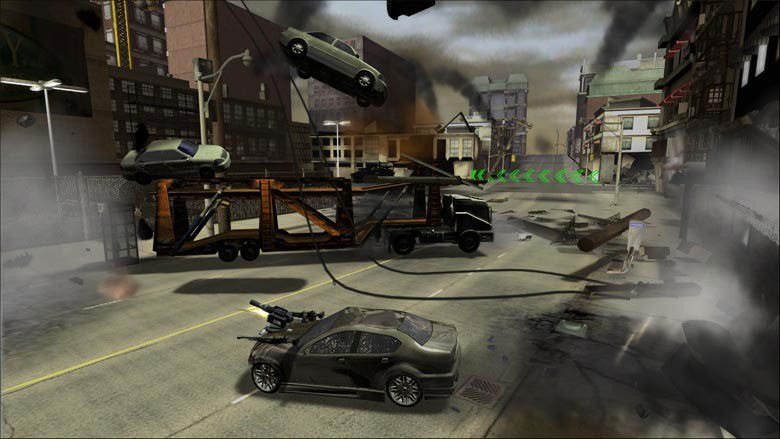
If you look down the line, into the future of Xbox 360 titles, you see some pretty complicated games coming our way. The likes of Elder Scrolls IV and Mistwalker Studios' Lost Odyssey and Blue Dragon are designed to change gamer perceptions of Microsoft's console. Out of the gate, though, Xbox 360 titles have fallen back on the themes that made the original Xbox so popular: sports, FPS games, and racing. The Xbox already has two popular racing franchises to its name. The exclusive Forza Motorsports is a powerful sim, while the multiplatform Burnout series finds its shiniest home on the Xbox. Full Auto, by developer Pseudo Interactive, tries very hard to interest the 360 owner with a brand new way to race. Strapping weapons to cars can only lead to good things, right? Unfortunately this modern title, in the vein of SJ Games classic Car Wars, fails to do much more than explode prettily in the interested gamer's face. Read on for my impressions of this disappointing title.- Title: Full Auto
- Developer: Pseudo Interactive
- Publisher: Sega
- System:360
Things start off well. The game's tutorial makes it clear from the get-go that your aim is speed, to an extent, but the real way to impress the title is by blowing stuff up. The game walks you through the various components of racing the Full Auto way. You have your boost bar, refilled by doing slides and jumps. You have your unwreck bar, which is refilled by blowing stuff up. Weapons can be mounted front and back, giving you a number of options when you're out on a course. There are several gameplay types, including basic racing, time trials, wreck point targets to hit, and qualifiers to run. There are also 'underdog' races to run, where you're outclassed by every other NPC and still have to make it to the finish line in one piece.
All of these elements somehow combine to make the most shallow and uninteresting game I've yet played on the 360. The first time you play you find dark satisfaction when a car explodes, hit by one of your hood-mounted missiles. The first time you make a mistake use unwreck, you smile in appreciation. By your third or fourth race you're settled in, driving your opponents into trucks and laying open building facades with machine guns. You're playing by rote already. You keep opening up new matches, hoping there will be new elements revealed by different race types, but you're disappointed. Within the first half hour of play, you've seen every trick this game has up its sleeve. At least it looks nice.As a 360 game it would be hard for Full Auto to look bad, and it doesn't. Graphically, the game is solid. The textures are nice, the autos are bright and move well, and the user interface is well thought out. Even here, I don't feel entirely satisfied. With a few exceptions, the backdrop you'll be racing in is very bland. The game that Full Auto begs comparison to is Burnout, and the intricate and highly themed tracks of that game make the dingy street corridors here look quite sad. There's a jump-cam effect that gives you a cinematic view of any aerial maneuvers you perform, but when the camera returns to a first-person perspective there is a jarring sense of discontinuity; Even if your car hit the pavement in the other camera mode, you're still in the air when control is returned to you.
Most frustrating, though, is the stuttering that persists throughout the game. In heavy traffic, you can pull the trigger in rapid succession and rack up an impressive number of kills. Vehicles respond in a realistic fashion, explosions bloom, shrapnel flies, all while you speed along the track ... the system is placed under a heavy load not just occasionally but frequently in this title. Knowing that, the pausing that takes place when in a heavy combat situation is intolerable. At times there is a disquieting 'driving through butter' sensation as the action slides to a crawl. This slowdown doesn't take place during every crash or explosion, but it happens often enough to be a distraction from the only thing this game has going for it.
The most frustrating aspect of this title is the purity of the experience. The game may only do one thing, but it does that one thing fairly well. I really want to like this game. I could see myself occasionally popping into Full Auto for an online match with someone on my friends list, or trying for a new wreck point max to blow off some steam. The key is that, in this vision, the game is a $20 download from Xbox Live. The depth of this game is very similar to what I've seen from some of the better Live Arcade titles, and the simple gameplay bears a resemblance to those downloadable morsels as well. The price Sega is asking for this game is a slap in the face to anyone browsing the recent release wrack. My vision is false, and in reality this is a $60 title you have to physically drive to a store to buy. I recommend against that. If you're in the mood to blow stuff up while driving, rent this one instead. It's just not worth the money for the variety or consistency I've seen here. -
Jim Lee To Direct DC MMO
Kotaku has a press release stating that Jim Lee will be Executive Creative Director for SOE while they develop a DC-branded Massively Multiplayer game. Jim Lee is best known for his work on Batman and the X-Men series of comics. From the article: "SOE will be developing and publishing a game based on the DC Comics universe for next generation gaming platforms and the PC. It is expected that Lee will serve as Executive Creative Director on the game, bringing his artistic flair and talents to the world of online gaming for the first time ... said Jim Lee; 'The truth is that I love gaming as much as I love drawing and telling stories and look forward to bringing the DC Universe to life for players and comic book fans all around the world.'" -
Help Break Original Enigma Messages
Stereo writes "The Enigma Machine was cracked in Poland in 1932, but three messages remain unbroken, despite having been intercepted in the North Atlantic in 1942. The M4 Project, named after the four rotor Enigma M4 used for encryption, is a distributed computing effort to break them. One message has already been deciphered successfully!" -
Help Break Original Enigma Messages
Stereo writes "The Enigma Machine was cracked in Poland in 1932, but three messages remain unbroken, despite having been intercepted in the North Atlantic in 1942. The M4 Project, named after the four rotor Enigma M4 used for encryption, is a distributed computing effort to break them. One message has already been deciphered successfully!" -
Spaceport Singapore
FleaPlus writes "In addition to last week's news of a spaceport in the UAE, Space Adventures has announced that they will also be building a spaceport in Singapore by 2009. The spaceport will offer flights on a variety of vehicles, such as a Russian-built suborbital spaceplane, fighter jets, and Vomit Comet-style weightless parabolas. Space Adventures will be competing with other fully-funded suborbital spaceflight companies, such as Virgin Galactic and Rocketplane." -
How Do You Decide Which Framework to Use?
GPolancic asks: "Software frameworks are increasingly popular software reuse technique, because they provide infrastructure functionalities to an application, or a layer of an application and therefore reduce the work of a software developer. Numerous complementary (for example: Struts and Hibernate) and competitive (for example: JSF vs. Struts or JSF vs. ASP.Net) software frameworks are available as both proprietary and open source software. A major precondition for the success of a software framework is their acceptance, which is related to market share or community size. On the other side, application developers need to review and select the best available software framework for their needs. Which factors do you evaluate before you decide to use a specific software framework?" "Our presumption is that software developers mostly evaluate following software framework characteristics based on:- perceived ease of use (e.g. easy to learn, easy to adapt)
- perceived usability (e.g. improving developer performances, reducing work, faster development),
- perceived sustainability (e.g. perceived long term support, supporting standards, clear project directions) and
- perceived fit to specific developer requirements (e.g. suited language, suited functions, suited architecture).
-
How Do You Decide Which Framework to Use?
GPolancic asks: "Software frameworks are increasingly popular software reuse technique, because they provide infrastructure functionalities to an application, or a layer of an application and therefore reduce the work of a software developer. Numerous complementary (for example: Struts and Hibernate) and competitive (for example: JSF vs. Struts or JSF vs. ASP.Net) software frameworks are available as both proprietary and open source software. A major precondition for the success of a software framework is their acceptance, which is related to market share or community size. On the other side, application developers need to review and select the best available software framework for their needs. Which factors do you evaluate before you decide to use a specific software framework?" "Our presumption is that software developers mostly evaluate following software framework characteristics based on:- perceived ease of use (e.g. easy to learn, easy to adapt)
- perceived usability (e.g. improving developer performances, reducing work, faster development),
- perceived sustainability (e.g. perceived long term support, supporting standards, clear project directions) and
- perceived fit to specific developer requirements (e.g. suited language, suited functions, suited architecture).
-
How Do You Decide Which Framework to Use?
GPolancic asks: "Software frameworks are increasingly popular software reuse technique, because they provide infrastructure functionalities to an application, or a layer of an application and therefore reduce the work of a software developer. Numerous complementary (for example: Struts and Hibernate) and competitive (for example: JSF vs. Struts or JSF vs. ASP.Net) software frameworks are available as both proprietary and open source software. A major precondition for the success of a software framework is their acceptance, which is related to market share or community size. On the other side, application developers need to review and select the best available software framework for their needs. Which factors do you evaluate before you decide to use a specific software framework?" "Our presumption is that software developers mostly evaluate following software framework characteristics based on:- perceived ease of use (e.g. easy to learn, easy to adapt)
- perceived usability (e.g. improving developer performances, reducing work, faster development),
- perceived sustainability (e.g. perceived long term support, supporting standards, clear project directions) and
- perceived fit to specific developer requirements (e.g. suited language, suited functions, suited architecture).
-
An Interview with Wikipedia's Jimbo Wales
Raul654 writes "The Wikipedia Signpost, Wikipedia's weekly in-house publication, is this week featuring an interview with Jimbo Wales. The questions, which were submitted by Wikipedia regulars, hit on subjects related to the Foundation, the budgeting and legal issues, the blocking of Wikipedia in China, as well as where Jimbo sees Wikipedia in the future." -
An Interview with Wikipedia's Jimbo Wales
Raul654 writes "The Wikipedia Signpost, Wikipedia's weekly in-house publication, is this week featuring an interview with Jimbo Wales. The questions, which were submitted by Wikipedia regulars, hit on subjects related to the Foundation, the budgeting and legal issues, the blocking of Wikipedia in China, as well as where Jimbo sees Wikipedia in the future." -
An Interview with Wikipedia's Jimbo Wales
Raul654 writes "The Wikipedia Signpost, Wikipedia's weekly in-house publication, is this week featuring an interview with Jimbo Wales. The questions, which were submitted by Wikipedia regulars, hit on subjects related to the Foundation, the budgeting and legal issues, the blocking of Wikipedia in China, as well as where Jimbo sees Wikipedia in the future." -
Moore's Law Staying Strong Through 30nm
jeffsenter writes "The NYTimes has the story on IBM with JSR Micro advancing photolithograhy research to allow 30nm chips. Good news for Intel, AMD, Moore's Law and overclockers. The IBM researchers' technology advance allows for the same deep ultraviolet rays used to make chips today to be used at 30nm. Intel's newest CPUs are manufactured at 65nm and present technology tapped out soon after that. This buys Moore's Law a few more years." -
Moore's Law Staying Strong Through 30nm
jeffsenter writes "The NYTimes has the story on IBM with JSR Micro advancing photolithograhy research to allow 30nm chips. Good news for Intel, AMD, Moore's Law and overclockers. The IBM researchers' technology advance allows for the same deep ultraviolet rays used to make chips today to be used at 30nm. Intel's newest CPUs are manufactured at 65nm and present technology tapped out soon after that. This buys Moore's Law a few more years." -
Creating a Backboneless Internet?
Peter Trepan asks: "The Internet is the best thing to happen to the free exchange of ideas since... well... maybe ever. But it can also be used as a tool for media control and universal surveillance, perhaps turning that benefit into a liability. Imagine, for instance, if Senator McCarthy had been able to steam open every letter in the United States. In the age of ubiquitous e-mail and filtering software, budding McCarthys are able and willing to do so. I Am Not A Network Professional, but it seems like all this potential for abuse depends upon bottlenecks at the level of ISPs and backbone providers. Is it possible to create an internet that relies instead on peer-to-peer connectivity? How would the hardware work? How would the information be passed? What would be the incentive for average people to buy into it if it meant they'd have to host someone else's packets on their hard drive? In short, what would have to be done to ensure that at least one internet remains completely free, anonymous, and democratized?" -
Creating a Backboneless Internet?
Peter Trepan asks: "The Internet is the best thing to happen to the free exchange of ideas since... well... maybe ever. But it can also be used as a tool for media control and universal surveillance, perhaps turning that benefit into a liability. Imagine, for instance, if Senator McCarthy had been able to steam open every letter in the United States. In the age of ubiquitous e-mail and filtering software, budding McCarthys are able and willing to do so. I Am Not A Network Professional, but it seems like all this potential for abuse depends upon bottlenecks at the level of ISPs and backbone providers. Is it possible to create an internet that relies instead on peer-to-peer connectivity? How would the hardware work? How would the information be passed? What would be the incentive for average people to buy into it if it meant they'd have to host someone else's packets on their hard drive? In short, what would have to be done to ensure that at least one internet remains completely free, anonymous, and democratized?" -
Creating a Backboneless Internet?
Peter Trepan asks: "The Internet is the best thing to happen to the free exchange of ideas since... well... maybe ever. But it can also be used as a tool for media control and universal surveillance, perhaps turning that benefit into a liability. Imagine, for instance, if Senator McCarthy had been able to steam open every letter in the United States. In the age of ubiquitous e-mail and filtering software, budding McCarthys are able and willing to do so. I Am Not A Network Professional, but it seems like all this potential for abuse depends upon bottlenecks at the level of ISPs and backbone providers. Is it possible to create an internet that relies instead on peer-to-peer connectivity? How would the hardware work? How would the information be passed? What would be the incentive for average people to buy into it if it meant they'd have to host someone else's packets on their hard drive? In short, what would have to be done to ensure that at least one internet remains completely free, anonymous, and democratized?" -
Consumers vs. IP Owners: The Future of Copyright
conJunk writes "The BBC has a thoughtful article about new challenges in copyright. The problem: The rights to the audio recordings of the Beatles first album will expire in 2013. While consumers stand to benefit from competing releases of the materials, the copyright owners are of course terrified. And the artists? This one doesn't even seem to affect them." -
Segway Inventor Turns To Environment
MBCook writes "CNN has an article in which they talk about Dean Kamen's latest inventions designed to provide water to rural villages. His goal is also to provide electricity and opportunities for entrepreneurship. From the article: 'Eighty percent of all the diseases you could name would be wiped out if you just gave people clean water,' says Kamen. 'The water purifier makes 1,000 liters of clean water a day, and we don't care what goes into it. And the power generator makes a kilowatt off of anything that burns.'" -
Interview with One of ENIACs Inventors
deeptrace writes "On the 60th anniversary of the ENIAC an old family friend of 'Pres' Eckert transcribed some interviews recorded before his death. Very interesting reading. They dispel a few myths, such as the lights didn't really dim when they turned it on, and the military officers did not salute ENIAC." -
Ask OSDL CEO Stu Cohen About Linux TCO Studies
This morning OSDL and OSDL member Levanta jointly released a study done by Enterprise Management Associates called Get the Truth on Linux Management. For years, a proprietary software company in Washington State has run what they call a Get the Facts campaign about Linux, full of studies that invariably show Linux to be expensive, hard to maintain, and less than totally secure. Stu Cohen, as CEO of OSDL, a group "dedicated to accelerating the growth and adoption of Linux in the enterprise," will happily answer your questions about Linux vs. Windows studies and the myths and FUD that seem to hover over them. Expect Stu's answers to the 10 - 12 highest-moderated questions later this week. -
Intel Looks Beyond the Microchip
Dr Occult writes "BBC reports about upcoming major changes in Intel in 2006. The current Intel core, the Pentium, is on its way out and is to be replaced by a new chip called 'Core'. These new Core chips come in two flavours. Solo Core is a single core processor, and Duo Core is a dual core processor. Intel has also announced the Viiv standard. Viiv is less technology and more a shopping list of technologies. Aimed at the home entertainment market, it defines the latest generation of media centres that are capable of playing anything from MP3 songs to high-definition films." -
A Good Filesystem for Storing Large Binaries?
jZnat asks: "I own hundreds of gigabytes of binary data, usually backed up from other mediums such as CDs and DVDs. However, I cannot figure out which filesystem would be best for storing all this reliably. What I'm looking for is a WORM-optimized FS that also has good journaling methods to prevent data loss due to some natural disaster while data is being shifted around. Trying something new for once, I tried using SGI's XFS due to its promising details, but I was met with countless IO errors after trying to write large amounts of data to it. I feel that Ext3 is not optimal for this; ReiserFS is too slow when it comes to reading large data files; and Reiser4 isn't mature enough to entrust my digital assets to. What filesystem would be most appropriate for these needs?" -
A Good Filesystem for Storing Large Binaries?
jZnat asks: "I own hundreds of gigabytes of binary data, usually backed up from other mediums such as CDs and DVDs. However, I cannot figure out which filesystem would be best for storing all this reliably. What I'm looking for is a WORM-optimized FS that also has good journaling methods to prevent data loss due to some natural disaster while data is being shifted around. Trying something new for once, I tried using SGI's XFS due to its promising details, but I was met with countless IO errors after trying to write large amounts of data to it. I feel that Ext3 is not optimal for this; ReiserFS is too slow when it comes to reading large data files; and Reiser4 isn't mature enough to entrust my digital assets to. What filesystem would be most appropriate for these needs?" -
A Good Filesystem for Storing Large Binaries?
jZnat asks: "I own hundreds of gigabytes of binary data, usually backed up from other mediums such as CDs and DVDs. However, I cannot figure out which filesystem would be best for storing all this reliably. What I'm looking for is a WORM-optimized FS that also has good journaling methods to prevent data loss due to some natural disaster while data is being shifted around. Trying something new for once, I tried using SGI's XFS due to its promising details, but I was met with countless IO errors after trying to write large amounts of data to it. I feel that Ext3 is not optimal for this; ReiserFS is too slow when it comes to reading large data files; and Reiser4 isn't mature enough to entrust my digital assets to. What filesystem would be most appropriate for these needs?" -
Open J2ME Development Options?
loganb asks: "I'm currently holding in my hand a brand new Samsung A900 cell phone with a brand new EVDO data plan. I was initially excited about the OSS/free application development possibilities, as the J2ME stack on this phone supports the new Media, Location, and Messaging APIs. Much to my dismay, however, Sprint (my carrier) locks all the interesting APIs up tighter than a drum, and makes it nearly impossible to get an app to market. You need a $400/yr Verisign certificate just to download an app to a developer-enabled phone and you need a contract with Sprint to receive the certificate necessary to distribute the app (solely through Sprint's online store) to regular users. Of course that is not really an option for free/OSS programs, 'vertical' applications, or anything that doesn't neatly fit into Sprint's business plan. Thus, do any of the other national domestic cell providers allow unfettered access to the Java APIs on their phones? Is there any sort of hackery (such as buying an unlocked phone from Europe and using it on a domestic GSM network) that has an equivalent result?" -
Near Light Speed Travel Possible After All?
DrStrabismus writes "PhysOrg has a story about research that may indicate that close to light speed travel is possible. From the article: 'New antigravity solution will enable space travel near speed of light by the end of this century, he predicts. On Tuesday, Feb. 14, noted physicist Dr. Franklin Felber will present his new exact solution of Einstein's 90-year-old gravitational field equation to the Space Technology and Applications International Forum (STAIF) in Albuquerque. The solution is the first that accounts for masses moving near the speed of light.'" -
Disney Trades Person for Intellectual Property
Dotnaught writes "Walt Disney Company's ABC has traded sportscaster Al Michaels to General Electric Co.'s NBC for cartoon character Oswald the Lucky Rabbit. NBC acquired the rights to the cartoon through its purchase of Universal Studios, which itself gained ownership of the animated rabbit through a contract that Walt Disney signed early in his career. Having to sign Oswald away supposedly prompted Disney to create Mickey Mouse, a character he'd own outright. The company that bears Disney's name fought tooth and nail to retain ownership of Mickey Mouse when the cartoon character's copyright was about to expire." -
Undisturbed Tomb found in the Valley of the Kings
akahige writes "Hot on the heels of the recent news about the death of King Tut comes a new story about the discovery of an unlooted and previously unopened 18th Dynasty tomb in the Valley of the Kings. American archaeologists found five mummies resting in sarcophagi, funerary masks, and coptic storage jars. It is the first such discovery since Howard Carter's discovery of Tutankhamun's tomb in 1922." -
Undisturbed Tomb found in the Valley of the Kings
akahige writes "Hot on the heels of the recent news about the death of King Tut comes a new story about the discovery of an unlooted and previously unopened 18th Dynasty tomb in the Valley of the Kings. American archaeologists found five mummies resting in sarcophagi, funerary masks, and coptic storage jars. It is the first such discovery since Howard Carter's discovery of Tutankhamun's tomb in 1922." -
Undisturbed Tomb found in the Valley of the Kings
akahige writes "Hot on the heels of the recent news about the death of King Tut comes a new story about the discovery of an unlooted and previously unopened 18th Dynasty tomb in the Valley of the Kings. American archaeologists found five mummies resting in sarcophagi, funerary masks, and coptic storage jars. It is the first such discovery since Howard Carter's discovery of Tutankhamun's tomb in 1922." -
Free-to-Air TV and Radio?
ChiaBen asks: "I was visiting a friend recently who has a Free-to-air satellite receiver. It allows him to pick up any free satellite TV and radio programs, along with many pay-to-view (requires a payment, of course) programs. Nokia has a receiver, and I'd like to know if else is making similar hardware. It seems interesting, but before I drop a few hundred bones on one, I'd like to know what everyone has to say about it?" -
GnuCash 1.9.0 Released
Grendel Drago writes "The GnuCash team have released GnuCash 1.9.0. After literally years of waiting, GnuCash is now a GTK2 application. The current version is unstable, and testers are needed." -
LEGO Tech Still Going Strong
zimage writes to tell us that Andrew Carol has designed and built a working Babbage Difference Engine out of LEGO. From the article: "Before the day of computers and pocket calculators, all mathematics was done by hand. Great effort was expended to compose trigonometric and logarithmic tables for navigation, scientific investigation, and engineering purposes. In the mid-19th century, people began to design machines to automate this error prone process. Many machines of various designs were eventually built. The most famous of these machines is the Babbage Difference Engine. [...] Babbage's design could evaluate 7th order polynomials to 31 digits of accuracy. I set out to build a working Difference Engine using LEGO parts which could compute 2nd or 3rd order polynomials to 3 or 4 digits." In related, but not quite as functional, news DigitalDame2 writes to tell us that PC Magazine has an interview with LEGO "brick-artist" Nathan Sawaya, creator of their commissioned LEGO PC. There are also several pictures of the creation in addition to a contest to win the snap-together sculpture. -
Videogames Affect Your Brain
ozmm writes "A story on GameSpot explains the concept of 'mirror neurons.' When we shoot a gun, certain neurons fire in our brain. When we see someone else shoot a gun, even a video game character, the exact same neurons fire. How do virtual reactions affect our lives and thoughts? This short but sweet article touches on all of this and more." From the article: "We can tell if someone is watching a television by the way that person is facing it--even if we can't see or hear if the television is even on. It also means that we can experience the mental states associated with actions without ever having to perform those actions. In video games, in particular, it's like we're automatically empathizing with what is happening on the screen as if we were the video game characters ourselves. If you've ever had a particularly heart-palpitating race in Burnout, surely you can relate." -
Alternatives to SourceForge for Larger Projects?
DavonZ asks: "I have recently requested hosting from SourceForge for andLinux, a Windows based Linux distribution. Since andLinux is essentially an operating system, it is quite large (500MB for the first release), and SourceForge rejected the hosting request due to its size. Since andLinux will allow handheld development environments to be 'plugged in', hosting it could require gigs of space. I have looked into alternative distribution methods like ed2k and Bittorrent, but the FUD associated with such distribution methods can slow adaption of the project. I have also considered purchasing hosting, but that is costly, would require donations and the project is not yet presentable for even beta release...at least not yet. What alternatives to SourceForge are available for large projects like this that include the 'bells and whistles' that SourceForge has (CVS, forums, mailing lists, bug tracking, etc.)?" -
Sound Waves Kill Skin and Prostate Cancer Cells
Anonymous Coward writes "A recent Study in the British Journal of Cancer shows that the use of Quercitin and 20KHz ultrasound for 60 seconds killed skin and prostate cancer cells. 90% of the abnormal cells were dead within 48hrs. Since low frequency ultrasound was previously shown to enhance the skin penetration of topical substances up to 1000 times, it would seem that a topical Quercetin cream with a low frequency ultrasound wand might be just the ticket for those annoying little skin cancers that tend to occur in older geeks who have spent a bit of time in the sun." -
Words Affect Our Reality - On The Right
The Whorf hypothesis claims that one's native language influences perception and thought. Researchers at UC-Berkeley and U-Chicago reasoned that, since language is predominantly processed in the left hemisphere of the brain, any effect on perception should have an effect predominantly on the right visual field, which is also processed on the left. After comparing reaction times for hues of blue-green -- colors with distinct names in one language but not another -- they concluded, in a just-published paper, that the Whorf hypothesis holds for the right visual field, but not the left. -
Wikipedia vs Congressional Staffers [Update]
There has been quite a bit of recent reporting on the recent troubles between Wikipedia and certain Congressional staffers. In response, abdulzis mentions that "an RFC, Wikipedia's mediation method to deal with 'disharmonious users', has been opened to take action against US Congressional staffers who repeatedly blank content and engage in revert wars and slanderous or libelous behavior which violates Wikiepdia code. The IP ranges of US Congress have been currently blocked, but only for a week until the issue can be addressed more directly." -
Mother 3 Finished After 11 Years
reidman writes "The unusual Japanese RPG Mother 2 (later released as "EarthBound" stateside) was a huge success in Japan. Hints about the development of the game's sequel were everywhere (even in the game itself). Originally developed for the ill-fated 64DD, the sequel was downgraded, delayed, and eventually cancelled. The fans, however, were too obsessed to let it be - and the game was quietly picked up again. Earlier this month an official announcement was finally made - the obsessive pursuit of the fans has made Mother 3 a reality (in Japan, at least) - it will be released on April 20, 2006 for the GBA! Now to get it translated..." -
Loss of Applied IQ Among UK Youth?
Baldrson writes "The UK Times Online reports that: 'After studying 25,000 children across both state and private schools Philip Adey, a professor of education at King's College London confidently declares: "The intelligence of 11-year-olds has fallen by three years' worth in the past two decades."' 3 years loss at age 11 is an IQ of 100*8/11 or 73 -- a massive loss of 27 points. Although the test measures, not general IQ per se, but general IQ applied to scientific and technical reasoning, it nevertheless appears to blow 'a gaping hole' in what has been called The Flynn Effect: that IQs have been rising in most parts of the world -- particularly the developed countries."