Slashdot Mirror
Domain: wikipedia.org
Stories and comments across the archive that link to wikipedia.org.
Stories · 7,048
-
Star Trek's Nichelle Nichols Hospitalised In LA After Stroke
WheezyJoe writes: The Register tells us that Nichelle Nichols, who played the lovely Lt. Uhura, communications officer of the original starship Enterprise (original series and animated series), has been hospitalized after a mild stroke. She is reported to have undergone a CAT scan and MRI, and was awake and eating as of Thursday evening. Nichols has shown minor signs of loss of mobility but otherwise no signs of paralysis. -
Star Trek's Nichelle Nichols Hospitalised In LA After Stroke
WheezyJoe writes: The Register tells us that Nichelle Nichols, who played the lovely Lt. Uhura, communications officer of the original starship Enterprise (original series and animated series), has been hospitalized after a mild stroke. She is reported to have undergone a CAT scan and MRI, and was awake and eating as of Thursday evening. Nichols has shown minor signs of loss of mobility but otherwise no signs of paralysis. -
Linux World Domination Creates Shortage of Linux-Skilled Workers
Linux Foundation Executive Director Jim Zemlin doesn't use the phrase 'world domination' in these videos, but he could. He lists enough computing niches where GNU/Linux is the major player -- from supercomputers to the next generation of automotive systems -- that with or without world domination, Linux has obviously become an extremely important, widely used operating system that has grown amazingly since Linus Torvalds first shared his humble kernel with the world in 1991. With great popularity has come a great need for people who know how to administer and otherwise work with Linux, so the Linux Foundation is developing new courses in tandem with massive open online course (MOOC) provider edX. Unlike some of the Linux Foundation's previous course offerings, their edX ones are free to audit, and the cost for certification (if you want a cred, not just knowledge) is lower than many IT certification tests and certificates.
These videos (both visible today) were made remotely, with Timothy Lord at one end in Austin, TX, and Jim Zemlin at the other end in Tokyo, Japan. Their sound quality suffers from the distance involved, but they are generally intelligible -- and, of course, you can always choose to read the transcript instead of watching the videos. -
Linux World Domination Creates Shortage of Linux-Skilled Workers
Linux Foundation Executive Director Jim Zemlin doesn't use the phrase 'world domination' in these videos, but he could. He lists enough computing niches where GNU/Linux is the major player -- from supercomputers to the next generation of automotive systems -- that with or without world domination, Linux has obviously become an extremely important, widely used operating system that has grown amazingly since Linus Torvalds first shared his humble kernel with the world in 1991. With great popularity has come a great need for people who know how to administer and otherwise work with Linux, so the Linux Foundation is developing new courses in tandem with massive open online course (MOOC) provider edX. Unlike some of the Linux Foundation's previous course offerings, their edX ones are free to audit, and the cost for certification (if you want a cred, not just knowledge) is lower than many IT certification tests and certificates.
These videos (both visible today) were made remotely, with Timothy Lord at one end in Austin, TX, and Jim Zemlin at the other end in Tokyo, Japan. Their sound quality suffers from the distance involved, but they are generally intelligible -- and, of course, you can always choose to read the transcript instead of watching the videos. -
Presidential Candidate Lincoln Chaffee Proposes That US Go Metric
New submitter Applehu Akbar writes: The good news is that for the first time in years, a candidate in the next presidential cycle has proposed completing our transition to the metric system. Though unfortunately it's Lincoln Chaffee, let's all hope that this long-standing nerd issue gets into the 2016 debate because of this. Warning: Lame CNN autoplaying video. -
Leaked TISA Documents Reveal Privacy Threat
schwit1 writes with some Wikileaks-enabled news at Forbes about the Trade in Services Agreement, a treaty currently under negotiation between the U.S., the European Union and nearly two dozen other parties. Wikileaks' release of 17 documents from the negotiating countries puts some bad light on some of the provisions being considered: From the Forbes report: Under the draft provisions of the latest trade deal to be leaked by Wikileaks, countries could be barred from trying to control where their citizens' personal data is held or whether it's accessible from outside the country. ... These negotiating texts are supposed to remain secret for five years after TISA is finalized and brought into force. Like TTIP and TPP, TISA could be sped through Congress using Trade Promotion Authority (TPA), also known as fast-track authority, which has been passed by the US Senate and may be taken up in the House this month. Under TPA, Congress is barred from making amendments to the trade deals, and most simply give yes-or-no approval. -
Google Diversity Report Straight Out of 'How To Lie With Statistics' Playbook
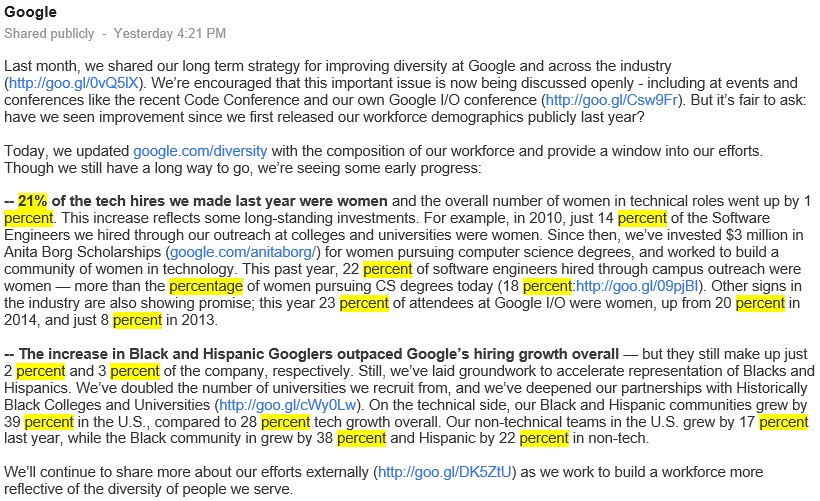
theodp writes: Among the books recommended by Bill Gates for beach reading this summer is How to Lie With Statistics, the published-in-1954-but-timely-as-ever introduction to the (mis)use of statistics. So, how can one lie with statistics? "Sometimes it is percentages that are given and raw figures that are missing," explains the book, "and this can be deceptive too." So, does this explain Google's just-released Diversity Report and the accompanying chock-full-o-percentages narrative (find-all-%-image), which boasts "the Black community in grew [sic] by 38 percent", while the less-impressive raw figures — e.g., the number of Google employees increased by 5,928, but the ranks of Black females only increased by 35 (less than 0.6% of the net increase) — are relegated to a PDF of its EEO-1 Report that's linked to in the fine-print footnotes? To be fair to Google, Microsoft, Twitter, Apple and Amazon didn't want people to see their EEO-1 numbers, either. -
The Artificial Pancreas For Diabetics Is Nearly Here
the_newsbeagle writes: It's the tech that type 1 diabetics have long been waiting for: An implanted "closed-loop" system that monitors a person's blood-sugar level and adjusts injections from an insulin pump. Such a system would liberate diabetics from constant self-monitoring and give parents of diabetic children peace of mind. Thanks to improvements in glucose sensors and control algorithms, the first artificial pancreas systems are now in clinical trials. -
SourceForge and GIMP [Updated]
New submitter tresf writes: In response to a Google+ post from the Gimp project claiming that "[Sourceforge] is now distributing an ads-enabled installer of GIMP," Sourceforge had this response: "In cases where a project is no longer actively being maintained, SourceForge has in some cases established a mirror of releases that are hosted elsewhere. This was done for GIMP-Win.
Submitter's note: Gimp is actively being maintained and the definition of "mirror" is quite misleading here as a modified binary is no longer a verbatim copy. Download statistics for Gimp on Windows show SourceForge as offering over 1,000 downloads per day of the Gimp software.
In an official response to this incident, the official Gimp project team reminds users to use official download methods. Slashdotters may remember the last time news like this surfaced (2013) when the Gimp team decided to move downloads from SourceForge to their own FTP service. "Therefore, we remind you again that GIMP only provides builds for Windows via its official Downloads page." Note: SourceForge and Slashdot share a corporate parent. Editor's note: I just got back from a busy weekend to see that a bunch of people are freaking out that we're "burying" this story, so here it is. Go hog wild. Sorry it took so long. (And for future reference, user submissions are easily found in the firehose, listed in the order they appear, newest first.)
Update: 06/01 22:37 GMT by T : The SourceForge blog has a welcome update; SourceForge, it says, has effective today "stopped presenting third party offers for unmaintained SourceForge projects. ... At this time, we present third party offers only with a few projects where it is explicitly approved by the project developer, or if the project is already bundling third party offers." -
Steve Albini: The Music Industry Is a Parasite -- and Copyright Is Dead
journovampire sends word of another thought-provoking rant from Steve Albini (mentioned here last a few years back for his paean to the beauty of analog tape for recording): The veteran producer addressed an audience in Barcelona on Saturday: "The old copyright model – the person who creates something owns it and anyone else that wants to use it or see it has to pay them – has expired." -
First Ultraviolet Quantum Dots Shine In an LED
ckwu with word that South Korean researchers have created the first UV-emitting quantum dots, and employed them in the creation of a flexible LED. Their achievement is notable because no one has previously succeeded in making quantum dots capable of emitting light at wavelengths shorter than 400 nm, which defines the upper range of the UV spectrum. Writes ckwu: To get quantum dots that emit UV, the researchers figured out how make them with light-emitting cores smaller than 3 nm in diameter. They did it by coating a light-emitting cadmium zinc selenide nanoparticle with a zinc sulfide shell, which caused the core to shrink to 2.5 nm. The quantum dots give off true UV light, at 377 nm. An LED made with the quantum dots could illuminate the anticounterfeiting marks on a paper bill. The article names a few applications of the technology, besides, including water sterilization and industrial applications. -
Hacking Your Body Through a Nerve In Your Neck
agent elevator writes: IEEE Spectrum has a feature (part of its Hacking the Human OS issue) on the future of vagus nerve stimulation, a device-based therapy with the potential to treat a ridiculously wide variety of ailments: epilepsy, depression, stroke, tinnitus, heart failure, migraines, asthma, the list goes on. One problem is that, because it required an implant (a bit like a pacemaker), it was never anybody's first-choice therapy. But now there's a non-invasive version, a device you just hold to your neck twice a day for a few minutes. It's being trialed first for migraines and cluster headaches (which sound horrible). If it works, vagus nerve stimulation could compete directly with drug treatments on cost and convenience and it would let doctors find new ways to hack human physiology. -
Land Art Park Significantly Reduces Jet Engine Noise Near Airport
ClockEndGooner writes: A study conducted by the Netherlands Organization for Applied Scientific Research found that low frequency and long wavelength jet engine droning noise was significantly reduced in the fall after farmers plowed their fields near Amsterdam's Schiphol Airport. The remaining furrows "had multiple ridges to absorb the sound waves, deflected the sound and muted the noise." This led to the development of the Buitenschot Land Art Park, a buffer park featuring "land art" that has significantly reduced aircraft noise without requiring cuts in the number of allowed flights in and out of the airport. The land art park has also provided neighbors with additional recreational paths and sports fields in the same space. -
Ask Slashdot: What Happens If We Perfect Age Reversing?
ourlovecanlastforeve writes: With biologists getting closer and closer to reversing the aging process in human cells, the reality of greatly extended life draws closer. This brings up a very important conundrum: You can't tell people not to reproduce and you can't kill people to preserve resources and space. Even at our current growth rate there's not enough for everyone. Not enough food, not enough space, not enough medical care. If — no, when — age reversal becomes a reality, who gets to live? And if everyone gets to live, how will we provide for them? -
Android M To Embrace USB Type-C and MIDI
jones_supa writes: USB Type-C connection is showing up in more and more devices, and Google is rolling support for the interface in its Android M operating system. The most significant additions relate to the USB Power Delivery spec. Charging will now work in both directions. That effectively means that Type-C devices can be used as external batteries for other devices. Android M is also finally introducing a feature that musicmakers have been long asking for: MIDI support. This builds on some of the audio features Google introduced in Android 5, including reduction in latency, multichannel audio stream mixing, and support for USB microphones, amplifiers, speakers, and other accessories. As others have written, music and media creation apps are much more prevalent in iOS than they are in Android, and Google hopes turning that around. -
Android M To Embrace USB Type-C and MIDI
jones_supa writes: USB Type-C connection is showing up in more and more devices, and Google is rolling support for the interface in its Android M operating system. The most significant additions relate to the USB Power Delivery spec. Charging will now work in both directions. That effectively means that Type-C devices can be used as external batteries for other devices. Android M is also finally introducing a feature that musicmakers have been long asking for: MIDI support. This builds on some of the audio features Google introduced in Android 5, including reduction in latency, multichannel audio stream mixing, and support for USB microphones, amplifiers, speakers, and other accessories. As others have written, music and media creation apps are much more prevalent in iOS than they are in Android, and Google hopes turning that around. -
Android M To Embrace USB Type-C and MIDI
jones_supa writes: USB Type-C connection is showing up in more and more devices, and Google is rolling support for the interface in its Android M operating system. The most significant additions relate to the USB Power Delivery spec. Charging will now work in both directions. That effectively means that Type-C devices can be used as external batteries for other devices. Android M is also finally introducing a feature that musicmakers have been long asking for: MIDI support. This builds on some of the audio features Google introduced in Android 5, including reduction in latency, multichannel audio stream mixing, and support for USB microphones, amplifiers, speakers, and other accessories. As others have written, music and media creation apps are much more prevalent in iOS than they are in Android, and Google hopes turning that around. -
Ways To Travel Faster Than Light Without Violating Relativity
StartsWithABang writes: It's one of the cardinal laws of physics and the underlying principle of Einstein's relativity itself: the fact that there's a universal speed limit to the motion of anything through space and time, the speed of light, or c. Light itself will always move at this speed (as well as certain other phenomena, like the force of gravity), while anything with mass — like all known particles of matter and antimatter — will always move slower than that. But if you want something to travel faster-than-light, you aren't, as you might think, relegated to the realm of science fiction. There are real, physical phenomena that do exactly this, and yet are perfectly consistent with relativity. -
Building Hospitable Open Source Communities (Video)
This is an 11 minute excerpt from an hour-long video, contributed by long-time Slashdot user Erik Möller. This video is the moving picture equivalent of the typical Slashdot summary of a text article, complete with a link to the main article, which in this case is a video (over an hour long) at PassionateVoices.org. Erik's interviewee, Sumana Harihareswara, is also a long-time Slashdot reader who claims (admits?) that she met her husband through a Slashdot link, albeit indirectly. She's spent most of the past decade working with open source, much of it as a community leader. If you are in a leadership role in an open source community or plan to lead one someday, you may want to listen to the complete interview. Sumana has many useful things to say about how open source communities should -- and shouldn't -- be run. -
Can Bad Scientific Practice Be Fixed?
HughPickens.com writes: Richard Horton writes that a recent symposium on the reproducibility and reliability of biomedical research discussed one of the most sensitive issues in science today: the idea that something has gone fundamentally wrong with science (PDF), one of our greatest human creations. The case against science is straightforward: much of the scientific literature, perhaps half, may simply be untrue. Afflicted by studies with small sample sizes, tiny effects, invalid exploratory analyses, and flagrant conflicts of interest, together with an obsession for pursuing fashionable trends of dubious importance, science has taken a turn towards darkness. According to Horton, editor-in-chief of The Lancet, a United Kingdom-based medical journal, the apparent endemicity of bad research behavior is alarming. In their quest for telling a compelling story, scientists too often sculpt data to fit their preferred theory of the world or retrofit hypotheses to fit their data.
Can bad scientific practices be fixed? Part of the problem is that no-one is incentivized to be right. Instead, scientists are incentivized to be productive and innovative. Tony Weidberg says that the particle physics community now invests great effort into intensive checking and rechecking of data prior to publication following several high-profile errors. By filtering results through independent working groups, physicists are encouraged to criticize. Good criticism is rewarded. The goal is a reliable result, and the incentives for scientists are aligned around this goal. "The good news is that science is beginning to take some of its worst failings very seriously," says Horton. "The bad news is that nobody is ready to take the first step to clean up the system." -
Large Amount of Star Citizen Art Assets Leaked
jones_supa writes: A huge batch of work-in-progress assets for Star Citizen have leaked to the public. An unknown person, likely connected with Cloud Imperium Games in some way, provided a link to the 48 gigabytes of content. The link has now been taken down, but as we know, it's hard to remove material from Internet after once put there. Being a CryEngine game, it has been suggested that it might be possible to view some of the assets using CryEngine development tools. Leaks are always quite the conundrum with the opportunities they present to curious fans and competitor companies, but can also be very depressing for the developers and publisher of the game. -
Sex-Switched Mosquitoes May Help In Fight Against Diseases
cstacy writes: Only the female mosquitoes bite and transmit viral diseases such as Dengue Fever. Scientists have finally discovered the elusive genetic switch called Nix, that determines the sex of these blood sucking insects, and hope to selectively eliminate females to control the spread of diseases. "Nix provides us with exciting opportunities to harness mosquito sex in the fight against infectious diseases because maleness is the ultimate disease-refractory trait," explained Zhijian Jake Tu, an affiliate of the Fralin Life Science Institute and a biochemistry professor from Virginia Tech's College of Agriculture and Life Sciences. -
Sex-Switched Mosquitoes May Help In Fight Against Diseases
cstacy writes: Only the female mosquitoes bite and transmit viral diseases such as Dengue Fever. Scientists have finally discovered the elusive genetic switch called Nix, that determines the sex of these blood sucking insects, and hope to selectively eliminate females to control the spread of diseases. "Nix provides us with exciting opportunities to harness mosquito sex in the fight against infectious diseases because maleness is the ultimate disease-refractory trait," explained Zhijian Jake Tu, an affiliate of the Fralin Life Science Institute and a biochemistry professor from Virginia Tech's College of Agriculture and Life Sciences. -
Largest Eruption In the Known Universe Is ~100 Times the Size of Milky Way
StartsWithABang writes: At the center of almost every galaxy is a supermassive black hole (SMBH); at the center of almost every cluster is a supermassive galaxy with some of the largest SMBHs in the Universe. And every once in a while, a galactocentric black hole will become active, emitting tremendous amounts of radiation out into the Universe as it devours matter. This radiation can cut across the spectrum, from the X-ray down to the radio. At the heart of MS 0735.6+7421, there's a >10^10 solar mass black hole that appears to have been active for hundreds of millions of years, something unheard of! -
Largest Eruption In the Known Universe Is ~100 Times the Size of Milky Way
StartsWithABang writes: At the center of almost every galaxy is a supermassive black hole (SMBH); at the center of almost every cluster is a supermassive galaxy with some of the largest SMBHs in the Universe. And every once in a while, a galactocentric black hole will become active, emitting tremendous amounts of radiation out into the Universe as it devours matter. This radiation can cut across the spectrum, from the X-ray down to the radio. At the heart of MS 0735.6+7421, there's a >10^10 solar mass black hole that appears to have been active for hundreds of millions of years, something unheard of! -
Tech Bubble? What Tech Bubble?
HughPickens.com writes: Conor Dougherty writes in the NYT that the tech industry's venture capitalists — the financiers who bet on companies when they are little more than an idea — are going out of their way to avoid the one word that could describe what is happening around them: Bubble. "I guess it is a scary word because in some sense no one wants it to stop," says Tomasz Tunguz. "And so if you utter it, do you pop it?" In 2000, tech stocks crashed, venture capital dried up and many young companies were vaporized. Today, people see shades of 2000 in the enormous valuations assigned to private companies like Uber, with a valuation of $41 billion, and Slack, the corporate messaging service that is about a year old and valued at $2.8 billion in its latest funding round. A few years ago private companies worth more than $1 billion were rare enough that venture capitalists called them "unicorns." Today, there are 107 unicorns and while nobody doubts that many of tech's unicorns are indeed real businesses, valuations are inflating, leading some people to worry that investment decisions are being guided by something venture capitalists call FOMO — the fear of missing out.
With interest rates at historic lows, excess capital causes investment bubbles. The result is too much money chasing too few great deals. Unfortunately, overcapitalizing startups with easy money results in superfluous spending and dangerously high burn rates and investors are happy to admit that this torrid pace of investment has started to worry them. "Do I think companies are overvalued as a whole? No," says Sam Altman, president of Y Combinator. "Do I think too much money can kill good companies? Yes. And that is an important difference." -
San Bernardino Sheriff Has Used Stingray Over 300 Times With No Warrant
An anonymous reader writes: After a records request by Ars, the sheriff in San Bernardino County (SBSD) sent an example of a template for a "pen register and trap and trace order" application. The county attorneys claim what they sent was a warrant application template, even though it is not. The application cites no legal authority on which to base the request. "This is astonishing because it suggests the absence of legal authorization (because if there were clear legal authorization you can bet the government would be citing it)," Fred Cate, a law professor at Indiana University, told Ars. "Alternatively, it might suggest that the government just doesn't care about legal authorization. Either interpretation is profoundly troubling," he added. Further documents reveal that the agency has used a Stingray 303 times between January 1, 2014 and May 7, 2015. -
Cute Or Creepy? Google's Plan For a Sci-Fi Teddy Bear
HughPickens.com writes: Time Magazine reports that Google has designed and patented an "anthropomorphic device" that could take the form of a "doll or toy" and interact both with people as well as tech gadgets echoing the "super toy" teddy bear featured in Stephen Spielberg's 2001 movie AI. This could be one of Google's creepiest patents yet — especially if movies like "Chuckie" still give you nightmares. The patent filing diagrams a stuffed teddy bear and a bunny rabbit outfitted with microphones, speakers, cameras and motors as well as a wireless connection to the internet. If it senses you're looking at it, the fuzzy toy will rotate its head and look back at you. Once it receives and recognizes a voice command prompt, you can then tell it to control media devices in your home (e.g. turn on your music or TV). According to the patent filing: "To express interest, an anthropomorphic device may open its eyes, lift its head, and/or focus its gaze on the user or object of its interest. To express curiosity, an anthropomorphic device may tilt its head, furrow its brow, and/or scratch its head with an arm. To express boredom, an anthropomorphic device may defocus its gaze, direct its gaze in a downward fashion, tap its foot, and/or close its eyes. To express surprise, an anthropomorphic device may make a sudden movement, sit or stand up straight, and/or dilate its pupils."
The patent adds that making the device look "cute" should encourage even the youngest members of a family to interact with it. But Mikhail Avady, from SmartUp, said he thought it belonged in "a horror film", and the campaign group Big Brother Watch has also expressed dismay. "When those devices are aimed specifically at children, then for many this will step over the creepy line," says Avady. "Children should be able to play in private and shouldn't have to fear this sort of passive invasion of their privacy." -
25 Years Today - Windows 3.0
An anonymous reader writes: Windows 3.0 was launched on 22 May 1990 — I know, 'coz I was there as a SDE on the team. I still have, um, several of the shrink-wrapped boxes of the product — with either 3.5 inch and 5.25 floppies rattling around inside them — complete with their distinctive 'I witnessed the event' sticker!
It was a big deal for me, and I still consider Win 3 as *the* most significant Windows' release, and I wonder what other Slashdotters think, looking back on Win 3? -
A Conversation with Druva Co-Founder Jaspreet Singh (Video)
This was originally going to be an interview about the state of enterprise-level backup software in an increasingly edge computing-focused world, but we rapidly drifted into talking about how Druva started in Pune (near Bangalore) and ended up moving to Silicon Valley. We hear plenty about American software companies moving to India, but not a lot about Indian software companies moving here. Druva had good reasons for the move, the chief one being a financing deal with Sequoia Capital. Aside from that, though, Jaspreet says the talent pool -- not just developers but software marketing people and other important staffers -- is more concentrated in Silicon Valley than almost anywhere else in the world. 'It's like Hollywood for geeks,' Jaspreet says. This doesn't mean business is necessarily easy in the USA: Jaspreet ended up laying off his entire staff. Twice. And he made other mistakes as a young, new CEO bringing a company to life in a crowded field.
Those mistakes, which Jaspreet shares freely with us, are like a business school 'Start-Up Pitfalls' class. You may never want to do your own startup, but if you're a developer or otherwise involved with the software industry, there's a good chance that you'll have a chance to work for one at some point. And if you have that chance, you'll be glad you watched this video (or read the transcript) before you take the startup plunge. -
A Conversation with Druva Co-Founder Jaspreet Singh (Video)
This was originally going to be an interview about the state of enterprise-level backup software in an increasingly edge computing-focused world, but we rapidly drifted into talking about how Druva started in Pune (near Bangalore) and ended up moving to Silicon Valley. We hear plenty about American software companies moving to India, but not a lot about Indian software companies moving here. Druva had good reasons for the move, the chief one being a financing deal with Sequoia Capital. Aside from that, though, Jaspreet says the talent pool -- not just developers but software marketing people and other important staffers -- is more concentrated in Silicon Valley than almost anywhere else in the world. 'It's like Hollywood for geeks,' Jaspreet says. This doesn't mean business is necessarily easy in the USA: Jaspreet ended up laying off his entire staff. Twice. And he made other mistakes as a young, new CEO bringing a company to life in a crowded field.
Those mistakes, which Jaspreet shares freely with us, are like a business school 'Start-Up Pitfalls' class. You may never want to do your own startup, but if you're a developer or otherwise involved with the software industry, there's a good chance that you'll have a chance to work for one at some point. And if you have that chance, you'll be glad you watched this video (or read the transcript) before you take the startup plunge. -
A Conversation with Druva Co-Founder Jaspreet Singh (Video)
This was originally going to be an interview about the state of enterprise-level backup software in an increasingly edge computing-focused world, but we rapidly drifted into talking about how Druva started in Pune (near Bangalore) and ended up moving to Silicon Valley. We hear plenty about American software companies moving to India, but not a lot about Indian software companies moving here. Druva had good reasons for the move, the chief one being a financing deal with Sequoia Capital. Aside from that, though, Jaspreet says the talent pool -- not just developers but software marketing people and other important staffers -- is more concentrated in Silicon Valley than almost anywhere else in the world. 'It's like Hollywood for geeks,' Jaspreet says. This doesn't mean business is necessarily easy in the USA: Jaspreet ended up laying off his entire staff. Twice. And he made other mistakes as a young, new CEO bringing a company to life in a crowded field.
Those mistakes, which Jaspreet shares freely with us, are like a business school 'Start-Up Pitfalls' class. You may never want to do your own startup, but if you're a developer or otherwise involved with the software industry, there's a good chance that you'll have a chance to work for one at some point. And if you have that chance, you'll be glad you watched this video (or read the transcript) before you take the startup plunge. -
New Class of "Non-Joulian" Magnets Change Volume In Magnetic Field
Zothecula notes an announcement from the University of Maryland saying they have developed a new class of magnets, called "Non-Joulian" magnets, which physically expand in the presence of a magnetic field. "In the 1840s, physicist James Prescott Joule discovered that iron-based magnetic materials changed their shape but not their volume when placed in a magnetic field. This phenomenon is referred to as "Joule Magnetostriction," and since its discovery 175 years ago, all magnets have been characterized on this basis." Another significant property of these new magnets is that they can harvest or convert energy with very little waste heat (abstract). The magnets are created when thermally-treated, iron-based alloys are heated in a furnace, then rapidly cooled. When they reach room temperature, they have an odd, almost cellular shape on the microscopic level. The researchers say the magnets have numerous applications for energy-efficient sensors and actuators. -
'Logjam' Vulnerability Threatens Encrypted Connections
An anonymous reader writes: A team of security researchers has revealed a new encryption vulnerability called 'Logjam,' which is the result of a flaw in the TLS protocol used to create encrypted connections. It affects servers supporting the Diffie-Hellman key exchange, and it's caused by export restrictions mandated by the U.S. government during the Clinton administration. "Attackers with the ability to monitor the connection between an end user and a Diffie-Hellman-enabled server that supports the export cipher can inject a special payload into the traffic that downgrades encrypted connections to use extremely weak 512-bit key material. Using precomputed data prepared ahead of time, the attackers can then deduce the encryption key negotiated between the two parties."
Internet Explorer is the only browser yet updated to block such an attack — patches for Chrome, Firefox, and Safari are expected soon. The researchers add, "Breaking the single, most common 1024-bit prime used by web servers would allow passive eavesdropping on connections to 18% of the Top 1 Million HTTPS domains. A second prime would allow passive decryption of connections to 66% of VPN servers and 26% of SSH servers. A close reading of published NSA leaks shows that the agency's attacks on VPNs are consistent with having achieved such a break." Here is their full technical report (PDF). -
US Levels Espionage Charges Against 6 Chinese Nationals
Taco Cowboy writes: The U.S. government has indicted five Chinese citizens and arrested a Chinese professor on charges of economic espionage. The government alleges that they took jobs at two small, American chipmakers — Avago Technologies and Skyworks Solutions — in order to steal microelectronics designs. "All of them worked, the indictment contends, to steal trade secrets for a type of chip popularly known as a “filter” that is used for acoustics in mobile telephones, among other purposes. They took the technology back to Tianjin University, created a joint venture company with the university to produce the chips, and soon were selling them to both the Chinese military and to commercial customers."
It's interesting to note that the Reuters article keeps mentioning how this technology — used commonly as an acoustic filter — has "military applications." It's also interesting to look at another recent case involving Shirrey Chen, a hydrologist who was mysteriously arrested on suspicion of espionage, but then abruptly cleared five months later. One can't help but wonder what's driving the U.S.'s new strategy for tackling economic espionage. -
Jason Scott of Textfiles.com Wants Your AOL & Shovelware CDs
eldavojohn writes: You've probably got a spindle in your closet, or a drawer layered with them: the CD-ROM discs that were mailed to you or delivered with some hardware that you put away "just in case." Now, of course, the case for actually using them is laughable. Well, a certain eccentric individual named Jason Scott has a fever — and the only cure is more AOL CDs. But his sickness doesn't stop there, "I also want all the CD-ROMs made by Walnut Creek CD-ROM. I want every shovelware disc that came out in the entire breadth of the CD-ROM era. I want every shareware floppy, while we're talking. I want it all. The CD-ROM era is basically finite at this point. It's over. The time when we're going to use physical media as the primary transport for most data is done done done. Sure, there's going to be distributions and use of CD-ROMs for some time to come, but the time when it all came that way and when it was in most cases the only method of distribution in the history books, now. And there were a specific amount of CD-ROMs made. There are directories and listings of many that were manufactured. I want to find those. I want to image them, and I want to put them up. I'm looking for stacks of CD-ROMs now. Stacks and stacks. AOL CDs and driver CDs and Shareware CDs and even hand-burned CDs of stuff you downloaded way back when. This is the time to strike." Who knows? His madness may end up being appreciated by younger generations! -
Four Quasars Found Clustered Together Defy Current Cosmological Expectations
StartsWithABang writes: Get a supermassive black hole feeding on matter, particularly on large amounts of cool, dense gas, and you're likely to get a quasar: a luminous, active galaxy emitting radiation from the radio all the way up through the X-ray. Our best understanding and observations indicate that these objects should be rare, transient, and isolated; no more than two have ever been found close together before. Until this discovery, that is, where we just found four within a million light years of one another, posing a problem for our current theories of structure formation in the Universe. -
Decoding the Enigma of Satoshi Nakamoto
HughPickens.com writes: For the past year Nathaniel Popper has been working on a book about the history of Bitcoin and writes in the NYT that it is hard to avoid being drawn in by the almost mystical riddle of Satoshi Nakamoto's identity. Popper has his own candidate for founder of Bitcoin, a reclusive American man of Hungarian descent named Nick Szabo. Szabo worked in a loosely organized group of digital privacy activists who over decades laid the foundation for Bitcoin and created many parts that later went into the virtual currency. Bitcoin was not a bolt out of the blue, as is sometimes assumed, but was instead built on the ideas of multiple people over several decades. Several experiments in digital cash circulated on the Cypherpunk lists in the 1990s. Adam Back, a British researcher, created an algorithm called hashcash that later became a central component of Bitcoin. Another, called b money, was designed by an intensely private computer engineer named Wei Dai.
It may be impossible to prove Satoshi's identity until the person or people behind Bitcoin's curtain decide to come forward and prove ownership of Satoshi's old electronic accounts and at this point, the creator's identity is no longer important to Bitcoin's future. Since Satoshi stopped contributing to the project in 2011, most of the open-source code has been rewritten by a group of programmers whose identities are known. According to Popper whoever it is, the real Satoshi Nakamoto has many good reasons for wanting to stay anonymous. Perhaps the most obvious is potential danger. Satoshi Nakamoto most likely collected nearly a million Bitcoins during the system's first year. Given that each Bitcoin is now worth about $240, the stash could be worth more than $200 million. That could make Satoshi a target. "With his modest clothes and unassuming manner, Mr. Szabo could be the kind of person who could have a fortune and not spend any of it," concludes Popper, "or even throw away the keys to the bank." -
Baton Bob Receives $20,000 Settlement For Coerced Facebook Post
McGruber writes: After arresting him during a June 2013 street performance, Atlanta Police Officers forced costumed street performer "Baton Bob" to make a pro-police statement on his Facebook page before they would allow him to be released on bond. Social media coverage of the incident triggered a six-month internal police investigation into the arrest. Atlanta Police Officer H.J. Davis was given a one-day suspension, then resigned from the Atlanta Police department a few weeks later. Atlanta Police Lt. Jeffrey Cantin received a five-day suspension for "violating responsibilities of a supervisor".
Baton Bob also filed a federal lawsuit against the city, arguing that officers made a wrongful arrest that violated, well, nearly every constitutional right you can name. Those included Jamerson's "right to free speech, his right to be free from unreasonable searches and seizures, his right to remain silent while in custody, his right to be free from compelled speech, his right to counsel, and his right to privacy." The City of Atlanta's legal department reviewed the case and determined that a $20,000 settlement would "be in the best interest of the city" rather than fighting the claims in court. -
Ask Slashdot: Best Payloads For Asteroid Diverter/Killer Mission?
TheRealHocusLocus writes: The Emergency Asteroid Defence Project has launched a crowdfunded IndieGoGo campaign to help produce a set of working blueprints for a two-stage HAIV, or Hypervelocity Asteroid Intercept Vehicle. This HAIV paper (PDF) describes the use of a leading kinetic impactor to make a crater — a following nuclear warhead would detonate in the crater for maximum energy transfer. The plans would be available for philanthropists to bring to prototype stage, while your friendly local nuclear weapon state supplies the warhead. This may be a best-fit solution. But just ask Morgan Freeman: these strategies could fail. What — if any — backup strategy could be integrated into an HAIV mission as a fail-safe in case the primary fails? Here is a review of strategies (some fanciful, few deployable) if we have to divert an asteroid with very short lead time. A gentle landing on the object may not be feasible, and we must rely on things that push hard or go boom. For example: detonating nearby to ablate surface materials and create recoil in the direction we wish to nudge. Also, with multiple warheads and precise timing, would it be possible to create a "shaped" nuclear explosion in space? -
Wind Turbines With No Blades
An anonymous reader writes: Wired has a profile of Spanish company Vortex Bladeless and their unusual new wind turbine tech. "Their idea is the Vortex, a bladeless wind turbine that looks like a giant rolled joint shooting into the sky. The Vortex has the same goals as conventional wind turbines: To turn breezes into kinetic energy that can be used as electricity." Instead of relying on wind to push a propeller in a circular motion, these turbines rely on vorticity — how wind can strike an object in a particular way to generate spinning vortices of air. Engineers usually try to avoid this — it's what brought down the Tacoma Narrows Bridge. But this Spanish company designed the turbine computationally to have the vortices occur at the same time along its entire height. "In its current prototype, the elongated cone is made from a composite of fiberglass and carbon fiber, which allows the mast to vibrate as much as possible (an increase in mass reduces natural frequency). At the base of the cone are two rings of repelling magnets, which act as a sort of nonelectrical motor. When the cone oscillates one way, the repelling magnets pull it in the other direction, like a slight nudge to boost the mast's movement regardless of wind speed. This kinetic energy is then converted into electricity via an alternator that multiplies the frequency of the mast's oscillation to improve the energy-gathering efficiency." -
Russian Rocket Crashes In Siberia
An anonymous reader writes: A Russian Proton-M rocket carrying a Mexican satellite broke down shortly after launch and crashed in Siberia. Russian space agency Roscosmos is investigating the incident, but the cause is not yet known. In the video, the rocket appeared to sputter and stop providing thrust when the third-stage engine unexpectedly switched off. Communications were lost with the rocket before that happened. This comes just a couple weeks after Russia experienced another high profile rocket failure when its cargo ship bound for the International Space Station failed to reach a high enough orbit and began spinning out of control. Russia's Proton family of rockets has been in use since the 1960s, though the current Proton-M incarnation was first flown in 2001. -
Russian Rocket Crashes In Siberia
An anonymous reader writes: A Russian Proton-M rocket carrying a Mexican satellite broke down shortly after launch and crashed in Siberia. Russian space agency Roscosmos is investigating the incident, but the cause is not yet known. In the video, the rocket appeared to sputter and stop providing thrust when the third-stage engine unexpectedly switched off. Communications were lost with the rocket before that happened. This comes just a couple weeks after Russia experienced another high profile rocket failure when its cargo ship bound for the International Space Station failed to reach a high enough orbit and began spinning out of control. Russia's Proton family of rockets has been in use since the 1960s, though the current Proton-M incarnation was first flown in 2001. -
Mechanical 'Clicky' Keyboards Still Have Followers (Video)
For a good number of years, the sound of the old IBM or other mechanical keyboard clacking away was the sound of programmers (or writers) at work on their computers. Then, according to Edgar Matias, president and cofounder of the Matias Corporation, computer companies started using membrane switches and other cheaper ways to make keyboards, which made a lot of people mutter curse words under their breath as they beat their fingers against keys that had to go all the way to the bottom of their travel to work, unlike the good old mechanical keyboards we once knew and loved.
Enter Edgar Matias, who started out making the half keyboard, which is like a chorded keyboard except that you can use your QWERTY typing skills with little modification -- assuming you or your boss has $595 (!) to lay out on a keyboard. But after that Edgar started making QWERTY and Dvorak keyboards for semi-competitive prices. FYI: No Slashdot person got a free keyboard (or extra money) for making this video, but I have a Matias keyboard, and in my opinion it's far better than the cheapie it replaced. A lot of other people seem to want "real" keyboards, too, which they buy from Matias or from other companies such as Unicomp, which makes keyboards just like the classic, heavily-loved IBM Model M. Again, I've owned a Unicomp keyboard (that I bought; it was not a giveaway) and it was excellent. Both companies put out quality products that are far easier on your hands and wrists than the $10 or $20 keyboards sold by big box electronics retailers. -
Mechanical 'Clicky' Keyboards Still Have Followers (Video)
For a good number of years, the sound of the old IBM or other mechanical keyboard clacking away was the sound of programmers (or writers) at work on their computers. Then, according to Edgar Matias, president and cofounder of the Matias Corporation, computer companies started using membrane switches and other cheaper ways to make keyboards, which made a lot of people mutter curse words under their breath as they beat their fingers against keys that had to go all the way to the bottom of their travel to work, unlike the good old mechanical keyboards we once knew and loved.
Enter Edgar Matias, who started out making the half keyboard, which is like a chorded keyboard except that you can use your QWERTY typing skills with little modification -- assuming you or your boss has $595 (!) to lay out on a keyboard. But after that Edgar started making QWERTY and Dvorak keyboards for semi-competitive prices. FYI: No Slashdot person got a free keyboard (or extra money) for making this video, but I have a Matias keyboard, and in my opinion it's far better than the cheapie it replaced. A lot of other people seem to want "real" keyboards, too, which they buy from Matias or from other companies such as Unicomp, which makes keyboards just like the classic, heavily-loved IBM Model M. Again, I've owned a Unicomp keyboard (that I bought; it was not a giveaway) and it was excellent. Both companies put out quality products that are far easier on your hands and wrists than the $10 or $20 keyboards sold by big box electronics retailers. -
How SpaceX and the Quest For Mars Almost Sunk Tesla Motors
braindrainbahrain writes: Elon Musk and his rocket company are well known to Slashdottters. This article and book excerpt tell the story of the creation of SpaceX and how it almost sank Musk's other company, Tesla Motors. Musk recalls, "I could either pick SpaceX or Tesla or split the money I had left between them. That was a tough decision. If I split the money, maybe both of them would die. If I gave the money to just one company, the probability of it surviving was greater, but then it would mean certain death for the other company." But then, at the last moment, years of work at SpaceX finally paid off: "[O]n Dec. 23, 2008, SpaceX received a wonderful shock. The company won a $1.6 billion contract for 12 NASA resupply flights to the space station. Then the Tesla deal ended up closing successfully, on Christmas Eve, hours before Tesla would have gone bankrupt. Musk had just a few hundred thousand dollars left and could not have made payroll the next day." Also, it turns out the inspiration for SpaceX was the idea of sending mice to Mars. -
How Light at Night Affects Preschoolers' Sleep Patterns, Part Two (Video)
Yesterday, in the intro to video number one of this two part extravaganza we wrote, "The effects of light and dark on adults' Circadian rythym has been studied over and over, but there hasn't been much research done on how light at night affects young children's sleep patterns."
Then we said, "This is the topic of Lameese Akacem's doctoral dissertation, and is a study being carried out under the aegis of the Sleep and Development Laboratory at the University of Colorado, Boulder," and we mentioned that this research is (at least in part) crowdfunded, and that the deadline for donating to this project is early next week, so if you feel this project is worth supporting you need to act within the next few days. -
Rediscovered Lucas-Commissioned Short "Black Angel" Released On YouTube
eldavojohn writes: Youtube now offers Black Angel, a short film shown in UK theaters before ESB. What was once thought lost is now found; enjoy. This may be the best half-hour you spend today, even if you must "set your clocks back 34 years," as writer and director Roger Christian advises. (Christian is also known for directing 2000's Battlefield Earth .) -
How Light at Night Affects Preschoolers' Sleep Patterns (Video)
The effects of light and dark on adults' Circadian rythym has been studied over and over, but there hasn't been much research done on how light at night affects young children's sleep patterns. This is the topic of Lameese Akacem's doctoral dissertation, and is a study being carried out under the aegis of the Sleep and Development Laboratory at the University of Colorado, Boulder, under the direction of Assistant Professor Monique K. LeBourgeois. Aside from the inherent value of this research, which may help parents decide whether (and how much) they are messing up their children's sleep patterns by letting them view screens such as TVs, tablets or smart phones near bedtime, its funding is unique; the money for this study is coming, at least in part, from crowdfunding. The crowdfunding itself is an experiment. This study is one of a small, select group of projects the University of Colorado at Boulder has in its pilot crowdfunding program. Its crowdfunding time window closes next week, so if you want to help sponsor this experiment, and help learn how different kinds of light can affect how (and how well) small children sleep, you need to act within the next six days. (This is a two-part video. Part one runs today. Part two will run tomorrow.) -
Dawn Spacecraft Gets a Better Look At Ceres' Bizarre 'White Spots'
StartsWithABang writes: Since its discovery as the first asteroid more than 200 years ago, Ceres has been one of the most poorly understood objects in the Solar System as even imagery from the Hubble Space Telescope is unable to resolve very much. But NASA's Dawn mission, since moving on from Vesta, has begun to map Ceres, constructing the highest resolution global map ever, with better data to come. The greatest mystery so far are two bright white spots at the bottom of a deep crater, brighter and more reflective than anything else on the planet's surface. Right now, three leading possibilities for the origin of these features exist, with Dawn possessing the capabilities to teach us which one (if any) is correct, hopefully by the end of the year!