Slashdot Mirror
Domain: wikipedia.org
Stories and comments across the archive that link to wikipedia.org.
Stories · 7,048
-
IBM Opens Up POWER Architecture For Licensing
New submitter HAL11000 was the first of many to write with news that IBM and others have formed a new consortium to license the POWER architecture to third parties "IBM puts up POWER architecture for licensing and announces the OpenPower Consortium with Google, Nvidia, Mellanox, and Tyan." Quoting El Reg: "The plan, according to McCredie, is to open up the intellectual property for the Power architecture and to allow customizations by licensees, just like ARM Holdings has done brilliantly with its ARM processors ... Nvidia is very excited about the prospects of marrying Power processors and Nvidia GPUs for both HPC and general purpose systems. ... Tyan will presumably be working on alternative motherboards to the ones that IBM has manufactured for its own use." There are mentions of the POWER firmware being "open sourced," but it is unclear if that actually means Open Source or something more like the Open Group's definition of open (vendors only). -
Hubble Spots Source of Short Gamma Ray Burst
symbolset writes "Researchers using the Hubble Space Telescope have imaged some evidence that the merger of neutron stars is responsible for producing a short-duration gamma ray burst. On June 3rd the Swift gamma-ray burst (GRB) mission detected GRB 130603B, a burst lasting only one tenth of a second nearly 4 billion light-years away. Imaging with Hubble, they located a small red dot which, over the course of the following two weeks, dimmed." -
Plants Communicate Using Fungi
Shipud writes "In response to aphid attacks, some plants produce chemicals that repel the aphids and attract wasps, the aphids' natural enemies. Researchers at the University of Aberdeen have shown that plants attacked by aphids can communicate that information to neighboring plants via existing networks of fungi in the soil. Thus fungal symbiosis with plants is shown to be taken one step further: not only do they provide nutrients to plants, they also function as communication hardware." -
Creator of xkcd Reveals Secret Back-story of His Epic, 3,099-Panel 'Time' Comic
vikingpower writes "Randall Munroe, the comic author best known as the creator of the xkcd webcomic, reveals the secret backstory of his epic, 3099-panel 'Time' strip in an interesting interview with Wired. He says, 'In my comic, our civilization is long gone. Every civilization with written records has existed for less than 5,000 years; it seems optimistic to hope that the current one will last for 10,000 more ... The Earth’s axis wobbles over the millennia, and some individual stars move visibly, so I used a few different pieces of astronomy software–with a lot of hand correction and tweaking–to render the future night sky. When the Sun sets in the night sequence, one of the first things you see is the gap where Antares should be, which was the first clue that this is taking place in the far future. Later in the night–which lasted for several days of real time–more astronomical details let readers pin down the date more precisely.' The comic can be seen as an animation on YouTube. There is also a complete click-through version available on geekwagon. This comic inspired a dedicated wiki and has its own glossary." -
The History of The Oregon Trail
Rick Zeman writes "Those of us of a certain age recall The Oregon Trail with fondness as the pioneering educational game that had the audacity to make learning fun! This article takes a look at the history behind the game, even going back to its initial text-based offering, showing how some programming magic pulled a generation of kids together. Quoting: '[F]or two weeks, the roommates holed up in a former janitor’s closet at Bryant Junior High School, where the school’s teletype was stored, and spent their evenings programming. Using Rawitsch’s historical knowledge, Heinemann and Dillenberger developed a series of algorithms, punching hundreds of lines of code into the teletype. But just because they created the program didn’t mean they could breeze through it. When Heinemann tried The Oregon Trail for the first time, he died of pneumonia midway!'" -
How Did My Stratosphere Ever Get Shipped?
Bennett Haselton writes "How did a $400-billion company ship millions of units of a phone with a calendar app that displays the wrong date, a texting app that can't reply to group texts, a screen capture function that doesn't work, and a phone app that won't let me use the keypad unless the speakerphone is on? The answer, perhaps, suggests deeper questions about why market forces fix certain problems but not others, and what to do about it." Read on for the rest of Bennett's thoughts.I've been using either a Samsung Stratosphere or a Samsung Stratosphere 2 from September 2012 to the present. Where to begin?
-
If you open the calendar application on the Stratosphere 2, it usually highlights tomorrow's date as "Today," and lists tomorrow's calendar entries as your list of things to do "Today." Here is a picture of my phone's screen taken on June 2, with the calendar app displaying "Today, Mon, Jun 3 2013" — despite the phone knowing the correct time is 9:22 PM on June 2.
Strangely, in the morning the calendar app would display the correct day as "Today," but would switch to the wrong day some time in the afternoon, and eventually I decided that the calendar app was probably using Coordinated Universal Time to decide what "Today" was, which is 9 hours ahead of Pacific Standard Time.
-
You'll notice that these images are not screen captures, but photos taken with another phone. This is because some time between the Stratosphere 1 and 2, the screen capture function broke — every support site says you're supposed to be able to take a screen cap on a Stratosphere by pressing the Home and Power buttons at the same time, and that works on the 1, but not on the 2.
-
If someone else sends a text to multiple recipients including you, the Stratosphere gives you no indication that it's a group text, and there's no way for you to see the other recipients or reply to the whole group. (I had a lot of awkward "What, you were asking everybody, not just me?" moments before I realized what was going on.) Other users have been complaining about this for months, and it apparently affects more Android phones than just the Stratosphere.
-
The built-in camera refuses to take a picture if the battery is low — it just says "Warning: low battery" and exits. Yes, I know they think they're doing it for my own good since the camera is a battery hog, but a few times I've wanted to take a picture where it was well worth using up a half a percent of my remaining battery life or however much it would have taken, but the phone wouldn't let me. That should be the user's decision, dammit.
-
When I was in Canada last week, if I tried sending a text message longer than 160 characters, the phone would tell me that the message sent, but it would actually fail silently and never get delivered. I'm not sure whether to blame Verizon, Android, or Samsung for this one (or just, you know), but in the end someone has to take responsibility for the product, and the phone telling you that a message was sent when it actually got lost, is a complete fail. If it doesn't work, fine, give me an error message, but never tell the user a message got sent successfully if it didn't.
-
During a phone call, the on-screen keypad doesn't work unless the phone is on speakerphone. If the speakerphone is off, the screen goes dark after about 1 second of inactivity, making it impossible to enter an account number or anything else. I can avoid this bug by turning on a speakerphone (which is how I know it's a software bug, not a problem with the touchscreen), but this is a pain if I'm in a public place and don't want to annoy everyone around me who would have to listen to all the voice prompts. (The phone's software seems to be following a rule like: "If the speakerphone is not on, then when the phone moves away from the user's face, assume the user is not actively using the phone and let the screen go dark" — where the bug is that it doesn't make an exception and keep the screen on if the user is actively pressing keys on the keypad.)
At first, these and many, many other bugs produce a state of mind that transcends annoyance to reach a kind of genuine curiosity, where you're asking "How did this happen?" not rhetorically, but because you actually want to know. But eventually the surprise wears off, and you're just left with bugs that are disproportionately aggravating because they obviously would have been caught during even the most basic UI testing. They're aggravating to me not because of how much they get in the way (you eventually get used to them), but because the existence of those bugs conveys a certain lazy attitude towards finding and fixing bugs at all.
I realize this is not a logical reaction. The aggravation you feel towards a bug should depend on how much the bug actually interferes with the user experience, not on how easily the manufacturer should have found it. Rationally speaking, the biggest problem with the phone right now (and the reason I'm having to mail to back to the manufacturer for a replacement) is that the charging port spontaneously broke, so that unless the micro USB charger is plugged in exactly right, the phone can't charge (even if you get it right and form a connection successfully, the connection breaks if you move the phone half an inch). Needless to say, that's exasperating — but it's hard for me to get mad at Samsung over that, because it's not an easy defect to catch at the manufacturing stage. On the other hand, if the calendar app displays the wrong day, I would say that someone should be fired over that except that probably nobody was assigned to do that testing in the first place.
I also posted questions about each of these problems on AndroidForums.com and AndroidCentral.com (those links show all questions recently posted from my username on each site), which have so far received hundreds of "views" but no replies. I mention this because some people think that if you do run into problems like these, all you have to do is post a question and The Community will help you out with a workaround. Nope.
Also, lest you think you can do away with these bugs by downloading third-party replacements for all of these apps, I spent part of an afternoon downloading different texting apps to see if any of them would fix even part of the problems I had with the built-in one. None of them worked much better, although several of them displayed pop-up ads over every third incoming text message, and most of them did not play nicely with each other, giving me no way to disable them so that their notifications would double and triple up on top of each other for every received text. So I gave up. Even if I thought I might eventually find a better app for texting, I didn't have time to test multiple replacements for every built-in default app that didn't work.
Farhad Manjoo has a column up at Slate arguing that the reason many Android phones suck is that they're laden down with adware attempting to extract more personal information and money from the user. I'm sure that's part of the problem, but I can't see how the manufacturer is making any money off of the bugs I ran into; they were just being lazy.
The problem, I think, is that phone manufacturers know that phone reviewers (and users, when they're choosing between models in the store) will focus on easily quanitifiable attributes, such as size, weight, battery life, and the number of megapixels in the camera. The number of aggravating bugs in the user interface is not something that is easy to compare across phones (and in any case would not be printed on the box). Thus market forces simply don't favor the development of a hassle-free interface, because in most cases the phone manufacturers wouldn't be rewarded for it.
And — I don't consider this too much of a stretch — this is where it connects with larger issues for me, because I've been arguing for years that the free market will usually fail to fix certain types of problems, often in the context of threats to free speech and civil liberties, especially if the user lacks information they need to compare multiple options. A major argument in favor of Net Neutrality is that the typical user wouldn't realize it if their ISP were throttling access to certain sites; they would just think that the remote site was responding slowly. Since that information would be hidden from the user, "the marketplace" won't solve the problem on its own. Similarly, every time I say that my Circumventor mailing list keeps getting blocked as "spam" by Yahoo, Hotmail, Gmail, or AOL (despite being 100% verified-opt-in, natch), someone tells me that if the free market is blocking my emails as unwanted, it must be because the users don't want them. That the free market might make a mistake (in this case, because users don't have full information about what is getting blocked as spam), doesn't occur to them. I think the belief in the infallibility of the free market, is one of the most widespread fallacies of our era — people who would never make the mistake of confusing correlation with causation, have no problem thinking that if a product or service gets blocked by a third-party intermediary, it must be because the end user didn't want it.
And so when I'm staring at my Stratosphere's calendar telling me that tomorrow is actually today, it brings out my aggravation not just towards Samsung, Google, and Verizon, but towards all the people I've heard over the years claiming that the marketplace will automatically reward good products and punish bad ones. If there weren't so many people who believed that, maybe we could have collectively put more effort into rating phones according to their usability, knowing that the "invisible hand" of the marketplace was not likely to solve those problems on its own, and maybe these bugs would have gotten fixed. Instead, the "marketplace" focuses disproportionately on attributes like dimensions, weight, and processor speed that are easily quantifiable.
So perhaps the solution — seriously — would be for some third-party review company to rate each new phone on the Stupid S#!% Index. They test the phone under normal usage, and each time they run into an idiotic bug like the calendar application not knowing what day it is, they file it under Stupid S#!%, and after some fixed period of phone usage they count up all the problems and rate the phone under the Stupid S#!% Index. For greater precision, you could compile multiple scores from different users for each phone and take the average. Now you have a quantifiable rating that can be used to compare one phone to another, and could incentivize manufacturers to do more testing on their phones in order to get a better Stupid S#!% Index score.
The message that Apple keeps pushing about the iPhone, after all, is essentially that it would get a good Stupid S#!% Index rating. In his keynote address at the 2011 Apple Worldwide Developers Conference, Steve Jobs repeated the words "It just works" like a mantra — unlike, presumably, everyone else's stuff. iPhones don't score well on price, openness, or compatibility with other companies' products (I always have to tell people that my car charger is not an iPhone charger, it's a literally-every-other-smartphone-in-the-entire-world charger) — but all of that scarcely matters to some people as long as It Just Works.
Well, I couldn't tell you. I can't test an iPhone under normal usage because I'm too addicted to the Stratosphere's slide-out keyboard, which enables me to type much faster than a touchscreen but which only comes on a few Android and Windows phones, and not on any version of the iPhone. Maybe I'll try one more time to make the switch to a touchscreen while my Stratosphere is in the shop.
Yes, these most First-World of First World Problems — especially the bugs specific to the Stratosphere — only apply to a small fraction of the population. But it should be a lesson for anyone who thinks the "free market" would prevent this sort of thing from happening.
Meanwhile, every time I hear an ad talking about how "thin" some new phone is going to be, I just want to say to the phone the same thing that I want to tell all the anorexic girls in nightclubs: You're already thin enough. So stop worrying about being thin, and just try to work on not being so f@#$ing stupid.
-
-
Surveillance Story Turns Into a Warning About Employer Monitoring
rtfa-troll writes "The story from yesterday about the Feds monitoring Google searches has turned into a warning about how work place surveillance could harm you. It turns out that Michele Catalano's husband's boss tipped off the police after finding 'suspicious' searches (including 'pressure cooker bombs') in his old work computer's search history. Luckily for the Catalanos, who even allowed a search of their house when they probably didn't have to, it seems the policemen and FBI agents were professional and friendly. Far from being imperiled by a SWAT raid, Catalano spoke to some men in black cars who were polite and even mentioned to Catalano that 99 times out of 100, these tip-offs come to nothing. Perhaps the lesson is to be a bit more careful about your privacy, so that what you do on the internet remains between you and the professionals at the NSA." -
Big Data for People and Revolutionaries, Not Just Businesses (Video)
This started as a basic, "Tell us how your service can help Slashdot readers who might want to go go into business," interview, but quickly morphed into something else. For one thing, Sumall CEO Dane Atkinson is not only a William Gibson fan, but actually knows Mr. Gibson rather well. For another, he soon jumped off the business topic, let his inner idealist take the stage, and started talking about how we, as individuals, can use Sumall's (free) service to track ourselves much the way NSA and big businesses do, and how we can see at least some of what they know about us. Then we started talking about how political candidates, parties, and even revolutionaries can (and do) use Sumall to track results of their actions -- and how cults and dictatorships do, too. The interview moves into subversive territory at around 7:40, but if you watch/listen from the beginning you'll get a more complete grasp of how this particular Big Data subset works, whether it's for small business marketing or as a way to justify your personal paranoia level. -
FAA OKs US UAVs
Two unmanned aerial vehicles have received approval from the Federal Aviation Administration to perform commercial operations in United States airspace. The Scan Eagle 200 from Insitu will be launched from a ship and used to monitor icebergs and migrating whales in parts of the Arctic where companies are looking for oil. The PUMA from Aerovironment will be used by emergency response teams for monitoring oil spills. (Both are referred to as unmanned aircraft systems, or UAS, by the Administration.) "Issuing the type certificates is an important step toward the FAA's goal of integrating UAS into the nation's airspace. These flights will also meet requirements in the FAA Modernization and Reform Act of 2012 that define Arctic operational areas and include a mandate to increase Arctic UAS commercial operations." -
FAA OKs US UAVs
Two unmanned aerial vehicles have received approval from the Federal Aviation Administration to perform commercial operations in United States airspace. The Scan Eagle 200 from Insitu will be launched from a ship and used to monitor icebergs and migrating whales in parts of the Arctic where companies are looking for oil. The PUMA from Aerovironment will be used by emergency response teams for monitoring oil spills. (Both are referred to as unmanned aircraft systems, or UAS, by the Administration.) "Issuing the type certificates is an important step toward the FAA's goal of integrating UAS into the nation's airspace. These flights will also meet requirements in the FAA Modernization and Reform Act of 2012 that define Arctic operational areas and include a mandate to increase Arctic UAS commercial operations." -
Secret Lab Develops Games and Teaches Others How to Develop Them as Well (Video)
On the Island of Tasmania, there is a Secret Lab. More accurately, it is a business called Secret Lab, run by co-founders Paris Buttfield-Addison and Jon Manning. On their website they say, “Secret Lab is an indie game developer and mobile app training studio based in Hobart, Australia. We're responsible for some of the world's most popular mobile apps -- recently, we've worked on Meebo for iPhone, ABC Play School Art Maker for iPad, ABC Good Game for iPhone and ABC Foodi for iPad. Secret Lab also offers intensive training workshops on iOS and Android development.” They recently presented at OSCON in Portland, OR, where Timothy Lord and his camcorder caught up with them there (as did Rachel Roumeliotis of O'Reilly Media with her camcorder). At just over 30 minutes, this is the longest Slashdot video interview we've ever run. It's worth the time, despite some rough sound patches, if you are interested in mobile game development -- or even if you are just interested in seeing what kind of colorful people do this sort of thing. -
Secret Lab Develops Games and Teaches Others How to Develop Them as Well (Video)
On the Island of Tasmania, there is a Secret Lab. More accurately, it is a business called Secret Lab, run by co-founders Paris Buttfield-Addison and Jon Manning. On their website they say, “Secret Lab is an indie game developer and mobile app training studio based in Hobart, Australia. We're responsible for some of the world's most popular mobile apps -- recently, we've worked on Meebo for iPhone, ABC Play School Art Maker for iPad, ABC Good Game for iPhone and ABC Foodi for iPad. Secret Lab also offers intensive training workshops on iOS and Android development.” They recently presented at OSCON in Portland, OR, where Timothy Lord and his camcorder caught up with them there (as did Rachel Roumeliotis of O'Reilly Media with her camcorder). At just over 30 minutes, this is the longest Slashdot video interview we've ever run. It's worth the time, despite some rough sound patches, if you are interested in mobile game development -- or even if you are just interested in seeing what kind of colorful people do this sort of thing. -
Russia Proposes Banning Foul Language On the Internet
eldavojohn writes "In a country where it's illegal to insult a government official, State Duma Deputy Yelena Mizulina has proposed an amendment to ban swearing on social networks, bulletin boards and all websites. The website would be blocked if the offending material had not been removed within 24 hours. The name of the law this would be added to? "On the protection of children from information harmful to their health and development." Mizulina's title in regards to this legislation? Chairwoman of the Committee on Family, Women and Children (No joke!). Of course, Yelena Mizulina is no stranger to unwarranted censorship as she was behind the law banning gay propaganda to minors and invoked laws to try to silence critics on twitter. The article also notes, 'United Russia deputy Vitaly Milonov put forward a similar initiative on 25 July. He proposed to tighten control over social networks and allow people to dating sites through their passports.'" -
How Outdated Data Distorts Doctors' Pay
Hugh Pickens DOT Com writes "Peter Whoriskey and Dan Keating report at the Washington Post that Medicare annually pays $69.6 billion for physician services according to an arcane and little-known price list, known as the Relative Value Update over which doctors themselves exercise considerable and less-than-totally-transparent influence. A 31-member committee of the American Medical Association (AMA) recommends what Medicare should pay for some 10,000 procedures — with the fees based in part on how long it takes to complete each one. But this time-and-motion study often fails to take full account of changing technology and other factors affecting physician productivity, so anomalies result. For example, if the AMA time estimates are correct, then 41 percent of gastroenterologists were typically performing 12 hours or more of procedures in a day, which is longer than the typical outpatient surgery center is open and and one gastroenterologist in the Post story would have to work 26 hours, according to the committee time estimates, to accomplish what he gets done in a typical workday. Here's how it works: Medicare pays for a 15-minute colonoscopy as if it took 75 minutes resulting in a median salary for a gastroenterologist of $481,000. It is possible that in 1992, critics allow, when the price list was first developed, a colonoscopy actually took something close to 75 minute when doctors had to hunch over an eyepiece similar to that of a microscope for a look. But technology has advanced and now the images are processed and displayed on a large screen in high-definition video. Responding to criticism that the nation's method of valuing medical procedures misprices payments, a bipartisan group of legislators has drafted a bill that would reshape the way the nation pays doctors. The bill would require Medicare officials to collect data such as how much time doctors spend doing procedures and reducing the doctor payment for overvalued services. 'What started as an advisory group has taken on a life of its own,' says Tom Scully, who was Medicare chief during the George W. Bush Administration. 'The idea that $100 billion in federal spending is based on fixed prices that go through an industry trade association in a process that is not open to the public is pretty wild.'" -
Students Hijack $80 Million Superyacht With GPS Spoofing
mask.of.sanity writes "A team of university students have hijacked an $80 million superyacht using GPS spoofing without tripping alarms. The experiment (run with permission) saw the White Rose sail from Monaco to the island of Rhodes in the Mediterranean. Faint GPS signals broadcast from a spoofing device slowly overpowered authentic signals allowing the students control over the yacht's navigational system." -
Book Review: Present Yourself - Using SlideShare To Grow Your Business
benrothke writes "SlideShareis a free web 2.0 based slide hosting service where users can upload presentation-based files. Launched in October 2006, it's considered to be similar to YouTube, but for slideshows. It was originally meant to be used for businesses to share slides among employees more easily, but it has since expanded to also become a host of a large number of slides which are uploaded merely to entertain. SlideShare gets an estimated 58 million unique visitors a month and has about 16 million registered users. With such a strong user base, authors Kit Seeborg and Andrea Meyer write in Present Yourself: Using SlideShare to Grow Your Business how SlideShare users can use the site (including other similar collaborative sites such as Prezi and Scribd) to present their story to a worldwide audience. Given that visual presentations are the new language of business, understanding how to maximize their potential can be a valuable asset for the entrepreneur, job seeker and everyone in between." Read below for the rest of Ben's review. Present Yourself - Using SlideShare to Grow Your Business author Kit Seeborg and Andrea Meye pages 224 publisher OReilly Media rating 9/10 reviewer Ben Rothke ISBN 978-1-4493-4236-4 summary Great resource for maximizing the use of SlideShare and your online presentation presence The truth is a book on SlideShare alone would need no more than 15 pages (20 pages if you include the Pro edition). How difficult is it to upload a PowerPoint? As an aside, there is a huge market for publishing freely available content. Check out Emereo Publisherson Amazon. They have mastered the art of taking free Wikipedia content and charging for it. Enough digression – in this valuable book – the authors show not only how to use the product, but how to maximize its use.
Throughout the book, the authors quote liberally from science and research on the power of visualization. With that lies the inherent power of SlideShare, as humans like images and think more efficiently when they use them. The authors quote a study which shows that when carrying out routine office tasks, if the data is displayed more visually (such as through visual maps), individuals are 17% more productive and need to use 20% fewer mental resources. As to the saying that a picture is worth a thousand words; the authors show that it has a basis in biological fact.
The book is worth it just for the sage advice in the quote at the beginning of chapter 3 where Nancy Duarte, author of slide:ology: The Art and Science of Creating Great Presentations states about presentations, that "they didn't come to your presentation to see you. They came to find out what you can do for them. Success means giving them a reason for taking their time, providing content that resonates, and ensures it's clear what they are to do". Using Duarte's call to arms with the guidance in the book can hopefully start a meaningful change in how data is presented.
As to the presentation itself, the book notes that the presenter of today has a huge challenge in keeping the audience engaged. Anyone who has presently recently knows that many, often a majority of the audience will be distracted by their smartphones, Twitter, Facebook, Angry Birds and more. With that, presenters must put in extra effort to compete for the mindshare of a distracted audience. The book shows you how to overcome such obstacles and suggests that one way to win more audience attention is to include engaging visual slides with your presentation and show them intermittently instead of in parallel with your talk.
Throughout the book, it is clear that the authors are passionate about the topic and it lists many resources and uses to make presentation much more effective. The book has numerous real-world examples of such users. One is Adam Tratt of Haiku Deck; a free presentation app for the iPad that makes presentations simple, beautiful, and fun.
Another example is that of Jeremiah Owyang of the Altimeter Group, a research and advisory firm whose reports consistently rank in the top 100 most viewed documents on SlideShare. The amazing thing about their research, which competing firms charge thousands of dollars for, is that it is all free on SlideShare. The example also shows how they use SlideShare Pro for the secure creation of the reports. They view this model of open research as a core asset that has served the firm well, establishing its credibility and reputation as a trusted resource
While the book has business in its title, it still has significant relevance for end-users, specifically in chapter 7. There it details how you can use SlideShare to further your career and find a job. This is crucial regardless of your profession and industry, in that while the traditional resume is still alive and well, the ability to place your experience on-line opens up new horizons. A full professional presence requires both a paper resume and an online presence.
The chapter notes that a comprehensive online presence, especially with a compete profile on LinkedIn, is forty times more likely to receive job opportunities. The authors note that even if a person is not a presenter, there are things they can do on SlideShare to highlight themselves; including a presentation that serves as a visual resume of their career, a portfolio presentation that displays their creative work and more. Even for those who are not speakers, the authors recommend that the serious job searcher consider public speaking as part of their career strategy,
For those that want to take a look, the first chapter of the book is available here. Not surprisingly, it is on SlideShare.
For those that want to learn everything about SlideShare, from the mundane of adding a SlideShare widget to your website, sharing your presentation across social platforms, sharing your content, collaboration, finding a more rewarding job and much more, Present Yourself: Using SlideShare to Grow Your Business is a great resource.
Reviewed by Ben Rothke
You can purchase Present Yourself - Using SlideShare to Grow Your Business from amazon.com. Slashdot welcomes readers' book reviews (sci-fi included) -- to see your own review here, read the book review guidelines, then visit the submission page. -
Software-Defined Data Centers Might Cost Companies More Than They Save
storagedude writes "As more and more companies move to virtualized, or software-defined, data centers, cost savings might not be one of the benefits. Sure, utilization rates might go up as resources are pooled, but if the end result is that IT resources become easier for end users to access and provision, they might end up using more resources, not less. That's the view of Peder Ulander of Citrix, who cites the Jevons Paradox, a 150-year-old economic theory that arose from an observation about the relationship between coal efficiency and consumption. Making a resource easier to use leads to greater consumption, not less, says Ulander. As users can do more for themselves and don't have to wait for IT, they do more, so more gets used. The real gain, then, might be that more gets accomplished as IT becomes less of a bottleneck. It won't mean cost savings, but it could mean higher revenues." -
Man Formerly Charged With Rigging Student Ballot Exposed As Labor Official
First time accepted submitter pocock writes "Motivated by reports of Matthew Weaver's twelve month jail sentence for rigging CalState student elections, a comprehensive blog describes in detail how a generation of student ballot riggers from the late 1990s have graduated unhindered into federal politics, playing a pivotal role in Australia's upcoming federal election. One can only wonder if Weaver had not been caught, would he too have eventually swiped a million dollars and put the SRC into liquidation?" -
The Shortest Internet Censorship Debate Ever
rysiek writes "When a politician starts talking about defending the innocence of children, there's bound to be a great policy initiative ahead. That's how British PM David Cameron introduced the British porn block. That's also how the Polish Minister of Justice started his remarks yesterday morning on how good an idea it is and that it should be introduced in Poland. This started the shortest Internet censorship debate ever, as in the evening of the same day the Polish Prime Minister and the Minister of Administration and Digitization denounced any such ideas: 'We shall not block access to legal content regardless of whether or not it appeases us aesthetically or ethically.' There had been several full-blown Internet censorship debates in Poland during the last four years. Apparently the arguments against it were not lost on at least some of Polish politicians." -
The Shortest Internet Censorship Debate Ever
rysiek writes "When a politician starts talking about defending the innocence of children, there's bound to be a great policy initiative ahead. That's how British PM David Cameron introduced the British porn block. That's also how the Polish Minister of Justice started his remarks yesterday morning on how good an idea it is and that it should be introduced in Poland. This started the shortest Internet censorship debate ever, as in the evening of the same day the Polish Prime Minister and the Minister of Administration and Digitization denounced any such ideas: 'We shall not block access to legal content regardless of whether or not it appeases us aesthetically or ethically.' There had been several full-blown Internet censorship debates in Poland during the last four years. Apparently the arguments against it were not lost on at least some of Polish politicians." -
Blizzard Breaks For Independence As Kotick Plans $8.2 Billion Dollar Buyout
MojoKid writes "The CEO of Activision Blizzard, Bobby Kotick, announced this morning that he would lead an investor buyout of the company worth approximately $8.2 billion dollars. The move would free Blactivision (how has this moniker never caught on?) to become an independent publisher and free it from the clutches of Vivendi, the evil French entertainment conglomerate. Vivendi has reportedly been attempting to sell Activision Blizzard for years, due to an apparent hatred of actually turning a profit, given than the game developer owns some of the most popular franchises on Earth. Kotick has previously been known for his comments regarding exploiting game franchises and for gems like this: 'We have a real culture of thrift. The goal that I had in bringing a lot of the packaged goods folks into Activision about 10 years ago was to take all the fun out of making video games.'" -
Bill Gates Is Beginning To Dream the Thorium Dream
Daniel_Stuckey writes "TerraPower, the Gates-chaired nuclear power company, has garnered the most attention for pursuing traveling wave reactor tech, which runs entirely on spent uranium and would rarely need to be refueled. But Terrapower just quietly announced that it's going to start seriously exploring thorium power, too." -
Fake "Speed Enforced By Drones" Signs On California Freeways
NF6X writes "CBS station KPIX reports that somebody has been installing counterfeit traffic signs on California bay area freeways, warning motorists of drone-based speed enforcement. They are professionally-made reflective metal signs of comparable style and quality to official traffic signs, and in some cases are even mounted with tamper-resistant hardware. The signs show the familiar silhouette of an MQ-1 Predator drone launching a weapon. According to KPIX, California Highway Patrol denies that they operate any drones, and states that the signs are fake." -
MediaNet Sued for Licensing Unlicensed Songs
New submitter duSoliel wrote in with news that another musician is complaining about a lack of royalties from streaming music services. This time, however, the musician is going after MediaNet (once known as MusicNet) which acts as an intermediary source for licensing songs to streaming music services that did not manage to gain compulsory licensing from the Copyright Royalty Board. MediaNet has a storied history riddled with lawsuits from the Harry Fox agency among others; a suit brought last year alleged that around a quarter of MediaNet's catalog was improperly licensed, but was settled privately out of court. Now, Aimee Mann is suing them for failure to properly license 120 of her songs, seeking $18 million in damages. From the article: "... she entered into a license agreement in 2003 with MediaNet (then known as MusicNet). The term of the license agreement was scheduled to end in 2006 but had automatic two-year extensions unless terminated by either party. Mann's representative is said to have sent a termination notice in 2005, but nevertheless, 'MediaNet continued after the Termination Date to transmit, perform, reproduce and distribute the Compositions as part of MediaNet's service, despite having no right or license to do so.' ... Besides suing for direct infringement, Mann is also claiming that MediaNet induced its business partners to commit copyright infringement. Mann also says she has not been paid any royalties by the company since Sept. 30, 2005 with the exception of a $20 advance this past March that was returned." The perils of not having sane compulsory licensing for Internet radio? -
Invalidation of Eolas's Web Patent Claims Upheld
New submitter Ajay Anand writes with news that Eolas's web patents are really dead (the infamous browser plugin patent that forced Internet Explorer to change how it activated plugins). After Eolas sued a number of companies, last fall a jury found the patents invalid; Eolas naturally mounted an appeal. But a panel of judges simply affirmed the jury decision (PDF). A quiet ending to a decade of patent trolling. -
DARPA Hydra: An Unmanned Sub Mothership to Deploy Drones
garymortimer tips more news about the rise of our robotic overlords. DARPA is now investigating military drone submarines as launch platforms for UAVs. Quoting John Keller at Military & Aerospace Electronics: "The Hydra program will develop and demonstrate an unmanned undersea system with a new kind of unmanned-vehicle delivery system that inserts UAVs and UUVs stealthily into operational environments to respond quickly to situations around the world without putting U.S. military personnel at risk. The Hydra large UUV is to use modular payloads inside a standardized enclosure to deploy a mix of UAVs and UUVs, depending on the military situation. Hydra will integrate existing and emerging technologies in new ways to create an alternate means of delivering a variety of payloads close to where they're needed, DARPA officials say." -
Lenovo "Rips and Flips" the ThinkPad With New Convertible Helix Design
MojoKid writes "Convertible laptops and ultrabooks had a big presence this year with the release of Windows 8. At CES, Lenovo revealed its ThinkPad Helix which it marketed as having a 'groundbreaking "rip and flip" design' that enables this 11.6-inch ultrabook to transform into a powerful Windows 8 tablet with Intel vPro technology for the enterprise. The ThinkPad Helix lets you work in four different modes: laptop, tablet, stand, and tablet+. When attached to the Enhanced Keyboard Dock in laptop mode, you'll get additional battery life and additional ports as well as Lenovo's ThinkPad Precision keyboard, a five button trackpad that supports Windows 8 features, and a traditional ThinkPad TrackPoint. ... The ThinkPad Helix features an 11.6-inch Full HD 1080p IPS (In-Plane Switching) 10-point multi-touchscreen with pen touch input and Gorilla Glass for protection. Lenovo claims the ThinkPad Helix will run for up to 8 hours on a single charge. Performance-wise, the new ThinkPad tablet convertible doesn't have a ton of horsepower, but the machine will get by well enough handling light multimedia and office app use with relative ease." The "stand" mode is just the tablet part mounted away from the keyboard, tablet+ similarly just the tablet part folded over the dock giving it a longer battery life and more ports. It comes at a price though: ~$1800. -
EOMA-68 Based KDE Vivaldi Tablet Engineering Boards Ship
sfcrazy writes "Aaron Seigo, a lead KDE developer, says that the ambitious KDE tablet Vivaldi is shipping to the team for quality testing. Seigo writes on his Google+ page, 'A great start to the week with a warm, sunny, quiet Monday. Well, almost quiet. The first Vivaldi tablets, new dual-core engineering boards and the custom EOMA68 developer workbenches we commissioned have all been shipped out. Don't get too excited: the tablets are pre-certification (EC/FCC) and are on their way to us so we can verify the Q/A targets we set out. Still ...'" It looks like long-time reader lkcl's EOMA-68 initiative is working out; in related news the first batch of Allwinner A10 EOMA-68 cards is shipping to the "...20 Free Software developers brave enough to take one of these at this very early phase." Update: 07/23 17:16 GMT by U L : Correction from lkcl: the first batch of EOMA-68 cards are actually using the Allwinner A20, a bit of an upgrade from the original design. -
Former WaPo Staffer Rob Pegoraro Talks About Newspapers' Decline (Video)
Newpapers. Remember them? The printout editions of websites like NYTimes.com, WSJ.com, and Rob Pegoraro's former workplace, WashingtonPost.com? Rob still writes for USAToday.com and its printout edition, but as a freelancer, not on staff. He's one of few newspaper layoff victims who has managed to hustle up enough freelance work to make a decent living. He's even on Boing Boing and Discovery.com. Where else? Tiny shots on various TV news programs, and one-off articles here and there. He's a hard-working and prolific guy, and he's had an insider's view of the decline of the newspaper industry and the rise of the online news business. In this interview he talks about both -- and adds a few cautionary notes for Rob Malda, the Slashdot co-founder who is now a Washington Post employee. -
Former WaPo Staffer Rob Pegoraro Talks About Newspapers' Decline (Video)
Newpapers. Remember them? The printout editions of websites like NYTimes.com, WSJ.com, and Rob Pegoraro's former workplace, WashingtonPost.com? Rob still writes for USAToday.com and its printout edition, but as a freelancer, not on staff. He's one of few newspaper layoff victims who has managed to hustle up enough freelance work to make a decent living. He's even on Boing Boing and Discovery.com. Where else? Tiny shots on various TV news programs, and one-off articles here and there. He's a hard-working and prolific guy, and he's had an insider's view of the decline of the newspaper industry and the rise of the online news business. In this interview he talks about both -- and adds a few cautionary notes for Rob Malda, the Slashdot co-founder who is now a Washington Post employee. -
Former WaPo Staffer Rob Pegoraro Talks About Newspapers' Decline (Video)
Newpapers. Remember them? The printout editions of websites like NYTimes.com, WSJ.com, and Rob Pegoraro's former workplace, WashingtonPost.com? Rob still writes for USAToday.com and its printout edition, but as a freelancer, not on staff. He's one of few newspaper layoff victims who has managed to hustle up enough freelance work to make a decent living. He's even on Boing Boing and Discovery.com. Where else? Tiny shots on various TV news programs, and one-off articles here and there. He's a hard-working and prolific guy, and he's had an insider's view of the decline of the newspaper industry and the rise of the online news business. In this interview he talks about both -- and adds a few cautionary notes for Rob Malda, the Slashdot co-founder who is now a Washington Post employee. -
3D Printers Shown To Emit Potentially Harmful Nanosized Particles
An anonymous reader writes "A new study by researchers in the Built Environment Research Group at the Illinois Institute of Technology shows that commercially available desktop 3D printers can have substantial emissions of potentially harmful nanosized particles in indoor air. Many desktop 3D printers rely on a process where a thermoplastic feedstock is heated, extruded through a small nozzle, and deposited onto a surface to build 3D objects. Similar processes have been shown to have significant aerosol emissions in other studies using a range of plastic feedstocks, but mostly in industrial environments. In this study, researchers measured ultrafine particle concentrations resulting from a popular commercially available desktop 3D printer using two different plastic feedstocks inside an office. Ultrafine particles (or UFPs) are small, nanosized particles less than 100 nanometers in diameter. Inhalation of UFPs may be important from a health perspective because they deposit efficiently in the lung and can even translocate to the brain. Estimates of emission rates of total UFPs in this study were high, ranging from about 20 billion particles per minute for a 3D printer utilizing a lower temperature polylactic acid (PLA) feedstock to about 200 billion particles per minute for the same type of 3D printer utilizing a higher temperature acrylonitrile butadiene styrene (ABS) feedstock. The emission rates were similar to those measured in previous studies of several other devices and indoor activities, including cooking on a gas or electric stove, burning scented candles, operating laser printers, or even burning a cigarette." -
Muon Neutrino To Electron Neutrino Oscillation Conclusively Shown
New submitter Chris Greenley writes "The T2K long baseline neutrino experiment in Japan has just announced conclusive evidence for electron to muon neutrino oscillation at the 7.5 sigma level. (The level needed for discovery is 5 sigma.) This experiment generates a focused beam of electron neutrinos using an accelerator in the J-PARC facility north of Tokyo which is aimed at the massive Super-Kamiokande detector 295 km (185 miles) away, near the west coast of Japan. 'This T2K observation is the first of its kind in that an explicit appearance of a unique flavor of neutrino at a detection point is unequivocally observed from a different flavor of neutrino at its production point.' This result clears the way for CP-violation neutrino studies which could show that 'regular' neutrinos act differently than their antimatter counterparts, a phenomenon that so far has only been observed in quarks. If neutrino CP-violation is found, it could explain why there is such a large predominance of matter over antimatter in the universe." -
J.K. Rowling Should Try the Voting Algorithm
Frequent contributor Bennett Haselton proposes a new use for online, anonymous voting: helping sort skill from luck in the cheek-by-jowl world of best-selling (and would-be best-selling) authors: "J.K. Rowling recently confirmed that she was the author of a book she had published under a pseudonym, which spiked in sales after she was outed as the true author. Perhaps she was doing an experiment to see how much luck had played a role in propelling her to worldwide success, and whether she could recreate anything close to that success when starting from scratch. But a better way to answer that question would be to strike a deal with an amateur-fiction-hosting site and use the random-sample-voting algorithm that I've written so much about, to test how her writing stacks up against other writers in the same genre." Read on for more. Update: 07/20 01:23 GMT by T : Note: An editorial goof (mine) swapped out the word "confirmed" for "revealed" (above) in an earlier rendering of this story.Rowling confirmed (after the information leaked accidentally) that she had authored a new book, The Cuckoo's Calling, under the male pseudonym Robert Galbraith, which went on to sell only about 1,500 copies before she announced that she was the real author and sales of the book spiked 150,000%.
Stephen King actually tried something similar in the 1970s, publishing a series of books under the pseudonym "Richard Bachman," which he later said was partly an attempt to answer the question of whether his success was due to talent or luck. (The Richard Bachman books sold 10 times as many copies after King was revealed as the author.) Rowling has not said whether she was attempting a similar experiment, having issued a statement that before the revelation, it had been "wonderful to publish without hype or expectation, and pure pleasure to get feedback under a different name."
But if either J.K. Rowling or Stephen King really wants to find the answer to the question of talent vs. luck, the solution lies in the random-sample voting algorithm that I've been advocating in occasional articles for years now, going back to "Censorship By Glut" in 2006. Here's how the experiment could work, for evaluating the quality of fiction writing:
-
Rowling or King could approach a pre-established amateur fiction hosting site with a large number of registered users. Or they could create their own fiction hosting site and announce it to the world for the purpose of running the experiment, which would almost certainly attract a large number of users to sign up. (The experiment only works if the site has a large number of users, for reasons that will become clear.)
-
When a user submits a new short story to the site, the site randomly selects a small subset of other users on the site (say, 20 other users), emails them a link to the new story, and invites them to read it and rate its content. There are several ways you could incentivize those users to read the link and rate the story on a scale of 1 to 10. You could bill it as the "civic duty" of registered users of the site (in the same way that it's the civic duty of registered Wikipedia editors to maintain the quality of articles, even though the editors are working for free). You could require registered users to read and rate any stories that are emailed to them (although of course there'd be no way to stop someone from lazily submitting a rating without even reading the story). You could actually require payments from users who submit stories, and then use that money to distribute small payments to the raters as compensation for reading the story (although that seems like it would be the biggest headache, since you'd have to jump through legal and logistical hoops to set it up, and it would attract cheaters who would try to abuse the system just for the free small payments). But in any case, you don't need every user who gets emailed a story, to actually click through to read the story and rate it. All that matters is that out of those 20 users, enough of them click through to read the story, that you get a statistically representative sample of what users think of the quality.
Optionally, the story raters could also submit written feedback about why they liked or did not like a story. But the important part is collecting the numeric ratings so that they can be averaged into a single overall rating for the piece of content.
-
If a story gets a high enough average rating in the first round of voting, then it gets emailed out to a larger random sample of voters, say, 200. The ratings given by this larger sample can be used to distinguish the very best stories from the merely good. (We expect that for good stories, the ratings would tend to cluster around the high end of the scale, so with that smaller variance, it would take a larger sample size to find a statistically significant difference between the quality of two stories.)
-
The stories that get the highest ratings can be featured on the front page of the site, so that everybody can have the benefit of enjoying the "best" stories. Meanwhile, J.K. Rowling and Stephen King have the benefit of finding out how their stories compare against stories written by unpublished amateur writers.
It all sounds deceptively simple, but the important feature is that you've taken the arbitrariness out of the outcome. As long as your sample sizes are large enough, the rating that a story obtains in this system, will be approximately equal to the average rating it would get from all users across the site. "Luck" is no longer a factor, because you could re-run the experiment twice with the same set of stories, and get approximately the same outcome.
This is important, because numerous experiments and real-world studies have shown that in any environment where users can recommend content to each other and browse content that is already known to be popular — in other words, how most of us discover content in the real world — luck plays a much greater role in which content becomes wildly successful. The generally accepted explanation is that an initial stroke of luck can have a self-reinforcing snowball effect — if a few key influencers happen to discover and recommend a piece of content at the same time, their friends and followers will be drawn to that content as well, and once it crosses that threshold, the content has now become "popular" enough that even more users will be drawn to it just because it's popular.
This is also why any of the existing fiction-rating sites would not work for this experiment — because most such sites allow authors to invite their friends to sign up and give high ratings to their stories, or to form cliques that all give high ratings to each other's writings. It's usually in the site's best interests to allow these tricks, because it gives authors the incentive to promote the site to their friends in order to get them to sign up. But it also means that (a) authors can easily game the system, and the highest-rated stories may not be the highest-quality ones but the ones whose authors simply play the game the best, and (b) even without "gaming the system", the fact that users can see other users' ratings and can seek out "most popular" or "trending" stories, creates the snowball effects discussed above, and introduces a huge amount of arbitrariness into the process.
Duncan Watts' excellent book Everything Is Obvious (Once You Know The Answer) is an excellent introduction to the arbitrariness phenomenon, but if you don't have time to read the whole book, just read about the Matthew Salganik 'many-worlds' experiment", which Watts co-authored and which I've linked to in pretty much every other article I've written about the random-sample-voting algorithm. The gist was that if you divide users into multiple artificial "worlds," where users can recommend content only to other users within those worlds, and seed all artificial worlds with the same content (in this case, songs), then songs which become wildly popular in some worlds will become duds in others.
The whole of Everything is Obvious is at least as insightful as anything ever written by Malcolm Gladwell, and would appeal to the same people, but it never became a bestseller, because — well, probably because we live in one of the many possible worlds of a Salganik experiment, and in the world we happen to live in, the luck of the draw meant that book didn't take off.
But back to the proposed experiment. It is true that the votes of the average users would not tell us anything about whether the winning stories were "artistically" good, however you define that. But in King's case, he was not trying to answer questions about artistic merit. he was trying to find out if his bestselling-author status was due to talent or luck, so the average rating from regular readers would be quite on point. Rowling said that she wanted to write without any hype and receive honest feedback, and it's hard to imagine a better place to do that than writing under a pseudonym for a fiction site that distributes your content directly to the public.
Both King and Rowling deserve some credit for even addressing the question of whether their success was due to talent or luck. It would have been easy for them to assume that their global success was due to their innate skill and hard work, and 99% of the world would have accepted that explanation, so it took no small amount of courage to even raise the question of how luck might have played a role. (We all know plenty of successful people who take umbrage if you even mention "the L word".)
But King did say that he thought he was outed too early to obtain any conclusive results from the experiment (and Rowling also said she wished she could have kept writing under the pseudonym, although she didn't say whether she had any similar "experiment" in mind). The random-sample-voting algorithm would provide instant feedback, not just to King and Rowling, but to any other writer who wanted to see how their writings would stack up against others in the field, from unpublished amateurs to worldwide bestselling authors.
My prediction, if such an experiment is ever conducted: King's and Rowling's writings would be rated very good, but so would many other writers' stories, including struggling writers who have never been published. Or as economist Daniel Kahneman put it: "success = talent + luck; great success = a little more talent + a lot of luck." (That took a certain amount of modesty on his part too, having achieved "great success" himself in the form of a Nobel Prize.) If J.K. Rowling or Stephen King ever launched such an experiment, the biggest favor they'd be doing for the world would not be to boost the egos of a few struggling writers, but to call more attention to the role that luck plays the world.
It's not as if their own egos would have to be bruised in the process. Donald Trump, the last person in the world that I would have guessed to have uttered these words, actually said that "Everything in life is luck," but it didn't seem to deflate his opinion of himself. You don't have to be a jerk like Trump, but just because some unpublished author's story gets a higher rating than yours, doesn't mean you have to let him come live in your mansion.
-
-
NSA Admits Searching "3 Hops" From Suspects
New submitter cpitman writes "In a house hearing Wednesday the NSA admitted that it could query not only a suspect's records, but also perform up to a 'three hop query'. Considering that most people in the world are separated by under 6 degrees of separation, the NSA essentially claims that any single suspect gives them rights to investigate a large chunk of the world's population. With the terror watch list having over 700,000 names, just how many times has Kevin Bacon been investigated?" -
C|Net Reporter Declan McCullagh Talks About Privacy (Video)
Declan Mccullagh, C|net's Chief political correspondent, has covered politics since the late 1990s for a variety of publications. He is a strong libertarian, privacy advocate, and long time Slashdot reader who is not happy about how the NSA and other government bodies are sticking their noses into our personal business. He and I originally talked about doing an interview based on a story he wrote for C|net on July 12 titled How the U.S. forces Net firms to cooperate on surveillance. Scheduling problems put the interview off for a bit, but here we are. Note that Declan has written millions of pixels worth of material about privacy, NSA spying, and related matters. With new revelations about unsavory government activities coming to light seemingly every day the interview delay is no big deal. And this question still remains: Can we repeal the Patriot Act? New Jersey Congressman Rush Holt wants to. What about your representatives? Are they willing to join Rep. Holt? Do you think they might if a bunch of people -- perhaps starting with you -- asked them to? -
Jimmy Carter Calls Snowden Leak Ultimately "Beneficial"
eldavojohn writes "According to RT, the 39th president of the United States made several statements worth noting at a meeting in Atlanta. Carter said that 'America has no functioning democracy at this moment' and 'the invasion of human rights and American privacy has gone too far.' The second comment sounded like Carter predicted the future would look favorably upon Snowden's leaks — at least those concerning domestic spying in the United States — as he said: 'I think that the secrecy that has been surrounding this invasion of privacy has been excessive, so I think that the bringing of it to the public notice has probably been, in the long term, beneficial.' It may be worth noting that, stemming from Zurcher v. Stanford Daily, Jimmy Carter signed the Privacy Protection Act of 1980 into law and that Snowden has received at least one nomination for the Nobel Peace Prize." -
IQ Test Pegs ConceptNet 4 AI About As Smart As a 4-Year-Old
An anonymous reader writes "Artificial and natural knowledge researchers at the University of Illinois at Chicago have IQ-tested one of the best available artificial intelligence systems to see how intelligent it really is. Turns out–it's about as smart as the average 4-year-old. The team put ConceptNet 4, an artificial intelligence system developed at M.I.T., through the verbal portions of the Wechsler Preschool and Primary Scale of Intelligence Test, a standard IQ assessment for young children. They found ConceptNet 4 has the average IQ of a young child. But unlike most children, the machine's scores were very uneven across different portions of the test." If you'd like to play with the AI system described here, take note of the ConceptNet API documentation, and this Ubuntu-centric installation guide. -
The City Where People Are Afraid To Breathe
HonorPoncaCityDotCom writes "BBC reports that cases of an incurable illness called valley fever are multiplying at an alarming and mystifying rate in the American south-west. Few places have been hit as hard as Avenal, a remote city of 14,000 people, nestling in a dip in the floor of the San Joaquin Valley in what experts refer to as a 'hot zone' for coccidioidomycosis — an illness caused by the inhalation of tiny fungal spores that usually reside in the soil. 'On windy days you are more conscious of it,' says Enrique Jimenez. 'You breathe in through your nose, and try not to breathe in as much dust. I worked in the fields for a long time, my father managed a few crops out here, and we took precautions, wearing bandanas.' Valley Fever is not easy to treat. Anti-fungal drugs are available for serious cases but some patients don't respond and it can take years to clear up. It never leaves the body and symptoms can be triggered again. Some patients are on the drugs for life, at a crippling financial cost. During World War II, German prisoners held at a camp in Arizona fell ill. Germany reportedly invoked the Geneva Convention to try to get them moved. Longstanding concerns about valley fever were heightened recently when a federal health official ordered the transfer of more than 3,000 exceptionally vulnerable inmates from two San Joaquin Valley prisons where several dozen have died of the disease in recent years. Dale Pulde, a motorcycle mechanic in Los Angeles County, said he contracted the disease three years ago after traveling to Bakersfield in Kern County and was coughing so hard he was blacking out; he spit blood and couldn't catch his breath. For two months, doctors tested him for everything from tuberculosis to cancer until blood tests confirmed he had the fever. 'When I found out that health officials knew about (this disease) and how common it is, I was beside myself,' said Pulde. 'Why don't they tell people?'" -
The City Where People Are Afraid To Breathe
HonorPoncaCityDotCom writes "BBC reports that cases of an incurable illness called valley fever are multiplying at an alarming and mystifying rate in the American south-west. Few places have been hit as hard as Avenal, a remote city of 14,000 people, nestling in a dip in the floor of the San Joaquin Valley in what experts refer to as a 'hot zone' for coccidioidomycosis — an illness caused by the inhalation of tiny fungal spores that usually reside in the soil. 'On windy days you are more conscious of it,' says Enrique Jimenez. 'You breathe in through your nose, and try not to breathe in as much dust. I worked in the fields for a long time, my father managed a few crops out here, and we took precautions, wearing bandanas.' Valley Fever is not easy to treat. Anti-fungal drugs are available for serious cases but some patients don't respond and it can take years to clear up. It never leaves the body and symptoms can be triggered again. Some patients are on the drugs for life, at a crippling financial cost. During World War II, German prisoners held at a camp in Arizona fell ill. Germany reportedly invoked the Geneva Convention to try to get them moved. Longstanding concerns about valley fever were heightened recently when a federal health official ordered the transfer of more than 3,000 exceptionally vulnerable inmates from two San Joaquin Valley prisons where several dozen have died of the disease in recent years. Dale Pulde, a motorcycle mechanic in Los Angeles County, said he contracted the disease three years ago after traveling to Bakersfield in Kern County and was coughing so hard he was blacking out; he spit blood and couldn't catch his breath. For two months, doctors tested him for everything from tuberculosis to cancer until blood tests confirmed he had the fever. 'When I found out that health officials knew about (this disease) and how common it is, I was beside myself,' said Pulde. 'Why don't they tell people?'" -
Very Large Telescope Observes Gas Cloud Being Ripped Apart By Black Hole
An anonymous reader writes "New observations (PDF) from ESO's Very Large Telescope show for the first time a gas cloud being ripped apart by the supermassive black hole at the center of the galaxy. The cloud is now so stretched that its front part has passed the closest point and is traveling away from the black hole at more than 10 million km/h, whilst the tail is still falling towards it." -
Yahoo Receives Special Recognition For Fighting For User Data Privacy
An anonymous reader writes "The Electronic Frontier Foundation awarded Yahoo a gold star for its diligence in fighting for user privacy in courts. From the release: 'In 2007, Yahoo received an order to produce user data under the Protect America Act (the predecessor statute to the FISA Amendments Act, the law on which the NSA’s recently disclosed Prism program relies). Instead of blindly accepting the government’s constitutionally questionable order, Yahoo fought back. The company challenged the legality of the order in the FISC, the secret surveillance court that grants government applications for surveillance. And when the order was upheld by the FISC, Yahoo didn’t stop fighting: it appealed the decision to the Foreign Intelligence Surveillance Court of Review, a three-judge appellate court established to review decisions of the FISC. ... Yahoo went to bat for its users – not because it had to, and not because of a possible PR benefit – but because it was the right move for its users and the company. It’s precisely this type of fight – a secret fight for user privacy – that should serve as the gold standard for companies, and such a fight must be commended. While Yahoo still has a way to go in the other Who Has Your Back categories (and they remain the last major email carrier not using HTTPS encryption by default), Yahoo leads the pack in fighting for its users under seal and in secret.'" Although they did end up losing, and were forbidden from even mentioning the existence of the case until recently. -
San Onofre's Closure: What Was Missed
Lasrick writes "John Mecklin explores the context that was missed when the LA Times and the San Diego Union Tribune reported on the closing of the remaining two San Onofre nuclear reactors: 'U-T San Diego published a similar flurry of well-reported stories that covered the basics of the reasons for the closure, as well as the impact on consumers, workers, and the electricity supply. At both papers, coverage included infographics that effectively explained the problem that forced the plant to close—vibration that caused wear in tubes for the plant's steam generators. (The Times's tick-tock takeout on the history of the steam generator snafu, published in July, is especially comprehensive.) The specifics of the San Onofre closing were covered well and thoroughly. The context within which those basics reside, however, was far less well-examined, and the two major newspapers closest to the San Onofre plant both therefore missed a real opportunity to inform readers about the major energy choices California and the country will need to make in the coming decade.' Excellent work at the Columbia Journalism Review." -
Secrets of Beatboxing Revealed By MRI
united_notions writes "An international team from UCSD and Philips Research have published a paper (article paywalled; extensive free related resources at UCS here) in the Journal of the Acoustical Society of America, showing the results of real-time magnetic resonance imaging conducted on a beatboxing performer. The authors make interesting comparisons to sounds in many minority languages around the world (such as the 'click' consonants in many African languages); they also show how beatboxing sounds can be represented using the International Phonetic Alphabet (IPA)." -
Secrets of Beatboxing Revealed By MRI
united_notions writes "An international team from UCSD and Philips Research have published a paper (article paywalled; extensive free related resources at UCS here) in the Journal of the Acoustical Society of America, showing the results of real-time magnetic resonance imaging conducted on a beatboxing performer. The authors make interesting comparisons to sounds in many minority languages around the world (such as the 'click' consonants in many African languages); they also show how beatboxing sounds can be represented using the International Phonetic Alphabet (IPA)." -
TV Programmers Seek the Elusive Dog Market
HonorPoncaCityDotCom writes "Stanley Coren reports that a number of new television stations are providing programming specifically designed for dogs and while many people report that their dogs completely ignore what is visible on television, with modern resolution and quicker imaging, more dogs have become potential television viewers. The increase in dog viewership is primarily attributed to the way the dog's eye works. The image on a standard television screen is updated 60 times per second and since a human's flicker fusion frequency is only 55 Hz, the image appears continuous and the gradually changing images give us the illusion of movement. However dogs can discern flickers at up to 80 Hz so with the increased availability of high-resolution digital screens that are refreshed at a much higher rate, the images are less likely to appear to be flickering to the canine eye. Presentation factors are also an issue. Dogs are most likely to respond to images that have been captured at the eye level of a dog with a low camera angle where there are moving things like animals or birds. But even if that requirement is fulfilled, most dogs do not watch television because the TV is normally placed at a comfortable eye level for human beings and dogs do tend not to scan upward, and therefore do not notice the TV images. All of which brings us to DogTV, the first cable network to deliver 24-hour programming for dogs that lets you flip on the channel while you go out for the day as your pet is stimulated, entertained and relaxed. 'If the dog wasn't enjoying it, he would find something else to do, like nibble on the end of a sofa,' says veterinarian Ann E. Hohenhaus." -
The Little Bomb-Detecting Device That Couldn't
theodp writes "Widely deployed in Iraq and promoted by military leaders, BusinessWeek reports the ADE 651 bomb-detecting device had one little problem: it wouldn't detect explosives (earlier Slashdot story). 'The ADE 651,' reports Adam Higginbotham, 'was modeled on a novelty trinket conceived decades before by a former used-car salesman from South Carolina, which was purported to detect golf balls. It wasn't even good at that.' One thing the ADE 651 did excel at, however, was making money — estimates suggest that the authorities in Baghdad bought more than 6,000 useless bomb detectors, at a cost of at least $38 million. Even though ADE 651 manufacturer James McCormick was found guilty of three counts of fraud and sentenced to 10 years in prison in May, the ADE 651 is still being used at thousands of checkpoints across Baghdad. Elsewhere, authorities have never stopped believing in the detectors. Why? According to Sandia Labs' Dale Murray, the ideomotor effect is so persuasive that for anyone who wants or needs to believe in it, even conclusive scientific evidence undermining the technology it exploits has little power." -
A Scientist's Quest For Perfect Broccoli
HonorPoncaCityDotCom writes "For all the wonders of fresh broccoli, in most parts of the country it is only available from local growers during the cooler weeks at either end of the growing season, nowhere near long enough to become a fixture in grocery stores or kitchens. But now Michael Moss writes in the NY Times that Thomas Bjorkman is out to change all that by creating a new version of the plant that can thrive in hot, steamy summers like those in New York, South Carolina or Iowa and is easy and inexpensive enough to grow in large volumes. And Bjorkman's quest doesn't stop there: His crucifer is also crisp, subtly sweet and utterly tender when eaten fresh-picked and aims to maximize the concentration of glucoraphanin, a mildly toxic compound used by plants to fight insects that in humans may stimulate our bodies' natural chemical defenses to aid in preventing cancer and warding off heart disease. The Eastern Broccoli Project's goal is to create a regional food network for an increasingly important and nutritious vegetable that may serve as a model network for other specialty crops to help shift American attitudes toward fruits and vegetables by increasing their allure and usefulness in cooking, while increasing their nutritional loads. 'If you've had really fresh broccoli, you know it's an entirely different thing,' says Bjorkman, a plant scientist at Cornell University. 'And if the health-policy goal is to vastly increase the consumption of broccoli, then we need a ready supply, at an attractive price.'" -
Google Patents Displaying Athletes On Sports Fields
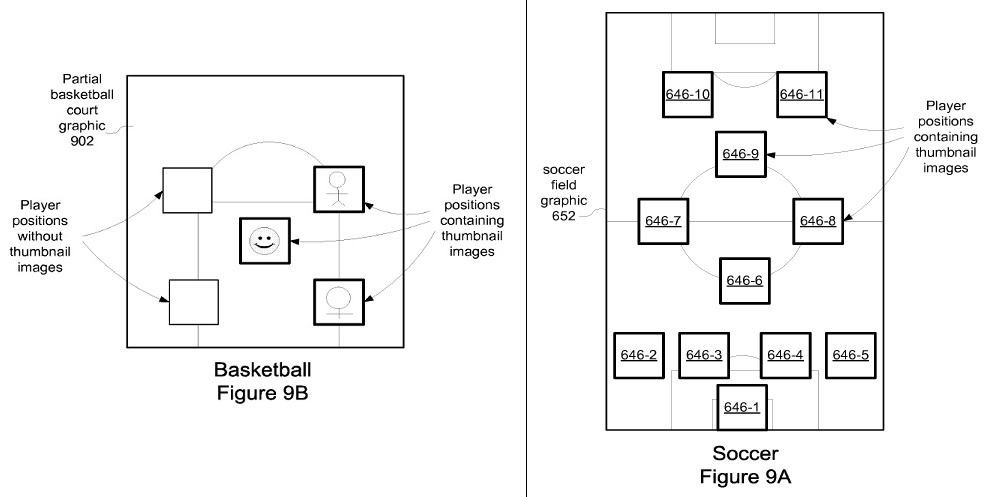
theodp writes "Just about anyone that's familiar with sports has seen position and depth charts, in which athletes are portrayed on the athletic fields their sport is played on. But that didn't stop Google from asking for — and the USPTO granting — a patent on displaying pictures of athletes on the fields on which their sport is played, or in legal-speak, its Method, System, and Graphical User Interface for Personalized Online Sports Team Charts. 'One aspect of the invention,' explains Google, 'involves a graphical user interface on a computer that includes a graphic of an athletic playing field or a portion thereof, and a plurality of player positions on the athletic field. At least some of the player positions contain thumbnail images selected by a first user. The thumbnail images provide links to corresponding profiles in an online social network.' Six Googlers, including Orkut Buyukkokten, were credited as inventors in the 2007 patent application." -
Google Patents Displaying Athletes On Sports Fields
theodp writes "Just about anyone that's familiar with sports has seen position and depth charts, in which athletes are portrayed on the athletic fields their sport is played on. But that didn't stop Google from asking for — and the USPTO granting — a patent on displaying pictures of athletes on the fields on which their sport is played, or in legal-speak, its Method, System, and Graphical User Interface for Personalized Online Sports Team Charts. 'One aspect of the invention,' explains Google, 'involves a graphical user interface on a computer that includes a graphic of an athletic playing field or a portion thereof, and a plurality of player positions on the athletic field. At least some of the player positions contain thumbnail images selected by a first user. The thumbnail images provide links to corresponding profiles in an online social network.' Six Googlers, including Orkut Buyukkokten, were credited as inventors in the 2007 patent application."