Slashdot Mirror
Domain: wikipedia.org
Stories and comments across the archive that link to wikipedia.org.
Stories · 7,048
-
Call for Questions: Rasterman, Founder of the Enlightenment Project
Since before all other interfaces, Enlightenment has been making computers look and feel like they're from the future. On December 21, the decade long effort to rewrite Enlightenment will see the first officially stable release. With e17 a few days away, project founder and master of X11 graphics hacking Carsten Haitzler (the Rasterman) has agreed to answer your questions. Ask as many questions as you like, but only one per post please. -
First Photos and Video of Raspberry Pi Model A
coop0030 writes "The first photos and videos of the Model A production samples are now available. The Raspberry Pi Model A is the newest low-cost computer from the Raspberry Pi Foundation. Compared to the popular Model B, the Model A forgoes the Ethernet Controller, has 256MB of RAM, and has a single USB port. A benefit of the missing Ethernet controller is that power consumption is reduced. This allowed them to reach their goals of a low-cost $25 computer. The release date is for sometime early in 2013." -
ATLAS Results: One Higgs Or Two?
TaeKwonDood writes with news from CERN about more results in the search for the Higgs Boson, this time from the ATLAS experiment. Researchers report peaks in the data in accordance with what they'd expect from the Higgs. The curiosity is that the peaks are a couple GeV away from each other. "The ATLAS analyses in these channels return the best fit Higgs masses that differ by more than 3 GeV: 123.5 GeV for ZZ and 126.6 GeV for gamma-gamma, which is much more than the estimated resolution of about 1 GeV. The tension between these 2 results is estimated to be 2.7sigma. Apparently, ATLAS used this last month to search for the systematic errors that might be responsible for the discrepancy but, having found nothing, they decided to go public." Scientific American has a more layman-friendly explanation available. As this work undergoes review, physicists hope more eyes and more data will shed some light on this incongruity. Tommaso Dorigo, a particle physicist working at the CMS experiment at CERN, writes, "Another idea is that the gamma-gamma signal contains some unexpected background which somehow shifts the best-fit mass to higher values, also contributing to the anomalously high signal rate. However, this also does not hold much water — if you look at the various mass histograms produced by ATLAS (there is a bunch here) you do not see anything striking as suspicious in the background distributions. Then there is the possibility of a statistical fluctuation. I think this is the most likely explanation." Matt Strassler provides a broader update to the work proceeding on nailing down the Higgs boson. -
Solar Panels For Every Home?
Hugh Pickens writes "David Crane and Robert F.Kennedy Jr. write in the NY Times that with residents of New Jersey and New York living through three major storms in the past 16 months and suffering sustained blackouts, we need to ask whether it is really sensible to power the 21st century by using an antiquated and vulnerable system of copper wires and wooden poles. Some have taken matters into their own hands, purchasing portable gas-powered generators to give themselves varying degrees of grid independence. But these dirty, noisy and expensive devices have no value outside of a power failure and there is a better way to secure grid independence for our homes and businesses: electricity-producing photovoltaic panels installed on houses, warehouses and over parking lots, wired so that they deliver power when the grid fails. 'Solar panels have dropped in price by 80 percent in the past five years and can provide electricity at a cost that is at or below the current retail cost of grid power in 20 states, including many of the Northeast states,' write Crane and Kennedy. 'So why isn't there more of a push for this clean, affordable, safe and inexhaustible source of electricity?' First, the investor-owned utilities that depend on the existing system for their profits have little economic interest in promoting a technology that empowers customers to generate their own power. Second, state regulatory agencies and local governments impose burdensome permitting and siting requirements that unnecessarily raise installation costs. While it can take as little as eight days to license and install a solar system on a house in Germany, in the United States, depending on your state, the average ranges from 120 to 180 days." -
Australian Prime Minister's Spoof "Apocalypse" Speech Goes Viral In China
brindafella writes "Australian Prime Minister, Julia Gillard, recorded a spoof speech about the Mayan calendar apocalypse several days ago, for radio station "Triple J". Gillard said in part, 'Whether the final blow comes from flesh eating zombies, demonic hell beasts or from the total triumph of K-pop, if you know one thing about me it is this: I will always fight for you to the very end.' The speech has been picked up in China on Sina Weibo (China's Twitter) and has achieved well over 23,000 repeats, without anyone picking up the irony." This comes on the heels of the online version of China's Communist Party newspaper picking up an Onion story about North Korean dictator Kim Jong Un being named the "Sexiest Man Alive." -
Is Technology Eroding Employment?
First time accepted submitter Idontpostmuch writes "The idea that technology cannot cause unemployment has long been taken as a simple fact of economics. Lately, some economists have been changing their tune. MIT research scientist Andrew Mcaffee writes, 'As computers and robots get more and more powerful while simultaneously getting cheaper and more widespread this phenomenon spreads, to the point where economically rational employers prefer buying more technology over hiring more workers. In other words, they prefer capital over labor. This preference affects both wages and job volumes. And the situation will only accelerate as robots and computers learn to do more and more, and to take over jobs that we currently think of not as "routine," but as requiring a lot of skill and/or education.'" Note: Certainly not all economists agree "that technology cannot cause unemployment," especially in the short term. From a certain perspective, displacing labor is a, if not the, central advantage of technology in general. -
NCTC Gets Vast Powers To Spy On U.S. Citizens
interval1066 writes "In a breathtaking new move by (another) little-known national security agency, the personal information of all U.S. citizens will be available for casual perusal. The 'National Counterterrorism Center' (I've never heard of this org) may now 'examine the government files of U.S. citizens for possible criminal behavior, even if there is no reason to suspect them.' This is different from past bureaucratic practice (never mind due process) in that a government agency not in the list of agencies approved to to certain things without due process may completely bypass due process and store (for up to 5 years) these records, the organization doesn't need a warrant, or have any kind of oversight of any kind. They will be sifting through these records looking for 'counter-insurgency activity,' supposedly with an eye to prevention. If this doesn't wake you up and chill you to your very bone, not too sure there is anything that will anyway." -
Earth Avoids Collisions With Pair of Asteroids
Hugh Pickens writes "According to NASA, a pair of asteroids — one just over three miles wide — passed Earth Tuesday and early Wednesday, avoiding a potentially cataclysmic impact with our home planet. 2012 XE5, estimated at 50-165 feet across, was discovered just days earlier, missing our planet by only 139,500 miles, or slightly more than half the distance to the moon. 4179 Toutatis, just over three miles wide, put on an amazing show for astronomers early Wednesday, missing Earth by 18 lunar lengths, while allowing scientists to observe the massive asteroid in detail. Asteroid Toutatis is well known to astronomers. It passes by Earth's orbit every four years and astronomers say its unique orbit means it is unlikely to impact Earth for at least 600 years. It is one of the largest known potentially hazardous asteroids, and its orbit is inclined less than half-a-degree from Earth's. 'We already know that Toutatis will not hit Earth for hundreds of years,' says Lance Benner of NASA's Near Earth Object Program. 'These new observations will allow us to predict the asteroid's trajectory even farther into the future.' Toutatis would inflict devastating damage if it slammed into Earth, perhaps extinguishing human civilization. The asteroid thought to have killed off the dinosaurs 65 million years ago was about 6 miles wide, researchers say. The fact that 2012 XE5 was discovered only a few days before the encounter prompted Minnesota Public Radio to poll its listeners with the following question: If an asteroid were to strike Earth within an hour, would you want to know?" -
Atheist Blogger Sentenced To 3 Years in Prison For Insulting Islam
An anonymous reader writes "Egyptian blogger Alber Saber, maintainer of the Egyptian Atheists Facebook page, has been sentenced to three years in prison under Egypt's blasphemy law for posting the trailer for the anti-Muslim film Innocence of Muslims. This film was widely blamed for al-Qaeda's coordinated attacks on U.S. embassies on September 11 of this year, which were meant to pressure the U.S. for the release of Omar Abdel-Rahman, who is imprisoned in the U.S. for his role in the World Trade Center attack of 1993. Amnesty International calls the sentence an 'outrageous' assault on freedom of expression." -
Has the Mythical Unicorn of Materials Science Finally Been Found?
gbrumfiel writes "For years, physicists have been on the hunt for a material so weird, it might as well be what unicorn horns are made of. Topological insulators are special types of material that conduct electricity, but only on their outermost surface. If they exist, and that's a real IF, then they would play host to all sorts of bizarre phenomenon: virtual particles that are their own anti-particles, strange quantum effects, dogs and cats living together, that sort of thing. Now three independent teams think they've finally found the stuff that the dreams of theoretical physicists are made of: samarium hexaboride." -
Air Force Sends Mystery Mini-Shuttle Back To Space
dsinc sends this quote from an AP report about the U.S. Air Force's X-37B spaceplane: "The Air Force launched the unmanned spacecraft Tuesday hidden on top of an Atlas V rocket. It's the second flight for this original X-37B spaceplane. It circled the planet for seven months in 2010. A second X-37B spacecraft spent more than a year in orbit. These high-tech mystery machines — 29 feet long — are about one-quarter the size of NASA's old space shuttles and can land automatically on a runway. The two previous touchdowns occurred in Southern California; this one might end on NASA's three-mile-long runway once reserved for the space agency's shuttles. The military isn't saying much, if anything, about this new secret mission. In fact, launch commentary ended 17 minutes into the flight. But one scientific observer, Harvard University's Jonathan McDowell of the Harvard-Smithsonian Center for Astrophysics, speculates the spaceplane is carrying sensors designed for spying and likely is serving as a testbed for future satellites." -
Kazakhstan Wants Russia To Hand Over Their Baikonur Space City
Hugh Pickens writes writes "RIA Novosti reports that Kazakhstan and Russia are in talks over returning the city of Baikonur to Kazakhstan — the site of the first Soviet rocket launches and Russia's most important space launch center. Baikonur, built in Kazakhstan in the 1950s, is the main launch facility for the current generation of Russian rockets and was leased by Russia from Kazakhstan under an agreement signed in 1994 after the collapse of the Soviet Union. 'Today both nations' governments have decided to set up a new intergovernmental commission for the Baikonur complex to be headed up by first or other deputy prime ministers,' said Talgat Musabayev, head of Kazakhstan's space agency. At issue is control over Baikonur and the rent Russia pays Kazakhstan to use the facility, a subject of ongoing dispute between the two nations ever since Kazakhstan gained independence from the USSR. Earlier this year, Kazakhstan blocked Russia from launching several rockets from Baikonur in a dispute over a drop zone for debris and Kazakhstan insisted this must be covered by a supplement to the main rental agreement signed in Astana in 2004, extending Russia's use of the space center's facilities until 2050. Russia pays an annual fee of approximately $115 million to use the space center, which currently has the world's busiest launch schedule, as well as $50 million annually for maintenance. Russia and Kazakhstan are working to build a new space launch facility at Baikonur, called Baiterek, to launch Angara carrier rockets capable of delivering 26 metric tons of payload to low-Earth orbits but Russia intends to eventually withdraw from Baikonur and conduct launches from the Plesetsk Cosmodrome, an operating spaceport about 500 miles north of Moscow — and the unfinished Vostochny Cosmodrome in the Russian Far East." -
Kazakhstan Wants Russia To Hand Over Their Baikonur Space City
Hugh Pickens writes writes "RIA Novosti reports that Kazakhstan and Russia are in talks over returning the city of Baikonur to Kazakhstan — the site of the first Soviet rocket launches and Russia's most important space launch center. Baikonur, built in Kazakhstan in the 1950s, is the main launch facility for the current generation of Russian rockets and was leased by Russia from Kazakhstan under an agreement signed in 1994 after the collapse of the Soviet Union. 'Today both nations' governments have decided to set up a new intergovernmental commission for the Baikonur complex to be headed up by first or other deputy prime ministers,' said Talgat Musabayev, head of Kazakhstan's space agency. At issue is control over Baikonur and the rent Russia pays Kazakhstan to use the facility, a subject of ongoing dispute between the two nations ever since Kazakhstan gained independence from the USSR. Earlier this year, Kazakhstan blocked Russia from launching several rockets from Baikonur in a dispute over a drop zone for debris and Kazakhstan insisted this must be covered by a supplement to the main rental agreement signed in Astana in 2004, extending Russia's use of the space center's facilities until 2050. Russia pays an annual fee of approximately $115 million to use the space center, which currently has the world's busiest launch schedule, as well as $50 million annually for maintenance. Russia and Kazakhstan are working to build a new space launch facility at Baikonur, called Baiterek, to launch Angara carrier rockets capable of delivering 26 metric tons of payload to low-Earth orbits but Russia intends to eventually withdraw from Baikonur and conduct launches from the Plesetsk Cosmodrome, an operating spaceport about 500 miles north of Moscow — and the unfinished Vostochny Cosmodrome in the Russian Far East." -
TSMC and Global Foundries Plan Risky Process Jump As Intel Unveils 22nm SoC
MrSeb writes with news on the happenings with next generation fabrication processes. From the article: "... Intel's 22nm SoC unveil is important for a host of reasons. As process nodes shrink and more components move on-die, the characteristics of each new node have become particularly important. 22nm isn't a new node for Intel; it debuted the technology last year with Ivy Bridge, but SoCs are more complex than CPU designs and create their own set of challenges. Like its 22nm Ivy Bridge CPUs, the upcoming 22nm SoCs rely on Intel's Tri-Gate implementation of FinFET technology. According to Intel engineer Mark Bohr, the 3D transistor structure is the principle reason why the company's 22nm technology is as strong as it is. Earlier this year, we brought you news that Nvidia was deeply concerned about manufacturing economics and the relative strength of TSMC's sub-28nm planar roadmap. Morris Chang, TSMC's CEO, has since admitted that such concerns are valid, given that performance and power are only expected to increase by 20-25% as compared to 28nm. The challenge for both TSMC and GlobalFoundries is going to be how to match the performance of Intel's 22nm technology with their own 28nm products. 20nm looks like it won't be able to do so, which is why both companies are emphasizing their plans to move to 16nm/14nm ahead of schedule. There's some variation on which node comes next; both GlobalFoundries and Intel are talking up 14nm; TSMC is implying a quick jump to 16nm. Will it work? Unknown. TSMC and GlobalFoundries both have excellent engineers, but FinFET is a difficult technology to deploy. Ramping it up more quickly than expected while simultaneously bringing up a new process may be more difficult than either company anticipates." -
Bennett's Whimsi-Geek Gift Guide For 2012
Frequent contributor Bennett Haselton writes this week with his favorite novelty science gift items for 2012. Levitation engines, puzzles, optical illusions brought to life, and all of the tips and tricks he's found for getting the products to work correctly. Decorative, whimsical, and not too expensive — except for the items that have earned it by being pretty amazing. Read on for the details, and be sure to mention other good possibilities (Just 14 shopping days left until Christmas) in the comments below.You already know how to find all the latest iPad or iPhone accessories, or how to find all the licensed merchandise if your BFF is a fan of some specific franchise. The items in this list are things that most people wouldn't even think to look for, but that I thought seemed interesting once I found out that they existed.
I'm more of a science geek than a gadget geek, so this list is built around optical illusions, whimsy, conversation pieces that demonstrate some scientific principle, and a reasonable budget. (The "Swinging Sticks Kinetic Energy Sculpture" from ThinkGeek is a work of art, but at $225, the price is apparently set to extract as much as possible from all the people who have to have one after seeing it in Iron Man 2.)
Also, unless otherwise noted, I've actually tried everything listed here and verified that it actually works; there were some items that I really wanted to make work, but couldn't. The Double Sand Sculpture, for example, looks great (especially in colors other than that ugly orange), but in all three models that American Science & Surplus sent me — the original plus the two free replacements — air bubbles formed in the hourglasses after a few days, which blocked the sand grains from flowing through the apertures. I could also never get Educational Innovations' Color Changing Nail Polish to change color, even under a UV light. And I loved the look of the Tornado Fountain from Fascinations.com, but no matter how I calibrated it, the drain at the bottom made a squirting and scraping sound like the last dregs of water draining from a bathtub, which pretty much killed its potential as a "tranquil" conversation piece. (As far as I can tell, any tabletop water fountain that costs less than $100 is either too noisy or doesn't work, but I haven't given up looking.) Of course, if you can get any of those things to work, more power to you.
For most of these items I've included the tips and tricks that I've accumulated for getting the full effect out of the product, tips that in some cases would have saved me a lot of hassle if I'd known them when the product first arrived. So you get the full benefit of my impulsive early-September Christmas shopping.
Neither I nor Slashdot make any profit from these links (except some items are from ThinkGeek, which is a corporate cousin of Slashdot for a few more weeks — but I didn't know that when I was making this list, and besides, it's not like you can put together a geek gift guide without including some stuff from ThinkGeek anyway).
Here are some of the things I've found that look as cool in person as they do in their catalog photos, and actually work:
- - - - - - - - - - - - - - - - - - - -
Levitron Revolution
Made by Fascinations.com, $100 from Innovatoys.com.I bought my first "Levitron"-branded product out of a Sky Mall catalog 15 years ago, assuming the picture of the levitating spinning top had to be a doctored photo, and half-set on proving that the product was a sham. I had spent enough time trying to levitate repelling magnets as a kid to conclude that it "couldn't be done," but I held out the faintest glimmer of hope that this might be the holy grail that I'd given up chasing about 10 years earlier. When the box arrived, I spent all evening and a sleepness night trying to get it working (the original product had to be calibrated and balanced very carefully, and you could waste a lot of time trying to make it work if the weights or alignments were slightly off), until just as the sun was coming up, I got the spinning top to levitate above the magnetic base for about four seconds before falling, and felt as if it had all been worth it. And the Levitron product line has come a long way since then, so you probably won't have to journey to the edge of your sanity to get this latest one working.
The Levitron Revolution is a levitation device which uses a base containing four computer-controlled magnets, and a magnetic disc that levitates about 1/2-inch above the base and can support a weight of up to 1 pound placed on top of it while continuing to levitate. It still takes a bit of practice to learn how to position the disc above the base to start the levitation, but the payoff is worth the effort. You can even rotate the base sideways and upside down, and the levitating disc will stay in the same position relative to the base while you turn it.
I used mine to levitate a crystal specimen that I got from a specialty gem store, which set me back about another $30, but I liked the way it glittered in the lights from the magnetic base. The rock was labeled "quartz / pyrite / sphalerite" at the store, and if you're looking for a similar rock to go with the Levitron Revolution, it looks like you can find one on Google Shopping for less than I paid for mine.
You can also use the Levitron Revolution for homemade illusions like levitating a cupcake in mid-air. (A Hostess dessert cup has a circular cavity on top to hold strawberries and whipped cream; turn it upside down and it fits perfectly over the Levitron disc. The book underneath the cupcake in the video was hollowed out to contain the magnetic base.)
Innovatoys sells several other Levitron products made by Fascinations, which all fall into two categories: those based on the classic Levitron design (which include any product showing the yellow-necked Levitron spinning top), and those based on the newer Levitron Revolution technology (everything else). I also have a Levitron CherryWood which is part of the "classic" lineup. The pros and cons of the two series are:
- The classic Levitron levitates the spinning top a full two inches above the base, which is much more visually impressive than the 1/2-inch that the magnetic disc floats above the base of the Levitron Revolution.
- The classic Levitron has to be hand-spun, however, and takes even more practice to operate than the Levitron Revolution.
- The classic Levitron has to be perfectly level for the top to float (the base comes with three adjustable legs to help you level it perfectly); the Levitron Revolution can be tilted and rotated, and the magnetic disc will continue to float in position relative to the base.
- The classic Levitron levitates in a very delicate equilibrium, with just the slightest touch being enough to push the floating top out out of balance and make it fall, so it can't be used to support other objects (and the top is spinning so fast that you wouldn't be able to see anything attached to it anyway). The Levitron Revolution floating disc can be touched and objects can be placed on top of it without pushing it out of equilibrium.
- The classic Levitron requires no power to operate, but because the top has to keep spinning at a high rate for the gyroscopic force to keep it from flipping over, after about two minutes the air friction will slow down the top enough that it falls. The Levitron Revolution will levitate forever as long as the DC power supply is connected.
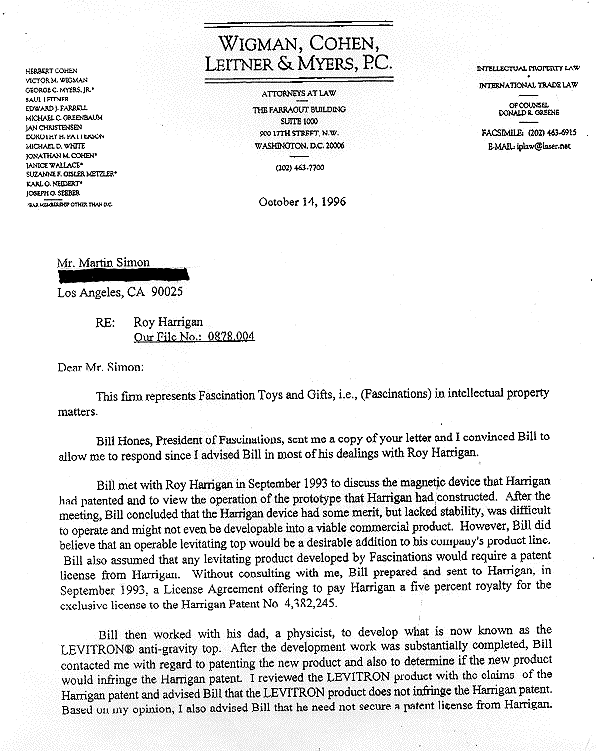
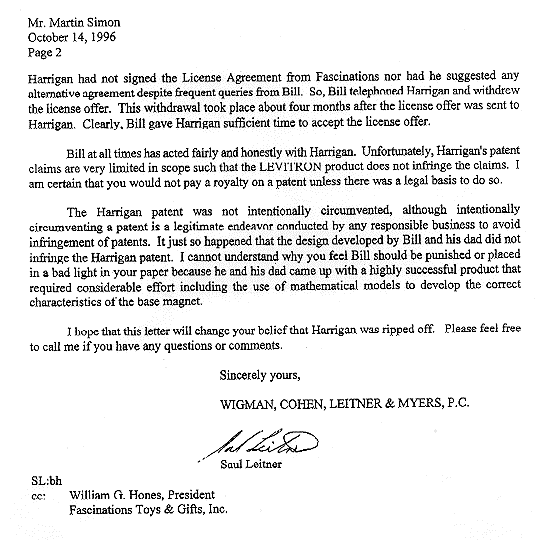
The Levitron invention itself has something of a contentious history (recounted here and here). Evidently, the physicist Ray Harrigan had patented a similar device a few years earlier and showed it to Bill Hones, who later got his own patent for a similar device and called it the "Levitron," but Hones was advised by his own lawyer that his own invention was sufficiently different from Harrigan's that he could market it without infringing Harrigan's patent or giving him credit or royalties. Apparently Harrigan was so disgusted and distrustful of his own lawyer that he never took the issue to court, so we'll never know what a judge would have thought. (The only issue which was ever litigated in court was over a former re-seller's use of the trademark "Levitron" — but that seems more straightforward, since the company that made up the word and trademarked it, owns it, completely separate from the merits of the invention that bears the name.) Some physicists have mixed feelings about the Levitron because of this, but it was apparently Harrigan's choice not to pursue the issue. (Besides, the new Levitron Revolution design uses nothing of Harrigan's idea, so some might feel that it's less "tainted".)
For cheaper levitation that takes no skill to operate, you can get the Diamagnetic Levitation Kit from Educational Innovations or search for pyrolitic graphite levitation on eBay — much less visually impressive though, with the graphite sheet levitating only 1 millimeter above the magnets.
Or for a more expensive conversation piece, the Levitron Lamp ($450 from InnovaToys or $400 from WorldToHome) levitates an entire lampshade above the base. I haven't tried that one out though.
- - - - - - - - - - - - - - - - - - - -
Levitating Picture Frames
Heart-shaped frame $25 from ZOpid; rectangular frame $70 from Hammacher Schlemmer.Computer-controlled levitation operating on a similar principle to the Levitron Revolution products. The $25 ZOpid picture frame is currently hanging out in Amazon limbo with a solitary 1-star review from a customer whose model broke after 4 months. But I think they look fine, and I'm giving two of them as gifts and crossing my fingers that I'm not that unlucky. With both the ZOpid and the Hammacher Schlemmer frames, unfortunately, there's apparently no way to switch off the LED lights (short of turning off the whole model).
Protip: You can prepare these as gifts by using photos downloaded from a friend's Facebook profile, but Facebook reduces the quality of uploaded photos, so that if you print them out, the pixellation will be noticeable up close. If you want the photos to look the best, you need to print them from high-res originals.
- - - - - - - - - - - - - - - - - - - -
Hanayama Japanese Pocket Puzzles
$13 from ThinkGeek and other vendors; some puzzles available for slightly less on eBay.Some disassembly puzzles are complete fails, either because there are so many separately moving pieces that you can't manipulate the puzzles in your hands at all (e.g. Yin and Yang"), or the moving parts are hidden from view so you can only "solve" them by pure guesswork (e.g. the "Bolted Closed" puzzle). The Hanayama pocket puzzles actually get it right — you can see all the pieces and move them comfortably in your hands, so solving them is just a matter of figuring out the right sequence of moves.
These are basically grown-up versions of the twisted nail puzzles you might have grown up with (and which you could also get, of course, as much cheaper stocking stuffers). But the Hanayama ones look good as shelf knick-knacks as well.
Hanayama pocket puzzles come with no solution included, but you can download a solution by going to this page and submitting your email address to request a download link.
- - - - - - - - - - - - - - - - - - - -
LED Jellyfish Mood Lamp
$35 from ThinkGeek and other vendors; no cheaper alternatives on eBayWorks more or less as shown in the video, with one caveat: In both the first model that I tried, and the free replacement ThinkGeek sent me when I reported the problem, the transitions between the different colors were much more abrupt and jarring than the smooth "color fade" shown in the video. (For some reason, some color LEDs would switch from completely on to completely off at the same time that other LEDs would switch on.) Unfortunately this small problem completely breaks the "reverie" effect of staring at the jellyfish floating around in the water, so I just set mine to a single color without using the transition effect.
Protip: You have to use real distilled water like the instructions tell you. I tried to make it work with regular tap water, and bubbles kept forming around the jellyfish and causing them to float to the surface. Fill it with distilled water and the jellyfish should sink beneath the surface without too much trouble.
Note, Fascinations has come out with a similar product, again sold on Innovatoys.com; I haven't tried that one, so it might be better (might actually get the color transition right), or it might not. Discovery Kids also makes a similar product which I haven't seen and which has been pulling pretty bad reviews on Amazon.
- - - - - - - - - - - - - - - - - - - -
Vino Vault and Cryptex Puzzle Pod
$30 and $22 from 4Thought Products LLCThe Puzzle Pod is a gift container that can only be opened by arranging the 5 rings to spell out a 5-letter password. It arrives pre-configured with the keyword "GRAPE"; once opened, you can re-configure the Pod with a new 5-letter secret word, seal a gift inside, and gift it to a recipient who has to find the secret word to open the puzzle and retrieve the gift. (It's re-usable, and you can set a different 5-letter "password" every time.) The Vino Vault is a larger version of the Puzzle Pod that can hold a bottle of wine.
I've only sampled the Puzzle Pod, so I can just vouch for the fact that it works exactly as described and doesn't get stuck or break easily. When you line up the letters of the secret word correctly, it actually slides smoothly open like it's supposed to.
- - - - - - - - - - - - - - - - - - - -
Ambiguous Vase
$33 from Grand Illusions Ltd (ships from the UK)This is a real-life version of the Rubin vase optical illusion. For years, Grand Illusions sold only a ceramic version for about $400 (plus another $200 to ship to the U.S.), but in November 2012 they released the $33 plastic version. It can also be used as a real vase (as long as you don't mind the barrier running down the center that divides the two halves).
- - - - - - - - - - - - - - - - - - - -
Steam Powered Top
$14 from Grand Illusions (ships from the UK)The world's simplest steam engine, made from a tube of copper pushed through a piece of cork, as shown in the demo video. Wikipedia explains the principle here — when the water in the copper tube is heated by the candle flame and boils, it expands and pushes out the ends of the tubes (driving the spinning motion). When the water contracts again, in sucks in water through the ends of the tubes — but the sucking motion pulls in water from all directions (while the expulsion of water pushes in only one direction), so the suction doesn't counteract the propulsion, and the top continues spinning.
Now, the original version is from Germany (and comes with detailed German instructions); the version that I got came with a sheet of English instructions that weren't as detailed. The instructions say to push the copper tube through the cork platform and "bend the tube at a 90-degree angle"; however if you just try bending the tube, it will probably crimp and create a hole, making it useless. To bend the tube so that it curves gradually, place your thumb on the cork next to where the tube protrudes, and use the fingers of your other hand to gently push the tube so that curves around your thumb. (This is spelled out in the original German instructions.)
Also, the instructions say to fill the copper tube by holding it under running tap water. This didn't work at all for me, since the tube is only about 2mm wide and the surface tension of water makes it hard to "push" it into a tube that small. Fortunately, a straw from a grocery-store juicebox fits perfectly over the other end of the copper tube, so if you submerge the other end in water, you can suck on the straw to fill the tube that way. (It's just copper after all, not lead.)
Finally, if you leave the cork floating in water too long, it eventually gets waterlogged and sinks, and as far as I can tell it's very hard to dry it out and bring it back to its original buoyancy. The workarounds for this are: (1) to increase the buoyancy, first put another tea light directly into your bowl of water so that it floats, and then lower the top into the water on top of that tea light, which will then help keep the top afloat; and (2) don't leave the top floating in water when not in use.
- - - - - - - - - - - - - - - - - - - -
"Flying F*CK" Remote-Control Helicopter
$20 from ThinkGeekAgain with the ThinkGeek swag; I swear I didn't know.
This is pretty self-explanatory, except I've tried two of them and the product doesn't seem to work too well as an actual remote-control helicopter; one of them couldn't hover in place (its two modes were "shooting up at the ceiling" or "falling"), and with the other, the R/C didn't seem to work through furniture. But that's probably OK since the whole point of this gift is in the giving and not the having.
In my case, I hid it behind a friend's chair at his birthday party, then at the appropriate time gave a speech ending with, "And so I thought, what do I give my friend to mark this occasion? What do I give? After much thought, I decided, this is what I give:..." There followed a dramatic pause where I pressed the "up" control on the remote, and nothing happened, whereupon I muttered, appropriately enough, "Fuck", then wandered over behind my friend's chair, repeated the setup line, pressed the remote button, at which point the copter shot up, banged into a chair and fell to the ground, whereupon for my third attempt I just picked it up and held it on the palm of my hand, pressed the remote, and the copter took flight and finally delivered the punch line, and all was good. If I'm there when he re-gifts it (since we both agreed that was the point of a gift like this), I hope it works better for him.
- - - - - - - - - - - - - - - - - - - -
Falling Sand Sculptures
$13 for the smaller 'Sandscape'; $80 for the larger 'Deep Sea Round'; both available from Educational InnovationsThese both make good decorations and shelf widgets. The sand in the Sandscape always falls in more or less the same pattern, since it's pre-determined by the gaps in the shelves holding the sand; the Deep Sea Round is more interesting since the pattern is determined by the placement of air bubbles and varies every time.
Pro tip: water evaporates from both of these, so eventually the water level will drop and the volume of air will increase, getting in the way of the sand flow. The 'Deep Sea Round' comes with a syringe that you can use to draw out air and inject more water into the aperture on the side. The cheaper 'Sandscape' doesn't come with a syringe, but it has a hole in the side where you can use a syringe to inject more water, if you buy the syringe separately.
- - - - - - - - - - - - - - - - - - - -
Galileo Thermometer
$17 for a wood-mounted model from Office Playground; cheaper ones available without wood mountingJust your basic elegant conversation piece demonstrating the principle that the density of a liquid changes with temperature. Pro tip: If you get the wood mounted one, before emailing the seller to complain that it's not working because all the spheres are bunched together at the wrong end, make sure it's not upside-down. (I realized, before I hit Send, that the felt-covered end goes on the bottom.)
- - - - - - - - - - - - - - - - - - - -
All of the remaining items on this list do exactly what they say they do, with no need for any special instructions not included by the manufacturer, so I'm just going to list them:
Glass Water Faucet — $50 from Uncommon Goods — a nice double optical illusion (faucet suspended in space, and glass-as-water).
Slicked Grandfather Clock — $30-$60 depending on who's selling it.
Tin Can Robot Kit — about $15 from various vendors — my stepdad and I assembled one using one of his beloved Hansen's soda cans.
Mini metal DIY sculptures — the Metal Works sculptures from Innovatoys ($7-$12) take some time to assemble but they come out looking pretty much like the pictures and make good shelf decorations. These Mikro sculptures ($10 and up, also available from Grand Illusions if you're filling your shopping cart there) are a bit easier to assemble since you just have to bend some shapes out from the metal sheet that they're carved from.
Ulexite "Television Stones" — $10 from Educational Innovations — a naturally occuring rock containing thousands of parallel fiber optic strands. Give it as a gift together with a square of patterned fabric so you can see the eerie effect when you place the rock against the fabric and the pattern "magically" appears on the opposite side of the rock.
And finally, if you need a last-minute gag gift for someone, browse through the gum and hand sanitizers from BlueQ.com — they're not geek-themed, but at $5.49 for the hand sanitizers and $1.39 for the gum, you can afford to stock up so you'll have a reserve of gag gifts suited for a variety of different people's tastes (except, of course, good taste).
And those are my favorites for gift-giving season 2012. You can send me suggestions for any items in this category that I've missed; I'll be back for Valentine's Day.
- - - - - - - - - - - - - - - -
Remember, if you have a feature idea, we'd love to hear it. -
Bennett's Whimsi-Geek Gift Guide For 2012
Frequent contributor Bennett Haselton writes this week with his favorite novelty science gift items for 2012. Levitation engines, puzzles, optical illusions brought to life, and all of the tips and tricks he's found for getting the products to work correctly. Decorative, whimsical, and not too expensive — except for the items that have earned it by being pretty amazing. Read on for the details, and be sure to mention other good possibilities (Just 14 shopping days left until Christmas) in the comments below.You already know how to find all the latest iPad or iPhone accessories, or how to find all the licensed merchandise if your BFF is a fan of some specific franchise. The items in this list are things that most people wouldn't even think to look for, but that I thought seemed interesting once I found out that they existed.
I'm more of a science geek than a gadget geek, so this list is built around optical illusions, whimsy, conversation pieces that demonstrate some scientific principle, and a reasonable budget. (The "Swinging Sticks Kinetic Energy Sculpture" from ThinkGeek is a work of art, but at $225, the price is apparently set to extract as much as possible from all the people who have to have one after seeing it in Iron Man 2.)
Also, unless otherwise noted, I've actually tried everything listed here and verified that it actually works; there were some items that I really wanted to make work, but couldn't. The Double Sand Sculpture, for example, looks great (especially in colors other than that ugly orange), but in all three models that American Science & Surplus sent me — the original plus the two free replacements — air bubbles formed in the hourglasses after a few days, which blocked the sand grains from flowing through the apertures. I could also never get Educational Innovations' Color Changing Nail Polish to change color, even under a UV light. And I loved the look of the Tornado Fountain from Fascinations.com, but no matter how I calibrated it, the drain at the bottom made a squirting and scraping sound like the last dregs of water draining from a bathtub, which pretty much killed its potential as a "tranquil" conversation piece. (As far as I can tell, any tabletop water fountain that costs less than $100 is either too noisy or doesn't work, but I haven't given up looking.) Of course, if you can get any of those things to work, more power to you.
For most of these items I've included the tips and tricks that I've accumulated for getting the full effect out of the product, tips that in some cases would have saved me a lot of hassle if I'd known them when the product first arrived. So you get the full benefit of my impulsive early-September Christmas shopping.
Neither I nor Slashdot make any profit from these links (except some items are from ThinkGeek, which is a corporate cousin of Slashdot for a few more weeks — but I didn't know that when I was making this list, and besides, it's not like you can put together a geek gift guide without including some stuff from ThinkGeek anyway).
Here are some of the things I've found that look as cool in person as they do in their catalog photos, and actually work:
- - - - - - - - - - - - - - - - - - - -
Levitron Revolution
Made by Fascinations.com, $100 from Innovatoys.com.I bought my first "Levitron"-branded product out of a Sky Mall catalog 15 years ago, assuming the picture of the levitating spinning top had to be a doctored photo, and half-set on proving that the product was a sham. I had spent enough time trying to levitate repelling magnets as a kid to conclude that it "couldn't be done," but I held out the faintest glimmer of hope that this might be the holy grail that I'd given up chasing about 10 years earlier. When the box arrived, I spent all evening and a sleepness night trying to get it working (the original product had to be calibrated and balanced very carefully, and you could waste a lot of time trying to make it work if the weights or alignments were slightly off), until just as the sun was coming up, I got the spinning top to levitate above the magnetic base for about four seconds before falling, and felt as if it had all been worth it. And the Levitron product line has come a long way since then, so you probably won't have to journey to the edge of your sanity to get this latest one working.
The Levitron Revolution is a levitation device which uses a base containing four computer-controlled magnets, and a magnetic disc that levitates about 1/2-inch above the base and can support a weight of up to 1 pound placed on top of it while continuing to levitate. It still takes a bit of practice to learn how to position the disc above the base to start the levitation, but the payoff is worth the effort. You can even rotate the base sideways and upside down, and the levitating disc will stay in the same position relative to the base while you turn it.
I used mine to levitate a crystal specimen that I got from a specialty gem store, which set me back about another $30, but I liked the way it glittered in the lights from the magnetic base. The rock was labeled "quartz / pyrite / sphalerite" at the store, and if you're looking for a similar rock to go with the Levitron Revolution, it looks like you can find one on Google Shopping for less than I paid for mine.
You can also use the Levitron Revolution for homemade illusions like levitating a cupcake in mid-air. (A Hostess dessert cup has a circular cavity on top to hold strawberries and whipped cream; turn it upside down and it fits perfectly over the Levitron disc. The book underneath the cupcake in the video was hollowed out to contain the magnetic base.)
Innovatoys sells several other Levitron products made by Fascinations, which all fall into two categories: those based on the classic Levitron design (which include any product showing the yellow-necked Levitron spinning top), and those based on the newer Levitron Revolution technology (everything else). I also have a Levitron CherryWood which is part of the "classic" lineup. The pros and cons of the two series are:
- The classic Levitron levitates the spinning top a full two inches above the base, which is much more visually impressive than the 1/2-inch that the magnetic disc floats above the base of the Levitron Revolution.
- The classic Levitron has to be hand-spun, however, and takes even more practice to operate than the Levitron Revolution.
- The classic Levitron has to be perfectly level for the top to float (the base comes with three adjustable legs to help you level it perfectly); the Levitron Revolution can be tilted and rotated, and the magnetic disc will continue to float in position relative to the base.
- The classic Levitron levitates in a very delicate equilibrium, with just the slightest touch being enough to push the floating top out out of balance and make it fall, so it can't be used to support other objects (and the top is spinning so fast that you wouldn't be able to see anything attached to it anyway). The Levitron Revolution floating disc can be touched and objects can be placed on top of it without pushing it out of equilibrium.
- The classic Levitron requires no power to operate, but because the top has to keep spinning at a high rate for the gyroscopic force to keep it from flipping over, after about two minutes the air friction will slow down the top enough that it falls. The Levitron Revolution will levitate forever as long as the DC power supply is connected.
The Levitron invention itself has something of a contentious history (recounted here and here). Evidently, the physicist Ray Harrigan had patented a similar device a few years earlier and showed it to Bill Hones, who later got his own patent for a similar device and called it the "Levitron," but Hones was advised by his own lawyer that his own invention was sufficiently different from Harrigan's that he could market it without infringing Harrigan's patent or giving him credit or royalties. Apparently Harrigan was so disgusted and distrustful of his own lawyer that he never took the issue to court, so we'll never know what a judge would have thought. (The only issue which was ever litigated in court was over a former re-seller's use of the trademark "Levitron" — but that seems more straightforward, since the company that made up the word and trademarked it, owns it, completely separate from the merits of the invention that bears the name.) Some physicists have mixed feelings about the Levitron because of this, but it was apparently Harrigan's choice not to pursue the issue. (Besides, the new Levitron Revolution design uses nothing of Harrigan's idea, so some might feel that it's less "tainted".)
For cheaper levitation that takes no skill to operate, you can get the Diamagnetic Levitation Kit from Educational Innovations or search for pyrolitic graphite levitation on eBay — much less visually impressive though, with the graphite sheet levitating only 1 millimeter above the magnets.
Or for a more expensive conversation piece, the Levitron Lamp ($450 from InnovaToys or $400 from WorldToHome) levitates an entire lampshade above the base. I haven't tried that one out though.
- - - - - - - - - - - - - - - - - - - -
Levitating Picture Frames
Heart-shaped frame $25 from ZOpid; rectangular frame $70 from Hammacher Schlemmer.Computer-controlled levitation operating on a similar principle to the Levitron Revolution products. The $25 ZOpid picture frame is currently hanging out in Amazon limbo with a solitary 1-star review from a customer whose model broke after 4 months. But I think they look fine, and I'm giving two of them as gifts and crossing my fingers that I'm not that unlucky. With both the ZOpid and the Hammacher Schlemmer frames, unfortunately, there's apparently no way to switch off the LED lights (short of turning off the whole model).
Protip: You can prepare these as gifts by using photos downloaded from a friend's Facebook profile, but Facebook reduces the quality of uploaded photos, so that if you print them out, the pixellation will be noticeable up close. If you want the photos to look the best, you need to print them from high-res originals.
- - - - - - - - - - - - - - - - - - - -
Hanayama Japanese Pocket Puzzles
$13 from ThinkGeek and other vendors; some puzzles available for slightly less on eBay.Some disassembly puzzles are complete fails, either because there are so many separately moving pieces that you can't manipulate the puzzles in your hands at all (e.g. Yin and Yang"), or the moving parts are hidden from view so you can only "solve" them by pure guesswork (e.g. the "Bolted Closed" puzzle). The Hanayama pocket puzzles actually get it right — you can see all the pieces and move them comfortably in your hands, so solving them is just a matter of figuring out the right sequence of moves.
These are basically grown-up versions of the twisted nail puzzles you might have grown up with (and which you could also get, of course, as much cheaper stocking stuffers). But the Hanayama ones look good as shelf knick-knacks as well.
Hanayama pocket puzzles come with no solution included, but you can download a solution by going to this page and submitting your email address to request a download link.
- - - - - - - - - - - - - - - - - - - -
LED Jellyfish Mood Lamp
$35 from ThinkGeek and other vendors; no cheaper alternatives on eBayWorks more or less as shown in the video, with one caveat: In both the first model that I tried, and the free replacement ThinkGeek sent me when I reported the problem, the transitions between the different colors were much more abrupt and jarring than the smooth "color fade" shown in the video. (For some reason, some color LEDs would switch from completely on to completely off at the same time that other LEDs would switch on.) Unfortunately this small problem completely breaks the "reverie" effect of staring at the jellyfish floating around in the water, so I just set mine to a single color without using the transition effect.
Protip: You have to use real distilled water like the instructions tell you. I tried to make it work with regular tap water, and bubbles kept forming around the jellyfish and causing them to float to the surface. Fill it with distilled water and the jellyfish should sink beneath the surface without too much trouble.
Note, Fascinations has come out with a similar product, again sold on Innovatoys.com; I haven't tried that one, so it might be better (might actually get the color transition right), or it might not. Discovery Kids also makes a similar product which I haven't seen and which has been pulling pretty bad reviews on Amazon.
- - - - - - - - - - - - - - - - - - - -
Vino Vault and Cryptex Puzzle Pod
$30 and $22 from 4Thought Products LLCThe Puzzle Pod is a gift container that can only be opened by arranging the 5 rings to spell out a 5-letter password. It arrives pre-configured with the keyword "GRAPE"; once opened, you can re-configure the Pod with a new 5-letter secret word, seal a gift inside, and gift it to a recipient who has to find the secret word to open the puzzle and retrieve the gift. (It's re-usable, and you can set a different 5-letter "password" every time.) The Vino Vault is a larger version of the Puzzle Pod that can hold a bottle of wine.
I've only sampled the Puzzle Pod, so I can just vouch for the fact that it works exactly as described and doesn't get stuck or break easily. When you line up the letters of the secret word correctly, it actually slides smoothly open like it's supposed to.
- - - - - - - - - - - - - - - - - - - -
Ambiguous Vase
$33 from Grand Illusions Ltd (ships from the UK)This is a real-life version of the Rubin vase optical illusion. For years, Grand Illusions sold only a ceramic version for about $400 (plus another $200 to ship to the U.S.), but in November 2012 they released the $33 plastic version. It can also be used as a real vase (as long as you don't mind the barrier running down the center that divides the two halves).
- - - - - - - - - - - - - - - - - - - -
Steam Powered Top
$14 from Grand Illusions (ships from the UK)The world's simplest steam engine, made from a tube of copper pushed through a piece of cork, as shown in the demo video. Wikipedia explains the principle here — when the water in the copper tube is heated by the candle flame and boils, it expands and pushes out the ends of the tubes (driving the spinning motion). When the water contracts again, in sucks in water through the ends of the tubes — but the sucking motion pulls in water from all directions (while the expulsion of water pushes in only one direction), so the suction doesn't counteract the propulsion, and the top continues spinning.
Now, the original version is from Germany (and comes with detailed German instructions); the version that I got came with a sheet of English instructions that weren't as detailed. The instructions say to push the copper tube through the cork platform and "bend the tube at a 90-degree angle"; however if you just try bending the tube, it will probably crimp and create a hole, making it useless. To bend the tube so that it curves gradually, place your thumb on the cork next to where the tube protrudes, and use the fingers of your other hand to gently push the tube so that curves around your thumb. (This is spelled out in the original German instructions.)
Also, the instructions say to fill the copper tube by holding it under running tap water. This didn't work at all for me, since the tube is only about 2mm wide and the surface tension of water makes it hard to "push" it into a tube that small. Fortunately, a straw from a grocery-store juicebox fits perfectly over the other end of the copper tube, so if you submerge the other end in water, you can suck on the straw to fill the tube that way. (It's just copper after all, not lead.)
Finally, if you leave the cork floating in water too long, it eventually gets waterlogged and sinks, and as far as I can tell it's very hard to dry it out and bring it back to its original buoyancy. The workarounds for this are: (1) to increase the buoyancy, first put another tea light directly into your bowl of water so that it floats, and then lower the top into the water on top of that tea light, which will then help keep the top afloat; and (2) don't leave the top floating in water when not in use.
- - - - - - - - - - - - - - - - - - - -
"Flying F*CK" Remote-Control Helicopter
$20 from ThinkGeekAgain with the ThinkGeek swag; I swear I didn't know.
This is pretty self-explanatory, except I've tried two of them and the product doesn't seem to work too well as an actual remote-control helicopter; one of them couldn't hover in place (its two modes were "shooting up at the ceiling" or "falling"), and with the other, the R/C didn't seem to work through furniture. But that's probably OK since the whole point of this gift is in the giving and not the having.
In my case, I hid it behind a friend's chair at his birthday party, then at the appropriate time gave a speech ending with, "And so I thought, what do I give my friend to mark this occasion? What do I give? After much thought, I decided, this is what I give:..." There followed a dramatic pause where I pressed the "up" control on the remote, and nothing happened, whereupon I muttered, appropriately enough, "Fuck", then wandered over behind my friend's chair, repeated the setup line, pressed the remote button, at which point the copter shot up, banged into a chair and fell to the ground, whereupon for my third attempt I just picked it up and held it on the palm of my hand, pressed the remote, and the copter took flight and finally delivered the punch line, and all was good. If I'm there when he re-gifts it (since we both agreed that was the point of a gift like this), I hope it works better for him.
- - - - - - - - - - - - - - - - - - - -
Falling Sand Sculptures
$13 for the smaller 'Sandscape'; $80 for the larger 'Deep Sea Round'; both available from Educational InnovationsThese both make good decorations and shelf widgets. The sand in the Sandscape always falls in more or less the same pattern, since it's pre-determined by the gaps in the shelves holding the sand; the Deep Sea Round is more interesting since the pattern is determined by the placement of air bubbles and varies every time.
Pro tip: water evaporates from both of these, so eventually the water level will drop and the volume of air will increase, getting in the way of the sand flow. The 'Deep Sea Round' comes with a syringe that you can use to draw out air and inject more water into the aperture on the side. The cheaper 'Sandscape' doesn't come with a syringe, but it has a hole in the side where you can use a syringe to inject more water, if you buy the syringe separately.
- - - - - - - - - - - - - - - - - - - -
Galileo Thermometer
$17 for a wood-mounted model from Office Playground; cheaper ones available without wood mountingJust your basic elegant conversation piece demonstrating the principle that the density of a liquid changes with temperature. Pro tip: If you get the wood mounted one, before emailing the seller to complain that it's not working because all the spheres are bunched together at the wrong end, make sure it's not upside-down. (I realized, before I hit Send, that the felt-covered end goes on the bottom.)
- - - - - - - - - - - - - - - - - - - -
All of the remaining items on this list do exactly what they say they do, with no need for any special instructions not included by the manufacturer, so I'm just going to list them:
Glass Water Faucet — $50 from Uncommon Goods — a nice double optical illusion (faucet suspended in space, and glass-as-water).
Slicked Grandfather Clock — $30-$60 depending on who's selling it.
Tin Can Robot Kit — about $15 from various vendors — my stepdad and I assembled one using one of his beloved Hansen's soda cans.
Mini metal DIY sculptures — the Metal Works sculptures from Innovatoys ($7-$12) take some time to assemble but they come out looking pretty much like the pictures and make good shelf decorations. These Mikro sculptures ($10 and up, also available from Grand Illusions if you're filling your shopping cart there) are a bit easier to assemble since you just have to bend some shapes out from the metal sheet that they're carved from.
Ulexite "Television Stones" — $10 from Educational Innovations — a naturally occuring rock containing thousands of parallel fiber optic strands. Give it as a gift together with a square of patterned fabric so you can see the eerie effect when you place the rock against the fabric and the pattern "magically" appears on the opposite side of the rock.
And finally, if you need a last-minute gag gift for someone, browse through the gum and hand sanitizers from BlueQ.com — they're not geek-themed, but at $5.49 for the hand sanitizers and $1.39 for the gum, you can afford to stock up so you'll have a reserve of gag gifts suited for a variety of different people's tastes (except, of course, good taste).
And those are my favorites for gift-giving season 2012. You can send me suggestions for any items in this category that I've missed; I'll be back for Valentine's Day.
- - - - - - - - - - - - - - - -
Remember, if you have a feature idea, we'd love to hear it. -
Bennett's Whimsi-Geek Gift Guide For 2012
Frequent contributor Bennett Haselton writes this week with his favorite novelty science gift items for 2012. Levitation engines, puzzles, optical illusions brought to life, and all of the tips and tricks he's found for getting the products to work correctly. Decorative, whimsical, and not too expensive — except for the items that have earned it by being pretty amazing. Read on for the details, and be sure to mention other good possibilities (Just 14 shopping days left until Christmas) in the comments below.You already know how to find all the latest iPad or iPhone accessories, or how to find all the licensed merchandise if your BFF is a fan of some specific franchise. The items in this list are things that most people wouldn't even think to look for, but that I thought seemed interesting once I found out that they existed.
I'm more of a science geek than a gadget geek, so this list is built around optical illusions, whimsy, conversation pieces that demonstrate some scientific principle, and a reasonable budget. (The "Swinging Sticks Kinetic Energy Sculpture" from ThinkGeek is a work of art, but at $225, the price is apparently set to extract as much as possible from all the people who have to have one after seeing it in Iron Man 2.)
Also, unless otherwise noted, I've actually tried everything listed here and verified that it actually works; there were some items that I really wanted to make work, but couldn't. The Double Sand Sculpture, for example, looks great (especially in colors other than that ugly orange), but in all three models that American Science & Surplus sent me — the original plus the two free replacements — air bubbles formed in the hourglasses after a few days, which blocked the sand grains from flowing through the apertures. I could also never get Educational Innovations' Color Changing Nail Polish to change color, even under a UV light. And I loved the look of the Tornado Fountain from Fascinations.com, but no matter how I calibrated it, the drain at the bottom made a squirting and scraping sound like the last dregs of water draining from a bathtub, which pretty much killed its potential as a "tranquil" conversation piece. (As far as I can tell, any tabletop water fountain that costs less than $100 is either too noisy or doesn't work, but I haven't given up looking.) Of course, if you can get any of those things to work, more power to you.
For most of these items I've included the tips and tricks that I've accumulated for getting the full effect out of the product, tips that in some cases would have saved me a lot of hassle if I'd known them when the product first arrived. So you get the full benefit of my impulsive early-September Christmas shopping.
Neither I nor Slashdot make any profit from these links (except some items are from ThinkGeek, which is a corporate cousin of Slashdot for a few more weeks — but I didn't know that when I was making this list, and besides, it's not like you can put together a geek gift guide without including some stuff from ThinkGeek anyway).
Here are some of the things I've found that look as cool in person as they do in their catalog photos, and actually work:
- - - - - - - - - - - - - - - - - - - -
Levitron Revolution
Made by Fascinations.com, $100 from Innovatoys.com.I bought my first "Levitron"-branded product out of a Sky Mall catalog 15 years ago, assuming the picture of the levitating spinning top had to be a doctored photo, and half-set on proving that the product was a sham. I had spent enough time trying to levitate repelling magnets as a kid to conclude that it "couldn't be done," but I held out the faintest glimmer of hope that this might be the holy grail that I'd given up chasing about 10 years earlier. When the box arrived, I spent all evening and a sleepness night trying to get it working (the original product had to be calibrated and balanced very carefully, and you could waste a lot of time trying to make it work if the weights or alignments were slightly off), until just as the sun was coming up, I got the spinning top to levitate above the magnetic base for about four seconds before falling, and felt as if it had all been worth it. And the Levitron product line has come a long way since then, so you probably won't have to journey to the edge of your sanity to get this latest one working.
The Levitron Revolution is a levitation device which uses a base containing four computer-controlled magnets, and a magnetic disc that levitates about 1/2-inch above the base and can support a weight of up to 1 pound placed on top of it while continuing to levitate. It still takes a bit of practice to learn how to position the disc above the base to start the levitation, but the payoff is worth the effort. You can even rotate the base sideways and upside down, and the levitating disc will stay in the same position relative to the base while you turn it.
I used mine to levitate a crystal specimen that I got from a specialty gem store, which set me back about another $30, but I liked the way it glittered in the lights from the magnetic base. The rock was labeled "quartz / pyrite / sphalerite" at the store, and if you're looking for a similar rock to go with the Levitron Revolution, it looks like you can find one on Google Shopping for less than I paid for mine.
You can also use the Levitron Revolution for homemade illusions like levitating a cupcake in mid-air. (A Hostess dessert cup has a circular cavity on top to hold strawberries and whipped cream; turn it upside down and it fits perfectly over the Levitron disc. The book underneath the cupcake in the video was hollowed out to contain the magnetic base.)
Innovatoys sells several other Levitron products made by Fascinations, which all fall into two categories: those based on the classic Levitron design (which include any product showing the yellow-necked Levitron spinning top), and those based on the newer Levitron Revolution technology (everything else). I also have a Levitron CherryWood which is part of the "classic" lineup. The pros and cons of the two series are:
- The classic Levitron levitates the spinning top a full two inches above the base, which is much more visually impressive than the 1/2-inch that the magnetic disc floats above the base of the Levitron Revolution.
- The classic Levitron has to be hand-spun, however, and takes even more practice to operate than the Levitron Revolution.
- The classic Levitron has to be perfectly level for the top to float (the base comes with three adjustable legs to help you level it perfectly); the Levitron Revolution can be tilted and rotated, and the magnetic disc will continue to float in position relative to the base.
- The classic Levitron levitates in a very delicate equilibrium, with just the slightest touch being enough to push the floating top out out of balance and make it fall, so it can't be used to support other objects (and the top is spinning so fast that you wouldn't be able to see anything attached to it anyway). The Levitron Revolution floating disc can be touched and objects can be placed on top of it without pushing it out of equilibrium.
- The classic Levitron requires no power to operate, but because the top has to keep spinning at a high rate for the gyroscopic force to keep it from flipping over, after about two minutes the air friction will slow down the top enough that it falls. The Levitron Revolution will levitate forever as long as the DC power supply is connected.
The Levitron invention itself has something of a contentious history (recounted here and here). Evidently, the physicist Ray Harrigan had patented a similar device a few years earlier and showed it to Bill Hones, who later got his own patent for a similar device and called it the "Levitron," but Hones was advised by his own lawyer that his own invention was sufficiently different from Harrigan's that he could market it without infringing Harrigan's patent or giving him credit or royalties. Apparently Harrigan was so disgusted and distrustful of his own lawyer that he never took the issue to court, so we'll never know what a judge would have thought. (The only issue which was ever litigated in court was over a former re-seller's use of the trademark "Levitron" — but that seems more straightforward, since the company that made up the word and trademarked it, owns it, completely separate from the merits of the invention that bears the name.) Some physicists have mixed feelings about the Levitron because of this, but it was apparently Harrigan's choice not to pursue the issue. (Besides, the new Levitron Revolution design uses nothing of Harrigan's idea, so some might feel that it's less "tainted".)
For cheaper levitation that takes no skill to operate, you can get the Diamagnetic Levitation Kit from Educational Innovations or search for pyrolitic graphite levitation on eBay — much less visually impressive though, with the graphite sheet levitating only 1 millimeter above the magnets.
Or for a more expensive conversation piece, the Levitron Lamp ($450 from InnovaToys or $400 from WorldToHome) levitates an entire lampshade above the base. I haven't tried that one out though.
- - - - - - - - - - - - - - - - - - - -
Levitating Picture Frames
Heart-shaped frame $25 from ZOpid; rectangular frame $70 from Hammacher Schlemmer.Computer-controlled levitation operating on a similar principle to the Levitron Revolution products. The $25 ZOpid picture frame is currently hanging out in Amazon limbo with a solitary 1-star review from a customer whose model broke after 4 months. But I think they look fine, and I'm giving two of them as gifts and crossing my fingers that I'm not that unlucky. With both the ZOpid and the Hammacher Schlemmer frames, unfortunately, there's apparently no way to switch off the LED lights (short of turning off the whole model).
Protip: You can prepare these as gifts by using photos downloaded from a friend's Facebook profile, but Facebook reduces the quality of uploaded photos, so that if you print them out, the pixellation will be noticeable up close. If you want the photos to look the best, you need to print them from high-res originals.
- - - - - - - - - - - - - - - - - - - -
Hanayama Japanese Pocket Puzzles
$13 from ThinkGeek and other vendors; some puzzles available for slightly less on eBay.Some disassembly puzzles are complete fails, either because there are so many separately moving pieces that you can't manipulate the puzzles in your hands at all (e.g. Yin and Yang"), or the moving parts are hidden from view so you can only "solve" them by pure guesswork (e.g. the "Bolted Closed" puzzle). The Hanayama pocket puzzles actually get it right — you can see all the pieces and move them comfortably in your hands, so solving them is just a matter of figuring out the right sequence of moves.
These are basically grown-up versions of the twisted nail puzzles you might have grown up with (and which you could also get, of course, as much cheaper stocking stuffers). But the Hanayama ones look good as shelf knick-knacks as well.
Hanayama pocket puzzles come with no solution included, but you can download a solution by going to this page and submitting your email address to request a download link.
- - - - - - - - - - - - - - - - - - - -
LED Jellyfish Mood Lamp
$35 from ThinkGeek and other vendors; no cheaper alternatives on eBayWorks more or less as shown in the video, with one caveat: In both the first model that I tried, and the free replacement ThinkGeek sent me when I reported the problem, the transitions between the different colors were much more abrupt and jarring than the smooth "color fade" shown in the video. (For some reason, some color LEDs would switch from completely on to completely off at the same time that other LEDs would switch on.) Unfortunately this small problem completely breaks the "reverie" effect of staring at the jellyfish floating around in the water, so I just set mine to a single color without using the transition effect.
Protip: You have to use real distilled water like the instructions tell you. I tried to make it work with regular tap water, and bubbles kept forming around the jellyfish and causing them to float to the surface. Fill it with distilled water and the jellyfish should sink beneath the surface without too much trouble.
Note, Fascinations has come out with a similar product, again sold on Innovatoys.com; I haven't tried that one, so it might be better (might actually get the color transition right), or it might not. Discovery Kids also makes a similar product which I haven't seen and which has been pulling pretty bad reviews on Amazon.
- - - - - - - - - - - - - - - - - - - -
Vino Vault and Cryptex Puzzle Pod
$30 and $22 from 4Thought Products LLCThe Puzzle Pod is a gift container that can only be opened by arranging the 5 rings to spell out a 5-letter password. It arrives pre-configured with the keyword "GRAPE"; once opened, you can re-configure the Pod with a new 5-letter secret word, seal a gift inside, and gift it to a recipient who has to find the secret word to open the puzzle and retrieve the gift. (It's re-usable, and you can set a different 5-letter "password" every time.) The Vino Vault is a larger version of the Puzzle Pod that can hold a bottle of wine.
I've only sampled the Puzzle Pod, so I can just vouch for the fact that it works exactly as described and doesn't get stuck or break easily. When you line up the letters of the secret word correctly, it actually slides smoothly open like it's supposed to.
- - - - - - - - - - - - - - - - - - - -
Ambiguous Vase
$33 from Grand Illusions Ltd (ships from the UK)This is a real-life version of the Rubin vase optical illusion. For years, Grand Illusions sold only a ceramic version for about $400 (plus another $200 to ship to the U.S.), but in November 2012 they released the $33 plastic version. It can also be used as a real vase (as long as you don't mind the barrier running down the center that divides the two halves).
- - - - - - - - - - - - - - - - - - - -
Steam Powered Top
$14 from Grand Illusions (ships from the UK)The world's simplest steam engine, made from a tube of copper pushed through a piece of cork, as shown in the demo video. Wikipedia explains the principle here — when the water in the copper tube is heated by the candle flame and boils, it expands and pushes out the ends of the tubes (driving the spinning motion). When the water contracts again, in sucks in water through the ends of the tubes — but the sucking motion pulls in water from all directions (while the expulsion of water pushes in only one direction), so the suction doesn't counteract the propulsion, and the top continues spinning.
Now, the original version is from Germany (and comes with detailed German instructions); the version that I got came with a sheet of English instructions that weren't as detailed. The instructions say to push the copper tube through the cork platform and "bend the tube at a 90-degree angle"; however if you just try bending the tube, it will probably crimp and create a hole, making it useless. To bend the tube so that it curves gradually, place your thumb on the cork next to where the tube protrudes, and use the fingers of your other hand to gently push the tube so that curves around your thumb. (This is spelled out in the original German instructions.)
Also, the instructions say to fill the copper tube by holding it under running tap water. This didn't work at all for me, since the tube is only about 2mm wide and the surface tension of water makes it hard to "push" it into a tube that small. Fortunately, a straw from a grocery-store juicebox fits perfectly over the other end of the copper tube, so if you submerge the other end in water, you can suck on the straw to fill the tube that way. (It's just copper after all, not lead.)
Finally, if you leave the cork floating in water too long, it eventually gets waterlogged and sinks, and as far as I can tell it's very hard to dry it out and bring it back to its original buoyancy. The workarounds for this are: (1) to increase the buoyancy, first put another tea light directly into your bowl of water so that it floats, and then lower the top into the water on top of that tea light, which will then help keep the top afloat; and (2) don't leave the top floating in water when not in use.
- - - - - - - - - - - - - - - - - - - -
"Flying F*CK" Remote-Control Helicopter
$20 from ThinkGeekAgain with the ThinkGeek swag; I swear I didn't know.
This is pretty self-explanatory, except I've tried two of them and the product doesn't seem to work too well as an actual remote-control helicopter; one of them couldn't hover in place (its two modes were "shooting up at the ceiling" or "falling"), and with the other, the R/C didn't seem to work through furniture. But that's probably OK since the whole point of this gift is in the giving and not the having.
In my case, I hid it behind a friend's chair at his birthday party, then at the appropriate time gave a speech ending with, "And so I thought, what do I give my friend to mark this occasion? What do I give? After much thought, I decided, this is what I give:..." There followed a dramatic pause where I pressed the "up" control on the remote, and nothing happened, whereupon I muttered, appropriately enough, "Fuck", then wandered over behind my friend's chair, repeated the setup line, pressed the remote button, at which point the copter shot up, banged into a chair and fell to the ground, whereupon for my third attempt I just picked it up and held it on the palm of my hand, pressed the remote, and the copter took flight and finally delivered the punch line, and all was good. If I'm there when he re-gifts it (since we both agreed that was the point of a gift like this), I hope it works better for him.
- - - - - - - - - - - - - - - - - - - -
Falling Sand Sculptures
$13 for the smaller 'Sandscape'; $80 for the larger 'Deep Sea Round'; both available from Educational InnovationsThese both make good decorations and shelf widgets. The sand in the Sandscape always falls in more or less the same pattern, since it's pre-determined by the gaps in the shelves holding the sand; the Deep Sea Round is more interesting since the pattern is determined by the placement of air bubbles and varies every time.
Pro tip: water evaporates from both of these, so eventually the water level will drop and the volume of air will increase, getting in the way of the sand flow. The 'Deep Sea Round' comes with a syringe that you can use to draw out air and inject more water into the aperture on the side. The cheaper 'Sandscape' doesn't come with a syringe, but it has a hole in the side where you can use a syringe to inject more water, if you buy the syringe separately.
- - - - - - - - - - - - - - - - - - - -
Galileo Thermometer
$17 for a wood-mounted model from Office Playground; cheaper ones available without wood mountingJust your basic elegant conversation piece demonstrating the principle that the density of a liquid changes with temperature. Pro tip: If you get the wood mounted one, before emailing the seller to complain that it's not working because all the spheres are bunched together at the wrong end, make sure it's not upside-down. (I realized, before I hit Send, that the felt-covered end goes on the bottom.)
- - - - - - - - - - - - - - - - - - - -
All of the remaining items on this list do exactly what they say they do, with no need for any special instructions not included by the manufacturer, so I'm just going to list them:
Glass Water Faucet — $50 from Uncommon Goods — a nice double optical illusion (faucet suspended in space, and glass-as-water).
Slicked Grandfather Clock — $30-$60 depending on who's selling it.
Tin Can Robot Kit — about $15 from various vendors — my stepdad and I assembled one using one of his beloved Hansen's soda cans.
Mini metal DIY sculptures — the Metal Works sculptures from Innovatoys ($7-$12) take some time to assemble but they come out looking pretty much like the pictures and make good shelf decorations. These Mikro sculptures ($10 and up, also available from Grand Illusions if you're filling your shopping cart there) are a bit easier to assemble since you just have to bend some shapes out from the metal sheet that they're carved from.
Ulexite "Television Stones" — $10 from Educational Innovations — a naturally occuring rock containing thousands of parallel fiber optic strands. Give it as a gift together with a square of patterned fabric so you can see the eerie effect when you place the rock against the fabric and the pattern "magically" appears on the opposite side of the rock.
And finally, if you need a last-minute gag gift for someone, browse through the gum and hand sanitizers from BlueQ.com — they're not geek-themed, but at $5.49 for the hand sanitizers and $1.39 for the gum, you can afford to stock up so you'll have a reserve of gag gifts suited for a variety of different people's tastes (except, of course, good taste).
And those are my favorites for gift-giving season 2012. You can send me suggestions for any items in this category that I've missed; I'll be back for Valentine's Day.
- - - - - - - - - - - - - - - -
Remember, if you have a feature idea, we'd love to hear it. -
USB NeXT Keyboard With an Arduino Micro
coop0030 writes "Ladyada and pt had an old NeXT keyboard with a strong desire to get it running on a modern computer. These keyboards are durable, super clicky, and very satisfying to use! However, they are very old designs, specifically made for NeXT hardware: pre PS/2 and definitely pre-USB. That means you can't just plug the keyboard into a PS/2 port (even though it looks similar). There is no existing adapters for sale, and no code out there for getting these working, so we spent a few days and with a little research we got it working perfectly using an Arduino Micro as the go between." -
Tour the Turn of the Century Electrotherapy Museum (Video)
Since he was a teenager, Jeff Behary's been interested in the work of Nikola Tesla, and has been collecting antique electric devices of a particular kind: ones that send electricity through the human body to effect medical benefits, many of which do so with the aid of Tesla coils. Tesla's not the only inventor involved, of course, but his influence overlapped and widely influenced the golden age of electrotherapy. Behary's day job as a machinist means he has the skills to rehabilitate and restore these aging beasts, too, along with a growing family of related devices. He's assembled them now, in West Palm Beach, Florida, into the Turn of the Century Electrotherapy Museum. This is a museum of my favorite kind: home-based and intimate, but with serious depth. Though it's open only by appointment, arranging a visit there is worth it, whether you're otherwise part of the Tesla community or not. Behary knows his collection inside and out, with the kind of deep knowledge it takes to fabricate replacement parts and revamp the internal wiring. The devices themselves are accessible, with original and restored pieces up close and personal — you need to be mindful about which ones are humming and crackling at any given moment. (There's also an archive with books, papers, and other effects relating to Tesla and other electric pioneers, not to mention glowing tubes that predate the modern vacuum tube, and the oldest known surviving Tesla coils, recovered from beneath their maker's Boston mansion. Electrotherapy is the organizing principle, but not the extent of this assembly.) And while Behary isn't fooled by all the therapeutic claims made by some machines' makers about running current through your limbs or around your body, he also doesn't discount them all, either, and points out that some of them really do affect the body as claimed. Yes, he's tried most of the machines himself, though he admits he's never dared taking the juice of his personal Tesla-powered electric chair. View the first video for a tour of part of this astounding collection; the second video is an interview with Jeff Behary. -
The Rise of Feudal Computer Security
Hugh Pickens writes "In the old days, traditional computer security centered around users. However, Bruce Schneier writes that now some of us have pledged our allegiance to Google (using Gmail, Google Calendar, Google Docs, and Android phones) while others have pledged allegiance to Apple (using Macintosh laptops, iPhones, iPads; and letting iCloud automatically synchronize and back up everything) while others of us let Microsoft do it all. 'These vendors are becoming our feudal lords, and we are becoming their vassals. We might refuse to pledge allegiance to all of them — or to a particular one we don't like. Or we can spread our allegiance around. But either way, it's becoming increasingly difficult to not pledge allegiance to at least one of them.' Classical medieval feudalism depended on overlapping, complex, hierarchical relationships. Today we users must trust the security of these hardware manufacturers, software vendors, and cloud providers and we choose to do it because of the convenience, redundancy, automation, and shareability. 'In this new world of computing, we give up a certain amount of control, and in exchange we trust that our lords will both treat us well and protect us from harm (PDF). Not only will our software be continually updated with the newest and coolest functionality, but we trust it will happen without our being overtaxed by fees and required upgrades.' In this system, we have no control over the security provided by our feudal lords. Like everything else in security, it's a trade-off. We need to balance that trade-off. 'In Europe, it was the rise of the centralized state and the rule of law that undermined the ad hoc feudal system; it provided more security and stability for both lords and vassals. But these days, government has largely abdicated its role in cyberspace, and the result is a return to the feudal relationships of yore,' concludes Schneier, adding that perhaps it's time for government to create the regulatory environments that protect us vassals. 'Otherwise, we really are just serfs.'" An anonymous reader provides a contrary opinion:
"The proposed analogy is wrong. Rather than feudal lords being replaced by a semi-accountable, presumably representative government, asking the government to take over would be going back to the having just AT&T as the sole provider of telecommunications, with private ownership of phones prohibited. It would be a reversion from an open and competitive market (where those who fail to provide security can be abandoned freely, the exact opposite of a feudal situation where serfs were forbidden to leave their masters and breaking oaths of obedience would lead to hit series on HBO) to a single "provider" which cannot be abandoned or ignored.
Monopolies, in general, suck, and without an external force to shore them up, they tend to be short lived. I remember when Lotus and WordPerfect and dBase were "unassailable", and people were wondering if the government should force these companies to be more "competitive" somehow. Then it was Windows, and particularly Explorer, that was going to control the world because "no one could compete". Now it's Google and Apple. Either these companies actually provide the security they promise, or they lose business to someone who will. The fear of the "feudal lords" failing to offer the security they promise is a false one, because they have no actual hold if they fail to deliver the goods.
The role of government in this arena is making sure that companies are held accountable for broken promises, that they pay the costs for data loss and security breaches. ... The government should not be determining what security is acceptable, because governments and regulations cannot possibly keep up with ever-changing realities." -
Wiki Weapon Project Test-Fires a (Partly) 3D-Printed Rifle
MrSeb writes "In its continuing mission to build a 'Wiki Weapon,' Defense Distributed has 3D printed the lower receiver of an AR-15 and tested it to failure. The printed part only survives the firing of six shots, but for a first attempt that's quite impressive. And hey, it's a plastic gun. Slashdot first covered 3D-printed guns back in July. The Defense Distributed group sprung up soon after, with the purpose of creating an open-source gun — a Wiki Weapon — that can be downloaded from the internet and printed out. The Defense Distributed manifesto mainly quotes a bunch of historical figures who supported the right to bear arms. DefDist (its nickname) is seeking a gun manufacturing license from the ATF, but so far the feds haven't responded. Unperturbed, DefDist started down the road by renting an advanced 3D printing machine from Stratasys — but when the company found out what its machine was being used for, it was repossessed. DefDist has now obtained a 3D printer from Objet, which seemingly has a more libertarian mindset. The group then downloaded HaveBlue's original AR-15 lower receiver from Thingiverse, printed it out on the Objet printer using ABS-like Digital Material, screwed it into an AR-57 upper receiver, loaded up some FN 5.7x28mm ammo, and headed to the range. The DefDist team will now make various modifications to HaveBlue's design, such as making it more rugged and improving the trigger guard, and then upload the new design to Thingiverse." Sensible ammo choice; 5.7x28mm produces less recoil than the AR-15's conventional 5.56mm. I wonder how many of the upper's components, too, can one day be readily replaced with home-printable parts — for AR-15 style rifles, the upper assembly is where the gun's barrel lives, while the lower assembly (the part printed and tested here) is the legally controlled part of the firearm. -
Orphaned Works and the Requirement To Preserve Metadata
An anonymous reader writes "Orphaned works legislation promises to open older forgotten works to new uses and audiences. Groups like ASMP think it's inevitable. But it comes with the risk of defanging protection for current work when the creator cannot be located. Photographer Mark Meyer wonders if orphaned works legislation also needs language to compel organizations like Facebook to stop their practice of stripping metadata from user content in order to keep new work from becoming orphans to begin with. Should we have laws to make stripping metadata illegal?" The author notes that excessive copyright terms may be to blame; if that's the case why lobby for Orphaned Works legislation? On a related note, Rick Falkvinge asks if we should revisit the purpose of the copyright monopoly. -
Voyager 1, So Close To Interstellar Space That We Can Taste It!
mphall21 writes "Voyager 1 is nearing the edge of the 'magnetic highway' of our solar system and scientists believe this is the final area the space probe must cross before entering interstellar space. The Voyager team infers this region is still inside of our heliosphere because the direction of the magnetic field has not changed. The direction of this field is expected to change when Voyager goes into interstellar space. 'Although Voyager 1 still is inside the sun's environment, we now can taste what it's like on the outside because the particles are zipping in and out on this magnetic highway,' said Edward Stone, Voyager project scientist based at the California Institute of Technology, Pasadena. 'We believe this is the last leg of our journey to interstellar space. Our best guess is it's likely just a few months to a couple years away. The new region isn't what we expected, but we've come to expect the unexpected from Voyager.' Moving at 10.5 miles per second, the space probe is the most distant man-made object from Earth. The space craft has been in operation for 35 years and receives regular commands and transmits data back to the Deep Space Network." -
Voyager 1, So Close To Interstellar Space That We Can Taste It!
mphall21 writes "Voyager 1 is nearing the edge of the 'magnetic highway' of our solar system and scientists believe this is the final area the space probe must cross before entering interstellar space. The Voyager team infers this region is still inside of our heliosphere because the direction of the magnetic field has not changed. The direction of this field is expected to change when Voyager goes into interstellar space. 'Although Voyager 1 still is inside the sun's environment, we now can taste what it's like on the outside because the particles are zipping in and out on this magnetic highway,' said Edward Stone, Voyager project scientist based at the California Institute of Technology, Pasadena. 'We believe this is the last leg of our journey to interstellar space. Our best guess is it's likely just a few months to a couple years away. The new region isn't what we expected, but we've come to expect the unexpected from Voyager.' Moving at 10.5 miles per second, the space probe is the most distant man-made object from Earth. The space craft has been in operation for 35 years and receives regular commands and transmits data back to the Deep Space Network." -
Vega Older Than Thought: Mature Enough To Nurture Life
sciencehabit writes about new estimates of Vega's age giving hope that any planets it might have are old enough to harbor life. From the article: "Shining just 25 light-years from Earth in the constellation Lyra, Vega is the fifth brightest star in the night sky. In 1983, astronomers discovered dust orbiting the star, suggesting it had a solar system, and Carl Sagan chose to make Vega the source of a SETI signal in his 1985 novel Contact. At the time, Vega was thought to be only about a couple hundred million years old, probably too young for any planets to have spawned life. Since then, however, estimates of Vega's age have increased to between 625 million and 850 million years old. So suitable planets have probably had sufficient time to develop primitive life." With improvements in telescopes allowing detection of the rough atmospheric composition of exoplanets on the way, this could be pretty exciting. -
Splashtop's Cliff Miller Talks About Their New Linux App (Video)
Yes, you can now have full remote access to your home computer or a server at work that's running Ubuntu Linux. Really any Linux distro, although only Ubuntu is formally supported by Splashtop. What? You say you already control your home and work Linux computers from your Android tablet with VNC? That there's a whole bunch of Android VNC apps out there already? And plenty for iOS, too? You're right. But Cliff says Splashtop is better than the others. It can play video at a full 30 frames per second, and has low enough latency (depending on your connection) that you can play video games remotely in between taking care of that list of server issues your boss emailed to you. Or perhaps, in between work tasks, you take a dip in the ocean, because you're working from the beach, not from a stuffy office. It seems that work and living locations get a little more remote from each other every year, and Splashtop is helping to make that happen. This video interview is, itself, an example of how our world has gotten flatter; Cliff was in China and I was in Florida. The connection wasn't perfect, but the fact that we could have this conversation at all is a wonder. Please note, too, that while Cliff Miller is now Chief Marketing Officer for Splashtop, he was also the founder and first CEO of TurboLinux, so he is not new to Linux. And Splashtop is the company that supplied the "instant on" Linux OS a lot of computer manufacturers bundled with their Windows computers for a few years. Now, of course, they're focusing on the remote desktop, and seem to be making a go of it despite heavy competition in that market niche. -
Splashtop's Cliff Miller Talks About Their New Linux App (Video)
Yes, you can now have full remote access to your home computer or a server at work that's running Ubuntu Linux. Really any Linux distro, although only Ubuntu is formally supported by Splashtop. What? You say you already control your home and work Linux computers from your Android tablet with VNC? That there's a whole bunch of Android VNC apps out there already? And plenty for iOS, too? You're right. But Cliff says Splashtop is better than the others. It can play video at a full 30 frames per second, and has low enough latency (depending on your connection) that you can play video games remotely in between taking care of that list of server issues your boss emailed to you. Or perhaps, in between work tasks, you take a dip in the ocean, because you're working from the beach, not from a stuffy office. It seems that work and living locations get a little more remote from each other every year, and Splashtop is helping to make that happen. This video interview is, itself, an example of how our world has gotten flatter; Cliff was in China and I was in Florida. The connection wasn't perfect, but the fact that we could have this conversation at all is a wonder. Please note, too, that while Cliff Miller is now Chief Marketing Officer for Splashtop, he was also the founder and first CEO of TurboLinux, so he is not new to Linux. And Splashtop is the company that supplied the "instant on" Linux OS a lot of computer manufacturers bundled with their Windows computers for a few years. Now, of course, they're focusing on the remote desktop, and seem to be making a go of it despite heavy competition in that market niche. -
Interviews: Ask What You Will of Eugene Kaspersky
Eugene Kaspersky probably hates malware just as much as you do on his own machines, but as the head of Kaspersky Labs, the world's largest privately held security software company, he might have a different perspective — the existence of malware and other forms of online malice drives the need for security software of all kinds, and not just on personal desktops or typical internet servers. The SCADA software vulnerabilities of the last few years have led him to announce work on an operating system for industrial control systems of the kind affected by Flame and Stuxnet. But Kaspersky is not just toiling away in the computer equivalent of the CDC: He's been outspoken in his opinions — some of which have drawn ire on Slashdot, like calling for mandatory "Internet ID" and an "Internet Interpol". He's also come out in favor of Internet voting, and against SOPA, even pulling his company out of the BSA over it. More recently, he's been criticized for ties to the current Russian government. (With regard to that Wired article, though, read Kaspersky's detailed response to its claims.) Now, he's agreed to answer Slashdot readers' questions. As usual, you're encouraged to ask all the question you'd like, but please confine your questions to one per post. We'll pass on the best of these for Kaspersky's answers. Update: 12/04 14:20 GMT by T : For more on Kaspersky's thoughts on the importance of online IDs, see this detailed blog posting. -
Just Say No To College
Hugh Pickens writes writes "Alex Williams writes in the NY Times that the idea that a college diploma is an all-but-mandatory ticket to a successful career is showing fissures. Inspired by role models like the billionaire drop-outs who founded Microsoft, Facebook, Dell, Twitter, Tumblr, and Apple, and empowered by online college courses, a groundswell of university-age heretics consider themselves a DIY vanguard, committed to changing the perception of dropping out from a personal failure to a sensible option, at least for a certain breed of risk-embracing maverick. 'Here in Silicon Valley, it's almost a badge of honor,' says Mick Hagen, 28, who dropped out of Princeton in 2006 and moved to San Francisco, where he started Undrip, a mobile app. 'College puts a lot of constraints, a lot of limitations around what you can and can't do. Some people, they want to stretch their arms, get out and create more, do more.' Perhaps most famously, Peter A. Thiel, the billionaire co-founder of PayPal, in 2010 started his Thiel Fellowship program, which pays students under 20 years old $100,000 apiece to bag college and pursue their own ventures. 'People are being conned into thinking that this credential is the one thing you need to do better in life. They typically are worse off, because they have amassed all this debt.' UnCollege advocates a DIY approach to higher education and spreads the message through informational 'hackademic camps.' 'Hacking,' in the group's parlance, can involve any manner of self-directed learning: travel, volunteer work, organizing collaborative learning groups with friends. Students who want to avoid $200,000 in student-loan debt might consider enrolling in a technology boot camp, where you can learn to write code in 8 to 10 weeks for about $10,000. 'I think kids with a five-year head start on equally ambitious peers will be ahead in both education and income,' says James Altucher, a prominent investor, entrepreneur and pundit who self-published a book called '40 Alternatives to College.' 'They could go to a library, read a book a day, take courses online. There are thousands of ways.'" -
Just Say No To College
Hugh Pickens writes writes "Alex Williams writes in the NY Times that the idea that a college diploma is an all-but-mandatory ticket to a successful career is showing fissures. Inspired by role models like the billionaire drop-outs who founded Microsoft, Facebook, Dell, Twitter, Tumblr, and Apple, and empowered by online college courses, a groundswell of university-age heretics consider themselves a DIY vanguard, committed to changing the perception of dropping out from a personal failure to a sensible option, at least for a certain breed of risk-embracing maverick. 'Here in Silicon Valley, it's almost a badge of honor,' says Mick Hagen, 28, who dropped out of Princeton in 2006 and moved to San Francisco, where he started Undrip, a mobile app. 'College puts a lot of constraints, a lot of limitations around what you can and can't do. Some people, they want to stretch their arms, get out and create more, do more.' Perhaps most famously, Peter A. Thiel, the billionaire co-founder of PayPal, in 2010 started his Thiel Fellowship program, which pays students under 20 years old $100,000 apiece to bag college and pursue their own ventures. 'People are being conned into thinking that this credential is the one thing you need to do better in life. They typically are worse off, because they have amassed all this debt.' UnCollege advocates a DIY approach to higher education and spreads the message through informational 'hackademic camps.' 'Hacking,' in the group's parlance, can involve any manner of self-directed learning: travel, volunteer work, organizing collaborative learning groups with friends. Students who want to avoid $200,000 in student-loan debt might consider enrolling in a technology boot camp, where you can learn to write code in 8 to 10 weeks for about $10,000. 'I think kids with a five-year head start on equally ambitious peers will be ahead in both education and income,' says James Altucher, a prominent investor, entrepreneur and pundit who self-published a book called '40 Alternatives to College.' 'They could go to a library, read a book a day, take courses online. There are thousands of ways.'" -
No More "Asperger's Syndrome"
cstacy writes "The American Psychiatric Association is dropping Asperger's Syndrome from the upcoming edition of the Diagnostic and Statistical Manual (DSM-5) Its symptoms will be included under the umbrella of Autism Spectrum Disorder, which includes everything from severe autism such as children who do not talk or interact, to milder forms of autism. Asperger's disorder is impairment in social interaction and repetitive and stereotyped patterns of behavior, activities and interests, without significant delay in language or cognitive development. Often the person has high intelligence and vast knowledge on narrow subjects but lacks social skills. DSM-5 comes out in May and will be the first major rewrite in 19 years." -
No More "Asperger's Syndrome"
cstacy writes "The American Psychiatric Association is dropping Asperger's Syndrome from the upcoming edition of the Diagnostic and Statistical Manual (DSM-5) Its symptoms will be included under the umbrella of Autism Spectrum Disorder, which includes everything from severe autism such as children who do not talk or interact, to milder forms of autism. Asperger's disorder is impairment in social interaction and repetitive and stereotyped patterns of behavior, activities and interests, without significant delay in language or cognitive development. Often the person has high intelligence and vast knowledge on narrow subjects but lacks social skills. DSM-5 comes out in May and will be the first major rewrite in 19 years." -
No More "Asperger's Syndrome"
cstacy writes "The American Psychiatric Association is dropping Asperger's Syndrome from the upcoming edition of the Diagnostic and Statistical Manual (DSM-5) Its symptoms will be included under the umbrella of Autism Spectrum Disorder, which includes everything from severe autism such as children who do not talk or interact, to milder forms of autism. Asperger's disorder is impairment in social interaction and repetitive and stereotyped patterns of behavior, activities and interests, without significant delay in language or cognitive development. Often the person has high intelligence and vast knowledge on narrow subjects but lacks social skills. DSM-5 comes out in May and will be the first major rewrite in 19 years." -
Multi-Server Microkernel OS Genode 12.11 Can Build Itself
An anonymous reader wrote in with a story on OS News about the latest release of the Genode Microkernel OS Framework. Brought to you by the research labs at TU Dresden, Genode is based on the L4 microkernel and aims to provide a framework for writing multi-server operating systems (think the Hurd, but with even device drivers as userspace tasks). Until recently, the primary use of L4 seems to have been as a glorified Hypervisor for Linux, but now that's changing: the Genode example OS can build itself on itself: "Even though there is a large track record of individual programs and libraries ported to the environment, those programs used to be self-sustaining applications that require only little interaction with other programs. In contrast, the build system relies on many utilities working together using mechanisms such as files, pipes, output redirection, and execve. The Genode base system does not come with any of those mechanisms let alone the subtle semantics of the POSIX interface as expected by those utilities. Being true to microkernel principles, Genode's API has a far lower abstraction level and is much more rigid in scope." The detailed changelog has information on the huge architectural overhaul of this release. One thing this release features that Hurd still doesn't have: working sound support. For those unfamiliar with multi-server systems, the project has a brief conceptual overview document. -
Senate Committee Approves Stricter Email Privacy
New submitter DJ Jones sent in good news in the attempts to update privacy rights for stored electronic communication. From the article: "The Senate Judiciary Committee on Thursday approved a bill that would strengthen privacy protection for e-mails by requiring law enforcement officials to obtain a warrant from a judge in most cases before gaining access to messages in individual accounts stored electronically. The bill is not expected to make it through Congress this year and will be the subject of negotiations next year with the Republican-led House." The EFF seems pretty happy with the proposed changes, but notes that the bill also reduces the protections of the Video Privacy Protection Act in order to allow Netflix et al to sell your viewing history. -
Nintendo Power's Final Cover
skade88 writes "Ars Technica has a review of the last-ever issue of Nintendo Power. It's bittersweet seeing a part of my childhood ending." Being in print for 25 years means it's got most single-platform computer magazines beat. -
Ask Slashdot: Good Linux Desktop Environment For Hi-Def/Retina Displays?
Volanin writes "I have been using Linux for the last 15 years both at home and at work (mostly GNOME and now Unity). Recently, I gave in to temptation and bought myself a Macbook retina 15". As you can read around, Linux still has no good support for this hardware, so I am running it inside a virtual machine. Running in scaled 1440x900 makes the Linux fonts look absolutely terrible, and running in true 2880x1800 makes them beautiful, but every UI element becomes so tiny, it's unworkable. Is there a desktop environment that handles resolution independence better? Linux has had support for SVG for a long time, but GNOME/Unity seems adamant in defining small icon sizes and UI elements without the possibility to resize them." -
US Birthrate Plummets To Record Low
Hugh Pickens writes "The Washington Post reports that the U.S. birthrate is at its lowest since 1920, the earliest year with reliable records. The rate decreased to 63.2 births per 1,000 women of childbearing age — a little more than half of its peak, which was in 1957. The overall birthrate decreased by 8 percent between 2007 and 2010, but the decline is being led by immigrant women hit hard by the recession, with a much bigger drop of 14 percent among foreign-born women. Overall, the average number of children a U.S. woman is predicted to have in her lifetime is 1.9, slightly less than the 2.1 children required to maintain current population levels. Although the declining U.S. birthrate has not created the kind of stark imbalances found in graying countries such as Japan or Italy, it should serve as a wake-up call for policymakers, says Roberto Suro, a professor of public policy at the University of Southern California. 'We've been assuming that when the baby-boomer population gets most expensive, that there are going to be immigrants and their children who are going to be paying into [programs for the elderly], but in the wake of what's happened in the last five years, we have to reexamine those assumptions,' he said. 'When you think of things like the solvency of Social Security, for example, relatively small increases in the dependency ratio can have a huge effect.'" -
Ask Slashdot: DIY 4G Antenna Design For the Holidays?
eldavojohn writes "This holiday season I will return to the land of my childhood. It is flat and desolate with the nearest major city being a three hour car drive away. Although being able to hear the blood pulse through your ears and enjoying the full milky way is nice, I have finally convinced my parents to get "the internet." It's basically a Verizon Jetpack that receives 4G connected to a router. My mom says it works great but she has complained of it cutting in and out. I know where the tower is, this land is so flat and so devoid of light pollution that the tower and all windmills are supernovas on the horizon at night. Usually I use my rooted Galaxy Nexus to read Slashdot, reply to work e-mails, etc. I would like to build an antenna for her 4G device so they can finally enjoy information the way I have. I have access to tons of scrap copper, wood, steel, etc and could probably hit a scrap yard if something else were needed. As a kid, I would build various quad antennas in an attempt to get better radio and TV reception (is the new digital television antenna design any different?) but I have no experience with building 4G antennas. I assume the sizes and lengths would be much different? After shopping around any 4G antenna costs way too much money. So, Slashdot, do you have any resources, suggestions, books, ideas or otherwise about building something to connect to a Jetpack antenna port? I've got a Masters of Science but it's in Computer Science so if you do explain complicated circuits it helps to explain it like I'm five. I've used baluns before in antenna design but after pulling up unidirectional and reflector antenna designs, I realize I might be in a little over my head. Is there an industry standard book on building antennas for any spectrum?" -
Ask Slashdot: DIY 4G Antenna Design For the Holidays?
eldavojohn writes "This holiday season I will return to the land of my childhood. It is flat and desolate with the nearest major city being a three hour car drive away. Although being able to hear the blood pulse through your ears and enjoying the full milky way is nice, I have finally convinced my parents to get "the internet." It's basically a Verizon Jetpack that receives 4G connected to a router. My mom says it works great but she has complained of it cutting in and out. I know where the tower is, this land is so flat and so devoid of light pollution that the tower and all windmills are supernovas on the horizon at night. Usually I use my rooted Galaxy Nexus to read Slashdot, reply to work e-mails, etc. I would like to build an antenna for her 4G device so they can finally enjoy information the way I have. I have access to tons of scrap copper, wood, steel, etc and could probably hit a scrap yard if something else were needed. As a kid, I would build various quad antennas in an attempt to get better radio and TV reception (is the new digital television antenna design any different?) but I have no experience with building 4G antennas. I assume the sizes and lengths would be much different? After shopping around any 4G antenna costs way too much money. So, Slashdot, do you have any resources, suggestions, books, ideas or otherwise about building something to connect to a Jetpack antenna port? I've got a Masters of Science but it's in Computer Science so if you do explain complicated circuits it helps to explain it like I'm five. I've used baluns before in antenna design but after pulling up unidirectional and reflector antenna designs, I realize I might be in a little over my head. Is there an industry standard book on building antennas for any spectrum?" -
Critic Cites Revenge of the Sith As "Generation's Greatest Work of Art
eldavojohn writes "Art critic and University Professor of Humanities and Media Studies at the University of the Arts in Philadelphia Camille Paglia has written a book that not only claims George Lucas is the 'World's Greatest Living Artist' but also that 'Revenge of the Sith' is our generation's greatest work of art. That's right: Titian, Bernini, Monet, Picasso, Jackson Pollock and ... George Lucas. If you thought you understood art but you hated Episode III, it might be difficult to understand how her book 'Glittering Images: A Journey Through Art from Egypt to Star Wars' ends with 'Revenge of the Sith.' There is a possibility that the art world remembers this generation by examining that movie." -
British Skylon Engine Passes Its Tests
An anonymous reader writes "The BBC reports that the SABRE hybrid (part air-breathing jet, part rocket) that is intended to power the Skylon single-stage-to-orbit space plane has passed its final technical demonstration test, and is now looking for money (only £250m!) to prepare for manufacturing. If this goes ahead, travel into orbit from local airports (ideally, those close to the equator) will be possible. And quite cheaply. But might it have the same legal difficulties flying from U.S. airports as the Concorde did?" -
Longest US Space Mission Planned For 2015
SchrodingerZ writes "Captain Scott Kelly, brother of former commander Mark Kelly, will embark on the United States' longest manned space mission, set for 2015. Kelly and Russian cosmonaut Mikhail Kornienko will spend an entire year on the orbiting International Space Station. The mission will be a first for NASA's space program, but it is far from the world record. The longest recorded time in space was the 438-day mission of Russia's Valery Polyakov, working on the Mir Space Station, 1994-1995. Kelly, a decorated Navy captain, received degrees from State University of New York Maritime College and the University of Tennessee, and was the flight engineer for space station expedition 25, and commander of expedition 26 in 2010. 'Kornienko hails from Russia's Syzran, Kuibyshev, region and has worked in the space industry since 1986.' The yearlong study on humans working in space will launch from the Baikonur Cosmodrome in Kazakhstan, spring 2015." -
Prediction Market Site InTrade Bans US Customers
MyFirstNameIsPaul writes "In an announcement dated Monday, Nov 26, 2012, Dublin-based InTrade stated 'that due to legal and regulatory pressures, InTrade can no longer allow U.S. residents to participate in our real-money prediction markets.' The Washington Post reports that the Commodity Futures Trading Commission filed a complaint in federal court against InTrade for 'illegally facilitating bets on future economic data, the price of gold and even acts of war,' demonstrating just how far the long arm of U.S. law can reach." -
Hairspray Could Help Us Find Advanced Alien Civilizations
Hugh Pickens writes "Charles Q. Choi reports that hairspray could one day serve as the sign that aliens have reshaped distant worlds because one group of gases that might be key to terraforming planets are CFCs. 'Our hypothesis is that evidence of intelligent life might be evident in a planetary atmosphere,' says astrobiologist Mark Claire at the Blue Marble Space Institute of Science. CFCs are entirely artificial, with no known natural process capable of creating them in atmospheres. Detecting signs of these gases on far-off worlds with telescopes might serve as potent evidence that intelligent alien civilizations were the cause, either intentionally as part of terraforming or accidentally via industrial pollution. 'An industrialized civilization will be one that will use its planetary resources for fabrication, the soon-to-be-detectable-from-Earth atmospheric byproducts of which could be a tell-tale sign of their activity,' says astrobiologist Sanjoy Som. CFCs can be easily recognized in planetary atmospheres because their atmospheric 'fingerprint' (i.e. chemical spectra) is very different from natural elements, and are a tell-tale sign that life on the surface has advanced industrial capabilities. Using state-of-the-art computer models of atmospheric chemistry and climate, researchers plan to discover what visible signs CFCs and other artificial byproducts of alien terraforming or industry might have on exoplanet atmospheres. 'We are about a decade away of being able to measure detailed compositions of the atmospheres of extrasolar planets,' says Som." -
Ask Mark Shuttleworth Anything
In addition to founding Canonical Ltd., the Ubuntu Foundation, and funding the Freedom Toaster, Mark Shuttleworth is a space enthusiast. In April 2002 Mark became the second self-funded space tourist and the first African in space. He spent eight days participating in experiments on the International Space Station as part of his $20 million trip. Now he's ready to answer your questions. Ask him anything you like, but please limit yourself to one question per post. -
Search For "Foolproof Suffocation" Missed In Casey Anthony Case
Hugh Pickens writes "The Orlando Sentinel reports that a google search was made for the term 'foolproof suffocation' on the Anthony family's computer the day Casey Anthony's 2-year-old daughter Caylee was last seen alive by her family — a search that did not surface at Casey Anthony's trial for first degree murder. In the notorious 31 days which followed, Casey Anthony repeatedly lied about her and her daughter's whereabouts and at Anthony's trial, her defense attorney argued that her daughter drowned accidentally in the family's pool. Anthony was acquitted on all major charges in her daughter's death, including murder. Though computer searches were a key issue at Anthony's murder trial, the term 'foolproof suffocation' never came up. 'Our investigation reveals the person most likely at the computer was Casey Anthony,' says investigative reporter Tony Pipitone. Lead sheriff's Investigator Yuri Melich sent prosecutors a spreadsheet that contained less than 2 percent of the computer's Internet activity that day and included only Internet data from the computer's Internet Explorer browser – one Casey Anthony apparently stopped using months earlier — and failed to list 1,247 entries recorded on the Mozilla Firefox browser that day — including the search for 'foolproof suffocation.' Prosecutor Jeff Ashton said in a statement to WKMG that it's 'a shame we didn't have it. (It would have) put the accidental death claim in serious question.'" -
Researchers Investigating Self-Boosting Vaccines
An anonymous reader writes "Vaccines, contrary to opinions from the anti-science crowd, are some of the most effective tools in modern medicine. For some diseases, a single shot is all it takes for lifetime immunity. Others, though, require booster shots, to remind your immune system exactly what it should prepare to fight. Failure to get these shots threatens an individual's health, and the herd immunity concept as well. Scientists are now looking into 'self-boosting' vaccines in order to fix that problem. Some viruses are capable of remaining in the body for a person's entire lifetime. If researchers can figure out a way to safely harness these, it may be possible to add genes that would create proteins to train the immune system against not just one, but multiple other viruses (abstract). This is a difficult problem to solve; changing the way we do vaccinations will itself have consequences for herd immunity. It also hinges on finding a virus that can survive the immune system without having uncomfortable flare-ups from time to time." -
Nexus 4 Includes Support For LTE
slashchuck writes "One of the drawbacks of Google's Nexus 4 was its lack of support for 4G LTE. Now comes a report from AnandTech that it's possible to enable partial LTE support on the device. It seems that a simple software update can allow the Nexus 4 smartphone to run on LTE Band 4. All users have to do is dial *#*#4636#*#* (INFO) or launch the Phone Info app. After that, choosing to connect to AWS networks should allow the Nexus 4 to run on LTE networks on Band 4. The AnandTech report states explicitly that the LG Nexus 4 only works on LTE Band 4, on 1700/2100MHz frequencies, and supports bandwidths of 5,10, and 20MHz." -
A Wi-Fi Wardriving Motorbike — With Plans Available
mask.of.sanity writes "This custom Yamaha TRX 850 has been outfitted with wireless sniffing and attack tools, routers, a laptop, Raspberry Pi and even a heads up display integrated within the bike helmet. It was built from open source kit and cheap hardware by a security penetration tester who wanted to make his love of wardriving more nimble. The plans are detailed in a diagram and a video."