Slashdot Mirror
Domain: wikipedia.org
Stories and comments across the archive that link to wikipedia.org.
Stories · 7,048
-
60 Years of Business Computing Started With Tea Shops
theshowmecanuck writes "The Telegraph has an article talking about the 60th anniversary of The Lyons Electronic Office I (LEO I), complete with an old video from the mid '50s about LEO II. The LEO I was the first major computer business system. It was installed at a large catering company in the U.K. named J. Lyons and Co. that operated a chain of tea shops among other business interests. So, blame them or praise them, November 17, 2011 will mark 60 years since the day in 1951 that the Brits started the age of business computing. All hail our tea- and biscuit-powered computer overlords." -
Helium White Dwarf Stars Bear New Quasiparticle
eldavojohn writes "Helium white dwarf stars are now theorized to produce a new kind of quasiparticle that would explain a known temperature anomaly between helium white dwarfs and vanilla white dwarfs (lumps of charcoal). Since helium can form a Bose-Einstein condensate and there are extra constraints inside such a dense object, a new quasiparticle emerges. Researchers' models claim it 'reduces the specific heat of the white dwarf core by two orders of magnitude compared to a crystalline core.' But even with that figured in, measurements of some nearby ancient helium white dwarfs show that they don't fit the specific temperature curve exactly. So, some questions remain, with the possible explanation that these stars undergo internal transition late in their age. The heavy reading is available on the prepublication site arXiv." -
Zynga To Employees: Surrender Pre-IPO Shares Or You're Fired
ardmhacha writes "Zynga seem to think they were overly generous handing out stock to early employees. Fearing a 'Google Chef' situation they are leaning on some employees to hand back their unvested stock or face termination. From the article: 'Zynga's demand for the return of shares could expose the company to employment litigation—and, were the practice to catch on and spread, would erode a central pillar of Silicon Valley culture, in which start-ups with limited cash and a risk of failure dangle the possibility of stock riches in order to lure talent.'" -
Ask Slashdot: Post-Quantum Asymmetric Key Exchange?
First time accepted submitter LeDopore writes "Quantum computers might be coming. I'd estimate that there's a 10% chance RSA will be useless within 20 years. Whatever the odds, some of the data we send over ssh and ssl today should remain private for a century, and we simply can't guarantee secrecy anymore using the algorithms with which we have become complacent. Are there any alternatives to RSA and ECC that are trustworthy and properly implemented? Why is everyone still happy with SSH and RSA with the specter of a quantum menace lurking just around the corner?" -
Teaching Programming Now Emphasizes Sharing
An anonymous reader writes "The NY Times explores some of the best ways to teach kids and finds that some of the new tools are encouraging the kids to share their work with each other. One teacher first tried to keep the kids quiet and staring at their own monitors but found it was better to let them copy each other. He calls MIT's Scratch a 'gateway' tool. Then the article points out that programming Blender with Python is not as hard to pick up as your grandparent's programming languages — and kids today are learning them in a few months." The Wikipedia entry on Scratch is worth reading, too. -
IEA Warns of Irreversible Climate Change In 5 Years
iONiUM writes "As a follow up to the previous slashdot story, there has been a new release by the International Energy Agency indicating that within 5 years we will have irreversible climate change. According to the IEA, 'There are few signs that the urgently needed change in direction in global energy trends is under way. Although the recovery in the world economy since 2009 has been uneven, and future economic prospects remain uncertain, global primary energy demand rebounded by a remarkable 5% in 2010, pushing CO2 emissions to a new high. Subsidies that encourage wasteful consumption of fossil fuels jumped to over $400bn (£250.7bn).'" -
End Bonuses For Bankers
theodp writes "NYU risk engineering prof Nassim Nicholas Taleb has a suggestion that won't sit too well with the banksters. In his NY Times op-ed, Taleb writes: 'I have a solution for the problem of bankers who take risks that threaten the general public: Eliminate bonuses.' The problem with the bonus system, Taleb explains, is that it provides an incentive to take risks: 'The asymmetric nature of the bonus (an incentive for success without a corresponding disincentive for failure) causes hidden risks to accumulate in the financial system and become a catalyst for disaster. This violates the fundamental rules of capitalism; Adam Smith himself was wary of the effect of limiting liability, a bedrock principle of the modern corporation.'" -
Asus Unveils Quad-Core Transformer Prime Tablet
MojoKid writes with an article in Hot Hardware about the fancy new Asus tablet/laptop hybrid. Quoting the article: "Asus and nVidia have collectively taken the wraps off the next-generation version of Asus's well-received Transformer tablet line. The new system aims to carve out a slice of the premium tablet market that Apple's iPad has dominated for so long. On paper and in pictures, the Prime impresses. The Transformer Prime incorporates NVIDIA's new Kal-El (Tegra 3) processor and is one of NVIDIA Tegra 3's upper-end launch systems. The new ARM-based CPU contains a fifth 'companion core' to reduce and manage idle power consumption and contains 12 GPU cores, up from the eight GPUs in Tegra 2. NVIDIA claims that Tegra 3's GPU is up to 3x faster than Tegra 2, thanks to additional architectural enhancements. Asus is also rolling out a new LCD they're calling 'Super IPS+.' The display's normal brightness tops out at ~500 nits, but the Prime offers an alternate Super IPS mode that pushes display brightness up to 600 nits for use in bright outdoor environments." -
Bill Gates Advocates Tax On Financial Transactions
First time accepted submitter wanzeo writes "With the current G-20 summit dominated by global financial uncertainty, previously unsuccessful tax strategies are getting new attention. In a short interview with the BBC, Bill Gates explains his support for a potential tax on financial transactions. The concept is sometimes called the Tobin tax after its originator, Nobel Laureate economist James Tobin, who first put forth the idea in 1972. Gates points to the success of Britain's Security Settlement Tax, and suggests that large economies like Germany, France, and the U.S. have expressed interest in his plan." -
Experimental Virtual Graphics Port Support For Linux
With his first accepted submission, billakay writes "A recently open-sourced experimental Linux infrastructure created by Bell Labs researchers allows 3D rendering to be performed on a GPU and displayed on other devices, including DisplayLink dongles. The system accomplishes this by essentially creating 'Virtual CRTCs', or virtual display output controllers, and allowing arbitrary devices to appear as extra ports on a graphics card." The code and instructions are at GitHub. This may also be the beginning of good news for people with MUX-less dual-GPU laptops that are currently unsupported. -
Derek Deville Answers Your Questions on Rocketry
After his amateur rocket flight in the desert (to 121,000 feet!), you asked rocket enthusiast Derek Deville about the project. Derek's responded to a selection of the best of those questions; read on below for his replies. Education
by Maladius
Where/how did you learn the information needed in order to pull off a feat like this? Related: How long have you been working on these types of projects?
Derek Deville: I got started in High Power Rocketry in 1996 after finding out about Tripoli, the national hobby rocket organization. I started attending Tripoli launches in West Palm Beach (I live in Miami) and quickly got certified Level 1 and 2. With that I could fly rockets up to "L" power (5,120 N-s) which have about 5 lbs of propellant. I started a chapter of Tripoli in South Florida and got a waiver to fly to 25,000' in a tomato field about 20 miles south of Miami. Shortly thereafter I got my Level 3 certification which opened the door to any size rocket. For the next 7 years I flew rockets almost every month, logging hundreds of flights with every increasing size and power. I took a hobby course introducing me to making my own propellant. That got me hooked.
I started talking to all the guys that were making the biggest hobby motors and started tinkering with even larger motors of my own. By 2000 I was making "P" motors with about 50lbs of propellant in them. This was on the high end of what the hobby was doing. I wanted to take it even further. I started doing a lot of research with AIAA and reference textbooks. I connected with several of the hobby rocket motor manufacturers such as Paul Robinson, Frank Kosdon and Gary Rosenfield. I also connected with some of the related scientific community such as Professor Terry McCreary and Charles Rogers. From these folks and my independent studies I was able to further my understanding of propulsion science.
In 2001 Korey Kline found me through my hobby exploits and invited me to join Environmental Aeroscience Corp (eAc) in developing a hybrid propulsion system for SpaceShipOne. It was the opportunity of a lifetime. For several years we fired some of the biggest and best hybrid rocket motors ever made. Hybrids use a solid fuel grain and liquid oxidizer such as Nitrous Oxide. In some ways these are similar to solids, but mostly they are a breed all their own. In 2004 after completing our work with Burt Rutan, Korey and I were asked to join the Civilian Space Exploration Team. We originally intended to make a large hybrid for them for their SpaceShot, but they weren't able to control the dispersion to the satisfaction of the FAA, so we switched to a solid.
Korey insisted that a full scale motor be test fired. During that process we learned a lot. We made an "S" motor that flew to space in March 2004. That was and remains the largest successful amateur motor ever made. The Qu8k motor is one third scaled down version of that motor. Because of the CSXT experience, I had even more data for my motor design and was able to go into Qu8k with higher confidence.
Theory vs Practical Experience
by Toonol
How much of the design of your rockets come from trial and error, and how much from more formal principles of rocketry? Or, in other words, how much of the planning comes from deliberate application of physics, ballistics, etc., and how much from past experience?
DD: The vast majority of the Qu8k design came from deliberate application of design principals. This is particularly true for the propulsion system, flight simulation and vehicle structure. The important thing that comes from past experience is knowing what the failure modes are so that I can design and test as necessary to prevent them. There are aspects of the rocket that come from rules of thumb generated from many years of experience. One example is the area of venting necessary for the payload section. I can ballpark the required area but it doesn't take into account all the variables. It is a function of the volume of the payload section, how quickly the rocket changes altitude (outside pressure) and what pressure the nose retention system can tolerate. All I can do in a case like that is make a best guess.
Thoughts on N-Prize, doable?
by foolish_to_be_here
I'm very impressed. Great job. Question: Do you have any comments on an N-Prize sort of launch? Do you feel it is achievable at even one orbit? If so are you part of a team?
DD: I am not part of any N-prize team. I do not think that the goals are achievable as defined. The tracking portion alone is a mammoth undertaking, and from my rocket experience I know that the expense of a launch vehicle will far exceed the stated budget.
Balancing work, family, and play?
by thermopile
I was impressed and somewhat humbled by all the different activities you had featured on your website. Do you ever sleep? In all seriousness, how do you (appropriately) balance work, family, and play time? In looking at your website, you seem to do at least two of those (family + play time) very well.
DD: Thank you so much. I am passionate about all three. My family is the top priority. A lot of the groundwork for my current ‘play' came before the family. I am a little OCD so when I get into something I really commit. Work had been engrossing for the past two years and I had to back-burner hobbies. I saw a break in work coming and took advantage of that to do Qu8k. This project was conceived in July and the work was done between August and September. Now I'm back to working and family. I can't wait for the next opportunity to do more rockets.
Machinery
by vlm
I looked at your website pictures; clean shop (cleaner than mine, anyway); Curious what type of equipment you used to build it. I see a Bridgeport-style knee milling machine, a large unidentifiable lathe with a quick change toolpost. Chinese or classic American heavy iron? Nice smoke off the carbide (carbide, unlike HSS, can be pushed hard enough to make the cutting oil burn without wearing the cutting edge) Looks like all manual machines, no CNC? TIG welding the aluminum or ? Did you CAD it all up or build as you get parts? Is something like this rocket light enough to manhandle around the shop or are their engine cranes involved, or a custom cradle of sorts?
DD: The machine shop is at my employer Syntheon. We have a Haas Mini Mill CNC but it was not used for any of these parts. We did all the CNC work on the ProtoTrac which looks just like a standard mill but has a controller attached. The manual mill and lathe were the primary tools. As you can see we had to get creative to work with 8 foot long parts. The CAD model is fully featured. The models were being refined during the fabrication due to the short timeline. The motor is the only part that started to get too heavy to handle comfortably. Once the propellant was poured it weighed 256 lbs. I actually ended up injuring my back from moving it too much. And yes, TIG welding for the fins.
Passive vs active stabilizing
by jd
For low-altitude rocketry, passive stabilizing is just fine. When you start getting to the heights your rocket is reaching, it's hard to imagine that this is still the case, yet your diagrams on your website show no active mechanism for keeping the rocket upright, the base fins for stability and that's about it. (Actually, given the wind sheer, it would be almost as bad to be blown horizontally yet remain vertical. To fix that, you'd need full-blown guidance.) To be fair, though, the diagram is hellishly crowded and you may well have kept the details to what would be the most interest/use to the most people.
So, are you using active mechanisms in your current rockets and, if not, are you planning on adopting any in future projects?
DD: For the type of Class 3 waiver that I was flying under, you can't use active guidance. Anything other than simple fin stabilization requires a full blown launch license which needs a range destruct and so much more.
I make sure that I have at least 1.5 calibers of stability at all Mach numbers and at least a 7:1 thrust ratio off the pad to keep things pointed straight up.
Temperature/Pressure
by Maladius
I noticed you said the temperature at its lowest was -32C, and the pressure was only 93 Pascals. Did you need special electronics/cameras in order to operate under these conditions?
DD: Since the exposure time was low, the only thing I was concerned about was the pressure. I tested the electronics function in a vacuum chamber before the flight.
Accuracy and difficulty
by planckscale
To what accuracy is the thrust nozzle lathed? In the rocketry movie October Sky, I recall that the nozzle/motor was the most important build. Which component required the most math/sweat/swearing?
DD: The nozzle was outsourced to a company that could CNC lathe graphite. They hold +/- .005 but that wasn't critical. I could easily tolerate two or three times that on the throat diameter given the overbuilt nature of my motor casing. This is a function of the type of propellant used and for me I my propellant is relatively insensitive. As a general rule though, we held tight tolerances on all the parts.
The thing that gave me the most grief was the fin can. The tube for the fin can needed the ID turned which required a lathe much bigger than what we had, so I had to outsource that at great expense. Then the welding of the fins caused the tube to deform and I ended up spending hours grinding on this finely machined ID to make it fit over the motor. To make matters worse, this was one of the last parts fabricated so I was working on it right up until the shipping deadline.
Rocket Assists
by jd
There are a lot of projects that aim to give rockets an assist at the start. NASA has experimented with ski ramps (and is back to them again) but has also played with turbine-assisted ramjets and variants thereof. ScaledX opted for a hybrid liquid/solid fuel motor, to get the controllability of liquid fuels with the oomph and reduced weight of solid. Have you considered any non-standard design or are you more in the "keep it simple" camp?
DD: I have worked with hybrids a lot. I prefer solids for simplicity. The objective of this launch was success. I did everything I could to reduce risk wherever possible. I have concepts for more exotic mixed propulsion systems in the future, but flying them without ground testing is crazy and I don't have access to the right test facilities now.
Oldest and newest flight technologies
by deathcloset
I (and many others) have been thinking about balloon-assisted launch systems recently. Balloons seem like an excellent and flexible launch element which could offer a ton of altitude and avoidance of at least some friction. Have you heard of or considered this?
DD: I am familiar with these schemes. I have not explored this at all. As tricky as it is to get this right while on the ground, I can't imagine doing it in the air.
Spinning
by notKevinJohn
Of all the rocket launch videos I have seen, your had by far the least amount of spin on the way up, no doubt due to precision engineering/machining on your part. Have you ever considered launching a camera with a wide angle lens that could see 360 degrees around rocket and then removing the spin from the resulting video with software?
DD: I haven't thought of that method, but have discussed several other methods. I think the main issue is that with any system, if the camera is panning rapidly, with any normal exposure time the view will be blurred by motion. I recently saw this roll stabilizing system which I think shows great promise. And yes, lots of effort went into making the fins as straight as possible to reduce roll.
Potential range
by mattr
23 miles is a great feat, congratulations!
I'm a layman but having read about the stroke victim in Antarctica I got curious about the application of aerospace technology to emergency transport, rescue, communications, observations, and whether focus on these issues could help attract funding to civilian engineering teams.
For example, it is apparently 5430km from Wellington, NZ to the Amundsen-Scott South Pole Station, and more like 6000km from Australia. What would it take (team, cost, time, technology) to build an emergency aid rocket, or rocket-assisted aircraft that could be set on stand-by to deliver for example a medicine, part or surgical tool to the Pole Station? Since the South Pole is not actually west of anywhere you can't take advantage of the Earth's rotation. Is it even possible to reach the Pole with a suborbital vehicle? If it was something like a scaled up, navigable version of your current rocket, what kind of stresses, temperatures would the payload experience (would medicine have to be kept warm? would anything mechanical get warped by the vibration/shock?)
DD: Wow, that's a whole lotta question. The first thought that comes to mind is that I don't want to be in the station the rocket is pointing at in case something goes wrong. The next thing is that I don't think an unguided rocket would have the accuracy required. I think you could get there with a big enough rocket, but I don't think it would be cost-effective.
Developing interest in rocketry?
by Registered Coward v2
As an old-school rocket hobbyist — one of the good outcomes was furthering an interest in science and engineering. Personally, model rocketry influenced my decision on which university to attend (one of the professors there was heavily involved with the NAR) and design to study Aeronautical and Astronautical Engineering. How can we foster the same interest today, given the attacks on rocketry by various well meaning, but misguided, agencies?
DD: Things have been looking up for rocketry. Recently Tripoli (the other national rocketry club) along with the NAR successfully sued the BATFE to get APCP (our most common propellant) taken off the explosives list.
I hope that the video of Qu8k can be shown in schools and used to inspire kids to dream big. I am working with the Symbyosis Foundation on a student payload project. They will be soliciting payload ideas from high schools and universities. The top concepts will get funded and get a chance to fly onboard the next flight of Qu8k. If anyone reading this can help spread the word, please direct interested parties to symbiosis-foundation.org/speer/speer.html.
Limits on GPS for Civilian Use
by PhunkySchtuff
How do you get around the restrictions on civilian GPS. While I'm sure this was taken into account, civilian GPS receivers are limited to speeds quite a bit below the speed achieved, and altitudes of around half of the achieved altitude:"The U.S. Government controls the export of some civilian receivers. All GPS receivers capable of functioning above 18 kilometres (11 mi) altitude and 515 metres per second (1,001 kn) are classified as munitions (weapons) for which U.S. State Department export licenses are required."
3,516 km/h is just over 975 m/sec and you estimate an altitude of more than twice the restricted altitude.
Even if it's a soft fail in the GPS module and it cuts back in when the "out of spec" conditions are no longer experienced, it would still make it difficult to record the maximum altitude if you're 18+km above that which a regular GPS will register.
DD: When these Cocom limits are properly implemented as an "and" condition then the data will resume when the speed drops below 1000 knots even if over 18km. The gps data dropped out for me way before these limits were hit so it's safe to say this wasn't the problem for me. It was a concern before the flight and I had intentionally selected hardware the I believed had proper implementation. There are ways to get permission to have these limits removed, but I don't think that I'll be worrying too much about gps for altitude data on my next flights. I am starting to work with some folks to create a low cost radar system that I think will work better for altitude measurement. I think the main role of gps in rockets will be to assist in recovery which worked wonderfully for Qu8k as we were able to drive straight to the rocket on the ground.
controlled airspace?
by element-o.p.
What, if any, notifications, waivers, etc. were required to penetrate controlled airspace in the launch area? At the very least, you would have penetrated Class A airspace (between 18,000MSL and 60,000MSL over the entire contiguous 48 states), so I presume you had to have FAA approval?
DD: I had a Class 3 waiver that ran concurrent with the BALLS rocket launch waiver which extends to 150,000 feet. Together we were required to make several notifications to the FAA. As a matter of fact, two representatives of the FAA were present during portions of this year's BALLS launch.
next launch?
by rastos1
Three questions regarding next launch: Where? When? May I come? (Well, in fact it's too far away for me, but I'd love to ;-) )
DD: There will definitely be a next launch! I am not sure if it will be an exact repeat of Qu8k, a stretch version, a two-stage version or something completely new and even bigger. It may even be more than one of the mentioned possibilities. Only time will tell. If you would like to contribute in some way please contact me and let me know what you can offer and I'll keep you informed as things move ahead. -
Derek Deville Answers Your Questions on Rocketry
After his amateur rocket flight in the desert (to 121,000 feet!), you asked rocket enthusiast Derek Deville about the project. Derek's responded to a selection of the best of those questions; read on below for his replies. Education
by Maladius
Where/how did you learn the information needed in order to pull off a feat like this? Related: How long have you been working on these types of projects?
Derek Deville: I got started in High Power Rocketry in 1996 after finding out about Tripoli, the national hobby rocket organization. I started attending Tripoli launches in West Palm Beach (I live in Miami) and quickly got certified Level 1 and 2. With that I could fly rockets up to "L" power (5,120 N-s) which have about 5 lbs of propellant. I started a chapter of Tripoli in South Florida and got a waiver to fly to 25,000' in a tomato field about 20 miles south of Miami. Shortly thereafter I got my Level 3 certification which opened the door to any size rocket. For the next 7 years I flew rockets almost every month, logging hundreds of flights with every increasing size and power. I took a hobby course introducing me to making my own propellant. That got me hooked.
I started talking to all the guys that were making the biggest hobby motors and started tinkering with even larger motors of my own. By 2000 I was making "P" motors with about 50lbs of propellant in them. This was on the high end of what the hobby was doing. I wanted to take it even further. I started doing a lot of research with AIAA and reference textbooks. I connected with several of the hobby rocket motor manufacturers such as Paul Robinson, Frank Kosdon and Gary Rosenfield. I also connected with some of the related scientific community such as Professor Terry McCreary and Charles Rogers. From these folks and my independent studies I was able to further my understanding of propulsion science.
In 2001 Korey Kline found me through my hobby exploits and invited me to join Environmental Aeroscience Corp (eAc) in developing a hybrid propulsion system for SpaceShipOne. It was the opportunity of a lifetime. For several years we fired some of the biggest and best hybrid rocket motors ever made. Hybrids use a solid fuel grain and liquid oxidizer such as Nitrous Oxide. In some ways these are similar to solids, but mostly they are a breed all their own. In 2004 after completing our work with Burt Rutan, Korey and I were asked to join the Civilian Space Exploration Team. We originally intended to make a large hybrid for them for their SpaceShot, but they weren't able to control the dispersion to the satisfaction of the FAA, so we switched to a solid.
Korey insisted that a full scale motor be test fired. During that process we learned a lot. We made an "S" motor that flew to space in March 2004. That was and remains the largest successful amateur motor ever made. The Qu8k motor is one third scaled down version of that motor. Because of the CSXT experience, I had even more data for my motor design and was able to go into Qu8k with higher confidence.
Theory vs Practical Experience
by Toonol
How much of the design of your rockets come from trial and error, and how much from more formal principles of rocketry? Or, in other words, how much of the planning comes from deliberate application of physics, ballistics, etc., and how much from past experience?
DD: The vast majority of the Qu8k design came from deliberate application of design principals. This is particularly true for the propulsion system, flight simulation and vehicle structure. The important thing that comes from past experience is knowing what the failure modes are so that I can design and test as necessary to prevent them. There are aspects of the rocket that come from rules of thumb generated from many years of experience. One example is the area of venting necessary for the payload section. I can ballpark the required area but it doesn't take into account all the variables. It is a function of the volume of the payload section, how quickly the rocket changes altitude (outside pressure) and what pressure the nose retention system can tolerate. All I can do in a case like that is make a best guess.
Thoughts on N-Prize, doable?
by foolish_to_be_here
I'm very impressed. Great job. Question: Do you have any comments on an N-Prize sort of launch? Do you feel it is achievable at even one orbit? If so are you part of a team?
DD: I am not part of any N-prize team. I do not think that the goals are achievable as defined. The tracking portion alone is a mammoth undertaking, and from my rocket experience I know that the expense of a launch vehicle will far exceed the stated budget.
Balancing work, family, and play?
by thermopile
I was impressed and somewhat humbled by all the different activities you had featured on your website. Do you ever sleep? In all seriousness, how do you (appropriately) balance work, family, and play time? In looking at your website, you seem to do at least two of those (family + play time) very well.
DD: Thank you so much. I am passionate about all three. My family is the top priority. A lot of the groundwork for my current ‘play' came before the family. I am a little OCD so when I get into something I really commit. Work had been engrossing for the past two years and I had to back-burner hobbies. I saw a break in work coming and took advantage of that to do Qu8k. This project was conceived in July and the work was done between August and September. Now I'm back to working and family. I can't wait for the next opportunity to do more rockets.
Machinery
by vlm
I looked at your website pictures; clean shop (cleaner than mine, anyway); Curious what type of equipment you used to build it. I see a Bridgeport-style knee milling machine, a large unidentifiable lathe with a quick change toolpost. Chinese or classic American heavy iron? Nice smoke off the carbide (carbide, unlike HSS, can be pushed hard enough to make the cutting oil burn without wearing the cutting edge) Looks like all manual machines, no CNC? TIG welding the aluminum or ? Did you CAD it all up or build as you get parts? Is something like this rocket light enough to manhandle around the shop or are their engine cranes involved, or a custom cradle of sorts?
DD: The machine shop is at my employer Syntheon. We have a Haas Mini Mill CNC but it was not used for any of these parts. We did all the CNC work on the ProtoTrac which looks just like a standard mill but has a controller attached. The manual mill and lathe were the primary tools. As you can see we had to get creative to work with 8 foot long parts. The CAD model is fully featured. The models were being refined during the fabrication due to the short timeline. The motor is the only part that started to get too heavy to handle comfortably. Once the propellant was poured it weighed 256 lbs. I actually ended up injuring my back from moving it too much. And yes, TIG welding for the fins.
Passive vs active stabilizing
by jd
For low-altitude rocketry, passive stabilizing is just fine. When you start getting to the heights your rocket is reaching, it's hard to imagine that this is still the case, yet your diagrams on your website show no active mechanism for keeping the rocket upright, the base fins for stability and that's about it. (Actually, given the wind sheer, it would be almost as bad to be blown horizontally yet remain vertical. To fix that, you'd need full-blown guidance.) To be fair, though, the diagram is hellishly crowded and you may well have kept the details to what would be the most interest/use to the most people.
So, are you using active mechanisms in your current rockets and, if not, are you planning on adopting any in future projects?
DD: For the type of Class 3 waiver that I was flying under, you can't use active guidance. Anything other than simple fin stabilization requires a full blown launch license which needs a range destruct and so much more.
I make sure that I have at least 1.5 calibers of stability at all Mach numbers and at least a 7:1 thrust ratio off the pad to keep things pointed straight up.
Temperature/Pressure
by Maladius
I noticed you said the temperature at its lowest was -32C, and the pressure was only 93 Pascals. Did you need special electronics/cameras in order to operate under these conditions?
DD: Since the exposure time was low, the only thing I was concerned about was the pressure. I tested the electronics function in a vacuum chamber before the flight.
Accuracy and difficulty
by planckscale
To what accuracy is the thrust nozzle lathed? In the rocketry movie October Sky, I recall that the nozzle/motor was the most important build. Which component required the most math/sweat/swearing?
DD: The nozzle was outsourced to a company that could CNC lathe graphite. They hold +/- .005 but that wasn't critical. I could easily tolerate two or three times that on the throat diameter given the overbuilt nature of my motor casing. This is a function of the type of propellant used and for me I my propellant is relatively insensitive. As a general rule though, we held tight tolerances on all the parts.
The thing that gave me the most grief was the fin can. The tube for the fin can needed the ID turned which required a lathe much bigger than what we had, so I had to outsource that at great expense. Then the welding of the fins caused the tube to deform and I ended up spending hours grinding on this finely machined ID to make it fit over the motor. To make matters worse, this was one of the last parts fabricated so I was working on it right up until the shipping deadline.
Rocket Assists
by jd
There are a lot of projects that aim to give rockets an assist at the start. NASA has experimented with ski ramps (and is back to them again) but has also played with turbine-assisted ramjets and variants thereof. ScaledX opted for a hybrid liquid/solid fuel motor, to get the controllability of liquid fuels with the oomph and reduced weight of solid. Have you considered any non-standard design or are you more in the "keep it simple" camp?
DD: I have worked with hybrids a lot. I prefer solids for simplicity. The objective of this launch was success. I did everything I could to reduce risk wherever possible. I have concepts for more exotic mixed propulsion systems in the future, but flying them without ground testing is crazy and I don't have access to the right test facilities now.
Oldest and newest flight technologies
by deathcloset
I (and many others) have been thinking about balloon-assisted launch systems recently. Balloons seem like an excellent and flexible launch element which could offer a ton of altitude and avoidance of at least some friction. Have you heard of or considered this?
DD: I am familiar with these schemes. I have not explored this at all. As tricky as it is to get this right while on the ground, I can't imagine doing it in the air.
Spinning
by notKevinJohn
Of all the rocket launch videos I have seen, your had by far the least amount of spin on the way up, no doubt due to precision engineering/machining on your part. Have you ever considered launching a camera with a wide angle lens that could see 360 degrees around rocket and then removing the spin from the resulting video with software?
DD: I haven't thought of that method, but have discussed several other methods. I think the main issue is that with any system, if the camera is panning rapidly, with any normal exposure time the view will be blurred by motion. I recently saw this roll stabilizing system which I think shows great promise. And yes, lots of effort went into making the fins as straight as possible to reduce roll.
Potential range
by mattr
23 miles is a great feat, congratulations!
I'm a layman but having read about the stroke victim in Antarctica I got curious about the application of aerospace technology to emergency transport, rescue, communications, observations, and whether focus on these issues could help attract funding to civilian engineering teams.
For example, it is apparently 5430km from Wellington, NZ to the Amundsen-Scott South Pole Station, and more like 6000km from Australia. What would it take (team, cost, time, technology) to build an emergency aid rocket, or rocket-assisted aircraft that could be set on stand-by to deliver for example a medicine, part or surgical tool to the Pole Station? Since the South Pole is not actually west of anywhere you can't take advantage of the Earth's rotation. Is it even possible to reach the Pole with a suborbital vehicle? If it was something like a scaled up, navigable version of your current rocket, what kind of stresses, temperatures would the payload experience (would medicine have to be kept warm? would anything mechanical get warped by the vibration/shock?)
DD: Wow, that's a whole lotta question. The first thought that comes to mind is that I don't want to be in the station the rocket is pointing at in case something goes wrong. The next thing is that I don't think an unguided rocket would have the accuracy required. I think you could get there with a big enough rocket, but I don't think it would be cost-effective.
Developing interest in rocketry?
by Registered Coward v2
As an old-school rocket hobbyist — one of the good outcomes was furthering an interest in science and engineering. Personally, model rocketry influenced my decision on which university to attend (one of the professors there was heavily involved with the NAR) and design to study Aeronautical and Astronautical Engineering. How can we foster the same interest today, given the attacks on rocketry by various well meaning, but misguided, agencies?
DD: Things have been looking up for rocketry. Recently Tripoli (the other national rocketry club) along with the NAR successfully sued the BATFE to get APCP (our most common propellant) taken off the explosives list.
I hope that the video of Qu8k can be shown in schools and used to inspire kids to dream big. I am working with the Symbyosis Foundation on a student payload project. They will be soliciting payload ideas from high schools and universities. The top concepts will get funded and get a chance to fly onboard the next flight of Qu8k. If anyone reading this can help spread the word, please direct interested parties to symbiosis-foundation.org/speer/speer.html.
Limits on GPS for Civilian Use
by PhunkySchtuff
How do you get around the restrictions on civilian GPS. While I'm sure this was taken into account, civilian GPS receivers are limited to speeds quite a bit below the speed achieved, and altitudes of around half of the achieved altitude:"The U.S. Government controls the export of some civilian receivers. All GPS receivers capable of functioning above 18 kilometres (11 mi) altitude and 515 metres per second (1,001 kn) are classified as munitions (weapons) for which U.S. State Department export licenses are required."
3,516 km/h is just over 975 m/sec and you estimate an altitude of more than twice the restricted altitude.
Even if it's a soft fail in the GPS module and it cuts back in when the "out of spec" conditions are no longer experienced, it would still make it difficult to record the maximum altitude if you're 18+km above that which a regular GPS will register.
DD: When these Cocom limits are properly implemented as an "and" condition then the data will resume when the speed drops below 1000 knots even if over 18km. The gps data dropped out for me way before these limits were hit so it's safe to say this wasn't the problem for me. It was a concern before the flight and I had intentionally selected hardware the I believed had proper implementation. There are ways to get permission to have these limits removed, but I don't think that I'll be worrying too much about gps for altitude data on my next flights. I am starting to work with some folks to create a low cost radar system that I think will work better for altitude measurement. I think the main role of gps in rockets will be to assist in recovery which worked wonderfully for Qu8k as we were able to drive straight to the rocket on the ground.
controlled airspace?
by element-o.p.
What, if any, notifications, waivers, etc. were required to penetrate controlled airspace in the launch area? At the very least, you would have penetrated Class A airspace (between 18,000MSL and 60,000MSL over the entire contiguous 48 states), so I presume you had to have FAA approval?
DD: I had a Class 3 waiver that ran concurrent with the BALLS rocket launch waiver which extends to 150,000 feet. Together we were required to make several notifications to the FAA. As a matter of fact, two representatives of the FAA were present during portions of this year's BALLS launch.
next launch?
by rastos1
Three questions regarding next launch: Where? When? May I come? (Well, in fact it's too far away for me, but I'd love to ;-) )
DD: There will definitely be a next launch! I am not sure if it will be an exact repeat of Qu8k, a stretch version, a two-stage version or something completely new and even bigger. It may even be more than one of the mentioned possibilities. Only time will tell. If you would like to contribute in some way please contact me and let me know what you can offer and I'll keep you informed as things move ahead. -
Guy Fawkes Day Fireworks Mishap Shortens Show From 30 Minutes to 1
ronaldm writes "Trigger-happy Scottish pyromaniacs celebrating Guy Fawkes Night last night ended up watching their creation go spectacularly wrong, when all the fireworks were triggered at the same time — resulting in the show being 29 minutes shorter than the 30 minutes it was supposed to last." The fireworks in suburban Baltimore were much more sedate, but lasted longer. How did you spend your Bonfire Night? -
Mathematically Pattern-Free Music
gary.flake writes "'Scott Rickard set out to do what no musician has ever tried — to make the world's ugliest piece of music [video]. At TEDxMIA, he discusses the math and science behind creating a piece of music devoid of any pattern.' He used mathematics of Évariste Galois (who was born 200 years ago) to create pattern-free sonar pings which he mapped to notes on a piano, and then played them using the non-rhythm of a Golomb Ruler. Now, why didn't I think of that..." -
Book Review: Securing the Clicks
brothke writes:"The book Digital Assassination: Protecting Your Reputation, Brand, or Business Against Online Attacks says businesses that take days to respond to social media issues are way behind the curve. Social media operates in real-time, and responses need to be almost as quick. In a valuable new book on the topic, Securing the Clicks Network Security in the Age of Social Media, Gary Bahadur, Jason Inasi and Alex de Carvalho provide the reader with a comprehensive overview on how not to be a victim of social media based security problems." Read on for the rest of Ben's review. Securing the Clicks Network Security in the Age of Social Media author Gary Bahadur, Jason Inasi and Alex de Carvalho pages 368 publisher McGraw-Hill Osborne Media rating 9/10 reviewer Ben Rothke ISBN 0071769056 summary Definitive guide around social network security Social media is now mainstream in corporate America, and even though it is hot, the security and privacy issues around it are even hotter. In the past, many firms simply said no to social media at the corporate level. But as Natalie Petouhoff of Weber Shandwick has observed, that will no longer work, as "social media isn't a choice anymore; it's a business transformation tool".
The main security and privacy issue around social media is that users will share huge amounts of highly confidential personal and business information with people they perceive to be legitimate. Besides that, issues such as malware, vulnerabilities (cross site scripting, cross site request forgery, etc.), corporate espionage, phishing, spear phishing and more; are just a few of the many security risks around social media that need to be taken into consideration.
In the book, the authors detail a framework for analyzing the corporate threats that arise from social media. The book uses the H.U.M.O.R methodology (Human resources, Utilization of resources and assets, Monetary considerations, Operations management, Reputation management) a matrix that outlines a systematic approach for developing the necessary security plans, policies and processes to mitigate social media risks.
At 325 pages, the books 5 parts and 18 chapters provide the reader with a comprehensive overview of all of the critical areas around social media secure, that can be used to safeguard its assets and digital rights, in addition to defending their reputation from social network-based attacks. The book covers all of the core topic areas, from assessing social media security, to monitoring in the social media landscape, threat assessments, reputation management: strategy and collaboration and more; the authors provide the reader with an enlightening overview of all of the core areas.
In chapter 1 the authors astutely note that no company today is immune to the many threats posted by a single individual, let alone a socially engaged and networked population. No firm should engage in social media before they fully understand the security and privacy risks that are being introduced. This book not only effectually does that; it also provides an all-inclusive framework around social media security.
As to the notion of the inherent security risks around social media, this was recently proven when Chris Hadnagy (author of Social Engineering: The Art of Human Hacking) and James O'Gorman detailed in their Social Engineering Capture the Flag results from Defcon 19 observed that information leakage via social media is a difficult problem to solve due to how it is used and the frequency it is used in today's society. Having access to social media from computers and cell phones means that people can update their accounts instantaneously, from anywhere. The ease of which an employee can share data can contribute heavily to information leakage.
Chapter 4 on threat assessments provides an exhaustive list of the different types of attackers and threat vectors that need to be considered when using social media. The attacks in the social media space are often different from typical IT attackers. As to threat vectors, there are a number of different vectors, both internal and external that can impact an organization. The chapter lists those vectors and details them.
Chapter 9 – monetary considerations – strategy and collaboration– is a fascinating chapter in that it notes that in many firms, IT security budgets have not yet clearly defined the line item for social media security. In addition, trying to retrofit the IT security budget by assuming that tools already purchased for data loss prevention will also cover social media security concerns will likely be inadequate.
Chapter 11 deals with reputation management – which has the goal to build and protect a positive Internet-based reputation, and not let it get subterfuge via social media. This is a significant issue as the risk to a firm's reputation is significant and growing with the increased use of social networks.
One very helpful feature of the book that effectively brings home the message is numerous real-world case studies in every chapter. One fascinating example in chapter 13 is about the Cooks Source infringement controversy and the nature of how notto respond to a social media issue.
The book also lists numerous amounts of tools. Chapter 13 has a comprehensive list of monitoring tools and the appendix has a list of nearly 100 tools for activity tracking, analytics, geolocation, plagiarism checking and more. These lists are extremely helpful, and the reader can start using many of these tools to get an initial pulse on the level of security around how their firm uses social media.
Chapter 14 provides excellent guidance on how to execute social media security on a limited budget. The authors suggest the use of free or inexpensive software and other resources that can be used to help a company monitor the impact of their social media infrastructure. The chapter also details how social media security can be executed on a bugger budget, via the use of more sophisticated tools that can be used to secure manage the data flows within an organization.
It will not be long until Facebook has its 1 billionth user. Given that a New York court recently referred to a user's reasonable expectation of privacy on sites like Facebook and MySpace as wishful thinking, the importance of Securing the Clicks Network Security in the Age of Social Media can't be overemphasized.
For those firms that are looking to securely use social media, and not get abused by it, this book should be required reading.
Ben Rothke is the author of Computer Security: 20 Things Every Employee Should Know.
You can purchase Securing the Clicks Network Security in the Age of Social Media from amazon.com. Slashdot welcomes readers' book reviews -- to see your own review here, read the book review guidelines, then visit the submission page. -
Fine Structure Constant May Not Be So Constant
BuzzSkyline writes "According to a post at Physics Buzz, 'Just weeks after speeding neutrinos seem to have broken the speed of light, another universal law, the fine structure constant might be about to crumble.' Astronomical observations seem to indicate that the constant, which controls the strength of electromagnetic interactions, is different in distant parts of the universe. Among other things, the paper may explain why the laws of physics in our corner of the universe seem to be finely tuned to support life. The research (abstract) is so controversial that it took over a year to go from submission to publication in Physical Review Letters, rather than the weeks typical of most other papers appearing in the peer-reviewed journal." -
NASA Wants To Make Tractor Beams a Reality
intellitech sends this quote from a NASA news release: "Tractor beams — the ability to trap and move objects using light — are the stuff of science fiction, but a team of NASA scientists has won funding to study the concept for remotely capturing planetary or atmospheric particles and delivering them to a robotic rover or orbiting spacecraft for analysis." Reader Bob the Super Hamste adds, "The article along with the BBC's coverage discuss briefly three methods of how this can be done with lasers. The first method called 'optical tweezers,' in which a molecule is trapped where two beams cross (PDF). However, it requires an atmosphere to work. The second method using solenoid beams has already worked in the laboratory (PDF). The third method using Bessel beams has yet to be experimentally proven." -
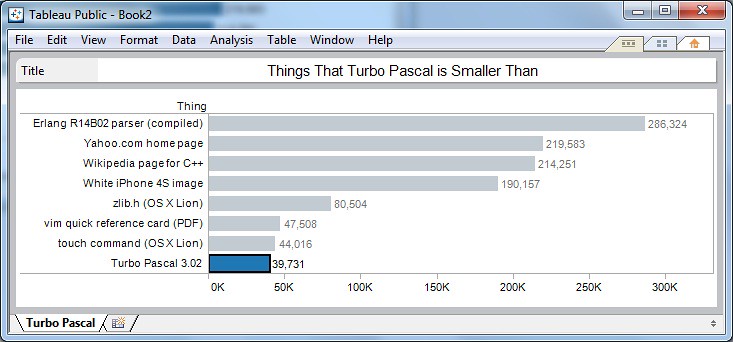
Things That Turbo Pascal Is Smaller Than
theodp writes "James Hague has compiled a short list of things that the circa-1986 Turbo Pascal 3 for MS-DOS is smaller than (chart). For starters, at 39,731 bytes, the entire Turbo Pascal 3.02 executable (compiler and IDE) makes it less than 1/4th the size of the image of the white iPhone 4S at apple.com (190,157 bytes), and less than 1/5th the size of the yahoo.com home page (219,583 bytes). Speaking of slim-and-trim software, Visicalc, the granddaddy of all spreadsheet software which celebrated its 32nd birthday this year, weighed in at a mere 29K." -
When Having the US Debt Paid Off Was a Problem
Hugh Pickens writes "NPR reports that not so long ago, the prospect of a debt-free U.S. was seen as a real possibility with the potential to upset the global financial system. As recently as 2000, the U.S. was running a budget surplus, taking in more than it was spending every year — and economists were projecting that the entire national debt could be paid off by 2012. So the government commissioned a secret report outlining the possible harmful consequences of retiring the debt completely. For one thing, paying off the national debt would mean the end of Treasury bonds, a pillar of the global economy. Treasury securities are crucially important to the world financial system in a number of ways: banks buy them as low-risk assets, the Fed uses them for executing monetary policy, and mortgage interest rates vary based on Treasury rates. 'It was a huge issue ... for not just the U.S. economy, but the global economy,' says Diane Lim Rogers, an economist in the Clinton administration. In the end, Jason Seligman, the economist who wrote most of the report titled 'Life After Debt (PDF),' concluded it was a good idea to pay down the debt — but not to pay it off entirely. 'There's such a thing as too much debt,' says Seligman. 'But also such a thing, perhaps, as too little.'" -
Ask Slashdot: Image Recognition For Race Timing?
First time accepted submitter int2str writes "Autocross is a form of motorsports practiced in the U.S. and around the world where car enthusiasts explore the capabilities of their car in an open parking lot or similar suited area. It's point-to-point racing (not closed circuit). Most of these events are organized by car clubs and volunteers. Timing is usually done with a form of detection beam at start and finish that gets interrupted by the car crossing the beam. Many commercial systems are available. All of these system require the operator to enter the car's number or ID and requires the cars finishing in the order they started. So if one car is not able to finish, the operator has to intervene, or timing is broken. For closed circuit racing, transponder systems are available to address this problem. But such systems require sensor loops in the track or overhead (bridge setup) and the transponders are expensive. Do you think it would be possible to design a timing system using off-the-shelf parts and open source solutions to uniquely distinguish about 100 participating vehicles and time them from a start to a finish point, independently of their finishing order?" Read below for some more details: int2str continues: "My initial idea would be:- Use (web-?)cameras at each end that feed into a Linux based notebook (USB/Ethernet).
- Start recoding still images as fast as possible when motion is detected
- Identify unique shape, numbers, barcode, qr code or similar in the images, that have been attached using a magnet to the vehicle's door.
Difficulties to overcome:
- Camera with high enough shutter speed to get recognizable image of vehicle traveling 30-60mph
- Quickly and accurately identify a unique symbol or shape
So far I've started looking into OpenCV as a possible tool for image recognition, but have not been able to find a capture solution. Does anybody have experience with something like this? The solution would be open source and well documented as to benefit the many car clubs around the country and the world."
-
TSA's VIPR Bites Rail, Bus, and Ferry Passengers
OverTheGeicoE writes "TSA's VIPR program may be expanding. According to the Washington Times, 'TSA has always intended to expand beyond the confines of airport terminals. Its agents have been conducting more and more surprise groping sessions for women, children and the elderly in locations that have nothing to do with aviation.' In Tennessee earlier this month, bus passengers in Nashville and Knoxville were searched in addition to the truck searches discussed here previously. Earlier this year in Savannah, Georgia, TSA forced a group of train travelers, including young children, to be patted down. (They were getting off the train, not on.) Ferry passengers have also been targeted. According to TSA Administrator John Pistole's testimony before the Senate last June, 'TSA conducted more than 8,000 VIPR operations in the [previous] 12 months, including more than 3,700 operations in mass-transit and passenger-railroad venues.' He wants a 50% budget increase for VIPR for 2012. Imagine what TSA would do with the extra funding." -
Highly Efficient Oxygen Catalyst Found
eldavojohn writes "As detailed in the journal Science (abstract), a new compound composed of cobalt, iron and oxygen with other metals presents us with the most efficient way (found so far) of splitting oxygen atoms from water. These ten known compounds provide a reactivity rate that is at least an order of magnitude higher than what is currently known as the gold standard in such reactions. During their research, the team discovered that the reactivity is dependent on the configuration of the outermost electron of transition metal ions, which they exploited to develop this efficient catalyst. For rechargeable batteries and hydrogen fuel, this is exciting work from MIT's Jin Suntivich, Kevin J. May, Hubert A. Gasteiger, and Yang Shao-Horn, and the University of Texas's John B. Goodenough." -
In Bolivia, a Supervolcano Is Rising
dutchwhizzman writes "Uturuncu is a Bolivian supervolcano. Research suggests that it has an eruption frequency of roughly 300,000 years and the last eruption was, give or take a few years, 300,000 years ago. Research suggests that it started rising in a 70 km diameter by 1 to 2 centimeters per year, making it the fastest-growing volcano on the planet. Break out the tin foil hats, and store plenty of canned beans, because it may just erupt before Yellowstone pops its cork." -
BT Ordered To Block Usenet Binaries Index
First time accepted submitter eyeoftheidol writes "A judge in the UK has ordered the ISP BT to block access to filesharing site Newzbin2 within 14 days. From the article: 'Wednesday's court order also allows for the blocking of any other IP or internet address that the operators of the Newzbin2 site might look to use to continue to offer copyrighted content to users. In addition the court said BT must foot the bill for the cost of implementing the web block on Newzbin2.'" -
Mystery of an Ancient Super Nova Solved
Bob the Super Hamste writes "The BBC is reporting that the mystery of a supernova seen almost 2000 years ago has been solved. The supernova RCW 86 was observed in 185AD by Chinese astronomers and was visible for eight months. Recently scientists have wondered how the supernova grew so big. By combining data from the Chandra X-ray telescope and the XMM-Newton Observatory with recent images from NASA's Spitzer and Wide-field Infrared Survey telescopes, scientists have figured out that the supernova expanded into a relatively empty bubble of space. These empty bubbles of space are typically associated with a core collapse supernova, but the core remnant is high in iron, which instead is associated with a type 1A supernova. The findings are published in The Astrophysical Journal." -
US's Most Powerful Nuclear Bomb Being Dismantled
SpuriousLogic sends this excerpt from an AP report: "The last of the nation's most powerful nuclear bombs — a weapon hundreds of times stronger than the bomb dropped on Hiroshima — is being disassembled nearly half a century after it was put into service at the height of the Cold War. The final components of the B53 bomb will be broken down Tuesday at the Pantex Plant near Amarillo, the nation's only nuclear weapons assembly and disassembly facility. ... The weapon is considered dismantled when the roughly 300 pounds of high explosives inside are separated from the special nuclear material, known as the pit. The uranium pits from bombs dismantled at Pantex will be stored on an interim basis at the plant, Cunningham said. The material and components are then processed, which includes sanitizing, recycling and disposal, the National Nuclear Security Administration said last fall when it announced the Texas plant's role in the B53 dismantling." -
HPV Vaccine Recommended For Boys
necro81 writes "An advisory committee to the U.S. Centers for Disease Control and Prevention will soon issue new recommendations that pre-adolescent boys be vaccinated against Human Papilloma Virus (HPV). The disease is sexually transmitted, endemic in the sexually active, can cause genital warts in both men and women, and is the primary cause of cervical cancer, which kills hundreds of thousands of women globally each year. The three-dose vaccination has been available for several years and is already recommended for pre-adolescent girls. Vaccinating boys should further reduce transmission." -
HPV Vaccine Recommended For Boys
necro81 writes "An advisory committee to the U.S. Centers for Disease Control and Prevention will soon issue new recommendations that pre-adolescent boys be vaccinated against Human Papilloma Virus (HPV). The disease is sexually transmitted, endemic in the sexually active, can cause genital warts in both men and women, and is the primary cause of cervical cancer, which kills hundreds of thousands of women globally each year. The three-dose vaccination has been available for several years and is already recommended for pre-adolescent girls. Vaccinating boys should further reduce transmission." -
Why So Many Crashes of Bee-Carrying Trucks?
Hugh Pickens writes "Interstate 15 in southern Utah has been reopened and officials say 25 million bees that closed the road have been accounted for after a flatbed truck heading for California carrying 460 beehives overturned near a construction zone. The bees were on their way to Bakersfield, California for almond pollination next spring. 'The driver lost control, hit the concrete barrier and rolled over,' says Corporal Todd Johnson with the Utah Highway Patrol. 'Of course we then had bees everywhere.' But a similar incident happened in July, when 14 million bees, as well as a river of honey, flowed out of a wrecked semi in Idaho; and 17 million bees escaped a fatal truck crash in Minnesota last year. Why so many highway accidents involving bees? The uptick results from more and more honey bee colonies being transported around the country via highways in recent years. Local bee populations are rapidly dying off from a little-understood disease called 'colony collapse disorder': 'The number of managed honey bee colonies [in the U.S.] has dropped from 5 million in the 1940s to only 2.5 million today,' says the U.S. Department of Agriculture. Unfortunately, some honey bee scientists suspect that the rise of migratory beekeeping may be contributing to the species' decline as transporting hives from farm to farm spreads pathogens to local bee populations." -
Earth Officially Home To 7 Billion Humans
New submitter arcite writes "It's official: planet Earth is now home to over seven billion ugly-bags-of-mostly-water (otherwise known as humans). We're adding ten thousand new humans every hour, or one billion every nine years. Head over to 7 Billion Actions (put together by the UN with the help of SAP) and check out the population map data. Short of adopting a strict diet of Soylent Green, what viable solutions will enable us to survive on this increasingly crowded pale blue dot? What will the role of technology be in supporting this many people?" -
Ask The Bad Astronomer
Astronomer, author, columnist, and successful populizer of science Phil Plait, perhaps best known as The Bad Astronomer, is a regular sight on Slashdot for his unusual ability to find lucid explanations of esoteric scientific claims and controversies. Phil has graciously agreed to answer Slashdot readers' questions, so ask him below about space, science, debunking conspiracy claims, and anything else that makes sense. Asking more than one question is fine (and encouraged!), but please separate unrelated questions into separate posts, lest your questions be moderated down. -
Hyperion Promises An AmigaOS Netbook
An anonymous reader writes with a report that an employee of Hyperion Entertainment has disclosed (but not officially announced) that there is a new portable computer with the Amiga name on it in the works, quoting: "Supposedly, the new netbook Amiga is will be 'sourced in a special configuration from an OEM.' The manufacturer in question is, just like the price tag, the launch date and the hardware specifications, currently unknown paving the way for further speculation and rumors. The netbook Amiga will set a mark in computer history as the first portable Amiga to see the light of the day since the Amiga 1000 was introduced to the U.S. market in 1985." -
Using Fuel Depots Instead of Giant Rockets
EccentricAnomaly writes "The New York Times has a story about a leaked NASA study that showed it would cost $80 BIllion less and get astronauts to an asteroid sooner if NASA used fuel depots instead of developing a new rocket. According to the article, NASA's response to the leaked study is to start developing fuel depots in addition to continuing its new rocket program. Because, after all, who doesn't need more cool stuff." -
Using Fuel Depots Instead of Giant Rockets
EccentricAnomaly writes "The New York Times has a story about a leaked NASA study that showed it would cost $80 BIllion less and get astronauts to an asteroid sooner if NASA used fuel depots instead of developing a new rocket. According to the article, NASA's response to the leaked study is to start developing fuel depots in addition to continuing its new rocket program. Because, after all, who doesn't need more cool stuff." -
Orionid Meteor Shower Peaks Early Tomorrow Morning
New submitter blastoff9 sends this excerpt from Space.com: "The annual October meteor shower will peak before sunrise on Saturday (Oct. 22) as the Earth passes through a stream of leftover dust from the famous Halley's Comet. The Orionid meteor shower promises to offer skywatchers with a dark sky and good weather up to 15 meteors per hour at its peak, according to a NASA forecast.... The Orionids are visible each year, even though Halley's comet only swings by about every 75 years. This is because comets leave a trail of volatile ices and dust along their orbital path that hangs around long after the comets have come and gone." -
A Digital Direct Democracy For the Modern Age
New submitter lordofthechia writes "Last month the White House created an online petition system through which constituents can directly voice any grievances and concerns to the US government. Any petition that reaches 25,000 signatures (5,000 originally) is promised an official reply. This weekend the first petitions will be closing, and already many have far exceeded the required number of signatures. Is this the way for the voice of the electorate to gain more weight in modern politics, or is it the web version of a placebo button? Will the President's office really consider the top pleas, which include petitions to Legalize and Regulate Marijuana, Forgive Student Loan Debt, and Abolish the TSA?" -
Google+ To End Real Names Policy
bs0d3 writes "After months of Google+ being unsuccessful at taking the edge over Facebook, Google announces a new plan. Google executive Vic Gundotra announced yesterday that they will be 'adding features that will "support other forms of identity,"' a major victory for security and privacy advocates. If Google+ gets rid of their 'real names' policy, they will finally be the social networking site that people will flock to when running away from Facebook." JWZ is a skeptic; he describes as "premature victory" (and much harsher things, too) any rejoicing in the announced policy change, writing in part "My guess? I'll bet they still require you to register with your 'real' name, but then they'll graciously allow you to have a linked nickname or two, meaning they're still fully prepared to roll over on you to authoritarian governments or advertisers at the drop of a hat." -
When Political Mapping Leaks Into Science Research
An anonymous reader writes "Political and territorial disputes have been leaking to scientific venues like Nature, Science and Climatic Change. Many recent scientific papers submitted to these journals promote the highly disputed Chinese U-shaped line. One of the authors refused to change her map after being requested by the journals, stating that that her published map was requested by the Chinese government. This practice was condemned by Nature in its latest editorial, which asserts that political maps that seek to advance disputed territorial claims have no place in scientific papers." -
Galileo To Be Europe's Answer To US GPS
judgecorp writes "Two Galileo satellites that will signify the start of the European Union's answer to the American Global Positioning System will be launched into orbit on Thursday aboard a Russian Soyuz rocket. It's using Soyuz because it is cheaper than the French Ariane — and the satellite system is supposed to free Europe from dependence on a U.S.-controlled positioning system." -
Ask Internet Visionary and Pioneer Vint Cerf
As co-designer of TCP/IP (along with Robert E. Kahn), and former chairman of ICANN, it is no exaggeration to say that Vint Cerf is certainly one of the fathers of the internet, and is often referred to as simply the father. His lifetime of network engineering accomplishments — meriting, among many other laurels, the Turing Award — leaves little doubt as to why he's now a full-time internet visionary for Google (and formerly with WorldCom) as well as a Google VP. Now, Cerf has graciously agreed to answer Slashdot readers' inquiries about the past and future of this little thing called the Internet, and his role in it thus far. This short call for questions is inadequate to sum up his contributions to engineering the data flows that entangle and enlighten us in 2011, but read through a few of these capsule descriptions to get a sense of them. In accord with the interview guidelines, please try not to lump together unrelated questions. (You may find that your questions are moderated downward if they aren't concise; if you have several distinct questions, simply submit separately as many as you'd like.) -
Ask Internet Visionary and Pioneer Vint Cerf
As co-designer of TCP/IP (along with Robert E. Kahn), and former chairman of ICANN, it is no exaggeration to say that Vint Cerf is certainly one of the fathers of the internet, and is often referred to as simply the father. His lifetime of network engineering accomplishments — meriting, among many other laurels, the Turing Award — leaves little doubt as to why he's now a full-time internet visionary for Google (and formerly with WorldCom) as well as a Google VP. Now, Cerf has graciously agreed to answer Slashdot readers' inquiries about the past and future of this little thing called the Internet, and his role in it thus far. This short call for questions is inadequate to sum up his contributions to engineering the data flows that entangle and enlighten us in 2011, but read through a few of these capsule descriptions to get a sense of them. In accord with the interview guidelines, please try not to lump together unrelated questions. (You may find that your questions are moderated downward if they aren't concise; if you have several distinct questions, simply submit separately as many as you'd like.) -
Book Review: The Information: a History, a Theory, a Flood
eldavojohn writes "The Information: A History, a Theory, a Flood by James Gleick has a rather nebulous title and the subtitle doesn't really help one understand what this book hopes to be about. The extensive citations are welcomed as the author barely scratches the surface of any theory of information. It also cherry picks odd and interesting facets of the history of information but presents them in a chronologically challenged order. This book is, however, a flood and as a result it could best be described as a rambling, romantic love note to Information — eloquently written and at times wondrously inspiring but at the same time imparting very little actual knowledge or tools to the reader. If I were half my age, this book would be the perfect fit for me (just like Chaos was) but knowing all the punchlines and how the story ends ahead of time rather ruined it for me. While wandering through interesting anecdotes, Gleick masks the reader from most of the gory details." Read on for the rest of eldavojohn's review. The Information: A History, a Theory, a Flood author James Gleick pages 544 publisher Pantheon rating 5/10 reviewer eldavojohn ISBN 978-0375423727 summary A wandering well-written historical who's who of Information Theory salted with references to hot topics. The book starts out with an introduction to the hero of The Information: Claude Shannon. It also introduces the hero's sidekick: Alan Turing. Aside from our initial introduction to Shannon's work at Bell Labs and his monumental paper from 1948, the author drops many names — a foreshadowing of what is to come in the book. George Campbell, George Boole, Norbert Wiener, Vannevar Bush, John Archibald Wheeler, Richard Dawkins and many many more. This sets the tone for the rest of the book as each chapter jumps around in time and grabs many quotations and excerpts to provide a gem studded narration by Gleick.
Chapter one provided me a piece of anecdotal information that I had actually never come across. It concerns the talking drums of Africa, an apparently ill-documented form of communication that existed in Africa. Rather, I had heard of the talking drums but never considered it in a context of information theory. It appears to be one of the earliest forms of long distance communication, predating all telegraphs. A drummer in one village would drum out the syllables and nuances in a lengthy sentence and often repeat it a few times. Drummers in distant villages would hear this and try to parse out what the drums were saying. As a result of this, they wouldn't just say 'moon' they would say something like 'the shiny white face that rises in the night' or something lengthier to ensure that the message was interpreted correctly. An ingenuous method of communicating, the chapter oddly never mentions parity bits or error detection, two things I basically equated with the additional words that were redundant. It does, of course, return to our hero Shannon who would later investigate the redundancy in the English language.
The next chapter concerns Walter J. Ong and his work concerning the persistence of information. Gleick discusses the find at Uruk and the subsequent deciphering of the cuneiform tablets. What was interesting about these tablets, however, is that they were inane things like bills and recipes. But when Donald Knuth saw one at a museum, he called what he read 'an algorithm.' The third chapter jumps to 1604 and the publishing of the very first dictionaries. Although amusing, this chapter merely extrapolates how difficult it was for us to codify our language (and still is nigh impossible). At the end Gleick translates this effort to cyberspace and similar problems.
The next chapter introduces Charles Babbage and his difference engine. To keep it interesting, Gleick includes excerpts from Charles Dickens, Edgar Allan Poe, Oliver Wendell Holmes and Lord Byron. And oddly enough there was some mentor relationship between Charles Babbage and Augusta Ada Byron King, Countess of Lovelace. Concerning Babbage, Gleick calls Ada 'first his acolyte and then his muse' for some reason this odd relationship is preserved in The Information. Lady Lovelace had many intuitions into how symbolic logic and algorithms would work in the future but I found much of this chapter to be concerning relationships and excerpts from letters. To give you an example of what I'm talking about, I learned that Ada died many years before Babbage of cancer of the womb and she took laudanum and cannabis to ease the pain. What does this have to do with The Information? You also learn that Babbage told a friend before his death that he would gladly give up whatever time he had left if he could spend three days five centuries in the future. Only one of the many stories of foolishly optimistic hope this book sells to the reader.
The next chapter involves the evolution of the telegraph. And the bulk of it concentrated on a telegraph that was quite unknown to me. The French Telegraph — or rather system of signs from high buildings — that could send messages by signaling from village to village. Aside from being an extrapolation of a binary signal from ages of yore like the lighting of fires on elevated land or smoke signals, I didn't really understand why the politics and problems of these devices were explored so in depth. When we finally get to the electric telegraph, we get some odd (albeit interesting) details about it instead of the theory. From the abbreviation of common sentences down to codewords to the fight of patenting the signaling mechanism, Gleick again avoids any sort of real numerical or even technical analysis of how humans were progressing from one bandwidth level to another. Cost per letter drove some odd advancements like acronyms and the investigation of how words could be encoded into less symbols. It ends with a reference to George Boole and logic as these symbolic representations lead the way for words to be replaced and turned into equations.
The book moves on to Claude Shannon and briefly touches on his work on signal noise. It jumps around to Russell and Whitehead's Principia Mathematica and Gödel's subsequent destruction of any dreams of representing everything with symbols by way of his famous Incompleteness Theorem. It goes on to talk about Weyl, Nyquist, Hartley, etc continuing the veritable who's who while providing very little actual knowledge of their work. Who could mention Gödel without also talking about Nazis? Certainly not Gleick. The politics of the time, the references back to Lovelace and Babbage dominate this chapter leaving very little room for any actual Information Theory. On page 201 you'll find H = n log s. Although you won't find more than a paragraph of explanation nor any extrapolations on that formula. Thsi chapter did yield something interesting — a piece of paper from Shannon's estimates of data storage on a logarithmic scale. While some estimates are close, others are very far off but he was already thinking of DNA as information storage. The anecdotes and quotations from peers of the time are impressively researched and cross referenced but at what cost?
The next chapter concentrates on the enemy: Norbert Wiener from MIT. He comes across as a cigar smoking, condescending, self involved, snobby professor who's primary contribution is a now defunct 'science' once called Cybernetics. He's quick to identify other's works as derivatives as his own and is presented as the antithesis to Claude Shannon who is portrayed as modest, cautious, well spoken. On top of that, not only is Shannon's work not defunct it is the basis of so much of everything that is useful today. Gleick portrays Wiener so negatively I almost wondered if the condescending label 'wiener' was somehow related to Norbert. This chapter delves into conferences once held and the interactions between the participants. While it lead for great humor in Shannon/Wiener interactions, I don't understand why they were relayed to the reader. Shannon's rat and its demonstration resulted in interesting remarks but I don't understand why the reader is given so much insight into these proceedings of Cybernetics when the field turned out to be little more than buzzwords. An interesting note, however, is how some of the members would let the media run away with phrases that the scientist had never actually said. They would do this almost strategically to both validate this new field and provide interest from Universities and funding sources ... but should anyone corner them and ask for clarifications they could always truthfully say that they never said that verbatim. I wonder how often this happens today?
This next chapter on Maxwell's demon and entropy was actually a little enlightening in that it provided a fairly clear discussion of entropy (physics) and entropy (information). In addition to this correlation, it discusses why it's often negentropy or negative entropy. Leo Szilárd's work is discussed as well as this concept that 'information is not free.' Although Maxwell's demon is simply a exercise in physics philosophy, this chapter begins what will be finished later: an English explanation of how information is fundamentally tied to matter and the universe.
Gleick now reaches biological information: DNA. He spends a chapter on the origins of DNA and how contemporaries of information theory approached it upon its inception. Of course Dawkins and Gould had interesting things to say in this chapter but also Hofstadtler and Gamow had perhaps the most interesting things to add. That DNA is essentially a number and that number represents a machine that can replicate and say things about itself. One thing this book does well is build this sort of interesting relationship between information and humans. This chapter takes a stab at establishing that we are all at our cores just information in the universe. As biological beings we are feeding off of negative entropy.
The book takes a bizarre twist now into memes. That's right, chain letters and lolcats. And how they replicate and infect our brain despite being nothing more than information. I found this chapter to be obvious and boring — worthy of complete removal from the text. This interjection is out of place entirely and I'm still scratching my head wondering what merit it had in this book. Since it is such an odd assortment and arrangement of the history of information, this could be skipped by the reader.
The chapter on randomness opens with an individual I've never heard of before: Gregory Chaitin. Gleick seems to imply that Incompleteness and Quantum Physics are somehow tied together by way of Turing's Uncomputability Proof — or so Chaitin (once?) thought. Because they were both related to entropy (the word I guess) and the connection was randomness. I didn't understand why this was in here if not to mislead the reader. What follows are some of the giants work and quotes about randomness and random numbers. While mildly interesting, there's not a whole lot to be gleaned from this chapter. I did appreciate the references to Andrei Nikolaevich Kolmogorov who did some original and even parallel work on information theory behind the iron curtain. Of course the text is rife with political situations and anecdotes (i.e. Kolmogorov's run in with one of Stalin's favorite pseudo-scientists). Oh and what book on information would be complete without G. H. Hardy visiting Srinivasa Ramanujan and remarking on the boring number of his taxi? The oft repeated story of the number 1,729. This anecdote feels out of place but Gleick uses it to probe the reader deeper into what randomness really means. Throw in Bach's Well-Tempered Clavier and I almost wondered if Gleick had re-read Gödel, Escher, Bach before writing this chapter.
The next chapter did actually touch on work that ties information to physics in that very basic sense of information is unable to be destroyed in our universe. The famous Preskill Hawking wager is discussed as well as the thermodynamics of computation and the resulting implications for quantum mechanics. The chapter wanders around to quantum cryptography (feeling a bit out of place) to qubits to RSA to ... well, it all (as it does throughout the book) comes back to Shannon. The chapter does end with an interesting quote from John Wheeler who apparently advocated translating the quantum versions of string theory and Einstein's geometrodynamics 'from the language of the continuum to the language of bit.' Sounds pretty interesting, right? Too bad all you get is the quote.
Was that chapter too technical for you? Don't worry, the text moves back to Wikipedia (shouldn't this have been addressed in the early chapters of dictionaries?) and actually talks about deletionism versus inclusionism and the Wikipedia debates on Pokemon articles. Of course, our old friends Babbage, Turing, Shannon, et al are brought back to somehow comment on this modern encyclopedia with quotes from Gleick like 'The universe is computing its own destiny' (for added drama that sentence is its own paragraph on page 377). Strangely enough there is no reference to Edward Fredkin throughout this book. Gleick jumps to domain name saturation on the internet and hits up 'the cloud' at the very end. I almost marvel at how many bases he can touch in one chapter. The penultimate chapter covers our inundation with news every single day of our lives probably from now to eternity. Unsurprisingly, Gleick conjures up quotes of ages long past (almost to the dark ages) of people complaining of the printing press or telegraph or newspaper or internet ruining their lives by assaulting them with information and news. Turns out 'Information Overload' is not a new concept. A chapter devoted to people complaining about too much information in a book on information seems to be too much credit for them, in my opinion.
The book really fizzles out as it tries to wrap up. Far from finalizing anything, the reader is given the concept of 'the library of babel' alongside the famous six degrees of separation. We are now more interconnected than ever before thanks to ... information!
Luckily this book has almost fifty pages of references to other books that contain far more complete and far more organized thoughts on information. I would not recommend this book to any of my colleagues unless they never went to college and never once picked up another book on Information. That said, I felt it was very well written and will no doubt continue to be sold en masse in bookstores. If anyone else read this book and came away with some very deep and profound understanding of the subject matter, I would love to hear it. Right now, the audience for this book is very small in my mind. It might best be given to a young engineer who has yet to go to college but has the vim and vigor to track down the real sources of The Information.
You can purchase The Information: A History, a Theory, a Flood from amazon.com. Slashdot welcomes readers' book reviews -- to see your own review here, read the book review guidelines, then visit the submission page. -
Renaming the Very Large Array
New submitter mercurywoodrose writes "To commemorate a decade-long electronics upgrade, the Very Large Array in New Mexico is up for renaming. Submissions may be made at the National Radio Astronomy Observatory's website until December 1." -
The Mystery of Mars' Bizarre Plumbing
astroengine writes "Hesperia Planum: once a Martian plain — a regular, no-surprises, run-of-the-mill plain. But now, thanks to researchers who used high-resolution imagery from the armada of satellites currently orbiting the Red Planet, Hesperia Planum holds a mystery. Sinuous rilles, a common feature in ancient volcanic regions on Mars and the Moon, appear across Hesperia, but they appear to have no origin and no destination. If they were formed by lava flows, wouldn't they originate near volcanoes? This oddity has led Tracy Gregg and her student Carolyn Roberts of the University at Buffalo to postulate an entirely different rille formation process that could make Hesperia Planum a whole lot more interesting than scientists ever thought." -
U.S. Senator Wyden Raises Constitutional Questions About ACTA
bs0d3 writes "In a written letter which can be found here, U.S. Senator Ron Wyden questions President Obama's authority to sign ACTA without Congressional approval. 'It may be possible for the U.S. to implement ACTA or any other trade agreement, once validly entered, without legislation if the agreement requires no change in U.S. law,' Wyden writes. 'But regardless of whether the agreement requires changes in U.S. law ... the executive branch lacks constitutional authority to enter a binding international agreement covering issues delegated by the Constitution to Congress' authority, absent congressional approval.'" -
Real Life Super Hero Arrested
First time accepted submitter Pat Attack writes "In an ironic twist of fate, Phoenix Jones, a self-styled super hero from Seattle, has landed in jail. Jones happened upon a group of people fighting in the street and tried to stop the fight using pepper spray. He was arrested by police on four counts of assault. The New York Daily News quotes Jones: 'I've been shot once and I don't really want it to happen again. I've been stabbed twice, hit with a baseball bat and had my nose broken,' he says. 'But in all those incidents I helped someone who was in danger. If someone is going to take that punishment it should be the guy in body armor,' he said." -
Mazda Stops Production of the Last Rotary Engine Powered Car
Hugh Pickens writes "After a 45-year production run, Mazda Motor Corp announced that the latest edition of the Mazda RX-8 will end production in June 2012. The Japanese automaker ... introduced its first rotary engine car in 1967 and is the only automaker in the world that makes rotary engine vehicles, once the darling of the automotive industry. Such engines have fewer moving parts and are quieter than comparable piston engines but are more expensive to manufacture and consume more fuel. Cumulative sales of Mazda vehicles with rotary engines total about 1.995 million but Mazda sold only 2,896 RX-8 cars last year, with 1,245 of them in North America and 963 in Japan. 'Although R-X production is ending, the rotary engine will always represent the spirits of Mazda, and Mazda remains committed to its ongoing development,' says Mazda Chief Executive and President Takashi Yamanouchi recalling the victory of Mazda's rotary engine at Le Mans 20 years ago... Mazda does not have flashy green technologies in its lineup that its bigger Japanese rivals do — such as the hybrids at Toyota Motor Corp. or electric vehicles at Nissan Motor Co. The fading away of its prized rotary engine — although largely symbolic — is yet another blow." -
Father of SSL Talks Serious Security Turkey
coondoggie writes with an excerpt from a Network World article: "SSL/TLS, the protocol that protects security of e-commerce, has taken a beating lately, with news items ranging from the violation of certificate authorities to the discovery of an exploit that beats the protocol itself. But despite the exploit ... and the failures of certificate authorities such as Comodo and DigiNotar that are supposed to authenticate users, the protocol has a lot of life left in it if properly upgraded as it becomes necessary, says Taher Elgamal, CTO of Axway and one of the creators of SSL." -
Boeing Suggests Possible Manned Version of the X-37B Space Plane
garymortimer writes with an article in sUAS News. From the article: "A Boeing chief has suggested that the company's mysterious unmanned space-plane, called X-37B, developed for the US Air Force, could be scaled up and modified to carry astronauts. The company's X-37B project chief Art Grantz revealed that at least two more versions of the 9-meter long space-plane are under investigation – one of which involves adding a crew to a much-enlarged version of the space drone, New Scientist reported. If built, the new version would give the US back its ability to shuttle people to the International Space Station." -
Jonathan Koomey Answers Your Questions
A couple weeks ago, you asked questions of Stanford professor Jonathan Koomey about what has been dubbed Koomey's Law — the idea that the energy efficiency of computing doubles every 1.5 years. Read on for Professor Koomey's answers to the questions you raised. What makes this a non-trivial extension?
by Anonymous
What makes your law a non-trivial extension of Moore's Law, which states that the transistor count would double every 18 months due to an increase in density? E&M theory states that if you cut a wire's length in half, it's resistance cuts in half. Granted density in this case is a 2 dimensional expansion and wire resistance is a 1 dimensional formula, but what makes this different from what a freshman in college can infer from an R = (resistivity * length)/cross sectional area?
Jonathan Koomey: First, it’s important to note that we assessed these trends empirically, using measured power data for each computer system in our dataset, and it’s often valuable to confirm with actual measurements what theory implies. Just because the result sounds intuitive to you after the fact doesn’t mean that it isn’t valuable to confirm with real data that the trends actually exist. And of course we discuss in the paper the driving forces behind the reductions in power use per logical switch (and they involve more than just reductions in I squared R losses in the wires). I’ve pasted below two relevant paragraphs from the article:
For vacuum tube computers, both computational speed and reliability issues encouraged computer designers to reduce power use. Heat reduces reliability, which was a major issue for tube-based computers. In addition, increasing computation speeds went hand in hand with technological changes (like reduced capacitive loading, lower currents, and smaller tubes) that also reduced power use. And the economics of operating a tube-based computer led to pressure to reduce power use, although this issue was probably a secondary one in the early days of electronic computing.
For transistorized and microprocessor based computers, the driving factor for power reductions was (and is) the push to reduce the physical dimensions of transistors, which reduces the cost per transistor. In order to accomplish this goal, power used per transistor also must be reduced; otherwise the power densities on the silicon rapidly become unmanageable. Per transistor power use is directly proportional to the length of the transistor between source and drain, the ratio of transistor length to mean free path of the electrons, and the total number of electrons in the operating transistor, as Feynman (2001) pointed out. Shrinking transistor size therefore resulted in improved speed, reduced cost, and reduced power use per transistor (see also Bohr (2007) and Carver Mead’s thinking in the late 1960s, as summarized in Brock (2006, pp. 98-100)).In addition, the fact that the trends have now been confirmed empirically means that people can get on with considering the implications of these trends, which I think are under-appreciated. The idea that we’ll be able to use ever more efficient computing technology in distributed applications will revolutionize data collection, communications, and control of processes, and people are only now starting to think about what may become possible.
As one of many examples showing the potential of ultra low power computing, consider the wireless no-battery sensors created by Joshua R. Smith of Intel and the University of Washington (coverage in the NY Times and the Economist). These sensors scavenge energy from stray television and radio signals, and they use so little power (60 microwatts in this example) that they don’t need any other power source. Stray light, motion, or heat can also be converted to meet slightly higher power needs, perhaps measured in milliwatts. The contours of this exciting design space are only beginning to be explored, and they are enabled by the trends identified in our paper.
I wouldn’t underestimate the importance of a shift in industry focus from raw performance to power efficiency for mobile devices. Some of the best engineers will be drawn to the problems of ultra low power computing in the same way as they’ve were drawn to high performance computing (HPC) in the past (no doubt terrific technologists will also continue to focus on HPC, but anytime a new hot area opens up there’s a migration of talent to that new topic).
Finally, I would add that the truly unexpected result was that the trend in computational efficiency extends for a longer period than Moore’s law, all the way back to Eniac in 1946. So these trends in computational efficiency are an inherent characteristic of computers that use electrons for switching, and are not limited to the microprocessor era. I, for one, did not expect that.
Your Take on Futurists?
by eldavojohn
What is your take on the interpretation of Futurists -- like Raymond Kurzweil -- in regards to extrapolating these 'laws' out to extreme distances?JK: The physicist Neils Bohr once famously said “Prediction is very difficult, especially about the future.” It’s important to be careful in making long-term extrapolations, even if some technological trend has continued for some time. I think it’s fair to say that Moore’s law (and the trends in computational efficiency we identify) have more years to run, given how far we are from theoretical limits, but exactly when we’ll hit a real roadblock it will take someone more brash than me to say. I discuss the theoretical limit based on Feynman’s calculations below, and we will eventually reach that, but there may be ways to sidestep those limits. We’ll have to see how clever we can be!
Lets work this backwards ...
by PPH
... and see where the Babbage Engine fits on the curve.JK: Since the Babbage engine never operated, I’m not sure how we could do this. I believe that some parts of the engine have been created using modern machining practices, but I don’t think anyone has ever made one in complete form. If someone has, I’d be interested to measure its electricity use and estimate its performance (of course, it was designed before the era of electricity). Nordhaus (2007) reports that
Early calculators were “dumb” machines that essentially relied on incrementation of digits. An important step in the development of modern computers was mechanical representation of logical steps. The first commercially practical information-processing machine was the Jacquard loom, developed in 1804. This machine used interchangeable punched cards that controlled the weaving and allowed a large variety of patterns to be produced automatically. This invention was part of the inspiration of Charles Babbage, who developed one of the great precursor inventions in computation. He designed two major conceptual breakthroughs, the “Difference Engine” and the “Analytical Engine.” The latter sketched the first programmable digital computer. Neither of the Babbage machines was constructed during his lifetime. An attempt in the 1990s by the British Museum to build the simpler Difference Engine using early-nineteenth-century technologies failed to perform its designed tasks. (reference: Swade, Doron. The Difference Engine. New York: Viking Press, 2000.)
Nordhaus, William D. 2007. "Two Centuries of Productivity Growth in Computing." The Journal of Economic History. vol. 67, no. 1. March. pp. 128-159. [http://nordhaus.econ.yale.edu/recent_stuff.html]
Nordhaus does attempt to estimate the speed of computation possible by hand calculations as well as abacuses, to compare to more automatic methods.
Infinity w/ reversible computing?
by DriedClexlerThis one doesn't seem to have fundamental physical limits, so long as we eventually transition to reversible computing, in which the computer does not use up useful energy because every process it uses is fully reversible (i.e. the original state could be inferred).
All the limits on computation (except regarding storage) that you hear about (e.g. Landauer limit) are on irreversible computing, which is how current architecture works. It is the irreversibility of an operation that causes it to increase entropy.
Could the whole process be bypassed by the near-infinite efficiency of reversible computers?
JK:Here’s the flip answer: Only if you can afford to wait infinitely long for your answer.
Here’s the more serious answer: in principle, reversible computing could have a revolutionary impact, if we could figure out how to do it, and some folks are working on this. But I haven’t seen any near term applications of such devices—if you know of any, please let me know.
Multicore or System on a Chip Speed bumps?
by eldavojohn
A lot of consumer grade machines have begun focusing on multicore chips with a lower frequency to provide the same or better perceived computing performance than a high frequency single core chip. What happens when a technology like this subverts our craving for higher transistor density? Can you argue that your "law" is immune to researchers focusing on some hot new technology like a thousand core processor or a beefed up system on a chip in order to improve end user experience over pure algorithm crunching speed?JK: First, I would call it (like Moore implied in his own papers) an empirical observation rather than a law.
But in any case, I don’t think that the transition to multicore has “subverted our craving for higher transistor density,” we’re just using the transistors in a different way. The density of chips (measured in components per square centimeter or equivalent metric) will continue to increase, it’s just that the scaling of clock speeds that drove performance increases for so long is no longer possible (mainly because of high leakage currents inside the chip). So that means we need to make many cores and then modify software to capture that performance.
At the end of the day, WHAT you choose to do with the computing power is unrelated to the trends we identify, but I would argue the focus of device and software design is inevitably moving towards enhancing the end-user experience because these trends in efficiency are allowing ever more mobile devices to serve people’s immediate needs in an ever more personal way.
How will this affect programmers?
by AnonymousWhen we eventually hit the physical limits of atoms, will programmers eventually stop their autistic quest for more and more layers, more and more complexity and more and more languages to move a number from one address to another?
How will programmers affect this?
by skidsWhile sarcastic, the above question is an important one: as computing power has increased, the tendency of coders to just ride over badly coded underlayers rather than redesign them competently and efficiently has increased. Why bother cutting out bloat that causes an 80% penalty on system efficiency when you can just use a more efficient chipset to get the same result?
So my question is whether you have put any thought into similarly quantifying the opposing software bloat factor, and what he sees the total balance of system works out to.
JK: Software bloat is a real issue, and I agree with your analysis that the ever-improving hardware picture has allowed poor coding practices to continue. But with the shift to multicore, there’s been at least some burden on programmers to change their ways—they have to modify their code to take advantage of multicore performance, so their skills are actually needed to capture increased performance (which is new, or at least a throwback to the early days of computing, when the programmers had so few hardware resources to work with that they had to be extremely parsimonious in their coding).
In the paper, we write:
Whether performance per CPU can grow for many years more at the historical pace is an ongoing subject of debate in the computer industry (Bohr 2007), but near-term improvements are already “in the pipeline”. Continuing the historical trends in performance (or surpassing them) is at this juncture dependent on significant new innovation comparable in scale to the shift from single core to multi-core computing. Such innovation will also require substantial changes in software design (Asanovíc et al. 2006), which is a relatively new development for the IT industry and it is another reason why whole system redesign is so critical to success.
This really doesn’t address the serious issue you raise about bloatware, which I think is a generic problem that other people more skilled in software design than me can address much better than I can. It’s hard to quantify it because it is so situation specific, but someone at a university somewhere may have tried to do this—I just don’t know.
Applied to Other Kinds of Computing?
by Anonymous
How well does Koomey's Law fit other kinds of computing? For instance, has the energy efficiency of cell phone microprocessors followed the same trend as desktop computers and servers? What about embedded systems like routers and car engine controllers, or specialized hardware like game consoles?JK: These are all excellent questions (which we raise in the article) and I’m actively seeking data, but I don’t have anything new to report on this yet. I’m also interested in trends in data transmission power efficiencies, because that’s a key limitation on these mobile devices. And I’m digging around for battery capacity data over time as well.
Moral/Ethical
by vlm
Here is the list of moral / ethical arguments about the path we're on, as seen in your law. You saw the path clearly enough to define a time based law. Are there any issues I'm not seeing on our current path?
1) Lower energy consumption at point of use
2) Higher energy consumption at manufacturing point
3) faster cpu = bigger programs = more bugs = lower quality of life
4) faster cpu = stronger DRM possibilities
5) Better processing * battery life = better medical devices
6) Better processing * battery life = better 1984 style totalitarian devices
7) Lower energy consumption = less air conditioning demand = decreasing average latitude of data centers = population shifts or whatever or something?
8) More money required for both hw and sw development = good for big corps and bad for the little guy
JK: Hmmm, I’m not quite sure where you are going with this. There are pluses and minuses to all technological innovations, but I’m pretty sure the benefits will outweigh the costs in this case (as long as we put proper restraints on how collected data can be accessed by the authorities).
Batter Capacity vs. Processor Speed
by vlm
Have you run into a law relating battery capacity (either per Kg or L) vs processor speed over time? I bet there is some kind of interesting curve for mobile devices. Or, maybe not — that’s why I'm asking a guy with previous success at data analysis in a closely related field...JK: Great questions. I haven’t seen any quantitative regularity in how battery power densities vary over time, but am actively looking for data. I hope to have something to report about that (along with the other trends I’m investigating, as I describe above). If you know of any good data sources, please let me know.
Queen of Hearts
by Anonymous
What do you think about the following observation: that every X years the amount of computing operations we use to perform basic calculations doubles (by virtue of doing those calculations with more complex software, slower languages...), so when you factor in Moore's law (and your own), the amount of useful calculations we do with computers remain more or less constant.JK: This is related to the bloatware question above. I haven’t seen any quantitative estimates of the real cost from bloatware, but computing is becoming more widely distributed throughout the society, and it’s hard to believe that will the proliferation of more and more mobile devices and all the chips now incorporated in embedded systems that we’re doing less useful computing work than in the past. Some folks have tried to quantify total computational work being done, but it’s hard to do: Hilbert, Martin, and Priscila López. 2011. "The World's Technological Capacity to Store, Communicate, and Compute Information." Science. vol. 332, no. 6025. April 1. pp. 60-65
Feynman Quote
by yakolevMr. Koomey, if we take your numbers from the attached article, which may not have been quoted correctly
Feynman indicated that there was approximately 100 billion times efficiency improvement possible, and 40,000 times improvement has happened so far.
If we take Feynman's number at face value, this means that if computing efficiency improvements continue at the current rate (doubling every 18 months,) we will reach the theoretical maximum in 2043.
Based on that, do you believe that we will see a dramatic reduction in efficiency improvements in the next 10-20 years as we approach the theoretical limit, or do you think Feynman was conservative in his estimate?
JK: Your math is correct, as is the quotation of those numbers. If computing efficiency doubles every 1.5 years, it will take 21.3 doublings before we reach the theoretical limits identified by Feynman, which means will hit that limit in 32 years (i.e. in 2043).
Here’s what Feynman had to say in the book I cited:
Of course there is a limitation, the practical limitation anyway, that the bits must be of the size of an atom and a transistor 3 or 4 atoms; the quantum mechanical gate I used has 3 atoms. (I would not try to write my bits on to nuclei, I’ll wait till the technological development reaches the atoms before I need to go any further!) That leads us just with (a) the limitations in size to the size of atoms, (b) the energy requirements depending on the time as worked out by Bennett, (c) and the feature that I did not mention concerning the speed of light; we can’t send the signals any faster than the speed of light. Those are the only physical limitations that I know on computers.
If we make an atomic size computer, somehow, it would mean that the dimension, the linear dimension is a thousand to ten thousands times smaller than those very tiny chips that we have now. It means that the volume of the computer is 100 billionth, 1011 of the present volume, because the transistor is that much smaller 1011 , than the transistors that we make today. The energy requirement for a single switch is also about eleven orders of magnitude smaller than the energy required to switch the transistor today, and the time to make the transitions will be at least ten thousands times faster per step of calculation. So there is plenty of room for improvement in the computer and I leave you, practical people who work on computers, this as an aim to get to. (Feynman, Richard P. 2001. The Pleasure of Finding Things Out: The Best Short Works of Richard P. Feynman. London, UK: Penguin Books.)So the calculation Feynman did was based on a transistor using just three atoms. In theory, one could use individual nuclei (as Feynman suggests) or there may be another as yet totally unknown way to crack this nut. But using Feynman’s calculation as the ultimate limit, in about three decades (and probably before that) we’re going to hit some kind of limit using our current methods.
But even given that, we’ve got at least another decade of improvements (that’s what my friends at Intel tell me) and probably more. Every decade means a factor of 100 improvement in the power efficiency of computing (doubling every 1.5 years) but there are also vast improvements we can make in our software as well as our implementation of power savings in the standby power of these devices (which turns out to be a much bigger power drain than the active power, given that almost all computers have very low average utilization). Hitting these limits may actually force the software designers to get more efficient (we’ll see!). And we’re just at the beginning of using the technologies enabled by these trends to accomplish human goals, so I’m hopeful we’ll be clever and figure out loads of important applications that will become possible with a factor of 100 or 1000 improvements in efficiency over the next 15 years.
Haven`t we already fallen behind?
by Anonymous
The Pentium M (which is powering the computer that I`m using to type this) came out eight years ago. Let`s call it 7.5 and make our "Koomey factor" 2^5=32. The ULV chip ran at 1.1GHz and ate 6.4W, and we can add on the power of the 855PM northbridge which would make the total 8.2W. I don`t see any products on the market that are anywhere close to a 32x improvement on performance per watt. Do you?JK: Our focus is on system power, not chip power alone. And you need to calculate what your current system is capable of in computations per kWh (which you can calculate from performance per watt) so you can compare to our numbers. But I’ll wager that the current crop of laptops (or the new Mac Mini) will blow away your old machine in terms of computations per kWh at maximum performance (which is what we measure).