Slashdot Mirror
Domain: ycharts.com
Stories and comments across the archive that link to ycharts.com.
Comments · 100
-
Re:Subtitle
There's never been a company, period, with the margins Apple has.
Yes there has. If you want to move the goalposts because I showed the error of your post, go ahead - but the fact doesn't change. Apple's margins have been readily eclipsed in the tech sector. Even Intel crushes Apple and Intel is probably the most hardware-centric computer-technology company you will find. Apple dreams of getting margins of Intel...
-
Re:Subtitle
Reality disagrees with you. Microsoft is down to a 58.5% gross margin, a gross margin Apple has never reached. And that 58.5% is LOW for Microsoft, historically.
-
Re:Fix a lot of problems?
For evidence on layoffs, look what's happening in Seattle - as there minimum wage goes up (beyond what the market used to support), unemployment is going up. That's right - while the national and even regional unemployment numbers are approaching record lows, unemployment in Seattle is increasing.
No, it isn't. In Dec. 2015 (the last month for which info is available), the unemployment rate was 4.2%. In Dec. 2014, it took a brief one-month dip to 3.8%, with 4.1% and 4.3% on either side of it. In Dec. 2013, it was 4.1%. The long-term average is 5.54%. Source: ycharts
There's no plausible reason why raising the minimum wage would increase unemployment from an economics perspective. If every business's wages go up equally, then they have to raise prices to compensate, and with few exceptions (things that Amazon also sells), you basically have a captive market. People aren't going to stop eating because prices go up. And people aren't realistically going to stop eating out. The people who are likely to balk at the high prices suddenly have more income to match, and nobody making a decent living cares about the difference between a $5 combo meal in Tennessee and a $7 combo meal in California, so why would they care about the difference between $7 and $8?
It's all supply and demand. If more workers can now afford the $1600 rent, there will be a shortage of apartments and owners will charge more.
With the potential for more people being able to afford apartments and the elimination of the mandatory low-rent units, it will be significantly more profitable to build housing, so more housing will get built, thus counterbalancing the increased demand. And with more housing getting built, that will also mean less space for businesses, which will help fix the current ridiculous imbalance where there are more businesses in SF than can be supported by the available housing, which will further lower demand over time.
-
Re:Athlon X4 845 why cut pci-e lanes? amd is losin
It's a little bit on the bullshit side to claim they had a "brief period of success in the early 2000's"
Yeah! They're losing money on almost every sale, but they're making it up through volume...
-
Re: Apple is doomed
The stock flatlined over the Ballmer years.
-
Re:anyone, employee or not, can (and should) buy s
GE has for example 9.4 billion shares, each costing around $23 a piece, and each returning approximately 25 cents of interest. you would need to purchase, at minimum, around half a million shares before you realized even upper-middle class living standards from your investment.
This is one of the stupider things I've read lately. I will explain how and why you're wrong:
- Having a 100% GE portfolio is stupidly un-diversified. Normal investors should be in something like VTI (an index fund, meaning a fund that holds a little bit of every stock in the market) instead.
- Stocks produce dividends, not interest, and GE pays out dividends quarterly. That means each share pays out about a dollar a year, for a dividend yield of a little over 3%
- And that's just the dividend: total return comes from dividends plus growth in the share price. The "rule of thumb" for the US stock market is that it has about 7% total return, on average.
- Based on that and an assumption of 3% average inflation, a reasonable safe withdrawal rate for a diversified US stock portfolio is about 4%, which means your assets need to be about 25x whatever you want your income to be. If we assumed a middle-class income to be $50K/year, that could be achieved using a $1.25M total investment.
- Leaving aside once again that a 100% GE portfolio would be moronic, $1.25M worth of GE shares would be about 50,000, not "millions."
- In order to achieve that $50K in investment income, one only needs to invest about $1000/month for 30 years, which is easily accomplished on a middle-class salary (unless you're a dumbass who lives above your means).
Anyway, that's the math that applies if you're an idiot consumer sucker. If you instead choose to invest a reasonable fraction of your salary -- say, 50% -- you can start from $0 and be living off your investments in about 16 years (and if you can get your savings rate to 65%, you can shave that down to a decade).
-
Re:I had no idea Amazon was that bad off
"Amazon is is burning cash (have yet to post a profit)"
Where did you hear that? I'm fairly certain that they've had profitable quarters during their 20 year history.
-
Re:Could not agree more
And this study smells like raw sewage. Check other links from this site, like bullshitty ( http://www.westernjournalism.c... ). However, the target audience of this site appears to drink this sewage with enthusiasm.
Meanwhile, Seattle's unemployment rate currently stands at 3% and is poised to drop to 2% by the end of the year. My favorite restaurant (it's in the next building from my apartment) has extended its hours to 2am.
http://ycharts.com/indicators/...
The unemployment rate is going back up and has been for the past 3 months. It dropped at the same time it was dropping for the rest of the country,
Raising minimum wage would have a greater negative impact in places closer to the southern border where there are a greater pool of people to pay under the table at rates below even today's minimum wage.I have always been curious if educated people really see raising minimum wage as anything more than suckering poor people into feeling like that have more cash. When minimum wage increases, it just creates even more income inequality as the cost of living suddenly rises very quickly and all the people that were making 16 - 20 an hour are suddenly making less (well the same but that same money now has a lot less buying power as prices have just shot up on them.)
-
Re:AMD doesn't have NVDIA's resources to throw aro
I don't think you understood my point. My point is they're better off spending money making their Windows drivers/profiles better because that's where they have the most customers and since they don't have nearly the money, which you can see for yourself, they're better off spending it where they get the biggest return. As you pointed out that likely includes the consoles.
-
Re:My god you people need to think about economics
The Waltons wealth did not come from their employees payroll. The Waltons wealth is in shares of the company.
It's that and it's money they didn't pay to their employees.
Walmart pays a dividend.
More than 50% of Walmart shares are held by Walton family members.
Walmart has 3.226 billion shares outstanding.
In 2014, Walmart paid a quarterly dividend of 48 cents, or $1.92 per share for the year.So for 2014 alone, the Walton family collected approximately $3.09 billion in cash from Walmart. Completely ignoring the value of the shares themselves, and changing no ownership of those shares in any way...
Your argument seems to be: Owners of a valuable company should sell the company and give the money to the employees. Except who is going to buy the company if they too must then sell it and give the money to the employees?
The reason you made this argument is because you are an ignorant fuck that doesnt understand the difference between wealth and income.
...you ignorant fuck.
-
Re:um yea...
Neil Irwin is a talking head on CNBC, MSNBC, PBS, etc...
http://neilirwin.com/about-nei...So he's not exactly unbiased. lol
For a decent counter to his stupid argument:
http://www.forbes.com/sites/ti...Worstall has part of an argument against the Times opinion piece, but he makes an even bigger whopper with his "proof" that no one wants taxes raised, because people aren't voluntarily gifting their wealth to the Federal Government by the hundreds of billions of dollars annually.
But he's right. No one wants their taxes raised. Everyone wants everyone else's taxes raised. His point is people will say lots of things because of their ideology when being polled. But when the tax man comes around, the tax hike aint fair! And when they need to get on a plane, they're getting on bundle or not.
Will al-a-cart be more expensive? That depends entirely how you look at it. You currently pay about $100 for around 350 channels. But, you absolutely cannot be watching all of those. In fact, you likely only watch less than a dozen. But they know what those dozen are and they organize those in such a way that you have to pay for all 350 to get the 12 you want. When it's Al-a-cart you'll likely pay around $5/channel on average. So now you'll be paying $60 for 12 channels instead of $100 for 350. Is that more or less expensive? It's more "per channel" but its less "per month" and you're not losing anything you were using.
But that's if prices remain the same. Which they absolutely will not. There is virtually no competition on the content side, they set a price and demand it. A company like Comcast can't just turn off "Comedy central" so they're stuck paying it. For evidence of this just check out Viacoms profit margin: http://ycharts.com/companies/V...
They're running at 22% profit... that's insane Most of the people out there paying for Viacom aren't even watching it! It's just part of a package they had to get to get some other channel. With a 22% profit margin and viewers that actually have a choice in the channels they pay for suddenly Viacom might decide the $7 they're charging might be a tad high.
-
Re:Just like "free" housing solved poverty!
It's dubious because it isn't winner takes all. Even with classic utilities, the term is misleading. For starters, the term was, to my knowledge, not introduced by economists, but rather by politicians. The claim was that the monopoly was "natural", so we ought to formalize the monopoly (provide protections for it) in exchange for control over how it operates. The classic examples you mentioned very much fit with this. Every large city that I'm aware of (and by large, I don't mean very large at all) grants firm A a monopoly on the services for exchange for some control. It's not very "natural" if the government forces it.
Furthermore, it is quite a large assumption that, say a water company, must span an entire city. I am not particularly fond of the practices used with my city's water. If the market was free, even if infrastructure were not to be overlapped (I don't know if that would ever be economically viable), there's nothing from stopping the city from being divvy'ed up into different quadrants run by different companies. Whether or not this would happen or not depends entirely on the consuming public, just like any normal market. When purchasing a house in a city, one would want to consider the utility providers for that quadrant of the city. People generally take home buying very seriously; I doubt that such a factor would be ignored to the point as to not provide an adequate profit/loss test for the various companies.
If you haven't all ready, I strongly suggest you read up on what happened with AT&T and the so-called "natural" monopoly that it had, what the government did, and what the practical implications were for those actions.
As for Comcast's financials, where are you getting your numbers? I looked at http://ycharts.com/companies/C..., which indicates 15.44% profit for the last quarter (high, but not unreasonable) but almost all other quarters for the past 5 years in the 10% (or under) range. Granted that is for the company as a whole.
-
Re:Fight for consumers
And my suspicion is that Amazon could care less about consumers other than their impact to their bottom line.
Amazon's profit margin is almost non-existent. They've never had much profit. They pass the savings to the consumer and take almost nothing. I don't see any indication that it will change.
Companies are not evil just because they exist.
-
Re:so? americans always hate some company
-
Re:so? americans always hate some company
-
Re:Smart Criminals
Profit margin isn't constant from year to year, look at the averages. Some even have negative averages. I would say the average of all the averages is around 1-2% over the years, say 3% if that makes you happy
Link 1:
http://ycharts.com/companies/LBLCF/profit_margin
Link 2:
http://ycharts.com/companies/SWY/profit_margin
Link 3:
http://ycharts.com/companies/KR/profit_margin
Link 4:
http://ycharts.com/companies/SVU/profit_margin
Link 5:
http://ycharts.com/companies/WFM/profit_margin
Link 6:
http://ycharts.com/companies/NGVC/profit_margin -
Re:Smart Criminals
Profit margin isn't constant from year to year, look at the averages. Some even have negative averages. I would say the average of all the averages is around 1-2% over the years, say 3% if that makes you happy
Link 1:
http://ycharts.com/companies/LBLCF/profit_margin
Link 2:
http://ycharts.com/companies/SWY/profit_margin
Link 3:
http://ycharts.com/companies/KR/profit_margin
Link 4:
http://ycharts.com/companies/SVU/profit_margin
Link 5:
http://ycharts.com/companies/WFM/profit_margin
Link 6:
http://ycharts.com/companies/NGVC/profit_margin -
Re:Smart Criminals
Profit margin isn't constant from year to year, look at the averages. Some even have negative averages. I would say the average of all the averages is around 1-2% over the years, say 3% if that makes you happy
Link 1:
http://ycharts.com/companies/LBLCF/profit_margin
Link 2:
http://ycharts.com/companies/SWY/profit_margin
Link 3:
http://ycharts.com/companies/KR/profit_margin
Link 4:
http://ycharts.com/companies/SVU/profit_margin
Link 5:
http://ycharts.com/companies/WFM/profit_margin
Link 6:
http://ycharts.com/companies/NGVC/profit_margin -
Re:Smart Criminals
Profit margin isn't constant from year to year, look at the averages. Some even have negative averages. I would say the average of all the averages is around 1-2% over the years, say 3% if that makes you happy
Link 1:
http://ycharts.com/companies/LBLCF/profit_margin
Link 2:
http://ycharts.com/companies/SWY/profit_margin
Link 3:
http://ycharts.com/companies/KR/profit_margin
Link 4:
http://ycharts.com/companies/SVU/profit_margin
Link 5:
http://ycharts.com/companies/WFM/profit_margin
Link 6:
http://ycharts.com/companies/NGVC/profit_margin -
Re:Smart Criminals
Profit margin isn't constant from year to year, look at the averages. Some even have negative averages. I would say the average of all the averages is around 1-2% over the years, say 3% if that makes you happy
Link 1:
http://ycharts.com/companies/LBLCF/profit_margin
Link 2:
http://ycharts.com/companies/SWY/profit_margin
Link 3:
http://ycharts.com/companies/KR/profit_margin
Link 4:
http://ycharts.com/companies/SVU/profit_margin
Link 5:
http://ycharts.com/companies/WFM/profit_margin
Link 6:
http://ycharts.com/companies/NGVC/profit_margin -
Re:Smart Criminals
Profit margin isn't constant from year to year, look at the averages. Some even have negative averages. I would say the average of all the averages is around 1-2% over the years, say 3% if that makes you happy
Link 1:
http://ycharts.com/companies/LBLCF/profit_margin
Link 2:
http://ycharts.com/companies/SWY/profit_margin
Link 3:
http://ycharts.com/companies/KR/profit_margin
Link 4:
http://ycharts.com/companies/SVU/profit_margin
Link 5:
http://ycharts.com/companies/WFM/profit_margin
Link 6:
http://ycharts.com/companies/NGVC/profit_margin -
Re:The real story should be...
http://ycharts.com/companies/YHOO/cash_on_hand
About $3 billion in cash and short term investments. While that ain't just walkin-around money, sinking a third of what you've got into something that 1) isn't currently profitable and 2) your press release about the acquisition announces your plan is to "do nothing with it" is head-assplode crazy. If I had stock in Yahoo I'd be dumping it about now.
-
Re:Long term?
In mid April [2012], after a series of high-level meetings, the Japanese government approved the restart of Kansai Electric's Ohi 3 & 4 reactors, and urged the Fukui governor and the Ohi mayor to endorse this decision. They restarted in July. Without the twin 1180 MWe units, significant electricity shortages would have been likely in summer peak periods.
(source)
Moreover:
Japan's idled nuclear reactors will gradually be restarted under the newly-elected Prime Minister Shinzo Abe as the units receive the all-clear from the country's Nuclear Regulation Authority, the Nikkei reported.
(source)
Japanese LNG prices went up from ~$13/MBTU just before the Fukushima event to ~$18/MBTU in July 2012 (source) just before the 2 reactors restarted, and is at $16.66 today
-
Re:Microsoft is finished
Microsoft still turns a hefty profit. They've got massive market share and the company is still experiencing revenue growth, though the rate of growth is declining.
http://ycharts.com/companies/MSFT/revenue_growth
Microsoft is losing market share in key markets. There are reasons why Microsoft could stumble, but they are so diversified and have so much capital that it would take a great number of massive failures for them to really go under.
I wonder how much longer Ballmer will remain CEO.
-
Re:It's called inflation
Looks to me like like core inflation (which doesn't include gas) also averaged 2.1% or very near that.
-
Re:Oh no
And the words "fiscal cliff" has nothing to do with this?
The problem is that they're expecting a renewed recession when taxes go up and government spending goes down. The government will be taking more money out of the economy and putting less into it.
Anybody as freaked out by current government borrowing as you describe is simply being hysterical. Sure the deficit at a historical high in absolute terms, but its nowhere near a historical high as percent of GDP. On top of that the government is currently borrowing money at or below the rate of inflation. It'd be insane not to borrow when people are in effect *paying* us to hold onto it for them. Check out the recent ten year treasury rate and compare it to inflation.
No business would worry about borrowing money at an interest rate below what it can earn by holding onto the cash it already has. That's why *every* large business borrows money, even when it's profitable. It's counter-intuitive if you think of business and government budgeting like they were normal household budgeting, but business and governments aren't like typical private households. Even wealthy *individuals* borrow money when the interest rates are favorable. I once had a wealthy young trust fund kid working for me who borrowed money from the bank to buy a yacht. It made no sense for him to liquidate his investments when those investments earned more than the bank's interest rate.
There's a time to worry about government borrowing, and that's in a full economy where dollars in the private sector are creating jobs like crazy. Nobody seems to worry about austerity then, when interest rates are high, but they should. But when interest rates are low, suddenly people freak out about borrowing money. It's hysterical fear, that's all.
-
Re:OK, stick a fork in them, they're done.
Rim used to make more money than god. It didn't take much to turn that around...
http://ycharts.com/companies/RIMM/net_income
http://ycharts.com/companies/AAPL/net_incomeLooking at the past 10 years of net income quarterlies, I don't see a single quarter Apple should swap with RIM, though I didn't check them all.
Apple hasn't failed to make a billion dollars in a quarter since 2007. RIM hasn't made a billion dollars in a quarter (in the past 10 years).
(Although looking at their net income trend going backward I'm guessing *ever* since there wasn't a comparatively huge market for email phones longer than 10 years ago.) -
Re:OK, stick a fork in them, they're done.
Rim used to make more money than god. It didn't take much to turn that around...
http://ycharts.com/companies/RIMM/net_income
http://ycharts.com/companies/AAPL/net_incomeLooking at the past 10 years of net income quarterlies, I don't see a single quarter Apple should swap with RIM, though I didn't check them all.
Apple hasn't failed to make a billion dollars in a quarter since 2007. RIM hasn't made a billion dollars in a quarter (in the past 10 years).
(Although looking at their net income trend going backward I'm guessing *ever* since there wasn't a comparatively huge market for email phones longer than 10 years ago.) -
Re:OK, stick a fork in them, they're done.
"... rest of the mortals"
I kind of know what you mean, but Apple is no overvalued dotcom. Their price/earnings ratio has been under 15 for a while. Lower than Google's, much lower than Facebook. Apple has a high valuation for a reason.
-
Re:$250? Apple doesn't do non-profit products.
This has been inferred for last 4 years or so, but somehow it never seems to come to pass. First it was the newer SanDisk mp3 players going to eat into the iPod margins, then the new Android phones would eat into the iPod margins, then the new Amazon Fires would eat into the iPads.
Somehow through all of the competition their margins just keep getting better.
-
Re:Strange Anniversary or Black Monday
There is nothing to prevent trading on a stock from becoming so irrational that it goes outside of the fundamentals floor, crashing below the book value of the company, particularly in a panic. Stocks whose price drops enough to start tripping stop loss orders can easily accelerate right below that for some amount of time, with fun stuff like margin calls joining the party too. Value investing based on fundamentals can work very well. But the idea that it must bound the movement of a stock's price, which are driven by all sorts of other things, is not a riskless one. It assumes you can always wait out irrational market behavior, and that's hard to guarantee.
This is sort of off-topic for Google though, given the company's P/E ratio history. It's still pretty far from being a book value driven investment.
-
Re:You can take your gold, and shove it.
The total US debt is much higher than 50K per person.
50K per person is only tip of the iceberg, that's just the outstanding public debt. However this does not include the 222Trillion USD of unfunded liabilities.
16Trillion / 300 Million is about 53K, that's true.
However another 222Trillion / 300 Million is another 740,000 in debt per person. Now, those are obligations that include SS and Medicare and various other pensions.
But this doesn't even include all the mortgage guarantees and all the student loan guarantees that the government makes! How about all the bank guarantees? FDIC? If everything is counted in, that's all sorts of money that the government promises to pay in case things go South, and that's all kinds of money that government does not have. There are no assets like that, there is no tax revenue that can cover that either.
In USA the federal taxes cover what, 2.4 Trillion of spending a year? That's just over half the spending, which is 3.8 Trillion (also, not counting various other off-budget items). Oh, and the States and municipalities and counties are fighting for the same tax payers' revenue. The real debt in USA per capita is ridiculous and can never be repaid.
-
Re:So they can buy all the helium if they want it
(/. comment limitation strikes again, thus my second account)
--They can try and dictate it, but the market always wins at the end, it's a law of nature, like gravity. You can fight it for a while, but you can't stop it.
Any price manipulations will be met by higher prices but also by black markets, where the price will be set by the market given the conditions it has to operate within.
In case of He production, it just may cease to exist altogether, after all, it's mostly extracted during natural gas mining process, so if the prices are set at a level where nobody buys the gas, then why should anybody produce it? It's ridiculous to believe that a company must collect a worthless resources like that (worthless, because it's unsellable and thus unusable). What, a company would build bigger and bigger, more and more expensive facilities to store Helium for the future use? 50 years into the future? It's not a metal, it's a very light gas, it's very expensive to keep around.
Here, look at the natural gas prices, set the time line to "Max". The prices are falling even in this manipulated inflationary economy, so this means the supply is plentiful given the consumption level (and it can't be stored and transported easily, like oil can).
The end result of artificial floor at 20 times the current rate (which is what Richardson wants) would be near disappearance of the gas from the market, THEN the prices would go up much higher, not 20 times, maybe 1000 times or more, nobody knows, but here is what this will mean for people: MRI scans will become much more expensive and no more party balloons for kids, all while most of He will be just let out into the space. Congrats.
-
Re:So they can buy all the helium if they want it
It is nonsense that prices are kept artificially low by government, they were kept artificially high by US gov't until 1996, when US gov't decided to stop gov't intervention in He production and storage. Just like most people, who don't understand economics, you and the 'academic' in question are talking about natural gas mining AS IF it is subsidised by gov't, it's not.
In FACT the prices for natural gas fell sharply in USA over the decade. Here is an interactive graph, set the scale to 10 years. It's a hard to store and transport commodity, many companies went out of business. There is NO shortage of Helium, that's what the market says. The market in USA also says that there is (right now) no shortage of natural gas.
Here, I'll make it easier for you (I don't know if you can understand the easier version either, but hey, I'll try).
Helium is almost fully extracted from natural gas, which is mined for its other uses (like fuel production), and so if He is not collected from natural gas production, there won't be almost ANY supply of He available at any price.
So by creating an artificial price floor for He all you are going to accomplish is this: the consumption will be much lower and production will mostly cease to exist, which means Helium is going to be RELEASED INTO THE ATMOSPHERE and that's it, it's gone. The entire process of He extraction may be scrapped and there will be no way of getting any of it. So your MRI costs will go up, enjoy.
-
Re:Huh.
[citation needed]
Specifically, I'm wondering which government program (or anybody else, for that matter) provided the funds for loan #2? I doubt it'd be the Federal Reserve Bank, which wouldn't lend out that much money in the first place (hence necessitating the bailouts) without more cash being in the JPM's reserves.
In fact, JPM's corporate debt is at its lowest since the bailout, regardless of the source.
That's okay... you can feel free to keep ranting about politics if it makes you feel better.
-
Market Caps
Microsoft's Market Cap
http://ycharts.com/companies/MSFT/market_capApple's Market Cap
http://ycharts.com/companies/AAPL/market_capAt one time Microsoft could have eaten Apple's lunch. They even bailed them out with a loan. Now look how things have changed. Microsft can clearly see where Apple has been a success and they think they can emulate it. A little envy?
If the DOJ now gives Apple a pass on this business model, why wouldn't they do the same for Microsoft?
-
Market Caps
Microsoft's Market Cap
http://ycharts.com/companies/MSFT/market_capApple's Market Cap
http://ycharts.com/companies/AAPL/market_capAt one time Microsoft could have eaten Apple's lunch. They even bailed them out with a loan. Now look how things have changed. Microsft can clearly see where Apple has been a success and they think they can emulate it. A little envy?
If the DOJ now gives Apple a pass on this business model, why wouldn't they do the same for Microsoft?
-
Re:Its a miss...
A 16% increase in earnings per share over this quarter last year... clearly the steepest decline they've had in a long time.
Do you compare a quarter this year only with the same quarter last year? Or do you compare it to the three quarters before?
Look at the slope of the last quarter in the graph. You don't see any drop as sharp in the past 4 years, do you?
-
Re: EPEAT caves
Apple has supplied us with an impressive string of fiascos lately. Do you really want me to enumerate? OK, here we go: #1: kicked in the door of a journalist. Ready for more?
Oh, wow...you mean two years ago when the San Mateo County Sheriff’s Office (not Apple) went to retrieve stolen (yes, stolen) property purchased for $5000 by Gizmodo?
That fiasco?
(Reference for those following, so they can see the facts: http://www.nytimes.com/2010/05/03/business/media/03carr.html )
Is that what makes Apple the most valuable company in the world?
I love the fact that you're clearly trolling by just randomly peppering falsehoods (and at best, contextless half-truths, like with this post) throughout this thread. But yes, please — keep 'em coming.
-
Re:Kill Patents
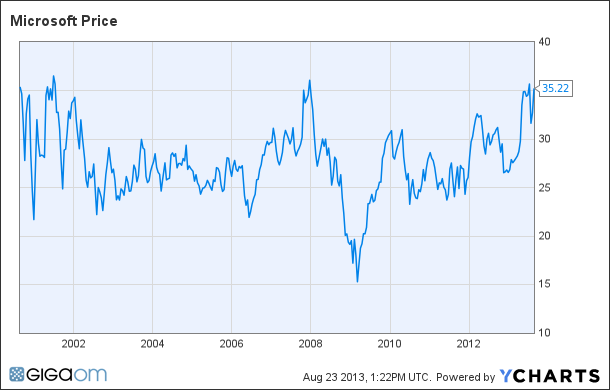
See here. Look back further and that curve looks yet uglier. No wonder MSFT trades chronically just over 10 P/E. The reason for the erosion of MSFT's gross margin is, it's getting harder to compete with the likes of Apple and Linux. Couldn't happen to a nicer criminal.
-
Re:Why Forbes name Ballmer one of the worst CEO?
Not a fan of his personality but since Gates has left: XBox,
I think CEOs that need to be crapped on are the ones that gave them selves bonuses when they were getting government bailouts and losing money. Or the second they got out of government ownership decide to reward themselves with 10's of millions as deferred payment for all those hard years of ~1M/yr salaries.
-
Re:They aren't the only ones
Google never pays higher than 5%
Google's effective tax rate has ranged between 19% to 28% over the last five years, with an average rate of 23.4%.
http://ycharts.com/companies/GOOG/effective_tax_rate -
Re:Yawn.. more anti-ms drivel
Yeah, MS is doing just great.
Why just 4 years ago, apple was 1/2 of MS's revenue and Google was 1/4. Now, Apple is double MS's and Google is 1/2 of MSs.
And you really think that MS is doing great? Seriously? You have not taken notice of the fact that much of MS's revenue is from price increases on western sold, while decreasing prices on all other locations? Even with that, their unit sales are dropping, not increasing. -
Re:Yawn.. more anti-ms drivel
I could have sworn this comment is posted every single week. And yet MS revenues continue to go up and up. "Stagnated" LOL. You are so wrong that you are either retarded or an anti-ms troll.
On Slashdot Microsoft has been dying for about as long as we've been waiting for the year of Linux on the desktop.
-
Yawn.. more anti-ms drivel
I could have sworn this comment is posted every single week. And yet MS revenues continue to go up and up. "Stagnated" LOL. You are so wrong that you are either retarded or an anti-ms troll.
-
Re:Wrong question
Looks like Yahoo! has been profitable all but one quarter in the last 10 years (some web site). Do you actually believe board politics reflects the market, or is that just a knee-jerk reaction to someone saying something that sounds liberal to you?
(I know profitability and net income aren't the whole story, of course, but maybe you could make an evidence-based point about how, in this particular case, the GP is wrong about the short-sightedness of this decision? Because there seems to be some evidence that short-sightedness is hurting American businesses, and it is the natural outcome of a market slanted towards quarter-to-quarter returns over long-term returns.)
-
Re:Google should buy these folks...
$40 billion? Pocket change.
-
Re:AT&T treat their shareholders nice
Verizon (VZ) has a pretty killer yield as well at 5.3% http://ycharts.com/companies/VZ/historical_data/dividend_yield
-
Re:Jobs must have went
It drove more than their share price.
If you're arguing that he made bad business decisions, I think you need to rework your argument.
-
Re:Cooke
Grew more? I guess it depends on how you measure this.
Here is a chart that goes back to Mar 01:
http://ycharts.com/companies/AAPL/market_cap#zoom=0- From Mar 01 (beginning of this chart) to Jun 04, Apple's market cap grew from $7.64B to $12.37B. This represents about $4B a rate of 14.8%/year.
- From Jun 04 to Sep 04 (roughly the time Cook took over, Apple's market cap grew to $15.04B. This is $3B at a rate of 77.6%/year. The rate is impressive, but the total amount is less.
Similarly, From Jun 04 to Jan 09, market cap went to $75.87B This is about $60B under Jobs' leadership at a rate of 37.3%. For the 6 months after that Cook had the reins, market cap increased to $127.06B. This is a phenomenal rate of 124.7%, but again a smaller number, about $50B.
So maybe you are right if you look at the percentages, but you are not right if you look at the straight values. Also, look at the shape of the curve in the figure and think about the history of Apple. While you can't see a clear jump in market cap from the iPod, you do see profitability in that time period and people generally consider that to be a huge factor in Apple's success. Clearly, the iPhone was a great decision in 2008, as the market cap started exploding after the iPhone release.
Now I have no doubt that Cook is a competent business person. But can you really say (with a straight face) that his brief running of the ship in those 8 months total are the reason for Apple's success?
The latter half of your post I agree with. They will need to find someone with the confidence and vision that Jobs has, and the thing about Jobs is he seems to be the only one capable serving the market he's served. Most solid engineering/integration companies serving this market gradually have all their substance hollowed out with style until the whole thing collapses. This happens because it works in the short term. My biggest fear, if Jobs doesn't come back, is that whoever takes over for him will eventually hollow Apple out to nothing.
That said maybe its a good thing, because I've not been a huge fan of what Apple has been doing lately to computing. Of course its not just them; everyone to a degree wants to make computers entertainment devices and not general purpose computers... It is just that Apple is so good at actually delivering that entertainment product I am a bit worried the other stuff which has lingered around for so long for us geeks/nerds to play with might actually be (finally) threatened.