Slashdot Mirror


IBM Patents Checking a Box

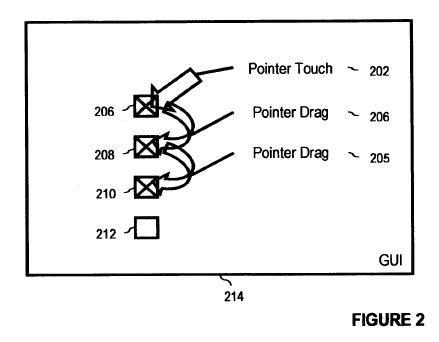
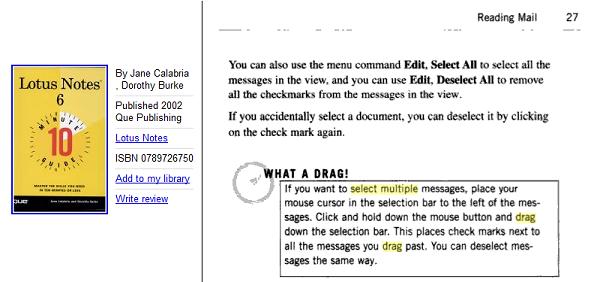
theodp writes "What do you call it when you drag a pointer over a checkbox to select or deselect it depending on its original state? Answer: US Patent 7,278,116. On Tuesday, the USPTO awarded IBM a patent for Mode Switching for Ad Hoc Checkbox Selection, aka Making an 'X'. Isn't this essentially the same concept as the older Lotus Notes selection model that IBM was recently asked to reintroduce?"
186 comments

  1. If someone patents something stupid, do we care? by KingSkippus · · Score: 5, Insightful

    First of all, it's not just "checking a box." It's clicking to toggle a checkmark, and dragging across a bunch of other checkboxes to toggle them all on (or off, depending on the state of the first one you clicked).

    Second of all, I have mixed feelings about this.

    On the one hand, it really bothers me in a cosmic sense that there was a patent granted for something so patently stupid. (Pun slightly intended.) I'm sorry, but this falls squarely in the realm of obvious to me. I mean, really, are programmers expected to patent every single frickin' thing they do out of fear that someone else might? Because that's the world we're living in, and I'd really like for it to change.

    On the other hand, I'm sorry, but the Lotus Notes selection model is one of the most frustratingly stupid things I've ever encountered in my life. Almost every other piece of software follows the old click-first-item, shift-click-last-item model. (Or ctrl-click individual items.) It's been in use since... Well, as long as I can remember using a GUI, and I'm really hard-pressed to think of any other way that selections work. Except for Lotus Notes, where they use this asinine system of selecting messages which means that if I have several pages of stuff to select, I have to scroll past each. and. every. one. Frankly, if IBM is the only company that can do this and it prevents any other company that has the bright idea from implementing something like this, then I can almost bring myself to say that this is a good thing.

  2. Wow... by apdyck · · Score: 2, Informative

    If IBM can patent the checkbox, what's next? The radio button? The text box? Maybe even the address bar?!?

    --
    .sig
    1. Re:Wow... by darthflo · · Score: 2, Informative

      TFS is a bit unclear on this, but the patent is about moving your cursor over checkbox #1 in a given list, holding down a given mouse button and dragging the cursor over a number of other checkboxes in the same list, changing their state to whatever state #1 assumed after you pressed the button. It's still very but not that stupid.

    2. Re:Wow... by UnderDark · · Score: 1

      They have just patented making speculations on future IBM patents!

    3. Re:Wow... by apdyck · · Score: 1

      Uh-oh...I can't afford to pay them any royalties...I'd like to retract my previous speculations...or can I just give them to the patent holder and forget about it?

      --
      .sig
    4. Re:Wow... by Kalriath · · Score: 1

      The address bar is already patented. I think it was even reported on Slashdot. Can't remember who owns it, but thankfully I don't think they've gone suing yet.

      --
      For a site about things like basic rights, Slashdot users sure do like to censor "dissent".
    5. Re:Wow... by UbuntuDupe · · Score: 1

      Hm, almost. Mozilla has a patent on "Making webpages load automatically when you drag them down from the address bar, but then making you have to hit 'go' or 'return' in later versions and destroying all evidence of the original functionality."

      They implement this in FireFox, and, so far, have successfully prevented Microsoft from implementing the second part.

    6. Re:Wow... by StarReaver · · Score: 0

      And after that, they'll patent Slashdot moderation...+5 Insightful now belongs in the hands of IBM!

  3. Re:If someone patents something stupid, do we care by Garridan · · Score: 1

    I have prior art for this. I call it, the pencil and eraser. Oh wait. That prior art isn't mine. This is a technology at least a hundred years old. You want to select a bunch of boxen at once? You just drag the pencil accross all of them. You want to deselect? Turn the pencil over and repeat the motion! w0w!!!

  4. Hey you useless people - it's not the checkbox. by Harik · · Score: 1

    The patent is on their hybrid 'checkbox/windows selection' GUI abomination. It's really fucking ugly - note the "If you scroll the current checked selection off the screen, the behavior changes."

    IF YOU SCROLL THE BEHAVIOR CHANGES.

    Dear IBM: Didn't you learn to share your drugs? Please be giving me some of that crack.

  5. What do you call it? by kidcharles · · Score: 3, Funny

    What do you call it when you drag a pointer over a checkbox to select or deselect it depending on its original state?

    What do you call it when I drag the U.S. software patent system behind my car until it is an unrecognizable bloody mess?

    Sorry for the graphic imagery, but I'm really getting sick of this crap.

    --
    Ceci n'est pas une sig.
    1. Re:What do you call it? by frank_adrian314159 · · Score: 1
      What do you call it when I drag the U.S. software patent system behind my car until it is an unrecognizable bloody mess?

      A beautiful, but sadly never to be realized, fantasy?

      --
      That is all.
    2. Re:What do you call it? by baggins2001 · · Score: 2, Funny

      Dragging it behind your car would be patentable, but making it an unrecognizable bloody mess has already been done.

      --
      He who said 1,000,000 monkeys on 1,000,000 typewriters would eventually type the great novel, never saw an AOL chat room
  6. Alternative. by JMZero · · Score: 4, Funny

    I'm patenting my own method of box checking:

    1. Cut a hole in the box.
    2. Put your check in that box.
    3. Make her open the box.

    --
    Let's not stir that bag of worms...
    1. Re:Alternative. by bigjocker · · Score: 1

      And that's the way you do it

      --
      Life isn't like a box of chocolates. It's more like a jar of jalapenos. What you do today, might burn your ass tomorrow.
    2. Re:Alternative. by terrymr · · Score: 2, Funny

      Are you sure you meant check ?

    3. Re:Alternative. by thatskinnyguy · · Score: 1

      I hold the patent to that numbered list thingy! You stole my IP! Where's my compensation?!

      --
      The game.
    4. Re:Alternative. by Anonymous Coward · · Score: 1, Funny

      I hold the patent to that numbered list thingy! You stole my IP! Where's my compensation?!
      You lose, because I hold the patent to "that numbered list thingy... on the internet! " It's a unique, revolutionary, and non-obvious design.
  7. Anonymous by adam.conf · · Score: 4, Funny

    Well, I guess I won't be posting anonymously for once.

    1. Re:Anonymous by Anonymous Coward · · Score: 0

      Haha, NOW I get it, that's hilarious!

  8. Re:If someone patents something stupid, do we care by lgw · · Score: 1

    Patents are not eternal the way copyrights are. The more obvious stuff that gets patented now, the more stuff that's clearly unpatentable 17 years from now. We're not that far from clearing all the crazy stuff that was patented in the 90s.

    --
    Socialism: a lie told by totalitarians and believed by fools.
  9. Re:If someone patents something stupid, do we care by Anonymous Coward · · Score: 0

    It's a stupid patent, and having that as the only multi-select method is annoying.

    However, if you have a set of four or five boxes close together, I can see it as being convinient.

    However if you drop shift/ctrl standards in your selection method, DIAF.

  10. Dont touch my patent IBM by svendsen · · Score: 1

    My patent (#2334533533.Bull.Crap) is: Drawing 2 circles on your body followed by a dot in each one prevents you from getting cooties from the opposite sex.

    Circle Circle Dot Dot, now I got my cootie shot

  11. Re:If someone patents something stupid, do we care by MrTester · · Score: 5, Interesting

    And while we are ripping on Lotus Notes...

    Why in the name of God would they take the F5 key (the key every other application known to man uses to refresh) and assign to to "Logout"?!?!??!!?

    WTF?

    Ive been using Lotus (against my will) for 3 years now, and still a few times a month I hit F5 because I just KNOW that I should have that email response by now.

    FOR THE LOVE OF GOD MAN!!!!!
    No, I dont normally invoke the name of God 2 times in an email (Well, I guess thats 3 now). Its just a sign of the wrath Lotus brings out in me.

  12. Re:If someone patents something stupid, do we care by dgatwood · · Score: 5, Interesting

    I have actual prior art on this. This is a common UI design in the audio world. If you click on a mute button and drag across multiple tracks, it mutes all of them just like it would if you drug your finger across the mute buttons on a console. Most DAW software I've used does this---BIAS Deck, MOTU Digital Performer, Apple Logic.... the list is almost endless.

    This is another example of a really obvious patent that adds NOTHING to advance the state of the art. The very fact that this patent was awarded is further evidence that every cool new idea that could possibly be patented in software has already been done at least once, and probably more than once, and hence, software patents to not do anything to improve the state of the art and only serve to harm innovation and stifle competition in the marketplace.

    --

    Check out my sci-fi/humor trilogy at PatriotsBooks.

  13. Unfortunately not by Rix · · Score: 2, Informative

    There are various tricks to subvert patent expiration, and this is one of them. Instead of patenting a large system, they patent as many small parts of it as possible, spreading the applications over years.

    This way, the system as a whole doesn't lose protection until the last patent expires. The mp3 patents are an example of this, as they would have entered the public domain years ago if not for these shenanigans.

    The only real solution is to require one patent per system. Make them pick the best and disallow any associated patents.

    1. Re:Unfortunately not by tchuladdiass · · Score: 1

      But I thought you only had one year from publication to patent something. So the trick of patenting parts of a system years after it was first put into use shouldn't work. Unless the patent office doesn't actually count the publishing of a program as the same as publishing the description of the object being patented.

    2. Re:Unfortunately not by sabt-pestnu · · Score: 1

      Now if only I was a patent attorney, and could answer intelligently on this...

      But I suspect that if they were to simply patent a different part of the existing MP3 format, the prior MP3 format itself would be prior art.

      So, they patent a different style of handle on the milk jug, then "indented panels allowing for thinner jug walls" then "screw on cap", yadda yadda yadda, making as small and inexpensive a change as possible, that remains a "new feature".

      But this argument is all hot air. As I said, I'm not a patent attorney...

  14. Obviously by packetmon · · Score: 3, Funny

    No one here understands the complexity involved in checking a box. I don't work for IBM and I am not a marketing expert, if you have side questions on my post please contact me at nocengineer@ibm.com with that said:

    IBM's patented technology is a boon to the Interweb of Googletoolbars worldwide. This extremely proficient alternative to physically filling out a form with a paper and pen method deserves its right in Patentdumb history. The traditional approach of said former technology via the pen and the paper is an approach that is inefficient and expensive. IMB's modular design of the radio button and check button interface allows users to utilize with maximum proficiency, the power of checking a box.

    Thank you

    THIS AND OTHER SUBSEQUENT POSTS ARE PATENT PENDING

  15. Re:If someone patents something stupid, do we care by Anonymous Coward · · Score: 0

    I see.

    And what would be your feelings on, oh, say patenting putting your dick in a box?

  16. Re:If someone patents something stupid, do we care by Jason+Levine · · Score: 5, Funny

    As someone who used Notes, let me just say that God had nothing to do with it's design. You need to look in the other direction.

    --
    My sci-fi novel, Ghost Thief, is now available from Amazon.com.
  17. Re:If someone patents something stupid, do we care by samkass · · Score: 2, Informative

    Almost every other piece of software follows the old click-first-item, shift-click-last-item model. (Or ctrl-click individual items.) It's been in use since... Well, as long as I can remember using a GUI, and I'm really hard-pressed to think of any other way that selections work.

    I believe, like many other standards in GUIs, this was first introduced as a standard by Apple and documented in the Macintosh User Interface Guidelines in the 80's (although I'm sure someone did it somewhere before that). Later Microsoft began using a similar standard, while XWindows was still using a "select copies, and right-click pastes" into the 90's, at least in twm and many of the common window managers (not sure what Motif did here).

    --
    E pluribus unum
  18. Re:If someone patents something stupid, do we care by mweather · · Score: 1

    Programmers shouldn't even be ABLE to patent anything. Software patents should be abolished.

  19. This is just so bad by Anonymous+EPA · · Score: 5, Informative

    I am a patent attorney who tries to get his clients good, valid patents for any technology, including those that are implemented in software.

    I really hate to see patents like this being granted, because they are so obviously stupid, and bring the whole system into disrepute.

    If this were a granted European patent, it would have any number of oppositions filed against it. (An opposition is a cheap and effective challenges to a granted patent). IMO, no proper patent system should be without a workable system of opposition!

    This is a horrible mess, and I wish that there were a way of extracting it from the US patent system in a way that will save IBM the ignominy of having such an obviously bad patent granted in its name.

    A

    1. Re:This is just so bad by davidsyes · · Score: 1

      I hope you can use your attorney powers to gather up some like-minded friends...

      TWO topics here: Patents/Symphony

      Patents

      I may be mistaken, but I think that Raining Data's Omnis Studio had such features BACK IN 1994!

      When I was a contractor back at Bay Networks in/~ 1993/94(formerly Synoptics and Wellfleet, BN later bought by Nortel, I think...) I used the Mac version of Omnis's Omnis database (later I began playing with Omnis Studio, but that's another topic), and I think the developers there had some such options.

      I think even Borland Paradox had such features, or something similar.

      Really, whether one database application can or cannot do EXACTLY what IBM claims depends on the technology, but in effect, there are ways to simulate the patent claim, or outright cobble code to do it. It might look ugly, be inelegant, but work.

      Honestly, I have not READ the patent claim in entirety, but I think that if enough older developers review the patent and can demonstrate they had created prior art, then this would be good (not to be attacking IBM) but to show how hosed up the USPTO still is. I know (I think I read somewhere) that the USPTO is opening up to more input prior to issuing/awarding/granting patents, but maybe I misread.

      SYMPHONY

      I'd RATHER see IBM's money spent on ditching Symphony's underpinnings and replacing it with Lotus SMARTSUITE, 2007. I suppose, though, they'll claim they don't own all the patents inside SmartSuite and signed a document that they would not try to imitate/reproduce/assist in doing so any component of SmartSuite (which excludes Notes). It's a shame, because I was decidedly underwhelmed, disappointed in fact, with Symphony. OO.o, I have to say, did a MUCH better job at opening and handling my company's ms-word-created tables and revision notes (tho, in OO.o I did not try to do any revision tracking stuff... can OO.o even do so?). I WISH SmartSuite were IBM's choice of platform.

      IBM, c'mon. Reign in your attorney head count and divert that money to developers who want to help you make a better splash than you did with Symphony. There's nothing even remotely reminiscent of Lotus Symphony of old in the IBM Lotus Symphony of new.

      C'mon, IBM. Bring your vast arsenal to bear by liberating SmartSuite, and using patents to protect things like SmartTabs, Smart Properties, and other features that WON AWARDS for SmartSuite when ms office wasn't EVEN WINNNG awards. YOUR property WON awards, when Corel didn't, and when ms probably was issuing payola to mag reviewers to bolster ms office's stand and market takeover.

      IBM, C'MON! SmartSuite is a treasure trove of potential patents. Cross-license with Sun/OO.o so Symphony can be as strong as Lotus SmartSuite, 2007.

      --
      Previously: "Linux... Toward the Sunrise..." Now: "Linux... Toward the-- No, now, part of Every Sunrise"
    2. Re:This is just so bad by rainman_bc · · Score: 1

      I really hate to see patents like this being granted, because they are so obviously stupid, and bring the whole system into disrepute. Better granted to IBM than a patent troll IMO. For all we know IBM might never implement this except in some obscure piece of software somewhere where some patent troll might try to milk it for a fifilion dollars.
      --
      09 F9 11 02 9D 74 E3 5B D8 41 56 C5 63 56 88 C0
  20. Re:If someone patents something stupid, do we care by oyenstikker · · Score: 1

    If you spend 5 years developing a physical machine that takes some physical input, does something to it in a novel way, and produces output, you can get a patent on it.

    Why shouldn't you be able to patent software which takes some electronic input, does something to it in a novel way, and produces output?

    --
    The masses are the crack whores of religion.
  21. The rest of us have to check them one by one by z-j-y · · Score: 1

    Imagine how many index fingers will be damaged by that.

  22. Re:If someone patents something stupid, do we care by brandonY · · Score: 2, Interesting

    It is because they picked that key before F5 meant refresh for everybody else, and they don't want to change it and confuse all the experienced Notes users just because some newfangled (read: after 1990 or so) products do it differently.

    You'll probably feel equally angry when you try out Notes 8 and realize that CTRL+tab doesn't take you between tabs because they decided to update themselves to use the same shortcut keys Eclipse uses for that operation, but you can't be angry at BOTH decisions and maintain internal rational consistency.

  23. Re: Patenting the Ugly!!? by TaoPhoenix · · Score: 0, Flamebait

    Wait a minute...

    If I had patented all the ridiculously ugly things I can think of, would that have prevented Microsoft DevelopersDevelopers(woohooo) from trashing both Office07 and IE7 User Interfaces?

    --
    My first Journal Entry ever, in 8 years! http://slashdot.org/journal/365947/aphelion-scifi-fantasy-horror-poetry-webzine
  24. Re:If someone patents something stupid, do we care by djchristensen · · Score: 1

    I'm pretty sure I've seen this same mechanism in the client software for IXIA network test equipment. They have a spreadsheet-like pages, and when there is a check box in a column, you can click it, then select a range of cells in the column and it will apply the setting for the check box you just changed.

  25. Re:If someone patents something stupid, do we care by Anonymous Coward · · Score: 0

    Takes an input, does something, and produces an output.

    Geez, that sounds a lot like a mathematical function.

    Sir, I'm interested in your newsletter and wish to subscribe to it.

  26. Prior Art? by sleepykit · · Score: 1

    No offense, but little check marks have existed since paper tests immemorial... I guess click/drag is sorta different but still fairly obvious.

    --
    "When did I realize I was God? Well, I was praying and I suddenly realized I was talking to myself." ~ Jack Gurney
  27. Re:If someone patents something stupid, do we care by ConceptJunkie · · Score: 1

    The last time I was forced to use Lotus Notes was 2003, and I was amazed that it _still_ looked like what I imagine software written in the Cold War Soviet Union must have been like. In 2003, it still wasn't caught up to conventions that were standard in the 1980's.

    --
    You are in a maze of twisty little passages, all alike.
  28. Re:If someone patents something stupid, do we care by larry+bagina · · Score: 1

    That was my first thought as well... except with pixel painting software. Magnify the screen and use the pencil tool to set a bunch of pixels without ever releasing the mouse button. This "invention" dates back to the parc xerox days.

    --
    Do you even lift?

    These aren't the 'roids you're looking for.

  29. Re:If someone patents something stupid, do we care by HTH+NE1 · · Score: 4, Insightful

    This is another example of a really obvious patent that adds NOTHING to advance the state of the art. At the very least there should be a "de minimis non curat USPTO" grounds for rejecting patents like this ("the USPTO is not interested in trivial matters").
    --
    Oh, say does that Star-Spangled Banner entwine / The myrtle of Venus with Bacchus's vine?
  30. Patent Troll? by Ryukotsusei · · Score: 0

    So IBM is trying to be the next big patent troll?

  31. At a party... by Seismologist · · Score: 2, Funny
    I'd like to hear the IBM "engineer" describe that he holds a "patent" during a conversation at some party:

    IBM Guy: Hey man, you know I have an patent?

    Party Dude: Really? What does it pertain to?

    IBM Guy: The "check box".

    Party Dude: The check box? Is that a new microchip technology.

    IBM Dude: No man... it's the box, that, you check... on forms 'n shit

    Party Dude: Really? That's not that novel...

    IBM Dude: Check it... you are on a computer and if you want to indicate that an item needs to be checked... you click on this little box, and, it totally gets checked-off... Way cool, cutting edge shit...

    Party Dude: Cool man. Need to get away, um, I mean some beer. Check you later.

    --
    ~ In Trust, We Trust ~
  32. What'll really infuriate you about Lotus... by Mongoose+Disciple · · Score: 2, Insightful

    I spent the better part of last year working at a client site that used Lotus Notes for e-mail, and thus, so did I, at least for their corporate stuff. I found it incredibly frustrating to use and frequently wished I could use something with a more satisfying user experience. Say, pine or elm.

    One of my lifelong best friends worked as a developer for IBM at the time, so naturally the next time I saw him I bitched at him about how much I hated Notes and asked how he could stand it. His reply? "Oh, I wouldn't know about that. We use Outlook."

    I'm sure there must be some (maybe even most) departments of IBM that use Notes, but man. To foist that dog food on the world and not even eat it yourself? That's the devil right there.

    I'm puzzled at this patent, but no more than I am about Notes in general.

    1. Re:What'll really infuriate you about Lotus... by Anonymous Coward · · Score: 0

      I've been a Notes Developer for almost 6 years now. It's kind of like Stockholm syndrome. At first you feel like your being held hostage by an evil terrorist but eventually after a few years something clicks in your head.

      You grow to love all the quirky behaviour, the way that almost everything is counter-intuitive. All those chunky buttons on your workspace...

  33. Maybe ... by Midnight+Thunder · · Score: 1

    If IBM can patent the checkbox, what's next? The radio button? The text box? Maybe even the address bar?!?

    I wonder if this is IBM's attempt to show how screwed up the patent system is?

    --
    Jumpstart the tartan drive.
  34. Shaddap You Commies by alexborges · · Score: 0, Flamebait

    In OUR company, we protect our intelectual property using patents. This is the best way for humanity itself to develop breaking-ground technologies like this one: imagine when you have a checkbox and you want to select it but are to lazy to click on it... yeah, i know, you frown... it has happened to you.

    Well not anymore. IBM's wonderfully patented technology will CLICK FOR YOU!

    Now isnt that a great breakthrough in human-computer interaction?

    --
    NO SIG
  35. Re:If someone patents something stupid, do we care by rainman_bc · · Score: 3, Insightful

    This is another example of a really obvious patent that adds NOTHING to advance the state of the art. With the way Patent lawsuits are going, don't blame IBM for this. They literally patent the hell out of everything they can to avoid being sued themselves. They're a patent suit target.

    If you don't like IBM's actions, phone your representative for patent law reform as it's the government's own fault for the sad state in which patent law exists today.
    --
    09 F9 11 02 9D 74 E3 5B D8 41 56 C5 63 56 88 C0
  36. Re:If someone patents something stupid, do we care by HTH+NE1 · · Score: 2, Funny

    Kids have been drag-selecting check-buttons for years. The de-selection mode of it wasn't done because even the de-selection of even one such button was not implemented for anyone without an elevator key.

    --
    Oh, say does that Star-Spangled Banner entwine / The myrtle of Venus with Bacchus's vine?
  37. That's Fine by Greyfox · · Score: 1
    If IBM would kindly patent all elements of the Lotus Notes UI such that no other company may ever inflict that atrocity upon its users, I'd be willing to overlook that patents are evil. I'd ask them to also patent the use of Lotus Notes in a business environment as well, except that I have yet to encounter any other company that actually uses the software. And I like it like that.

    For those of you who haven't had an opportunity to actually use Lotus Notes, think of it as Business Herpes.

    --

    I'm trying to teach myself to set people on fire with my mind... Is it hot in here?

    1. Re:That's Fine by Pop69 · · Score: 1

      These guys use it groupwide http://en.wikipedia.org/wiki/Lvmh and I fully agree, it sucks big time, even the Mac version

    2. Re:That's Fine by chromeronin · · Score: 1

      Personally I thnk Notes is a great back end system, but it's client should never have been let near any users. It is terrible, slow, hard to manage and just plain ugly. Howeever is is really easy to develop some good business systems and have clustering, replication, secured access, web front ends, cross platform etc.

      However MS Exchange and Outlook, there is a neat client that is fundamentally easy to use, but the back-end is very poor, hard to troubleshoot. Exchange 2007 is the first version that is even going to have some form of high-availability for its databases included right out of the box, but you are going to have to upgrade just about your entire exchange network (and every server running it to 64 bit Windows to make use of the features.)

    3. Re:That's Fine by Anonymous Coward · · Score: 0

      I am not an anonymous coward I just don't particularly want to create yet another account with another web site just to post a comment in my name. Anyway, clearly you've never learned how to use Notes properly because once you do, you will see that it's a much better alternative to Outlook and it's actually a very good program. Ever tried filing multiple e-mails in Outlook? You have to drag and drop. With Notes you simply start typing the name of the folder and it finds it. So simple and great. Ever tried doing follow-ups in Outlook? What a nightmare! In Notes - it's so simple, it's a dream.

    4. Re:That's Fine by Greyfox · · Score: 1
      It's a dream? Is that the dream where the naked clown with the huge erection is chasing you down a dark alley? That's a fun one... I've had Notes inflicted on me every time I've done contracting work at IBM and I'll stick by my assertion that it's business herpes. I was not comparing it to anything in particular. Outlook also sucks. I honestly have yet to find an email client I particularly like. Some have interesting features but they either don't integrate well with all my mailboxes or reading and replying to email is a chore or archiving is a pain in the ass or doing a full text search of all your mail for the past decade is awkward...

      You would think that it wouldn't be that difficult to get all that functionality working and working smoothly but I have yet to see anyone accomplish it particularly well.

      --

      I'm trying to teach myself to set people on fire with my mind... Is it hot in here?

  38. You ALL are in violation of my US Patent 7,276,517 by unity100 · · Score: 1

    Which covers "Ejecting bodily excrements by restraining stomach muscles and putting pressure on the Bowels" - you all better start paying up royalties when you go for taking a dump or ill sue your butts out of you

    that'll teach you to respect patents !

  39. Re:If someone patents something stupid, do we care by Anonymous Coward · · Score: 0

    No, I dont normally invoke the name of God 2 times in an email

    You still haven't. 'God' is not a name; it's just a noun.

  40. Re:If someone patents something stupid, do we care by blincoln · · Score: 1

    In that case, they should make it an option that can be set either way. It's not like Notes is a bastion of clean and simplistic design that would be ruined by a few more radio buttons or a set of drop-downs to define your function key behavior.

    --
    "...always new atoms but always doing the same dance, remembering what the dance was yesterday." -Richard Feynman
  41. Re:You ALL are in violation of my US Patent 7,276, by Anonymous Coward · · Score: 0

    I don't give a shit. In fact, I can't give a shit because I have an ostomy. Go ahead and send my an angry letter about violating your patent, I'll reply with a bag of shit, signed and dated.

    Oh yeah, and you can have my butt as I'll not be needing it.

  42. Re:If someone patents something stupid, do we care by Eric+Smith · · Score: 2, Informative

    While independent claims 1, 6, and 11 do cover multiple checkboxes, they not require dragging do toggle the state of multiple checkboxes. That is covered in later dependent claims. Effectively IBM has just been granted a patent on the basic GUI checkbox which was implemented by Apple in the Lisa Office System in January 1983. Xerox probably used checkboxes before that, but I'm not certain. It seems likely that Claims 1, 6, and 11 can be invalidated by prior art, should someone be willing to invest the time and effort to do so. The dependent claims might have a better chance of being upheld.

  43. I win by Anonymous Coward · · Score: 0

    I am patenting a mechanism to allow for intake of oxygen and discharge of carbon dioxide in a human apparatus. I think I may be golden.

  44. Re:If someone patents something stupid, do we care by Chris+Burke · · Score: 2, Funny

    This is a common UI design in the audio world.

    Ah-hah! But this is On A Computer! Completely original!

    Next up they'll patent the same thing, but On The Internet! Genius!

    --

    The enemies of Democracy are
  45. But, is it really for "checking a box"? by blckbllr · · Score: 5, Informative
    I'm biased. I really hate patent stories on Slashdot. They're oversimplified and do not substantively address the patent at issue.

    That being said, let's see what IBM really patented. First, for the time being, discount everything before the "claims." Claims protect what the patentee considers his/her invention. There are 15 claims of the '116 patent ("We" usually refer to patents by their last three digits). Claims 1, 6, and 11 appear to be the independent claims. These are, arguably, the broadest claims in that the claimed subject matter is much broader than claims 2-5, 7-10, and 12-15.

    Claim 1 recites:
    A method for control of checkbox status, the method comprising:
    • selecting and deselecting checkboxes in a GUI according to a mode of operation the GUI having displayed upon it a set of checkboxes comprising a multiplicity of checkboxes, wherein each checkbox comprises a selection status indicating whether each checkbox is selected;
    • detecting a mode selection event;
    • changing the mode of operation in dependence upon the detected mode selection event.

    Now, we come to the crux of the matter. What do these three limitations mean? Honestly, I have no idea. This is when we have to go back and read everything before the claims. Do these three limitations mean merely "checking a box"? Somehow, I don't think so. There seems to be a lot more going on here. For example, what does it mean to "detect[] a mode selection event"? That doesn't sound like merely "checking a box." That sounds like a bit more.

    The other independent claims recite a similar limitations. For example, claim 6 recites "means for detecting a mode selection event." What does this mean? I don't know, I haven't read the rest of the patent's specification. Again, however, this seems to be a bit more than "checking a box." I live it up to another reader to figure out what this limitation means.

    The lesson to take away here is that the patent stories on Slashdot are sensationalism at its finest. I read Slashdot, and often, I find the stories very interesting. However, the patent summaries are atrocious and are nothing short of informative, if not misleading.

    If you think you have prior art that would invalidate this patent, then please, submit it. I invite you to read about the reexamination procedures at the USPTO. You can find them here.

    The views expressed herein are in no way associated with any private entity or government organization
    1. Re:But, is it really for "checking a box"? by Anonymous Coward · · Score: 1, Insightful

      I agree, i'm taking a digital ip law class right now and some of the stuff you'd think is obvious (such as amazon's one click patent) when you actually read the patent you'll find the claims aren't for what a sensationalized title says it is or its something that seems obvious in hindsight but obviously wasn't because no one was doing it before the patent was filed.

    2. Re:But, is it really for "checking a box"? by pipatron · · Score: 4, Informative

      If you think you have prior art that would invalidate this patent, then please, submit it.

      This has nothing to do with prior art or not. I read through about 10% of this, skipping what mostly looked like fillers to make it more technical. This is seriously basic things. You know back in the 80ies when you used the 'pen' in MacPaint, and if you clicked a white square it would 'remember' that it was going to paint everything black, and if you started on a black square it would 'remember' it was going to paint every square white. That this thing goes through shows what sad state the sytem is in. This is what those points means, in practice:

      detecting a mode selection event

      This is when you click the first checkbox.

      changing the mode of operation in dependence upon the detected mode selection event

      There are two modes of operation: If the first checkbox is set, you enter the "clear" mode. If it's cleared, you enter the "set" mode.

      Now you can drag the mouse, all checkboxes you hit will enter the state you chose with the first click.

      I could show prior art; this is how the menus in DirWork 1.62 on my Amiga works, from 1992 (I just checked, to be sure I didn't imagine things). I have no wish to submit this, since doing that would just make people believe that "Hey, the system works! People can submit prior art if they aren't happy, so let's just keep giving out patents like santa on christmas day!". Something else has to be done.

      --
      c++; /* this makes c bigger but returns the old value */
    3. Re:But, is it really for "checking a box"? by blckbllr · · Score: 2, Interesting

      Exactly! You'll find that as you read Slashdot's postings on patents, you'll become more and more frustrated with how summaries are written. Patent law is completely fascinating, but the Slashdot summaries always manage to muck it up. If you're curious, take a look at some of my past postings where I've tried to clear up issues that the summary completely fails to address. I think patent summaries are one place where Slashdot could really benefit from a volunteer IP person working to review and edit them.

      Good luck in your digital IP law class. Take lots of notes, do your outlines, and you'll be fine!

      The views expressed herein are in no way associated with any private entity or government organization

    4. Re:But, is it really for "checking a box"? by Anonymous Coward · · Score: 0

      Ever use xfig? You "detect the mode" of a box: checked or unchecked. It inverts, and if you drag the mouse over other boxes, they become check or unchecked depending on the initial mode.

      And if I can find prior art, and am not a patent examiner, shouldn't the patent examiner lose his job?

      I mean really - they say "checkbox comprises a selection status indicating whether each checkbox is selected" then you claim you don't know what "detecting a mode selection event" means. Obviously to anyone even semi-literate, detecting a mode selection event means detecting a change in the selection status - aka, when someone checks or unchecks a box. Then it easily follows that "changing the mode of operation in dependence upon the detected mode selection event" would have to mean changing whether later on you check or uncheck boxes based upon whether you initially checked the box. If you can't parse that fairly simple jargon, you really should be quiet about it. Really.

    5. Re:But, is it really for "checking a box"? by blckbllr · · Score: 1

      This has nothing to do with prior art or not. I read through about 10% of this, skipping what mostly looked like fillers to make it more technical....

      Whoa whoa whoa. Slow down there. Patent law has EVERYTHING to do with prior art. The Examiner must have felt that, based on the claims presented before him and the references at hand, that the claims were patentable in view of those references. At this point, there is no debate on this subject. The claims are presumptively patentable. The only way to invalidate this patent at this point is either through litigation, such as a declaratory judgment that the patent is, in fact, invalid, or through re-examination, which requires that the references bring up a substantial question of patentability. To say that this has "nothing" to do with prior art is missing the point of the patent system in the first place.

      This is when you click the first checkbox.

      Is this what limitation means? Are you sure? Are you familiar with the case law regarding patent claim construction? Do you know what claim construction is? Did you read the claim? Did you ascribe the claim's terms their "ordinary and customary meaning"? Did you look at the specification? Did you read the patent prosecution history to determine whether the applicant/patentee disclaimed any subject matter relating to "detecting a mode selection event"?

      To dismiss outright that "detecting a mode selection event" means "when you click the first checkbox" is to dismiss an entire body of case law devoted to interpreting what claims mean. This is precisely why I didn't take on that exercise in the first place. If claim construction were that simple, a lot more people would be patent litigators.

      There are two modes of operation: If the first checkbox is set, you enter the "clear" mode. If it's cleared, you enter the "set" mode.

      Are those the only modes covered by the claim? Are these modes even contemplated? Are there additional modes or other "mode selection events"? Without undergoing proper claim construction, how do you know that this is what the patentee, in fact, meant?

      I have no wish to submit this, since doing that would just make people believe that "Hey, the system works! People can submit prior art if they aren't happy, so let's just keep giving out patents like santa on christmas day!". Something else has to be done.

      While I agree that sometimes Examiners aren't as rigorous in their examination, the U.S.P.T.O. purposefully created the ex parte reexamination procedure to question those patents that may have been improperly granted. To say that "something else needs to be done," but not to participate in the procedures that have already been established is simply hypocritical. There are opportunities for you to challenge an improperly granted patent, and if you're going to complain about improper patents without actually engaging the system to correct those patents, you perpetuate those problems as much as the system itself.

      The views expressed herein are in no way associated with any private entity or government organization

    6. Re:But, is it really for "checking a box"? by blckbllr · · Score: 1

      Obviously to anyone even semi-literate, detecting a mode selection event means detecting a change in the selection status - aka, when someone checks or unchecks a box. Then it easily follows that "changing the mode of operation in dependence upon the detected mode selection event" would have to mean changing whether later on you check or uncheck boxes based upon whether you initially checked the box.

      As I explained to pipatron, there is an entire body of case law dealing with claim construction. Claim construction is the carefully crafted body of case law dealing with what claims mean.

      Again, and as before, to simply stay that "detecting a mode selection event" is equivalent or equal to "when someone checks or unchecks a box" without reviewing the rest of the claims, the specification, and the prosecution history, there is simple no way to definitely state what these claims mean. While we can speculate what we think these claims may mean, to ascribe any sort of knowledge as to their actual meaning is to dismiss an entire body of case law going back to the 1950s.

      Really.

      The views expressed herein are in no way associated with any private entity or government organization

    7. Re:But, is it really for "checking a box"? by Anonymous Coward · · Score: 0

      Abstract: Controlling checkbox status by selecting and deselecting checkboxes in a GUI according to a mode of operation, the GUI having displayed upon it a set of checkboxes comprising a multiplicity of checkboxes, wherein each checkbox comprises a selection status indicating whether each checkbox is selected; detecting a mode selection event; and changing the mode of operation in dependence upon the detected mode selection event. In some exemplary embodiments each checkbox comprises a drag status and the method includes toggling the status of the first checkbox and statefully toggling the selection status of checkboxes experiencing drag event in dependence upon drag status, the new state of the first checkbox, and the original state of the current checkbox.

      And if that's not clear enough: In exemplary embodiments of the invention, each checkbox includes a drag status indicating whether each checkbox has experienced a drag event. In such embodiments, selecting and deselecting checkboxes in a GUI according to a mode of operation includes detecting a touch event on a first checkbox in the GUI, toggling the status of the first checkbox to a new status, and setting the drag status of the first checkbox. Typical embodiments include detecting first drag events on additional checkboxes onto which a user drags the pointer, including setting a drag status of the additional checkboxes indicating that the additional checkboxes have experienced a drag event. Exemplary embodiments include statefully toggling, to the new selection status of the first checkbox, the status of the additional checkboxes, detecting subsequent drag events for additional checkboxes onto which a user drags the pointer more than once during a click-and-drag operation, including determining in dependence upon the drag statuses of the additional checkboxes whether the additional checkboxes have experienced a drag event, and statefully toggling the selection status for each additional checkbox for which a subsequent drag event is detected to the opposite of the selection status of such additional checkbox when the additional drag event is detected.

      The construction of claims may be a sophisticated art, but the substance is empty and clearly so. It doesn't take legal tricks to judge the substance - just the technical validity. At the end of the day, supposedly an actual design is being patented (ostensibly). Just like a sales contract - hundreds of years have gone into the gaming of sales, but in the end the substance is I gave the man my money, and I want my stuff. Really. Parsing substance doesn't take a JD - winning in court does, particularly if you want to make the claim broader than what you've actually thought of. We can clearly see what the engineer is trying to patent (shamelessly) - what the lawyer can get away with is a completely different question. Really, I'd be sort of embarrassed if I conflated an actual product with a contract for a product.

      Law is essentially substance-free - it's about how you say things, not what you say, just like an old shaman in a village or a medieval theologian. At best, a necessary evil to minimize social conflict - at worst, an unproductive parasite designing rituals to fleece the population. I think we can see which category patent law tends to fall under...

    8. Re:But, is it really for "checking a box"? by RowanS · · Score: 1
      OK, patent stories on Slashdot are sensational and poorly researched, and no one understands the patent language anyway. All true.

      But a checkbox has two states. Is there any possible useful method of changing the states of a "multiplicity of checkboxes" that is not obvious and trivial to develop?

    9. Re:But, is it really for "checking a box"? by blckbllr · · Score: 1

      All that's been done here, is that the Abstract and a portion of the specification have been copied and pasted. However, that still doesn't address what the limitation means. What about the rest of the specification? What about other claims? What about the prosecution history? What about the claim terms' "ordinary and customary" meaning? We're trying to figure out what the limitation of claim 1 means, and to copy and paste portions of the Abstract and specification willy-nilly doesn't focus in on what the limitation means. Copying and pasting portions of the Abstract and specification without regard to what they're trying to convey, is just copying and pasting.

      The construction of claims may be a sophisticated art, but the substance is empty and clearly so.
      But we're not arguing about substance. We're discussing whether or not IBM has patented "checking a box." Furthermore, repeating a statement over and over again doesn't make it true.

      It doesn't take legal tricks to judge the substance - just the technical validity.
      I'm not sure what you mean by "technical validity." However, I didn't think we were discussing technical validity. I thought we were talking about what the claims mean. Furthermore, the U.S.P.T.O. doesn't care about "technical validity." The U.S.P.T.O. wants to know what the article is useful, novel, and nonobvious. If you want to discuss "technical validity," then I suggest you review the requirements for patent applications in the European Patent Office. But, since we're not talking about either "technical validity" or the EPO, I think the issue is rather moot.

      Just like a sales contract - hundreds of years have gone into the gaming of sales, but in the end the substance is I gave the man my money, and I want my stuff. Really.
      But we're not talking about a sales contract - we're discussing the meaning of claims. To conflate sales contracts with patent law is to confuse two totally different subject matters.

      Parsing substance doesn't take a JD - winning in court does, particularly if you want to make the claim broader than what you've actually thought of.
      Why are we talking about "winning in court"? I thought this discussion was whether the Examiner should have granted the application in the first place. "Winning in court" only makes sense if you sue somebody where a patent is at issue. And, you only have a patent if it's been granted by the USPTO. So, why don't we focus in on whether the patent should have issued, rather than whether somebody is "winning in court."

      Really, I'd be sort of embarrassed if I conflated an actual product with a contract for a product.
      But we're not discussing contracts, products, or contract law. We're talking about patent applications and the requirements for having a patent issue.

      Law is essentially substance-free - it's about how you say things, not what you say, just like an old shaman in a village or a medieval theologian. At best, a necessary evil to minimize social conflict - at worst, an unproductive parasite designing rituals to fleece the population. I think we can see which category patent law tends to fall under...
      Making this statement simply ignores the body of case law that has developed in both the USPTO, the district courts, the Federal Circuit, and the Supreme Court. We've gone from discussing patent law specifically to "law" as a general concept. I don't see how this statement advances the discussion.

      To state that patent law is either a "necessary evil" or an "unproductive parasite" is to make ad hominem attacks on a body of law to which you've demonstrated you don't fully understand. We can only have a discussion on this topic if you're willing to keep to the topic at hand. If you want to make additional, nonsensical blanket statements on other issues, fine, but I won't respond to them.

      The views expressed herein are in no way associated with any private entity or government organization

    10. Re:But, is it really for "checking a box"? by blckbllr · · Score: 1

      Is there any possible useful method of changing the states of a "multiplicity of checkboxes" that is not obvious and trivial to develop?
      I don't know. However, in this case, the Examiner thought that the claims presented by the Applicant were both novel and nonobvious over the references cited.

      In thinking about your question though, you've presented an interesting conundrum. You say any possible useful method that is not obvious and trivial to develop. I would argue, that, yes, there is some method out there that is nonobvious and nontrivial that is useful. I have to say though, that the standard of "useful" is pretty low. We're not discussing "most efficient," "least processor intensive," "least number of lines of code." When we say, "useful," we simply mean that exactly. The method could be inefficient, bloated, and processor intensive, but if it's minimally useful in changing the states of a "multiplicity of checkboxes," and nonobvious, then I think we've found a satisfactory candidate for patenting.

      But, what is that method? I have no idea.

      The views expressed herein are in no way associated with any private entity or government organization

    11. Re:But, is it really for "checking a box"? by Anonymous Coward · · Score: 0

      "useful, novel, and nonobvious"

      Those are not technical legal jargon, in essence. They describe engineering attributes. Engineering attributes are completely disjoint from legal attributes. Really, you are a bit slow, ain't ya? Of course, lawyers are quite good at converting ostensibly meaningful terms into legal playthings - see "Mutual Consideration", that in contemporary law means nothing of the kind except for a formal ritual of legalese.

      The engineering product being patented, which is the original motive for patent law existing at all, is completely different from the arcana of patent law. The engineering claim is trivial and obvious from the application - someone did actually write some software with a feature that someone thought "Cool - we should patent that." Or more likely some manager did on seeing it in a demo.

      Of course, its legal implications is a secret only known to the high priests of the law - and even they don't know what it means until they've actually sued someone, or used the patent to successfully threaten competitors. Substance-free, and getting stupider by the day.

      You may also want to learn what Ad Hominem means. It's a pet peeve, this gratuitous use of ad-hominem to apply to anything that should actually be described as insulting. To describe patent law (or the law in general) as, in the worst case, parasitic is not irrelevant to the case at hand - this is an example of that parasitic, counter productive characteristic. But yes, it is clearly insulting as well. I assume that you're involved in the patent business, no?

      "Really, I'd be sort of embarrassed if I conflated an actual product with a contract for a product."
      "But we're not discussing contracts, products, or contract law. We're talking about patent applications and the requirements for having a patent issue."

      I'd be even more embarrassed if I couldn't parse a fairly transparent metaphor. I guess that's what legal training does to the human mind - that's an example of a statement that is both insulting and ad-hominem.

      "At best, a necessary evil to minimize social conflict - at worst, an unproductive parasite designing rituals to fleece the population. I think we can see which category patent law tends to fall under..."
      "Making this statement simply ignores the body of case law that has developed in both the USPTO, the district courts, the Federal Circuit, and the Supreme Court."

      That is not ignoring the relevant body of law. That is dismissing that body of law - any body of law that has reduced patent law from the original conception of granting a monopoly on actual real-world engineering designs with engineering claims into a game of ambiguous legal jargon unexplainable to anyone without a JD and multiple years of practice in the field can be dismissed as simply an empty shell game, whether or not it is a sophisticated, intricate shell-game.

      Ignoring the transparent Engineering claims for Legal claims may be legally the correct position - of that I have no doubt. But then claiming that these legal claims somehow trump the substance of the claims that can only reside in the Engineering claims is just plain silly. Whether or not they can get away with patenting click-and-drag is a legal question. But whether the patent attempts to claim (a particular variation of) click-and-drag is trivial by simple looking at their examples. We can easily ascertain what features have actually been implemented in software leading to this entire farce.

    12. Re:But, is it really for "checking a box"? by blckbllr · · Score: 1

      This discussion is over Anonymous Coward. When you have something meaningful, intelligent, and useful to contribute, please let me know. Thanks.

      The views expressed herein are in no way associated with any private entity or government organization

    13. Re:But, is it really for "checking a box"? by noidentity · · Score: 1

      The GUI has to detect that the user is intending to change the status of multiple boxes, rather than canceling the operation by dragging off before releasing the mouse. Perhaps this "mode selection event" refers to the logic employed to detect the user's intent? Or maybe it's the name for the software "event" generated in response to detection of the user's intent. Absurd either way.

    14. Re:But, is it really for "checking a box"? by blckbllr · · Score: 1
      One way I find helpful in determining what language means in a claim is to search the application for that exact word or phrase. I find that Firefox's search ability is extremely helpful, because you can highlight all instances of the searched or phrase.

      In searching for "mode selection event," I found this nice gem:

      In many embodiments of the present invention, including the exemplary embodiment of the pseudocode Appendix, a mode selection event (410) is a keypress on a keyboard (408). A keypress is used here for explanation, however, not for limitation. In fact, any event cognizable in a user interface, can be implemented as a mode selection event within the scope of the present invention including, for example, a mousepress on a radio button, a selection from a pull-down menu, a mousepress on a component in a dialogue box, and so on, as will occur to those of skill in the art.
      (emphasis added).

      So what does this mean? Does this mean that "detecting a mode selection" event is "detecting a keypress on a keyboard"? If that's the case, then there must be other aspects of the limitations of claim 1 that the Examiner found patentable. Could the Examiner have found claim 1 patentable because of the limitation of "changing the mode of operation in dependence upon the detected mode selection event"? I don't know.

      I think, with this case especially, you would have to download the prosecution history to figure out exactly what the Examiner found patentable.

      The views expressed herein are in no way associated with any private entity or government organization
    15. Re:But, is it really for "checking a box"? by Anonymous Coward · · Score: 0

      Hopefully not a trolling question, but if you can't tell from the patent what is being patented, how can you determine if there is prior art for the patent or if your new development is covered by an existing patent?

      captcha superior, which is really weird for an "I'm so confused" post.

    16. Re:But, is it really for "checking a box"? by blckbllr · · Score: 1

      Hi AC.

      This is actually a really good question. And I don't mean for this response to be a "gotcha" sort of an answer. However, during the course of examination (called prosecution in "patent-ese"), the Examiner is permitted to give claim terms their broadest possible meaning. By giving the claim terms their broadest possible meaning, the Examiner may then search for references that teach or suggest the claim terms with the applied broadest meaning.

      We are now at the stage where claims have issued, and as the reader, have to decide what claim terms mean. Maybe the claim terms have retained their broadest meaning during prosecution, but maybe they haven't. I think an example will help.

      Suppose I write a claim stating "An apparatus comprising a retaining member." Now, I submit this claim to the Examiner in my patent application for examination. The Examiner is now permitted to give the phrase "retaining member" its broadest possible meaning.

      Suppose now, that the Examiner finds a reference that shows a screw and issues a rejection based on this reference. I write back to the Examiner, "Oh no Mr./Ms. Examiner. My retaining member is not a screw and does not cover screws. For various legal and technical reasons, a screw is not a retaining member." The Examiner may then be satisfied with this response and issues my patent with the understanding that the term "retaining member" does not cover screws.

      We are now at this point with this IBM patent. As in my example, one would think that screws are covered by "retaining members." However, we see that from the prosecution history, where I disclaimed screws, that screws are not considered "retaining members." Hence, we have one possible interpretation for "retaining member." A "retaining member" is a member that retains, except for screws.

      The simple answer here is that Examiner's are allowed to give claim terms their broadest meaning during prosecution. After issuance (that is, when the patent issues), we, the readers, have to resort to the claims, the specification, and the prosecution history to determine what the claim terms mean.

      The views expressed herein are in no way associated with any private entity or government organization. None of the information contained herein should be construed as legal advice. If you need legal advice, please seek the advice of independent legal counsel.

    17. Re:But, is it really for "checking a box"? by Oztechreich · · Score: 1

      Sorry, but who rated this asstrumpetry "Informative?"
      The poster states that they haven't bothered to read any of the application apart from the few bits they quoted. If you were to bother to read the full (or even significant portions of the) application, you would see that it is pretty clear.
      IBM has essentially patented a mode of operation for checkboxes that nobody uses except IBM. I can't imagine many scenarios where this is a superior method of operation to a shift-click or ctrl-click approach. I can't see it taking off (especially since its been patented) and it seems fairly harmless, if a little tenuous, and I an't believe it's taken more than 4 years to go through the process of being assessed, and then still accepted!
      In essence they have patented a method for checking and unchecking multiple checkboxes at once, using a combination of mouse and keyboard. Doesn't seem terribly unique or profitable.

      --
      10001001111001110110011000011101110
    18. Re:But, is it really for "checking a box"? by blckbllr · · Score: 1

      Sorry, but who rated this asstrumpetry "Informative?"

      I will respond in kind.

      The poster states that they haven't bothered to read any of the application apart from the few bits they quoted. If you were to bother to read the full (or even significant portions of the) application, you would see that it is pretty clear.

      You obviously no nothing about patent law. This is evidenced as much by you stating "or even significant portions" of the application. The significant portions of the application are the claims. Had you carefully read my earlier post, you would have read this. I write that after reading the claims, you should go back to figure out what the claim terms mean. I never gave meaning to the claim terms, nor did I attempt to interpret them. This is a task best left up to litigators and opinion writers.

      So, please, until you've had the requisite training and experience to properly interpret claims, keep your opinions to yourself.

      The views expressed herein are in no way associated with any private entity or government organization. None of the information contained herein should be construed as legal advice. If you need legal advice, please seek the advice of independent legal counsel.
    19. Re:But, is it really for "checking a box"? by ClassMyAss · · Score: 1

      See, I think the problem in all of these threads is that blckbllr is arguing things based on what the patent system is in practice (I assume he is involved in patent law in some way); everyone else is arguing from the point of view of what it should be in a perfect world. Blckbllr sees everyone as hopelessly ill informed, sticking their noses into a subject that they don't understand, whereas everyone else sees him as too personally invested in a broken system to see what's so obviously wrong with it. Both sides are probably a little bit right.

      In the opinion of a lot of people here, a patent should probably only apply to something that is somewhat difficult to do for someone competent in the field. They (we) feel that if you handed a fairly obvious task to 100 decent programmers and 90 of them almost immediately came up with (in, say, a few minutes) and implemented (in a few days) roughly the same solution without any references or collaboration, then that solution should certainly not be patentable (ahem, marching cubes, anyone?). That should be true regardless of whether you happen to be the first one to take on said fairly obvious task. We also feel that you should not be able to patent a mere problem in need of a solution. Certainly we feel that coming up with one solution to a problem should not mark the entire problem as off-limits, but only that one solution. And yes, some of us do appreciate the difficulty in setting limits here: sometimes the difficult work is in the formulation of the problem, and a proper statement of the problem is in some respects equivalent to the solution. This should not necessarily prevent such a solution from being patented. But we feel that the current system sets the bar far too low, and considers many obvious problems to be novel enough to be patent-worthy, and in practice that often means that the first person to stumble across some stupid problem that for whatever reason hasn't needed to be solved yet (usually because enabling technologies weren't in place to even allow formulation of the problem, or market conditions didn't require the problem to be solved at the time; either way, the problem often literally didn't exist for very long...see one-click shopping for a perfect example) gets to stake ownership on it, even though they haven't done anything useful at all except get there first and plant the flag.

      Even if crap like this is perfectly legal and right within the US patent system, that's beside the point. It shouldn't be. It doesn't help anyone except the trolls. I'm not naive enough to think that the system is really supposed to primarily a) help "stimulate" innovation or b) be completely and utterly fair, but I think when it's failing badly on both of these counts it indicates a problem.

    20. Re:But, is it really for "checking a box"? by Aristotle's+Fearless · · Score: 1

      True /. may be a biased forum for the finer points of patent law. What irritates me about reading about frivolous patents such as these is that my company has been trying to get a patent on a legitimately new idea for about four years now. The process is frightfully expensive, confusing, intimidating, and honestly probably not worth the effort for a small company such as ours.

    21. Re:But, is it really for "checking a box"? by avirrey · · Score: 1

      While I disagree with blckbllr's argument, I have to say that it is a prior art issue. The logic you mentioned in your post is much more simpler and basic than the average person may perceive.

      If the first checkbox is set, you enter the "clear" mode. If it's cleared, you enter the "set" mode.

      Fundamentally, this is an XOR http://en.wikipedia.org/wiki/XOR_gate which flips any bit from 1 to 0 and vice-versa, and everyone on /. knows there are less /. posts and responses in existence than the number of times a boolean XOR has been used in the computer world.

      IBM cannot patent the boolean XOR function.

      --
      X's and O's for all my foes.

    22. Re:But, is it really for "checking a box"? by Anonymous Coward · · Score: 0

      Please post non-AC next time so I can friend you up. You pwned the shit out of that lawyer douchebag. Nice work!

  46. Re:If someone patents something stupid, do we care by PeelBoy · · Score: 1

    "The very fact that this patent was awarded is further evidence that every cool new idea that could possibly be patented in software has already been done at least once"

    huh?

    You're crazy if you believe that.

  47. Re:If someone patents something stupid, do we care by dgatwood · · Score: 3, Insightful

    The reality is that IBM has a huge patent portfolio. You can't urinate on a computer without violating one of their patents. Why do they need junk patents like this one? If IBM is truly doing this defensively, they should be be phoning their representatives instead of filing such dubious patents. Instead of trying to change the system, they are taking advantage of the brokenness, and that's wrong.

    IBM should drop this patent or release it into the commons or something. It should never have been granted, and profiting from wrong is still wrong.

    --

    Check out my sci-fi/humor trilogy at PatriotsBooks.

  48. Re:If someone patents something stupid, do we care by IronChef · · Score: 4, Informative

    Photoshop does the same thing. Click the eye to toggle vis of a layer and you can drag to do more than one.

  49. Re:If someone patents something stupid, do we care by Anonymous Coward · · Score: 0

    to piss off grammar fascists like yourself.

  50. Re:If someone patents something stupid, do we care by dgatwood · · Score: 1

    How are my examples of prior art not on a computer? All those products I mentioned are audio software products that do almost precisely what is described in the patent. The oldest of those apps, Digital Performer, has been around since 1985, though it was originally called Performer. Assuming that was around in the original interface (I didn't use it back then), it is likely that there are already expired patents on this subject....

    The only thing even slightly original here is that this makes an X appear instead of changing whether a button icon appears "pushed". The X UI has been in use for decades, so that's not really particularly original, either, and I even remember audio/MIDI software back in the 80s that used the checkbox UI itself for mute buttons, though I don't remember if any of those also implemented the drag behavior. I'm fairly sure (but not entirely certain) that Master Tracks Pro (MIDI sequencer) did this with a checkbox for their mute control back in the late 80s... or was that a dot in the box? Is there a difference between a check and a dot? If so, is it worthy of a patent?

    In short, from my perspective, this patent makes Amazon one-click sound like a brilliant innovation by comparison. In fact, this ranks right up there with patenting the wheel.

    --

    Check out my sci-fi/humor trilogy at PatriotsBooks.

  51. IBM corss licensing. by Repossessed · · Score: 1

    iirc IBM licenses it's software patents both to all open source software, and to anybody who extends their patents to FOSS as well. Actually having patents to allow FOSS to use seems fairly irrelevant, as Google jumped in to take advantage of this deal. So pretty much anybody who doesn't have a vested interest in damaging FOSS can still do strange drag mouse to checkmark actions.

    --
    Liberte, Egalite, Fraternite (TM)
  52. Re:If someone patents something stupid, do we care by SL+Baur · · Score: 1

    If you click on a mute button and drag across multiple tracks, it mutes all of them just like it would if you drug your finger across the mute buttons on a console. That differs somewhat from this patent. In this patent if you click a checkbox to mute, then drag it across a checkbox that is already in mute state, it would have to unmute it. The key word appears to be "toggle".

    I think I implemented exactly this kind of interface in the mid '80s, though I would have to check the code (which I no longer have) to be sure. I know I had multiple checkbox selection and deselection by click and drag, it just seems likely that I would have done toggle too.

    Personally, I would consider this kind of interface obvious. But thank you kdawson for yet another article with a totally clueless title. This certainly is not about patenting "checking a box".
  53. Re:If someone patents something stupid, do we care by Chris+Burke · · Score: 1

    Oh, well I thought you were talking about a physical console or mix board where the electronics inside would (on a digital board at the very least) certainly be a computer, the interface itself is traditional buttons, knobs, and sliders. Whereas IBMs patent is on a computer GUI. That's not the case, mea culpa.

    More importantly, I was completely supporting your position that this is a stupid patent. I can't be more sarcastic than "Next up they'll patent the same thing, but On The Internet! Genius!" without feeling like I'm being a complete ham.

    --

    The enemies of Democracy are
  54. Freaking MacPaint is prior art by tepples · · Score: 1

    he patent is about moving your cursor over checkbox #1 in a given list, holding down a given mouse button and dragging the cursor over a number of other checkboxes in the same list, changing their state to whatever state #1 assumed after you pressed the button. Do you remember how the desktop pattern editor or the MacPaint pencil tool from Mac OS 1 worked?
  55. Re:If someone patents something stupid, do we care by mweather · · Score: 1

    The same reason you shouldn't be able to patent mathematical equations. It stifles innovation. Besides, you're still protected by copyright.

  56. Re:If someone patents something stupid, do we care by Garridan · · Score: 3, Funny

    Damn! I just finished preparing my patent for "Usage of Computer as Human Waste Receptical", and you're telling me that there's prior art?

  57. No by Rix · · Score: 1

    I'm pretty certain that's not the case.

  58. Re:If someone patents something stupid, do we care by justzisguy · · Score: 1

    Wow, someone who seems to understand the meets and bounds of the claim and proposes actual potential prior art. Now we just need to obtain some dated documentation. Great job!

    It's hard to blame the examiner for not knowing about an obscure audio program that wouldn't turn up under more generalized searches. This is why the Peer to Patent project has some potential at fixing the problems with software patents.

  59. what a country! by juan2074 · · Score: 1

    Too bad this wasn't obvious.

    On the plus side, no more surveys without IBM licenses.

  60. Re:If someone patents something stupid, do we care by Anonymous Coward · · Score: 0

    If it is really a defensive action which I could imagine with a company around in Redmond, I think/hope they will carry Real Networks attitude. It will be completely free without strings attached to open source developers.

  61. Prior art... by Rix · · Score: 1

    Only matters if it's someone else's prior art.

  62. M.Y.O.B. Accounting has done this for years. by Dr.+Mu · · Score: 3, Informative

    The M.Y.O.B Accounting software I use in my business has had this feature for years. When reconciling your checking account, for example, just click on a cleared check and drag across all the others in sequence that have also cleared, and they all get checked.

    Nothing to see here, folks. Move along.

  63. Czech Box by Anonymous Coward · · Score: 0

    In Soviet Russia you are buried in Czech Box!

  64. Just say no... by sqrt(2) · · Score: 1

    ...to software patents.

    Pretty much all stories related to company X patenting trivial computing action can be summed up with that. When you have an asinine and completely absurd legal/patent system, don't be surprised when people take that for the example of how they're supposed to act using it.

    --
    If you build it, nerds will come. Soylentnews.org
  65. Re:If someone patents something stupid, do we care by Anonymous Coward · · Score: 0

    Right, knew I saw this somewhere before. Mod up?

  66. This is otherwise like... by Tablizer · · Score: 1

    ...drawing in MS-Paintbrush with the pixel grid on

  67. And to think IBM is participating in patent reform by 3seas · · Score: 1

    Open Source as Prior Art and Patent Peer review...both have IBM as participants...

  68. Simple Work-around by Tablizer · · Score: 1

    Just use "sticky" buttons instead of check-boxes on your GUI.

  69. Re:If someone patents something stupid, do we care by sgt_doom · · Score: 1

    Ya know...I've been giving serious thought to patenting the names Dick bin Cheney and George bin Bush. Whadyathink????

  70. Ah Rats! by Tablizer · · Score: 1

    So much for my new Tetris GUI framework.

  71. Re:If someone patents something stupid, do we care by fishbowl · · Score: 1

    >I mean, really, are programmers expected to patent every single frickin' thing they do out of fear that someone else might?

    NO! They are supposed to patent everything so that TWENTY YEARS from now, there will be a sudden boost to development when all the patents from the big rush of the early 21st century expire all together.

    --
    -fb Everything not expressly forbidden is now mandatory.
  72. Re:If someone patents something stupid, do we care by fishbowl · · Score: 1

    >That differs somewhat from this patent. In this patent if you click a checkbox to mute, then drag it across a checkbox that is already in mute state, it
    >would have to unmute it. The key word appears to be "toggle".

    I'm thinking that anything that "works" this way, is into "UI hall of shame" territory anyway.

    --
    -fb Everything not expressly forbidden is now mandatory.
  73. Getting lawyers outof the technology business by cdn-programmer · · Score: 1

    Is there some way to get the lawyers out of the technology business?

    What they like to do in court is select a jury that cannot possibly comprehend the case. By doing this it becomes a crap shoot and either side has an equal chance of winning. Patents like this make no sense to anyone other than lawyers who like them as a way yo retrain trade.

    It puts all programmers at a disadvantage because at any time we can be attacked by someone's legal beagles.

    Maybe we can ask for a patent on a business model based on patents on obvious ideas an prior art?

    1. Re:Getting lawyers outof the technology business by Anonymous Coward · · Score: 0

      Lawyers will always be in every business because our constitution guarantees a method of resolution of conflicts ... and lawyers will always be at the center of that.

      The big picture is that if this patent is obvious, it will become invalidated eventually (it will just take time). But there is no doubt that lawyers do have an interest in protecting their trade. The lobbying interests I believe are winning inspite of this (KSR v. Teleflex, the new continuation rules, and proposed new legislation, etc.).

  74. RMS by wikinerd · · Score: 1

    RMS has many times explained very clearly why software patents suck.

    1. Re:RMS by Anonymous Coward · · Score: 0

      RMS has many times explained very clearly why software patents suck.

      Not of interest around here, dude. Here, the slashtards are only interesting in getting a "5 Funny" mod by making jokes about his hair or lifestyle, or repeating the same old "patent joke" endlessly.

  75. Re:If someone patents something stupid, do we care by ewhenn · · Score: 1

    You can't urinate on a computer without violating one of their patents.
    And you can't do it without shocking your penis either :(
  76. Re:If someone patents something stupid, do we care by oyenstikker · · Score: 1

    The code itself if covered by copyright. The system architecture is not.

    You seem to think that patent protection on physical goods encourages innovation, but patent protection on system architecture does not. Why do you think that is?

    --
    The masses are the crack whores of religion.
  77. Prior Art by tjstork · · Score: 1

    I have a version of my shareware program, called Commodity Server, which does this already. The idea is that you can sorta paint the checks in the boxes.

    --
    This is my sig.
    1. Re:Prior Art by itlurksbeneath · · Score: 2, Funny

      I think Erwin Schrödinger beat you on the prior art. He invented "checking a box" in 1935.

      --
      Have you ever considered piracy? You'd make a wonderful Dread Pirate Roberts.
    2. Re:Prior Art by tjstork · · Score: 1

      normal check boxes are buttons, and to get a click needed to check or uncheck the box, windows waits for a mouse button up message. So, if you have ten things you want to check or uncheck, you can't just drag the mouse across and check them all, and you would have to click ten times. my checkbox, on the other hand, allowed you to drag through a bunch of bunch of items, and it looks like ibms does too.

      --
      This is my sig.
  78. Re:If someone patents something stupid, do we care by livewire98801 · · Score: 1

    "God" is a name. If he was referring to a "god", then it would be a noun. In most monotheistic religions, when you refer to their god, they call it God, since there is only one. Polytheistic religions give other names to their gods, but in a monotheistic religion, why bother? When you're referring to Zeus, you don't capitalize the "G", but you do if you're referring to Christ's father.

    Back on topic, I think it's time that IBM starts donating it's patents and copyrights to Public Domain. . . They could have quite an impact on the community.

    --
    "He may be mad, but there's method in his madness. [...] It's what drives men mad, being methodical." G.K.Chesterton
  79. Re:If someone patents something stupid, do we care by dtobias · · Score: 1

    As I recall, around the 1980s or so, there were no firm standards for what the function keys did other than F1 meaning "Help". In a lot of programs I wrote around that time for diskmagazines and the like, I used F5 to mean "Print".

    --
    --Dan
    Web Tips
  80. Re:If someone patents something stupid, do we care by wolenczak · · Score: 2, Interesting

    F5 Logoff - its origins:

    Remember, Notes has been around since 1973 ('PLATO Notes'), so there are some quirks in there which might seem illogical until you examine its history. I first came across Notes in 1987 before it was ever released by Lotus. Back then it was known as DEC Notes and was widely (internationally) used within Digital Equipment Corporation on their VAX network, but never commercially released.

    A DEC Notes user would logon to their VAX host using a 'dumb' VT terminal. To logout, a user could use a menu option or the command line, in which case their process was gracefully terminated by the host, alternatively they could hit the shortcut F5 key. On the back of your terminal was a DB25pin male RS232 port - on hitting the F5 key, the voltage on pin#20 (DTR - data terminal ready) would drop to 3 volts. The modem (DCE) to which you were connected would respond by dropping its carrier signal which would hang up your phone line (no Hayes commands either). At the far end of the phone line, the host modem would respond to carrier loss by dropping the voltage on its pin#6 (DSR - data set ready), and the comm port on the host VAX would respond by killing the user's process. This was the standard of the time.

    When Ray and the guys took their idea to Lotus, pc networking and client/server architecture was just evolving. In the absence of any standard they simply carried over the tradition of F5 logout from the DEC environment. Up till then, the nearest thing to 'groupware' was internet newsgroups or bulletin board services (typically a host/terminal topology) - at the time, F5 was a well-considered choice for a logout shortcut

    Soonafter, Windows emerged and some ignoramous up in Redmond decided to assign F5 as refresh.

  81. Re:If someone patents something stupid, do we care by Anonymous Coward · · Score: 0

    So everyone who believes in only one god for their religion believes in exactly the same god as people from other religions who believe their god is the only one god? This makes no sense. That that I would expect them to make sense . . . you know, with them believing in the whole magic sky person stuff to begin with . . . but still.

  82. Phil Salin by a1mint · · Score: 1

    Check out how (late) Phil Salin puts it: http://philsalin.com/patents.html "It is an absurdity to expect those millions of individuals to perform patent searches or any other kind of search prior to the act of writing a program to solve a specific problem." I just wish that people of the USPTO would pay attention to Phil's excellent article. ~Mike

  83. Re:If someone patents something stupid, do we care by fractoid · · Score: 1

    You'll probably feel equally angry when you try out Notes 8 and realize that CTRL+tab doesn't take you between tabs because they decided to update themselves to use the same shortcut keys Eclipse uses for that operation, but you can't be angry at BOTH decisions and maintain internal rational consistency. Sure you can. F5 is a pretty universal 'refresh' button. Ctrl+Tab is the standard "switch between tabs" hotkey and has been iirc since MS added tabbed dialog boxes to Windows. Just because Eclipse uses some shitty nonstandard hotkey doesn't excuse Notes copying it when there's a clearly defined standard.

    Another, similar pet hate is undo/redo keys. Everyone uses Ctrl+Z to undo. So far so good. Nearly everything uses Ctrl+Y to redo. But TOAD uses Ctrl+Shift+Z to redo, and Ctrl+Y to DELETE THE CURRENT LINE! So you've not only lost your entire redo stack but you've also deleted a bunch of lines and the only way to get back to where you were is hope you saved the file and can reopen it. Fuck you, TOAD, fuck you. :(
    --
    Rampant carbon sequestration destroyed the Dinosaurs' tropical paradise. I'm here to help repair the damage.
  84. Re:If someone patents something stupid, do we care by fractoid · · Score: 1

    You seem to think that patent protection on physical goods encourages innovation, but patent protection on system architecture does not. Why do you think that is? Good call. The two are analogous, but one is accepted as necessary and the other reviled as stifling innovation. Possibly the problem is that the Patent Office is good enough at denying stupid patents on physical devices, because they're more intuitive, but seem unable to detect the difference between a groundbreaking algorithm and the computer equivalent of Ball-in-a-Cup.
    --
    Rampant carbon sequestration destroyed the Dinosaurs' tropical paradise. I'm here to help repair the damage.
  85. Re:If someone patents something stupid, do we care by TheVelvetFlamebait · · Score: 1

    I, for one, actually think it isn't that obvious and rather cool. I haven't seen it implemented before (granted the range of software I've seen is relatively limited). But the fact that this cool idea has been used in some corner of the software spectrum shows just how bad an idea software patents are.

    --
    You know, there is a difference between trolling and pointing out the flaws in your reasoning. Just saying.
  86. Examples? by TheVelvetFlamebait · · Score: 1

    I am a patent attorney who tries to get his clients good, valid patents for any technology, including those that are implemented in software.
    And I'm someone who doesn't believe in the software patent system. I don't suppose you can give us any examples of the kind of software patents you help push through? Or would that breach some confidentiality laws?
    --
    You know, there is a difference between trolling and pointing out the flaws in your reasoning. Just saying.
  87. Re:If someone patents something stupid, do we care by kennygraham · · Score: 1

    I kill you now in the name of his grammar-loving shadow.

  88. Re:If someone patents something stupid, do we care by Anonymous Coward · · Score: 0

    Science?

  89. Re:If someone patents something stupid, do we care by Tanktalus · · Score: 1

    What's really funny is that I'm currently using the Notes 8 pre-release, and, well, shift-click/ctrl-click (or, more usually in my case, shift-arrow/ctrl-arrow+ctrl-space) does exactly what it does everywhere else, once I've applied the Notes8 template. So why they need to patent something that's going away, I'm not sure... maybe it's to get the "oh, you can't be serious about such a stupid interface" lawsuit into patent-infringement court?

  90. This is gonna go viral. by Fieryphoenix · · Score: 1

    To all the lawyers out there
    with patents to press,
    it's easy to do.

    Just follow these steps:

    1: Put a check in a box
    2: Patent checking that box
    3: ????

    And that's the way you profit!

    1. Re:This is gonna go viral. by Echolima · · Score: 1

      1: Put a check in a box 2: Patent checking that box 3: ???? 4: PROFIT! "And that's the way you" actually write it.

    2. Re:This is gonna go viral. by Fieryphoenix · · Score: 1

      Not if you're sticking with the cadence of "Dick in a Box".

  91. Re:If someone patents something stupid, do we care by mindwhip · · Score: 1

    Not without violating my patents "Rendering equipment safe to urinate on by removing the power cable" and "Usage of Computer as Human Waste Receptical After Rendering It Safe"

    However someone else got the "Usage of Computer as Human Waste Receptical After Rendering It Safe Over The Internet" filed first :/

    --
    [The Universe] has gone offline.
  92. Re:If someone patents something stupid, do we care by IvanTheNotSoBad · · Score: 1

    If IBM is truly doing this defensively, they should be be phoning their representatives instead of filing such dubious patents
    Maybe the patent route is cheaper.
  93. The "On Sale" bar applies by Infonaut · · Score: 1

    Only matters if it's someone else's prior art.

    The "On Sale" statutory bar of 102(b) applies. If the invention is placed on sale in the US by anyone, more than a year before the filing of the patent application, the application will not be granted.

    Therefore your own prior art can invalidate your attempt to obtain a patent on something you've already brought to market.

    --
    Read the EFF's Fair Use FAQ
  94. Re:If someone patents something stupid, do we care by livewire98801 · · Score: 1

    They believe that their God is the only one, and that the other religions are wrong and are going to burn in hell or wander in Purgatory, etc.

    --
    "He may be mad, but there's method in his madness. [...] It's what drives men mad, being methodical." G.K.Chesterton
  95. Re:If someone patents something stupid, do we care by forgotten_my_nick · · Score: 1

    > They literally patent the hell out of everything they can to avoid being sued themselves.

    That isn't entirely true. If they feel the idea is not worth protecting they publish it to stop people from patenting it.

    To file a patent isn't cheap. So I doubt very much they just put in silly ones for the sake of it.

  96. Public Shame..... by IHC+Navistar · · Score: 1

    Someone ought to put up the names of Patent Clerks who approve these idiotic patents and publicly humiliate them.

    Seriously, I would LOVE to see a site go up dedicated to the absent minded idiots who think this stuff is innovative. It would be easy too. Just find the name of the clerk (public information), and post the name of the clerk and the bad decision on the internet for all to see. If they found out that their stupid decisions we being publicly and openly shown, I think that they would take there jobs more seriously. Plus the backlash and furor that would arise out of the posting of the names and decisions would bring massive attention to both the sheer, staggering ineptitude of the USPTO and patent abuse by companies.

    The baseless lawsuits from the clerks (public posting of public information IS LEGAL. Period.) and backlash from the USPTO would make this a self-promoting issue, and the only ones who could lose would be the clerks, USPTO, and the companies who abuse the patent system.

    It would be a cheap shot, but what have the clerks, USPTO, and companies been doing for years?

    I think it would be WELL worth it.

    --
    Knowing Google's lust for data collection, the Soviet Union is still alive and well inside the psyche of Sergey Brin....
    1. Re:Public Shame..... by JetScootr · · Score: 1

      I think that would be the employee roster.

      --
      Pavlov wouldn't be so famous if he'd used a can opener instead of a bell.
    2. Re:Public Shame..... by Anonymous Coward · · Score: 0

      How do you get information on patent that has been published or is still pending:

      Go to this site: http://portal.uspto.gov/external/portal/pair

      Type in the application number of the patent .. Looks like XX/XXX,XXX - X being an integer (10/406,654 for the IBM patent).

      Then you get all the information about this patent, pulled up on on government served page.

  97. Yet more prior art by 6Yankee · · Score: 2, Funny

    Haven't gynaecologists been checking boxes for years?

    1. Re:Yet more prior art by Cnik70 · · Score: 1

      +100 Funny! ROFLMAO *note, I have patented rolling on floor..now you may only laugh...untill I patent that too*

      --
      -Cnik
  98. Re:If someone patents something stupid, do we care by mgblst · · Score: 1

    Yeah, I knew Richard Dawkins was somehow to blame. I guess this UI evolved into this stupid mess somehow.

  99. That's it. by Tastecicles · · Score: 1

    I'm gonna put in a patent on inhaling. Cease & Desist letters will be going out shortly.
    Now, let's see...

      The White House
    1600 Pennsylvania Avenue NW
    Washington, DC 20500

    That's the first one off...

    --
    Operation Guillotine is in effect.
  100. Broke this patent two weeks ago by thred · · Score: 1

    I have implemented this two weeks ago in an application for the company i work for.....on the 19th Sept...just checked the repository. Heres the code

    <script type="text/javascript">
    var CheckBoxMultiSelect = {
            mouseIsDown: false,
            checkBoxIsChecked: false,
            initialCheckBox: null,

            setMouseIsDown: function(elem, event, value) {
                    this.mouseIsDown = value;

                    if ('INPUT' == elem.nodeName) {
                            this.initialCheckBox = elem;
                            this.checkBoxIsChecked = !elem.checked;
                    }
                    else
                            this.initialCheckBox = false;
            },

            onCheckboxMouseOver: function(elem, event) {
                    if (this.mouseIsDown) {
                            if ((this.initialCheckBox) && (elem != this.initialCheckBox)) {
                                    this.initialCheckBox.checked = this.checkBoxIsChecked;
                                    this.initialCheckBox = null;
                            }

                            elem.checked = this.checkBoxIsChecked;
                    }
            }
    }
    </script>

    <body onmouseup="CheckBoxMultiSelect.setMouseIsDown(this, event, false)"> ....

    <input .... onmouseover="CheckBoxMultiSelect.onCheckboxMouseOver(this, event)" onmousedown="CheckBoxMultiSelect.setMouseIsDown(this, event, true)"/> ....
    </body>

    Do I have to remove this code now?

    1. Re:Broke this patent two weeks ago by Aristotle's+Fearless · · Score: 2, Funny

      Nope. Just send your check to me and I'll make sure it gets to IBM.

  101. Re:If someone patents something stupid, do we care by Yer+Mum · · Score: 1

    Symbian Nokia phones also use this method to select a number elements in a list (messages, contacts, etc...), and they have done for at least three years.

  102. Re:If someone patents something stupid, do we care by Credible · · Score: 1

    As someone who used Notes, let me just say that God had nothing to do with it's design. You need to look in the other direction. Actually Lotus Notes manages to disproves both intelligent design AND evolution.
  103. Re:If someone patents something stupid, do we care by F4_W_weasel · · Score: 1

    "First of all, it's not just "checking a box." It's clicking to toggle a checkmark, and dragging across a bunch of other checkboxes to toggle them all on (or off, depending on the state of the first one you clicked).

    Second of all, I have mixed feelings about this.

    On the one hand, it really bothers me in a cosmic sense that there was a patent granted for something so patently stupid. (Pun slightly intended.) I'm sorry, but this falls squarely in the realm of obvious to me. I mean, really, are programmers expected to patent every single frickin' thing they do out of fear that someone else might? Because that's the world we're living in, and I'd really like for it to change.

    On the other hand, I'm sorry, but the Lotus Notes selection model is one of the most frustratingly stupid things I've ever encountered in my life. Almost every other piece of software follows the old click-first-item, shift-click-last-item model. (Or ctrl-click individual items.) It's been in use since... Well, as long as I can remember using a GUI, and I'm really hard-pressed to think of any other way that selections work. Except for Lotus Notes, where they use this asinine system of selecting messages which means that if I have several pages of stuff to select, I have to scroll past each. and. every. one. Frankly, if IBM is the only company that can do this and it prevents any other company that has the bright idea from implementing something like this, then I can almost bring myself to say that this is a good thing."


    did not know what to say, so I just used your reply, for you did not patented it, or attached any license (c. commons, and etc)

    thanks.

  104. Re:If someone patents something stupid, do we care by GlobalMind · · Score: 1

    > On the other hand, I'm sorry, but the Lotus Notes selection model is one of
    > the most frustratingly stupid things I've ever encountered in my life.
    > Almost every other piece of software follows the old click-first-item, shift-
    > click-last-item model. (Or ctrl-click individual items.)

    Actually this is exactly what Notes 8 does, and if you read the link provided you would see that the user community for Notes has asked that they reconsider going back to the older model as that was preferred by more users.

    However, you make a good point as to ways the"standard" model you suggest is better. Nonetheless just because you happen to like this method doesn't mean everyone else does.

    K.

  105. Re:If someone patents something stupid, do we care by Anonymous Coward · · Score: 0

    > really, are programmers expected to patent every single frickin' thing they do out of fear that someone else might?

    No, and it doesn't matter. In theory you can't patent something that has already been invented elsewhere:

    From http://www.patent.gov.uk/protect/protect-should/protect-should-patent.htm:

    "To get patent protection your invention must be:

            * new, not known anywhere in the world prior to filing"

    So if you disclose your program, it should be fine.

  106. It's my check in a box by Anonymous Coward · · Score: 0

    1) Make a square like a box
    2) Put your check in that boooox!
    3) Make 'em patent the box

    And that's the way you screw 'em, It's my check in a box!

  107. Re:If someone patents something stupid, do we care by Sierpinski · · Score: 1

    It is because they picked that key before F5 meant refresh for everybody else, and they don't want to change it and confuse all the experienced Notes users just because some newfangled (read: after 1990 or so) products do it differently.

    You'll probably feel equally angry when you try out Notes 8 and realize that CTRL+tab doesn't take you between tabs because they decided to update themselves to use the same shortcut keys Eclipse uses for that operation, but you can't be angry at BOTH decisions and maintain internal rational consistency.


    There is an unbelievably simple fix for this situation (if they would just develop it). File/Preferences/"Use Classic Lotus Notes keybindings | Use Eclipse/New/Whatever keybindings"

    Several other programs do it, some even go as far as to change the layout of the UI (re: Dreamweaver) depending on what style you are used to. Changing the key bindings to be par with the current times is one thing, but give people an option to select which key binding set the want. Or.. *GASP* you could *can't believe I'm going to say this out loud* LET THEM BIND THEIR OWN KEYS!! What a novel idea.

  108. Re:If someone patents something stupid, do we care by oyenstikker · · Score: 1

    Or perhaps it is an issue of the length of the patent. At the time the current term of 14 years was set, it took a long time to develop something, and it would be in use for a long time. Now with many software systems, the development period is much shorter and the time between introduction and obsolescence is less than a decade in most cases, and less than a few years in some; compared to many decades of use of, say, the cotton gin.

    Or maybe it is an issue of interoperability. If only one company can produce a cotton gin, that doesn't prevent anybody from using other products to plant, grow, and pick the cotton, or to make clothes with it. Can somebody give an example of a software patent that covers one thing, but prevents competition (stifling innovation) in regards to products that work before, after, and in conjunction with the patented piece?

    --
    The masses are the crack whores of religion.
  109. And once again by bflynn · · Score: 1

    Once again, the patent office shows us why we need actual experts examining software patents, not just scholarly bookworms. A software expert would recognize the difference between software requirements and actual implementation. Here's a hint: when your patent covers the process of how something is being performed, you're trying to patent requirements. If the telephone had been patented this way, they would have patented holding one or more sound producing devices to one or more ears while speaking into a one or more noise transmission devices. Why does it seem like the PTO dwells in the realm of the Galactically Stupid?

  110. Re:If someone patents something stupid, do we care by Grapes4Buddha · · Score: 1

    Nope. "God" is a title or a nickname. It's like calling your father "Dad". The Jewish/Christian/Islamic God's name is YHWH or Jehovah or Allah (I know, three names for the same Entity). It's considered bad form and disrespectful to actually speak his name though.

  111. Re:If someone patents something stupid, do we care by Random832 · · Score: 1

    Almost every other piece of software follows the old click-first-item, shift-click-last-item model. (Or ctrl-click individual items.) Yeah, but most of them screw up the ctrl-shift-click aspect for multiple ranges (firefox, for example, supports it for selecting but not deselecting)

    --
    We've secretly replaced Slashdot with new Folgers Crystals - let's see if it notices.
  112. Re:You ALL are in violation of my US Patent 7,276, by fptt · · Score: 1

    The headline to this thread reads like an Onion headline.

    I could clearly see it next to "Bush makes surprise visit to work" in a recent issue.

  113. Re:If someone patents something stupid, do we care by Anonymous Coward · · Score: 0

    Ya know...I've been giving serious thought to patenting the names Dick bin Cheney and George bin Bush. Whadyathink???? You're in right office, but the wrong line. This window is for filing patents. What you want are trademarks. You need to wait in that line over there. NEXT!
  114. Even if it were... by mengel · · Score: 1
    Even if it had been implemented that way on a electro-mechanical mixer panel, rather than in software, implementing the same exact interface on a computer screen ought to be "obvious", and not patentable.

    This is the thing I find most frustrating about the current patent situation. Things that have been done on paper, or mechanically, for decades are somehow novel and patentable because someone did it in software?!? That's just silly. And ditto for doing things over the Internet.

    Which is to say, I think generalizing your latter point invalidates your former one.

    --
    - "History shows again and again how nature points out the folly of men" -- Blue Oyster Cult, 'Godzilla'
    1. Re:Even if it were... by Chris+Burke · · Score: 1

      Which is to say, I think generalizing your latter point invalidates your former one.

      It was the same point, which as I made explicit (rather than merely using the most sarcastic tone I know how) last post, is that I think this is a stupid patent.

      I hope that is perfectly clear now. I don't think just adding "but on a computer" to an existing idea makes for a novel patent, neither does "but on the internet". Should I repeat that again?

      --

      The enemies of Democracy are
  115. Making an "X" by LeadSongDog · · Score: 1

    This, from the company that brought us the hanging chad.

    --
    Oh, I'm sorry sir, I thought you were referring to me, Mr. Wensleydale.
  116. Re:If someone patents something stupid, do we care by Hognoxious · · Score: 1

    He didn't, it was the Lotus Notes spelling checker.

    --
    Confucius say, "Find worm in apple - bad. Find half a worm - worse."
  117. Re:If someone patents something stupid, do we care by Anonymous Coward · · Score: 0

    I don't think this patent and the idea of patents is getting a fair shake today. A few quick points/questions:

    1)I personally have not heard of this idea previous to this article. Exactly how much of the population of /. readers strongly believe they've seen/used prior art of this submission? I think some solid statistics would be useful.

    2)If there is so much prior art, and I do think this idea would help mass selection of checkboxes, then why isn't this better documented in UI best practices/standards? Why isn't this more prevalent in software products/UIs? Is it really as obvious and prevalent as some posters seem to indicate?

    3)Even if there were instances of the application of this idea. I think there is value and credit for formalizing the idea. Just because some of us have seen a wheel or used it once doesn't mean we know the actual impact/implications of a wheel. If no one has actually formalized the idea nor stress the utility of it then maybe it isn't so bad to have it patented?

    4)Btw, some of the examples of prior art is kind of a stretch. If continuously painting an area divided into squares can be cited as prior art, people can go back and break almost any idea down to more elementary forms.

  118. Re:If someone patents something stupid, do we care by Hognoxious · · Score: 1

    LET THEM BIND THEIR OWN KEYS!! What a novel idea.
    I was in a retro mood last night so I had a session of TA:Kingdoms - with that you can do it with a plain ol' text file.

    Of course these days you'd need a 97 meg XML file compressed using a semi proprietary algorithm and stored in the registry. Now get off my lawn!
    --
    Confucius say, "Find worm in apple - bad. Find half a worm - worse."
  119. Re:If someone patents something stupid, do we care by Molochi · · Score: 1

    I thought they were all nicknames, as actually using the "people of the book" God's real name was idolatry or cause the end times or something. Hence YHWH instead of Yahwey... oops.

    --
    "The Adobe Updater must update itself before it can check for updates. Would you like to update the Adobe Updater now?"
  120. one coder's impression on claims... by JetScootr · · Score: 1

    From TFP:
    claim 1: preseting checkboxes according to previous state or user preferences, etc.
    Claim 2: Click and drag across the checkboxes toggles them. It doesn't say Toggle to a specific state (i.e., the state of the first box in the drag).
    Claim 3: Click and drag again, but this time, toggle to the state of the first box.
    Claim 4: "XOR" click and drag.
    Claim 5: Some gibberish about interaction between drags when clicking and dragging more than once.
    Claim 6: Describes standard gui events for a checkbox; is generic enough it describes both X and Windows.
    Claim 7: Adds "drag" to the idea of checkbox events, and tying 'drag' to toggling the checkbox.
    Claim 8: Seems to repeat earlier claims; don't see a diff other than way it's expressed.
    Claim 9: Store "prev" state of checkbox, toggle or not to the state opposite the first check box's state.
    Claims 10-15: using a computer to do this, and storing 'preferences' on disk. This is just a 'game level reset' function, narrowed down to the concept of a single set of checkboxes rather than the whole game level. Also includes 'logging' to log the click-and-drag events that occur.

    A very long time ago, I did this in Visual Basic on a user desktop app. Yup, it's a bogus patent.

    --
    Pavlov wouldn't be so famous if he'd used a can opener instead of a bell.
  121. Humblest apologies by mengel · · Score: 1
    ... for misunderstanding your position.

    Always feels silly, debating someone who agrees with you :-)

    --
    - "History shows again and again how nature points out the folly of men" -- Blue Oyster Cult, 'Godzilla'
    1. Re:Humblest apologies by Chris+Burke · · Score: 1

      Well I felt pretty silly when I didn't realize that Apple Logic was a piece of desktop software. So there ya go. :)

      --

      The enemies of Democracy are
  122. Stupid Gov't Workers by Anonymous Coward · · Score: 0
    No doubt the Patent Office official approved with his/her/its signature - 'X'

    Insert snide comment about "Americans With Disability Act" here.

  123. Nothing Poysonal by turgid · · Score: 1

    ...it's just business.

    This is just the standard way IBM goes about its business: amassing an enormous portfolio of patents with which to intimidate other companies and to extort money out of them.

    The handy thing is, though, that IBM is standing up for Linux at the moment.

    You can be sure that as soon as Linux is no longer of tactical importance to them, the support will dry up and they might become the new enemy.

  124. Re:If someone patents something stupid, do we care by Hognoxious · · Score: 1

    I think, given the context, the person you're replying to specifically meant selection of checkboxes or similar binary cases.

    And I agree with what many have said, the way Notes does it is bogus. Lat week we had a fault on our call-out management system and I was getting bombarded with automatic notifications. It was a total PITA deleting them.

    --
    Confucius say, "Find worm in apple - bad. Find half a worm - worse."
  125. IANAPL by Rix · · Score: 1

    But these shenanigans are being done. As I said, look up the mp3 patents.