Slashdot Mirror


Teaching Fractions: The Tootsie Roll Is the New Pie

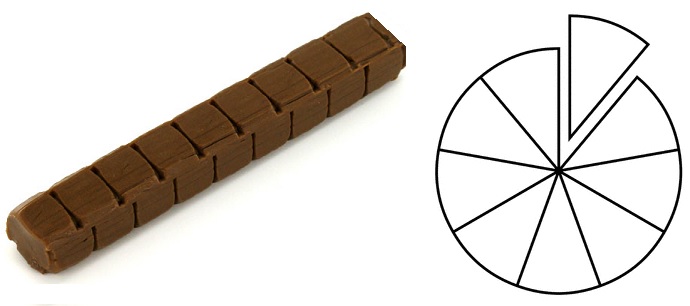
theodp writes "Following up on a WSJ story, data visualization author Stephen Few illustrates why using lines or bars may be sweeter than pie when it comes to teaching kids fractions. 'Although the metaphor is easy to grasp (the slices add up to an entire pie),' explains Few, 'we know that visual perception does a poor job of comparing the sizes of slices, which is essential for learning to compare fractions. Learning that one-fifth is larger than one-sixth, which is counter-intuitive in the beginning, becomes further complicated when the individual slices of two pies — one divided into five slices and other into six — look roughly the same. Might it make more sense to use two lines divided into sections instead, which are quite easy to compare when placed near one another?' So, is the Tootsie Roll the new pie?"
194 comments

  1. First question from the kids by Chrisq · · Score: 3, Insightful

    What the fuck is a tootsie roll?

    1. Re:First question from the kids by sortius_nod · · Score: 0

      While I know what one is, why are Americans commandeering reality? They can't even keep their government open, how the fuck are they supposed to keep maths consistent?

    2. Re:First question from the kids by tehlinux · · Score: 1

      That's why they'll need the *new* textbooks.

      --
      Most linux users don't know this, but the man pages were named after Chuck Norris. Chuck Norris fsck'ing hates noobs!
    3. Re:First question from the kids by Mitchell314 · · Score: 0

      And . . . what does politics have to do with comparing different methods of teaching math?

      --
      I read TFA and all I got was this lousy cookie
    4. Re: First question from the kids by StikyPad · · Score: 3, Insightful

      The smartest Americans know better than to go into politics, which leaves the politicians we have.

    5. Re:First question from the kids by Canazza · · Score: 2

      We've used to use Jaffa Cakes to teach phases of the moon in the UK.

      --
      It pays to be obvious, especially if you have a reputation for being subtle.
    6. Re:First question from the kids by Sockatume · · Score: 1

      Advice for submitters: avoid writing while hungry, snack foods might not be the universal and inviolable constant you assume them to be when your stomach is growling.

      Pies? Rolls? I'm heading into a mid-afternoon blood sugar crash here and Slashdot is not helping.

      --
      No kidding!!! What do you say at this point?
    7. Re:First question from the kids by dywolf · · Score: 1

      said no kid ever

      --
      The guy who said the election was rigged won the presidency with the second-most votes.
    8. Re: First question from the kids by Anonymous Coward · · Score: 0

      While a joke, it's kind of true: Americans have set up a government which is by-and-large expected to do nothing. At least nothing quickly or requiring decision-making skills. We have set up a nation of laws and as a result have a government of lawyers who are most adept at negotiating and constructing those laws. Everything else -- the business of actually _doing_ things -- is left up to petty bureaucrats and the private sector.

      A government shutdown would cripple many counties. In the U.S. it's slightly less of a hassle than a major power-outage.

    9. Re:First question from the kids by mcgrew · · Score: 4, Informative

      WTF, an AC links to the urban dictionary rather than Webster's or wikipedia, and gets modded informative? It's offtopic, racist, and sexist; we're talking about the candy, not ghetto slang for a black woman's nipples,

      No wonder slashdot is going for the new universally hated design, they're pandering to the army of idiots from 4chan and reddit who have invaded our beloved nerd site.

      For the GP, Pictures and description of a tootsie roll here. They don't export the things? Wait a minute...

      Tootsie Rolls have been introduced to Canada, Mexico, Ireland, Aruba, United Kingdom, Portugal, Spain, France, Italy, Indonesia, Philippines, South Korea, Panama, Netherlands, Germany, Poland, Denmark, Norway, Singapore, Sweden, Finland, Austria, Australia, and New Zealand.

      So how in the hell can someone not know what a tootsie roll is? How in the hell can someone not google for a piece of information that shouldn't have to be explained in a /. summary?

      I guess I should metamoderate...

    10. Re:First question from the kids by Anonymous Coward · · Score: 1

      Re: So how in the hell can someone not know what a tootsie roll is?
      I've lived in four of the listed countries and they aren't stocked in supermarkets. Nor is the name commonly known. My best guess is that they're only sold in import shops for expats.
      And to get back on topic: I think it's a terrible idea, because the various ‘slices’ of tootsie rolls aren't equal in the way the slices of a pie (approximately) are. It just confuses things.

    11. Re:First question from the kids by funwithBSD · · Score: 2

      Tootsie rolls look like a turd.

      --
      Never answer an anonymous letter. - Yogi Berra
    12. Re:First question from the kids by Anonymous Coward · · Score: 0

      How is this racist or sexist? "A woman's nipples, especially dark nipples"
      a term that applies to a woman does not automatically make it sexist. i can think of plenty of terms that apply only to woman that aren't sexist.
      also, it doesn't say anything about race anywhere.

      offtopic? yeah. i'm sure it was intended as a joke. calm down and get off your pedestal.

    13. Re:First question from the kids by Anonymous Coward · · Score: 0

      For what it's worth, I have lived most of my life in Australia, I have also lived for some years in two other countries in that list, and to top it off, I do love to treat myself to a variety of confectionary. And yet I have never seen or heard of a Tootsie roll. I have grave doubts about wikipedia's list of export destinations.

    14. Re:First question from the kids by Chrisq · · Score: 1

      We've used to use Jaffa Cakes to teach phases of the moon in the UK.

      I like the idea of that .... take bigger bites out until its gone!

    15. Re:First question from the kids by LordLucless · · Score: 1

      I'm with AC; I've only ever lived in Australia, but am fairly well-versed in variously waistline-expanding confection available here, and I've only ever heard of Tootsie Rolls from Americans.

      --
      Just because you're paranoid doesn't mean there isn't an invisible demon about to eat your face
    16. Re:First question from the kids by uninformedLuddite · · Score: 1

      >

      I guess I should metamoderate...

      I have found throwing half bricks at things makes me feel better

      --
      The new right fascists are bilingual. They speak English and Bullshit.
    17. Re: First question from the kids by cogeek · · Score: 1

      This government shutdown doesn't even put a blip on my radar screen. Much less hassle than even a 10 minute power outage. Turn the national parks over to the states, highway maintenance as well and seal the doors on the federal buildings. Good riddance!

    18. Re:First question from the kids by mcgrew · · Score: 1

      Yes, but it doesn't fix anything.

    19. Re:First question from the kids by nobodie · · Score: 1

      and they are disappearing in the US as well. To expect anyone in the world to know TRs is just.... well you are obviously old, like me, but also not really observant.
      Look, Halloween is coming up soon. We can end this debate then. Check in the grocery stores in the week before Halloween and see how many TRs are being sold. Then, case closed.

      --
      Subversion of spatial scale luxury decoration ideas.
  2. No by Anonymous Coward · · Score: 0

    They need to use both.

    1. Re:No by plover · · Score: 2

      The pre-segmented Tootsie Roll is actually a poor choice. A person who sees it already divided into seven chunks won't understand all those divisions have to move in order to divide it by eight.

      --
      John
    2. Re:No by Anonymous Coward · · Score: 0

      They need to use both.

      They need to use neither.
      Give 'em the good axiomatic definition of a fraction. And them later on give the examples with pies and tootsies.

    3. Re:No by Chrisq · · Score: 1

      They need to use both.

      I agree, some things like halving halves to make a quarter are easier to show in two dimensions.

    4. Re:No by fuzzyfuzzyfungus · · Score: 1

      They need to use neither. Give 'em the good axiomatic definition of a fraction. And them later on give the examples with pies and tootsies.

      Oh, you'll loath some of the bullshit that gets added to math curricula to pad out the vocab lists...

      Hey kids, because it's fucking pointless, we are going to be learning about 'proper fractions', 'improper fractions' and 'mixed numbers'! Open your copybooks now: "A proper fraction is a fraction where the numerator is smaller than the denominator. An improper fraction is a fraction where the numerator is larger than the denominator. A mixed number is a number written with a whole number component and a fractional component." All of these are basically just division problems that are being left unevaluated for reasons of convenience, or because the resulting decimal representation may not be entirely well behaved, so this shit is pointless; but it will be on the quiz.

    5. Re:No by Anonymous Coward · · Score: 0

      They need to use both.

      I agree, some things like halving halves to make a quarter are easier to show in two dimensions.

      And how do you visualize 1/3-1/5 or 1/3+1/5 with pies or tootsie rolls ? Either metaphor (pies or tootsie rolls) is fundamentally flawed in that it captures only 1 property of fractions (fraction of a whole) and that's it.

    6. Re:No by Mitchell314 · · Score: 4, Informative

      Uh, there *are* legit reasons for teaching the different classifications of fractions. For example, mixed fractions are the most intuitive representation of rational numbers. Improper fractions are the simplest way to write the number down, but not the most intuitive (for the given audience). Proper fractions are the remainder part of the mixed fraction, whereas the integers are taught in different lessons.

      Math is hard, and teaching math is hard. The 'intuitive' or 'obvious' way to teach math isn't necessarily a good way.

      --
      I read TFA and all I got was this lousy cookie
    7. Re:No by Anonymous Coward · · Score: 0

      They need to use neither.
      Give 'em the good axiomatic definition of a fraction. And them later on give the examples with pies and tootsies.

      Oh, you'll loath some of the bullshit that gets added to math curricula to pad out the vocab lists...

      Hey kids, because it's fucking pointless, we are going to be learning about 'proper fractions', 'improper fractions' and 'mixed numbers'! Open your copybooks now: "A proper fraction is a fraction where the numerator is smaller than the denominator. An improper fraction is a fraction where the numerator is larger than the denominator. A mixed number is a number written with a whole number component and a fractional component." All of these are basically just division problems that are being left unevaluated for reasons of convenience, or because the resulting decimal representation may not be entirely well behaved, so this shit is pointless; but it will be on the quiz.

      Well at least modern maths as it was teached in the 60s, 70s and 80s gave students the notion of how you construct and use mathematical objects. In their case natural numbers, integer numbers, fractions and decimal numbers. And progressing from one set to the other is made logically clear and unanmbiguous. Clarity of exposition and a rigurous theory (at their level obviously) is everything in maths. Today we have replaced clarity and rigour with hocus-pocus rules. No one is advocating with teaching university maths in kindergarten, middle school or high school. But what students learn nowadays in school is just a recipe of rules without any justification. They are simply not learning maths. And we are doing them a disservice.

    8. Re:No by colinrichardday · · Score: 0

      gave students the notion of how you construct and use mathematical objects.

      Do we construct mathematical objects? Did the number one not exist until I became aware of it?

    9. Re:No by Anonymous Coward · · Score: 0

      gave students the notion of how you construct and use mathematical objects.

      Do we construct mathematical objects? Did the number one not exist until I became aware of it?

      We can debate on wether the integer numbers are constructed or not. That is a metaphysical debate. But once we have agree on what natural numbers are, and what operations we can do on them we can construct rigourously the set of integer numbers, and set of rational numbers, as well as the set of real numbers and complex numbers.

      Try defining what the number one is, you'll have quite a difficult problem on your hands.
      You can say 1 bottle of wine, 1 car, one airplane, one universe, 1 planet etc... but that doesn't tell you what the number one is does it ?

    10. Re:No by Chrisq · · Score: 2

      They need to use both.

      I agree, some things like halving halves to make a quarter are easier to show in two dimensions.

      And how do you visualize 1/3-1/5 or 1/3+1/5 with pies or tootsie rolls ? Either metaphor (pies or tootsie rolls) is fundamentally flawed in that it captures only 1 property of fractions (fraction of a whole) and that's it.

      In UK schools they use Unifix blocks which are essentially the same as the "tootsie roll" examples. The way these would be used would be to make several columns of 15 blocks. One would be divided into three parts and the other into five. They could then easily illustrate adding 1/3 + 1/5 by adding one of the "three part division" to one of the "five part division". Counting would show that the answer was 8/15 and comparrison to the whole 15 parts would show that it is just over half.

      This would also illustrate why you have to get the fractions to have the same denominator. Subtraction is a bit harder - they would have to take away the 3 15ths from the 5 15ths but you get the idea

    11. Re:No by Anonymous Coward · · Score: 0

      The 'intuitive' or 'obvious' way to teach math isn't necessarily a good way.

      It is, in fact, the only good way to teach math. If kids don't have an intuitive and deep understanding of all the concepts, they don't truly understand it.

    12. Re:No by Archangel+Michael · · Score: 1

      Math is not hard. Teaching Math is not hard. Math is conceptual and until you get the concepts, actual math is just by rote, which is how math was taught to me.

      --
      Agent K: A *person* is smart. People are dumb, stupid, panicky animals, and you know it.
    13. Re:No by colinrichardday · · Score: 1

      we can construct rigourously the set of integer numbers, and set of rational numbers, as well as the set of real numbers and complex numbers.

      Perhaps we specify the rationals in terms of the rational numbers. Also, if we are now constructing the rational numbers, does that mean they didn't exist in Newton's time? Or if they did exist then, how do we construct them now?

    14. Re:No by Anonymous Coward · · Score: 0

      we can construct rigourously the set of integer numbers, and set of rational numbers, as well as the set of real numbers and complex numbers.

      Perhaps we specify the rationals in terms of the rational numbers. Also, if we are now constructing the rational numbers, does that mean they didn't exist in Newton's time? Or if they did exist then, how do we construct them now?

      You're mixing up intuitive concepts with rigourous mathematical concepts. The first can be useful in getting a glimpse of the later, but they can never be used as a mathematical justification of the later. In Newton's time they used infinitesimals. Hell the whole of calculus as invented by Leibniz and Newton used infinitesimals. And you know what ? Infinitesimals as a mathematical entity doesn't exist at least as elements of the real numbers. Only in the 1960s mathematicians designed a new number system where infinitesimals actually existed. This didn't stop the engineers in the XVIIIth, XIXth and XXth century from using calculus. But if you try to give a precise, rigourous mathematical interpretation of an integral then you have to forget about infinitesimals.

    15. Re:No by Mitchell314 · · Score: 1

      You're confusing "teaching math to be intuitive" with "the method that would be most obvious to teach".

      --
      I read TFA and all I got was this lousy cookie
    16. Re:No by mcgrew · · Score: 1

      Oh, you'll loath some of the bullshit that gets added to math curricula to pad out the vocab lists...

      Hey kids, because it's fucking pointless, we are going to be learning about 'proper fractions', 'improper fractions' and 'mixed numbers'!... All of these are basically just division problems that are being left unevaluated for reasons of convenience, or because the resulting decimal representation may not be entirely well behaved, so this shit is pointless; but it will be on the quiz.

      Getting added? I learned that in the third grade fifty years ago, it isn't something new that they're adding now. We learned fractions before learning division; it makes division much easier to learn if you understand breaking groups into fractions of a group first. Also, back then first you learned addition and subtraction, then fractions, then multiplication and dividion, THEN decimals.

      Oh, and you missed one.
      2/3 proper fraction
      3/2 improper fraction
      1 2/3 mixed number
      1 3/2 retarded number

    17. Re:No by colinrichardday · · Score: 1

      What do rational numbers have to do with infinitesimals? And I should have said that we might specify the rational numbers in terms of the natural numbers.

      While Leibniz used infinitesimals, Newton used nascent and evanescent quantities, which may have been one-sided limits.

    18. Re:No by Anonymous Coward · · Score: 0

      Are those imperial or metric fractions? I can never tell.

    19. Re:No by Anonymous Coward · · Score: 0

      Tau is stupid. It makes simple operations marginally easier, but it messes up some of the elegant results of calculus later on immensely. There is no net benefit to using tau instead of pi.

    20. Re:No by Jarik+C-Bol · · Score: 1

      there already is a teaching tool for this. Cuisenaire Rods. Its how I learned fractions, and an assortment of other mathematical principles

      --
      I've decided to Diversify my Holdings. I've divided my cash between my left and right pockets, instead of all in one.
  3. Start a classroom war by Anonymous Coward · · Score: 5, Insightful

    The pie chart is counter intuitive? Anyone who has ever fought over pizza slices knows very well that 1/5 is larger than 1/6, even kids.

    Here's a simple classroom script to teach kids about fractions:

    1) Buy 2 pizzas, slice one in 8 pieces, the other in 12 pieces.

    2) Take 20 students in the classroom and tell them to choose a piece from any of the pizzas.

    3) Watch as war ensues

    1. Re:Start a classroom war by Vanderhoth · · Score: 2

      You forgot step 4) Laugh manically

    2. Re:Start a classroom war by Anonymous Coward · · Score: 1

      If it's Italian pizza, there will probably be oil. Olive oil, to be exact.

    3. Re:Start a classroom war by SJHillman · · Score: 5, Funny

      Anyone who fought over pizza knows that not all 1/8ths are created equal.

    4. Re:Start a classroom war by Richy_T · · Score: 1

      I prefer chicago cut.

    5. Re:Start a classroom war by h4rr4r · · Score: 2

      Yeah, sometimes they weigh 3.5 grams, sometimes 3.7 or even 4.0.

    6. Re:Start a classroom war by ohieaux · · Score: 5, Funny

      When asked if he wanted his pizza cut into 4 or six slices: "You better cut the pizza in four pieces because I'm not hungry enough to eat six." - Yogi Berra

      --
      Where all think alike, no one thinks very much.
    7. Re:Start a classroom war by Hatta · · Score: 1

      There's another teaching opportunity. Using nothing more than a compass and straight edge, divide the pizza into equal portions.

      --
      Give me Classic Slashdot or give me death!
    8. Re:Start a classroom war by Anonymous Coward · · Score: 0

      Fought over pizza? I like pizza, but holy shit, it's not that important to me.

      What kind of a greedy world do you live in?

    9. Re:Start a classroom war by SleazyRidr · · Score: 1

      Man, you need to be less stingy with your toppings if a slice of pizza only weighs 4 grams...

    10. Re:Start a classroom war by sootman · · Score: 1, Funny

      A guy walks into a pizza shop at lunchtime and asks for a personal pizza. The shop is new and wants to make people happy so the guy behind the counter asks "Do you want us to cut that into 4 slices or 6?" The customer thinks for a second and says "Better make it four. I'm not sure I could eat six."

      --
      Dear Slashdot: next time you want to mess with the site, add a rich-text editor for comments.
    11. Re:Start a classroom war by Anonymous Coward · · Score: 0

      : "You better cut the pizza in four pieces because I'm not hungry enough to eat six." - Yogi Berra

      "I never said half the things I really said." -- Yogi Berra

    12. Re:Start a classroom war by Anonymous Coward · · Score: 0

      You mean cut the pizza with a .38?

    13. Re:Start a classroom war by radarskiy · · Score: 1

      It represents a one-dimensional value with a two-dimensional symbol.

      You make the baby Edward Tufte cry.

    14. Re:Start a classroom war by Anonymous Coward · · Score: 0

      *ahem*, they are talking about drug dealing "eighths".

    15. Re:Start a classroom war by SleazyRidr · · Score: 1

      I'm used to having techno-words sail over my head here, but when did /. become a drug den?

    16. Re:Start a classroom war by Anonymous Coward · · Score: 0

      Every moderately funny statement was not necessarily spoken by Yogi Berra.
      --Anonymous Coward

    17. Re:Start a classroom war by Anonymous Coward · · Score: 0

      Sadly? the physiological effects of having fewer remaining pieces to eat and the expectation to finish eat what you started eating makes the parent valid. Some subset of people who can eat a pizza cut into four pieces can't eat the same pizza cut into six pieces.

      Companies use the effect to get you to super size your order. You can use the effect to improve your diet.

    18. Re:Start a classroom war by Anonymous Coward · · Score: 0

      I think there's an upper limit on this. We have pizza places around here that cut into bite-sized squares -- literally around 100 pieces. Most of the people I know can eat an entire pizza which, anecdotally, is because they have a "it's just one more bite" attitude towards taking another piece.

    19. Re:Start a classroom war by Richy_T · · Score: 1

      I cut it with a piano wire then embed it in concrete and throw it in the river.

      I may be doing something wrong.

  4. Who cares? by Russ1642 · · Score: 2

    So one method is probably a small fraction better than another method of teaching fractions. This isn't how you enhance the next generation's education. This is how you make it look like you're doing something to help when you're actually just raising a fuss over the tiniest of things. This is the plastic banana slicer of education: an answer to a question nobody asked.

    1. Re:Who cares? by SJHillman · · Score: 1

      My teachers preferred to use real-world examples, which seemed to help. Cutting a pizza into 8ths or 10ths (who the hell cuts it into fifths?). Doubling or halving chocolate chip cookie recipes (1/3 cup sugar doubled is 2/3 cup. 1/2tsp vanilla halved is 1/4tsp). Sports statistics, word problems, supermarket packaging, etc. It was all better than some arbitrary pie chart that carried no meaning beyond "this slice is bigger than that slice".

    2. Re:Who cares? by AHuxley · · Score: 1

      Recall the damage done to education in Alabama, Mississippi and South Carolina by the General Education Board after the War of Northern Aggression?
      English, math and science best left for college preparatory classes.

      --
      Domestic spying is now "Benign Information Gathering"
    3. Re:Who cares? by Anonymous Coward · · Score: 0

      So one method is probably a small fraction better than another method of teaching fractions.

      How are you calculating that? Using the tootsie roll method, or the pie method?

      This isn't how you enhance the next generation's education. This is how you make it look like you're doing something to help when you're actually just raising a fuss over the tiniest of things. This is the plastic banana slicer of education: an answer to a question nobody asked.

      I've never actually heard anyone ask for a better mouse trap, either. That doesn't mean we shouldn't pursue better designs, does it?

    4. Re:Who cares? by b4upoo · · Score: 1

      I suspect that a child dull enough not to be able to judge the size of a piece of pie is unfit for education anyway. Just being in a classroom with normal kids should indicate some level of intellectual function. Part of the ruin of our schools is an effort to educate the ineducable children. That hole is so deep that it will not be filled. The best path might be to get them out of the schools by sixth grade and put them into a menial work situation such as picking oranges or washing dishes. These unfortuante American kids do get displaced by illegal immigrant labor.

    5. Re:Who cares? by Quirkz · · Score: 1

      In a college differential equations class we got questions such as:

      * There's a party and people are spiking the originally nonalcoholic punch at a rate of X, while drinking at a rate of Y. How long until everyone is drunk, assuming Z for the amount of alcohol needing to be consumed to be drunk.

      * Kryptonite with a radioactive field described with [equation] is placed near Superman. Which way should he fly to get away fastest?

      Silly little things like that made it fun. Of course I had to get through 14 or 15 years of math before getting to those fun questions, but still.

  5. Something weird just happened ... by MacTO · · Score: 4, Insightful

    ... and somebody read a school textbook.

    Seriously. Textbooks have used multiple representations of fractions for years, one of which is linear, because the education research has indicated that different children learn better with different representations of fractions.

    Well, at least we now know how long it takes for education research to trickle into the classroom: decades.

    1. Re:Something weird just happened ... by Sarten-X · · Score: 3, Interesting

      Teachers also use word problems, discrete objects, and liquids, ideally delivered in quick enough succession that the student's brain catches the only constant: the concept of a fraction.

      I think the problem isn't education research getting into the classroom - it's exactly the opposite. Teaching is an application-focused industry. When a teacher solves a particular educational problem, the technique stays within the school district, or perhaps makes a few rounds at educational conferences. The technique rarely gets any widespread attention, hardly any formal study, and is entirely forgotten within the decade... until an "educational researcher" stumbles across it and publishes a paper describing its effectiveness, which doesn't help because the school boards aren't interested in using new experimental techniques when their budgets are already in such jeopardy.

      There is no Nobel Prize for education.

      --
      You do not have a moral or legal right to do absolutely anything you want.
    2. Re:Something weird just happened ... by fuzzyfuzzyfungus · · Score: 1

      ... and somebody read a school textbook.

      Seriously. Textbooks have used multiple representations of fractions for years, one of which is linear, because the education research has indicated that different children learn better with different representations of fractions.

      Well, at least we now know how long it takes for education research to trickle into the classroom: decades.

      It's important to remember that (assuming qualified faculty, an assumption that is...widely variable... in its truth; but is definitely nonfalse in better systems and some parts of worse ones) educational research can make it into a classroom from the top or from the bottom:

      Your top-down approach (curriculum design followed by mandate, textbooks 'aligned' with that curriculum) is nominally research based; but ponderous as hell and perpetually mired in comittee and trying to appease the wackjobs in Texas and the wackjobs in California at the same time. It's primary virtue is that, sooner or later, their work trickles down to even the most burned-out and ossified classrooms; because the faculty and local admin have no choice. On the other hand, faculty enjoy some freedom to teach as their training and experience deems best, and the ones with recent educational education and/or professional development are probably familiar with the research. This happens a great deal faster, especially in situations with new teachers or districts that do a good job of encouraging faculty not to ossify. However, it can take unbounded amounts of time to have any effect in situations with lousy faculty and local administration.

    3. Re:Something weird just happened ... by Anonymous Coward · · Score: 0

      ... and somebody read a school textbook.

      Seriously. Textbooks have used multiple representations of fractions for years, one of which is linear, because the education research has indicated that different children learn better with different representations of fractions.

      Well, at least we now know how long it takes for education research to trickle into the classroom: decades.

      Hah? So textbooks have been using it for years, but somehow these are not the same textbooks that are used in the classroom?

    4. Re:Something weird just happened ... by FalcDot · · Score: 1

      Technically, every Nobel Prize also rewards all the winner's teachers...

    5. Re:Something weird just happened ... by phantomfive · · Score: 1

      It's a horrible explanation of the article. Researchers found that "a child's knowledge of fractions in fifth grade predicts performance in high-school math classes, even after controlling for IQ." That's a really big result.

      So now a lot of research is being done into, "how can we teach kids fractions in a way that they understand them?" The first link explains a lot of the different things people have tried. The second link is a blog with (big surprise) wild speculation.

      Guess which link ended up in the summary? But the real story is how important fractions are in a child's math development, and how much effort scientists are putting into improving teaching.

      --
      "First they came for the slanderers and i said nothing."
  6. Pffft, Fractions? How about Frogs AND Fractions? by AdamStarks · · Score: 1

    http://twinbeard.com/frog-fractions

    Frog Fractions taught me enough fractions to pass my GED!

    Thanks, Frog Fractions :-D

  7. No, Not At All. by Anonymous Coward · · Score: 0

    This is a solution looking for a problem. But, more so, this solution makes the problem much worse. The pictured Tootsie roll, appears to be a square turd, with lines all over it. Though the lines don't align both sets of divisions indicate the same number of segments. It makes no sense to me, with regards to fractions, and I'd like to think that after mastering probability and statistics that I have a reasonable grasp on fractions.

    What is the tootsie roll supposed to represent? The pie in the same picture clearly indicates a single slice out of nine.

    1. Re:No, Not At All. by SJHillman · · Score: 1

      I think a Hershey's bar would be a better choice if they want something that's already marked up. At least then you can break it into halves, quarters, eighths, etc (depending on which size bar you buy). Or just just a regular, unmarked tootsie roll, a ruler and something sharp enough to cut it.

    2. Re:No, Not At All. by Bob+the+Super+Hamste · · Score: 1

      and something sharp enough to cut it.

      I don't think the school board would approve of the use of a thermal lance or diamond coated masonry saw in an elementary school classroom.

      --
      Time to offend someone
  8. Length vs volume. by PlusFiveTroll · · Score: 2

    The comments on the site (as of this time) give some pretty good reasons why using slices of a circle aren't the best way to describe fractions. Most of the time it is easier for the mind to tell if two lengths are the same versus if two slices of a circle are the same. It is a much simpler calculation to determine length (line) then volume (pie piece).

    1. Re:Length vs volume. by Anonymous Coward · · Score: 0

      If you're calculating volumes of pie pieces then you're doing it all wrong. You only need to look at the chord length of the arc of the pie slice, it's a simple linear length.

    2. Re:Length vs volume. by Arker · · Score: 1

      Which is simply more reason why students need practice doing the more difficult calculation early.

      This whole notion that everything in education needs to be watered down and simplified for ease of digestion simply cheats the children - who tend to be quite a bit smarter than we think, when given a chance.

      --
      =-=-=-=-=-=-=-=-=-=-=-=-=-=-
      Friends don't let friends enable ecmascript.
    3. Re:Length vs volume. by Anonymous Coward · · Score: 0

      The comments on the site (as of this time) give some pretty good reasons why using slices of a circle aren't the best way to describe fractions. Most of the time it is easier for the mind to tell if two lengths are the same versus if two slices of a circle are the same. It is a much simpler calculation to determine length (line) then volume (pie piece).

      There is not such a thing as the "best way to describe fractions". Which is why for the last hundred years, teachers and textbooks have used a variety of different representations, I'm not sure where this guy has been hiding.

      As for what is "easier" to tell apart, if the kids are having trouble making the distinction between 8/10 and 9/10 then the problem is not so much HOW you represent it visually, but rather that the difference is getting small enough that some representations aren't visually different enough. So.... increase the difference. Quit comparing 4/5 to 3/5, and compare 1/2 to 1/4. Pretty easy and obvious to spot the size difference on the pie graph.
      But as a counter-point to his love for bar graphs- they don't reinforce the idea that the divisions are part of a whole, whereas a pie chart does.

    4. Re:Length vs volume. by cryptizard · · Score: 1

      Oh man because 3rd graders are going to love all those word you just said. They're for sure understand that right away because you are the best educational mind of our generation.

    5. Re:Length vs volume. by Anonymous Coward · · Score: 0

      If you are using volume in the pie chart, you are doing it wrong, you use the inner angle.

    6. Re:Length vs volume. by AdamHaun · · Score: 1

      They shouldn't be (and probably aren't) using numbers that are very close together to teach the concept. Instead of using 1/5 and 1/6, use 1/2 and 1/3, or 1/3 and 1/8. If the perception of length vs. area/angle matters, it's a bad choice of numbers.

      --
      Visit the
    7. Re:Length vs volume. by Anonymous Coward · · Score: 0

      I don't quite understand why you would want to present a linear length wrapped around in a circle. If you are not going use the simplest form (the line), why not use a hexagon instead? Or a star shape? Actually, it's children, so let's make the charts animal shaped instead. Although I do like your n-sided polygon approach (the chords make a polygon).

      The problem with presenting linear values with two dimensional shapes is that there are so many ways to interpret it. The angle or equivalently the arc length gives one way to measure linear values, and the area is another way. Using the chord length (the third way) is especially nice, as changing one value requires changing all the other values in a non-trivial manner. None of these three approaches give the same fractions except in special cases.

    8. Re:Length vs volume. by Anonymous Coward · · Score: 0

      My 4 year old preschooler got it.

      Maybe I let him play too much DragonBox.

    9. Re:Length vs volume. by colinrichardday · · Score: 1

      That article doesn't even mention slices. Also, we can use stackable slices and have the students put one on top of the other.

    10. Re:Length vs volume. by Anonymous Coward · · Score: 0

      The comments on the site (as of this time) give some pretty good reasons why using slices of a circle aren't the best way to describe fractions. Most of the time it is easier for the mind to tell if two lengths are the same versus if two slices of a circle are the same. It is a much simpler calculation to determine length (line) then volume (pie piece).

      The awesome thing about statements like yours is that nobody can disagree, because obviously, in your world, everybody thinks exactly alike.

      I also must applaud your statistical analysis. It's fun to pull statistics out of your ass, isn't it? I am a little curious, though as to what constitutes "most of the time". Is it 50.0000000000000000000000000000000000000000000001% of the time, or plus or minus .0000000000000000000000000000000000000000000001%? Or is it closer to 50.0000000000000000000000000000000000000000000002%?

    11. Re:Length vs volume. by CastrTroy · · Score: 1

      Actually, it's length vs. area. If you wanted to start talking volume, you'd have to start cutting up 3D shapes, like cubes and spheres. That would be even more complicated. If you're dealing with cubes or other 3 dimensional shapes, there's quite a few ways to split it in half. using lines to demonstrate fractions, at least when introducing them could help out. But after they have the basic idea of fractions, it's important that the student move on to fractions of more complex things.

      --

      Anthropic principle: We see the universe the way it is because if it were different we would not be here to see it.
    12. Re:Length vs volume. by Anonymous Coward · · Score: 0

      But nobody uses pie charts besides terrible executives and morons.

      And nobody cares about correct pie or pizza slices either.

      So why even bother with these archaic things? Because some Math teacher has a turbo hardon for them? Hell no.

    13. Re:Length vs volume. by Arker · · Score: 1

      Because they continue to be effective ways to teach difficult concepts like fractional volume, which can be very important for people in many fields later in life. Fractional volume, btw, as opposed to fractional length (the subject of the thread) is certainly a concept with application throughout modern society, from the industrial to the financial and the social.

      --
      =-=-=-=-=-=-=-=-=-=-=-=-=-=-
      Friends don't let friends enable ecmascript.
    14. Re:Length vs volume. by radarskiy · · Score: 2

      "You only need to look at the chord length of the arc of the pie slice, it's a simple linear length"

      Because obviously 1/3 is larger than 3/4.

  9. Break me off a piece by Anonymous Coward · · Score: 0

    of that Kit Kat Bar.

  10. No way by operagost · · Score: 1, Funny

    Hasn't Michelle Obama already banned pies and Tootsie Rolls?

    --

    Gamingmuseum.com: Give your 3D accelerator a rest.
    1. Re:No way by i+kan+reed · · Score: 1

      You know how much kids like to rebel against authority figures. It's all a secret plot to teach kids fractions.

  11. No wonder kids are getting fat these days by Anonymous Coward · · Score: 0

    The new curriculum has math teachers slicing lemon merengue pie in class instead of teaching fractions.

  12. Hershey bars would also work well by RobertLTux · · Score: 1

    any candy bar that has natural sections would work for fractions

    Kit Kats would work for 2 and 4 based fractions

    --
    Any person using FTFY or editing my postings agrees to a US$50.00 charge
    1. Re:Hershey bars would also work well by dywolf · · Score: 1

      we actually did use hershey bars. the ones with the 3x5 (?) breakable grid layout.

      --
      The guy who said the election was rigged won the presidency with the second-most votes.
  13. Only denominators with 9 by Anonymous Coward · · Score: 4, Funny

    There's 9 sections. What happens when you want to teach 1/4s, 1/2s, 16ths ?

    That's why I think a bottle of Scotch is the new pie!

    Now children, let me drink two shots, what fraction of the bottle did I just drink?

    Now children, assume what's left is the whole and I drink another three shots, what fraction is left?

    Now children, write a 1,000 word essay on why whiskey is the best math tutor whle I take a little snap.

  14. A New Product Line by archer,+the · · Score: 1

    Now Tootsie can sell a bunch of new lengths: halves, thirds, quarters, fifths, sixths, etc. Schools would just need to go out and buy a few bags.

    For adults learning fractions, they could use alcohol instead, but they'd just have one fraction: fifths.

  15. Use a single bar by Anonymous Coward · · Score: 0

    Between the numerator and the denominator.

  16. Re:Pffft, Fractions? How about Frogs AND Fractions by i+kan+reed · · Score: 1

    And it helped me get my insect porn business off the ground, and won me elected office!

  17. Why teach fractions to kids in the first place? by Anonymous Coward · · Score: 1

    Students will need to learn about fraction, true...

    However, there is little to no need for fraction in the real world, with one exception. The US. Due to the antiquated mesurement system, you have to know fractions, else you are doomed...

    However, in the rest of the world, fraction do not have a lot of use and their teaching can be pushed later in the cursus when we this learning is easier and has less need to rely on visualisation...

    Cyrille

    1. Re:Why teach fractions to kids in the first place? by Anonymous Coward · · Score: 0

      dude what?

    2. Re:Why teach fractions to kids in the first place? by SJHillman · · Score: 1

      Fractions are still useful in the metric system, granted, with more limited application. Halves and quarters are fine, but what about when you need to divide a whole between seven people? Each person can get 1/7 or each person can have 0.142857142857... even rounded to only .14 that's kind of hard to figure out compared to 1/7.

      Metric and decimal is great for science, but fractions still have their place in everyday life.

    3. Re:Why teach fractions to kids in the first place? by pla · · Score: 2

      However, there is little to no need for fraction in the real world

      Let me guess, you find the the Big Mac button confusingly similar to the Quarter Pounder button.

      Hint: One has 2/3rds of the number of buns of the other one. One bun, two buns, red bun, blue bun!

    4. Re:Why teach fractions to kids in the first place? by Hatta · · Score: 1

      Yes, because .08333333333333333333333333... is so much more intuitive than 1/12.

      --
      Give me Classic Slashdot or give me death!
    5. Re:Why teach fractions to kids in the first place? by Anonymous Coward · · Score: 0

      Then don't use Decimal.
      Fractions in some other bases (e.g. base-12) are typically easier.

    6. Re:Why teach fractions to kids in the first place? by oh2 · · Score: 1
      Not true.

      Fractions are important for later mathematics and for understanding things like percentages, decimal notation, scale, parts of the whole, ratios, I could go on. Early work in fractions helps foster a better way for kids to think about mathematics. We use few fractional measurements in Sweden, but its still an important mathematical concept. Also, using graphical representations of fractions frequently leads to misunderstandings or fixations on fractions being just pieces of a pie. When you actually try to do math beyone adding up to one whole pie, bar, octagon or whatever a lot of students hit a brick wall unless you have worked with multiple representations and thinking about fractions as numbers, not pieces of a given whole.

      --

      Now the world has gone to bed, Darkness won't engulf my head, I can see by infra-red, How I hate the night.

  18. Re:Pffft, Fractions? How about Frogs AND Fractions by tepples · · Score: 0

    How would one go about converting a Flash game like this to HTML5?

  19. Inevitable by Impy+the+Impiuos+Imp · · Score: 1

    (slam!)
    "Mom! Mom!!! Mr. Johnson tried to get me to touch his Tootsie Roll! He told me I just hadda touch the last third of it!"

    --
    (-1: Post disagrees with my already-settled worldview) is not a valid mod option.
  20. Hershey Bars Are Better by dmiller1984 · · Score: 1

    It's much easier to get the concept of a whole with an entire Hershey bar than with an arbitrary number of Tootsie Rolls.

    1. Re:Hershey Bars Are Better by SJHillman · · Score: 1

      When we first started fractions and division (third grade or so?), we used groups of discrete units rather than cutting up a single unit. If you have ten pennies and you eat half, how many do you have left? If you have 14 pennies and you throw 1/7th of them at Johnny, how many did you throw? Most kids are still smart enough to see a group of individual objects as a "whole".

    2. Re:Hershey Bars Are Better by colinrichardday · · Score: 1

      If you have ten pennies and you eat half,

      Eating pennies? Shouldn't schools be discouraging that?

  21. Use both by Anonymous Coward · · Score: 0

    If you're only going to use lines (and not pies) just use a damn tape measure. Seriously. I still have trouble reading a tape measure. I'm awesome at reading pie-charts though! Maybe if I were taught fractions with a tape measure I wouldn't have so much trouble with it now.

  22. Who eats a Tootsie Roll in equal fractions? by Anonymous Coward · · Score: 0

    If you want a divisible bar, the best food for dividing into fractions is sushi rolls.

  23. Stephen Few Loves his Bar charts by ZahrGnosis · · Score: 2

    I completely Agree... I've actually had a few public disagreements with Stephen Few (on his blog - Hi Stephen) about his love of bar charts.

    He's absolutely right, technically, on the visual perception -- that it's easier to compare lengths to basically anything else (like pie slices), particularly shapes that vary in more than one dimension (is a 5x5 rectangle bigger than a 6x4? If you know the dimensions you can do the math, but if you look at the boxes it's not as easy).

    BUT, where I disagree (and I seem to agree with parent AC) is that people get tired of bar charts. Kids, in particular, have amazingly short attention spans, and as any teacher knows, engaging a child in a learning experience is very important, and different students will learn different ways. Your example of buying pizzas for a class is a classic example (although war is not the standard goal). Cutting a long subway sandwich or tootsie roll may not have the same effect. In fact, it's possible that the measurements Stephen Few relies on to measure visual perception could change if we took the time early on not to cater only to what our students are already good at, but to exercise spatial considerations that could improve.

    Pie charts have their place, if only to break up the monotony. Certainly we should teach kids ratios based on bars, lines, squares, and other things as well -- for the most part we already do -- but we should not say that any one way is the best, even if there's one measurement that "proves" it, at the expense of variety.

  24. Thank you for the idea by advid.net · · Score: 1

    From now I'll try this way to teach fractions, let see that this evening on a 9yo.
    (a child who doesn't understand why a fraction is smaller with higher numbers)

  25. Here's a thought.... (or 2 or 3) by cogeek · · Score: 2

    Math was taught and learned just fine for over 2000 years. Pretty damn arrogant to come along in the last 50 and think we know how to teach children math in a better manner than they've learned math all along. Pick your slogan, acronym, whatever. KISS (Keep It Simple Stupid), If it ain't broke, don't fix it... Nothing wrong with the way math has been taught all along. I have 4 kids that have all gone through Algebra in the last few years, and I had to go out and buy them Lego sets to learn Algebra. A true WTF moment for me. We didn't get Legos in school and still learned Algebra just fine. When they learned addition, subtraction, multiplication and division I'd help them with their homework only to hear "that's not how we do it" "our teacher taught us a different way" and we'd wind up taking 15 steps to solve a problem that should be done in 2 or 3. When people get paid to come up with "new and better" ways to do things, they have to come up with something or wind up losing that steady government paycheck. Doesn't matter that it's a worse solution than what's already in place, just that it's different.

    1. Re:Here's a thought.... (or 2 or 3) by SJHillman · · Score: 1

      People were fine cooking with fire for X thousand years just fine, pretty damned arrogant for them to invent the microwave.

      Just because "that's the way it's always been done" doesn't mean it's the most efficient/effective/bestest way. Sure, it doesn't mean the old way isn't better for some people, but it's even more arrogant to assume the new way isn't better without trying it first, especially based on some anecdotal evidence.

      Also, I highly doubt that math was taught the same way across any or every culture over the course of 2000 years.

    2. Re:Here's a thought.... (or 2 or 3) by cryptizard · · Score: 1

      You are so right. Who needs newfangled things like cars and cell phones. People got around just fine in biblical times I say. For that matter, who needs vaccines or medicine? Living past 30 is overrated.

    3. Re:Here's a thought.... (or 2 or 3) by cogeek · · Score: 1

      Yes, and the vast improvement in the public school system over the last 50 years certainly proves their "new way" of doing things to be so much better than the old way. American education is in a steep decline, because we've stopped teaching the basics and tried to come up with a "one-size fits all" approach. It won't work, every child is different and there are some kids that will just never get it now matter how far we dumb things down. One of the biggest causes of this is the recent belief that every kid needs to go to college. Sorry, some kids have to go to Vo-Tech and learn to fix cars, some kids have to go to beauty school and be hair stylists, and some have to get their BA's so they can ask me if I want fries with that.

    4. Re:Here's a thought.... (or 2 or 3) by cogeek · · Score: 2

      Not saying there's never room for improvement, I'm saying there's no need to fix what already works and has worked well for centuries. The constant plea from the teacher's unions is that we just need to spend more money per student when we already spend more money per student than any other civilized nation and still graduate kids that can't read and write at an elementary school grade level. One room school houses with a single teacher for all grades used to be able to teach the basics, no reason they shouldn't be able to now with the resources available.

    5. Re:Here's a thought.... (or 2 or 3) by cryptizard · · Score: 1

      Except people from back then would be legally retarded now (i.e. the Flynn Effect). Students are expected to learn more, quicker than ever before. As you say, we are spending more money per student than anyone and it just isn't working. I would actually say that teaching methods haven't changed that much in the past hundred years. Maybe the answer is to get kind of extreme and start from scratch.

    6. Re:Here's a thought.... (or 2 or 3) by ohieaux · · Score: 2, Insightful

      Just last night I was helping my elementary age son study for a test on fractions and percents. We went through all concepts and he was still not getting it. Finally, he drew a line and started segmenting it. The teacher had shown the class "another way" to conceptualize this topic. He completely understood this approach. He then told me that his teacher told them about learning styles and tried to present the topic in multiple ways. So, while it seemed simple from one perspective to most of the class, others needed a different conceptualization.

      I see no problem with exploring different approaches to learning. And, finding a better visualization for those types of learners is more than appropriate.

      --
      Where all think alike, no one thinks very much.
    7. Re:Here's a thought.... (or 2 or 3) by cogeek · · Score: 1

      I agree, nothing wrong with teaching "some students" a different way of doing it. But when the teacher's throw out a tried and true way of doing something to benefit the few, thus causing it to be more complex and difficult for the many, that's a problem. It's unfortunate that your son struggles with a method of learning that works for most other people, but that's no reason for people to advocate tossing out the entire system and starting from scratch. There will always be some people that don't get it no matter what method is used or taught.

    8. Re:Here's a thought.... (or 2 or 3) by AlphaWoIf_HK · · Score: 1

      Math was taught and learned just fine for over 2000 years.

      It wasn't. Rote memorization is not ideal, and I do not consider it "just fine." Our entire education system is pretty much broken.

      --
      Da derp dee derp da teedly derpee derpee dum. Rated PG-13.
    9. Re:Here's a thought.... (or 2 or 3) by AlphaWoIf_HK · · Score: 1

      Students are expected to learn more, quicker than ever before.

      People expect them to learn more, but in practice, they just memorize more and then later forget it all.

      As you say, we are spending more money per student than anyone and it just isn't working.

      Change is difficult and expensive, so why fix something that is completely broken?

      --
      Da derp dee derp da teedly derpee derpee dum. Rated PG-13.
    10. Re:Here's a thought.... (or 2 or 3) by cogeek · · Score: 2

      Rote memorization is the only way to learn the fundamentals, addition, subtraction, multiplication, division, but those aren't taught any more. No kids are required to memorize math tables unless it's done by a parent. More complex ideas require teaching a kid how to think, but if they're busy counting on their fingers to subtract 7 from 13, more complex problems will never sink in.

    11. Re:Here's a thought.... (or 2 or 3) by Anonymous Coward · · Score: 0

      Rote memorization is the only way to learn the fundamentals, addition, subtraction, multiplication, division, but those aren't taught any more. No kids are required to memorize math tables unless it's done by a parent. More complex ideas require teaching a kid how to think, but if they're busy counting on their fingers to subtract 7 from 13, more complex problems will never sink in.

      Suffer a little, but have the fundamentals right for the rest of your life.
      If I had mods point I'd give you +20

    12. Re:Here's a thought.... (or 2 or 3) by cryptizard · · Score: 1

      You are so right, this is where we should apply that old American motto: "sounds hard, lets just give up."

    13. Re:Here's a thought.... (or 2 or 3) by AlphaWoIf_HK · · Score: 1

      Rote memorization is the only way to learn the fundamentals, addition, subtraction, multiplication, division, but those aren't taught any more.

      An understanding of the concepts is much better; otherwise, they might as well just use calculators, which are much faster, since that's what you seem to care about.

      but if they're busy counting on their fingers to subtract 7 from 13, more complex problems will never sink in.

      That is completely false. As long as they're capable of performing such basic operations one way or another, the fact that they can't subtract numbers as quickly as some would like does not mean they're not capable of understanding the problems. Do you know what we have right now? A system that encourages rote memorization. A system where understanding is not required or valued. A system that produces products who do not understand any of the material they memorized en masse.

      No kids are required to memorize math tables unless it's done by a parent.

      Try telling that to my brother's child.

      --
      Da derp dee derp da teedly derpee derpee dum. Rated PG-13.
    14. Re:Here's a thought.... (or 2 or 3) by Vaphell · · Score: 1

      No, they are not expected to learn more, at least not when you compare curriculum to the one that was there 20-30 years ago. In recent years there was plenty of cuts justified by 'nobody deals with it in real life' and 'we have calculators for that' and other nonsense. Most 20year olds today are clueless and borderline retarded. FFS, illustrated cash registers had to be invented because your average teen after a decade spent in school can't handle basic arithmetic, doesn't grasp the concept behind paying $10.12 for $7.62 worth of groceries and has to have pictures of coins.

    15. Re:Here's a thought.... (or 2 or 3) by ohieaux · · Score: 1

      That's the point. They didn't throw out the old method (at least not locally). At the end of the module, the teacher took some time to go over a different approach. He explained learning styles and then showed the different approach. For the 3 or 4 students who didn't get it, the new approach helped. For the others, they either reinforced their understanding or likely goofed off.

      That is what we should be doing in primary education. We lose opportunity when we teach to 80% of the class. A simple addition of 10 minutes at the end of a module helped most of the remaining 20%.

      The kicker is that this teacher has been quite vocal about how student performance is now linked to his compensation. He has told this to the students on more than one occasion. Would he have gone to the extra effort in the past? I prefer not to speculate.

      --
      Where all think alike, no one thinks very much.
  26. Use Democrat logic... by AmazinglySmooth · · Score: 1, Funny

    If we divide people into identity groups, you can truly understand how to put certain groups together! 50% white 50% female ...

    1. Re:Use Democrat logic... by cogeek · · Score: 1

      Don't think I've ever seen a better example of the English word "oxymoron" than "Democrat logic"....

  27. One and Done by Anonymous Coward · · Score: 0

    posting AC as I'm away at friends....

    Ok; Take a 1/3 pie slice. Enlarge it by 50%. It is still a 1/3 pie slice, in value and visually.

    Now; Take a 1/3 line slice. Enlarge it by 50%. It is no longer a 1/3 line slice in visual, but still in value.

    Pie pieces include both the value and the master unit in their visual.

    And finally, it's a good precursor to learning about degrees and radians.

    1. Re:One and Done by SJHillman · · Score: 1

      That 1/3 pie slice is no longer 1/3 of the pie in value if you only enlarge the slice and not the rest of the pie. Sure, it's still 1/3 of a circle, but it's no longer 1/3 of the pie it was originally from. That's only good for teaching fractions of a circle, which really doesn't come up all that often until you're way past the point of learning basic fractions. The whole idea is to compare the fraction to the whole (or other parts of the whole), and if you're enlarging just one part of it, then you're throwing everybody off for no good reason.

    2. Re:One and Done by colinrichardday · · Score: 1

      Perhaps GP meant to increase the radius by 50% while leaving the central angle the same.

    3. Re:One and Done by Minwee · · Score: 1

      Ok; Take a 1/3 pie slice. Enlarge it by 50%. It is still a 1/3 pie slice, in value and visually.

      Okay, I'll bite. Take that 1/3 pie slice and move it from the front of the pie to the back. Is it still a 1/3 pie slice visually?

      Now draw two Tootsie Rolls, one twice as long as the other. Does that accurately represent the values of each roll, or is the longer one one big Twinkie?

      Learning to use tools lie pie charts and bar graphs is just as important to students as reading their first copy of How to Lie With Statistics.

  28. Re:Pffft, Fractions? How about Frogs AND Fractions by pla · · Score: 1

    How would one go about converting a Flash game like this to HTML5?

    First, you learn HTML2 (or 3, or 4, doesn't much matter). Then you learn CSS. Then, you learn Javascript. Then, you learn HTML5. Then, you learn Flash. Then, you learn ActionScript. And finally - You break into TwinBeard HQ, steal the source code to Frog Fractions, and begin the long process of porting it.

    After all that, though, you probably already have a pretty good grasp of fractions.

  29. The latest episode by sharknado · · Score: 2

    This is just the latest episode in Stephen Few's war on pie charts. For anyone interested: http://www.perceptualedge.com/blog/?p=1492 http://www.perceptualedge.com/articles/08-21-07.pdf

    1. Re:The latest episode by Hatta · · Score: 1

      I think he discounts the value of the implied 0-100% scale in a pie chart. If I have a bar graph, with 3 bars 60%, 20%, and 10%, even if there's a scale on the graph it's not immediately obvious that we're missing 10%. With a pie chart, it is impossible to miss that missing 10%. There's value in that.

      Pie charts are overused, as are bar charts (box plots are usually better), but they have their place. Their place is representing proportions of a whole, and that's it.

      --
      Give me Classic Slashdot or give me death!
    2. Re:The latest episode by sharknado · · Score: 1

      Well, box plots and bar charts have very different purposes...box plots are used to show distribution statistics, whereas bars are for comparing individual values. 100% agree on the pie charts though - in fact, the percent completion property of pie charts is perhaps the only thing that makes them useful. Imagine a scorecard with many rows of data, that uses a partly completed pie to represent a percentage value (e.g. half a pie = 50%, three quarters of a pie = 75%). Now, sort the data by the pie column, so the pie grows/shrinks as your eyes move up and down the scorecard. It's a very quick and useful visual representation because it provides a vertical reference for finding values near a certain percentage value. The cognitive delay that you normally experience with pie charts (of converting a slice to a percentage value) is irrelevant because the sorting makes it so that you only have to do this conversion once for many rows of data. I call this a pie trend. You heard it here first. The problem is that most common uses for pie charts give them a bad rep in the dataviz best practices community. Have to agree with Few on that one.

  30. Pretty good with fractions by kilodelta · · Score: 1

    Because I had it drilled into me as a kid. Now I sort of unconsciously can do most fractions.

  31. No, Use a scale by sl4shd0rk · · Score: 2, Interesting

    Show them 1" on a ruler. Show them 1/4" increments. It's real easy to see 4 of those make up 1". Next show them 1/8" increments and 1/16" increment. They see pretty quickly how 16 can fit but the marks are smaller even though the number is bigger.

    Now they've just learned how to read the crazy US Inch-standard system as well. Pretty handy for growing up in a slack-jawed yokel country who's politicians never let teachers adopt the metric system, but I digress...

    Extra credit: show them a meter stick and listen to the gasp at how easy everything is because every little mark takes 10 units to get to the next larger unit of measure.

    --
    Join the Slashcott! Feb 10 thru Feb 17!
    1. Re:No, Use a scale by cogeek · · Score: 1

      This is a new one to me... the "US Inch-standard system?" I always grew up hearing it called the "English System of Measurement" for the country it originated in, England....

    2. Re:No, Use a scale by Anonymous Coward · · Score: 0

      It's called The Imperial System

    3. Re:No, Use a scale by Anonymous Coward · · Score: 0

      America is a country founded on Not Invented Here* so your imperial measurement system is not the same as the one used in Merry England. Hence calling it the English system is doubly wrong.

      * See also football, spelling, etc.

    4. Re:No, Use a scale by Anonymous Coward · · Score: 0

      Pretty handy for growing up in a slack-jawed yokel country who's politicians never let teachers adopt the metric system,

      They've been teaching both systems in classrooms for decades...it's never been prohibited.

      Source: My early-80s elementary schooling in Louisiana.

    5. Re:No, Use a scale by Anonymous Coward · · Score: 0

      I suppose it still is the English system of measurement, since two of the three countries still officially using it have English as the most common or official tongue. For some reason I thought Liberia wasn't a big pusher of English, but there you go.

    6. Re:No, Use a scale by MonkeyDancer · · Score: 1

      A Meter can only be evenly divided into 2 or 5.
      A Foot can be divided into 2, 3, 4, or 6.

      So if you ever have to measure a third of a Meter, good luck!

    7. Re:No, Use a scale by dougmc · · Score: 2

      Pretty handy for growing up in a slack-jawed yokel country who's politicians never let teachers adopt the metric system, but I digress...

      Eh?

      Politicians have never stopped teachers from teaching the metric system in this country, and schools have taught the metric system for decades starting at a young age.

      But it's often taught in the context of science and while the students do learn enough about it to use it "in the real world" -- the US still doesn't use it for everyday things, and so they don't get practice using it and don't truly grow comfortable using it (unless they go into science) and as adults they still know the metric system but are more comfortable with the Imperial system and so don't really support laws to move more things to the metric system, and so things stay the same.

      But certainly, it's not politicians "not letting teachers teach". And remember, today's politicians were yesterday's students.

    8. Re:No, Use a scale by Anonymous Coward · · Score: 0

      And a yard is good for teaching 1/1760th of a mile increments. I've never needed another fraction so often!

    9. Re:No, Use a scale by Anonymous Coward · · Score: 0

      Now they've just learned how to read the crazy US Inch-standard system as well. Pretty handy for growing up in a slack-jawed yokel country who's politicians never let teachers adopt the metric system, but I digress...

      Ah, yes, the "but I digress" with all the subtlety of a boozed-up mouth-breathing pub crawler vomiting into an alley so he can fit more shitty beery-tasting piss past his decaying teeth into his rotting liver. A classic.

    10. Re:No, Use a scale by Anonymous Coward · · Score: 0

      Double Extra Credit: Get them to fully understand 16ths using only a meter stick.

    11. Re:No, Use a scale by phantomfive · · Score: 1

      Pretty handy for growing up in a slack-jawed yokel country who's politicians never let teachers adopt the metric system, but I digress...

      I went to two different schools in the country, and learned metric at both of them.......

      --
      "First they came for the slanderers and i said nothing."
    12. Re:No, Use a scale by disposable60 · · Score: 1

      Funnier still, the 'correct' word for the system we use is 'avoirdupois,' a French word. / and the 'correct' pronunciation for that particular lady bit is waGEEna, with a hard G

      --
      You're looking for quotes? See my journal.
    13. Re:No, Use a scale by radarskiy · · Score: 1

      "politicians never let teachers adopt the metric system"

      -1, Lie

    14. Re:No, Use a scale by Anonymous Coward · · Score: 0

      So, you can only understand a simpler measuring system, and Americans are dumb because they can sucessfully utilize a more complicated system? I think you have something backwards.

    15. Re:No, Use a scale by volmtech · · Score: 1

      Europeans, they know five languages but can only comprehend the simplest measurement system.

  32. I always wanted... by Anonymous Coward · · Score: 0

    I remember those questions: I always wanted the pizza cut into 6ths as I didn't think I could eat 10 slices.

    Now there's an advertisement for a post-secondary education.

  33. 6/5 of a tootsie roll by Overzeetop · · Score: 1

    The linear idea is good for comparison side by side, but if you have a tootsie roll which is 5" long and one that is 6" long, which one is a whole tootsie roll, which one is 5/6 of a tootsie roll, and which one is 6/5 of a tootsie roll. Even if you show the individual pieces, you can't tell. With a pie, there's never any question as to whether you have more or less than a whole pie.

    --
    Is it just my observation, or are there way too many stupid people in the world?
  34. No, the Tootsie Roll is not the new pie by paramour · · Score: 1

    No, no, no, it should be the Tautsie Roll that replaces pie.

  35. Why is this a story? by harvestsun · · Score: 1

    This isn't a problem that needs solving. I never needed a teacher or diagram to explain to me that a half of something is larger than a quarter; that's effing obvious. "Learning that one-fifth is larger than one-sixth, which is counter-intuitive in the beginning"? WHAT? And even so, this article's point is moot, since visual representations other than pies have been around for many years. Containers of liquid, pieces of chocolate bar, etc.

    The only things I needed to learn about fractions were the tricks for adding/subtracting/multiplying/dividing them. And a bigger problem is that teachers nowadays focus more on teaching the procedures than the concepts. Kids may know "you cross out a number on the top and a number on the bottom when multiplying fractions" but they don't understand WHY.

    1. Re:Why is this a story? by Jack+Fretwell · · Score: 1

      Check out Fractured Fractions at www.capjax.com. Let me know if you think it helps and what could be added. __Jack jack@capjax.com

    2. Re:Why is this a story? by terryk29 · · Score: 1

      ...And a bigger problem is that teachers nowadays focus more on teaching the procedures than the concepts.

      ...which is obviously related to the problem of elementary teachers not having enough of a math background, on average. From the linked WSJ article, regarding a discussion with the head of a tutoring firm:

      Many students are confused by the terms often used to describe fractions, such as "common denominator," so tutors offer clearer, more concrete names.

      Denominators, for example, are "the name of the fraction," rather than simply "the bottom number"... This helps kids understand why they can't add ½ and 1/3 and get 2/5, he says. Tutors explain, "One apple plus one apple is two apples. One banana plus one banana is two bananas. But one apple plus one banana isn't two banapples."

      Kids have to resort to extra tutoring to hear that comparison?! Something like that should come up several times on the first day of doing fractions. But perhaps not, if the teacher is following the script of that flashy new unit, without the creativity (or confidence?) to "teach between the lines".

      As others have pointed out, a good teacher will use many real-world examples of fractions - to focus too much on this vs that, or to continually revamp / reinvent math instructional methods, is to try and solve the wrong problem.

  36. Artificiality by Anonymous Coward · · Score: 0

    Maybe I'm just crazy, but I think "Fractions" are a stupid concept in the first place and are very arbitrary. The way it's taught seems to create an arbitrary distinction between plain old division and this somewhat confounding other entity "The Fraction". A fraction is just an un-evaluated piece of an equation that we leave alone for convenience sake (because 1/6 is easier to work with than 0.1666666...)

    Now is that the best way to teach kids? Hell if I know, all I know is that at some point in my college maths I stopped seeing fractions and just saw mathematical operations and it all got a lot easier for me.

    1. Re:Artificiality by Sockatume · · Score: 1

      I think that the fact that quantity can be expressed in many different ways is a pretty fundimental mathematical idea and trying to hide it from children would be a mistake. 1/6 isn't the "un-evaluated" version of 0.166..., it's exactly the same thing.

      --
      No kidding!!! What do you say at this point?
    2. Re:Artificiality by harvestsun · · Score: 1

      at some point in my college maths I stopped seeing fractions

      Must have not gotten very far in college maths then. Because in academia, fractions are the only widely accepted way of representing division (either by a horizontal line, or a slashed line, '/')

    3. Re:Artificiality by Anonymous Coward · · Score: 0

      I know, that's my point. The way fractions are taught acts as though they are two different things, that a fraction is A THING and not just division. The way it's taught creates separate conceptual categories for divisions, fractions, and decimals, when they should all be much more fluid because they are all the exact same thing.

    4. Re:Artificiality by Arker · · Score: 1

      You have it backwards. What you are thinking of as 'plain old' are actually normalised decimal fractions - one particular subset of fractional arithmetic. But decimal is no more inherently sensible than duodecimal, or octal, or binary, or even sexagesimal. A proper education in mathematics should enable one to work in whatever base and with whatever fractions are natural to a given question - instead of training you to use one particular set of variables as a procrustean bed.

      --
      =-=-=-=-=-=-=-=-=-=-=-=-=-=-
      Friends don't let friends enable ecmascript.
  37. No by BenSchuarmer · · Score: 1

    tau is the new pi

  38. Number line by bugs2squash · · Score: 1

    The number line is used a lot too, and they look mighty similar to the fraction line. I could see it confusing some kids. Especially as the curriculum likes so much to teach key word vocabularies and associate particular visualizations with particular concepts in such an inflexible manner

    My biggest complaint with math education is that the schools seem so inflexible in it. My 6th grader is doing OK with math so he's in the "7th grade" math class. Along with, as it turns out, most of the rest of the 6th grade students. If he had done better he would be promoted to the 8th grade class.

    Basically I think they just renamed 6th grade math to call it 7th grade math probably to appease parents, and the whole "early promotion to 8th grade math" would seem to raise questions over whether the 7th grade curriculum is all that worthwhile anyway, and wouldn't this bright kid be learning at a higher rate than the average 8th grader

    it's just all wrong, yet these are the only options they will consider, its as if the math teachers are unfamiliar with math or at least uncomfortable splitting the class into three or four groups and teaching each group at its own pace for each major topic

    --
    Nullius in verba
  39. old news by cellocgw · · Score: 1

    No, really old. My grandmother used to break apart chocolate bars to teach fractions to her 2nd or 3rd grade classes back in the 50's and 60's.

    Now some self-proclaimed genius has figured out what Tufte has been saying forever: that pie charts suck?

    --
    https://app.box.com/WitthoftResume Code: https://github.com/cellocgw
    1. Re:old news by geekoid · · Score: 1

      Tufte has been saying pie chart are over used.

      And more interesting then your UserID being prime, its a Fibonacci number .

      --
      The Kruger Dunning explains most post on /. http://en.wikipedia.org/wiki/Dunning%E2%80%93Kruger_effect
  40. Cuisenaire rods by themushroom · · Score: 1

    This is how I learned math in the first grade, and is very much visual in how fractions work.
    http://en.wikipedia.org/wiki/Cuisenaire_rods

    1. Re:Cuisenaire rods by Anonymous Coward · · Score: 0

      Mod parent up. I also learned it this way 40 years ago.

    2. Re:Cuisenaire rods by srmalloy · · Score: 1

      Ahh, so that's what they're called. I had a bag of these (wood) when I was a kid, and just called them my 'math blocks'.

    3. Re:Cuisenaire rods by terrycojones · · Score: 1

      Me too, in Australia in ~1969.

  41. Old News by Anonymous Coward · · Score: 0

    Montessori schools have known this since, well, forever. Glad public education research is finally catching up!

  42. (what I was getting at is...) by themushroom · · Score: 1

    Basically the Tootsie Roll concept spoken of has been in use for decades, this ain't new.

  43. This is just so much BS by Anonymous Coward · · Score: 0

    A pie is a lot better for teaching fractions because it is apparent that the piece of pie is only a portion of the whole.
    If I show you a quarter of a piece of pie, you could tell me how many pieces there were if they were even.
    If I show you one inch of tootsie roll, what fraction is it?

    As for the "it is hard to tell what is bigger, 1/5 or 1/6" that is just so much BS.
    You don't use fifths and sixths for this, demonstrate it with halves, thirds and quarters.
    It is pretty damn obvious.

    The demonstration loses its effectiveness as you cut the pie into more pieces, but so does the tootsie roll analogy.
    If I cut a 6 inch tootsie roll in 24 even pieces and one into 25 even pieces, could you see the difference (less than 2/1000 of an inch)?

    I sure hope this was a joke, because if they are taking themselves seriously, they are seriously stupid.

  44. SweeTarts by Anonymous Coward · · Score: 0

    Tootsie Rolls, are frankly, one of the worst tasting candies out there. Why not use the SweeTart analogy?

  45. Want to make it even more complicated? by Anonymous Coward · · Score: 0

    Take two tootsie rolls and stretch one of them out so it is longer and skinnier. Then take the longer roll and divide it into six pieces. Cut the unstretched soll into five pieces. Now try to convinve a child that is trying to understand fractions that the entire rolls are equal.

  46. 30 year ago: cuisenaire rods by cinnamon+colbert · · Score: 1

    http://www.elementarymatters.com/2012/05/learning-math-facts-with-cuisenaire.html
    I had these in the early 1960s (JFK presidency) at the http://www.lesleyellis.org/about/who-we-are/history which at the time was off concord street in Cambridge

  47. Here's an idea by geekoid · · Score: 1

    show them the math.

    Worked well with my kids and every other kid I showed it to.

    --
    The Kruger Dunning explains most post on /. http://en.wikipedia.org/wiki/Dunning%E2%80%93Kruger_effect
  48. This is very wrong! by lahvak · · Score: 1

    What they don't realize is that using pies and pizzas to teach fractions is secretly preparing kids for trigonometry. Except that the whole pizza is actually 2 pi, rather than a pi.

    --
    AccountKiller
  49. Lines and bars? by Anonymous Coward · · Score: 0

    Surely getting the kids high and drunk isn't going to help their education.

  50. Montessori schools have realized this decades ago by Anonymous Coward · · Score: 0

    This is why Montessori schools have ALWAYS used "number rods" to teach intuitions for numbers and fractions. If schools had followed Montessori 50 years ago this would not have ever been an issue.

  51. Yogi Berra by intermodal · · Score: 1

    A different paraphrase, but this one's often attributed (though many such attributions to him are questionable) to Yogi Berra.

    --
    In SOVIET RUSSIA... erm...NSA AMERICA, the Internet logs onto YOU!
  52. rational.dll by bkcallahan · · Score: 1

    Glad I made that rational.dll for using fractions on computers. I call 'em rat for short (like int for integer.)