Slashdot Mirror
Domain: af.mil
Stories and comments across the archive that link to af.mil.
Stories · 54
-
Air Force Budget Reveals How Much SpaceX Undercuts Launch Prices (arstechnica.com)
An anonymous reader quotes a report from Ars Technica: In 2014, the U.S. Government Accountability Office issued a report on cost estimates for the U.S. Air Force's program to launch national security payloads, which at the time consisted of a fleet of rockets maintained and flown entirely by United Launch Alliance (ULA). The report was critical of the non-transparent nature of ULA's launch prices and noted that the government "lacked sufficient knowledge to negotiate fair and reasonable launch prices" with the monopoly. At around the same time, the new space rocket company SpaceX began to aggressively pursue the opportunity to launch national security payloads for the government. SpaceX claimed to offer a substantially lower price for delivering satellites into various orbits around Earth. But because of the lack of transparency, comparing prices was difficult. The Air Force recently released budget estimates for fiscal year 2018, and these include a run out into the early 2020s. For these years, the budget combines the fixed price rocket and ELC contract costs into a single budget line. (See page 109 of this document). They are strikingly high. According to the Air Force estimate, the "unit cost" of a single rocket launch in fiscal year 2020 is $422 million, and $424 million for a year later. SpaceX sells basic commercial launches of its Falcon 9 rocket for about $65 million. But, for military launches, there are additional range costs and service contracts that add tens of millions of dollars to the total price. It therefore seems possible that SpaceX is taking a loss or launching at little or no profit to undercut its rival and gain market share in the high-volume military launch market. Elon Musk retweeted the article, adding "$300M cost diff between SpaceX and Boeing/Lockheed exceeds avg value of satellite, so flying with SpaceX means satellite is basically free." -
California Fights Drought With 96 Million "Shade Balls"
HughPickens.com writes: Katie Rogers writes in the NY Times that the city of Los Angeles is releasing 96 million plastic "shade balls" into the 175-acre Los Angeles Reservoir to help block sunlight and UV rays that promote algae growth, which would help keep the city's drinking water safe. Officials also say the balls will help slow the rate of evaporation, which drains the water supply of about 300 million gallons a year. The balls cost $0.36 each and are part of a $34.5 million initiative to protect the water supply. Shade balls are the brainchild of Brian White, a biologist with the utility who based the idea on "bird balls" that he observed in waterways near airport runways to prevent airfield bird strikes. The Los Angeles Reservoir, which holds 3.3 billion gallons, or enough water to supply the city for up to three weeks, joins three other reservoirs already covered in the shade balls. "In the midst of California's historic drought, it takes bold ingenuity to maximize my goals for water conservation," says Mayor Eric Garcetti who was at the Los Angeles Reservoir to mark the addition of 20,000 of the small balls to the lake. "This effort by LADWP is emblematic of the kind of the creative thinking we need to meet those challenges." -
SpaceX Signs Lease Agreement With Air Force For Landing Pad
PaisteUser writes Space News reports that SpaceX has signed a historic agreement to allow construction of a landing pad for Falcon 9 booster stages. From the article: "The U.S. Air Force announced Feb. 10 that SpaceX has signed a five-year lease for Cape Canaveral's Launch Complex 13, which was used to launch Atlas rockets and missiles between 1956 and 1978. In its new role, it will serve as a landing pad for Falcon 9 and Falcon Heavy booster cores launched from Florida, the Air Force said. Financial terms of the lease were not disclosed." Patrick Air Force Base also provides the documentation used for the environmental impact study which details out how the landing pad will be constructed. -
The Feathered Threat To US Air Superiority
Hugh Pickens DOT Com writes "Mark Thompson writes in Time Magazine that Air Force pilots flying the T-38 Talon can rest easy, knowing that their cockpit canopy can survive hitting a 4-lb. bird at 190 mph. Unfortunately, the Northrop supersonic jet trainer has a top speed of 812 mph. 'To my knowledge, the training planes are the only ones in the Air Force fast enough to make a bird strike lethal, and with a windshield too flimsy to deflect one,' wrote one Air Force pilot. Midair collisions between birds and Air Force aircraft have destroyed 39 planes and killed 33 airmen since 1973. That's why the USAF is seeking comments to 'identify potential sources, materials, timeframe, and approximate costs to redesign, test, and produce 550 T-38 forward canopy transparencies to increase bird strike capability.' The move follows a T-38 crash on July 19 in Texas triggered by a canopy bird strike. 'The current 0.23 inch thick stretched acrylic transparency can resist a 4-pound bird impact at 165 knots which does not offer a capability to resist significant bird impacts, and has resulted in the loss of six (6) aircraft and two pilot fatalities,' the service acknowledged. 'Numerous attempts since 1970 were made to evaluate existing materials and redesign a transparency that could withstand a bird impact of 4 pounds at 400 knots.' Previous efforts have foundered because they'd require expensive cockpit modifications to the twin-engine, two-seat supersonic jet. 'Although it would increase the level of bird impact protection,' the Air Force said, 'the proposal was cancelled due to the high cost of the modification.'" -
USAF Hypersonic Scramjet Successfully Scrams
cold fjord writes "It looks like another milestone for hypersonic flight has been reached. From the story: 'The final flight of the X-51A Waverider test program has accomplished a breakthrough in the development of flight reaching Mach 5.1 over the Pacific Ocean . . ."It was a full mission success," said Charlie Brink, X-51A program manager for the Air Force Research Laboratory Aerospace Systems Directorate. The cruiser traveled over 230 nautical miles in just over six minutes over the Point Mugu Naval Air Warfare Center Sea Range. It was the longest of the four X-51A test flights and the longest air-breathing hypersonic flight ever. . . This was the last of four test vehicles originally conceived when the $300 million technology demonstration program began in 2004. The program objective was to prove the viability of air-breathing, high-speed scramjet propulsion. The X-51A is unique primarily due to its use of a hydrocarbon fuel in its supersonic combustion ramjet, or Scramjet, engine. ... The use of logistically supportable hydrocarbon fuel is widely considered vital for the practical application of hypersonic flight.'" -
Is China's Space Race An Opportunity For the US?
Hugh Pickens writes "Lieutenant General Frank Klotz (ret.), the former vice commander of Air Force Space Command, writes that it's worth considering whether aspects of the U.S.-Russian experience with space cooperation can be pursued with China to serve long-term American interests. 'China has in many respects already reached the top tier of spacefaring nations — with profound implications for America's own interests in space,' writes Klotz. While initially starting well behind the two original space powers, China has slowly but steadily added accomplishments to its space portfolio, conducting nineteen space launches in 2011 — twelve less than Russia but one more than the United States. It's worth recalling that even in the darkest days of the Cold War, the United States and its archrival at the time — the Soviet Union — embarked upon cooperative efforts in space, most famously with the joint Apollo-Soyuz docking mission in 1975 and today the first stage of one of the rockets that currently lofts U.S. national-security satellites into orbit — United Launch Alliance's Atlas V booster — uses the powerful RD-180 rocket engine, which is made in Russia. Washington has called for enhanced dialogue with Beijing on strategic issues and for military-to-military exchanges to help reduce uncertainty and potential misunderstandings, however, in May of last year, the House inserted a provision into the NASA appropriations bill prohibiting the US from spending any funds 'to participate, collaborate, or coordinate bilaterally in any way with China or any Chinese-owned company' and blocking the hosting of official Chinese visitors at facilities belonging to or used by NASA. 'This legislative action reportedly reflected deeply held concerns about protecting American intellectual property and sensitive technologies in the face of aggressive Chinese attempts to glean scientific and technical information from abroad,' writes Klotz. 'However, in the process, it foreclosed one possible avenue for gaining greater insight into China's intentions with respect to space.'" -
It's Baaack! XB-37B Finally Lands
ColdWetDog writes "The US Air Force / DARPA 'baby shuttle,' the Boeing-built XB-37B has just landed after 469 days in orbit. No official explanation of why controllers kept the mission going past the original duration of 270 days other than 'because we could.' I, for one, welcome our long duration, unmanned orbital overlords." -
Mechanic's Mistake Trashes $244 Million Aircraft
Hugh Pickens writes "An accident report is finally out for the Air Force E-8C Joint Surveillance Targeting and Attack Radar System that had started refueling with a KC-135 on on March 13, 2009 when the crew heard a 'loud bang throughout the midsection of the aircraft.' Vapor and fuel started pouring out of the JSTARS from 'at least two holes in the left wing just inboard of the number two engine.' The pilot immediately brought the jet back to its base in Qatar where mechanics found the number two main fuel tank had been ruptured, 'causing extensive damage to the wing of the aircraft.' How extensive? 25 million dollars worth of extensive. What caused this potentially fatal and incredibly expensive accident to one of the United States' biggest spy planes? According to the USAF accident report, a contractor accidentally left a plug in one of the fuel tank's relief vents (PDF) during routine maintenance. 'The PDM subcontractor employed ineffective tool control measures,' reads the report. Tool control measures? 'You know, the absolutely basic practice of accounting for the exact location of every tool that is used to work on an airplane once that work is finished.' Air Force Chief of Staff Gen. Norton Schwartz just told Congress, 'there is a JSTARS platform that was damaged beyond economical repair that we will not repair.' So, if this is the one Schwartz is talking about, then one mechanic's mistake has damaged a $244 million aircraft beyond repair." -
What Happens In Vegas Happens In Afghanistan
theodp writes "After the morning commute from his Las Vegas apartment, Air Force captain Sam Nelson sits in a padded chair inside a low, tan building in Nevada, controlling a heavily armed drone aircraft soaring over Afghanistan, prepared to kill another human being 7,500 miles away if necessary. Welcome to the surreal world of drone pilots, who have a front-row seat on war from half a world away. 'On the drive out here, you get yourself ready to enter the compartment of your life that is flying combat,' explained retired Col. Chris Chambliss. 'And on the drive home, you get ready for that part of your life that's going to be the soccer game.' No wonder why the Air Force is interested in the Xbox LIVE crowd and the Army's opened a new arcade recruitment center!" -
40 Years Ago, the US Lost a Nuclear Bomb
Hugh Pickens writes "A BBC investigation has found that in 1968 the US abandoned a nuclear weapon beneath the ice in northern Greenland after a nuclear-armed B52 crashed on the ice a few miles from Thule Air Base. The Stratofortress disintegrated on impact with the sea ice and parts of it began to melt through to the fjord below. The high explosives surrounding the four nuclear weapons on board detonated without setting off the nuclear devices, which had not been armed by the crew. The Pentagon maintained that all four weapons had been 'destroyed' and while technically true, investigators piecing together fragments from the crash could only account for three of the weapons. Investigators found that 'something melted through ice such as burning primary or secondary.' A subsequent search by a US submarine was beset by technical problems and, as winter encroached and the ice began to freeze over, the search was abandoned. 'There was disappointment in what you might call a failure to return all of the components,' said a former nuclear weapons designer at the Los Alamos nuclear laboratory. 'It would be very difficult for anyone else to recover classified pieces if we couldn't find them.'" -
First All-Drone USAF Air Wing
bfwebster writes "Strategy Page reports that the United States Air Force has announced its first air wing that will consist entirely of unmanned craft. The 174th Fighter Wing has flown its last manned combat sorties; its F-16s will be entirely replaced by MQ-9 Reapers. Reasons cited include costs (maintenance and fuel) and the drone's ability to stay in the air up to 14 hours, waiting for a target to show itself." -
Air Force Cyber Command General Answers Slashdot Questions
Here are the answers to your questions for Major General William T. Lord, who runs the just-getting-off-the ground Air Force Cyber Command. Before you ask: yes, his answers were checked by both PR and security people. Also, please note that this interview is a "first," in that Generals don't typically take questions from random people on forums like Slashdot, and that it is being watched all the way up the chain of command into the Pentagon. Many big-wigs will read what you post here -- and a lot of them are interested in what you say and may even use your suggestions to help set future recruiting and operational policies. A special "thank you" goes to Maj. Gen. Lord for participating in this experiment, along with kudos to the (necessarily anonymous) people who helped us arrange this interview.
How do we prevent "mission creep" (Score:5, Insightful)
by Jeremiah Cornelius (137)
It appears that the military is increasingly involved in areas who's jurisdiction was once considered to be wholly in the civil domain. Use of jargon like "cyberspace" seems only to obfuscate and distract from the core issue. This appears an effort to recruit public opinion and defuse the deeper questions that strike at the heart of a free and civil society. I think that if we had a statement that "The private mails are a warfighting domain" would generate a fair amount of debate on the role of the military as opposed to the police, the function of constitutional protection of liberties, and the question of what actually constitutes a state of war.
What are the limits on this jurisdiction? Who enforces these limits, and how is the public informed of that status? How are efforts to extend being safeguarded from creating mission creep that threatens all civil discourse in the United States and abroad form targeting, suppression, propaganda and extra-legal surveillance?
ANSWER:
A very good question. It's a complex issue, but bottom line is that we won't need new laws to be able to fly and fight in cyberspace. The DoD's role in protecting cyberspace is governed by domestic and international law to the same extent as its activities in other domains. Other U.S. agencies, such as the Department of Justice and the FBI, have important and, in many cases, leading roles to play.
Attacks on the US and its Allies by China (Score:5, Interesting)
by Yahma (1004476)
There have been several recent news reports that China has and is engaging in a nationally funded effort to hack into and attack US government computer systems. The German government recently announced that they traced recent aggressive cyber-attacks back to the Chinese government. What, if anything, is being done against this type of cyber-terrorism against us and our allies? Why do we still confer most-favored nation trading status onto a Nation who is actively engaged in efforts to spy on and attacak our government and corporate computer systems?
ANSWER:
Yes, there are lots of news reports on that, but I'm sure you can appreciate the fact that there are other branches of the U.S. government that must answer your foreign policy questions. I can tell you that securing cyberspace is difficult and requires a coordinated and focused effort from our entire society - federal government, state and local governments, the private sector and the American people. The Air Force is working to improve our ability to respond to cyber attacks, reduce the potential damage from such events, and to reduce our vulnerability to such attacks.
Accept, Retain, Solicit good people? (Score:5, Interesting)
by Lally Singh (3427)
General,
Some of the most talented people in computer security tend to have the sort of records that prevent them from getting clearance. Maybe nothing heavily criminal, but enough of a colored background that traditional security clearance mechanisms would throw them out of the room before they get started. Often the same types of minds that are really good at computer security are also the rebel types, who'll have some history. Will you work to get these people in, or are we looking at a bunch of off-the-shelf programmers/admins who've taken a few simple courses in computer security?
Also, how do you plan to attract/retain them? Again, rebel types are some of the best hackers, and they're not likely to go in without incentives. Not due to any lack of patriotism per se, but an unexplored understanding of it. More importantly, they're likely to be anti-establishment types who aren't comfortable in the strict traditional chain of command. Finally, usually the outside industry pays quite well for the good ones. Are you prepared to financially compete for the best?
Finally, will there be any connections back to the research/academic community? You may find academics more happy to help than usual, as cyber warfare can often be nonviolent. Also, will the existing (and immense) capability within the NSA be properly leveraged?
ANSWER:
I believe even the most unlikely candidate, when working for a cause bigger than himself, turns out to be a most loyal ally. Young men and women come into the military for any number of reasons - education, health care, etc. - but end up staying because they believe what they're doing matters. We know money doesn't create loyalty--a sense of purpose does. We'll take what they have to offer, and in turn they might be surprised by what they get back. It's not just our military members either, it's all those who partner with us . . . academia and private industry, our civilians and contractors, too. In the cyber command, there is a purpose and sense of urgency to be ready. You can bet that we leverage all the expertise out there to help us do our job.
Older recruits? (Score:5, Interesting)
by rolfwind (528248)
It seems that in the military traditionally it was always looking for people fresh out of highschool for EMs and if you wanted to get anywhere in the military you had to be either college educated or, to really have a high end military career, start really young in something like the Valley Forge Military Academy and work from there.
In a traditional branch of the army/navy/airforce that is probably as it should be.
But in this area people have to be trained for years, still not know as much as the older hands in the private industry, and before they really know enough their enlistment would be over. Also, it would be unacceptable for an older IT person to join but take a pay cut to a Private's level or perhaps even a Lieutenant's -- so I imagine this branch would have to be somewhat different.
Is the military going to do to reach out toward the older folks who have extensive experience and knowledge outside the military?
ANSWER:
As I work alongside today's Airmen, many with very specialized skill sets in great demand outside the Air Force, I find them to be incredibly well trained and up-to-speed on current technologies. We bring them in from a general practitioner level and take them to expert level in reasonable time ... and well before retirement age indeed! We train them with specific technical skills as well as overarching abilities required to lead in today's environment. You're right in that we couldn't compete in the cyber world without the experts in the civilian industries who give us the technology in the first place, provide the architectures we use, and even the software we need. People don't have to enlist or take a pay cut to help us out. Certain skill sets can also be brought on board as civilians or contractors, and in many cases we do offer compensation competitive with the commercial sector.
Which acts of war should be illegal in cyberspace? (Score:5, Interesting)
by cohomology (111648)
War is never clean.
In conventional warfare, certain actions such as hiding among civilian populations are forbidden. These actions are considered war crimes because of the collateral damage they are likely to cause. What actions in cyberspace do you think should be outlawed? How about intentionally bringing down hospital IT systems, or destroying undersea cables without regard to the effects on civilian populations?
ANSWER:
The U.S. military complies with all applicable domestic and international laws, and that will certainly apply equally within cyberspace. The Law of Armed Conflict, for example, arose from a desire among civilized nations to prevent unnecessary suffering and minimize unintended destruction while still waging an effective war. It would be possible, as you mentioned in your scenario, that some who ignore the laws of civilized nations could conduct operations in cyberspace that may have unlawful negative consequences on civilian populations. For us, abiding by these laws, being good at we what do and maintaining a technological advantage over our adversaries provides us a first line of defense. Those who commit unlawful acts would certainly face potential criminal liability for war crimes.
Physical Fitness (Score:5, Interesting)
by spacerog (692065)
General, You were recently quoted in Wired as having said "So if they can't run three miles with a pack on their backs but they can shut down a SCADA system, we need to have a culture where they fit in." Is this an accurate quote? As a former member of the US Army I must say that passing a PT test is not very difficult and the suggestion that some soldiers should be exempt from basic minimum requirements is rather upsetting. Are you actually advocating the relaxation of military physical fitness standards for 'cyber warriors'? Would this not create a double standard and animosity between the cyber command and other sections of the military? Surely there must be other recruitment incentives that can be applied to attract the talent you need.
ANSWER:
I don't disagree with you . . . and I am not advocating changing our PT test. What I am saying is that we, as a military culture, need to look beyond what we've traditionally recruited. The very nature of our military requires that we be able to work in combat conditions and be able to establish and protect our cyber/communications structures and networks in remote, even austere conditions. As anyone who has worked in these austere locations will tell you, being fit is critical to mission success, so I don't foresee or advocate for a relaxation of standards just to bring in this specific type of talent. But, as we know, some of what we do in cyber can be done at home station as well, so what will our force look like in the future? This is something we need to look at and evaluate as we progress in this area.
It is good war is so terrible... (Score:5, Insightful)
by MozeeToby (1163751)
A wise man once said "It is good that war is so terrible, lest we grow too fond of it". If cyberwarfare ever becomes a reality, how do we respond to the fact that is isn't "terrible"?
The direct damage from such warfare would be primarily economic or data security related (rather than a cost in human lives) how do you feel we can prevent it from becoming a monthly, yearly, or daily occurance?
ANSWER:
The fact is we are dealing with this on a daily basis and it won't be going away anytime soon. Not for any of us. The way to shield ourselves from these attacks is to be at the forefront of technology, tactics and procedures relating to operating in cyberspace. We have systems and software that are protected by multiple layers of security and functional redundancy. We train our people to be on the cutting edge of this technology, and we find ways secure our information. We have to take this very seriously because we rely on our networks to conduct military operations all around the world. The person who hates war the most is the warrior who has to go to it ... we want to prevent that.
Criminal vs Warlike Actions (Score:5, Interesting)
by florescent_beige (608235)
General Lord,
Does the AFCC have a mandate to pursue criminals that use information infrastructure to commit crimes, or is your group intended to defend against warlike attacks only?
If the latter is true, how would you distinguish between criminal activity and warlike activity in cyberspace?
ANSWER:
The speed and anonymity of cyber attacks makes it very hard to distinguish what actions would be those of terrorists, criminals, nation states or just some lone prankster. Our command coordinates with government partners such as the DoD's Cyber Crime Center staff, who work with law enforcement officials to investigate and prosecute criminal acts if necessary. A "war-like activity" can also include presenting misleading information to our battlefield commanders. So, we've got to be spot on about authenticating the trusted source of that information in the first place. But, generally speaking, if something is a coordinated attack that would cause disruption or an attack that required a high level of technical sophistication to carry out, that would cause us to take a closer look and recommend a proper response.
Legal Hacking... (Score:5, Funny)
by JeanBaptiste (537955)
Just post a list of the stuff you want hacked and the more patriotic hackers will enjoy doing it for free.
Due to the nature of hacking and what many people do to acquire such skills, they may not want to 'join up' and all that.
But if you post a list of IP's that are okay to bring down, and networks you want information stolen from, with the understanding that the US will not condemn any attacks, and I'm sure more than enough people would do it for free.
Is there anything like this already in place? Cause I got nothing better to do this weekend. Or most any weekend.
ANSWER:
YGTBKM! LOL! I like your enthusiasm, but you know the Air Force neither encourages nor condones criminal activity.
Could a Cyber Attack Trigger a Real War? (Score:5, Interesting)
by florescent_beige (608235)
General Lord,
I'm curious to know if you have have any criteria that would enable you do decide when a cyber attack is an act of war. Would it be possible for some kind of action inside a network to lead to a shooting war without some kind of overt physical threat occurring first?
ANSWER:
Within the Department of Defense, we are careful not to speculate about what would be considered an act of war. Our nation's elected officials are the ones who will decide what threats to, or actions against our national security will constitute an act of war against the United States. These same leaders will likewise determine what an appropriate response would be, and that could be diplomatic, economic or involve the military to demonstrate the nation's resolve. That's why it's my responsibility to oversee the building of a command that will provide our leaders, through the appropriate chain of command, with many options with which to deter threats in the first place or respond when necessary.
Why was the Air Force tasked with this? (Score:5, Interesting)
by Isaac-Lew (623)
Why should the US Air Force be tasked with this, instead of DISA or NSA, neither of which is tied to a specific branch of the military?
ANSWER:
Don't confuse the fact that we are standing up the Air Force Cyber Command to mean we are the lead for the nation, or the primary command to respond to a particular incident. We are just one part of a combined effort. Our first priority is to work with DoD to defend AF military resources, but many of those resources rely on civilian entities, so we obviously have a keen interest in protecting those items as well. We thought it was the right thing to do to consolidate our efforts and to align all the Air Force cyber-related resources so we can have better command and control. This command will be able to respond better to the needs of our commanders and be the focal point within the Air Force for cyber security and defense missions, as well as respond to emergencies and natural disasters. Make no mistake, we are partners with the other sister services--the Army, Marines, Navy--as well as with DISA, NSA and Homeland Security to name a few. We're all in this together.
Question about Existing Contractors (Score:5, Interesting)
by tachyon13 (963336)
General Lord, I currently work as the exact type of 'cyber warrior' you intend to recruit. But I already have a Top Secret clearance, already familiar with DoD systems, etc. The dynamic with what we call 'Information Assurance' is that of a constant struggle with our contractor management (stay within the contract, the budget, etc) and with our 'warfighter' higher ups (educating them on why they can't have full access from their home in the spirit of "operations are a priority, to hell with security"). So assuming you can get the type of expertise that are eligible for clearances, and that are willing to relocate to Offutt/etc, how are you going to address the core issue of security in the DoD: Operations/budget/schedule will always trump security. Or alternatively, security will always be back burner to 'hot' issues. Thank you for your time.
ANSWER:
Certainly the balance between having access to do our mission and having robust security is an issue where not everyone agrees on just how much to restrict or how much to allow. The Air Force takes the security of its computer networks very seriously and has taken several measures to educate our users and to provide secure means for them to operate. As with many other issues, the Air Force through its commanders, must assess the risks and make a decision. I don't agree or I maybe I just haven't seen where security is always a back burner item.
CyberCommand Location (Score:5, Interesting)
by Mz6 (741941)
General,
Can you explain some about the situation developing between Barksdale AFB and Offutt AFB as they try to fight over the eventual final location for CyberCommand? My thoughts are that finding and recruiting talent, and laying the foundation for such a large wired infrastructure in the Omaha, Nebraska area may be easier to accomplish than in and around Shreveport, LA. What types of things is the DoD looking for when they choose the final location for this new Command?
ANSWER:
The government actually has a regulation that covers the whole process for choosing a location for a command and it's a very defined, thorough process. The bases must meet certain criteria -- existing infrastructure would be just one aspect of many items along with communications or square footage requirements, but there are other considerations, such as the impact to the environment that the Pentagon will consider. I would hope that no matter where it was located, we would still be able to attract the talent needed to work in this exciting command and that all communities see the need to protect this domain. -
Air Force Cyber Command General Answers Slashdot Questions
Here are the answers to your questions for Major General William T. Lord, who runs the just-getting-off-the ground Air Force Cyber Command. Before you ask: yes, his answers were checked by both PR and security people. Also, please note that this interview is a "first," in that Generals don't typically take questions from random people on forums like Slashdot, and that it is being watched all the way up the chain of command into the Pentagon. Many big-wigs will read what you post here -- and a lot of them are interested in what you say and may even use your suggestions to help set future recruiting and operational policies. A special "thank you" goes to Maj. Gen. Lord for participating in this experiment, along with kudos to the (necessarily anonymous) people who helped us arrange this interview.
How do we prevent "mission creep" (Score:5, Insightful)
by Jeremiah Cornelius (137)
It appears that the military is increasingly involved in areas who's jurisdiction was once considered to be wholly in the civil domain. Use of jargon like "cyberspace" seems only to obfuscate and distract from the core issue. This appears an effort to recruit public opinion and defuse the deeper questions that strike at the heart of a free and civil society. I think that if we had a statement that "The private mails are a warfighting domain" would generate a fair amount of debate on the role of the military as opposed to the police, the function of constitutional protection of liberties, and the question of what actually constitutes a state of war.
What are the limits on this jurisdiction? Who enforces these limits, and how is the public informed of that status? How are efforts to extend being safeguarded from creating mission creep that threatens all civil discourse in the United States and abroad form targeting, suppression, propaganda and extra-legal surveillance?
ANSWER:
A very good question. It's a complex issue, but bottom line is that we won't need new laws to be able to fly and fight in cyberspace. The DoD's role in protecting cyberspace is governed by domestic and international law to the same extent as its activities in other domains. Other U.S. agencies, such as the Department of Justice and the FBI, have important and, in many cases, leading roles to play.
Attacks on the US and its Allies by China (Score:5, Interesting)
by Yahma (1004476)
There have been several recent news reports that China has and is engaging in a nationally funded effort to hack into and attack US government computer systems. The German government recently announced that they traced recent aggressive cyber-attacks back to the Chinese government. What, if anything, is being done against this type of cyber-terrorism against us and our allies? Why do we still confer most-favored nation trading status onto a Nation who is actively engaged in efforts to spy on and attacak our government and corporate computer systems?
ANSWER:
Yes, there are lots of news reports on that, but I'm sure you can appreciate the fact that there are other branches of the U.S. government that must answer your foreign policy questions. I can tell you that securing cyberspace is difficult and requires a coordinated and focused effort from our entire society - federal government, state and local governments, the private sector and the American people. The Air Force is working to improve our ability to respond to cyber attacks, reduce the potential damage from such events, and to reduce our vulnerability to such attacks.
Accept, Retain, Solicit good people? (Score:5, Interesting)
by Lally Singh (3427)
General,
Some of the most talented people in computer security tend to have the sort of records that prevent them from getting clearance. Maybe nothing heavily criminal, but enough of a colored background that traditional security clearance mechanisms would throw them out of the room before they get started. Often the same types of minds that are really good at computer security are also the rebel types, who'll have some history. Will you work to get these people in, or are we looking at a bunch of off-the-shelf programmers/admins who've taken a few simple courses in computer security?
Also, how do you plan to attract/retain them? Again, rebel types are some of the best hackers, and they're not likely to go in without incentives. Not due to any lack of patriotism per se, but an unexplored understanding of it. More importantly, they're likely to be anti-establishment types who aren't comfortable in the strict traditional chain of command. Finally, usually the outside industry pays quite well for the good ones. Are you prepared to financially compete for the best?
Finally, will there be any connections back to the research/academic community? You may find academics more happy to help than usual, as cyber warfare can often be nonviolent. Also, will the existing (and immense) capability within the NSA be properly leveraged?
ANSWER:
I believe even the most unlikely candidate, when working for a cause bigger than himself, turns out to be a most loyal ally. Young men and women come into the military for any number of reasons - education, health care, etc. - but end up staying because they believe what they're doing matters. We know money doesn't create loyalty--a sense of purpose does. We'll take what they have to offer, and in turn they might be surprised by what they get back. It's not just our military members either, it's all those who partner with us . . . academia and private industry, our civilians and contractors, too. In the cyber command, there is a purpose and sense of urgency to be ready. You can bet that we leverage all the expertise out there to help us do our job.
Older recruits? (Score:5, Interesting)
by rolfwind (528248)
It seems that in the military traditionally it was always looking for people fresh out of highschool for EMs and if you wanted to get anywhere in the military you had to be either college educated or, to really have a high end military career, start really young in something like the Valley Forge Military Academy and work from there.
In a traditional branch of the army/navy/airforce that is probably as it should be.
But in this area people have to be trained for years, still not know as much as the older hands in the private industry, and before they really know enough their enlistment would be over. Also, it would be unacceptable for an older IT person to join but take a pay cut to a Private's level or perhaps even a Lieutenant's -- so I imagine this branch would have to be somewhat different.
Is the military going to do to reach out toward the older folks who have extensive experience and knowledge outside the military?
ANSWER:
As I work alongside today's Airmen, many with very specialized skill sets in great demand outside the Air Force, I find them to be incredibly well trained and up-to-speed on current technologies. We bring them in from a general practitioner level and take them to expert level in reasonable time ... and well before retirement age indeed! We train them with specific technical skills as well as overarching abilities required to lead in today's environment. You're right in that we couldn't compete in the cyber world without the experts in the civilian industries who give us the technology in the first place, provide the architectures we use, and even the software we need. People don't have to enlist or take a pay cut to help us out. Certain skill sets can also be brought on board as civilians or contractors, and in many cases we do offer compensation competitive with the commercial sector.
Which acts of war should be illegal in cyberspace? (Score:5, Interesting)
by cohomology (111648)
War is never clean.
In conventional warfare, certain actions such as hiding among civilian populations are forbidden. These actions are considered war crimes because of the collateral damage they are likely to cause. What actions in cyberspace do you think should be outlawed? How about intentionally bringing down hospital IT systems, or destroying undersea cables without regard to the effects on civilian populations?
ANSWER:
The U.S. military complies with all applicable domestic and international laws, and that will certainly apply equally within cyberspace. The Law of Armed Conflict, for example, arose from a desire among civilized nations to prevent unnecessary suffering and minimize unintended destruction while still waging an effective war. It would be possible, as you mentioned in your scenario, that some who ignore the laws of civilized nations could conduct operations in cyberspace that may have unlawful negative consequences on civilian populations. For us, abiding by these laws, being good at we what do and maintaining a technological advantage over our adversaries provides us a first line of defense. Those who commit unlawful acts would certainly face potential criminal liability for war crimes.
Physical Fitness (Score:5, Interesting)
by spacerog (692065)
General, You were recently quoted in Wired as having said "So if they can't run three miles with a pack on their backs but they can shut down a SCADA system, we need to have a culture where they fit in." Is this an accurate quote? As a former member of the US Army I must say that passing a PT test is not very difficult and the suggestion that some soldiers should be exempt from basic minimum requirements is rather upsetting. Are you actually advocating the relaxation of military physical fitness standards for 'cyber warriors'? Would this not create a double standard and animosity between the cyber command and other sections of the military? Surely there must be other recruitment incentives that can be applied to attract the talent you need.
ANSWER:
I don't disagree with you . . . and I am not advocating changing our PT test. What I am saying is that we, as a military culture, need to look beyond what we've traditionally recruited. The very nature of our military requires that we be able to work in combat conditions and be able to establish and protect our cyber/communications structures and networks in remote, even austere conditions. As anyone who has worked in these austere locations will tell you, being fit is critical to mission success, so I don't foresee or advocate for a relaxation of standards just to bring in this specific type of talent. But, as we know, some of what we do in cyber can be done at home station as well, so what will our force look like in the future? This is something we need to look at and evaluate as we progress in this area.
It is good war is so terrible... (Score:5, Insightful)
by MozeeToby (1163751)
A wise man once said "It is good that war is so terrible, lest we grow too fond of it". If cyberwarfare ever becomes a reality, how do we respond to the fact that is isn't "terrible"?
The direct damage from such warfare would be primarily economic or data security related (rather than a cost in human lives) how do you feel we can prevent it from becoming a monthly, yearly, or daily occurance?
ANSWER:
The fact is we are dealing with this on a daily basis and it won't be going away anytime soon. Not for any of us. The way to shield ourselves from these attacks is to be at the forefront of technology, tactics and procedures relating to operating in cyberspace. We have systems and software that are protected by multiple layers of security and functional redundancy. We train our people to be on the cutting edge of this technology, and we find ways secure our information. We have to take this very seriously because we rely on our networks to conduct military operations all around the world. The person who hates war the most is the warrior who has to go to it ... we want to prevent that.
Criminal vs Warlike Actions (Score:5, Interesting)
by florescent_beige (608235)
General Lord,
Does the AFCC have a mandate to pursue criminals that use information infrastructure to commit crimes, or is your group intended to defend against warlike attacks only?
If the latter is true, how would you distinguish between criminal activity and warlike activity in cyberspace?
ANSWER:
The speed and anonymity of cyber attacks makes it very hard to distinguish what actions would be those of terrorists, criminals, nation states or just some lone prankster. Our command coordinates with government partners such as the DoD's Cyber Crime Center staff, who work with law enforcement officials to investigate and prosecute criminal acts if necessary. A "war-like activity" can also include presenting misleading information to our battlefield commanders. So, we've got to be spot on about authenticating the trusted source of that information in the first place. But, generally speaking, if something is a coordinated attack that would cause disruption or an attack that required a high level of technical sophistication to carry out, that would cause us to take a closer look and recommend a proper response.
Legal Hacking... (Score:5, Funny)
by JeanBaptiste (537955)
Just post a list of the stuff you want hacked and the more patriotic hackers will enjoy doing it for free.
Due to the nature of hacking and what many people do to acquire such skills, they may not want to 'join up' and all that.
But if you post a list of IP's that are okay to bring down, and networks you want information stolen from, with the understanding that the US will not condemn any attacks, and I'm sure more than enough people would do it for free.
Is there anything like this already in place? Cause I got nothing better to do this weekend. Or most any weekend.
ANSWER:
YGTBKM! LOL! I like your enthusiasm, but you know the Air Force neither encourages nor condones criminal activity.
Could a Cyber Attack Trigger a Real War? (Score:5, Interesting)
by florescent_beige (608235)
General Lord,
I'm curious to know if you have have any criteria that would enable you do decide when a cyber attack is an act of war. Would it be possible for some kind of action inside a network to lead to a shooting war without some kind of overt physical threat occurring first?
ANSWER:
Within the Department of Defense, we are careful not to speculate about what would be considered an act of war. Our nation's elected officials are the ones who will decide what threats to, or actions against our national security will constitute an act of war against the United States. These same leaders will likewise determine what an appropriate response would be, and that could be diplomatic, economic or involve the military to demonstrate the nation's resolve. That's why it's my responsibility to oversee the building of a command that will provide our leaders, through the appropriate chain of command, with many options with which to deter threats in the first place or respond when necessary.
Why was the Air Force tasked with this? (Score:5, Interesting)
by Isaac-Lew (623)
Why should the US Air Force be tasked with this, instead of DISA or NSA, neither of which is tied to a specific branch of the military?
ANSWER:
Don't confuse the fact that we are standing up the Air Force Cyber Command to mean we are the lead for the nation, or the primary command to respond to a particular incident. We are just one part of a combined effort. Our first priority is to work with DoD to defend AF military resources, but many of those resources rely on civilian entities, so we obviously have a keen interest in protecting those items as well. We thought it was the right thing to do to consolidate our efforts and to align all the Air Force cyber-related resources so we can have better command and control. This command will be able to respond better to the needs of our commanders and be the focal point within the Air Force for cyber security and defense missions, as well as respond to emergencies and natural disasters. Make no mistake, we are partners with the other sister services--the Army, Marines, Navy--as well as with DISA, NSA and Homeland Security to name a few. We're all in this together.
Question about Existing Contractors (Score:5, Interesting)
by tachyon13 (963336)
General Lord, I currently work as the exact type of 'cyber warrior' you intend to recruit. But I already have a Top Secret clearance, already familiar with DoD systems, etc. The dynamic with what we call 'Information Assurance' is that of a constant struggle with our contractor management (stay within the contract, the budget, etc) and with our 'warfighter' higher ups (educating them on why they can't have full access from their home in the spirit of "operations are a priority, to hell with security"). So assuming you can get the type of expertise that are eligible for clearances, and that are willing to relocate to Offutt/etc, how are you going to address the core issue of security in the DoD: Operations/budget/schedule will always trump security. Or alternatively, security will always be back burner to 'hot' issues. Thank you for your time.
ANSWER:
Certainly the balance between having access to do our mission and having robust security is an issue where not everyone agrees on just how much to restrict or how much to allow. The Air Force takes the security of its computer networks very seriously and has taken several measures to educate our users and to provide secure means for them to operate. As with many other issues, the Air Force through its commanders, must assess the risks and make a decision. I don't agree or I maybe I just haven't seen where security is always a back burner item.
CyberCommand Location (Score:5, Interesting)
by Mz6 (741941)
General,
Can you explain some about the situation developing between Barksdale AFB and Offutt AFB as they try to fight over the eventual final location for CyberCommand? My thoughts are that finding and recruiting talent, and laying the foundation for such a large wired infrastructure in the Omaha, Nebraska area may be easier to accomplish than in and around Shreveport, LA. What types of things is the DoD looking for when they choose the final location for this new Command?
ANSWER:
The government actually has a regulation that covers the whole process for choosing a location for a command and it's a very defined, thorough process. The bases must meet certain criteria -- existing infrastructure would be just one aspect of many items along with communications or square footage requirements, but there are other considerations, such as the impact to the environment that the Pentagon will consider. I would hope that no matter where it was located, we would still be able to attract the talent needed to work in this exciting command and that all communities see the need to protect this domain. -
Ask the Air Force Cyber Command General About War in Cyberspace
We ran an article about the new Air Force Cyber Command and its recruiting efforts on February 13, 2008. Now Major General William Lord, who is in charge of this effort, has agreed to answer Slashdot users' questions. If you're thinking about joining up -- or just curious -- this is a golden opportunity to learn how our military is changing its command structure and recruiting efforts to deal with "cyberspace as a warfighting domain." Usual Slashdot interview rules apply. -
Ask the Air Force Cyber Command General About War in Cyberspace
We ran an article about the new Air Force Cyber Command and its recruiting efforts on February 13, 2008. Now Major General William Lord, who is in charge of this effort, has agreed to answer Slashdot users' questions. If you're thinking about joining up -- or just curious -- this is a golden opportunity to learn how our military is changing its command structure and recruiting efforts to deal with "cyberspace as a warfighting domain." Usual Slashdot interview rules apply. -
Ask the Air Force Cyber Command General About War in Cyberspace
We ran an article about the new Air Force Cyber Command and its recruiting efforts on February 13, 2008. Now Major General William Lord, who is in charge of this effort, has agreed to answer Slashdot users' questions. If you're thinking about joining up -- or just curious -- this is a golden opportunity to learn how our military is changing its command structure and recruiting efforts to deal with "cyberspace as a warfighting domain." Usual Slashdot interview rules apply. -
Air Force Seeking Geeks For 'Cyber Command'
An anonymous reader writes "Wired reports that the two-star general in charge of the US Air Force's new Cyber Command is looking for hacker-types to beef up its cadre of cyber warriors — no heavy lifting required. 'We have to change the way we think about warriors of the future,' General William Lord says. 'So if they can't run three miles with a pack on their backs but they can shut down SCADA system, we need to have a culture where they fit in.' The Cyber Command is the Air Force's first new Major Command since the early 1990s. Its purpose is to be able to win an electronic war with China and other potential adversaries." -
Followup On Java As "Damaging" To Students
hedley writes "A prior article on the damage Java does to CS education was discussed here recently. There was substantial feedback and the mailbox of one of the authors, Prof Dewar, also has been filled with mainly positive responses. In this followup to the article, Prof. Dewar clarifies his position on Java. In his view the core of the problem is universities 'dumbing down programs, hoping to make them more accessible and popular. Aspects of curriculum that are too demanding, or perceived as tedious, are downplayed in favor of simplified material that attracts a larger enrollment.'" -
Professors Slam Java As "Damaging" To Students
jfmiller call to our attention two professors emeritus of computer science at New York University who have penned an article titled Computer Science Education: Where Are the Software Engineers of Tomorrow? in which they berate their university, and others, for not teaching solid languages like C, C++, Lisp, and ADA. The submitter wonders whether any CS students or professors would care to respond. Quoting the article: "The resulting set of skills [from today's educational practices] is insufficient for today's software industry (in particular for safety and security purposes) and, unfortunately, matches well what the outsourcing industry can offer. We are training easily replaceable professionals... Java programming courses did not prepare our students for the first course in systems, much less for more advanced ones. Students found it hard to write programs that did not have a graphic interface, had no feeling for the relationship between the source program and what the hardware would actually do, and (most damaging) did not understand the semantics of pointers at all, which made the use of C in systems programming very challenging." -
GPS Transitions to New Control System
gsfprez writes "It took us a long time, but the Air Force has finally moved off of the 1970's mainframe GPS control system and is now running on a new Unix-based Control System called AEP — Architecture Evolution Plan. It's important to remember that current GPS satellites are basically solar powered iPod shuffles with atomic clocks that simply playback whatever we upload into them at a precise rate. They don't actually have any idea where they are — its the control system at Schriever Air Force Base that does. The new system will be a lot cheaper to support and modify since Sun stocks things like SATA drives - while digging up Saturday Night Fever-era DASDs isn't simple. AEP will also allow us to be ahead of the curve: we're basically good to go to fly the new IIF birds." -
U.S. Gov't To Use Full Disk Encryption On All Computers
To address the issue of data leaks of the kind we've seen so often in the last year because of stolen or missing laptops, writes Saqib Ali, the Feds are planning to use Full Disk Encryption (FDE) on all Government-owned computers. "On June 23, 2006 a Presidential Mandate was put in place requiring all agency laptops to fully encrypt data on the HDD. The U.S. Government is currently conducting the largest single side-by-side comparison and competition for the selection of a Full Disk Encryption product. The selected product will be deployed on Millions of computers in the U.S. federal government space. This implementation will end up being the largest single implementation ever, and all of the information regarding the competition is in the public domain. The evaluation will come to an end in 90 days. You can view all the vendors competing and list of requirements." -
U.S. Gov't To Use Full Disk Encryption On All Computers
To address the issue of data leaks of the kind we've seen so often in the last year because of stolen or missing laptops, writes Saqib Ali, the Feds are planning to use Full Disk Encryption (FDE) on all Government-owned computers. "On June 23, 2006 a Presidential Mandate was put in place requiring all agency laptops to fully encrypt data on the HDD. The U.S. Government is currently conducting the largest single side-by-side comparison and competition for the selection of a Full Disk Encryption product. The selected product will be deployed on Millions of computers in the U.S. federal government space. This implementation will end up being the largest single implementation ever, and all of the information regarding the competition is in the public domain. The evaluation will come to an end in 90 days. You can view all the vendors competing and list of requirements." -
When Bugs Aren't Allowed
Coryoth writes "When you're writing software for an air traffic control system, military avionics software, or an authentication system for the NSA, the delivered code can't afford to have bugs. Praxis High Integrity Systems, who were the feature of a recent IEEE article, write exactly that kind of software. In "Correctness by Construction: A Manifesto for High-Integrity Software" developers from Praxis discuss their development method, explaining how they manage such a low defect rate, and how they can still maintain very high developer productivity rates using a more agile development method than the rigid processes usually associated with high-integrity software development." -
The New Air Force Mission?
mvnicosia asks: "The US Air Force has released its new mission statement, which reads 'The mission of the United States Air Force is to deliver sovereign options for the defense of the United States of America and its global interests -- to fly and fight in Air, Space, and Cyberspace.' With the recent rows over US Internet governance, what do you think is the impact of a US government overtly practicing cyberspace warfare? And what are the US's legal limitations?" -
Transparent Aluminum a Reality
TuballoyThunder writes "Many of us remember the scene from Star Trek IV where Scotty barters the formula for transparent aluminum for a small run. It now appears that we can now add transparent aluminum to the science fact column." -
Conquering the LaGrange Points?
3laws_safe writes "For decades, people have dreamed about building colonies at the five LaGrange points, intersections in space where gravitational and centrifugal forces balance out to provide orbital stability. But now, the official magazine of the U.S. Space Command advocates seizing control of the LaGrange points before other nations do it. From the article: 'We face the need to control the chokepoints of the solar system.' Arthur C. Clarke, who depicted a LaGrange colony in his classic 1961 novel A Fall of Moondust, is not very happy about this. He argues we should not 'export national rivalries beyond the atmosphere.' Is he right? Or should we prepare for the fact that such rivalries are inevitable, even in space?" -
Sony PSP 1.50 Swap Trick
Negroiso writes "It appears that the folks over at PSP-DEV have created a swap trick for your PSP 1.50 to play your homebrew applications. It requires two memory sticks to use. Please read the included tutorial on how to use the exploit properly." Here is the PSP 1.50 Exploit as well as website mirrors. -
NASA Discovers Space Spies From the 60's
Saeed al-Sahaf writes "In a room forgotten for more than thirty years at NASA's Cape Canaveral Air Force Station in Florida, NASA recently found suits for space spies. Originally thought to be Gemini suits, the manufacturer determined that they were suits from a short-lived Cold War-era military program to put a manned reconnaissance station in space. Begun in 1964, the Manned Orbiting Laboratory program was an Air Force initiative that would have sent Air Force astronauts to a space station in a Gemini capsule. After spending a few weeks in orbit, the crew would undock and return to Earth. An interesting blast from the past." -
Last Titan Launch from Florida
The Breeze writes "Driving along San Diego's freeways, I often passed a large Lockheed Martin facility that had big ATLAS and TITAN logos on them - it looked like it was still operating, even though I thought the Titan missile had been retired years ago. Well, according to CNN, the last Titan to be launched from Florida just took off with a classified military payload. I had no idea that they were still using 50-year old technology to launch stuff into space. If you are not adverse to MS Word documents, Patrick AFB, (the Air Force station at Cape Canaveral) has some press releases about the launch. Interested parties might want to click here for more info on Titan, along with links to the Titan Missile Museum where you can actually see a Titan in a silo -- and where Zeframe Cochrane launched his first warp ship from." -
Air Force Launches Encrypted IM Service
nomrniceguy writes "U.S. Air Force's Print News Today announces a new instant messaging service for enlisted people stationed abroad to communicate with their families and loved ones. Users cannot send images, audio or other documents through the system. Messages are also encrypted to prevent unauthorized access." -
Japanese Balloon Battle
mw2040 writes "Slate reports on a little-known method used by the Japanese during WWII - hydrogen-filled paper balloons with deadly payloads floated without a guidance-system across the Pacific. Both amazing low-tech warfare and a cautionary tale about censorship during wartime. More links (even one for our neighbors to the North) (shamelessly stolen from the article)." -
U.S. Air Force Plans for War In Space
arhca writes "Wired has an article about the U.S. Air Force's plans to put military weapons in outer space. Plans include firing hypervelocity rods from space to targets on the ground, space-based lasers and large mirrors to reflect the beams at targets on the ground, and a space-based radio frequency energy weapon to destroy or disable foreign satellites. The Air Force's PDF can be found here." -
USAF Wants To Find Steganographic Content
Bud Higgins writes "The U.S. Air Force has posted a Small Business Technology Transfer Program (STTR) solicitation in which they seek proposals for the automated detection of steganographic content. They seek an application that should run both unobtrusively in the background and in a manual mode, and provide the user the capability to scan all email attachments, downloaded materials and accessed files with an appropriate steganalysis algorithm, reporting any abnormal results (i.e. the presence of steganography). I personally don't think that is feasible, but maybe a good programmer can prove me wrong. A link to the solicitation AF04-T008 can be found here. For those who are not familiar with the SBIR/STTR program, it provides up to $850k for 3 years of research." This sounds very similar to what Niels Provos did over a several-year period at University of Michigan's CITI and released under a free license. I hope the USAF doesn't spend too much of my money without considering extending that research. -
Throw-to-Launch Spy Planes
mahonri5 writes "Miniture spy planes, developed by BYU and the Air Force, weighing only 3 oz, and having a 24 foot wingspan. Launched by throwing them into the air. And if that wasn't cool enough, you can fly them by laptop, PDA, or voice command. It does all the dirty work of flying on board, and you just tell it where to go. Best part, they've already been deployed. More at some Utah newspapers: here(1), here(2), or here(3)." -
Robots for Air Force Protection
Roland Piquepaille writes "During a demonstration held in San Antonio on August 6, twelve robots intended to protect bases and people were shown to Air Force security directors and to 230 other security professionals. In "Robots display force-protection prowess," Air Force Link tells us the story. "Demonstrations included one robot that crawled up walls and across ceilings, another that clambered over rocks with six rotating legs and a third that wriggled like a snake through a pipe." This summary contains more details, including photos of the "Wall Crawler" climbing a wall and of Hexapod, a robot with six rotating legs walking over a pile of rocks." -
International Connectivity
Steve Suppe writes "As an American who is going to be living overseas for a few years (Germany, to be more exact), I'm curious as to what advice/information Slashdot could provide people like me. How much can I expect to pay for dial-up/broadband, and from who? I'd be interested to hear how it differs around the world. Any good reference sites? Thanks!" -
Inspection Microsat Tested In Orbit
727scotty writes " Aviation Week magazine reports (Feb 3, page 39) that a 70 lb microsatelite designed to inspect its "mother ship" was successfully tested in orbit on January 29. The XXS-10 was launched on a Boeing Delta II , piggybacked on a GPS IIR-8 payload. The Microsat was maneuvered around the orbiting Delta upper stage, using video cameras to inspect it from all angles and various distances. Would have been nice to have on the Columbia mission." -
Inspection Microsat Tested In Orbit
727scotty writes " Aviation Week magazine reports (Feb 3, page 39) that a 70 lb microsatelite designed to inspect its "mother ship" was successfully tested in orbit on January 29. The XXS-10 was launched on a Boeing Delta II , piggybacked on a GPS IIR-8 payload. The Microsat was maneuvered around the orbiting Delta upper stage, using video cameras to inspect it from all angles and various distances. Would have been nice to have on the Columbia mission." -
Lasers for Fun and Profit
Stuart of Wapping writes "This is a very interesting site, links to pages describing real-life, tried-and-tested Star-Trek/James Bond gadgets... The Laser Medical Pen, or Medpen, developed in-house by the Laser Division of the Air Force Research Laboratory's Directed Energy Directorate, is a second-generation device that provides a physician or paramedic with a unique, compact, portable, and battery-operated laser capability. The laser can cut like a scalpel as well as coagulate bleeding." -
Big Black Delta Mystery Solved?
jonerik writes "According to this article from Space.com, hundreds of sightings of enormous arrowhead-shaped aircraft that have been logged since the 1980s just might have been solved. According to a new report by the National Institute for Discovery Science, the craft (referred to as Big Black Deltas, or BBDs) are massive black airships on the order of 600 feet long, 300 feet wide, and 40 feet tall, weighing on the order of 100 tons and capable of carrying huge loads over long distances. Since a 2001 NIDS study correlated sightings of large triangular or delta-shaped objects with Air Force Materiel Command and Air Mobility Command bases throughout the United States, it's assumed that the BBDs are DoD transport airships. Dr. L. Scott Miller, professor of Aerospace Engineering at Wichita State University, agrees with much of the NIDS report. 'I do think that a large airship, with a heavy lift and other mission objectives, has been built,' says Dr. Miller. 'Lockheed has shown a great deal of interest in airships for many years. The real question is whether the Department of Defense has committed to buy and use such machines.'" -
Big Black Delta Mystery Solved?
jonerik writes "According to this article from Space.com, hundreds of sightings of enormous arrowhead-shaped aircraft that have been logged since the 1980s just might have been solved. According to a new report by the National Institute for Discovery Science, the craft (referred to as Big Black Deltas, or BBDs) are massive black airships on the order of 600 feet long, 300 feet wide, and 40 feet tall, weighing on the order of 100 tons and capable of carrying huge loads over long distances. Since a 2001 NIDS study correlated sightings of large triangular or delta-shaped objects with Air Force Materiel Command and Air Mobility Command bases throughout the United States, it's assumed that the BBDs are DoD transport airships. Dr. L. Scott Miller, professor of Aerospace Engineering at Wichita State University, agrees with much of the NIDS report. 'I do think that a large airship, with a heavy lift and other mission objectives, has been built,' says Dr. Miller. 'Lockheed has shown a great deal of interest in airships for many years. The real question is whether the Department of Defense has committed to buy and use such machines.'" -
F-22 Avionics Require Inflight Reboot
An anonymous reader writes "The Atlanta Journal & Constitution is fronting a lengthy piece on the USAF's new F-22 and its upcoming shootout with the existing fleet of F-15's & 16's. One line in the article really jumped out at me: 'When avionics problems crop up now, pilots must restart the entire system as if rebooting a personal computer.' I did some googling, and this is about as much as I could find: The hardware backbone for the system is the Hughes Common Integrated Processor, which, in turn, appears to be built around the Intel i960 CPU. I couldn't find a name for the operating system, but it appears to be written in about one and a half million lines of Ada code; more on the Ada hardware integration and Ada i960 compilers is here. Any Slashdotters working on this project? If so, why do you need the inflight reboot? PS: Gamers will be interested to learn that nVidia's Quadro2 Go GPU and Wind River's VxWorks Operating System are melded in the F-22's Multi-Function Display." -
Inside the Joint Strike Fighter Competition
jonerik writes "The June issue of the Atlantic Monthly has this account of the history of the Joint Strike Fighter competition between Boeing and Lockheed Martin (which the latter company ended up winning this past fall, with Boeing now touting its expanding line of unmanned aircraft as the true future of tactical aviation). The article does a fine job of showing how the competitors dealt with the challenge of producing an aircraft (now dubbed the F-35) that the Air Force, Navy, Marines, RAF, and Royal Navy could all live with. Funniest part: Boeing's X-32 entry, with its enormous pelican-like jet intake, had some questioning whether the plane's bizarre appearance didn't hurt its chances more than its performance. 'Helpful as my contacts at Boeing were, no one was eager to claim credit for the design of the plane,' says the article's writer James Fallows." Fascinating article. -
Your Online Marketplace for Classified Jet Parts
jonerik writes: "Reuters is reporting that the U.S. Air Force is less than pleased about the recent posting of a number of sensitive jet communications components on eBay, including parts for the SR-71 spy plane, the F-16 fighter, the KC-10 tanker, and the giant C-5 transport. According to the article, the parts had sat in a warehouse for 12 years after being lost in shipping when the dealer, Norb Novocin, bought the lot for $244 in an unclaimed property sale. Novocin ended up selling four of the items to bidders in a recent auction, including an X-Band Weather Radar Modulator for $500 and a high-frequency radio circuit card for $32. The Air Force is looking into the incident and Novocin is cooperating." -
Air Force Warns Microsoft/Others to Tighten Security
FattyBoeBatty wrote to us with a story from USA Today about the the Air Force and security concerns. The Microsoft point is the primary point of the article, but the AF CIO has also made the point at industry forums, and evidently with Cisco. Specific companies aside, I think it's a good thing that organizations are beignning to realize the exposure they have on security issues - and maybe will actually start to take steps to close them. -
USAF Readies Laser of Death
An anonymous reader submits: "From the SkyNet Terminator Death Beam Dept...The London Telegraph is carrying this article about U.S. military plans to outfit AC-130 Spectre gunships with a chemical oxygen iodine laser (COIL) which can be used against personnel and materiel for lethal and nonlethal missions." -
Nimda To Strike Again
Seabass55 writes: "Researchers say Nimda is set to propagate again after rechecking Nimda's code. God help all the MS boxes ... again." Looks like the owners of unpatched IIS machines have until 9 p.m. GMT (1 a.m. ET) to get ready. I'd like to see a nice double stockade for the writers of Sircam and Nimda, and maybe some fireants. Update: 09/27 22:45 GMT by T : Temporal confusion -- that's 5:00 GMT, sorry :) Update: 09/28 00:14 GMT by T : Carnage4Life contributes this link to a command-line tool from Microsoft to list patches already installed or still needed, if you think your Windows machine may be vulnerable. -
Scramjet Test Successful
An Anonymous Coward writes: "The Sacramento Bee is running this story about the first powered device to achieve "hypersonic" speeds in the Earth's atmosphere. In a series of DARPA-sponsored tests, at Arnold Air Force Base in Tennessee, a scramjet engine, encased in a titanium projectile, was fired from a 130-foot cannon, at an initial velocity of Mach 7.1. The scramjet's engines then ignited, and the object moved another 260 feet, in just 30 milliseconds, before it came to rest in a series of steel plates designed to halt the flight. Peak acceleration: about 10,000 G's. Elapsed time, including cigarettes & pillowtalk: less than a second. PS: According to this nifty page at NASA, Mach 7.1 is about 5406 MPH, whereas 260 ft, per 0.03 seconds, is about 5909 MPH." -
Robot Plane Makes Unaided U.S.-Australia Crossing
PenguinRadio writes: "Yahoo Australia is reporting an unmanned U.S. aircraft recently flew from the US to Australia, smashing an endurance record for remotely controlled aircraft. The Global Hawk reconnaissance jet arrived in Adelaide 14 minutes ahead of schedule after a non-stop flight of more than 23 hours. The Air Force has some pictures and more news on their site as well." Update: 04/24 7:26 AM by michael : This is a follow-up to our story a few days ago. -
Mir Deathwatch
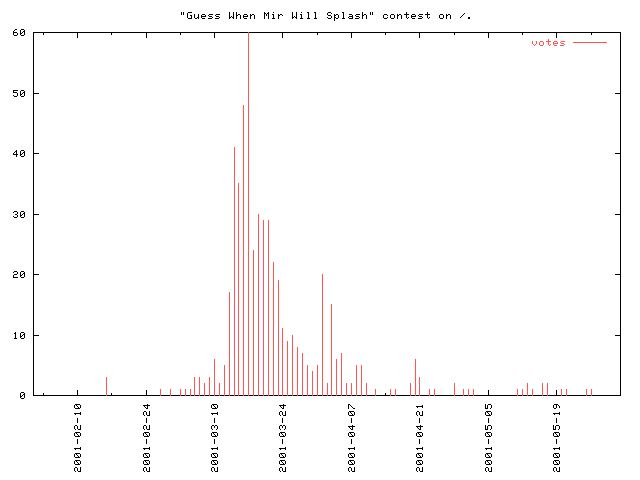
Well, everybody and his brother wants to let us know that Mir is coming down, really, they mean it this time. Pick your favorite site to track its descent: Yahoo | NY Times | United States Space Command | Heavens Above | BBC. But Frederic Freidel provides an oddly personal note: what goes up must come down.Jacek Fedorynski took a look at Guess When Mir Will Splash and drew up this nice histogram of the guesses. He also notes that the median guess for Mir's return to Mother Earth was 2001-03-19 10:11:01, so the collective wisdom of slashdot was off by a few days.
Nowhere in this slashdot story do we mention either the stupid Taco Hell advertising campaign or the space fungus or the Crashing Mir Space Station Detecto-Hat.