Slashdot Mirror
Domain: airspacemag.com
Stories and comments across the archive that link to airspacemag.com.
Comments · 80
-
Re:"No Moon"
The Moon has more water than we could use for the next 100 years. 600 million metric tons at the opposite pole to the one LCROSS crashed into.. probably similar amounts at the south pole too.
My argument would be that if we're going to the Moon to get resources to go somewhere else, which is what Dr Paul Spudis, the foremost expert (and jackass, but that's a personality trait, his ideas are great) on the Moon says we should, that's a great idea, but why would you do that with humans? Paul regularly talks about the comprehensive robotic precursor missions which would characterize the resources and prove the capability to get it and make propellant from it. Then in the next breath he talks about humans on the Moon. This kind of "find a justification for human spaceflight" thinking is common in the space community. If the goal of going to the Moon is to get resources to go elsewhere, just do that with robots. There's no need to build an ISS on the Moon unless that's the goal. There's nothing wrong with that goal, but it will take time and budget, and NASA is having enough trouble getting enough budget to do anything with just one ISS to support.
-
Re:Change the band's name
Actually, the astronauts' "Max Q" came first: 1987.
http://www.airspacemag.com/multimedia/videos/Max-Qs-First-Gig.html
Michael Hutchence's "Max Q" didn't start until 1989. -
Re:Send up some miners
That would be very interesting indeed! I suppose that would require that it be patchy rather than uniformly distributed. Because it's certainly not taking up even a couple percent of the north pole image that they showed in a manner that's that thick and relatively pure; there's just too much area for that compared to their cited mass figure.
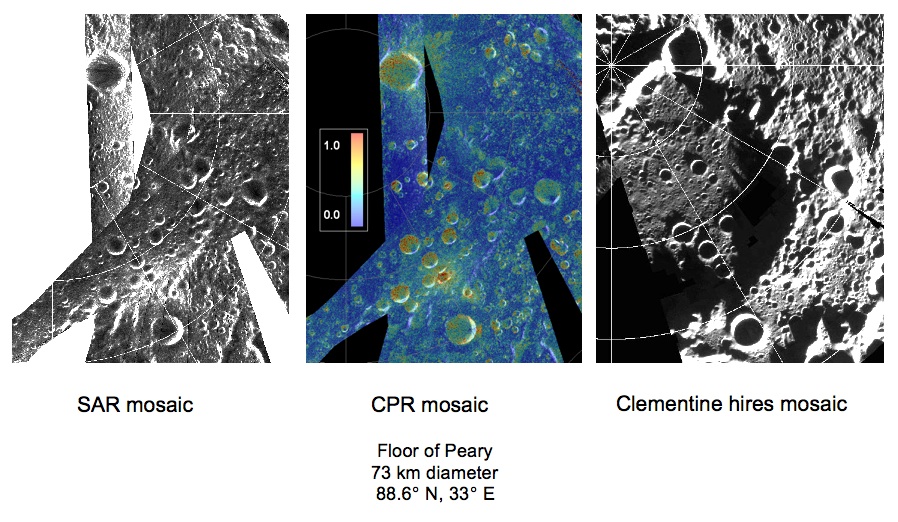
I was taking a look at this image which Paul Spudis posted, specifically the middle "CPR" image:
http://blogs.airspacemag.com/moon/files/2010/03/Peary-CPR.jpg
I assume that the regions where it's >= 2 meters thick corresponds to the reddest regions, of which there are only a few speckles. It also makes sense when you consider that large amounts of lunar ice are likely to only persist in those parts of the crater which are in permanent shadow.
Also, as a practical matter, it's worth noting that these craters are some of the coldest spots in the solar system. It'll require some clever engineering to work in an environment with a temperature even colder than liquid nitrogen.
-
Re:Send up some miners
As for the ice issue: 600m metric tons at the "north pole". They say it's within green circles that look to take up something like 4% of the image. The area covered is down to 80N. The moon's circumference is 6790 miles. I'm too lazy to do the exact math, but that means that the area covered here is something like 550,000 square miles. That means that the area taken up by the green circles is something like 22,000 square miles, so about 27,000 metric tons per square mile. Mini-SAR measures to a depth of "a few meters"; let's say 10 feet. That would work out to about 100 grams of water per cubic foot in those areas. A cubic foot of regolith has a mass of something like 75 kilograms, so that would be about 0.13% water. These are very rough calculations, of course.
This certainly requires more investigation, but Paul Spudis, the scientist in charge of the experiment, posted the following on his blog, indicating that the evidence supports there being relatively pure ice at least 2 meters thick:
http://blogs.airspacemag.com/moon/2010/03/01/ice-at-the-north-pole-of-the-moon/
Over forty small (2-15 km diameter) craters near the north pole of the Moon are found to contain this elevated CPR material. The total mount of ice present at the pole depends on how thick it is; to see this elevated CPR effect, the ice must have a thickness on the order of tens of wavelengths of the radar used. Our radar wavelength is 12.6 cm, therefore we think that the ice must be at least two meters thick and relatively pure. At such a thickness, more than 600 million metric tones of water ice are present in this area.
-
Re:If just one life is saved, it's worth it.
There are other measures that can be enacted to improve airline safety even further, and if it saves even one life, we should enact them, too. It's unacceptable that anyone should die as a result of anything they do.
Right on, one simple measure is to have all the seats face backwards. People have known that this arrangement is much safer for around 50 years but nothing is done. So much for safety being the top priority.
-
Sleath - cloaking devicesArticle in the current issue of Air and Space magazine about this sort of technology and how might be used to create cloaking devices one day.
Scientists and engineers are trying to emulate that trick by designing materials that could constitute the next-next (or next-next-next) generation of stealth. Some of their ideas sound like they sprang from the imaginations of Gene Roddenberry or J.K. Rowling, with phrases like “cloaking device” and “invisibility carpet” popping up as frequently in academic papers as in television scripts and books for kids. Other ideas are more realistic, as researchers devise ways to change an aircraft’s color and blur its outline, confusing the bad guys enough to make them shoot in the wrong direction.
-
Re:Why are they just doing this now?
Actually Special Forces have had access to PDAs for a few years now that can access to Global Hawk imagery real time. They can pinpoint an area on a map to cue the plane to scan or to send down historical imagery. The only real new thing here is that they are using Apple devices.
-
Re:He's still kicking!
Wow, you're right, but it's even further: 1949. I had no idea. Right reason, totally wrong date.
When my instructor said "they used to teach spin recovery a few years ago" I figured he meant 5, not 50... -
SpaceX - Third time's the charm?
Falcon 1 ready to fly --- launch window open July 29- Aug 6. update here: http://www.airspacemag.com/space-exploration/Third_Times_the_Charm.html
-
Not on one man alone... Korolev & TikhonravovThe story they tell hinges on luck and the drive of one man, Sergei Korolyov, who died in 1966, unheralded in his lifetime.
Korolev (westernized spellings vary) had an even less heralded sidekick, Tikhonravov, who although brilliant, is much less well known, even in Russia. You know, the quiet, nerdy type.
There is an interesting article this month in Smithsonian Air & Space magazine on him this month: http://airspacemag.com/issues/2007/october-november/sputnik_creator.php
And, of course, any large program has lots of total unknowns who all did their part.
-
Korolev or Tikhonravov?
Air and Space Smithsonian has a rather different take on who deserves the credit for Sputnik's success in the current issue.
-
Air and Space Smithsonian Salute
Air and Space Smithsonian had a "22-page salute" to the Tomcat in its August-September issue, some of which is available online.
-
Ah, yes, the flying car
Reminds me of a fine overview of the phenomenon of flying cars, and in particular all the hype surrounding the Mitzar, a "flying Ford Pinto", that recorded one takeoff and no landings. Let's hope the SkyScooter, or whatever it's called, and the Mollar SkyCar don't meet the same fate of lots of hype and one tangled mess.
-
Scaled Composites == Burt Rutan
It's appropriate to view this attempt win the X Prize with a full perspective of who Scaled Composites are, and where they came from.
Burt Rutan has been thinking outside the box, from the halcyon days of the Vari-Eze & Long-Eze to the innovative Ares and the 'appear-to-thumb-your-nose-at-physics' Boomerang.
His company; Scaled Composites, have not only survived the drastic slump of the light aircraft market in the 80's and 90' but made innovation their tradition - no small feat.
IMHO, they deserve to succeed with this attempt of Spaceship One. -
Re:Not quite film yet....
Having worked aerial surviellance back in the last century, I agree on the value of film. We routinely datalinked our Sidelooking Airborne Radar (SLAR) imagery to ground stations but were required many times to send copies of the in-plane film to the remote sites to validate what was recorded on the ground. This was to ensure that there were no coverage dropouts due to datalink issues or worse, additional data due to interference or jamming.
We used a dry silver film heat developed film to give a near real-time readout in the cockpit, and the ground station operators had the same cockpit equipment, just minus the radar controls.
We also used literally tons of Kodak 5 inch rolls of film for mosaic photo mapping, and 70mm film for panoramic forward and vertical shots. Sneaking peeks over the iron curtain were always a tense mission, but we had reasonable standoff capabilities with the 5inch camera.
It was geek heaven: guns and gadgets; fear and loathing from mere groundbased mortals, snobbery and FUD. A great way of life, and good training ground for a BOFH attitude.
The Last of the Mohawks -
Re:Unstarts and things that go bump in the night
On inlets:
also
Dont know if it is authoritative or not, but it basically matches my understanding.
The speed of the air at the compressor face is an issue for all supersonic aircraft, not just the mach 3 variety.
On the XB-70 ( compression lift is discussed )
The wing tips fold down as part of how the compression lift is "captured" under the aircraft. -
Re:X-Prize == Darwin Awards??Rocket technology aiming at supersonic suborbital flights built by privateers using off-the-shelf components? Sounds more like Darwin Awards, especially after you take a look at the level of technology.
When you consider that we went to the moon with Sixties technology, designed by guys (girls didn't do engineering back then) with slide rules, I don't think that the technology level poses an obstacle.
How do they even know that their rocket is aerodynamically stable?
I'll bet that Burt Rutan knows. He's designed some of the most impressive light aircraft in the world, some of them jet propelled.
Building robust, real-time control systems to adjust the attitude during flight at a sub-millisecond rate can't be that easy either.
If NASA engineers could do it almost 50 years ago, using cardboard, string and slide rules, I suspect that most any electrical engineer could do it today.
-
Re:Two WordsI found this interview with Burt Rutan. There's a particular question and answer that I'm sure the Slashdot crowd will enjoy:
Q: How do you feel when you see imitations of your designs? Do you feel flattered?
A: Well, you know, for about 14 years, I was in the home-built business, selling plans. And during that time, several different outfits essentially copied what I was doing in structural ways, aerodynamic ways. And I think it is a compliment if people go out and copy what you do. If you turn around and sue, that pretty much puts you at a stop, at a stymie. That kind of an approach essentially stopped the Wright brothers in their tracks in the late '10s. They let others advance the art because they were patenting the airplane. And you know, once they started working with lawyers, they were doomed.
-
Rutan Interview
Smithsonians Air and Space mag did an interview on Rutan, is pretty interesting and includes a quicktime panaorama of some of his aircraft.
http://www.airandspacemagazine.com/ASM/Web/TWD/rut an.html
-
More in the current Air & Space magazineGive credit where credit is due. This and others are in the current June/July 2003 issue of Air and Space Smitsonian magazine. Links from the artcicle:
- One from OZ built into a Ford chassis
- An F/A 18 Hornet simulator made from wood, also in OZ
- A Boeing 767 in London that "flies" around the world
- A "multi-mission simulator" by an avionics engineer in the US
- An F-15 in Washington
Let's try not to Slashdot 'em too badly. - One from OZ built into a Ford chassis
-
What should NASA do next?I like several ideas I've heard over the years, besides the elevator to space, which still seems out of reach.
1) Send a robot to Mars with empty tanks, a reactor, a pump, and telemetry. Let it mine the Martian atmosphere for a year or so to extract oxygen from C02 in the thin air, and H2 from the water vapor in the thin air. Check on it to make sure there are plenty of both before sending the people, and then you don't have to carry your return fuel and oxygen all the way there. The savings are astounding! Here is one plan.
2)Put a base on the north pole of the Moon. There 's water there (as ice) so with energy from a reactor you can make a livable place much cheaper than at a space station. It lots easer to get rocks to protect your living quarters too! Melt the rocks down to make the equivalent of fiber glass, concrete, etc. It's very much cheaper to take off from the Moon, (even at its north pole) than it is from the Earth at its equator.
3)Talk to Burt Rutan about making an airbreather plane that converts to a rocket after it leaves the atmophere. Most of the weight of a rocket now is oxidant.
-
Re:Shares some interesting similarities with past
In case you are unaware, when the first proposals were made by the engineer responsible for the B2 stealth bomber, everyone said "Theres no damn way that thing is leaving the ground. That thing can't fly."
Care to provide a reference for that quote? Since the basic flying wing design was validated in 1949 with the YB-49 (caution - Quicktime image of YB-49 takeoff on linked page). It turned out that fly-by-wire control was needed for the flying wing to be fully reliable, but that was certainly available in 1975.sPh
-
Re:Wright brothers engineered for stall safety
By using a canard airfoil that stalled before the main wing, they designed an aircraft whose nose would remain high during a stall. (There was a Scientific American article years ago that described all this)
The canard design does NOT allow the "nose" to "remain high," it prevents the nose from GETTING too high.
The canard provides a good portion (40% on modern designs) of the airplane's lift and it is, indeed set at a higher angle of attack than the main wing. If the nose is raised both wings go to higher of angles of attack. The more-angled canard stalls first, which removes the lift that is holding up the nose, so the aircraft automatically lowers the nose and prevents the main wing from ever getting to a critical angle and stalling. Thanks to that built-in mechanism carnard designs are called "stall-proof."
Burt Rutan, the designer of the Voyager airplane that flew non-stop around the world, has developed modern composite aircraft with canard designs, which he credits to the Wright Brothers, his entire professional life. -
Re:PlutonAt one stage, the US military designed a dirty no-holds-barred nuclear-propelled missile named (IIRC) Pluton. The main objection to that one was that the shockwave and radiation effects killed everything within a large number of kilometers of the flight path.
That was Project Pluto, which was, as you note, a hell of a lot more "dirty" than what NASA is proposing. The project started in 1957, and was canceled in 1964, after the USAF had determined that there was no need for such a missile, as well as the political fallout (sometimes puns are actually appropriate) considerations. As for the radioactivity, part of the plan was to have the missile drop its bombs where needed, then fly patterns over the target country (fUSSR, primarily) to irradiate it. Nasty stuff, that.
National Air and Space Magazine had an article on the project, but for the life of me I can't remember when it was published, other than over a decade ago. Their online site doesn't have a way of searching back copies for specific articles, and I don't presently have access to a library for more traditional research.
There's not too much of actual use on the web, from a "quick and dirty" Google search. I did, however find this, about the history of Lawrence Livermore National Labratory, which was involved with just about every nuclear program the US had.
-- -
tacoma narrows
like the Tacoma Narrows Bridge did when the equal frequencies of the wind and the structure of the bridge matched
Just to do a little karma whoring...
Google has some nice links to video of the Tacoma Narrows bridge moving. This one from the Smithsonian is pretty good.
-- -
your link, sir.
"The US Air Force is already flying remote spy planes over the Balkans. The "Predator" is flown via remote, and can go over the horizon by use of satelites to send and recieve transmissions. May issue of Air & Space has an article on them. The pilots who get the duty are none too happy, as they don't accumulate flight time while doing this, but typically will be rewarded when their tour is up with the duty of their choice."
http://www.airspacemag.com/ASM/Mag/Index/2001/AM/
p redator.html -
Not unprecented
Seems I recally that the 70's skylab had an incident when the astronaughts (funny speeling on purpose) went on strike and refusted to do what ground control asked, felt they we're being pushed too hard. Too lazy to look up referances
-
NOT Popular Mechanics..... (And Encyclopedia...)
For everyone who can't/won't do a google search themselves.
Manned Orbiting Laboratory (MOL)
www.google.com/search?q =Air+Force+MOL+&num=10&lc=www
www.airspacemag.com/ ASM/Mag/Index/1998/JJ/Contents.html
www.farhills.org/s/lees/space/air force.htm
Dyna Soar
www.google.com/search?q=dynasoar&lc= www
www.google.com/search?q=dyna+soar+%2Bsmithsonian&n um=10&lc=www&btnG=Google+Search BR> www.arnold.af.mil/aedc/systems/60- 933.htm
www.nasm.edu/galle ries/gal114/SpaceRace/sec500/sec540.htm
www.hq.nasa.gov/offi ce/pao/History/Timeline/1961-4.html
Blue Gemini
www.google.com/search?q=Bl ue+Gemini&num=10&lc=www
student.uq.edu.au/~s373901/land
www.hq.nasa.gov/office/ pao/History/SP-4203/ch6-2.htm
LK Lander
www.google.com/search? q=%2BLK+%2BLander&num=10&lc=www
www.interaxs.net/pub/spacey/lk1.htm
www.ninfinger.org/~sven/mode ls/sovietsp/lk.html
Spiral
www.google.com
www.mcs.net/~rusaerog/spiral/spiral
General Spacecraft info
www.rocketry.com/mwade/spaceflt.htm Encyclopedia Astronautica -
Re:what about links to links?Try getting to, say, any porn site from, oh, Jane's Information Group
OK....
- Jane's Defence Community
- Jan e's Defence Community
- Air&Space Smithsonian Magazine
- Website Central
- Netsc ape Products: How to Make Communicator Your Default Browser
- Member Directory
- Netcenter Enterta inment Channel
- Search - Photogra phy
- Search - Arts > Photography > Galleries
- S earch - Arts > Photography > Galleries > People
- EROS
- EROS
- EROS
- EROS
- Lady Lynx - erotica for women, links to g alleries of naked men
- Lady Lynx - Erotica for Women
- Free Sites with Galleries o f Pics
Although soem of the URLs say "search", I didn't do any searching, just clicked on links.
And I have now just proved how easy I can get to male pr0n on-line -- oh, no, what have I done?!
-
Re:what about links to links?Try getting to, say, any porn site from, oh, Jane's Information Group
OK....
- Jane's Defence Community
- Jan e's Defence Community
- Air&Space Smithsonian Magazine
- Website Central
- Netsc ape Products: How to Make Communicator Your Default Browser
- Member Directory
- Netcenter Enterta inment Channel
- Search - Photogra phy
- Search - Arts > Photography > Galleries
- S earch - Arts > Photography > Galleries > People
- EROS
- EROS
- EROS
- EROS
- Lady Lynx - erotica for women, links to g alleries of naked men
- Lady Lynx - Erotica for Women
- Free Sites with Galleries o f Pics
Although soem of the URLs say "search", I didn't do any searching, just clicked on links.
And I have now just proved how easy I can get to male pr0n on-line -- oh, no, what have I done?!