Slashdot Mirror
Domain: alaska.edu
Stories and comments across the archive that link to alaska.edu.
Comments · 219
-
Watching online
-
I'm not entirely sure, but perhaps...the weather has something to do with it. Earthquake weather in particular.
But I could be wrong, yes?
-
Re:You get what you pay for.
The oldest CDR I've ever used must have been burned in 1994. The disc itself said it was rated for 2x burning, and I *think* the brand was Pinnacle. I saw an ad for the same kind of CDR (and a burner) in a 1994 Macworld. I think it's the burner mentioned in this article. The CD read just fine in my 24x Yamaha drive in 2000. So if all of the CD's I burn today last 6-8 years, I'll be OK, because I'll be able to transfer them all to a 1TB iPod
-
Geeks in space! I mean, Alaska!
Alaska is seen as more outdoorsy than geeky, and it is (thank God). But if you find yourself up here, be sure to check out the Poker Flats rocket launching site. It's the only non-federal, university owned and operated range in the world and the only high-latitude, auroral-zone rocket launching facility in the U.S. You can find a launch schedule at the website, and the personnel are really into it and enthusiastic about what they do.
That said, few geeks are geekier than marine biology geeks, so if you fall into that category you'd probably like the Alaska SeaLife Center, where you can check out sea lions and puffins and things, and check out their research.
Finally, I want to give a shout out to one supergeeky site that someone else mentioned but was somewhat passed over: The Chicago Museum of Science and Industry. I visited it when I was just a little mini-Alaskan, and was blown away by all the buttons you get to push, levers to pull, etc. Plus, you get to tour a real German U-Boat. 31337! Or, as I would have said at the time, neato!
-
Re:"protected CDs" != CDs
The Amélié sound track CD carried the Philip's Digital Audio CD label. Still it was copy protected.
I mentioned this to the store and they just looked confused when I started talking about Red Book format.
I got my money back after testing a second copy of the CD, the reason I gave for requesting the refund at the check out was that the CD was not a valid audio CD.
"Red Book - CD Audio
- Defined by Philips and Sony in 1980 and published in a red binder, hence Red Book.
- Standard needed so a CD made by any manufacturer can be read by any CD player."
-
Not convinced one way or the other
Since we still have a_lot_to_learn about/from tornadoes and since the poster's ideas seemed well thought out, I gave it a chance. I found a link to the HAARP Project and its experiments effects on atmospheric ionization and motion. Here is an excerpt:
What Effects Are Produced By HAARP? A portion of the energy contained in the HF signal transmitted by HAARP can be transferred to existing electrons or ions making up the ionospheric plasma through a process called absorption, thus raising the local effective temperature. As an example, the electron temperature at a height of 275 km (the peak of the F2 region) is over 1400K. [2]. Work at other active ionospheric research facilities has shown that it is possible to raise this temperature by as much as 30% within a small, localized region during an experiment. The affected region would then temporarily display electrical characteristics different from neighboring regions of the layer. Sensitive scientific instruments on the ground can then be used to study the dynamic physical properties of this region in great detail. As the electrons (and ions) acquire additional energy, their temperature increases, their kinetic energy increases and they begin to move more rapidly. In the F layer, this increased movement or expansion results in a decrease in the electron density. Experience at other active ionospheric research facilities [3] has shown that electron densities in the small, affected region can be reduced by 10% to 20%.
Very, very interesting... -
Not convinced one way or the other
Since we still have a_lot_to_learn about/from tornadoes and since the poster's ideas seemed well thought out, I gave it a chance. I found a link to the HAARP Project and its experiments effects on atmospheric ionization and motion. Here is an excerpt:
What Effects Are Produced By HAARP? A portion of the energy contained in the HF signal transmitted by HAARP can be transferred to existing electrons or ions making up the ionospheric plasma through a process called absorption, thus raising the local effective temperature. As an example, the electron temperature at a height of 275 km (the peak of the F2 region) is over 1400K. [2]. Work at other active ionospheric research facilities has shown that it is possible to raise this temperature by as much as 30% within a small, localized region during an experiment. The affected region would then temporarily display electrical characteristics different from neighboring regions of the layer. Sensitive scientific instruments on the ground can then be used to study the dynamic physical properties of this region in great detail. As the electrons (and ions) acquire additional energy, their temperature increases, their kinetic energy increases and they begin to move more rapidly. In the F layer, this increased movement or expansion results in a decrease in the electron density. Experience at other active ionospheric research facilities [3] has shown that electron densities in the small, affected region can be reduced by 10% to 20%.
Very, very interesting... -
Re:ATI All In Wonder
Newspaper in a dump?
-
Re:we alread haveIndeed, we already have.
HAARP is an endeavor by the US gov't to attempt to tweak the ionosphere by the way of something akin to a huge electromagnet, near the North Pole.It's a wonder they haven't downed Santa's sleigh!
Seriously, though, this is one project that has been accused of causing El Nino.
For you who haven't followed my links, HAARP stands for High-Frequency Active Auroral Research Program, and is run by the Naval Research Laborarory.
As you've seen from my links, there are many zealots who would claim that HAARP causes weather disturbances. The Official HAARP FAQ, though, claims quite the contrary.
Personally, I tend to take the side of the zealots; the US gov't is well-known to hide issues of widespread importance and, in many cases, outright mislead its citizens. Hence my opening statement.
-
Re:we alread haveIndeed, we already have.
HAARP is an endeavor by the US gov't to attempt to tweak the ionosphere by the way of something akin to a huge electromagnet, near the North Pole.It's a wonder they haven't downed Santa's sleigh!
Seriously, though, this is one project that has been accused of causing El Nino.
For you who haven't followed my links, HAARP stands for High-Frequency Active Auroral Research Program, and is run by the Naval Research Laborarory.
As you've seen from my links, there are many zealots who would claim that HAARP causes weather disturbances. The Official HAARP FAQ, though, claims quite the contrary.
Personally, I tend to take the side of the zealots; the US gov't is well-known to hide issues of widespread importance and, in many cases, outright mislead its citizens. Hence my opening statement.
-
wirelss everywhereMy school has had campus wide wireless for almost three years. They also allow students to check out wireless cards and dell laptops freely for varying periods of time.
What's even better is that anyone with airsnort and a laptop or ipaq can get free wireless access nearly anywhere in town with Costco selling $100 basestations. heheh
-
Re:And that tells me?It's over a distance of 500 sq miles, which is about a 22.3 * 22.3 mile square. People can see 22 miles and with any number of instruments (a flag, a shiny bit of metal, whatever) could direct others to draw lines. This would only take a few days to mark the places to dig.
"But during the day, there is an upper limit to the distance at which objects can be discerned on the earth's surface. Craig Bohren, writing in Weatherwise magazine, states that this is about 200 miles under ideal conditions." - Source. This is backed up in many places, "Visibility [...] averages about 30 miles because of declining air quality, according to park literature. There was a time, however, when the view regularly was up to 233 miles on a clear day, according to the National Park Service."
So around 200 miles would be the limit. That is, if it were that large. The longest one is only 90 metres long ("the hummingbird figure is over 90 meters long."), so marking out figures in a 90x90 metres wouldn't be difficult. Given a week, any of us could do it.
"Straight lines go on for kilometers varying from straight by only a few degrees."
Also, it's not like we've got original drawings that they were trying replicate. Also, what they were trying to replicate was rather stylised anyway. They may have got the beak all wrong, but we'll never know. It looks like a bird, but if they were five metres out could anyone tell a mistake was made?
It's impressive, but not out of anyone's reach. Lines stretch several kilometres and vary by several degrees. Figures are considerably smaller. I want to see it, it's impressive. No reason to think it was non-human, though.
-
"Linus Torvalds": Absurd Liberal MythIt amazes me that so many reputable people and organisations have fallen for the ridiculous myth that there is some sort of Finnish student who has single-handedly created something that threatens to overthrow the current software distribution system as we know it. I find it particularly absurd that he is lauded as some sort of super overlord throughout hackerdom. Even generally reliable sources have fallen for this ridiculous scam. The concept that one youth from Central Europe could sow the seed for an operating system which frightens Microsoft is risible at best. It has taken Microsoft a decade to produce an OS which is even reasonably reliable and stands alone. So what makes you think that in the short time span from 1991 to the present day that a fictional character could produce an operating system which is more stable than Windows?
Obviously, this "Linus Torvalds" must be some sort of superhuman to have done such a thing. But we all know that there is no such thing as a superhuman. As such it must be plain for all to see that this "Linus Torvalds" is some sort of fabrication. It is the only way to explain why Linus keeps such a low profile, and that the main bit of evidence to even suggest his existence is the testimony of his mother and the strange posts "he" makes on obscure message boards. The fact that an entire community of "warez doods" has sprung up, proclaiming that "LUNIX RULEZZZ" is such a flimsy piece of evidence it must be discounted. But if "Linus Torvalds" does not actually exist, then who has conjured up his existence? There is only one possible person who could get away with such a fraud. Mikke Torvalds, "his" supposed birth parent.
Mrs. Torvalds may have a lot to say about her son, but this does not excuse the fact that he does not exist. When you consider this, is it genuinely surprising that she found him "easy to raise"? Of course, there is one immediate objection which will no doubt be raised. "If Linus Torvalds doesn't really exist," I hear you ask, "then who wrote Linux?" That is a good question, but it is very obvious to see who. If you take a look around here for a while, you will hear names like Alan Cox, Richard Stallman, and Eric Raymond being bandied about. Obviously, it is immensely skilled coders and hackers such as these people who have made the wonderful OS Linux what it is today. The person who first made that post on comp.os.minix was in fact Linus' mother, who, frustrated by the ludicrous restrictions imposed upon her by Minix, posted a message under a partial pseudonym, asking for help building a new operating system. All she wanted was someone to help her use her PC to print out her recipes, but before she knew it she was in way over her head. Pretty soon Linux had hit 1.0 and strangers like Tanenbaum were talking about and cussing it.
Fortunately, Mikke had released the kernel under the GPL from the start, so she was able to dump it onto the shoulders of other people without arousing too much suspicion. Now she only has to make periodic appearances on Usenet and the like to avoid arousing the interest of news-hungry geeks and ZDNet reporters. "But what about the conferences?" you cry. "We have photographic evidence!" Well, that isn't Linus. Are you sure you'd like me to tell you who it is? OK. The person whom you have all been worshipping for eleven years is in fact Richard Stallman, a man simultaneously venerated and vilified by the Slashdot community. When Linux started to become famous, Mikke knew that she was in deep water and that her hoax might be uncovered, so she decided to contact the most trustworthy man in the open source world. RMS was happy to cooperate, especially when he knew that Linux had completely overwhelmed the Hurd and that he might as well help; after all, if Linux was exposed as a giant falsification, mightn't his beloved GNU project be considered a hoax also? Neither could take the chance, and for that reason Stallman was perfectly happy to quickly purchase a cheap rubber mask and shave off some of his bodily hair.
Fast forward to 2002, and GNU/Linux is very stealthily taking over the server market. Mikke Torvalds' simple request has turned into a multi-million dollar industry, and Stallman's hobby and grand vision has actually begun to come to fruition. This is why, despite the fact that Linus Torvalds is actually a figment of our collective imagination, we should all honour him for being a prime symbol of our steadfast belief and ability to do what must be done. May his memory live on forever.
-
"Linus Torvalds": Absurd Liberal MythIt amazes me that so many reputable people and organisations have fallen for the ridiculous myth that there is some sort of Finnish student who has single-handedly created something that threatens to overthrow the current software distribution system as we know it. I find it particularly absurd that he is lauded as some sort of super overlord throughout hackerdom. Even generally reliable sources have fallen for this ridiculous scam. The concept that one youth from Central Europe could sow the seed for an operating system which frightens Microsoft is risible at best. It has taken Microsoft a decade to produce an OS which is even reasonably reliable and stands alone. So what makes you think that in the short time span from 1991 to the present day that a fictional character could produce an operating system which is more stable than Windows?
Obviously, this "Linus Torvalds" must be some sort of superhuman to have done such a thing. But we all know that there is no such thing as a superhuman. As such it must be plain for all to see that this "Linus Torvalds" is some sort of fabrication. It is the only way to explain why Linus keeps such a low profile, and that the main bit of evidence to even suggest his existence is the testimony of his mother and the strange posts "he" makes on obscure message boards. The fact that an entire community of "warez doods" has sprung up, proclaiming that "LUNIX RULEZZZ" is such a flimsy piece of evidence it must be discounted. But if "Linus Torvalds" does not actually exist, then who has conjured up his existence? There is only one possible person who could get away with such a fraud. Mikke Torvalds, "his" supposed birth parent.
Mrs. Torvalds may have a lot to say about her son, but this does not excuse the fact that he does not exist. When you consider this, is it genuinely surprising that she found him "easy to raise"? Of course, there is one immediate objection which will no doubt be raised. "If Linus Torvalds doesn't really exist," I hear you ask, "then who wrote Linux?" That is a good question, but it is very obvious to see who. If you take a look around here for a while, you will hear names like Alan Cox, Richard Stallman, and Eric Raymond being bandied about. Obviously, it is immensely skilled coders and hackers such as these people who have made the wonderful OS Linux what it is today. The person who first made that post on comp.os.minix was in fact Linus' mother, who, frustrated by the ludicrous restrictions imposed upon her by Minix, posted a message under a partial pseudonym, asking for help building a new operating system. All she wanted was someone to help her use her PC to print out her recipes, but before she knew it she was in way over her head. Pretty soon Linux had hit 1.0 and strangers like Tanenbaum were talking about and cussing it.
Fortunately, Mikke had released the kernel under the GPL from the start, so she was able to dump it onto the shoulders of other people without arousing too much suspicion. Now she only has to make periodic appearances on Usenet and the like to avoid arousing the interest of news-hungry geeks and ZDNet reporters. "But what about the conferences?" you cry. "We have photographic evidence!" Well, that isn't Linus. Are you sure you'd like me to tell you who it is? OK. The person whom you have all been worshipping for eleven years is in fact Richard Stallman, a man simultaneously venerated and vilified by the Slashdot community. When Linux started to become famous, Mikke knew that she was in deep water and that her hoax might be uncovered, so she decided to contact the most trustworthy man in the open source world. RMS was happy to cooperate, especially when he knew that Linux had completely overwhelmed the Hurd and that he might as well help; after all, if Linux was exposed as a giant falsification, mightn't his beloved GNU project be considered a hoax also? Neither could take the chance, and for that reason Stallman was perfectly happy to quickly purchase a cheap rubber mask and shave off some of his bodily hair.
Fast forward to 2002, and GNU/Linux is very stealthily taking over the server market. Mikke Torvalds' simple request has turned into a multi-million dollar industry, and Stallman's hobby and grand vision has actually begun to come to fruition. This is why, despite the fact that Linus Torvalds is actually a figment of our collective imagination, we should all honour him for being a prime symbol of our steadfast belief and ability to do what must be done. May his memory live on forever.
-
A bit of context
Linus' tone might seem a bit aggressive and abrupt, but consider that this is message is a deep, deep down a very long thread that starts here.
From the very beginning, Linus was saying he thought this patch was something that should be driven by vendors - i.e. put it in their trees *first*, and then it may find a way into Linus' tree later.
Hence the constant references to 'this is my tree, this is how I do things'.
The whole thread is actually quite interesting. If you're thinking of suggesting a patch, I suggest you read the whole lot to get an idea about how best to approach it. -
A bit of context
Linus' tone might seem a bit aggressive and abrupt, but consider that this is message is a deep, deep down a very long thread that starts here.
From the very beginning, Linus was saying he thought this patch was something that should be driven by vendors - i.e. put it in their trees *first*, and then it may find a way into Linus' tree later.
Hence the constant references to 'this is my tree, this is how I do things'.
The whole thread is actually quite interesting. If you're thinking of suggesting a patch, I suggest you read the whole lot to get an idea about how best to approach it. -
A bit of context
Linus' tone might seem a bit aggressive and abrupt, but consider that this is message is a deep, deep down a very long thread that starts here.
From the very beginning, Linus was saying he thought this patch was something that should be driven by vendors - i.e. put it in their trees *first*, and then it may find a way into Linus' tree later.
Hence the constant references to 'this is my tree, this is how I do things'.
The whole thread is actually quite interesting. If you're thinking of suggesting a patch, I suggest you read the whole lot to get an idea about how best to approach it. -
Re:Bug tracker for the kernel
-
Re:Nearly 1000 horsepower!
I remember a vehicle from the 1930's in the Deutches (spelling) Museum in Munich that could do 70 miles an hour on a very low power engine (I seem to remeber about 50 hoursepower).
That would be the 1921 Rumpler Wagon. Very good aerodynamics even by current standards, even though it doesn't look all that sleek. Then again, it was designed by an aircraft engineer
-
Re:Choice Of Location?
Fairbanks even holds a few records for the biggest seasonal variances in temperature.
I wouldn't doubt it.
I used to live there some time back. The depths of winter would see super lows around -60F sometimes in town where the ice fog and carbon monoxide from running vehicles would pile up. (You'd be afraid to turn off your car, too, at those temperatures unless you were near an outlet you could plug your engine block heater and battery warmer into.) Fortunately, on the Fbx campus there are lots of parking spaces with such plugs.
Also, up on the hill where the UAF campus is located, the temperatures in the dead of winter are usually warmer than downtown Fbx, or places southeast of the city (Badger Road).
I could tolerate the cold with minor inconvenience. You can even wear tennis shoes outside quite nicely for up to about 15 minutes at at time - about the time to go between buildings in the worse case. The more insidious drawback to Fbx in the winter is the paucity of daylight.
Summertime high temperatures are usually in the 80s in early July; August is the rainy season. I once saw it go into the low 90's, but that's as unusual as going below -60F in the winter.
Oh, and definitely watch out for the mosquitoes. In the height of the season, the arctic is infested with as many of the little bloodsuckers as the everglades.
Not to be all down on Fairbanks - there's a lot of wonderful scenery (Alaska range to the south, including Denali(/McKinley). Great rivers, fishing, hunting, backpacking, etc. Frequently you can see the aurora borealis in the winter.
-
Re:Choice Of Location?
Fairbanks even holds a few records for the biggest seasonal variances in temperature.
I wouldn't doubt it.
I used to live there some time back. The depths of winter would see super lows around -60F sometimes in town where the ice fog and carbon monoxide from running vehicles would pile up. (You'd be afraid to turn off your car, too, at those temperatures unless you were near an outlet you could plug your engine block heater and battery warmer into.) Fortunately, on the Fbx campus there are lots of parking spaces with such plugs.
Also, up on the hill where the UAF campus is located, the temperatures in the dead of winter are usually warmer than downtown Fbx, or places southeast of the city (Badger Road).
I could tolerate the cold with minor inconvenience. You can even wear tennis shoes outside quite nicely for up to about 15 minutes at at time - about the time to go between buildings in the worse case. The more insidious drawback to Fbx in the winter is the paucity of daylight.
Summertime high temperatures are usually in the 80s in early July; August is the rainy season. I once saw it go into the low 90's, but that's as unusual as going below -60F in the winter.
Oh, and definitely watch out for the mosquitoes. In the height of the season, the arctic is infested with as many of the little bloodsuckers as the everglades.
Not to be all down on Fairbanks - there's a lot of wonderful scenery (Alaska range to the south, including Denali(/McKinley). Great rivers, fishing, hunting, backpacking, etc. Frequently you can see the aurora borealis in the winter.
-
Re:Mirror
-
Old News and Correction
Check out this article from 1977. Bacteria, with a little help, will eat oil/blacktop.
Bacteria is now used to clean up oil spills.
Now for the correction. The Observer article simply says 'bugs'. Given the above info, they almost certainly mean bacteria, not a virus, as the story submitter assumes. -
Re: 21st century units
Given the choice between units created by the French, and units created by anyone else, you'd have to choose...
Anyone else.
Unless you're a scientist. Even in backward coutries like the United States, scientists have long ago switched to metric. As long ago as George Washington people knew that metric was the way to go.
Did you know that it took a World War to even settle on a standard value for the inch? The same article notes that metric was made law in the US before imperial measures were legally defined, and when they finally were, the legal definition of the inch (etc) was defined in metric.
Praise Google, the Bringer of Semi-Useless Factoids. -
Upper Atmosphere wind force
A factor in space launches IIRC is the wind velocity in the upper atmosphere, which at times can reach hundreds of knots. I also recall that the high wind velocity was a factor in the post-explosion breakup of the Challenger space shuttle.
Although the atmospheric density and pressure is much lower at these altitudes (50-1000km+), the wind force is a factor, and it makes me wonder how a geo-stationary elevator shaft could be designed to withstand the energy of such wind forces.
If it could work, it'd probably kick off a revolution in space industry. -
reports of our death are greatly exageratedIn reference to another post claiming alphalinux.org and alphanews.net are 'dead'. I like to clairfy a few things. First there is a mirror of the content of ALO hosted by Compaq at www.linuxalpha.org and www.alphanews.net is hosted there as well.
moreover the current status of the Alpha port is doing quite well thank you and is the best supported port out there bar none. Please disregard this gentlemans comments regarding the fesibility of 2.4 on Alpha. Only a 'few' engineers have left Compaq to pursue other projects like the Athlon, HP is porting their own UNIX to Alpha, and the Compaq compiler team is alive and well working at Compaq in Nashua, NH on spitbrook rd. working on Alphas 'and' the Itanium compiler. Oh, Intel hasn't bought out Alpha, they only bought a 'license' to some of the EV8 core, thats it. I hope I've cleared up enough fud.
As for the situation regarding the orignal domain and hardware please see the following: list thread.
We don't intend to fade into the night. Not while I'm still around anyways
Peter
-
Re:It's called "span of control"
Well said, I was thinking of the same. Hierarchial management has persisted for thousands of years and bazillions of management books. In fact, most management strategies are rather subtle modifications on the standard hierarchial model. I.e. what is the optimal span of control for some organization, how to communicate between the subtrees (formalized in the matrix strategy) etc. Not that I'm a kernel developer, but I would suggest that Linus would designate say 10 people as his official subsystem maintainers, announce publicly that all patches must go through them, and to be really sure automatically bounce every patch he gets except from his 10 trusted maintainers (should be a really simple procmail script). Actually, this was also sort of suggested on lkml, and Linus own response sort of reflected a line of thought like this IMHO, even if he explicitly stated that it wasn't/shouldn't be a "general at the top"-kind of strategy.
-
Re:Linus is, as is often the case, rightSigh. You didn't read the original post by Linus about his vision for kernel dev, did you?
The "hierarchy" goes exactly one level deep. Hardly worth talking about.
The maintainers that "report" directly to Linus are the second level of that hierarchy. From there on, the "levels" begin to blur, as many of the "lower" levels of maintainers would probably eventually be in the circle of trust of more than one other maintainer.
In effect, this method becomes a web, not a tree. Well, it could be argued, I suppose, that the web looks pretty damn tree like in parts. Or that the tree has large portions that are quite web-like.
Whatever.
The main things, as s Linus originally pointed out here is to:
- Lack of dependencies on a source level. This is Linus's job, with the help of his trusted luitenant.
- Lack of people who have to follow everythin This is where the web comes in.
-
From someone who has never hacked a kernel:Well, I'm really surprised at all this.
I think I'm not alone when I say that, when I came to linux a few years ago, I was very impressed. Stability, speed, tons of functions, and a lot of configuration...
whoa... you get to compile your own kernel, man!
Well, that was all well and good. What was not all well and good is that, like so many others, I didn't actually write anything for the kernel. I assumed it was in good, and (as I have no real OS-level programming experience) more capable hands. I know that was what I was thinking when I explained to others why linux was so cool, and would always keep getting better. People would keep on sending in improvements, and these improvements, when approved for absolute stabiity (Alan Cox's old job mentioned in the leter, wasn't it?), they would be integrated into the sacred source.Sigh. Well, that assumes the improvements get accepted or even seen in the first place, doesn't it? Linux is a huge development project (I mean, come on, it's an OS), and anything made in last I don't know how many years of development of any significant size had ought to have a tighter system of management; human or not. I'm a little worried that Linus has any opposition to these sorts of things. I'm actually amazed that linux got this far without more- I always assumed there were some definite mechanisms of the sort involved (hence my regret for never messing with the "sacred source"). I always just assumed there were.
Now I am surprised there wasn't a call to action before this. In a project of this nature, with so many people, projects, and significant economic forces putting their investments of time, money, and effort into this, you'd think that something would have been done when good patches started getting dropped. If that is the case something has to be done now.
Like I said, I never messed with the source. I never fixed anything; I never submitted patches; therefore I never had this problem. In short, I never knew. I was never involved, and never felt I had to be- I mean, better heads than mine were on the job, right (I said the source was "sacred")? Well, not all heads are better at everything, and I think that the more heads invoved, the better off this would be (at the very least, we would have reached this crisis point sooner and come to some decision on how to handle it). Maybe if some of the right people got in on it earlier, an appropriate management system would have been advocated and introduced- and these problems would have been minimized.
Possibly not. But more has to be done on this. Linus' counterpoints are well argued, but if lots of valuable code patches are really being (uneccesarily) lost due to the current system, are they good enough?
-
Linus is, as is often the case, rightLinus's vision of the kernel dev process is really the right answer. Why can't more people see that? By using a non-hierarchial network of maintainers, the kernel effort can scale indefinately.
The basic premise he makes is one that many developers seem to miss. To quote Linus:
Basic premise: development is done by humans
From that, he goes on to point out that people tend to have a small group of people they work well with and trust; perhaps 5 - 10 people. So, in essence, if Linus appoints 5 - 10 maintainers of major subsystems (which he has), and each of them has 5 - 10 people the trust to maintain specific aspects of their subsystem, then there is no problem.We're not there yet. But that is the only direction I can see that will work, long term. It just takes time for the appropriate people to move into their spots; trust takes time to build, and the structure has taken time to modularize enough to allow this to work.
And, though I would prefer to see it in use just to make the maintainers' jobs easier, CVS will do nothing to solve the problem. It is a tool, not a process. We need a process. Actually we have a process, it just isn't fully implemented yet.
No, strike that. We have two processes. The first, used by the bulk of the kernel hackers, is not fully implemented yet. The second, used by a minority of the kernel hackers and a large part of the pretenders, is simple: whine alot, and, when that doesn't work, whine some more.
Linus says it much better, and in his own unique
Idium, sir?
Yes, in his own, unique idium.
-
A few notes from a Hurd userI've got a GNU/Hurd machine right next to me compiling Emacs as I write this, but I'm no expert. Take the following with a salt shaker, if you like
A few people have mentioned trying to merge Linux with the Hurd. For many reasons, this probably won't happen, and would probably detract from some of the advantages the Hurd's design offers.For example, Neal Walfield mentions in the interview that there's a fellow who's succeeded by himself at porting substantially the Hurd to the PowerPC architecture. He took OSFMach from the MkLinux project, modified slightly the four core servers and libc, and had a system capable of running bash, fileutils, and I think some other standard apps. This feat confirms the portability of the Hurd's design, which might not be as easily accomplished with the Linux kernel. I don't know Linux's internal arrangement very well, but I have read comments of Linus's to the effect that kernel development shouldn't be easy. While writing Hurd servers or an implementation of Mach isn't particularly easy, it looks as though the portability and modularity promises of the microkernel advocates may be borne out. In addition, at least one fellow has succeeded at running Lites, the BSD single-server, alongside the Hurd on a machine running Mach. In principle it should be possible to run the MkLinux single server in a similar way atop Mach, perhaps concurrently with the Hurd. This would be similar, according to the Hurd's developers in a recent list discussion, to the virtual server capabilities discussed last week someplace
The Hurd accomplishes this while remaining POSIX compliance, sufficient to make the user experience indistinguishable from standard *nixes. At first my biggest disappointment with the Hurd was that nothing much seemed different. All the standard utilities were there, I got X working (though I don't use kde or gnome -- just windowmaker), and found myself somewhat surprised that most of what I need to do I can get done with my GNU/Hurd machine. This seems to have been accomplished by about ten or so kernel developers plus maybe fifty application porters over a long time; naturally if the user and developer bases were larger, things would be farther along.
My GNU/Hurd system is, however, slow. I haven't done any careful tests, but it feels sluggish at times. File access and network operations are fairly slow, similar operations are noticeably faster with Linux. There's a lot of driver support missing [e.g. no sound
Anyway, it's not quite there yet, but things are coming along, both feature- and performance-wise. It's worth trying out, if you've got a spare pc with a gigabyte of disk or so. -
Re:They could learn from Linux...
what about that hole that affected 2.2 onward that was discovered only a short while ago.. http://asimov.lib.uaa.alaska.edu/linux-kernel/arc
h ive/2001-Week-41/0920.html -
Re:It should be green not red!
The red is caused by a higher energy effect. If I remember correctly, it is caused by Oxygen molecules. So during a CME it's not surprising you would see red aurora.
What strikes me about these images is that the Aurora is very red in these images. The aurora was always green when I saw it. Rarely there would be a little red in it for a short time.
From Alaska.edu:
All-red auroras are seen near the beginnings of large magnetic storms, and only during some of these. At such times, large numbers of electrons originating on the sun stream into the high atmosphere. There they strike oxygen atoms resident at altitudes 200 to 500 km and cause them to emit quanta of pure red light. Normal green auroras and green auroras tinged with reddish lower borders occur at much lower altitude, typically near 100 km. The electrons that produce these auroras are more energetic than those creating blood-red auroras so they penetrate more deeply into the atmosphere. During their passage through the upper reaches, these electrons also cause red emissions from oxygen atoms but the red color usually is so much weaker than the green that it is detected only with special instruments.
Milalwi -
Re:It should be green not red!
The red is caused by a higher energy effect. If I remember correctly, it is caused by Oxygen molecules. So during a CME it's not surprising you would see red aurora.
What strikes me about these images is that the Aurora is very red in these images. The aurora was always green when I saw it. Rarely there would be a little red in it for a short time.
From Alaska.edu:
All-red auroras are seen near the beginnings of large magnetic storms, and only during some of these. At such times, large numbers of electrons originating on the sun stream into the high atmosphere. There they strike oxygen atoms resident at altitudes 200 to 500 km and cause them to emit quanta of pure red light. Normal green auroras and green auroras tinged with reddish lower borders occur at much lower altitude, typically near 100 km. The electrons that produce these auroras are more energetic than those creating blood-red auroras so they penetrate more deeply into the atmosphere. During their passage through the upper reaches, these electrons also cause red emissions from oxygen atoms but the red color usually is so much weaker than the green that it is detected only with special instruments.
Milalwi -
What bothers me is not the frequency of releases..
...but its criteria:
2.4.12 was released just 2 days after 2.4.11 to fix a bug that happens in a particular situation that happily nobody uses
Then 2.4.12 had a bug that broke the parport module, which unhappilly affects almost everyone who compiles a kernel, and a release to fix that bug took almost 2 weeks!
IANAQAE (I am not a QA expert), but that doesn't sound good to me...
-
Aurora forcast website
Living in Whitehorse, I use this site from the University of Alaska Geophysical Institute to see if staying up late will be worth it.
-
2.5 is comming
Read it here
-
This is actually the second rocket range in AlaskaThe first rocket range in Alaska is at Poker Flats. Poker Flats hasn't launched any orbital rockets, but they have launched a good many ``sounding rockets'' which carry instrument packages into the upper atmosphere.
The range is operated by the University of Alaska's Geophysical Institute, which studies Space Physics and Aeronomy among other things.
One of the neatest things about having a rocket range affiliated with the University is that students can design and launch a suborbital rocket in the ASRP.
-
This is actually the second rocket range in AlaskaThe first rocket range in Alaska is at Poker Flats. Poker Flats hasn't launched any orbital rockets, but they have launched a good many ``sounding rockets'' which carry instrument packages into the upper atmosphere.
The range is operated by the University of Alaska's Geophysical Institute, which studies Space Physics and Aeronomy among other things.
One of the neatest things about having a rocket range affiliated with the University is that students can design and launch a suborbital rocket in the ASRP.
-
This is actually the second rocket range in AlaskaThe first rocket range in Alaska is at Poker Flats. Poker Flats hasn't launched any orbital rockets, but they have launched a good many ``sounding rockets'' which carry instrument packages into the upper atmosphere.
The range is operated by the University of Alaska's Geophysical Institute, which studies Space Physics and Aeronomy among other things.
One of the neatest things about having a rocket range affiliated with the University is that students can design and launch a suborbital rocket in the ASRP.
-
Re:Consequence?Well, most of us think this is just a joke... But, more importantly, it is a bit misleading. 2 billion joules sounds like a lot.... But, if we want to transform that to the equivalent of energy released by TNT, it is just about 5 tons.... And it is distributed right across UK...
energy content of a ton of TNT: 4.18x10^9J
energy released during the event: 20x10^9J
-
PICTURES....Here are a few links with pictures and more info:
-
Re:Washboards?
The how and why of washboard roads.
-
Re:Sends the Wrong Message
- Speed of completion is not important
I think most people would have to disagree there. What we would probably agree on is that speed of completion often takes precedence over correctness, and that is unfortunate. Speed of completion is very important in all fields of engineering.
- Do Mechanical Engineers have contests to see who can design a bridge the fastest? NO!
Sure they do. Check out the ASCE/AISC bridge building competition. Here is a pdf of the rules
Still, I would have to agree that there is a problem with the field of programming being recognized as a legitimate field. Who knows, perhaps the downturn will further this advance. -
Concerns on LKML
Someone posted a message to the Linux Kernel Mailing List telling people not to use Hotmail for patches to the kernel.
It may be an overreaction, but it's probably still a good idea. It would be a messy court fight if it ever came to that. -
Re:Aurora links from Alaska
My favorite site for photos.
Jan Curtis
Great photos and they update them frequently. We've had some great activity over the last couple of weeks. -
Aurora links from AlaskaThe University of Alaska Geophysical Institute's Aurora page , and a link to the allsky camera at the Poker Flats rocket range, the only university owned rocket range in the world. Finally, here's a direct link to a mpg. Enjoy!
No preview on this attempt, since the post seemed to get lost during preview on the first try.
-
Aurora links from AlaskaThe University of Alaska Geophysical Institute's Aurora page , and a link to the allsky camera at the Poker Flats rocket range, the only university owned rocket range in the world. Finally, here's a direct link to a mpg. Enjoy!
No preview on this attempt, since the post seemed to get lost during preview on the first try.
-
Aurora links from AlaskaThe University of Alaska Geophysical Institute's Aurora page , and a link to the allsky camera at the Poker Flats rocket range, the only university owned rocket range in the world. Finally, here's a direct link to a mpg. Enjoy!
No preview on this attempt, since the post seemed to get lost during preview on the first try.
-
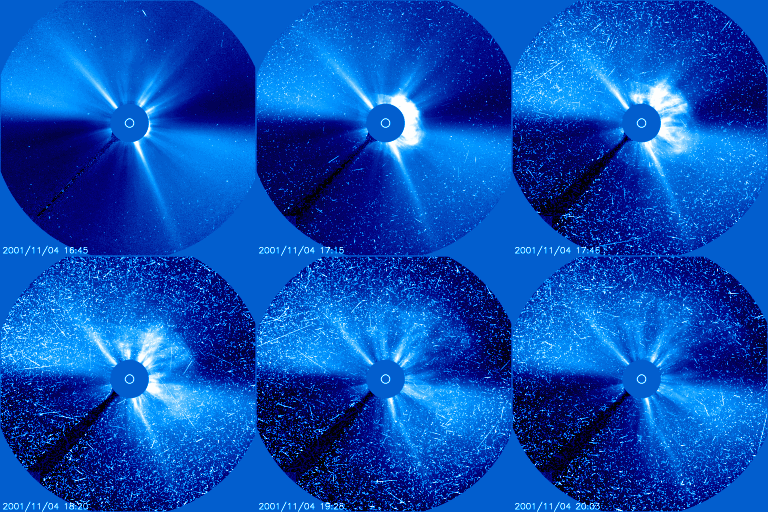
Northern Lights
It should be noted (for those who don't know such things) that this geomagnetic storm will likely produce a great light show in the northern skies, including most of the northern USA (albeit low on the horizon).