Slashdot Mirror
Domain: amazon.com
Stories and comments across the archive that link to amazon.com.
Stories · 1,405
-
Alexa Scientists Claim Audio Watermarking Technique Nearing 100% Accuracy (venturebeat.com)
georgecarlyle76 brought our attention to Amazon's claim of an algorithm that "solves the 'second-screen problem' in real-time."
"Ever hear (no pun intended) of audio watermarking?" asks VentureBeat. It's the process of adding distinctive sound patterns identifiable to PCs, and it's a major way web video hosts, set-top boxes, and media players spot copyrighted tracks. But watermarking schemes aren't particularly reliable in noisy environments, like when the audio in question is broadcasted over a loudspeaker. The resulting noise and interference -- referred to in academic literature as the "second-screen" problem -- severely distorts watermarks, and introduces delays that detectors often struggle to reconcile. Researchers at Amazon, though, believe they've pioneered a novel workaround, which they describe in a paper newly published on the preprint server Arxiv ("Audio Watermarking over the Air with Modulated Self-Correlation") and an accompanying blog post. The team claims their method -- which they'll detail at the International Conference on Acoustics, Speech, and Signal Processing in May -- can detect watermarks added to about two seconds of audio with "almost perfect accuracy," even when the distance between the speaker and detector is greater than 20 feet...
So how's it work? As Tai explains, the model employs a "spread-spectrum" technique in which watermark energy is spread across time and frequency, rendering it inaudible to human ears while robustifying it against postprocessing (like compression). And it generates watermarks from noise blocks of a fixed duration, each of which introduces its own distinct pattern to selected frequency components in the host audio signal. Conventional detectors would compare the resulting sequence of noise blocks -- the decoding key -- with a reference copy. But Tai and colleagues take a different approach: Their algorithm embeds the noise pattern in the audio signal multiple times and compares it to itself. Because said signal passes through the same acoustic environment, Tai explains, instances of the pattern are distorted in similar ways, enabling them to be compared directly. "The detector takes advantage of the distortion due to the acoustic channel, rather than combatting it," he added.
"Audio content that Alexa plays -- music, audiobooks, podcasts, radio broadcasts, movies -- could be watermarked on the fly," explains Amazon's blog post. It argues that this could be useful "so that Alexa-enabled devices can better gauge room reverberation and filter out echoes." -
Is Amazon's AWS Approaching 'War' for Control of Elasticsearch? (datanami.com)
Long-time Slashdot reader jasenj1 and Striek both shared news of a growing open source controversy. "Amazon Web Services on Monday announced that it's partnering with Netflix and Expedia to champion a new Open Distro for Elasticsearch due to concerns of proprietary code being mixed into the open source Elasticsearch project," reports Datanami.
"Elastic, the company behind Elasticsearch, responded by accusing Amazon of copying code, inserting bugs into the community code, and engaging with the company under false pretenses..." In a blog post, Adrian Cockcroft, the vice president of cloud architecture strategy for AWS, says the new project is a "value added" distribution that's 100% open source, and that developers working on it will contribute any improvements or fixes back to the upstream Elasticsearch project. "The new advanced features of Open Distro for Elasticsearch are all Apache 2.0 licensed," Cockroft writes. "With the first release, our goal is to address many critical features missing from open source Elasticsearch, such as security, event monitoring and alerting, and SQL support...." Cockroft says there's no clear documentation in the Elasticsearch release notes over what's open source and what's proprietary. "Enterprise developers may inadvertently apply a fix or enhancement to the proprietary source code," he wrote. "This is hard to track and govern, could lead to breach of license, and could lead to immediate termination of rights (for both proprietary free and paid)."
Elastic CEO Shay Banon responded Tuesday to AWS in a blog post, in which he leveled a variety of accusations at the cloud giant. "Our products were forked, redistributed and rebundled so many times I lost count," Banon wrote. "There was always a 'reason' [for the forks, redistributions, and rebundling], at times masked with fake altruism or benevolence. None of these have lasted. They were built to serve their own needs, drive confusion, and splinter the community." Elastic's commercial code may have provided an "inspiration" for others to follow, Banon wrote, but that inspiration didn't necessarily make for clean code. "It has been bluntly copied by various companies and even found its way back to certain distributions or forks, like the freshly minted Amazon one, sadly, painfully, with critical bugs," he wrote. -
Is Amazon's AWS Approaching 'War' for Control of Elasticsearch? (datanami.com)
Long-time Slashdot reader jasenj1 and Striek both shared news of a growing open source controversy. "Amazon Web Services on Monday announced that it's partnering with Netflix and Expedia to champion a new Open Distro for Elasticsearch due to concerns of proprietary code being mixed into the open source Elasticsearch project," reports Datanami.
"Elastic, the company behind Elasticsearch, responded by accusing Amazon of copying code, inserting bugs into the community code, and engaging with the company under false pretenses..." In a blog post, Adrian Cockcroft, the vice president of cloud architecture strategy for AWS, says the new project is a "value added" distribution that's 100% open source, and that developers working on it will contribute any improvements or fixes back to the upstream Elasticsearch project. "The new advanced features of Open Distro for Elasticsearch are all Apache 2.0 licensed," Cockroft writes. "With the first release, our goal is to address many critical features missing from open source Elasticsearch, such as security, event monitoring and alerting, and SQL support...." Cockroft says there's no clear documentation in the Elasticsearch release notes over what's open source and what's proprietary. "Enterprise developers may inadvertently apply a fix or enhancement to the proprietary source code," he wrote. "This is hard to track and govern, could lead to breach of license, and could lead to immediate termination of rights (for both proprietary free and paid)."
Elastic CEO Shay Banon responded Tuesday to AWS in a blog post, in which he leveled a variety of accusations at the cloud giant. "Our products were forked, redistributed and rebundled so many times I lost count," Banon wrote. "There was always a 'reason' [for the forks, redistributions, and rebundling], at times masked with fake altruism or benevolence. None of these have lasted. They were built to serve their own needs, drive confusion, and splinter the community." Elastic's commercial code may have provided an "inspiration" for others to follow, Banon wrote, but that inspiration didn't necessarily make for clean code. "It has been bluntly copied by various companies and even found its way back to certain distributions or forks, like the freshly minted Amazon one, sadly, painfully, with critical bugs," he wrote. -
Nintendo Reportedly Plans Smaller and Cheaper Switch For This Year (engadget.com)
According to a report from Nikkei, Nintendo is developing a smaller and cheaper version of the Switch focused on portability, and without some of the features in the original console. "A rumor in October suggested Nintendo was developing a new Switch, but instead of improving on the existing model, it's just as likely the company is looking for ways to streamline the system," notes Engadget. From the report: As Ars Technica speculates, the console's plastic dock could be the first thing to go. It's available separately for $90, and there are also cheaper ways to get your Switch to output to a TV (it's relying on a USB-C connection, after all). Nintendo could conceivably move towards a smaller and cheaper screen, and potentially even make the controller a physical part of the console, instead of the removable Joy-Cons. It also wouldn't be out of character for Nintendo to break existing functionality with a console revamp -- the 2DS was a cheaper spin on the 3DS that was still very playable without 3D. -
Facebook's '10 Year Challenge' Meme Could Train Facial Recognition Algorithms On Age Progression, Age Recognition (wired.com)
If you've spent any time on social media lately, you've probably noticed a trend where users are posting their then-and-now profile pictures, mostly from 10 years ago and this year. While this "10 Year Challenge" appears harmless, founder of KO Insights and the author of Tech Humanist, Kate O'Neill, says all this data "could be mined to train facial recognition algorithms on age progression and age recognition." She adds: "It's worth considering the depth and breadth of the personal data we share without reservations." From the report: Imagine that you wanted to train a facial recognition algorithm on age-related characteristics, and, more specifically, on age progression (e.g. how people are likely to look as they get older). Ideally, you'd want a broad and rigorous data set with lots of people's pictures. It would help if you knew they were taken a fixed number of years apart -- say, 10 years. Sure, you could mine Facebook for profile pictures and look at posting dates or EXIF data. But that whole set of profile pictures could end up generating a lot of useless noise. People don't reliably upload pictures in chronological order, and it's not uncommon for users to post pictures of something other than themselves as a profile picture. A quick glance through my Facebook friends' profile pictures shows a friend's dog who just died, several cartoons, word images, abstract patterns, and more. In other words, it would help if you had a clean, simple, helpfully-labeled set of then-and-now photos.
What's more, for the profile pictures on Facebook, the photo posting date wouldn't necessarily match the date that the picture was taken. [...] Through the Facebook meme, most people have been helpfully adding that context back in (e.g. "me in 2008, and me in 2018"), as well as further info, in many cases, about where and how the pic was taken (e.g. "2008 at University of Whatever, taken by Joe; 2018 visiting New City for this year's such-and-such event"). In other words, thanks to this meme, there's now a very large data set of carefully curated photos of people from roughly 10 years ago and now. In closing, Kate says it's not necessarily bad that someone could use your Facebook photos to train a facial recognition algorithm -- it's inevitable. "Still, the broader takeaway here is that we need to approach our interactions with technology mindful of the data we generate and how it can be used at scale." -
IMDb Launches Ad-Supported Movie Streaming Service (theverge.com)
An anonymous reader quotes a report from The Verge: IMDb is known as the place to go to look up details for any film under the sun, and now it's entering the streaming video arena. The company has launched Freedive, a free streaming platform that's supported by periodic ad breaks. The service's films and TV shows are available to registered IMDb or Amazon users and Amazon Fire TV owners. (The list of compatible devices is the same as the list for Prime Video.) Fire owners can navigate the service by way of a new icon in the "Your Apps & Channels" section or by telling their Amazon smart device, "Alexa, go to Freedive." The site says it will continually add new offerings to the site. The site will also indicate on a film's page if it's available on Freedive. -
AWS Launches Fully-Managed Document Database Service (zdnet.com)
An anonymous reader quotes a report from ZDNet: Amazon Web Services (AWS) has announced a fully-managed document database service, building the Amazon DocumentDB (with MongoDB compatibility) to support existing MongoDB workloads. The cloud giant said developers can use the same MongoDB application code, drivers, and tools as they currently do to run, manage, and scale workloads on Amazon DocumentDB. Amazon DocumentDB uses an SSD-based storage layer, with 6x replication across three separate Availability Zones. This means that Amazon DocumentDB can failover from a primary to a replica within 30 seconds, and supports MongoDB replica set emulation so applications can handle failover quickly. Each MongoDB database contains a set of collections -- similar to a relational database table -- with each collection containing a set of documents in BSON format. Amazon DocumentDB is compatible with version 3.6 of MongoDB and storage can be scaled from 10 GB up to 64 TB in increments of 10 GB. The new offering implements the MongoDB 3.6 API that allows customers to use their existing MongoDB drivers and tools with Amazon DocumentDB. In a separate report, TechCrunch's Frederic Lardinois says AWS is "giving open source the middle finger" by "taking the best open-source projects and re-using and re-branding them without always giving back to those communities."
"The wrinkle here is that MongoDB was one of the first companies that aimed to put a stop to this by re-licensing its open-source tools under a new license that explicitly stated that companies that wanted to do this had to buy a commercial license," Frederic writes. "Since then, others have followed."
"Imitation is the sincerest form of flattery, so it's not surprising that Amazon would try to capitalize on the popularity and momentum of MongoDB's document model," MongoDB CEO and president Dev Ittycheria told us. "However, developers are technically savvy enough to distinguish between the real thing and a poor imitation. MongoDB will continue to outperform any impersonations in the market." -
'Amazon Prime is Getting Worse' (fastcompany.com)
Mark Wilson, writing for FastCompany magazine: That little Prime logo used to mean something. Now it feels like a ruse that lulls shoppers into a false sense of security, until they go to checkout and see a shipping arrival date far later than anticipated. This cuts through the greatest promise of Prime. It's not just the free, two-day shipping. It's that it's so reliable, you never have to think for more than a second about buying something. In this sense, Prime was constructed to be great for the consumer (so efficient) and great for businesses (mindless impulse shopping!). I've been a Prime member myself for over a decade, so I've come to expect that the rush of the holiday season will clog the arteries of Amazon's fulfillment centers and delivery services alike and make shipping less than reliable. But anecdotally, to me and many of the people I know and work with, this year, it feels worse than ever.
It doesn't help that we've seen a slow dilution of Prime itself over time, with the rise of Prime Pantry and Add-on Items. They force you to buy a minimum number of items to get the best deal, adding back the very psychic burden Prime had eliminated from the equation of online shopping in the first place. As a result, it can be hard to find true, two-day Prime items that aren't marked up to insane prices by third-party sellers. But Prime was still Prime. This holiday, I've noticed things that are in stock and labeled "Prime" have nonsensical shipping dates. I'm not alone in experiencing Shipping Shock. Complaints about slow Prime shipping abound across the internet. Quora literally has a thread asking, "Has Amazon slowed down their free shipping speed intentionally?" The "top answer" with 22,000 views is a customer rant about late shipments. Many others chime in to confirm the slowdowns, and offer conspiracy theories as to what could be going on. -
Alexa Gets Hooked Up To a Singing Fish Toy, and Mocked By Jimmy Kimmel (mashable.com)
An anonymous reader writes: An updated version of the singing "Big Mouth Billy Bass" plastic fish toy now speaks (with synchronized lip movements) with the voice of Alexa. "Your humdrum life will be totally uprooted because you hung a talking fish on your wall," jokes Fast Company. "Just imagine setting an alarm and being woken up by a Big Mouth Billy Bass dancing and flopping around while it sings to you," adds Mashable.
But more than half the device's 100 reviews from Amazon customer's award it just one star (with another 15% awarding two stars). "The programming on these fish are awful," wrote one reviewer, complaining that the sound continues coming from the Echo device (rather than through the fish's speaker), and when it does actualy sync to the music, "the tail flaps and head movements are off-beat and look terrible."
Meanwhile, late-night talk show host Jimmy Kimmel recently staged a skit with a carolling "choir" of Amazon's smart speakers dressed in Christmas sweaters and caps — a skit which ends with the devices producing a horrific cacophony that Kimmel was unable stop. Kimmel then instructs a stagehand to bring the choir of singing Alexa units "to the ocean, and dump it in." -
Alexa Gets Hooked Up To a Singing Fish Toy, and Mocked By Jimmy Kimmel (mashable.com)
An anonymous reader writes: An updated version of the singing "Big Mouth Billy Bass" plastic fish toy now speaks (with synchronized lip movements) with the voice of Alexa. "Your humdrum life will be totally uprooted because you hung a talking fish on your wall," jokes Fast Company. "Just imagine setting an alarm and being woken up by a Big Mouth Billy Bass dancing and flopping around while it sings to you," adds Mashable.
But more than half the device's 100 reviews from Amazon customer's award it just one star (with another 15% awarding two stars). "The programming on these fish are awful," wrote one reviewer, complaining that the sound continues coming from the Echo device (rather than through the fish's speaker), and when it does actualy sync to the music, "the tail flaps and head movements are off-beat and look terrible."
Meanwhile, late-night talk show host Jimmy Kimmel recently staged a skit with a carolling "choir" of Amazon's smart speakers dressed in Christmas sweaters and caps — a skit which ends with the devices producing a horrific cacophony that Kimmel was unable stop. Kimmel then instructs a stagehand to bring the choir of singing Alexa units "to the ocean, and dump it in." -
Alexa is Implementing Self-Learning Techniques To Better Understand Users (theverge.com)
In a developer blog post published this week, Alexa AI director of applied science Ruhi Sarikaya detailed the advances in machine learning technologies that have allowed Alexa to better understand users through contextual clues. From a report: According to Sarikaya, these improvements have played a role in reducing user friction and making Alexa more conversational. Since this fall, Amazon has been working on self-learning techniques that teach Alexa to automatically recover from its own errors. The system has been in beta until now, and it launched in the US this week. It doesn't require any human annotation, and, according to Sarikaya, it uses customers' "implicit or explicit contextual signals to detect unsatisfactory interactions or failures of understanding."
The contextual signals range from customers' historical activity, preferences, and what Alexa skills they use to where the Alexa device is located in the home and what kind of Alexa device it is. For example, during the beta phase, Alexa learned to understand a customer's mistaken command of "Play 'Good for What'" and correct them by playing Drake's song "Nice for What." -
Amazon Is Launching Pay-As-You-Go Cloud Computing In Space (technologyreview.com)
At its annual re:Invent conference in Seattle this week, Amazon unveiled a service that lets owners of satellites rent time on Amazon-managed ground stations to send and receive data from orbit. "The service, called AWS Ground Station, works in much the same way as Amazon's well-established business for tapping computing capacity via the cloud," reports MIT Technology Review. From the report: According to an AWS blog post, big businesses with a large number of satellites typically build and operate their own ground stations at a cost of a million dollars or more for each one. Smaller companies that can't afford their own often end up signing inflexible, long-term contracts with third parties that own and run such stations. The new service will let satellite operators get access to a ground station at short notice on a pay-as-you-go basis. Those who know how much capacity they will need well in advance can book ahead and pay less for downlink time. AWS is kicking off with a pair of ground stations and says it will have a total of a dozen up and running by the middle of next year. It will monitor how demand develops before deciding how many more stations to add. -
Amazon Starts Selling Software To Mine Patient Health Records (wsj.com)
An anonymous reader quotes a report from The Wall Street Journal: Amazon is starting to sell software to mine patient medical records (Warning: source paywalled; alternative source) for information that doctors and hospitals could use to improve treatment and cut costs, the latest move by a big technology company into the health care industry. The software can read digitized patient records and other clinical notes, analyze them and pluck out key data points, Amazon says. The company is expected to announce the launch Tuesday. Amazon Web Services, the company's cloud-computing division, has been selling such text-analysis software to companies outside medicine for use in areas such as travel booking, customer support and supply-chain management. The technology's health-care application is the newest effort by Amazon to tap into the lucrative market.
Amazon officials say the company's software developers trained the system using a process known as deep learning to recognize all the ways a doctor might record notes. "We're able to completely, automatically look inside medical language and identify patient details," including diagnoses, treatments, dosage and strengths, "with incredibly high accuracy," said Matt Wood, general manager of artificial intelligence at Amazon Web Services. During testing, the software performed on par or better than other published efforts, and can extract data on patients' diseases, prescriptions, lab orders and procedures, said Taha Kass-Hout, a senior leader with Amazon's health-care and artificial intelligence efforts. The project is called Amazon Comprehend Medical, which "allows developers to process unstructured medical text and identify information such as patient diagnosis, treatments, dosages, symptoms and signs, and more," according to a blog post. Dr. Kass-Hout says Amazon Web Services won't see the data processed by its algorithms, "which will be encrypted and unlocked by customers who have the key," reports WSJ. -
Amazon Opens Up Its Internal Machine Learning Training To Everyone (amazon.com)
Amazon announced Monday that it's making the machine learning courses it uses to train its engineers available to everybody for free. The course is tailored to four major groups -- developers, data scientists, data platform engineers and business professionals -- and it offers both foundational level lessons as well as more advanced instruction. -
Virginia To Produce 25K-35K Additional CS Grads As Part of Amazon HQ2 Deal (loudounnow.com)
theodp writes: Developers! Developers! Developers! To make good on the proposal that snagged it a share of the Amazon HQ2 prize, the State of Virginia is also apparently on the hook for doubling the annual number of graduates with computer science or closely related degrees, with a goal to add 25,000 to 35,000 graduates (Amazon's HQ2 RFP demanded info on "education programs related to computer science"). To do that, the state will establish a performance-based investment fund for higher education institutions to expand their bachelor's degree programs, and spend up to $375 million on George Mason University's Arlington campus and a new Virginia Tech campus in Alexandria. The state will also spend $50 million on STEM + CS education in public schools and expanding internships for higher education students.
Amazon is certainly focused on boosting the ranks of software engineer types. Earlier this month, Amazon launched Amazon Future Engineer, a program that aims to teach more than 10 million students a year how to code, part of a $50 million Amazon commitment to computer science education that was announced last year at a kickoff event for the Ivanka Trump-led White House K-12 CS Initiative. And on Wednesday, Amazon-bankrolled Code.org -- Amazon is a $10+ million Diamond Supporter of the nonprofit; CS/EE grad Jeff Bezos is a $1+ million Gold Supporter -- announced it has teamed with Amazon Future Engineer to build and launchHour of Code: Dance Party, a signature tutorial for this December's big Hour of Code (powered by AWS in 2017), which has become something of a corporate infomercial (Microsoft recently boasted "learners around the world have completed nearly 100 million Minecraft Hour of Code sessions"). Students participating in the Dance Party tutorial, Code.org explained, can choose from 30 hits like Katy Perry's "Firework" and code interactive dance moves and special effects as they learn basic CS concepts. "The artists whose music is used in this tutorial are not sponsoring or endorsing Amazon as part of licensing use of their music to Code.org," stresses a footnote in Code.org's post. So, don't try to make any connections between Katy Perry's Twitter endorsement of the Code.org/Amazon tutorial later that day and those same-day follow-up Amazon and Katy Perry tweets touting their new exclusive Amazon Music streaming deal, kids! -
Ask Slashdot: How To Fix an Outdated College Tech Curriculum?
An anonymous reader writes: As a student, what's the best way to bring change to an outdated college tech curriculum?
The background on this is that I have 15 years of experience in the field and a very healthy amount of industry-recognized training and certifications. I'm merely finishing up my degree to flesh out my resume -- I haven't learned much from the program that I don't already know. However, the program would have benefited me greatly 15 years ago. It's a great program, except for a biometrics class that is absolutely behind the curve. The newest publication on the syllabus is from 2009. This is simply teaching the students outdated and often wrong information.
Additionally, a lot of the material seems like it was stretched to make a full semester class in biometrics in the first place -- most of the material, honestly, could be compressed to about two hours of lecture and still be delivered at a reasonable rate.
What's the best way for a student in my situation to get this fixed so the school stops wasting student's time with outdated and wrong information? -
150 San Franciscans Explain How Tech Money Changed Their City (sfchronicle.com)
DevNull127 writes: In a remarkable odyssey, documentary-maker Cary McClelland interviewed more than 150 San Francisco residents — including a tattoo artist, a longshoreman, a venture capitalist, and a pawnshop owner — to capture the real voices of a changing city, in a kind of oral history of the present. It becomes a magical "documentary without film... panoramic, complex — and surprisingly well-balanced," writes one reader, applauding the book's "dazzling omniscience." Legendary Silicon Valley marketer Regis McKenna speaks fondly of the days when young Steve Wozniak and Steve Jobs were dropping into his office, and despite the apparent challenges facing San Francisco, many people interviewed remained surprisingly hopeful.
"Idexa, a German-born tattoo artist who'd hitchhiked to the city from Los Angeles as a teenager, says despite the new displacements happening today, 'It's also beautiful. There's been a lot of money put into the neighborhood and into the buildings. Buildings that would have fallen apart have been renovated. Oh, it's the end of the world soon. We're not the first generation who thinks that.' It's an almost poetic picture of San Francisco that proves the world isn't as simple — or as discouraging — as it's often made out to be, and the book's passionate purpose seems to spontaneously find its way into the words of each interview subject."
"Until you're standing in front of someone and listening to them with your own ears, you're never going to understand them," says a survivor of one of California's recent wildfires. So Cary McClelland listens — writing in his introduction that his book asks us to hear the city of San Francisco speak in a chorus of voices, with a message for all the other cities. "The goal of the book," he says, "is to reflect people's subjective perspective, their experience — lived, visceral, emotional, intimate. The living-room experience..." -
Does Amazon Owe Wikipedia For Taking Advantage of The Free Labor of Their Volunteers? (slate.com)
Slate's Rachel Withers argues that "tech companies that profit from Wikipedia's extensive database owe Wikimedia a much greater debt." Amazon's Alexa, for example, uses Wikipedia "without credit, contribution, or compensation." The Google Assistant also sources Wikipedia, but they credit the encyclopedia -- and other sites -- when it uses it as a resource. From the report: Amazon recently donated $1 million to the Wikimedia Endowment, a fund that keeps Wikipedia running, as "part of Amazon's and CEO Jeff Bezos' growing work in philanthropy," according to CNET. It's being framed as a "gift," one that -- as Amazon puts it -- recognizes their shared vision to "make it easier to share knowledge globally." Obviously, and as alluded to by CNET, $1 million is hardly a magnanimous donation from Amazon and Bezos, the former a trillion-dollar company and the latter a man with a net worth of more than $160 billion. But it's not just the fact that this donation is, in the scheme of things, paltry. It's that this "endowment" is dwarfed by what Amazon and its ilk get out of Wikipedia -- figuratively and literally. Wikipedia provides the intelligence behind many of Alexa's most useful skills, its answers to everything from "What is Wikipedia?" to "What is Slate?" (meta).
Amazon's know-it-all Alexa is renowned for its ability to answer questions, but Amazon didn't compile all that data itself; according to the Amazon developer forum, "Alexa gets her information from a variety of trusted sources such as IMDb, Accuweather, Yelp, Answers.com, Wikipedia and many others." Nor did it pay those who did: While Amazon customers pay at least $39.99 for an Echo device (and the pleasure of asking Alexa questions), Alexa freely pulls this information from the internet, leeching off the hard work performed by Wikipedia's devoted volunteers (and unlike high school students, it doesn't even bother to change a few words around). It's hardly noble for Amazon to support Wikipedia, considering how much Alexa uses its services, nor is it particularly selfless to fund the encyclopedia when it relies upon its peer-reviewed accuracy; ultimately, helping Wikipedia helps Amazon, too. [...] We all benefit from Wikipedia, but arguably no one more than the smart speakers, for which the internet's encyclopedia is a valuable and value-adding resource. It's frankly a little exploitative how little they give back. Withers goes on to note that Wikipedia seeks donations from its users -- it's a non-profit that runs entirely on donations from the general public. While one can argue that "Amazon is only packing up information that we ourselves leech for free all the time, [...] Alexa is also diverting people away from visitng Wikipedia pages, where they might noticed a little request for a donation, or from realizing they are using Wikipedia's resources at all," Withers writes.
A report from TechCrunch earlier this year pointed out that Amazon is the only one of the big tech players not found on Wikimedia's 2017-2018 corporate donor list -- one that includes Apple, Google, and even Amazon's Seattle-based sibling Microsoft, all of which matched employee donations to the tune of $50,000. -
Apple Insiders Say Nobody Internally Knows What's Going On With Bloomberg's China Hack Story (buzzfeednews.com)
An anonymous reader quotes a report from BuzzFeed News: Multiple senior Apple executives, speaking with BuzzFeed News on the condition of anonymity so that they could speak freely all denied and expressed confusion with a report earlier this week that the company's servers had been compromised by a Chinese intelligence operation. On Thursday morning, Bloomberg Businessweek published a bombshell investigation. The report -- the result of more than a year of reporting and over 100 interviews with intelligence and company sources -- alleged that Chinese spies compromised and infiltrated almost 30 U.S. companies including Apple and Amazon by embedding a tiny microchip inside company servers. Both Amazon and Apple issued uncharacteristically strong and detailed denials of Bloomberg's claims.
Reached by BuzzFeed News multiple Apple sources -- three of them very senior executives who work on the security and legal teams -- said that they are at a loss as to how to explain the allegations. These people described a massive, granular, and siloed investigation into not just the claims made in the story, but into unrelated incidents that might have inspired them. A senior security engineer directly involved in Apple's internal investigation described it as "endoscopic," noting they had never seen a chip like the one described in the story, let alone found one. "I don't know if something like this even exists," this person said, noting that Apple was not provided with a malicious chip or motherboard to examine. "We were given nothing. No hardware. No chips. No emails." Equally puzzling to Apple execs is the assertion that it was party to an FBI investigation -- Bloomberg wrote that Apple "reported the incident to the FBI." A senior Apple legal official told BuzzFeed News the company had not contacted the FBI, nor had it been contacted by the FBI, the CIA, the NSA or any government agency in regards to the incidents described in the Bloomberg report. This person's purview and responsibilities are of such a high level that it's unlikely they would not have been aware of government outreach. -
Is Tech Billionaires' Educational Philanthropy a Bug Or a Feature?
Long-time reader theodp writes: Some education watchers have adopted a wait-and-see response to Jeff Bezos' two-pronged $2B pledge to aid the homeless and to establish preschools for low-income children (Mark Zuckerberg's The Primary School interestingly prefers 'em even younger, noting "we admit students at or before birth"). Not so Audrey Watters, who presents her misgivings in a blog post, titled, "It's Like Amazon, But for Preschool" (tl;dr: read her URL), wondering what a chain of preschools that "use the same set of principles that have driven Amazon" might look like, considering Amazon's own labor practices. She asks, "Are private preschool chains really the path we want to pursue, particularly if we believe that access to excellent early childhood education is so incredibly crucial? Can the gig economy and the algorithm ever provide high quality preschool? For all the flaws in the public school system, it's important to remember: there is no accountability in billionaires' educational philanthropy." Sharing Watters' concerns is author Anand Giridharadas, who argues in his new book Winners Take All that the wealthy pursue social change without uprooting the systems that produce inequality. Bezos has a "a stark opportunity to be a traitor to his class, to actually think about giving in ways that transform the system atop which he stands," Giridharadas said. "It is great to be a winner who gives back. It is even better to be a winner who thinks about how winners can take less." -
Professor Who Coined Term 'Net Neutrality' Thinks It's Time To Break Up Facebook (theverge.com)
pgmrdlm shares a report from The Verge: Best known for coining the phrase "net neutrality" and his book The Master Switch: The Rise and Fall of Information Empires, Wu has a new book coming out in November called The Curse of Bigness: Antitrust in the New Gilded Age. In it, he argues compellingly for a return to aggressive antitrust enforcement in the style of Teddy Roosevelt, saying that Google, Facebook, Amazon, and other huge tech companies are a threat to democracy as they get bigger and bigger. "We live in America, which has a strong and proud tradition of breaking up companies that are too big for inefficient reasons," Wu told me on this week's Vergecast. "We need to reverse this idea that it's not an American tradition. We've broken up dozens of companies."
"I think if you took a hard look at the acquisition of WhatsApp and Instagram, the argument that the effects of those acquisitions have been anticompetitive would be easy to prove for a number of reasons," says Wu. And breaking up the company wouldn't be hard, he says. "What would be the harm? You'll have three competitors. It's not 'Oh my god, if you get rid of WhatsApp and Instagram, well then the whole world's going to fall apart.' It would be like 'Okay, now you have some companies actually trying to offer you an alternative to Facebook.'" Breaking up Facebook (and other huge tech companies like Google and Amazon) could be simple under the current law, suggests Wu. But it could also lead to a major rethinking of how antitrust law should work in a world where the giant platform companies give their products away for free, and the ability for the government to restrict corporate power seems to be diminishing by the day. And it demands that we all think seriously about the conditions that create innovation. "I think everyone's steering way away from the monopolies, and I think it's hurting innovation in the tech sector," says Wu. -
J.R.R. Tolkein's Last Book Finally Published (cnet.com)
An anonymous reader quotes CNET: J.R.R. Tolkien fans can get their hands on what might be the late author's final work. The Fall of Gondolin was published August 30 by Houghton Mifflin Harcourt in the US and HarperCollins in the UK. J.R.R. Tolkien died in 1973, but since his death, his son Christopher, now 93, has edited a number of his father's works, including this one. The book tells of the founding of the Elven city of Gondolin, and is considered one of Tolkien's Lost Tales... The Fall of Gondolin follows another posthumously published Lost Tale, The Tale of Beren and Luthien, which came out in 2017. At the time, many expected that book to be J.R.R. Tolkien's final published work. Christopher Tolkien even wrote in its preface that it was "(presumptively) my last book in the long series of my father's writings." But now, Entertainment Weekly reports, Christopher Tolkien has written that "The Fall of Gondolin is indubitably the last."
The book is illustrated by Alan Lee, who has illustrated numerous Tolkien books, and along with Grant Major and Dan Hennah won an Oscar for best art direction for the 2003 film, The Lord of the Rings: The Return of the King.
The Washington Post includes the book's description of a "hideous mechanical army" deployed in battle against Gondolin, and summarizes the book's plot. "In short, the evil overlord Morgoth -- called Melko here -- seeks to dominate the entire world, but the hidden elvish city of Gondolin remains out of his grasp."
"We are reminded that Tolkien first drafted this story while in the hospital recuperating from the Battle of the Somme." -
J.R.R. Tolkein's Last Book Finally Published (cnet.com)
An anonymous reader quotes CNET: J.R.R. Tolkien fans can get their hands on what might be the late author's final work. The Fall of Gondolin was published August 30 by Houghton Mifflin Harcourt in the US and HarperCollins in the UK. J.R.R. Tolkien died in 1973, but since his death, his son Christopher, now 93, has edited a number of his father's works, including this one. The book tells of the founding of the Elven city of Gondolin, and is considered one of Tolkien's Lost Tales... The Fall of Gondolin follows another posthumously published Lost Tale, The Tale of Beren and Luthien, which came out in 2017. At the time, many expected that book to be J.R.R. Tolkien's final published work. Christopher Tolkien even wrote in its preface that it was "(presumptively) my last book in the long series of my father's writings." But now, Entertainment Weekly reports, Christopher Tolkien has written that "The Fall of Gondolin is indubitably the last."
The book is illustrated by Alan Lee, who has illustrated numerous Tolkien books, and along with Grant Major and Dan Hennah won an Oscar for best art direction for the 2003 film, The Lord of the Rings: The Return of the King.
The Washington Post includes the book's description of a "hideous mechanical army" deployed in battle against Gondolin, and summarizes the book's plot. "In short, the evil overlord Morgoth -- called Melko here -- seeks to dominate the entire world, but the hidden elvish city of Gondolin remains out of his grasp."
"We are reminded that Tolkien first drafted this story while in the hospital recuperating from the Battle of the Somme." -
Bill Gates Argues 'Supply and Demand' Doesn't Apply To Software (gatesnotes.com)
"Not enough people are paying attention to this economic trend," writes Bill Gates, challenging the widespread use of forecasts and policies based on a "supply and demand" economic model. An anonymous reader quotes the Gates Notes blog: Software doesn't work like this. Microsoft might spend a lot of money to develop the first unit of a new program, but every unit after that is virtually free to produce. Unlike the goods that powered our economy in the past, software is an intangible asset. And software isn't the only example: data, insurance, e-books, even movies work in similar ways.
The portion of the world's economy that doesn't fit the old model just keeps getting larger. That has major implications for everything from tax law to economic policy to which cities thrive and which cities fall behind, but in general, the rules that govern the economy haven't kept up. This is one of the biggest trends in the global economy that isn't getting enough attention. If you want to understand why this matters, the brilliant new book Capitalism Without Capital by Jonathan Haskel and Stian Westlake is about as good an explanation as I've seen.... They don't act like there's something evil about the trend or prescribe hard policy solutions. Instead they take the time to convince you why this transition is important and offer broad ideas about what countries can do to keep up in a world where the "Ec 10" supply and demand chart is increasingly irrelevant.
"What the book reinforced for me is that lawmakers need to adjust their economic policymaking to reflect these new realities," Gates writes, adding "a lot has changed since the 1980s. It's time the way we think about the economy does, too." -
Amazon AI Researchers Release a Dataset of 400,000 Transliterated Names To Aid the Development of Natural-Language-Understanding Systems (amazon.com)
New submitter georgecarlyle76 writes: Amazon AI researchers have publicly released a dataset of almost 400,000 transliterated names, to aid the development of natural-language-understanding systems that can search across databases that use different scripts. They describe the dataset's creation in a paper [PDF] they're presenting at COLING, together with experiments using the dataset to train different types of machine learning models. -
Doug Grindstaff, 'Star Trek' Sound Effects Maestro, Dies At 87 (hollywoodreporter.com)
Doug Grindstaff, a five-time Emmy Award winner behind Star Trek's Tribble coos, communicator beeps, and Enterprise bridge door whooshes, has died at 87. The Hollywood Reporter looks back at Grindstaff's contributions to the Star Trek universe: [Grindstaff] received 14 Emmy nominations in all -- including one for Star Trek in 1967 -- and won for his editing on The Immortal in 1970, Medical Story in 1976, Police Story in 1978, Power in 1980 and Max Headroom in 1987. Working with Jack Finlay and Joseph Sorokin, Grindstaff created the background sounds and effects used on NBC's Star Trek. These sounds included red alert klaxons, the whoosh of Enterprise bridge doors opening/closing, heartbeats, boatswain whistles, sickbay scanners and communicator beeps and the acoustics that invoked phasers striking deflector shields and transporter materialization (and dematerialization).
In a 2016 interview for the Audible Range blog, Grindstaff noted that Star Trek creator Gene Roddenberry "wanted to paint the whole show [with sound] like you were painting a picture. "And he wanted sounds everywhere. One time I asked him, 'Don't you think we're getting too cartoony?' Because I felt it should be a little more dignified, but he wanted sound for everything. For example, I worked on one scene where [Dr. McCoy] is giving someone a shot. Gene says, 'Doug, I'm missing one thing. The doctor injects him and I don't hear the shot.' I said, 'You wouldn't hear a shot, Gene.' He said, 'No, no, this is Star Trek, we want a sound for it.' "So I turned around to the mixing panel and said, 'Do you guys have an air compressor?' And they did. I fired up the air compressor, squirted it for a long enough period by the mic, went upstairs, played with it a little bit and then put it in the show. And Gene loved it. So, that's how Gene was. He didn't miss nothing!" Grindstaff said he created Tribble coos by manipulating the sound of a dove. -
New Book Paints Different Picture of Workplace Behavior At Google and Facebook
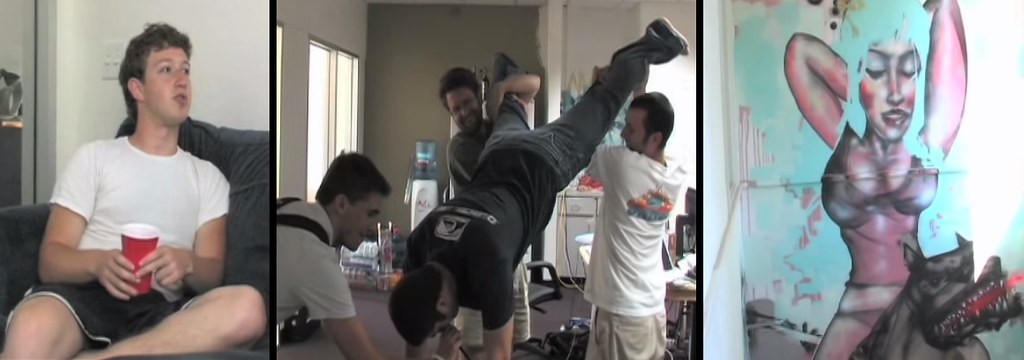
Longtime Slashdot reader theodp writes: In Valley of Genius: The Uncensored History of Silicon Valley (As Told by the Hackers, Founders, and Freaks Who Made It Boom), Adam Fisher paints quite a different picture of life at now-workforce behavior preachers Google and Facebook, revealing that the tech giants' formative days were filled with the kind of antics that run afoul of HR protocols. Google was not a normal place, begins an excerpt in Vanity Fair that includes some juicy quotes attributed to Google executive chef Charlie Ayers about Google's founders ("Sergey's the Google playboy. He was known for getting his fingers caught in the cookie jar with employees that worked for the company in the masseuse room. He got around.") And in Sex, Beer, and Coding, Wired runs an excerpt about Facebook's wild early days, which even extended to the artwork gracing its office ("The office was on the second floor, so as you walk in you immediately have to walk up some stairs, and on the big 10-foot-high wall facing you is just this huge buxom woman with enormous breasts wearing this Mad Max-style costume riding a bulldog. It's the most intimidating, totally inappropriate thing. [...] That set a tone for us. A huge-breasted warrior woman riding a bulldog is the first thing you see as you come in the office, so like, get ready for that!" So, what changed? "When Sheryl Sandberg joined the company is when I saw a vast shift in everything in the company," said Ayers about Google. Sandberg later became Facebook's grown-up face. -
Ask Slashdot: Did Baby Boomers Break America? (time.com)
"Automation taking jobs is only one symptom of a larger problem," argues an anonymous Slashdot reader, sharing a link to this excerpt from Steven Brill's new book Tailspin, which seeks to identify "the people and forces behind America's fifty-year fall -- and those fighting to reverse it." The excerpt has this intriguing title: "How Baby Boomers Broke America." As my generation of achievers graduated from elite universities and moved into the professional world, their personal successes often had serious societal consequences. They upended corporate America and Wall Street with inventions in law and finance that created an economy built on deals that moved assets around instead of building new ones. They created exotic, and risky, financial instruments, including derivatives and credit default swaps, that produced sugar highs of immediate profits but separated those taking the risk from those who would bear the consequences. They organized hedge funds that turned owning stock into a minute-by-minute bet rather than a long-term investment... Regulatory agencies were overwhelmed by battalions of lawyers who brilliantly weaponized the bedrock American value of due process so that, for example, an Occupational Safety and Health Administration rule protecting workers from a deadly chemical could be challenged and delayed for more than a decade and end up being hundreds of pages long. Lawyers then contested the meaning of every clause while racking up fees of hundreds of dollars per hour from clients who were saving millions of dollars on every clause they could water down...
As government was disabled from delivering on vital issues, the protected were able to protect themselves still more. For them, it was all about building their own moats. Their money, their power, their lobbyists, their lawyers, their drive overwhelmed the institutions that were supposed to hold them accountable -- government agencies, Congress, the courts... That, rather than a split between Democrats and Republicans, is the real polarization that has broken America since the 1960s. It's the protected vs. the unprotected, the common good vs. maximizing and protecting the elite winners' winnings... [I]n a way unprecedented in history, they were able to consolidate their winnings, outsmart and co-opt the forces that might have reined them in, and pull up the ladder so more could not share in their success or challenge their primacy.
Brill argues that the unprotected need things like "a realistic shot at justice in the courts," writing that instead "the First Amendment became a tool for the wealthy to put a thumb on the scales of democracy." And he shares these statistics about the rest of America today:- For adults in their 30s, the chance of earning more than their parents dropped to 50% from 90% just two generations earlier.
- In 2017, household debt had grown higher than the peak reached in 2008 before the crash, with student and automobile loans staking growing claims on family paychecks.
- Although the U.S. remains the world's richest country, it has the third-highest poverty rate among the 35 nations in the Organisation for Economic Co-operation and Development...
Has he identified the source of a societal malaise? Leave your own thoughts in the comments.
And is Brill's thesis correct? Did baby boomers break America? -
Lenovo Teases a True All-Screen Smartphone With No Notch (cnet.com)
An anonymous reader quotes a report from CNET: Notches, it seems, are the new black. Originally seen -- and often criticized -- on the Essential PH-1 and iPhone X in 2017, the trend of adding notches to Android phones has only accelerated this year as phone makers look to maximize the screen size. But the Lenovo Z5 is going the other way: It's truly all-screen, and notch-free. At least, that's according to a sketch shared last Friday by Lenovo VP Chang Cheng on Weibo, a Twitter-like platform in China. Cheng's teaser post says (according to Google Translate) that the Lenovo Z5 is the company's new flagship phone. Besides that, the post leaves it pretty vague.
All-screen phones look cool, but they challenge the manufacturer to find a place to put front cameras, sensors and other hardware. That's why we see bezels on some phones and notches on others. It's not clear what Lenovo plans to do with the front camera on the Lenovo Z5. Cheng's post claims that "four technological breakthroughs" and "18 patented technologies" were made for the phone, but doesn't go into details. One of the first smartphones to launch with an edge-to-edge display was the Xiaomi Mi Mix. It launched with next to no bezel or notch, leaving many to wonder where the earpiece would be. What Xiaomi managed to do was use what it calls "cantilever piezoelectric ceramic acoustic technology." Basically, it's a component that converts electrical energy into mechanical energy to transfer to the phone's internal metal frame, which then vibrates to create sound. It's possible the Z5 relies on a similar technology, or bone conduction technology found in many headphones and some smartphones.
Aside from the front-facing camera and ambient light sensors, the other components that are typically found on the front of smartphones are relatively easy to drag-and-drop to different locations. For example, the speakers in the Z5 are likely bottom facing and the navigation controls are almost certainly software based. The question is whether or not it's worth having a true all-screen smartphone if it means there's no front-facing camera, ambient light sensors, or stereo speakers. -
Devices Supporting Google Assistant Have More Than Tripled In Last Four Months
In a blog post on Thursday, Google announced that their smart assistant is now compatible with more than 5,000 devices. That's up from the 1,500 devices it worked with back in January. The Verge reports: According to Google, it's a list made up of a huge variety of products, including "cameras, dishwashers, doorbells, dryers, lights, plugs, thermostats, security systems, switches, vacuums, washers, fans, locks, sensors, heaters, AC units, air purifiers, refrigerators, and ovens." It's a big jump -- at least, numerically speaking -- and if nothing else, it's a sign that the full court press that Google started at the beginning of the year with its massive Google Assistant-themed booth at CES is starting to show some results. For comparison, Apple's Homekit is compatible with 195 products while Amazon's Alexa assistant currently supports over 12,000 devices. -
Facebook's Phone-Free, Wireless 'Oculus Go' VR Headset Is Released Today
UnknownSoldier writes: The Oculus Go is finally available for purchase. Amazon is selling the 32GB model for $199, while the 64GB model is selling for $249. As a standalone virtual reality unit, it doesn't require a computer or phone to use. Ironically, you must use a phone for the initial setup. Reviews are out on The Verge and Ars Technica. The TL;DR -- Pros: Inexpensive; Cons: LCD, fixed 72 Hz rate, limited motion tracking. Will 2018 finally will be the year of cheap VR? -
Amazon Web Services Starts Blocking Domain-Fronting (theverge.com)
Earlier this month, Google announced it is discontinuing domain fronting, a practice that lets developers disguise their traffic to evade network blocks. Now, Amazon Web Services has announced a similar move to implement a new set of enhanced domain protections specifically designed to stop domain fronting. The Verge reports: In the post, Amazon characterized the change as an effort to stamp out malware. "Tools including malware can use this technique between completely unrelated domains to evade restrictions and blocks that can be imposed at the TLS/SSL layer," the post explained. "No customer ever wants to find that someone else is masquerading as their innocent, ordinary domain." Domain-fronting works by using major cloud providers as a kind of proxy, making a data request seem like it's heading to a major service like Google or Amazon only to be forwarded along to a third party once it reaches the broader internet. Unfortunately for circumvention tools, neither Amazon nor Google will let them pull that trick anymore. Amazon will still allow domain fronting within domains owned by the same customer (or more specifically, listed under the same SSL certificate), but customers can no longer use the technique to disguise where data is going, making it far less useful for blocked apps. -
New Book Describes 'Bluffing' Programmers in Silicon Valley (theguardian.com)
Long-time Slashdot reader Martin S. pointed us to this an excerpt from the new book Live Work Work Work Die: A Journey into the Savage Heart of Silicon Valley by Portland-based investigator reporter Corey Pein.
The author shares what he realized at a job recruitment fair seeking Java Legends, Python Badasses, Hadoop Heroes, "and other gratingly childish classifications describing various programming specialities." I wasn't the only one bluffing my way through the tech scene. Everyone was doing it, even the much-sought-after engineering talent. I was struck by how many developers were, like myself, not really programmers, but rather this, that and the other. A great number of tech ninjas were not exactly black belts when it came to the actual onerous work of computer programming. So many of the complex, discrete tasks involved in the creation of a website or an app had been automated that it was no longer necessary to possess knowledge of software mechanics. The coder's work was rarely a craft. The apps ran on an assembly line, built with "open-source", off-the-shelf components. The most important computer commands for the ninja to master were copy and paste...
[M]any programmers who had "made it" in Silicon Valley were scrambling to promote themselves from coder to "founder". There wasn't necessarily more money to be had running a startup, and the increase in status was marginal unless one's startup attracted major investment and the right kind of press coverage. It's because the programmers knew that their own ladder to prosperity was on fire and disintegrating fast. They knew that well-paid programming jobs would also soon turn to smoke and ash, as the proliferation of learn-to-code courses around the world lowered the market value of their skills, and as advances in artificial intelligence allowed for computers to take over more of the mundane work of producing software. The programmers also knew that the fastest way to win that promotion to founder was to find some new domain that hadn't yet been automated. Every tech industry campaign designed to spur investment in the Next Big Thing -- at that time, it was the "sharing economy" -- concealed a larger programme for the transformation of society, always in a direction that favoured the investor and executive classes.
"I wasn't just changing careers and jumping on the 'learn to code' bandwagon," he writes at one point. "I was being steadily indoctrinated in a specious ideology." -
Amazon Will Now Deliver Packages To the Trunk of Your Car (theverge.com)
Last year, Amazon unveiled a service called Amazon Key that lets delivery people into your home to drop off packages. Now, the tech giant wants to do the same thing with your car. Amazon announced a new service that gives it couriers access to a person's vehicle for the purpose of leaving package deliveries inside. "Amazon wants to use the connected technologies embedded in many modern vehicles today" to gain entry, reports The Verge. "The company is launching this new service in partnership with two major automakers -- General Motors and Volvo -- and will be rolling out in 37 cities in the U.S. starting today." From the report: Amazon has been beta testing the new service in California and Washington state for the past six months. To start out, the service will only be available to Amazon Prime subscribers. It's also limited to owners of GM and Volvo vehicles, model year 2015 or newer, with active OnStar and Volvo on Call accounts. Amazon says it plans to add other automobile brands over time. Packages that weigh over 50 pounds, are larger than 26 x 21 x 16 inches in size, require a signature, are valued over $1,300, or come from a third-party seller also are not eligible for in-car delivery.
To access the new delivery service, you need to add your car to your Amazon Key app and include a description of the vehicle, so Amazon's couriers will be able to locate it. The car will need to be parked within a certain radius of an address used for Amazon deliveries, so either home or work. Driveways, parking lots, parking garages, and street parking are all eligible locations, just as long as it's not at some random address across town. To find your car, Amazon's couriers will have access to its GPS location and license plate number, as well as an image of the car. -
New Alexa Blueprints Let Users Make Custom Skills Without Knowing Any Code (arstechnica.com)
An anonymous reader quotes a report from Ars Technica: Amazon just released a new way for Alexa users to customize their experience with the virtual assistant. New Alexa Skill Blueprints allow you to create your own personalized Alexa skills, even if you don't know how to code. These "blueprints" act as templates for making questions, responses, trivia games, narrative stories, and other skills with customizable answers unique to each user. Amazon already has a number of resources for developers to make the new skills they want, but until now, users have had to work within the confines of pre-made Alexa skills. Currently, more than 20 templates are available on the new Alexa Skill Blueprints website, all ready for Alexa users to personalize with their own content. Any blueprint-made skills you make will show up on the "Skills You've Made" section of the blueprints website. While these skills will exist for your Amazon account until you delete them, they aren't posted to the general Alexa Skills score, so strangers will not have access to your couple's trivia game that's personalized for you, your spouse, and your best coupled friends. -
Amazon Takes Fresh Stab At $16 Billion Housekeeping Industry (bloomberg.com)
PolygamousRanchKid shares a report from Bloomberg: Amazon is quietly hiring house cleaners in Seattle as direct employees. The online retailer is swapping the low cost of contract workers for the greater control of employing its own people. Doing so puts it on the hook for things like minimum wage, workers compensation and overtime pay. But it also lets Amazon determine how the workers are trained, which cleaning products they use and how they organize their schedules. Amazon's experiment signals it's concerned that saving money by using independent contractors can compromise the customer experience and make it just another online matchmaker. So it's conducting a trial to see if investing in its own housekeepers will differentiate its services by linking them more directly to the popular Amazon brand. The new housecleaning service, Amazon Home Assistants, offers home cleanings in Seattle that vary in price by the size of the home and frequency of visits. A weekly cleaning of a 1,500-square-foot home runs about $156. -
Reddit Audiophiles Test HomePod, Say It Sounds Better Than $1,000 Speaker (arstechnica.com)
An anonymous reader quotes a report from Ars Technica: Apple released its much-hyped HomePod speaker to the masses last week, and the general consensus among early reviews is that it sounds superb for a relatively small device. But most of those reviews seem to have avoided making precise measurements of the HomePod's audio output, instead relying on personal experience to give generalized impressions. That's not a total disaster: a general rule for speaker testing is that while it's good to stamp out any outside factor that may cause a skewed result, making definitive, "objective" claims is difficult. But having some proper measurements is important. Reddit user WinterCharm, whose real name is Fouzan Alam, has made just that in a truly massive review for the site's "r/audiophile" sub. And if his results are to be believed, those early reviews may be underselling the HomePod's sonic abilities. After a series of tests with a calibrated microphone in an untreated room, Alam found the HomePod to sound better than the KEF X300A, a generally well-regarded bookshelf speaker that retails for $999. What's more, Alam's measurements found the HomePod to provide a "near-perfectly flat frequency response," meaning it stays accurate to a given track without pushing the treble, mids, or bass to an unnatural degree. He concludes that the digital signal processing tech the HomePod uses to "self-calibrate" its sound to its surroundings allows it to impress at all volumes and in tricky environments. "The HomePod is 100% an audiophile grade speaker," he writes. -
Rust Creator Graydon Hoare Says Current Software Development Practices Terrify Him (twitter.com)
An anonymous reader writes: On Monday Graydon Hoare, the original creator of the Rust programming language, posted some memories on Twitter. "25 years ago I got a job at a computer bookstore. We were allowed to borrow and read the books; so I read through all the language books, especially those with animals on the covers. 10 years ago I had a little language of my own printing hello world." And Monday he was posting a picture of O'Reilly Media's first edition of their new 622-page book Programming Rust: Fast, Safe Systems Development. Then he elaborated to his followers about what happened in between.
"I made a prototype, then my employer threw millions of dollars at it and hired dozens of researchers and programmers (and tireless interns, hi!) and a giant community of thousands of volunteers showed up and _then_ the book arrived. (After Jim and Jason wrote it and like a dozen people reviewed it and a dozen others edited it and an army of managers coordinated it and PLEASE DESIST IN THINKING THINGS ARE MADE BY SINGLE PEOPLE IT IS A VERY UNHEALTHY MYTH)." He writes that the nostaglic series of tweets was inspired because "I was just like a little tickled at the circle-of-life feeling of it all, reminiscing about sitting in a bookstore wondering if I'd ever get to work on cool stuff like this."
One Twitter user then asked him if Rust was about dragging C++ hackers halfway to ML, to which Hoare replied "Not dragging, more like throwing C/C++ folks (including myself) a life raft wrt. safety... Basically I've an anxious, pessimist personality; most systems I try to build are a reflection of how terrifying software-as-it-is-made feels to me. I'm seeking peace and security amid a nightmare of chaos. I want to help programmers sleep well, worry less." -
Ford Patents Driverless Police Car That Ambushes Lawbreakers Using AI (washingtonpost.com)
Ford has developed a patent for a police car that issues tickets without even pulling you over. The same car could also use artificial intelligence to find good hiding spots to catch traffic violators (Warning: source may be paywalled; alternative source) and identify drivers by scanning license plates, tapping into surveillance cameras and wirelessly accessing government records. The Washington Post reports: The details may sound far-fetched, as if they belong in the science-fiction action flick "Demolition Man" or a new dystopian novel inspired by Aldous Huxley's "Brave New World," but these scenarios are grounded in a potential reality. They come from a patent developed by Ford and being reviewed by the U.S. government to create autonomous police cars. Ford's patent application was published this month. Although experts claim autonomous vehicles will make driving safer and more rule-bound, Ford argues in its application that in the future, traffic violations will never disappear entirely. "While autonomous vehicles can and will be programmed to obey traffic laws, a human driver can override that programming to control and operate the vehicle at any time," the patent's application says. "When a vehicle is under the control of a human driver there is a possibility of violation of traffic laws. Thus, there will still be a need to police traffic."
The patent application says that autonomous police vehicles don't necessarily replace the need for human police officers for catching traffic scofflaws. Some "routine tasks," such as issuing tickets for failure to stop at a stop sign, can be automated, the patent says, but other tasks that can't be automated will be left to people. The application, which was filed in July 2016 and includes elaborate diagrams depicting the autonomous police car interacting with its environment, says officers could be inside the vehicle at all times and reclaim control of the car when necessary. But the application also shows how an autonomous police vehicle could be able to carry out many tasks we associate with human officers. -
'Don't Fear the Robopocalypse': the Case for Autonomous Weapons (thebulletin.org)
Lasrick shares "Don't fear the robopocalypse," an interview from the Bulletin of the Atomic Scientists with the former Army Ranger who led the team that established the U.S. Defense Department policy on autonomous weapons (and has written the upcoming book Army of None: Autonomous Weapons and the Future of War). Paul Scharre makes the case for uninhabited vehicles, robot teammates, and maybe even an outer perimeter of robotic sentries (and, for mobile troops, "a cloud of air and ground robotic systems"). But he also argues that "In general, we should strive to keep humans involved in the lethal force decision-making process as much as is feasible. What exactly that looks like in practice, I honestly don't know."
So does that mean he thinks we'll eventually see the deployment of fully autonomous weapons in combat? I think it's very hard to imagine a world where you physically take the capacity out of the hands of rogue regimes... The technology is so ubiquitous that a reasonably competent programmer could build a crude autonomous weapon in their garage. The idea of putting some kind of nonproliferation regime in place that actually keeps the underlying technology out of the hands of people -- it just seems really naive and not very realistic. I think in that kind of world, you have to anticipate that there are, at a minimum, going to be uses by terrorists and rogue regimes. I think it's more of an open question whether we cross the threshold into a world where nation-states are using them on a large scale.
And if so, I think it's worth asking, what do we mean by"them"? What degree of autonomy? There are automated defensive systems that I would characterize as human-supervised autonomous weapons -- where a human is on the loop and supervising its operation -- in use by at least 30 countries today. They've been in use for decades and really seem to have not brought about the robopocalypse or anything. I'm not sure that those [systems] are particularly problematic. In fact, one could see them as being even more beneficial and valuable in an age when things like robot swarming and cooperative autonomy become more possible. -
White House Bans Use of Personal Devices From West Wing (cbsnews.com)
In the wake of damaging reports of a chaotic Trump administration detailed in a new book from Michael Wolff, the White House is instituting new policies on the use of personal cellphones in the West Wing. CBS News reports: White House Press Secretary Sarah Huckabee Sanders released the following statement on the policy change: "The security and integrity of the technology systems at the White House is a top priority for the Trump administration and therefore starting next week the use of all personal devices for both guests and staff will no longer be allowed in the West Wing. Staff will be able to conduct business on their government-issued devices and continue working hard on behalf of the American people."
Wolff reportedly gained access to the White House where he conducted numerous interviews with staffers on the inner-workings of the Trump campaign and West Wing operations. Sanders told reporters Wednesday that there were about "a dozen" interactions between Wolff and White House officials, which she said took place at Bannon's request. The White House swiftly slammed the book and those who cooperated with Wolff. -
That '70s Show: the Conference That Predicted the Future of Work (wired.com)
theodp writes: Over at Wired, Leslie Berlin writes about Futures Day at the 1977 Xerox World Conference, an invitation-only demonstration of the Alto personal computer system developed at Xerox PARC. It's an excerpt from Troublemakers: How a Generation of Silicon Valley Upstarts Invented the Future. Both Berlin's book and Brian Dear's recent The Friendly Orange Glow: The Untold Story of the PLATO System and the Dawn of Cyberculture are shedding light on groundbreaking systems of the '70s that were ultimately done in by the less-featured but low-cost Apple II (yes, $2,638 for a system with 48 kB of RAM was 'low cost'!) and other personal computers. Interestingly, Dear notes that the Xerox Parc and PLATO teams sent people out to see and learn and exchange ideas with each other over the years. Their interactions included 'tremendous battles' over the advantages and disadvantages of mouse interfaces [Xerox] vs. touch screens [PLATO], as well as plasma displays [PLATO] vs. other, cheaper display solutions [Xerox]. As is the case with many debates, both teams proved to be "right." Apple wouldn't introduce the masses to a mouse interface until 1984 [Macintosh] and a touch screen interface until 2007 [iPhone]. -
That '70s Show: the Conference That Predicted the Future of Work (wired.com)
theodp writes: Over at Wired, Leslie Berlin writes about Futures Day at the 1977 Xerox World Conference, an invitation-only demonstration of the Alto personal computer system developed at Xerox PARC. It's an excerpt from Troublemakers: How a Generation of Silicon Valley Upstarts Invented the Future. Both Berlin's book and Brian Dear's recent The Friendly Orange Glow: The Untold Story of the PLATO System and the Dawn of Cyberculture are shedding light on groundbreaking systems of the '70s that were ultimately done in by the less-featured but low-cost Apple II (yes, $2,638 for a system with 48 kB of RAM was 'low cost'!) and other personal computers. Interestingly, Dear notes that the Xerox Parc and PLATO teams sent people out to see and learn and exchange ideas with each other over the years. Their interactions included 'tremendous battles' over the advantages and disadvantages of mouse interfaces [Xerox] vs. touch screens [PLATO], as well as plasma displays [PLATO] vs. other, cheaper display solutions [Xerox]. As is the case with many debates, both teams proved to be "right." Apple wouldn't introduce the masses to a mouse interface until 1984 [Macintosh] and a touch screen interface until 2007 [iPhone]. -
Ask Slashdot: How Do You Avoid 'Information Overload' (wikipedia.org)
As we approach a holiday weekend and a brand new year, do we need to start carving out more time away from the internet? "I'm convinced the Internet (as in Slashdot) is making many people more lonely (and duller), not better," writes long-time Slashdot reader shanen: I think the best description of the problem I've read is The Shallows: What the Internet is Doing To Our Brains by Nicholas Carr. Not exactly his formulation, but in brief I would say that too much information is overwhelming us...
Some approaches towards solutions appear in The Art of Thinking Clearly by Rolf Dobelli (based on the German Die Kunst des klaren Denkens : 52 Denkfehler, die Sie besser anderen uberlassen. Again, better references would be greatly appreciated, especially as regards the problem of disaster porn overwhelming journalism.
New Media professor Clay Shirky has argued that "it's not information overload, it's filter failure." And Carr's original question was actually "Is Google Making Us Stupid?" though he still warned of the possibility that "the crazy quilt of Internet media" is remapping the neural circuitry in our brains. (And that "as we come to rely on computers to mediate our understanding of the world, it is our own intelligence that flattens.") The original submitter asked the question another way -- "Is deep thought possible in the Internet Age?" But it'd be interesting to hear what strategies are being used by Slashdot readers.
Leave your best answers in the comments. How do you avoid information overload? -
Ask Slashdot: How Do You Avoid 'Information Overload' (wikipedia.org)
As we approach a holiday weekend and a brand new year, do we need to start carving out more time away from the internet? "I'm convinced the Internet (as in Slashdot) is making many people more lonely (and duller), not better," writes long-time Slashdot reader shanen: I think the best description of the problem I've read is The Shallows: What the Internet is Doing To Our Brains by Nicholas Carr. Not exactly his formulation, but in brief I would say that too much information is overwhelming us...
Some approaches towards solutions appear in The Art of Thinking Clearly by Rolf Dobelli (based on the German Die Kunst des klaren Denkens : 52 Denkfehler, die Sie besser anderen uberlassen. Again, better references would be greatly appreciated, especially as regards the problem of disaster porn overwhelming journalism.
New Media professor Clay Shirky has argued that "it's not information overload, it's filter failure." And Carr's original question was actually "Is Google Making Us Stupid?" though he still warned of the possibility that "the crazy quilt of Internet media" is remapping the neural circuitry in our brains. (And that "as we come to rely on computers to mediate our understanding of the world, it is our own intelligence that flattens.") The original submitter asked the question another way -- "Is deep thought possible in the Internet Age?" But it'd be interesting to hear what strategies are being used by Slashdot readers.
Leave your best answers in the comments. How do you avoid information overload? -
Ask Slashdot: Are There Any Alternatives To Android Or iOS?
An anonymous Slashdot reader is asking whether or not there are any alternatives to Android or iOS smartphones: Like most of us, I've owned a few smartphones over time, ranging from a Nokia E71 to a Samsung Android phone and now, an Apple iPhone. It is close to phone upgrade time, and I've been reviewing the features that I use on my phone. When I think honestly about it, the only features I really need are:
1. Phone calls (loads of conference calls, for which I use a wired headset with a microphone)
2. SMS Messaging (unlimited on my plan)
3. Navigation (very important, and is probably the most-used app on my phone)
4. Occasional internet browsing
All of this could be done by the Nokia E71, when Nokia Maps was a thing. If I want to move away from Apple, Google and the like, do I have any options now? Are there any trustable (and by trustable, I mean avoiding unknown Chinese manufacturers) phones in the market today that could do all four and (ideally) have better battery life than one day? -
A Book Recommendation for Bill Gates: The Story of PLATO
Long-time Slashdot reader theodp writes: This holiday season, many Slashdot readers are likely to find gifts under the tree because of Bill Gates' book picks. Not that there's anything wrong with that, but it seems that turnabout is fair play -- what book recommendations do you have for Bill?
At the top of my pick list for personalized learning advocate Gates would be Brian Dear's remarkable The Friendly Orange Glow: The Untold Story of the PLATO System and the Dawn of Cyberculture, with its tale of how a group of visionary engineers and designers -- some of them only high school students -- created a shockingly little-known computer system called PLATO in the late 1960s and 1970s that was decades ahead of its time in experimenting with how people could learn, engage, communicate, and play through connected terminals and computers. After all, "we can't move forward," as Audrey Watters argued in The Hidden History of Ed-Tech, "til we reconcile where we've been before." -
Why Google and Amazon Are Hypocrites (om.blog)
Amazon earlier this month responded to Google's decision to remove YouTube from all Fire TV products and the Echo Show. Google says it's taking this extreme step because of Amazon's recent delisting of new Nest products (like Nest Secure and the E Thermostat) and the company's long-running refusal to sell Chromecast or support Google Cast in any capacity. Veteran journalist Om Malik writes: This smacks of so much hypocrisy that I don't even know where to start. The two public proponents of network neutrality and anything but neutral about each other's services on each other's platforms. They can complain about the cable companies from blocking their content and charging for fast lanes. The irony isn't lost on me even a wee bit. They are locked in a battle to collect as much data about us -- what we shop, what we see, what we do online and they do so under the guise of offering us services that are amazing and wonderful. They don't talk about what they won't do with our data, instead, they bicker and distract. So to think that these purveyors of hyper-capitalism will fight for interests of consumers is not only childish, it is foolish. We as end customers need to figure out who is speaking on our behalf when it comes to the rules of the Internet. -
Should Teachers Get $100 For Steering Kids To Google's 'Hour of Code' Lesson?
Tomorrow's "Hour of Code" kick-off event features Melinda Gates, Facebook COO Sheryl Sandberg, YouTube CEO Susan Wojcicki, and "multiple state governors," reports theodp -- who has some concerns. With Microsoft boasting that nearly 70 million of its Minecraft Hour of Code sessions have been launched, and tech companies pushing coding and their products into classrooms, it's probably no surprise that the 2017 Hour of Code -- organized by tech-bankrolled Code.org -- seems to have presented a too-hard-to-resist branding opportunity for Google, Microsoft, Apple and Amazon.
And, in what might evoke memories of Dollars for Doctors, some teachers will even be rewarded for steering their kids to Google's Hour of Code lesson. "Thanks to our friends at Google," explains crowdfunding website DonorsChoose.org, "4th-8th grade public school teachers who engage their students in a 'Create your own Google logo' Hour of Code activity can earn a $100 DonorsChoose.org gift code -- and have the opportunity to receive one of five other grand prizes (including $5,000 in DonorsChoose.org credits for your school!)." -
Ambitious Augmented Reality Startup Doppler Labs Shuts Down (theverge.com)
Wired reports that Doppler Labs, the company behind Here One smart earbuds, has announced that it's shutting down all operations today. The Verge reports: Founded in 2013, Doppler Labs debuted the prototype of its Here Active Listening System two years later in 2015. The battery-powered earbuds, according to Doppler Labs founder and CEO Noah Kraft, were built to enhance sound in the world around you. By using the accompanying app, users could, in theory, apply any manner of EQ settings that did everything from reduce overwhelming bass frequencies at a concert to dim the midrange chatter of co-workers while in an office. Kraft's vision for Doppler's future was an compelling idea -- "we want to put a computer, speaker, and mic in everyone's ear" -- but the Here Active Listening System was met with mixed reviews. In 2016, the company announced a new version of the earbuds, now called Here One. Dubbed "augmented reality earbuds," these earbuds allowed for streaming audio via Bluetooth, combined with the sound-enhancement tools seen in the Here Active Listening System. It seemed to offer the best of both worlds: a way to not only blend music or content playing in-ear with ambient noise, but the ability to adjust that ambient noise as well. Unfortunately, in bringing Here One to market the company was met with a raft of problems. According to Wired, a manufacturer change pushed production delivery from the fall 2016 to February 2017. There was also bad news on the battery front. The company hoped to offer 4.5 hours of battery life using augmented hearing and three hours of music streaming, but the unit's Bluetooth chip wound up diminishing those expectations.