Slashdot Mirror
Domain: amazonaws.com
Stories and comments across the archive that link to amazonaws.com.
Stories · 41
-
3-5 Degree Rise in Arctic Temperatures Called 'Inevitable' (theguardian.com)
An anonymous reader quotes the Guardian: Sharp and potentially devastating temperature rises of 3C to 5C in the Arctic are now inevitable even if the world succeeds in cutting greenhouse gas emissions in line with the Paris agreement, research has found.
Winter temperatures at the north pole are likely to rise by at least 3C above pre-industrial levels by mid-century, and there could be further rises to between 5C and 9C above the recent average for the region, according to the UN. Such changes would result in rapidly melting ice and permafrost, leading to sea level rises and potentially to even more destructive levels of warming. Scientists fear Arctic heating could trigger a climate "tipping point" as melting permafrost releases the powerful greenhouse gas methane into the atmosphere, which in turn could create a runaway warming effect. "What happens in the Arctic does not stay in the Arctic," said Joyce Msuya, the acting executive director of UN Environment...
Even if all carbon emissions were to be halted immediately, the Arctic region would still warm by more than 5C by the century's end, compared with the baseline average from 1986 to 2005, according to the study from UN Environment. That is because so much carbon has already been poured into the atmosphere. The oceans also have become vast stores of heat, the effect of which is being gradually revealed by changes at the poles and on global weather systems, and will continue to be felt for decades to come.
The findings were presented at the UN Environment assembly Wednesday, where a report written by 250 scientists and experts from over 70 countries also warned that "damage to the planet is so dire that people's health will be increasingly threatened unless urgent action is taken." -
Workplace Theft Is On the Rise (theatlantic.com)
rfengineer tipped us off to this story. The Atlantic reports: Your office is a den of thieves. Don't take my word for it: When a forensic-accounting firm surveyed workers in 2013, 52 percent admitted to stealing company property. And the thievery is getting worse. The Association of Certified Fraud Examiners reports that theft of "non-cash" property -- ranging from a single pencil in the supply closet to a pallet of them on the company loading dock -- jumped from 10.6 percent of corporate-theft losses in 2002 to 21 percent in 2018. Managers routinely order up to 20 percent more product than is necessary, just to account for sticky-fingered employees.
Some items -- scissors, notebooks, staplers -- are pilfered perennially; others vanish on a seasonal basis: The burn rate on tape spikes when holiday gifts need wrapping, and parents ransack the supply closet in August, to avoid the back-to-school rush at Target. After a new Apple gadget is released, some workers report that their company-issued iPhone is broken -- knowing that IT will furnish a replacement, no questions asked. What's behind this 9-to-5 crime wave? Mark R. Doyle, the president of the loss-prevention consultancy Jack L. Hayes International, points to a decrease in supervision, the ease of reselling purloined products online, and what he alleges is "a general decline in employee honesty."
The report advises companies that the best way to reduce fraud was with surprise audits and data monitoring.
Another interesting statistic? "Fraudsters" who'd been with their company for more than five years "stole twice as much." -
Why One Tiny Island is Still a Domain Name Giant (zdnet.com)
The small Pacific island Tokelau is still the most populated country-level domain in the world, outnumbering the 20.8 million domains that use China's .cn. From a report: UK registry for .uk domains has published its latest topsy-turvy map of the world, with land mass weighted according to the number of registered country-level domains. As it was two years ago, Tokelau remains the world's 'largest' country, thanks to its free registration policy; the number of .tk domains reaching nine million in 2012 and from there tripling to 31 million by 2016. Today, the number of .tk domains stands at 21.2 million, but it still remains the largest, just ahead of China. The number of domains with China's .cn has increased over the past two years from 17 million to 20.8 million, making it the second most widely used country-level domain in the world. -
Trump's Pick To Be the Next Attorney General Has Opposed Net Neutrality Rules For Years (fastcompany.com)
William P. Barr, President Trump's pick to become the nation's next Attorney General, is a former chief lawyer for Verizon who has opposed net neutrality rules for more than a decade. "Barr, who served as attorney general under former President George H.W. Bush from 1991-93, warned in 2006 that 'network neutrality regulations would discourage construction of high-speed internet lines that telephone and cable giants are spending tens of billions of dollars to deploy,'" reports Fast Company. From the report: Barr's appointment would be welcome news for at least three major internet service providers and a trade organization -- including Verizon, AT&T, Comcast, and the National Cable & Telecommunications Association -- that have spent more than $600 million lobbying on Capitol Hill since 2008, according to a MapLight analysis. Their lobbying on a key issue was rewarded last December, when the Federal Communications Commission, led by another former Verizon lawyer-turned-Trump appointee, overruled popular opinion by voting to scrap rules that banned internet companies from giving preferential treatment to particular websites or charging consumers more for different types of content.
Barr's previous employment with Verizon foreshadows credibility problems similar to those faced by FCC Chairman Ajit Pai, also a former Verizon lawyer. Barr, however, is likely to face even more scrutiny stemming from his role as a member of WarnerMedia's board of directors. The entertainment conglomerate, which includes HBO, Turner Broadcasting, and Warner Bros. Entertainment Group, was created in the aftermath of AT&T's 2016 purchase of Time Warner Inc. [...] Barr has argued that net neutrality rules will discourage internet service providers from investing in high-end delivery systems, such as fiber-optic networks. "Companies are going to make these kinds of investments only if they see an opportunity to earn a return that is commensurate with the risk, and only if they have the freedom to innovate, differentiate, and make commercially sensible decisions that they need to compete and win in the market," he said at a 2006 Federalist Society convention. Barr also claimed that 81 percent of the nation's roughly 40,000 zip codes have three or more choices of broadband providers. A PC Magazine study last year found that to be untrue, with only 30 percent of 20,000 zip codes having three or more broadband options. -
Comcast Raises Cable TV Bills Again -- Even If You're Under Contract (arstechnica.com)
An anonymous reader quotes a report from Ars Technica: Comcast is raising its controversial "Broadcast TV" and "Regional Sports Network" fees again on January 1, with the typical total price going from $14.50 to $18.25 a month. The newly raised broadcast TV fee will be $10 a month, and the sports fee will be $8.25 a month, Cord Cutters News reported last week. The new fee sizes are confirmed in a Comcast price list for the Atlanta market. The new price hikes will take effect in most of Comcast's regional markets across the U.S. on January 1, but some cities will get the increase later in 2019, a Comcast spokesperson told Ars. The fee sizes can vary by city based on which stations are available, so in some cases they could be less than $10 and $8.25, Comcast said.
The fees, which have become common in the industry, are controversial because they are not included in Comcast's advertised prices and because Comcast imposes fee increases even on customers who are under contract. The broadcast and sports fee increases will also be applied to customers who pay Comcast's promotional rates, which typically last one year, Comcast told Ars. Equipment rental fees are rising, too. Comcast last year raised its modem rental fee from $10 to $11 a month. The new price list for January 1 lists an "Internet/Voice Equipment Rental" fee as $13. Comcast confirmed to Ars that the modem rental fee is rising $2 a month. Customers can avoid that fee by purchasing their own modem. -
Copyright Law Just Got Better for Video Game History (vice.com)
In a series of rulings, the Library of Congress has carved out a number of exemptions that will help the movement to archive and preserve video games. From a report: In an 85-page ruling [PDF] that covered everything from electronic aircraft controls to farm equipment diagnostic software, the Librarian of Congress carved out fair use exemptions to the Digital Millennium Copyright Act (DMCA) for video games and software in general. These exemptions will make it easier for archivists to save historic video games and for museums to share that cultural history with the public. "The Acting Register found that the record supported granting an expansion in the relatively discrete circumstances where a preservation institution legally possesses a copy of a video game's server code and the game's local code," the Librarian of Congress said. "In such circumstances, the preservation activities described by proponents are likely to be fair uses."
These rules are definitely good news for single-player games. "The big change for single-player games happened during the last DMCA review process in 2015, when the Copyright Office decided that museums and archives could break the online authentication for single-player titles that were just phoning home to a server for copy protection reasons," Phil Salvador -- a Washington, DC-area librarian and archivist who runs The Obscuritory, a site that focuses on discussing and preserving obscure, old game -- told Motherboard. That 2015 ruling was due to expire this year, but thanks to pressure from activists it was renewed today instead. -
Feds Say Hacking DRM To Fix Your Electronics Is Legal (vice.com)
An anonymous reader quotes a report from Motherboard: The Librarian of Congress and U.S. Copyright Office just proposed new rules that will give consumers and independent repair experts wide latitude to legally hack embedded software on their devices in order to repair or maintain them. This exemption to copyright law will apply to smartphones, tractors, cars, smart home appliances, and many other devices. The move is a landmark win for the "right to repair" movement; essentially, the federal government has ruled that consumers and repair professionals have the right to legally hack the firmware of "lawfully acquired" devices for the "maintenance" and "repair" of that device. Previously, it was legal to hack tractor firmware for the purposes of repair; it is now legal to hack many consumer electronics.
Specifically, it allows breaking digital rights management (DRM) and embedded software locks for "the maintenance of a device or system in order to make it work in accordance with its original specifications" or for "the repair of a device or system to a state of working in accordance with its original specifications." New copyright rules are released once every three years by the U.S. Copyright Office and are officially put into place by the Librarian of Congress. These are considered "exemptions" to section 1201 of U.S. copyright law, and makes DRM circumvention legal in certain specific cases. The new repair exemption is broad, applies to a wide variety of devices (an exemption in 2015 applied only to tractors and farm equipment, for example), and makes clear that the federal government believes you should be legally allowed to fix the things you own. -
Boeing's Folding Wingtips Get the FAA Green Light (engadget.com)
Boeing received FAA approval today for its folding wingtips, which will let the planes stop at airport gates big enough to accommodate typical 777 models. "Once the 777X lands, the wingtips will rotate until they point upwards," reports Engadget. "Bloomberg notes that the plane will be the only commercial model in widespread use to have such a feature." From the report: The 777X's wingtips are so novel that U.S. regulators had to draw up new standards for them. The agency was concerned that the wingtips could cause safety issues -- some plane crashes occurred after pilots did not secure flaps on wings before takeoff. The FAA required Boeing to have several warning systems to make sure pilots won't attempt a takeoff before the wingtips are locked in the correct position. The FAA also wanted assurances that there was no way the tips would rotate during flight, and that the wings could handle winds of up to 75 miles per hour while on the ground.
The new wings are made from carbon-fiber composites that are stronger and lighter than the metal Boeing uses in other wings. That lets the company increase the wings' width by 23 feet to 235 feet, which makes flying more efficient. These are the widest wings Boeing has attached to a plane, surpassing the 747-8's 224 feet. However, it doesn't hold the record for a commercial plane: the Airbus A380 has a 262-foot-wide wing, which forced some airports to install gates specifically to accommodate it. -
Don't Keep Cellphones Next To Your Body, California Health Department Warns (techcrunch.com)
The California Department of Public Health (CDPH) issued a warning against the hazards of cellphone radiation this week. They are asking people to decrease their use of these devices and suggest keeping your distance when possible. TechCrunch reports: The warning comes after findings were offered up this week from a 2009 department document, which was published after an order from the Sacramento Superior Court. A year ago, UC Berkeley professor Joel Moskowitz initiated a lawsuit to get the department to release the findings after he started looking into whether mobile phone use increased the risk of tumors. A draft of the document was released in March, but the final release is more extensive.
According to the Federal Communication Commission's website, there is no national standard developed for safety limits. However, the agency requires cell phone manufacturers to ensure all phones comply with "objective limits for safe exposure." The CDPH recommends not keeping your phone in your pocket, not putting it up to your ear for a prolonged amount of time, keeping use low if there are two bars or less, not sleeping near it at night and to be aware that if you are in a fast-moving car, bus or train, your phone will emit more RF energy to maintain the connection. -
Don't Keep Cellphones Next To Your Body, California Health Department Warns (techcrunch.com)
The California Department of Public Health (CDPH) issued a warning against the hazards of cellphone radiation this week. They are asking people to decrease their use of these devices and suggest keeping your distance when possible. TechCrunch reports: The warning comes after findings were offered up this week from a 2009 department document, which was published after an order from the Sacramento Superior Court. A year ago, UC Berkeley professor Joel Moskowitz initiated a lawsuit to get the department to release the findings after he started looking into whether mobile phone use increased the risk of tumors. A draft of the document was released in March, but the final release is more extensive.
According to the Federal Communication Commission's website, there is no national standard developed for safety limits. However, the agency requires cell phone manufacturers to ensure all phones comply with "objective limits for safe exposure." The CDPH recommends not keeping your phone in your pocket, not putting it up to your ear for a prolonged amount of time, keeping use low if there are two bars or less, not sleeping near it at night and to be aware that if you are in a fast-moving car, bus or train, your phone will emit more RF energy to maintain the connection. -
The Fourth US Navy Collision of the Year Was Ultimately Caused By UI Confusion (arstechnica.com)
Yesterday, the U.S. Navy issued its report on the collisions of the USS Fitzgerald and USS John S. McCain this summer, which was the fourth U.S. Navy collision this year. "The Navy's investigation found that both collisions were avoidable accidents," reports Ars Technica. "And in the case of the USS McCain, the accident was in part caused by an error made in switching which control console on the ship's bridge had steering control. While the report lays the blame on training, the user interface for the bridge's central navigation control systems certainly played a role." From the report: According to the report, at 5:19am local time, the commanding officer of the McCain, Commander Alfredo J. Sanchez, "noticed the Helmsman (the watchstander steering the ship) having difficulty maintaining course while also adjusting the throttles for speed control." Sanchez ordered the watch team to split the responsibilities for steering and speed control, shifting control of the throttle to another watchstander's station -- the lee helm, immediately to the right (starboard) of the Helmsman's position at the Ship's Control Console. While the Ship's Control Console has a wheel for manual steering, both steering and throttle can be controlled with trackballs, with the adjustments showing up on the screens for each station. However, instead of switching just throttle control to the Lee Helm station, the Helmsman accidentally switched all control to the Lee Helm station. When that happened, the ship's rudder automatically moved to its default position (amidships, or on center line of the ship). The helmsman had been steering slightly to the right to keep the ship on course in the currents of the Singapore Strait, but the adjustment meant the ship started drifting off course.
At this point, everyone on the bridge thought there had been a loss of steering. In the commotion that ensued, the commanding officer and bridge crew lost track of what was going on around them. Sanchez ordered the engines slowed, but the lee helmsman only slowed the port (left) throttle, because the throttle controls on-screen were not "ganged" (linked) at the time as the result of the switch-over of control. The ship continued to turn uncontrolled to port -- putting the ship on a collision course with the Liberian-flagged chemical carrier Alnic MC. -
Seattle Man Accused of Using Social Media To Set Up Fake Porn Agency (nbcnews.com)
The Washington State Attorney General's Office has charged a Seattle man for setting up a fake talent agency for adult entertainers in order to trick women into posing nude and having sex with him. NBC News reports: Michael-Jon Matthew Hickey is accused of creating a fictitious business and using deceptive ads with bogus employment offers to find his victims. The lawsuit alleges Hickey offered and advertised commercial services solely for his "own personal gain" and to "satisfy his sexual desires" with no intention of following through on the promised services to help these women find jobs. Hickey, a 40-year old technology blogger and aspiring photographer, is charged with numerous violations of the Washington Consumer Protection Act and the Commercial Electronic Mail Act. Assistant Attorney General Andrea Alegrett, who is handling the consumer protection case, told NBC News Hickey had developed "a sophisticated scam" which involved fake business websites, fictional people, and bogus contact information. The lawsuit alleges Hickey pretended to be a woman named Deja Stwalley, who claimed to live in Las Vegas where she ran a number of talent companies, including New Seattle Talent, West Coast Talent and FMH Modeling. The New SeattleTalent website stated: "We work as recruiters and scouts for some of the top studios in the Northwest. Our goal is to be the top recruiting group for girls in America. We're woman-founded and woman-owned, and take the talent's safety and welfare seriously." Hickey, posing as Stwalley, would contact women between the ages of 17 and 25 via Facebook and offer them a chance to audition for an adult film studio. Stwalley assured each woman that they "TOTALLY have the look they're going for" and could earn between $1,200 and $3,500 a day, the AG's complaint alleges. Digital Security expert Adam Levin, Chairman and founder of Identity Theft 911, said this case shows just how easy it is for someone to use social media for fraudulent purposes. -
EFF Report Finds 74% Of Censorship News Stories Are About Facebook (onlinecensorship.org)
An anonymous reader writes: OnlineCensorship.org just released a new report "to provide an objective, data-driven voice in the conversation around commercial content moderation." They're collecting media reports about censorship on Facebook, Twitter, Instagram, YouTube, Flickr and Google+, and have now analyzed 294 reports of content takedowns -- 74% of which pertained to Facebook. (Followed by Instagram with 16% and Twitter with 7%.) 47% of all the takedowns were nudity-related, while the next two most frequent reasons given were "real name" violations and "inappropriate content".
Noting "a more visible public debate" over content moderation, the report acknowledges that 4.7 billion Facebook posts are made every day. (It also reports the "consistent refrain" from services apologizing for issues -- that "our team processes millions of reports each week...") But the most bizarre incident they've identified was the tech blogger in India who was locked out of his Facebook account in October because he shared a photo of a cat in a business suit. "It might sound stupid but this just happened to me," he told Mashable India, which reports Facebook later apologized and said it had made a mistake.
Their report -- part of the EFF's collaboration with Visualizing Impact -- urges platforms to clarify their guidelines (as well as applicable laws), to explain the mechanisms being used to evaluate content and appeals, and to share those criteria when notifying users of take-downs. For example, in August Facebook inexplicably removed a 16-century sketch by Erasmus of Rotterdam detailing a right hand. -
2016 Winners Announced For Interactive Fiction Competition (ifcomp.org)
An anonymous reader writes: This week IFComp 2016 announced the winners in their 22nd annual interactive fiction competition. After a seven-week play period, the entry with the highest average rating was "the noir standout 'Detectiveland' by Robin Johnson," according to contest organizers (while the game earning the lowest score was "Toiletworld.") A special prize is also awarded each year -- the Golden Banana of Discord -- for the game which provoked the most wildly different ratings. This year that award went to "A Time of Tungsten" by Devin Raposo. ("The walls are high, the hole is deep. She is trapped, on a distant planet. Watched. She may not survive...")
The games will soon be released on the official IF Archive site, but in the meantime you can download a 222-megabyte archive of all 58 games. -
FDA Bans 19 Chemicals Used In Antibacterial Soaps (nbcnews.com)
The Food and Drug Administration has ordered "antibacterial" ingredients to be removed from consumer soaps, citing a lack of evidence that they are effective in making soap work any better and that the industry has failed to prove they're safe. The banned chemicals include triclosan, triclocarban and 17 others (PDF) typically found in hand and body soaps. Companies have until late next year to remove the ingredients from their products, the FDA said. "Companies will no longer be able to market antibacterial washes with these ingredients because manufacturers did not demonstrate that the ingredients are both safe for long-term daily use and more effective than plain soap and water in preventing illness and the spread of certain infections," the FDA said in a statement. NBC News reports: "In 2013 FDA gave soapmakers a year to show that adding antibacterial chemicals did anything at all to help them kill germs. It made the rule final Friday. The FDA started asking about triclosan in 1978. Environmental groups and some members of Congress have been calling for limits on the use of triclosan. The Natural Resources Defense Council (NRDC) sued and the FDA agreed to do something about triclosan by 2016. There's no proof that triclosan is dangerous to people, but some animal studies suggest high doses can affect the way hormones work in the body. The proposed rule only affects hand soaps and body washes. Triclosan is often used in toothpaste and it's been shown to help kill germs that cause gum disease." -
Perseid Meteor Shower Peaks Tonight With Up To 200 Meteors Per Hour (latimes.com)
The Perseid meteor shower happens ever year in August, but this year it will be especially spectacular with twice as many shooting stars streaking across the night sky. Los Angeles Times reports: "In past years, stargazers would have seen up to one meteor each minute, on average, in a very dark sky. But this year, there's even more reason to stay up late or crawl out of bed in the middle of the night. 'We're expecting 160 to 200 meteors per hour,' said Bill Cooke, head of NASA's Meteoroid Environment Office. This year's 'outburst' of shooting stars was set into motion more than a year ago, when Jupiter passed closer than usual to the stream of dusty debris left in the wake of the comet Swift-Tuttle. Jupiter's gravity field tugged a large clump of the tiny particles closer to Earth's eventual path. These intense displays happen once a decade or so, Cooke said. The next one won't be until 2027 or 2028." The best viewing experience will be away from the city. Since it takes roughly 30-45 minutes for your eyes to adjust to the darkness, it's recommended you don't pull out your smartphone or excessively shine your flashlight around. The Los Angeles Times has a neat infographic of the Perseid meteor shower. -
Washington State Sues Comcast For $100M Over 'Pattern of Deceptive Practices' (komonews.com)
An anonymous reader writes: Washington State has filed a lawsuit against Comcast to the sum of $100 million, accusing Comcast of "engaging in a pattern of deceptive practices." It claims that Comcast's documents reveal a pattern of illegally deceiving its own customers for profit. KOMO News reports: "The lawsuit (PDF) alleges more than 1.8 million individual violations of the Washington Consumer Protection Act. The Attorney General's Office says 500,000 Washington consumers were affected. The lawsuit also accuses Comcast of violating the Consumer Protection Act to all of its nearly 1.2 million Washington subscribers due to its deceptive 'Comcast Guarantee,' Ferguson said. The lawsuit accuses Comcast of misleading 500,000 Washington consumers and deceiving them into paying at least $73 million in subscription fees over the last five years for what the attorney general says is a a near-worthless protection plan. Customers who sign up for Comcast's Service Protection Plan pay a $4.99 monthly fee to avoid being charged if a Comcast technician visits their home. But the plan did not cover wiring inside a wall, the lawsuit says. The Attorney General Office says 75 percent of the time, customers who contacted Comcast were told the plan covered inside wiring. Customer service scripts, which the Attorney General's Office said it obtained during its investigation, told Comcast representatives to say that the plan covers calls 'related to inside wiring' and 'wiring inside your home.'" According to KOMO News, the lawsuit is seeking more than $73 million in restitution to pay back Service Protection Plan subscriber payments; full restitution for all service calls that applied an improper resolution code, estimated to be at least $1 million; removal of improper credit checks from the credit reports of more than 6,000 customers; up to $2,000 per violation of the Consumer Protection Act; and that Comcast clearly disclose the limitations of its Service Protection Plan in advertising and through its representatives, correct improper service codes that should not be chargeable and implement a compliance procedure for improper customer credit checks. -
Mozilla Releases First Build of Servo, Its Next-Generation Browser Engine (venturebeat.com)
An anonymous reader writes: As promised, Mozilla has released the first Nightly build of Servo, its new browser engine. This is the first tech demo of Servo, which Jack Moffitt, Servo project lead at Mozilla, described to us a few months ago as "a next-generation browser engine focused on performance and robustness." Packages for macOS and Linux are available to download from here: Servo Developer Preview Downloads. Mozilla promises that Windows and Android packages will be available "soon." And because this is Mozilla, you can check out all the code yourself over on GitHub. -
FDA To Regulate E-Cigarettes Like Tobacco (cnn.com)
An anonymous reader writes: Electronic cigarettes (e-cigarettes) have been all the rage lately, as many claim they are healthier than traditional tobacco cigarettes. Since they are so relatively new to the market, the government hasn't been able to effectively study them and determine whether or not they should be regulated like traditional cigarettes and smokeless tobacco -- until now. The FDA has released their final rule Thursday, broadening the definition of tobacco products to include e-cigarettes, hookahs, pipe tobacco, premium cigars, little cigars and other products. "Going forward, the FDA will be able to review new tobacco products not yet on the market, help prevent misleading claims by tobacco product manufacturers, evaluate the ingredients of tobacco products and how they are made, and communicate the potential risks of tobacco products," the agency said. The new rule will go into effect immediately. According to CDC data from 2014, e-cigarette use among adults has gone up about 12.6%. People under the age of 18 will no longer be able to buy these products with the new regulations, and the products will be required to be sold in child-resistant packaging. In addition, the government will now be able to have a say in what goes into the products. Previously, there was no law mandating that manufacturers tell you what you are inhaling when trying their products. -
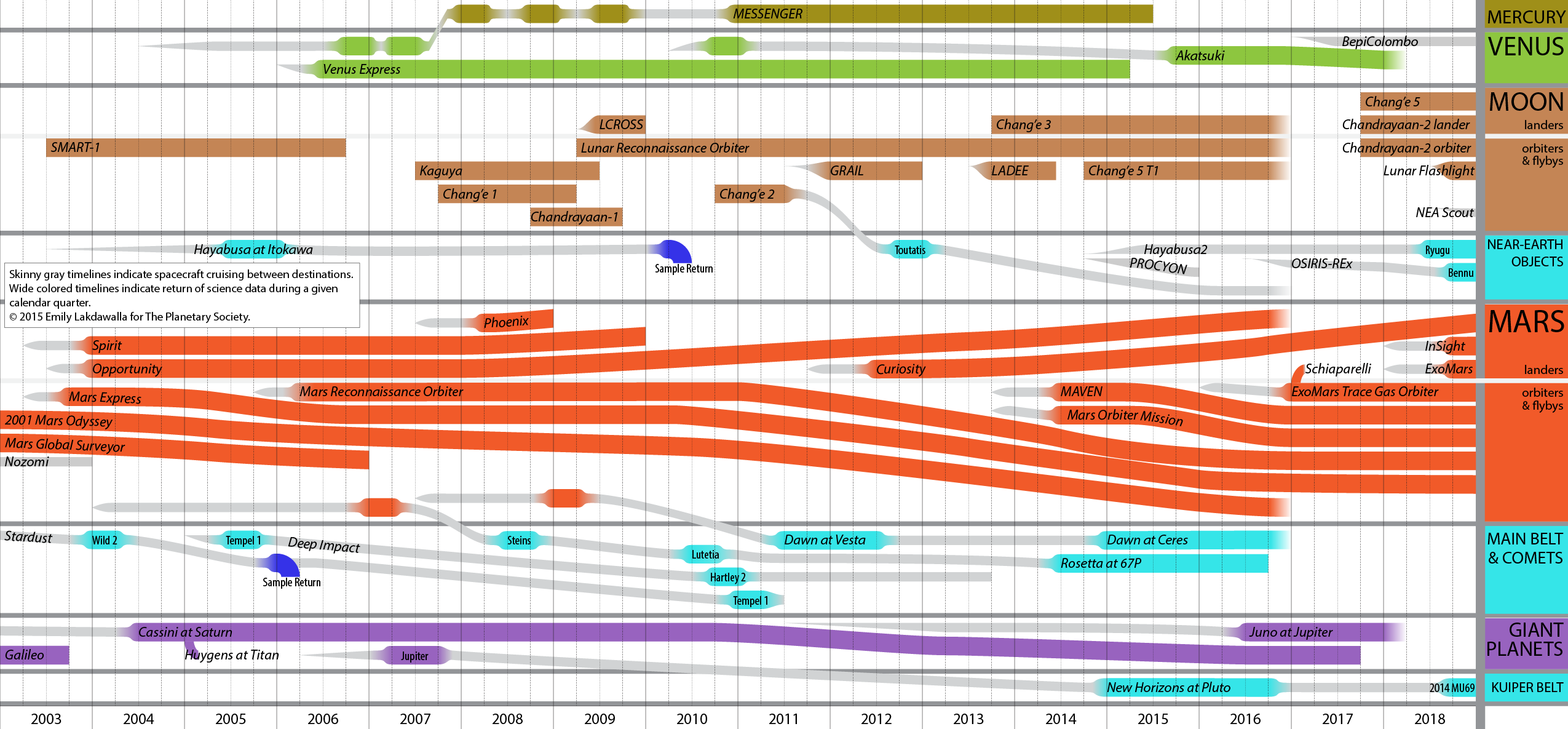
Planetary Exploration In 2016 (planetary.org)
An anonymous reader writes: Emily Lakdawalla at the Planetary Society blog has put together a post about all of the space missions set to return data from planets, moons, and other bodies in the solar system this year. She's also assembled some cool visualizations of when the missions are active at their locations of interest. In summary: "Akatsuki is at Venus, Lunar Reconnaissance Orbiter and two Chang'e missions at the Moon, two rovers and five orbiters are active at Mars, Dawn is at Ceres, Rosetta is at 67P, Cassini is at Saturn, and although New Horizons is far past Pluto, it'll be sending back new Pluto science data for most of the year, so I'm counting that as still doing science. Another two missions (Hayabusa2 and Juno) are in their cruise phase; Juno arrives at Jupiter in August. Two (ExoMars Trace Gas Orbiter and OSIRIS-Rex) or three (if you count the Schiaparelli lander separately) will launch this year, with their science starting after 2016." -
DRM Circumvention Now Lawful For More Devices
BUL2294 writes: The U.S. Library of Congress' Copyright Office has published their newest rules regarding DRM circumvention. Much to the chagrin of car makers and agricultural vehicle manufacturers, DRM circumvention, with the exception of telmatics ("black box") and entertainment systems, and anything that would run afoul of DOT or EPA regulations, is now allowed for "diagnosis, repair or lawful modification of a vehicle function." In addition, jailbreaking is now extended to tablets, wearables, and smart TVs, but not to single-purpose devices like e-readers. An exemption has been carved out for security researchers to hack cars, voting machines, and medical devices — as long as that device is not being used for its purpose and is in an isolated environment. Finally, owners of abandoned video games that require server authentication (where such authentication is no longer available) may also circumvent DRM. DRM circumvention is NOT allowed for jailbreaking gaming systems and e-readers, and does not allow for "format-shifting" (e.g. moving e-books from one platform to another).
The full text of the new rules is available online (PDF), and will be published in the Federal Register on October 28, 2015. -
ISPs Claim Title II Regulations Don't Apply To the Internet Because "Computers"
New submitter Gryle writes: ArsTechnica is reporting on an interesting legal tactic by ISPs in the net neutrality fight. In a 95-page brief the United States Telecom Association claims Internet access qualifies as information service, not a telecommunication service, because it involves computer processing. The brief further claims "The FCC's reclassification of mobile broadband internet access as a common-carrier service is doubly unlawful." (page 56) -
Plan To Run Anti-Google Smear Campaign Revealed In MPAA Emails
vivaoporto writes: Techdirt reports on a plan to run an anti-Google smear campaign via the Today Show and the WSJ discovered in MPAA emails. Despite the resistance of the Hollywood studios to comply with the subpoenas obtained by Google concerning their relationship with Mississippi Attorney General Jim Hood (whose investigation of the company appeared to actually be run by the MPAA and the studios themselves) one of the few emails that Google have been able to get access to so far was revealed this Thursday in a filling. It's an email between the MPAA and two of Jim Hood's top lawyers in the Mississippi AG's office, discussing the big plan to "hurt" Google.
The lawyers from Hood's office flat out admit that they're expecting the MPAA and the major studios to have its media arms run a coordinated propaganda campaign of bogus anti-Google stories. One email reads: "Media: We want to make sure that the media is at the NAAG meeting. We propose working with MPAA (Vans), Comcast, and NewsCorp (Bill Guidera) to see about working with a PR firm to create an attack on Google (and others who are resisting AG efforts to address online piracy). This PR firm can be funded through a nonprofit dedicated to IP issues. The "live buys" should be available for the media to see, followed by a segment the next day on the Today Show (David green can help with this). After the Today Show segment, you want to have a large investor of Google (George can help us determine that) come forward and say that Google needs to change its behavior/demand reform. Next, you want NewsCorp to develop and place an editorial in the WSJ emphasizing that Google's stock will lose value in the face of a sustained attack by AGs and noting some of the possible causes of action we have developed."
As Google notes in its legal filing about this email, the "plan" states that if this effort fails, then the next step will be to file the subpoena (technically a CID or "civil investigatory demand") on Google, written by the MPAA but signed by Hood. This makes it pretty clear that the MPAA, studios and Hood were working hand in hand in all of this and that the subpoena had no legitimate purpose behind it, but rather was the final step in a coordinated media campaign to pressure Google to change the way its search engine works. -
FDA Bans Trans Fat
An anonymous reader writes: The U.S. Food and Drug Administration has finally come to a conclusion about artificial trans fat: it must be removed from the U.S. food supply over the next three years. According to their final determination (PDF), there's no longer a scientific consensus that partially hydrogenated oils are safe to consume. Trans fat must be gone from food in the U.S. by June, 2018, unless a petitioner is granted specific approval by the FDA to continue using it. "Many baked goods such as pie crusts and biscuits as well as canned frosting still use partially hydrogenated oils because they help baked goods maintain their flakiness and frostings be spreadable. As for frying, palm oil is expected to be a go-to alternative, while modified soybean oil may catch on as well." The food industry is expected to spend $6.2 billion over the next two decades to formulate replacements, but the money saved from health benefits is expected to be more than 20 times higher. -
Appeals Court Rejects ISP Stay of Neutrality Rules
An anonymous reader writes: The Federal Communications Commission's net neutrality rules will go into effect Friday after a court decided not to block them. The ruling is an early win for the FCC, whose assertion of enforcement authority over ISP's is being challenged in court by cable and wireless industry groups. Techdirt reports: "According to the court order (pdf), broadband providers failed to provide 'the stringent requirements for a stay pending court review,' meaning that the FCC's new net neutrality rules will remain in place for the duration of the ISPs assault on the FCC. While the courts have promised to expedite it, a resolution to the case could still take more than a year. FCC boss Tom Wheeler was quick to take to the FCC website to applaud the ruling." -
Opportunity Rover Reaches Martian Day 4,000 of Its 90-Day Mission
An anonymous reader writes: Let's take a moment to appreciate the incredible engineering, scientific, and planning skill that went into the construction and deployment of the Opportunity rover. It landed on Mars with the goal of surviving 90 sols (Martian days), and it has just logged its 4,000th sol of harvesting valuable data and sending it back to us. The Planetary Society blog has posted a detailed update on Opportunity's status, and its team's plans for the future. The rover's hardware, though incredibly resilient, is wearing down. They reformatted its flash drive to block off a corrupted sector, and that solved some software problems that had cropped up. They're currently trying to figure out why the rover unexpectedly rebooted itself. Those events are incredibly dangerous to the rover's survival, so their highest priority right now is diagnosing that issue.
Fortunately, weather on Mars is good where the rover is, and it's still able to harvest upwards of 500 Watt-hours of energy from its solar panels. Opportunity recently completed a marathon on Mars and took an impressive picture of the Spirit of St. Louis crater, and the rover will soon be on its way to enormous clay deposits that could provide valuable information about where we can look for water when we eventually put people on Mars. As always, you can look through Opportunity's images at the official website. -
Long Uptime Makes Boeing 787 Lose Electrical Power
jones_supa writes: A dangerous software glitch has been found in the Boeing 787 Dreamliner. If the plane is left turned on for 248 days, it will enter a failsafe mode that will lead to the plane losing all of its power, according to a new directive from the US Federal Aviation Administration. If the bug is triggered, all the Generator Control Units will shut off, leaving the plane without power, and the control of the plane will be lost. Boeing is working on a software upgrade that will address the problems, the FAA says. The company is said to have found the problem during laboratory testing of the plane, and thankfully there are no reports of it being triggered on the field. -
Federal Study: Marijuana Use Doesn't Increase Auto Crash Rates
An anonymous reader writes: After the legalization of marijuana in multiple states around the U.S., many are worried about a corresponding uptick in car crashes as people drive while under the influence of pot. But according to a new federal study (PDF) commissioned by the National Highway Traffic Safety Administration, those fears seem unfounded. They report that after adjusting for other factors (people who tend to drive after using marijuana also tend to be more crash-prone in general), there was no statistically significant increase in crash rates by drivers who tested positive for the drug. It's still a bad idea to drive high, but driving drunk is far, far worse: "One substance was shown to have a major influence on crashes: alcohol. The study confirmed the enormous danger of drinking and driving, even after age and sex adjustment: drivers with a 0.05% blood-alcohol level were found to be twice as likely to be in a crash. For a person weighing 180 to 190 pounds, that could be a single can of beer, glass of wine, or shot of liquor. At 0.08% (two drinks), the likelihood is quadrupled, and at .20% (four drinks or more), the risk is higher by 23 times." -
Overbilled Customer Sues Time Warner Cable For False Advertising
An anonymous reader writes According to a lawsuit filed Friday in a New York court, when Jeremy Zielinski signed up for Time Warner Internet service after seeing an ad that it was $34.99 a month, he didn't expect his first bill to be more than $94. He didn't expect he'd have to fight for weeks to resolve it. And he didn't expect that, Time Warner's next step would be to sell him faster speeds, not bother to tell him his modem couldn't handle them, send him a bill anyway, then demand that he drive to the local office at his own expense to get a compatible modem. So he's taking the cable giant to court, accusing it of false advertising and deceptive business practices. While a lone individual fighting in court against the second largest cable company in the world certainly doesn't have the odds in his favor, this could get interesting. According to the complaint, he opted out of TWC's binding arbitration clause a few days after he opened his account, so he might have a shot of keeping this issue in real court. Stay tuned for more. -
Judge Allows L.A. Cops To Keep License Plate Reader Data Secret
An anonymous reader writes: A Los Angeles Superior Court judge has ruled that the Los Angeles Police Department is not required to hand over a week's worth of license plate reader data to the American Civil Liberties Union (ACLU) and the Electronic Frontier Foundation (EFF). He cited the potential of compromising criminal investigations and giving (un-charged) criminals the ability to determine whether or not they were being targeted by law enforcement (PDF). The ACLU and the EFF sought the data under the California Public Records Act, but the judge invoked Section 6254(f), "which protects investigatory files." ACLU attorney Peter Bibring notes, "New surveillance techniques may function better if people don't know about them, but that kind of secrecy is inconsistent with democratic policing." -
Comet ISON Survives Perihelion (Barely)
An anonymous reader sends this update from NightSkyInfo: "Yesterday, when Comet ISON plunged through the solar atmosphere and behind SOHO's coronagraph (the black disk designed to block out the direct light from the Sun), its nucleus dwindled away to nothing and most of the tail simply evaporated. Everyone assumed that the comet completely disintegrated and died a fiery death. However, several hours after perihelion, ISON began to brighten up again. It is now distinctly evident on live images from SOHO, looks like a comet, and continues to brighten as it moves farther away from the Sun." Experts are unwilling to say precisely how intact the comet is — we'll need more data to make a conclusion about that — but astrophysicist Karl Battams says this is their best guess: 'As comet ISON plunged towards to the Sun, it began to fall apart, losing not giant fragments but at least a lot of reasonably sized chunks. There's evidence of very large dust in the form of that long thin tail we saw in the LASCO C2 images. Then, as ISON plunged through the corona, it continued to fall apart and vaporize, and lost its coma and tail completely just like Lovejoy did in 2011. (We have our theories as to why it didn't show up in the SDO images but that's not our story to tell - the SDO team will do that.) Then, what emerged from the Sun was a small but perhaps somewhat coherent nucleus, that has resumed emitting dust and gas for at least the time being. In essence, the tail is growing back, as Lovejoy's did.' Here's a GIF of the comet rounding the Sun (put together by Emily Lakdawalla). -
Comet ISON Approaches Perihelion
New submitter BugNuker writes "Comet ISON has been speeding towards the sun, and while doing so, it has been getting brighter. There was hope that ISON would be 'Comet of the Century' material. That does not seem to be the case, but it still exists and it's still very interesting. Recently, ISON has undergone some outbursts, making it a near naked-eye object. ISON is still approaching perihelion (it will get there at 18:25 UTC on 28 November). For now, we can keep watching the STEREO spacecraft images for more evidence." Emily Lakdawalla of the Planetary Society put together this animated GIF of the comet from images taken by the STEREO-A spacecraft. Karl Battams put together a fascinating GIF as well. The Planetary Society has a list of information feeds and scheduled events for keeping tabs on ISON. -
On Eve Of Election, Australia's Conservatives Announce Mandated Filtering Policy
Dan B. writes "After Australia's Conservative party (LNP) quietly posted a policy [PDF] to impose mandatory internet filtering just one day prior to the country's election, local premiere internet forum Whirlpool has gone in to overdrive with the fastest 50 page thread ever. At 8:30pm, both sides of politics were busy running media releases, with the Conservatives hastily back-pedalling on the policy, and the Government attacking it, accusing them of hypocrisy after voting down their own proposed filter 3 years prior, stating there was no proof filtering works." -
Feds Continue To Consider Linux Users Criminals For Watching DVDs
An anonymous reader sent in a link to an article in Wired about the latest DMCA loophole hearing. Bad news: the federal government rejected requests that would make console modding and breaking DRM on DVDs to watch them legal. So, you dirty GNU/Linux hippies using libdvdcss better watch out: "Librarian of Congress James Billington and Register of Copyrights Maria Pallante rejected the two most-sought-after items on the docket, game-console modding and DVD cracking for personal use and 'space shifting.' Congress plays no role in the outcome. The regulators said that the controls were necessary to prevent software piracy and differentiated gaming consoles from smart phones, which legally can be jailbroken. ... On the plus side, the regulators re-authorized jailbreaking of mobile phones. On the downside, they denied it for tablets, saying an 'ebook reading device might be considered a tablet, as might a handheld video game device.'" So you can jailbreak a phone, but if it's 1" larger and considered a "tablet" you are breaking the law. -
EA Sues Zynga For Copying Sims Game
Social game developer Zynga has been on the receiving end of complaints in the past for releasing games that look a bit too much like games from indie developers, and for other shady business practices. Now, they've run afoul of somebody with sharper teeth. Today Electronic Arts and Maxis filed a copyright infringement lawsuit against Zynga claiming that The Ville is "blatant mimicry" of The Sims Social. "'This is a case of principle,' says EA Maxis general manager Lucy Bradshaw. 'Maxis isn't the first studio to claim that Zynga copied its creative product. But we are the studio that has the financial and corporate resources to stand up and do something about it. Infringing a developer's copyright is not an acceptable practice in game development.' In its complaint, EA argues that Zynga willfully and intentionally copied ideas from The Sims Social, the Facebook edition of the EA/Maxis franchise that released in August 2011. When Zynga released The Ville last June, consumers and the press immediately pointed out that the title resembled The Sims more than a little." -
Texas GOP Educational Platform Opposes Teaching Critical Thinking Skills
An anonymous reader writes "Texas Republican delegates met earlier this month to put together their 2012 platform. Much of this focused on the educational system. Alarmingly, they openly state that they oppose schools teaching critical thinking, on the grounds that it may challenge 'student's fixed beliefs' and undermine 'parental authority.' Page 12 of their official platform (PDF) discusses their thinking on teaching thinking." -
FunnyJunk Sues the Oatmeal Over TM and "Incitement To Cyber-Vandalism"
eldavojohn writes "You may recall from last week the news item concerning FunnyJunk's extortion ... er ... threat of defamation lawsuit against The Oatmeal highlighting a fairly pervasive problem of rehosting content — in this case web comics. Instead of expediting a payment of $20,000 to FunnyJunk, Matthew Inman of The Oatmeal decided to crowd source the money (with 8 days left he has only garnered 900% of his goal) and donate it to charity after sending a picture of it to FunnyJunk. Charles Carreon (the man who has FunnyJunk) has made statements of Inman saying 'I really did not expect that he would marshal an army of people who would besiege my website and send me a string of obscene emails.' In an interview Carreon says 'So someone takes one of my letters and takes it apart. That doesn't mean you can just declare netwar, that doesn't mean you can encourage people to hack my website, to brute force my WordPress installation so I have to change my password. You can't encourage people to violate my trademark and violate my twitter name and associate me with incompetence with stupidity, and douchebaggery. And if that's where the world is going I will fight with every ounce of force in this 5'11 180 pound frame against it. I've got the energy, and I've got the time.' Well it appears that Carreon has filed suit over these matters alleging 'trademark infringement and incitement to cyber-vandalism.' Speaking of douchebaggery, Charles Carreon curiously fails to mention that he first incited all of his users to harass The Oatmeal anyway they can which they dutifully did. One last juicy detail is that Carreon is also suing the National Wildlife Federation and the American Cancer Society to which Inman's crowd sourced money is going. Luckily, Inman's lawyer appears to be fully competent and able to address Carreon's complaints." -
EU Speaks Out Against US Censorship
bs0d3 writes "The EU Parliament has adopted, 'by a large majority,' a statement warning the US to refrain 'from unilateral measures to revoke IP addresses or domain names' due to the 'need to protect the integrity of the global internet and freedom of communications.' This resolution highlights both the practices prescribed in SOPA/PIPA... but also the actions of Homeland Security and ICE in seizing domain names. By adopting a resolution against domains seizures the European Parliament recognizes the dangerous precedent the pending SOPA legislation would set, and it wouldn't be a surprise if more foreign criticism follows. No country should have the ability to simply take over international domain names, and surely the US would feel the same if this plan was put in motion by a foreign country. Or as some 60 press freedom and human rights advocate groups put it in their letter to the US representatives: 'This is as unacceptable to the international community as it would be if a foreign country were to impose similar measures on the United States.'" -
Book Review: Amazon SimpleDB Developer Guide
KuanH writes "Amazon SimpleDB Developer Guide is billed as a complete guide to using Amazon's SimpleDB database API. It's most detailed for PHP. It's helpful for Python. But the Java code and explanations aren't up to the standard of the others. It includes a primer on using Amazon S3 with SimpleDB: files stored on S3, file metadata stored in SimpleDB — again, less good for Java. It also covers tuning to reduce usage costs, caching using memcached, and ways to batch-update and make serial or parallel requests to SimpleDB. However, it's missing some information that beginners might need, and it's perhaps not quite advanced enough for the more experienced. Downloadable example code is available only for PHP." Keep reading for the rest of Kuan's review. Amazon SimpleDB Developer Guide author Prabhakar Chaganti, Rich Helms pages 252 publisher Packt Publishing rating 6 reviewer Kuan Hon ISBN 1847197345 summary "Getting started" guide to using Amazon's SimpleDB cloud database Say "cloud" to get the attention of CIOs seeking to cut costs in these recessionary times. One well known "database in the cloud" option is Amazon Web Services' SimpleDB, which Amazon describes as "a highly available, flexible, and scalable non-relational data store that offloads the work of database administration."
Those who prefer traditional relational databases could try eg Amazon RDS. This book only covers SimpleDB, a NoSQL or non-relational database. As is well known, NoSQL databases grew in popularity with the growth of large distributed systems and cloud computing, and their proponents tout their scalability and speed.
For anyone wanting a quick primer on NoSQL databases, this book includes a chapter on NoSQL which isn't limited to SimpleDB. It outlines some key conceptual differences between NoSQL and relational database management systems, with pros and cons, using the analogy of "a spreadsheet with some XML characteristics", and illustrating with some concrete examples. That chapter's been made available as a free sample chapter (SimpleDB versus RDBMS), so you can get a flavour of the book.
The contents list for this book is online, I won't recite it here. As well as an overview of SimpleDB, its terminology and advantages, the book goes through signing up with AWS and SimpleDB, and the account access keys. That chapter is also online, as a tutorial.
You may ask, how does this book differ from Amazon's free SimpleDB documentation, which includes a developer guide and a "getting started" guide? Amazon's own "getting started" is certainly helpful, and it's worth downloading and trying their web app scratchpad. But Amazon's detailed developer guide concentrates on REST and SOAP requests, which most people wouldn't want to deal with direct at that low level.
This book's focus is on using the SimpleDB web services API through certain specific languages and libraries — namely Java (JDK6 — using the typical 1.6 library plus several dependencies), Python (2.5 — you need boto), and PHP (with curl). It recommends the SDBtool Firefox extension (SDBizo), which is excellent for checking the results of running the code.
I've tried the book's Java and Python examples, on Windows. Not PHP, as I've not got round to learning PHP yet, though I skimmed the PHP explanations. Similarly, I've not had time to try it all over again on Linux. Generally, the book's coverage seems fuller and better for PHP than for Java or Python. Perhaps it was originally written for PHP, and the rest was bolted on — the stuff for Java more hurriedly than for Python?
The downloadable code samples, as mentioned, are PHP only. They really should have provided downloadable code for all 3 languages, plus some fake MP3 files (see later). If you get the e-book (available in PDF and epub), you can copy and paste the Java or Python code. But that's a tad tedious, especially when the code runs onto a new page, and there are stray end of lines etc that you have to delete manually. Furthermore, the Python code provided is for the interpreter in interactive mode (not for .py files, except a couple towards the end). So, for the Python, you also have to copy/paste each line one at a time. But that still beats having to re-type pages of code in full.
In other words, if you want this book and you're only interested in PHP, you can get away with just buying the hard copy and downloading the code from the Packt site. But if you prefer Python or Java, to save your fingers and blood pressure you should buy just the e-version, or get both paper and e books together. I really hope Packt will in future provide downloadable code samples for all the languages covered.
I have more issues with the sample code given in this book. The typical imports should have been spelled out in the example Java code. Eclipse offers more than one possible import in some cases. It was "try everything till it works", at least until I found this tutorial. I've included the initial required typical imports (though not the standard java.util etc ones) in my own list of points, which I'll say more about at the end of this review. Surely it wouldn't have been difficult to include just those few lines of imports, which could have saved readers a lot of time trying to work out the correct imports. There are also errors in the Python code, and on one page the code that should have been included is missing altogether.
Now, more on the book proper. After the overview described above, this book walks you through the basic SimpleDB operations: how to create a SimpleDB "domain" (equivalent to a worksheet in a spreadsheet), list domains, create/retrieve items (like spreadsheet rows), and delete domains.
Items have attributes (spreadsheet column headings), as key:value pairs — the key is the attribute name, the value is its value, eg address:1 Acacia Avenue. An attribute can have more than one value, eg the same item can have both address:1 Acacia Avenue and address:2 Broadway. The book also lists the SimpleDB constraints on domains, items and attributes — maximum number or size, etc — but it's best to check the AWS site for the latest info.
Code examples are given for each of the 3 languages mentioned. The examples are similar, but don't always cover the same ground. If they'd done that, where possible, it would have been more helpful to those of us trying examples in more than one language. One advantage of a book with associated website is that electronic updates can be published, and it would have been great if that had been done for this book. For instance, the book gave conditional put/delete code examples only for PHP. At the date of this review, boto now supports those features, but sample supplemental Python code for that still hadn't been made available.
SimpleDB stores attribute values as UTF-8 strings. This means that comparisons for sorting or searching are done lexicographically (character by character, left to right, numbers take precedence over uppercase over lowercase), and to handle numbers or dates you have to encode and decode them yourself. So, the book has a chapter explaining lexicographical comparison, data types, and how to encode and decode data to enable proper sorting and comparison of numbers, dates, Boolean values and XML-restricted characters. In the case of numbers this means zero padding and offsets, and there's example code for decoding and encoding numbers. Unlike with PHP and Python, oddly the Java code given was for the body of the typical method that carries out the encoding etc. This could have been omitted, and they should have given example code illustrating the method's usage instead. Similarly for the date formats code.
The SimpleDB query syntax is generally covered well, in a chapter which takes readers through first creating a sample database of song metadata to run queries against. It's not too painful copy/pasting the Java code (3+ pages), but with Python in interactive mode I drew the line at creating every song item and attributes using individual statements, even with pasting, so I just tried adding a couple of random ones to test that the code worked. I say again, full downloadable code please...!
That chapter then gives helpful examples of queries against the sample database and their results, including for more complex combined queries ("and", "or" type queries, "not" etc), and querying for multiple-value attributes. It also provides code examples for sorting and counting query results. But the Java code for retrieving an item's attributes wouldn't run, and I couldn't find the method used (getItemsAttributes()) detailed in the typical documentation; perhaps the book is out of date here?
The book starts going beyond the basics from Chapter 7 onwards, with a chapter on Amazon's S3 storage service — another well known component of Amazon Web Services, where "objects" (files) may be stored in "buckets" (directories), with "keys" used to retrieve objects.
For S3, the book uses JetS3t for Java. However, the Java code given for uploading files to S3 didn't demonstrate any integration with SimpleDB at all — the files were just uploaded with their filenames as the S3 keys, and the code didn't seem to deal with the creation of your own custom S3 keys for uploaded objects. In contrast, the Python code generated the S3 keys for the files from hashes previously produced and stored in the SimpleDB database, as well as dealing with their uploading. In addition, for me the Java code for downloading files from S3 just wouldn't run, and also it wasn't clear where the files were supposed to be downloaded to locally, unlike with the Python example. Inexplicably, there was no info on how to delete objects from S3 buckets, or indeed how to delete buckets. So, while the S3 chapter is of help, it could definitely do with being expanded, especially the Java sections.
Next, money money money. AWS charges are based on usage, so the chapter on tuning and usage costs has some practical value in explaining how SimpleDB is charged for, the "BoxUsage" value returned by requests to SimpleDB, using BoxUsage to optimize queries and compute costs, and how to get BoxUsage values back with your queries using Java, Python etc. There are code examples that, when run, illustrate the different BoxUsage values you get when you use different operators or expressions in queries (eg, using LIKE costs more).
However, partitioning your data into multiple domains is covered in only a few paragraphs, with no code given. I'd have liked to see more info on that, and some sample code for the partitioning process.
To further save money, you can use a cache to store data locally, trying your local cache first; and, only if the data is not there, would your app go out to SimpleDB and incur costs for querying it. This book accordingly has a chapter on how to install and use the popular open source caching system memcached to cache your query results locally. (CacheLite for PHP is also covered.) Again, the Java sections caused me some frustration. The Java test code showed that the memcached server was running properly on my machine, but the Java code for using the cache just didn't work; it ran, but continued to query SimpleDB direct. The Python code, however, worked perfectly — except that, if you're using memcached in Windows, you'll need to use port 11211 instead of what's shown in the book. (I didn't try it in Linux.)
Finally, the book deals with running parallel operations against SimpleDB, using its BatchPutAttributes. The section on updating SimpleDB in Python by making serial consecutive calls to SimpleDB is completely missing the code for the script, but the book does then cover inserting multiple items concurrently into SimpleDB using a threadpool in Java. It also gives sample Python code for alternative ways of parallelising requests: using Python's built-in threading module, threading and queues combined, then threading using the open source workerpool module.
To conclude, in substance the book has a fair amount of useful information on the basics of getting started with SimpleDB, particularly for Python (and probably PHP). But not providing downloadable code samples in Java and Python, or "fake" MP3 files to try S3 uploading/downloading, is a minus.
Some errors, inconsistencies and missing information from the department of "I-wish-they'd-included-this-even-if-they-thought-it-was-basic-as-it's-too-easily-missed-if-it's-not-spelled-out", mean that the book is not really "complete", and not as suitable as it should be for relative beginners — especially for Java and (in whatever language) Windows. It wouldn't take much extra work to get it up to scratch on that front. Perhaps the next edition, or better still an online update/supplement?
For the more experienced, the book doesn't take readers to as advanced a stage as it could have, in my view. In particular, it would have been good to have more info and example code on partitioning data between different domains, and also how to migrate data from an existing database to SimpleDB — their code for "importing" the sample database literally just adds each item and attribute individually.
Fix the errors, add the missing info for beginners, provide downloads of code in all relevant languages and "fake files", and I'd have given it a 7. Provide working sample Java code with more explanation, plus proper integration with S3, an 8. Add fuller info on partitioning, migration, and perhaps even integration with yet more AWS services, a 9.
All opinions are personal to me: half geek, half lawyer, mostly harmless. I'm researching legal issues in cloud computing.
You can purchase Amazon SimpleDB Developer Guide from amazon.com. Slashdot welcomes readers' book reviews -- to see your own review here, read the book review guidelines, then visit the submission page. -
Book Review: Amazon SimpleDB Developer Guide
KuanH writes "Amazon SimpleDB Developer Guide is billed as a complete guide to using Amazon's SimpleDB database API. It's most detailed for PHP. It's helpful for Python. But the Java code and explanations aren't up to the standard of the others. It includes a primer on using Amazon S3 with SimpleDB: files stored on S3, file metadata stored in SimpleDB — again, less good for Java. It also covers tuning to reduce usage costs, caching using memcached, and ways to batch-update and make serial or parallel requests to SimpleDB. However, it's missing some information that beginners might need, and it's perhaps not quite advanced enough for the more experienced. Downloadable example code is available only for PHP." Keep reading for the rest of Kuan's review. Amazon SimpleDB Developer Guide author Prabhakar Chaganti, Rich Helms pages 252 publisher Packt Publishing rating 6 reviewer Kuan Hon ISBN 1847197345 summary "Getting started" guide to using Amazon's SimpleDB cloud database Say "cloud" to get the attention of CIOs seeking to cut costs in these recessionary times. One well known "database in the cloud" option is Amazon Web Services' SimpleDB, which Amazon describes as "a highly available, flexible, and scalable non-relational data store that offloads the work of database administration."
Those who prefer traditional relational databases could try eg Amazon RDS. This book only covers SimpleDB, a NoSQL or non-relational database. As is well known, NoSQL databases grew in popularity with the growth of large distributed systems and cloud computing, and their proponents tout their scalability and speed.
For anyone wanting a quick primer on NoSQL databases, this book includes a chapter on NoSQL which isn't limited to SimpleDB. It outlines some key conceptual differences between NoSQL and relational database management systems, with pros and cons, using the analogy of "a spreadsheet with some XML characteristics", and illustrating with some concrete examples. That chapter's been made available as a free sample chapter (SimpleDB versus RDBMS), so you can get a flavour of the book.
The contents list for this book is online, I won't recite it here. As well as an overview of SimpleDB, its terminology and advantages, the book goes through signing up with AWS and SimpleDB, and the account access keys. That chapter is also online, as a tutorial.
You may ask, how does this book differ from Amazon's free SimpleDB documentation, which includes a developer guide and a "getting started" guide? Amazon's own "getting started" is certainly helpful, and it's worth downloading and trying their web app scratchpad. But Amazon's detailed developer guide concentrates on REST and SOAP requests, which most people wouldn't want to deal with direct at that low level.
This book's focus is on using the SimpleDB web services API through certain specific languages and libraries — namely Java (JDK6 — using the typical 1.6 library plus several dependencies), Python (2.5 — you need boto), and PHP (with curl). It recommends the SDBtool Firefox extension (SDBizo), which is excellent for checking the results of running the code.
I've tried the book's Java and Python examples, on Windows. Not PHP, as I've not got round to learning PHP yet, though I skimmed the PHP explanations. Similarly, I've not had time to try it all over again on Linux. Generally, the book's coverage seems fuller and better for PHP than for Java or Python. Perhaps it was originally written for PHP, and the rest was bolted on — the stuff for Java more hurriedly than for Python?
The downloadable code samples, as mentioned, are PHP only. They really should have provided downloadable code for all 3 languages, plus some fake MP3 files (see later). If you get the e-book (available in PDF and epub), you can copy and paste the Java or Python code. But that's a tad tedious, especially when the code runs onto a new page, and there are stray end of lines etc that you have to delete manually. Furthermore, the Python code provided is for the interpreter in interactive mode (not for .py files, except a couple towards the end). So, for the Python, you also have to copy/paste each line one at a time. But that still beats having to re-type pages of code in full.
In other words, if you want this book and you're only interested in PHP, you can get away with just buying the hard copy and downloading the code from the Packt site. But if you prefer Python or Java, to save your fingers and blood pressure you should buy just the e-version, or get both paper and e books together. I really hope Packt will in future provide downloadable code samples for all the languages covered.
I have more issues with the sample code given in this book. The typical imports should have been spelled out in the example Java code. Eclipse offers more than one possible import in some cases. It was "try everything till it works", at least until I found this tutorial. I've included the initial required typical imports (though not the standard java.util etc ones) in my own list of points, which I'll say more about at the end of this review. Surely it wouldn't have been difficult to include just those few lines of imports, which could have saved readers a lot of time trying to work out the correct imports. There are also errors in the Python code, and on one page the code that should have been included is missing altogether.
Now, more on the book proper. After the overview described above, this book walks you through the basic SimpleDB operations: how to create a SimpleDB "domain" (equivalent to a worksheet in a spreadsheet), list domains, create/retrieve items (like spreadsheet rows), and delete domains.
Items have attributes (spreadsheet column headings), as key:value pairs — the key is the attribute name, the value is its value, eg address:1 Acacia Avenue. An attribute can have more than one value, eg the same item can have both address:1 Acacia Avenue and address:2 Broadway. The book also lists the SimpleDB constraints on domains, items and attributes — maximum number or size, etc — but it's best to check the AWS site for the latest info.
Code examples are given for each of the 3 languages mentioned. The examples are similar, but don't always cover the same ground. If they'd done that, where possible, it would have been more helpful to those of us trying examples in more than one language. One advantage of a book with associated website is that electronic updates can be published, and it would have been great if that had been done for this book. For instance, the book gave conditional put/delete code examples only for PHP. At the date of this review, boto now supports those features, but sample supplemental Python code for that still hadn't been made available.
SimpleDB stores attribute values as UTF-8 strings. This means that comparisons for sorting or searching are done lexicographically (character by character, left to right, numbers take precedence over uppercase over lowercase), and to handle numbers or dates you have to encode and decode them yourself. So, the book has a chapter explaining lexicographical comparison, data types, and how to encode and decode data to enable proper sorting and comparison of numbers, dates, Boolean values and XML-restricted characters. In the case of numbers this means zero padding and offsets, and there's example code for decoding and encoding numbers. Unlike with PHP and Python, oddly the Java code given was for the body of the typical method that carries out the encoding etc. This could have been omitted, and they should have given example code illustrating the method's usage instead. Similarly for the date formats code.
The SimpleDB query syntax is generally covered well, in a chapter which takes readers through first creating a sample database of song metadata to run queries against. It's not too painful copy/pasting the Java code (3+ pages), but with Python in interactive mode I drew the line at creating every song item and attributes using individual statements, even with pasting, so I just tried adding a couple of random ones to test that the code worked. I say again, full downloadable code please...!
That chapter then gives helpful examples of queries against the sample database and their results, including for more complex combined queries ("and", "or" type queries, "not" etc), and querying for multiple-value attributes. It also provides code examples for sorting and counting query results. But the Java code for retrieving an item's attributes wouldn't run, and I couldn't find the method used (getItemsAttributes()) detailed in the typical documentation; perhaps the book is out of date here?
The book starts going beyond the basics from Chapter 7 onwards, with a chapter on Amazon's S3 storage service — another well known component of Amazon Web Services, where "objects" (files) may be stored in "buckets" (directories), with "keys" used to retrieve objects.
For S3, the book uses JetS3t for Java. However, the Java code given for uploading files to S3 didn't demonstrate any integration with SimpleDB at all — the files were just uploaded with their filenames as the S3 keys, and the code didn't seem to deal with the creation of your own custom S3 keys for uploaded objects. In contrast, the Python code generated the S3 keys for the files from hashes previously produced and stored in the SimpleDB database, as well as dealing with their uploading. In addition, for me the Java code for downloading files from S3 just wouldn't run, and also it wasn't clear where the files were supposed to be downloaded to locally, unlike with the Python example. Inexplicably, there was no info on how to delete objects from S3 buckets, or indeed how to delete buckets. So, while the S3 chapter is of help, it could definitely do with being expanded, especially the Java sections.
Next, money money money. AWS charges are based on usage, so the chapter on tuning and usage costs has some practical value in explaining how SimpleDB is charged for, the "BoxUsage" value returned by requests to SimpleDB, using BoxUsage to optimize queries and compute costs, and how to get BoxUsage values back with your queries using Java, Python etc. There are code examples that, when run, illustrate the different BoxUsage values you get when you use different operators or expressions in queries (eg, using LIKE costs more).
However, partitioning your data into multiple domains is covered in only a few paragraphs, with no code given. I'd have liked to see more info on that, and some sample code for the partitioning process.
To further save money, you can use a cache to store data locally, trying your local cache first; and, only if the data is not there, would your app go out to SimpleDB and incur costs for querying it. This book accordingly has a chapter on how to install and use the popular open source caching system memcached to cache your query results locally. (CacheLite for PHP is also covered.) Again, the Java sections caused me some frustration. The Java test code showed that the memcached server was running properly on my machine, but the Java code for using the cache just didn't work; it ran, but continued to query SimpleDB direct. The Python code, however, worked perfectly — except that, if you're using memcached in Windows, you'll need to use port 11211 instead of what's shown in the book. (I didn't try it in Linux.)
Finally, the book deals with running parallel operations against SimpleDB, using its BatchPutAttributes. The section on updating SimpleDB in Python by making serial consecutive calls to SimpleDB is completely missing the code for the script, but the book does then cover inserting multiple items concurrently into SimpleDB using a threadpool in Java. It also gives sample Python code for alternative ways of parallelising requests: using Python's built-in threading module, threading and queues combined, then threading using the open source workerpool module.
To conclude, in substance the book has a fair amount of useful information on the basics of getting started with SimpleDB, particularly for Python (and probably PHP). But not providing downloadable code samples in Java and Python, or "fake" MP3 files to try S3 uploading/downloading, is a minus.
Some errors, inconsistencies and missing information from the department of "I-wish-they'd-included-this-even-if-they-thought-it-was-basic-as-it's-too-easily-missed-if-it's-not-spelled-out", mean that the book is not really "complete", and not as suitable as it should be for relative beginners — especially for Java and (in whatever language) Windows. It wouldn't take much extra work to get it up to scratch on that front. Perhaps the next edition, or better still an online update/supplement?
For the more experienced, the book doesn't take readers to as advanced a stage as it could have, in my view. In particular, it would have been good to have more info and example code on partitioning data between different domains, and also how to migrate data from an existing database to SimpleDB — their code for "importing" the sample database literally just adds each item and attribute individually.
Fix the errors, add the missing info for beginners, provide downloads of code in all relevant languages and "fake files", and I'd have given it a 7. Provide working sample Java code with more explanation, plus proper integration with S3, an 8. Add fuller info on partitioning, migration, and perhaps even integration with yet more AWS services, a 9.
All opinions are personal to me: half geek, half lawyer, mostly harmless. I'm researching legal issues in cloud computing.
You can purchase Amazon SimpleDB Developer Guide from amazon.com. Slashdot welcomes readers' book reviews -- to see your own review here, read the book review guidelines, then visit the submission page. -
Asteroid Mission Competition Announces Winner
Riding with Robots writes "The Planetary Society invited participants to compete for $50,000 in prizes by designing a mission to rendezvous with and 'tag' a potentially dangerous near-Earth asteroid. The asteroid Apophis was used as the target for the mission design because it will come closer to Earth in 2029 than the orbit of geostationary satellites. The winning mission design is called Foresight, and calls for the use of off-the-shelf parts to undercut the price of other proposals. Here's a PDF of the winning proposal."