Slashdot Mirror
Domain: anandtech.com
Stories and comments across the archive that link to anandtech.com.
Comments · 3,318
-
Re:Let me get this straight...
A 50% GPU improvement over Sandy Bridge is VERY significant.
Not particularly. A 50% faster GPU will still suck for gamers and will be irrelevant to non-gamers.
-
Re:Let me get this straight...
A 50% GPU improvement over Sandy Bridge is VERY significant.
-
Review Roundup
A roundup of reviews from the usual major sites as well as others not mentioned in the summary above: Overclockers Review, Anandtech Review, Anandtech Undervolting/Overclocking, HardwareSecrets, Bit-tech, PCPer, Tweaktown, Hard OCP, The Inquirer, Techspot, Computer Shopper, Tom's Hardware, ExtremeTech, PC Mag, Overclockers Club, and Guru 3d
-
Review Roundup
A roundup of reviews from the usual major sites as well as others not mentioned in the summary above: Overclockers Review, Anandtech Review, Anandtech Undervolting/Overclocking, HardwareSecrets, Bit-tech, PCPer, Tweaktown, Hard OCP, The Inquirer, Techspot, Computer Shopper, Tom's Hardware, ExtremeTech, PC Mag, Overclockers Club, and Guru 3d
-
Recent Intel graphics runs Skyrim
Even if you just optimize for Ivy Bridge graphics, you can still hit playable frame rates with PS3-class scene complexity. Skyrim on an Intel HD 4000 hits 46 fps at 720p-class resolution with AA off.
-
Re:It does support enterprise
The real question is: why would you want an ARM powered Windows Tablet anyway? With Medfield http://www.anandtech.com/show/5365/intels-medfield-atom-z2460-arrive-for-smartphones/1 we're already seeing x86 not only competitive but actually besting some ARM devices for performance and battery life.
Corporations are going to want backwards compatibility in applications and other x86 capabilities. If corporations need the full group policies and enterprise features they can just buy a full copy of Windows 8 Enterprise.
If I was a corporate IT department I would prefer to support a single Windows version instead of trying to stay on top of both x86 and ARM updates and glitches.
-
Re:1920x1200 getting hard to find anymore
Sure, there are cheaper monitors. Dell's 24" is ~$550. Check http://www.anandtech.com/tag/displays, the have great monitor articles for more high resolution IPS or S-IPS monitors.
-
Re:like palm
Uncomfortable facts you are not willing to acknowledge:
April 13, 2011 (1 week before PlayBook was launched)
The bottom line is that today the PlayBook can't store contacts, it can't organize your day and you can't use it to check emails using anything other than your web browser. RIM's explanation? Most users who buy tablets don't buy it for push email, most are on WiFi, and if you're not getting push email then a web client is probably ok. I don't agree with this assessment, and clearly RIM doesn't completely agree with it either, so we'll eventually get all of these things for the PlayBook later this summer alongside the release of the WiMAX PlayBook.
There is no native mail app, contacts app, or calendar app. Looking to the near future, I’m told that these are absolutely coming in the future through a free software update. I’ve also been told PlayBooks that launch in the coming months with 4G compatibility (WiMAX, LTE, and HSPA+), will most certainly have these apps built in. Until then, the Wi-Fi PlayBook isn’t that useful to me without native apps that are extremely necessary in this day and age of mobile computing.
Another glaring flaw is the PlayBook’s complete lack of native e-mail, contacts and calendar apps. Want those apps? Log on to your Gmail account with the browser. BlackBerry smartphone owners can access e-mail on the PlayBook after installing RIM’s Bridge app, which connects the phone to the tablet by Bluetooth, but we weren’t able to test this feature. If you don’t have a BlackBerry phone, you’re out of luck until summer, when RIM says a future software update will bring native clients to the PlayBook.
You: "The PlayBook was never supposed to have native email."
Your delusions or lies do not mesh with real facts.
-
Re:This is Sony
a company that doesn't care if your old blu-ray player plays the latest blu-rays or not
Actually, based on what you are linking, that's not true. Old players play new discs and new players play old disc. There's no problem there. The issue discussed in the linked article is that newer players (or older players with updated firmware) may not be able to play copies or rips of certain newer discs which contain the audio watermarking.
Thanks a lot...not you've made me sick to my stomach for having to defend Sony.
-
This is Sony
For those not familiar with this company, who may ask "But won't they lose money if they take down the games?", let me give you some background. This is a company that would rather pull EVERY game on PSN than to lose even the slightest bit of control over their locked-down system. This is a company that will infect their CD's with viruses to prevent copying, a company that repeatedly kills its own platforms with its insistence on proprietary formats, a company that doesn't care if your old blu-ray player plays the latest blu-rays or not--a company that will remove any feature, cripple any platform, pull any game, destroy any product line--all to maintain control. If Sony were faced tomorrow morning with the choice between risking people copying even one of their movies and bulldozing the entire PSP line into a landfill, they would have that landfill full before the sun went down.
This is what happens when you allow a media producer to mix in the same company with the producer of the hardware that plays said media.
-
Re:Intrinsity is fabless
manufactured in Texas by Apple-owned Fab house, Intrinsity
Intrinsity (back when it existed independent of Apple) was a fabless manufacturer that contracted out to other foundries (including and especially Samsung) to manufacture their chips. Samsung just upgraded its Austin plant for A#-series chip production; Intrinsity never had an Austin plant and Apple hasn't built one.
Rumor has it (ugh...) that Apple was trying to shift assembly to TSMC, but they didn't have the quality/yield.
Hmmm. Interesting. I did not know that! Why would Apple need a fabless semi house? That makes NO sense...
Oh wait! Here's some stuff... I guess I'd always figured that PASemi was responsible for the Axx SoC design. Guess I was only half-right!
HOWEVER, the rest of my post stands. -
Re:1366x768
Citation please? Because everything I've seen on Metro is that pretty much everything that doesn't run on ARM got thrown under a bus and i just don't see how you are gonna get DirectX, an API designed for killer graphics above battery life, to run on your average ARM tablet or even one of the midrange units.
I don't know where you've getting your information on Win8 so far, but it's clearly not the primary sources (i.e. MSDN library & blogs), because the fact that DirectX is available in Metro has been publicly known since Developer Preview release last year, which had both the docs and the SDK.
Anyway, as far as primary sources go: this gives an exhaustive list of supported D3D API surface, and here is a D3D Metro sample. Good enough?
By the way, what makes you think that Direct3D is "designed for killer graphics above battery life"? I mean, sure, it's designed to allow for it - same as OpenGL - but there's nothing inherent in the API design that mandates that. Again, if OpenGL can downscale to ARM, what makes you think D3D can't?
. ARM is low power above all and its IPC is worse than even Atom, much less Bobcat or a normal AMD or Intel CPU, yet they are trying to get devs to swallow they can "write once, use everywhere" when you are talking about arches THAT dissimilar? Are they stoned? Either the ARM version will suck a battery dry so fast it will make your head swim or it'll be using so little of the hardware because it was designed for WOA that it'll be like some fart app on the PC.
So, what exactly is "THAT dissimilar" about the architectures that makes it impossible to write portable apps? Linux world has been managing that just fine. As for battery, the techniques to conserve it are exactly the same on both Intel and ARM, namely - don't run stuff in background unless absolutely needed, let the OS put your app to sleep and out of RAM, and awake it when it's re-activated. Metro is specifically designed for that - apps can be expected to be unloaded at any moment and have to save/restore state transparently, and practically all APIs follow the asynchronous callback model to force programmers to use the reactor pattern rather than polling or doing other stupid (battery-wise) things.
-
Re:Not any more
But the iPad still is fine otherwise. The higher-glare screen doesn't really matter much even when reading outdoors in practice.
Yes, it does. With a high glare screen, you need to turn up the brightness to compensate, whereas the Kindle is perfectly happy at ambient light levels. This is fatiguing indoors, and trying to manoeuvre the thing so that it's not afflicted with glare is just obnoxious. I like reading to be a comfortable thing I can do wherever I feel like sitting down, I shouldn't have to struggle to get in the right position for it.
And reading outdoors on an iPad is just plain exhausting. Unless you've got photos showing that it no longer looks like this in the sunlight, I don't see why that would have changed any with the new one.
-
Ivy Bridge runs Skyrim
I would also lay odds that he PS3 is STILL better than the budget boxes in many people's homes (many are still single core with GPU's nowhere near the capability of the Nvidia chip in the PS3)
That all depends on how fast these budget boxes get replaced with Ivy Bridge boxes, whose integrated GPU runs a PS3-class PC game (Skyrim) at a playable frame rate according to AnandTech.
-
Updated XBOX: up to 90 watts while gaming
-
iPad 2 Already Beat Tegra 3
Considering that these graphics benchmarks from Anandtech show the iPad 2 GPU handily beating a Tegra 3, it doesn't seem like much of a stretch that the iPad 3 GPU should beat it further.
-
Re:Validity?
He also had problems when his mail client changed the Icon to write e-mails from "Mail" to "Compose".
I'm curious as to where UIs will go, as it seems the latest trend is to not label icons at all. Personally, I think that's stupid since icons typically represent a real-world item, which relies on you figuring out what item is pictured and then which function of the program the designer thinks you should associate with that item. Not being a graphics designer, this is often cumbersome... e.g. WTF does an EKG showing normal sinus rhythm, or worse, ST segment elevation mean in the context of a word processor? Or, slightly more amusingly, if a simple math equation represents something "difficult", does that mean the artist sucks at math?
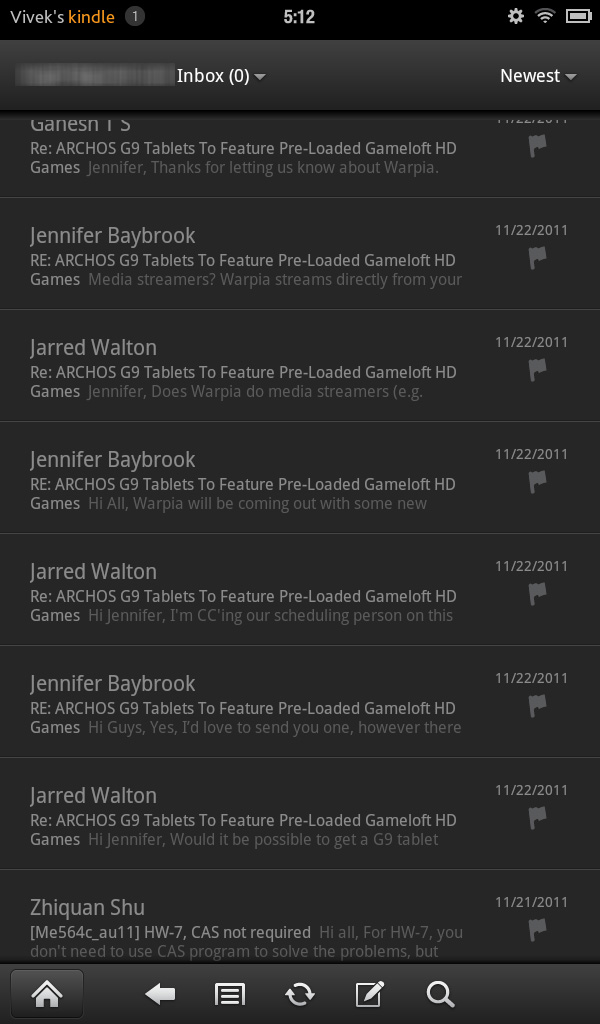
For example, my aunt called me over Christmas trying to figure out how to use the Kindle Fire e-mail client. Apparently it wasn't obvious that the square was the appropriate area to tap to compose a new e-mail. (I think it was supposed to represent a sheet of paper... an equally useless metaphor IMHO, as I doubt anyone younger than my aunt has recently handwritten a letter.) On the same toolbar was a rectangle (also likely representing a sheet of paper, or a list... it's highly stylized) for the android context menu, which contained other functions.
I realize that words are equally abstract, but at least they're mostly consistent, whereas designers change icons for everything. Plus, words take on new meanings, whereas pencils, floppy disks, or file cabinets are tangible items that are fading in prominence, and have no intrinsic connection to modern electronics. Just try composing a document on your tablet using a pencil and saving it to a floppy disk, just remember to record the support call and post it to the internet. -
Re:Pays off in usability
Using a Netbook means you are generally running software that usually was built targeting a much more powerful system - yes it runs, but not well.
Wait, what? Most of today's PC software was designed in the Pentium 4 era. Something like the AMD E-series makes the Pentium 4 look like a silly toy.
On top of that, a netbook processor is substantially faster than the processor in the iPad in absolute terms as well. If you're doing the same task on both, the netbook will be faster, period. The amount of inefficiency you see in 'designed for PC' software is never going to make up for the processor being like four times slower.
-
Re:Tradeoff?
Many people like games, and games are demanding. This is why Intel is working on making their integrated video cards better. No, it's not as good as the AMD offering, but it is improving, and since Sandy Bridge they've been sufficient to run most games in low settings.
Lo and behold! Actual review instead of FUD! Starcraft 2 running in 1680x1050, Medium settings, 44.6 fps. -
Re:But still slower then a "real" video card...
Actually, there is one place where Intel's integrated GPU knocks the socks off all the competition... Video encoding!
Just look at the benchmarks and image examples from AnandTech's review.
And that's the old Sandy Bridge. If we see 30%-50% improvement over that again.. I can see some uses for the integrated card
-
Re:But still slower then a "real" video card...
You can get a $40 card that will outperform the onboard.
Based on what we've seen, discrete GPUs below the $50 - $60 mark don't make sense if you've got Intel's HD 4000 inside your system. The discrete market above $100 remains fairly safe however.
-
Faster than low end Card.
http://www.anandtech.com/show/5626/ivy-bridge-preview-core-i7-3770k/11
It was faster than low end cheapo cards. Which is mainly the point.
If you are putting in $200 cards, they are a long ways off, but they essentially obsolete the need for a low end card, which is a good thing.
And since all most people need is a low end card, this is sufficient for most people.
For desktop, internet, video, web games, older games and even new games at modest settings this is fine.
-
Re:Where's the 10GbE?
Well, the Anandtech review on the Intel S2600GZ said:
Four GBe interfaces are on board and an optional I/O module can add dual 10 GBe (Base-T or optical) or QDR infiniband.
So maybe what you should be looking for is IO modules? I don't know.
-
Re:Are there any benchmarks posted yet?
Anandtech's review is up, only single threaded benchmark I saw though was the Cinebench one where the 2.2 GHz is only a slight improvement. The 2.9 GHz top model is running away from everything else though, if you got $2000 to spare...
-
Re:This isn't nearly as bad as the division bug
Take a look at the benchmarks. The FX-8150 really doesn't come out looking good against the 2500k, much less against the i7-980.
-
Re:vaporware
I'm going to go ahead and concede that I don't design microprocessors for a living, and I'll give you the heritage of the various architectures because I'm primarily just reiterating what others have told me and I feel like at this point unless you have some kind of non-public information we're both just speculating about it anyway.
So if you want to be the expert, let's see if we can learn anything here instead of just having a flame war.
You're arguing that Bulldozer uses too many transistors for its performance, and never mind that most of those transistors are wasted on an unfortunate cache architecture because it would be too difficult to change that. At the same time, you seem to think nothing of Intel basically starting over entirely with the L2 between Katmai and Coppermine. So let's see if you can help me understand why that is.
If you look at the cache latencies for Bulldozer, they're terrible. The L2 is 21 cycles compared to 11 for Core i5. The L3 is 65 cycles compared to 25 for Core i5. Combined with the 16KB L1D which means that a huge amount of data will (at best) be hitting the L2 and you've got something terrible going on.
OK, so why are the latencies so high? Here's what I think, you correct me if I'm wrong. Cache latencies are higher when caches are larger, when they have higher associativity, and when they're exclusive rather than inclusive. There is a trade-off between latency and hit rate. The L2 on BD is 2MB instead of 256KB on SB, is 16-way associative instead of 8, and is exclusive instead of inclusive. Hence, the latency is nearly double, and that's very bad.
And I can see why they did it that way. If you want to keep eight threads happy, you have to keep them out of main memory, and the way to do that is with large caches. They didn't want to have a tiny little L2 because there would be too much contention for the L3. They didn't want to have a big L2 which is inclusive with the L3 because it would be a huge waste of transistors to pay for 16MB of cache and only be able to put 8MB in it before you hit main memory. So they went for 8MB of L2 exclusive with the 8MB of L3 -- 16MB total, a good use of transistors, great.
Except that it causes the L2 latency to be terrible, and with a tiny L1 that turns into a catastrophe. I don't know if they didn't notice this or what, but it happened.
Now let's think about some alternatives here. Suppose they adopt the exact same L2 and L3 caches that SB uses: 256KB of 8-way, 11 cycle L2 inclusive with 8MB of 25 cycle L3. That would certainly be faster on anything with a working set that fits in the 256KB L2 regardless of the number of threads, and probably be faster on anything single-threaded because the L3 latency would then be almost as low a the L2 latency is now. And it would save them exactly those transistors that you're claiming disadvantages BD over SB cost-wise. (The disadvantage would be that they would then have a total of ~8MB of cache before they hit main memory, just like SB, and that could impact some highly threaded workloads with large working set sizes. But it seems like a small price.) Adopting this kind of cache architecture for a prospective A-series and selling it into the consumer market along with an integrated GPU sounds like a plan to me, so please explain why it would be unworkable.
Another alternative would be the one I described already: You use the same number of transistors for the cache but you arrange them differently: 512KB as inclusive L2 on each module (or 256MB on each thread), then a 1.5MB exclusive L3 per module, and 8MB of exclusive L4. You get the L2 latency way down for the first 256KB (by making it inclusive and 4- or 8-way associative instead of 16), but you get to keep 14MB of the 16MB of cache as exclusive so that you don't hit main memory on server workloads and you keep anything with a working set smaller than 1.5MB on a single module instead of contending with other m
-
Re:vaporware
And people are continuously comparing the i5 2500k to the FX-8150 because the comparison makes Intel look good, but try comparing it to something else, like the FX-6200.
Look, I am an AMD user. I dont have a single Intel chip in my house... but lets be honest here..
The i5-2500K is compared to the FX-8150 because the FX-8150 is $25 more expensive, and when AMD wins in a specific benchmark its only a small advantage going to AMD while when the Intel wins a specific benchmark its usually a significant advantage. The numbers speak for themselves
Trying to compare to the FX-6200 is sort of laughable thing to suggest. I dont get how you claim that the FX-6200 is significantly cheaper or better performing at anything since you cant even buy one yet, and nobody has benchmarked one. -
Re:vaporware
You are implying that only PC enthusiasts are interested in single-thread performance. How come that Intel invests so much in improving it, then, and does not lose its market share to AMD? This is also at odds with AMD's improvements in Turbo Core in Bulldozer.
That's kind of a silly question, isn't it? Why would they lose market share as a result of higher single-thread performance?
Intel is aiming for the broadest possible market. They want the subset of people who care about maximizing single thread performance in addition to the subset who care about maximizing multi-thread performance and the (by far largest) subset who don't really care about record-breaking performance very much at all and just want the best value for money.
AMD has concluded that they can't afford to match Intel's R&D budget in order to target every market segment and can get by with only the latter two. And they're not wrong -- they sell as many processors as they can produce.
I am afraid that either most of desktop workloads remain essentially single-threaded (e.g. compilers are single-threaded if you want to perform global (whole program) optimizations as opposed to trivial - but suboptimal - splitting the program to multiple compile units) or it is peak single threaded performance that affects the feeling of "snappiness" that customers want to pay money for.
You are apparently under the impression that CPU performance is still a major factor in "snappiness" in modern computers. The fact of the matter is that any K10, Bulldozer or Core processor in the vast majority of desktops spends 99% of its time idle. Moreover, the user without an unlimited budget will find that they experience better performance for the same price by combining an AMD processor with a Raptor or SSD than they would have using a more expensive Core processor with a slower disk. AMD can succeed perfectly well without beating Intel's fastest CPU on single thread performance as long as they can beat several of its slower CPUs at the same or lower price point.
The example of compiling stuff is particularly artificial because a) the vast majority of users don't ever compile anything (or, really, do anything CPU intensive whatsoever) and b) if you actually care about waiting for compiles to finish then you can turn off the most expensive performance optimizations until you get to deployment for beta testing because in the rare event that you discover it causes a major problem you can in the worst case just turn it back off.
-
Re:Asus is failing me
Actually according to theverge.com and gizmodo.com the descendants will have a Tegra 3 if you only want WiFi it's the 3g and LTE versions that will use the S4 due to Tegra 3 lacking LTE at this time and based on the Anandtech reviews of the S4 it's dual cores pretty much win all the CPU tests and most of the GPU tests compared to a Tegra3.
http://www.anandtech.com/show/5563/qualcomms-snapdragon-s4-krait-vs-nvidias-tegra-3
-
Re:The reason is LTE
WTF where did my links go... lets try that again and
http://www.anandtech.com/show/5563/qualcomms-snapdragon-s4-krait-vs-nvidias-tegra-3
-
Re:The reason is LTE
WTF where did my links go... lets try that again and
http://www.anandtech.com/show/5563/qualcomms-snapdragon-s4-krait-vs-nvidias-tegra-3
-
Re:vaporware
You are implying that only PC enthusiasts are interested in single-thread performance. How come that Intel invests so much in improving it, then, and does not lose its market share to AMD? This is also at odds with AMD's improvements in Turbo Core in Bulldozer.
I am afraid that either most of desktop workloads remain essentially single-threaded (e.g. compilers are single-threaded if you want to perform global (whole program) optimizations as opposed to trivial - but suboptimal - splitting the program to multiple compile units) or it is peak single threaded performance that affects the feeling of "snappiness" that customers want to pay money for. -
Re:Good News...
Seagate is shipping 3TB drives composed of 3 x 1TB platters (as of about Nov of 2011) I don't see why a 4x1TB platter design should be far off.
http://www.anandtech.com/show/5042/seagates-new-barracuda-3tb-st3000dm001-review
Pretty excellent drive, it's a shame they lowered the warranty to a not-at-all-acceptable 1 year term
-
Re:Eh
While you appear to have a solid technical knowledge base, it is clear you have little to no practical knowledge or experience with SSDs other than off the cuff comments you've read here or there.
Let's go through some of your misconceptions shall we...
Price. Yes they are more expensive than mechanical hard drives. But the speed boost is substantial and worth it. I remember paying $200 for a 30GB HDD a long time ago. Now I can get a 128GB SSD for $160. My 128GB Crucial M4 is limited by my 3Gbs SATA 2 connection. It maxes out at ~280MB/sec for reads due to the pipe. It is actually much faster than that (over 400MB/sec fast). Pretty amazing difference for the otherwise slowest piece of hardware in any computer. Plus with TLC NAND arriving drives are going to start getting cheaper. Pair the cheaper flash with more mature controllers and within the next year or so SSDs will be in their prime.
Yes they are not tolerant of vast amount of write cycles. That is what wear levelling and TRIM are for. Even if new 25nm MLC flash could *only* handle 3000 write cycles, do you think you will ever use it that much? Highly unlikely. New Intel drives in the worst case scenarios running MySQL databases are still expected to last for a few years. Are home users ever going to continuously do 1TB of writes per day on an SSD? Most enterprise systems won't even touch that.
Mostly wrong about the swap file. Microsoft recommends putting the pagefile onto an SSD. See: http://blogs.msdn.com/b/e7/archive/2009/05/05/support-and-q-a-for-solid-state-drives-and.aspx
Take a look at SSD caching. In particular Intel Smart Response. It's a great way to get the speed benefit of SSDs much of the time with a lower cost.
You are dead wrong about SSD speed. Where did you even come up with those numbers? My USB 3.0 32GB flash drive reads at over 120MB/sec. As already stated my SSD totally maxes out 3gb/sec SATA: something mechanical HDDs can only do in RAID. And that's only talking about sequential reads/writes. I dare you to open up firefox, photoshop, and start a 1080p movie off of a mechanical HDD, and then off of an SSD. Access times on SSDs are near instant. See http://www.anandtech.com/show/2829/20
Yes SSDs are still relatively young and immature in some areas. That doesn't change the fact that support for them is substancial and they are above and beyond mechanical drives in anything related to performance.
-
Re:Bad Choices --- What?
Saying 'my new integrated GPU is now half as fast as the slowest discrete card!' is not a great marketing win. If you want to play games well you need something better and if you don't care about games you don't care how fast the integrated graphics are.
AMD has never been saying that. When Llano came out, it was on par with mid-range discrete cards. You could clearly play quite a few modern games on it: http://www.anandtech.com/show/4444/amd-llano-notebook-review-a-series-fusion-apu-a8-3500m/11
-
Re:Products
Hertz to Hertz, AMD makes a better processor.
I would say that the complete opposite is true. Intel has better IPC and IPW. Their branch predictors are the best in the business. The Achilles heel of AMD's fusion processors is the fact that they bundled a solid GPU with a mediocre CPU. Well it turns out that you can't really upgrade the CPU in a Llano rig. On the other hand, it's trivial to upgrade one of Intel's crappy integrated GPUs with a discrete card.
I mean, look at what the 3850 compares to in CPU-intensive benchmarks: http://www.anandtech.com/bench/CPU/2 - it's behind Wolfdale chips that were released 2 years earlier and aren't even available anymore. Let's just face it: AMD chips are terrible. That doesn't mean that they're a bad purchase - they're still great value. But you get what you pay for. Intel's technology is much more advanced. And honestly, I'm firmly in the don't-buy-from-Intel-cause-they're-evil camp. Thankfully I can build my own desktop, but a Linux-based AMD laptop is pretty much impossible to find.
-
Re:Just another class action suit
I can't, for the life of me, see how this could have been marked as informative. Tests ( http://www.anandtech.com/show/3794/the-iphone-4-review/2 ) show that the iPhone 4's antennae behaves very much like the Nexus One antennae, but when gripped drops the signal much more than the iPhone 3GS and the Nexus One.
There is a serious flaw that manifests in low reception areas and with left handed people. If it wasn't a big problem, it would not have been noticed.
Apple touted improved reception and revolutionary design in it's adds, but that was not true, and it took them long enough to "admit" it (actually, they never did, but still accepted returns and gave free bumpers to those affected with by the problem they claim did not exist).
In one thing you're right though, the hype was ridiculous. But what caused that hype was people proving, either by simple tests or real research, Few days after steve job's mea culpa (or actually "no culpa"), the media frenzy stopped. It's a textbook example on how not to handle a problem.
-
Why Go ARM when there is Medfield?
I am failing to see why anyone would get an WOA tablet.
http://www.anandtech.com/show/5365/intels-medfield-atom-z2460-arrive-for-smartphones
Summary Medfield is running in similar power envelope to an ARM SoC, but with faster benchmarks.ARM might get you marginally more battery life, but Medfield gives you full backward compatibility.
-
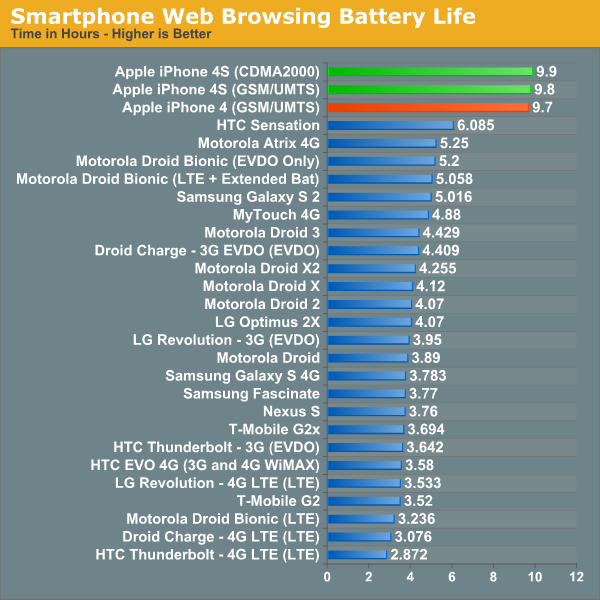
A chart worth more than a thousand words
Look out for the LTE phones on that battery life chart. Hint: Start looking from the bottom.
-
Re:Very frustrating
"The iPhone 4S supports HSDPA 14.4 and HSUPA 5.76 for GSM/UMTS-based carriers like AT&T, alongside CDMA2000 1x/EVDO Rev.A for 3GPP2 based carriers like Verizon." The article claims HSUPA is another name for HSPA+.
-
320 Series BugI have bought six X25Ms in total; all are tremendous performers and give me no problems. The are all G2s and range in age from 1 to 2 years (except for a used 40GB one I bought a month ago).
Unfortunately the Intel 320 series (really the X25-M G3) has had its own reliability issues with a nasty firmware bug that causes it to suddenly report its capacity as 8MB (causing complete data loss).
http://www.pcworld.com/businesscenter/article/236468/intel_acknowledges_ssd_320_bug_working_on_firmware_upgrade.htmlIntel on Sunday acknowledged that a bug could cause its SSD 320 solid-state drives to fail, and said a firmware upgrade is on its way to address the problem.
In some instances, a power loss may cause Intel's SSD 320 drives to crash and lose data. On rebooting the system, the system BIOS could report the SSD as having only 8MB of storage capacity. Intel two weeks ago said the error was possibly a bug, and that the issue was being investigated.
"Intel has reproduced 'Bad Context 13x Error' utilizing strenuous testing methods. This 'Bad Context 13x Error' can be addressed via a firmware update and Intel is in the process of validating the firmware update. A future update will define the schedule to deliver the firmware fix," an Intel spokeswoman said in an e-mail statement.It's ironic that a power failure triggers this problem, since Intel had marketed the 320 as especially resilient to them:
http://www.anandtech.com/show/4244/intel-ssd-320-reviewIntel always prided itself on not storing any user data in its DRAM cache. The external DRAM is only used to cache mapping tables and serve as the controller's scratchpad. In the event of a sudden loss of power, Intel only has to commit whatever data it has in its SRAM to NAND. To minimize the amount of data loss in the event of a sudden power failure, Intel outfitted the SSD 320 with an array of six 470F capacitors in parallel.
Some posters say it can happen without a power failure:
http://communities.intel.com/message/133499
Intel said they found the cause and released a firmware update, but applying it seems to have actually triggered the bug in previously problem-free drives for many posters:
http://communities.intel.com/thread/24121?start=0&tstart=0
Intel has not acknowledged any problems with the fix, nor told anyone which serial numbers were affected. Nobody has reported on the bug since Intel said they fixed it, including Anand.
This issue was enough to convince me to buy something else (even though the 320 series would otherwise have been my first choice) when I had to shop for an SSD last month. I found a used "like new" (according to the SMART data, at least) X25-M G2 on amazon instead.
Interestingly, X25-M G2 prices have held steady ($2/GB or so) and only gone up over the last year. Yeah it's probably because of dwindling supply, but I can't help but suspect that lack of confidence in the 320 series may have contributed to an increase in demand for the G2. -
Re:Samsung SSD 830 is also a good choice.
That's great. But when I was in the market for an SSD, their were three options: M4, Samsung or a Sandforce. Intel was more expensive, and the SandForce SSDs had reliability issues. Samsung SSDs have a great track record for reliability too
Samsung is a dangerous competitor in the SSD space. Not only does it make its own controller, DRAM and NAND, but it also has an incredible track record in terms of reliability It's also worth pointing out that Samsung SSDs are also one of the two options Apple rebrands and delivers in its Mac lineup. To continue to hold on to Apple's business for this long is an impressive feat on Samsung's part.
It's amazing to see Samsung come so far in the enthusiast space. From a drive that I simply wouldn't recommend to building a downright competitive solution backed by a near flawless track record.
-
Re:Sometimes
Anandtech mentions that the 520 went through a year of testing, so it should be much more reliable than other SF-2200 SSDs. Also fixed a BSOD issue in one of their systems, which was also using SF-2281.
-
Re:True stories
So why is it being outsold by the N9 with 95% less marketing? The 710 has a faster processor than the N9's A8.
Then again, it wouldn't surprise me if Harmattan was just a lot more efficient than WP7.http://www.anandtech.com/show/3633/apples-a4-soc-faster-than-snapdragon
-
Re:You had me at..
Last year, I tried writing a game in JavaScript, since all the cool kids are dropping Flash nowadays. It worked fine on Chrome, but was completely unusable on FF.
Which Firefox version was this though? 'Last year' could mean anything from V3.6 to V9. FF JavaScript speed started to improve significantly at around V7 and by V9 the tests below show it as better than Chrome in 2 out of 3 standard tests (although you could call it a draw since it's still significantly slower in 1 out of the 3 tests).
http://www.anandtech.com/show/5260/firefox-9-released-brings-javascript-speed-improvements
Why don't you try your game again in V9 and report back?
-
Re:Medfield
The Z6xx based SoC has a TDP of 1.3-3W. TDP does not equal idle power consumption, TDP is much closer to the maximum power usage since TDP (Thermal Design Power) is the amount of heat that the system must be able to move away from the chip if it should operate reliably. The performance figures that AnandTech posted for Medfield seems to suggest that Atom has an IPC (instruction per clock) much closer to Cortex A9 than A8. A9 should be up to 25% faster on the same clock speed according to ARM. The power-figures for Medfield doesn't look to shabby either, but they where measured by Intel so I guess they need to be taken with a grain of salt. Link to medfield article: http://www.anandtech.com/show/5365/intels-medfield-atom-z2460-arrive-for-smartphones
-
Re:why phase out DVI?Displayport does support 2560x1600. I hope it's not going away?
Anyways, we can't keep every standard forever. Right now a high-end monitor will have a 2x HDMI, 2xDVI-D, a DisplayPort, VGA, and Component in. That is a lot of connectors!
-
Re:Then we'll need a faster bus
The SF-2000 series controllers are already limited on the sequential side by 6Gbps SATA as well as the ONFI 2.x interface. Both need to be addressed to improve sequential performance, which we likely won't see until 2013.
-
Re:Interesting for silent computing enthusiasts
Intel's recently announced Cedar Trail update to the Atom line of processors also includes some models that are meant to be run fan-less. I think you're more likely to see these Cedar Trail chips being brought to the market in silent PCs than Medfield chips.
Glad to see that there are others out there who value silence above all else! -
Re:Dull Specs, but battery life?
I don't understand how people are speaking with conviction at numbers that are based on guesstimates and hearsay, and to the extent that they have already written off a chip that is just launching. Plus, these numbers seem to be wildly incorrect based on initial actual tests.
Please see the Anandtech article that contains actual performance and power numbers:
http://www.anandtech.com/show/5365/intels-medfield-atom-z2460-arrive-for-smartphonesThe Intel Medfield SoC idles at 18mW, consumes 1W during 3G browsing, and 850mW when running a 720p video.
The SoC does NOT consume 2 or 2.5W.Medfield's power performance at idle is significantly better than iPhone4S, somewhat better than Galaxy S2, is somewhat better than both at 3G browsing, and trails a bit in video playback. While Medfield isn't killing ARM with a much lower power consumption, it is definitely at par with ARM chips that are *currently shipping* and will likely be competitive with the slew of upcoming chips as well.