Slashdot Mirror
Domain: anandtech.com
Stories and comments across the archive that link to anandtech.com.
Comments · 3,318
-
Re:I think this confirms what Jobs was saying
The HTC nexus one doesn't seem to do that well:
http://www.anandtech.com/show/3821/iphone-4-redux-analyzing-apples-ios-41-signal-fix/3
Anyway, the Kapton tape workaround shows that problem may be is solvable without drastically affecting the appearance of the product. Unless of course the gold appearance is linked to the Kapton tape's function - even so black/white and gold isn't that bad a combination, Just bump up the reality distortion field a little.
-
Thin coating does help
It is possible that clear nail polish will do very little to mitigate the problem.
Anadtech showed that 1-mil Kaplan tape applied did reduce the effect somewhat.
The case will always be better but even bare as it is it works well enough. I don't plan to put a case on mine.
-
Re:I think this confirms what Jobs was saying
This could be related to the previously-discussed 'bug' in how the number of bars is calculated. As I understand it, the bar count is/was heavily weighted such that you'd still get 4-5 bars even when the signal strength was actually marginal. So even though you previously had 5 bars, you may not have had that strong a signal to begin with. See here for more details.
-
Re:How many of them have bare metal antennas?
Sorry but you don't even know what you are talking about. I refer you to http://www.anandtech.com/show/3821/iphone-4-redux-analyzing-apples-ios-41-signal-fix. People are assuming "bridging" or "shorting" is the problem. Anadtech shows a 10db performance difference, they do not specify the cause. The redux article above clearly states they talked to metallurgists that stated stainless steel is a poor conductor, and your hand is a poor conductor.
Find an old radio. Touch the middle of the antenna, it effects the sound quality. Now touch the tip of the antenna. It effects quality much more drastically. THIS is what the iPhone 4 is doing.
-
News from last month, Stuff that we already know
This is all very interesting, but any tech site that hasn't been using this method in their smartphone reviews since this started is behind the 8 ball. Consider Anantech's coverage of last week's update, with numbers before and after the software update and comparisons to the field. Heck, their Droid X review today treats the test as a standard benchmark.
-
News from last month, Stuff that we already know
This is all very interesting, but any tech site that hasn't been using this method in their smartphone reviews since this started is behind the 8 ball. Consider Anantech's coverage of last week's update, with numbers before and after the software update and comparisons to the field. Heck, their Droid X review today treats the test as a standard benchmark.
-
Re:Ancedotal Evidence
If you are going the SSD route, make sure you read this article first
The SSD Anthology: Understanding SSDs and New Drives from OCZ
http://www.anandtech.com/show/2738 -
Re:Ancedotal Evidence
> My current system is a C2D 1.8GHz E6300 that's now pushing 4 years of age,
> yet according to all the benchmarks I've seen by Anntech, Tom's Hardware and others, my performance results are less then 20 percent below the latest/greatest CPU's.While you probably don't need to upgrade your CPU, I don't see how your CPU can be only 20% slower than the latest and greatest. Even for single-threaded stuff.
See: http://www.anandtech.com/bench/Product/61?vs=142
Note: I'm even comparing the 2.33GHz C2D to the latest and greatest, since the 1.8GHz one isn't listed. But I'm sure the 2.33GHz C2D should be a bit faster than your 1.8GHz C2D.
For graphically intensive games, though the difference in the average fps would not be as high, the difference in the minimum fps might be, and that might be more important in many real-world scenarios.
In many ways it's quite impressive what Intel has done with the x86. The equivalent of a hypersonic flying pig beating the less "ugly" MIPS and Alphas
Assuming nothing breaks, my next upgrade is more likely to be an SSD than CPU, GPU, RAM or HDD. I'm just waiting for the prices to go down to more reasonable levels (and the number of bug reports to dwindle as well
-
Re:And yet the missed it.
The tour was for show because it sidestepped the key points. That is,
- How with all that testing did they miss the obvious test of just touching the antenna?
- Why did they ignore their internal memos that flagged the issue early on?
- If they knew about the issue, why didn't they insulate the antenna to begin with?
I believe they knew about the issue early on. I further believe it's quite possible the engineers had intended to coat the antenna but Jobs didn't like the look of a coated antenna. When it came down to "what are we going to do about this?" the logic that prevailed was "It only affects a minority (left-handed customers) so we'll put the bumpers out there and charge extra. That'll address the problem and bump our ROI on the phone. Problem solved." They failed to anticipate how the decision would blow up in their face and since it's probably Jobs who made the call, it's taken this long for the rest of Apple to convince him he had to acknowledge the mistake.
-
Re:What the hell, Steve?
Well, a clear epoxy coating on the antenna would have fixed this poor design inexpensively. That's still within the laws of physics, isn't it?
No - that's resistance in a DC circuit that you're thinkng of. On an AC antenna it's impedance you need, and as that varies inversely with frequency, at phone frequencies you'd need a pretty specialist high impedance (low dielectric constant) coating, should a viable such exist (that I don't know; Anandtech tested with a specialist tape, and it helped---perhaps enough to bring it in line with other phones, but didn't eliminate it entirely, even wearing rubber gloves.).
You can read more about it in a post on my own (hobby - I don't stand to gain from hits) blog.
-
Re:No surprise
Pretty much what we would expect from any company in Apple's shoes. Damage control at minimum cost.
Apple's numbers are suspicious. Everyone I know with an iPhone 4 has the issue(s) but NONE of them have called AppleCare or gone to the Apple store to complain. They have all been patiently waiting for Apple to take care of them.
I call shenanigans. Your numbers are even more suspicious than Apple's! So, you're saying that your prediction based on your data set is that all iPhone 4s have some deadline serious problem that destroys the ability for the phone to work? This is just implausible on the face of it. You're implying that 3 million out of 3 million phones have this issue?
How many of these people you know really had the "issue" of dropped calls, or did some of them just confirm that they can see bars go down when touching some parts? And for the record, that does NOT happen on my iPhone 4, and I've dared other people to try with my phone with their own hands.
I know several people with iPhone 4s, including myself, and NONE of them have *actually* reported more dropped calls in real life or dreadful data rates. My cell reception is surely better now than my iPhone 3G was in my area. And the times I had crappy coverage with the new phone it wasn't because of antenna touching -- i could put it on a table and see i had no reception no matter what! And one time it showed no coverage weirdly at home (while not touching it) and I had to restart the device. Lame, but probably fixable in a software update.
And I did the speedtest.net iPhone app tests and did it 3 or more times with each hand position and found no significant difference between holding the iphone in my left versus right hand (the AT&T network speed was very different each time, but the average was about the same).
Bottom line: the Anantech article seems basically right, and well researched, and matches my tests. YES, there is a loss in signal, but it starts at a higher point and the overall effect is that the iPhone does NOT have a big issue. And why all the fuss when you can get a bumper/case and it fixes even that mild issue in low signal areas if you really want to.
And because people keep posting falsehoods on Slashdot about this, WIRED did not rip them a new one over this. They mostly expounded on other people's complaints. What about their OWN tests at WIRED? Their summary of their own tests was "And in our own tests [...] the antenna problem is not especially serious .
-
Re:'Bout time
The dB drop when holding it is SIGNIFICANTLY higher than other phones.
-
Re:The others
The only "sensationalism" I've seen here was when Jobs said it would be a good idea to put two independent antennas on the outside of the phone, with a sum-millimeter gap between them. Anyone with some basic notions of electromagnetism facepalmed at the same time.
Now they spin it completely, as if the interference between the two antennas were the same thing as the natural signal obstruction you get when you hold your phone around the antenna. On my old Nokia I can make the signal drop by 15 dBm (measured by PhoNetInfo) if I cup the phone tightly around the antenna area; on the iPhone4, AnandTech measured a drop of 24 dBm just by holding the phone. That's unacceptable.
-
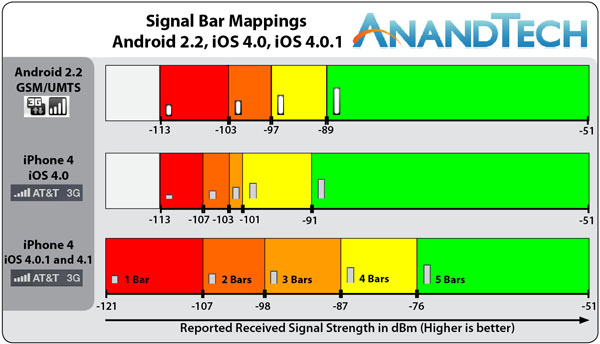
Graphical comparison of 4.0, 4.0.1, Android 2.2
http://images.anandtech.com/reviews/gadgets/apple/iPhone4/part2/signalbarmapping.jpg is a good picture comparing the display changes in 4.0.1.
4.0 was broken down as -51 to -91 / -91 to -101 / -101 to -103 / -103 to -107 / -107 to -113.
4.0.1 is broken down as -51 to -76 / -76 to -87 / -87 to -98 / -98 to -107 / -107 to -121.
Android's four bars are divided up as -51 to -89 / -89 to -97 / -97 to -103 / -103 to -113.With 4.0.1, it will accept a lower signal before dropping to "No Service" (-121 instead of -113). It also divides the range up more evenly. What was previously the lower end of the 5th bar is now in the range of the 3rd bar, as one of the largest examples of how this display update changes things around.
-
Re:lolwut
Well, since you were clearly confused about the conclusion I was drawing, perhaps you are incorrect about whether my "evidence" was anecdotal. And technically, you're still wrong with your definition of anecdotal, but I won't quibble about that.
My point was that most users are likely to perceive better performance from iPhone 4 than older iPhones and possibly other phones in general.
You don't like my evidence, so maybe you'll believe the folks over at AnandTech.
True, their conclusion was that the iPhone's reception would be better (under certain conditions) if the antennae were insulated, but they still found the phone's overall reception exceptional compared to iPhone 3GS. Oh and they confirmed what I said about all smartphones having these sorts of problems.
I searched high and low, but could not find any of these other studies you mention... Oh I found a bunch of here-say and anecdotal studies, but these you've already deemed unacceptable.
Also, maybe you shouldn't place too much faith in the Consumer Reports study - it's quite possible that their study was flawed.
-
Re:It does "simply work"
Real-world tests by Wired, Engadget, etc. all show that you can have 4 bars and great signal. Hold the phone and have zero signal.
What real-world use are you talking about? I'm not even activating my iPhone 4 until I get my bumper in the mail I just ordered.
I also hate this notion that Apple products always just work.
Moderators: parent post is insightful?
1) You haven't even activated it and so you can't even verify the claims yourself, so you are basing your views on self-admitted anger about previous products and other people's reports only. And all that despite the fact that you could choose to gather actual good data simply by activating it and being a good nerd and doing your own tests? To focus on the phrase "real-world tests" and then mock the possibility of you actually doing real-world tests seems to denigrate the scientific method, and the approach of geekiness in general. Unlike you, I actually activated my iPhone 4, have made tons of calls with BETTER reception than my iPhone 3G. And I even downloaded the speedtest.net app and tested with left hand, right hand, and not touching the phone, and didn't see much of a real world difference when holding it **naturally**. I am open to the possibility that there is more of a problem for some people, but everyone I know with an iPhone 4 does not have this problem when they hold the phone naturally. (my experience is consistent with the excellent anantech article based on a fairly thorough and nerdy testing process.
2) I have gotten crappy reception a few times, but as an experiment put the phone down on a non-conductive table and demonstrated that the AT&T crappy reception is independent of any antenna touching issue. I can still say that AT&T sucks ass, but that doesn't mean that it's some touching-the-phone issue.
3) And then you quote WIRED to back up your vitriol. WIRED, like most of the media, for the most part has been reporting about other people's reports, not their own testing, and in summarizing their experience WIRED says "And in our own tests, as well as the reports of many readers, the antenna problem is not especially serious.". That is hardly the indictment you make it out to be in your post. I'd go so far as to say your post is entirely misleading about Wired's assessment.
3) Showing low bars doesn't == more dropped calls. The excellent anantech article has demonstrated this using a fairly thorough testing process.
Your post almost seems like a Poe's Law post in the voice of a Mac Hater.
-
Re:It does "simply work"
Real-world tests by Wired, Engadget, etc. all show that you can have 4 bars and great signal. Hold the phone and have zero signal.
What real-world use are you talking about? I'm not even activating my iPhone 4 until I get my bumper in the mail I just ordered.
I also hate this notion that Apple products always just work.
Moderators: parent post is insightful?
1) You haven't even activated it and so you can't even verify the claims yourself, so you are basing your views on self-admitted anger about previous products and other people's reports only. And all that despite the fact that you could choose to gather actual good data simply by activating it and being a good nerd and doing your own tests? To focus on the phrase "real-world tests" and then mock the possibility of you actually doing real-world tests seems to denigrate the scientific method, and the approach of geekiness in general. Unlike you, I actually activated my iPhone 4, have made tons of calls with BETTER reception than my iPhone 3G. And I even downloaded the speedtest.net app and tested with left hand, right hand, and not touching the phone, and didn't see much of a real world difference when holding it **naturally**. I am open to the possibility that there is more of a problem for some people, but everyone I know with an iPhone 4 does not have this problem when they hold the phone naturally. (my experience is consistent with the excellent anantech article based on a fairly thorough and nerdy testing process.
2) I have gotten crappy reception a few times, but as an experiment put the phone down on a non-conductive table and demonstrated that the AT&T crappy reception is independent of any antenna touching issue. I can still say that AT&T sucks ass, but that doesn't mean that it's some touching-the-phone issue.
3) And then you quote WIRED to back up your vitriol. WIRED, like most of the media, for the most part has been reporting about other people's reports, not their own testing, and in summarizing their experience WIRED says "And in our own tests, as well as the reports of many readers, the antenna problem is not especially serious.". That is hardly the indictment you make it out to be in your post. I'd go so far as to say your post is entirely misleading about Wired's assessment.
3) Showing low bars doesn't == more dropped calls. The excellent anantech article has demonstrated this using a fairly thorough testing process.
Your post almost seems like a Poe's Law post in the voice of a Mac Hater.
-
Re:The thing is...
If you read the CR test report, they tested signal strength (with their "base station emulator"), but did not test for dropped calls. The fairly thorough AnandTech review agrees with the grandparent poster's experience, and perhaps explains the varied results the have been reported anecdotally. I have not seen a good test of the frequency of dropped calls by iPhone4 vs. any other phone. Until that data comes in, this is all full of sound and fury, signifying nothing.
-
Technical details from AnandTechhttp://www.anandtech.com/show/3794/the-iphone-4-review/2
Anand found that gripping the iPhone 4 a certain way could indeed cause up to 24dB of signal drop. This was worst-case, with a sweaty deathgrip. Touching more lightly or with less moisture had less of an effect. Gripping other smartphones near their antennas also caused a drop in signal.
The non-linear signal representation of the "bars" can also lead to some confusion related to this. The valid range is between -113dB (no signal) and -51dB (full signal). However, 5 bars represents the range of -51 to -91. 4 bars is -91 to -101. 3 bars is -101 to -103. 2 bars is -103 to -107. 1 bar is -107 to -113. If you have a full strength 5 bar connection, that 24dB drop won't even move you out of the 5th bar. If you've just barely got 5 bars, the same 24dB drop can put you down to 1 or 0 bars.
Anand's testing also confirmed what sjonke said in the comment above. Even when it was showing the same signal strength, the iPhone 4 was better at not dropping calls compared to the 3GS. The page shows a screenshot of a 625/31 run on Speedtest.net during a call with only -113dB.
-
Re:There's only one problem
> but from what I can tell, right now, the bang-for-your-buck crown goes to Nvidia.
Um, no.
$320 5770 CF >= $500 GTX 295
$400 5870 = $500 GTX 295http://www.anandtech.com/show/2856/
http://www.anandtech.com/show/2841/ -
Re:There's only one problem
> but from what I can tell, right now, the bang-for-your-buck crown goes to Nvidia.
Um, no.
$320 5770 CF >= $500 GTX 295
$400 5870 = $500 GTX 295http://www.anandtech.com/show/2856/
http://www.anandtech.com/show/2841/ -
Re:How does it compare to other phones?
Anandtech did something close to this in the second page of their iPhone 4 review, comparing quantitative signal strength from the 4, 3GS, and Nexus One. The iPhone 4 had the most significant drop for a "natural" grip, but with an overall better reception than the 3GS, that doesn't necessarily mean worse reception. They also have a few other reception-related quantitative comparisons.
-
Quiet and GP-GPU potential
As well as being a relative bargain, this is the quietest GPU in its power range, especially considering it uses the Fermi architecture.
http://www.anandtech.com/show/3809/nvidias-geforce-gtx-460-the-200-king/16It's going to be a great boon for those who would like great GP-GPU performance too. Custom raytracing, and scientific research is going to get a kick from this.
-
Seagate Momentus XT
I dropped a Seagate Momentus XT 500 GB in my Macbook Pro for $130 the other day. It has a 4 GB SSD-like swap-space on it and it's totally boss. You don't get the performance of an SSD, but you do get better than average performance for not much more. http://www.anandtech.com/show/3734/seagates-momentus-xt-review-finally-a-good-hybrid-hdd
-
Re:PC gaming never went away.
For a few bucks more, you can get a much beefier GPU...
$125 (MiR) 5770 http://www.newegg.com/Product/Product.aspx?Item=N82E16814131328The 5770 is twice as fast athe 240. Compare 103 fps vs. 54 fps @ 1680x01050.
http://www.anandtech.com/show/2917/12It appears Newegg is only stocking the GTS 250; lowest price is $90.
http://www.newegg.com/Product/Product.aspx?Item=N82E16814134094&cm_re=geforce_gts_250-_-14-134-094-_-ProductI agree the GTS 250 would be a inexpensive gaming card. For better bang/buck though, I would still recommend the 5770 as you can pick up another one in a year's time at a reduced price, and get double the frame rate.
-
Re:Next please!
Except the iphone 4 drops less calls than the 3GS. http://www.anandtech.com/show/3794/the-iphone-4-review/2 I have no reception issues with my iphone, and I am not an apple apologist. Yes they should test better, yes they should have added non-conductive coating, yes itunes felches, but in actual use it works better than the 3GS as from the article: "There's no doubt in my mind this iPhone gets the best cellular reception yet, even though measured signal is lower than the 3GS."
-
Re:so what if the calculation is wrong
They should of course accept that everyone is as ignorant as you about the fact that ALL mobile phones get signal attenuation when you hold your hand around the antenna.
Sure, but the phones do not all experience this attenuation equally. The attenuation on the iPhone 4 is significantly worse than the Nexus One and the iPhone 3GS. The problem can be easily ameliorated with a bit of plastic covering the antenna. The basic criticism, that the exposed antenna in contact with human skin causes reception problems, is accurate.
-
Re:Formula change
So you're entirely willing to discount solid reviews of signal strength, all because it smacks, to you, of an Apple 'Love', or is it possible you don't like it because it doesn't slam the iPhone 4 as as you think it should? kool-aid goes both ways my friend.
PC Magazine? Anandtech? These are not 'fanboi' sites for Apple as far as I'm aware of. They are PC oriented sites. Neither gushed about the phone as the be-all-end-all, just as neither said it was 'faulty' as is the fashion of late in these forums. They both did give it favorable reviews however:
http://www.pcmag.com/article2/0,2817,2364785,00.asp
http://www.anandtech.com/show/3794/the-iphone-4-review/2
Where in the parents post was it claimed it was superior to everyone else's choice?
Lastly, reading the parent and your post above, I think it's clear who is being the 'arrogant prick' as you kindly put it.
-
Re:Actual formula change
Are people actually reporting an increased frequency of dropped calls with normal use? I haven't seen any report that actually measured the frequency of dropped calls with normal use. I've seen anecdotal reports that it's a lot better, and a few saying its worse. The only report that seemed to do a careful job of lookeing at the signal strength issue (the Anandatech one) says that it's it's better, but even that author does not provide any kind of real statistics for both phone models under a range of signal conditions.
Based on the Anandatech report, a reasonable interpretation is that the external antenna design gives much better sensitivity, with the downside that with an unfavorable hand position, it degrades to something approaching the sensitivity of the earlier model iPhones with internal antennas.
-
Re:Actual formula change
Actually, there is no "correct" way to relate signal strength to number of bars, because there is no industry standard. What likely has happened is that Apple's original algorithm does not have sufficient dynamic range for the new iPhone, which is far more sensitive than their earlier models. Worse, the old algorithm exaggerates the impact of changes in signal strength due to hand contact , and makes people think that it is worse than the old model, when it's actually better even with hand contact. Apple probably doesn't want say, "we originally chose an algorithm different from the one that AT&T recommends to make the original iPhone look better," so instead they are "shocked, shocked" to discover the "mistake."
-
Re:Formula changehttp://www.anandtech.com/show/3794/the-iphone-4-review/2
The Antenna is Improved
From my day of testing, I've determined that the iPhone 4 performs much better than the 3GS in situations where signal is very low, at -113 dBm (1 bar). Previously, dropping this low all but guaranteed that calls would drop, fail to be placed, and data would no longer be transacted at all. I can honestly say that I've never held onto so many calls and data simultaneously on 1 bar at -113 dBm as I have with the iPhone 4, so it's readily apparent that the new baseband hardware is much more sensitive compared to what was in the 3GS. The difference is that reception is massively better on the iPhone 4 in actual use.
-
Re:Formula change
I can tell you that your entire post is horseshit. How do I know? Actual testing with actual numbers provided by Anandtech. Specifically, this page.
The bars do not convey an accurate sense of the phone's ability to make a call/transfer data. What a lot of people are seeing is going from 4 or 5 bars to 1 or none, but the difference in signal quality isn't from "super awesome to poor" (as a 5 bar to 1 bar drop implies) it's really from "not so good to poor" (which would be more accurately conveyed by a 3 bar to 1 bar drop).
-
Re:Actual formula change
Where do you get your figures from? On the Droid video, the display ranges from 73 - 94 dBm. That's 21dB.
The iPhone when tested has a worst case loss of 24dB.
http://www.anandtech.com/show/3794/the-iphone-4-review/2Not much of a difference. And one that could easily be the other way around had a different person, with different hands, tested it on a different day, in a different location, with different atmospherics.
Why don't you stop the hysteria?
-
Re:Formula change
That's the thing, though. According to AnandTech's analysis, the iPhone 4 has generally *better* reception than any of the previous iPhones. The problem is, people sit in a poor signal area, grip the antenna area on the phone (which does have a *modest* but significant effect on signal strength in all phones), the thing goes from 5 bars to 1 or none, and people freak out, even though they probably were not getting a good signal with or without their hand on the phone. By contrast, in a good signal area with the same grip on the phone the indicator won't budge from 5. The log scale and dynamic scaling/averaging over time do unintuitive things with the indicator.
Apple isn't the only one that has said this. In the same article that they described the antenna as better overall, AnandTech said the "visualization is flawed".
The antenna IS better than the previous design. The defective thing here was the display, not the antenna, because the display was misleading people about signal strength. Of course fixing the signal strength display won't change the effect of a hand on the antenna, and it won't change AT&T's service quality in marginal areas, but at least people might have a better indicator they are in a marginal area. Knowing the signal is dicey is important information when you're trying to call or download data.
-
Re:Formula change
Yes and no. The issue had to do with the scale used. From AppleInsider:
"Apple's iOS allots nearly 40 percent of reception levels to five bars, from -51 dB to -91 dB. But the distance from four bars to one bar of reception is much less, from -91 dB to -113 dB."
Unless you live under a rock, or have never cracked open ANY cell phone manual, you would know that they all recommend avoiding the lower left side where the antenna is located. The problem with Apple's configuration is that they used 5 bars for -51 to -91 db, which in itself is fine, since any call with those signal strengths would be very stable.
The problem has to do with dropping signal strength when you cover the antenna. Although you couldn't cause any phone to lose 63 db from grabbing it, getting a 20 db drop in signal strength isn't all that uncommon. If someone was in the weaker 5 bar range (say -90 db), which is still a decent signal, the phone would display 5 bars. When you covered the antenna, you could potentially get a 20 db drop, bringing you down to -110 db, which is a very poor signal. It gave the impression that someone went from 5 bars to no bars, or even no service (no service being very possible with -110 db).
There are no standards defining what dB is represented by the number of bars. It is totally up to the hardware manufacturer. As to whether or not this was a mistake, who can say? The haters will claim it's a marketing ploy, the lovers will claim it's a fair way to rate the signal. I'll probably fall in between.
What this fix will do is better represent the number of bars by signal strength in a more linear fashion, so that -90 might only be three or two bars, and covering the antenna would drop you to 1 or no bars. Although any phone might make a call at 1 bar, you should also expect that you might drop it with such a poor signal.
Frankly, I think most of the posts in these and other forums are full of 'noise' from people who hate Apple, from Droid fans, to people who just dislike them for their closed systems. It's an ideal way for them to take shots by spreading FUD and making the issue appear far worse than it actually is. Unfortunately, it also makes it much more difficult for people to judge the scope of the problem, which in itself is a win for Droid from a marketing perspective. I do know that I haven't dropped a single call on the iP4 regardless of the bar display. I suspect most fall into the same category. Reviews of the phone also back up the same. Dropped calls have actually been reduced under the iP4, regardless of the number of bars displayed. Anandtech actually has a nice write up and some more thorough testing of signal strength. What they found is that the exposed antenna's do make the iPhone 4 more susceptible to interference, but not so much that it would affect people with decent signal strength. It actually performs better than a droid for signal loss when it's in a cover:
http://www.anandtech.com/show/3794/the-iphone-4-review/2
The Antenna is Improved
From my day of testing, I've determined that the iPhone 4 performs much better than the 3GS in situations where signal is very low, at -113 dBm (1 bar). Previously, dropping this low all but guaranteed that calls would drop, fail to be placed, and data would no longer be transacted at all. I can honestly say that I've never held onto so many calls and data simultaneously on 1 bar at -113 dBm as I have with the iPhone 4, so it's readily apparent that the new baseband hardware is much more sensitive compared to what was in the 3GS. The difference is that reception is massively better on the iPhone 4 in actual use.With my bumper case on, I made it further into dead zones than ever before, and into marginal areas that would always drop calls without any problems at all. It's amazing really to experience the difference in sensitivity the iPhone 4 brings compared to the 3GS, and issues from holding the phone aside, reception is
-
Re:Formula change
OTOH, I've had some experience with sensors, and there's sometimes ambiguity to how the signals should be evaluated/presented. I'd guess that a logarithmic scale is a better fit for the relationship of absolute signal strength and perceived quality than a linear one. If they previously used a linear scale, this update might be appropriate.
From what I read here they used something that looked like a 4-6 dB over the first 3 bars, then 10 dB on the fourth and 40 (!) dB on the fifth.
Please remember that a logarithmic scale in signal power is linear in dB.
-
Re:Do The Right Thing - A Steve Jobs Joint
I can have a trendy, overpriced device
The iPhone costs the same[1] as any other (new) Android smartphone. Less, even, depending on how you calculate it. Now there is the fact that the data plan is no longer unlimited, but I dunno, 2GB is more than twice the volume of the most mobile data I've ever used in a month (even with tethering). But then, I operate with an ad and flash blocker, so I'd imagine others' results would vary.
[1] AnandTech: Apple's iPhone 4: Thoroughly Reviewed -
Re:Formula change
Well, There are some issues with the calculation of bars. I could pretend I knew what I was talking about, or that I'd RTFAs, but instead I'll just post this link to a FANTASTIC review of iPhone 4 vs. iPhone 3g[s] vs. Nexus One reception under various holding-conditions. ALL phones suffer signal loss when you hold them. The iPhone 4 is just a SLIGHTLY more egregious offender than other phones. That being said, though, it is much better at having a high quality of service even with lower signal strength. Something something something dBm something signal to noise something something.
-
Your assumption is incorrect
BESIDES it doesn't matter - a dropped call is a dropped call. If the iPhone 4 drops calls in areas where other phones (like the iPhone 3) worked perfectly, then the problem...
The iPhone4 does not drop calls in areas where other phones work perfectly. Instead of relying on your vast Apple Hater Rage to inform your opinion, why not try reading a carefully done study instead:
From my day of testing, I've determined that the iPhone 4 performs much better than the 3GS in situations where signal is very low, at -113 dBm (1 bar). Previously, dropping this low all but guaranteed that calls would drop, fail to be placed, and data would no longer be transacted at all. I can honestly say that I've never held onto so many calls and data simultaneously on 1 bar at -113 dBm as I have with the iPhone 4...In reality, reporting based on SNR makes a lot more sense, since I couldn't make calls drop driving around an entire day cupping the phone, despite being at -113 dBm (1 bar) most of the time.
The reality is that the iPhone 4 is BETTER at making and receiving calls. This is my own experience, and of the other people I know who have the phone - and also borne out by actual testing.
As Apple said, if people think there is a problem they can just return the phones, no questions asked. But I don't think Apple will see many takers.
-
Re:Actual formula change
a dropped call is a dropped call. If the iPhone 4 drops calls in areas where other phones (like the iPhone 3) worked perfectly, then the problem is not the number of bars displayed or the software.
According to the Anandtech review, the opposite is true:
From my day of testing, I've determined that the iPhone 4 performs much better than the 3GS in situations where signal is very low, at -113 dBm (1 bar). Previously, dropping this low all but guaranteed that calls would drop, fail to be placed, and data would no longer be transacted at all. I can honestly say that I've never held onto so many calls and data simultaneously on 1 bar at -113 dBm as I have with the iPhone 4, so it's readily apparent that the new baseband hardware is much more sensitive compared to what was in the 3GS. The difference is that reception is massively better on the iPhone 4 in actual use.
http://www.anandtech.com/show/3794/the-iphone-4-review/2
If people with this problem were measuring it in frequency of dropped calls during normal use, we probably wouldn't be seeing nearly so much complaining.
-
Re:Formula change
I believe they are currently using a non-linear scale. I don't know the exact relationship, but it sure looked logarithmic at a quick glance. '5 bars' was covered by ~50% of the 'usable' signal reading. From what I understand, this is reasonably representative (perhaps slightly optimistic -- "look we have more bars" marketing strikes again?) of actual performance, so if they do too much tweaking, it'll be much less representative of real quality drops/increases. Plus that doesn't solve the fact that (some) people are actually quantifying this as a drop in data speeds or calls dropping when held in certain ways -- and not solely in 'number of bars'.
Here's the link with numbers and more info.
-
Re:Applies to all iPhones
Actually, the Nexus One's attenuation is worse than the iPhone 3GS – almost as bad as the iPhone 4's
-
Anandtech may have an explanation...
Anandtech posted a review of the iPhone 4 the other day and they have a break down of the signal strength in dBm compared to how many bars are displayed. The specific page is here.
Basically it looks like there is a huge range for what is considered five bars, and a small range for the remaining four bars. -
Re:Applies to all iPhones
This needs to get out. anandtech did a bang up job investigating how strong the signal is based on the bars you have and found it to be logarithmic and heavily weighted to having 5 bars. This is probably a software fix to make it more linear. It's not fixing the antenna issue or all the dropped calls you'll still get because of the grip of death.
-
Anand Tech
-
Re:cough
Or you could just read the latest buying guide from Anandtech. http://www.anandtech.com/tag/guides
-
Re:Good riddance
My understanding is that people are judging things by "how many bars are on my phone?".. not "can i still make a phone call?"
Anandtech has a very thorough review of the iPhone 4.. but in particular page which talks in depth the changes happening when one uses the grip o' death, etc etc.
Such as:
From my day of testing, I've determined that the iPhone 4 performs much better than the 3GS in situations where signal is very low, at -113 dBm (1 bar). Previously, dropping this low all but guaranteed that calls would drop, fail to be placed, and data would no longer be transacted at all. I can honestly say that I've never held onto so many calls and data simultaneously on 1 bar at -113 dBm as I have with the iPhone 4, so it's readily apparent that the new baseband hardware is much more sensitive compared to what was in the 3GS. The difference is that reception is massively better on the iPhone 4 in actual use.
-
Re:Good riddance
My understanding is that people are judging things by "how many bars are on my phone?".. not "can i still make a phone call?"
Anandtech has a very thorough review of the iPhone 4.. but in particular page which talks in depth the changes happening when one uses the grip o' death, etc etc.
Such as:
From my day of testing, I've determined that the iPhone 4 performs much better than the 3GS in situations where signal is very low, at -113 dBm (1 bar). Previously, dropping this low all but guaranteed that calls would drop, fail to be placed, and data would no longer be transacted at all. I can honestly say that I've never held onto so many calls and data simultaneously on 1 bar at -113 dBm as I have with the iPhone 4, so it's readily apparent that the new baseband hardware is much more sensitive compared to what was in the 3GS. The difference is that reception is massively better on the iPhone 4 in actual use.
-
Re:Bumper solves and creates a problem
Thanks for the clarification - and the message on the paper
I got the information from here but as someone else pointed out, it might just be the non-Apple ones which don't work.
Either way, I think I'm going to hold out buying a new phone for a month or so, just in case these kinks work themselves out.
-
Who's assuming?
You merely assume that the problems are similar. Upon what are you basing the assumption?
Could you 'short' the antenna in the Nexus One merely by holding a phone in the 'wrong' way? No.
What proof do you have that the antenna is "short"ing on the iPhone 4? The only user-doable test is to look at the bars while changing the grip. That does not tell you what is causing it. It doesn't even produce a repeatable result every time.
Is the reception quantifyably worse than either the Nexus One or the previous generation iPhone? Yes.
Actually folks who have done tests report the reception is better than the previous iPhone. Link