Slashdot Mirror
Domain: anandtech.com
Stories and comments across the archive that link to anandtech.com.
Comments · 3,318
-
Re:Maybe per watt performance is the best but...
Bear in mind that Yonah is a chip aimed at portables (and other low-power requirements e.g. Mac Mini), and represents an early re-jigging of the Pentium-M architecture. Merom/Conroe will be improved even further, and it appears that the things really will be very good performers.
Of course, there's a few months until these things are on the shelves, but with the roadmaps as they stand, and with these early Conroe benchmarks, you'd be hard pressed to convince anyone that Intel aren't going to have a very compelling piece of hardware. -
Re:Are we reading the same data?Although the Dell has slightly lower specs, it also has a much lower price. Even if the coupon doesn't work anymore, these coupons periodically shows up:
-
Re:What's the variance?Yea, this test is riddled with obvious issues.
- On page two they say they're testing GeIL DDR2-533, yet on page 9, they're talking about DDR2-667 memory. Without a part number, we don't know which (of several) RAM module they were using.
- They didn't swap the RAM modules into the other "apparently identical" motherboard.
- They were testing overclockablity. If the mfg had made all of them able to run at DDR2-942 (471 MHz), don't you think they would have... I dunno, labeled them in that ballpark?
DDR2 comes in 400, 533, 667, 800, 900 & 1000/1066 MHz flavors,
sometimes known as 3200, 4200, 5400, 6400, 7200 or 8000 respectively.
That gives manufacturers a good opportunity to differentiate their product lines. Tom's Hardware should be glad their got a 533 (or 667?) module up to 800 & 900 MHz speeds.
And to address one of your questions, there really shouldn't be much variance, unless the ambient temperature changes between (or during) tests. Maybe you'd have a slight difference if you think the setup needed a burn in period. -
Re:boutique hardware
"Mac mini is virtually unique."
Yeah right, Shuttle released their mini PC with similar size in 2001, over two years before Mac mini.
Sorry, I forgot that in a world of Apple fanatics technology doesn't exist until Apple creates a product based on it. -
Re:AMD Vs Intel: Round 8The parent post is a perfect into of how to get modded up
Ok, so I know I'm going to get a lot of AMD people agreeing with me and a lot of Intel people outright ripping me to shreds.
Reverse Psychology 101 : Slashdot mods will never mod you down if you say this, because the think that slashdot should be a haven for unpopular opinions persecuted by the corrupt, capitalist main stream media. It also encourages people to back you up if you make a few 'mistakes' in your post and start a huge flamewar.
But I'm going to speak my thoughts come hell or high water and you can choose to be a yes-man (or woman) with nothing to add to the conversation or just beat me with a stick.
Yeah, it took courage to type all this in, as well as speed. If Galileo was alive today, he'd be too cowardly to post like this. Martin Luther king would no doubt be afraid to lay into Wintel on slashdot. Remember, your opinions are not mainstream, but that's because the mainstream is dominated by stupid Neurotypicals
I believe that AMD had this technology before Intel ever started in on it.
You're confusing dual core with Core. AMD had the first dual core chip, and it was widely recognised as being a cleaner design than Intels dual core P4. The P4 wasn't designed with dual core in mind, and it's pipeline was too long, because it was designed to get to higher clock frequencies faster. It turns out that the process shrinks ground to a halt because of leakage current, and ultra long pipelines perform rather poorly on desktop stuff compared to processors like the Athlon which are more conventional. So the P4 designers bet on the wrong things.
Essentially Core is Intel learning from the A64 and Pentium M. And prioritising dual core performance over clock frequency from the start. Now they're betting on much the same things as AMD. They've cloned AMD64 too. It's interesting stuff.As a disclaimer, I cannot say I've had the ability to try an Intel dual core but I'm just ever so happy with my AMD processor that I don't see why I should.
Translation : Yeah, I know about how the chip really works, so I don't need to bother with tiresome competitive benchmarking. Everyone knows those are rigged by evil capitalist big companies.
There's a nice little chart in the article but I like AMD's explanation along with their pdf a bit better. As you can see, AMD is no longer too concerned with dual core but has moved on to targeting multi core.
Translation : "I know the technology so much, I don't need to understand details like microop fusion. The P4 sucked and so even though they claim to have moved to a more Athlon like pipeline length, and Intel chips aren't more expensive than AMD and they will probably be more competitive in tests and lower power, that's probably just marketing buzz."
Note the benchmarks I quoted are of Yonah, a low power laptop chip that almost matches the performance of a similarly clocked A64. It's at least plausible that Merom, with more of an emphasis on performance than power will leapfrog Athlon 64 in performance terms in much the same way that Athlon 64 leapfrogger the P4.Do I want to see Intel evaporate? No way. I want to see these two companies go head to head and drive prices down. You may mistake me for an AMD fanboi but I simply was in agony in high school when Pentium 100s costed an arm and a leg.
Genius again : the image of a poor student, oppressed by the evil capitalists. Vengeful feelings to said capitalists.
Then AMD slowly climbed the ranks to be a major competitor with Intel--and thank god for that! Now Intel actually has to price their chips competitively and I never wa
-
Re:Linux?
But what would be the advantage of running Linux vs. the BSD-based MacOS X?
1) Because you like free software.
2) You need to run many X applications (and want to see them at native speeds)
3) You want to run MySQL (or nmap, or many other OSS packages) with better performance. -
Re:Dude... get a Dell
That's not exactly a big secret.
-
Re:OK, but why is Mac OS X so slow?
But even when you're not running legacy code, OS X is still slow. As I've reported in my blog recent article on Ars Technica showed that Mac OS X, running on the same hardware as Windows XP, is substantially slower at doing the same software tasks.
Johan De Gelas reported that the main cause for a lot of Mac OSX's speed problems is due to its extremely coarse thread locking. benchmarks show that thread latencies are extremely high, and this causes severe problems for highly multi-threaded applications, especially software like Apache and MySQL. it all stems from the massive wrapper bolted onto the Mach kernel for its IPC and threading mechanisms. it's very unlike FreeBSD's userthreads model, but seems ot be just as slow.
this is whay i don't own a mac.
-
Re:OK, but why is Mac OS X so slow?
But even when you're not running legacy code, OS X is still slow. As I've reported in my blog recent article on Ars Technica showed that Mac OS X, running on the same hardware as Windows XP, is substantially slower at doing the same software tasks.
Johan De Gelas reported that the main cause for a lot of Mac OSX's speed problems is due to its extremely coarse thread locking. benchmarks show that thread latencies are extremely high, and this causes severe problems for highly multi-threaded applications, especially software like Apache and MySQL. it all stems from the massive wrapper bolted onto the Mach kernel for its IPC and threading mechanisms. it's very unlike FreeBSD's userthreads model, but seems ot be just as slow.
this is whay i don't own a mac.
-
Dell still doesn't need AMD
In fact Intel's new microarchitecture processor Conroe makes AMD cpus unnecessary. Has it occured to anyone that now that Intel is poised to decisively take back the performance crown, Dell wants to be able to exploit that in the gamer/enthousiast market before the other specialty firms do?
-
Stupid, stupid, stupid.
This is retarded. Mac OS X - which is based on one of the slowest operating systems in the history of UNIX (Mach) - performs terribly. Microkernels were a terrible idea in practice; that's why everyone moved their shit into kernel space (and gave up the benefit of having a microkernel in the first place).
It took Apple until the Tiger release to make the kernel's locking scheme any finer than ONE network lock, and ONE "everything else" lock. Reminds me of the days of cli()/sti()/lock_kernel() in Linux. (In Tiger, there are something like 5 or 6 locks -- still a disaster.)
The funny thing is when Anandtech did a Tiger review some time back to measure the performance. Considering the delta between modern Linux and OS X (Linux measuring in at ten times faster in some places), it's outstandingly shocking that anyone would say OS X performs at all. Windows puts up a *much* better fight.
http://www.anandtech.com/mac/showdoc.aspx?i=2436&p =1 -
Does this fix OSX's bad Apache & Database
performance under load? As reported here: http://www.anandtech.com/mac/showdoc.aspx?i=2520 OSX has to this time had severe performance problems under load for Web applications, does it look like the improvements in this article will help?
-
Re:What a retarded article
True, now that the hardware is the same, true speed tests of each operating system can begin. And as we've already seen, and as mentioned several posts up, OS X is slower than Linux and FreeBSD.
-
Re:uhhhhh
The RSX supports rendering to both local and system memory. The way I'm understanding it you would probably want to leave your textures in the low latency video memory, but have your models sitting in system memory so that you could use the Cell's SPEs to do all kinds of nifty transforms. Hell, I still haven't heard anything definative on whether the RSX even has real vertex shaders.
Anyhoo, getting back on point... if you look at what PGR3 did with mapping giant textures to a cube and then bump-mapping them into nice buildings I could see using 1000MB of textures per level. Lets assume that 80% of the textures are unique to each level of a game. That means you could fit 10 levels on a DL-DVD or 5 levels on a SL-DVD.
The cost of single layer Blu-Ray discs should fall below DL-DVD prices pretty quickly, and with a single layer disc you don't have to worry about discs stuttering when you switch layers.
If the space is there it will be used. -
Re:Intel should be ashamed.
This was some of the biggest news in a while and it all happened about 1.5 weeks ago (where were you?:P)... Here are some from Anandtech.
This one is the preliminary benchmark testing that a lot of folks questioned and this one is the follow up that answered a lot of the concerns about the first one. The conclusion was the same, though... at 2.66GHz Conroe beats an overclocked 2.8GHz FX-60 (overclocked to simulate the upcoming FX-62) quite handily (20%+ most of the time) while using 1/2 the power of the AMD part (and obviously at a lower clock speed). There were a few other sites that had similar previews but they all say the same thing. -
Re:Intel should be ashamed.
This was some of the biggest news in a while and it all happened about 1.5 weeks ago (where were you?:P)... Here are some from Anandtech.
This one is the preliminary benchmark testing that a lot of folks questioned and this one is the follow up that answered a lot of the concerns about the first one. The conclusion was the same, though... at 2.66GHz Conroe beats an overclocked 2.8GHz FX-60 (overclocked to simulate the upcoming FX-62) quite handily (20%+ most of the time) while using 1/2 the power of the AMD part (and obviously at a lower clock speed). There were a few other sites that had similar previews but they all say the same thing. -
Re:Intel should be ashamed.
This was some of the biggest news in a while and it all happened about 1.5 weeks ago (where were you?:P)... Here are some from Anandtech.
This one is the preliminary benchmark testing that a lot of folks questioned and this one is the follow up that answered a lot of the concerns about the first one. The conclusion was the same, though... at 2.66GHz Conroe beats an overclocked 2.8GHz FX-60 (overclocked to simulate the upcoming FX-62) quite handily (20%+ most of the time) while using 1/2 the power of the AMD part (and obviously at a lower clock speed). There were a few other sites that had similar previews but they all say the same thing. -
ExtremeTech, Tom's, Anand reviews
-
Detail for the uninitiated
Wikipedia:
Nvidia
Comparison_of_NVIDIA_Graphics_Processing_Units
GeForce_7_SeriesATI_Technologies
Comparison_of_ATI_Graphics_Processing_Units
Radeon_SeriesAnandtech:
ATI's New Leader in Graphics Performance: The Radeon X1900 Series
X1900 XT/XTX Roundup: A Closer Look at the Performance Leader in Graphics
NVIDIA's Tiny 90nm G71 and G73: GeForce 7900 and 7600 Debut -
Detail for the uninitiated
Wikipedia:
Nvidia
Comparison_of_NVIDIA_Graphics_Processing_Units
GeForce_7_SeriesATI_Technologies
Comparison_of_ATI_Graphics_Processing_Units
Radeon_SeriesAnandtech:
ATI's New Leader in Graphics Performance: The Radeon X1900 Series
X1900 XT/XTX Roundup: A Closer Look at the Performance Leader in Graphics
NVIDIA's Tiny 90nm G71 and G73: GeForce 7900 and 7600 Debut -
Detail for the uninitiated
Wikipedia:
Nvidia
Comparison_of_NVIDIA_Graphics_Processing_Units
GeForce_7_SeriesATI_Technologies
Comparison_of_ATI_Graphics_Processing_Units
Radeon_SeriesAnandtech:
ATI's New Leader in Graphics Performance: The Radeon X1900 Series
X1900 XT/XTX Roundup: A Closer Look at the Performance Leader in Graphics
NVIDIA's Tiny 90nm G71 and G73: GeForce 7900 and 7600 Debut -
Re:Not a fair test
So the nVidia card wins because they used 3 games that are designed to work better with nVidia boards than ATI boards?
What are you talking about? While Quake 4 has always run better on Nvidia hardware, Half-Life 2 has always performed better on ATI hardware, to the extent that ATI hardware came bundled with Half-Life 2. You have to give it to Nvidia for designing a card that would beat ATI's flagship at their own game (pun intended), and this alone deserves to declare them the winner of this comparison.
Their fab process and Q&A suck
Again, you show that you don't know what you're talking about. Their "fab process"?? Both Nvidia and ATI used TSMC to fab both of those chips. No difference between the two. As for Q&A, then you have to talk to the specific board manufacturer. Nvidia doesn't design the graphics boards, only the chips. Other vendors like Asustek and eVGA design the boards, and sell them to you. So they are responsible for any Q&A.
they cannot be bothered to properly follow the farking API specs for dx9 or openGL
Again you're spreading FUD. The NV3x (GeForce FX) had issues, which NVidia were the first to acknowlege. The tables have completely turned with the Geforce 6x and 7x series. Can you point the parts of the spec that those cards don't implement properly?
I've see far too many of their cards TOAST from being OC'ed by their own drivers.
The drivers don't just OC the cards. You have to do it. You know that this voids the warranty, don't you? -
Re:I'm sorry but I'd rather...
What if you don't need another car, and like to play games?
And that would be more like 1/10th (or less) the price for a previous generation card (here's a froogle for a 6800 at $170, compared to roughly $1000 for a 7900 SLI).
http://froogle.google.com/froogle_cluster?q=geforc e+6800&pid=2223881873561302977&oid=299528262137621 7068&btnG=Search+Froogle&scoring=mrd
But it wouldn't be nearly as good, unless you consider 8x slower nearly as good. In fact, given the prices
http://www.anandtech.com/video/showdoc.aspx?i=2717 &p=7
(note that the 7900 sli is consistently more than 4x as fast as the 6800 sli, and that we're considering how it would compare to just one 6800 in the pricing above). -
Re:OS? Hardware?
-
Re:Inefficency.
Times change quickly in processor business. Intel is back.
Intel now rules efficiency per clock.
Intel now rules efficiency per watt.
http://anandtech.com/tradeshows/showdoc.aspx?i=271 6 -
Re:Inefficency.
FYI: http://www.anandtech.com/tradeshows/showdoc.aspx?
i =2713 http://www.anandtech.com/tradeshows/showdoc.aspx?i =2716 You might want to keep up with the news better. This -
Re:Inefficency.
FYI: http://www.anandtech.com/tradeshows/showdoc.aspx?
i =2713 http://www.anandtech.com/tradeshows/showdoc.aspx?i =2716 You might want to keep up with the news better. This -
Re:TFA is weak, Here is Anand's updated benchmarks
I agree with many here who have already said: Don't waste your time RTFA.
Read the AnandTech IDF benchmarks updated instead.
http://anandtech.com/tradeshows/showdoc.aspx?i=271 6
"On the Intel front, there is a lot of time for performance optimization with regards to Conroe and its platforms. It's also worth noting that the 2.66GHz E6700 we previewed here is simply a high end mainstream part, it is not an Extreme Edition flavor of Conroe. At 2.8 or 3.0GHz, a Conroe EE would offer even stronger performance than what we've seen here. "
"The performance picture with regards to Conroe hasn't really changed all that much - on average we're still seeing a bit over a 20% increase in performance over an overclocked Athlon 64 FX-60. While it's worth noting that these results should be taken with a grain of salt, we really were not able to determine any cause for suspicion based on Intel's setups. The machines were as clean as they could get, with the BIOS oversight having no tangible impact on most performance" -
TFA is weak, Here is Anand's updated benchmarks
I RTFA and it is severly lacking on substance.
Here is Anand's updated benchmarks.
http://anandtech.com/tradeshows/showdoc.aspx?i=271 6 -
Re:Price point
-
Re:XBOX 360Your anecdotal, biased observations at Target is great proof that PCs have had better graphics than the XBox 360 "for years."
Two "years" ago, the high end PC GPUs were the ATI Radeon 9800 and NVIDIA GeForce FX 5950, both DirectX 9 Shader Model 2.0 GPUs. The XBox 360 GPU is a DirectX 9 SM 3.0 GPU with some support for the upcoming DirectX 10.
-
Re:OS? Hardware?
Since the poster says he is an avid gamer, it is probably safe to assume that he runs Windows XP.
A site that I have always found helpful is AnandTech. Every couple of months or so they publish a guide on recommended hardware for different performance levels of computers. The systems they recommend are usually designed so that no one piece of hardware is a bottleneck on the performance. -
Re:I need a simple site like this:
Anandtech does precisely that kind of article every few months. They just released the lastest one. http://anandtech.com/guides/showdoc.aspx?i=2714 Three pages. High End, Medium Range, Low End.
-
More Sources, no karma whoring
http://www.amdzone.com/modules.php?op=modload&nam
e =Sections&file=index&req=listarticles&secid=13
http://www.anandtech.com/video/showdoc.aspx?i=2717
http://www.guru3d.com/article/Videocards/326/
http://pcper.com/article.php?aid=213
http://techreport.com/onearticle.x/9529
http://www.tomshardware.com/2006/03/09/ati_and_nvi dias_same_day_mega_launch_mayhem/ -
Re:Do we have evidence that Intel coerced...This disproves your claim that Intel isn't innovating: http://anandtech.com/tradeshows/showdoc.aspx?i=27
1 3 They demonstrated a quad-core. (2-die)As far as Viiv is concerned, its primary advantage is ease-of-use. Specifically, if you have a Viiv HTPC that does DVR in your living room, you can stick a Viiv device on the TV in your kitchen and access all of your shows. It's supposed to be easy to set up, but I'll believe it when my parents set it up.
The Pentium M can be placed in a desktop computer.
Although Intel has marketed the Pentium M exclusively as a mobile product, two motherboard manufacturers (AOpen and DFI) developed and shipped Pentium M compatible desktop boards in late 2004. An adapter, the CT-479, has also been developed by ASUS to allow the use of Pentium M processors in selected ASUS motherboards designed for Socket 478 Pentium 4 processors.
http://en.wikipedia.org/wiki/Pentium_ MAnyway, it was my mistake for saying Core Duo. I meant Centrino Duo, which uses Core Duo.
Anyway, we're now way off of the topic of this forum.
-
Re:Shock news.
In fact, AM2 isn't superior to what Intel has, because DDR2 performance on AM2 is significantly SLOWER than AMD's current DDR performance.
See this article:
http://anandtech.com/weblog/default.aspx?bid=279
Essentially, AMD is having huge performance issues with AM2 with their current prototypes. At the current point in time, overclocking a current DDR1 S939 chip is going to give you faster performance than a current DDR2 AM2 chip. -
Re:Wait and see (faked tests)
Something isn't right, from the screenshot.
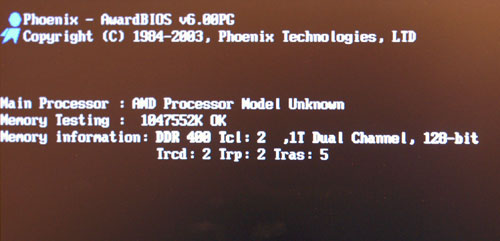
..Using an award bios last copyrighted in 2003 for AMD's latest FX-60 chip (2006)..
..Notice how the AMD Processor isn't correctly id'd in the Bios post.
..Even though.. DFI has distributed a new bios version to suport FX60.... This thread indicates that there is some video defect in RD480 chipset..
These red flags indicate that something is very fishy and Intel's results should not be trusted... (rigged test)
-
Re:Wait and see
Umm, I suggest you RTFC (comment), as the grandparent was in fact referring to a link posted in another comment to arstechnica, not the original anandtech article.
-
Re:The Conclusion
Here is an anand blog piece on am2. Doesn't seem to give great hope that just am2 will make a huge difference http://www.anandtech.com/weblog/default.aspx?bid=
2 79 -
Re:slightly off-topic
Um those arent the yonahs(Core duos), these are the yonahs:
http://www.anandtech.com/cpuchipsets/showdoc.aspx? i=2648&p=14
To save you the trouble, "We continue to see that the Core Duo can offer, clock for clock, overall performance identical to that of AMD's Athlon 64 X2 - without the use of an on-die memory controller. The only remaining exception at this point appears to be 3D games, where the Athlon 64 X2 continues to do quite well, most likely due to its on-die memory controller. "
So basically intels laptop chips use less power, and can go head to head against AMD's desktop chips.
In any case Q3 Intel will be releasing the desktop version of the core duo which will up the power envelope slightly, but still be less then the amd,a dn should offer significantly better performance per clock then the core duo. -
Re:Why keep SSH on?
"True, a Mac Mini isn't typically going to be used as a server, but if Apple decides to make some kind of Intel based server, this kind of thing is a HUGE problem."
All major OSes have tons of local root vulnerabilities all the time:
http://www.google.com/search?hl=en&q=linux+local+r oot+vulnerability&btnG=Google+Search
http://www.google.com/search?hl=en&lr=&c2coff=1&q= solaris+local+root+vulnerability&btnG=Search
etc.
It hardly prevents them from being used as servers. I think its the serious performance problems that is keeping people from using Max OS X on servers:
http://www.anandtech.com/mac/showdoc.aspx?i=2436 -
Re:Mac mini
Maybe that means a couple percents in benchmarks, but they're basically identical.
Yeah, I mostly agree when it comes to most benchmarks and OS X (GMA 950 is needed for Vista Aero Glass support, but that's another thread). However, Core Solo does have some non-trivial architectural improvements over Pentium M including SSE3 and other floating point improvements (see "Digital Media Boost"). And if your laptop is 3 years old and has integrated graphics, then it must be using the older Intel "Extreme" AGP graphics. For things like Core Image, Photoshop, and Final Cut, I think Core Solo and GMA 950 probably is a large improvement over 1.5GHz Pentium M and Intel Extreme graphics.I have a 3 year old laptop with a Pentium-M 1.5Ghz CPU, and that was a lower-end model at the time. In otherwords, pretending that the bottom Mini model is bleeding edge in anyway is false.
I meant to emphasize the component price differences between a (1.5GHz Pentium M + 915GM + wireless b/g) bundle and a (Core Solo + 945GM + wireless a/b/g) bundle. However, I'm probably wrong on that point. According to Intel's Jan 2 pricelist, the former costs $272 (1.6GHz Pentium M) and the latter costs $278. Still, Dell's just-announced "cheap" Core Solo Inspiron starts at $929 ($729 for a limited time).
-
Re:dell...You're fudging on numbers...the machine you just stated isn't even remotely comparable. The Ars box has a 17 inch monitor, speakers included, and a CDRW...if you tack those options onto the "$437.94 shipped" computer you priced, you're well over $500. And on top of that, the computer you priced is a Celeron, which isn't even remotely in the same range of an Opteron 2800+ . Celerons are bar none the shittiest processor ever invented. I swear my old Athlon 1700+ ran faster than my Celeron 2.4 Ghz. Or it sure as hell felt like it.
But face it, it's roughly equivalent. The only difference is that building OEM lets you choose your components, rather than getting stuck with a shitty retail build full of "lowest bidder" parts and crappy bundled software (and often BIOS) loads.
-
Re:I stopped reading here...
This is laughable at best. Just look at Blu-ray Disc Association website and the long list of the members, far longer than that of HD DVD.
http://www.blu-raydisc.com/general_information/Sec tion-14009/Index.html
Maybe you should actually read the page. This is a list of Supporting Companies, not Companies that are PART of or EVEN ALLOWED to participate in the technology.
These are just SUPPORTERS, not participents in developing, adding to or even allowed to question Sony about the Technology.
Here I will illustrate for the slow swimmers.. HP is listed on the page you provided us the nice link to, now read this...
"Here's more on the reason for HP's decision to also back the competing HD-DVD format. It appears that HP wasn't too happy that Sony decided to turn its back on iHD support. Hewlett-Packard was pushing hard for iHD which allows for more interactive features to be included on the disc"
http://www.anandtech.com/news/shownews.aspx?i=2545 3
Get it? -
Unfortunately for them...there is this thing called the Internet and on this Internet, there these things called Forums and some of these forums are tailored for bargain hunters. From http://forums.anandtech.com/messageview.aspx?cati
d =40&threadid=1810259&enterthread=y :KFC is giving away coupons for a free Buffalo stacker standwich.
Go to KFC.com and enter code Buffalo
Hey it's worth a shot for a free sandwich -
This is nothing to complain aboutI don't know how many socket architectures Intel has introduced in the last two years. I just stopped caring enough to count. AMD, on the other hand, has basically standardized on one: 939. They deserve a lot of praise and respect for the fact that 939 runs everything from (almost) the bottom of the line to the very top, which is a big range, covering at least eight distinct core designs.
Nobody believed them when they said that they won't make you buy a new mobo to upgrade to dual-core processors. Amazingly, AMD kept their promise! They even migrated some Opterons to 939 so you can upgrade your home computer with a real server chip. Now compare this to Intel and you'll see how disciplined and customer-friendly AMD have been.
Of course, they want to make use of DDR2, and since your old motherboard doesn't have DDR2 slots, you'll need to buy a new motherboard to use DDR2. That's the end of the story! You'd have to be high to think you could keep your board and just upgrade to DDR2. AMD switched the pinout a tiny bit so that you don't make the mistake of plugging in an incompatible processor into the board. There's nothing more to it than that.
So maybe people are complaining about being forced to go to DDR2, but I don't think that will happen. I'm quite sure there will be several new AMD processors for Socket 939, probably priced at the same level as their AM2 counterparts. The only difference will be the memory controller. Of course, it won't make much sense to buy 939, with DDR2 being almost as cheap as DDR.
Maybe people were complaining about the extra burden on mobo manufacturers to retool, but this is absolutely minimal, as the Anand article makes clear. We will see many cheap AM2 boards almost right away, because they are so similar to Socket 939 and 940.
Really, this is a great illustration of how a socket change should look.
-
Anandtech
I'd rather read the AnandTech article on AM2
-
What's the advantage?
Without having RTFA or the replies, I present the above question. Venice doesn't consume more than 30 watts from what I read. See this thread: http://forums.anandtech.com/messageview.aspx?cati
d =29&threadid=1780053&enterthread=y -
Re:Dvorak: wrong, again.
i bought a 3.2ghz, 1gig RAM laptop from hp around a year ago for less than these "cutting edge" 2.16ghz mac's
I was referring to the gap between "a G4 and a modern Athlon" being reduced by becoming the gap between a modern Intel and a modern Athlon. By reversed, I meant that according to some sites the Core Duos are faster than the mobile Athlons for many things.
Anyway, your case doesn't apply here because as far as I know AMD doesn't have 3.2 GHz processors, so I assume that you have a P4. Well, I'm amazed that even now you don't know that clockspeed is meaningless. That's why in general Athlon 64s cream P4s even though the Athlons run at lower clockspeeds. And the Pentium M and Core Duos, which aren't descendants of the P4, run as fast as P4s of much higher clock speeds. So you got a 3.2 GHz P4 laptop? Great, it may be a little faster than the Core Duos, but that doesn't justify the extra cooling needed (and thus the weight), nor the reduced battery life.
Oh, and regarding multiple cores and multiple processors, for some of us they do make a huge difference, even for single (well optimized) tasks.so I still know what it feels to be a Windows user
and what does that feel like exactly?
Slightly frustrating. As compared to working on my Mac, I feel that I need to invest more time in coaxing the (Windows) PC into helping me to do my work.
On the Mac things are easy to install and they tend to be very consistent (for example, setting up a program usually does not require me to look all over the menus trying to guess what was the author thinking when he wrote the program). Things just work. Programs are also trivial to uninstall, so I'm never afraid to mess up my system by trying new software (e.g., corrupting the registry). It's really another world. -
Re:Tom's was wrong