Slashdot Mirror
Domain: anandtech.com
Stories and comments across the archive that link to anandtech.com.
Comments · 3,318
-
They've dropped Performance, tooAt least, according to the Boy Wonder. Check out their tests here.
Still beta, I know, but startling nonetheless.
-
Re:As it says...The AMD core is primarily x86, where the P3's and P4's are more RISC-like.
This is so wrong. The AMD core breaks up an x86 instruction into RISC-like "micro-ops" or ROPs, and then various RISC-like execution units go to work executing the ROPs. Up to 9 ROPs can be executed at the same time! This is why the Athlon so thoroughly stomps all over the Intel chips at equivalent clock rates--the AMD chips can get more done per clock. This is especially true for floating point, where the Athlon can execute 3 floating point instructions at once.
Full details here in the AnandTech article. I linked to page 8, the one that has the discussion of how instructions get executed.
This is the reason why Pentiums cost more than AMD's
Total nonsense. Intel chips cost more because Intel charges more. The Pentium 4 is expensive because its die size is freaking huge.
Let's just say I have inside knowledge of Intel products.
You don't seem to know very much about AMD products.
steveha
-
Re:As it says...The AMD core is primarily x86, where the P3's and P4's are more RISC-like.
This is so wrong. The AMD core breaks up an x86 instruction into RISC-like "micro-ops" or ROPs, and then various RISC-like execution units go to work executing the ROPs. Up to 9 ROPs can be executed at the same time! This is why the Athlon so thoroughly stomps all over the Intel chips at equivalent clock rates--the AMD chips can get more done per clock. This is especially true for floating point, where the Athlon can execute 3 floating point instructions at once.
Full details here in the AnandTech article. I linked to page 8, the one that has the discussion of how instructions get executed.
This is the reason why Pentiums cost more than AMD's
Total nonsense. Intel chips cost more because Intel charges more. The Pentium 4 is expensive because its die size is freaking huge.
Let's just say I have inside knowledge of Intel products.
You don't seem to know very much about AMD products.
steveha
-
Re:What about power?
According to AnandTech it does.
-- -
Re:12dB-16db that's low noise
It's apparently been a while since you've used a Cyrix chip. The Cyrix III series of chips supposedly run at around 5 watts and don't really need a fan, although the chip says "Heatsink/fan required". I understand performance is pretty bad, but if you don't need a top-of-the-line system this CPU could be nice to have. Anandtech has an article on this chip that is not too flattering, so I'm kind of wary about it. Does anyone have any real world experience with one of these things? I am interested in their power usage and stability (another traditional Cyrix weak point).
--------------------------
"Any fool can make a rule, and any fool will mind it." -
Re:Anand is an idiot
Anand's "News" headline thing on the left is a merging of the four "News" sections he has. The Seagate "story" is under the Press Releases section which is why it's pretty much verbatim as with everything else in that section.
-
Re:A desperate attempt?
Then how do you explain the results here?
-
Re:This is proof...
Personally, I bought a new machine five months or so ago, and instead of buying a P4, I went with a 1GHz Pentium III. A lot of my friends ridiculed me.
I would have ridiculed you, too -- for not buying an Athlon. With everything that we know know, how could anyone not buy AMD? (I feel like Elaine talking to that smoking pregnant psychic...) I mean, they're faster (perhaps not for all applications, but my own comparisons of the 800MHz P3 at work to the 800MHz Tbird at home say that they are), and they're cheaper (this is just undeniable). Unless you're looking at SMP solutions, anyone who has kept buying Intel chips over the past eight months needs a beating with the clue stick.Now that the Athlon MP and dual-CPU mainboards have been released, it just restates what we knew a year ago: AMD is slowly but surely beating Intel at Intel's game.
Well, they're not looking so damned smart now, are they?
I think that both you and your friends need to try developing (assuming that you develop) or gaming (and I'm sure that you game) on AMD boxes for a week.
--
-
Interesting Benchmarks (summarized)...Although benchmarks are always open to interpretation, I think some of the numbers are quite interesting here. The Dual Athlon 1.2GHz outperforms the Dual Pentium Xeon 1.7 GHz by 6 to 18% on almost all the tests they ran. Here's a rundown:
- Database Server Performance: 17.6% Faster
- 3D Rendering Performance: 14% Faster
- Image Editting Performance: 6.1% Faster
- Workstation Performance (Overall): 22.1% Faster*
- Linux Performance (Total): 12% Faster
- IT/Constant Computing Performance (Average): 17% Faster
- Overall System Performance: 8.6% Slower**
** - The Overall System Performance numbers ended up that way due to the Xeons' 20% advantage over the Athlons on the Internet Content Creation benchmarks and the basically even performance on the Office Productivity benchmarks. -
Interesting Benchmarks (summarized)...Although benchmarks are always open to interpretation, I think some of the numbers are quite interesting here. The Dual Athlon 1.2GHz outperforms the Dual Pentium Xeon 1.7 GHz by 6 to 18% on almost all the tests they ran. Here's a rundown:
- Database Server Performance: 17.6% Faster
- 3D Rendering Performance: 14% Faster
- Image Editting Performance: 6.1% Faster
- Workstation Performance (Overall): 22.1% Faster*
- Linux Performance (Total): 12% Faster
- IT/Constant Computing Performance (Average): 17% Faster
- Overall System Performance: 8.6% Slower**
** - The Overall System Performance numbers ended up that way due to the Xeons' 20% advantage over the Athlons on the Internet Content Creation benchmarks and the basically even performance on the Office Productivity benchmarks. -
Interesting Benchmarks (summarized)...Although benchmarks are always open to interpretation, I think some of the numbers are quite interesting here. The Dual Athlon 1.2GHz outperforms the Dual Pentium Xeon 1.7 GHz by 6 to 18% on almost all the tests they ran. Here's a rundown:
- Database Server Performance: 17.6% Faster
- 3D Rendering Performance: 14% Faster
- Image Editting Performance: 6.1% Faster
- Workstation Performance (Overall): 22.1% Faster*
- Linux Performance (Total): 12% Faster
- IT/Constant Computing Performance (Average): 17% Faster
- Overall System Performance: 8.6% Slower**
** - The Overall System Performance numbers ended up that way due to the Xeons' 20% advantage over the Athlons on the Internet Content Creation benchmarks and the basically even performance on the Office Productivity benchmarks. -
Interesting Benchmarks (summarized)...Although benchmarks are always open to interpretation, I think some of the numbers are quite interesting here. The Dual Athlon 1.2GHz outperforms the Dual Pentium Xeon 1.7 GHz by 6 to 18% on almost all the tests they ran. Here's a rundown:
- Database Server Performance: 17.6% Faster
- 3D Rendering Performance: 14% Faster
- Image Editting Performance: 6.1% Faster
- Workstation Performance (Overall): 22.1% Faster*
- Linux Performance (Total): 12% Faster
- IT/Constant Computing Performance (Average): 17% Faster
- Overall System Performance: 8.6% Slower**
** - The Overall System Performance numbers ended up that way due to the Xeons' 20% advantage over the Athlons on the Internet Content Creation benchmarks and the basically even performance on the Office Productivity benchmarks. -
Interesting Benchmarks (summarized)...Although benchmarks are always open to interpretation, I think some of the numbers are quite interesting here. The Dual Athlon 1.2GHz outperforms the Dual Pentium Xeon 1.7 GHz by 6 to 18% on almost all the tests they ran. Here's a rundown:
- Database Server Performance: 17.6% Faster
- 3D Rendering Performance: 14% Faster
- Image Editting Performance: 6.1% Faster
- Workstation Performance (Overall): 22.1% Faster*
- Linux Performance (Total): 12% Faster
- IT/Constant Computing Performance (Average): 17% Faster
- Overall System Performance: 8.6% Slower**
** - The Overall System Performance numbers ended up that way due to the Xeons' 20% advantage over the Athlons on the Internet Content Creation benchmarks and the basically even performance on the Office Productivity benchmarks. -
Interesting Benchmarks (summarized)...Although benchmarks are always open to interpretation, I think some of the numbers are quite interesting here. The Dual Athlon 1.2GHz outperforms the Dual Pentium Xeon 1.7 GHz by 6 to 18% on almost all the tests they ran. Here's a rundown:
- Database Server Performance: 17.6% Faster
- 3D Rendering Performance: 14% Faster
- Image Editting Performance: 6.1% Faster
- Workstation Performance (Overall): 22.1% Faster*
- Linux Performance (Total): 12% Faster
- IT/Constant Computing Performance (Average): 17% Faster
- Overall System Performance: 8.6% Slower**
** - The Overall System Performance numbers ended up that way due to the Xeons' 20% advantage over the Athlons on the Internet Content Creation benchmarks and the basically even performance on the Office Productivity benchmarks. -
Interesting Benchmarks (summarized)...Although benchmarks are always open to interpretation, I think some of the numbers are quite interesting here. The Dual Athlon 1.2GHz outperforms the Dual Pentium Xeon 1.7 GHz by 6 to 18% on almost all the tests they ran. Here's a rundown:
- Database Server Performance: 17.6% Faster
- 3D Rendering Performance: 14% Faster
- Image Editting Performance: 6.1% Faster
- Workstation Performance (Overall): 22.1% Faster*
- Linux Performance (Total): 12% Faster
- IT/Constant Computing Performance (Average): 17% Faster
- Overall System Performance: 8.6% Slower**
** - The Overall System Performance numbers ended up that way due to the Xeons' 20% advantage over the Athlons on the Internet Content Creation benchmarks and the basically even performance on the Office Productivity benchmarks. -
Re:Looks good, but the price is a bit too high
Why haven't anyone tested the motherboard (with all its features) under Linux?
They have a cursory look at Linux on page 17 of the Anand article. Not as much info as you'd like, but enough to reckon they have it working on the Mobo with little problem
-
My quiet case project : it's an answer ... sort of
Well, it seem these days, most of the power user just care to get something like 200fps in Quake III. Why ? Beat's me ! I'm not on a quest to get the ultimate frame rate, I just want my box to be quiet as possibly can be.
To help you understand my take on the subject, here is the background
My PC has the following components :- A OEM case
- A 235W OEM power supply
- ASUS P3B-F
- Intel Pentium II rated 400Mhz @ 400Mhz
- A cheap OEM SECC2 Heat-Sink made of aluminum
- A 128MB CAS2 no-name DIMM
- Two 32MB CAS3 Samsung DIMM slowing down my memory timing, but preventing the appearance of the all mighty evil SwaP
- A ATI All-In-Wonder Rage128 16MB
- A Creative SoundBlaster Live! Value
- A Realtek 8139 Ethernet NIC
- My beloved USR 56Kbps ISA Real Modem. Sorry but to me a component that uses CPU power to do it's processing instead of taking the load off is not worthy of being in my computer. Not to mention the M$ Win part...
- A Creative 48x CD-ROM drive. It's the loudest damned thing in my computer when it's spinning
- A Quantum Fireball AS PLUS 40GB (7200RPM) in a removable tray
- A Quantum Fireball CX1 10GB (5400RPM) mounted inside the case
- Of course the stupid old 1.44 MB floppy drive only used for booting Tomsbrt in case of emergency
Soon to be
- A Adaptec 2940UW
- A Diamond Monster 3D II for Glide games
It turn out that the Quantum Fireball AS makes less noise than the Quantum Fireball CX1. I still have to figure it out
I use my PC for
- Running Linux and learning as much as time allows me (Jez I had so much time when I was a student... Think of all the time I wasted in High-School running the evil W monster)
- Doing some gaming i.e. : Diablo II, Unreal, UT, Undying (Although that thing is going to cost me a new box)
- Spending numerous nights filling my brain @ Slashdot, Tomshardware, Anandtech, Arstechnica, StorageReview, Developper.Intel.com, and most importantly, hounding the web for all the case manufacturers and their take at a quiet box.
As I'm writing this post, that is probably going to be the base documentation for my Silent Case Project, you're guessing that my sleepless night of browsing have not yielded the desired result.
I've check out many options such as water cooling, moving the PC to the closet, returning to the forest where a PC is pretty far from your everyday quest for survival. None of them suits me.
The objective of my project is to build a case that meets the following criteria
- A silent as possible
- Accessible
- Provides sufficient ventilation to maintain all the components running within thermal specs
- Be light enough to be easily transportable (Let's not forget the Lan parties
To attain those goals I have to
- Read all I can about noise, sound, aerodynamics, PC specs
- Find suitable materials : A case is not just a protection against unwanted fingers and dust ; it must provide EMI shielding, proper grounding, resist to impacts, and fit into my conception of the king of object you want in your bedroom (If you were thinking about plywood and a box of rusted leftover nails, forget it)
- Find the tools or the companies or individuals with the means to work the materials I choose to build the casing
For the sound isolation I was thinking about some kind of foam. Mineral lint would be affective but that takes too much space and it's not the kind of thing I want beside my bed. Form the casing itself, metal is almost inevitable if you want EMI shielding and grounding. And as for you who wonder why I have not mentioned water cooling yet, the greatest source of noise is not my CPU cooler and your just moving the problem out of the case (Nice ; you have water heating up but unless your reservoir is like a bathtub or something you will have to transfer the heat for the water to the air).
That about as far as I am. If you have any idea that might help me, please fell free to send me some bits forming ASCII characters at Prozzaks@operamail.com
To finish up, here is a list of thing that might help people wanting to achieve similar goals
- http://www.formfactors.org/ You should be able to find all the documents regarding the ATX form factor and thermal design guides. A must if you want to build a quiet PC.
- http://developer.intel.com/ Intel has contributed a great deal to the ATX definition ; here you will find many relevant documents including thermal design guides for all Intel processors.
- Etract from my favorite's :
Hardware\cases PC CASE
Fong Kai
PowerOn
Enlight Corporation
dir.yahoo Enclosures Manufacturers
procase
YY Computer
Psi
IN WIN
Amtrade
American Suntek
Addtronics
A-Top Technology, Inc
Nikao
Palo Alto Products
Antec
Lian-Li
amaquest
Koolance
Quietpc
PC Power & Cooling
Hardware\Heat Sinks ALPHA
Cooler Master
AVC
ekl
GlobalWIN
globefan
RDJD
Foxconn
Spring Spread
Sanyo Denki
TITAN
TaiSol
ChipCoolers
Orb a
ElanVital
Hardware\Info\Form Factor Platform Development Support
SSI
WTX
Hardware\Info\Standards Fibre Channel Industry Association
PCI SIG
RAB
serialata
SPEC
Hardware\Info\Storage RAID.edu
Hardware\Info\Cours CS 252 - Graduate Computer Architecture
Hardware\Info The PC Guide!
Hardware Bible
FullOn3D
developer.intel.com
HwB The Hardware Book
United Overclockers
Ars Technica
Tech-Junkie
HardwarePub
Webopedia
Illustrated Guide to the PC Hardware
SysOpt
2CPU
Ace's Hardware
Technical Support - RaidHelp v1.0 - Free RAID Technology Guide
Computer Architecture
OPENCORES.ORG
TechFest
MidWest Micro Support
Hardware\Resalers GeekTek!
Micro-Bytes
ALCO
ABC Micro
2CoolTek
Plycon Computers
TCWO
ABC Micro - Lprix
Case Outlet
The Chip Merchant, Inc
Cimsys
OrdiGros
ALIENWARE
SHENTECH
FireStorm
Hyper Microsystems
TWEAKBOX
Hardware\Reviews Tom's Hardware Guide
Sharky Extreme
StorageReview
HardOCP
AnandTech
SystemLogic
x-bit labs
Active-Hardware
FiringSquad
SocketA
Overclockers Australia
HEXUS
dansdata
SysReview
Hardware\Manufacturers AMD
ASUS
Belkin
MassMultiples
Promise
StarTech
VIA Technologies, Inc
ABIT Computer Corp
Comcase
Micron Semiconductor
ECS
Hardware Freeboxen
-
Summations are our friends!
Here's a great summary of the architecture for people (like me) who aren't engineers on HardOCP: http://www.hardocp.com/articles/nforce/index.html
Also, in addition, I personally really like AnandTech, so here's a link to his detailed article: http://www.anandtech.com/showdoc.html?i=1484
(And no, I'm not a 'karma whore' -
Re:It's all about design.The six or seven fans necessary because AMD's design is substandard
Nonsense. AMD's design is just fine. The Athlon is not particularly bad compared to Intel CPUs, given what it does. (And Intel made the Pentium 4 look better than the Athlon basically by lying.)
And the new Palomino-core Athlons dissipate 20% less heat, thanks to a bit of clever engineering; read more here.
If you really think the Athlon is substandard, feel free to send your Athlons to me.
steveha
-
Now it's a political issue
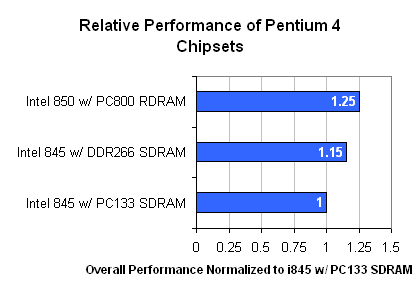
Remember how when RDRAM first came out and it's benchmarks were abysmal? Rambus said that it was designed for the P4 moreso then the P3. I remember thinking that was a bunch of bs but it turns out to be true, not only that but the 10% performance difference (btwn RDRAM AND DDR)in that benchmark sounds about right if recall my impressions from some of Tom's comparisons.
I wouldn't go near a RDRAM based system but now that they have a viable platform for their product they'll never see the market penetration they now need. If I didn't hate Rambus so much I woulda considered an i850 RDRAM.
Anyone agree/disagree? -
Re:2D video: the best?I'd at least check out the reviews before you count it out, maybe other people were more impressed.
Unfortunately, but unsurprisingly, the reviews focus almost soley on the 3D performance. I'd like to find a hardware review site written by graphic design and Mac guys.A few years ago I was swapping hardware between an NT and a FreeBSD box, and I that was when I saw a first-hand comparison of the TNT2 and Xpert 98. Now in terms of 3D performance, the Xpert 98 can't touch the TNT2, but when I swapped cards and put the TNT2 in the FreeBSD box, I had to turn the monitor brightness up a whole lot to see the screen clearly. Conversely, I had to turn the brightness down on the NT box to keep from blinding myself. The TNT2 was dark and mushy on the desktop. Now that I have the GeForce, I wish I still had the Xpert98 for comparison.
--
-
Re:Athlon
Anandtech has an intel bias, since when? You do know that they run their site on mostly Athlon based servers now, don't you?
--- -
Read the article
This means that the Athlon 4 that is being launched in notebooks today is simply a lower clocked version of the workstation/server Athlon 4 that will be launched in June. And the workstation/server Athlon 4 is nothing more than a lower clocked version of the desktop Athlon 4 that will be launched in August. [emphasis added]
That notebook you saw on QVC is real. It is the desktop model that will not ship until August.
-
Re:Loadbalancing large websiteshowever I havn't seen that many testimonies/reviews from sites that use it.
http://slashdot.org/article.pl?sid=01/04/26/03392
1 9Anandtech.com is using it.
--
-
Re:You can safely assume...
Just check this page: Advertising. They wouldn't lie on that page (they claim >40 million page views monthly), it would give them a bad reputation with advertisers if they found out.
-
Full article.For those that don't want to wade through many "click here for the next page of ads" I bring you this link.
Enjoy!
"We have the right to believe at our own risk any hypothesis that is live enough to tempt our will." -
Inconsistancies in benchmarking
But they never appeared to actually make it faster than an Athlon 1.2.
That's the interesting thing though. Look at the SYSMark2001 scores on Tom's Hardware and the SYSMark2001 scores on AnandTech. The Athlon scores about the same in both (145) but in Tom's review the P4 performs very poorly (115 @ 1.5GHz and 124 @ 1.7GHz) and in Anand's review it scores very well (154 @ 1.5GHz and 167 @ 1.7GHz). That's a 35% difference between the two sites. So what's the difference? Tom's using a Asus motherboard and Anand's using an Intel motherboard, other than that not much. But then Quake and UT show much the same results on both sites. The lesson is don't rely on one review site. Still it seems that you'd want to be very careful if you're buying a P4 for anything other than games. Get the wrong motherboard or maybe the wrong BIOS settings and you'll suffer.unless you're going to be playing a whole lot of Quake, if you're looking for a new system you should grab one of those cheap Athlon CPU/Motherboard combos selling for $300 at Fry's.
Yep, and that's still the case. Even with the radical price cuts the 1.7GHz P$ is $350 which is still considerably more than the Athlon 1.33GHz. Of course if you're into games you're generally better of upgrading your graphics card anyway. -
Ummm...grammar check?
This is a completely redundant article rendered nearly impossible to read because of miserable grammar. Plenty other websites have more detailed articles about far more effective and inexpensive ways to tweak your system. And they take the time to edit their work, do benchmarks and such.
-
Possibly helpful references
If you want to know what is the best value for the money, look around at Hard|OCP and Anandtech. Every few months Anand's site does system price guides, putting together various systems on a budget. The latest price for a lower-budget gaming system was $1,045. This was in November, so you can get an even better system for that amount, or that same system even cheaper. (Price includes montitor, but not software).
-
Possibly helpful references
If you want to know what is the best value for the money, look around at Hard|OCP and Anandtech. Every few months Anand's site does system price guides, putting together various systems on a budget. The latest price for a lower-budget gaming system was $1,045. This was in November, so you can get an even better system for that amount, or that same system even cheaper. (Price includes montitor, but not software).
-
Re:Reduced operatings temps, reduced voltage ...
Caveat emptor, any or all of this could be hype.
I think I currently trust AMD's word more than I trust Intel's. The ones I tend to trust most are Tom's Hardware, Anandtech, and Aces' Hardware.
I see ZD-Net, C|Net, and and their ilk as being informative as long as you take their endorsement of any platform with a skeptical grain of salt. When you surf these sites you have to keep in mind that each has its own interests tied closely to various hardware manufacturers.
At least Tom's, Anand's, and Aces' have no overt interest in the succes of one of the big tech companies over another. That's a positive mark for them in my book.
-
Yet more reviews
It's going to be hard for AMD to keep up the clock speed race with the Pentium 4, but this is a good start. Here's two more reviews, Anandtech and Tom's Hardware.
-
Usual Suspects
Don't forget my fave, AnandTech. Lots of people like Tom's Hardware as well.
-
Re:score(-1, Offtopic)
First of all, a hardware forum like Anandtech would be a better place to ask than slashdot. Second, CPU clock speed is controlled by the motherboard via either jumpers or the bios. Windows has nothing to do with it.
-
Re:competition underway...
Wait a minute. Where did this come from? Last I heard, Intel still loved RDRAM.
You can check out this article at Anandtech about the Intel Developer Forum Conference (Spring 2001). It looks like for the server market, Intel will solely be using PC1600 DDR. They will be using Rambus RDRAM only for high end desktops (PC133 SDRAM for the low end) where they will eventually be able to use 4-layer motherboards because of the low pin-out of RDRAM.
-
Re:competition underway...
Wait a minute. Where did this come from? Last I heard, Intel still loved RDRAM.
You can check out this article at Anandtech about the Intel Developer Forum Conference (Spring 2001). It looks like for the server market, Intel will solely be using PC1600 DDR. They will be using Rambus RDRAM only for high end desktops (PC133 SDRAM for the low end) where they will eventually be able to use 4-layer motherboards because of the low pin-out of RDRAM.
-
Gone in 60 Seconds
Will people want to steal it? That's a measure of true value of course.
No wait, True Value is a hardware store.
Damn! Real hardware can be found at Tom's or Anand's.
I wonder if Tom and Anand date?
But a date is a fruit! I wonder if they bake cakes together, even if they don't date.
Will people steal the cake if they bake it? Probably not. They'd rather steal Sue's Chocolate Wafer Roll .
WebWord.com -- Industrial Strength Usability
-
To clear some things up.
Everytime there is a story about overclocking on Slashdot the naysayers flood the forums with comments about how terrible an idea it is to overclock. They say things like "You only save a little bit and spend more on cooling..." or "Your chip will be unstable and then have a shorter life."
I would like to clear some things up about overcloking for the uninformed people.
Firstly, the stability issue. Overclockers hate instability. Most of us go way out of our way to make sure that the system we are running is not going to be acting all flaky when we overclock. The whole point of overclocking is to get the most out of the system, and if your system is freezing all of the time you aren't getting much out of it are you? We accomplish this by running benchmarks and torture tests to make sure that the overclock isn't adversely affecting performance or stability, if it is then we step it off.
Second, with the exception of a few extreme instances, most overclockers save money for the same performance. We don't all go out and buy peltiers and liquid cooled heatsinks. Most of us spend more on cooling than the average person but not by much, and our cooling system usually lasts through several cpus. Compare the $50 hsf I'm using now with your $10, so I spent $40 more than average, big deal, I saved $300 on the cpu and I'll use this cooler with my next upgrade too.
Which brings me to the savings. We save a lot of money for the performance. When I purchased my Celeron300A I spent $109 for it and after I overclocked it, the performance I got out of the chip in games at the time was almost identicle to a P2-450 which was selling for well over $600.
Now thats about as good as overclocking gets, but there are many other examples of chips since then that have done almost as well.
That celeron300a I spoke of is still running at the same overclocked speed as the day I put it in, and it's rock solid. You want stability, there you go.
On top of all of this, overclocking is fun! No really. It's an enjoyable experience, you learn a lot about hardware, and at the end of the day you can be happy that you have a screaming fast system for a fraction of the price you could have spent.
If you want to think about overclocking try checking out some of the sites around the net:
www.overclockers.com
www.hardocp.com
www.anandtech.com
www.tomshardware.com
Try it, you might like it. -
fill rate vs. memory bandwidthIncreasing fillrate is pointless, when things are already so memory-bound.
Exactly. Anand's GeForce3 preview puts it this way: "even the GeForce2 GTS with its 800 Mpixels/s fill rate was only capable of a 300 Mpixels/s fill rate in a real world situation."
If you look at the GeForce2 MX reviews, you'll see that it barely edges ahead of the SDR GeForce at higher resolutions, and falls well behind the DDR GeForce. Forget about doing old-fashioned FSAA on an MX.
-
The Other Big Reviews
In case anyone wants a quick link to the other big reviews...
Sharky Extreme: http://www.sharkyextreme.com/hardware/articles/nvi dia_geforce3_preview/
AnandTech: http://www.anandtech.com/showdoc.html?i=1426
HardOCP: http://www.hardocp.com/articles/nvidia_stuff/gf3_t ech/i
-pepermil -
Re:RDRAM is used in Playstation 2 aswell.
A real server, not something on a Abit-VP6, but something on a Tyan dual or quad CPU board, would be best served by dual or quad SDR-SDRAM channels.
It's called the ServerWorks series of chipsets, read up here (on AnandTech): ServerWorks HEsl: DDR bandwidth without DDR SDRAM
It'd add a few hundred dollars to the price, but it'd easily outpace anything RDRAM could throw at it, with all the bandwidth needed AND the low latency of a good technology.
And they are expensive too...
Macs did this a long time ago (memory interleaving) and it's nice to finally see this feature implemented in motherboards again. It'd be nicer if they'd be implemented in lower-end motherboards as well (if Apple did it years and years ago, it can't be some sort of trade secret...).
Abit's "-RAID" boards should have it... they have RAID, why not use a "RAM RAID" as well? -
Re:RDRAM is used in Playstation 2 aswell.
A real server, not something on a Abit-VP6, but something on a Tyan dual or quad CPU board, would be best served by dual or quad SDR-SDRAM channels.
It's called the ServerWorks series of chipsets, read up here (on AnandTech): ServerWorks HEsl: DDR bandwidth without DDR SDRAM
It'd add a few hundred dollars to the price, but it'd easily outpace anything RDRAM could throw at it, with all the bandwidth needed AND the low latency of a good technology.
And they are expensive too...
Macs did this a long time ago (memory interleaving) and it's nice to finally see this feature implemented in motherboards again. It'd be nicer if they'd be implemented in lower-end motherboards as well (if Apple did it years and years ago, it can't be some sort of trade secret...).
Abit's "-RAID" boards should have it... they have RAID, why not use a "RAM RAID" as well? -
IDE RAID? It's already been done.
IDE RAID on the MOBO has already been done.
Check it out here: Abit KT7A-RAID. It's got the on-board IDE RAID you dreamed of, AND it's been acclaimed on Anandtech... their mobo pick for many of their high-end systems. Ultra ATA-100, 3 DIMMs, 1 AGP, 6 PCI and you even get to keep your one ISA card
Sadly, no dual processor support yet -
IDE RAID? It's already been done.
IDE RAID on the MOBO has already been done.
Check it out here: Abit KT7A-RAID. It's got the on-board IDE RAID you dreamed of, AND it's been acclaimed on Anandtech... their mobo pick for many of their high-end systems. Ultra ATA-100, 3 DIMMs, 1 AGP, 6 PCI and you even get to keep your one ISA card
Sadly, no dual processor support yet -
IDE RAID? It's already been done.
IDE RAID on the MOBO has already been done.
Check it out here: Abit KT7A-RAID. It's got the on-board IDE RAID you dreamed of, AND it's been acclaimed on Anandtech... their mobo pick for many of their high-end systems. Ultra ATA-100, 3 DIMMs, 1 AGP, 6 PCI and you even get to keep your one ISA card
Sadly, no dual processor support yet -
Integrated video comparison
AnandTech has a look at integrated video. It includes comparisons of solutions from Intel, SiS, VIA, and ALi. I don't personally like integrated solutions, but if you need one this might be a good source of supplementary info.
-
Re:Same old reactionist banter
Hmm...lots of interesting thoughts.
I've seen quite a few people point out that the situation isn't likely to get better until bandwidth costs go down. The assumption there is that once badnwidth is less expensive then sites will be able to better afford to exist on meagre advertising revenues. But I think that there's another reason that more bandwidth is one of the answers. Multimedia and interactivity. Once bandwidth becomes more plentiful and less expensive, web-based advertising can finally evolve from a stupid little flashing banner to something more effective, whether that be through integrated video/audio, etc. Regular commercial breaks might even someday make it into web sites.
BTW, I too hate animated
Personally, what I think the wave of the immediate future in online advertising is in product sponsorship. And not just random junk either. My "other job" is as a crew member for an auto racing team. Big-time auto racing like NASCAR and Formula 1 only exists because of advertising. And they have a very effective sponsorship model. Many race fans would decide whether to buy a particular brand of product based on whether or not they sponsor auto racing (all else being roughly equal). It builds an extended sense of comraderie with the teams because the consumer knows that by purchasing product x they are supporting their racing team.
I've seen dozens of people point out that they buy stuff from ThinkGeek or other similar merchants who advertise on Slashdot, and that they would be more inclined to click-thru on ads if they knew that they had been hand-picked by the editors. Well isn't that what sponsorship is? It certainly has the potential to be that.
Let's do a hypothetical Slashdot sponsorhsip. ThinkGeek probably can't afford to be the sole sponsor of Slashdot, but they could afford to be an associate sponsor. So then Slashdot recruits a couple other sponsors. VA Linux, Sun, Cisco, etc. Companies whose target markets are the same as Slashdots. Then instead of banner ads, maybe they sponsor a certain section of the site. I dunno...the VA Linux Slashback page. Or they get prominent placement on certain types of Slashdot pages. Maybe they even have a tie-in...like 1% off the purchase price of a Sun Enterprise Server if you mention a special Slashdot discount code.
So what do the sponsors get? Targeted advertising that is much more likely to generate clickthrus and/or other revenue for the company. Their customers are Slashdot readers. In the case of marketing tie-in's, they even get statistics on how the sponsorship affects their sales.
What does Slashdot get? Money to pay the bills.
What do the readers get? Slashdot for one. And information on goods and services that likely interest them and that they are likely to make use of. I personally had never heard of ThinkGeek untill I saw their ad on Slashdot. But I have purchased from them twice in the past month. So targeted advertising does work for both advertisers and consumers.
The Register did an interesting "experiment" a year or so ago where they "sold their souls" to Compaq for a week. Basically, they only ran Compaq ads for that entire week in a pseudo-sponsorship deal. I never did hear how it worked out, but I'd be curious to find out.
Honestly though, when advertising on the net first came into being, I think that sponsorship was the way that it generally worked. And then people got lazy because nobody wanted to spend time and effort tracking down sponsors or sites to sponsor. It was easier to just join an ad network and get some generic crap. But now we're seeing that doing it the lazy way doesn't necessarily work. Like anything else, the readers can tell if you put any work into it...and if you haven't, they'll ignore it.
When I think of some of the sites that are still pretty successful though, I think that they do rely (to an extent) on sponsorhsip-style ads versus banner ads. It seems to me that Anandtech always has ads from the same hardware vendors. Same with Tom and many many others. Even Slashdot probably has direct relationships with companies selling products rather than companies placing ads. And you'll notice that they aren't the web sites complaining about the ad services cutting them loose.
Just some food for thought. -
Case studies...
-
Wait just a little longer...
IMHO the Aiwa is way too tacky for use by anyone over 12. Anand did a review of an Aiwa player a few months ago, and found the interface kinda awkward. A conversation I had last month with a grunt at Circuit City revealed that the "second generation" of players is coming RSN, including rationally-priced models from Kenwood. Consumer demand is picking up, so it may be best to get a Philips eXpanium (or other portable) until there's some more maturity in the market.
-
The Bus a Bus
The most significant and compelling reason I can think of to not go with x86 architecture is that every PC MP setup besides AMD 760 MP (which isn't out yet, and will only support two processors to begin with anyway) has a truly pathetic bus architecture. If you're doing something where bandwidth makes a difference, which you would seem to be if you're getting a single SMP box rather than contemplating clustering, the bus bandwidth is going to figure in, too.
As you probably know, in an intel-based solution, all CPUs sit on the same bus to the so-called "memory masters";
A memory master is anything that accesses the main system memory. Your CPU, your AGP card, and your PCI devices (actually the PCI bus itself) are all memory masters.
Meanwhile, the AMD CPU bus architecture is more closely based on the Alpha EV6 bus, and each CPU has its own bus to sit upon.
Since you can't go with a AMD 760MP solution, you should get a real live unix box; Something slick from Compaq/DEC, Sun, IBM, or even HP (though I don't recommend it.) If you're looking for raw power and the ability to handle large numbers quickly, Alpha is probably your daddy.
Side note: Apologies to Busta for the title of my comment. I couldn't resist.