Slashdot Mirror
Domain: arizona.edu
Stories and comments across the archive that link to arizona.edu.
Comments · 896
-
Sounds like 'Assassin'.
There are many varients of the game Assassin, and there was also a set of rules put out by Steve Jackson called Killer
In Assassin, everyone had to fill out their class schedule, and include a picture, and give it to the person running the game. Everyone was given a card at random (redraw if you got your own card).
The goal was to get your card -- but you weren't allowed to draw on anyone unless they were your target, or if they drew on you first (ie, they were trying to kill you).
I'm guessing that these games wouldn't go down so well in today's high schools, though.
There are some varients that aren't quite as obvious, but use your own judgement -
Impact Calculator says:If that little 500m sucker clobbered LA (my fave target) and you were 100km away out in the desert, the impact calculator says:
Impact Effects Robert Marcus, H. Jay Melosh, and Gareth Collins
Your Inputs:
Distance from Impact: 100.00 km = 62.10 miles
Projectile Diameter: 500.00 m = 1640.00 ft = 0.31 miles
Projectile Density: 3000 kg/m3
Impact Velocity: 10.00 km/s = 6.21 miles/s
Impact Angle: 45 degrees
Target Density: 3000 kg/m3
Target Type: Competent Rock or saturated soil
Major Global Changes:
The Earth is not strongly disturbed by the impact and remains intact.
The impact does not make a noticeable change in the Earth's rotation period or the tilt of its axis.
The impact does not shift the Earth's orbit noticeably.
Energy: 9.82 x 10¹⁸ Joules = 2.35 x 10^3 MegaTons TNT
The average interval between impacts of this size somewhere on Earth is 4.3 x 10^4 yearsCrater Size:
Transient Crater Diameter: 4.59 km = 2.85 miles
Final Crater Diameter: 5.63 km = 3.50 miles
The crater formed is a complex crater.
Thermal Radiation: Time for maximum radiation: 0.43 seconds after impact
Visible fireball radius: 3.5 km = 2.2 miles
The fireball appears 7.9 times larger than the sun
Thermal Exposure: 3.60 x 10⁴ Joules/m2
Duration of Irradiation: 6 seconds
Radiant flux (relative to the sun): 6.5
Seismic Effects:
The major seismic shaking will arrive at approximately 20.0 seconds.
Richter Scale Magnitude: 6.9
Mercalli Scale Intensity at a distance of 100 km:
VI. Felt by all. Many frightened and run outdoors. Persons walk unsteadily. Windows, dishes, glassware broken. Knickknacks, books, etc., off shelves. Pictures off walls. Furniture moved or overturned. Weak plaster and masonry D cracked. Small bells ring (church, school). Trees, bushes shaken (visibly, or heard to rustle).
VII. Difficult to stand. Noticed by drivers of motor cars. Hanging objects quiver. Furniture broken. Damage to masonry D, including cracks. Weak chimneys broken at roof line. Fall of plaster, loose bricks, stones, tiles, cornices (also unbraced parapets and architectural ornaments). Some cracks in masonry C. Waves on ponds; water turbid with mud. Small slides and caving in along sand or gravel banks. Large bells ring. Concrete irrigation ditches damaged.
Masonry C. Ordinary workmanship and mortar; no extreme weaknesses like failing to tie in at corners, but neither reinforced nor designed against horizontal forces.
Masonry D. Weak materials, such as adobe; poor mortar; low standards of workmanship; weak horizontally.Ejecta: The ejecta will arrive approximately 144.2 seconds after the impact.
At your position the ejecta arrives in scattered fragments
Average Ejecta Thickness: 4.6 mm = 0.1822 inches
Mean Fragment Diameter: 3.5 cm = 1.37 inches
Air Blast:
The air blast will arrive at approximately 333.3 seconds.
Peak Overpressure: 19232.2 Pa = 0.1923 bars = 2.7310 psi
Max wind velocity: 38.2 m/s = 85.4 mph
Sound Intensity: 86 dB (Loud as heavy traffic)
So let's see - you're 100 km away - first you experience a 6.9 earthquake, and the red hot 4.6mm fragments arrive 144 seconds later? Great - that's like 250 km per hour... Nice. Anyone in the open is DEAD, and your house might not survive that either. Then after being weakened by a major earthquake and a barrage of highspeed rocks, an 86 mph wind comes to visit.
Great. Sounds pretty crappy to me. I doubt that it would be the end of the world (Except for LA, but who cares?) but I think that even a smallish rock like that would produce some MAJOR damage, and should be avoided at all costs - alomst as much as voting for GW should be avoided.
RS
-
Re:Attention spans
Leave us bloggers out of it. Reality TV and IM are more akin to those bad teenage LiveJournals than proper blogs. There is a difference. Also, check out the various philosophy-related weblogs.
-
Clue Boomerang
Ignorance is bliss. Now try to learn something.
Wow, if you're going to be snarky at least get your facts straight.
You're right about the frequency of the microwave oven, but it's not the resonance frequency of water, that's 545GHz.
Microwaves work by electromagnetically vibrating any asymetrical (polar) molecules found in the target foodstuffs. Water is usually a very large percentage of that, but you're just vibrating the molecule, not causing it to resonate. If you did, the water on the outside of the food would absorb all the energy and you'd have a cold center.
Some links:
Microwave tech
Good Eats
Water resonance chart
How Things Work -
Cassini Imaging Team Homepage
One again, I just like to point on a link to the Cassini Imageing Team's Homepage located here
-
Re:Waves in the Rings?
Fortunately, unfortunately that is going to be the extent of it. I hope that sometime before the end of THIS century some sort of probe will actually make it to Saturn, this time exclusively to study the ring systems themselves. It would be cool to intentionally do a rendevous with one of the moons within the ring system, and perhaps even try to land, or even do a little "moon hopping" around the ring system. The is much to learn about what is going on.
From my own look of the rings, there are some strong mathmatical harmonics going on... worthy of at least a few master's degrees if not a couple of PhDs with these photos alone. Perhaps the most intriguing are the scalloped rings that were found. This is going to be a career maker for somebody when they finally figure out the celestial mechanics regarding how this could have been done. This photo also seems to have a moire pattern between the pixel resolution of the CCD camera and the rings on Ring A. That is a significant finding in itself, and can be used to determine the approximate size of the smaller ringlets that form Ring A. (I.E. rougly the same arc angle that a single pixel would have on the probe camera... that is quite tiny to be honest, and suggests some uniformity of the ringlets as well, or even suggesting mean particle size in the rings.)
That is just my casual observations as a very amature astronomer. The Pros are certainly going to have a fun couple of months ahead, particularly if they are into planetary astronomy. -
Re:Waves in the Rings?
This is the closest the spacecraft is going to get to the rings, yet I really was hoping to see the individual components of the rings themselves. I've seen the intro to Voyager, and I wanted to see tumbling boulders...
Me too - all the same you can make out some structural detail in these pictures if you download the big 1024x1024-ish versions (ie, clumpiness and brightness variation). Since the pixel size is still on the order of hundreds of meters (IIRC) that's the best we'll probably get...
All the same if they decide to do a close run by the rings four or five years from now when the mission is winding down, it would be very cool indeed to see some real detail. Here's hoping.
-
Re:Pictures.
You can also find pictures at the CICLOPS site.
-
Re:Saturn V Engines
I was curious, so I looked up the output of the Shuttle's main engines compared to the Saturn V main engines.
The shuttle's main engines produce a maximum of 488,000 pounds of thrust. The Saturn V main engines produced a total of 7.5 million pounds of thrust, or 1.5 million pounds per engine. So it looks like each engine on the Saturn V was about 3 times as powerful as each of the main engines on the shuttle.
Oh, the solid rocket boosters on the shuttle each produce 3.3 million pounds of thrust. -
Lisp++? Try Unicon instead!
Have you looked into Icon, or its extension Unicon? You can make custom control structures (using what are called co-expressions). It also has goal-directed evaluation (backtracking, think continuations of the LISP world) built into its expression evaluation. Of course it's dynamically typed and has all sorts of data structures like lists/trees, associative arrays, sets etc. built-in, plus X11 and Win32 graphics, automatic storage management (garbage collection) and lots of cool features for text manipulation (it's a development of the ideas in SNOBOL4). To all this Unicon adds object-orientedness, POSIX system calls and networking, message-passing, etc. All this in a easy to read block structured (C-like) syntax. -
More pictures just in...
The pictures mentioned earlier are still not taken from the closest point to Phoebe.
In the Imaging Diary you'll find the latest pictures, amongst which one taken from 2365 kilometers (1,470 miles).
-
More pictures just in...
The pictures mentioned earlier are still not taken from the closest point to Phoebe.
In the Imaging Diary you'll find the latest pictures, amongst which one taken from 2365 kilometers (1,470 miles).
-
Re:Watching lightening...up close
Incidentally, University of Arizona is where E. Philip Krider works in the Department of Atmospheric Sciences - he basically spearheaded the development of lightning detection systems. Coincidence? Probably not.
-
Re:Watching lightening...up close
Incidentally, University of Arizona is where E. Philip Krider works in the Department of Atmospheric Sciences - he basically spearheaded the development of lightning detection systems. Coincidence? Probably not.
-
Re:Where are the RAW Images!
The Casinni Imagaing team is located in Colorado, but we host the offical webserver at the Lunar and Planetary Lab at the University of Arizona. You can view the website and an image diary at ciclops.lpl.arizona.edu
-
RTF DMCA for cryinoutloud!
-
Re:bird-dinosaur link
no really compelling evidence that exctinction was caused by a meteor as the mainstream media implies.
Barring the really gigantic impact crater in the south of Mexico?
After the Chicxulub crater was found (oddly enough - with a dating of 65 million years) most scientists were pretty convinced that an asteroid (10 km is not a meteorite) killed off the dinosaurs. There may have been other contributing effects, but a 10 km object slamming into the Earth would have done extremely bad things to the planet's biosphere. -
Re:Melbourne .au viewing : Rialto Observation DeckVia the ASV:
The Astronomical Society of Victoria has arranged with the Victoria Gardens Shopping Centre, Richmond to conduct a viewing event of this rare astronomical event. A variety of telescopes with solar observing gear will be available for safe solar viewing. Venus's disk should be very noticeable in silhouette against the face of the Sun.
Time: 2pm - Sunset. Place: Southern end, Upper Level 6, Carpark, Victoria Gardens Shopping Centre, cnr Victoria & Burnley Streets, Richmond. Melway 44 H7
ASV members, their guests and members of the public are invited. The Shopping Centre is at Tram Super Stop 25, Victoria St on the Port Melbourne-Box Hill line. Catch Tram 109 in Collins Street, City. Undercover parking is available.
The next opportunity to Observe a Transit of Venus is in June 2012 and then the next two occur in December 2117 and December 2125 - a long wait.
More information on the Transit of Venus can be obtained from www.astronomy.org.au (Astronomical Society of Australia), http://sunearth.gsfc.nasa.gov... or www.lpl.arizona.edu... (top overseas sites)
And it's a whole $12.50 cheaper than the Rialto -
Re:5000 years? I think not
By my calculations, Wilt Chamberlain would have 4,138,0001 children
Zing!
Wilt the stilt Chamberlain -
Re:Anipodal effects
Sorry for the late response, it's been a long weekend...
Yes, I saw those quotes. But those are statements by third parties, not support per se. There are better links, like this one for support purposes (and see below )
That said, I have some problems with Melosh (and Kring/Durda)'s models. For one thing (as can be clearly seen in the gif on the link I provided) they postulated wildfires from impact debris in an area that at the time included very little land; and we have no way of verifying the computer model that they used for impact debris distribution from geological data.
Hence, my reaction to it; and sorry, I didn't mean to berate the messenger.
In any case, I've read about Melosh's work before, and I find the mathematical models he used somewhat suspect - but I'll withhold further judgement on that until I can obtain a copy of his paper (which a friend of mine is mailing me this week, got interested enough to request it rather than reading the thirdparty-etc abstracts.) Like I said, the math is tortuous; and a lot of the effects of those impact energies are not as well understood as we'd like.
I am not saying that it won't All I am saying is that debris will fall at the antipode in a grearter concentration than other distant locales. Are you saying that none of it will reach the anitpode? Are you also saying that none will reach orbit?
Um, no to either question. As to whether debris in an earth impact would have a concentration at the antipode is still pretty much conjecture backed by a couple of computer models. Personally, I disagree with it; at least I don't think (not having seen his paper yet I can't make a stronger case than that) that he's modeled all the factors correctly, such as impact obliquity, high-altitude wind factors, gravitational variations effecting debris suborbit trajectory, suborbital atmospheric variations, etc, blah blah blah
Of *course* some of it will reach the antipode. Whether there is a relevant concentration there is what I debate; it's not proven to my satisfaction, not yet, anyway. Orbital mechanics postulates that a portion of the debris may land there, but I think I've already dealt with that.
As to whether it will reach orbit, it's pretty easy to show that a fair amount (10% or so according to the models) will not only reach orbit but be ejected from the Earth-Moon system entirely (and that 10% figure of course depends a great deal on the impact obliquity and whether or not it impacts deep water or land, and also on the impact energies - a 10-20 km body is borderline in that respect, additionally, impact velocity is a lot more important; KE=mv^2, and we don't have *any* even semisolid figures as to either.)
I guess what got me about your post was that you linked to a couple of sites that merely mentioned the antipodal debris effect, and not to one that was from the horse's mouth, so to speak.
The reason I talked about the shockwave effect a lot is because extremely good evidence for it has been found on other planets (and possibly even here, the Permian event and the Deccan trap eruptions are a good example), and I feel that shockwave concentration in the K-T event probably accounts for a lot more geophysical effects than debris concentration - and yes, I'm aware that some circumstantial evidence has been found for debris concentration effects on the moon (fascinating reading in itself, scroll about halfway down), but impact debris distribution on the earth is going to be entirely different than it will be on a smaller body with no atmosphere.
It was also late, and I was tired, and probably not thinking clearly
Anyway, having googled it a bit, I'd sugges -
Re:How does one orbit a ringed planet?Although one of the Voyager probes whizzed through Saturn's ring plane (which is only about a km or so thick), no such daring maneuver is planned for Cassini.
There is a preliminary plot of Cassini's possible orbital tour here . According to it, Cassini will make around 69 orbits during its planned mission. Note that one of Cassini's primary targets, Titan, orbits at around 40 Saturn radii, well outside the rings.
Oh, and, look for all the pretty pictures from Cassini to be posted over at CICLOPS (Cassini Imaging Central Laboratory for Operations).
-
Re:Beauty is important
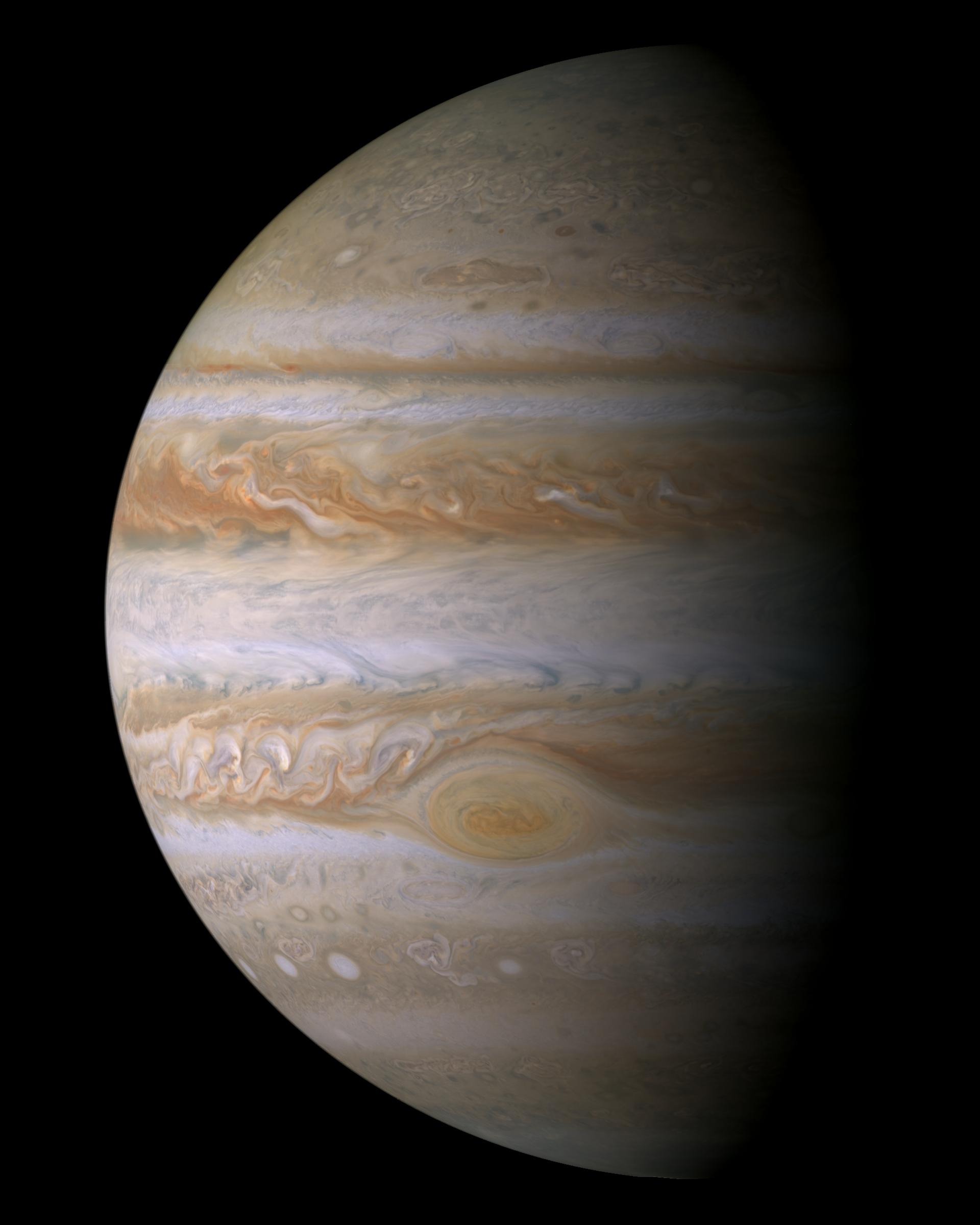
Judging from previous releases from the imaging team(CICLOPS, they seem to be a very, very competent bunch. During the Jupiter flyby 4 years ago, they used the spare seconds between scheduled observations to take extra images of Jupiter in true color which they then stitched together later to form the highest detailed full planet image of Jupiter ever taken. With Cassini actually passing through a gap in the inner rings during its orbit insertion it's hard to imaging the spectacular images that await us.
-
Re:Photographic mission
Photographic indeed. Take a look at the DISR page that details the optics and detectors that are aboard the Huygens probe. There are even some test images taken with the flight spare that give an idea of the images to be returned from the surface of Titan (sans palm trees perhaps). Huygens is expected to relay ~175 MBytes of data through Cassini and back to Earth for a nominal mission, this is almost 500 TIMES the total data returned from the Galileo atmospheric probe!! There are many other experimental devices attached to the bottom of the probe which are beautifully elegant in design that will tell us about just what it hits when it gets to the surface ice...liquid hydrocarbons...etc. The surface science package also contains a piezoelectric transducer to determine the depth of the ocean it may land in using sonar pulses. It can measure the height of waves on the surface with its accelerometers and the density of the liquid with a refractometer to determine the liquid's index of refraction. The amount and quality of information retured from the dim frigid surface of this strange world hundreds of millions of miles away will be positively awe inspiring.
-
Re:Photographic mission
Photographic indeed. Take a look at the DISR page that details the optics and detectors that are aboard the Huygens probe. There are even some test images taken with the flight spare that give an idea of the images to be returned from the surface of Titan (sans palm trees perhaps). Huygens is expected to relay ~175 MBytes of data through Cassini and back to Earth for a nominal mission, this is almost 500 TIMES the total data returned from the Galileo atmospheric probe!! There are many other experimental devices attached to the bottom of the probe which are beautifully elegant in design that will tell us about just what it hits when it gets to the surface ice...liquid hydrocarbons...etc. The surface science package also contains a piezoelectric transducer to determine the depth of the ocean it may land in using sonar pulses. It can measure the height of waves on the surface with its accelerometers and the density of the liquid with a refractometer to determine the liquid's index of refraction. The amount and quality of information retured from the dim frigid surface of this strange world hundreds of millions of miles away will be positively awe inspiring.
-
Imagessome cool images and data:
Map and Images of Titan from Hubble Space Telescope
Nasa Titan Photojournal
Saturnian Satellite Fact Sheet
Phoebe best image so far, from Voyager2 in 1981! -
Yes indeed!
Free maps from the TIGER data, as well as the (free) software that draws them. Here's Gregg Townsend's package in Icon. (Icon is a free VHLL -- very high level language -- of which Unicon is the current development extension.
-
Re:Anipodal effectsWhat you say is true. However, what I say is true as well, despite all the naysayers that responded without details, facts, or even a well-reasoned criticism.
Further reading:
http://atropos.as.arizona.edu/aiz/teaching/nats10
2 -
Re:Anyone know...
There are a number of factors that go into the size of an impact crater, not just the mass of the object. F=mv^2 is a simple example (and it also explains why it suxor worse to get hit by that superfast tight end in U.S. Football than the massive, but slow, lineman).
IAOAPS, so feel free to correct me ifn' I got that equation a bit wrong. The essence is correct though.
There was a good site mentioned about a month ago here on -
Challenges of finding extrasolar planetsThe question becomes even more convolved once we move outside the solar system, since we now know of a wide diversity of systems, of which our own solar system is only one particular instance. (And perhaps not even typical at that.) We know that there are objects extending all the way down from massive stars (around 100 Msun) to hydrogen-burning stars like our sun to brown dwarfs to planets. Clearly any definition of a planet must apply not only to our solar system, but also to these extrasolar systems. Some of these systems are much like our own (for instance, they may contain a brown dwarf orbiting a star, or a planet orbiting a star), and some (including a few systems of low enough mass to qualify as a planet) are "free-floaters" -- just sitting out there by themselves in space.
I think ultimately the question is whether there is a single continuous "initial mass function" of isolated objects or not. The best idea as to how stars acquire their initial mass is that turbulence in the interstellar medium, which exists on all scales, establishes a power-law distribution of initial masses. Every once in a while, you get a very strong shock which passes by inside a giant molecular cloud and forces the collapse of a large region which then goes on to form a massive star. But more typically, you form stars more like our sun. And just as rare as massive collapses are very small mass ones which go on to form isolated brown dwarfs and free-floating planets. If this model holds up to be true, then we are all mincing words in our definitions of isolated systems, since they are all manifestations of the same universal formation process.
However, to avoid the difficult question of formation mechanisms, an IAU working group of some of the most respected people in the field established a working definition to define by fiat what it means to be a brown dwarf, and a planet. Extrasolar "planets" are those objects orbiting a star which are beneath the deteurium-burning limit -- regardless of how they are formed. "Brown dwarfs" are defined to be those which burn deuterium but not lithium, and "sub-brown dwarfs" (NOT free-floating planets!) are defined to be those isolated objects which do not burn deuterium. Even the working group itself admitted that this definition was not satisfying to a single member of the group, and so it is likely it will be replaced at a later time with something more physically-motivated. The "planet/planetismal/KBO" distinction was pushed back to our own solar system, since it will be some time before anyone sees anything that small in another system.
Also of interest is the following link, which gives a history of previous claims for additional planetary members of our solar system : SEDS.
-
Re:InfotainmentI think you have to be a bit careful here.
13% of Americans believe that both evolution and creationism should be taught as scientific theories in science class.
Yes, many people do not understand the definition of science and the need for falsifiability. But...
16% percent want no mention of evolution at all.
...the (political) question of what should be taught in federally mandated compulsory education is not so simple. Do people have a right to be ignorant? And if not, who decides what constitutes ignorance? Bear in mind that "science" has often been used to strip people of basic rights.
60% of respondents agreed that "some people possess psychic powers or ESP" in a 2001 NSF study.
Not so clear. For example, see the experiments of Dean Radin (independent verification published here.) The argument here is that the brain works partly by using mild precognition.
In 2001, 30% of NSF survey respondents agreed that "some of the unidentified flying objects that have been reported are really space vehicles from other civilizations"
Probably false for a host of common-sense reasons, but also testable. Most importantly, it has not been tested (yet is believed). I have more trouble with this because most scientists "believe" one side or another of an unsettled question (this is just human nature). If they are good, they are willing to be wrong, but the energy for research comes from having a workable model - even if it is incorrect.
So while many of the things you list are examples of ignorance, one of them is a political question, two may be true and one of those is a subject of current research. While I have to agree that most folks believe that these things are proved when they are not, some of them are worth considering for various reasons. -
Re:Catch that puppy
I mean what are the odds!?
Well, this *is* Slashdot. You *know* someone has to work out the answer
Lets see... the entire Earth is about 197,000,000 square miles (509,600,000 square km). A bit of Googling turned up a 6 meg jpg map of the Fallujah area. It's roughly 5 square miles (13.5 square km).
The odds of a direct hit are a bit better than one in fourty million.
Of course we don't exactly need a direct hit. When it comes to a few GIGATONS of rock slamming into the ground at 50 times the speed of sound I think the horseshoes and handgrenades rules apply, close counts.
Playing around with an impact effects calculator and some reasonable assumptions, it appears such an impact would level Fallujah out to a range of 390 miles (630 km) with 140 mph winds (225 kph).
That gives a devestation area of 481,000 square miles (1,245,000 square km). One quarter of one percent of the entire surface of the earth.
Final result: one in four hundred chance of leveling Fallujah at random.
- -
Re:What would be left after 60 million years?
Aren't you mixing the concepts of "sentient" and "intelligent" a bit?
Indeed. These folks have a model that could take it all the way back to the Cambrian explosion. -
If it hits Los AngelesAnd you're here with me in San Francisco, this is what would happen, according to the impact calculator:
Thermal Radiation:
Time for maximum radiation:
3.29 seconds after impactVisible fireball radius:
8.4 km = 5.2 miles
The fireball appears 2.4 times larger than the sunThermal Exposure:
1.19 x 10⁵ Joules/m2Duration of Irradiation:
77 secondsRadiant flux (relative to the sun):
1.5Seismic Effects:
The major seismic shaking will arrive at approximately 161.0 seconds.
Richter Scale Magnitude: 9.1 (This is greater than any shaking in recorded history)
Mercalli Scale Intensity at a distance of 805 km: IV. Hanging objects swing. Vibration like passing of heavy trucks; or sensation of a jolt like a heavy ball striking the walls. Standing motor cars rock. Windows, dishes, doors rattle. Glasses clink. Crockery clashes. In the upper range of IV wooden walls and frame creak.
V. Felt outdoors; direction estimated. Sleepers wakened. Liquids disturbed, some spilled. Small unstable objects displaced or upset. Doors swing, close, open. Shutters, pictures move. Pendulum clocks stop, start, change rate.Ejecta:
The ejecta will arrive approximately 436.0 seconds after the impact.
Average Ejecta Thickness:
2.7 cm = 1.04 inchesMean Fragment Diameter:
1.4 mm = 0.0561 inchesAir Blast:
The air blast will arrive at approximately 2683.3 seconds.
Peak Overpressure:
39729.6 Pa = 0.3973 bars = 5.6416 psi
Max wind velocity:
73.5 m/s = 164.5 mph Sound Intensity:
92 dB (May cause ear pain)
Damage Description:
Wood frame buildings will almost completely collapse. Glass windows will shatter. Up to 90 percent of trees blown down; remainder stripped of branches and leaves.
So: In a nut shell:
the asteroid smacks LA. A great cheer is heard round the world - that idoitic show Friends is finally off the air, and now nature is here to make sure it never sees re-runs. A fitting punishment, much like that space byport problem meted out for Really Bad Poetry. So, all in all, the erasure of Los Angeles isn't such a bad thing, in the greater scheme of things - no more Meg Ryan movies, Bruce and Demi vapourised - aaaah - not so bad at all!The problem is:
on the horizon would be a largish fireball, and things here in SF would get really warm for about a minute or two. Then 2 minutes and 41 seconds later, an earthquake hits, the likes of which makes 1906 look like a joyride. Then about 5 and a half minutes later gravel comes flying out of the sky at supersonic speed. Then about 45 minutes later the wind hits at 165 miles per hour, pretty much scouring the bay area of anything left alive.So, while it would completely wipe LA off the map (YAY!!!) and leave a crater 35 miles wide ( |{3vv|_ !!! ) it will first lightly toast (boo!) then pulverise with hypersonic gravel (EEEK!!) then shake to pieces (Bad. Reeeally Bad) and then blow away (Suckage!) the Bay Area.
Therefore, it is incumbent on the Bay Area to find a way to stop such a rock from hitting the earth, because, as we all know, such disasters only hit two cities: Tokyo and LA. And given that Tokyo is being continuously reduced to rubble by those giant lizards, Moths and Turtles, it's the rocks we have to watch out for.
RS
-
What might happen if it hit
For all the people worring about massive worldwide destruction, have a gander at the Asteroid Impact Simulator
Assumptions:
-- the asteroid would be travelling at a "typical" velocity on impact, or about 17 km/s
-- the asteroid is primarily composed of dense rock, rather than solid iron
-- it impacts Earth at about a 45-degree angle
-- it hits land, not water (actually not too likely, considering Earth's surface is 75% water)
Of course, this also assumes that the asteroid wouldn't break apart in the atmosphere. This thing isn't the most stable, solid asteroid ever -- the space.com article even makes mention of how narrow its "waist" is, and that it might simply be two large chunks that collided gently, sticking together because of gravity. If that's the case, it would almost certainly break apart and its impact wouldn't be nearly as severe.
It would take a much bigger space rock than this to wipe out humanity.
p -
Re:Roger Penrose's argument is sound
I've never seen him once offer actual proof of any such conjecture
In this lecture he describes the Goodstein's Theorem, which has an independence proof; it cannot be proven by ordinary induction (peano arithmatic 1st order). -
Re:Roger Penrose
Penrose in recent years isn't saying "consciousness isn't a computer." Rather in collaboration with Stuart Hameroff and a number of physicists is saying that "consciousness is a quantum computer."
So for all you -
Re:Allow me to point out a huge assumption
Ignoring the strong mathematical and theoretical evidence that it is based on computation
I'm not so sure it is as strong as you imply. There are a number of phenomeona (unitary experience and the flow of time to name but two) that are completely ignored by computational models of consciousness. -
Re:Sweet
If there's a limit to consiousness on the high end of an expanding universe then we should also be able to make educated guesses at the low end and then put a front time on the resulting "wave" of intelligence.
The Big wow theory proposes that the universe itself was conscious for a brief moment after the big bang. -
Re:"Consciousness is finite?"
Yes, the vaunted consciousness that reacts a full 1/4 second after the fact when we do most common actions such as crossing the road, kicking a ball, picking up a cup, or typing comments to Slashdot?
I'm not sure where you are getting this, but it sounds like the experiments done in the 70s where subjects had brain activity 1/2 s before the execution of volitional action. The inference was that consciousness is simply meant becoming aware of something that had happened at the subconscious level.
There is another interpretation - with some interesting (replicated) experimental results to back it up - that suggests that the brain sends information backwards in time. The evolutionary advantages of this are pretty obviou, and - more relevant to this discussion - the nature of consciousness may not even be expressible in terms of discreet computation. For example, if the brain can somehow harness John Cramer's "advanced waves", then I seriously doubt that the brain is anything like a Turing machine. -
Re:You're new around here, aren't you?
I'm not new around here, and I think it could have been posted early enough that I might have read it before the shower arrived. I guess the "news" part of the motto is really inappopropriate. A meteor shower is only news before it happens. Unless of course it delivers a crushing blow to the earth, which reminds me of a really cool site, the Earth Impact Calculator, which lets you estimate tremor, ejecta, blast, and radiation effects of various impacts. Really handy if you're a Dr. Doom type and want to avoid wrecking your lair along with Des Moines when you attract a horde of cometary fragments with your tractor beams....
-
Re:well...
Actually, I think university libraries do subscribe to some magazines that might be considered porn. The University of Arizona Library has archives of Playboy from 1953 to 1990.
-
Re:FluorinertPlease, if you don't know anything about the topic, don't clutter up slashdot with meaningless speculation. That's my job.
From here:
Patients Breathing Liquid in UMC Intensive Care Unit
A picture of a 1960's mouse in a beaker too.By Kevin Rademacher
Like a scene from a science-fiction movie, some of the sickest at University Medical Center are breathing fluid as a critical life-saving treatment.
Steven B. Johnson, MD, associate professor of surgery at the University of Arizona College of Medicine, and Steven R. Knoper, assistant research professor with the College of Medicine, are leading a study examining liquid ventilation, a new treatment that has produced impressive results.
The liquid is administered to patients suffering from severe acute respiratory distress syndrome (ARDS) and breathing with the aid of mechanical ventilation. The liquid ventilation therapy involves trickling the fluid, LiquiVent®, into the patient's lungs through the endotracheal tube.
The fluid _ a clear, colorless, oily liquid that looks and flows like water but is twice as dense _ carries oxygen and promotes respiratory gas exchange while opening up the lungs. The dense fluid also serves to wash out the ailing lungs, assisting in the removal of debris and other contaminants.
-
And if they hit the Earth
You can use this to see the effects. I particularly like the overpressure values. Good predictor of mayhem.
-
Re:FluorinertWell, let's see. Links to Argonne National Labs, University of Arizona, links to Liquivent's manufacturer, or links to articles in the New England Journal of Medicine.
You're right. Not everything on the web is real. However, there is an occasional kernel of truth.
-
Re:FluorinertWell, let's see. Links to Argonne National Labs, University of Arizona, links to Liquivent's manufacturer, or links to articles in the New England Journal of Medicine.
You're right. Not everything on the web is real. However, there is an occasional kernel of truth.
-
Quantum Consciousness
I wonder how this combines with the idea of a "Quantum Consciousness", as posted on
-JT -
Re:Depends on the .edu
No it wasn't me that posted to those lists - I just checked - they are using the same address - If you have a more efficient URL that won't necessitate the redirect - please post - or use my e-mail link in the original article - Thanks.
-
"Seismic Effects" measurementThe "Seismic Effects" values seem contradictory to me. See this example:
Distance from Impact: 4000.00 km = 2484.00 miles
[...]
Seismic Effects:
The major seismic shaking will arrive at approximately 800.0 seconds.
Richter Scale Magnitude: 9.1 (This is greater than any shaking in recorded history)
Mercalli Scale Intensity at a distance of 4000 km:
I. Not felt. Marginal and long-period effects of large earthquakes.
II. Felt by persons at rest, on upper floors, or favorably placed.Huh? Richter Scale Magnitude 9.1 and "Not Felt"? Am I missing something?
-
I love degenerate cases.
So, if a ball of solid iron the same size as Earth creeps up to us at 1 cm/sec, the "crater" (indentation?) will only be 45 miles across, and no one much will feel it. Also, we can expect this to happen every 800,000 years.
-
Re:Fun with Numbersthe metabolic half-life of caffeine is approximately 3 hours...
the LD50 of caffeine is approximately 192 mg/kg.
brewed coffee has ~230 mg of caffeine per cup.
assuming that one were to space their coffee drinking out evenly, over the 24hr period, that amounts to 4 1/6 cups per hour.
this gives an estimated blood serum level of ~62 mg/kg (for a 75 kg person, with working kidneys, &c.) at the end of the day (about 1/3 the LD50).
so the caffeine wouldn't kill you... Hypotonic shock is a different matter.