Slashdot Mirror
Domain: arxiv.org
Stories and comments across the archive that link to arxiv.org.
Stories · 808
-
Google's AI Translation Tool Creates Its Own Secret Language (techcrunch.com)
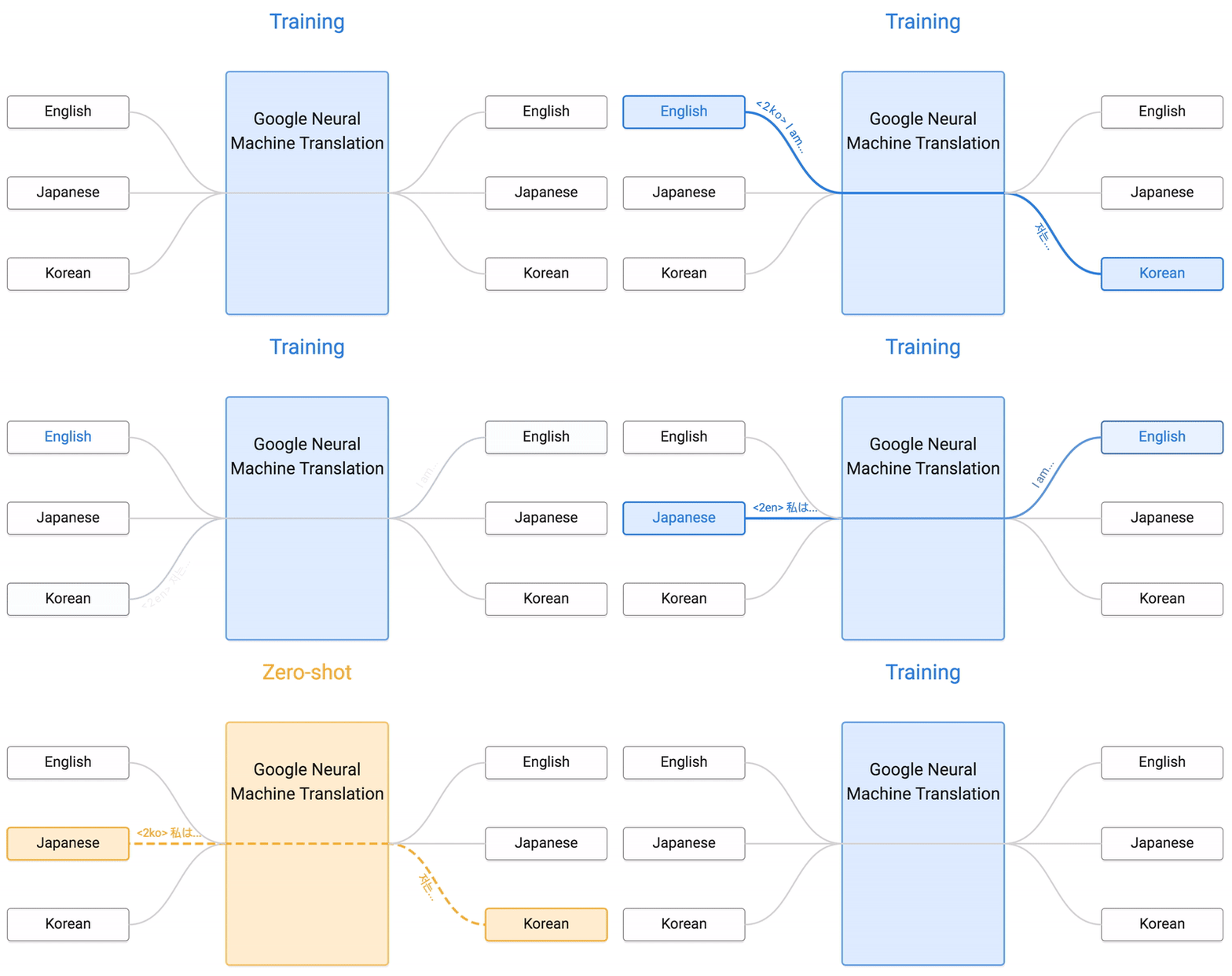
After a little over a month of learning more languages to translate beyond Spanish, Google's recently announced Neural Machine Translation system has used deep learning to develop its own internal language. TechCrunch reports: GNMT's creators were curious about something. If you teach the translation system to translate English to Korean and vice versa, and also English to Japanese and vice versa... could it translate Korean to Japanese, without resorting to English as a bridge between them? They made this helpful gif to illustrate the idea of what they call "zero-shot translation" (it's the orange one). As it turns out -- yes! It produces "reasonable" translations between two languages that it has not explicitly linked in any way. Remember, no English allowed. But this raised a second question. If the computer is able to make connections between concepts and words that have not been formally linked... does that mean that the computer has formed a concept of shared meaning for those words, meaning at a deeper level than simply that one word or phrase is the equivalent of another? In other words, has the computer developed its own internal language to represent the concepts it uses to translate between other languages? Based on how various sentences are related to one another in the memory space of the neural network, Google's language and AI boffins think that it has. The paper describing the researchers' work (primarily on efficient multi-language translation but touching on the mysterious interlingua) can be read at Arxiv. -
Is Google's AI-Driven Image-Resizing Algorithm Dishonest? (thestack.com)
The Stack reports on Google's "new research into upscaling low-resolution images using machine learning to 'fill in' the missing details," arguing this is "a questionable stance...continuing to propagate the idea that images contain some kind of abstract 'DNA', and that there might be some reliable photographic equivalent of polymerase chain reaction which could find deeper truth in low-res images than either the money spent on the equipment or the age of the equipment will allow." An anonymous reader summarizes their report: Rapid and Accurate Image Super Resolution (RAISR) uses low and high resolution versions of photos in a standard image set to establish templated paths for upward scaling... This effectively uses historical logic, instead of pixel interpolation, to infer what the image would look like if it had been taken at a higher resolution.
It's notable that neither their initial paper nor the supplementary examples feature human faces. It could be argued that using AI-driven techniques to reconstruct images raises some questions about whether upscaled, machine-driven digital enhancements are a legal risk, compared to the far greater expense of upgrading low-res CCTV networks with the necessary resolution, bandwidth and storage to obtain good quality video evidence.
The article points out that "faith in the fidelity of these 'enhanced' images routinely convicts defendants." -
New Theory of Gravity Might Explain Dark Matter (phys.org)
vikingpower writes: Dutch prodigy and Amsterdam University Professor Erik Verlinde published a paper on arXiv yesterday, November 7, titled "Emergent Gravity and the Dark Universe." In the paper, Verlinde derives gravity from the so-called Holographic Principle, which -- simply put -- states that gravity emerges from the interplay between and entropy re-arrangement of sub-atomic "strings" that live in a negatively curved spacetime. At that level [...] spacetime and gravity are emergent from an underlying microscopic description in which they have no a priori meaning." Most importantly, Verlinde's paper has as a consequence that dark matter, nemesis of many an astronomer, is nothing more than an illusion. Verlinde, who was awarded the Dutch national Spinoza science prize in the recent past, already completed the tour de force of deriving Newtonian gravity from the same principles in a 2010 paper, also on arXiv. We are probably looking at Nobel-prize material here, as Verlinde is acknowledged by his peers to "go one better than Einstein's General Theory of Relativity." Slashdot reader turkeydance adds from a report via Forbes (Warning: source may be paywalled): As dark matter continues to vex astronomers, new solutions to the dark matter question are proposed. Most focus on pinning down the form of dark matter, while others propose modifying gravity to account for the effect. But a third proposal is simply to remove gravity from the equation. What if the effects of gravity aren't due to some fundamental force, but are rather an emergent effect due to other fundamental interactions? A new paper proposes just that, and if correct it could also explain the effects of dark matter. -
New Theory of Gravity Might Explain Dark Matter (phys.org)
vikingpower writes: Dutch prodigy and Amsterdam University Professor Erik Verlinde published a paper on arXiv yesterday, November 7, titled "Emergent Gravity and the Dark Universe." In the paper, Verlinde derives gravity from the so-called Holographic Principle, which -- simply put -- states that gravity emerges from the interplay between and entropy re-arrangement of sub-atomic "strings" that live in a negatively curved spacetime. At that level [...] spacetime and gravity are emergent from an underlying microscopic description in which they have no a priori meaning." Most importantly, Verlinde's paper has as a consequence that dark matter, nemesis of many an astronomer, is nothing more than an illusion. Verlinde, who was awarded the Dutch national Spinoza science prize in the recent past, already completed the tour de force of deriving Newtonian gravity from the same principles in a 2010 paper, also on arXiv. We are probably looking at Nobel-prize material here, as Verlinde is acknowledged by his peers to "go one better than Einstein's General Theory of Relativity." Slashdot reader turkeydance adds from a report via Forbes (Warning: source may be paywalled): As dark matter continues to vex astronomers, new solutions to the dark matter question are proposed. Most focus on pinning down the form of dark matter, while others propose modifying gravity to account for the effect. But a third proposal is simply to remove gravity from the equation. What if the effects of gravity aren't due to some fundamental force, but are rather an emergent effect due to other fundamental interactions? A new paper proposes just that, and if correct it could also explain the effects of dark matter. -
New Paper Explores The Prospects For Life Around M-Class Stars (arxiv.org)
Long-time Slashdot reader RockDoctor summarizes the significance of a new paper describing "The Habitability of Planets Orbiting M-Dwarf Stars": Although Star Trek had a minor smattering of "M-class planets" -- a designation that tells one nothing of substance -- "M-class star" is a much more meaningful designation of color, with two size classes, the dwarfs and the red giants... an M-dwarf of 1/10 the mass of the Sun will burn for around 1000 times the time that the Sun does... Therefore, if humanity ever meets an alien species, the odds of them coming from an M-dwarf [system] are already high. If humanity ever meets an alien species that has been around a billion years longer than us and has technology we can't even dream of, then the odds of it coming from an M-dwarf are overwhelmingly high.
This new paper offers "a comprehensive picture of the current knowledge of M-dwarf planet occurrence and habitability," pointing out that most of these stars are apparently orbited by planets packed closely together, with "a paucity of Jupiter-mass planets and the presence of multiple rocky planets." And more importantly, roughly a third of those rocky planets are orbiting in a "habitable zone" -- far enough away from their stars to support liquid water. -
Serious Hacks Possible Through Inaudible Ultrasound (newscientist.com)
An anonymous reader writes: "High-frequency audio 'beacons' are embedded into TV commercials or browser ads," reports New Scientist. "These sounds, which are inaudible to the human ear, can be picked up by any nearby device that has a microphone and can then activate certain functions on that device...Some shopping reward apps, such as Shopkick, already use it to let retailers push department or aisle-specific ads and promotions to customers' phones as they shop."
But now Fortune reports that some apps "often actively listen for ultrasound signals, even when the app itself is closed, creating a new and relatively poorly-understood pathway for hacking." In addition, security researchers "have already found ways to mine cloaked IP addresses. Speaking to New Scientist, team member Vasilios Mavroudis suggests that an app's always-on microphone access could be leveraged to monitor conversations (and, if you're not paranoid already, to decipher what you're typing). The 'beacons' that transmit ultrasound data can also be spoofed to manipulate apps' user data." -
Pokemon Go Could Add 2.83 Million Years To Users' Lives, Says Study (cnn.com)
An anonymous reader quotes a report from CNNMoney: A new study from Microsoft Research found that the most interested Pokemon Go players took 26% more steps than before using the app. The largest behavior changes were seen among sedentary users. No matter their gender, age, weight or lifestyle, Pokemon Go users began to move more -- taking an extra 194 steps a day once they started using the app. (That's the equivalent of walking roughly one tenth of a mile.) The researchers estimate that Pokemon Go has added 144 billion steps to U.S. physical activity. That's 143 roundtrips to the moon. The study was published online this month in the Cornell Library University. Since activity reduces mortality risks, the researchers estimated that Pokemon Go could add 2.83 million years to the life expectancy of an assumed 25 million U.S. users. Based off research that showed walking reduces mortality, the researchers calculated that Pokemon Go users who continued to walk an extra 1,000 steps a day would enjoy 41.4 days of additional life expectancy. The Microsoft scientists examined data shared by 31,793 users of Microsoft Band, a wearable device, and Bing, the company's search engine. They compared the movement data from the wearables with users' web search queries. Pokemon Go players were identified by web searches that indicated they were playing the game. The Microsoft team also looked at four of the most popular health apps on Apple and Android devices. They found these apps had little impact on a person's behavior. The activity levels of Pokemon Go users changed far more. -
New AI Is Capable of Beating Humans At Doom (denofgeek.com)
An anonymous reader quotes a report from Den of Geek UK: Two students at Carnegie Mellon University have designed an artificial intelligence program that is capable of beating human players in a deathmatch game of 1993's Doom. Guillaume Lample and Devendra Singh Chaplot spent four months developing a program capable of playing first-person shooter games. The program made its debut at VizDoom (an AI competition that centered around the classic shooter) where it took second place despite the fact that their creation managed to beat human participants. That's not the impressive part about this program, however. No, what's really impressive is how the AI learns to play. The creator's full write-up on the program (which is available here) notes that their AI "allows developing bots that play the game using the screen buffer." What that means is that the program learns by interpreting what is happening on the screen as opposed to following a pre-set series of command instructions alone. In other words, this AI learns to play in exactly the same way a human player learns to play. This theory has been explored practically before, but Doom is arguably the most complicated game a program fueled by that concept has been able to succeed at. The AI's creators have already confirmed that they will be moving on to Quake, which will be a much more interesting test of this technologies capabilities given that Quake presents a much more complex 3D environment. -
Google's New Translation Software Powered By Brainlike Artificial Intelligence (sciencemag.org)
sciencehabit quotes a report from Science Magazine: Today, Google rolled out a new translation system that uses massive amounts of data and increased processing power to build more accurate translations. The new system, a deep learning model known as neural machine translation, effectively trains itself -- and reduces translation errors by up to 87%. When compared with Google's previous system, the neural machine translation system scores well with human reviewers. It was 58% more accurate at translating English into Chinese, and 87% more accurate at translating English into Spanish. As a result, the company is planning to slowly replace the system underlying all of its translation work -- one language at a time. The report adds: "The new method, reported today on the preprint server arXiv, uses a total of 16 processors to first transform words into a value known as a vector. What is a vector? 'We don't know exactly,' [Quoc Le, a Google research scientist in Mountain View, California, says.] But it represents how related one word is to every other word in the vast dictionary of training materials (2.5 billion sentence pairs for English and French; 500 million for English and Chinese). For example, 'dog' is more closely related to 'cat' than 'car,' and the name 'Barack Obama' is more closely related to 'Hillary Clinton' than the name for the country 'Vietnam.' The system uses vectors from the input language to come up with a list of possible translations that are ranked based on their probability of occurrence. Other features include a system of cross-checks that further increases accuracy and a special set of computations that speeds up processing time." -
How The FBI Might've Opened the San Bernardino Shooter's iPhone 5c (schneier.com)
"Remember the San Bernardino killer's iPhone, and how the FBI maintained that they couldn't get the encryption key without Apple providing them with a universal backdoor?" Slashdot reader LichtSpektren quotes Bruce Schneier: Many of us computer-security experts said that they were wrong, and there were several possible techniques they could use. One of them was manually removing the flash chip from the phone, extracting the memory, and then running a brute-force attack without worrying about the phone deleting the key. The FBI said it was impossible. We all said they were wrong. Now, Sergei Skorobogatov has proved them wrong.
Sergei's new paper describes "a real world mirroring attack on the Apple iPhone 5c passcode retry counter under iOS 9." The process does not require any expensive and sophisticated equipment. All needed parts are low cost and were obtained from local electronics distributors. By using the described and successful hardware mirroring process it was possible to bypass the limit on passcode retry attempts... Although the process can be improved, it is still a successful proof-of-concept project. -
None of Your Pixelated or Blurred Information Will Stay Safe On The Internet (qz.com)
The University of Texas at Austin and Cornell University are saying blurred or pixelated images are not as safe as they may seem. As machine learning technology improves, the methods used to hide sensitive information become less secure. Quartz reports: Using simple deep learning tools, the three-person team was able to identify obfuscated faces and numbers with alarming accuracy. On an industry standard dataset where humans had 0.19% chance of identifying a face, the algorithm had 71% accuracy (or 83% if allowed to guess five times). The algorithm doesn't produce a deblurred image -- it simply identifies what it sees in the obscured photo, based on information it already knows. The approach works with blurred and pixelated images, as well as P3, a type of JPEG encryption pitched as a secure way to hide information. The attack uses Torch (an open-source deep learning library), Torch templates for neural networks, and standard open-source data. To build the attacks that identified faces in YouTube videos, researchers took publicly-available pictures and blurred the faces with YouTube's video tool. They then fed the algorithm both sets of images, so it could learn how to correlate blur patterns to the unobscured faces. When given different images of the same people, the algorithm could determine their identity with 57% accuracy, or 85% percent when given five chances. The report mentions Max Planck Institute's work on identifying people in blurred Facebook photos. The difference between the two research is that UT and Cornell's research is much more simple, and "shows how weak these privacy methods really are." -
Can Humankind Establish a Supply Chain in Space? (arxiv.org)
Long-time Slashdot reader RockDoctor shares a new paper by NASA planetary scientist Philip Metzger, "detailing a roadmap for humanity to take control of the Solar System in order to solve problems on Earth" by utilizing the resources that are already on the moon. In a 2013 paper, Dr. Metgzer wrote: "[B]ootstrapping" can be achieved with as little as 12 metric tons landed on the Moon during a period of about 20 years... The industry grows exponentially because of the free real estate, energy, and material resources of space. The mass of industrial assets at the end of bootstrapping will be 156 metric tons with 60 humanoid robots or as high as 40,000 metric tons... Within another few decades with no further investment, it can have millions of times the industrial capacity of the United States...
Dr. Metzger wrote in 2013 that "This industry promises to revolutionize the human condition." (See RockDoctor's original submission for more details.) While Metzger now notes that "It will require a sustained commitment of several decades to complete," his new article points out that a lunar supply chain outpost "will cost about 1/3 or less of the existing annual budgets of the national space programs," thanks to advances in both robotics and artificial intelligence, and will help humanity develop renewable energy and greatly expand the availability of other limited resources. -
Second Irregularly Dimming Star Found (phys.org)
Long-time Slashdot reader RockDoctor writes: Remember the screaming and welcoming of our Dyson-Sphere-Dwelling 1500 LY distant Overlords that accompanied the news that star KIC 8462852 was irregularly dimming on both short and longer timescales? A second star with a similar light curve has been discovered and reported on ARXIV.
With the euphonious names "EPIC 204278916" and "2MASS J16020757-2257467", the star is a young M1 (red) star, traveling as part of a group of stars which haven't had time to disperse from their place of formation. The age is estimated at 5 — 11 million years. Analysis of 70+ days of data from the K2 mission epoch shows a rotation of 3.6 days, but a period of 25 days near the start of the observation epoch showed dips in intensity of up to 60% lasting for up to about a day each. Details are in the Arxiv paper linked to above, particularly figures 1 and 4.
If confirmed, this discovery changes the situation with interpreting the so-called "Tabby's Star". Firstly with a second object in the class, the odds of it representing a class of naturally occurring objects compared to a unique, unusual object is greatly increased. Secondly, the different celestial mechanical situations around the different stars allows a better estimate of plausible formation mechanisms. One potentially important point is that clumps of debris that could produce these dimmings seem to be quite large. "It is also important to note that the resulting size for the transiting and occulting clump would be quite large at with the clump being in the order of 1.5 times the radius of the Sun. Sadly, this appears to be a new class of "dirty young planetary system." no alien Overlords, no screaming in the streets. Just business-like astronomy. -
There May Be A Fifth Force of Nature, Study Suggests (space.com)
According to a paper published in the journal Physical Review Letters, physicists at the University of California, Irvine, may have discovered a previously unknown subatomic particle that's evidence of a fifth fundamental force of nature. Space.com reports: "[Professor of physics and astronomy Jonathan Feng] and his colleagues analyzed data gathered recently by experimental nuclear physicists at the Hungarian Academy of Sciences, who were trying to find 'dark photons' -- hypothetical indicators of mysterious dark matter. Dark matter is thought to make up about 85 percent of all matter in the universe, but it neither absorbs nor emits light, so it's impossible to detect directly. 'The experimentalists weren't able to claim that it was a new force,' Feng said. 'They simply saw an excess of events that indicated a new particle, but it was not clear to them whether it was a matter particle or a force-carrying particle.' The new work by Feng and his team suggests that the Hungarians found not a 'dark photon' but rather a 'protophobic X boson' -- a strange particle whose existence could indicate a fifth force of nature. The known electromagnetic force acts on protons and electrons, but this newfound particle apparently interacts only with protons and neutrons, and then only at very short distances, researchers said. The potential fifth force may be linked to the electromagnetic and strong and weak nuclear forces, as 'manifestations of one grander, more fundamental force,' Feng said. It's also possible that the universe of 'normal' matter and forces has a parallel 'dark' sector, with its own matter and forces, Feng added. 'It's possible that these two sectors talk to each other and interact with one another through somewhat veiled but fundamental interactions,' Feng said. 'This dark-sector force may manifest itself as this protophobic force we're seeing as a result of the Hungarian experiment. In a broader sense, it fits in with our original research to understand the nature of dark matter.'"
Locke2005 writes: I've always speculated that there might be forces of nature that we never observed because they were on a much larger or smaller scale than we could detect easily. But now Jonathan Feng, a professor of physics and astronomy at the University of California, Irvine, is suggesting there may actually be a fifth force. Of course, this might vanish just like the Higgs Boson evidence did. Can anybody explain better what it was they detected, and why it is being interpreted as evidence of a previously unknown force? -
Maybe There's No Life in Space Because We're Too Early
Long-time Slashdot reader sehlat shares "a highly accessible summary" of a new theory about why we haven't yet find life on other planets -- that "we're not latecomers, but very, very early." From Lab News: The universe is 13.8 billion years old, with Earth forming less than five billion years ago. One school of thought among scientists is that there is life billions of years older than us in space. But this recent study in the Journal of Cosmology and Astroparticle Physics argues otherwise... "We find that the chance of life grows much higher in the distant future..."
Stars larger than approximately three times the Sun's mass will perish before life has a chance to evolve... The smallest stars weigh less than a tenth as much as the sun and will glow for 10 trillion years, meaning life has lot of time to begin on those planets orbiting them in the 'habitable zone'. The probability of life increases over time so the chance of life is many times higher in the distant future than now.
The paper ultimately concludes that life "is most likely to exist near 0.1 solar-mass stars ten trillion years from now." -
New Air-Gap Jumper Covertly Transmits Data in Hard-Drive Sounds (arstechnica.com)
Security researchers have found a new way to siphon data out of an infected computer even when it has been physically disconnected from the Internet -- otherwise known as "air-gap" computers -- to prevent the leakage of sensitive information it stores, reports ArsTechnica. From the article: The method has been dubbed "DiskFiltration" by its creators because it uses acoustic signals emitted from the hard drive of the air-gapped computer being targeted. It works by manipulating the movements of the hard drive's actuator, which is the mechanical arm that accesses specific parts of a disk platter so heads attached to the actuator can read or write data. By using so-called seek operations that move the actuator in very specific ways, it can generate sounds that transfer passwords, cryptographic keys, and other sensitive data stored on the computer to a nearby microphone. The technique has a range of six feet and a speed of 180 bits per minute, fast enough to steal a 4,096-bit key in about 25 minutes. -
'Faceless Recognition System' Can Identify You Even When You Hide Your Face (vice.com)
schwit1 quotes a report from Motherboard: By itself, the ability to instantly identify anyone just by seeing their face already creates massive power imbalances, with serious implications for free speech and political protest. But more recently, researchers have demonstrated that even when faces are blurred or otherwise obscured, algorithms can be trained to identify people by matching previously-observed patterns around their head and body. In a new paper uploaded to the ArXiv pre-print server, researchers at the Max Planck Institute in Saarbrucken, Germany demonstrate a method of identifying individuals even when most of their photos are un-tagged or obscured. The researchers' system, which they call the "Faceless Recognition System," trains a neural network on a set of photos containing both obscured and visible faces, then uses that knowledge to predict the identity of obscured faces by looking for similarities in the area around a person's head and body. As for the accuracy of the system, "even when there are only 1.25 instances of the individual's fully-visible face, the system can identify an obscured face with 69.6 percent accuracy; if there are 10 instances of an individual's face, it increases to as high as 91.5 percent." -
There's A 50% Chance of Another Chernobyl Before 2050, Say Safety Specialists (technologyreview.com)
An anonymous reader writes from a report via MIT Technology Review: Spencer Wheatley and Didier Sornette at ETH Zurich in Switzerland and Benjamin Sovacool at Aarhus University in Denmark have compiled the most comprehensive list of nuclear accidents ever created and used it to calculate the chances of future accidents. They say there is a 50:50 chance that a major nuclear disaster will occur somewhere in the world before 2050. "There is a 50 percent chance that a Chernobyl event (or larger) occurs in the next 27 years," they conclude. Since the International Atomic Energy Agency doesn't publish a historical database of the nuclear accidents it rates using the International Nuclear Event Scale, others, like Wheatley and co, have to compile their own list of accidents. They define an accident as "an unintentional incident or event at a nuclear energy facility that led to either one death (or more) or at least $50,000 in property damage." Each accident must have occurred during the generation, transmission, or distribution of nuclear energy, which includes accidents at mines, during transportation, or at enrichment facility, and so on. Fukushima was by far the most expensive accident in history at a cost of $166 billion, which is 60 percent of the total cost of all other nuclear accidents added together. Wheatley and co say their data suggests that the nuclear industry remains vulnerable to dragon king events, which are large unexpected events that are difficult to analyze because they follow a different statistical distribution, have unforeseen causes, and are few in number. "There is a 50% chance that a Fukushima event (or larger) occurs in the next 50 years," they say. -
Universe Is Expanding Faster Than We Thought (gizmodo.com)
An anonymous reader writes from a report via Gizmodo: The Hubble Space Telescope has released some new numbers indicating that the rate of expansion of our universe is approximately 45.5 miles per second per megaparsec. It calculated this by measuring the distance between 19 faraway galaxies. Conceptually, the calculations show that space is expanding fast enough to essentially double the distance between our galaxy and our nearest neighbors in about 10 billion years. The new Hubble constant, which is 5 to 9 percent higher than previous estimates, does not match estimated expansion rates from the energetic leftovers of the Big Bang, thus causing a headache for cosmologists. It could mean that Einstein's theory of relativity is incomplete and/or there are processes pushing space apart that we have yet to account for. -
Computer Generates Largest Math Proof Ever At 200TB of Data (phys.org)
An anonymous reader quotes a report from Phys.Org: A trio of researchers has solved a single math problem by using a supercomputer to grind through over a trillion color combination possibilities, and in the process has generated the largest math proof ever -- the text of it is 200 terabytes in size. The math problem has been named the boolean Pythagorean Triples problem and was first proposed back in the 1980's by mathematician Ronald Graham. In looking at the Pythagorean formula: a^2 + b^2 = c^2, he asked, was it possible to label each a non-negative integer, either blue or red, such that no set of integers a, b and c were all the same color. To solve this problem the researchers applied the Cube-and-Conquer paradigm, which is a hybrid of the SAT method for hard problems. It uses both look-ahead techniques and CDCL solvers. They also did some of the math on their own ahead of giving it over to the computer, by using several techniques to pare down the number of choices the supercomputer would have to check, down to just one trillion (from 10^2,300). Still the 800 processor supercomputer ran for two days to crunch its way through to a solution. After all its work, and spitting out the huge data file, the computer proof showed that yes, it was possible to color the integers in multiple allowable ways -- but only up to 7,824 -- after that point, the answer became no. Is the proof really a proof if it does not answer why there is a cut-off point at 7,825, or even why the first stretch is possible? Does it really exist? -
Nvidia GPU-Powered Autonomous Car Teaches Itself To See And Steer (networkworld.com)
An anonymous reader quotes a report from Network World discussing Nvidia's project called DAVE2, where their engineering team built a self-driving car with one camera, one Drive-PX embedded computer and only 72 hours of training data: Neural networks and image recognition applications such as self-driving cars have exploded recently for two reasons. First, Graphical Processing Units (GPU) used to render graphics in mobile phones became powerful and inexpensive. GPUs densely packed onto board-level supercomputers are very good at solving massively parallel neural network problems and are inexpensive enough for every AI researcher and software developer to buy. Second, large, labeled image datasets have become available to train massively parallel neural networks implemented on GPUs to see and perceive the world of objects captured by cameras. The Nvidia team trained a convolutional neural network (CNN) to map raw pixels from a single front-facing camera directly to steering commands. Nvidia's breakthrough is the autonomous vehicle automatically taught itself by watching how a human drove, the internal representations of the processing steps of seeing the road ahead and steering the autonomous vehicle without explicitly training it to detect features such as roads and lanes. -
Researchers Find Vulnerabilities In Microsoft's and Google's Short URL Services (arstechnica.com)
An anonymous cites an article on Ars Technica: Two security researchers have published research exposing the potential privacy problems connected to using Web address shortening services. When used to share data protected by credentials included in the Web address associated with the content, these services could allow an attacker to gain access to data simply by searching through the entire address space for a URL-shortening service (PDF) in search of content, because of how predictable and short those addresses are. Both Microsoft and Google have offered URL shortening services embedded in various cloud services. Microsoft included the 1drv.ms URL shortening service in its OneDrive cloud storage service and a similar service (binged.it) for Bing Maps -- "branded" domains of the bit.ly domain shortening service. Microsoft has stopped offering the OneDrive embedded shortener, but existing URLs are still accessible. Google Maps has an embedded a tool that creates URLs with the goo.gl domain. Vitaly Shmatikov of Cornell Tech and visiting researcher Martin Georgiev conducted an 18-month study in which they focused on OneDrive and Google Maps. "We did not perform a comprehensive scan of all short URLs (as our analysis shows, such a scan would have been within the capabilities of a more powerful adversary)," Shmatikov wrote in a blog post today, "but we sampled enough to discover interesting information and draw important conclusions." One of those conclusions was that Microsoft's OneDrive shortened URLs were entirely too easy to traverse. -
IBM Researchers Propose Device To Dramatically Speed Up Neural-Net Learning (arxiv.org)
skywire writes: We've all followed the recent story of AlphaGo beating a top Go master. Now IBM researchers Tayfun Gokmen and Yurii Vlasov have described what could be a game changer for machine learning — an array of resistive processing units that would use stochastic techniques to dramatically accelerate the backpropagation algorithm, speeding up neural network training by a factor of 30,000. They argue that such an array would be reliable, low in power use, and buildable with current CMOS fabrication technology. "Even Google's AlphaGo still needed thousands of chips to achieve its level of intelligence," adds Tom's Hardware. "IBM researchers are now working to power that level of intelligence with a single chip, which means thousands of them put together could lead to even more breakthroughs in AI capabilities in the future." -
Saturn's Moons and Rings May Be Younger Than The Dinosaurs (space.com)
An anonymous reader quotes a report from Space.com: Some of Saturn's icy moons may have been formed after many dinosaurs roamed the Earth. New computer modeling of the Saturnian system suggests the rings and moons may be no more than 100 million years old. A new computer model suggests that the Saturnian moons Tethys, Dione and Rhea haven't seen the kinds of changes in their orbital tilts that are typical for moons that have lived in the system and interacted with other moons over long periods of time. In other words, these appear to be very young moons. "Moons are always changing their orbits. That's inevitable," Matija Cuk, principal investigator at the SETI Institute and one of the authors of the new research, said in a statement. "But that fact allows us to use computer simulations to tease out the history of Saturn's inner moons. Doing so, we find that they were most likely born during the most recent 2 percent of the planet's history." -
Google Brain Researchers Make Significant Progress On Language Modeling (arxiv.org)
New submitter integralclosure writes: Using neural networks, Google Brain researchers have significantly improved a computer's ability to model English (achieving extremely low perplexity score on a large dataset). Using the model they were able to generate random sentences, such as the following: 'Yuri Zhirkov was in attendance at the Stamford Bridge at the start of the second half but neither Drogba nor Malouda was able to push on through the Barcelona defence.' The sentences are generally coherent and mostly grammatically correct. Advances seem to be a replay of neural networks' dominance in the Imagenet competition. -
Why Sarcasm Is Such a Problem In Artificial Intelligence (thestack.com)
An anonymous reader writes: A new paper from researchers in India and Australia, "Automatic Sarcasm Detection: A Survey," highlights one of the strangest and ironically most humorous facets of the problems in machine learning and humour. The paper outlines ten years of research efforts from groups interested in detecting sarcasm in online sources. It details the ways that academia has approached the sarcasm problem, including flagging authors and ring-fencing sarcastic data. However, the report concludes that the solution to the problem is not necessarily one of pattern recognition [PDF], but rather a more sophisticated matrix that has some ability to understand context. -
Physicists Create 'Quantum Knots' (amherst.edu)
New submitter Kekke writes with news that researchers from Amherst College and Aalto University have figured out a way to create knotted solitary waves in a quantum-mechanical field. They call their creation "quantum knots". Professor David Hall said, "First we cooled a gas of rubidium atoms down to billionths of a degree above zero, at which point it became a superfluid—a tiny, well-ordered environment in which these particle-like objects can exist. Then we exposed the superfluid to a rapid change of a specifically tailored magnetic field, which tied the knot in less than a thousandth of a second." Research group leader Mikko Möttönen added, "For decades, physicists have been theoretically predicting that it should be possible to have knots in quantum fields, but nobody else has been able to make one. Now that we have seen these exotic beasts, we are really excited to study their peculiar properties." -
Distant Supernova Is the Most Powerful Ever Detected (osu.edu)
schwit1 writes: Newly published research into a supernova under observation since June has found it to be the most powerful known to modern science. "This one, called ASASSN-15lh, is about 3.8 billion light years away, 200 times more powerful than most supernovas, and twice as bright as the previous record holder. It shines 20 times brighter than the combined output of the Milky Way's 100 billion stars, and in the last six months, it has spewed as much energy as the sun would in 10 lifetimes, says Krzysztof Stanek of the Ohio State University, co-principal investigator of the All Sky Automated Survey for SuperNovae (ASAS-SN) network that spotted the explosion." The explosion doesn't fit well with current theories of supernova energy release, so astronomers are working to figure out its unusual mechanics. -
Smartwatches Can Be Used To Spy On Your Card's PIN Code (softpedia.com)
An anonymous reader writes: A researcher has developed a smartwatch app that can interpret hand motions and translate the movements to specific keystrokes on 12-key keypads, like the ones used at ATMs. The app sends the data to a nearby smartphone, which then relays it to a server, for analysis. The whole AI algorithm on which it's built has a 73% accuracy for touchlogging events, and 59% for keylogging. The entire code is on GitHub, along with his research paper, and a YouTube video. -
The Mystery of the Naked Black Hole (sciencemag.org)
sciencehabit writes: Most, if not all, galaxies have supermassive black holes at their centers surrounded by dense clouds of stars. Now, researchers have found one that seems to have lost almost its entire entourage. The team, which reported its find at the annual meeting of the American Astronomical Society, says it doesn't know what stripped the stars away. But it has put forward a tantalizing possibility: The object could be an extremely rare medium-sized black hole, which theorists have predicted but observers have never seen. -
Should a Mars Colony Be Independent? (bbc.com)
An anonymous reader writes: The BBC has an article about a recent essay (PDF) from researcher Jacob Haqq-Misra, who argues that any future colonies established on Mars should be independent from nations or corporations on Earth. He suggests that such colonists be entirely disentangled from Earth, to the point of revoking their Earthbound citizenship. Haqq-Misra also thinks we should establish laws on Earth to prevent governments, companies, and individuals from interfering with the politics or economics of Mars. That might be harder to do; clearly, even innocent communications between family members can have an effect, and surely there will be a continuous flow of supplies to help support a colony. Where would we draw the line? It may be hard to secure investments for a Mars colony if it is guaranteed to cut ties with those spending the resources to build it. At the same time, enforcing a relationship seems impossible at interplanetary distances. Still, we're starting to ramp up our Mars exploration plans, and it's a good idea to start debating these issues now. -
Google Finds D-Wave Machine To Be 10^8 Times Faster Than Simulated Annealing (blogspot.ca)
An anonymous reader sends this report form the Google Research blog on the effectiveness of D-Wave's 2X quantum computer: We found that for problem instances involving nearly 1000 binary variables, quantum annealing significantly outperforms its classical counterpart, simulated annealing. It is more than 10^8 times faster than simulated annealing running on a single core. We also compared the quantum hardware to another algorithm called Quantum Monte Carlo. This is a method designed to emulate the behavior of quantum systems, but it runs on conventional processors. While the scaling with size between these two methods is comparable, they are again separated by a large factor sometimes as high as 10^8. A more detailed paper is available at the arXiv. -
Dark Matter Grows Hair Around Stars and Planets (forbes.com)
StartsWithABang writes: Dark matter may make up 27% of the Universe's energy density, compared to just 5% of normal (atomic) matter, but in our Solar System, it's notoriously sparse. In particular, there's just a nanogram's worth per cubic kilometer, which makes the fact that we've never directly detected it seem inevitable. But recent work has demonstrated that Earth and all the planets leave a "wake" of dark matter where the density is enhanced by a billion times or more. Time to go put those dark matter detectors where they belong: in the path of these dark matter hairs. -
How Computer Scientists Cracked a 50-Year-Old Math Problem (quantamagazine.org)
An anonymous reader writes: Over the decades, the Kadison-Singer problem had wormed its way into a dozen distant areas of mathematics and engineering, but no one seemed to be able to crack it. The question "defied the best efforts of some of the most talented mathematicians of the last 50 years," wrote Peter Casazza and Janet Tremain of the University of Missouri in Columbia, in a 2014 survey article.
As a computer scientist, Daniel Spielman knew little of quantum mechanics or the Kadison-Singer problem's allied mathematical field, called C*-algebras. But when Gil Kalai, whose main institution is the Hebrew University of Jerusalem, described one of the problem's many equivalent formulations, Spielman realized that he himself might be in the perfect position to solve it. "It seemed so natural, so central to the kinds of things I think about," he said. "I thought, 'I've got to be able to prove that.'" He guessed that the problem might take him a few weeks.
Instead, it took him five years. In 2013, working with his postdoc Adam Marcus, now at Princeton University, and his graduate student Nikhil Srivastava, now at the University of California, Berkeley, Spielman finally succeeded. Word spread quickly through the mathematics community that one of the paramount problems in C*-algebras and a host of other fields had been solved by three outsiders — computer scientists who had barely a nodding acquaintance with the disciplines at the heart of the problem. -
'Shrinking Bull's-eye' Algorithm Speeds Up Complex Modeling From Days To Hours (mit.edu)
rtoz sends word of the discovery of a new algorithm that dramatically reduces the computation time for complex processes. Scientists from MIT say it conceptually resembles a shrinking bull's eye, incrementally narrowing down on its target. "With this method, the researchers were able to arrive at the same answer as a classic computational approaches, but 200 times faster." Their full academic paper is available at the arXiv. "The algorithm can be applied to any complex model to quickly determine the probability distribution, or the most likely values, for an unknown parameter. Like the MCMC analysis, the algorithm runs a given model with various inputs — though sparingly, as this process can be quite time-consuming. To speed the process up, the algorithm also uses relevant data to help narrow in on approximate values for unknown parameters." -
New Algorithm Recognizes Both Good and Bad Fake Reviews (thestack.com)
An anonymous reader writes: Researchers from the university of Sao Paolo have developed an algorithm able to identify both good and bad online reviews in the massive daily chatter of millions of peer-community posts, and in lateral mendacities at social network sites such as Google+ and Facebook reposts and 'likes'. Two of the datasets tested in the research were from Amazon, which has a vested interest in restoring the reputation of its community reviews, and has recently taken action on the matter. -
Astronomers Spot Most Distant Object In the Solar System (sciencemag.org)
sciencehabit writes: Astronomers have found the most distant known object in our solar system, three times farther away than Pluto. The dwarf planet, which has been designated v774104, is between 500 and 1000 kilometers across. It will take another year before scientists pin down its orbit, but it could end up joining an emerging class of extreme solar system objects whose strange orbits point to the hypothetical influence of rogue planets or nearby stars. In other planetary science news, UCLA professor Jean-Luc Margot has proposed a new definition of the term "planet" which would allow for the inclusion of exoplanets. His metric is laid out in an academic paper available at the arXiv. -
Baidu Data Research Reveals China's Ghost Cities (thestack.com)
An anonymous reader writes: Chinese web services giant, Baidu, has embarked on a new study in which it uses location information from users' mobile devices, as well as mapping and building data, to identify areas with high volumes of construction with relatively low population densities — known as 'ghost cities.' The researchers, in the published findings Ghost Cities: Analysis Based on Positioning Data in China, were able to discount areas which experienced high levels of tourism which skew the figures in peak seasons. The Baidu Big Data team discovered 50 ghost cities, although only 20 of these were revealed in the report to avoid potential harm to the real estate market in these areas. -
Leading Theory of Solar System's Formation Just Disproven (forbes.com)
StartsWithABang writes: In 2005, scientists put forth the Nice Model to explain the configuration of the Solar System's planets. It was thought that the outer planets, Jupiter in particular, migrated through the inner Solar System, and were then pulled back out by the presence of the outer giants, causing the late heavy bombardment of the terrestrial planets as it crossed the asteroid belt. But not only are extra gas giants that have since been ejected required to explain the outer worlds, but the migration would have ejected the inner, terrestrial worlds, indicating that the rocky planets finished forming after the gas giants were already in place. R.I.P., Nice Model: 2005-2015. -
New Algorithm Provides Huge Speedups For Optimization Problems (mit.edu)
An anonymous reader writes: MIT graduate students have developed a new "cutting-plane" algorithm, a general-purpose algorithm for solving optimization problems. They've also developed a new way to apply their algorithm to specific problems, yielding orders-of-magnitude efficiency gains. Optimization problems look to find the best set of values for a group of disparate parameters. For example, the cost function around designing a new smartphone would reward battery life, speed, and durability while penalizing thickness, cost, and overheating. Finding the optimal arrangement of values is a difficult problem, but the new algorithm shaves a significant amount of operations (PDF) off those calculations. Satoru Iwata, professor of mathematical informatics at the University of Tokyo, said, "This is indeed an astonishing paper. For this problem, the running time bounds derived with the aid of discrete geometry and combinatorial techniques are by far better than what I could imagine." -
Replacing Humans With CGI Animations To Protect Anonymity In Video Footage (thestack.com)
An anonymous reader writes: New research (PDF) from the University of Zagreb proposes the de-identification of innocent individuals in closed circuit footage by replacing them with CGI animations which either guess their skeletal motion or impose the animation via Kinect-style movement sensors. In order to preserve the raw footage, the original frames are then re-encoded via steganographic techniques into the final amended output. -
Mysteriously Variable Star Causes Speculation About Dyson Sphere (slate.com)
gurps_npc writes: Phil Plait just wrote an interesting article about a star that is extremely variable. We generally look for cyclical, minute (1%) variations in star light to detect planets. But we found one that has a variation in starlight of over 20%. We don't have a very good explanation for this, and some people are speculating that such variation could be caused by a civilization building a Dyson Sphere around the star. From the article: "Such a sphere would be dark in visible light, but emit a lot of infrared. People have looked for them, but we've never seen one (obviously). Which brings us back to KIC 8462852 (PDF). What if we caught an advanced alien civilization in the process of building such an artifact? Huge panels (or clusters of them) hundreds of thousands of kilometers across, and oddly-shaped, could produce the dips we see in that star's light." Plait says it's overwhelmingly unlikely, but interesting nonetheless. -
Researchers Create 'Habitability Index' For Exoplanets
hypnosec writes: The Kepler Space Telescope has allowed astronomers to detect and catalog thousands of exoplanets and exoplanet candidates. With more powerful telescopes like the James Webb Space Telescope scheduled for launch, scientists will be able to check if any of these exoplanets are habitable. But these space telescopes are expensive to create, and access time is coveted. This means simply pointing telescopes to random exoplanets isn't a practical proposition. That's why researchers have created what they call a "habitability index for transiting planets," with which astronomers will be able to prioritize the use of space telescopes for finding habitable planets. Their paper is available at the arXiv. -
Tracing the Limits of Computation
An anonymous reader writes: For more than 40 years, researchers had been trying to find a better way to compare two arbitrary strings of characters, such as the long strings of chemical letters within DNA molecules. The most widely used algorithm is slow and not all that clever: It proceeds step-by-step down the two lists, comparing values at each step. If a better method to calculate this "edit distance" could be found, researchers would be able to quickly compare full genomes or large data sets, and computer scientists would have a powerful new tool with which they could attempt to solve additional problems in the field.
Yet in a paper presented at the ACM Symposium on Theory of Computing, two researchers from the Massachusetts Institute of Technology put forth a mathematical proof that the current best algorithm was "optimal" — in other words, that finding a more efficient way to compute edit distance was mathematically impossible. But researchers aren't quite ready to record the time of death. One significant loophole remains. The impossibility result is only true if another, famously unproven statement called the strong exponential time hypothesis (SETH) is also true. -
Google AdSense Click Fraud Made Possible By Uncloaking Advertisers' Sites
An anonymous reader writes: A Spanish researcher claims to have uncovered a vulnerability in the security procedures of Google's AdSense program which would allow a third party to manipulate clicks on Google's syndicated ad service by 'de-cloaking' the obfuscated advertiser URLs that Google AdSense placements provide as links. He has also provided downloadable PHP files to show the exploit in action. -
Chinese Researchers Propose Tor-Inspired Overhaul of Bitcoin
Patrick O'Neill writes: Although Bitcoin was never designed to be anonymous, many of its users have used it as if it were. Now, two prominent Chinese researchers are proposing a system that encrypts all new Bitcoin transactions layer by layer to beat network analysis that can unmask Bitcoin users. The new research is inspired by the Tor anonymity network. The researchers' paper is at arXiv. (Also covered by The Stack.) -
Image Doctoring Is Tough To Spot, Even When We're Looking For It
An anonymous reader writes with a link to The Stack's look at study that examines the human capacity to detect (or to overlook) manipulation in images. About 400 volunteers looked at images which had been digitally altered by erasing elements, by replicating parts the image, or by pasting in elements from other images. Less than 58 percent of the alterations were detected, even though the volunteers knew that's what they were to look for. The article says "While its conclusion – that we are not very good at identifying doctored photos – is predictable, it's the type of 'fakes' that deceive us which are most interesting." Spoiler: Erasure is much harder to spot than image splicing. -
Neural Network Chess Computer Abandons Brute Force For "Human" Approach
An anonymous reader writes: A new chess AI utilizes a neural network to approach the millions of possible moves in the game without just throwing compute cycles at the problem the way that most chess engines have done since Von Neumann. 'Giraffe' returns to the practical problems which defeated chess researchers who tried to create less 'systematic' opponents in the mid-1990s, and came up against the (still present) issues of latency and branch resolution in search. Invented by an MSc student at Imperial College London, Giraffe taught itself chess and reached FIDE International Master level on a modern mainstream PC within three days. -
Scientists Propose App That Detects Emotions Based On Walking Style
An anonymous reader writes: Chinese researchers claim to be able to deduce a person's emotional state using accelerometer data from mobile devices attached to the wrist and ankle. The study recorded baseline data and then comparitive data after showing either disturbing or amusing videos to test subjects. The paper envisages the ultimate development of smartphone and wearable apps capable of providing systematic long-term and short-term data on someone's state of being, based mostly on the movement of the ankle whilst walking. They posit the usefulness of the information in medical applications, but do not address possible unsuitable uses, such as for the purposes of employment assessment or insurance premiums. -
Wikipedia's Viewing Statistics Could Provide Better Web-Trends Data Than Google
An anonymous reader writes: Researchers in Japan have established an almost 75% correlation between Google Trends data on keyword surges and equivalent Wikipedia page views. Since Google provides aggregate web-trends data with little granularity, the 'early ripples' of web interest are far harder to detect via its APIs than by a system that gathers information from Wikipedia's publicy accessible page views data.