Slashdot Mirror
Domain: astrobio.net
Stories and comments across the archive that link to astrobio.net.
Stories · 147
-
Interview With Planet Hunter, Geoff Marcy
mindpixel writes "I was told as a child we'd never 'see' atoms or planets of other stars. Now with atomic force microscopes we 'see' atoms and with almost any telescope and statistics we 'see' planets. In the amazing online journal - Astrobiology - Planet-finding scientist, Geoff Marcy, describes just how it feels to find a new world." -
Interview With Planet Hunter, Geoff Marcy
mindpixel writes "I was told as a child we'd never 'see' atoms or planets of other stars. Now with atomic force microscopes we 'see' atoms and with almost any telescope and statistics we 'see' planets. In the amazing online journal - Astrobiology - Planet-finding scientist, Geoff Marcy, describes just how it feels to find a new world." -
Plankton in the Clouds
An anonymous reader writes "NASA is reporting that the September 1997 Pacific hurricane, Nora, was able to deliver sea salt and plankton as far inland as Oklahoma. The tale-tell signs of prismatic light halos around cirrus clouds pointed to ice crystals with nucleated hexagons and sea-salted clouds. Various proposals have been made previously about such 'life in the clouds' proposals on other planets like Jupiter and Venus." -
Plankton in the Clouds
An anonymous reader writes "NASA is reporting that the September 1997 Pacific hurricane, Nora, was able to deliver sea salt and plankton as far inland as Oklahoma. The tale-tell signs of prismatic light halos around cirrus clouds pointed to ice crystals with nucleated hexagons and sea-salted clouds. Various proposals have been made previously about such 'life in the clouds' proposals on other planets like Jupiter and Venus." -
Jill Tarter and the Allen Telescope Array
An anonymous reader writes "Today's interview with Jill Tarter of the SETI Institute (and Carl Sagan's inspiration for the main character of his novel Contact), outlines the forthcoming search capabilities of the large Allen Telescope Array. Their thousand-fold expanded search must find promising places to point 350 radio dishes. Outside San Francisco, the array spans an equivalent 8 football fields. Their new catalog, called HabCat, identifies all potentially habitable hosts for complex life within 450 light-years from Earth. Of the billions of places to point in the sky, their A-list total: 17,129. Start at Vega." -
Lost City: Where Crust Meets Mantle
An anonymous reader writes "Track two-dozen oceanographers on their one-month expedition to the Lost City, submersed off the Mid-Atlantic Ridge. Since up to a third of the planet's total biomass may live below 100 meters, one goal is to see if microbes can survive without volcanic heat--instead living off the heat of a limestone rock reaction where the crust meets the mantle. After 15 years of dormancy, this is also rumored to be the script line of the fourth Indiana Jones installment." -
Hypernova Erupts as Global Telescopes Scramble
An anonymous reader writes "The remarkable Robotic Optical Transient Search Experiment [ROTSE] telescopes have tracked a 2 billion year old hypernova, from which an intense gamma ray burst reached earth on March 29. From Carl Akerlof, the ROTSE investigator: "The optical brightness of this gamma ray burst is about 100 times more intense than anything we've ever seen before." To underscore how the sun never rises on this automated telescope network, the observations switched rapidly from New South Wales in Australia back to Fort Davis, Texas, over a 12 hour burnout of the collapsing black hole." -
DNA, Fifty Years To the Day
An anonymous reader writes "Today being the fiftieth anniversary (April 2, 1953) of the Watson-Crick double-helical, DNA discovery [to quote, 'We wish to put forward a radically different structure...'], there is an interesting tally of completed gene sequences here, and ones still being worked, including the Ames strain of the anthrax bacteria. It also appears that the only lifeforms not using DNA for code storage are a few viruses like the common cold." -
GZipping Life Forms: Deflate Reveals Bare-Bones
An anonymous reader writes "To distinguish images derived from living vs. non-living sources, USC and NASA JPL researchers report today using the standard gzip compression utility. As a measure of overall pattern complexity, they find that the inherent pixel content of biologically generated fossils produces higher image compression ratios [more data redundancy], compared to their non-biological counterparts. The more the file shrinks, the more likely it is that a living process was involved. A test is live online here. This extends the simple, but powerful, uses of gzip to biogenic fossil detectors, in addition to spam cop filters, DNA sequence comparisons, digital camera image crunchers, etc. In nine months, the two Mars rovers will send back the first microscopic-scale images of Mars rocks, which should be amenable to some of these same techniques: thus gzipping is apparently pretty zippy." -
GZipping Life Forms: Deflate Reveals Bare-Bones
An anonymous reader writes "To distinguish images derived from living vs. non-living sources, USC and NASA JPL researchers report today using the standard gzip compression utility. As a measure of overall pattern complexity, they find that the inherent pixel content of biologically generated fossils produces higher image compression ratios [more data redundancy], compared to their non-biological counterparts. The more the file shrinks, the more likely it is that a living process was involved. A test is live online here. This extends the simple, but powerful, uses of gzip to biogenic fossil detectors, in addition to spam cop filters, DNA sequence comparisons, digital camera image crunchers, etc. In nine months, the two Mars rovers will send back the first microscopic-scale images of Mars rocks, which should be amenable to some of these same techniques: thus gzipping is apparently pretty zippy." -
Venus and Life
An anonymous reader writes "Venus-- thought in the 1950's by British astrophysicist, Fred Hoyle, to be covered in oil-- is discussed today by NASA's Principal Investigator for Planetary Atmospheres and Venus Data Analysis Program as having water in its atmosphere, and strange ultraviolet absorbers that swirl in the upper clouds. He speculates on the four ways that Venus might harbor life. Today's Cessna 182 crash led to the tragic death of the spacecraft manager for the highly successful Venus Magellan radar mapping mission, Gary Parker. The next scheduled Venus fly-by will be in 2004 and 2006 by the Johns Hopkins/Goddard Messenger spacecraft on its four-year mission to study Mercury." -
The Lazarus Zoo: Resurrecting Extinct Species
An anonymous reader writes "The Australian Museum is attempting to resurrect the extinct Tasmanian tiger, using pup cells harvested from storage jars in alcohol from 70 years ago. The tiger was hunted to extinction, and has the ironic distinction of receiving legal protection the same year that the last of its kind (named Benjamin) died at the Hobart Zoo on September 7, 1936. Other cloning attempts at conserving endangered species include the South Asian banteng on an Ohio farm, the world's last burcado (a Spanish mountain goat), a wild Asian ox called the gaur, and even a woolly mammoth." They're hoping for a live birth in 2010. -
Mining Mars from Houston
An anonymous reader writes "Computer simulations of what bits of Earth, Mars and Venus might be found on the moon point to new methods for extraterrestrial sample return. Because the moon is lifeless, its sterile condition gives a very rare laboratory for collecting what may be as high as 3 grams of Earth's past, from the half-ton of lunar rocks and soil that Apollo returned for study [3 grams (Earth-terran), 0.03 grams (Mars), 0.003 grams (Venus)]. While such interplanetary exchanges are now thought common, what is surprising is these pristine samples often have never exceeded a temperature of around 100 F. Any similar planetary samples found today in, say, Antarctica, would have been weathered, eroded, or contaminated." -
Jupiter's "Mini-Me" Solar System Grows
An anonymous reader writes "University of Hawaii's robotic telescopes have discovered 8 new moons for Jupiter, thus bringing its mini solar system to 48 total. No one knows how Jupiter dissipates the energy of these likely asteroid captures, unless it once had a massively larger atmosphere. Indeed, its ion cloud today seems to spell doom for what Sir Arthur C. Clarke indicated, is another reason to avoid probing life on Europa. ('All these worlds are yours--except Europa. Attempt no landings there.'-- 2010: Odyssey Two). As an aside, one of those NASA sites seem technically to be doing text-to-speech in a very familiar-sounding, Stephen Hawkings version [MP3] of those articles." -
Jupiter's "Mini-Me" Solar System Grows
An anonymous reader writes "University of Hawaii's robotic telescopes have discovered 8 new moons for Jupiter, thus bringing its mini solar system to 48 total. No one knows how Jupiter dissipates the energy of these likely asteroid captures, unless it once had a massively larger atmosphere. Indeed, its ion cloud today seems to spell doom for what Sir Arthur C. Clarke indicated, is another reason to avoid probing life on Europa. ('All these worlds are yours--except Europa. Attempt no landings there.'-- 2010: Odyssey Two). As an aside, one of those NASA sites seem technically to be doing text-to-speech in a very familiar-sounding, Stephen Hawkings version [MP3] of those articles." -
Nanodiamonds Are Not Forever
An anonymous reader writes "Livermore Labs and the Belgian Institute of Astrophysics (Catholic University, Leuven) are reporting today that nanodiamonds trapped by U2 spyplanes are pretty common (one part per 1000 in meteors), but don't originate from violent supernovae as previously thought. Instead their absence in comets suggest they formed after our solar system (are not pre-solar) by chemical vapor deposition -- and from much less violent asteroid collisions. Their technique of spectroscopy is compared to looking for the proverbial needle in a haystack by burning down the haystack. It seems these diamond time capsules are close to perfect tracers for guessing the initial conditions when life first formed in the universe. On April 23-24, a large flux of identifiable comet dust will streak through our stratosphere from the Grigg-Skjellerup earth-crossing dust trail." -
Nanodiamonds Are Not Forever
An anonymous reader writes "Livermore Labs and the Belgian Institute of Astrophysics (Catholic University, Leuven) are reporting today that nanodiamonds trapped by U2 spyplanes are pretty common (one part per 1000 in meteors), but don't originate from violent supernovae as previously thought. Instead their absence in comets suggest they formed after our solar system (are not pre-solar) by chemical vapor deposition -- and from much less violent asteroid collisions. Their technique of spectroscopy is compared to looking for the proverbial needle in a haystack by burning down the haystack. It seems these diamond time capsules are close to perfect tracers for guessing the initial conditions when life first formed in the universe. On April 23-24, a large flux of identifiable comet dust will streak through our stratosphere from the Grigg-Skjellerup earth-crossing dust trail." -
Collecting Stardust
An anonymous reader writes "Washington University in St. Louis space scientists are reporting the first definitive laboratory dissection of an interstellar dust particle, thus pulling out each grain's history individually. When collected at high-altitude, the origin of six grains are from outside our solar system. 'Space' is full of dust, or ejected material from long-dead stars. In this case, 3 of the 6 dust grains are from red giant stars, and perhaps 2 are from supernovae. In the next 5 years, there are six missions targeting a rendezvous with either a comet or asteroid, including the Stardust mission to return the first extraterrestrial samples since Apollo. That only leaves 100 billion comets left to explore in our own solar system's Oort cloud." Update: 02/28 17:22 GMT by M : Fixed university name. -
NEAT Comet Crossing: Internet Telescopes
An anonymous reader writes "During a large solar coronal mass ejection, this week's NEAT Comet crossing, gave some spectacular film footage. While no comet with such a small nucleus has ever survived that kind of close solar approach (one-fourth of Mercury's orbit) without fragmenting, this one did-- and is now outward bound on its 370 century roundtrip. These new comet discoveries have filled the log files of the now 70 big robotic telescope projects, most of which are being connected to the internet. The largest ($3 M) research-class one for public use--the Hawaiian Faulkes Project--will see first light in 45 days." -
Murchison Meteorite Still Contentious
An anonymous reader writes "The well-known 1969 meteorite that fell 60 miles north of Melbourne, Australia, remains remarkably contentious today. The 100 kilogram carbon rock : a) contains pre-biotic proteins and 12% water; b) harbors 50 amino acids not found on Earth; c) favors the tell-tale signature of biochemistry based on a dominant left-handed chirality, compared to random or racemic mixtures found in test-tube syntheses. While terrestrial contamination (even interior to the meteor) may discount this so-called 'Murchison meteor', its light isotopes of carbon and nitrogen suggest the left-handed amino acids not found elsewhere on Earth have the same ratios as the right-handed ones. This would not be the case if, say, bacteria was just making the left-handed ones after impact. Seems quite a controversy from down-under." -
Mining Asteroids@Home
An anonymous reader writes "Like the lively discussion on mediation strategies for exterminating asteroids, a six-person expert panel is debating today whether humans exist because of big collisions or in spite of them. Interestingly Mexico's oil (and most of the rest of the world's resources) seem to have arisen from later mining of these byproducts: the luck of geography or the price at the pump for dead dinosaurs." -
Walking Before Flying
An anonymous reader writes "BYU biostaticians report in Nature their genetic analysis of the insect, known as the 'walking stick', which apparently gives a contrapuntal example of reversible evolution. Called Dollo's Law, the principle holds that the same evolutionary pathway can never be backtracked, because of random mutations. But this insect class first had wings, lost them, then got them back again. So what's next for some humans: a happy return to dragging their knuckles?" -
Neptune's New Icy Companions
An anonymous reader writes "The Harvard-Smithsonian Center for Astrophysics has announced new moons found around Neptune. The findings represent the first discovery of moons from ground-based telescopes in more than a half-century (1949), and required an international team to track and confirm. Notable about the ice-planet Neptune is also its largest moon-Triton-which is the coldest measured object in our solar system, and as a consequence even its volcanoes spew not lava, but ice." -
Conan the Bacterium
An anonymous reader writes "The world's toughest organism, able to withstand thousands of time more radiation than a human, is reported by the Weizmann Institute to have its secret to survival as a tightly packed DNA ring. Their Science article indicates that radiation-induced breakages are held tightly packed rather than floating off into the intracellular fluid. The bacteria,Deinococcus radiodurans, was discovered decades ago in canned food that was sterilized using radiation. Red patches appeared in the cans - colonies of the bacterium - setting off questions as to how it could have survived." -
Salt Volcanoes on Io
An anonymous reader writes "Johns Hopkins astronomers trying to resolve the 30 year mystery of how one of Jupiter's moons generates its swirling clouds of charged particles have found their answer. The stunningly colorful moon, called Io, has a pillar of salt that spews from its volcanic surface." -
SimEarth: Terraforming Mars by the Numbers
An anonymous reader writes "Today NASA has an online terraforming simulation based on the McKay/Zubrin/Fogg model of Mars' weather modification. The simulation shows that the greening of Mars can be done in at least three ways: 1) mirrors melting stored carbon dioxide in tropical soil and polar dry ice; 2) a fluorocarbon (CFC) factory; 3) blowing a vent thruster in the side of a methane-rich asteroid and engineering a collision (perhaps many impacts, but a mere 0.3 km/s impulse drive if using an outer solar system asteroid, such as Chiron, beyond Saturn). Irrespective of the merits or wisdom of these huge engineering projects, their simulation allows moving back the clock to a previous time when Mars was blanketed by greenhouse gases, and thus much warmer." -
How An Andromeda Strain Might be Strained
An anonymous reader writes "For the world-record holder as the longest surviving bacteria in space [6 years, Bacillus subtillis], it turns out that among the multitude of dangers [cold, vacuum, UV, lack of nutrients, etc.] the greatest stress of all is intense ultraviolet radiation. In the next two years, new space station experiments are slated to test the panspermia hypothesis--also popularized in Robert Zubrin's "Entering Space", but dating back at least 150 years in the scientific literature. Recent balloon experiments, have rekindled alot of the controversy, but NASA Ames scientist, Rocco Mancinelli, concludes: "In my opinion, for a spore, it's quite likely."" -
Galileo's Flyby of Almathea
An anonymous reader writes "The spectacular Galileo flybys of Jupiter, Europa and Io are largely credited with the discovery of frozen water ice and some of the earliest examples of non-solar (tidal) heating anywhere in our solar system. For the next 10 days, Galileo scientists are preparing for their next target: probing one of Jupiter's moons, Almathea, at the close-up range of 100 miles. Almathea is one of the most unusual moons in the solar system, because it gives off more heat than it receives from the Sun." -
Andean Bioexpedition To Highest Lake Mimics Old Mars
An anonymous reader writes "The analogy between the highest lake on Earth and extremes on Mars has NASA Ames and the SETI Institute collaborating to analyze microbial samples. The combination of high ultraviolet radiation, low oxygen, low atmospheric pressure approximates the closest one can come to what Mars was like 3.5 billion years ago when it was wet and warm. The expedition page has a running schedule for the next 3 weeks." -
Rare Desert Walking Robot: Mojave or Bust
An anonymous reader writes "Robust walking robots are still surprisingly rare. The Astrobiology Magazine is reporting today on the German-American Scorpion Project to conquer 25 miles of targeted navigation into the Mojave Desert and back autonomously. The eight-legged robot is triple-jointed and must travel by day (solar-batteries) for two-weeks alone without human intervention. Because it's a scorpion, the camera is in the tail." -
Project Transit Search: Planet Hunting
An anonymous reader writes "During the nights of Oct. 5 and Oct. 30, backyard sky-watchers will get their chance. Univ. California (St. Cruz) and NASA are enlisting the large amateur astronomy community to use CCD-equipped telescopes and computer-analyzed photographs to find dimming in the only star (HD 209458 b, HD is the Henry Draper star catalog) known to have a planet candidate correctly aligned for the 'transit method' of planet discovery." -
Sputnik's 45th Anniversary
An anonymous reader writes "Today's 45th Anniversary of the day, Oct. 4, 1957, when Sputnik changed the world. "Never before had so small and so harmless an object created such consternation." Daniel J. Boorstin, The Americans: The Democratic Experience. Actually the choice of HAM Radio Broadcast frequencies was neither small nor harmless. NASA HQ WAV Audio." -
Five Year Retrospective: Mars Pathfinder
An anonymous reader writes "Five years ago today, on September 27, 1997, NASA and the Jet Propulsion Laboratory began to lose communication with the Mars Pathfinder and ended its highly successful mission. The interview with Matt Golombek, Project Scientist, highlights Mars' warm and wet past. The still remarkable landing sequence, with first signal only 3 minutes after touchdown, seemed a rare combination of luck (bounced 16 times and landed on its base petal). Not mentioned, it cost less than the making of even a medium-sized Hollywood movie." NASA is getting ready to publish their future plans for deep-space missions. -
SpinCam: High-Gravity (100G) Camera
An anonymous reader writes "Centrifuge-cameras began exploration of genetic changes at the extremes of high gravity-- in the only animal with a completely sequenced gene library. Students at Harvey Mudd designed the 100G camera, Stanford is doing the gene array and NASA is spinning the 1 millimeter worms that are the model system for how to adapt and survive 100-times your terrestrial weight. Accelerated aging and slowed DNA repair are just two biological consequences of gravity changes. The Japanese (NASDA) are building the space station centrifuge for 2006. What other garden-variety objects can be photographed in that kind of ultra-spindryer?" -
Earth: The Ring World
An anonymous reader writes "Sandia Labs is reporting on the 100,000 years or so when the Earth might have had a debris ring like Saturn. They need the rings to help explain climatic shifts and after all, what happened to all those ejected rocks when the larger meteors hit the Earth?" -
Today's Solar Flare
An anonymous reader writes "X1-class solar flare today (13:30 Universal Time). Still the SOHO spacecraft offers some of the all-time greatest snapshots anywhere on the web. The flare's residual activity would be shown white and at around 9 o'clock position here. There are 3 major categories, each 10 times stronger than the next: X-class flares are big; they are major events that can trigger planet-wide radio blackouts and long-lasting radiation storms. M-class flares are medium-sized; they generally cause brief radio blackouts that affect Earth's polar regions. C-class flares are small with few noticeable consequences here on Earth. If it were headed towards Earth, arrival is usually 48-72 hrs later (this is not coming this way). Future Mars astronauts should take a lead umbrella because one radiation day on Mars is like living at 70,000 feet on Earth." Nature is pretty. -
Deeper Science of Green Slime
An anonymous reader writes: "As the source of all breathable air, and often-cited as the oldest fossils (3.5 billion years, Western Australia), cyanobacteria or green slime is discussed today in NASA's Astrobiology Magazine. The fascinating parts are the two survival paths that make cyanobacteria ductile, but not fragile (relatively unchanged since the beginning of life on Earth): sharing genes (lateral transfer) to get new capabilities for photosynthesis, and absorbing other cells by engulfment. It is the evolution by engulfment that seems so amazing as a means of species survival, since it is the opposite of parasitism." -
Deeper Science of Green Slime
An anonymous reader writes: "As the source of all breathable air, and often-cited as the oldest fossils (3.5 billion years, Western Australia), cyanobacteria or green slime is discussed today in NASA's Astrobiology Magazine. The fascinating parts are the two survival paths that make cyanobacteria ductile, but not fragile (relatively unchanged since the beginning of life on Earth): sharing genes (lateral transfer) to get new capabilities for photosynthesis, and absorbing other cells by engulfment. It is the evolution by engulfment that seems so amazing as a means of species survival, since it is the opposite of parasitism." -
Deeper Science of Green Slime
An anonymous reader writes: "As the source of all breathable air, and often-cited as the oldest fossils (3.5 billion years, Western Australia), cyanobacteria or green slime is discussed today in NASA's Astrobiology Magazine. The fascinating parts are the two survival paths that make cyanobacteria ductile, but not fragile (relatively unchanged since the beginning of life on Earth): sharing genes (lateral transfer) to get new capabilities for photosynthesis, and absorbing other cells by engulfment. It is the evolution by engulfment that seems so amazing as a means of species survival, since it is the opposite of parasitism." -
Farthest Human-Made Object: First Quarter Century
An anonymous reader writes "The NASA Astrobiology Magazine reports today the 25th anniversary of the Voyager I launch, now the farthest human-made object at 93 Sun-Earth distances (93 AU), or 12 light-hours away. Expected battery life to 2020. The fascinating part is that gold record of civilization, which is a strange audio mix of sentimental kisses [wav file, let ET phone home that way] and perhaps the most dated picture of DNA. Some progress there. Voy 1 will likely confuse even modern earthlings-- much less ET. Case in point: In 2002, can we understand that 70's show, when the Polish greeting memorialized as "Welcome, creatures from beyond the outer world"? Unlike those ET creatures we meet daily from the inner world?" -
How to Tell Time with an Amino Acid Clock
An anonymous reader writes "Jet Propulsion Lab and Russian Academy of Sciences are reporting today that when held in suspended animation, permafrost bacteria can continue key molecular maintenance for at least 30,000 years. Since Martian permafrost is the most likely place to identify such still-living bacteria in the novel state of suspended animation, this new deep-freeze clock has considerable research promise as a biomarker. If the urban legend of Walt Disney being cryogenically-preserved under Disneyland's Pirates of Penzance amusement ride were true [it isn't], then his body would continue to repair radiation cell damage until, say, the year 30,000 A.D." -
August of Wind: Rare Mars Dust Devil Footage Released
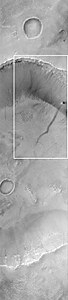
astrobio writes "Very rare picture released today from Mars Orbital Camera: the image actually captured a dust devil in the act of creating a streak as it climbed an embankment out of a crater. See panorama, larger image here, and in context. Apparently the University of Arizona has a study called Project Matador which is supposed to tornado-chase on Earth, so that Mars-instruments can be hardened against dust devils. Dorothy, it isn't Kansas." -
August of Wind: Rare Mars Dust Devil Footage Released
astrobio writes "Very rare picture released today from Mars Orbital Camera: the image actually captured a dust devil in the act of creating a streak as it climbed an embankment out of a crater. See panorama, larger image here, and in context. Apparently the University of Arizona has a study called Project Matador which is supposed to tornado-chase on Earth, so that Mars-instruments can be hardened against dust devils. Dorothy, it isn't Kansas." -
August of Wind: Rare Mars Dust Devil Footage Released
astrobio writes "Very rare picture released today from Mars Orbital Camera: the image actually captured a dust devil in the act of creating a streak as it climbed an embankment out of a crater. See panorama, larger image here, and in context. Apparently the University of Arizona has a study called Project Matador which is supposed to tornado-chase on Earth, so that Mars-instruments can be hardened against dust devils. Dorothy, it isn't Kansas." -
Cellular Phone Spectra and Earth's SETI Invisibility
astrobio writes: "How long will the Earth's technology be detectable to other worlds? From an article today by the Chairman of the SETI Institute: 'Not long, with shared transmission spectra. To transmit ever-increasing amounts of information, portions of the spectrum must be shared. This is only possible if signal strengths are reduced so that transmissions on the same frequency do not interfere with one another. The textbook example of this paradigm is the cellular phone system. This signal reduction means we are well on our way to becoming invisible.'" -
Drake on Drake: ET Life A Certainty
astro writes "Frank Drake, Chairman of the Board of Trustees of the SETI Institute applies Occam's Razor to his own Drake equation: 'Life should appear very frequently on other Earth-like planets. There will be microbial life nearby the solar system.' The simplest scenario is that 'Not Life' has a nearly identical number of assumptions as 'Life.' The contrasting view is that experimentation can prove it--but how many times did life independently create itself while the Earth changed through the whole spectrum of what biological forces might conjure up elsewhere. A sample size of 1 is in fact an experimental sample size of many--just here during Earth's climatic history." -
NASA's Kepler Mission Coming in 2006
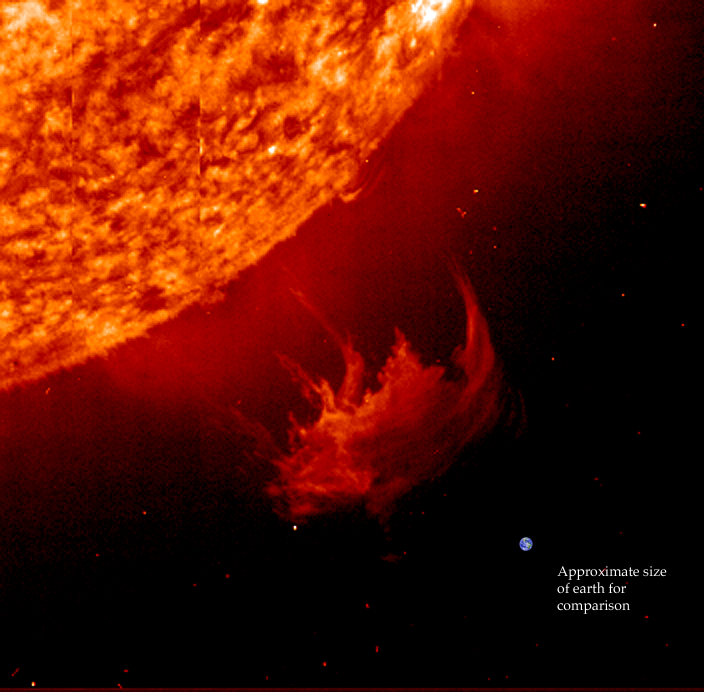
Anonymous Coward writes "NASA Kepler mission should discover 50 terrestrial planets if most of those found are about Earth's size, 185 planets if most are 30 percent larger than Earth and 640 if most are 2.2 times Earth's size. To highlight the difficulty of detecting an Earth-sized planet orbiting a distant star, Borucki, Kepler's principal investigator, points out it would take 10,000 Earths to cover the Sun's disk. But in a 1000x1000 pixel jpeg, that is 100 pixels (large) and there are about 120 million 'astronomical' photocells or rods in the human eye (good pixel density)."