Slashdot Mirror
Domain: astrobio.net
Stories and comments across the archive that link to astrobio.net.
Stories · 147
-
Terrestrial Garbage On Mars
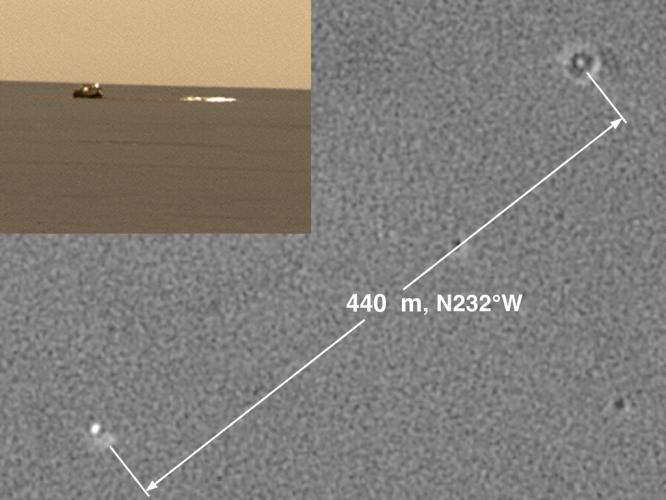
An anonymous reader writes "The garbage left behind by the twin Mars rovers was highlighted this week by the close-up view in panorama of the Spirit rovers' heatshield. Not including the various Viking, Pathfinder and some crippled probes, the human contribution of rover hardware to the martian surface now includes a few odd nicknacks, parachutes, heatshields, back shell,landing petals and many wheel tracks. It may be September before the rovers themselves become part of the red planet's debris field." -
Terrestrial Garbage On Mars
An anonymous reader writes "The garbage left behind by the twin Mars rovers was highlighted this week by the close-up view in panorama of the Spirit rovers' heatshield. Not including the various Viking, Pathfinder and some crippled probes, the human contribution of rover hardware to the martian surface now includes a few odd nicknacks, parachutes, heatshields, back shell,landing petals and many wheel tracks. It may be September before the rovers themselves become part of the red planet's debris field." -
Terrestrial Garbage On Mars
An anonymous reader writes "The garbage left behind by the twin Mars rovers was highlighted this week by the close-up view in panorama of the Spirit rovers' heatshield. Not including the various Viking, Pathfinder and some crippled probes, the human contribution of rover hardware to the martian surface now includes a few odd nicknacks, parachutes, heatshields, back shell,landing petals and many wheel tracks. It may be September before the rovers themselves become part of the red planet's debris field." -
New Marine Species, Dragonfish Eats Lanternfish
An anonymous reader writes "A new species of dragonfish has been discovered which adds to the Earth's biological census of around 28,000 distinct vertebrates. Found by Dr. Tracey Sutton, a fish ecologist at the Harbor Branch Oceanographic Institution in Ft. Pierce, Fla, the dragonfish's home is the Bear Seamount region off New England-- surprisingly one of the most thoroughly studied marine regions on the planet since it is nearby Woods Hole Oceanographic Institute. This rare fish apparently escaped previous discovery because it has some survival disadvantages: it is the size of a hotdog, eats lanternfish using a fleshy lure like a fishing pole, and individualizes that same predatory lure to catch its mate. What apparently the dragonfish has to improve its survival chances are a camouflaging glow (bioluminescence) when seen by lanternfish from below against the sun's glare-- and real big teeth." -
Monday's Planet Views Best Until 2036
An anonymous reader writes "NASA is reporting that Monday night, March 22nd, offers a rare, naked-eye glimpse of our five prominent astronomical neighbors--Saturn, Jupiter, Mars, Venus, and the Moon--in close proximity in the night sky, near to the familiar Orion constellation. This contrasts with the picture of the 'Fab Five' shot by Voyager looking back on the inner solar system. Monday's aligned view is not likely to appear in this configuration again until 2036." -
Monday's Planet Views Best Until 2036
An anonymous reader writes "NASA is reporting that Monday night, March 22nd, offers a rare, naked-eye glimpse of our five prominent astronomical neighbors--Saturn, Jupiter, Mars, Venus, and the Moon--in close proximity in the night sky, near to the familiar Orion constellation. This contrasts with the picture of the 'Fab Five' shot by Voyager looking back on the inner solar system. Monday's aligned view is not likely to appear in this configuration again until 2036." -
Spirit Takes Snapshot of Earth
ControlFreal writes "On its 66th Sol on Mars, Mars Exploration Rover Spirit has obtained its first full view of crater Bonneville. In doing so, Spirit achieved its primary travel destination, as set out in its initial itinerary. Furthermore, Spirit has now travelled more than 300 meters, thereby fulfilling its minimum mission success criteria. With this, and Opportunity halfway through its primary mission, and having discovered very strong indications of a wet Martian past, NASA has truly many an astonishing interplanetary succes story! See the overview at the Mars Rover site for more details." Another reader writes "Among the 'money-shots' from the Mars rovers would have to rank the 'pale blue dot' image released today--a view looking back towards Earth. The larger image also includes the horizon and Sun, which because the Earth is seen as an inner planet closer in towards the Sun from a martian perspective, is difficult to photograph without saturation by solar glare." -
Terraform Mars Using Oasis Greenhouses
An anonymous reader writes "The Director of the Mex-Areohab project, Omar Diaz, is interviewed today on the feasibility of modifying the Martian climate and terraforming with mini-greenhouses. At higher than 5,000 meters above sea level, on the volcano Pico de Orizaba, the Mexican model can be compared to many oases in the desert and contrasts with industrial-scale terraforming by Zubrin and McKay, among others, who use fluorocarbons, orbital mirrors, polar melting and pollution machines. One planet's pollution is another planet's rain machine, but the thrust of the interview seems to maintain that micro-terraforming is just faster and more efficient." -
Tumbleweed Rover for Marathon Martian Journeys
An anonymous reader writes "A prototype Mars rover, the Tumbleweed, has completed its 40 mile trek across the Antarctic, driven only by winds even in rough terrain over eight days. While the current rovers are designed for flat, equatorial regions, the tumbleweed design is geared to cover longer distances across what many consider the more interesting and dangerous polar regions on Mars." -
Saturn Rings But No Spokes
An anonymous reader writes "Scientists continue to ponder why images of Saturn's rings today lack the 'spokes' or dark radial bands radiating outward and first observed on the Voyager flyby. The Boulder-based Cassini Image Team describes 5 visible moons, plans for the descent probe going into the Titan moon's hydrocarbon-rich atmosphere and the expected orbital entry around Saturn less than 4 months from now." -
Saturn Rings But No Spokes
An anonymous reader writes "Scientists continue to ponder why images of Saturn's rings today lack the 'spokes' or dark radial bands radiating outward and first observed on the Voyager flyby. The Boulder-based Cassini Image Team describes 5 visible moons, plans for the descent probe going into the Titan moon's hydrocarbon-rich atmosphere and the expected orbital entry around Saturn less than 4 months from now." -
Vint Cerf's Disruption-Tolerant Networking
An anonymous reader writes "Net pioneer, Vint Cerf, talked this week about the space internet (the Interplanetary Internet), and an interesting 1994 April Fool's email he penned as a Request for Comment [1607]. The thread involves a reverse time capsule from the year 2023, but covers Cerf's side interests in Shakespeare. Since 2004 marks the 30th anniversary of publication of the first paper on the Internet, his views on the future of the net and Interplanetary Internet seem to have morphed somewhat into delay and disruption tolerant networking because of high demand for videoconferencing, Voice-Over IP, and multimedia." -
Vint Cerf's Disruption-Tolerant Networking
An anonymous reader writes "Net pioneer, Vint Cerf, talked this week about the space internet (the Interplanetary Internet), and an interesting 1994 April Fool's email he penned as a Request for Comment [1607]. The thread involves a reverse time capsule from the year 2023, but covers Cerf's side interests in Shakespeare. Since 2004 marks the 30th anniversary of publication of the first paper on the Internet, his views on the future of the net and Interplanetary Internet seem to have morphed somewhat into delay and disruption tolerant networking because of high demand for videoconferencing, Voice-Over IP, and multimedia." -
Largest Lens Ever Discovered
K Tanmay writes "A team of Astronomers have found a natural lens capable of resolving details as fine as 10 microarcseconds across - equivalent to seeing a sugar cube on the Moon, from Earth. The lens comprises of a cloud of interstellar gas, and works on the principle of scintillation; where the clumpiness inside a cloud of gas creates a density change thus bending and focusing the light. This technique, dubbed 'Earth-Orbit Synthesis', will be first used to study black holes in distant quasars, so don't expect spectacular wallpaper replacing images. There's also an interview with Dr. Hayley Bignall, an astronomer from the Joint Institute for Very Long Baseline Interferometry in Europe (JIVE), where she discusses the concept of using interstellar scintillation to get observations that we could never measure from here on earth." Update: 02/22 18:23 GMT by T : That wikipedia link had led to the wrong place; here's the definition for arcsecond if you still want to read it. -
James Cameron's Illustrated Mars Reference Design
An anonymous reader writes "Terminator Director James Cameron commissioned renderings of the NASA Mars Reference Design [HTML, 4 PDFs]. The mission profile calls for a cargo ship sent ahead of a crew, a huge (Terminator-like?) rover, and inflatable habitats. It's not clear where Skynet and the T-800's hyper-alloy combat chassis fit in yet. Between now and then, the 5 Mars missions: 2005 Mars Reconnaisance Orbiter, 2007 Phoenix and Netlanders, 2009 Science Lab Rover, and 2011 Scout. Skynet comes in 2026." -
Homing In On Opportunity From Orbit
An anonymous reader writes "Finding its lander inside a 20-meter crater, NASA has further homed in its latest lander's location and a major science target for the Opportunity rover using high resolution orbital cameras from 400 km overhead. The lander's parachute even casted a shadow nearby this target [another 150 meter crater] during descent. Earlier, each bounce of the Spirit rover could be imaged, along with its backshell, heatshield and parachute debris. Even with dust and weathering, this method could find Pathfinder and Viking [barely], and a technical discussion with pictures is at Malin Space Systems, which designed the Mars Orbital Camera. Because of uncertainties in location, however, it would take 60 years to find the lost Mars Polar Lander, but they may look for Beagle if conditions aren't too dusty." -
Homing In On Opportunity From Orbit
An anonymous reader writes "Finding its lander inside a 20-meter crater, NASA has further homed in its latest lander's location and a major science target for the Opportunity rover using high resolution orbital cameras from 400 km overhead. The lander's parachute even casted a shadow nearby this target [another 150 meter crater] during descent. Earlier, each bounce of the Spirit rover could be imaged, along with its backshell, heatshield and parachute debris. Even with dust and weathering, this method could find Pathfinder and Viking [barely], and a technical discussion with pictures is at Malin Space Systems, which designed the Mars Orbital Camera. Because of uncertainties in location, however, it would take 60 years to find the lost Mars Polar Lander, but they may look for Beagle if conditions aren't too dusty." -
The Dirt On Mars, In Words And Pictures
An anonymous reader writes "The Spirit rover's first soil analysis reveals some puzzling features about Gusev crater. The region seems to contain the greenish silicate mineral, olivine, which usually is considered water-reactive and thus volcanic in origin. For olivine to be found in the soil may point to rock formation during a drier period in martian history, even with strong evidence for sampling in an ancient lakebed. A second puzzle is why the soil seems so crusty. After the rover arm pressed soil down, the top layer of dust hardly moved, a finding that suggests something may be binding the dust like some type of salt or thin cement." For even more and better Mars pictures, read on below.mlyle writes "I've spent a few hours hacking together some software to deal with the Mars Exploration Rover imagery at JPL. The software puts together a webpage and RDF feed of new raw imagery as it is posted to the JPL site, along with technical information decoded about how the picture was taken. It also produces stereo anaglyphs and color images that NASA has not seen fit to convert and make publically available. Be sure to also check out the ultra high resolution image of the lander as viewed from Spirit."
-
The Dirt On Mars, In Words And Pictures
An anonymous reader writes "The Spirit rover's first soil analysis reveals some puzzling features about Gusev crater. The region seems to contain the greenish silicate mineral, olivine, which usually is considered water-reactive and thus volcanic in origin. For olivine to be found in the soil may point to rock formation during a drier period in martian history, even with strong evidence for sampling in an ancient lakebed. A second puzzle is why the soil seems so crusty. After the rover arm pressed soil down, the top layer of dust hardly moved, a finding that suggests something may be binding the dust like some type of salt or thin cement." For even more and better Mars pictures, read on below.mlyle writes "I've spent a few hours hacking together some software to deal with the Mars Exploration Rover imagery at JPL. The software puts together a webpage and RDF feed of new raw imagery as it is posted to the JPL site, along with technical information decoded about how the picture was taken. It also produces stereo anaglyphs and color images that NASA has not seen fit to convert and make publically available. Be sure to also check out the ultra high resolution image of the lander as viewed from Spirit."
-
Spirit's First Mars Images
An anonymous reader writes "First panoramic and overhead polar views of Mars, a quarter billion miles away are available. Some spectacular examples and accompanying commentaries are at NASA's Astrobiology Magazine, and JPL." -
Spirit's First Mars Images
An anonymous reader writes "First panoramic and overhead polar views of Mars, a quarter billion miles away are available. Some spectacular examples and accompanying commentaries are at NASA's Astrobiology Magazine, and JPL." -
Spirit's First Mars Images
An anonymous reader writes "First panoramic and overhead polar views of Mars, a quarter billion miles away are available. Some spectacular examples and accompanying commentaries are at NASA's Astrobiology Magazine, and JPL." -
Spirit's First Mars Images
An anonymous reader writes "First panoramic and overhead polar views of Mars, a quarter billion miles away are available. Some spectacular examples and accompanying commentaries are at NASA's Astrobiology Magazine, and JPL." -
Living on Mars Time
Roland Piquepaille writes "When NASA's rovers, 'Spirit' and 'Opportunity,' touch down on Mars next January, scientists and engineers in charge of the missions at the Jet Propulsion Laboratory (JPL), will start to experiment with a 90-day period of jet lag. Why? Because, as reports Astrobiology Magazine, 'a day on Mars is 39.5 minutes longer than a day on Earth.' To accommodate the requirements of interplanetary communication, during the mission the Spirit science and engineering teams will have to live on Mars time, in synch with the red planet's cycle of light and dark. This means that, here on Earth, they'll sometimes be working during daylight hours, and at other times they'll be working through the night. This summary contains more details and a screenshot of the Mars24 application, a Java program which gives you the time on Mars." -
Nuclear Powered Mission to Jovian Moons
Skyshadow writes "The San Francisco Chronicle has an article about NASA's new project, the JIMO (Jupiter Icy Moons Orbiter). The probe is designed specifically to search for liquid water and signs of life on Europa, as well as making detailed observations of Callisto and Ganymede. Planned for a 2010 liftoff, this new probe makes all previous interplanetary probes look wussy: it'll be 300 feet long and powered by a next-gen fission reactor (as opposed to nuclear batteries). Sure beats blowing money circling the earth over and over again..." -
SETI Project Scientist Discusses Prospects
An anonymous reader writes "Today Astrobiology Magazine interviewed SETI@home Project Scientist, Dan Wertheimer, about subjects including the first detailed 'best of SETI' candidate reobservations for repeating telescope acquisition on the most promising 166 star candidates. Their policy is not to release precise sky coordinates on the best ones yet (so far a signal called SHGb11+15a), with this type of Gaussian signal shape. The candidates number some 400 million Gaussians and 5.7 billion spikes." -
Why Mars May Be Difficult
An anonymous reader writes with a link to this "dramatic article leading up to the three Mars probes for December/January at NASA's JPL (also hosted at Ames) on Mars risks: Two out of three missions to the red planet have failed. After 300 million miles of deep space, 'One colleague describes the entry, descent and landing as six minutes of terror,' says Dr. Firouz Naderi, manager of the Mars Program Office. Descending at 1,000 miles per hour, with only 100 seconds left at the altitude that a commercial airliner typically flies -- things need to happen in a hurry. Doesn't mention solar flares, electronics shielding, signal snags or budget tightening. The previous account listed the top 10 reasons Mars was hard in 1976." -
Crash Course in Safely Crashing on Mars
An anonymous reader writes "NASA described today how they prepared for the twin air-bag crash landings on Mars. The sites are Gusev Crater on January 4th and Terra Meridiani on January 25th. The golfcart-sized rovers have double-lined bladders, that must protect against: the equivalent of a forty mile-per-hour crash, compression against a surface of unknown sharpness, impacts repeated in rapid succession up to sixteen times, and the big bounce covering more than half-a-mile. Airbag landings are considered easier than retro-rocket or soft landings." -
Crash Course in Safely Crashing on Mars
An anonymous reader writes "NASA described today how they prepared for the twin air-bag crash landings on Mars. The sites are Gusev Crater on January 4th and Terra Meridiani on January 25th. The golfcart-sized rovers have double-lined bladders, that must protect against: the equivalent of a forty mile-per-hour crash, compression against a surface of unknown sharpness, impacts repeated in rapid succession up to sixteen times, and the big bounce covering more than half-a-mile. Airbag landings are considered easier than retro-rocket or soft landings." -
Crash Course in Safely Crashing on Mars
An anonymous reader writes "NASA described today how they prepared for the twin air-bag crash landings on Mars. The sites are Gusev Crater on January 4th and Terra Meridiani on January 25th. The golfcart-sized rovers have double-lined bladders, that must protect against: the equivalent of a forty mile-per-hour crash, compression against a surface of unknown sharpness, impacts repeated in rapid succession up to sixteen times, and the big bounce covering more than half-a-mile. Airbag landings are considered easier than retro-rocket or soft landings." -
Ohio State SETI Wow Signal Revisited and Debunked
An anonymous reader writes "SETI's famous 1977 'Wow' signal has been discredited in the Astrophysical Journal, using the University of Tasmania Hobart 26 m radio telescope to search for intermittent and possibly periodic emissions at the 'Wow' locale. Of the many 'maybes' that SETI has turned up in its four-decade history, none is better known than the brief, powerful one that was discovered in August, 1977, in Columbus, Ohio. Marked by the signal's rise from zero, to '30-sigma' over background noise, and back to zero in 37 seconds, the famous Wow signal was found as part of a long-running sky survey conducted with Ohio State University's 'Big Ear' radio telescope. To quote from their article in The Astrophysical Journal, Robert Gray and Simon Ellingsen, of Australia's University of Tasmania, 'no signals resembling the Ohio State Wow were detected...' So until and unless the cosmic beep measured in Ohio is found again, the 'Wow' signal will remain a 'What' signal." -
Mars Sundials - True Colors, Ambiguous Hours
An anonymous reader writes "NASA's Astrobiology Magazine today has an interview with Bill Nye, the Science Guy, who spearheaded the first interplanetary sundial, which will land on Mars in early January. The Cornell sundial inscription reads "Two Worlds, One Sun" in 17 languages [including ancient Sumerian and Mayan], and was selected over such historical mottos as one French sundial that reads: "Every hour injures; the last one kills". The sundials were an inspired transformation of a needed [mainly orange-pink] color wheel to calibrate the Mars' panoramic cameras to give true Martian colors, but so resembled the shadow-casting time pieces, that Nye took it over to become an internet-updated interplanetary dial." Read on for some more. Our reader continues: "There are no conventional hour lines at all on these dials, because unlike regular sundials, they are on moving platforms. Nye says: 'Before people figured this out back in the first era of Mars probes (also the first Disco Era) the images from the Viking spacecraft were too pink or orange. Those "over-pink" images still show up in Mars science fiction movies and Mars-themed posters and restaurant walls. One of the charming challenges is roughly, "What is an hour on Mars?" Is it a "Mour?" Is it a "quadraduodeci-sol," a twenty fourth of a sol, a Mars day? ' The interview recounts the Apollo 12 controversy over whether one of the first lunar probes, Surveyor, returned viable contaminants to Earth." -
Mars Sundials - True Colors, Ambiguous Hours
An anonymous reader writes "NASA's Astrobiology Magazine today has an interview with Bill Nye, the Science Guy, who spearheaded the first interplanetary sundial, which will land on Mars in early January. The Cornell sundial inscription reads "Two Worlds, One Sun" in 17 languages [including ancient Sumerian and Mayan], and was selected over such historical mottos as one French sundial that reads: "Every hour injures; the last one kills". The sundials were an inspired transformation of a needed [mainly orange-pink] color wheel to calibrate the Mars' panoramic cameras to give true Martian colors, but so resembled the shadow-casting time pieces, that Nye took it over to become an internet-updated interplanetary dial." Read on for some more. Our reader continues: "There are no conventional hour lines at all on these dials, because unlike regular sundials, they are on moving platforms. Nye says: 'Before people figured this out back in the first era of Mars probes (also the first Disco Era) the images from the Viking spacecraft were too pink or orange. Those "over-pink" images still show up in Mars science fiction movies and Mars-themed posters and restaurant walls. One of the charming challenges is roughly, "What is an hour on Mars?" Is it a "Mour?" Is it a "quadraduodeci-sol," a twenty fourth of a sol, a Mars day? ' The interview recounts the Apollo 12 controversy over whether one of the first lunar probes, Surveyor, returned viable contaminants to Earth." -
New Moon System Around Uranus
An anonymous reader writes "Astronomers have discovered two of the smallest moons yet found around Uranus. The new moons, uncovered by NASA's Hubble Space Telescope, are about 8 to 10 miles across (12 to 16 km) -- about the size of San Francisco. The two moons are so faint they eluded detection by the Voyager 2 spacecraft, which discovered 10 small satellites when it flew by the gas giant planet in 1986. The newly detected moons are orbiting even closer to the planet than the five major Uranian satellites, which are several hundred miles wide. The two new satellites are the first inner moons of Uranus discovered from an Earth-based telescope in more than 50 years. "It's a testament to how much our Earth-based instruments have improved in 20 plus years that we can now see such faint objects 1.7 billion miles (2.8 billion km) away," says Mark Showalter, a senior research associate at Stanford University. 'The inner swarm of 13 satellites is unlike any other system of planetary moons,' says co-investigator Jack Lissauer. 'The larger moons must be gravitationally perturbing the smaller moons. The region is so crowded that these moons could be gravitationally unstable. So, we are trying to understand how the moons can coexist with each other.'" -
Hubble Telescope Shows Giant View of Saturn
An anonymous reader writes "The giant planet, Saturn, offers the best Southern view of its spectacular rings only three times a century. The Hubble Space Telescope astronomers published this seasonal glimpse today, in infrared, ultraviolet and visible spectral bands. The Hubble also first penetrated the changing face of Saturn's biochemically rich moon, Titan, which will be the ambitious target of a landing mission - the Cassini-Huygens probe in 294 days (July 1, 2004). Because Titan changes both spatially and temporally based on observations of its atmosphere, speculation of what drives these variations derives from the moon's high content of methane and other organic building blocks." -
Hubble Telescope Shows Giant View of Saturn
An anonymous reader writes "The giant planet, Saturn, offers the best Southern view of its spectacular rings only three times a century. The Hubble Space Telescope astronomers published this seasonal glimpse today, in infrared, ultraviolet and visible spectral bands. The Hubble also first penetrated the changing face of Saturn's biochemically rich moon, Titan, which will be the ambitious target of a landing mission - the Cassini-Huygens probe in 294 days (July 1, 2004). Because Titan changes both spatially and temporally based on observations of its atmosphere, speculation of what drives these variations derives from the moon's high content of methane and other organic building blocks." -
Halley's Comet Imaged As Transneptunian Object
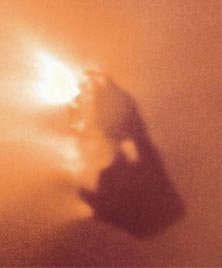
An anonymous reader writes "The European Space Observatory has imaged Halley's Comet at the farthest point (past Neptune) in which such a 10-kilometer diameter iceball has ever been observed. To image a comet as a raven-black object, without its bright dust tail (coma), is equivalent to seeing a lump of coal at the distance between the Earth's poles and to do so in the evening twilight. The last gasp seen from Halley's Comet was 1991, when a gigantic explosion happened, providing it with an expanding, extensive cloud of dust for several months. It is not known whether this event was caused by a collision with an unknown piece of rock or by internal processes (a last 'sigh' on the way out). Halley has an orbital period just over 76 years and will return in 2062." -
Infrared Telescope Lifts Off
An anonymous reader writes "On its Delta 2 Heavy-Lift vehicle, the Space Infrared Telescope (SIRTF) successfully launched to its solar orbit at 1:35 AM (EDT). As a result of the expansion of the Universe, most of the optical and ultraviolet radiation emitted from stars, galaxies, and quasars since the beginning of time now lies in the infrared. How and when the first objects in the Universe formed will be learned in large part from this observatory's infrared observations." -
Are You Man or Mouse?
fygment writes "... according to recent studies. It seems were more closely related to rodents than the carnivores i.e. the primates didn't evolve from the noble jungle cats, wolves, etc. Were closer to rats. Of course this has long been suspected in lawyers and SCO execs ..." -
Hyperion Rover, 1 km On One Command
An anonymous reader writes "Carnegie Mellon's next generation robot just finished its Chilean expedition and achieved a new planetary exploration benchmark, including being the first autonomous rover to cover 1 km on a single command. The other milestones from the Atacama Desert, Chile--the driest place on the planet--centered on over-the-horizon stereo navigation, sun-tracking for efficient solar panel pointing, and fault recovery. CMU shows pictures of the robot, called Hyperion, in action. One of its prime objectives was to plot courses that avoid shade, by finding the position of virtually everything in the solar system." -
SETI@Home Publishes Skymap
An anonymous reader writes "The skymap of where in the night sky to find the most promising SETI@Home signals is reported today, along with the research plan for the March Stellar Countdown project. The dedicated use of the Arecibo Telescope to revisit these spikes, pulses, and steady signals, focused on 166 star candidates. Those 166 were pruned from the five billion signals that have been found since 1999, depending on the signal's persistence, closeness to a known star, and frequency. The next step is particularly fascinating, if a signal appears to have increased since the first observation put that star on the checklist." -
SETI@Home Publishes Skymap
An anonymous reader writes "The skymap of where in the night sky to find the most promising SETI@Home signals is reported today, along with the research plan for the March Stellar Countdown project. The dedicated use of the Arecibo Telescope to revisit these spikes, pulses, and steady signals, focused on 166 star candidates. Those 166 were pruned from the five billion signals that have been found since 1999, depending on the signal's persistence, closeness to a known star, and frequency. The next step is particularly fascinating, if a signal appears to have increased since the first observation put that star on the checklist." -
Engineering From Science Fiction
An anonymous reader writes "NASA's long planning horizon today details a history of science facts and their sci-fi roots. The study is based on a collaborative European Space Agency project, 'Innovative Technologies from Science Fiction for Space Applications.' More than 200 technical dossiers are described--from holodecks to terraforming comets--but one of the fundamental questions posed is: what is the best communication device to scale-up expert opinion itself? Other than some future, expert version of the internet itself, is that a a collaborative Matrix? Other such interesting collections are from: MIT Media Lab's ThinkCycle, Da Vinci Institute, and the unpretentious HalfBakery of ideas." -
The Best Of Planetary Explorers
An anonymous reader writes "NASA's timeline is published today on the top seventy five events in recent planetary explorations. Since June and July inaugurates three new landers going to Mars, it is curious to see their selected images: Venusian crust hot enough to melt lead, comets colliding with Jupiter, Europa's frozen ocean. But the most precious discoveries may be those chalked up as nearly free riders: the fifteen Mars rocks that annually are found among Antarctic meteors [100 grams total] and all those four and half million personal computers doing SETI@home CPU cycles." -
The Best Of Planetary Explorers
An anonymous reader writes "NASA's timeline is published today on the top seventy five events in recent planetary explorations. Since June and July inaugurates three new landers going to Mars, it is curious to see their selected images: Venusian crust hot enough to melt lead, comets colliding with Jupiter, Europa's frozen ocean. But the most precious discoveries may be those chalked up as nearly free riders: the fifteen Mars rocks that annually are found among Antarctic meteors [100 grams total] and all those four and half million personal computers doing SETI@home CPU cycles." -
Mars and the History of Antacids
An anonymous reader writes "NASA's retrospective today on the 1976 Mars Viking mission describes the first probe to orbit another planet, and the first biology experiments based on soil sampling. Program managers maintained a dynamic 'worry list', which included a 1970's computer that opened like a wireframe book. The all-important biology experiments could not be tested prior to launch, then lightning struck the probe components (at Kennedy's Explosive Safe Area Building)." -
Mission to Harpoon Comet is Back on Track
An anonymous reader writes "The Rosetta mission planners have announced today that after an indefinite launch delay earlier this year, their goal of landing on a comet is back on track. Their new baseline target is a rendezvous with the comet, Churyumov-Gerasimenko, in November 2014. En route to the comet, Rosetta will inspect two asteroids (Otawara and Siwa) at close quarters." -
Mud on Mars: Look for Life in Russell Crater
An anonymous reader writes "Mars Global Surveyor satellite images show mud may have flowed on Mars as recently as the last 100 years. The place is called Russell Crater, in the southern hemisphere. Water would exist during summer noon, long enough to carve out the embankments and dams that make these patterns different from rocky avalanches. The BBC has an interview." -
Primordial Soup: Interview with Stanley Miller
An anonymous reader writes "Stanley Miller's classic 'primordial soup' experiments showed that 13 of the 21 amino acids necessary for life could be made in a glass flask. For its fifty-year commemoration, Miller is interviewed today and reflects on what Carl Sagan called 'the single most significant step in convincing many scientists that life is likely to be abundant in the cosmos.'" -
Digital Darwin
An anonymous reader writes "Using genetic algorithms to breed strings of computer code graphically, this week's Nature magazine describes results from Caltech and Michigan State. Their program is Avida. While they mainly mimic mutation, not genetic cross-over [or inheritance (thus wiping away much memory of initial conditions)], their simulations show how a short-term backward step in survival strategies can generate innovative advances. It is not unlike running a maze which necessarily involves testing alot of dead-ends, and thus shares the graphical look of Conway's classic Game of Life." Here's a National Geographic story about this as well, or see their press release.