Slashdot Mirror
Domain: att.net
Stories and comments across the archive that link to att.net.
Stories · 45
-
Wine HQ Password Database Compromised
With his first accepted submission, tyler.russell writes with a report that the WineHQ database systems were compromised. Quoting the official announcement: "We are sorry to report that recently our login database for the Wine HQ Application Database was compromised. We know that the entire contents of the login database was stolen by hackers. The password was encrypted, but with enough effort and depending on the quality of your old password, it could be cracked. We have closed the hole in our system that allowed read access to our database tables. To prevent further damage we have reset your password to what is shown below. We strongly suggest that if you shared your AppDB password on any other sites that you change that password as soon as possible.". He adds: "A new username and password were included with this email." -
Mainstream Press "Cringes" At Win7 Launch Parties
lurking_giant writes "Well, Microsoft has done it again with the YouTube Windows 7 launch party video that is turning the stomachs of even the mainstream press with its clueless and campy marketing style. A Washington Post reader was quoted as saying 'If Microsoft had been put in charge of marketing sex, the human race would have ended long ago, because no one would be caught dead doing something that uncool.'" Even the Guardian's resident die-hard Apple hater calls it "the most nauseating advert in history." -
Hobbit Hole + World Class Fallout Shelter
ChaosMt writes "Slashdot has covered buying missile silos before, along with buying old microwave bunkers to provide the ultimate level of data protection. Making your own Hobbit hole has been covered too. Now you can have it all in the best shelter I've ever seen (even beating the Subterranean Fortress) in an undisclosed location outside of Durango, Colorado. It may not be your cup of tea, but it is very impressive to see and compare to your own disaster planning." -
Appeals Court OKs Microsoft Antitrust Settlement
mbstone writes "The U.S. Court of Appeals for the D.C. Circuit has upheld [pdf] the settlement reached between Microsoft and the U.S. Justice Department in the antitrust case filed in 1998, beating back a challenge by Massachusetts, the only state that didn't settle. Many critics, of course, believe that Attorney General John Ashcroft took a dive on the case which was originally filed by former Clinton Administration Attorney General Janet Reno." -
Building an Unattended Computer Presentation?
hastenslowly asks: "I'm a member of a non-profit Association restoring a 1920's gas station, here in the midwest, for National Historic Register status. I'd like to provide an 24/7 'unattended' audio (visual) presentation for visitors using an 'el cheapo' computer, monitor, and mouse. I'd like to connect the entire thing to the doorbell which, when triggered, will start the presentation. Can anyone steer me to some hardware, software (for whatever OS), programming, newsgroup or any other source of info, so I don't re-invent the wheel when I do this?" -
Electronic Voting in the News
heymarcel writes "After a negative review of the Diebold voting machines by the State Gaming Control Board, it looks like Nevada has gone with a competitor for the upcoming election. And Secretary of State Dean Heller is requiring paper receipts. According to the Associated Press story, Nevada is the first state to do so." There's another story about Nevada voting machines as well. zapf writes "It appears that the major e-Voting machine vendors have banded together to form the 'Election Technology Council.'" Reader SemperUbi writes: "Demand for a voter-verified audit trail is really gaining momentum these days. The Voter Verification Act, introduced yesterday by Senator Bob Graham (D-Florida), would require a voter-verified paper audit trail, ban the use of 'undisclosed' software and wireless communications for voting machines, and require mandatory surprise recounts -- all in time for the November 2004 election. Rep. Holt's HR2239 in the House requires much the same thing. Resistance to both bills may focus on the aggressive timetable, but the effort is worth it -- as Warren Slocum once said, democracy ain't cheap. Take that, Diebold!" And finally, a Maryland newspaper dredges up an internal Diebold email that recommends gouging Maryland if the state wants paper printouts for its Diebold voting system. -
Where Have You Found LED Holiday Lights?
glassware asks: "Perhaps you know that LED holiday Lights last hundreds of times longer than regular lights. Perhaps you know that your local utility company recommends them for drastically lowering your electricity bill. But my real problem is, where can you find them? I've found lousy battery-operated LED lights in some department stores; but even in the best stores I give up after a half hour of searching, and so far I see only one vendor making them. Surely there must be alternatives. Where do you get your LED holiday lights?" -
Taiwanese Capacitors Leaking, Exploding
ackthpt writes "A few astute slashdot readers were on to something back when this article was published. After a tip (at e-insight.net) on failing caps over at amdmb I did a little looking around and found this article by Dennis Zogbi on TTI Inc.'s site, which goes into more detail. In a nutshell, many motherboards are now failing due to electolytic capacitors made with an inferior water-based electolyte. Within days or a few months these capacitors build up hydrogen gas and blow the rubber bung out the end of the capacitor, leaking electolyte and causing havoc. The problem may be widespread, as many consumer electronics made with these capacitors may also fail prematurely. Gary Headlee specializes in Abit motherboards, but as his FAQ states, he will work on other makes and the FAQ has more info on capacitor problems." -
Scientists Create Lullabies From Brain Waves
Lord Custos writes "From ABC News: Your Brain Waves are Better than Sleeping Pills! Everyone has a song in them...literally. And you can use it to put yourself to sleep. Canadian scientists have discovered that deep sleep can be induced in insomniacs by copying the insomniacs brainwaves, turning it into 'music', and then playing this 'audio transcription' of their own sleep brainwave pattern back to them." -
Scientists Create Lullabies From Brain Waves
Lord Custos writes "From ABC News: Your Brain Waves are Better than Sleeping Pills! Everyone has a song in them...literally. And you can use it to put yourself to sleep. Canadian scientists have discovered that deep sleep can be induced in insomniacs by copying the insomniacs brainwaves, turning it into 'music', and then playing this 'audio transcription' of their own sleep brainwave pattern back to them." -
Yucca Mountain Approved for US Nuclear Waste Storage
Cephalien writes "As reported by Reuters (The link is from AT&T Worldnet -- No registration required, etc, etc), looks like congress has pushed this through against Nevada's objections (NIMBY, anyone?). Now all that's left is the licensing from the NRC. I dunno about you folks, but I'm glad I don't live in Nevada." After 20 years in the making and 4 billion in studies construction on the $58b facility can begin. It was this or Cmdrtacos basement. -
DVD Format Changing Movie-making
rgmoore writes "The Los Angeles Times is running an interesting article on the impact of DVDs on the movie making process. They briefly mention the possibilities of end-users being able to re-edit the movie (with a veiled reference to The Phantom Edit) but focus more on the way that it's starting to influence directors and producers during the course of making the movie." -
Audio Fingerprinting Via Cell Phones
aruil writes: "MSNBC has a story reporting on yet another audio fingerprinting application. Next year, Royal Philips Electronics will begin selling licenses to allow users to identify songs using their cell phones. Similar technology has already been open-sourced in FreeAmp, which uses the Relatable engine." -
No One Wants The Not-Coms
angkor points to this Siliconvalley.com article about companies not jumping for the newfangled TLDs like dot-biz. "This is delicious revenge for all the spam I've gotten reminding me to reserve new domain names now before they're all gone ... ." Besides the nice sound of "dot com," perhaps the restrictions surrounding the new official TLDs help to prevent them selling like hotcakes. The world won't be fair until the LED museum and similar sites are offered -- No, given! -- .museum addresses. -
NATO Developing Environment Friendly Weapons
EGSonikku writes: "Although it may seem a bit odd, according to this msnbc.com story NATO and its member countries are developing so called 'green weapons' that produce similar effects to standard weaponry, without using chemicals that could be hazardous to the environment and the soldiers using them. Good to know that we can bomb each other without hurting the butterflies now, eh?" Heh -- it's the environmental bit shift of the neutron bomb -- "Kill the people, preserve the industry" becomes "Kill the people, preserve the land." -
Exceptionally Unexceptional Quickies
Starting the show off with some cool do-it-yourselfer sorta projects: Diederik Meijer submitted the The Silicon Graphics Refrigerator Project (or: How To Turn a $175.000 High-End SGI Challenge DM Server into a Fridge). Next up, mdaughtrey built a Mechanical Hit Counter jrbx1 sent us a link to an in-dash Atari 2600. Even coolor is that the dash its in is attached to a 1978 volkswagon ;) rednax sent us a review of a kit for adding neon to your PC. If you're not skilled enough to hack how it works, at least you can pretend you're cool and hack how it looks! I Nothing is more dangerous then glewtion's link to a story about a sculpture in england that that worries people since the heat it generates cook fry a bird mid-air. Oh, and I lied: even more dangerous then art is amasci's link to making pet ball-lightning. In your microwave, duh. If you've got some spare time, MxTxL submitted something that we've been seeing more of, email games. This one is battlemail, which apparently is glorified addictive paper rock scissors. f you were an Anime character, here's some helpful hints to keep in mind. Hieronymus Coward sent us a bit about The Drew Carrey Show featuring a 2 minute segment based on the sims. I wonder if they will use the vibromatic bed, actually the next expansion comes out soon (today?) so I probably am gonna have to resurrect my neighborhood sometime soon. Thirsty? Dipfan sent in a story about Coke wanting to put soda fountain style coke in every house right next to the water dispenser. Got Carbonated Milk? Finally for a little random product plugging, Rustin H. Wright found a place selling penguin crossing signs. Finally, anotherone noted that you can use Google in full swedish bork bork chef glory. -
Gamepro Talks About Indrema
Amigori writes "Gamepro has this article about the upcoming Indrema console. Its a basic article, but it does a decent job of explaining the system in an easy to read way." Talks about how they are expecting hackers to take apart the box (unlike the ZapStation: I asked about this at ALS and was told that they are doing stupid things like encrypting their file system, despite the fact that it is super cool and runs Linux and screams "Hack me Hack me!" and hackers would just love to rip that thing apart and make it better. The next generation of Linux devices is going to be interesting: the ones you can hack (Tivo and Indrema) and the ones you can't (may they see the light) -
Will New TLDs' Restrictions Negate Their Aims?
Kyle writes: "According to this story on Wired, most of the new TLDs selected by ICANN will be restricted. For example, .biz will sport a $2000 price tag with an annual $150 fee, and will be limited to verifiable, legitimate businesses with specific commercial intent. The .pro TLD will be used exclusively by certified "professionals," including doctors, lawyers, etc. If the point is to introduce competition for .com, ICANN might have missed the target. Might this exclusivity limit the popularity of new domains? If almost no one is allowed to use them, the general consumer will likely be unaware that they exist, and continue in their .com'ocentric mindset." Problem is, who says what's bona fide? Would officious rules like this allow eccentric, personal Web-museums (like the online LED Museum) into.museum? -
Lighting The Future: Lasers And (Wild) LEDs
Effugas writes: "Thank Memepool for pointing everyone towards The LED Museum, an absolute geek haven if there ever was one. The Museum archives, tests, and describes the multitude of LED types out there, from Ultraviolet to Turquoise to Infrared--and, most amazingly, true full color LEDs! Apparently, I wasn't the only tech drooling over the possibilities that these devices could be put to use towards: Color Kinetics threw 75 of 'em into a spotlight can and added a surprisingly versatile digital controller with external interfaces. The result: A 16.7 Million Color Programmable Spotlight, for $500US." This is an incredible site; I look forward to when the full color LEDs (and that spotlight - Yow!) are a lot cheaper. And unaccountably, Effugas has linked that "A" to something awful.mindpixel writes: "Sandia National Laboratories is reporting the demonstration of the first UV microcavity laser which could be used to replace gas-filled fluorescent tubes in home and commercial lighting applications. Successful penetration of the lighting market by this and LED technology by 2025 "should translate [globally] into cost savings of $100 billion a year, power generation capacity reductions of 120 gigawatts, and carbon emission reductions of approximately 350 million tons per year (assuming that all the savings come from coal-fired plants)."
" -
Lighting The Future: Lasers And (Wild) LEDs
Effugas writes: "Thank Memepool for pointing everyone towards The LED Museum, an absolute geek haven if there ever was one. The Museum archives, tests, and describes the multitude of LED types out there, from Ultraviolet to Turquoise to Infrared--and, most amazingly, true full color LEDs! Apparently, I wasn't the only tech drooling over the possibilities that these devices could be put to use towards: Color Kinetics threw 75 of 'em into a spotlight can and added a surprisingly versatile digital controller with external interfaces. The result: A 16.7 Million Color Programmable Spotlight, for $500US." This is an incredible site; I look forward to when the full color LEDs (and that spotlight - Yow!) are a lot cheaper. And unaccountably, Effugas has linked that "A" to something awful.mindpixel writes: "Sandia National Laboratories is reporting the demonstration of the first UV microcavity laser which could be used to replace gas-filled fluorescent tubes in home and commercial lighting applications. Successful penetration of the lighting market by this and LED technology by 2025 "should translate [globally] into cost savings of $100 billion a year, power generation capacity reductions of 120 gigawatts, and carbon emission reductions of approximately 350 million tons per year (assuming that all the savings come from coal-fired plants)."
" -
Lighting The Future: Lasers And (Wild) LEDs
Effugas writes: "Thank Memepool for pointing everyone towards The LED Museum, an absolute geek haven if there ever was one. The Museum archives, tests, and describes the multitude of LED types out there, from Ultraviolet to Turquoise to Infrared--and, most amazingly, true full color LEDs! Apparently, I wasn't the only tech drooling over the possibilities that these devices could be put to use towards: Color Kinetics threw 75 of 'em into a spotlight can and added a surprisingly versatile digital controller with external interfaces. The result: A 16.7 Million Color Programmable Spotlight, for $500US." This is an incredible site; I look forward to when the full color LEDs (and that spotlight - Yow!) are a lot cheaper. And unaccountably, Effugas has linked that "A" to something awful.mindpixel writes: "Sandia National Laboratories is reporting the demonstration of the first UV microcavity laser which could be used to replace gas-filled fluorescent tubes in home and commercial lighting applications. Successful penetration of the lighting market by this and LED technology by 2025 "should translate [globally] into cost savings of $100 billion a year, power generation capacity reductions of 120 gigawatts, and carbon emission reductions of approximately 350 million tons per year (assuming that all the savings come from coal-fired plants)."
" -
Lighting The Future: Lasers And (Wild) LEDs
Effugas writes: "Thank Memepool for pointing everyone towards The LED Museum, an absolute geek haven if there ever was one. The Museum archives, tests, and describes the multitude of LED types out there, from Ultraviolet to Turquoise to Infrared--and, most amazingly, true full color LEDs! Apparently, I wasn't the only tech drooling over the possibilities that these devices could be put to use towards: Color Kinetics threw 75 of 'em into a spotlight can and added a surprisingly versatile digital controller with external interfaces. The result: A 16.7 Million Color Programmable Spotlight, for $500US." This is an incredible site; I look forward to when the full color LEDs (and that spotlight - Yow!) are a lot cheaper. And unaccountably, Effugas has linked that "A" to something awful.mindpixel writes: "Sandia National Laboratories is reporting the demonstration of the first UV microcavity laser which could be used to replace gas-filled fluorescent tubes in home and commercial lighting applications. Successful penetration of the lighting market by this and LED technology by 2025 "should translate [globally] into cost savings of $100 billion a year, power generation capacity reductions of 120 gigawatts, and carbon emission reductions of approximately 350 million tons per year (assuming that all the savings come from coal-fired plants)."
" -
Lighting The Future: Lasers And (Wild) LEDs
Effugas writes: "Thank Memepool for pointing everyone towards The LED Museum, an absolute geek haven if there ever was one. The Museum archives, tests, and describes the multitude of LED types out there, from Ultraviolet to Turquoise to Infrared--and, most amazingly, true full color LEDs! Apparently, I wasn't the only tech drooling over the possibilities that these devices could be put to use towards: Color Kinetics threw 75 of 'em into a spotlight can and added a surprisingly versatile digital controller with external interfaces. The result: A 16.7 Million Color Programmable Spotlight, for $500US." This is an incredible site; I look forward to when the full color LEDs (and that spotlight - Yow!) are a lot cheaper. And unaccountably, Effugas has linked that "A" to something awful.mindpixel writes: "Sandia National Laboratories is reporting the demonstration of the first UV microcavity laser which could be used to replace gas-filled fluorescent tubes in home and commercial lighting applications. Successful penetration of the lighting market by this and LED technology by 2025 "should translate [globally] into cost savings of $100 billion a year, power generation capacity reductions of 120 gigawatts, and carbon emission reductions of approximately 350 million tons per year (assuming that all the savings come from coal-fired plants)."
" -
Lighting The Future: Lasers And (Wild) LEDs
Effugas writes: "Thank Memepool for pointing everyone towards The LED Museum, an absolute geek haven if there ever was one. The Museum archives, tests, and describes the multitude of LED types out there, from Ultraviolet to Turquoise to Infrared--and, most amazingly, true full color LEDs! Apparently, I wasn't the only tech drooling over the possibilities that these devices could be put to use towards: Color Kinetics threw 75 of 'em into a spotlight can and added a surprisingly versatile digital controller with external interfaces. The result: A 16.7 Million Color Programmable Spotlight, for $500US." This is an incredible site; I look forward to when the full color LEDs (and that spotlight - Yow!) are a lot cheaper. And unaccountably, Effugas has linked that "A" to something awful.mindpixel writes: "Sandia National Laboratories is reporting the demonstration of the first UV microcavity laser which could be used to replace gas-filled fluorescent tubes in home and commercial lighting applications. Successful penetration of the lighting market by this and LED technology by 2025 "should translate [globally] into cost savings of $100 billion a year, power generation capacity reductions of 120 gigawatts, and carbon emission reductions of approximately 350 million tons per year (assuming that all the savings come from coal-fired plants)."
" -
Gore-Lieberman on Filters
The NYT tells us about Gore's latest campaign commercial, which tells us that Gore will "fight violence and pornography on the Internet, helping parents block out what children shouldn't see." zhensel comments: "I was aware of Lieberman's previous efforts at censoring, but this seems a little bit ridiculous. Should we expect a government provided net filter for families? A government requirement that sites rate their content? I don't see how a president could accomplish this." There are many ways; the problem is that most parents don't need censorware, and they especially don't need the government pushing it on them. The NYT today has an above-the-fold, front-page story in which parents say censorship of films, music, and the internet is Their Job, Not Politicians'. -
More News On Dune Miniseries
Yodel_Spoogenshortz write:s "Here is an update on the Dune Miniseries being produced by New Amsterdam Entertainment to be shown in December of this year on the Sci-Fi Channel. The site has more photos and press releases. Earlier Slashdot articles on the upcoming series can be found here and here. For information on the Dune book series look at the Official Dune Web Site." Dune is an absolute classic, and probably my favorite book of all time. I'm hoping they don't screw it up. -
Thoughts On Unix ODBC Implementations?
scenic asks: "I was wondering what people thought about the available ODBC implementations that are available for Unix. I've been looking at ways to simplify database access in my applications on Linux and Solaris without having to use API's which are specific to a particular DB (or platform, ideally). Does anyone have suggestions or comments on the ODBC software that is available for Linux or any Unix flavor? What about advantages and disadvantages of specific ODBC packages?" -
Best Online Trading Company?
Stacy Uden asks: "What is your favorite online trading company? Which one is the best? I am a newbie to online trading, and I am looking to jump into the game. I have heard good things about E*Trade, Charles Schwab, and Vanguard, but I would like to hear the opinion of the Slashdot community! " -
Having Fun with Y2K
CDS writes "Fade to Black comedy magazine has a hilarious story on the Y2K problem. Michael Page, the main man @ F2B, e-mails several companies asking if their products (such as Haagen-Dazs, Oil of Olay, and Elmer's Glue) are Y2K compliant. Funny Stuff. " I laughed. I cried. It was better then "Cats". Warning: Some of the material is offensive. To someone. I think. -
Basic Patent Law for Programmers
Steven Young writes "As an intellectual property attorney, and a regular Slashdot reader, I would like to share a few of my thoughts regarding patent issues, especially as they relate to programmers. Although patents (for better or worse) are playing an ever-expanding role in the software field, many programmers do not know much about them." (Full story below.)Independent Invention is Not a Defense to a Claim of Patent Infringement
- by Steven YoungPeople sometimes get confused about whether or not independent invention (i.e. inventing something without reference to the work of an earlier inventor) protects them from patent liability. This confusion is likely due to their familiarity with copyright law. Under copyright law, you only have liability to a copyright owner if you actually copy their copyrighted work. If you create a work of your own without reference to their copyrighted work, you are not liable to them for copyright infringement, even if your work closely resembles theirs.
Liability for patent infringement, however, does not depend on your having copied the work of another. You can be held liable for patent infringement if you have made, used, sold or imported, without a license, something that is claimed by a valid patent owned by another. Your lack of knowledge about the work (or patents) of another is irrelevant to the question of whether you are liable for infringing that person's patent.
Because you cannot realistically compare your own creation against the millions of existing patents, or even against the thousands that might be in the same field, there is no way to completely shield yourself from liability for patent infringement. Even if you could compare your work to those existing patents, there would be ever present danger from those patents that might issue next Tuesday. I see this potential "gotcha" as one of the most problematic aspects of current patent law.
The legal fiction that supposedly justifies this result is that a patentee (i.e. patent owner) is given this very strong right in exchange for disclosing an invention to the public. Upon the publication of a patent, everyone is constructively (i.e. by legal fiction) put on notice that they are no longer free to do the particular things claimed by the patent. As I mentioned, however, there are millions of patents currently in effect -- no one is really aware of the scope of coverage of any sizeable portion of them. Although there might be some individuals who are aware of the general state of patent coverage in particular niches, even they would be exposed to potential liability for those patent claims they are not aware of.
To compound the silliness of all this, the courts have held that no one but a patent attorney can really know what the scope of coverage of a patent claim is. Therefore, even the theoretical justification for absolute liability in patent law is not applicable to individuals who cannot afford to keep a small army of patent attorneys on retainer.
Software patents (of one kind or another) are valid in most countries of the world (even those that officially do not grant software patents).
In the U.S. software is clearly patentable. What many people are unaware of, however, is that, for practical purposes, software has been patentable in the U.S., and most other countries of the world, for quite some time. The current debate about software patents in certain non-U.S. jurisdictions is a matter of form over substance.
While you may not be able to patent "a computer program that performs the steps of X, Y and Z" in some countries, you can generally claim something like, a computer apparatus consisting of a processor and memory, wherein the memory contains instructions which, when executed by the processor, cause the processor to perform the steps of X, Y and Z Because this type of claim is directed to a computer programmed in a particular way, and not just a program itself, most countries will allow that claim. Strictly speaking, it is not a "software claim", but the effect is nearly the same. Anyone wanting to use the program described by the steps of "X, Y and Z" will necessarily infringe the claim, so this is one effective method of getting coverage for software. There are other forms of such claims, such as a claim to "a computer readable medium storing computer instructions which, when executed by a processor cause the processor to execute the steps of X,Y and Z", or even a simple method claim such as "a method comprising the steps of...". The computer readable medium claim would cover a diskette or CD-ROM containing the "X, Y and Z" program. The simple method claim broadly covers the steps of doing X, Y and Z, regardless of whether a computer is used or not. Some of these claim forms may not allow a programmer to be sued for direct infringement (for example, if the programmer is not distributing a pre-programmed computer, the programmer is not directly infringing the "computer apparatus" claim), but a programmer could be sued for contributory infringement on any of these claims. Legal form aside, the end result to a programmer is the same: using or distributing your programs puts you at legal risk.
The scope of a patent is defined by its "claims" -- patents generally cover much more than one specific product.
A lot of people think of patents as covering particular products -- a new speaker might be marked with one or more patent numbers, suggesting that there is a patent on that exact speaker. Actually, things are more complicated than that. Each of the patents indicated on the speaker includes one or more (usually more) "claims." Each claim specifies one or more characteristics which must be present in any device for that device to infringe that claim.
For example, there might be a claim specifying that the speaker cone angle is between 40 and 45 degrees, and that the speaker magnet is made of an alloy of iron and nickel, in which nickel makes up at least 5% of the alloy by weight (clearly I am just making this up, and I don't know anything about speaker cones, magnets or metallurgy). In order for the claim to be allowed by the Patent Office, a patent examiner must be unable to find an example of a speaker with a cone of the claimed shape and with a magnet of the claimed type. To infringe that claim, a speaker must have both these claim elements. Any speaker with both elements is an infringing device, and any speaker without both elements is (probably) not an infringing device.
Other claims in the patent may claim other combinations of elements, and each claim essentially stands alone. If you infringe one claim of the patent (i.e. you make, use, sell or import something that has all of the elements of the claim), you are liable for infringement, even though you are not infringing the other claims. It is as though each claim is an independent patent. To be free from infringement, you must clear every claim of every patent.
Willful infringement of a patent exposes you to major damages.
Ordinarily, when someone is found liable for patent infringement, they are prohibited from continuing the infringing activity, and they are ordered to pay the patent holder damages equal to a reasonable royalty for the use of the patent, or the patentee's lost profits. The law permits judges to increase the monetary damages by up to three times, however, if there is a finding of willful infringement, meaning that the infringer had knowledge of the patent before engaging in the actions which constitute infringement.
If someone brings a patent to your attention, and you decide that you are safe because it does not cover what you are doing, you are entering into a legally shaky area. The Court of Appeals for the Federal Circuit (effectively the final word on patent law, since the Supreme Court rarely takes patent cases) has ruled that anyone who is not a patent attorney is not qualified to determine the scope of the claims in a patent, and that it would be unreasonable for you to determine that a particular patent is not applicable to what you are doing unless you first get a legal opinion from a patent attorney. Because, as a matter of law, you couldn't really have believed that you understood the patent (yes, our federal courts can be quite condescending), you will likely be found liable for triple damages if it turns out that you were wrong, and that you really are infringing the patent.
Because of this, lawyers routinely advise their clients to avoid reading patents in areas they are working in. The danger posed by the willful infringement doctrine is seen as outweighing any benefit that can be gained from reading patents. This state of affairs, of course, negates even the theoretical benefit of the patent system, that the public at large learns about new technology once it is patented. As it stands, the people who should be learning from patents in any given field are the same people who stand to lose the most if they dare to take a peek.
The standard of invention for patents is much thinner than most people believe.
When a new patent is announced, one of the most common criticisms is that the patent is invalid because the patented invention is merely an obvious extension of something that is already done. Theoretically, this is a valid criticism. Two requirements for a valid patent are that it is novel (the inventor was the first (sort of) to invent that particular thing or method), and non-obviousness (that the invention is not an obvious extension of something that is already known).
In practice, the level of inventiveness required for patentability is vanishingly small. It is relatively easy to show that a patent claim is invalid for a lack of novelty: you simply find something in the prior art (prior art is typically something that was published more than a year before the patent was applied for, although there are many exceptions) that includes all of the elements of the claim. Showing that a patent claim is invalid because of obviousness is considerably more difficult. First, you have to find examples in the prior art that, when taken together, add up to the patented invention. That is not enough, however. You also have to find something in the prior art that suggests putting these prior art pieces together. That is often difficult to find, even where a modification does seem obvious.
During the examination of patent applications by the Patent Office, many claims slip through that are clearly obvious. This can happen for a number of reasons. One is that the patent examiner has not found any prior art that can be combined to give all of the elements of the claimed invention. Another is that the patent examiner has not found any suggestion to combine prior art that has been found. Still another reason is psychological: a rejection on obviousness grounds is rarely clear-cut, and some patent examiners are uncomfortable making such an inherently subjective call. So, when a claim to an obvious invention makes it through the Patent Office, what happens? Generally, the validity of the patent is only challenged by a defendant when the patent owner sues for infringement (assuming the defendant has enough money for a defense). In court, however, much deference is given to the judgment of the patent examiner who originally allowed the claims, and invalidating an issued patent is a very high hurdle. Unless the obviousness is extraordinarily clear (and it rarely is), the patent will not be invalidated on grounds of obviousness, and the patentee will be able to stop others from using the claimed invention.
The consequence of this is that very little inventiveness is necessary in order for a patent to be valid. As a rule of thumb, it is probably safe to assume that every trifling modification, no matter how small, will be patentable by someone -- as long as that someone gets to the patent office in time. In practice, there is a strong possibility that any given patent will be ruled valid, unless you can find something in the prior art that is exactly what is claimed in the patent.
Patents are national in scope, however...
A patent offers exclusive rights to the owner of the patent only within the country that granted the patent. International treaties, however, have made it relatively easy to get almost identical patents issued in many countries. While each country independently examines each application, patents that are allowed in one country generally get allowed in other countries as well. The existence of a U.S. patent suggests the possible existence of corresponding non-U.S. patents (and vice versa).
The U.S. is one of the only major countries that does not publish patent applications until they are issued as patents. In most other nations, patent applications are published 18 months after filing. This publication gives the public some notice of what is coming down the pike. Although the U.S. does not publish, many U.S. companies routinely file foreign counterparts to their U.S. patent applications, typically using the system put in place by the Patent Cooperation Treaty (PCT). The PCT provides for publication 18 months after the patent was first filed, even if that filing was in the U.S. As a result, even though the U.S. does not publish patents that are being examined, searching through international patent publications can tip you off as to what is currently being examined in the U.S.
Determining whether a patent is valid and enforceable is a non-trivial exercise.
Determining whether a patent is valid and can be enforced is very complicated. Some of the reasons a patent might not be valid or enforceable include:
- (i) someone else invented the same thing first;
- (ii) the invention was described in a publication more than a year before the patent application was filed;
- (iii) the invention was offered for sale (by anyone) more than a year before the patent application was filed;
- (iv) less than all of the actual inventors were named in the patent application;
- (v) the inventor misled the patent examiner during examination of the application;
- (vi) the inventor failed to disclose material prior art to the patent examiner during examination; and
- (vii) the patent owner has misused the patent (the "misuse" doctrine is similar to antitrust).
Disclaimer My remarks here are intended to be of general use, but (of course) they should not be taken as legal advice -- if you have questions about any particular patent issues, you should see your friendly neighborhood patent attorney.
-
Basic Patent Law for Programmers
Steven Young writes "As an intellectual property attorney, and a regular Slashdot reader, I would like to share a few of my thoughts regarding patent issues, especially as they relate to programmers. Although patents (for better or worse) are playing an ever-expanding role in the software field, many programmers do not know much about them." (Full story below.)Independent Invention is Not a Defense to a Claim of Patent Infringement
- by Steven YoungPeople sometimes get confused about whether or not independent invention (i.e. inventing something without reference to the work of an earlier inventor) protects them from patent liability. This confusion is likely due to their familiarity with copyright law. Under copyright law, you only have liability to a copyright owner if you actually copy their copyrighted work. If you create a work of your own without reference to their copyrighted work, you are not liable to them for copyright infringement, even if your work closely resembles theirs.
Liability for patent infringement, however, does not depend on your having copied the work of another. You can be held liable for patent infringement if you have made, used, sold or imported, without a license, something that is claimed by a valid patent owned by another. Your lack of knowledge about the work (or patents) of another is irrelevant to the question of whether you are liable for infringing that person's patent.
Because you cannot realistically compare your own creation against the millions of existing patents, or even against the thousands that might be in the same field, there is no way to completely shield yourself from liability for patent infringement. Even if you could compare your work to those existing patents, there would be ever present danger from those patents that might issue next Tuesday. I see this potential "gotcha" as one of the most problematic aspects of current patent law.
The legal fiction that supposedly justifies this result is that a patentee (i.e. patent owner) is given this very strong right in exchange for disclosing an invention to the public. Upon the publication of a patent, everyone is constructively (i.e. by legal fiction) put on notice that they are no longer free to do the particular things claimed by the patent. As I mentioned, however, there are millions of patents currently in effect -- no one is really aware of the scope of coverage of any sizeable portion of them. Although there might be some individuals who are aware of the general state of patent coverage in particular niches, even they would be exposed to potential liability for those patent claims they are not aware of.
To compound the silliness of all this, the courts have held that no one but a patent attorney can really know what the scope of coverage of a patent claim is. Therefore, even the theoretical justification for absolute liability in patent law is not applicable to individuals who cannot afford to keep a small army of patent attorneys on retainer.
Software patents (of one kind or another) are valid in most countries of the world (even those that officially do not grant software patents).
In the U.S. software is clearly patentable. What many people are unaware of, however, is that, for practical purposes, software has been patentable in the U.S., and most other countries of the world, for quite some time. The current debate about software patents in certain non-U.S. jurisdictions is a matter of form over substance.
While you may not be able to patent "a computer program that performs the steps of X, Y and Z" in some countries, you can generally claim something like, a computer apparatus consisting of a processor and memory, wherein the memory contains instructions which, when executed by the processor, cause the processor to perform the steps of X, Y and Z Because this type of claim is directed to a computer programmed in a particular way, and not just a program itself, most countries will allow that claim. Strictly speaking, it is not a "software claim", but the effect is nearly the same. Anyone wanting to use the program described by the steps of "X, Y and Z" will necessarily infringe the claim, so this is one effective method of getting coverage for software. There are other forms of such claims, such as a claim to "a computer readable medium storing computer instructions which, when executed by a processor cause the processor to execute the steps of X,Y and Z", or even a simple method claim such as "a method comprising the steps of...". The computer readable medium claim would cover a diskette or CD-ROM containing the "X, Y and Z" program. The simple method claim broadly covers the steps of doing X, Y and Z, regardless of whether a computer is used or not. Some of these claim forms may not allow a programmer to be sued for direct infringement (for example, if the programmer is not distributing a pre-programmed computer, the programmer is not directly infringing the "computer apparatus" claim), but a programmer could be sued for contributory infringement on any of these claims. Legal form aside, the end result to a programmer is the same: using or distributing your programs puts you at legal risk.
The scope of a patent is defined by its "claims" -- patents generally cover much more than one specific product.
A lot of people think of patents as covering particular products -- a new speaker might be marked with one or more patent numbers, suggesting that there is a patent on that exact speaker. Actually, things are more complicated than that. Each of the patents indicated on the speaker includes one or more (usually more) "claims." Each claim specifies one or more characteristics which must be present in any device for that device to infringe that claim.
For example, there might be a claim specifying that the speaker cone angle is between 40 and 45 degrees, and that the speaker magnet is made of an alloy of iron and nickel, in which nickel makes up at least 5% of the alloy by weight (clearly I am just making this up, and I don't know anything about speaker cones, magnets or metallurgy). In order for the claim to be allowed by the Patent Office, a patent examiner must be unable to find an example of a speaker with a cone of the claimed shape and with a magnet of the claimed type. To infringe that claim, a speaker must have both these claim elements. Any speaker with both elements is an infringing device, and any speaker without both elements is (probably) not an infringing device.
Other claims in the patent may claim other combinations of elements, and each claim essentially stands alone. If you infringe one claim of the patent (i.e. you make, use, sell or import something that has all of the elements of the claim), you are liable for infringement, even though you are not infringing the other claims. It is as though each claim is an independent patent. To be free from infringement, you must clear every claim of every patent.
Willful infringement of a patent exposes you to major damages.
Ordinarily, when someone is found liable for patent infringement, they are prohibited from continuing the infringing activity, and they are ordered to pay the patent holder damages equal to a reasonable royalty for the use of the patent, or the patentee's lost profits. The law permits judges to increase the monetary damages by up to three times, however, if there is a finding of willful infringement, meaning that the infringer had knowledge of the patent before engaging in the actions which constitute infringement.
If someone brings a patent to your attention, and you decide that you are safe because it does not cover what you are doing, you are entering into a legally shaky area. The Court of Appeals for the Federal Circuit (effectively the final word on patent law, since the Supreme Court rarely takes patent cases) has ruled that anyone who is not a patent attorney is not qualified to determine the scope of the claims in a patent, and that it would be unreasonable for you to determine that a particular patent is not applicable to what you are doing unless you first get a legal opinion from a patent attorney. Because, as a matter of law, you couldn't really have believed that you understood the patent (yes, our federal courts can be quite condescending), you will likely be found liable for triple damages if it turns out that you were wrong, and that you really are infringing the patent.
Because of this, lawyers routinely advise their clients to avoid reading patents in areas they are working in. The danger posed by the willful infringement doctrine is seen as outweighing any benefit that can be gained from reading patents. This state of affairs, of course, negates even the theoretical benefit of the patent system, that the public at large learns about new technology once it is patented. As it stands, the people who should be learning from patents in any given field are the same people who stand to lose the most if they dare to take a peek.
The standard of invention for patents is much thinner than most people believe.
When a new patent is announced, one of the most common criticisms is that the patent is invalid because the patented invention is merely an obvious extension of something that is already done. Theoretically, this is a valid criticism. Two requirements for a valid patent are that it is novel (the inventor was the first (sort of) to invent that particular thing or method), and non-obviousness (that the invention is not an obvious extension of something that is already known).
In practice, the level of inventiveness required for patentability is vanishingly small. It is relatively easy to show that a patent claim is invalid for a lack of novelty: you simply find something in the prior art (prior art is typically something that was published more than a year before the patent was applied for, although there are many exceptions) that includes all of the elements of the claim. Showing that a patent claim is invalid because of obviousness is considerably more difficult. First, you have to find examples in the prior art that, when taken together, add up to the patented invention. That is not enough, however. You also have to find something in the prior art that suggests putting these prior art pieces together. That is often difficult to find, even where a modification does seem obvious.
During the examination of patent applications by the Patent Office, many claims slip through that are clearly obvious. This can happen for a number of reasons. One is that the patent examiner has not found any prior art that can be combined to give all of the elements of the claimed invention. Another is that the patent examiner has not found any suggestion to combine prior art that has been found. Still another reason is psychological: a rejection on obviousness grounds is rarely clear-cut, and some patent examiners are uncomfortable making such an inherently subjective call. So, when a claim to an obvious invention makes it through the Patent Office, what happens? Generally, the validity of the patent is only challenged by a defendant when the patent owner sues for infringement (assuming the defendant has enough money for a defense). In court, however, much deference is given to the judgment of the patent examiner who originally allowed the claims, and invalidating an issued patent is a very high hurdle. Unless the obviousness is extraordinarily clear (and it rarely is), the patent will not be invalidated on grounds of obviousness, and the patentee will be able to stop others from using the claimed invention.
The consequence of this is that very little inventiveness is necessary in order for a patent to be valid. As a rule of thumb, it is probably safe to assume that every trifling modification, no matter how small, will be patentable by someone -- as long as that someone gets to the patent office in time. In practice, there is a strong possibility that any given patent will be ruled valid, unless you can find something in the prior art that is exactly what is claimed in the patent.
Patents are national in scope, however...
A patent offers exclusive rights to the owner of the patent only within the country that granted the patent. International treaties, however, have made it relatively easy to get almost identical patents issued in many countries. While each country independently examines each application, patents that are allowed in one country generally get allowed in other countries as well. The existence of a U.S. patent suggests the possible existence of corresponding non-U.S. patents (and vice versa).
The U.S. is one of the only major countries that does not publish patent applications until they are issued as patents. In most other nations, patent applications are published 18 months after filing. This publication gives the public some notice of what is coming down the pike. Although the U.S. does not publish, many U.S. companies routinely file foreign counterparts to their U.S. patent applications, typically using the system put in place by the Patent Cooperation Treaty (PCT). The PCT provides for publication 18 months after the patent was first filed, even if that filing was in the U.S. As a result, even though the U.S. does not publish patents that are being examined, searching through international patent publications can tip you off as to what is currently being examined in the U.S.
Determining whether a patent is valid and enforceable is a non-trivial exercise.
Determining whether a patent is valid and can be enforced is very complicated. Some of the reasons a patent might not be valid or enforceable include:
- (i) someone else invented the same thing first;
- (ii) the invention was described in a publication more than a year before the patent application was filed;
- (iii) the invention was offered for sale (by anyone) more than a year before the patent application was filed;
- (iv) less than all of the actual inventors were named in the patent application;
- (v) the inventor misled the patent examiner during examination of the application;
- (vi) the inventor failed to disclose material prior art to the patent examiner during examination; and
- (vii) the patent owner has misused the patent (the "misuse" doctrine is similar to antitrust).
Disclaimer My remarks here are intended to be of general use, but (of course) they should not be taken as legal advice -- if you have questions about any particular patent issues, you should see your friendly neighborhood patent attorney.
-
Windows Host, Linux Client?
Chris asks: "For the past while I have had a LAN connecting my parents Win95 machine to my Win98 macine. The 95 machine has a connection to the phone line, and I have been using a Proxy server to connect to that machine and use the net at the same time. Recently, I've installed Red Hat 6.0 on my machine. My problem is that I want to connect to the internet using Linux through my parent's machine like I have always done, but I can't find any info on how to do it. My ISP dynamically allocates our IP address, so that complicates the matter. I realize that IP-Masquirading exists, but that only works with the Linux machine as the server, and I want it as the client. I also know about proxy servers, like squid, but they are too large for a 2 computer network, and again, use Linux as the server. I know my Ethernet card has support, according to LinkSys it uses a Tulip driver and that was detected on installation. Any help would be greatly appreciated." -
Here Come the Quickies
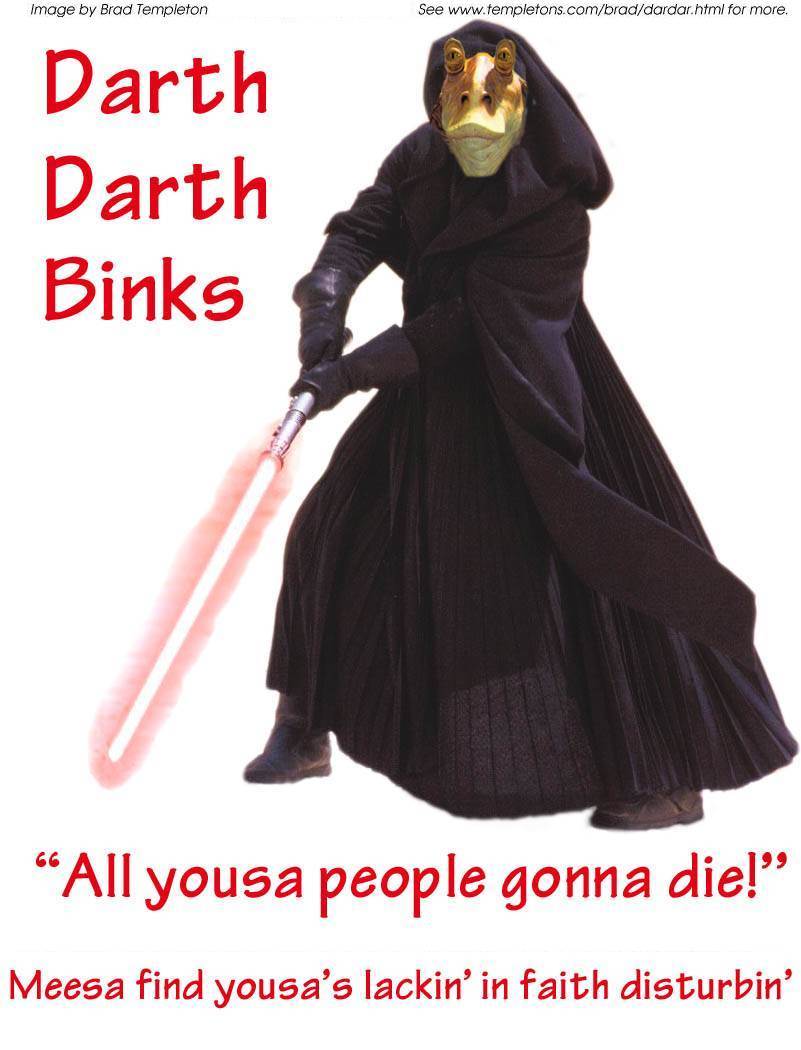
An anonymous reader noted an amusing story where we learn that Jar Jar will make space fun for children with attention spans destoryed by MTV, and senses of humor rendered disfunctional by years of Sitcoms. It might be better if it was hosted by Darth Darth Binks (thanks SissyLaLa) Point_Blank Sent us a really interesting site that has a history of GUIs. Its just interesting to watch the evolution of those clicky interfaces that we've been using for so long. John Hebert noted that there are New Dune Novels coming out. Tim Macinta sent us a super hilarious Microsoft Advocacy HOWTO. Worth the read. $Bob was the first to tell us that the new obfuscated Perl challange is up (no I'm not entering Slash ;) Bowie J. Poag has concocted an epic poem known asTuxowolf: ..A retelling of the classic Beowulf legend in more familliar prose. Gorak sent us a great 3D image gallery at Mastering 3D Graphics that is laden with bit streams that fulfil Rob's Art Axiom (Art is better when it is a desktop image) And finally, the most disturbing bit was sent by an anonymous reader. Ever want to augment your cats the hi tech way. Check it out. Update: 07/29 12:05 by CT : Shaheen reminded me that I'm going to be on The Wednesday Night Wireside net radio thingee tonight at 9:30 EDT. -
NYT Magazine Says No Network Is Secure
bw writes "The NYTimes magazine explains why there is no such thing as a secure network. Along the way, it compares the attacks of script kiddies to a million monkeys firing catapults at random -- some attacks are bound to succeed. Also, Eugene Spafford thinks that after Y2K suits dwindle away, hungry lawyers will start looking at how the promiscuous connectivity of modern office apps can have dangerous side effects (think Melissa with a payload). " A truly excellent article! It's quite long, but worth the reading time, and if you don't have a (free) NYT login yet, this is the time to get it. -
Less Television in Online Homes
Shaheen writes "USA Today has an interesting report about how homes that have an Internet connection watch an average of %13 (about an hour) less television than other homes each day. You can read about it here. " What about those of us who forget to turn the TV off while we read our email? The scariest thing to me is that 13% is an hour. Who is watching 10 hours of TV a day? -
Gary Kasparov vs. The World
Shaheen writes "Gary Kasparov (world's greatest chess player) is once again doing something to mix technology with Chess. This time it's him against anyone and everyone. Basically, Kasparov makes a move, then the world - along with "expert" advice - votes which move to make. You can sign up here. " Interesting, but could chess be where some of Brooks's theories apply? Could throwing more people at the problem hurt instead of being beneficial? -
Apple Sale Rumors
-
Linux a "temporary phenomenon"
scenic writes "A Washington "Think Tank" has a report complaining about the new "Assessing Microsoft" conference. In particular, they have an issue with the OSS remedy that many, including Nader and Love, have proposed (i.e. opening up the Windows source code). There is quite a bit of stuff concerning Linux (about a quarter of the long article) and why OSS and Linux are temporary phenomenons created by "media interest in identifying a viable competitor to Microsoft." " -
Full Quickie Disclosure
Gveloper wrote in to say that x11amp is in CVS. An anonymous reader sent us a link to a Linux based synthesiser. I probably wouldn't have posted it, but I was playing with it quite a bit and its just a lot of fun. Make little drum beats and throw power chords over top of it. Whee. AbsurdSnore wrote in to tell us about a Slashdot mentioned in New Scientist's Netropolitan column for February 6th regarding the fight for ajax.org and the creation of the Domain Defense Advocate site. Anyone who thinks that the world is coming to an end is probably right as evidenced by the following three inventions: A nonymous Coward sent us the first. Pray that it is a hoax. fcw sent us number 2: the world's first (and I hope only) Ass Kicking Machine. And last of all, for the completely random, David Price sent us a link to gas powered couch Don't care about the advancement of technology? How about some bits about a a more primal topic? Knish wrote in to say that the Swimsuit Edition of Sports Illulstrated is online. Somewhat related I guess, Greedo sent us another Pseudo O'Reilly Book that you won't see in bookstores. -
Fun With Spam
I had a few minutes and felt like writing something completely off the wall. So if you so desire, you can hit the link below and read "Rob's Ultimate Solution for Eliminating Spam". It's purely a joke, so don't take it too seriously. The following was written by Rob "CmdrTaco" Malda. It's based on a conversation I had with some friends a long time ago, and a recent email from Rob Ludwick.WARNING:The Following is a Joke. Do NOT DO THIS! It is merely meant to be funny. Massive Disclaimers, Read at your own risk, I will not be held responsible yada yada yada. Now that we have that out of the way...
Rob's Ultimate Solution for Eliminating SpamI got spam again this morning. That isn't uncommon actually, but it is still annoying. My email address is in InterNIC somewhere, I occasionally post to Usenet. Slashdot seems to be pretty popular these days, and my email address is pretty much conventional wisdom, not to mention whenever I post a comment, my address is attached to that. Basically, there are a dozen ways any email address harvesting software could get my name, and all of them have.
So I get spam. Just a few a day. Most of them are ok- some idiotic company sends me spam asking me to by their spamming software. Yeah, that'll work. At least I'm not like Kurt. Kurt posted once to a news server in microsoft.com and now he gets spam for warez CDs and mail order brides. But the worst ones are the ones that start out "RE:Yesterday Afternoon" or something. A completely random subject designed to look like real mail. I get hundreds of emails a day, those things fool me. And each time it wastes maybe 10 seconds of my life. Maybe I get 3 spams a day. times 365 days a year. I'm not good at math, but I can figure this one out: 3 Spam * 10 seconds * 365 days / 60 minutes an hour, that's 18 hours. If I made, say $10 an hour, that means that spam costs me $180 a year in wasted time. Heck, if I was actually paid good money, spam would waste even more!
And this doesn't even begin to show the problem multiplied by millions of people. Every router on the net shovels this garbage through wasting everybodys time. It wastes everybodys bandwidth. It costs zillions of dollars.
Now I accept that Spam is part of the Internet. And I accept that until some sort of email micropayment system exists, Spam will continue to represent one out of every hundred emails I receive. I personally believe that it's the right of the spammer to send spam. (Please don't argue with me about this here or now- that isn't the point of this story)
But sometimes these monsters don't include a reply email address:That should be punishable by death.
So I think to myself that what these guys are doing is effectively mail fraud. And that makes me angry. And not providing a return address is definately on the same level of evil as Genocide, Rape, Murder, Kicking Puppies etc So what will I do about it?
I suddenly realize that I run a website. It's fairly popular. We probably have 25,000 people here on a day when the routers aren't overloaded from routing all that spam. And these people have modems. And this obnoxious spam includes a phone number.
So now I'm sure the solution is as obvious to you as it is to me. I post the phone number. Short term, everyone could call once a day. If we can get 1,440 people to each dial once a day (and since many of these things have 800 numbers, the spammer will have to pay for it), well that means every 60 seconds, they would have another phone call to deal with. Sure, it would just be modem static. They would have no choice but to change their phone number.
Software could make the process very efficient. Any time you get spam with an improper header, you could send it to a server (forward it to ihatespam@spamhaters.com). The server tracks all the 800 numbers, and everyone runs a special client. Once a day each client asks the server what number it should call.
It just seems that if spammers can waste our time, the least we can do is waste theirs in return.
WARNING:Please Please Please don't do this. At least not here... *smile*
-
Feature:A Square Deal
Matthew Newhall has written an interesting piece on commercial vs. GPLd programming, and OS development. His solution is a free software advocacy commercial license. Will it work? Read and decide for yourself. The following is a feature by Slashdot Reader Matthew Newhall A Square deal for the Linux OS and for developers. A solution for the person in the middle, the Free Advocacy Commercial Licence. by Matthew NewhallThe thought process...
I recently wrote a response on Slashdot to Richard M. Stallman's June 13th on-line interview. I started thinking about a better way to encourage developers to take on monster projects. Like any programmer I know recycling code is quicker and easier. So here is the response.
Actually I find it quite humorous that Bill G and RMS are telling their points of view on the same Slashdot page. They have one very similar vital quality, they are about as flexible as an I-beam. They really don't sound all that different. I wonder what they would do to each other in an open discussion?
The insane completeness to their points of view have driven their dreams into reality. Now it is up to us, the middle people, to find a middle ground.
Here is the balance....
-
Organizers, developers, and distributors get rewarded financially for useful and quality OS components.
and
Users get freedom of choice, low or no price tags for OS components, no company controls the OS, perpetuating and enhancing innovation.
Notice I said OS not software. Software is a different discussion. OS control is about freedom of choice. Applications other than the OS can easily be replaced. Free or not.
If we can find a system in which these conditions are met, Linux will have 50% of the market in no time. I say 50% of computer users because the othe r half will avoid the extra choices available in Linux for sometime. That will change as they grow to better understand computers. That is fine, Microsoft can have those users. They will have an option to go to when they need it.
The two most frequent arguments I hear from each side are...
- "Everything should be free because:
-
- We can make money supporting it and professionally manipulating and adding to it."
- If it is so complicated that you need to be a professional to use it, people will look for other options, for all but the most advanced situations. That doesn't sound like world domination to me.
- Having one central control avoids redundant work. This allows for quicker creation of new software and hardware. No confusion, no chaos. When somthing g oes wrong blame is easily placed."
- Absolute power corrupts absolutely. Any company or group of companies in control will fleece the customers for a better profit margin. Projects will drag on, blame will tossed around or customers ignored altogether. If IBM had not hired Bill Gates to buy MSDOS, then IBM would be the big bad guy right now.
As a programer I want to eat, have a roof over my head and a car in my driveway. I don't want to have to work on a customer support line or flip burgers to do it.
As a programmer and as a user I never want see a Blue Screen of Death again. I never want to buy a Microsoft operating system again.
I want Linux to succeed. Microsoft is way too powerful. Without Linux to stop it, well who knows what could happen.
Let companies make money on their good ideas and turn their profits around towards more ideas. But don't let them take control. Keep the Freedom in Linux. Lets make Linux huge.
I had four responses to my letter. Putting them all in would make this proposal too long. Yury Onischuck had said:
- " 1. Sometimes there is no middle
-
2. What flexibility You are talking about whenthe question is whether to have freedom or not to have
3. Read http://www.gnu.org/philosophy/stallman-kth.html before your reply, please."
Well first I read the above mentioned article. It is an incredible argument for free software. It shows how open source code can make a far superior piece of software while avoiding redundant work. In fact the GPL is the most important part of my idea. Yury Onischuck's initial two points rung very true. What are the choices for a programmer in OS development right now?
0. Work for Microsoft.1. Work on Linux GPL or LGPL code for free.
Greg Block responded to Yury Onischuck buy pointing out that there are infinite points between 1 and 0. But in this is not the case when it comes to free OS components. I have a proposal for a .5 between the 1 and 0. Unfortunately I am not a lawyer so I can't imagine any sane company will use this as I wrote it. (That's a cry for help.) I present, in it's raw form the....
Free Advocacy Commercial Licence
The Proposal...Let's say there is a company Widgetcorp. Widgetcorp is developing an awesome voice recognition package. Widgetcorp wants to release for Linux when its time, but the programmers are getting hungry and cranky. The bills are starting to come in. It's basically a start-up and has a very little money. The voice recognition package is very resource hungry, and needs to interact directly with the kernel and other OS components. The need to be part of the OS occurred in many places and was unavoidable. Widgetcorp is about to give up and go to Microsoft when, blamo, one of the programmers that works at WidgetCorp notices the Free Advocacy Commercial Licence. The FACL allows them to make a profit, use the open source model, and produce quality OS offerings and inventions to help the free software effort.
This is the general idea in non-legal terms- 1. The software is free at all stages for non-commercial use. Anyone is free to modify and distribute at pre x.0 stages of development but not sell. Source is available at all stages. There is a time limit decided upon by the company before any bug fixes or additions are accepted.
-
- example:
-
- a. Widgetcorp uses this to put out their alpha's and beta's for testing, suggestio nsetc. They have to have a 1.0 out in one and a half years from a given date. Users get early use of the program and get to put the ir ideas in.
2. Commercial users can make deals and offers for post x.0 commercial licences. They could even make pre x.0 if that's how they want to work it, so long as it was layed out in the initial proposal. Again, the program is freely distributable, so long as you don't sell it or use it's code for your own profit.
- examples:
-
- a. When the company decides to go 1.0 Redhat decides that Widgetcorps voice recognition package is great and will up distribution sales. It cuts a deal to pay fifteen cents for every copy of Redhat 6.x sold.
-
b. Caldera also recognizes the merit to this package and cuts a deal. Seventy thousand dollars up front and eleven cents per distribution.
c. Widgetcorp gets requests outside of distributions. They make a shrink-wrapped version. They sell it mail order for twenty dollars per licenced copy.
3. Two limits on are set at the beginning of the project. The FACL would be limited by number of copies sold since x.0 and a number of months after the release of x.0. When either of these limits are met the sunset clause is activated. The sunset clause converts the working code to GPL and LGPL for libraries at the end of that week. Widgetcorp. takes a snapshot with of the code with revisions right before it goes GPL. It will fork from the GPL code and can be used in future projects under the FACL. The FACL copy of the code belongs to Widgetcorp.
- examples:
-
- a. Widgetcorp decides that it would make everyone happy, and pay the bills, and make a reasonable profit if they set limits of nine hundred thousand copies or 7 and a half months.
-
b. Widgetcorp can use the code from 1.x to work on voice recognition 2.x and voice synthesis 1.x. They know if they get power hungry and try to control the market through anything but a superior product, the free software advocates will pick up where they left at the last GPLed copy.
c. Widgetcorp's minor revisions continue past x.0 during the profit period because of the promise of profit on the next major revision. Any contracts with the distributions should reinforce this.
There are a few catches. We as a community have to examine every contract very closely before we accept it. Here's some things to watch.1. The sunset clause. The sunset clause will be drawn up at the time of creation. It should some basic conditions met. There needs to a limit to developing time before x.0. There needs to be a basic outline of features, methods, and what standards will be adhered to or created. There needs to be a reasonably short amount of time past x.0 when the profit period is over, say no more than a year for huge projects.& nbsp; There needs to be a reasonable limit on the amount copies sold before it forks to GPL.
2. Big companies. The bigger the company the better the bargaining&nbs p; position. Companies that did not grow out of the free software community will try to change the rules. This will be partly done because of the realization that even though I'm pretty sure you could make millions doing this, you won't be able to make billions. Some companies have billion dollar infrastructures to support. It is logical to them to expand, not shrink.
3. The distributions have to play ball. If you are considering trying this, the first thing you might want to do is see if you have any takers from the distributors. Will people be interested in you project?&n bsp; Will it be big enough to justify paying anything for it, or can a bunch of weekend warriors duplicate it in a few weeks? If no distributions want it you may find yourself not being able to sell enough shrink-wrapped copies to make cost. Then again who says you can't make your own distribution. ;)
I thought about the whole GNOME vs. KDE situation. My main complaint and I think the main concern of most people are the commercial components in KDE. I am afraid the people at TROLL TECH who are responsib le for QT might use those components to pull the rug out once they have control. This is not a personal blow to the people in charge over there. I'm scared of a change in ownership, not the current ownership. It would mean using time and energy to replace my KDE compliant programs. If KDE had used components with a simi lar licence to the FACL I would not hesitate to use their interface.
GNOME is a combination of charity and self-interest on Red Hat's part. We can't always count on distributions to come up with WYSIWYG or non technician oriented answers for the world. Distributions may come to a point where they are too competitive to be able to spare the resources on side projects.
This would be great for Linux. It would give free software advocates the opportunity to do what they love, full time. The chance to innovate OS components for OS's like Linux and get paid for it. Not only will the technician benefit but so will the user. If there were 10 such programs on the next distribution you pick up it would only cost one dollar and fifty cents more according to Widgetcorp's figures. I'll pay that price for a larger GPLand LGPL code base! I think this could be the vehicle with which to outpace duplication and enhancment ; and be the leader in substance, interface, and useability. In a few generations of distributions, Linux would have at least 50% of the market. ; Linux would be superior to other operating systems, in all aspects, by at least a mile.
I'm sure there are plenty of good and bad angles and ideas I have missed in here. The general concept of the FACL is the inteligent use of a sunset clause and the GPL. Pay the most attention to the idea and the idea will grow. I want to hear your opinion, but please let constructive criticism reign.
Don't be afraid to change the rules!
-
-
Feature:A Square Deal
Matthew Newhall has written an interesting piece on commercial vs. GPLd programming, and OS development. His solution is a free software advocacy commercial license. Will it work? Read and decide for yourself. The following is a feature by Slashdot Reader Matthew Newhall A Square deal for the Linux OS and for developers. A solution for the person in the middle, the Free Advocacy Commercial Licence. by Matthew NewhallThe thought process...
I recently wrote a response on Slashdot to Richard M. Stallman's June 13th on-line interview. I started thinking about a better way to encourage developers to take on monster projects. Like any programmer I know recycling code is quicker and easier. So here is the response.
Actually I find it quite humorous that Bill G and RMS are telling their points of view on the same Slashdot page. They have one very similar vital quality, they are about as flexible as an I-beam. They really don't sound all that different. I wonder what they would do to each other in an open discussion?
The insane completeness to their points of view have driven their dreams into reality. Now it is up to us, the middle people, to find a middle ground.
Here is the balance....
-
Organizers, developers, and distributors get rewarded financially for useful and quality OS components.
and
Users get freedom of choice, low or no price tags for OS components, no company controls the OS, perpetuating and enhancing innovation.
Notice I said OS not software. Software is a different discussion. OS control is about freedom of choice. Applications other than the OS can easily be replaced. Free or not.
If we can find a system in which these conditions are met, Linux will have 50% of the market in no time. I say 50% of computer users because the othe r half will avoid the extra choices available in Linux for sometime. That will change as they grow to better understand computers. That is fine, Microsoft can have those users. They will have an option to go to when they need it.
The two most frequent arguments I hear from each side are...
- "Everything should be free because:
-
- We can make money supporting it and professionally manipulating and adding to it."
- If it is so complicated that you need to be a professional to use it, people will look for other options, for all but the most advanced situations. That doesn't sound like world domination to me.
- Having one central control avoids redundant work. This allows for quicker creation of new software and hardware. No confusion, no chaos. When somthing g oes wrong blame is easily placed."
- Absolute power corrupts absolutely. Any company or group of companies in control will fleece the customers for a better profit margin. Projects will drag on, blame will tossed around or customers ignored altogether. If IBM had not hired Bill Gates to buy MSDOS, then IBM would be the big bad guy right now.
As a programer I want to eat, have a roof over my head and a car in my driveway. I don't want to have to work on a customer support line or flip burgers to do it.
As a programmer and as a user I never want see a Blue Screen of Death again. I never want to buy a Microsoft operating system again.
I want Linux to succeed. Microsoft is way too powerful. Without Linux to stop it, well who knows what could happen.
Let companies make money on their good ideas and turn their profits around towards more ideas. But don't let them take control. Keep the Freedom in Linux. Lets make Linux huge.
I had four responses to my letter. Putting them all in would make this proposal too long. Yury Onischuck had said:
- " 1. Sometimes there is no middle
-
2. What flexibility You are talking about whenthe question is whether to have freedom or not to have
3. Read http://www.gnu.org/philosophy/stallman-kth.html before your reply, please."
Well first I read the above mentioned article. It is an incredible argument for free software. It shows how open source code can make a far superior piece of software while avoiding redundant work. In fact the GPL is the most important part of my idea. Yury Onischuck's initial two points rung very true. What are the choices for a programmer in OS development right now?
0. Work for Microsoft.1. Work on Linux GPL or LGPL code for free.
Greg Block responded to Yury Onischuck buy pointing out that there are infinite points between 1 and 0. But in this is not the case when it comes to free OS components. I have a proposal for a .5 between the 1 and 0. Unfortunately I am not a lawyer so I can't imagine any sane company will use this as I wrote it. (That's a cry for help.) I present, in it's raw form the....
Free Advocacy Commercial Licence
The Proposal...Let's say there is a company Widgetcorp. Widgetcorp is developing an awesome voice recognition package. Widgetcorp wants to release for Linux when its time, but the programmers are getting hungry and cranky. The bills are starting to come in. It's basically a start-up and has a very little money. The voice recognition package is very resource hungry, and needs to interact directly with the kernel and other OS components. The need to be part of the OS occurred in many places and was unavoidable. Widgetcorp is about to give up and go to Microsoft when, blamo, one of the programmers that works at WidgetCorp notices the Free Advocacy Commercial Licence. The FACL allows them to make a profit, use the open source model, and produce quality OS offerings and inventions to help the free software effort.
This is the general idea in non-legal terms- 1. The software is free at all stages for non-commercial use. Anyone is free to modify and distribute at pre x.0 stages of development but not sell. Source is available at all stages. There is a time limit decided upon by the company before any bug fixes or additions are accepted.
-
- example:
-
- a. Widgetcorp uses this to put out their alpha's and beta's for testing, suggestio nsetc. They have to have a 1.0 out in one and a half years from a given date. Users get early use of the program and get to put the ir ideas in.
2. Commercial users can make deals and offers for post x.0 commercial licences. They could even make pre x.0 if that's how they want to work it, so long as it was layed out in the initial proposal. Again, the program is freely distributable, so long as you don't sell it or use it's code for your own profit.
- examples:
-
- a. When the company decides to go 1.0 Redhat decides that Widgetcorps voice recognition package is great and will up distribution sales. It cuts a deal to pay fifteen cents for every copy of Redhat 6.x sold.
-
b. Caldera also recognizes the merit to this package and cuts a deal. Seventy thousand dollars up front and eleven cents per distribution.
c. Widgetcorp gets requests outside of distributions. They make a shrink-wrapped version. They sell it mail order for twenty dollars per licenced copy.
3. Two limits on are set at the beginning of the project. The FACL would be limited by number of copies sold since x.0 and a number of months after the release of x.0. When either of these limits are met the sunset clause is activated. The sunset clause converts the working code to GPL and LGPL for libraries at the end of that week. Widgetcorp. takes a snapshot with of the code with revisions right before it goes GPL. It will fork from the GPL code and can be used in future projects under the FACL. The FACL copy of the code belongs to Widgetcorp.
- examples:
-
- a. Widgetcorp decides that it would make everyone happy, and pay the bills, and make a reasonable profit if they set limits of nine hundred thousand copies or 7 and a half months.
-
b. Widgetcorp can use the code from 1.x to work on voice recognition 2.x and voice synthesis 1.x. They know if they get power hungry and try to control the market through anything but a superior product, the free software advocates will pick up where they left at the last GPLed copy.
c. Widgetcorp's minor revisions continue past x.0 during the profit period because of the promise of profit on the next major revision. Any contracts with the distributions should reinforce this.
There are a few catches. We as a community have to examine every contract very closely before we accept it. Here's some things to watch.1. The sunset clause. The sunset clause will be drawn up at the time of creation. It should some basic conditions met. There needs to a limit to developing time before x.0. There needs to be a basic outline of features, methods, and what standards will be adhered to or created. There needs to be a reasonably short amount of time past x.0 when the profit period is over, say no more than a year for huge projects.& nbsp; There needs to be a reasonable limit on the amount copies sold before it forks to GPL.
2. Big companies. The bigger the company the better the bargaining&nbs p; position. Companies that did not grow out of the free software community will try to change the rules. This will be partly done because of the realization that even though I'm pretty sure you could make millions doing this, you won't be able to make billions. Some companies have billion dollar infrastructures to support. It is logical to them to expand, not shrink.
3. The distributions have to play ball. If you are considering trying this, the first thing you might want to do is see if you have any takers from the distributors. Will people be interested in you project?&n bsp; Will it be big enough to justify paying anything for it, or can a bunch of weekend warriors duplicate it in a few weeks? If no distributions want it you may find yourself not being able to sell enough shrink-wrapped copies to make cost. Then again who says you can't make your own distribution. ;)
I thought about the whole GNOME vs. KDE situation. My main complaint and I think the main concern of most people are the commercial components in KDE. I am afraid the people at TROLL TECH who are responsib le for QT might use those components to pull the rug out once they have control. This is not a personal blow to the people in charge over there. I'm scared of a change in ownership, not the current ownership. It would mean using time and energy to replace my KDE compliant programs. If KDE had used components with a simi lar licence to the FACL I would not hesitate to use their interface.
GNOME is a combination of charity and self-interest on Red Hat's part. We can't always count on distributions to come up with WYSIWYG or non technician oriented answers for the world. Distributions may come to a point where they are too competitive to be able to spare the resources on side projects.
This would be great for Linux. It would give free software advocates the opportunity to do what they love, full time. The chance to innovate OS components for OS's like Linux and get paid for it. Not only will the technician benefit but so will the user. If there were 10 such programs on the next distribution you pick up it would only cost one dollar and fifty cents more according to Widgetcorp's figures. I'll pay that price for a larger GPLand LGPL code base! I think this could be the vehicle with which to outpace duplication and enhancment ; and be the leader in substance, interface, and useability. In a few generations of distributions, Linux would have at least 50% of the market. ; Linux would be superior to other operating systems, in all aspects, by at least a mile.
I'm sure there are plenty of good and bad angles and ideas I have missed in here. The general concept of the FACL is the inteligent use of a sunset clause and the GPL. Pay the most attention to the idea and the idea will grow. I want to hear your opinion, but please let constructive criticism reign.
Don't be afraid to change the rules!
-
-
Corel and Alpha
Ari Haviv sent us this story where you can read that Corel has made a bundling deal on its suite for Alpha/NT systems. Sure, it's NT, but its not x86.. -
Corel + Voice Recognition
Ari haviv wrote in to send us this story where you can read that Corel and Lotus are both integration Voice Recognition into their office suites. This is one VR that might actually be feasible in the next few years. I can type at about the same rate as I can talk, but this would definately save everyone a lot of repetitive stress if it becomes standard. And reliable (that's a big If though) -
Pixel Uses More of your Monitor
Scott Francis sent us a link to an article this Seattle Times Article where you can read about a company called Pixel, who apparently has some clever patent pending (grr) software that allows them to shrink the desktop, and put icon bars and stuff around the edges. I'm curious to see if it really works. Currently it is a win95 only technology, but if this really works, it could certainly be put to good use somewhere. arielb also sent us a similiar article from wired. And the MySpace Homepage claims that Mac and Unix versions are coming.