Slashdot Mirror
Domain: benbest.com
Stories and comments across the archive that link to benbest.com.
Comments · 29
-
Re: Slashvertisement
It could just as well be proof of their stupidity.
Hold on there, now you're saying they're stupid, instead of saying they're scammers. Is it possible that you simply don't like the concept and are making up reasons that support your feeling?
To directly address your concerns, I'm reading through the extended FAQs.[1]
First off, I have to admit that what I thought I read was Cryonics Institute being based where they are due to low geological risk. However, it seems I read that about Alcor Life Extension Foundation, which is the other non-profit Cryonics preservation service in the US. They detailed their location decision here: [2] Summarizing, it's because of very low risk of natural disaster, availability of major airport facilities, favorable weather (no winter blockages), and low crime. See the link for extended information.
Doing some quick research, it seems that in terms of seismic activity, Michigan is even safer than Arizona.[3,4] You mention geological stability is your territory, so I'll defer to your opinion on that.Why not the North of Canada or the center of Australia?
I would think the main reasons are: The North of Canada is hard to get to, and frequently inaccessible, which is a problem when time is of the essence. Australia is not populated enough: People from the USA would find it hard to get to, and there may not be enough people in Australia to warrant a Cryonics center there. Australia's laws might also create a hurdle, although I'm not too familiar with that.
As a final note, I'd suggest interested people have a look around through the public information. All financials are public,[5] the cryopreservation methods used are well detailed,[6] and for every person cryopreserved there is a case report available, detailing both the things that went well and the things that need improvement.[7]
Cryonics is a thing. The people involved are intelligent, and are working to give the preserved patients the best chance they can at a future. Cryopreservation seems odd at first glance, raising a lot of concerns that need to be addressed. Luckily, these have indeed been addressed. Have a google through the information available, and perhaps you'll find your view shifting!
[1]
Cryonics: A basic introduction
Cryonics: A basic introduction (Continued)
Cryonics: A basic introduction (Continued 2)
Cryonics: Why don't we?
Cryonics Frequently Asked Questions (FAQ)
[2] Why Scottsdale?
[3] Arizona Seismic Hazard Map
[4] Michigan Seismic Hazard Map
[5] Cryonics Institute Financial Statements
[6] Outline of CI Cryopreservation procedures
[7] The Cryonic Institute's 110th Patient -
Re: Slashvertisement
It could just as well be proof of their stupidity.
Hold on there, now you're saying they're stupid, instead of saying they're scammers. Is it possible that you simply don't like the concept and are making up reasons that support your feeling?
To directly address your concerns, I'm reading through the extended FAQs.[1]
First off, I have to admit that what I thought I read was Cryonics Institute being based where they are due to low geological risk. However, it seems I read that about Alcor Life Extension Foundation, which is the other non-profit Cryonics preservation service in the US. They detailed their location decision here: [2]
Summarizing, it's because of very low risk of natural disaster, availability of major airport facilities, favorable weather (no winter blockages), and low crime. See the link for extended information.Doing some quick research, it seems that in terms of seismic activity, Michigan is even safer than Arizona.[3,4] You mention geological stability is your territory, so I'll defer to your opinion on that.
Why not the North of Canada or the center of Australia?
I would think the main reasons are: The North of Canada is hard to get to, and frequently inaccessible, which is a problem when time is of the essence. Australia is not populated enough: People from the USA would find it hard to get to, and there may not be enough people in Australia to warrant a Cryonics center there. Australia's laws might also create a hurdle, although I'm not too familiar with that.
As a final note, I'd suggest interested people have a look around through the public information. All financials are public,[5] the cryopreservation methods used are well detailed,[6] and for every person cryopreserved there is a case report available, detailing both the things that went well and the things that need improvement.[7]
Cryonics is a thing. The people involved are intelligent, and are working to give the preserved patients the best chance they can at a future. Cryopreservation seems odd at first glance, raising a lot of concerns that need to be addressed. Luckily, these have indeed been addressed. Have a google through the information available, and perhaps you'll find your view shifting!
[1]
Cryonics: A basic introduction
Cryonics: A basic introduction (Continued)
Cryonics: A basic introduction (Continued 2)
Cryonics: Why don't we?
Cryonics Frequently Asked Questions (FAQ)[2] Why Scottsdale?
[3] Arizona Seismic Hazard Map
[4] Michigan Seismic Hazard Map
[5] Cryonics Institute Financial Statements
[6] Outline of CI Cryopreservation procedures
[7] The Cryonic Institute's 110th Patient -
Re:security though obscurity
it's not possible (it'd be like trying to have fully manual antilock brakes, with individual wheelspeed sensing and control, at the driver's feet).
Heavy equipment has had this for decades. Individual brake pedals for left and right sides, and a little slider so you can lock them together if you don't want to "play the brake pedals".
Also, heart failure was far and away from being the major cause of death for most of humanity's existence. Disease, exposure to the elements, starvation, war, accidents
Or how about these snapshots:Murder being the #1 cause of death for pregnant women in Maryland, and the #2 cause nationally, behind accidents, or the #2 cause of death for infants/a
-
Re:wow
It's called the duplicates paradox or sometimes the transporter paradox. If you get duplicated and then the original is destroyed, there isn't a continuity of consciousness. You seem to have completely missed this in order to make your point about biological renewal.
-
Re:Cryogenics?
> Could this discovery be developed to make cryogenically preserving people work?
No, but it is another step in that direction.
> As it is right now, the cells rupture during the freezing process
This isn't completely correct. The current state of the art causes significant dehydration of cells, and very few of them actually rupture during freezing. With vitrification, this damage is reduced even further as tissues become super-viscuous (like glass) instead of freezing.
The $64,000 problem with working cryopreservation today is Cryoprotectant toxicity. The chemicals that make it feasible to vitrify tissue are toxic at high temperatures.
Interesting reading on this topic (not linkspam.
http://www.21cm.com/
http://benbest.com/cryonics/cryonics.html -
Re:we're doomed anyway
from here: http://www.benbest.com/science/standard.html "A free neutron (a neutron not in an atomic nucleus) has a mean lifetime of about 15 minutes, typically decaying into a proton, an electron and an electron antineutrino"
The 10^49 years accounts for the time it takes for all the stars in all the Universe to reach whichever final state they are destined for, based upon their size, and then go through neutron decay. I got this from an essay done in the 60's by physicist whose name I cannot recall right now, from the book "The World Treasury of Physics, Astronomy, and Mathematics" -
Re:"andnothingofvaluewaslost" tag
I am not sure that idea about Amber was that bad
He had to provide explanation somehow, or else it would be like magic. Remember that a lot of people (non-scientists) at that time did not even know that DNA represented almost all the information about the species. If you said you created a dinosaur they'd simply ask where you got Dino eggs from.
I read the Jurassic park and it was presented very very cleverly. It is a slighlty older idea that was in discussion during the time of publication that he extended.
You have to remember that this was well before animal DNA had even been sequenced.
His speculation about SIDS being blamed for unexplained child deaths and about diet of Dinosaurs were pretty much on target too.
Now I really disliked his later books (Airframe, State of Fear), but Jurassic park was a pretty interesting book - and if nothing else should receive credit for making children interested in Dinosaurs and Geology.
Offtopic - BTW your sig is just encouragement for all women readers to mod you down. You probably should have an AND condition in there somewhere. -
It is profoundly mysterious
Starting with the hypothesis that consciousness is purely a physical thing (i.e. the atoms and electric signals firing in your brain, and there is no soul or wonky business like that)--a hypothesis that I happen to agree with. It is a *profoundly* mysterious question if it would, in fact, be the same "you" inside if your brain were switched off for a while and then turned back on. Suppose in the time you were shut off, it were possible to make an exact copy of yourself, down to the atomic level, and then both copies were turned back on. Which one is "you"? Obviously both of you would think you were the original since you share the exact same memories.
It's one of those questions that seem unanswerable. Personally I feel it has something to do with the continuity of brain activity. You interrupt that, and whatever that "spark" is ceases to be, and if the brain is turned back on, it would be a different "you". Which is why I'd never take a transporter ride and think actual working cryonics would be pointless since I would never experience waking back up, it would be a different consciousness, albeit one that thinks everything went just fine. If ever underwent either, I would assume the "me" that woke back up would have some lingering doubts.
One of the many philosophical papers on this: http://www.benbest.com/philo/doubles.html -
Re:Until you consider Patents and other G. Monopol
-
Re:It's standard progression.
The world is no scarier than it ever was, if anything it's less scary. Look at this list of causes of death. Nowhere on there do I see rampaging hordes of terrorists. Most deaths are due to genetic predispositions to disease or stupidity. In previous centuries you might have seen "executions by a mad king" or "crushed to death while building a pyramid". In foreign countries today, "starvation" or "collateral damage" would be high on the list. Americans are some of the safest people in history.
Consider that during the cold war, your enemy had nuclear weapons and threatened to use them! More than once! Consider that during the second world war western democracies were under attack, not by some rogue bands of extremists, but by large industrial states with real armies and the resources to potentially conquer the world. The entire world could fall under a fascist regime. Now that's a threat!
Of course, during all of this people talked about curtailing freedom of speech, and they actually rounded up a bunch of Japanese americans and put them in camps. Most people (paradoxically) think this was wrong, but what the US government is doing with Guantanemo is far worse. They have already passed a law that will allow the president to throw people into a black hole with no judicial process or review. And those people can be tortured, because the president and the military get to decide what torture is. This is far worse than anything America has done going back to Lincoln, who suspended habeas corpus (it has since been eliminated!) when the confederate army was at his doorstep. Lincoln may have been justified, but Bush is not. There is nowhere near the threat to the United States today. If anything, the biggest threat is the United States government itself, and the people who are so disinterested in politics that they have allowed a tyrant to rule them. -
The fire problem
The thing that burns in a house fire is the contents. It doesn't really matter if the house is fireproof or not, the contents will burn just as well. If the occupants aren't prepared, they will die just as well in a fireproof house. In urban areas, most house fires don't result in irreperable damage to the structure.
Most municipalities have laws that require smoke detectors in every dwelling. It is also standard to require construction that prevents a burning house from igniting its neighbor. The result is that death by housefire is far behind death by traffic accident. http://www.benbest.com/lifeext/causes.html
As far as being permanent, wooden structures last forever, as long as they are kept dry. Check out the thousand year old timber churches in Scandanavia.
The odor problem comes about because we permit all kinds of nasty things in our building materials and consumer products. Carpets and particle board are major offenders. Maybe what you're smelling is formaldyhide. -
This overstates the risk from terrorism
There are several problems with your analysis.
- The total number of victims is used, without regard to whether these are civilian or military deaths. Soldiers operating against terrorists are at much higher risk than the general population
- It also includes "members of paramilitary groups" - broadly speaking, 2 different gangs of terrorists (though of course each group would claim that only the other group were terrorists), some of whom were killed while conducting terrorist attacks
So I think that the number of "civilians" killed (excluding the above groups) is more relevant. This number is given in Wikipedia as 1857. Giving a chance of about 0.006% of being killed by terrorism in a lifetime.
For comparison with chances of dying from a range of other causes, see here. For example, an American has about a 1.3% chance of dying by suicide.
If it's a choice between giving up civil liberties to the government, and putting up with a risk of dying because of some terrorist attack, I'll take the risk of being killed by terrorists, thanks.
-
Re:Leopard spots, snail shells, and Leonardo of Pi
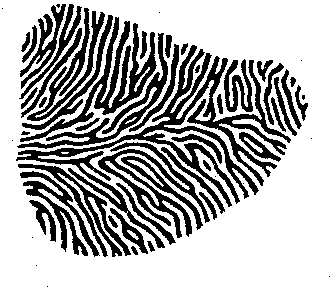
The BBC had an article on how lead atoms could self organise into patterns
Similar patterns are found in the striate cortex in the visual part of the brain.
Interactive examples include reaction-diffusion equation applets
My favourite is quasi-crystalline patterns. They aren't periodic like squares, hexagons or triangles, but do have symmetry. -
Re:Mathematically, it does not work.
I'm pretty sure the most common reason people kill each other (or themselves, or a combination) is somebody drunk being behind the wheel of a car.
If you want to talk about murder instead of "accidental" causes, something like 40% of murders are due to arguments, often between family members or relatives or friends, murders commissioned in relation with another felony crime (theft, rape, etc) are about 25% of the total, and murders related to narcotics being around 8%. Lots of data here:
http://www.benbest.com/lifeext/murder.html -
Re:Terrorist threat is minimal
Just to help you out a little, take a look at the stats.
Unintentional injuries caused 4.4% of deaths in 2002; accidents caused 12752 deaths among 15-24 yr olds alone in fact.
Terrorists didn't win on Sep 11, they won when the PATRIOT act was introduced.
What did we as a society so despise about the "commies" during the cold war? Their repression of freedoms? How about the Taliban? How they restricted freedoms? What exactly are americans standing up for by allowing massive government suppression of their freedoms? -
Re:Christmas GiftInterestingly, at points Christmas was banned as being part of the Protestant Reformation's rejection of the Roman Church's traditions:
- English Puritanism was probably the most extreme manifestation of the Protestant reaction against the Roman Church. Exodus 20:4 could be taken to indicate that God does not want to be worshiped the way pagans worship their gods -- with idolatry such as Christmas trees and Nativity Scenes (much less revelry, drinking and gluttony). Oliver Cromwell campaigned against the heathen practices of feasting, decorating and singing, which he felt desecrated the spirit of Christ. Christmas was called such names as "the Papist's Massing Day" and "Old Heathen Feasting Day". The very word Christmas was viewed as taking the Lord's name in vain. Cromwell's government abolished English Christmas celebration by an act of Parliament in 1647, and the ban was not lifted until Cromwell lost power in 1660. But the tradition of caroling at Christmastime did not resume again in England until the 1800s
There's a case made that the practice of wassailing was intentionally shifted from the practice of charitable gift-giving to drunken adult Christmas revelers to instead gift children, reinforcing a victorian stereotype of "worthy" poor, of which Tiny Tim is an archetypical:
- The face of Christmas was to be deeply affected by the classic novel our family read every year: A Christmas Carol written by Charles Dickens in 1843. It was a sobering lesson to the middle class on charity and its message dealt with the spirit of Christmas as a benevolent holiday of giving, caring, and spending time with family and friends. It helped to clearly define and establish what Christmas was really all about. The Industrial Revolution had left little place for the doting of children, but in large part due to Dicken's powerful prose, Christmas was increasingly seen as an opportunity to devote attention to one's children: to lavish them with gifts and pay them special attention. Christmas became a time of joyful celebration.
While that's a bit of a reach, it's fairly well agreed that the practice of gift giving at Christmas was certainly not as popular as it is today:
- Gift-giving at Christmastime was rare in Europe or America prior to the 19th century. The first advertisements for Christmas gifts in the United States were primarily for children's books. In the 19th century gifts tended to be made by the giver and were practical (eg, mittens or food), but modern gifts tend to be more frivolous, fun or luxurious. Half of the year's sale of diamonds, furs and luxury watches happen in December. SCROOGE (Society to Curtail Ridiculous, Outrageous and Ostentatious Gift Exchanges) is attempting to promote the giving of smoke alarms, first aid kits and other practical gifts. The Christmas Resistance Movement is dedicated to opposing the "holiday hysteria" of "compulsory consumption".
So the weight of evidence as Christmas gift giving (as we think of it) being a recent invention is on the original poster's side.
-
Re:You live in an ivory tower
So you know what I think?
I say put the cameras on the subway already.
It's funny you say that, given this link: New York Murder Rate in 2000. Some more googling indicates that in 2004 the murder rate was under 500. So, it's reasonable to say that that over the spans of 8 years there's been more "regular" murders than the murder performed on 9/11. Further, death in motor accident rates are many times the homicide rate, so I'd imagine that it only took one or two years before NYC covered 4000 dead.
Do you support sticking a camera in every alley and along every roadway? Of course, nothing about a camera will stop those motor accident rates (though they'll at least be caught). And if there's cameras in the alleys, I'm sure that they'll just murder in the building or at the docks or somewhere else there aren't cameras. But my major point is, this is a serious waste of money. If New York City is getting $200 million to work on anti-terrorism, then I'd expect it to be spending at least $5.5 billion on trying to stop motor accident deaths (this based on death statistics and counting 9/11 as homicides). Hell, I'd expect at least $400 million spent on working on resolving suicide.
So, we're talking over $150 billion on just trying to cure motor vehicle deaths. Do you see that coming anywhere? Now, you might say that motor vehicle deaths are accidents and hence there's no one to hold coupable, so more effort is spent on going after the terrorists. But you don't see NYC receiving an equally matched $200 million to help with their homicide problem. There's hardly any talk about trying to stop the cigarette trade to stop lung cancer; with lung cancer being 30% of all cancer deaths and 90% of lung cancer being the result of cigarettes, you'd think we'd have law makers going crazy over the cigarette drug and its 10 fold killing rate over homicide--and all this is on the positive spin ignoring that there are people who survive the cancer.
So, my biggest complaint is not even that there's going to be cameras on the subway, which for the most part is a hugely pointless exercise, but that all of this money is funneling from a supposedly monetarily conservative government to fight terrorists instead of a war on drug or a war on conservative spending or one of the many other supposed wars the Republican lead government stands for. The hypocrisy of it all just tells me it's a show and dance, where the politicians make it all too clear they don't really give a fuck about the people. -
Re:It IS arguable
Homicide rates are regarded as a key balanced metric for violent crime (ie, not heavily influenced by variants of law). US homicide rates vary widely by region, but their average of about 10 homicides per 100,000 people is high in the context of region and comparative wealth (Canada is 1.7/100,000, for example).
Washington DC's homicide rate of 45.8/100,000 is more than a hundred times that of the capital of the European Union, Brussels
http://www.ojp.usdoj.gov/bjs/homicide/homtrnd.htm
http://www.benbest.com/lifeext/murder.html#world -
Re:Real Estate Bubble
I wonder why we get boom and bust cycles
An Austrian Theory of Business Cycles
Check that page out. It's not that businessmen are clueless...it's that central banking sends them the wrong signals every time it inflates the money supply. I've studied the austrian business cycle for quite a while now, and there's so much evidence for it, it's crazy. But Keynesian theorists are sort of the "creationists" of economics. Keynesian economics clearly did not save us in the 70's, it did not save Japan in the 90's, and it won't save us from this housing bubble. I was watching the history channel recently, and they even mentioned that about 10 years after FDR took over, the unemployment rate will still about 20%! But yeah, his "new deal" saved us from the Great Depression *rolls eyes*
But it doesn't seem to matter to people that we keep seeing the Austrian business cycle in every country with a central bank...people are still under the foolish idea that the cycle is just a "feature" of the free market. Some people might say, "But the federal reserve wasn't created until 1913, and we had cycles before then!" Check out Rothbard: History of Money and Banking in the US. People have been screwing with banks for a looooooong time, and the results are always the same; the greater the manipulation, the greater the cycle. -
Re:No no no!
the instant that you travel back in time, you would create a fork in the past
That's called the Copenhagen Interpretation of Quantum Machanics(CIQM) by Bohr and Heisenberg - or the Many Worlds Theory. It's been around since the 1930s. CIQM holds that the past is an uncollapsed wave form - I'm extropolating here - they weren't really concerned with time travel. These scientists as described in the article hold that the past is in a collapsed state and cannot be changed.
Or at least I think so. The article was poorly written. It makes several assumptions that seem false to me. Namely the statement of "fading into the ether". If the past was altered (killed someone's father before he sired his child) there'd be no fading, the person would have never existed. Also, some of the statements can be ammended to fit the CIQM.
For example: "...the laws of the quantum universe state that there is no possibility of him being killed in the past"
Just append the sentence so it read like this: "...the laws of the quantum universe state that there is no possibility of him being killed in the past [of this particular timeline]."
Now we're back to a Many Worlds approach. If you went back (call it timeline A) and killed someone, the reality you are experiencing would collapse into timeline B. Timeline B does not exist until you actively or passively (that pesky observation thing) alter something that contradicts timeline A. In fact just travelling to the past at all would cause a collapse into a secondary timeline. CIQM shows space-time not as a spreading cone, but more of a binary tree made of many, many spreading cones all branching from one primary (call it Timeline Prime). And none of these "cones" interact.
Ok, I have a headache now -
Re:Can Microsoft even legally sell Windows in Cuba
Sorry I took so long to respond. I had a busy weekend
If I tell my kids that misbehaving will result in the bogeyman getting them, that is a useful (for me) lie - it'll keep them quiet, dammit. However, this does not in any way mean that the bogeyman is real.
There is a difference. When you lie to your child in this way, you are correct that you will likely receive an immediate positive (keeping them in line), but when they grow up and realize you lied to them, they will be more inclined to openly rebel against all your teachings. Many religionists often find themselves trapped by this, eventually. Don't masturbate -- you'll go blind. The kid grows up, discovers he didn't go blind, then decides maybe his friends that keep telling him that heroin and crack will "expand his mind" have been right all along, too. The point is, even though this appears on the surface to produce a positive, over time, the net result will likely be negative. Constrast this with the protection of rights, which I consider to be a net positive.
if I understand correctly, your view is that rights are built into human nature (can you confirm whether or not I'm correct?).
I don't know if I'd use those words, exactly. To better convey my feelings, I'll treat the "Scientific Method", in much the same way we've been discussing rights:
Just what is this scientific method I keep hearing about? Why can't I find evidence of its' "existance"? I haven't been able to find any instrument capable of detecting its' presence. Obviously the scientific method is nothing more than a "white lie" we tell our kids to get them to invent and discover cool stuff -- useful, but non-existant.
I consider the scientific method and human rights to be in about the same category. From what I gather, the difference in our POV appears to be that you consider these principles to be inventions of humans for our benefit. I consider them discoveries of pre-existing principles that don't change, regardless of our perception (correct or incorrect) of them. In other words, to answer the famous tree question: Yes. I do think the tree makes a sound (or vibrates the air, or some synonym or equivalent to making a sound) when it falls, even when no one is around to hear it. Although this may fall into the category of "something I think, but can't prove", to me it would violate Occam's Razor to think otherwise (If it makes a sound when I'm always around, it seems a pretty big assumption that it wouldn't when I'm not).
For example, the consequence of the widely-accepted (in America) right to own weapons has resulted in America having one of the highest homicide rates in the world.
The perception of the U.S. as an overtly violent place is really exaggerated, thanks in no small part, to Hollywood's stellar portrayal of things. Most of the really high crime rates are often confined to a few square blocks in most major metropolitan areas. Anyone who's been around the U.S. a bit can tell you that the rural zones actually have higher ownership of firearms. In some places it's hard to find a pickup truck that doesn't have a shotgun or two hanging in the rear window. Shockingly, these are frequently places with far less crime. From what I can tell, in other countries where firearms have been outlawed, or restricted heavily to varying degrees, the results are inconclusive at best. Here's a good discussion of the subject. Scroll down for the top 10 worst countries for homicide in 2003. I don't know about the others, but I lived in Mexico for over 2 years, and I happen to know that all private ownership of firearms is forbidden there. Despite this it continues to be a very violent place. Even though firearm deaths aren't as common (they still happen, though), stabbings are an every-day occurance. Most of the numbers
-
Re:Can it cut things?
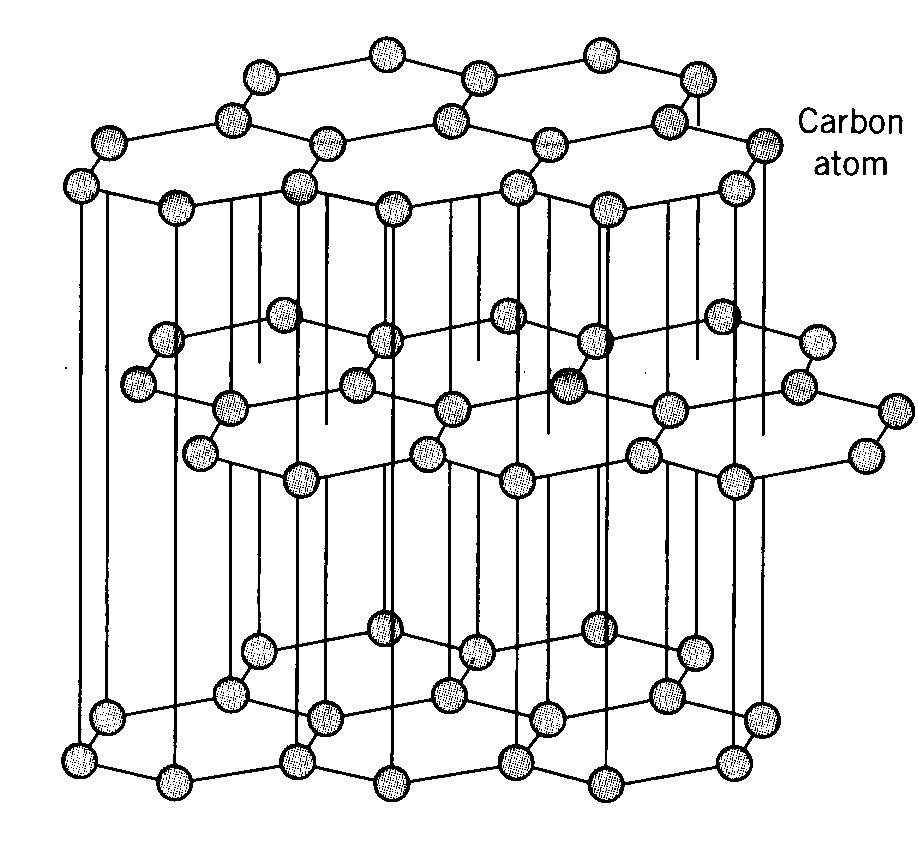
(half of a ring, see this picture of graphite crystal structure)
Thank you, that picture clarified everything for me. </sarcasm>
-
Re:Can it cut things?
Seriously, does this mean the edge of the fabric is really sharp? Can it cut through stuff?
Nope. It's not rigid.
But.. if you could add a layer on top of that layer, juxtaposed by the minimal amount (half of a ring, see this picture of graphite crystal structure), and then add another layer, and another..
Then you could form a 'perfectly sharp' knife.
I'm not sure how durable it'd be though, because the inter-layer bonds in graphite are rather weak. -
Re:Don't be a metrosexual
I've gotten it from a number of sources, backed up with actual governmental sites. These sites also say the recent jump in crime in England is attributable to more accurate tracking.
As for "plea-bargaining" not happening in England, maybe I should have said "where charges are reduced". I was operating off of memory.
Murder Rates
If the large cities have rates in the 20-60 range, but the whole country rates a 9.8, the cities are dragging the rate up quite a bit. The site also points out that a large study showed that liberal (more free) gun policies reduced the crime rate, to include murder. I've also heard that we'd rate right with Europe if you remove African Americans from the ratings.
I blame the high murder rate of the USA on the drug war, welfare, and stupid policies in the cities. -
Continuity of Consciousness
My personal view on this is that it is the continuity of your consciousness that makes you *you*. So I personally would never be frozen or ever take a transporter.
Assuming for the sake of argument that you could actually be unfrozen successfully, the "you" that woke up wouldn't "really" be you. Obviously, the "you" that's there would think everything worked just fine since it had all the same exact memories and experiences as you. It's actually a terribly disturbing thought if that ever happened to me. Because the "me" after being unfrozen would obviousy have my same beliefs but would still feel his consciousness did in fact survive the freezing. And even if I'm wrong, I'd still having the nagging feeling I wasn't "me". I suppose "I" would somehow rationalize it. It's one of those essential unanswerable questions.
As far as the transporter goes, it's just freaking destroying you and creating another copy somewhere else. My thinking on all this is similiar to this guy's thoughts on the "Duplicates Paradox": http://www.benbest.com/philo/doubles.html. There's a lot of interesting literature on this subject and "qualias". -
Re:Actually i got a true story about this...
Unfortunately cancer is a pretty random thing, meaning plenty of those exposed won't get it, while those that aren't can. This is why anecdotal evidence doesn't do well compared to statistical evidence from looking at many people (I think there was a Dilbert TV show making reference to that).
It only takes one damaged cell to start cancer, so that means a single stray gamma ray, ultraviolet ray, carcinogenic molecule, etc. needs to break some DNA in a cell and turn it into a cancer cell. We do have built in defense measures to this that will try to fix damaged DNA or kill cancer cells, but it is not always perfect. But it makes it near impossible to guess the source of a single person's cancer, as we are exposed to trace amounts of such chemicals and radiation every day (a lot of which, probably a majority for most people, is natural).
It is even more complicated as hereditary can affect your chances of getting different types of cancer too. Although I've been involved in several experiments involving a fair amount of radioactive material just in undergraduate labs and will probably get more from my research career (the total so far has been less than that of a dental x-ray), if I get cancer, I would be more likely to think it was a result of a trend showing in my family than my work (assuming something obviously severe doesn't come along).
Also remember that cancer is the second largest cause of death in the United States (a quick google search found this source). 22.9% of Americans will die from cancer. Since there are plenty of cases of cancer being cured, or not killing some one, there stories of people with cancer will be much larger (from the American Cancer Society, it comes out to a one in two chance for men, and a one in three chance for women, of getting cancer sometime in your life... although this probably includes smokers, however prostate and breast cancer account for half the cases respectively).
So expect to hear many stories from people all over the place with cancer, no matter what their background. I am sure many of these nuclear tests didn't help... but it is very hard to say how much they hurt. Let's just hope that progress in finding cures continues.
-
Re:Airport Police
The war on terror isn't about the terrorists, it's all PR.
But that's the point! Terror is not about killing people, it's about scaring the public and causing them to act a certain way.
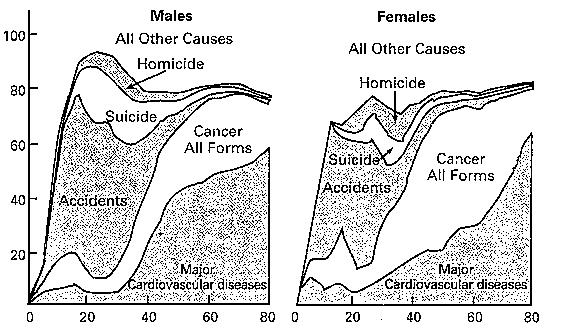
I read an essay about this subject. The guy was saying that terrorism was efficient because by killing very few people, it could influence the foreign policy of a whole country. As a matter of fact, only about 3000 were killed because of terrorism in the USA in 2001, which is a really minor cause of death compared to all others : see this graphic with all causes of death in the USA.
In 1998, 12752 people were killed in road accidents in the USA, accounting for 51.8% of all death causes. Which means that USA citizens are killing themselves on the road much more efficiently than Al Qaida will ever be able to do using huilding-crashing planes.
This does absolutely not mean that terrorism shouldn't be fought appropriately and that we should forget the 9/11 victims, it just means that public opinion should be more aware that it's emotional impact is much higher than it should be : we hurt ourselves every year much more than the terrorists will ever be able to hurt us. -
Many Interpretations
Roughly in chronological order are:
The original Copenhagen Interpretation
Bohm's Interpretation
The Many Worlds Interpretation
The Transactional Interpretation
My own Aethereal Interpretation (blatant plug -
Re:Already happened (and 'Gravity Waves')Apparently you are suffering from some sort of brain damage. A site describing the standard model includes this text:
Photons & gravitons have no mass, whereas the gluon and weak-force quantum-particles have mass of 0.14 and 80-90 GeV, respectively. Mass of subatomic particles is described by the mass-energy unit GeV, Giga (billion) electron volts. (The amount of energy an electron gains moving through a potential of one volt in a vacuum is one electron-volt,1eV.) Gravity is only included in the Standard Model by tentative hypothesis -- gravitons have never been observed.
If massy particles could travel at c, then according to Special Relativity their mass would appear infinite to outside observers.
I have never heard that photons were ever thought to have mass. They have momentum of course, equal to Planck's constant times their frequency; but they have no mass.
Even if you were taught in your "physics classes" that photons had mass, a two minute search of Google shows that 99% of the website-producing population of earth disagrees. Admittedly, that is not necessarily proof - it's been said that any idiot can put up a web site, and many idiots have - but reading textbooks and the physics section of any bookstore will produce the same conclusion.