Slashdot Mirror
Domain: blachford.info
Stories and comments across the archive that link to blachford.info.
Comments · 55
-
Why is this news?
It would only be news if they managed to produce a lightweight cell phone
-
Re:I KNEW IT
Perhaps I didn't explain it clearly enough for you to understand. Yes, the processing units are separate things (albeit in the same package, connected by an internal bus), and I'm not why you thought I was suggesting otherwise.
Read this - http://www.blachford.info/computer/Cell/Cell1_v2.h tml
Then substitute the Power Processor Element with a dual core X86_64 element.
Then substitute the Synergistic Processor Elements with new processor elements derived from ATIs GPU work (eg the same technology that Folding@Home uses to accelerate their X1900 GPU client math).
Or maybe I'm dreaming and only IBM, Sony, and Toshiba are capable of creating nonsensical and impossible CPUs. -
Re:Quit your whining...
OK so I went and refreshed myself on the cell architecture and realized I was going about my argument the wrong way. There is effectively no difference between programming for the CBE and Programing for multiple PPC cores. I know you are going to say that I don't have a clue and that there is alot of difference. If you can design and develop for multi threading and vector processing (though you could skip that as the SPEs are capable of scalar processing as well) then you can develop for the Cell. True there will be some code better suited for the PPE than the SPEs and knowing how to break up the code to use each effectively will take time to learn, but once you start thinking like the CBE it will become second nature (Of course I still say this will be a moot point once the tools catch up since they, such as advance compilers, will determine what is best to run on each processor). The only complaints I have read, from people that have actually programmed for the Cell and aren't just bitching about it, is that the SPEs are in order processors with no branch prediction, etc, that go along with it, but this is place that the tools, again compilers, should be able to pick up the slack (and I should add not much different than the PPC cores used in the XBox 360 and Wii which are also in order).
The only argument I will concede is a slight modification of what you said previously and that is that it may always be harder to get the absolute most out of a Cell like architecture as compared to the more common architectures of the day, but that is only because it has more potential. I think you will get comparable or better performance with no hit to development time. You could always use it like a PPC with multiple associated vector processors, just have people have been doing with Power/Altivec systems for years, and still get a performance increase in AI and Physics processing.
Nicholas Blachford adds detail to what I am trying to say. And though this guy is no John Carmack, he actually details the process rather than just saying "I don't like it." -
Why the hatred for the PS3
You know, I didn't get excited about the PS3 until I read the technical specs a few weeks ago. Now I'd love to play around with the Cell.
Cell processor info
I think it's pretty sad that the PS3 gets such a bad rap on here. It's a consumer-grade super-computer that runs Linux out of the box, no mods required. What's not to like?
I'm thinking that my next PC won't be Intel-based at all, it will be a PS3. -
I'm actually quite excited
Not necessarily about this announcement of course as most of us have seen it coming for some time. However, the concept of the core processor is quite strong and I think that it will play an important role in computing in the future.
A little tid bit about all that: http://www.blachford.info/computer/Cell/Cell0_v2.h tml -
Re:Sega Saturn Redux?
Thanks for the condescending and uninformative remark. What I was not sure of was if the OS treated each SPE as a separate, autonomous core (i.e. SMP). I had assumed the context of my question made that clear. As it turns out, my assumption was correct.
"The PPE which is capable of running a conventional operating system has control over the SPEs and can start, stop, interrupt and schedule processes running on the SPEs. To this end the PPE has additional instructions relating to control of the SPEs. Despite having Turing complete architectures the SPEs are not fully autonomous and require the PPE to initiate them before they can do any useful work." Courtesy of the cell wiki
In other words, the OS tasks the PPE which tasks the SPEs. This is a entirely different beast from 8 autonomous cores.
I also found an interesting article about programming the cell. Not all my assumptions survived *sigh*. Thanks!
~nate -
Amiga Walker
It looks like a horizontal version of the vertical "Amiga Walker" http://www.blachford.info/computer/walker/walker.
h tml It was never functional as intended, but the top and bottom halves were meant to be separated and expansion modules placed in the middle. Which would make the top and bottom the equivalent to the bookends... -
Re:We'll start with 3D...
Not to be a buzz kill, but it looks like we'll have to wait for a lot of development and middle ware maturity before we see the real potential in cell processors.
Yes, but why worry about something so trivial when we've got anti-gravity technology?
http://www.blachford.info/quantum/gravity.html
And faster than light travel?
http://www.blachford.info/quantum/fastlight.html
Blachford is just as qualified to talk about processor technology as he is about physics. He's an attention seeking charlatan lacking either the experience or qualifications to contribute anything but hype and bullshit. And he's becoming just as ubiquitous and irritating as that Piquapelle prick. -
Re:We'll start with 3D...
Not to be a buzz kill, but it looks like we'll have to wait for a lot of development and middle ware maturity before we see the real potential in cell processors.
Yes, but why worry about something so trivial when we've got anti-gravity technology?
http://www.blachford.info/quantum/gravity.html
And faster than light travel?
http://www.blachford.info/quantum/fastlight.html
Blachford is just as qualified to talk about processor technology as he is about physics. He's an attention seeking charlatan lacking either the experience or qualifications to contribute anything but hype and bullshit. And he's becoming just as ubiquitous and irritating as that Piquapelle prick. -
We'll start with 3D...
Not to be a buzz kill, but it looks like we'll have to wait for a lot of development and middle ware maturity before we see the real potential in cell processors.
-
Re:Uh huh...
Furthermore, nVidia and ATI are marketing their GPUs as capable of taking over more primary PC functions, thus, thet makes 4 HUGE opponents for this kind of stuff. Personally, I believe this is IBM's attempt at wagging the dog. They're still screwed.
That's what the Cell processor is for. It is a POWER-like processor with several number-chunching sub-processors on the same die. This allows much better communication between the units that the classic CPU/GPU couple, besides the sub-processors are more general purpose than GPUs.
If they can demonstrate that it can be programmed efficiently, I think the PC has real competition. Initially, it will probably be most interesting to game developers and scientists who are willing to invest time in performance.
-
Isn't anyone going to mention this is a DRM chip?
On-chip hardware in support of security system for intellectual property protection.
Each Cell is given a GUID, a global identifier.
Some will no doubt be turned off by the fact that DRM is built into the Cell hardware.
on-chip hardware DRM support
It also has built-in on-chip digital rights management (DRM)
It seems that details on this DRM system are still secret, but I would wager strong odds that is it exactly compliant with the Trusted Computing Group specification. Exactly compliant with the Intel La Grande DRM system, exactly compliant with the AMD Presidio DRM system, exactly compliant with the Transmeta Security eXtensions DRM system.
One DRM to rule them all, One DRM to find them,
One DRM to bring them all and in the darkness bind them.
One Trusted Computing system to bind a network of software running on different CPUs.
- -
Re:I thought that the PS3 was going to be real
You could always try clicking this then
Cell info
-
PPC free of DRM?From http://www.blachford.info/computer/Cells/Cell2.ht
m lDRM In The Hardware
Some will no doubt be turned off by the fact that DRM is built into the Cell hardware. Sony is a media company and like the rest of the industry that arm of the company are no doubt pushing for DRM type solutions. It must also be noted that the Cell is destined for HDTV and BluRay / HD-DVD systems, any high definition recorded content is going to be very strictly controlled by DRM so Sony have to add this capability otherwise they would be effectively locking themselves out of a large chunk of their target market. Hardware DRM is no magic bullet however, hardware systems have been broken before - including Set Top Boxes and even IBM's crypto hardware for their mainframes.
So while the current Apple lineup is DRM free, not all IBM PPC powered machines are quite so lucky.
-
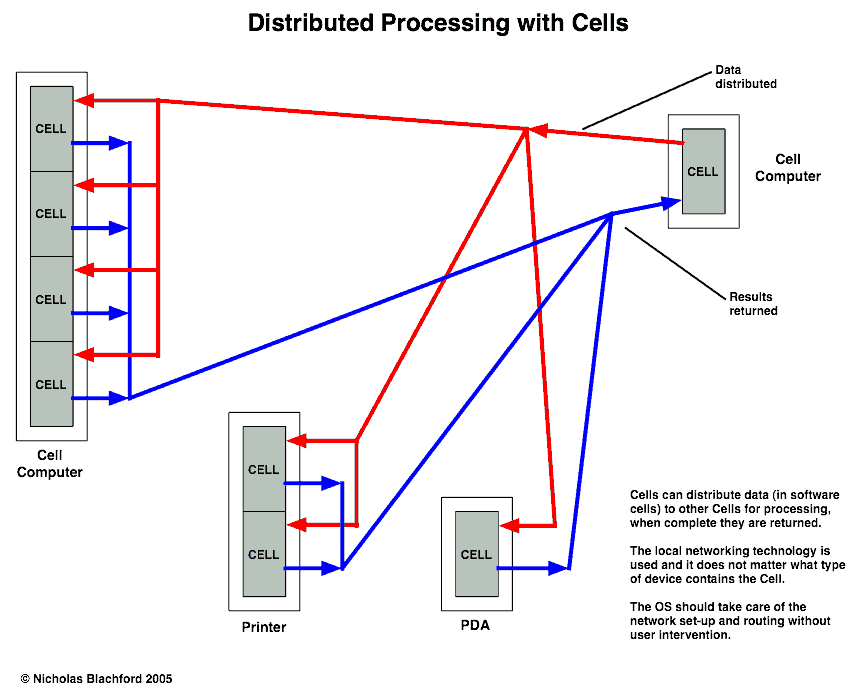
Other blatchford weirdnessalso check out blatchford section on distributed processing. I have seen several media level articles blabbering on about massively distributed processing with the implication that the Cell processor automatically does this. I don't see anything in his diagrams that can't be done by any computer with a network.
- Cells can distribute data to other processors (can't any computer do that?)
- the local network is used, Cell doesn't care which one (ok, so it isn't the Cell that is doing the distributing after all)
- OS should take care of it without user intervention (so its the software, not the processor)
-
Re:Very promising technology= investment opportuni
It's only fair to look at Blachford's rebuttal to Hannibals critique. http://www.blachford.info/computer/Cells/Rebuttal
. html
Then it's only fair to keep in mind while reading his rebuttal that Hannibal has been writing CPU Tech articles for the last 5 years and is extremely well respected.
Blachford is an unemployed attention seeking non-entity with kooky ideas and the only respect he gets is from people equally eager to swallow the Cell hype. -
Re:Very promising technology= investment opportuni
It's only fair to look at Blachford's rebuttal to Hannibals critique. http://www.blachford.info/computer/Cells/Rebuttal
. html -
Re:Very promising technology= investment opportuni
Guess it is time to invest in Sony and IBM! This technology really looks promising, especially when you read this article --> http://www.blachford.info/computer/Cells/Cell5.ht
m l
I've said it before and I'll say it again - Blachford is a complete kook. He thinks he's invented a means of faster than light travel and if that isn't obvious kooksign, I don't know what is.
Oh, and he writes for OSNews. Two strikes and you're out kookboy.
Unfortunately he wrote a piece stating that Apple would adopt the Cell for Macs, making them the ultimate gaming platform. So he has plenty of people willing to defend him, realism not being one of the premier traits of the Mac community.
Please don't disagree until you've explored his site a bit or you will make yourself look foolish.
And as another poster said - check the rebuttal to his wide eyed claims on Ars Technica. You don't mess with Hannibal, beeyatch. -
DRM!
From page 2 of this article:
http://www.blachford.info/computer/Cells/Cell2.htm l
"Some will no doubt be turned off by the fact that DRM is built into the Cell hardware. Sony is a media company and like the rest of the industry that arm of the company are no doubt pushing for DRM type solutions. It must also be noted that the Cell is destined for HDTV and BluRay / HD-DVD systems, any high definition recorded content is going to be very strictly controlled by DRM so Sony have to add this capability otherwise they would be effectively locking themselves out of a large chunk of their target market. Hardware DRM is no magic bullet however, hardware systems have been broken before - including Set Top Boxes and even IBM's crypto hardware for their mainframes." -
Very promising technology= investment opportunity?
Guess it is time to invest in Sony and IBM! This technology really looks promising, especially when you read this article --> http://www.blachford.info/computer/Cells/Cell5.ht
m l
The first Cell based desktop computer will be the fastest desktop computer in the industry by a very large margin. Even high end multi-core x86s will not get close. Companies who produce microprocessors or DSPs are going to have a very hard time fighting the power a Cell will deliver. We have never seen a leap in performance like this before and I don't expect we'll ever see one again, It'll send shock-waves through the entire industry and we'll see big changes as a result. -
Here are some reasons..The most interesting aspect of the Cell for meis the independence and powere of the vector processors. Otherwise, there's noting it can do that an intel or AMD can't (AMD anyway
"Each Cell contains 8 APUs. An APU is a self contained vector processor which acts independently from the others. They contain 128 X 128 bit registers, there are also 4 floating point units capable of 32 GigaFlops and 4 Integer units capable of 32 GOPS (Billions of Operations per Second). The APUs also include a small 128 Kilobyte local memory instead of a cache, there is also no virtual memory system used at runtime.
Independent processing The APUs are not coprocessors, they are complete independent processors in their own right. The PU sets them up with a software Cell and then "kicks" them into action. Once running the APU executes the apulet in the software Cell until it is complete or it is told to stop. The PU sets up the APUs using Remote Procedure calls, these are not sent sent directly to the APUs but rather sent via the DMAC which also performs any memory reads or writes required."
A bit complicated to understand, but you get the picture.
IMHO, aside from graphics rendering and video, stream processing, and DSP etc, I think it's got serious security potential because of the independence of these vector processors. I would expect it to be very usefull for secure processing. Let's face it - it's a bloody complicated platform!!! IT's gonna be good for security. The API for it alone would put many crackers off...
More here: http://www.blachford.info/computer/Cells/Cell3.ht
m l -
Re:Why is IBM pushing Cell?
I was doing some looking on Google and I came up with this link. It's pretty informative and goes in depth on what this dude is pretty sure Cell is going to be like. I have no idea whether he's a reputable source or not, so keep that in mind.
http://www.blachford.info/computer/Cells/Cell0.htm l -
Re:what does it do?
Read this... Cell Architecture Explained: Introduction You can't just run a new linux dist or drop a couple of cpu on a box to emulate CELL. http://www.blachford.info/computer/Cells/Cell0.ht
m l -
Background For Those Unfamiliar With Cell
-
Cell Processor
I hardly see how they will blow by sony if sony is going to use the Cell processor designed to get many teraflops. Links: Tom's Hardware about Cell Processor Cell Processor Explained Google News on Cell Processors Forum Topic about Cell Processors
-
Perhaps, but FOUR of them...
...might be used to run the PS3 (assuming this is true). Outside of a weighty OS (assuming you use Windows, Mac or a Linux GUI with that nVidia) they should do better.
Besides, 256 GFlops in single-prec. can't be too bad either...can it?
-
More evidence ..
The fact is that no console has managed to maintain a lead over PCs in terms of hardware, simply due to the fact that PCs have much faster release cycles than consoles
Ah, but have you read any of the reviews recently about the new IBM-Sony Cell architecture. Try reading this one and lets see if you're still singing the same tune:
Btw, that's the conclusion
If this guy is right, no one who develops games for this puppy is going to cross-platform it with a PC, cos the PC architecture will be way too slow (and employ different programming techniques) to make it worth their while.
-
this is small - check out DARPA ACIPAs someone mentioned earlier, this is a pretty small award, only $400k. And for a fairly limited tech area.
If you want to see where DARPA is putting effort for next gen AI, look at the ACIP Program. ACIP stands for "Architectures for Cognitive Information Processing". They are funding several teams with BIG bucks to develop a whole new architecture for processors to do "Cognitive" computing. The idea is to put decompose the high level functions that we call 'cognitive' (reasoning, learning, etc) into operations that can be implemented in silicon (or something more exotic). The applications that attempt Cognitive Computing now are big and slow and dont do 'real world' problems well. If DARPA can get a chip to do help do it faster, smaller, then they can start making real smart bombsAnd ACIP is just one of several programs funded by DARPA IPTO (Information Processing Technology Office).
Just wait till the Playstation 4 comes out with massively parallel streaming (CELL) processors for graphics, AND cognitive processors for intelligent characters.
-
Re:Competition
The only way for the PS3 to have something playable at this year's E3 would be for Sony to change from using the Cell to using a different chip that developers already know (like an x86 or PPC variant, or maybe an updated Emotion Engine)
According to http://www.blachford.info/computer/Cells/Cell1.ht
m l the paper about the Cell patents a bit back, each of the Cell's Processor Units was described as a 64-bit POWER arch. chip, so if the developers are familiar with PPC, they should at least be able to work the "controllers" on the Cell chips. The "really cool stuff" comes after getting used to the parallel processing "software Cell" paradyme that the paper describes. -
Re:Tablespork, you must have been the only one
As I posted I wonder if Apple might jump right over the G5 in notebooks to something based on the CELL cpu that IBM is developing.
I think you may be right, and you're not the only one to think that.
The Cell is part of the Power lineup from IBM, as is the G5, so technically the Cell and the G5 are in the same category, just different cores. The Power architecture is being touted as something that is scalable from Server hardware all the way down to Cell phones, so it really is just a matter of (hopefully not much) time until Apple releases a laptop based on G5 or the Cell.As we now know [Recent Details] the PU is a 64bit "Power Architecture" processor. Power Architecture is a catch all term IBM have been using for a while to describe both PowerPC and POWER processors. Currently there's only 3 CPUs which fit this description: POWER5, POWER4 and the PowerPC 970 (aka G5) which itself is a derivation of the POWER4.
It would be sweet if they designed the G6 and did simultaneous releases of desktop and laptop, with the laptop CPU being just a scaled down version of the desktop version.
quoted from: http://www.blachford.info/computer/Cells/Cell1.htm l -
Imagine the energy bills...
...that all this processing power will run up.
I mean, if the PS3 does use 4 Cells, that alone will certainly be a power hog in itself, right?
I wonder what portion of energy today is used for CPU power.
-
Re:In related news...
Actually the PS3 will be revolutionary.Here is some detail eh'. PenGun Do What Now ???
-
Re:We are going in the WRONG direction for desktop
We need more parallel processing applications. We need to drop the intel isa architecture(heat,effectiveness).
The reason why we use AMD and Intel is because of applications are all intel isa based. We need effective parallel processing compilers . Who cares about word processing software that might get slowed down . Graphics,mathematics and sciences,and supercomputing will get a BIG BOOST.
i think slashdot linked to this article on the ps3's cell processor a few days ago, and i found it to be good light reading on this topic.
i disagree with the author on the general use pc-killing potential of the cell because it's hard to parallelize most operations. most people want one thing to run really quickly at a time, and for those people, x86 is serving them very well. a compiler won't be able to do much to split something like X or a media player into lots of parallel threads, so the only applications that'll benefit from such a radical change are those expressly written to use that. so while a cluster of playstation 3's has huge potential for stream processing, it wouldn't really be relevant to the average user running the applications that such average users put on their average computers.
it's more likely that a cell processor may be used to complement an x86 cpu in future pc's to accelerate things along the lines of the gpu-accelerated video editor mentioned on slashdot earlier today. -
Re:Every system says thatWell, that would assume everything that was said about cell processors here was also untrue.
Heh. Looking at your first link, I think you should consider the source a little bit. This is the same guy who believes he knows how to counteract gravity and travel faster than light. So if it's all the same to you, I'll consider his "analysis" of the cell processor with a large dose of salt. -
Re:Every system says thatWell, that would assume everything that was said about cell processors here was also untrue.
Heh. Looking at your first link, I think you should consider the source a little bit. This is the same guy who believes he knows how to counteract gravity and travel faster than light. So if it's all the same to you, I'll consider his "analysis" of the cell processor with a large dose of salt. -
Re:Every system says thatWell, that would assume everything that was said about cell processors here was also untrue.
Heh. Looking at your first link, I think you should consider the source a little bit. This is the same guy who believes he knows how to counteract gravity and travel faster than light. So if it's all the same to you, I'll consider his "analysis" of the cell processor with a large dose of salt. -
Re:Movie animation
The reason people are talking about this kind of power is because the PS3 is going to be based around the Cell processor.
Whether or not the Cell really is "All That" remains to be seen... -
Re:Every system says that
I think it is safe to assume that any such statements made by Sony marketing are bullshit.
Well, that would assume everything that was said about cell processors here was also untrue.
If what was forwarded in that article was even half true, I don't know that real time redering would be that far off. -
Or Faster?
Maybe its possible to travel faster then light then
-
Re:In other news...
By the way, did you heard about that story about the Cell architecture explained?
-
Not as interesting as Cell
That's not nearly as interesting as the Cell Architecture. You can read about it here.
Oh wait, that was already posted. Well its been over 6 hours, I must have forgot. -
Re:Speed issues
sure.
http://www.blachford.info/computer/Cells/Cell1.htm l
has "something like a G5"in the image.
Beneath that, it has specs, including the line "4.6 GHz"
Next time RTFA might be a good idea, huh? -
Re:PS1/PS2 compatibility?
Here you go... http://www.blachford.info/computer/Cells/Cell1.ht
m l
A seemingly intelligent take on cellular processing. -
oh lord...
...save us all from this idiot!
seriously, the gentleman that wrote this article is a worthy match for Bowie J. Poag (described properly at http://bowiepoag.is.batshitinsane.com/).
it is completely clear from the text that he knows shit about architecture of computer systems and even much less about parallel processing.
communication vs. processing ratio of parallel algorithms? never mind, we'll use the method at http://www.blachford.info/quantum/fastlight.html for communication between "cells". inherent serial nature of many algorithms? who cares! the OS will implicitly parallelize any algorithm, no matter, how serially designed...
anyway, take a stroll over the rest of his site: his knowledge of physics (demonstrated in the antigravity machine proposal) perfectly matches his knowledge of computers. -
Is it just me?
Or does the logical extension of this chart:
http://www.blachford.info/computer/Cells/Cell_Dist ributed.gif
Make it look a little more like a HAL than a Cell? -
The HP stand looked good
Yeah, right. As if that's what he was looking at. Sure, anything you say.
-
MorphOS explained a bit.
That's a reply I wrote to some person that I believe that is interesting to read. -- Ehm, MorphOS consists of the Quark kernel (a micro/pico kernel mixture) on which, the A/Box, an AmigaOS reimplementation with MANY extensions and improvements, runs hosted. It's VERY cleanly implemented. It's main concern is to run PPC native applications but it includes Trance a 68k>PPC JiT that can produce code that runs at 50%-70% of the native PPC speed (tested by users, not some wierdo benchmark they did themselves). But, that's not it's future, they already plan the Q/Box, a new operating system that has nothing to do with AmigaOS, running on the Quark kernel. AmigaOS and PPC A/Box applications will still be able to be run in the A/Box, in parallel, like Classic in OSX. More information about all these are here. -- Feel free to reply with any questions, or flames;)
-
Re:hack-alike system
Ehm, MorphOS consists of the Quark kernel (a micro/pico kernel mixture) on which, the A/Box, an AmigaOS reimplementation with MANY extensions and improvements, runs hosted. It's VERY cleanly implemented. It's main concern is to run PPC native applications but it includes Trance a 68k>PPC JiT that can produce code that runs at 50%-70% of the native PPC speed (tested by users, not some wierdo benchmark they did themselves). But, that's not it's future, they already plan the Q/Box, a new operating system that has nothing to do with AmigaOS, running on the Quark kernel. AmigaOS and PPC A/Box applications will still be able to be run in the A/Box, in parallel, like Classic in OSX. More information about all these are here.
-
Re:Ah! The crowd has fulfilled it's expectations!
It won't run any old Amiga games without an Amiga emulator
Good thing they built one in! From a FAQish page on MorphOS:...it includes a complete PowerPC native clean-room reimplementation of version 3.1 of the Amigas' Operating System (herein AOS) and a JIT (Just In Time compiler) based 68K emulator...which converts 68K code into native PowerPC code then caches it largely removing the overhead emulation usually incurs.
There is quite a bit more in the above article as well, I would read it first instead of making uninformed posts. -
Re:What's up with you people?
Check this out.