Slashdot Mirror
Domain: bostonglobe.com
Stories and comments across the archive that link to bostonglobe.com.
Stories · 59
-
'Fortnite' May be a Virtual Game, But It's Having Real-life, Dangerous Effects (bostonglobe.com)
An anonymous reader shares a report: "They are not sleeping. They are not going to school. They are dropping out of social activities. A lot of kids have stopped playing sports so they can do this." Michael Rich, a pediatrician and director of the Clinic for Interactive Media and Internet Disorders at Boston Children's Hospital, was talking about the impact "Fortnite: Battle Royale" -- a cartoonish multiplayer shooter game -- is having on kids, mainly boys, some still in grade school. "We have one kid who destroyed the family car because he thought his parents had locked his device inside," Rich said. "He took a hammer to the windshield."
A year and a half since the game's release, Rich's account is just one of many that describe an obsession so intense that kids are seeing doctors and therapists to break the game's grip, in some cases losing so much weight -- because they refuse to stop playing to eat -- that doctors initially think they're wasting away from a physical disease. The stress on families has become so severe that parents are going to couples' counselors, fighting over who's to blame for allowing "Fortnite" into the house in the first place and how to rein in a situation that's grown out of control. Further reading: 'Fortnite' Creator Sees Epic Games Becoming as Big as Facebook, Google. -
Harvard Researchers Suggest Interstellar Object Might Have Been From Alien Civilization (bostonglobe.com)
A strange interstellar object that invaded our solar system and passed close to Earth in the fall of 2017 could have been an artificial object, a piece of a spacecraft from an alien civilization, Harvard researchers are suggesting in a new paper [PDF]. From a report: "There is data on the orbit of this object for which there is no other explanation. So we wrote this paper suggesting this explanation," said Professor Avi Loeb, chairman of the Harvard astronomy department. "The approach I take to the subject is purely scientific and evidence-based. As far as I know, there is no other explanation. You can rule it out or in, based on additional data." He said the study had been accepted for publication in the The Astrophysical Journal Letters on Nov. 12.
The paper, written by Loeb and postdoctoral researcher Shmuel Bialy, suggests the object might be a light sail, or solar sail -- a proposed method of powering spacecraft that uses a sail to catch radiation pressure and propel the spacecraft, just as a normal sail uses the wind to propel a boat. The object 'Oumuamua -- Hawaiian for "messenger from afar arriving first" -- is the first ever observed intruding in the orbits of our planets. It was picked up by telescopes in October 2017 at the University of Hawaii's Haleakala Observatory, the National Aeronautics and Space Administration said. It is on its way out of the solar system and expected to never return. Scientists say other "interstellar" objects may have sailed by in the past, undetected.
The object raised eyebrows. It was monitored for signs of radio signals as weak as one-tenth of a cellphone-strength signal, but nothing was detected. Researchers said in December 2017 that it appeared to be a naturally formed, icy object covered with a dry crust. Further reading: Interstellar Visitor 'Oumuamua Is a Comet After All (June 2018), Scientists say mysterious 'Oumuamua' object could be an alien spacecraft, and Cigar-shaped interstellar object may have been an alien probe, Harvard paper claims. -
Robot Pioneer Rethink Shuts Down (bostonglobe.com)
Rethink Robotics led the way in building robots that could work safely alongside humans. But when it came to selling those robots, Boston-based Rethink came up second best. On Wednesday, without warning, Rethink shut its doors, after a deal to acquire the company fell through. From a report: "We thought that we had a deal that we were going to be able to close," said Rethink chief executive Scott Eckert. But the buyer backed out. Eckert declined to identify the company that had broken off the acquisition. Eckert said Rethink ran low on cash as sales of the company's Baxter and Sawyer robots fell short of expectations. "We got out a little early with a very, very innovative product, and unfortunately did not get the commercial success that we expected to get," he said. Rethink was a pioneer in developing collaborative robots, or "cobots," which are designed to work side-by-side with humans. Their software makes them easy to program, even by workers with no training in robotics, and they come with sensors and software to prevent them from accidentally harming nearby humans. -
MIT's Elegant Schoolbus Algorithm Was No Match For Angry Parents (bostonglobe.com)
"Computers can solve your problem. You may not like the answer," writes the Boston Globe. Slashdot reader sandbagger explains: "Boston Public Schools asked MIT graduate students Sebastien Martin and Arthur Delarue to build an algorithm that could do the enormously complicated work of changing start times at dozens of schools -- and re-routing the hundreds of buses that serve them. In theory this would also help with student alertness...." MIT also reported that "Approximately 50 superfluous routes could be eliminated using the new method, saving the school district between $3 million and $5 million annually."
The Globe reports: They took to the new project with gusto, working 14- and 15-hour days to meet a tight deadline -- and occasionally waking up in the middle of the night to feed new information to a sprawling MIT data center. The machine they constructed was a marvel. Sorting through 1 novemtrigintillion options -- that's 1 followed by 120 zeroes -- the algorithm landed on a plan that would trim the district's $100 million-plus transportation budget while shifting the overwhelming majority of high school students into later start times.... But no one anticipated the crush of opposition that followed. Angry parents signed an online petition and filled the school committee chamber, turning the plan into one of the biggest crises of Mayor Marty Walsh's tenure. The city summarily dropped it. The failure would eventually play a role in the superintendent's resignation...
Big districts stagger their start times so a single fleet of buses can serve every school: dropping off high school students early in the morning, then circling back to get the elementary and middle school kids. If you're going to push high school start times back, then you've probably got to move a lot of elementary and middle schools into earlier time slots. The district knew that going in, and officials dutifully quizzed thousands of parents and teachers at every grade level about their preferred start times. But they never directly confronted constituents with the sort of dramatic change the algorithm would eventually propose -- shifting school start times at some elementary schools by as much as two hours. Even more... Hundreds of families were facing a 9:30 to 7:15 a.m. shift. And for many, that was intolerable. They'd have to make major changes to work schedules or even quit their jobs...
Nearly 85% of the district had ended up with a new start time, and "In the end, the school start time quandary was more political than technical... This was a fundamentally human conflict, and all the computing power in the world couldn't solve it."
But will the whole drama play out again? "Last year, even after everything went sideways in Boston, some 80 school districts from around the country reached out to the whiz kids from MIT, eager for the algorithm to solve their problems." -
Airbnb Sues New York City To Block User-Data Bill Over Privacy (bostonglobe.com)
Airbnb has filed a lawsuit against the city of New York over a recent law the city passed, requiring the home-sharing site to hand over information about its hosts. From a report: The company is hoping to avoid millions in losses when the law, designed to police short-term home rentals, takes effect this winter. The New York City legislation, which passed with a 45-0 vote, would require Airbnb to share the names and addresses of its hosts with the city's Office of Special Enforcement. "The ordinance is an unlawful end-run around established restraints on governmental action and violates core constitutional rights," the company said in a claim filed in New York court on Friday.
New York, which faces an affordable housing shortage, has struggled with how to enforce regulations to control Airbnb and other home-sharing services like Expedia's HomeAway. Regulators argue that short-term rentals, which can be more profitable than long-term leases, disrupt neighborhoods and drive up rents. The new legislation is designed to give officials enough information to catch Airbnb hosts who operate outside of strict home-sharing laws. -
Boston Globe Outs Secret TSA Tracking Program 'Quiet Skies' At Airports (bostonglobe.com)
The Boston Globe reports of a previously undisclosed program, called "Quiet Skies," that targets travelers who "are not under investigation by any agency and are not in the Terrorist Screening Data Base." The insights come from a TSA bulletin in March that describes the program's goal as thwarting threats to commercial aircraft "posed by unknown or partially known terrorists. The program "gives the agency broad discretion over which air travelers to focus on and how closely they are tracked," reports The Boston Globe. From the report: But some air marshals, in interviews and internal communications shared with the Globe, say the program has them tasked with shadowing travelers who appear to pose no real threat -- a businesswoman who happened to have traveled through a Mideast hot spot, in one case; a Southwest Airlines flight attendant, in another; a fellow federal law enforcement officer, in a third. It is a time-consuming and costly assignment, they say, which saps their ability to do more vital law enforcement work. TSA officials, in a written statement to the Globe, broadly defended the agency's efforts to deter potential acts of terror. But the agency declined to discuss whether Quiet Skies has intercepted any threats, or even to confirm that the program exists.
Already under Quiet Skies, thousands of unsuspecting Americans have been subjected to targeted airport and inflight surveillance, carried out by small teams of armed, undercover air marshals, government documents show. The teams document whether passengers fidget, use a computer, have a "jump" in their Adam's apple or a "cold penetrating stare," among other behaviors, according to the records. Air marshals note these observations -- minute-by-minute -- in two separate reports and send this information back to the TSA. All US citizens who enter the country are automatically screened for inclusion in Quiet Skies -- their travel patterns and affiliations are checked and their names run against a terrorist watch list and other databases, according to agency documents. The bulletin highlights 15 rules used to screen passengers. If someone is selected for surveillance, a team of air marshals will be placed on the person's next flight. -
A Well-Known Expert On Student Loans Is Not Real (chronicle.com)
mi shares a report from The Chronicle of Higher Education: Drew Cloud is everywhere. The self-described journalist who specializes in student-loan debt has been quoted in major news outlets, including The Washington Post, The Boston Globe, and CNBC, and is a fixture in the smaller, specialized blogosphere of student debt. But he's a fiction, and "his" site -- an invention of a student-loan refinancing company.
"Drew Cloud is a pseudonym that a diverse group of authors at Student Loan Report, LLC use to share experiences and information related to the challenges college students face with funding their education," wrote Nate Matherson, CEO of LendEDU (the company that owns Cloud's website, The Student Loan Report). Before that admission, however, Cloud had corresponded at length with many journalists, pitching them stories and offering email interviews, many of which were published. When The Chronicle attempted to contact him through the address last week, Cloud said he was traveling and had limited access to his account. He didn't respond to additional inquiries. And on Monday, as The Chronicle continued to seek comment, Cloud suddenly evaporated. His once-prominent placement on The Student Loan Report had been removed. His bylines were replaced with "SLR Editor." Matherson confirmed on Tuesday that Cloud was an invention. Pressed on whether he regretted deceiving news organizations with a fake source, Matherson said Cloud "was created as a way to connect with our readers (ex. people struggling to repay student debt) and give us the technical ability to post content to the Wordpress website." -
NYT: Lynchings Around the World are Linked To Facebook Posts (bostonglobe.com)
An anonymous reader quotes the New York Times: Riots and lynchings around the world have been linked to misinformation and hate speech on Facebook, which pushes whatever content keeps users on the site longest -- a potentially damaging practice in countries with weak institutions and histories of social instability. Time and again, communal hatreds overrun the newsfeed unchecked as local media are displaced by Facebook and governments find themselves with little leverage over the company. Some users, energized by hate speech and misinformation, plot real-world attacks.
A reconstruction of Sri Lanka's descent into violence, based on interviews with officials, victims and ordinary users caught up in online anger, found that Facebook's newsfeed played a central role in nearly every step from rumor to killing. Facebook officials, they say, ignored repeated warnings of the potential for violence, resisting pressure to hire moderators or establish emergency points of contact... Sri Lankans say they see little evidence of change. And in other countries, as Facebook expands, analysts and activists worry they, too, may see violence.
A Facebook spokeswoman countered that "we remove such content as soon as we're made aware of it," and said they're now trying to expand those teams and investing in "technology and local language expertise to help us swiftly remove hate content." But one anti-hate group told the Times that Facebook's reporting tools are too slow and ineffective.
"Though they and government officials had repeatedly asked Facebook to establish direct lines, the company had insisted this tool would be sufficient, they said. But nearly every report got the same response: the content did not violate Facebook's standards." -
R.I.P., Cape Wind (bostonglobe.com)
schwit1 quotes the Boston Globe: What a long, slow death it has been for Massachusetts's first proposed offshore wind farm. But now, its proponents are finally pulling the plug. While others in the energy industry considered the Cape Wind project dead, developer Jim Gordon didn't quit after losing power contracts he needed for financing in early 2015, or after state regulators yanked permission for a power line connection last year.
Another big blow came later in 2016 when Cape Wind foes worked their magic on Beacon Hill. They successfully lobbied lawmakers to prevent Cape Wind from benefitting from a major energy bill, one that requires utilities to buy large amounts of offshore wind. This was exactly the kind of legislation Gordon needed. But he wasn't being allowed at the party...
We're embarking on a new era. Wind turbines are on their way for deeper waters, south of Martha's Vineyard. They won't be Gordon's. But at least he can take some credit, in his defeat, for being a pioneer. -
R.I.P., Cape Wind (bostonglobe.com)
schwit1 quotes the Boston Globe: What a long, slow death it has been for Massachusetts's first proposed offshore wind farm. But now, its proponents are finally pulling the plug. While others in the energy industry considered the Cape Wind project dead, developer Jim Gordon didn't quit after losing power contracts he needed for financing in early 2015, or after state regulators yanked permission for a power line connection last year.
Another big blow came later in 2016 when Cape Wind foes worked their magic on Beacon Hill. They successfully lobbied lawmakers to prevent Cape Wind from benefitting from a major energy bill, one that requires utilities to buy large amounts of offshore wind. This was exactly the kind of legislation Gordon needed. But he wasn't being allowed at the party...
We're embarking on a new era. Wind turbines are on their way for deeper waters, south of Martha's Vineyard. They won't be Gordon's. But at least he can take some credit, in his defeat, for being a pioneer. -
R.I.P., Cape Wind (bostonglobe.com)
schwit1 quotes the Boston Globe: What a long, slow death it has been for Massachusetts's first proposed offshore wind farm. But now, its proponents are finally pulling the plug. While others in the energy industry considered the Cape Wind project dead, developer Jim Gordon didn't quit after losing power contracts he needed for financing in early 2015, or after state regulators yanked permission for a power line connection last year.
Another big blow came later in 2016 when Cape Wind foes worked their magic on Beacon Hill. They successfully lobbied lawmakers to prevent Cape Wind from benefitting from a major energy bill, one that requires utilities to buy large amounts of offshore wind. This was exactly the kind of legislation Gordon needed. But he wasn't being allowed at the party...
We're embarking on a new era. Wind turbines are on their way for deeper waters, south of Martha's Vineyard. They won't be Gordon's. But at least he can take some credit, in his defeat, for being a pioneer. -
Facebook To Open New Office in Kendall Square, Adding Hundreds of Jobs (bostonglobe.com)
Facebook has a status update: The social network will open a new office in Cambridge next year and plans to hire more than 500 employees, bringing the Boston-based staff to 650. From a report: The company, which founder Mark Zuckerberg launched at Harvard before decamping for the West Coast, established its first Boston-based team nearly four years ago with a small group of employees sharing a workspace. Today, that team has grown to more than 100 people in a Kendall Square office, and space is getting tight, said Ryan Mack, who leads the Facebook Boston office. "We serve 2 billion people on Facebook," he said, "and we need to continue to scale." The new offices will occupy the top three floors of 100 Binney St., a new building designed by Elkus Manfredi that is scheduled to open early next year. Facebook will share the space with 300 Bristol-Myers Squibb employees. -
Hearing Loss of US Diplomats In Cuba Is Blamed On Covert Device (bostonglobe.com)
bsharma shares a report from The Boston Globe: The two-year-old U.S. diplomatic relationship with Cuba was roiled Wednesday by what U.S. officials say was a string of bizarre incidents that left a group of American diplomats in Havana with severe hearing loss attributed to a covert sonic device. In the fall of 2016, a series of U.S. diplomats began suffering unexplained losses of hearing, according to officials with knowledge of the investigation into the case. Several of the diplomats were recent arrivals at the embassy, which reopened in 2015 as part of former President Barack Obama's reestablishment of diplomatic relations with Cuba. Some of the diplomats' symptoms were so severe that they were forced to cancel their tours early and return to the United States, officials said. After months of investigation, U.S. officials concluded that the diplomats had been exposed to an advanced device that operated outside the range of audible sound and had been deployed either inside or outside their residences. It was not immediately clear if the device was a weapon used in a deliberate attack, or had some other purpose. -
Opioid Dealers Embrace the Dark Web To Send Deadly Drugs by Mail (nytimes.com)
Anonymous online sales are surging, and people are dying. Despite dozens of arrests, new merchants -- many based in Asia -- quickly pop up. From a report on the New York Times: In a growing number of arrests and overdoses, law enforcement officials say, the drugs are being bought online. Internet sales have allowed powerful synthetic opioids such as fentanyl -- the fastest-growing cause of overdoses nationwide -- to reach living rooms in nearly every region of the country, as they arrive in small packages in the mail (syndicated source). The authorities have been frustrated in their efforts to crack down on the trade because these sites generally exist on the so-called dark web, where buyers can visit anonymously using special browsers and make purchases with virtual currencies like Bitcoin. The problem of dark web sales appeared to have been stamped out in 2013, when the authorities took down the most famous online marketplace for drugs, known as Silk Road. But since then, countless successors have popped up, making the drugs readily available to tens of thousands of customers who would not otherwise have had access to them. Among the dead are two 13-year-olds, Grant Seaver and Ryan Ainsworth, who died last fall in the wealthy resort town of Park City, Utah, after taking a synthetic opioid known as U-47700 or Pinky. The boys had received the powder from another local teenager, who bought the drugs on the dark web using Bitcoin, according to the Park City police chief. -
Is Social Media Making Us Hate Each Other? (bostonglobe.com)
Nicholas Carr's book The Shallows: What the Internet Is Doing to Our Brains was a finalist for the 2011 Pulitzer Prize. Now an anonymous Slashdot reader reports on Carr's newest warning: It seems obvious: The more we learn about other people, the more we'll come to like them. The assumption underpins our deep-seated belief that communication networks, from the telephone system to Facebook, will help create social harmony. But what if the opposite is true? In a Boston Globe article, Nicholas Carr presents evidence showing that as we get more information about other people, we tend to like them less, not more. Through a phenomenon called "dissimilarity cascades," we place greater stress on personal and cultural differences than on similarities, and the bias strengthens as information accumulates. "Proximity makes differences stand out," he writes. The phenomenon intensifies online, where people are rewarded for sharing endless information about themselves. What the research indicates, warns Carr, is that the spread of social media is more likely to create social strife than social harmony.
The article concludes by opposing the idea that "If we get the engineering right, our better angels will triumph. It's a pleasant thought, but it's a fantasy... Technology is an amplifier. It magnifies our best traits, and it magnifies our worst. What it doesn't do is make us better people. That's a job we can't offload on machines." -
Work-Life Balance: Cryptographer Fired By BAE Systems For Taking Care of Dying Wife (bostonglobe.com)
mdecerbo writes: A new lawsuit by cryptographer Don Davis against multinational defense giant BAE Systems highlights the fact that companies are free to have their boasts about "work-life balance" amount to nothing but idle talk. The Boston Globe reports that on his first day on the job, Davis explained that his wife had late-stage cancer. He would work his full work day in the office, but if he was needed nights or weekends, he'd want to work from home. His supervisor was fine with it, but the human resources department fired him on the spot after four hours of employment. The lawsuit raises interesting questions, such as whether employment law requires corporations to have the sort of common decency we expect from individuals. But what I want to know is, if BAE Systems loses this lawsuit, will they prevent future ones by making their "work-life balance" policy say simply: We own you, body and soul? Don Davis' lawyer, Rebecca Pontikes, contends he was discriminated against because the company "requires its male employees to be the stereotypical male breadwinner and to leave family responsibilities to women." BAE issued a statement to The Boston Globe saying, "we do not tolerate discrimination of any kind and work hard to provide our employees with flexible working options that enable them to have a meaningful work/life balance." The company declined to discuss specifics, citing pending litigation. -
Hackers Corrupt Data For Cloud-Based Medical Marijuana System (bostonglobe.com)
Long-time Slashdot reader t0qer writes: I'm the IT director at a medical marijuana dispensary. Last week the point of sales system we were using was hacked... What scares me about this breach is, I have about 30,000 patients in my database alone. If this company has 1,000 more customers like me, even half of that is still 15 million people on a list of people that "Smoke pot"...
" No patient, consumer, or client data was ever extracted or viewed," the company's data directory has said. "The forensic analysis proves that. The data was encrypted -- so it couldn't have been viewed -- and it was never extracted, so nobody has it and could attempt decryption." They're saying it was a "targeted" attack meant to corrupt the data rather than retrieve it, and they're "reconstructing historical data" from backups, though their web site adds that their backup sites were also targeted.
"In response to this attack, all client sites have been migrated to a new, more secure environment," the company's CEO announced on YouTube Saturday, adding that "Keeping our client's data secure has always been our top priority." Last week one industry publication had reported that the outage "has sent 1,000 marijuana retailers in 23 states scrambling to handle everything from sales and inventory management to regulatory compliance issues." -
Google Searches For 'President Impeachment', 'Canada Immigration', 'Nuclear Shelter' Skyrocket After Trump's Victory
As people celebrate Trump's victory in the United States (and many come to terms with it), the search trend on Google illustrates what's going on in many's minds. Searches for "how to impeach a president", for instance, have gone up 4,850 percent. Similarly, searches for "how to move to Canada", "are people moving to Canada", "list of people moving to Canada", "immigrate to Canada", "list of people moving to Canada if Trump wins" and "where to move if Trump wins" were also very popular, toot. Amid all of this, searches for "nuclear shelter" have skyrocketed as well.
Deja vu. In the aftermath of Brexit, Brits had shown a lot of interest in making Google searches about Irish passport, meaning of EU, and why it all happened. -
Krebs Is Back Online Thanks To Google's Project Shield (krebsonsecurity.com)
"After the massive 600gbps DDOS attack on KrebsOnSecurity.com that forced Akamai to withdraw their (pro-bono) DDOS protection, krebsonsecurity.com is now back online, hosted by Google," reports Slashdot reader Gumbercules!!.
"I am happy to report that the site is back up -- this time under Project Shield, a free program run by Google to help protect journalists from online censorship," Brian Krebs wrote today, adding "The economics of mitigating large-scale DDoS attacks do not bode well for protecting the individual user, to say nothing of independent journalists...anyone with an axe to grind and the willingness to learn a bit about the technology can become an instant, self-appointed global censor." [T]he Internet can't route around censorship when the censorship is all-pervasive and armed with, for all practical purposes, near-infinite reach and capacity. I call this rather unwelcome and hostile development the "The Democratization of Censorship...." [E]vents of the past week have convinced me that one of the fastest-growing censorship threats on the Internet today comes not from nation-states, but from super-empowered individuals who have been quietly building extremely potent cyber weapons with transnational reach...
Akamai and its sister company Prolexic have stood by me through countless attacks over the past four years. It just so happened that this last siege was nearly twice the size of the next-largest attack they had ever seen before. Once it became evident that the assault was beginning to cause problems for the company's paying customers, they explained that the choice to let my site go was a business decision, pure and simple... In an interview with The Boston Globe, Akamai executives said the attack -- if sustained -- likely would have cost the company millions of dollars.
One site told Krebs that Akamai-style protection would cost him $150,000 a year. "Ask yourself how many independent journalists could possibly afford that kind of protection money?" He suspects the attack was a botnet of enslaved IoT devices -- mainly cameras, DVRs, and routers -- but says the situation is exacerbated by the failure of many ISPs to implement the BCP38 security standard to filter spoofed traffic, "allowing systems on their networks to be leveraged in large-scale DDoS attacks... the biggest offenders will continue to fly under the radar of public attention unless and until more pressure is applied by hardware and software makers, as well as ISPs that are doing the right thing... What appears to be missing is any sense of urgency to address the DDoS threat on a coordinated, global scale." -
32 States Offer Online Voting, But Experts Warn It Isn't Secure (bostonglobe.com)
Long-time Slashdot reader Geoffrey.landis writes: According to the Washington Post, 32 states have implemented some form of online voting for the 2016 U.S. presidential election -- even though multiple experts warn that internet voting is not secure. In many cases, the online voting options are for absentee ballots, overseas citizens or military members deployed overseas. According to Verified Voting, "voted ballots sent via Internet simply cannot be made secure and make easy and inviting targets for attackers ranging from lone hackers to foreign governments seeking to undermine US elections."
And yet 39% of this year's likely voters said they'd choose to vote online if given the option, according a new article in the Boston Globe, noting that "All 50 states and D.C. send ballots to overseas voters electronically," with Alabama even allowing them to actually cast their ballots through a special web site. "Security is exponentially increased over any other kind of voting because each ballot, as well as the electronic ballot box, has military-grade encryption," argues the founder of the software company that assures the site's security. "She also claims that Web voting is more accurate," reports the Boston Globe. "No more hanging chads or marks on a paper ballot that may be difficult to interpret. Web systems can also save money and can be upgraded or reconfigured as laws change..." -
Technology Is Making Doctors Feel Like Glorified Data Entry Clerks (fastcompany.com)
An anonymous reader writes from a report via Fast Company: The average day for a doctor consists of hours of data entry. Since the Health Information Technology for Economic and Clinical Health (HITECH) Act of 2009 took effect in January of 2011, which incentivized providers to adopt electronic medical records, hospitals have spent millions, sometimes billions, on computer systems that weren't designed to help providers treat patients to begin with. The technology was supposed to reduce inefficiencies, make doctors' lives easier, and improve patient outcomes, but in fact it has done the opposite. "Frankly, the main incentive is to document exhaustively so you cover your ass and get paid," says Jay Parkinson, a New York-based pediatrician and the founder of health-tech startup Sherpa. The systems are flooding doctors with important and utterly meaningless alerts. One of the biggest problems is that the systems have made it very difficult for doctors to share information between one another, which is what the systems were intended to do all along. Why? "Because it doesn't help the bottom line of the biggest medical record vendors or the hospitals to make it easy for patients to change doctors," reports Fast Company. Since it often takes weeks, or months for data to be sent to and from facilities, that, according to Consumers Union staff attorney Dana Mendelsohn, increases the chances of doctors ordering duplicate tests. All of this reduces the time doctors have with their patients. A recent study shows that the average time doctors spend with their patients is about eight minutes and 12% of their time, down from 20% of their time in the late 1980s. "This group is 15 times more likely to burn out than professionals in any other line of work," reports Fast Company. "And much of the research on the topic concludes that 'documentation overload' is a key factor." To help alleviate this pain, medical groups are working to reduce the data-entry burden for doctors, so they can in turn spend more of their time with patients. -
All-Female Ridesharing To Debut In Boston (qz.com)
HughPickens.com writes: Scores of women have reported assaults by Uber drivers... Now Jenni Avins reports at Quartz that a ride-sharing service that only uses women as drivers, Chariot for Women, is set to launch April 19 in Boston, featuring more stringent background checks and additional steps to ensure riders correctly match with their drivers.... "[U]nlike other services, Chariot for Women features a patent-pending technology that will provide both users and drivers with a code after a request is made that will need to be verified upon starting the ride," reports Glamour. But "whether it's legal or not is a different question," says Joseph L. Sulman. Quartz reports that "According to civil rights lawyers, Chariot for Women's female-only policies could put it squarely in the crosshairs of gender discrimination lawsuits, which would be difficult to win." Founder Michael Pelletz says he welcomes the legal challenge. "We want to show there's inequality in safety in our industry," says Pelletz. "We hope to go to the US Supreme Court to say that if there's safety involved, there's nothing wrong with providing a service for women." -
FBI Wants To Access Terror Suspect's Skype Records (bostonglobe.com)
Milton J. Valencia, reporting for BostonGlobe: The FBI is investigating whether a third, unknown person discussed an alleged terrorism plot with Alexander Ciccolo, the Western Massachusetts man accused of planning to attack a state university with guns and explosives on behalf of the Islamic State terror group. FBI Special Agent Jeffrey J. Lawrence said in an affidavit filed in US District Court in Springfield last week that Ciccolo told a witness who was cooperating with the FBI that he had discussed his terrorism plans with one other person. The affidavit was part of an application for a search warrant authorities filed with the court. Officials are seeking access to Ciccolo's online Skype account as part of their investigation into the alleged terror plot. The search warrant seeks to have Microsoft -- which owns Skype -- provide the government with logs and the content of conversations and written messages made on Ciccolo's account, as well as passwords. Given Microsoft's stance on these matters, the company is likely to hand over the data FBI is looking for. -
20th Anniversary of Unabomber's Arrest (abc10.com)
theodp writes: Sunday marks the 20th anniversary of the arrest of Theodore Kaczynski, aka the Unabomber, at his cabin in rural Montana. Kaczynski, a brilliant mathematician turned recluse, spread destruction and death throughout the U.S by mailing bombs to his victims, most of whom worked at UNiversities or in the Airline industry -- hence the "UNAbomber" moniker -- from 1978 until his arrest in Lincoln, MT, on April 3, 1996. For years, the only clue to his identity was a single now-iconic sketch of a shadowy, hooded figure. The big break in the case came in 1995, when David Kaczynski recognized the ramblings of the Unabomber's 35,000-word anti-technology manifesto entitled Industrial Society and its Future, which was published in the Washington Post, as those of his older brother Theodore and tipped off the FBI. (Kaczynski warns of a world of intelligent machines where "the fate of the human race would be at the mercy of the machines.") Kaczynski, now 73, is currently serving a life sentence without parole at the so-called Supermax prison in Colorado. Kaczynski's listing in the Harvard alumni directory for the class of 1962 gives his occupation as 'prisoner' and cites "eight life sentences, issued by the United States District Court for the Eastern District of California, 1998" in the awards section. -
Nintendo Nixes YouTube Videos of Super Mario Speedruns
The Boston Globe reports (based on Kotaku's story earlier this month) that Nintendo is cracking down on YouTube videos which show speedruns of its games -- computer-guided play that skips completely human hands pressing buttons on a controller. Why? The article notes that these play-throughs "require the use of ROMs, digital backup files of the original game that can be freely passed from computer to computer, or downloaded from well-known websites. Therefore, Nintendo reasons — and YouTube is clearly sympathetic to this reasoning — there are copyright issues at play, since players aren’t using the (ancient) original game cartridges, or newer copies sold directly online by Nintendo." Legally justifiable or not, this seems unlikely to build goodwill with some of Nintendo's most nostalgic fans. -
Boston Tracks Vehicles, Lies About It, Leaves Data Exposed
An anonymous reader writes: License plate readers have been in the news a lot lately for the invasion of privacy they represent. Boston is the latest city to make mistakes with the technology. Two weeks ago, a reporter realized that the City of Boston had accidentally exposed records for their automated license plate reader system online. Anyone could have downloaded "dozens of sensitive files, including hundreds of thousands of motor vehicle records dating back to 2012." What's worse is that the Boston Police Department claimed in 2013 that it had stopped using license plate readers. A look through the accidentally-public database shows "hundreds of emails" dating from 2013 to the present, indicating that the police were still getting that data with help from the Transportation Department. -
The Coming Terrorist Threat From Autonomous Vehicles
HughPickens.com writes: Alex Rubalcava writes that autonomous vehicles are the greatest force multiplier to emerge in decades for criminals and terrorists and open the door for new types of crime not possible today. According to Rubalcava, the biggest barrier to carrying out terrorist plans until now has been the risk of getting caught or killed by law enforcement so that only depraved hatred, or religious fervor has been able to motivate someone to take on those risks as part of a plan to harm other people. "A future Timothy McVeigh will not need to drive a truck full of fertilizer to the place he intends to detonate it," writes Rubalcava. "A burner email account, a prepaid debit card purchased with cash, and an account, tied to that burner email, with an AV car service will get him a long way to being able to place explosives near crowds, without ever being there himself." A recent example is instructive. Dzhokhar and Tamerlan Tsarnaev were identified by an examination of footage from numerous private security cameras that were recording the crowd in downtown Boston during the Marathon. Imagine if they could have dispatched their bombs in the trunk of a car that they were never in themselves? Catching them might have been an order of magnitude more difficult than it was.
According to Rubalcava the reaction to the first car bombing using an AV is going to be massive, and it's going to be stupid. There will be calls for the government to issue a stop to all AV operations, much in the same way that the FAA made the unprecedented order to ground 4,000-plus planes across the nation after 9/11. "But unlike 9/11, which involved a decades-old transportation infrastructure, the first AV bombing will use an infrastructure in its infancy, one that will be much easier to shut down" says Rubalcava. "That shutdown could stretch from temporary to quasi-permanent with ease, as security professionals grapple with the technical challenge of distinguishing between safe, legitimate payloads and payloads that are intended to harm." (And don't forget The Dead Pool.) -
The Making of a 1980s Dungeons & Dragons Module
An anonymous reader writes: Over at Medium, Jon Peterson (author of Playing at the World) has put up a new in-depth article covering the internal process at TSR that created Dungeons & Dragons modules in the 1980s. The adventures created at that time (by the likes of Tracy Hickman, then a staff designer) paved the way for many later computer role-playing games, and this piece shows how TSR work was pitched, storyboarded, proofed, edited and organized. With the positive reception of the new 5th edition of D&D and the attention paid to the fortieth anniversary of the game, the historical record behind modern gaming gets ever more important. -
Boston Elementary, Middle Schools To Get a Longer Day
Many public elementary- and middle-school students in Boston may soon have a longer time to spend in school each day. A change, announced Friday by Boston mayor Martin J. Walsh, though yet to get final approval from the city's school committee and teachers' unions' full membership, would add 40 minutes to the schedule at schools not already under an extended schedule. Currently, most elementary school students have a 6-hour day, and middle school students' is 10 minutes longer, which means that high schools will now have by default the shortest day (six and a half hours) in the Boston public school system. From the Boston Globe's coverage: Teachers in the 60 schools would get an annual stipend of $4,464 for the expanded schedule, the mayor’s office said. The plan would be rolled out over three years, beginning with about 20 schools in the 2015-2016 school year, the statement said. Officials said it wasn’t clear which schools would be in the first group. Once fully rolled out, the plan, which would add up to about an extra month of learning per year for 23,000 students, would cost about $12.5 million per year. How long is the school day in your neck of the woods, and do you think it should be any longer? -
How a Massachusetts Man Invented the Global Ice Market
An anonymous reader writes with the story of Frederic Tudor, the man responsible for the modern food industry. "A guy from Boston walks into a bar and offers to sell the owner a chunk of ice. To modern ears, that sounds like the opening line of a joke. But 200 years ago, it would have sounded like science fiction—especially if it was summer, when no one in the bar had seen frozen water in months. In fact, it's history. The ice guy was sent by a 20-something by the name of Frederic Tudor, born in 1783 and known by the mid-19th century as the "Ice King of the World." What he had done was figure out a way to harvest ice from local ponds, and keep it frozen long enough to ship halfway around the world.
Today, the New England ice trade, which Tudor started in Boston's backyard in 1806, sounds cartoonishly old-fashioned. The work of ice-harvesting, which involved cutting massive chunks out of frozen bodies of water, packing them in sawdust for storage and transport, and selling them near and far, seems as archaic as the job of town crier. But scholars in recent years have suggested that we're missing something. In fact, they say, the ice trade was a catalyst for a transformation in daily life so powerful that the mark it left can still be seen on our cultural habits even today. Tudor's big idea ended up altering the course of history, making it possible not only to serve barflies cool mint juleps in the dead of summer, but to dramatically extend the shelf life and reach of food. Suddenly people could eat perishable fruits, vegetables, and meat produced far from their homes. Ice built a new kind of infrastructure that would ultimately become the cold, shiny basis for the entire modern food industry." -
Taxi Medallion Prices Plummet Under Pressure From Uber
HughPickens.com writes Most major American cities have long used a system to limit the number of operating taxicabs, typically a medallion system: Drivers must own or rent a medallion to operate a taxi, and the city issues a fixed number of them. Now Josh Barro reports at the NYT that in major cities throughout the United States, taxi medallion prices are tumbling as taxis face competition from car-service apps like Uber and Lyft. The average price of an individual New York City taxi medallion fell to $872,000 in October, down 17 percent from a peak reached in the spring of 2013, according to an analysis of sales data. "I'm already at peace with the idea that I'm going to go bankrupt," said Larry Ionescu, who owns 98 Chicago taxi medallions. As recently as April, Boston taxi medallions were selling for $700,000. The last sale, in October, was for $561,000. "Right now Uber has a strong presence here in Boston, and that's having a dramatic impact on the taxi industry and the medallion values," says Donna Blythe-Shaw, a spokeswoman for the Boston Taxi Drivers' Association. "We hear that there's a couple of medallion owners that have offered to sell at 425 and nobody's touched them."
The current structure of the American taxi industry began in New York City when "taxi medallions" were introduced in the 1930s. Taxis were extremely popular in the city, and the government realized they needed to make sure drivers weren't psychopaths luring victims into their cars. So, New York City required cabbies to apply for a taxi medallion license. Given the technology available in the 1930s, It was a reasonable solution to the taxi safety problem, and other cities soon followed suit. But their scarcity has made taxi medallions the best investment in America for years. Where they exist, taxi medallions have outperformed even the Standard & Poor's 500-stock index. In Chicago, their value has doubled since 2009. The medallion stakeholders are many and deep pockets run this market. The system in Chicago and elsewhere is dominated by large investors who rely on brokers to sell medallions, specialty banks to finance them and middle men to manage and lease them to drivers who own nothing at all. Together, they're fighting to protect an asset that was worth about $2.4 billion in Chicago last year. "The medallion owners seem to be of the opinion that they are entitled to indefinite appreciation of their asset," says Corey Owens, Uber's head of global public policy.. "The taxi medallion in the U.S. was the best investment you could have made in the last 30 years. Will it go up forever? No. And if they expected that it would, that was their mistake." -
Glut of Postdoc Researchers Stirs Quiet Crisis In Science
HughPickens.com writes: Carolyn Johnson reports in the Boston Globe that in recent years, the position of postdoctoral researcher has become less a stepping stone and more of a holding tank. Postdocs are caught up in an all-but-invisible crisis, mired in an underclass as federal funding for research has leveled off, leaving the supply of well-trained scientists outstripping demand. "It's sunk in that it's by no means guaranteed — for anyone, really — that an academic position is possible," says Gary McDowell, a 29-year old biologist doing his second postdoc. "There's this huge labor force here to do the bench work, the grunt work of science. But then there's nowhere for them to go; this massive pool of postdocs that accumulates and keeps growing." The problem is that any researcher running a lab today is training far more people than there will ever be labs to run. Often these supremely well-educated trainees are simply cheap laborers, not learning skills for the careers where they are more likely to find jobs. This wasn't such an issue decades ago, but universities have expanded the number of PhD students they train from about 30,000 biomedical graduate students in 1979 to 56,800 in 2009, flooding the system with trainees and drawing out the training period.
Possible solutions span a wide gamut, from halving the number of postdocs over time, to creating a new tier of staff scientists that would be better paid. One thing people seem to agree on is that simply adding more money to the pot will not by itself solve the oversupply. Facing these stark statistics, postdocs are taking matters into their own hands, recently organizing a Future of Research conference in Boston that they hoped would give voice to their frustrations and hopes and help shape change. They ask, "How can we, as the next generation, run the system?" -
Boston Trying Out Solar-Powered "Smart Benches" In Parks
An anonymous reader writes Through a partnership with a MIT Media Lab spinoff, Changing Environments, Boston has announced that it will install solar-powered benches in several of its parks that allow you to charge your cell phone. The bench has a USB outlet, and also collects and shares a wide range of data, including location-based information, as well as air quality and noise-levels. "Your cell phone doesn't just make phone calls, why should our benches just be seats?" said Mayor Martin J. Walsh. "We are fortunate to have talented entrepreneurs and makers in Boston thinking creatively about sustainability and the next generation of amenities for our residents." -
MIT Used Lobbying, Influence To Restore Nuclear Fusion Dream
An anonymous reader writes in with the story of how MIT's fusion energy experiment is alive and well even though its federal funding was axed. "'In the end, it is about picking a winner and a parochial effort to direct money to MIT,' said Steve Ellis, vice president of Taxpayers for Common Sense, a Washington-based watchdog group. 'It's certainly a case of lawmakers bucking the president and putting their thumb on the scale for a particular project.' MIT enlisted the support of a wealthy Democratic donor from Concord and the help of an influential Washington think-tank co-founded by John Kerry. These efforts were backed by lobbyists, including a former congressman from Massachusetts, with connections to the right lawmakers on the right committees. The cast also included an alliance of universities, industry and national labs, all invested in the fusion dream. 'It's ground-breaking research that could lead an energy revolution,' [Senator Elizabeth] Warren said. 'This was not about politics. This was about good science.' The revival of MIT's project, whatever its merits, clearly demonstrated what the combination of old-fashioned Washington horse-trading and new-fangled power — both nuclear and political — can do." -
An MIT Dean's Defense of the Humanities
AthanasiusKircher (1333179) writes "Deborah Fitzgerald, a historian of science and dean of MIT's School of the Humanities, Arts, and Social Sciences, speaks out in a Boston Globe column about the importance of the humanities, even as STEM fields increasingly dominate public discussion surrounding higher education. '[T]he world's problems are never tidily confined to the laboratory or spreadsheet. From climate change to poverty to disease, the challenges of our age are unwaveringly human in nature and scale, and engineering and science issues are always embedded in broader human realities, from deeply felt cultural traditions to building codes to political tensions. So our students also need an in-depth understanding of human complexities — the political, cultural, and economic realities that shape our existence — as well as fluency in the powerful forms of thinking and creativity cultivated by the humanities, arts, and social sciences.' Fitzgerald goes on to quote a variety of STEM MIT graduates who have described the essential role the humanities played in their education, and she concludes with a striking juxtaposition of important skills perhaps reminscent of Robert Heinlein's famous description of an ideal human being: 'Whatever our calling, whether we are scientists, engineers, poets, public servants, or parents, we all live in a complex, and ever-changing world, and all of us deserve what's in this toolbox: critical thinking skills; knowledge of the past and other cultures; an ability to work with and interpret numbers and statistics; access to the insights of great writers and artists; a willingness to experiment, to open up to change; and the ability to navigate ambiguity.' What other essential knowledge or skills should we add to this imaginary 'toolbox'?" -
Anonymous's Latest Target: Boston Children's Hospital
Brandon Butler writes: "Supporters of the faceless collective known as Anonymous have taken up the cause of a young girl, after the State of Massachusetts removed her from her parents earlier this year. However, the methods used to show support may have unintended consequences, which could impact patient care. On Thursday, the Boston Children's Hospital confirmed that they were subjected to multiple DDoS attacks over the Easter holiday. Said attacks, which have continued throughout the week, aim to take the hospital's website offline. Similar attacks, including website defacement, have also targeted the Wayside Youth and Family Support Network. Both organizations are at the heart of a sensitive topic, child welfare and the rights of a parent." Members of Anonymous are now calling for a halt to the attacks. -
Anonymous's Latest Target: Boston Children's Hospital
Brandon Butler writes: "Supporters of the faceless collective known as Anonymous have taken up the cause of a young girl, after the State of Massachusetts removed her from her parents earlier this year. However, the methods used to show support may have unintended consequences, which could impact patient care. On Thursday, the Boston Children's Hospital confirmed that they were subjected to multiple DDoS attacks over the Easter holiday. Said attacks, which have continued throughout the week, aim to take the hospital's website offline. Similar attacks, including website defacement, have also targeted the Wayside Youth and Family Support Network. Both organizations are at the heart of a sensitive topic, child welfare and the rights of a parent." Members of Anonymous are now calling for a halt to the attacks. -
Aaron Swartz and MIT: The Inside Story
An anonymous reader writes: "The Boston Globe has reviewed over 7,000 pages of documents from Aaron Swartz's court case, shedding light on the activities that got him in trouble and how MIT reacted to his case. Quoting: 'Most vividly, the e-mails underscore the dissonant instincts the university grappled with. There was the eagerness of some MIT employees to help investigators and prosecutors with the case, and then there was, by contrast, the glacial pace of the institution's early reaction to the intruder's provocation. MIT, for example, knew for 2½ months which campus building the downloader had operated out of before anyone searched it for him or his laptop — even as the university told JSTOR they had no way to identify the interloper.
And once Swartz was unmasked, the ambivalence continued. MIT never encouraged Swartz's prosecution, and once told his prosecutor they had no interest in jail time. However, e-mails illustrate how MIT energetically assisted authorities in capturing him and gathering evidence — even prodding JSTOR to get answers for prosecutors more quickly — before a subpoena had been issued. ... But a number of JSTOR's internal e-mails show a much angrier face in the months that Swartz eluded capture, with employees sharing frustration about MIT's "rather tepid level of concern." JSTOR officials repeatedly raised the prospect, among themselves, of going to the police, e-mails show." -
Charter Challenges Comcast/Time Warner Merger
An anonymous reader writes "Regional ISP Charter Communications is fighting back against the potential merger between Time Warner Cable and Comcast. Charter had been bidding for TWC before Comcast got involved, and now they're urging shareholders to reject the deal. 'From the regulatory perspective, it is difficult to imagine a transaction that could concentrate the industry more than the proposed Comcast merger,' they said in an SEC filing. James Stewart with the NY Times explains what Comcast would look like if the merger continues — when you add the TWC deal to the NBCUniversal pickup a few years ago, Comcast is starting to resemble a global tech company. He also explains why the deal isn't setting off antitrust alarm bells: 'Time Warner Cable operates in 29 states, but thanks to the old system of regional and municipal cable monopolies, Comcast and Time Warner Cable don't compete anywhere. Justice Department merger guidelines define geographical markets, which is why regulators weighing airline mergers examine competition on individual routes, not national market share. ... Under conventional antitrust standards, it's pretty much an open-and-shut case.'" -
The Poor Neglected Gifted Child
theodp writes "'Korea, Taiwan, and Singapore,' explains The Boston Globe's Amy Crawford in The Poor Neglected Gifted Child, 'have national laws requiring that children be screened for giftedness, with top scorers funneled into special programs. China is midway through a 10-year "National Talent Development Plan" to steer bright young people into science, technology, and other in-demand fields.' It seems to be working — America's tech leaders are literally going to Washington with demands for "comprehensive immigration reform that allows for the hiring of the best and brightest". But in the U.S., Crawford laments, 'we focus on steering all extra money and attention toward kids who are struggling academically, or even just to the average student' and 'risk shortchanging the country in a different way.' The problem advocates for the gifted must address, Crawford explains, is to 'find ways for us to develop our own native talent without exacerbating inequality.' And address it we must. 'How many people can become an astrophysicist or a PhD in chemistry?' asks David Lubinski, a psychologist at Vanderbilt University. We really have to look for the best — that's what we do in the Olympics, that's what we do in music, and that's what we need to with intellectual capital." -
First New Generic Top Level Domains Opening
umdenken points out that the first batch of generic Top Level Domains will go live within the next several days, including .bike, .guru, .clothing, .holdings, .singles, .plumbing, and .ventures. (Early access began Jan. 29th.) ICANN CEO Fadi Chehade says there is currently huge demand for ICANN to reopen their program to let companies run their own gTLD. He said, "Many, many brands and many, many communities didn't know about the GTLD program. I get significant amounts of questions about when can we open the next round, because certainly there is a bit of angst that if Canon [who applied for the .canon gTLD] uses this to do an incredible mass customization campaign to win users to their product, I'm sure the brand next to them will say "Why aren't we doing this?" So I do believe this will snowball. But many will find a .com or whatever they have now will be good enough, and I believe that one excludes the other." He also said the $185,000 price tag to do so is likely to drop. -
US Customs Destroys Virtuoso's Flutes Because They Were "Agricultural Items"
McGruber writes "Flute virtuoso Boujemaa Razgui performed on a variety of flutes, each made by himself over years for specific types of ancient and modern performance. Razgui has performed with many U.S. ensembles and is a regular guest with the diverse and enterprising Boston Camerata. Last week, Razgui flew from Morocco to Boston, with stops in Madrid and New York. In New York, he says, a US Customs official opened his luggage and found the 13 flutelike instruments — 11 nays and two kawalas. Razgui says he had made all of the instruments using hard-to-find reeds. 'They said this is an agriculture item,' said Razgui, who was not present when his bag was opened. 'I fly with them in and out all the time and this is the first time there has been a problem. This is my life.' When his baggage arrived in Boston, the instruments were gone. He was instead given a number to call. 'They told me they were destroyed,' he says. 'Nobody talked to me. They said I have to write a letter to the Department of Agriculture in Washington, D.C. This is horrible. I don't know what to do. I've never written letters to people.'" -
Boston Cops Outraged Over Plans to Watch Their Movements Using GPS
Hugh Pickens DOT Com writes "The Boston Globe reports that the pending use of GPS tracking devices, slated to be installed in Boston police cruisers, has many officers worried that commanders will monitor their every move. Boston police administrators say the system gives dispatchers the ability to see where officers are, rather than wait for a radio response and supervisors insist the system will improve their response to emergencies. Using GPS, they say, accelerates their response to a call for a shooting or an armed robbery. 'We'll be moving forward as quickly as possible,' says former police commissioner Edward F. Davis. 'There are an enormous amount of benefits. . . . This is clearly an important enhancement and should lead to further reductions in crime.' But some officers said they worry that under such a system they will have to explain their every move and possibly compromise their ability to court street sources. 'No one likes it. Who wants to be followed all over the place?' said one officer who spoke anonymously because department rules forbid police from speaking to the media without authorization. 'If I take my cruiser and I meet [reluctant witnesses] to talk, eventually they can follow me and say why were you in a back dark street for 45 minutes? It's going to open up a can of worms that can't be closed.' Meanwhile civil libertarians are relishing the rank and file's own backlash. 'The irony of police objecting to GPS technology for privacy reasons is hard to miss in the aftermath of United States v. Jones,' says Woodrow Hartzog. 'But the officers' concerns about privacy illustrate just how revealing GPS technology can be. Departments are going to have to confront the chilling effect this surveillance might have on police behavior.'" -
No FiOS In Boston? We'll Make an Ad Anyway
Zott writes "The Boston Globe has a front-page story about Verizon's FiOS that recounts what many of us here in Boston and some surrounding urban areas know already: Verizon won't invest in the physical plant and actually offer the fiber optic Internet and TV service here in the 'hub of the universe.' This hasn't stopped Verizon from launching a new advertising campaign with Donnie Wahlberg (member of New Kids on the Block, actor, and well-known Boston native) standing in Copley Square and the Charlestown neighborhood touting the product. It goes even further, though — according to the Globe's article, '"This is New England, where people tell it straight," says Wahlberg... "No phonies, no fakers, no shortcuts."' Except for the shortcut in the fine print that's presumably in the ad somewhere: 'FiOS not available in all areas.'" -
Its Nuclear Plant Closed, Maine Town Is Full of Regret
mdsolar writes in with a story about the fallout from a nuclear plant closing on a small town in Maine. "In a wooded area behind a camouflage-clad guard holding an assault rifle, dozens of hulking casks packed with radioactive waste rest on concrete pads — relics of the shuttered nuclear plant that once powered the region and made this fishing town feel rich. In the 17 years since Maine Yankee began dismantling its reactors and shedding its 600 workers, this small, coastal town north of Portland has experienced drastic changes: property taxes have spiked by more than 10 times for the town's 3,700 residents, the number living in poverty has more than doubled as many professionals left, and town services and jobs have been cut. 'I have yet to meet anyone happy that Maine Yankee is gone,' said Laurie Smith, the town manager. 'All these years later, we're still feeling the loss of jobs, the economic downturn, and the huge tax increases.'" -
Massachusetts Set To Repeal Controversial IT Services Tax
Nerval's Lobster writes "Massachusetts lawmakers have agreed to repeal a six-week-old tax on computer services that generated such outrage that even the governor who proposed the tax in January now opposes it. The 6.25 percent sales tax on 'computer system design services' was proposed by Gov. Deval Patrick in January, but got little notice before it was slipped in mid-July into a $500 million supplementary funding bill meant to pay for improvements in the state's public transportation system. It was passed by the legislature with almost no debate, was signed into law by the governor with little public outrage, and went into effect – theoretically – July 31. IT businesses in the state used social media, business associations and angry letters to both lawmakers and local media to describe problems with the tax and show their opposition. Confusion over what qualifies as a 'computer system design service' and how to actually implement the tax – which was supposed to generate $161 million in revenue for the state – has been such a challenge to implement that the state has yet to collect a dime. The main logistical problem is figuring out what is covered and what isn't: data access, data processing and 'information services,' for example, are not taxed, which exempts most hosting, cloud, outsourcing and remote-access monitoring or security services. Democratic leaders announced Sept. 12 they would support repeal of the tax, which could be completed within weeks. 'It is now evident that the impact of the tax is broader than any of us ever anticipated or intended,' according to Mass. Senate President Therese Murray at a press conference Sept. 12." -
Boston Replacing Microsoft Exchange With Google Apps
netbuzz writes "The city of Boston, which employs 20,000 people, has become the latest large organization to switch from Microsoft Exchange to Google Apps. The city estimates that the move will save it $280,000 a year. Microsoft's reaction? 'We believe the citizens of Boston deserve cloud productivity tools that protect their security and privacy. Google's investments in these areas are inadequate, and they lack the proper protections most organizations require.' More and more customers aren't buying that FUD." Hopefully they'll be more satisfied than Los Angeles was (PDF). -
One Boston Marathon Bomb Suspect Dead, Other At Large After Shootout With Police
theodp writes "During the night, The Tech broke news that gunshots were reported at MIT near 32 Vassar Street (the Ray and Maria Stata Center for Computer, Information, and Intelligence Sciences), and one officer was shot and taken to Mass General Hospital. MIT's Emergency Information page also reports that injuries have been reported. Sadly, CNN is now reporting that the university police officer has died. Look for updates on Twitter." The two suspects identified earlier as being behind the Boston Marathon bombings are believed to be responsible for this. They were found by police. One suspect, 26-year-old Tamerlan Tsarnaev, was killed in a shootout. The other suspect, 19-year-old Dzhokhar Tsarnaev, is still being pursued. The Associated Press reports that the two are believed to be from the Russian region near Chechnya. During the firefight, the suspects threw explosive devices at police. Public transit in Boston has been shut down, and hundreds of thousands of people have been asked to not leave their homes. Here are live feed for local TV news and emergency services audio. Police have been warned that the remaining suspect may have a suicide vest.
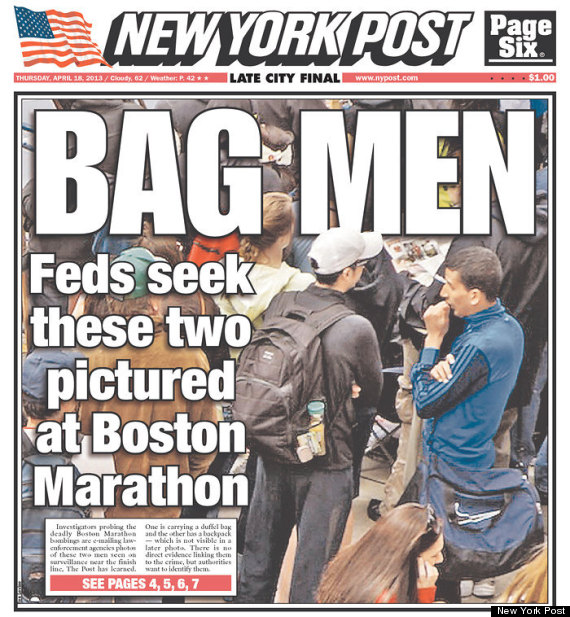
Reader Okian Warrior points out a related story worthy of notice: "The 4chan crowd, poring over images of the Boston marathon, identified two dark-skinned and bag-carrying suspects (among others). This was then picked up by The New York Post, who ran the image on Thursday's front page with the headline 'Feds seek these two pictured at Boston Marathon.' And now, a completely innocent teen now finds himself scared to leave his home." -
One Boston Marathon Bomb Suspect Dead, Other At Large After Shootout With Police
theodp writes "During the night, The Tech broke news that gunshots were reported at MIT near 32 Vassar Street (the Ray and Maria Stata Center for Computer, Information, and Intelligence Sciences), and one officer was shot and taken to Mass General Hospital. MIT's Emergency Information page also reports that injuries have been reported. Sadly, CNN is now reporting that the university police officer has died. Look for updates on Twitter." The two suspects identified earlier as being behind the Boston Marathon bombings are believed to be responsible for this. They were found by police. One suspect, 26-year-old Tamerlan Tsarnaev, was killed in a shootout. The other suspect, 19-year-old Dzhokhar Tsarnaev, is still being pursued. The Associated Press reports that the two are believed to be from the Russian region near Chechnya. During the firefight, the suspects threw explosive devices at police. Public transit in Boston has been shut down, and hundreds of thousands of people have been asked to not leave their homes. Here are live feed for local TV news and emergency services audio. Police have been warned that the remaining suspect may have a suicide vest.
Reader Okian Warrior points out a related story worthy of notice: "The 4chan crowd, poring over images of the Boston marathon, identified two dark-skinned and bag-carrying suspects (among others). This was then picked up by The New York Post, who ran the image on Thursday's front page with the headline 'Feds seek these two pictured at Boston Marathon.' And now, a completely innocent teen now finds himself scared to leave his home." -
DOJ, MIT, JSTOR Seek Anonymity In Swartz Case
theodp writes "Responding to an earlier request by the estate of Aaron Swartz to disclose the names of those involved in the events leading to Aaron's suicide, counsel for MIT snippily told the Court, "The Swartz Estate was not a party to the criminal case, and therefore it is unclear how it has standing, or any legally cognizable interest, to petition for the modification of the Protective Order concerning others' documents." In motions filed on slow-news-day Good Friday (MIT's on spring break), the DOJ, MIT, and JSTOR all insisted on anonymity for those involved in the Swartz case, arguing that redacting of names was a must, citing threats posed by Anonymous and LulzSec, a badly-photoshopped postcard sent to Assistant U.S. Attorney Stephen Heymann and another sent to his Harvard Prof father, cake frosting, a gun hoax, and e-mail sent to MIT. From the DOJ filing: 'I also informed him [Swartz estate lawyer] that whatever additional public benefit might exist by disclosing certain names was, in this case, outweighed by the risk to those individuals of becoming targets of threats, harassment and abuse.' From the MIT filing: 'The publication of MIT's documents in unredacted form could lead to further, more targeted, and more dangerous threats and attacks...The death of Mr. Swartz has created a very volatile atmosphere.' From the JSTOR filing: 'The supercharged nature of the public debate about this case, including hacking incidents, gun hoaxes and threatening messages, gives JSTOR and its employees legitimate concern for their safety and privacy.'"