Slashdot Mirror
Domain: bott.org
Stories and comments across the archive that link to bott.org.
Comments · 29
-
Re:That might be true now
but they got their start as a Veblen good.
I assure you they did not start that way.
-
Re:Why stop now?
Copying Apple has worked for 30 years. Why quit now?
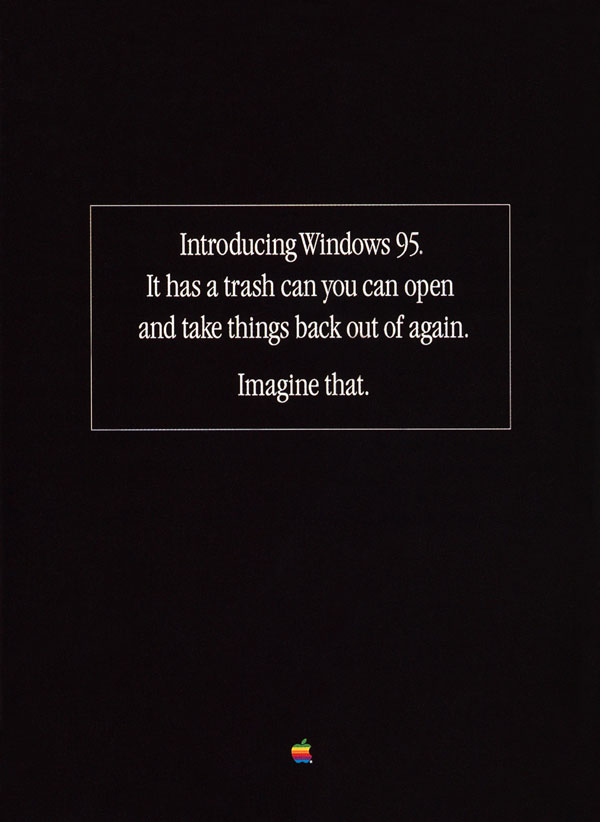
http://applemuseum.bott.org/se...
Yep, like this never gets old!
-
Why stop now?
Copying Apple has worked for 30 years. Why quit now?
-
Sounds great, but...
Interactive live tiles could shine here, turning the click-fest we have now into a modern (no pun intended) take on the original Macintosh control panel.
By replacing dumb menus with interactive gadgets you could shave a click or two off most setting changes, so the user doesn't get lost in nested screen after nested screen.Unfortunately, Microsoft's "modern" design guide seems to be a manifesto on how to make the user as lost as possible, so I'm not getting my hopes up.
-
Re:Easy
Exactly. See for example:
http://en.wikipedia.org/wiki/History_of_Mac_OS
http://osxbook.com/book/bonus/ancient/whatismacosx/history.html
http://applemuseum.bott.org/sections/codenames.htmlSo the versioning becomes slightly obvious, as do the names.
Microsoft is a bit less so -- they keep a consistend internal versioning system, but the "product" names are pure marketing.
Linux distros tend to waffle between pure versioning and attempting to be like Apple or Microsoft -- which makes sense, as there's no one vision driving them all.
-
Re:Yep - He did it to Steve Jobs
My understanding of the history goes like this:
- Apple got permission from Xerox corporate for a private meeting with PARC engineers.
- Apple paid for two meetings and use of Xerox ideas with $1M of Apple stock.
- PARC engineers didn't like the idea but complied.
- Apple engineers were shown the Star and got to ask detailed questions about how it worked and concepts.
- Apple would take the ideas and later build the Mac on it.
The Mac was not an exact copy of the Star. The Xerox Star system however was far from complete. It didn't have drag-and-drop, windows could not overlap, etc. Apple did use the idea of menus, using a mouse as a pointer, etc.
- Apple did not steal the source code from Xerox.
Part of the deal worked out with Xerox was that Apple was shown Smalltalk. However, Xerox built the Star using another own language called Mesa. Even if Apple got the source code and an emulator, it would be useless as the Mac OS was written in assembly.
-
Re:Free-thinking?
Tell that to these people:
Douglas Adams Gary Snyder Bjork
and a few others...
Hardly a list of the most 'conformist' people on the planet...
-
Re:Next up:Delusion_ wrote:
Next up:
the Lisa II
sorry, already done. The Lisa II (or Lisa 2 or Mac XL) was the follow on to the original Lisa. It replaced the Lisa's dual 5.25-inch "Twiggy" floppies with a single 400KB 3.5-inch floppy and came bundled with a Macintosh emulation program (MacWorks XL: basically Mac ROM code adapted to run on the Lisa hardware). It was released around the same time as the original Mac and cost slightly more, but had a larger display, hard disk drive, expandable memory (up to 2MB) and an internal I/O expansion bus. The processor was slower (6MHz for the Lisa vs. 8MHz for the Macintosh) but there was a custom memory protection/memory management chip that was, unfortunately, never used in Macintosh mode.
What you're looking for is the (dreaded) Lisa -
Re:Linux has very good installer packages...
Because "Trainyard" is a much more professional name? "Harmony"? "Dolly"? "Frosting"? They're Microsoft code names. "Diana"? "Adam Ant"? "Rambo?" Apple code names. The release is "Ubuntu 7.04". Go ahead, try to find the word "feisty" or "fawn" on the first page of www.ubuntu.com. If you want to hate Linux, go for it. But get a clue about the rest of the world (including the one you prefer), first.
Apt-get is not a band-aid. That's spoken like someone who hasn't ever used it, and doesn't understand it. It's not "fixing" anything, it's providing an entirely new way of installing software and updating your computer. Windows installers? They depend on the application developer being a "good citizen". And that's it. Hopefully you didn't just google "screensaver" and download something dodgy that just infected your computer with spyware/trojans/viruses/whatever. Try searching for "screensaver" in adept or synaptic. It'll return tons of results, and all of them will be virus-free and easily installable. Ubuntu/Debian apps depend on the operating system maintainers to be good citizens. Who do you trust more to make a compatible, non-buggy installer, Random Q. Developer, or the person who supplies your operating system? -
Apple IIc
My first computer was the Apple IIc. It being portable was awesome. I would take it to my room, downstairs, etc... wherever I needed it. I would also connect it to my parents old color TV for my color monitor needs.
I would fall asleep at the desk writing silly basic programs in between playing Ultima IV, Burgertime, DigDug, Lemmings, Lemonade Stand, Bolo, all the favorites. I still have it and boot it once in a while to ensure that all of my floppies are truly magged out. However, one that did work was a game called Sherwood Forest. A Robin Hood puzzle game. Good times... -
Re:Commodore 64, baby!
I had an apple IIc
(http://applemuseum.bott.org/sections/computers/ IIc.html)
We used Apples at School, so I went with the Apple, not an IBM compatible.
I remember that when we wanted a bigger monitor, we would hook it up to the TV (which had rotary knobs!)
It was cool because it had a handle, so it was portable.
Specifications:
Processor: 65C02 processor running at 1-4 MHz, the fastest of any Apple II.
Memory: came with 128k of RAM expandable to 1 MB.
Display: a 9" green Flat Panel Display on a tilt monitor.
Ports: The Apple IIc 2 serial ports, a mouse port, and a disk port.
And I remember my friends being impressed.... -
Toasted bunny and snail ads were by Chiat/Day
Actually, the ads to which you refer were made by TBWA Chiat/Day, when Steve Jobs was CEO of Apple. However, you're right that it was a long time ago (1998). See the Great Apple Ads page for details.
-
Re:Burn baby Burn
Check out this site. I still think the best Ad ever was the Intel Bunny guy getting burned. Genius!
-
20th Anniversary Macintosh
The single greatest failure of Gil Amelio was approving the 20th Anniversary Macintosh, codename Spartacus. The design was inspired when compared to the standard "pizza boxes" of the time, but the machine was completely overpriced at around $7500 and completely underpowered when compared with the other Macintosh machines which were available at the time. The "TAM" ran at 250MHz while Apple had PowerMac 9600s available earlier that same year running dual processors at 200MHz.
If you expect people to pay premium prices for a "special" machine then it sure as hell better have the fastest processor and the latest hardware available at the time. -
The idea of Windows was stolen from Apple/Xerox
Here's some good stuff for someone's movie entry for this contest: http://applemuseum.bott.org/sections/gui.html Bill Gates also decided the GUI was the way to go during this time. After seeing that Apple refused to license the Mac OS, he announced Windows in 1983, and how it would revolutionize the PC industry. The first version of Windows would not be released for 4 more years. During the development of Windows, Bill Gates feared Apple would sue him due to the fact that his OS was looking a lot like the Mac OS. So on November 22, 1983, John Sculley, then CEO of Apple, signed an agreement to allow Microsoft use Mac OS technology in exchange for further development of Microsoft software for the Mac. This single event would be one of the biggest mistakes in the history of the microcomputing industry. Windows 1.01 was finally released for use with IBM computers and compatible clones on August 11, 1987. Its arcane interface, built on the cryptic MS-DOS operating system, was almost unusable. With its unsightly tiled windows and lack of icons, it was a large disappointment. Even so, Jobs began to complain about how Microsoft had stolen the Mac OS's interface design to which Bill Gates replied in the March 14, 1989 edition of MacWEEK: "Hey, Steve, just because you broke into Xerox's house before I did and took the TV doesn't mean I can't go in later and take the stereo"
-
A link is worth a thousand pictures.
GUI screenshots.
http://www.aci.com.pl/mwichary/guidebook/interface s
Englebart's famous 1968 demo.
http://sloan.stanford.edu/MouseSite/1968Demo.html
Acorn Archimedes GUI
http://homepage.tinet.ie/~lrtc/computers/acorn_ro/ acorn/
http://www.bbc.co.uk/h2g2/guide/A225785
Knowledge Navigator.
http://en.wikipedia.org/wiki/Knowledge_navigator
Apple II GS
http://applemuseum.bott.org/sections/computers/IIg s.html
BeBox
http://www.bebox.nu/history.php
8-1/2: The Plan 9 Window system
http://plan9.bell-labs.com/sys/doc/8%BD/8%BD.pdf
Genera
http://www.geocities.com/mparker762/toys.html
Video Interviews of Early Pioneers
http://www.invisiblerevolution.net/
GUI News
http://interfacelift.com/news/
ZUI's
http://www.cs.umd.edu/hcil/piccolo/applications/in dex.shtml
---
Important Stuff to keep slashdot's filter happy.
# Please try to keep posts on topic.
# Try to reply to other people's comments instead of starting new threads.
# Read other people's messages before posting your own to avoid simply duplicating what has already been said.
# Use a clear subject that describes what your message is about.
# Offtopic, Inflammatory, Inappropriate, Illegal, or Offensive comments might be moderated. (You can read everything, even moderated posts, by adjusting your threshold on the User Preferences Page)
# If you want replies to your comments sent to you, consider logging in or creating an account. -
Re:Tigger
my bad, it will be renamed LASW, For Lawyers are Still Wimps
See the Apple Museum for more code name fun. -
Re:Dude--Apple stole our idea!
It should be noted that Desk Accessories are a lot older than Mac OS 9. In fact, they are from the original System 1.0 of the year 1984.
-
A quick A9 gives me...
-
Old Apple eMate 300?
If price is an issue, what about one of these:
Apple eMate 300
I have one in the closet, and they work pretty well. You can buy them on eBay for about $60 or so, and they have a touch screen, a full keyboard, and 12+ hour battery life.
I have heard of people getting them working with modems and ethernet, but I have not tried it myself. It has a PCMCIA slot though, so it's certainly feasible. -
Re:Icons.
-
I don't see the enmity between Apple and Linux
Unlike some folks, I've been tracking the relationship between Apple and the Linux world for a while now. In fact, my original impetus for becoming a switcher (in 1997 or 1998, no less) was the introduction of MkLinux. That's what convinced me to get rid of my PC and buy a PowerMac 7300.
MkLinux was a project within Apple to port the Linux kernel, along with the necessary GNU tools to make a complete OS, to the PowerMac architecture; this was accomplished by running the Linux kernel as a personality on top of the Mach microkernel, which was ported to the PowerPC PREP/CHRP architecture.
With the advent of other Linux ports to PowerPC, most of which involved running the Linux kernel monolithically rather than hosting it on top of Mach, MkLinux was mothballed and quietly discontinued. However, the engineers at Apple learned a lot from the process, and this set the stage for the eventual merger with NeXT and the Rhapsody project, which evolved into Darwin and OS X. Specifically, lessons learned from porting Mach to PowerPC and hosting various OS personalities on top of it proved invaluable.
It's fair to say that Apple contributes a lot to the Open Source world, and therefore the Linux world by extension. (KHTML has been improved a fair bit by Apple engineers since they picked it as the rendering engine for Safari.) Of course, Apple's contributed more heavily to the *BSD communities.
Suffice it to say that I don't think Apple is worried about Linux, at least not in the way that Microsoft is. I certainly don't see any enmity between Apple and the Linux communities that you seem to be implying.
What software does Apple make available to the Linux world? Well, besides their contributions to KHTML, they have Quicktime Streaming Server (or whatever they're calling it today) and various other Open Source projects that are free for the Linux community to use. Apple's Rendezvous code is open, for instance, and it's a pretty good implementation of ZeroConf as I understand it.
Of course, when push comes to shove, Apple will try to promote their own products over other products. What else would you expect of them? But failure to endorse Linux doesn't mean Apple and Linux are "enemies." Apple's big selling point is ease of use and ease of administration. So far, the Linux world doesn't have this across the board. Since Apple tightly controls the look and feel of everything Macintosh, as well as other aspects that make up the user experience, I don't think Linux will ever quite catch up in this arena. Some things can't be commoditized, and Open Source (for all its benefits) doesn't lend itself to the development of seamlessly integrated software suites with consistent user interfaces. Should that ever happen in a big way, then maybe Apple might re-think its relationship with the Linux world, because then Linux will be competing on Apple's turf; right now, though, there's not much competition. -
Re:Outflank == CopyFact: Apple came to the GUI via Xerox, after attending a PARC presentation which convinced them it was a good idea. What more really needs to be said?
- July 1979: List project started
- September 1979: Mac project started
- November 1979: Jobs et al visit PARC
-
Re:Jan. 22, 1984
The spot aired on Jan. 22, 1984, the date of that year's Super Bowl.
(See here or here for details) -
Keyboard Hall of ShameEnough about the best and most useful keyboards. How about the worst ones?
Here's a couple to start with:
The first Macintosh. I think Apple was so awestruck with the new idea of the GUI that it looks like the keyboard was a mere afterthought with the the first Mac. What they ended up including was designed to encourage mouse-usage; with its heavy-force keystroke requirements and its almost rudimentary nature.
the Atari 400
Anyone remember saving $400 over the price of the full-keyboard Atari 800 by getting one of these things? It spawned a cottage industry of replacement keyboards.
TRS-80 Color Computer. The keyboard on the "ColorTRaSh" was eventually improved, but the earlier models had Fisher-Price written all over.
-
Re:uhhhh....
They thought of that..
Anyone remember the eMate? -
Thorough summary of GUI development history
With a decidedly Apple bent - here.
-
Re:Hello?
Kinda like the code name 'Sagan' that Apple used, that got the hemphead astronomer into a tiff not that long ago.
Part of the tiff though was due not just to the use of his name, but because of the OTHER PowerPC code names being used, namely Cold Fusion and PDM (Piltdown Man) -- All hoaxes.
apple code name -
Dammit, apple
Apple has had good, working handwriting recognition technology ever since the Newton 130 or 2000 or so in 1996.
(Yes, the first newtons had laughable handwriting recognition at first. But by the time that the newton was at the end of its life cycle, it was actually a good, worthwhile, usable product, one that technology is only just now catching up with. People don't remember that the year Windows 95 came out, NewtonOS v2.0 won the "Best New Operating System" award at comdex.. the problem was that Apple released the Newton prematurely, and then hyped it endlessly. Then a few years later, in *1996*, when the thing was actually FIXED, they did absolutely nothing to promote it. So the general public, unless they read "MacWorld" cover to cover, didn't know the Newton then worked-- they just remembered the beginning of the Newton's cycle, when Apple released it in a blitz of hype, and every journalist in the world picked it up, tried it out, and reported, hey, guess what, this thing doesn't WORK.)
Apple will be putting handwriting recognition back into the OS with mac os 10.2. But it is too late-- by the time that 10.2 is released, MS will have their handwriting-recognition-enabled WinXP Tablet Edition *preinstalled on tablet PCs being shipped in stores*. Before 10.2 is released, WinXP Tablet Beta will be in the hands of consumers. Although Apple has had a great handwriting recognition tech for years, MS will actually be releasing the tech first-- and when they do, it will be in a much cooler form, namely tablet laptops. Something apple currently has no analogue for at all. (iWalk? What's that? Is that like the segway?)
Just think what apple could have done: they didn't have the funds or resources to continue developing the Newton in 1997. However, they could have sold/licensed some of that technology to Wacom, and worked with them on getting some kind of simple, early version of this Cintiq thing (which, by the way, is absolutely the coolest tech toy i've seen in ages) created-- then put the newton handwriting recognition stuff into the Mac OS. They would have had an advantage for *quite* awhile in that you would have something absolutely unique for the Mac OS-- Wacom would surely release windows drivers for their tablet/monitor, but 1) it would take a really long time for MS to play catch-up and get some kind of workable handwriting recognition feature, not counting Graffiti (handwriting recognition not being a useful feature, but definitely an eye-catching one to consumers), and 2) this was back when the Mac OS had multiple monitor support, and Windows didn't to speak of. (Mac OS has had seamless multiple monitor support for a long time; Windows didn't in any functional form until Windows 98, and even for awhile after that, it was buggy).
Think about all that could have done for Apple-- even though the monitor might have been prohibhitively hyperexpensive outside of its designated "niche market", given the LCD tech of the day, Apple could have been publicly seen as doing something truly revolutionary and new at a time they were troubled. Instead, Apple just gave off the impression that year of falling apart at the seams. An image problem which of course didn't help sales. Instead, though, MS is going to be the one to first take advantage of this technology, and Apple will be playing catch-up in a field they pioneered.
Typical-- the entire computing world, including apple, is just now catching up with where Apple was six years ago. Once again, Apple is far ahead of Microsoft in terms of getting something working & usable, and far, far behind microsoft in terms of actually getting their technology into the hands of consumers. I'm tired of this being the way the computing world works.
Now i can't wait to see what happens when the Windows world discovers the "voice command" useless gimmick.