Slashdot Mirror
Domain: bu.edu
Stories and comments across the archive that link to bu.edu.
Stories · 24
-
Using Nanotechnology To Build Thinner, Stronger Condoms
Hugh Pickens DOT Com writes "Discovery Magazine reports that the Bill and Melinda Gates Foundation has granted $100,000 to Boston University School of Medicine (BUSM) and Boston Medical Center (BMC) to develop a nanoparticle coating for condoms that will make them more comfortable and stronger while simultaneously keeping them thin to preserve – and increase – sensation in order to make them more appealing to use. According to the Gates Foundation, in the time that condoms have been in use, not much has changed: '[Condoms] have undergone very little technological improvement in the past 50 years. The primary improvement has been the use of latex as the primary material and quality-control measures, which allow for quality testing of each individual condom. Material science and our understanding of neurobiology has undergone revolutionary transformation in the last decade, yet that knowledge has not been applied to improve the product attributes of one of the most ubiquitous and potentially underutilized products on earth.' The nanotechnology that the Boston doctors intend to use for their improved condoms will be superhydrophillic nanoparticles that coat the condom and trap water to make them more resilient and easier to use. 'We believe that by altering the mechanical forces experienced by the condom, we may ultimately be able to make a thinner condom which reduces friction, thereby reducing discomfort associated with friction increases pleasure, thereby increasing condom use and decreases rates of unwanted pregnancy and infection transmission.'" -
A Mind Made From Memristors
Csiko writes "Researchers at Boston University's department of cognitive and neural systems are working on an artificial brain implemented with memristors. 'A memristor is a two-terminal device whose resistance changes depending on the amount, direction, and duration of voltage that's applied to it. But here's the really interesting thing about a memristor: Whatever its past state, or resistance, it freezes that state until another voltage is applied to change it. Maintaining that state requires no power.' Also theoretically described, solid state versions of memristors have not been implemented until recently. Now researchers in Boston claim that memristors are the new key technology to implement highly integrated, powerful artificial brains on cheap and widely available hardware within five years." -
Designing DNA Circuits To Brew Tastier Beer
Al writes "Researchers at Boston University have developed a way to predict the behavior of different DNA segments and make synthetic biology a little bit more reliable. James Collins and colleagues have built libraries of component parts and a mathematical modeling system to help them predict the behavior of parts of a gene network. Like any self-respected bunch of grad students, they decided to demonstrate the approach by making beer. They engineered gene promoters to control when flocculation occurs in brewers yeast, which allowed them to finely control the flavor of the resulting beer." -
Microsoft Seeks Patent On Brain-Based Development
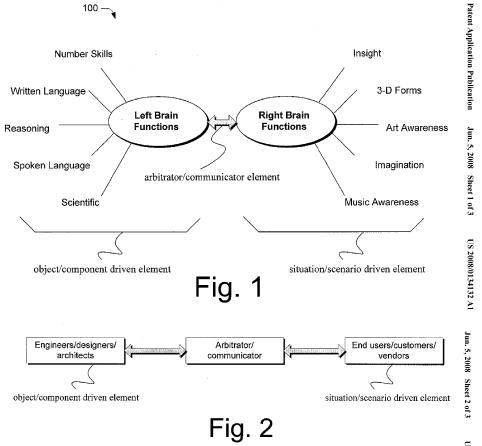
theodp writes "With its just-published patent application for Developing Software Components Based on Brain Lateralization, Microsoft provides yet another example of just how broken the patent system is. Microsoft argues that its 'invention' of having a Program Manager act as an arbitrator/communicator between a group of right-brained software users and left-brained software developers mimics 'the way that the brain communicates between its two distinct hemispheres.' One of the 'inventors' is Ray Ozzie's Technical Strategist. If granted, the patent could be used to exclude others from making, using, or selling the 'invention' for 17 years." -
Microsoft CEO Claims iPhone Will Be Bust
Theaetetus writes "In an interview with USA Today, Microsoft CEO Steve Ballmer claimed there is no chance that the iPhone is going to get any significant market share. The article also deals with Microsoft's friction with the Justice Department, friction with Google, and the profitability of MSN. 'No chance. It's a $500 subsidized item. They may make a lot of money. But if you actually take a look at the 1.3 billion phones that get sold, I'd prefer to have our software in 60% or 70% or 80% of them, than I would to have 2% or 3%, which is what Apple might get. In the case of music, Apple got out early. They were the first to really recognize that you couldn't just think about the device and all the pieces separately. Bravo. Credit that to Steve (Jobs) and Apple. They did a nice job. But it's not like we're at the end of the line of innovation that's going to come in the way people listen to music, watch videos, etc. I'll bet our ads will be less edgy. But my 85-year-old uncle probably will never own an iPod, and I hope we'll get him to own a Zune.'" -
DARPA Funds Remote Control Sharks
An anonymous reader writes "From Undersea Spies: Turning Sharks into Robotic Sentries "It seems like science fiction, but the U.S. military would like to use sharks as underwater spies. The folks at the Defense Advanced Research Projects Agency (DARPA), who dream up the future of weapons and military systems, envision squads of sharks prowling the oceans with sensors that could transmit evidence of explosives or other threats."" -
Petabyte Storage Array
knight13 writes "Engadet is reporting that EMC is rolling out a petabyte RAID array. From the article, "And if you're ready for that level of storage, there's now someplace to get it: EMC has launched its first petabyte array, a version of the company's flagship Symmetrix DMX-3 system that includes nine room-filling cabinets of drives." The price? A mere $4 million." -
Nanoscale Switches in Memory
Frans Faase writes "At the university of Boston, researchers are using nano-scale mechanical switches as a novel technology for building memory. These switches are extremely small, require only femtowatts of power to switch, but still can switch at speeds of 23.57 megahertz. And they are expected to become even smaller and faster and are expected to overcome the theoretical limit of 100 gigabits per square inch capacity for magnetic media." -
Teaching History In Schools With Video Games
Joe writes "There's a story about a Massachusetts company, Muzzy Lane Software, creating a Civ-style simulation computer game to teach history to high school and college students. 'Our view isn't that you take the right video game, stick it in a classroom and everything gets better,' Mr. McCool said. 'But with the right tools, this can significantly enhance learning.'" -
Adobe Kills FrameMaker for Mac
Feneric writes "As noted on FrameUsers.com, FrameMaker for the Mac was officially killed by Adobe. Of course, since one of the primary selling points of FrameMaker is its wonderfully solid cross-platform MS-Windows / Macintosh / Unix support, many are now wondering how long it'll now last for any platform." -
Cultured Perl: Fun with MP3 and Perl, Part 2
Ted writes "I continues to look at manipulating and guessing MP3 tags with Perl, FreeDB, and various CPAN models via my autotag.pl application. Writing autotag.pl was grueling but fun. I used fuzzy string matching, FreeDB searches, ID3 versions 1 and 2, and lots of text-mode user interactions. It all came together in an application that I tested thoroughly over the course of a month. Info and Slashdot comments about Part One can be seen here, which was posted in December." -
Cultured Perl: Fun with MP3 and Perl, Part 1
Ted writes "Every self-respecting computer and music fan needs to be able to manipulate MP3s -- the defacto standard for recreational digital music use. In this article, I'll look at ways to manage and manipulate MP3s (searching, tagging, renaming, commenting, etc.) using the autotag.pl application. I'll also take you through the application, illustrating how CPAN modules enable the application." -
Microsoft Officially Shows Longhorn, WinFX
Theaetetus writes "Microsoft today unveiled its most detailed look yet at its new OS, Longhorn, due in 2006, during Bill Gates' keynote speech at the company's Professional Developers Conference in Los Angeles. An article at Internet Week describes some of the goals: avoiding viruses, worms, and 'building apps that are as smart as Outlook.'" The company "also unveiled 'WinFX,' which it described as a new application programming model for Windows that is the evolution of its .NET programming framework." -
Skittlebrau
diego001 writes "In the spirit of the T.W.I.N.K.I.E.S. Project, and taking a cue from The Simpsons, someone has apparently come up with a real-life Skittlebrau project - various alcoholic beverages with Skittles inside them. Take a look." -
Stephen Wolfram Radio Lecture
Stephen Wolfram, subject of much discussion here, once known solely as the creator of Mathematica, now also known as the author of A New Kind of Science (/. review here), gave a lecture at Boston University this past spring on that book's subject matter. The audio of the lecture was broadcast this evening on the program World of Ideas on WBUR-FM out of Boston. If you don't live in the Boston area, if you missed the program, or if like me you were listening in your car while driving and found that two activites incompatible, the hour-long recording is also available for download in RealMedia format. -
Will Genetic Engineering Kill Us?
Kaz Riprock writes "Mark Baard, author of this Wired article was a recent attendee at The Future of Human Nature symposium (that I helped organize). The talks were held at Boston University through the Pardee Center for the Study of the Longer-Range Future. A high profile assemblage of well-known thinkers, such as Steven Pinker, Lee Silver, and Marvin Minsky, were invited to speak at the 3 day conference to examine what 'Human Nature' would be like in 50-200 years. While the article describes a good amount of the 'doom and gloom' which was presented and discussed, it does not quite capture the upside to our potential future aims. One example from the conference was the talk by Christine Peterson, head of The Foresight Institute, on the future use of nanotechnology to better the human condition." -
Galileo To Commit Mechacide
taylor writes "The Sydney Morning Herald reports that the old explorer spacecraft Galileo will soon commit suicide after flying a final mission. The spacecraft has been orbiting Juptiter for seven years. Tomorrow, Galileo will pass Amalthea, a tiny moon of that planet, to gather information about the moon's gravitational pull on the spacecraft, and thus about its material makeup. Immediately thereafter, Galileo will move quickly through Jupiter's rings, exposing itself to 100 times the radiation a human could withstand. The spacecraft will likely not survive; it is already crippled from the large amounts of radiation it has encountered thus far. In any case, Galileo will then begin its final orbit of Jupiter, ending next September in a fatal crash into the planet's dense atmosphere. Read the full article on SMH.com.au." -
Quantum Holography
Buzz Skyline writes "Physicists succeed where psychics fail. Researchers from Boston University propose a quantum holography system that can construct 3d images of objects sealed in closed containers. Could it lead to quantum luggage scanners at the airport?" -
AOL Shuts Down 3rd Party IM Software?
David Gervais noted that AOL has begun shutting out third party IM software (among other things, breaking the Linux clones). Their error message is "AOL IMer Client: Gaim CVS Version. 09:24:11 AOL Instant Messenger: You have been disconnected from the AOL Instant Message Service (SM) for accessing the AOL network using unauthorized software." Can someone confirm this, or is Mr Gervais on something here? I've had several folks say they can get through just fine. Perhaps this is just a Gaim CVS bug? Update: 09/11 05:12 PM by C : Have tested AIM connectivity with Gaim v0.9.20 and Everybuddy 0.1.4 with no problems. Sorry for the scare. -
In Depth Look At Red Hat Certification
Matthew Miller recently went through the RH300 training course, as well as the RHCE Certification Exam. He was kind enough to write an overview and give us his opinions on both of them, as well as his opinions on the relevance and quality of the training and the exam. Certification has been discussed extensively with regards to Linux, and here's a big scoop of food for thought.The following was written by Slashdot Reader Matthew Miller
I'm fortunate enough to work at a place that realizes the importance of keeping employees educated and up-to-date. Since my largest current project is Linux-related, and based on Red Hat's distribution in specific, we thought it'd be worthwhile to send me to Red Hat for their RH300 course. I'm pretty familiar with Linux, but I'm a long way from knowing everything, and it's always interesting to learn what the vendor thinks are the most important parts of their product. We chose RH300 because it's the highest-level systems administration class currently offered. It's also the one linked to the RHCE exam, which was an added bonus, but learning was my main goal, not getting the certification. This is my report on the experience -- hopefully, it will help you decide if this is a good choice for you, either as a sysadmin or as an employer.
The Training CenterThis course is not only available directly from Red Hat, but also from various partner organizations, including Global Knowledge, which has a training center here in Boston. However, we decided that if we were going to go to the expense of sending me, I might as well go directly to Red Hat, to increase the chances of getting a good instructor, and to insure adequate access to resources. We've had experiences in the past with third-party instructors who didn't know much beyond what was written in the materials. Of course, I don't know that this would be the case with Global Knowledge's version of RH300 -- perhaps someone else can comment on any experience they've had there.
So, it was off to the Red Hat headquarters in Durham, NC. Incidentally, I stayed in the Residence Inn there -- it was on Red Hat's site as being nearby. They didn't mention that it was on the other side of a major highway, with no provision for pedestrians to get across. Moral: stay at one of the closer hotels, or else get a car. Anyway, the RH building is very nice -- much bigger than I expected. (I suppose the IPO cash is going to good use.) Of course, as students, we weren't shown much of it -- no tour, and we weren't introduced to any of the celebrity employees. (Fair enough -- with several classes coming through every week, they'd never get anything done.) The people I did meet seemed pretty cool, and in general I got the impression that it's a fun place to work.
The classroom was about as I expected -- projection screen up front, rows of decent-enough small-brand Celeron-based systems (one per student). The machines were on a private network -- reasonable for the course, but unfortunately there was no provision for Internet access, which at the least would have been nice to have when I finished labs early.
We did have access to a breakroom with free soft drinks / juice and various snack items. This is also where the lunches were served -- to my surprise, these were quite good, and there were even decent non-meat choices.
The TeacherThe instructor was very knowledgeable -- not necessarily a complete guru, but he knew his stuff, including the "why" behind the course material. He was able to present the material in a good way, and was good at answering questions. I think the decision to go to Red Hat directly was wise; unlike a third-party consultant, he had some idea of what was going on inside of Red Hat and of their potential future plans. For example, during the section on the printing subsystem, he mentioned that they're considering a replacement for LPR in future releases -- perhaps LPRng or even CUPS. It's unlikely that someone from a different company would have had access to that kind of information.
Other StudentsThe other students in the course had a wide range of skills and backgrounds. I think that everyone probably met the listed better than pico. However, I could tell that some people were struggling. The instructor mentioned that the pass rate for the exam is about 65%, and I wouldn't be surprised if our class came out at that level or worse. It's not that anyone was stupid -- just that some people were out of their depth. On the other end of the spectrum, there were some people who were over-qualified: a few highly experienced sysadmins, and some folks from IBM taking the class because they are soon going to teach it.
The CourseThe course was generally similar to the outline found on Red Hat's site, although I think the online information is a bit out of date. (Notice that the Web page makes reference to ipfwadm instead of ipchains or netfilter.) The eight units had slightly different names, and covered slightly different information. In the most drastic example, Unit 8, listed on the Web site as "Systems Administration and Security II", has turned into "Routers, Firewalls, Clusters and Troubleshooting". Some of the information listed in the online Unit 8 was moved into Unit 7, and some of it (cops, for instance) wasn't talked about at all. Hopefully, the online info will be updated soon.
Overall, the class went into less depth than I was hoping. Some of this was due to limitations of the lab setup -- it's a bit difficult to experiment with RAID in any meaningful way when you've only got one IDE hard drive, and obviously impossible to set up a cluster on one machine (short of running VMware). Other things where just plain introductory -- the section on the kernel, for example, focused on the steps required to build and install a new kernel, rather than being an in-depth discussion of tunable parameters. The part about Apache was similar; I was hoping to hear "You've all configured Apache before; here's things you should be aware of when you need it to do such-and-such", but the most advanced we got was setting up a virtual host. Building RPMs from source was mentioned briefly, but there was no information given on important and largely undocumented topics like --buildpolicy.
That's not to say I didn't learn anything -- the section on LVS / Piranha was enlightening even without hands-on experience, and I appreciated the part about quotas, which isn't something I've worked with much. And, I learned a large number of tiny things which add up to making the experience worthwhile to me. RPM can now do globbing over ftp! Portmap uses tcp_wrappers, but doesn't do reverse name lookups, so be sure to use IP addresses instead of names. RH Linux provides a little script called "service" that lets one avoid the tedium of typing /etc/rc.d/init.d/servicename all the time. And so on....
The "300" designation is a bit misleading. This isn't really what I'd consider an upper-level course -- it's more along the lines of SysAdmin 101. Overall, I think this class is probably worthwhile to someone with a good RH Linux background who hasn't done any systems administration. In fact, I'd even recommend it to people in that situation. On the other hand, if you've been a Linux sysadmin for a while, you'll probably be bored most of the time. It might be valuable to experienced Unix sysadmins who haven't dealt with Linux much (or even Linux admins who haven't used Red Hat Linux), but the course wasn't particularly taught from that angle and there are probably better options.
The ExamSince I signed a confidentiality agreement, I can't talk about specific details of the test, but I will address the exam in general terms. It's a day-long three part process, with each part being worth 1/3 of the total. To pass, your overall score must be at least 80%, and you can't do worse than 50% on any one part.
One of the sections is a typical multiple-choice test, but the other two are lab based. I was quite impressed with the hands-on tests -- they are certainly what makes the RHCE meaningful. I'm not aware of any other sysadmin certifications that work this way.
For one of the lab tests, students are given a several-page specification, and must install and configure Red Hat Linux and several network services. This wasn't particularly difficult, and shouldn't be for anyone with much experience. For me, the hardest part was resisting the temptation to go beyond the spec -- since I finished the given requirements with plenty of spare time, I considered installing and setting up additional services in a way that would fit in with the listed goals. But, I decided that it'd be better to leave well-enough alone -- there's no concept of extra credit.
The other hands-on test is the cool and exciting one. Students are given preconfigured setups which are broken in some way, and given a task that must be completed. The system's problem doesn't necessarily relate directly to the task, but does interfere with it. The test-taker must find out what's wrong and correct the error. (Reinstalling packages is not allowed.) Being able to list the steps taken and to repeat the fix is important, but ultimately the test is scored on a works / doesn't work basis. One the examiner verifies that the problem is fixed, he or she wipes the system and provides another broken config.
This problem-solving section directly tests skills important to being a sysadmin in the real world; if someone has trouble with these, they're probably not ready for a systems administration job. Of course, just passing this test doesn't guarantee good problem solving skills (let alone all the other needed abilities), but it does seem a genuinely valuable indicator.
I've only two complaints with this part of the test. First, I'd make it a much larger section -- at least 50% -- and I'd increase the number of problems given so that there'd be a better sample size. The various challenges are assigned at random, and some are easier than others, and each tests knowledge of different parts of the system. The way it's done isn't bad, but it wouldn't hurt to have a lot more of it. Second, I'd give each student two computers, and make more of the problems network-related. This has logistical and cost issues (especially in places other than Red Hat's own training centers), but since many of the problems faced in the real world have to do with the way systems interact, I feel it'd be worth it.
The Exam Separated From The CourseYou may have noticed that I seem a lot more excited by the exam than by the course itself. I think both are valuable, but they seemed aimed at slightly different levels. The course definitely can serve as a good review for the exam, but if you need the course, you won't do well on the test. If you're tight on cash and the certification seems valuable to you or to your employer, going straight to the exam would be reasonable. (Make sure you take a look at Red Hat's test prep page.) On the other hand, if you need to be quickly brought up to speed on the basic knowledge required of a RH Linux sysadmin, it might make sense to take this course without worrying about the test. Since RH300 is equivalent to RH033 + RH133 + RH253, this could be a much more intensive and time-efficient option.
Red Hat-SpecificnessIt's probably obvious, but bears mentioning anyway: this is a Red Hat Linux course and certification, not a general Linux one. I found this to be true both explicitly and implicitly. The instructor was good about saying "This is the Red Hat way of doing things -- it's possibly different on other distributions." (I found the increase-the-whole-pie attitude to be common to all of the RH employees I talked to.) There were also quite a few things that were just assumed. If you take the exam without knowing a lot about Red Hat Linux in particular, you're likely to have trouble.
This doesn't make the certification meaningless for organizations running other distributions -- many of the skills and knowledge required for the test (especially the problem solving part) are generally applicable anywhere. In fact, due to the lab-based testing process, I have more respect for this exam than I might for a multiple-choice test covering more distributions. I think this issue is a one-way sort of thing: the RHCE exam requires knowledge of Red Hat Linux, but anyone who can pass it shouldn't have much trouble picking up other flavors.
StuffOk, the Web page promises that they'll give Red Hat promotional items to course participants. Yeah, well, they can do better on this front. Not even a t-shirt! C'mon, everyone gives t-shirts. Vendor shirts are a staple of my wardrobe! All we got was a mousepad, some stickers, and a baseball cap. (No chance of getting a red fedora.) Oh, and of course an official copy of the CD (with the 180 days of support). Many people in the class were surprised to learn that Red Hat doesn't sell anything from their offices -- you can't buy copies of the distro or additional merchandise. They've got a lot of students coming through there, so it seems like this could be a decent (even if relatively small) revenue stream.
A Bit About Study GuidesBefore I went, I flipped through RHCE Exam Cram , the sole study guide I found at the local bookstore. Someone in the class actually purchased it and brought it with them, and I got a chance to read more of it then. I wasn't really impressed. The book was especially concerned with what it called "trick questions", and indeed its sample questions were sometimes a bit confusing -- and often poorly worded. After taking the test, I can say that this seems mostly to be a problem with the book, not something encountered on the actual exam, which was mostly straightforward and fair.
There are RHCE study guides, but I wouldn't recommend spending any money on any of them. As the course instructor told us: if you're going to pass, you'll do so even if you don't have a guide. And if you're going to fail, the guide won't be much help.
ConclusionI think the RH300 course and RHCE certification can be valuable to both employers and individuals. The course provides a nice quick overview of the basics needed to move, for example, from being a systems operator to being an admin. I wouldn't think of it as either a requirement for the test or as something that can make someone not ready suddenly have the skills required for the exam. Since the exam is hands-on and lab based, those abilities can only come from real world experience. Looking at that from the other direction: this is exactly what makes the RHCE worth anything. While it's not a total statement on someone's talent, being able to pass is a strong indicator that they have the basic skills for a systems administration job. If I were making hiring decisions, I wouldn't make the RHCE a requirement, but I would have more confidence in applicants who have it.
-
In Depth Look At Red Hat Certification
Matthew Miller recently went through the RH300 training course, as well as the RHCE Certification Exam. He was kind enough to write an overview and give us his opinions on both of them, as well as his opinions on the relevance and quality of the training and the exam. Certification has been discussed extensively with regards to Linux, and here's a big scoop of food for thought.The following was written by Slashdot Reader Matthew Miller
I'm fortunate enough to work at a place that realizes the importance of keeping employees educated and up-to-date. Since my largest current project is Linux-related, and based on Red Hat's distribution in specific, we thought it'd be worthwhile to send me to Red Hat for their RH300 course. I'm pretty familiar with Linux, but I'm a long way from knowing everything, and it's always interesting to learn what the vendor thinks are the most important parts of their product. We chose RH300 because it's the highest-level systems administration class currently offered. It's also the one linked to the RHCE exam, which was an added bonus, but learning was my main goal, not getting the certification. This is my report on the experience -- hopefully, it will help you decide if this is a good choice for you, either as a sysadmin or as an employer.
The Training CenterThis course is not only available directly from Red Hat, but also from various partner organizations, including Global Knowledge, which has a training center here in Boston. However, we decided that if we were going to go to the expense of sending me, I might as well go directly to Red Hat, to increase the chances of getting a good instructor, and to insure adequate access to resources. We've had experiences in the past with third-party instructors who didn't know much beyond what was written in the materials. Of course, I don't know that this would be the case with Global Knowledge's version of RH300 -- perhaps someone else can comment on any experience they've had there.
So, it was off to the Red Hat headquarters in Durham, NC. Incidentally, I stayed in the Residence Inn there -- it was on Red Hat's site as being nearby. They didn't mention that it was on the other side of a major highway, with no provision for pedestrians to get across. Moral: stay at one of the closer hotels, or else get a car. Anyway, the RH building is very nice -- much bigger than I expected. (I suppose the IPO cash is going to good use.) Of course, as students, we weren't shown much of it -- no tour, and we weren't introduced to any of the celebrity employees. (Fair enough -- with several classes coming through every week, they'd never get anything done.) The people I did meet seemed pretty cool, and in general I got the impression that it's a fun place to work.
The classroom was about as I expected -- projection screen up front, rows of decent-enough small-brand Celeron-based systems (one per student). The machines were on a private network -- reasonable for the course, but unfortunately there was no provision for Internet access, which at the least would have been nice to have when I finished labs early.
We did have access to a breakroom with free soft drinks / juice and various snack items. This is also where the lunches were served -- to my surprise, these were quite good, and there were even decent non-meat choices.
The TeacherThe instructor was very knowledgeable -- not necessarily a complete guru, but he knew his stuff, including the "why" behind the course material. He was able to present the material in a good way, and was good at answering questions. I think the decision to go to Red Hat directly was wise; unlike a third-party consultant, he had some idea of what was going on inside of Red Hat and of their potential future plans. For example, during the section on the printing subsystem, he mentioned that they're considering a replacement for LPR in future releases -- perhaps LPRng or even CUPS. It's unlikely that someone from a different company would have had access to that kind of information.
Other StudentsThe other students in the course had a wide range of skills and backgrounds. I think that everyone probably met the listed better than pico. However, I could tell that some people were struggling. The instructor mentioned that the pass rate for the exam is about 65%, and I wouldn't be surprised if our class came out at that level or worse. It's not that anyone was stupid -- just that some people were out of their depth. On the other end of the spectrum, there were some people who were over-qualified: a few highly experienced sysadmins, and some folks from IBM taking the class because they are soon going to teach it.
The CourseThe course was generally similar to the outline found on Red Hat's site, although I think the online information is a bit out of date. (Notice that the Web page makes reference to ipfwadm instead of ipchains or netfilter.) The eight units had slightly different names, and covered slightly different information. In the most drastic example, Unit 8, listed on the Web site as "Systems Administration and Security II", has turned into "Routers, Firewalls, Clusters and Troubleshooting". Some of the information listed in the online Unit 8 was moved into Unit 7, and some of it (cops, for instance) wasn't talked about at all. Hopefully, the online info will be updated soon.
Overall, the class went into less depth than I was hoping. Some of this was due to limitations of the lab setup -- it's a bit difficult to experiment with RAID in any meaningful way when you've only got one IDE hard drive, and obviously impossible to set up a cluster on one machine (short of running VMware). Other things where just plain introductory -- the section on the kernel, for example, focused on the steps required to build and install a new kernel, rather than being an in-depth discussion of tunable parameters. The part about Apache was similar; I was hoping to hear "You've all configured Apache before; here's things you should be aware of when you need it to do such-and-such", but the most advanced we got was setting up a virtual host. Building RPMs from source was mentioned briefly, but there was no information given on important and largely undocumented topics like --buildpolicy.
That's not to say I didn't learn anything -- the section on LVS / Piranha was enlightening even without hands-on experience, and I appreciated the part about quotas, which isn't something I've worked with much. And, I learned a large number of tiny things which add up to making the experience worthwhile to me. RPM can now do globbing over ftp! Portmap uses tcp_wrappers, but doesn't do reverse name lookups, so be sure to use IP addresses instead of names. RH Linux provides a little script called "service" that lets one avoid the tedium of typing /etc/rc.d/init.d/servicename all the time. And so on....
The "300" designation is a bit misleading. This isn't really what I'd consider an upper-level course -- it's more along the lines of SysAdmin 101. Overall, I think this class is probably worthwhile to someone with a good RH Linux background who hasn't done any systems administration. In fact, I'd even recommend it to people in that situation. On the other hand, if you've been a Linux sysadmin for a while, you'll probably be bored most of the time. It might be valuable to experienced Unix sysadmins who haven't dealt with Linux much (or even Linux admins who haven't used Red Hat Linux), but the course wasn't particularly taught from that angle and there are probably better options.
The ExamSince I signed a confidentiality agreement, I can't talk about specific details of the test, but I will address the exam in general terms. It's a day-long three part process, with each part being worth 1/3 of the total. To pass, your overall score must be at least 80%, and you can't do worse than 50% on any one part.
One of the sections is a typical multiple-choice test, but the other two are lab based. I was quite impressed with the hands-on tests -- they are certainly what makes the RHCE meaningful. I'm not aware of any other sysadmin certifications that work this way.
For one of the lab tests, students are given a several-page specification, and must install and configure Red Hat Linux and several network services. This wasn't particularly difficult, and shouldn't be for anyone with much experience. For me, the hardest part was resisting the temptation to go beyond the spec -- since I finished the given requirements with plenty of spare time, I considered installing and setting up additional services in a way that would fit in with the listed goals. But, I decided that it'd be better to leave well-enough alone -- there's no concept of extra credit.
The other hands-on test is the cool and exciting one. Students are given preconfigured setups which are broken in some way, and given a task that must be completed. The system's problem doesn't necessarily relate directly to the task, but does interfere with it. The test-taker must find out what's wrong and correct the error. (Reinstalling packages is not allowed.) Being able to list the steps taken and to repeat the fix is important, but ultimately the test is scored on a works / doesn't work basis. One the examiner verifies that the problem is fixed, he or she wipes the system and provides another broken config.
This problem-solving section directly tests skills important to being a sysadmin in the real world; if someone has trouble with these, they're probably not ready for a systems administration job. Of course, just passing this test doesn't guarantee good problem solving skills (let alone all the other needed abilities), but it does seem a genuinely valuable indicator.
I've only two complaints with this part of the test. First, I'd make it a much larger section -- at least 50% -- and I'd increase the number of problems given so that there'd be a better sample size. The various challenges are assigned at random, and some are easier than others, and each tests knowledge of different parts of the system. The way it's done isn't bad, but it wouldn't hurt to have a lot more of it. Second, I'd give each student two computers, and make more of the problems network-related. This has logistical and cost issues (especially in places other than Red Hat's own training centers), but since many of the problems faced in the real world have to do with the way systems interact, I feel it'd be worth it.
The Exam Separated From The CourseYou may have noticed that I seem a lot more excited by the exam than by the course itself. I think both are valuable, but they seemed aimed at slightly different levels. The course definitely can serve as a good review for the exam, but if you need the course, you won't do well on the test. If you're tight on cash and the certification seems valuable to you or to your employer, going straight to the exam would be reasonable. (Make sure you take a look at Red Hat's test prep page.) On the other hand, if you need to be quickly brought up to speed on the basic knowledge required of a RH Linux sysadmin, it might make sense to take this course without worrying about the test. Since RH300 is equivalent to RH033 + RH133 + RH253, this could be a much more intensive and time-efficient option.
Red Hat-SpecificnessIt's probably obvious, but bears mentioning anyway: this is a Red Hat Linux course and certification, not a general Linux one. I found this to be true both explicitly and implicitly. The instructor was good about saying "This is the Red Hat way of doing things -- it's possibly different on other distributions." (I found the increase-the-whole-pie attitude to be common to all of the RH employees I talked to.) There were also quite a few things that were just assumed. If you take the exam without knowing a lot about Red Hat Linux in particular, you're likely to have trouble.
This doesn't make the certification meaningless for organizations running other distributions -- many of the skills and knowledge required for the test (especially the problem solving part) are generally applicable anywhere. In fact, due to the lab-based testing process, I have more respect for this exam than I might for a multiple-choice test covering more distributions. I think this issue is a one-way sort of thing: the RHCE exam requires knowledge of Red Hat Linux, but anyone who can pass it shouldn't have much trouble picking up other flavors.
StuffOk, the Web page promises that they'll give Red Hat promotional items to course participants. Yeah, well, they can do better on this front. Not even a t-shirt! C'mon, everyone gives t-shirts. Vendor shirts are a staple of my wardrobe! All we got was a mousepad, some stickers, and a baseball cap. (No chance of getting a red fedora.) Oh, and of course an official copy of the CD (with the 180 days of support). Many people in the class were surprised to learn that Red Hat doesn't sell anything from their offices -- you can't buy copies of the distro or additional merchandise. They've got a lot of students coming through there, so it seems like this could be a decent (even if relatively small) revenue stream.
A Bit About Study GuidesBefore I went, I flipped through RHCE Exam Cram , the sole study guide I found at the local bookstore. Someone in the class actually purchased it and brought it with them, and I got a chance to read more of it then. I wasn't really impressed. The book was especially concerned with what it called "trick questions", and indeed its sample questions were sometimes a bit confusing -- and often poorly worded. After taking the test, I can say that this seems mostly to be a problem with the book, not something encountered on the actual exam, which was mostly straightforward and fair.
There are RHCE study guides, but I wouldn't recommend spending any money on any of them. As the course instructor told us: if you're going to pass, you'll do so even if you don't have a guide. And if you're going to fail, the guide won't be much help.
ConclusionI think the RH300 course and RHCE certification can be valuable to both employers and individuals. The course provides a nice quick overview of the basics needed to move, for example, from being a systems operator to being an admin. I wouldn't think of it as either a requirement for the test or as something that can make someone not ready suddenly have the skills required for the exam. Since the exam is hands-on and lab based, those abilities can only come from real world experience. Looking at that from the other direction: this is exactly what makes the RHCE worth anything. While it's not a total statement on someone's talent, being able to pass is a strong indicator that they have the basic skills for a systems administration job. If I were making hiring decisions, I wouldn't make the RHCE a requirement, but I would have more confidence in applicants who have it.
-
G4 vs. Athlon Review
heatseeka writes "There is a great article at Ars Technica comparing the Motorola G4 and the AMD Athlon. They discuss every detail of the design of the CPU's, and give credit where credit is due. " Hannibal does a great job dissecting the different chips, as well as explaining the background behind each chip. -
RISC vs. CISC in the post-RISC era
S. Casey writes "Ars Technica has a very cool article up that takes on the typical RISC versus CISC debate. The author argues that today's microprocessors aren't RISC or CISC, really, and covers the historical/technical reasons why these two distinctions aren't particularly useful anymore. It's pretty convincing (to me). " Essentially, the author argues that it is difficult, if not impossible, to have the normal debate because both chipsets have evolved features that used to be found in the other chipset. -
Petreley, OEMs and Choice
Justin Hahn writes "Take a look at Nick Petreley's Latest. It's a good rundown of TMS, and actually gives a decent metaphor to what MS really is doing. Also gives a top ten as to what will happen if OEMs get a choice. " I dig Petreley. Unlike most of his peers, he almost always is on the money.