Slashdot Mirror
Domain: cam.ac.uk
Stories and comments across the archive that link to cam.ac.uk.
Comments · 1,846
-
How you can help
"IF YOU'RE AN ENGINEER, COMPUTER SCIENTIST, ETC: learn some biology. I started making really well-received contributions to biogerontology after I'd been reading the literature for TWO MONTHS -- no kidding. Maybe I was lucky, but maybe it was just that scientists really need input from people with a different training and mindset. Don't take the easy way out of thinking that you can't help because you haven't got the right expertise."...says SENS
-
Re:Entropy will winThis is correct, a great deal of aging is due to mitchondrial mutations. That was confirmed very recently by a Swedish team, and bolsters Aubrey de Grey's proposals quite considerably.
Go read the SENS proposals - they'll tell you exactly how we currently believe we can fix the aging process. Knowing how to do it is half the battle. After that, it's just time, money, and sweat.
-
Re:dimmer than night sky??
Any portion of sky which doesn't have a star/galaxy in it is black, black black!
Not totally black... there is a fair bit of light that reflects off dust in the solar system (zodiacal light). So it's entirely possible for this galaxy to appear 101% as bright as the background sky.
And just for general info... there are lots of low-surface brightness galaxies out there - Malin1 for example. -
There is a more general proof now:Recently some guys managed to prove that there exists an infinite number of arithmetic progressions of prime numbers of any length. So, it is not only true for p, p+2.. but true for (p, p+N), and also for (p, p+k,
In setting out to prove that there are an infinite number of arithmetic progressions of prime numbers with four terms, two mathematicians appear to have proved the result for prime progressions of all lengths.
A summary of the article appeared in science. The research article is currently under review. but there is a preprint available on arXiv, and also a nice image that shows the result graphically.
-
Slashvertisement?Submitter: Stab, a.k.a. Anil Madhavapeddy
Story is about HighEnergyMagic, for which WHOIS tells me:Administrative Contact:
Story is mirrored at University of Cambridge Systems Research Group, where we find that the page is "© 2004 Anil Madhavapeddy".
Madhavapeddy, Anil anil@recoil.org
100 Carnbrae Avenue
Belfast, Northern Ireland BT8 6NH
UK
+44 7771640674Seriously, shouldn't the submitter put some sort of a disclaimer somewhere? Or failing which, at least pay Slashdot to run these "ads", dammit!
-
Re:Astroturf...
Because this was invented at the University of Cambridge Computer Laboratory, in the Systems Research Group. Link
-
Mirror for some of the videos
Since the main site is predictably a bit bogged down, there is also a page at the University of Cambridge Systems Research Group detailing the research side of things. It also has some cool videos
-
Moderately OTSome of the best lecture notes (I feel) covering the basics of Game Theory at a mathematically 'serious' level:
http://www.statslab.cam.ac.uk/~rrw1/mor/index.htm
l The author is an very well respected operational researcher (sadly no poker analysis in these notes). I had the good fortune to be lectured this course a couple of years back and found it incredibly interesting.
-
Re:You don't have to give up SUV's
As I've said before I'd define 10,240mpg as good mileage
-
Re:The plot thickens
when Dennis Ritchie wrote the compiler for the BCPL language
Uh, I think you'll find that BCPL was written by Martin Richards. -
Re:The plot thickens
when Dennis Ritchie wrote the compiler for the BCPL language
Uh, I think you'll find that BCPL was written by Martin Richards. -
taxes
How much of your 4$/gallon is EU or local taxes? From my quick search it looks like the UK and France have gas price + 300% tax. That suggests $1gas plus $3taxes. These are 1997 numbers too. It's likely taxes have increased since then. (details)
The US has what we consider high taxes on gas. Hawaii is 53.5c (as of July 2002), California is 50.4c, and Texas is 38.4c/gallon. (details) -
Re:Get the name of the period right!exp(\pi * \sqrt(163))
What does this all mean?This number has the surprising property of being within 10^-12 of an integer. It is known as "Ramanujan's number", after the Indian mathematician who made the observation. For a well-presented (warning: technical) proof of this fact, read Ben Green's account.
-
Re:Get the name of the period right!exp(\pi * \sqrt(163))
What does this all mean?This number has the surprising property of being within 10^-12 of an integer. It is known as "Ramanujan's number", after the Indian mathematician who made the observation. For a well-presented (warning: technical) proof of this fact, read Ben Green's account.
-
Please learn how to make links.Please learn how to make links.
<a href="http://www.admin.cam.ac.uk/univ/science/dna
yields: last year/ ">last year</a> -
Re:Secure ?
Ahhh but it's the asymmetry.
A would-be hacker just has to find one bug...
Ross Anderson describes it much better... -- *.pdf format -
Re:I never understood the Bittorrent thing...
Having just written a paper on BitTorrent (which should be presented at PGNET 2004 if anyone cares), a couple of points:
1. About 20% of people upload at least as much as they download. Which isn't a staggering number (I expected a lot higher), but that's still a reasonable number of people.
2. eDonkey - don't know about you, but I get about 24kbit/s on eDonkey. On BitTorrent, average bandwidth available per user comes out at around 200kbit/s, although I've seen up to 8mbit/s on high-demand torrents.
Oh, and there's another interesting paper at http://www.cl.cam.ac.uk/Research/SRG/netos/pam2004
-
Re:dates
Of course, that RFC is based on, and explicitly refers to the more authoritative ISO 8601 standard, which makes so much sense that I sometimes feel like printing it out, rolling it up and beating some Americans over the head with it.
-
Re:Established paper size
This, actually, is the official date format in Sweden. It's beautiful. This of course does not in any way mean that you in Swedish always say dates like that, it's just a writing thing. Absolutely lovely. Logical, sorts well, and even is an international standard. Now, if only it were used in even more places (like best-before dates on all foods) I'd be happy. Um. Make that "happier", there are more important things I guess.
-
Re:Established paper size
Date.
British: 14/5/2004
American: 5/14/2004
ISO8601: 2004-05-14
(Incidentally, the ISO8601 page is maintained by the same author as this Metric paper page.) -
google is your friend
This web-page: International Standard Paper Sizes contains all the information you would ever need about the history and advantages of A4 paper and its relationship with the US standards.
-
article doesn't mention
Turing is one of the reasons that I'm heading to King's College to take my PhD (although the Turing room there is hardly a suitable tribute to his memory).
The end to his story is extremely tragic (although this must all be taken with a pinch of salt) - apparently, had Turing's involvement in the war effor been known, he would have been saved the indignity of the trials and medical procedures that were foisted upon him. Given that he arguably won the war for us, that doesn't seem unreasonable. Unfortunately the paranoia surrounding the country after the war meant that Turing's involvement had to remain a secret until the 1970s which was clearly far too late. As a result, the intolerance of the time lost us the service of one of the finest minds and most decent men we've seen.
henry
-
Coffee was first by 12 years
Anyone remember this? I remember running XCoffee when hanging out at CL ten years ago.
-
Re:Grey goo
The UK parliment Science and Technology recently discussed nanotechnology, they question experts on how likley senario's like those depected in Michael Crichton's Prey, are to happen.
Useful Nanotech progress in the UK:Nanotechnologies to Cure Disease. -
Re:Old! :)
Why can't people use ISO date format? That is the silly month/day/year format.
The ISO format is YYYY-MM-DD. Big-endian, like how we write other numbers, or times. Sorts easily.
See the ISO date format campaign.
An interesting alternative is to do what VMS does: 4-MAY-2004 No ambiguity when you spell out the month (VMS uses three letter abbreviations). But it's not culture neutral of course... -
Re:Wrong month, guys.
Actually that would be 2004/5/1, since year/month/day is the ISO standard.
-
Re:Wrong way round
For better or for worse, DRM is a battle that content providers will lose
No they won't.
Don't be surprised when Apple suddenly becomes one of the biggest supporters of "trusted" computing, and introduces a palladium technology of their own. And all the Mac zealots who were busy telling us before why Apple DRM was good, while Microsoft DRM was bad, will come back to tell us why Mac Palladium is good.
I'm not saying the coders here are doing something wrong because they are pushing Apple in that direction: if we self censor ourselves to appease the DRM monglers, then we are where they wants us anyways. Apple picked sides in this battle, and for all the bullshit their fans are feeding us about "nice" DRM, the side they chose leads only one way. Goodbye user controlled computer. Welcome Palladium controlled user. -
Re:What I do.
Get a wacom graphics tablet with a stylus (works with linux also). Then download dasher for doing long sessions of text entry. You spell out words by "driving" the cursor in the direction that the characters come flying toward you (see the animation). Also get xstroke to do graffiti like handwriting recognition. My next goal it to start looking into voice recognition.
-
Re:What I do.
Get a wacom graphics tablet with a stylus (works with linux also). Then download dasher for doing long sessions of text entry. You spell out words by "driving" the cursor in the direction that the characters come flying toward you (see the animation). Also get xstroke to do graffiti like handwriting recognition. My next goal it to start looking into voice recognition.
-
Xen and Wine
I supported Wine development in a small way early on when I was director of the Syntropy Institute. I think one of the most important things we've learned from Wine Development is that catching up with a complex closed source project is _hard_. My guess is that Xen will be the first Open Source product to really allow Windows and Linux to coexist well. IMHO it is worthwhile for Wine to be fully developed-but in the meantime, Xen provides a solution that is applicable for folks that already have a Windows license. Xen appears to have Microsoft's blessing. The release of Xen will mean there is no reason not to have Linux on any Windows machine-you'll be able to give Windows badly needed adult supervision with no more ill effects other than use of a bit of disk space and cpu cycles.
-
Well....
Start at the LaTeX project site.
Go buy Leslie Lamport's "LaTeX: A Document Preparation System" book.
Take a look at the Indian TeX Users Group's LaTeX tutorial.
Then read Tobias Oetiker's "The Not So Short Introduction to LaTeX 2e"
If you need a quick start then start using Lyx and their Tips and Tricks section.
-
Re:170 dpi?What's the point of 170dpi?
In fact, some magazines and other printed media contain text rasterized at way, way higher resolution, in the ranges of 1200-2400 dpi even. Graphics are usually rasterized at 150 - 300 dpi, 600 - 1200 for high quality (high dollar) prints. On the other hand, most colour-printed media use colour separations to obtain (seemingly) higher resolution.
-
Re:Noose for the gownsman
Although that might be exaggerating slightly.
-
Something like this you mean?
-
VMWare Price Drop
-
Re:ProblemsThis is clearly a problem with object recognition and there are certain techniques for doing this that reject the "clutter" in the scene. I'm not sure exactly how this system would work in 3D, but when viewing a planar scene (i.e. objects flat on a table), you can calculate "invariants" associated with the objects in view. Essentially, an invariant is a viewpoint independent representation of the object.
You would clearly have a library of objects (e.g. buildings) on the servers. When a picture is sent, the service would perform some sort of feature extraction, and calculate the invariants of the objects in the scene. It would then see if these objects nearly matched any in the database. If they did, it would project possible matches onto the image and look for edges around the model. If there was good correlation (accepting the fact that the match would not be perfect because of moveable objects) it would return the name of the building.
Prof. Cipolla lectures me on (suprise, surprise...) Computer Vision. You can find his lecture handouts here. (the projection handout, page 46 onwards talks about the process I have just described.)
-
Re:Why is DRM bad?
I can see that you're not a troll by reading your comment history. This is a common question that has a simple answer:
Read the above two links, and see if you don't get the idea. It's not about the content, or access to it. It's about freedoms that we're not willing to give up. Hardware-controlled DRM for content distribution is just one step away from hardware-level control over what software you can and can't install on your machine. Imagine a future where you don't have sufficient priviledges to install Mozilla (for example) on your home computer. Should they be the ones determining what I can and can't install on my own computer? No. That's my decision. This is the problem with "trusted" computing.
-
Re:Maybe when...
I tend to think it is more when the Linux community views Windows as a nasty app that needs to be controlled and managed. Something like Xen is an interesting step in that direction--but the installation onto a machine that already has Windows on it would need to be really seemless(and Xen appears to only be supporting newer versions of Windows like XP).
-
Re:in reverse
I imagine its similar to the Xen project at the lab here. The Xen hyper-visor runs in ring 0, and linux was ported to it by removing all the ring-0 calls and making them calls to Xen instead. This was fairly easy, as linux is designed for portability, so all these (hardware-dependent) calls are abstracted well.
I was talking to someone working on the XP port, who said that it really is not designed for portability any more, and that even with the source code its a lot of work to port it.
-
Why this probably won't ever catch on
I posted something to this effect the first time this was announced. Essentially, I don't think this technology has the likelyhood of producing anything that's ever remotely safe to use. Here's why:
CoLinux essentiallys hooks the timer interrupt IIRC and thereby allows Linux and Windows to play along together. They then take a Linux kernel, and muck with it so that all the memory allocation/potentially nasty stuff goes through Windows first.
However, they make two huge assumptions in this. One, they assume that the Windows OS isn't going to do something very weird/subtle to kernel space code. Two they assume that Linux is going to behave in all places like a Windows device driver.
The danger here is that you're sticking two pieces of software together that were never meant to run together (imagine taking two programs, giving them different start addresses, and running them in the same address space.. you'd get some horribly subtle bugs if either process depended on something in a location that happened to be a location the other was using.).
This is definitely one of those things where it working with limited functionality doesn't mean that with a little more work/polishing it can behave like VMWare or user mode linux.
Besides, if you want to run linux and windows together, check out Xen Hypervisor. A much cleaner (and probably just as fast) solution. Just start bugging redmond to release a hypervisor aware version of Windows (or start writing tools to binary-patch Windows into being hypervisor friendly).
Actually, binary patching Windows to make it be more emulator/virtualizer friendly is not a new concept... -
Re:Virtual machine monitor : Xen
maybe the xen virtual machine monitor doesn't run on top of an os. does it?
No, it doesn't. See the SOSP paper on Xen (and the Xen Web site).
-
Re:Virtual machine monitor : Xen
maybe the xen virtual machine monitor doesn't run on top of an os. does it?
No, it doesn't. See the SOSP paper on Xen (and the Xen Web site).
-
The most important applications...Are in spectroscopy...the probing of molecular and atomic electron structure, and bonding and such. Femtosecond lasers are so important because of the time over which they can emit a burst of same frequency photons. That short time allows the laser to be cutoff, and for the detection equipment to measure the response from the molecule/atom, which in most cases is a few hundred femtoseconds long (although longer responses exist...hence fluorescence and phosporescence).
Another big impact for these lasers on science is that there is no heat transfer from laser to a meterial being analyzed. Of course, being a laser, it can also be used in all sorts of machining or surgical procedures, and the low heat dissipation is an added benefit.
"It takes alkynes to make a world"
-
Re:A very incomplete list off the top of my head
* Christ, man, there's more, but I'll get accused of being a Microsoftie even more than the trolls already do, so I'll stop.
Aside from the fact that you are a drooling MS fanboy, you forgot perhaps the most important feature that Longhorn will have: Next Generation Secure Computing Base.
Yes boys and girls, underneath all the ooo, shiny is that wonderful bit of technology: Trusted Computing. You know, the kind of trust where your computer doesn't trust you? But I suppose you wouldn't want to yell too loudly about that particular feature of Longhorn, now, would you, since it paints MS in a less than favorable light?
So you can have your fucking spinning Notepads and videos looping in the background of windows--to me the price is simply too high. -
Re:Code library.
Don't forget that most of the calendar using world formats its dates as dd/mm/yyyy, not our American system of mm/dd/yyyy. So if you plan on writing software for use outside of the U.S., this would be a really useful piece of code to keep laying around.
Actually, most of the world is following ISO 8601 standard, which says that you should use YYYY-MM-DD instead. The ISO 8601 time format is also recommended by W3C.
-
Re:Bayesian Approaches to PhylogeneticsWinBugs Is another code that does this stuff. It is amazing what it can do. Since this is slashdot, I will mention that their mailing list just had an email today mentioning a port to (the open source) R that is well underway. The program itself is free (as in beer).
But basically, the Bayesian approach is a probability approach, not a statistics approach (i.e. what is reality like based on my data and on previous data).
-
Re:Reverse Security
It's not clear to me that the "mathematics" of DES *is* understood. It's clear what it's doing, but designing the s-boxes still is a black-art, AFAIK.
You can analyse robustness against differential and linear attacks. See for example notes on the S-box generation of Tiger.(And another reason crypto is often published is it's so hard to get right, people need to check each other's work. So publishing to some extent is a sanity check that you didn't do something stupid.)
There's also the "Publish or die" aspect of academic security research. -
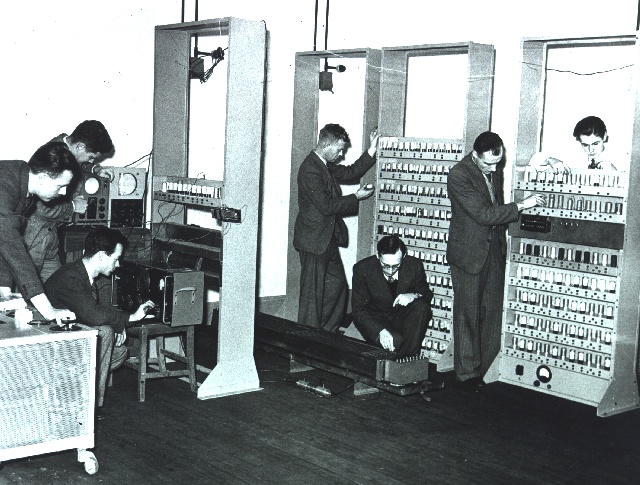
EDSAC missing, as well [Re: COLOSSUS missing too!]The EDSAC shall not be forgotten in this list:
"After the Second World War the director of the Computer Laboratory, M[aurice] V. Wilkes, headed what was perhaps the most influential of Britain's postwar computer projects the building of the EDSAC. Modelled on the American storedprogram concept that Wilkes had heard outlined at the Moore School lectures in August 1946, the EDSAC (Electronic Delay Storage Automatic Calculator) ran its first calculation in May 1949. The objective of the design team Wilkes, W. Renwick, S. Barton and G. Stevens on the hardware side; and D.J. Wheeler on the programming side was to provide a useful and reliable computing service. Such a service, the first in the world using a storedprogram computer, was available from early 1950. A significant feature of the Cambridge approach was the attention paid to userconvenience and programming; hence the group's book, The Preparation of Programmes for an Electronic Digital Calculator (1951), became the first textbook on programming a storedprogram computer, and was soon regarded as a classic."
(Quote, hyperlinks added by JLL) -
EDSAC missing, as well [Re: COLOSSUS missing too!]The EDSAC shall not be forgotten in this list:
"After the Second World War the director of the Computer Laboratory, M[aurice] V. Wilkes, headed what was perhaps the most influential of Britain's postwar computer projects the building of the EDSAC. Modelled on the American storedprogram concept that Wilkes had heard outlined at the Moore School lectures in August 1946, the EDSAC (Electronic Delay Storage Automatic Calculator) ran its first calculation in May 1949. The objective of the design team Wilkes, W. Renwick, S. Barton and G. Stevens on the hardware side; and D.J. Wheeler on the programming side was to provide a useful and reliable computing service. Such a service, the first in the world using a storedprogram computer, was available from early 1950. A significant feature of the Cambridge approach was the attention paid to userconvenience and programming; hence the group's book, The Preparation of Programmes for an Electronic Digital Calculator (1951), became the first textbook on programming a storedprogram computer, and was soon regarded as a classic."
(Quote, hyperlinks added by JLL) -
Oh for God's sake!
Whilst people seem to have a knee-jerk reaction against "Trusted Computing", I think there is one crucial issue that actually determines wether or not it's a Good Idea(tm). And that is: Who holds the master keys to my computer?
My God, that is status quo, for God's sake! You already hold the master keys to your computer right now! You don't need any hardware change to preserve the status quo!
Ofcourse, that's pretty guaranteed not what MS wants to push, but still - when discussing "Trusted" architectures in general, I think it's a valid point. It could for instance enable me to say that I trust the FSF's list of trustworthy applications - and viruses and other malware would actually be physically unable to run on my workbox. How could that be wrong?
You don't need "trusted computing" system to do that, for God's sake! You don't need temper-resistant chip in your computer for the most basic cryptography for the love of God! My God, every single "I could use it control my machine" argument I have read so far (and I have been following the discussions for quite a few years now) was describing a feature which can be implemented (or even already have been implemented, like in the case of your Score:5, Insightful idea) in software to achieve exactly the same functionality as when being implemented using temper-proof hardware, the only difference being the fact that the owner can control it. That's it. This whole discussion is a complete waste of my time. Why people post such a crap before even searching Google for trusted computing and reading the first God damn link is beyond me.