Slashdot Mirror
Domain: cam.ac.uk
Stories and comments across the archive that link to cam.ac.uk.
Comments · 1,846
-
Re:Honestly
-
Re:Customer Service : My Screen is Broken
From the patent:
[0029]The following notes apply to one or more implementations described herein: The implementation of advertisement presentation in an operating system (OPS) can require an analysis of the level of security required from the perspective of the manufacturer or provider of the computer system. For example, a system architecture can be designed (or modified) to supply advertisement presentation, in a way that ensures or seeks to ensure that a user does not bypass the presentation and thereby renders it fully or partially ineffective. A person implementing OPS-based advertising can analyze a hardware structure and identify one or more points (e.g., parts and subparts) therein to which the advertisement presentation should be tied, both for purposes of facilitating the presentation and to provide the above-mentioned resistance against user actions. For example, hardware points can be identified and controlled accordingly, so that the advertisement presentation can in effect "take over the system" in relevant aspects for a limited time.
[0030]In implementations where the OPS-based advertising is provided using executable code in the system, it can be necessary or desirable to protect that code from being removed, rendered inoperative, bypassed or manipulated. As another example, the system can provide constant or repeated monitoring of whether the system presents the advertisement(s) as scheduled. If non-presentation is detected, the system can invoke one or more enforcement routines to seek compliance with the advertisement presentation schedule. Such enforcement routines can include, but are not limited to, disabling the system in whole or in part, reporting the issue to a responsible party, invoking an alternative way of presenting the advertisement (such as by audio when visual presentation is impeded), or by registering the non-compliance in a log that can later be used in a follow-up process. In some implementations, an enforcement routine is implemented in a different part of the system (e.g., in a different software and/or other system component) than the OPS-based advertising feature it is designed to monitor. For example, an operating system can have a windows server that maintains windows and controls their presentation on a display screen, and the windows server in such an implementation can be configured or modified to provide for OPS-based advertising. As another example, when the advertising is visually presented in a user interface the system can be designed to not allow anything to be presented over that interface, or to prevent anything from being drawn on top of it.
AKA... Trusted Computing. So all you Apple superfans wondered what that Trusted Platform Module in your machine was for? Now you know. It's to ensure that you don't own your own system... the one that you paid for. It's to make sure that it stays tied to Apple, and that little Stevie Jobs, and little Billy Gates, and little Stevie Ballmer can always yank it back into their control when they feel like it.
-
Re:From an adjacent industry...
Indeed - as someone who did a mere three years at a UK university, I'm amused at the idea that this somehow means I'm not up to the job. You can't really compare degrees simply by the number of years.
AFAIK, three years is common for most UK universities, and I imagine the difference is they're more specialised - there's no need for the extra year, if you're not required to do random other subjects that have nothing to do with your chosen area. Whilst a broad education is important, I feel the time for that is during general school education.
-
Re:Penalties
I'd suggest to get rid of those bogus patents is to have a rule that says that if a patent is proven obvious later on...
The law already says that you can't patent anything already obvious to those familiar with the art, or technology, in the area to which your patent applies (I paraphrase).
One should already be able to overturn any obvious patent.
The problem is that some patent examiners are good, some are less so - I know this from firsthand experience.
One opinion on the matter here:
-
"Junk" = regulatory RNAProbably not - it's doing something far more important than that.
It's already been known for a few years now that the "junk" scales directly with complexity of the organism - unlike number of genes, which does not. It's becoming increasingly apparent that huge numbers of "junk" sections of DNA are actually transcribed to RNA, and play essential roles in regulating what gets made into protein.
The new hypothesis is that RNA is the computational engine of the cell, allowing it to rapidly process information and react appropriately, and the non-protein-coding "junk" sections are what it uses to do this.
There's a guy called John Mattick from the University of Queensland who has done a lot of really exciting work in this area, and gives a fantastic talk on the subject - here's an abstract for a version of it. Sample quote:
the extent of non-protein-coding DNA increases with increasing complexity, reaching 98.8% in humans, suggesting that much of the information required to program development may reside in these sequences. Moreover it is now evident the majority of the mammalian genome is transcribed, mainly into non-protein-coding RNAs (ncRNAs), and that there are tens if not hundreds of thousands of long and short RNAs in mammals that show specific expression patterns and subcellular locations. Our studies indicate that these RNAs form a massive hidden network of regulatory information that regulates epigenetic processes and directs the precise patterns of gene expression during growth and development.
Using the argument that cells are RNA machines, there is most likely no junk whatsoever in the human genome.
-
Re:What about the banks?
You go to complete the transaction and are presented with the challenge.. some long-ish unique number. You whip out an annoying little calculator device that you have to stick a smart card into.
A big problem with this (if they're the same as the ones used in the UK and, I think, Germany): Criminals can now verify a PIN number when they mug someone. After stealing your card and demanding to know the PIN, they can put your card in a card reader thing, press "Identify" and check it. The reader says "PIN OK" or "PIN incorrect".
See this paper (PDF) for full details.
-
Re:Sure...
able to remotely disable the device over the network. Each netbook is also fitted with a passive RFID chip which will enable the netbooks to be identified 'even if they were dropped in a bathtub.'
Ahh... trusted computing and PCs with TPMs in them. Take a look folks, your new PC is going to look like this very soon. More and more
-
Re:Why not ask the owner 1st?
You don't ask the user because... you don't TRUST the user.
-
Old News
Cambridge University and some UK high school (US Middle school) kids did this in 2008 - http://www.admin.cam.ac.uk/news/dp/2008120401
-
Re:Molecules are made of atoms, right?
-
Re:Molecules are made of atoms, right?
So what is a molecule, then? At what size does it become big enough that it's easy?
This image, for example, shows individual atoms, not in much greater number than the pentacene, although they are attached to a bigger object and can't roll around. These and these, however, seem similar to the pentacene. It's still impressive and cutting edge, just not that new. -
Leo, the tea-shop computer
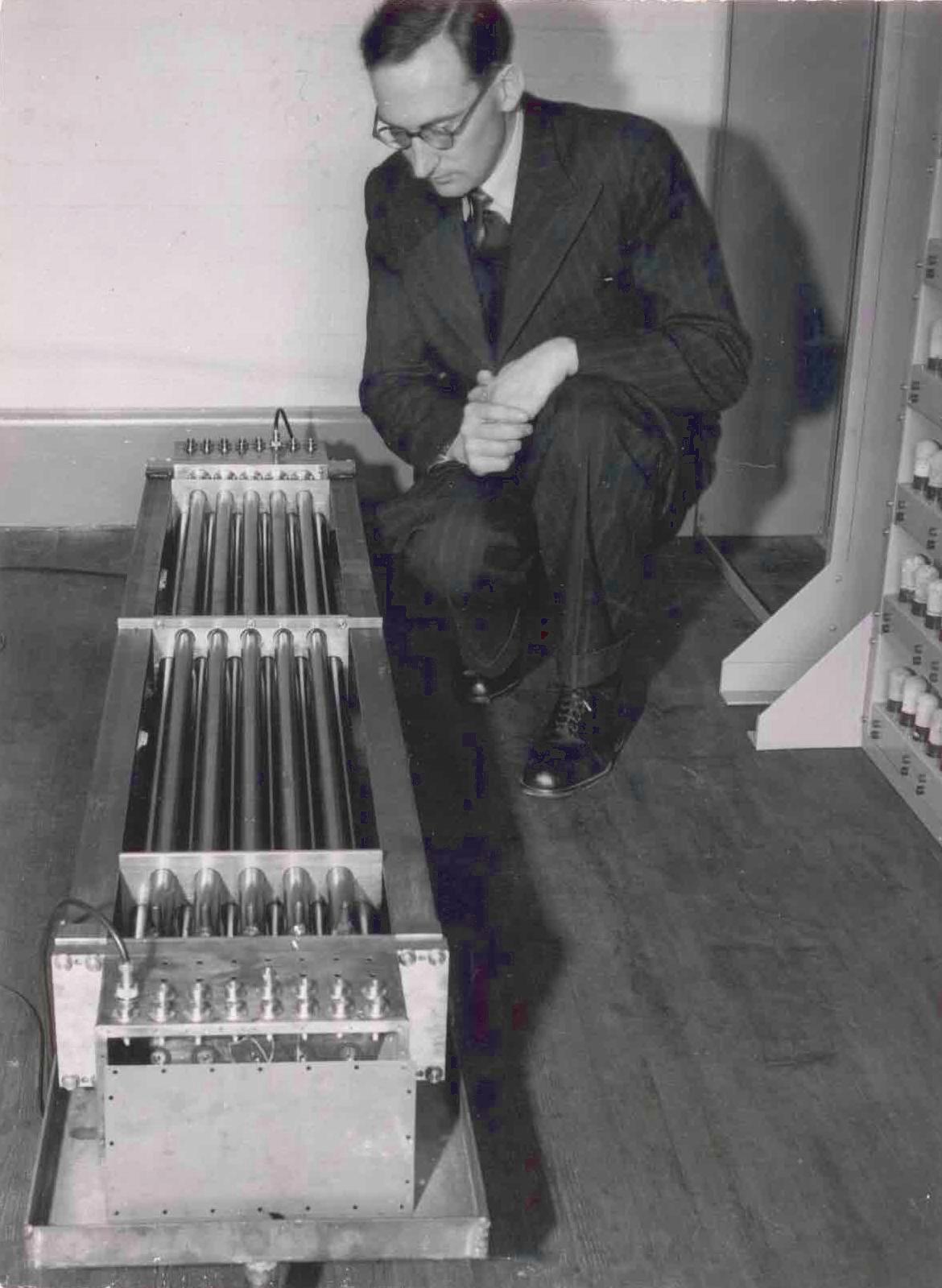
I recently read A Computer called Leo, which tells a story of post WW2 computer development in the UK.
The thing that stuck me most was the long cylinders of mercury used as memory, (mercury delay lines).
-
Re:unfortunately...
...I suspect many professors still feel a textbook lacks legitimacy unless it's hard cover, thick and there is a substantial price tag connected to it. I say this so as to suggest that "free" might mean it won't be as widely adopted as the authors first one.
That's fine -- just take a leaf out of David MacKay's book (ha). His textbook (Information Theory, Inference, and Learning Algorithms) is available online for free, but is also published by Cambridge University Press, one of the world's top academic publishers.
It's also one of their best-sellers.
(I own a copy of the above textbook; it's excellently written, typeset and bound. One of the best books I own!)
-
Re:Nuisance of free software
Check out this rebuttal of the idea that waste heat from electronics is equivalent to heating.
It does depend where you are, but in the UK we mostly use gas to heat houses. Electrically heated houses usually use storage heaters, which use electricity at night when there's lower demand and the electricity would be wasted (because you can't turn a power plant on and off at the flick of a switch).
-
Re:There's a difference between subsidies and loan
Government-2006 energy review
http://www.carbon-info.org/carbonnews_100.htmThat is from 2006 when the then president, Bush, waged a war against science. I also noticed it says "nuclear energy produces significantly less CO2 compared to the normal fossil fuels" and says in the graph that wind emits 10 grams of CO2 per KWh and nuclear only emits 7. There is nothing there about solar.
Also I take it you couldn't re arsed reading this when I linked to it earlier.
http://www.inference.phy.cam.ac.uk/sustainable/book/tex/cft.pdfThree hundred and eighty three pages? My eye's be killing me after 10 pages. I did go through the chapter on solar and the paragraphs themselves focus on solar in Great Britain. Figure 6.16 only lists 2 locations in GB for average sunshine, W/m^2, the greater of the 2 is London with 109. New York City and the rainy city of Seattle, WA, on the other hand each show 147. LA, CA, shows 225. The chapter on wind says that though it doesn't provide enough energy to power the UK it can provide some and provide it economically. However SciAm's article "A Grand Solar Plan" says that by 2050 solar power can provide 69% of the US's electrical needs. And the study Global potential for wind-generated electricity published by the National Academy if Sciences of the USA says wind can provide "40 times current worldwide consumption of electricity, >5 times total global use of energy in all forms."
You know why solar and wind don't get as much total? because they're no hopers. They get money to placate people who know fuck all about generating power for the grid but want a symbol of how very green their power is.
Only those who know nothing about solar and wind support it? Those who live Off the grid know nothing? They're only source of electricity is alternatives sources but they know nothing? John Doerr, appointed a member of Obama's Economic Recovery Advisory Board knows little? As venture capitalist and partner of Kleiner, Perkins, Caufield, and Byers he has invested billions in alternative energy but he knows nothing? Vinod Khosla, cofounder of Sun and another venture capitalist also knows little?
Did you even read my post?wind+solar cannot be used for more than 20% of the grid
Did you read the science links I provided saying solar can provide 69% of the electricity of the USA by 2050 and that wind could provide 400% of the world's energy?
Add in some kind of smart grid and you might, might just push that up to 30% and that's at an insane cost.
According to the article "Lifeline for Renewable Power" by Tech Review currently because the grid is now failing it costs businesses $80 billion dollars a year, so the grid needs to be rebuilt and made smart period. Even with more nuclear power plants that's true. But you're only using it against solar and wind, which is hypocritical.
Geothermal is fantastic for the few places where there's magma near the surface
I agree geothermal is not usable everywhere, no energy source even nuclear power is good everywhere. That's why I want a mix of different energy sources used. Biofuels can be used for fuel for things like aircrafts. The US Department of Defense is working to create biodiesel for jets.
-
Re:There's a difference between subsidies and loan
Prove it.
Government-2006 energy review
http://www.carbon-info.org/carbonnews_100.htm
Also I take it you couldn't re arsed reading this when I linked to it earlier.
http://www.inference.phy.cam.ac.uk/sustainable/book/tex/cft.pdf
read it.
for the love of god read it.Your sources seem to be nothing more than opinion pieces with broken links.
http://www.greentechmedia.com/articles/read/report-wind-the-best-energy-nuclear-coal-and-ethanol-the-worst-5352/
If Jacobson ranked nuclear bellow tidal and solar for "overall potential to generate electricity" then he's a moron.
Jacobsen makes some fairly heroic assumptions ? even charging civilian nuclear power generation with the carbon emissions (and loss of life) of a 50x15-kiloton nuclear war! By contrast, he charges his favored power sources with no "opportunity cost emissions", as though they faced no delays in permitting, environmental reviews, transmission-line construction, and equipment backlogs.http://www.greentechmedia.com/articles/read/for-cheap-clean-energy-go-geothermal-study-says/
An MIT study that's much more extensive suggests geothermal is damn risky; loss of water to the formation, loss of heat over time, dry (cold) holes that are non-productive; difficult drilling conditions (hot etc). And, geothermal is rarely near city the user base... so add long transmission lines...Sure geothermal is great for some things, it may cause small earthquakes but that's not too bad but depending on how you use it it can be more like oil drilling, you extract all the heat from a given area and it takes thousands of years to replenish.
I wouldn't complain at seeing a fair investment in geothermal but can it provide what we need? only a little.
We need power everywhere, not just where there's pleanty of geothermal near the surface.By that criteria nuclear power is not a serious energy source
By the grand total subsidies or the subsidies per megawatt? the second is what matters and by that criteria nuclear is very good. You know why solar and wind don't get as much total? because they're no hopers. They get money to placate people who know fuck all about generating power for the grid but want a symbol of how very green their power is.
Studies linked to say both wind and geothermal and cheaper and cleaner than nuclear. Now will you provide links to evidence says nuclear is cleaner?
Did you even read my post?wind+solar cannot be used for more than 20% of the grid. Add in some kind of smart grid and you might, might just push that up to 30% and that's at an insane cost.
Geothermal is fantastic for the few places where there's magma near the surface, otherwise drilling a hole 15km deep and keeping it open can be a problem.
Plus you use up the heat in a region and you stop getting geothermal power out and you have to drill a new hole.This isn't that bad a problem since lots of things kill birds but it's also expensive to maintain. Offshore wind farms suffer from the salt water and need a lot of maintenance.
I know reading is hard but try it some time.
This isn't that bad a problem since lots of things kill birds but it's also expensive to maintain. Offshore wind farms suffer from the salt water and need a lot of maintenance.
I made the point that is isn't a big problem.
The bigger problem is how expensive it is and how short the lifetimes of turbines is.
Off shore ones suffer particularly badly.
Try again.A Solar Grand Plan
-
part of an Intelligent Book
A very small part of My PhD looked at this (but with "collaborative textbooks" rather than wikis) -- see Chapter 4. Adding a very simple metadata-based navigation layer over the top of the wiki is pretty easy, clean (doesn't confuse users), and seems to do the trick. The wiki itself shows in an embedded frame. Of course, I had to go further and let students do difficult number theory proofs backed by machine reasoning systems within the book, but you won't have to solve that problem!
I'm (gradually) putting this fairly simple but useful part of the software into an online resource at www.theintelligentbook.com, though it's in my spare time and the system is down at the moment. I'll put my contact details back up there shortly in case the question-asker wants to discuss it technically.
-
Re:Yeah
Read this:
http://www.inference.phy.cam.ac.uk/sustainable/book/tex/cft.pdf
Personally I don't really think spending the nations total GDP for years to come on endless fields of solar panels or varients is going to be a good investment.
Especially when you could achieve much better results with nuclear for a tiny tiny fraction of the cost.
-
Re:Al Gore
Or better, a real climate scientist.
David MacKay is a former Information Theorist. A few years ago, he started thinking in earnest about the world's energy problem, and produced the amazing book behind my first link. He's a great example of a smart, integre, generalist scientist who does whatever he thinks needs to be done, even if it has nothing to do with "his field". He is a great public speaker, and a lucid thinker.
-
Re:Additional recommended reading
For those interested: http://www.cl.cam.ac.uk/~rja14/book.html
And a link straight to the book: http://www.cl.cam.ac.uk/~rja14/musicfiles/manuscripts/SEv1.pdfQuote from the author:
My goal in making the first edition freely available five years after publication was twofold. First, I wanted to reach the widest possible audience, especially among poor students. Second, I am a pragmatic libertarian on free culture and free software issues; I think that many publishers (especially of music and software) are too defensive of copyright. (My colleague David MacKay found that putting his book on coding theory online actually helped its sales. Book publishers are getting the message faster than the music or software folks.) I expect to put the whole second edition online too in a few years.
I have a hard copy of this, and while I've only read a select few chapters I have to say I enjoy the book. Definitely recommended to anyone who has a interest in any kind of security, be it information security or anything all the way upto securing a nuclear missile.
-
Re:Additional recommended reading
For those interested: http://www.cl.cam.ac.uk/~rja14/book.html
And a link straight to the book: http://www.cl.cam.ac.uk/~rja14/musicfiles/manuscripts/SEv1.pdfQuote from the author:
My goal in making the first edition freely available five years after publication was twofold. First, I wanted to reach the widest possible audience, especially among poor students. Second, I am a pragmatic libertarian on free culture and free software issues; I think that many publishers (especially of music and software) are too defensive of copyright. (My colleague David MacKay found that putting his book on coding theory online actually helped its sales. Book publishers are getting the message faster than the music or software folks.) I expect to put the whole second edition online too in a few years.
I have a hard copy of this, and while I've only read a select few chapters I have to say I enjoy the book. Definitely recommended to anyone who has a interest in any kind of security, be it information security or anything all the way upto securing a nuclear missile.
-
Re:nothing == suicide
Don't assume. If I had meant "fossil fuels" I would have said "fossil fuels". We have all sorts of limited resources that we need to deal with because we live on a finite planet. In fact I believe the current debate over cap and trade is about carbon emissions so the limited resource that is being dealt with is clean air.
But if you want to talk about letting the free market automagically deal with our limited fossil fuel resources, I suggest you take a look at Sustainable Energy - without the hot air by David MacKay. MacKay is a well respected physicist and mathematician. If you think he is a lightweight, take a look at his earlier book: Information Theory, Inference, and Learning Algorithms.
The problem with relying on the free market instead of acting intelligently is that you are staking our civilization on a bet that there will be a cosmic coincidence such that fossil fuel resources will dry up slowly enough to give us time to develop alternative power sources before the fossil fuels are effectively all gone. If, for example, all the world's fossil fuels were sitting in a tank ready to be piped out then we would be totally screwed if we relied on the free market to give us enough lead time to develop other energy sources.
Currently most of our resource allocation is decided by corporate officers who are charged with making money for their shareholders in the short term, not decades ahead. If we run up against a problem that takes planning on a longer time scale then we are totally screwed if we "do nothing" and let the free market do its thing.
As I said before, even though there are many problems that the free market is very good at dealing with there are also some problems that the free market makes worse. If you insist on relying on the free market to solve every problem then you are no better than a lemming running to the cliff. -
Re:Complexity.
Or they switch to the cipher they should have gone with, namely Serpent: http://en.wikipedia.org/wiki/Serpent_(cipher) http://www.cl.cam.ac.uk/~rja14/serpent.html For those too lazy to read the links, Rijndael (aka AES) is faster, simpler, and more elegantly designed than Serpent. Serpent is more conservative, slightly slower in software (faster in hardware though), and not quite as pretty aesthetically. Rijndael was chosen to become AES for its speed and simplicity, two things IMO that have minimal desirability in a cryptography algorithm.
-
Re:The reason that nobody really works on this...
There are many people working on input methods for the disabled. As just one example, Dasher is an information efficient text-entry method that can be controlled by mouse, voice, gaze, two buttons or even a single button. Experienced users regularly type 20+ words per minute, just with their gaze. Try that with an on-screen keyboard.
The same group has just published nomon, a single-button text entry method (and pointing device) for the severely disabled. Did I mention that both programs are open source?
yeah dasher is pretty cool. i assisted in testing in cambridge when i was an undergrad there a few years ago. i also tried it with the gaze and do stuff device. was pretty cool. i must look up the project again at some point.
-
Re:The reason that nobody really works on this...
There are many people working on input methods for the disabled. As just one example, Dasher is an information efficient text-entry method that can be controlled by mouse, voice, gaze, two buttons or even a single button. Experienced users regularly type 20+ words per minute, just with their gaze. Try that with an on-screen keyboard.
The same group has just published nomon, a single-button text entry method (and pointing device) for the severely disabled. Did I mention that both programs are open source?
yeah dasher is pretty cool. i assisted in testing in cambridge when i was an undergrad there a few years ago. i also tried it with the gaze and do stuff device. was pretty cool. i must look up the project again at some point.
-
Re:The reason that nobody really works on this...
There are many people working on input methods for the disabled. As just one example, Dasher is an information efficient text-entry method that can be controlled by mouse, voice, gaze, two buttons or even a single button. Experienced users regularly type 20+ words per minute, just with their gaze. Try that with an on-screen keyboard.
The same group has just published nomon, a single-button text entry method (and pointing device) for the severely disabled. Did I mention that both programs are open source? -
Re:The reason that nobody really works on this...
There are many people working on input methods for the disabled. As just one example, Dasher is an information efficient text-entry method that can be controlled by mouse, voice, gaze, two buttons or even a single button. Experienced users regularly type 20+ words per minute, just with their gaze. Try that with an on-screen keyboard.
The same group has just published nomon, a single-button text entry method (and pointing device) for the severely disabled. Did I mention that both programs are open source? -
Dasher
http://www.inference.phy.cam.ac.uk/dasher/DasherSummary2.html
Play with it. It's smart.
-
Re:Doh!
We could use the British Library, but I personally prefer to use the Cambridge University Library. Doing a degree at Cambridge was worth it just to be allowed in there
-
Re:LaTeX the editor of choice?!
You're overstretching in your attempt to delineate the difference between physics and maths. The line between theoretical physics and applied maths is very blurry - as witness. Fundamentally what determines whether you're doing maths or physics isn't the existence or not of processes which fit your model but the extent to which you care about whether the model fits the processes.
I'm not entirely convinced by your definition of computer science, either. The study of information is part of it, but I don't think it's a suitable classification of e.g. complexity theory. (It is a prerequisite thereof, because it's required for the definition of problem size.)
-
Re:Offer the Ebook for free.
Here's a textbook on Data Compression, Information Theory, Inference and Learning Algorithms that's five years old.
It's freely available online, from the author. And here comes the shocking bit: It's fun to read. -
Dasher
All he would need to pick up with the EEG is "up" or "down" signals, and it could be used to type very quickly with Dasher
http://blog.makezine.com/archive/2009/04/single-finger_text_input_1.html
http://www.inference.phy.cam.ac.uk/dasher/Demonstrations.html
-
Re:If the only thing they run is windows...
I can recommend to read the Computer Laboratory Tech-Report. They have quite a bit of advice on how security should be tightened and how sensitive data should be handled. Among other things the authors clearly state that no system connected to the internet can withstand the attacks of a really committed opponent such as the Chinese government for a long time. However there are other compelling reasons apart from security to use free software.
-
Gallium Nitride
The source material for this LED is Gallium Nitride(GaN). Its quite a revolutionary semiconductor material developed first by Shuji Nakamura in the 90s at Nichia Corporation, Japan.
It has a multitude of applications in different fields - optoelectronics, HF microwave communications and anti-radiation hardening for space vehicles.These LEDs are very efficient in the sense that they consume less power and have more lumen output. And they die out gradually, unlike traditonal sources of lights like tubes/bulbs which will immediately fuse off. Which explains why they are robust alternatives for street lights, traffic signals, etc. They need less power, less maintainance and due to their solid state nature are quite tough materials.
Lot of research has been conducted on them. Here are couple of leading centres for GaN research -
UCSB - http://my.ece.ucsb.edu/mishra/studygane.htm
Cambridge(UK) - http://www.msm.cam.ac.uk/GaN/There is an online journal of Nitride Semiconductor research not updated much now, but very useful -
http://nsr.mij.mrs.org/Check it out.
Many traffic light signals use these LEDs already across the world nowadays for less power consumption. Watch out for few in your city.
I remember back in my college days that it was already being touted as a replacement for the century+ old incandescent bulb. Buzz and hype I guess but still with a lot of substance.Cheers!
-
Re:This should be over any time
only problem is the time it takes to deploy a world based on smart cards and what we do in the interim??? there are some studies that have figured ways to produce fake cards from the data stored in a smartcard. There are some data components of the chip that are customizable by the Banks or whatever company issues smart cards, and there can be foolish and stupid things people could do, as for example, copy the data of the magnetic stripe on the chip (don't ask me what for, but they have!). So I won't be so at ease if I were you...MUHUHOHOHAHA... even so, yes...smart cards are WAY more secure than magnetic stripes (pretty obvious isn't?).
-
Re:But how exactly does it work?Technical explanation in some detail
Q Why is it an opt-out system?
A Because they couldn't get away with providing no optionality control, so they went for the option which pushed as many users as possible to their system.Q When did I or Slashdot give implied consent to anyone to inspect the packets for reasons other than routing?
A You didn't, but Phorm and the spineless UK government has decided you did.Q What data do they collect and what do they do with it?
A Browsing habits to produce targeted advertising. -
Re:Tracking Eye Movements
You might want to look at opengazer
http://www.inference.phy.cam.ac.uk/opengazer/
For a while development had been abandoned but that disclaimer has now disappeared from the website so I imagine someone is working on it.
The same people created the dasher text input system which is really worth having a look at as an example of innovative input methods.
-
Re:Tracking Eye Movements
You might want to look at opengazer
http://www.inference.phy.cam.ac.uk/opengazer/
For a while development had been abandoned but that disclaimer has now disappeared from the website so I imagine someone is working on it.
The same people created the dasher text input system which is really worth having a look at as an example of innovative input methods.
-
Re: Phishing appears to be good enough
Is there any realistic way to prevent something like this in the future? I'm afraid I don't see anything obvious.
Me neither. The Cambridge tech report has some thoughts about what organizations with sensitive data should be doing by way of countermeasures, but to sum it up:
Prevention will be hard. The traditional defence against social malware in government agencies involves expensive and intrusive measures that range from mandatory access controls to tiresome operational security procedures. These will not be sustainable in the economy as a whole. Evolving practical low-cost defences against social-malware attacks will be a real challenge.
In their conclusion they say:
In short, we predict that the criminals who adapt social malware to fraud will enjoy many years of rich pickings.
-
the lone operator went to lunch ..
'An operator corrects the telemetry problem but forgets to restart the monitoring tool'
This from conclusions in the report by the investigating task force. This is BS, the reason the 'operator' disabled 'real-time status of the power system' was to 'conduct a manual check of the network' because they were fully aware an incident was in progress, in the middle of which he then
"We have no clue. Our computer is giving us fits, too," replied a FirstEnergy technician identified as Jerry Snickey. "We don't even know the status of some of the stuff (power fluctuations) around us."
"I called you guys like 10 minutes ago, and I thought you were figuring out what was gong on there," the MISO technician, identified as Don Hunter, complained, according to the transcripts.
'FirstEnergy's operators were unaware for over an hour that they were looking at outdated information on the status of their portion of the power grid, according to the November report'
'no such call was made or warning given. I have confirmed that by having my staff listen to control room operator tapes'
'At 14:02 EDT
I think he means the screen froze -
It should be possible with high-end pohnes
I don't think phones have the computing power to do dynamic features now
Actually they do. There are several working implementation of dense feature detectors on the smartphone, including SIFT, FAST and SURF, and some of them are capable of doing planar image registration(like Daniel Wagner "markerless" tracker. It's using image as fiduciary). The real difficulty is getting 3d structure form motion on the mobile, but that could be possible too soon. My opinion is tat 500+Mhz smartphone with floating point support should be capable of that, at least under good lighting conditions. The problem is to find correct algorithm with good enough optimization. Most of modern phones have DSP coprocessor, but API for it is closed by manufacturer. With open DSP API it would be practically sure thing.
-
Re:yeah, and?
not the colour, it's EURion constellation
There was some prize available for anyone who could figure-out how to print it on a t-shirt such that digital cameras refused to take photos of you.
May as well correct myself before anyone else does.
-
Re:1996 nothing...
And here is the original page.
-
Re:I'll tell you why...
Here is good response to this meme: http://www.mrc-cbu.cam.ac.uk/people/matt.davis/Cmabrigde/ The most interesting analysis is after "Update 2". Also click on Graham's thesis summary.
-
Who do you trust - Re:turn tables
The Windows kernel source code is also available for audit and research purposes. Your organization just needs to sign up through Microsoft's Shared Source Initiative http://www.microsoft.com/resources/sharedsource/default.mspx. Many governments already have access to the source code for various Windows versions http://www.microsoft.com/presspass/press/2005/feb05/02-10NISTPR.mspx. Academic access to the source code was also used to port Windows so it would function under early versions of Xen (w/o hardware virtualization support) http://www.cl.cam.ac.uk/netos/papers/2003-xensosp.pdf & http://en.wikipedia.org/wiki/Xen. Access is probably not "free" in the sense that anyone can download it. But source is available.
I just did a GSEC bootcamp where the instructor used the argument that China has access to the Windows source code to stir people's security concerns up. No-one seemed bothered by China's access to Linux, BSD, or other FOSS kernels. It was kind of comical.
Like most security issues it can be framed as a question of trust. You trust a bunch of people you probably don't know personally to audit the Linux kernel, trust your government to audit the Windows kernel, or trust Microsoft to do the right thing. Seems like you need to trust strangers.
Or I guess you could go paranoid and build your own secure operating system...do you trust your compiler and hardware maker? Maybe I better start my own chip fab and compiler project? -
Prime numbers online article thing
I wrote this:
http://people.pwf.cam.ac.uk/jlnw3/maths/books/prime/It was meant as an introduction to the idea of proof. Perhaps you might like it.
-
Re:Surprise to Anyone?
they actually have a registry entry, but they have ignored it since NT and it doesnt really work
-
Re:This seems abrupt
Here bloody fucking here. Vista has codepaths in it which can be traced back to the Windows NT Alpha implementation. I found that out the hard way when I tried to get Windows to behave timewise on a multi-booting system.
After dicking around with a registry setting and encountering all kinds of weird timewarps I finally found this little gem:
2001-07-09: I got a reply from someone in Microsoft's Base Kernel Team who got interested in RealTimeIsUniversal and they had a look at the relevant parts of the NT kernel source code. The RealTimeIsUniversal flag is there (a leftover from the days when NT still ran on RISC machines with UTC RTCs), but its implementation seems now incomplete and it is currently not covered by Microsoft's documentation and regression test suite, therefore using it is not recommended at this time.
And this semi-implemented known bad behaviour has persisted through win2k (nt 5), winxp (nt 5.1) and vista (nt 6). Wanna bet Winblows 7 will still have the same flakey code path, the same semi-implemented flag?
And people wonder why I don't trust Microsoftware.
-
Re:So much for not sacrificing ideals for safety.
Bzzzt. The US pays more than any nation
-
Re:Freeze the CPU
No, not a floating point operation. The 6-transistor SRAM cell you describe is commonly called a flip-flop. According to this paper, SRAM retains data only for a fraction of a second at room temperature, but apparently can be extended to seconds or minutes by freezing.