Slashdot Mirror
Domain: canon.com
Stories and comments across the archive that link to canon.com.
Comments · 193
-
Re:Apparently photo printers...
> I have been told laser printers make inferior picture prints.
As someone who has BOTH a color laser printer and inkjet that is indeed TRUE.
* Laser printers are awesome for text but OK for photographs,
* Inkjet printers are OK for text (slightly blurry) but phenomenal for portraits, and HDR photographs.One of the many standard "litmus test images" are the ones listed on the defunct Outback Print
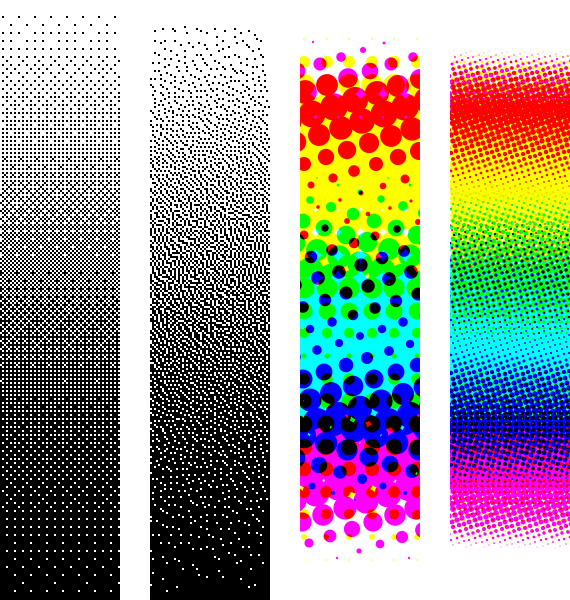
From 3+ feet away you can't tell the difference between an inkjet and color laser on "natural" images. (i.e. non test patterns.) But closer then 3 feet and you start to notice the flaws of color laser printers -- especially gradients that have artifacts. Not Mach Banding but error dot diffusion patterns due to the small size of toner color laser printers basically "print" in a halftone pattern.
> I doubt professional industry-grade printing firms print their photos on inkjet printers.
That's because they care more about cost then quality.
> see no reason why laser printer pigments would have to be inferior.
I take it you don't do much (any?) printing of HDR photos. Here is a primer (pardon the pun.)
First, color laser printers only have the standard 4 color CYMK toners. This means the gamut is not quite as large as inkjets's dyes and pigments.
Second, in Canon printers the large black "PGI" cartridge are pigments which is used when printing text. The remaining color tanks may be dye based inks which tend to have smaller particles than the pigment based inks. See Canon PGI vs CLI for more details.
Third, inkjets tend to have more dyes then just the standard 4 color CYMK inks. For example, the Canon Pixma PRO-1 is a 12 pigment system. Why 12?
5 are dedicated for black and white printing:
* LGY (Light Gray)
* GY (Grey)
* DGY (Dark Grey)
* MBK (Matte Black)
* PBK (Photo Black)Remaining 7 are for colors:
* C (Cyan)
* Y (Yellow)
* M (Magenta)
* R (Red)
* PC (Photo Cyan)
* PM (Phtoto Magenta)
* CO (Chroma Optimizer)If you want the best quality the type of printer inkjet vs color laser matters due to printing technology. i.e. For every day use a color laser printer is more then good enough but if you want quality portraits nothing beats an inkjet.
-
Use native WiFi on camera?
Most modern DSLRs (e.g. Canon EOS 5D IV, Canon EOS 6D II, Canon EOS 80D) have built-in WiFi now, and you can trivially send all photos from the camera to a smart phone (ideally one with support for removable micro-SD cards) where you could have encrypted storage set up. I have done this on many occasions (e.g. post a photo from my 80D to the internet while at an event).
(I am not as familiar with Nikon models, but I am sure they have some models with built-in WiFi).
Sure, it may be slightly more fiddly than being able to write directly to encrypted SD (or CF) cards on-camera, but much easier to set up as plausibly-denaible.
Of course, if your camera doesn't have WiFi support, you can do the same thing with a bit more fiddling by using a cable (or the "camera connectivity kit" if you use a phone from a vendor who artificially limits the capabilities of their products in order to extract more money from their customers), but then it may be more obvious to nefarious people what you have done with the photos you took.
-
Use native WiFi on camera?
Most modern DSLRs (e.g. Canon EOS 5D IV, Canon EOS 6D II, Canon EOS 80D) have built-in WiFi now, and you can trivially send all photos from the camera to a smart phone (ideally one with support for removable micro-SD cards) where you could have encrypted storage set up. I have done this on many occasions (e.g. post a photo from my 80D to the internet while at an event).
(I am not as familiar with Nikon models, but I am sure they have some models with built-in WiFi).
Sure, it may be slightly more fiddly than being able to write directly to encrypted SD (or CF) cards on-camera, but much easier to set up as plausibly-denaible.
Of course, if your camera doesn't have WiFi support, you can do the same thing with a bit more fiddling by using a cable (or the "camera connectivity kit" if you use a phone from a vendor who artificially limits the capabilities of their products in order to extract more money from their customers), but then it may be more obvious to nefarious people what you have done with the photos you took.
-
Re: iPhone costs.
The phone market is strange in that lots and lots of people want to have the "flagship" phone and you're not allowed to have a more expensive model in your lineup. I mean it's not like every Ford is a Ford GT or every guy with a Canon has a EOS-1D X Mark II. But if Apple wants to make a $999 phone, like actually spec-wise next level not just inlaid with gold and diamonds there's panic. Apple needs to stay out in front on the premium side, if people stop saying "if money was no object, I'd get an iPhone" that's when they should not worry not "damn I want an iPhone, but that last one is bloody expensive". People have been saying that for years and Apple has been making bank on it.
-
HDR Reference Monitor
I suggest the Canon DP-V2420 4K Reference Display, 24" display that supports SMPTE ST 2084 and HLG (Hybrid Log-Gamma) broadcast HDR standards.
-
Re:I just don't care anymore
Pretty sure the powershot series has wifi support, and some of those are under $100.
Ok, not sub $100, but the Powershot S120 has been out for a while and it has wifi support.
-
Re: No wayWell, to be fair....there are actually a LOT of people out there, that don't consider $1200 as being a lot of money...to them, that is pocket change.
No, I'm not one of them, but I know a lot of them....and it isn't uncommon.
And even with me, while I don't consider $1200 to be cheap, I also don't think it breaks the bank either....I tend to be the type that doesn't buy a lot of trivial shit here and there constantly.
I tend to save my money and 2-3 times a year, I drop a wad of money on something I really want. Earlier this year, I dropped about $2370 on a new lens for my camera. It was a Canon 11-24 f/4 zoom lens....this monster usually lists for about $3K, I found one on the canon refurb site for the sale price and jumped on it.
Now..do I buy things like this willy-nilly all the time. No.
But, I had been researching, and plotting and planning AND...yes...SAVING to buy this and when this came up for sale I immediately pulled the trigger.
I'm now quite happy with the new lens in my stable.
So, yes...there are a lot of people out there with a LOT of disposable income. There are a lot of people out there with some disposable income, but with that...if you are choosy, you can save and have some really nice things. It really isn't that difficult at all.
The key point is knowing how to save...and NOT go into CC debt hell.
-
Re:Note to self
I'll second the Canon recommendation.
Their fancy inkjets and color lasers are the same way. We have a PIXMA-100 PRO and an MF8280cw. Both will warn you that the toner/ink may be running low but neither will stop...ever. My laser has been warning me that two of the colors (both starters) are "beyond usable life" (or something like that) for over a year now but continues to print (in B&W and color) without a hitch. Given the abhorrent behavior of the other printer manufacturers, I'm not sure I'll ever buy from anyone else.
The only problem I've ever had is a little bit of difficulty with the Linux drivers. However, with Windows, Android, iOS, and OSX, though, it just works. -
Re:Note to self
I'll second the Canon recommendation.
Their fancy inkjets and color lasers are the same way. We have a PIXMA-100 PRO and an MF8280cw. Both will warn you that the toner/ink may be running low but neither will stop...ever. My laser has been warning me that two of the colors (both starters) are "beyond usable life" (or something like that) for over a year now but continues to print (in B&W and color) without a hitch. Given the abhorrent behavior of the other printer manufacturers, I'm not sure I'll ever buy from anyone else.
The only problem I've ever had is a little bit of difficulty with the Linux drivers. However, with Windows, Android, iOS, and OSX, though, it just works. -
Re:Doctoring? Not likely. Probably a workflow issu
Bet you anything they've a managed workflow system and their solution can't deal with raw files.
It's actually worse than that: they aren't merely saying, "Don't send us raw files" (Note no caps -- "raw" isn't an abbreviation); they're saying "Don't send us anything that was even *processed* from raw files." It's as if the raw processing algorithms in the camera are somehow sacrosanct, but the equivalent algorithms run in Lightroom is suspect.
In fact, I think it would be harder to doctor a RAW format because all image sensors have random imperfections, their own physical "fingerprint" that can be traced back to a specific camera. (These imperfections are fixed in processing. All serious cameras have a built-in imperfection reference map created during manufacture and testing. More serious cameras let you update this manually too) Not to mention doctoring a RAW would require inanimate knowledge of the imaging sensor.
I'm not sure what you're talking about by "imperfection reference map" -- do you mean dust delete data? That isn't built-in; you need to take a reference photo of something white in order to generate that. Some software processors also have hot/dead pixel detection.
Otherwise, there is definitely nothing in serious cameras (I assuming that the Canons and Nikons that the vast majority of photojournalists journalists use are "serious") that has any sort of built-in calibration for random imperfections in the sensor. While I have no doubt that, given enough samples and enough time, you might be able to find a way to "fingerprint" a camera, in most cases, sensor noise (whether photon-shot noise, readout noise, or others) is going to significantly overpower any sort of unique characteristics.
-
Leeloo Dallas Canon MultiPASS
So that's why she kept saying MultiPASS.
-
Re:Still hoping they make a movie camera
Are you managing to keep the bird on the auto-focus point (or the majority of points for multipoint focus)? While you're tracking it? Including when you press the shutter?
This is where AF point expansion on the current-generation DSLRs comes in handy. But for any camera more than a couple of years old, yes, it's rather a pain, and the keeper rate often isn't great. Of course, depending on how fast the bird is moving, at 300mm, even with IS, half the time, I can't keep the bird fully in the frame, so focus is the least of my problems when taking bird photos. I'm better with people.
Most people will mangle the bird in flight on an auto camera because the shutter speed was too long and the photographer's tracking wasn't perfect (and the bird did something silly like flap it's wings).
True, full auto isn't great for those situations except maybe in bright sunlight. If I'm anticipating taking pictures of fast-moving objects in less-than-ideal light, I tend to use the time-value (Tv) mode—I guess you'd call that a partial auto mode. I set the shutter speed to ensure a reasonably crisp photo, and let the camera worry about changing light levels by adjusting the aperture and ISO settings automatically to get the best picture that it can manage.
Most of the point and shoot I've used refocus when you actually shoot, so there's an extra second while it adjusts, while the bird disappears from your view. Most of those either focus on the clouds, some tree on the horizon, or tall grass in the foreground.
Agreed. The contrast detection autofocus that they use on point-and-shoot cameras (and on DSLRs in live mode) is mostly a train wreck. They're using the image sensor itself to determine whether the image is in focus, by adjusting the focus in each direction to see if doing so results in increased contrast in a particular part of the photo. Therein lies the path to madness. It's amazing that it works at all.
I'll be interested to see how well Canon's new dual pixel autofocus does at solving this problem. In effect, it turns the entire image sensor into a phase detection AF sensor similar to what you get with a DSLR when used with the OVF, but with a ridiculous number of autofocus line sensors of fully adjustable length, and nearly infinite ability to do motion tracking across almost the entire sensor area. I'm looking forward to the day when DPAF appears in DSLRs for live view purposes. If it works as well as Canon implies, then when combined with decent motion tracking algorithms (and, in an ideal world, eye tracking), it promises to make manual focusing mostly obsolete except when using lenses that don't have AF capabilities.
-
Again with the alphabet soup
Does everyone really just know that SOHO = "Single Owner Home Office" (took a bit of Google fanciness to get around the neighborhoods in London & NYC).
To answer the OP's question, I've had great luck with my Canon Pixma MP495. Canon *did write* Linux firmware/software, it's just not available through their US site for whatever reason (it's also kludgy as hell, but it gets the job done). -
Re:Impact printers and thermal printers
30 Watts is way too low.
Even battery operated inkjets like Brother PJ663 PocketJet 6 or HP Officejet 100 Mobile Printer suck up more than that.They also tend to be rated for "up to 500 pages per month".
Which is sort of a perfect number in theory - it comes out to ~16 pages per day, or one page per patient every 30 minutes during an 8-hour shift.
In reality, it's probably (at least) either double the pages or patients or both.There ARE very low power consumption printers out there like PIXMA iP100 (9 Watts operational) but those are still, like all mobile printers, first and foremost "first world" toys instead of "third world" work horses.
He's probably going to have to go with a dot matrix solution (durability, price, moderate power consumption) or with a dot matrix and mobile inkjet mix of some kind.
Real life solutions tend to be like that.
Many "acceptable" solutions for the problem instead of a single perfect answer to the question. -
You are looking for...
...the Canon BJC-85
-
Re:New type of "bio" imaging ?
It probably is though. Have you seen this? That's a full frame CMOS HD video sensor, not the graphene based sensor.
-
Re:yeay four sensors
Most of the photo printers will do 4-color. And there are 8-color printers, if you wish (this one under the "consumer" heading, but titled "pro", $500 doesn't sound too pro, and seems more like the fake pro type to suck in the pro-sumer crowd) http://www.usa.canon.com/cusa/consumer/products/printers_multifunction/professional_photo_inkjet_printers/pixma_pro9000_mark_ii
-
Re:It's a trap: Next step: Proprietary battery
It's because AA batteries are an inconvenient form factor for a device that should be small and mostly rectangular...
You can still get them, but they're bulky compared to ones made with a boxy battery - http://www.usa.canon.com/cusa/consumer/products/cameras/digital_cameras/powershot_a1200
Give it some time and we may see a standard emerge there. Digital cameras are still not a mature product yet.
-
Re:Failed?
I think the submitter needs to understand what "failed" means.
He's mostly using "failed" in the conventional marketdroid sense - they didn't fly off the shelves making the corporation manufacturing them and those investing in them buckets of cash.
A lot of that stuff were far from failures. they were designed for a specific task. the 3d mousing devices are STILL used to this day in high end 3d CAD.
That's true of many of the items in the collection.
He labels the overblown Swiss Army Knife as a bad design - while failing to consider the purpose of the design. (As a collectible/art piece, which he tacitly admits it was a success at.) The next knife down he's equally dismissive of. But he fails to consider that a) there are other methods of carrying (a belt pouch for example), or b) that there *are* people who constantly have something it will fit into handy (a photographer and his camera bag, a fisherman and his tackle box, etc..). The lowest knife, which he praises, has so little functionality it's only real use is to be impressive to the guy in the next cubicle over because you're the Guy Who Always Has A Knife.
The same with the Nikon Coolpix 100. He seems utterly unaware that there are a huge number of cameras out there... My little Canon A1200 has no extra chargers or cables either.
He praises the Olympic Memory Stick Thumb Drive - but take away the 'cool' packaging, and it's just another thumb drive. Maybe he keeps the 'cool' packaging as an art piece on his desk, but I suspect he's one of the few.
Overall Mr Buxton is really, really bad at evaluating the success or failure and the usefulness or not of many of the items he has in his collection. -
Re:No Drivers for Windows
That must be nice for you. I've got this Canon scanner which I bought roughly 10 years ago. Can you locate a driver that works under Windows for it? Canon isn't releasing any. Canon doesn't provide a Linux driver for it either. Yet it works out of the box under Linux - both 32 and 64-bit. It might be an old scanner, but it's in perfect working condition, runs at 1200x1200 dpi optical resolution, and is lightweight and portable. Why should I have to buy a new scanner because I upgraded my OS?
-
Re:Rockwell's an expert
A 4x5 camera with a digital back will also shoot much higher resolution than a DX digital camera. The point is also invalid, because realistically, a top-end DSLR actually costs less than a 4x5 camera with lenses and the cost of film and processing.
This is only valid if you shoot hundreds if not thousands of photos. Fact is is the major difference in cost between digital and film medium format cameras is the cost of the backs. And film backs are a lot cheaper than the thousands of dollars a digital back costs. Take for instance a Hasselblad H2F. B&H Photo and Video lists the price at $7000. A film back for it costs $400 and RVP 120mm Fujichrome Velvia film is $6. A Adapter Plate Kit for CF/CF-MS Digital Backs cost $900. That's more than twice as much for digital, and it is a dedicated interface for the Hasselblad CF Digital Back System not a digital back itself, than the film back. You can shoot a lot of film with just the difference in price.
Or take a DSRL instead of a medium camera with digital back. Canon's highest res DSRL is the EOS 1Ds Mark III which costs the same as the Hasselblad. Now which do you think is a better camera (rhetorical question, it depends on the use)? Or there's the Hasselblad H2F at $2700. And of course there are a number of cameras other than Hasselblad, such as Mamiya and Pentax.
Falcon
-
Re:So, *will* it be missed?
A low end DSLR can beat 35mm film today. high end dslr's utterly kicks the crud out of 35mm in resolution.
The getting old Canon 5d Mark II is 21.5 megapixels which is 1.5 megapixels greater than the absolute best 35mm film+best camera+best lens can do. Honestly 90% of all 35mm film shots are less than 12megapixel in resolution due to low end glass and cameras as well as being processed less than perfect. And that's just the mid level stuff from Canon. high end digitals that reach the 60 megapixel mark utterly destroy 35mm film even when used with the best of everything.
That just goes to show how much you know, Canon's highest res pro camera is the 21.1 MP EOS-1Ds Mark III. Even Nikon's D3x only has a 24.5 MP sensor. If you want bigger ones you have to step up to medium format cameras such as Hasselblad or Mamiya.
Meanwhile in pro photographer Ken Rockwell's article Why We Love Film he writes:
"You want dynamic range? I got your dynamic range right here in this little canister. It's called film; a write-once, read-many (WORM) medium."
"I made this shot on a Contax G2 with a 21mm Zeiss lens at f/8 on Fuji Velvia 50, which was processed and scanned at the same time at NCPS. The dynamic range is so great that the hellacious sunbursts you see are just what's naturally coming off the diaphragm blade at f/8, as if 1,000 suns were shining in the lens in the two-minute exposure."
"Not only that, but the film I shot in a Canon EOS Rebel G film camera, worth about $20 today, was sharper as scanned at NCPS than the file I made with the same lens on a Canon 5D, which is sharper still than anything on earth from Nikon digital."
"How about that? A $20 camera with a $5 roll of film and $20 to process and scan the entire roll is sharper than a $5,000 camera. (The Contax cost more, but still loads less than anything in full-frame digital.)"
Falcon
-
Re:Cheap NAS
I second this. I just bought my 2nd DNS 323 after the first one got full. (its cheaper to buy 2 DNS 323 which are 2 bays, compared to getting the 4 bay version). I shoot a lot of pics, and at 20-25 meg per RAW file, it adds up quickly. The first is stacked with 2x1.5 TB drives, the 2nd with 2x2TB drives.
I'd love to get the Canon EOS 1Ds Mark III, I still have a film based EOS Rebel and lenses for it, which has a file size over 60 MB according to Canon. And though maybe not all the tyme I'm sure there will be tymes I'll want to save photos in raw as well as tiff and or jpeg. Eventually I'll also want to get a medium format camera body, perhaps a 645 like Mamiya's 645AFD III, with film and digital backs. I don't know when but I want to start a photography business.
Right now for mass storage I have 3 external HDDs, two I have here with me while the third can be stored off-site. Now what I'd like is wide area wireless broadband so when I'm out hiking I can upload my photos, I mostly do nature photography but I want to try astrophotography as well.
Falcon
-
Re:MPEG-LA is doing a happy dance
Not that Microsoft cares, but Free Culture just took a big hit. Money quote:
there is something very important, that the vast majority of both consumers and video professionals don't know: ALL modern video cameras and camcorders that shoot in h.264 or mpeg2, come with a license agreement that says that you can only use that camera to shoot video for "personal use and non-commercial" purposes (go on, read your manuals). I was first made aware of such a restriction when someone mentioned that in a forum, about the Canon 7D dSLR. I thought it didn't apply to me, since I had bought the double-the-price, professional (or at least prosumer), Canon 5D Mark II. But looking at its license agreement last night (page 241), I found out that even my $3000 camera comes with such a basic license. So, I downloaded the manual for the Canon 1D Mark IV, which costs $5000, and where Canon consistently used the word "professional" and "video" on the same sentence on their press release for that camera. Nope! Same restriction: you can only use your professional video dSLR camera (professional, according to Canon's press release), for non-professional reasons. And going even further, I found that even their truly professional video camcorder, the $8000 Canon XL-H1A that uses mpeg2, also comes with a similar restriction. You can only use your professional camera for non-commercial purposes. For any other purpose, you must get a license from MPEG-LA and pay them royalties for each copy sold. I personally find this utterly unacceptable.
And no, this is not just a Canon problem (which to me sounds like false advertising). Sony and Panasonic, and heck, even the Flip HD, have the exact same licensing restriction.
Welcome to Digital Sharecropping.
-
MPEG-LA is doing a happy danceNot that Microsoft cares, but Free Culture just took a big hit. Money quote:
there is something very important, that the vast majority of both consumers and video professionals don't know: ALL modern video cameras and camcorders that shoot in h.264 or mpeg2, come with a license agreement that says that you can only use that camera to shoot video for "personal use and non-commercial" purposes (go on, read your manuals). I was first made aware of such a restriction when someone mentioned that in a forum, about the Canon 7D dSLR. I thought it didn't apply to me, since I had bought the double-the-price, professional (or at least prosumer), Canon 5D Mark II. But looking at its license agreement last night (page 241), I found out that even my $3000 camera comes with such a basic license. So, I downloaded the manual for the Canon 1D Mark IV, which costs $5000, and where Canon consistently used the word "professional" and "video" on the same sentence on their press release for that camera. Nope! Same restriction: you can only use your professional video dSLR camera (professional, according to Canon's press release), for non-professional reasons. And going even further, I found that even their truly professional video camcorder, the $8000 Canon XL-H1A that uses mpeg2, also comes with a similar restriction. You can only use your professional camera for non-commercial purposes. For any other purpose, you must get a license from MPEG-LA and pay them royalties for each copy sold. I personally find this utterly unacceptable.
And no, this is not just a Canon problem (which to me sounds like false advertising). Sony and Panasonic, and heck, even the Flip HD, have the exact same licensing restriction. -
Re:Sensitivity is not Resolution
> the more space on the sensor is dedicated to overhead instead of picking up light.
Not a big problem if you build stuff in 3D.
Some modern sensors have microlenses in front of the actual detectors.
http://imaging.nikon.com/products/imaging/technology/d-technology/imagingsensor/iso/img/cp_02.gif
http://www.usa.canon.com/dlc/controller?act=GetArticleAct&articleID=246
-
Re:We're all mind readers
I recently bought a Canon Powershot A1100IS 12.1mp digital camera. When I plugged it in, Win XP instantly detected it as a camera,
and now I can just browse to it via Windows Explorer and copy off the photos I took. No need for any third party software (even though a CD was provided with some Canon software), thanks to the camera supporting PTP.
I found myself marveling that an almost decade old operating system could still work with a fairly new piece of hardware like this one, thanks to support for common standards in hardware.
The same way, my Nokia N82 supports MTP as well as mass storage mode, so since I already use Winamp, I can use it to manage music on it. For copying larger files, like movies (I got a16 GB microSD card recently), I can set it to USB mass storage mode for faster transfer.
And finally, I have a Creative Zen Vision W 60GB media player, which can play Divx/Xvid/mpeg and supports MTP. So again, I can manage music with Winamp or Media Monkey or even Windows Media Player. If I want to share songs or movies with someone, they plug it in and thanks to MTP in Windows, it shows up without requiring any further drivers.
Both the Zen and the N82 also support TV out using standard cables, so I've used that to show photos/movies when I visit a friend's place.THIS, for me, is the real advantage of open standards for hardware. If I lose the accessories, I can easily use another miniUSB/microUSB/TV out cable, and transfer stuff between computers or share files with others. A vanilla iP[od|hone] is all about proprietary hardware and interfaces, and you simply cannot get this kind of flexibility and convenience.
-
Re:Donate
My Pixma MP600 not only let me bypass the fact it was "out of ink" (hah! still printing), but still performs all other functions normally. Not to mention it's still using the original ink cartridges almost two years later, after light use.
-
Re:make a real camera please
Thats when they go to the high end camera thats not a DSLR such as the new Cannon G11. Suggested Retail price: $499.99 or the Powershot SX20IS at $399.99 Not as complex as a DSLR, but better than the cheap point and shoot they had before. If you're going to price it like a DSLR, you better be delivering a DSLR, there's a reason they're that expensive.
-
ew DSLRs now shooting 1080p video
Canon or Nikon? The Canon I linked to shoots up to 29 seconds of HD, 1080p, video. But I'd rather have the EOS-1Ds Mark III because it's built more like a tank, it can take abuse and being dropped.
Falcon
-
ew DSLRs now shooting 1080p video
Canon or Nikon? The Canon I linked to shoots up to 29 seconds of HD, 1080p, video. But I'd rather have the EOS-1Ds Mark III because it's built more like a tank, it can take abuse and being dropped.
Falcon
-
I honestly don't care much whether I'm getting
1,000,000,000,0000 bytes, or
1,099,511,627,776 bytes.You may not care but I do. The 1.5TB drive I thought I bought shrunk to 1.36TB once I installed it. I lost 10% of the capacity I thought I bought.
Either number is "big enough that I won't be filling this thing up anytime soon".
You may not but pro photographers and I can. The DSLR camera I want to get, the Canon prosumer model EOS 5D Mark II has a 21.1 Megapixel sensor than can put out a 60MB raw file. Process it and edit in Photoshop and the file could be 500MB.
Here's an article, "Sizing for Alamy", Alamy is a microstock photography website, for photographers that brings up the issue of whether 1MB equals 1024KBs or 1,000,000 bytes.
Falcon
-
Re:My my my me me me ....
Maybe you should reconsider terminology; the 5D mk II isn't just a DSLR. It's a DSLR that shoots amazing video.
Have you seen this? http://www.usa.canon.com/dlc/controller?act=GetArticleAct&articleID=2326
And recall that as you view that movie, it's running at 1/4 resolution.
Saying, "I'd rather have XLR mic in and record real audio than use a DSLR as a video camera" is just being ill-informed about the capabilities of the 5D mk II. I'd rather use an adapter and record real video with the 5D mk II. My brother has one, and I've played a little with it (just a little): it is an amazing bit of technology. And Canon's glass is fantastic.
-
CF is already on the way out for pro gear.
Newer DLSR's are pretty much moving in bulk to SD cards already.
Canon's EOS 5D Mark II, which most certainly is a pro model, uses CF but not SD cards. Now the EOS-1Ds Mark III uses both as does the EOS-1D Mark III.
Falcon
-
CF is already on the way out for pro gear.
Newer DLSR's are pretty much moving in bulk to SD cards already.
Canon's EOS 5D Mark II, which most certainly is a pro model, uses CF but not SD cards. Now the EOS-1Ds Mark III uses both as does the EOS-1D Mark III.
Falcon
-
CF is already on the way out for pro gear.
Newer DLSR's are pretty much moving in bulk to SD cards already.
Canon's EOS 5D Mark II, which most certainly is a pro model, uses CF but not SD cards. Now the EOS-1Ds Mark III uses both as does the EOS-1D Mark III.
Falcon
-
Re:What is eye-fi and why would I care?
Ricoh, and the few others I have seen, are doing it wrong: the bulky, almost-SLR high-end cameras are the ones that would benefit from this least. What really needs GPS are the relatively cheap point-and-shoots (like mine) that are designed to be carried around everywhere, even when you don't have anything else. Camera phones would be okay too, except that they generally don't have a good enough user interface to get the shot when speed is of the essence.
Also, not having to match time stamps is a big deal, for me at least. It means only having to deal with one device (and one battery) instead of two, not having to spend time later, having the tagged pictures instantly available (in case I want to do something with them before I get home), etc. And it both maximizes accuracy (since the location reading is taken at the time of the shot there's no interpolation) and battery life (no readings are taken when not also taking a picture).
By the way, keep in mind that I'm not talking about some sort of hybrid device, where you'd be using the thing to navigate. I'm talking about adding the most bare-bones GPS functionality possible, where it just take a latitude and longitude (and maybe elevation, if possible) and sticks it in the picture's metadata. No routing, no UI, no maps, nothing else.
-
I'm put off of larger sensors by two things
First, large format sensors are quite a bit more expensive....Second, I have a lot of hardware invested in smaller sensor sizes. I have a few full-frame lenses, but most of my lenses were bought for then-standard small format sensors.
Yea, fullframe sensors are more expensive. But if you're like me and only have lenses for 35mm film SLRs you get similar exposures using film and fullframe digital SLRs.
For me, the switch to full-frame would require investment in a more expensive body, as well as replacing a number of my favorite lenses, some of which have no equivalent in the full-frame world.
You don't have fisheye or other wide angle lenses do you? The smaller sensors on most DSLRs turn those wide angle lenses to normal lenses. If you still want wide angle you have to spend more for digital equivalents. Owning a number of lenses, it would be cheaper to get a fullframe sensor camera than replacing all your lenses, with prime lenses it would be even more expensive. If I had a fullframe Canon EOS 5D Mark II I could use the same lenses I'd use with my film based EOS with the 5D and get similar exposures.
when I bought most of my lenses, I did so with the belief that I'd have them for the rest of my life.
Same here but if I got a DSLR that wasn't fullframe I'd have to replace my lenses. And when I went out into the field I'd have to carry twice as much equipment. Yes, twice as much. I'll still shoot film even when I get a DSLR. I'll shoot it as long as film, chemicals, and the equipment is available at a reasonable price. Now the equipment lasts for years and so doesn't need to be replace often. And for developing film and making prints there are alternative processes. For instance orange juice can be used as a developer. There's a book I wish I had on alternative processing by a University of Chicago professor.
Falcon
-
Re:Megapixel wars? Were they?
The "megapixel wars" have ceased a long, long time ago in most of photography-related forums.
Ask someone who has a Canon EOS 5D Mark II, with a 21.1 MP sensor, if they feel the same. One photographer on Photo.net says "The 5D2 is truly a remarkable camera...." Personally I don't particularly care about it's HD video capabilities. Others like the Sony Alpha A900 with a 24MP sensor.
Except for professionals, 10MP and more is something like audiophily. And definitely an overkill for a pocket camera, where you are much more likely to hit the resolution boundary of the optical system itself
First, as someone already pointed out, the executive quoted is Akira Watanabe, head of Olympus' SLR planning department and SLRs are not pocket cameras. He could be saying that the Megapixel war is over because Olympus doesn't want to compeat with Canon, Nikon, and Sony. Now as for glass of the optics, you're right the glass can be toe limiting factor. If you have poor glass it does not matter how many MPs you have.
Falcon
-
Re:16 Megapixels is point of diminishing returns
Yes, I agree. In fact, the real point of diminishing returns is 6 MP.
See what you can do with a Canon EOS 5D Mark II or a 40MP digital back for a medium format camera and see if your opinion won't change. A 60 MP digital back can do much more than a 6 MP point and shoot, and less.
I frequently set my 12 MP camera at 6 for snapshots.
I don't have a digital camera but I'd like to get the Canon above, which has a 21.1 MP sensor. Shooting it I'd save files as both raw and jpeg. For now though I'm stuck shooting film then scanning it.
Falcon
-
lenses
Honestly, having some acquaintance with Sony optics, half of their current lenses can't begin to resolve that kind of detail.
Zoom or prime lenses? At any given focal length prime lenses resolve more details than zooms. Of course all of my lenses except one are zooms. The one lens that isn't is a telescope.
In order to get more pixels from this point onwards, I think we're going to see folks using full frame cameras, or even medium format.
So far I don't have a DSLR, just a film SLR. But I'd like to get Canon's EOS 5D Mark II as well as a 645 medium format camera. I've looked at what Mamiya has, but I think I'll get a used camera.
Falcon
-
Re:Maybe not.
Indeed, a larger sensor means a larger file (by a wide margin) when shooting RAW, and a lot of pros and semi pros are almost put off by larger sensors since these are slower to work with and of course eat more disk space (and pro and semi pro will only shoot RAW). Unlike computer enthusiasts, camera enthusiasts are not looking for an excuse to buy bigger hard drives and a faster computer; their normal hardware is expensive enough as it is.
Many pros want larger sensors, otherwise there wouldn't be a market for medium format and large format digital backs. And speed doesn't depend on sensor size so much as pixel count. Many pros also shoot both raw and jpeg, or tiff. Me, I'd like to get the 21.1 MP Canon EOS 5d Mark II and if I get one I'll save both jpeg and raw. Unfortunately it doesn't save in tiff otherwise I'd also use that format. I'd also like to get a medium format, perhaps a 645, with a film back to start with but eventually a digital back.
Falcon
-
The megapixel wars may be drawing to a close
I don't think the megapixel wars are drawing to a close. People in the industry was saying that as far back as 2005, when 12 MP was "big". As you say Canon now sells the EOS 5D Mark II with 21.1 MP for $2700.
Falcon
-
Re:10 Years, not Infinity+ years
I would argue that the copyright duration should be dependent upon the amount of risk the creator or creators had to take on in order to create the work. Thus, a photograph's copyright might last only five years because it takes a fairly short amount of time to create it and the risk is thus relatively low.
You've never seen photos combat and wildlife photographers took have you? It doesn't matter what you're using to shoot in combat, using a camera can get you just as dead as shooting a rifle. And using a camera can decidedly be more dangerous than using a rifle to shoot wildlife.
Good cameras are also expensive. A Canon EOS-1Ds Mark III cost $8000. A Mamiya RZ67 Pro IID film camera cost at least $2000, a digital back for it will set you back several thousand dollars more.
You may be asking why a movie deserves less protection than a novel. Several reasons. First, having created both, I find that it's a lot harder to write a novel than to write a screenplay.
For others it's the opposite, it's easier for some to write novels than movies. Fact is is different types of writing are easier for some than for others. Robert Ludlum wrote 25 novels but only a few were made into movies, and the scripts for those were probably written by script writers.
Falcon
-
Re:5D Mark II... Sweet!
Whether or not you are exagerating as some replies make out, I don't care - but surely for amateur use things like this : http://www.usa.canon.com/dlc/controller?act=GetArticleAct&articleID=2326 make for a compelling argument.
-
Re:Comic is on topic
Ah, found it in Canon EOS
-
Convergence of Video and Still Cameras
There are a lot of really interesting developments in video these days, not the least of which is the increasing convergence of video and still cameras. We're not talking about crappy video on your cell phone - this is all about taking the unique properties of still cameras into the realm of full-motion video.
Still cameras traditionally have better resolution, ISO sensitivity and dynamic range than their video counterparts. Furthermore, DSLRs have much better control over depth of field due to their sensor size and lens options (traditional digicams generally have a very large depth of field, which is great for shooting your kids' birthday party but not so good for artistic effects). Furthermore, by taking a 20+MP sensor and downsampling it to 1080 video, you get a very clean and noise-free image. It's also easy to see how the ability to shoot broadcast-quality video from a DSLR would be very attractive to professionals such as photojournalists.
A great example of this is the Canon 5D Mark II. The 5D MkII is Canon's latest full-frame offering, which in addition to a new sensor, improved dynamic range and greater resolution also shoots full 1080 video. The results are impressive, to say the least - check out this sample video by director Vincent Laforet.
This is a perfect example of convergence done right - taking the best features of different tools and making something better. -
HD Cameras tend to use firewire
Look at this camera comparison - all these cameras are firewire. That's a little old, so here are some newer ones :
Cannon XL H1S : IEEE 1394 (i.e., Firewire)
Sony XDCAM EX : Sony I.Link (i.e., IEEE 1394, i.e., Firewire)
I bet the (very Mac centric) video community will be pissed.
-
.mac
the iLife applications.
Oh, okay. I haven't used any iLife app yet, though I did mistakenly launch one or two. For instance iDisk. I don't what it is but there's a hot key combo that launches iDisk, I sometimes type fast and will hit the wrongs keys. A few tymes I've done that iDisk has launched.
Well, my digital camera is from 2004 but still one 4 mpx image takes 2.5 MB and since additional photos are virtually free I often take 3-20 images of the same thing just to see which one looks better.
Even with film I'm trigger happy. I can burn, er expose, a 36 exposure roll in minutes. I'm sure with a DSLR I'd shoot even more exposures. And the DSLRs I'd want to get have considerably more resolution than 4mpx. The minimum camera I want is the Canon EOS 5D which has a 12.8mpx sensor. The one I'd really love to get is the EOS-1Ds Mark III which has a 21.1mpx sensor. And that's just to start with, eventually I want to get a medium format camera, perhaps a 645 and a film back for it but also a digital back. And those have sensors with 40mpx or more.
The ironic thing, is that though I'm trigger happy with a camera, I'm careful when shooting a firearm. Then I make every shot count.
Falcon
-
.mac
the iLife applications.
Oh, okay. I haven't used any iLife app yet, though I did mistakenly launch one or two. For instance iDisk. I don't what it is but there's a hot key combo that launches iDisk, I sometimes type fast and will hit the wrongs keys. A few tymes I've done that iDisk has launched.
Well, my digital camera is from 2004 but still one 4 mpx image takes 2.5 MB and since additional photos are virtually free I often take 3-20 images of the same thing just to see which one looks better.
Even with film I'm trigger happy. I can burn, er expose, a 36 exposure roll in minutes. I'm sure with a DSLR I'd shoot even more exposures. And the DSLRs I'd want to get have considerably more resolution than 4mpx. The minimum camera I want is the Canon EOS 5D which has a 12.8mpx sensor. The one I'd really love to get is the EOS-1Ds Mark III which has a 21.1mpx sensor. And that's just to start with, eventually I want to get a medium format camera, perhaps a 645 and a film back for it but also a digital back. And those have sensors with 40mpx or more.
The ironic thing, is that though I'm trigger happy with a camera, I'm careful when shooting a firearm. Then I make every shot count.
Falcon