Slashdot Mirror
Domain: catb.org
Stories and comments across the archive that link to catb.org.
Comments · 2,698
-
Re:Abandon Ship?
(I assume by "fork" they mean "we're going to steal all the hard work that's been denoted so far so that our new product doesn't have to start from scratch.")
if the license permits it, it's not stealing (it wouldn't be stealing anyway, perhaps you meant copyright infringement). a fork is a common thing.
-
Re:I love my Yugo luge commute
ACID is wothless when your data is worthless. Following Sturgeon's Revelation, mySQL is perfect for most web use.
But if you're using a dbms for an actual application -- web-based or not -- you (more than likely) need the data integrity that ACID stives to provide.
-
Re:Practical considerations
from the jargon file:
http://www.catb.org/jargon/html/G/gorilla-arm.html
gorilla arm:
The side-effect that destroyed touch-screens as a mainstream input technology despite a promising start in the early 1980s. It seems the designers of all those spiffy touch-menu systems failed to notice that humans aren't designed to hold their arms in front of their faces making small motions. After more than a very few selections, the arm begins to feel sore, cramped, and oversized -- the operator looks like a gorilla while using the touch screen and feels like one afterwards. This is now considered a classic cautionary tale to human-factors designers; "Remember the gorilla arm!" is shorthand for "How is this going to fly in real use?".
at my place of work we develop a pos (point of sales) system that uses touch screens and in some places were they have one person using the touchscreen they take a serious whack when people are using them for a long period of time. it wasn't too bad with heavy crt touchscreens but the lighter lcd touchscreens seem more fragile. -
Re:No real programmers either
In other news, kids today also don't know how to make fire by rubbing two sticks together, bring down an antelope with an atlatl or use every last bit of a dead bison.
Ok, that was a bit inflamatory, but you see my point. Assembler is a very useful skill when it's useful, but for people who want to develop web applications, program in Java or admin Unix systems it's almost useless. And if not useless, then at least not nearly as useful as spending that time learning [perl|php|ruby|bash|*].
I did some assembler at University - enough to get an understanding of it. I now know what assembler is, and roughly what developing in it is like. I also know that I'll never use it for 99.999% of my life, for the same reason I don't set out to make a table by glueing together splinters. Sure, I might get a really beautiful table, with edges precise down to the micrometre, but frankly precision to the millimetre is good enough for the current job, and I don't have ten years to spend knocking out one table.
If you want to get into an area where assembler is useful (like, say, embedded software development), then you'll learn it in order to do so. You even provide the example yourself that people were quite happy to learn it to learn video card shader programming, when it was necessary.
Of course, we all know there aren't any real programmers left, anyway... -
Re:Gas tubes.
From the Jargon File:
sneakernet:
Term used (generally with ironic intent) for transfer of electronic information by physically carrying tape, disks, or some other media from one machine to another. "Never underestimate the bandwidth of a station wagon filled with magtape, or a 747 filled with CD-ROMs." Also called 'Tennis-Net', 'Armpit-Net', 'Floppy-Net' or 'Shoenet'; in the 1990s, 'Nike network' after a well-known sneaker brand.
I have a few floppies/zip disks/CD-RWs around labeled "sneakernet packet". -
Re:1900s 3 D stereoscope post cards come to mind
I have hunch (art dudes have hunches
http://en.wikipedia.org/wiki/The_Mythical_Man-Mont h
http://www.catb.org/~esr/writings/cathedral-bazaar /
http://en.wikipedia.org/wiki/The_Art_of_Computer_P rogramming
I think you will grant me that these texts are more important and insightful than the latest J random "dummies" guide to writing AJAX or whatever the latest programming fad is. WHY are they more important? Because they offer deep insights into the very nature of coding that transcends any particular coding language or time or place. They are books that give you many ah-ha type insights. Well art works the same way, the way artists train themselves is by looking at works that contain deep insights into the human experience like Guernica:
http://www.pbs.org/treasuresoftheworld/guernica/gm ain.html
If the artist has a VERY RARE combination of creative insight, and skill, they may produce another work as insightful as Guernica but it's about as likely as J Random programmer being as insightful about coding as Turing or Knuth.
Back to the original subject I believe it will be obvious when video games produce their Guernica because it will produce a powerful reaction and will be discussed everywhere even by ordinary people on the street like Guernica and Citizen Kane were as soon as they were released.
http://www.filmsite.org/citi.html
These are works of genius which in themselves have the power to move people unlike subjective interpretations of clouds. Again this is not to say that video games aren't capable of producing good art with this level of insight but I sincerely suspect it hasn't happened YET or I would have heard about it, in fact everyone will hear about it, it will rock the world in the same way the Beatles, Bob Dylan, or Jimi Hendrix, or Patti Smith, or Public Enemy did by bringing true artistic insight into the pop culture of rock and roll.
Where is video games Knuth, Turing, Picasso, Hendrix? Hint it's not going to be obscure when it happens, it will likely start an entire movement in video games when it happens just like surrealism was a movement in the arts, and the hippies, punk, and hip hop were movements in music and the entire culture. Has ANY video game transformed the culture in this way? I don't think so. -
My two cents...
1) Immediately go here and read the whole thing. Then keep it near you throughout the entire process of developing your product. Although not as strictly necessary, reading this site definitely won't hurt you either.
2) Do not go near rpm.
3) Do not go near dpkg/apt.
I can safely say that there is no packaging system in existence for Linux which I anyway am completely happy with on all fronts. They all have egregious problems, and what is even worse, re-inventing the wheel tends to get virtual tomatoes thrown at you, because people think you're an idiot for trying to solve a problem that has already been solved...the only thing is, it hasn't been. The reasons for the above are similar for both package managers listed, but broadly speaking,
a) The use of subpackaging and package splitting can (and does) cause all manner of headaches.
b) Unsigned binary rpms/debs are horrible for security.
c) Although dpkg is worse, neither of these systems are particularly robust. I've had them go berserk and trash the entire host distro numerous times when I was trying to uninstall something and the program got the dependencies screwed up.
d) The spec/Makefile formats for both are hideous, and encourage false dependencies, and all manner of sloppiness and bad practice.
e) *Binary* packaging in general has been a practice adopted purely to satisfy the desires of Windows users, and was not originally a fundamental characteristic of Linux. This was because before people started trying to make Linux mainstream, they were aware that binary packaging was a really bad idea.
What I'm doing for my own system is an adaptation of ports, which isn't exactly the same as BSD's ports given that there are differences between the two operating systems...although I'm still intending it to be as portable as possible. For this reason I also do not recommend portage, because it is Gentoo specific.
4) If you default to runlevel 4 on bootup, (going straight into X Windows, with kdm or gdm) make sure the user is told somewhere how to switch to 3 so he can fix anything in xorg.conf that needs fixing. Yes, I know you're also going to want an automagic GUI element that sets such things up...but things at times can still go wrong.
5) Run an open beta, and give it to people with as many different hardware configurations as possible. You want to know about exotic/weird hardware that people are trying to use with it, so that you can find drivers for it and set up detection for it. The end user isn't going to be able to do that, and if you expect them to, they will simply throw your product away. (Unfortunately, they don't need to be able to do it; windows plug and play hardware detection is taken for granted by users of that system, to a large degree)
6) Figure out very early on what your revenue model is going to be, and realise that because you're using a GPLed system, whatever you're going to make money on, it isn't going to be IP. Either make money on support, or open source all of your unique elements (I'm going to be using the BSD license for anything I write myself which doesn't use GPLed code, and recommend that you do the same, for both widest possible circulation and PR points) and then sell integration of said individual elements as a service and convenience.
7) Focus on people who are entirely new to Linux as a target audience for your product, rather than the established userbase. The reason why is because if you try to sell to the existing userbase, you will attract the inevitable screeching, basement-dwelling, autistic FSF/GNU fanatics who if you try and make any money on the product at all, will endlessly whine that you're not doing enough to "give back to the community", (read: cult) irrespective of how much effort you actually do make on this score by open sourcing all of your product's unique elements. They will also complain if you use Gnome as a UI instead of KDE, if you us -
Re:Deserved honour, indeed.
It's a lesson in the cathedral and bazaar.
GCHQ = cathedral
Silicon Valley = bazaar
Which one do you think won?
-
Hardware becomes software becomes hardware
This is just another spoke in the wheel of reincarnation. This too shall pass.
-
My Toolbox == Perl
I will no doubt get replies that "Scripting Language X would be better", but I have the most experience with Perl. So if time was of the essence, that's what I'd use. Perl is a Swiss Army Knife in this kind of situation, and you can easily get just about any kind of blade or tool you might want to deal with files and formatting via CPAN.
You can use Perl to fix the file names, restructure the directories, extract the content, put it into a database, and even drive the new site if you'd like. No matter what the choice of new site software, Perl can salvage the existing content and transform it into whatever format you require.
If I had more time I might choose Ruby instead simply because I like programming in it more. However the choice of ready-made tools via the Ruby CPAN equivalent is somewhat less.
No matter what scripting language you choose, you'll be saving time in the long run. Building tools is always time well spent. Indeed, taking a few hours or even days to write a script that makes a weeks-to-months long job of reformatting take hours is one of the great joys of programming for a living.
Post Scriptum: I'm sure you already did, but just in case: Don't forget to back up the original. Thrice. They'll tell you it's already backed up. That's fine. Make three of your own anyway. If they'll let you, lock one in the safe. "Whenever testing or reconfiguring, always mount a scratch monkey." -
Never mind "evil"; how about "legal"?
Of course, this may be just FUD, but I am pretty certain it qualifies as unlawful data collection and breach of privacy in my jurisdiction.
How about wiretapping under US federal law (18 USC 2511)? I really think Google will have a hard time stretching an EULA that far. Since it's possible Eve might install it on her personal laptop, leave it in the office while she's gone, and her coworkers Alice and Bob might get recorded without their knowledge or consent, this is a BAD idea.
Of course, the NSA may be interested in the idea....
-
Re:I want to believe
The usage you describe is just a dilution of the original usage. If you've never heard it used that way, and you live in the U.S., it may be because you already had a preconception about what it meant. In the tech context, for another definition aside from the Wikipedia one someone pointed to, see the Jargon File.
-
Re:Backwards System
Yet if they don't get it into print, it can't be used in a classroom setting.
Fortunately, this isn't always true! While taking my advanced operating systems course, we used Linux Device Drivers which is available online for free. This is also the case with my Programming Languages class where we learned and wrote an interpreter for Scheme. Then, in my computers and society class we used ESR's writings and Stallman's biography.
Maybe more topics could be covered in free format... Seems to me like Google is making life easier for some English courses and MIT already has opencourseware up and running.
Guess I went off on a tangent over one little line... -
Re:one more brick in the wall
Let's not be overly morbid and give BSD credit for its early successes. In the 1970s, Ken Thompson and Bill Joy both made significant contributions to the computing world on the BSD platform. In the 80s, DARPA saw BSD as the premiere open platform, and, after initial successes with the 4.1BSD product, gave the BSD company a 2 year contract.
These early triumphs would soon be forgotten in a series of internal conflicts that would mar BSD's progress. In 1992, AT&T filed suit against Berkeley Software, claiming that proprietary code agreements had been haphazardly violated. In the same year, BSD filed countersuit, reciprocating bad intentions and fueling internal rivalry.
While AT&T and Berkeley Software lawyers battled in court, lead developers of various BSD distributions quarreled on Usenet. In 1995, Theo de Raadt, one of the founders of the NetBSD project, formed his own rival distribution, OpenBSD, as the result of a quarrel that he documents on his website. Mr. de Raadt's stubborn arrogance was later seen in his clash with Darren Reed, which resulted in the expulsion of IPF from the OpenBSD distribution.
As personal rivalries took precedence over a quality product, BSD's codebase became worse and worse. As we all know, incompatibilities between each BSD distribution make code sharing an arduous task. Research conducted at MIT found BSD's filesystem implementation to be "very poorly performing." Even BSD's acclaimed TCP/IP stack has lagged behind, according to this study.
Problems with BSD's codebase were compounded by fundamental flaws in the BSD design approach. As argued by Eric Raymond in his watershed essay, The Cathedral and the Bazaar, rapid, decentralized development models are inherently superior to slow, centralized ones in software development. BSD developers never heeded Mr. Raymond's lesson and insisted that centralized models lead to 'cleaner code.'
Don't believe the BSD hype - BSD's development model has significantly impaired its progress. Any achievements that BSD managed to make were nullified by the BSD license, which allows corporations and coders alike to reap profits without reciprocating the goodwill of open-source. Fortunately, Linux is not prone to this exploitation, as it is licensed under the GPL.
The failure of BSD culminated in the resignation of Jordan Hubbard and Michael Smith from the FreeBSD core team. They both believed that FreeBSD had long lost its earlier vitality. Like an empire in decline, BSD had become bureaucratic and stagnant. As Linux gains market share and as BSD sinks deeper into the mire of decay, their parting addresses will resound as fitting eulogies to BSD's demise. -
Re:Is this some kind of... God ?
Have you forgotten that GCOS is/was "God's Chosen Operating System"?
-
Re:Speech? Where's the multi-touch?
The problem with touch screens is well known:
http://www.catb.org/jargon/html/G/gorilla-arm.html
ook! -
Re:revolution indeed
Sounds like the Wheel of Reincarnation is spinning again. Not that that's a bad thing
-
Re:Tort: Conversion / Title 18
Tell me where those "ethics training" courses are held?
Accredited Computer Science curriculums for one...
Aside from that, you have to realize, at that young of an age, telling someone "Hey do this and you get paid money!!!" is really a hard lure. How ethical where YOU back when you were 13? Would you have thought that typing commands into a computer to copy electronic signals from point a to point b would constitute theft?
Hell, the qustion STILL comes up here atThe President and FEMA - nearly a year ago to the day - let thousands of people die when they had five (5) days notice that Katrina was headed into the Gulf. We have Tom Delay and Duke Cunningham as sterling examples of thieves in government (with Duke in the Stir and The Hammer soon to follow)....
How about the Physicians in the US who left untreated Syphilis in black males from 1932 through 1972! See, http://www.cdc.gov/nchstp/od/tuskegee/time.htm/Notice those are all called lapses in ethics. Or when not being so politically correct about it unethical f*ckups.
You can't teach what you don't know.
I didn't ask you to turn them over to the government, I have no doubt that in such cases they would continue to follow right on down the path they were already on.
Heck, I wouldn't trust turning my DOG over to the government.Now, you talk about training prodigies - in the traditions and ethics of the technology professions???! What are you talking about?
I linketh to the jargon file: The Story of Mel.
THOSE kinds of traditions. Honoring others work and truthfullness in ones actions.
The pursuit of perfection in what one does, taking pride in one's work.
Old fashion things like that.
How about Marie Curie who literally died from her contributions to science? Who donated the metal her nobel prizes to the war effort of the Allies?
How about Richard Stallman, who forgave the "work until 35, retire a millionaire" life that geniuses of his caliber so often obtain, and instead has chosen to devote his entire life to a cause that he believes will help the world?
How about the tradition of countless technicians who, unpaid, off company time, explain computers and technology to people all around them, solely so that others can gain a better understanding of computers? Heck if I (or almost any other technically minded person!) was paid the same as motivational speakers for the work we do trying to get people over their fear of technology, I could go out and buy a new sports car right now.
But you know what? We don't demand that kind of payment. For the same reason we troll newsgroups, discussion groups, and other forums. Because there is an innate feeling, and innate need, telling us that we have been given this "gift" as it where of understanding technology (never mind that it involved hard work and hours of screwing things up then having to fix them!), and that we have a responsibility to help others achieve at least some part of that understanding.
That is either religion, or a set of ethics. And with the decline of the -
Jeez has ESR become totally cluelessCorrectly formatted this time (!@#$ slashdot)...
First, many Linux distros already support most common audio formats, either through reverse engineered codecs (developed outside of the Land of the Free[tm], natch) or binary wrappers around Windows codecs. While they may not be easy for a distro vendor to legally distribute, it is certainly not difficult for users to obtain them. It's unclear if ESR really understands what he is talking about here, or the state of Linux media support, which is really quite good. But he likes making up buzzwords for concepts which have already been hashed and rehashed outside his reality distortion field, then pretending he's saying something brand new. Damn am I glad he doesn't run OSI anymore. (The comment about sci-fi convention geeks is also deeply ironic given ESR's own personal history.)
One path is clear -- while evangelism for open codecs like Ogg, and support for them in hardware, should continue, Linux users should also cease recommending distributions like Fedora that don't come with basic mp3 playback support out of the box. Redhat's lawyers really screwed the pooch on that one, and it takes a very mangled reading of the situation regarding mp3 to assume you need a license to decode mp3's.
Note that he has not actually mentioned DRM. Of course that's the big sticking point, and even if you assume the RIAA would be satisfied with application-level control (because you will NEVER get driver-level control on Linux to match Windows), you've got to convince one of the big legal music distribution sites to play along. Surprise -- both iTunes and Urge are owned by or partnerships with a major OS vendor that competes directly with Linux. Does he think there's a chance in hell Apple would jeopardize their hardware market to port iTMS to what they consider an insignificant platform? Windows Media DRM on Linux? Don't make me laugh! Steve Jobs will embrace Linux if it has good "industrial design"? Maybe if it's designed by his industrial designers!
And remember, the iPod generation is only slightly younger than the Napster mini-generation...
-
Jeez has ESR become totally clueless
First, many Linux distros already support most common audio formats, either through reverse engineered codecs (developed outside of the Land of the Free[tm], natch) or binary wrappers around Windows codecs. While they may not be easy for a distro vendor to legally distribute, it is certainly not difficult for users to obtain them. It's unclear if ESR really understands what he is talking about here, or the state of Linux media support, which is really quite good. But he likes making up buzzwords for concepts which have already been hashed and rehashed outside his reality distortion field, then pretending he's saying something brand new. Damn am I glad he doesn't run OSI anymore. (The comment about sci-fi convention geeks is also deeply ironic given ESR's own personal history.) One path is clear -- while evangelism for open codecs like Ogg, and support for them in hardware, should continue, Linux users should also cease recommending distributions like Fedora that don't come with basic mp3 playback support out of the box. Redhat's lawyers really screwed the pooch on that one, and it takes a very mangled reading of the situation regarding mp3 to assume you need a license to decode mp3's. Note that he has not actually mentioned DRM. Of course that's the big sticking point, and even if you assume the RIAA would be satisfied with application-level control (because you will NEVER get driver-level control on Linux to match Windows), you've got to convince one of the big legal music distribution sites to play along. Surprise -- both iTunes and Urge are owned by or partnerships with a major OS vendor that competes directly with Linux. Does he think there's a chance in hell Apple would jeopardize their hardware market to port iTMS to what they consider an insignificant platform? Windows Media DRM on Linux? Don't make me laugh! Steve Jobs will embrace Linux if it has good "industrial design"? Maybe if it's designed by his industrial designers! And remember, the iPod generation is only slightly younger than the Napster mini-generation...
-
Re:Nintendo Treading On Thin Ice
The fundamental problem with it is 'Gorilla Arm' http://www.catb.org/jargon/html/G/gorilla-arm.htm
l
It's easy to hit buttons all night long, but when sword fighting takes just as much energy in-game as it does in real life, people are too lazy to do it. -
Re:Nobody ever logs out.
http://catb.org/jargon/html/writing-style.html has a pretty good explanation.
Hackers tend to use quotes as balanced delimiters like parentheses, much to the dismay of American editors. Thus, if "Jim is going" is a phrase, and so are "Bill runs" and "Spock groks", then hackers generally prefer to write: "Jim is going", "Bill runs", and "Spock groks". This is incorrect according to standard American usage (which would put the continuation commas and the final period inside the string quotes); however, it is counter-intuitive to hackers to mutilate literal strings with characters that don't belong in them. Given the sorts of examples that can come up in discussions of programming, American-style quoting can even be grossly misleading. When communicating command lines or small pieces of code, extra characters can be a real pain in the neck.
Consider, for example, a sentence in a vi tutorial that looks like this:
Then delete a line from the file by typing "dd".
Standard usage would make this
Then delete a line from the file by typing "dd."
but that would be very bad -- because the reader would be prone to type the string d-d-dot, and it happens that in vi(1), dot repeats the last command accepted. The net result would be to delete two lines!
[...]
Interestingly, a similar style is now preferred practice in Great Britain, though the older style (which became established for typographical reasons having to do with the aesthetics of comma and quotes in typeset text) is still accepted there. Hart's Rules and the Oxford Dictionary for Writers and Editors call the hacker-like style 'new' or 'logical' quoting. This returns British English to the style many other languages (including Spanish, French, Italian, Catalan, and German) have been using all along. -
If by "now" you mean "always" ...
Eric Raymond has decided that proprietary software is now a good thing, according to The Register.
Moron's disband! ESR was never "anti-proprietary" ESR has always said that proprietery has its place
"We have a serious problem. Whenever I try to pitch Linux to anyone under 30, the question I get is: 'Will it work with my iPod?," he said.
ESR missed this one. The real question is "will my iPod work with -
This is *still* my favourite "Vodoo" story!!
http://www.catb.org/jargon/html/magic-story.html
A Story About 'Magic'
Some years ago, I (GLS) was snooping around in the cabinets that housed the MIT AI Lab's PDP-10, and noticed a little switch glued to the frame of one cabinet. It was obviously a homebrew job, added by one of the lab's hardware hackers (no one knows who).
You don't touch an unknown switch on a computer without knowing what it does, because you might crash the computer. The switch was labeled in a most unhelpful way. It had two positions, and scrawled in pencil on the metal switch body were the words 'magic' and 'more magic'. The switch was in the 'more magic' position.
I called another hacker over to look at it. He had never seen the switch before either. Closer examination revealed that the switch had only one wire running to it! The other end of the wire did disappear into the maze of wires inside the computer, but it's a basic fact of electricity that a switch can't do anything unless there are two wires connected to it. This switch had a wire connected on one side and no wire on its other side.
It was clear that this switch was someone's idea of a silly joke. Convinced by our reasoning that the switch was inoperative, we flipped it. The computer instantly crashed.
Imagine our utter astonishment. We wrote it off as coincidence, but nevertheless restored the switch to the 'more magic' position before reviving the computer.
A year later, I told this story to yet another hacker, David Moon as I recall. He clearly doubted my sanity, or suspected me of a supernatural belief in the power of this switch, or perhaps thought I was fooling him with a bogus saga. To prove it to him, I showed him the very switch, still glued to the cabinet frame with only one wire connected to it, still in the 'more magic' position. We scrutinized the switch and its lone connection, and found that the other end of the wire, though connected to the computer wiring, was connected to a ground pin. That clearly made the switch doubly useless: not only was it electrically nonoperative, but it was connected to a place that couldn't affect anything anyway. So we flipped the switch.
The computer promptly crashed.
This time we ran for Richard Greenblatt, a long-time MIT hacker, who was close at hand. He had never noticed the switch before, either. He inspected it, concluded it was useless, got some diagonal cutters and diked it out. We then revived the computer and it has run fine ever since.
We still don't know how the switch crashed the machine. There is a theory that some circuit near the ground pin was marginal, and flipping the switch changed the electrical capacitance enough to upset the circuit as millionth-of-a-second pulses went through it. But we'll never know for sure; all we can really say is that the switch was magic.
I still have that switch in my basement. Maybe I'm silly, but I usually keep it set on 'more magic'.
1994: Another explanation of this story has since been offered. Note that the switch body was metal. Suppose that the non-connected side of the switch was connected to the switch body (usually the body is connected to a separate earth lug, but there are exceptions). The body is connected to the computer case, which is, presumably, grounded. Now the circuit ground within the machine isn't necessarily at the same potential as the case ground, so flipping the switch connected the circuit ground to the case ground, causing a voltage drop/jump which reset the machine. This was probably discovered by someone who found out the hard way that there was a potential difference between the two, and who then wired in the switch as a joke. -
More Magic!
I'm surprised no one has posted this yet: http://www.catb.org/jargon/html/magic-story.html To be honest there have been so many incidents that most have simply been forgotten. One recent one was a PC that didn't get past POST until a USB webcam was unplugged, then it booted fine, even with said webcam reattached to the same port. One which I liked was a friends laptop that would not do anything. Black screen, no sounds, nothing. I just press the on button for just over a second and it works fine ever after... I was known as having a magic touch after that
-
Re:Walk into the room
Computers mysteriously start working again when you enter the room? Feh. This hardly qualifies as Voodoo. I mean, it's got a perfectly rational explanation:
quantum bogodynamics:
A theory that characterizes the universe in terms of bogon sources (such as politicians, used-car salesmen, TV evangelists, and suits in general), bogon sinks (such as taxpayers and computers), and bogosity potential fields. Bogon absorption, of course, causes human beings to behave mindlessly and machines to fail (and may also cause both to emit secondary bogons); however, the precise mechanics of the bogon-computron interaction are not yet understood and remain to be elucidated. Quantum bogodynamics is most often invoked to explain the sharp increase in hardware and software failures in the presence of suits; the latter emit bogons, which the former absorb. See bogon, computron, suit, psyton.
Here is a representative QBD theory: The bogon is a boson (integral spin, +1 or -1), and has zero rest mass. In this respect it is very much like a photon. However, it has a much greater momentum, thus explaining its destructive effect on computer electronics and human nervous systems. The corollary to this is that bogons also have tremendous inertia, and therefore a bogon beam is deflected only with great difficulty. When the bogon encounters its antiparticle, the cluon, they mutually annihilate each other, releasing magic smoke. Furthermore 1 Lenat = 1 mole (6.022E23) of bogons (see microLenat).
-
Touch screens
"touch screens in general, though they have been around for a long time and are still not very popular"
Remember the gorilla arm!
http://www.catb.org/jargon/html/G/gorilla-arm.html -
Re:Generic Brand Name Issue
> Take for instance Kleenex, Jell-O, Frisbee & Hoover.
You forgot: Nothing sucks like a VAX! -
Re:Someday they will know !!!!!
As far as I can see they still are stealing from the Amiga
What did they steal from the Amiga?
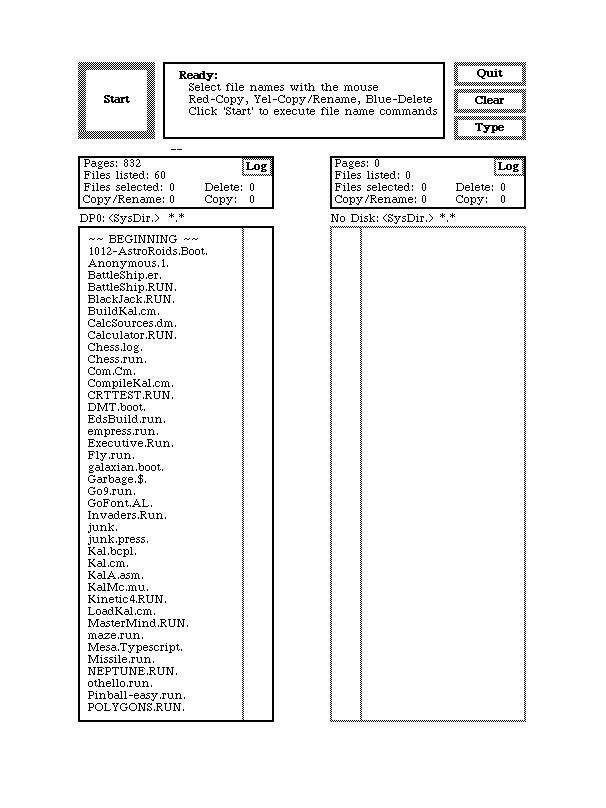
1973: Xerox Alto. Bitmapped display, 3-button mouse, 16-bit CPU.
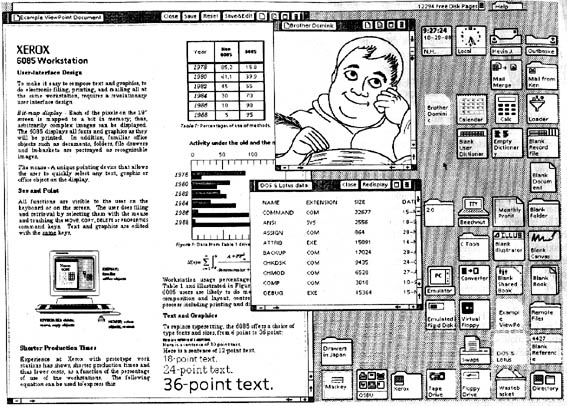
1981: Xerox Star screenshot.
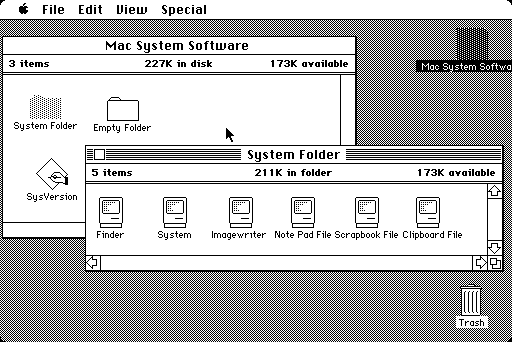
1984: Apple Macintosh.
1985: Amiga 1000.
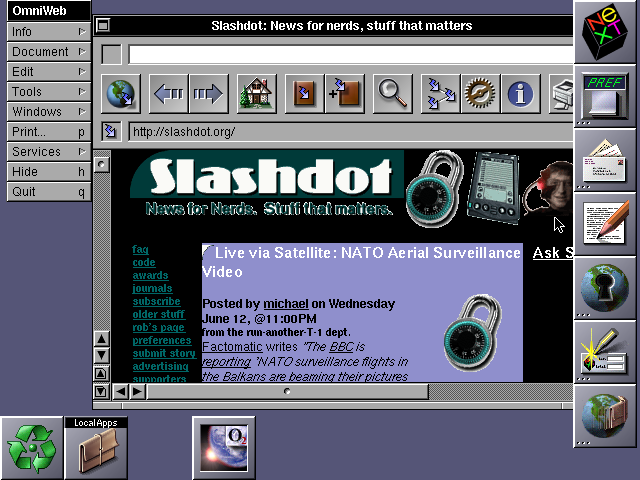
1988: NeXT and OPENSTEP.
1990: Amiga pushing the boundaries of the GUI in 1990! Watch out Apple, NeXT and Microsoft!
Most of this from Nathan Lineback's Graphical User Interface Timeline. -
Re:This is how terrorism is fought againstMmmm, reasoned debate.
Like appeasing hostile forces in a culture war. That's always fun, "but what if we saw things from Hitler's point of view" is a great time killer. Go nuts - or more specifically - go FURTHER nuts.
Uhhhh, Mr Godwin? We need a ruling here please... -
A standard for bogosity
AI is bogus.
See The Jargon File entry for micro-Lenat
http://catb.org/jargon/html/M/microLenat.html
For a more literary perspective on the attempt
to imbue machine intelligence with common sense,
see _Galatea_2.2_ by Richard Powers,
http://www.amazon.com/gp/product/0312423136/sr=1-1 /qid=1155242163/ref=pd_bbs_1/103-4246079-1703018?i e=UTF8&s=books
---
He's no fun; he fell right over. -
Re:kinda cool
Offloading that job to your ethernet card is a nice way to keep your CPU doing the stuff you want it focused on.
Sounds like the wheel of reincarnation.We were just piping
Sure! Read from -
There's a fundamental mistake in his assumptionsIt looks to me like this guy just doesn't get the reason behind Linux and
the other Free(dom) OSes. I use Linux not for the closed source
applications, but because I don't have to use any closed source applications
applications.
I can't speak for anyone else on this, but I got sick and tired of:- Buggy software that would crash at the drop of a hat
- Spyware that would try to track me
- Being treated like a criminal: you know, would require an "activation code",
I would give my first born as a hostage, tell them everything about me including
where I live - Code that ran on only 1 platform and 1 version of the OS
- Code that I could only run on 1 machine and God help you if you tried
to sell it to someone else with out the Brown shirts^h^h^h^h^^h^h^h, sorry BSA
coming down on you - not being able to figure out what the code was doing --- I had NO input
into their code other than not using it -- which is exactly what I ultimately did
I escaped the BillyG matrix in 1997 and I will never go back to that environment.
If you want closed source software then you know where to find it:
http://catb.org/jargon/html/I/If-you-want-X--you-k now-where-to-find-it-.html -
Re:Google
I like google groups better than the google linux search, but I don't think either are the best sites. IMHO any site that purports to have all answers to all linux questions isn't going to do very well with any semi-complex question. They just can't have the know-how.
IRC channels are good, but it is kind of like IM - if the devs aren't on you're out of luck.
I think it really depends on the distro. For Ubuntu, there is Ubuntu forums for SuSE there are SuSE forums. The same goes for Gentoo, Mepis, Debian, Redhat, Fedora or any other distro out there. The larger projects also have their own forums.
Getting as specific a location as you can will help (e.g. the google group on Debian is better than the one on Linux users for Debian problems). That is why IRC is great when you have a reasonably well-researched and specific question. Before you ask a dev (who may be working on fixing the problem, or may have already fixed it, or may be plagued by the same question over and over again) please read how to ask a question properly. That way you are maximizing the chance that you get the right answer, people won't get mad at you, and you won't be wasting anyone else's time. -
Re:Right tool...
I don't know about good, but evil appears to have an established definition: http://catb.org/esr/jargon/html/E/evil.html It is, of course, not everyone's definition, but MS products tend to have a high Evil-to-'Good Thing' ratio.
-
Re:Butterfly test
Walking drives predate 1990 by many years.
They've been part of the Jargon File since its inception. -
Re:GIft ideas
So what would make a good gift for a well deserving system admin? Funny or serious ideas are welcome.
what do you mean? a bigger LART of course! -
See Hackers Dictionary: "Wheel of reincarnation"AMD needs GPU functionality on the CPU.
See the entry in the Hacker's Dictionary / Jargon File for "Wheel of reincarnation":wheel of reincarnation: [1968] Term used to refer to a well-known effect whereby function in a computing system family is migrated out to special-purpose peripheral hardware for speed, then the peripheral evolves toward more computing power as it does its job, then somebody notices that it is inefficient to support two asymmetrical processors in the architecture and folds the function back into the main CPU, at which point the cycle begins again.
Several iterations of this cycle have been observed in graphics-processor design, and at least one or two in communications and floating-point processors. [...]
-Mark -
Asking Questions
This would be useful reading. One thing that everybody has to deal with, especially when getting started, is asking questions. If everyone had tons of time to answer everyone else's questions, it'd be great. Fact is, we don't. I appreciate that your time is valuable, as you've said. Everybody else's is too. So, the gist of it is, if you don't follow the accepted etiquette, you will find that people are much much less friendly, and much much less willing to spend their own time to help you. On the other hand, if you do follow the etiquette, then sure, some people will still flame you (life is just like that, all over the place), but chances are, you will find several people who are perfectly happy and willing to help you.
Best of luck with ubuntu! -
Intentions and Reality.
I just don't buy the whole Microsoft is hurting Linux/Apple/BSD etc. because all of those systems are growing and getting better all the time. Linux is getting better and better, OS X is super cool, and so on.
Microsoft's inability to disrupt free software is not from a lack of trying. See the Halloween Documents for graphic proof of their honesty, attitude and intentions. The attack includes all dependencies and weaknesses perceived eight years ago, discussion groups and standards of all sorts. If anything, those attacks have multiplied and intensified. The reality is that they are so paranoid and crazy that they won't be happy until every compting device on the planet, right down to your music player, runs their software without choice. The other day's "We own corporate search and nobody's takin food off our table," crazy should convince you before October that all is the same in the M$ world. Their inability to "fucking kill _your_favorite_thing_here" does not indicate a lack of effort so much as it indicates common sense elsewhere.
Strangely enough, they have helpers. Apple is insanely supporting them for many issues and the media companies are terminally stupid. The harm done includes:
- Difficulty collaborating with M$ users.
- Difficulty installing and using new hardware.
- DRM'd media and difficulty playing content on anything but licensed systems. Show me a simple music player that does USB file system and plays OGGs here in the US. It's not there, you have to use an old player like IRiver and hack it up with Rockbox.
- Crappy wireless "security" network protocols.
- All the usual non free upgrade train nonsense their users suffer, which amounts to massive intentional waste.
Free software has managed to float above all that and will prevail. It's as inevitable as Vista is buggy, bloated and sorry improvement on previous offerings.
Microsoft is not your friend. They never have been and never will be.
-
Re:Along those lines...Here's an actual data point:
I sped up some C code by unrolling a loop with Duff's Device. Duff's Device, for those who haven't encountered it, makes an ingenious use of the often-maligned C behavior that case statements, in the absence of a break or return statement, fall-through.
Duff's Device takes advantage of the fall-through by jumping into the middle of an unrolled loop of repeated instructions. If eight instructions are unrolled, Duff's Device iterates the loopcount divided by eight (count / 8 )
times, but enters the loop by jumping to the
count mod eight (count % 8)
'the unrolled instruction from the end of the loop. (This sounds complicated, but isn't; just look at the code and it becomes clear.)
The whole point of Duff's Device is speed and locality of code. Speed: because the loop is unrolled, more instructions are executed for each jump back to the top (and jumps are, relatively, expensive, because they mean any preloaded instructions must be tossed out ans re-read. Locality: (hopefully) all the instructions can be cached, so the processor doesn't have to re-read them from memory.
But what gcc does with Duff's Device on ARM targets is just bizarre. gcc uses a jump table (good) to directly change the Program Counter (good, so far). But instead of jumping into the loop (which would be good), gcc uses the jump table to jump to
a redundant assignment and
an unconditional jump.
Yes, gcc very smartly makes a jump table (which directly changes the Program Counter, just like a jump would) to jump to a jump. This is simply a waste of code and time:I'd show you the entire assembly code gcc produces, but slashdot won't let me: "Your comment violated the "postercomment" compression filter. Try less whitespace and/or less repetition. Comment aborted."
cmp r2, #7
ldrls pc, [pc, r2, asl #2] <-- directly modify the Program Counter making it pc + ( r2 << 2 )
b
.L79: <-- jump table
.L72: <-- first jump table destination
mov r1, lr <-- redundant assignment made at every destination
b
[ 7 repeats of the above, with differnt branch targets elided]
.L87: <-- for each iteration of the loop, we're moving exactly 8 halfwords = 4 words
ldrh r3, [r0], #2 <-- what would be fastest is to load multiple four words,
<-- then shift high words down
strh r3, [ip, #0] @ movhi
[6 repeats of the above elided]
.L80:
ldrh r3, [r0], #2
strh r3, [ip, #0] @ movhi
sub r1, r1, #1 <-- a subs instruction here would obviate the need for the
cmp r1, #0 <-- cmp instruction that follows it, saving a cycle per iteration
bgtWhy a jump table just to set up an unconditional jump? Why the redundant mov, which could have been done once, prior to the jump table jump? Who knows, that's what gcc does.
In this particular case, the object is to copy halfwords to a memory address, which address is really mapped to an output device. ARM processors, of course, are optimized for word addresses, so the "best" way to do this would be to load multiple words (LDM), shift the upper -
Summery of the article
Hello, I re-invented Usenet.
Ok, Usenet does not have 1on1 real time conversation. It does have the advantage that you have many people looking at your problem and often hand you several solutions. There is a downside, you have to read this page first. -
Re:combination
disclaimer: I have no experience doing this in Linux
That's because it's only needed (as a performance hack) with Windows. Forking is cheap with *nix."Those who don't understand UNIX are doomed to reinvent it, poorly."
--Henry SpencerGet ESR's "The Art of UNIX Programming" - or if cheap read it online. Chapter 7 might be a good place for you to start.
-
You know, if you were a real geek...
this would be old news.
I mean, "neophilia" has been in the jargon file since, what, 1973? -
Re:Cathedral and the Bazaar - closed source versio
Why should Eric Raymond mind if I take The Cathedral and the Bazaar and sanitize it for people that don't like open source?
The Cathedral and the Bazaar
"Permission is granted to copy, distribute and/or modify this document under the terms of the Open Publication License, version 2.0." -
Re:Better how?I believe this would qualify as a hack.
Hack
In this case, the real problem is the people behind the scams, but to fix it they're mucking a system that already works beautifully now.
1. n. Originally, a quick job that produces what is needed, but not well.
But in the end, no one is being forced to use it. This won't have any affect on the current system, so whomever they "cater to" won't matter to the overwhelming majority of people who stick with vanilla DNS. -
Re:so?
"Yeah, because offering a peek at the goddamned source code didn't go far enough, right?"
No, because the source code is NOT what was ASKED FOR. How can people not understand this? Go read the halloween papers. You will see why MS went as far as to try giving source instead of actual API documentation, because that is how badly they DON'T WANT to do that, not because they can't, or it's too hard as they say.
Here, feel free to read up on what is actually going on right here...
http://www.catb.org/~esr/halloween/halloween1.html
then maybe you'll see how much of a bully MS actually is. Anything that would put a stop to that has my full approval. -
Re:Whining capitalist ....
Eric Raymond has been an important evangelist for open source software and is a self proclaimed Libertarian---that's a pretty hard core capitalist philosophy. True capitalists are all for the right to give things away. That's among the biggest of reasons they oppose the death tax. You can't give things away that the government takes away first. As a matter of fact, because a communist society doesn't recognize the concept of private property, how can you give something away if you don't have the right to own it in the first place?
-
Re:Now who will I choose...
First Post on Slashdot is a badge of honor among neophytes in their larval stage. Most of them grow out of it... Unfortunately Slashdot seems to attract Larva faster than they grow up.
-
Re:How did this get modded up?
ok, i'll bite
And these snobbish attitudes are exactly the reason why linux has difficulty in desktop penetration and overall mindshare.
first of all, i see you have a lowish uid and should know better before talking shit. second, i know that OpenBSDs `mission statement' is to provide a solid, free, secure OS -- what's the goal of Linux, handholding and making friends? i think not.
and before the RMS-squad starts gnawing on the back of my head, lets assume he wrote GNU/Linux and was not referring just at the kernel.