Slashdot Mirror
Domain: code.org
Stories and comments across the archive that link to code.org.
Stories · 148
-
82-Year-Old Pope Francis Is 'First Pope To Write a Line of Code' (geekwire.com)
Long-time Slashdot reader theodp writes: After seeing to it that UK Prime Minister David Cameron, US President Barack Obama, and Canadian Prime Minister Justin Trudeau all received (widely-publicized) coding lessons, Code.org CEO Hadi Partovi noted in late 2016 that he was "still working on Pope Francis." GeekWire reports that Partovi was able to cross that one off his bucket list Thursday, as he helped Pope Francis become 'the first Pope to write a line of code' at a 'Programming for Peace' event organized by the Pope's foundation, Scholas Occurrentes, in Vatican City (not ready for Twitch.TV video).
"In the 21st century, computer science is a fundamental subject that all students should learn," said Partovi, whose tech-bankrolled nonprofit has entered a partnership with Scholas to introduce children to computer science. "Schools should teach computer science to prepare students for the future, empower children with creativity and teach how to harness technology and creativity." The Pontiff's programming lesson comes a month after Partovi's next-door neighbor, Microsoft President and Code.org Board member Brad Smith, had a sit-down with the Pope to discuss the ethical use of AI and ways to bridge the digital divide between rich and poor nations. -
A 60 Minutes Story on Gender Equality Accidentally Proved the Persistence of Patriarchy (qz.com)
Over at Quartz, Ephrat Livni reports that a 60 Minutes story about gender equality accidentally proved the persistence of patriarchy. Reader theodp shares the report: Good intentions are nice, but they aren't enough, the TV news show 60 Minutes recently proved. The show's producers apparently meant well when they decided to do a segment on women in technology and the gender gap, which aired on March 4. But they ended up punching women in the gut, as the founder and CEO of Girls Who Code, Reshma Saujani, puts it in her response to the segment. Ultimately, 60 Minutes featured a man, Code.org CEO Hadi Partovi. His [tech-backed] organization's mission is to expand access to computer science education in schools.
Women technologists like Saujani who were tapped to appear on the show about a year ago and worked with producers to provide research and interviews, ended up on the cutting room floor while Partovi spoke on their behalf. Here is the cruel irony: As a result, 60 Minutes' segment was accidentally exceptionally effective-it proved that women in tech really can't catch a break. [...] Ayah Bdeir, the founder of STEM learning toy company littleBits, also responded to the episode in a Medium post. She noted that she worked with 60 Minutes for a year, planning interviews, providing research, talking to the producers and reporters, telling her story and that of her organization, which is focused on closing the gender gap in technology. Yet producers wrote to her last August to say that the focus of the segment had shifted and that littleBits would no longer be central in the story. In an email, a producer explained to her, 'It's not that the important points you made in your interview are ignored in the story, or that you didn't make them very effectively, they're just made by others'. -
Bill Gates, Amazon and Google Urge Followers To Share Data On Teacher Friends
theodp writes: Facebook may be facing the threat of a multi-billion dollar FTC fine for privacy lapses that included allowing companies to obtain users' email addresses from their friends, but that didn't discourage Bill Gates from taking to Twitter to urge his 46.5 million followers to give up the names and email addresses of teachers so they can be contacted by tech-bankrolled Code.org for a chance to receive a "Computer Science Scholarship" (attend Professional Development workshops). Or Amazon. Or Google. "The success of our professional learning program depends on the work of our partners to spread the word," explained Code.org in a Medium Post. "Corporate partners like Amazon, Infosys, and Google are rallying their employees and communities to nominate a teacher, and so are fellow teachers, parents, and students. We couldn't do it without you! [...] Code.org (and these scholarships) are supported by: Amazon, Bill and Melinda Gates Foundation, Facebook, Google, Infosys Foundation USA, Microsoft [...] Code.org has prepared almost 100,000 educators to teach our courses, and they give our program rave reviews. We welcome teachers from all subject areas-no CS experience needed!"
In May, Code.org announced it was crowdsourcing a database of U.S. K-12 schools that teach -- or don't teach -- CS, with a goal to "gather data for 100% of U.S. schools by the end of 2018." The database would be used by the nonprofit and the CS community to "make our shared vision [for every school to teach computer science] a reality." Several months later, Amazon disclosed its involvement with the data collection effort, explaining it "will help us bring access to the schools that need it most." Amazon on Thursday announced it had selected 1,000 high schools to receive Amazon-funded CS classes and will be tapping another lucky 1,000 schools in the next few months. An Amazon press release said the company hopes to "inspire and educate 10 million children and young adults each year from underprivileged, underrepresented, and underserved communities to pursue careers in the fast-growing field of computer science and coding" through its Amazon Future Engineer program, which the e-tailer describes as "a four-part, childhood-to-career program." -
Bill Gates, Amazon and Google Urge Followers To Share Data On Teacher Friends
theodp writes: Facebook may be facing the threat of a multi-billion dollar FTC fine for privacy lapses that included allowing companies to obtain users' email addresses from their friends, but that didn't discourage Bill Gates from taking to Twitter to urge his 46.5 million followers to give up the names and email addresses of teachers so they can be contacted by tech-bankrolled Code.org for a chance to receive a "Computer Science Scholarship" (attend Professional Development workshops). Or Amazon. Or Google. "The success of our professional learning program depends on the work of our partners to spread the word," explained Code.org in a Medium Post. "Corporate partners like Amazon, Infosys, and Google are rallying their employees and communities to nominate a teacher, and so are fellow teachers, parents, and students. We couldn't do it without you! [...] Code.org (and these scholarships) are supported by: Amazon, Bill and Melinda Gates Foundation, Facebook, Google, Infosys Foundation USA, Microsoft [...] Code.org has prepared almost 100,000 educators to teach our courses, and they give our program rave reviews. We welcome teachers from all subject areas-no CS experience needed!"
In May, Code.org announced it was crowdsourcing a database of U.S. K-12 schools that teach -- or don't teach -- CS, with a goal to "gather data for 100% of U.S. schools by the end of 2018." The database would be used by the nonprofit and the CS community to "make our shared vision [for every school to teach computer science] a reality." Several months later, Amazon disclosed its involvement with the data collection effort, explaining it "will help us bring access to the schools that need it most." Amazon on Thursday announced it had selected 1,000 high schools to receive Amazon-funded CS classes and will be tapping another lucky 1,000 schools in the next few months. An Amazon press release said the company hopes to "inspire and educate 10 million children and young adults each year from underprivileged, underrepresented, and underserved communities to pursue careers in the fast-growing field of computer science and coding" through its Amazon Future Engineer program, which the e-tailer describes as "a four-part, childhood-to-career program." -
Bill and Melinda Gates: Textbooks Are Becoming Obsolete
Reader theodp writes: Thanks to software, Bill and Melinda Gates report in their 2019 Annual Letter, textbooks are becoming obsolete. Bill writes: "I read more than my share of textbooks. But it's a pretty limited way to learn something. Even the best text can't figure out which concepts you understand and which ones you need more help with. It certainly can't tell your teacher how well you grasped last night's assigned reading. But now, thanks to software, the standalone textbook is becoming a thing of the past" (if so, it'll be a 60-year overnight success!). The Gates are putting their money where their mouths are -- their education investments include look-Ma-no-textbooks Khan Academy and Code.org. Code.org, whose AP Computer Science Principles course for high schools "does not require or follow a textbook", boasted in its just-released Annual Report that 38% of all AP CS exam takers in 2018 came from "Code.org Computer Science Principles classrooms," adding that it had spent $24.2 million of its donors' money on curriculum and its Code Studio learning platform (30,300 hours of coursework), another $46.7 million to prepare 87,000 new K-12 CS teachers, $12.4 million on Marketing, and $6.9 million on Government Affairs. So, do we still need textbooks? -
Bill and Melinda Gates: Textbooks Are Becoming Obsolete
Reader theodp writes: Thanks to software, Bill and Melinda Gates report in their 2019 Annual Letter, textbooks are becoming obsolete. Bill writes: "I read more than my share of textbooks. But it's a pretty limited way to learn something. Even the best text can't figure out which concepts you understand and which ones you need more help with. It certainly can't tell your teacher how well you grasped last night's assigned reading. But now, thanks to software, the standalone textbook is becoming a thing of the past" (if so, it'll be a 60-year overnight success!). The Gates are putting their money where their mouths are -- their education investments include look-Ma-no-textbooks Khan Academy and Code.org. Code.org, whose AP Computer Science Principles course for high schools "does not require or follow a textbook", boasted in its just-released Annual Report that 38% of all AP CS exam takers in 2018 came from "Code.org Computer Science Principles classrooms," adding that it had spent $24.2 million of its donors' money on curriculum and its Code Studio learning platform (30,300 hours of coursework), another $46.7 million to prepare 87,000 new K-12 CS teachers, $12.4 million on Marketing, and $6.9 million on Government Affairs. So, do we still need textbooks? -
Bill and Melinda Gates: Textbooks Are Becoming Obsolete
Reader theodp writes: Thanks to software, Bill and Melinda Gates report in their 2019 Annual Letter, textbooks are becoming obsolete. Bill writes: "I read more than my share of textbooks. But it's a pretty limited way to learn something. Even the best text can't figure out which concepts you understand and which ones you need more help with. It certainly can't tell your teacher how well you grasped last night's assigned reading. But now, thanks to software, the standalone textbook is becoming a thing of the past" (if so, it'll be a 60-year overnight success!). The Gates are putting their money where their mouths are -- their education investments include look-Ma-no-textbooks Khan Academy and Code.org. Code.org, whose AP Computer Science Principles course for high schools "does not require or follow a textbook", boasted in its just-released Annual Report that 38% of all AP CS exam takers in 2018 came from "Code.org Computer Science Principles classrooms," adding that it had spent $24.2 million of its donors' money on curriculum and its Code Studio learning platform (30,300 hours of coursework), another $46.7 million to prepare 87,000 new K-12 CS teachers, $12.4 million on Marketing, and $6.9 million on Government Affairs. So, do we still need textbooks? -
Virginia To Produce 25K-35K Additional CS Grads As Part of Amazon HQ2 Deal (loudounnow.com)
theodp writes: Developers! Developers! Developers! To make good on the proposal that snagged it a share of the Amazon HQ2 prize, the State of Virginia is also apparently on the hook for doubling the annual number of graduates with computer science or closely related degrees, with a goal to add 25,000 to 35,000 graduates (Amazon's HQ2 RFP demanded info on "education programs related to computer science"). To do that, the state will establish a performance-based investment fund for higher education institutions to expand their bachelor's degree programs, and spend up to $375 million on George Mason University's Arlington campus and a new Virginia Tech campus in Alexandria. The state will also spend $50 million on STEM + CS education in public schools and expanding internships for higher education students.
Amazon is certainly focused on boosting the ranks of software engineer types. Earlier this month, Amazon launched Amazon Future Engineer, a program that aims to teach more than 10 million students a year how to code, part of a $50 million Amazon commitment to computer science education that was announced last year at a kickoff event for the Ivanka Trump-led White House K-12 CS Initiative. And on Wednesday, Amazon-bankrolled Code.org -- Amazon is a $10+ million Diamond Supporter of the nonprofit; CS/EE grad Jeff Bezos is a $1+ million Gold Supporter -- announced it has teamed with Amazon Future Engineer to build and launchHour of Code: Dance Party, a signature tutorial for this December's big Hour of Code (powered by AWS in 2017), which has become something of a corporate infomercial (Microsoft recently boasted "learners around the world have completed nearly 100 million Minecraft Hour of Code sessions"). Students participating in the Dance Party tutorial, Code.org explained, can choose from 30 hits like Katy Perry's "Firework" and code interactive dance moves and special effects as they learn basic CS concepts. "The artists whose music is used in this tutorial are not sponsoring or endorsing Amazon as part of licensing use of their music to Code.org," stresses a footnote in Code.org's post. So, don't try to make any connections between Katy Perry's Twitter endorsement of the Code.org/Amazon tutorial later that day and those same-day follow-up Amazon and Katy Perry tweets touting their new exclusive Amazon Music streaming deal, kids! -
With Few US Students Taking CS Classes, Code.org 'Scales Back' Funding For CS Education (acm.org)
"In 2012, most CS teacher professional development was paid for by the National Science Foundation or Google." And in the years that followed, 80,000 primary and secondary school teachers received opportunities to learn how to teach computer science without paying any fees -- thanks to tech-bankrolled Code.org.
But is anyone taking the classes? Slashdot reader theodp quotes a Communications of the ACM post by University of Michigan professor Mark Guzdial: In 2013, Code.org began, and they changed the face of CS education in the United States . It started out as just a video (linked here, seen over 14 million times), and grew into an organization that created and provided curriculum, offered teacher professional development, and worked with states and districts around public policy initiatives. A recent report from Code.org showed that 44 states have enacted public policies to promote computing education in the five years from 2013 to 2018, and much of that happened through Code.org's influence....
Now, Code.org has announced that they are starting to scale back their funding, which begins a multi-year transition to shift the burden of paying for teacher professional development to the local regions.... The only question is whether it's too soon. Will local regions step up and demonstrate that they value computer science by paying for it...? I'd guess that many states have between 40% and 70% of their high schools now offering computer science. However, even though many schools offer computer science, there are still few students taking computer science.
Indiana reported that only 0.4% of Indiana high school students had enrolled in their most popular course. Meanwhile in one region in Texas, 54 of 159 high schools offer computer science, yet only 2.3% of their students have ever taken a computer science class. But of course, there's another issue.
"If Code.org (or NSF or Google) are paying for all the development of CS teachers, then the districts don't get to say, 'In our community we care about this and we care less about that.' The U.S. education system is organized around the local regions calling the shots, setting the priorities, and deciding what they want teachers to teach." -
Amazon Accelerating Effort To Bring CS To More Than 133,000 US Schools
theodp writes: In addition to a monetary commitment of $10 million in cash and donations to Code.org, Amazon reports it's also accelerating the effort to bring computer science to all U.S. high schools by having employees spend time at Code.org, while maintaining employment at Amazon. According to the company's Day One blog, Amazon has lent its employees to help the tech-bankrolled nonprofit "gather data about computer science programs, or lack thereof, at every single school across the country." (There are over 133,000 schools in the United States.) Amazon added: "Putting this data on a map and combining it with what we know about the school's population, lets us see whether access to computer science courses are concentrated in wealthier schools or schools that are less diverse, and will help us bring access to the schools that need it most. [...] It will also ultimately support the much-needed pipeline for workers who are well versed in computer science."
Earlier, Code.org noted it was compiling the national database for use by the nonprofit and the CS community to "make our shared vision [for every school to teach computer science] a reality," but didn't note the involvement of Amazon, which committed $50 million last fall to the White House's new computer science push (part of a larger $300 million tech sector commitment). Execs from Amazon, Microsoft, Google, and Infosys occupy four of Code.org's nine board seats and have contributed $33+ million to the nonprofit (Facebook has kicked in another $10+ million). Hey, it's what parents want! -
Amazon Accelerating Effort To Bring CS To More Than 133,000 US Schools
theodp writes: In addition to a monetary commitment of $10 million in cash and donations to Code.org, Amazon reports it's also accelerating the effort to bring computer science to all U.S. high schools by having employees spend time at Code.org, while maintaining employment at Amazon. According to the company's Day One blog, Amazon has lent its employees to help the tech-bankrolled nonprofit "gather data about computer science programs, or lack thereof, at every single school across the country." (There are over 133,000 schools in the United States.) Amazon added: "Putting this data on a map and combining it with what we know about the school's population, lets us see whether access to computer science courses are concentrated in wealthier schools or schools that are less diverse, and will help us bring access to the schools that need it most. [...] It will also ultimately support the much-needed pipeline for workers who are well versed in computer science."
Earlier, Code.org noted it was compiling the national database for use by the nonprofit and the CS community to "make our shared vision [for every school to teach computer science] a reality," but didn't note the involvement of Amazon, which committed $50 million last fall to the White House's new computer science push (part of a larger $300 million tech sector commitment). Execs from Amazon, Microsoft, Google, and Infosys occupy four of Code.org's nine board seats and have contributed $33+ million to the nonprofit (Facebook has kicked in another $10+ million). Hey, it's what parents want! -
Amazon Accelerating Effort To Bring CS To More Than 133,000 US Schools
theodp writes: In addition to a monetary commitment of $10 million in cash and donations to Code.org, Amazon reports it's also accelerating the effort to bring computer science to all U.S. high schools by having employees spend time at Code.org, while maintaining employment at Amazon. According to the company's Day One blog, Amazon has lent its employees to help the tech-bankrolled nonprofit "gather data about computer science programs, or lack thereof, at every single school across the country." (There are over 133,000 schools in the United States.) Amazon added: "Putting this data on a map and combining it with what we know about the school's population, lets us see whether access to computer science courses are concentrated in wealthier schools or schools that are less diverse, and will help us bring access to the schools that need it most. [...] It will also ultimately support the much-needed pipeline for workers who are well versed in computer science."
Earlier, Code.org noted it was compiling the national database for use by the nonprofit and the CS community to "make our shared vision [for every school to teach computer science] a reality," but didn't note the involvement of Amazon, which committed $50 million last fall to the White House's new computer science push (part of a larger $300 million tech sector commitment). Execs from Amazon, Microsoft, Google, and Infosys occupy four of Code.org's nine board seats and have contributed $33+ million to the nonprofit (Facebook has kicked in another $10+ million). Hey, it's what parents want! -
Code.org Is Crowdsourcing Database of US K-12 Schools That Teach, Or Don't Teach CS
Longtime reader theodp writes: Nonprofit Code.org, which is bankrolled by the likes of Microsoft, Facebook, Amazon, Google, and Infosys, has teamed up with the Computer Science Teachers Association (CSTA) and is "calling on all educators and parents" to "help us build a database of all schools that teach (or don't teach) computer science" (via direct responses and email advocacy tools). Called the K-12 Computer Science Access Report, Code.org says "the database will be a resource that everyone in the CS community can use." For what purposes, however, is not entirely clear, although the Code.org Medium post indicates the database will be used by the nonprofit and the CS community to "make our shared vision [for every school to teach computer science] a reality." The post cites a 2016 study conducted by Google and Gallup -- which took principals to task for being clueless about what constituted "computer science" and misgauging parental and student demand for CS -- and goes on to add that the new database will allow the organization to "be able to report more precisely which schools do or don't offer this opportunity to their students." As far as a timeframe for the naughty-or-nice K-12 CS school database goes, Code.org reports, "our goal is to gather data for 100% of US schools by the end of 2018." In earlier posts, Code.org has thanked its partners for their help in "changing [K-12 CS] education policies in forty states" (make that 43 states!) and claimed credit for "pressing lawmakers" into unlocking Federal funding for K-12 CS with the passage of the Every Student Succeeds Act. -
Code.org Is Crowdsourcing Database of US K-12 Schools That Teach, Or Don't Teach CS
Longtime reader theodp writes: Nonprofit Code.org, which is bankrolled by the likes of Microsoft, Facebook, Amazon, Google, and Infosys, has teamed up with the Computer Science Teachers Association (CSTA) and is "calling on all educators and parents" to "help us build a database of all schools that teach (or don't teach) computer science" (via direct responses and email advocacy tools). Called the K-12 Computer Science Access Report, Code.org says "the database will be a resource that everyone in the CS community can use." For what purposes, however, is not entirely clear, although the Code.org Medium post indicates the database will be used by the nonprofit and the CS community to "make our shared vision [for every school to teach computer science] a reality." The post cites a 2016 study conducted by Google and Gallup -- which took principals to task for being clueless about what constituted "computer science" and misgauging parental and student demand for CS -- and goes on to add that the new database will allow the organization to "be able to report more precisely which schools do or don't offer this opportunity to their students." As far as a timeframe for the naughty-or-nice K-12 CS school database goes, Code.org reports, "our goal is to gather data for 100% of US schools by the end of 2018." In earlier posts, Code.org has thanked its partners for their help in "changing [K-12 CS] education policies in forty states" (make that 43 states!) and claimed credit for "pressing lawmakers" into unlocking Federal funding for K-12 CS with the passage of the Every Student Succeeds Act. -
Code.org Is Crowdsourcing Database of US K-12 Schools That Teach, Or Don't Teach CS
Longtime reader theodp writes: Nonprofit Code.org, which is bankrolled by the likes of Microsoft, Facebook, Amazon, Google, and Infosys, has teamed up with the Computer Science Teachers Association (CSTA) and is "calling on all educators and parents" to "help us build a database of all schools that teach (or don't teach) computer science" (via direct responses and email advocacy tools). Called the K-12 Computer Science Access Report, Code.org says "the database will be a resource that everyone in the CS community can use." For what purposes, however, is not entirely clear, although the Code.org Medium post indicates the database will be used by the nonprofit and the CS community to "make our shared vision [for every school to teach computer science] a reality." The post cites a 2016 study conducted by Google and Gallup -- which took principals to task for being clueless about what constituted "computer science" and misgauging parental and student demand for CS -- and goes on to add that the new database will allow the organization to "be able to report more precisely which schools do or don't offer this opportunity to their students." As far as a timeframe for the naughty-or-nice K-12 CS school database goes, Code.org reports, "our goal is to gather data for 100% of US schools by the end of 2018." In earlier posts, Code.org has thanked its partners for their help in "changing [K-12 CS] education policies in forty states" (make that 43 states!) and claimed credit for "pressing lawmakers" into unlocking Federal funding for K-12 CS with the passage of the Every Student Succeeds Act. -
Code.org Is Crowdsourcing Database of US K-12 Schools That Teach, Or Don't Teach CS
Longtime reader theodp writes: Nonprofit Code.org, which is bankrolled by the likes of Microsoft, Facebook, Amazon, Google, and Infosys, has teamed up with the Computer Science Teachers Association (CSTA) and is "calling on all educators and parents" to "help us build a database of all schools that teach (or don't teach) computer science" (via direct responses and email advocacy tools). Called the K-12 Computer Science Access Report, Code.org says "the database will be a resource that everyone in the CS community can use." For what purposes, however, is not entirely clear, although the Code.org Medium post indicates the database will be used by the nonprofit and the CS community to "make our shared vision [for every school to teach computer science] a reality." The post cites a 2016 study conducted by Google and Gallup -- which took principals to task for being clueless about what constituted "computer science" and misgauging parental and student demand for CS -- and goes on to add that the new database will allow the organization to "be able to report more precisely which schools do or don't offer this opportunity to their students." As far as a timeframe for the naughty-or-nice K-12 CS school database goes, Code.org reports, "our goal is to gather data for 100% of US schools by the end of 2018." In earlier posts, Code.org has thanked its partners for their help in "changing [K-12 CS] education policies in forty states" (make that 43 states!) and claimed credit for "pressing lawmakers" into unlocking Federal funding for K-12 CS with the passage of the Every Student Succeeds Act. -
Code.org Is Crowdsourcing Database of US K-12 Schools That Teach, Or Don't Teach CS
Longtime reader theodp writes: Nonprofit Code.org, which is bankrolled by the likes of Microsoft, Facebook, Amazon, Google, and Infosys, has teamed up with the Computer Science Teachers Association (CSTA) and is "calling on all educators and parents" to "help us build a database of all schools that teach (or don't teach) computer science" (via direct responses and email advocacy tools). Called the K-12 Computer Science Access Report, Code.org says "the database will be a resource that everyone in the CS community can use." For what purposes, however, is not entirely clear, although the Code.org Medium post indicates the database will be used by the nonprofit and the CS community to "make our shared vision [for every school to teach computer science] a reality." The post cites a 2016 study conducted by Google and Gallup -- which took principals to task for being clueless about what constituted "computer science" and misgauging parental and student demand for CS -- and goes on to add that the new database will allow the organization to "be able to report more precisely which schools do or don't offer this opportunity to their students." As far as a timeframe for the naughty-or-nice K-12 CS school database goes, Code.org reports, "our goal is to gather data for 100% of US schools by the end of 2018." In earlier posts, Code.org has thanked its partners for their help in "changing [K-12 CS] education policies in forty states" (make that 43 states!) and claimed credit for "pressing lawmakers" into unlocking Federal funding for K-12 CS with the passage of the Every Student Succeeds Act. -
Code.org Celebrates 5th Anniversary, Success In Changing K-12 Education Policy (slashdot.org)
theodp writes: It's exactly five years since Code.org launched with the video What Most Schools Don't Teach ," noted Code.org in a Monday blog post entitled Dedicating Our 5 year Anniversary to our Partners. "Since then, tens of millions of students have begun learning computer science, hundreds of thousands of schools have begun teaching CS, tens of thousands of teachers have attended workshops to introduce CS in their classrooms, hundreds of school districts have added CS to their curriculum, and forty U.S. states and 25 countries have announced policies and plans to support CS in schools [...] We should start by thanking our amazing donors, particularly Amazon [$10+ million], Facebook [$10+ million], Google [$3+ million], Infosys [$10+ million], and Microsoft [$10+ million]. Whether it's corporate funders, foundations, or individual donors, without your generous funding, we wouldn't exist [...] Changing education policies in forty states wouldn't be possible without the help of Microsoft, College Board, Amazon, and every partner in the Code.org Advocacy Coalition [...] We're particularly fortunate and proud to have had the vocal support of Bill Gates [$4+ million] and Mark Zuckerberg [$1+ million] since day one." Hey, it takes a corporate village to raise a CS-savvy child! -
Code.org Celebrates 5th Anniversary, Success In Changing K-12 Education Policy (slashdot.org)
theodp writes: It's exactly five years since Code.org launched with the video What Most Schools Don't Teach ," noted Code.org in a Monday blog post entitled Dedicating Our 5 year Anniversary to our Partners. "Since then, tens of millions of students have begun learning computer science, hundreds of thousands of schools have begun teaching CS, tens of thousands of teachers have attended workshops to introduce CS in their classrooms, hundreds of school districts have added CS to their curriculum, and forty U.S. states and 25 countries have announced policies and plans to support CS in schools [...] We should start by thanking our amazing donors, particularly Amazon [$10+ million], Facebook [$10+ million], Google [$3+ million], Infosys [$10+ million], and Microsoft [$10+ million]. Whether it's corporate funders, foundations, or individual donors, without your generous funding, we wouldn't exist [...] Changing education policies in forty states wouldn't be possible without the help of Microsoft, College Board, Amazon, and every partner in the Code.org Advocacy Coalition [...] We're particularly fortunate and proud to have had the vocal support of Bill Gates [$4+ million] and Mark Zuckerberg [$1+ million] since day one." Hey, it takes a corporate village to raise a CS-savvy child! -
Gates On a Plane: Alaska Airlines Inflight Entertainment Stars Bill Gates (miamiherald.com)
theodp writes: On Tuesday, it was announced that Alaska Airlines will make a new Code.org series of six short videos starring Microsoft's Bill Gates on How Computers Work available as inflight entertainment. "Because students and adults alike can learn from these videos," wrote Code.org CEO Hadi Partovi, "we are pleased to announce Khan Academy and Alaska Airlines will make them available beyond Code.org classrooms."
The original submission notes that Gates (and the Bill and Melinda Gates Foundation) have contributed millions to both educational groups, but Alaska Airlines calls the videos "entertaining and approachable," and says they'll start appearing on their flights in April.
But the videos are also available online, and besides Gates also feature appearances by former Apple designer May Li Khoe and Nat Brown, one of the creators of Microsoft's Xbox gaming system. -
High School Computer Science: Look Ma, No Textbooks!
theodp writes: Computer Science Teacher Alfred Thompson wonders how other high school CS teachers use textbooks. "It's not a conversation I hear much about," he writes. Indeed, many teachers apparently don't rely on CS textbooks much at all. In fact, the highly-touted new AP Computer Science Principles (AP CSP) course does not require a CS textbook for students (sample College Board AP CSP syllabus), albeit to the chagrin of some. Some of the bigger providers of AP CSP curriculum -- e.g., BJC and Code.org, both of whom partner with Microsoft TEALS -- don't require a traditional CS textbook. But with teachers being recruited to teach Computer Science even if they don't have a CS background, should students learning CS have a textbook? Or is the high AP exam pass rate enjoyed by AP CSP students proof that no-more-books works? -
High School Computer Science: Look Ma, No Textbooks!
theodp writes: Computer Science Teacher Alfred Thompson wonders how other high school CS teachers use textbooks. "It's not a conversation I hear much about," he writes. Indeed, many teachers apparently don't rely on CS textbooks much at all. In fact, the highly-touted new AP Computer Science Principles (AP CSP) course does not require a CS textbook for students (sample College Board AP CSP syllabus), albeit to the chagrin of some. Some of the bigger providers of AP CSP curriculum -- e.g., BJC and Code.org, both of whom partner with Microsoft TEALS -- don't require a traditional CS textbook. But with teachers being recruited to teach Computer Science even if they don't have a CS background, should students learning CS have a textbook? Or is the high AP exam pass rate enjoyed by AP CSP students proof that no-more-books works? -
Bill Gates Is First Guest Editor In Time Magazine's 94-Year History (geekwire.com)
Long-time Slashdot reader theodp writes: Time invited Bill Gates to be the first guest editor in the 94-year history of the magazine. Among the news Bill deemed fit to print in Time's first augmented-reality-enhanced issue were articles by wife Melinda and pal Bono, both of whom graced the cover of Time with Bill as the 2005 Persons of the Year... Another article reveals that "the four learning hacks Bill Gates swears by" include Khan Academy (a $10+ million Gates Foundation partner), tech-backed Code.org (to which Bill, the Gates Foundation, Microsoft, and Steve Ballmer have given somewhere north of $17M), the Big History Project (to which Bill had contributed a "modest $10 million" as of 2014), and The Teaching Company (which got Bill stoked about Big History).
The issue also includes Gates' "four favorite ways to give back" and "six innovations that could change the world." In fact, the theme of the whole issue is "optimism," with 62-year-old Gates writing that "On the whole, the world is getting better. This is not some naively optimistic view; it's backed by data. Look at the number of children who die before their fifth birthday. Since 1990, that figure has been cut in half. That means 122 million children have been saved in a quarter-century, and countless families have been spared the heartbreak of losing a child."
Another optimistic essay came from Daily Show host Trever Noah, who writes, "Mock millennials all you want. Here's why they give me hope." -
Should Teachers Get $100 For Steering Kids To Google's 'Hour of Code' Lesson?
Tomorrow's "Hour of Code" kick-off event features Melinda Gates, Facebook COO Sheryl Sandberg, YouTube CEO Susan Wojcicki, and "multiple state governors," reports theodp -- who has some concerns. With Microsoft boasting that nearly 70 million of its Minecraft Hour of Code sessions have been launched, and tech companies pushing coding and their products into classrooms, it's probably no surprise that the 2017 Hour of Code -- organized by tech-bankrolled Code.org -- seems to have presented a too-hard-to-resist branding opportunity for Google, Microsoft, Apple and Amazon.
And, in what might evoke memories of Dollars for Doctors, some teachers will even be rewarded for steering their kids to Google's Hour of Code lesson. "Thanks to our friends at Google," explains crowdfunding website DonorsChoose.org, "4th-8th grade public school teachers who engage their students in a 'Create your own Google logo' Hour of Code activity can earn a $100 DonorsChoose.org gift code -- and have the opportunity to receive one of five other grand prizes (including $5,000 in DonorsChoose.org credits for your school!)." -
Microsoft Debuts Minecraft-Themed Coding Tutorial
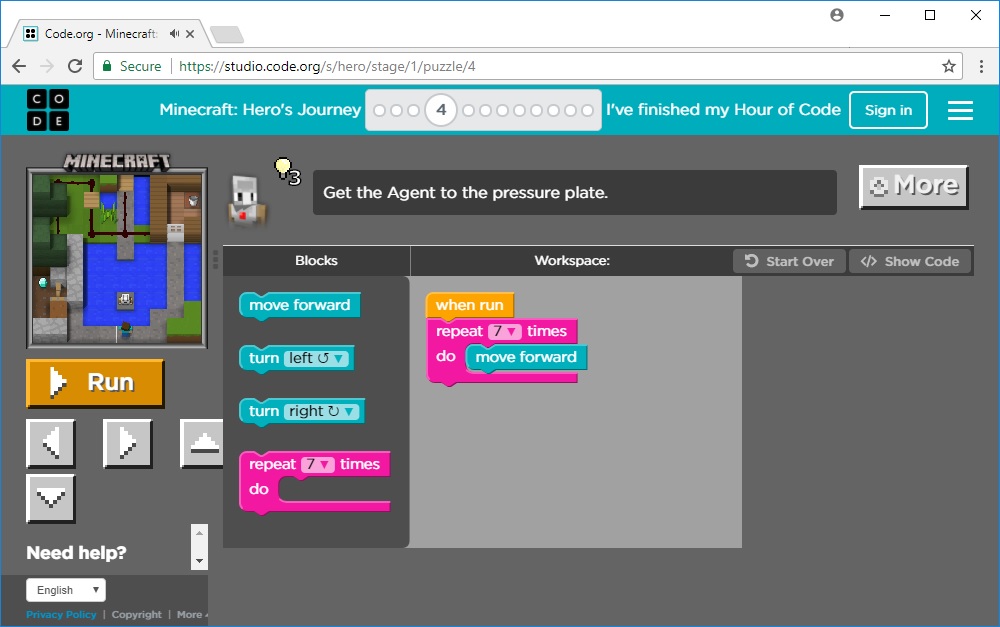
theodp writes: In a few weeks, writes Microsoft Corporate VP Mary Snapp, "millions of kids and others will participate in an Hour of Code, a global call to action to spend an hour learning the basics of coding. Today, it's my privilege to announce that Microsoft has released a new Minecraft tutorial for Hour of Code, called Hero's Journey." The release of the new Code.org-touted flagship Hour of Code tutorial -- the third since Microsoft purchased Minecraft Maker Mojang for $2.5B in 2014 -- comes as Microsoft celebrates Minecraft: Education Edition reaching a milestone of 2 million users.
Microsoft boasts that nearly 70 million of its Minecraft Hour of Code sessions have been launched to-date, which is certainly impressive from an infomercial or brand awareness standpoint. But does [adding a Scratch block to] move a Minecraft character forward 7 times on an $800 Microsoft Surface offer all that much more educational value than, say, moving a peg forward 5 times on a $10.99 Pop-O-Matic Trouble board game? -
Microsoft Debuts Minecraft-Themed Coding Tutorial
theodp writes: In a few weeks, writes Microsoft Corporate VP Mary Snapp, "millions of kids and others will participate in an Hour of Code, a global call to action to spend an hour learning the basics of coding. Today, it's my privilege to announce that Microsoft has released a new Minecraft tutorial for Hour of Code, called Hero's Journey." The release of the new Code.org-touted flagship Hour of Code tutorial -- the third since Microsoft purchased Minecraft Maker Mojang for $2.5B in 2014 -- comes as Microsoft celebrates Minecraft: Education Edition reaching a milestone of 2 million users.
Microsoft boasts that nearly 70 million of its Minecraft Hour of Code sessions have been launched to-date, which is certainly impressive from an infomercial or brand awareness standpoint. But does [adding a Scratch block to] move a Minecraft character forward 7 times on an $800 Microsoft Surface offer all that much more educational value than, say, moving a peg forward 5 times on a $10.99 Pop-O-Matic Trouble board game? -
How Silicon Valley Pushed Coding Into American Classrooms
theodp writes: Noting that Apple CEO Tim Cook's advice for President Trump at last week's White House gathering of the Tech Titans was that "coding should be a requirement in every public school," the New York Times examines How Silicon Valley Pushed Coding Into American Classrooms (Warning: source may be paywalled). "The Apple chief's education mandate was just the latest tech company push for coding courses in schools," writes Natasha Singer. "But even without Mr. Trump's support, Silicon Valley is already advancing that agenda -- thanks largely to the marketing prowess of Code.org, an industry-backed nonprofit group." Singer continues: "In a few short years, Code.org has raised more than $60 million from Microsoft, Facebook, Google and Salesforce, along with individual tech executives and foundations. It has helped to persuade two dozen states to change their education policies and laws, Mr. Hadi Partovi, co-founder of Code.org, said, while creating free introductory coding lessons, called Hour of Code, which more than 100 million students worldwide have tried. Along the way, Code.org has emerged as a new prototype for Silicon Valley education reform: a social-media-savvy entity that pushes for education policy changes, develops curriculums, offers online coding lessons and trains teachers -- touching nearly every facet of the education supply chain. The rise of Code.org coincides with a larger tech-industry push to remake American primary and secondary schools with computers and learning apps, a market estimated to reach $21 billion by 2020." Singer also mentions Apple's work to spread computer science in schools. The company launched a free app last year called Swift Playgrounds to teach basic coding in Swift, as well as a yearlong curriculum for high schools and community colleges to teach app design in Swift. -
Arizona Bill Would Make Students In Grades 4-12 Participate Once In An Hour of Code (azpbs.org)
theodp writes: Christopher Silavong of Cronkite News reports: "A bill, introduced by [Arizona State] Sen. John Kavanagh [R-Fountain Hills] would mandate that public and charter schools provide one hour of coding instruction once between grades 4 to 12. Kavanagh said it's critical for students to learn the language -- even if it's only one session -- so they can better compete for jobs in today's world. However, some legislators don't believe a state mandate is the right approach. Senate Bill 1136 has passed the Senate, and it's headed to the House of Representatives. Kavanagh said he was skeptical about coding and its role in the future. But he changed his mind after learning that major technology companies were having trouble finding domestic coders and talking with his son, who works at a tech company." According to the Bill, the instruction can "be offered by either a nationally recognized nonprofit organization [an accompanying Fact Sheet mentions tech-backed Code.org] that is devoted to expanding access to computer science or by an entity with expertise in providing instruction to pupils on interactive computer instruction that is aligned to the academic standards." -
Disney Thinks High Schools Should Let Kids Take Coding In Place of Foreign Languages
theodp writes: Florida lawmakers are again proposing a contentious plan that would put coding and foreign language on equal footing in a public high school student's education. Under a proposed bill students who take two credits of computer coding and earn a related industry certification could then count that coursework toward two foreign language credits.
"I sort of comically applaud that some would want to categorize coding as a foreign language," said Miami-Dade Schools Superintendent Alberto Carvalho. "Coding cannot be seen as an equivalent substitute." Disclosure records show that Walt Disney Parks and Resorts has three lobbyists registered to fight in support of the bill. Disney did not return an email seeking comment, but State Senator Jeff Brandes said the company's interest is in a future workforce... Disney has provided signature tutorials for the nation's Hour of Code over the past three years, including Disney's Frozen princess-themed tutorial. -
The 32-Bit Dog Ate 16 Million Kids' CS Homework (code.org)
"Any student progress from 9:19 to 10:33 a.m. on Friday was not saved..." explained the embarrassed CTO of the educational non-profit Code.org, "and unfortunately cannot be recovered." Slashdot reader theodp writes: Code.org CTO Jeremy Stone gave the kids an impromptu lesson on the powers of two with his explanation of why The Cloud ate their homework. "The way we store student coding activity is in a table that until today had a 32-bit index... The database table could only store 4 billion rows of coding activity information [and] we didn't realize we were running up to the limit, and the table got full. We have now made a new student activity table that is storing progress by students. With the new table, we are switching to a 64-bit index which will hold up to 18 quintillion rows of information.
The issue also took the site offline, temporarily making the work of 16 million K-12 students who have used the nonprofit's Code Studio disappear. "On the plus side, this new table will be able to store student coding information for millions of years," explains the site's CTO. But besides Friday's missing saves, "On the down side, until we've moved everything over to the new table, some students' code from before today may temporarily not appear, so please be patient with us as we fix it." -
Canada's Prime Minister Justin Trudeau Makes Game For Third Annual Hour of Code (gamasutra.com)
Eloking writes: Canadian Prime Minister Justin Trudeau's Twitter account lit up today with a message all too familiar to many indie devs: Mr. Trudeau has made a video game, and he'd like everyone to play it. It was a cute bit of promotion for Hour of Code, the computer science education event masterminded every year by the Code.org nonprofit. While the Hour of Code websites hosts one-hour tutorials (in 45 languages) for coding all sorts of simple applications, game developers may appreciate that the lion's share appears to be game projects, like the one Trudeau modified into a sort of hockey-themed Breakout variant. -
White House Silence Seems To Confirm $4 Billion 'Computer Science For All' K-12 Initiative Is No More
theodp writes: "2016 as a year of action builds on a decade of national, state, and grassroots activity to revitalize K-12 computer science education," reads the upbeat White House blog post kicking off Computer Science Education Week. But conspicuous by its absence in the accompanying fact sheet for A Year of Action Supporting Computer Science for All is any mention of the status of President Obama's proposed $4 billion Computer Science For All initiative, which enjoyed support from the likes of Microsoft, Facebook, and Google. On Friday, tech-backed Code.org posted An Update on Computer Science Education and Federal Funding, which explained that Congress's passage of a 'continuing resolution' extending the current budget into 2017 spelled curtains for federal funding for the program in 2016 and beyond. "We don't have any direct feedback yet about the next administration's support for K-12 CS," wrote CEO Hadi Partovi and Govt. Affairs VP Cameron Wilson, "other than a promise to expand 'vocational and technical education' as part of Trump's 100-day plan which was published in late October. I am hopeful that this language may translate into support for funding K-12 computer science at a federal level. However, we should assume that it will not." -
Code.org Disses Wolfram Language, Touts Apple's Swift Playgrounds (edsurge.com)
America is changing the way it teaches computer science. "There are now 31 states that allow CS to count towards high school graduation," according to an announcement this week by the White House, while a new Advance Placement course "will be offered in more than 2,000 U.S. classrooms this fall...the largest course launch in the history of the AP exam." But what's the best way to teach coding? theodp reports: Tech-backed Code.org, one of the leaders of the new CSforAll Consortium that was announced at the White House on Wednesday, took to its blog Thursday to say "Thanks, Tim [Cook], for supporting the effort to give every student the opportunity to learn computer science," giving a shout out to Apple for providing "resources for teachers who want to put Swift Playgrounds in their classrooms. (A day earlier, the White House said Apple developed Swift Playgrounds "in support of the President's call to action" for CS for All).
Curiously, Code.org CEO Hadi Partovi argued Friday that "the Wolfram Language has serious shortcomings for broad educational use" in an EdSurge op-ed that was called a "response to a recent blog post by Stephen Wolfram" on Wolfram's ambitious plan to teach computational thinking in schools. Partovi's complaints? "It requires login for all but the simplest use cases, but doesn't provide any privacy safeguards for young children (required in the U.S. through legislation such as COPPA). Also, a serious user would need to pay for usage, making implementation inaccessible in most schools. Lastly, it's a bit difficult to use by students who struggle with English reading or writing, such as English language learners or early elementary school students."
The submission ultimately asks how should computer science be taught to teenagers. "Would you be inclined to embrace Wolfram's approach, Apple's Swift Playgrounds, Microsoft TEALS' Java-centric AP CS curriculum, or something else (e.g., R, Tableau, Excel+VBA)?" -
Code.org Disses Wolfram Language, Touts Apple's Swift Playgrounds (edsurge.com)
America is changing the way it teaches computer science. "There are now 31 states that allow CS to count towards high school graduation," according to an announcement this week by the White House, while a new Advance Placement course "will be offered in more than 2,000 U.S. classrooms this fall...the largest course launch in the history of the AP exam." But what's the best way to teach coding? theodp reports: Tech-backed Code.org, one of the leaders of the new CSforAll Consortium that was announced at the White House on Wednesday, took to its blog Thursday to say "Thanks, Tim [Cook], for supporting the effort to give every student the opportunity to learn computer science," giving a shout out to Apple for providing "resources for teachers who want to put Swift Playgrounds in their classrooms. (A day earlier, the White House said Apple developed Swift Playgrounds "in support of the President's call to action" for CS for All).
Curiously, Code.org CEO Hadi Partovi argued Friday that "the Wolfram Language has serious shortcomings for broad educational use" in an EdSurge op-ed that was called a "response to a recent blog post by Stephen Wolfram" on Wolfram's ambitious plan to teach computational thinking in schools. Partovi's complaints? "It requires login for all but the simplest use cases, but doesn't provide any privacy safeguards for young children (required in the U.S. through legislation such as COPPA). Also, a serious user would need to pay for usage, making implementation inaccessible in most schools. Lastly, it's a bit difficult to use by students who struggle with English reading or writing, such as English language learners or early elementary school students."
The submission ultimately asks how should computer science be taught to teenagers. "Would you be inclined to embrace Wolfram's approach, Apple's Swift Playgrounds, Microsoft TEALS' Java-centric AP CS curriculum, or something else (e.g., R, Tableau, Excel+VBA)?" -
WSJ: Facebook's Point System Fails To Close Diversity Gap
theodp writes: Gizmodo and others are picking up on a Wall Street Journal story (Warning: may be paywalled) which reported that Facebook's failure to move the needle on diversity is all the more surprising because the social network awarded Facebook recruiters double points for a "diversity hire" -- a female, Black, or Hispanic engineer -- compared to the hire of a White or Asian male. Facebook declined to comment on whether this points-based system is still in effect. The WSJ also notes that Intel has paid its employees double referral bonuses for women, minorities, and veterans. The reward schemes evoke memories of gender-based (and later race-based) incentives offered for K-12 coding and STEM programs run by tech-backed Code.org (to which Facebook just pledged $15 million) and Google, which offered lower funding or no funding at all to teachers if participation by female students was deemed unacceptable to the sponsoring organizations. Facebook's efforts also seem consistent with the tech-backed Every Student Succeeds Act, which calls for increasing CS and STEM access to address a tech-declared national crisis, but only "for students through grade 12 who are members of groups underrepresented in such subject fields, such as female students, minority students, English learners, children with disabilities, and economically disadvantaged students." Hey, sometimes "every" doesn't mean "every!" -
Tech Takes Its K-12 CS Education and Immigration Crisis To the DNC (cnet.com)
theodp writes: In early 2013, Code.org and FWD.us coincidentally emerged after Microsoft suggested tech's agenda could be furthered by creating a crisis linking U.S. kids' lack of computer science savvy to tech's need for tech worker visas. Three years later, CNET's Marguerite Reardon reports that tech took its K-12 computer science and immigration crisis to the Democratic National Convention on Wednesday, where representatives from Microsoft, Facebook, and Amazon called for the federal government to invest in more STEM education and reform immigration policies -- recurring themes the industry hopes to influence in the run-up to the 2016 presidential election. "We believe in the importance of high-skilled immigration coupled with investments in education," said Microsoft President Brad Smith, repeating the Microsoft National Talent Strategy. The mini-tech conference also received some coverage in the New Republic, where David Dayen argues that the DNC is one big corporate bride. -
Microsoft President Brad Smith: Computer Science Is Space Race of Today
theodp writes: Q. How is K-12 computer science like the Cold War? A. It could use a Sputnik moment, at least that's the gist of an op-ed penned by Senator Jerry Moran (R., KS) and Microsoft President Brad Smith. From the article: "In the wake of the Soviet Union's 1957 Sputnik launch, President Eisenhower confronted the reality that America's educational standards were holding back the country's opportunity to compete on a global technological scale. He responded and called for support of math and science, which resulted in the National Defense Education Act of 1958 and helped send the country to the moon by the end of the next decade. It also created the educational foundation for a new generation of technology, leadership and prosperity. Today we face a similar challenge as the United States competes with nations across the globe in the indispensable field of computer science. To be up to the task, we must do a better job preparing our students for tomorrow's jobs." Smith is also a Board member of tech-bankrolled Code.org, which invoked Sputnik in its 2014 Senate testimony ("learning computer science is this generation's Sputnik moment") as it called for "comprehensive immigration reform efforts that tie H-1B visa fees to a new STEM education fund [...] to support the teaching and learning of more computer science," nicely echoing Microsoft's National Talent Strategy. Tying the lack of K-12 CS education to the need for tech visas is a time-honored tradition of sorts for Microsoft and politicians. As early as 2004, Bill Gates argued that CS education needed its own Sputnik moment, a sentiment shared by Senator Hillary Clinton in 2007 as she and fellow Senators listened to Gates make the case for more H-1B visas as he lamented the lack of CS-savvy U.S. high school students. -
3 Years Ago, Microsoft Said Tech Should Fund K-12 CS Education. What Changed? (motherjones.com)
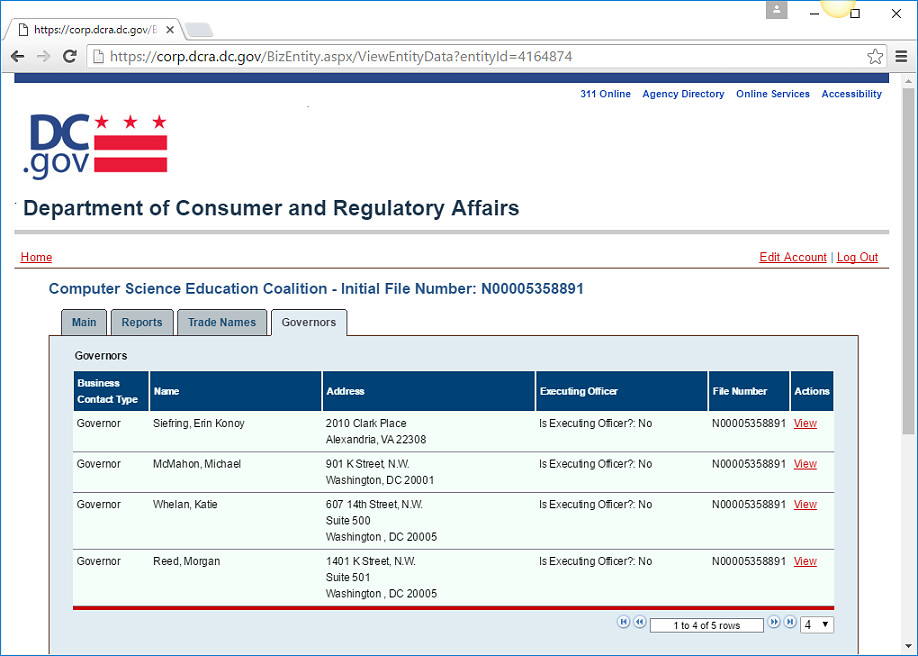
theodp writes: Last week, Microsoft and some of the biggest names in tech and corporate America threw their weight behind a Change.org petition that urged Congress to fund K-12 Computer Science education. The petition, started by the tech-backed CS Education Coalition (btw, 901 K Street NW is Microsoft's DC HQ) in partnership with tech-backed Code.org, now has 90,000+ supporters. But three years ago, Microsoft backed a very different Change.org petition that called for corporate America to foot the STEM education bill.
"While the need to expand high-skilled immigration is immediate," read the letter to Congress, "we also need to expand STEM opportunities in U.S. education. A positive proposal has emerged in Washington to create a national STEM education fund, paid for only by businesses using green cards and visas. This fund will help prepare Americans for 21st-century STEM jobs. The proposal is supported by a broad coalition [PDF] that includes Microsoft, GE, the National Council of La Raza, the National Association of Manufactures, and the National Science Teachers Association, to name a few."
The earlier petition, which wound up with 41,009 supporters, was started by Voices for Innovation, a self-described "Microsoft supported community" that says it's now "proud to support the Computer Science Education Coalition" as part of its efforts to "shape public policies for our 21st century digital economy and society." So, what changed? Well, Mother Jones did warn that what Microsoft promises and what it delivers for education isn't necessarily the same... -
Code.org Hacked, Emails and Locations Data of Volunteers Compromised
An anonymous reader allegedly quoting an email from Code.org, claims that the database of the non-profit organization has been breached: Some personal data was accessed on our web site by a firm exploiting a client-side vulnerability. Your email address and your location, if you provided it, were compromised and may have been read. The exploit was limited to engineers and others who volunteered to help in classrooms. No student or teacher accounts were impacted, nor passwords or additional information. The exploit did not give hackers access to any of our servers. Earlier this week, a volunteer engineer told us he received an unsolicited recruiting email from a technical freelancing firm in Singapore. We determined the firm was able to retrieve the volunteer's private email address by exploiting a client-side vulnerability on our volunteer map. We've since had 6 similar cases reported. We've fixed the problem, and all private data was secured against future attacks late Friday. We also inspected and secured the rest of our site from similar vulnerabilities. Code.org has confirmed to Slashdot that it has indeed suffered a breach. The non-profit separately wrote in a blog post that a Singapore-based recruiting firm had exploited a vulnerability on its website to send emails to Code.org members. Following is an email sent by the recruiting firm to Hadi Partovi, CEO, Code.org. "Sorry about this... our intention was we thought it'd be good to get them more opportunities to improve their own Computer Science skills beyond the opportunities available in their geographical boundaries / location. We've told our team to stop this with immediate effect. No one should be receiving anymore e-mails from us from this point onwards. You have my word that we will delete their email addresses from our mailing lists. They should not receive anymore emails from us." -
Chicago Public Schools Make Computer Science a Requirement For a HS Diploma
theodp writes: Less than 48 hours after the Chicago Public Schools hosted a three-hour "soiree" at Google's brand-new Chicago HQ, the CPS Board of Education voted unanimously to make computer science a graduation requirement for all high school students in the nation's third largest school district. Starting with next school year's freshman class, CPS students will be required to complete curriculum around computer science before graduating. "Requiring computer science as a core requirement will ensure that our graduates are proficient in the language of the 21st century so that they can compete for the jobs of the future," said Chicago Mayor Rahm Emanuel. CPS is working with tech bankrolled and led Code.org and other organizations to further develop a CS education curriculum to implement across all its high schools. Nationwide, President Obama has a $4B proposal on the table to bring CS education to all K-12 schools across the nation, which is also spurring action at the state level, Officials from Code.org, Microsoft and Google joined Arkansas Gov. Asa Hutchinson and Washington Gov. Jay Inslee at the National Governors Association winter meeting in Washington D.C. on Sunday to kick off a new partnership aimed at promoting CS. The new GovsForCS website notes that the Governors will be relying on Code.org for advice, explaining that the nonprofit "will provide the Partnership with resources related to best practices in policy and programs, and will facilitate collaboration among Governors and their staff, in person and virtually." -
Chicago Public Schools Make Computer Science a Requirement For a HS Diploma
theodp writes: Less than 48 hours after the Chicago Public Schools hosted a three-hour "soiree" at Google's brand-new Chicago HQ, the CPS Board of Education voted unanimously to make computer science a graduation requirement for all high school students in the nation's third largest school district. Starting with next school year's freshman class, CPS students will be required to complete curriculum around computer science before graduating. "Requiring computer science as a core requirement will ensure that our graduates are proficient in the language of the 21st century so that they can compete for the jobs of the future," said Chicago Mayor Rahm Emanuel. CPS is working with tech bankrolled and led Code.org and other organizations to further develop a CS education curriculum to implement across all its high schools. Nationwide, President Obama has a $4B proposal on the table to bring CS education to all K-12 schools across the nation, which is also spurring action at the state level, Officials from Code.org, Microsoft and Google joined Arkansas Gov. Asa Hutchinson and Washington Gov. Jay Inslee at the National Governors Association winter meeting in Washington D.C. on Sunday to kick off a new partnership aimed at promoting CS. The new GovsForCS website notes that the Governors will be relying on Code.org for advice, explaining that the nonprofit "will provide the Partnership with resources related to best practices in policy and programs, and will facilitate collaboration among Governors and their staff, in person and virtually." -
How Have Large Donations Affected Education Policy In New York City?
theodp writes: According to Chalkbeat, the expansion of charter schools, the movement to break New York City's large schools into smaller ones, and the push to teach computer science have something in common: the influence of philanthropy. Though contributions from big donors amount to only a fraction of New York City's education spending, they still have a real impact on public school policy, said Jeffrey Henig, the co-author of The New Education Philanthropy: Politics, Policy and Reform, which details how powerful individuals and organizations increasingly use donations to advance policies they support. Increasingly, Henig adds, some of those donors are paying more attention to advocacy, creating at least the appearance, if not the reality, of grassroots support. -
How Have Large Donations Affected Education Policy In New York City?
theodp writes: According to Chalkbeat, the expansion of charter schools, the movement to break New York City's large schools into smaller ones, and the push to teach computer science have something in common: the influence of philanthropy. Though contributions from big donors amount to only a fraction of New York City's education spending, they still have a real impact on public school policy, said Jeffrey Henig, the co-author of The New Education Philanthropy: Politics, Policy and Reform, which details how powerful individuals and organizations increasingly use donations to advance policies they support. Increasingly, Henig adds, some of those donors are paying more attention to advocacy, creating at least the appearance, if not the reality, of grassroots support. -
K12CS.org: Microsoft, Google, Apple Identifying What 1st Graders Should Know
theodp writes: On Sunday, The Simpsons declared computer coding class the nation's latest educational fad (script). Proving Principal Skinner's point, K12CS.org on Thursday announced a New Framework to Define K-12 Computer Science Education, the collaboration of participants from a number of states (MD, CA, IN, IA, AR, UT, ID, NE, GA, WA), large school districts (NYC, Chicago, San Francisco), technology companies (Microsoft, Google, Apple), organizations (Code.org, ACM, CSTA, ISTE, MassCAN, CSNYC), and individuals (higher ed faculty, researchers, K-12 teachers, and administrators). "A steering committee initially comprised of the Computer Science Teachers Association, the Association for Computing Machinery, and [tech bankrolled and led] Code.org will oversee this project," explained a CSTA blog post. "Funding for the project will be provided by Code.org and the ACM. The framework will identify key K-12 computer science concepts and practices we expect students exiting grades 2, 5, 8, and 12 to know."
In a FAQ, K12CS.org envisions a Programming and Algorithms standard for 1st Graders that calls for the 5-year-olds to "Work collaboratively in clear roles (e.g., pair programming) to construct a problem solution of a sequence of block-based programming commands." A day before the announcement, Politico reported that K-12 CS education is expected to get a State of the Union mention this year, and that the White House and U.S. Dept. of Education have been trolling for CS success stories in conjunction with the announcement of a broad set of new commitments to CS Education in early 2016. -
K12CS.org: Microsoft, Google, Apple Identifying What 1st Graders Should Know
theodp writes: On Sunday, The Simpsons declared computer coding class the nation's latest educational fad (script). Proving Principal Skinner's point, K12CS.org on Thursday announced a New Framework to Define K-12 Computer Science Education, the collaboration of participants from a number of states (MD, CA, IN, IA, AR, UT, ID, NE, GA, WA), large school districts (NYC, Chicago, San Francisco), technology companies (Microsoft, Google, Apple), organizations (Code.org, ACM, CSTA, ISTE, MassCAN, CSNYC), and individuals (higher ed faculty, researchers, K-12 teachers, and administrators). "A steering committee initially comprised of the Computer Science Teachers Association, the Association for Computing Machinery, and [tech bankrolled and led] Code.org will oversee this project," explained a CSTA blog post. "Funding for the project will be provided by Code.org and the ACM. The framework will identify key K-12 computer science concepts and practices we expect students exiting grades 2, 5, 8, and 12 to know."
In a FAQ, K12CS.org envisions a Programming and Algorithms standard for 1st Graders that calls for the 5-year-olds to "Work collaboratively in clear roles (e.g., pair programming) to construct a problem solution of a sequence of block-based programming commands." A day before the announcement, Politico reported that K-12 CS education is expected to get a State of the Union mention this year, and that the White House and U.S. Dept. of Education have been trolling for CS success stories in conjunction with the announcement of a broad set of new commitments to CS Education in early 2016. -
Did Google and the Hour of Code Get "Left" and "Right" Wrong?
theodp writes: Command the dancers to "point left" in Google's dance-themed Code Boogie learn-to-code tutorial on the Santa Tracker website, and the dancers actually point to their own right. The lesson seems to reinforce a common mistake made by younger children learning to code in LOGO, which is to use their own or the display screen's frame of reference rather than the turtle's frame of reference. "These misconceptions," explained Richard E. Mayer, "may be due to the knowledge that the child brings with him or her to the programming environment. For example, children who possess an egocentric conception of space (Piaget & Inhelder, 1956) would fail to recognize that when the turtle is at a 180-degree orientation, its right corresponds to the child's left." So, it should probably be asked if the learn-to-code tutorials from Lucasfilm, Code.org, and Google that are being used to teach the world's K-12 schoolchildren to code might be making the same mistake as 4-7 year-olds. In this year's flagship flagship Lucasfilm/Code.org Star Wars Hour of Code tutorial, for example, command the droid BB-8 to move left and it could move to either its own left or right depending on what direction it's pointed in. So, did the "Largest Learning Event in History" also get "left" and "right" wrong? -
US Bureau of Labor Statistics: Programmer Jobs Will Decline 8% (computerworld.com)
theodp writes: Two weeks ago, as the nation's schools 'taught kids to program' with an Hour of Code, Microsoft and others celebrated a 6-year lobbying effort that culminated in the passage of legislation that made Computer Science a core K-12 subject, which the software giant said "will advance some of the goals outlined in Microsoft's National Talent Strategy." But on Tuesday, Computerworld reported that the U.S. Bureau of Labor Statistics has put somewhat of a buzzkill on the learn-to-code party, saying IT jobs will grow 12% over the next decade, although computer programmers will see an 8% decline. "Computer programming can be done from anywhere in the world, so companies sometimes hire programmers in countries where wages are lower," explained the government. The silver lining is that software developers, the largest occupational group in IT, will increase by 17% or 186,600, over this period. The nomenclature here is a little muddy, since "programmers" and "software developers" are often used interchangeably. Here's how they're distinguished in this article: "Programmers are focused on coding and implementing requirements, and that’s why they may be more susceptible to offshoring, in contrast to software developers who may be more engaged with the business, analyzing needs and collaborating with multiple parties." -
White House Expected To Announce Big Computer Science Push
theodp writes: Politico reports that the White House is talking to groups about a push for computer science education in the coming weeks, possibly in mid-January, which could involve commitments from outside groups or companies. Code.org CEO Hadi Partovi recently credited a 2013 push from the White House for inspiring Code.org to dream up and team up with Big Tech on the wildly-successful Hour of Code, an event that brought teachers, schools, computer scientist volunteers, and other organizations together with the goal of bringing hands-on CS learning to 10 million K-12 students. Coincidentally, the Hour of Code event bears more than a passing similarity to the less-successful and now-abandoned National Lab Day (school flyer), an annual event announced by President Obama in 2009 that brought teachers, schools, computer scientist volunteers, and other organizations together with the goal of bringing hands-on STEM learning to 10 million K-12 students. -
WSJ: New Education Bill To Get More Coding In Classrooms
theodp writes: The WSJ's Yoree Koh reports that computer science has been recognized as important an academic subject as math and English in the new Every Student Succeeds Act, putting it on equal footing with other subjects when state and local policymakers decide how to dole out federal funds. The law is likely to be a boon for tech companies, Koh adds, which constantly face a shortage of engineers to hire, and have backed Code.org to lobby for computer science teaching in schools. "This legislation will increase access to STEM and computer science learning nationwide and will advance some of the goals outlined in Microsoft's National Talent Strategy," said Microsoft in a blog post. "ESSA makes a number of significant improvements to expand access to computer science education by diverse populations in urban, suburban, and rural areas," explained the ACM. As far as CS and STEM goes, the bill calls for "increasing access for students through grade 12 who are members of groups underrepresented in such subject fields, such as female students, minority students, English learners, children with disabilities, and economically disadvantaged students." -
Stephen Wolfram's Free Book Teaches the Wolfram Language To Kids
theodp writes: Stephen Wolfram received a PhD in particle physics at age 20 (his thesis committee included Richard Feynman). So it's probably not too surprising that Wolfram's new book, An Elementary Introduction to the Wolfram Language (free on the web), aspires to teach those new to programming how to do much more than just move Minecraft and Star Wars characters around. "The goal of the book," explains Wolfram in a blog post, "is to take people from zero to the point where they know enough about the Wolfram Language that they can routinely use it to create programs for things they want to do. And when I say 'zero', I really mean 'zero'. This is a book for everyone. It doesn't assume any knowledge of programming, or math (beyond basic arithmetic), or anything else. It just starts from scratch and explains things. I've tried to make it appropriate for both adults and kids. I think it'll work for typical kids aged about 12 and up."