Slashdot Mirror
Domain: columbia.edu
Stories and comments across the archive that link to columbia.edu.
Comments · 1,401
-
Read the papers
Reserach Papers
I'm not sure if they've done anything really novel. I skimmed through one of the more recent papers, on sentence ordering; but that seem to only operate on the same event There's research like this going one at alot of major universities like CMU and MIT. That said, it does look impressive. -
Here are some papers
Here are some papers about Newsblaster and computer text summarization in general.
-
Still a few bugs in the summarizer
Here is one borderline-incoherent Newsblaster summary:
Will Hollywood's 'Tomb' be a box office 'Raider?'
Summary:
After the success of last year ' s Lara Croft: Tomb Raider and high expectations for Resident Evil, out Friday, studios are booting up for more. The game: Alice in Wonderland gets a twisted remake in American McGee ' s Alice, a gothic horror version of the classic tale; based on the game by Electronic Arts Studio: Dimension Status: Horror master Wes Craven directs. The game: A sunglasses-wearing all-American hero blows away bad guys with machine guns; 3D Realms Studio: Dimension Status: In limbo. Star Angelina Jolie was attached to the sequel before the original Tomb Raider opened. The game: Amateur taxi drivers take to the sidewalks and crowded streets, picking up customers and delivering them to their destinations unscathed; Sega Studio: No distributor yet. Brothers Jon and Erich Hoeber(Montana) currently are writing the screenplay.
-
Let computers be computers, humans be humans
I think it does an OK job for a computer, but nobody's going to accuse those summaries of being overly coherent (or well-typed).
Occasionally, the summary will juxtapose two sentences (it's just ripping examplar sentences from different stories), that when put together create screw up the meaning:
"Now that David Letterman is staying at CBS, ABC s corporate bosses took steps to mend fences with"Nightline"host Ted Koppel on Tuesday. And that ' s appealing to beer companies..."
Doh!
I think a more fruitful avenue of research is new methods of presenting information so that humans can decide what to read. Instead of using tricks to simulate a computer understanding the meaning of an article, this uses the same tricks to simply assist reading the article.
Apple's research group did some interesting work in that area in the 90's. -
Direct NewsBlaster linkThe direct link is here:
www.cs.columbia.edu/nlp/newsblaster/
although I found some of the summaries slightly shallow, they are not bad.
The problem is that it becomes an average of opinion, when you sometimes need that longer insightful article. This easily could become the news of sheep everywhere.
This could be bad when facts come in to contradict initial impressions.
oops
-
Still Some Work To Be Done...
Check out this odd story about incarcerated Browns. The summarizer could apparently still use some manual supervision.
-
Re:This is important news
Also keep in mind that these tunnels run very close to the Ramapo Fault Line [PDF]. Every few years or so we get a minor quake. I always seem to sleep through them, so they're not that big, but I'm sure they've had some impact on the aqueducts.
Lot's more info is available from Lamont-Doherty Labs which is located in the area. -
Re:This is important news
Also keep in mind that these tunnels run very close to the Ramapo Fault Line [PDF]. Every few years or so we get a minor quake. I always seem to sleep through them, so they're not that big, but I'm sure they've had some impact on the aqueducts.
Lot's more info is available from Lamont-Doherty Labs which is located in the area. -
Re:This is just stupid...
-
Get back in lineThe Chinese will just have to join the queue of people that apparently discovered America before Columbus. In addition Columbus actually did not discover the American main land, but landed in the carribean. So just to round up the current list of America discoveries:
- Native Americans. They walked! Well....now its suggested that they sailed!
- Vikings. Made short crosses from Greenland to Newfoundland, but didn't settle as such. Just popped over for the timber.There was a whole bunch of them!
- Celts. St. Brendan sailed there in a leather boat. The trip was reinacted about 25 years ago The original history and The book
- The basques.They sailed across to catch cod. Book by Mark Kurlansky.
- The Chinese in a 1000 ft boat....hmmmmmm!
- Columbus stumbles across the Carribean. The Columbus Navigation Homepage and The Columbus Landfall Page.
- John Cabot finds the American main land, which if all the theories are correct would have been getting crowded already!What little is known about John Cabot.
-
Click here for a rimjob
-
Pointers to the MARS project:
I'm doing this anonymously so that the sys. admin. guys don't get pissed at me for the extra traffic.
That said, here are a few pointers to the MARS project itself (the main system being discussed in the article):
- The web page for the MARS project
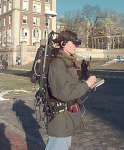
- An image of the MARS unit itself (large tif)
- The same image as a smaller gif
- The main graphics lab page
I've worn this thing myself once or twice... its big and clunky.
- The web page for the MARS project
-
Pointers to the MARS project:
I'm doing this anonymously so that the sys. admin. guys don't get pissed at me for the extra traffic.
That said, here are a few pointers to the MARS project itself (the main system being discussed in the article):
- The web page for the MARS project
- An image of the MARS unit itself (large tif)
- The same image as a smaller gif
- The main graphics lab page
I've worn this thing myself once or twice... its big and clunky.
- The web page for the MARS project
-
Pointers to the MARS project:
I'm doing this anonymously so that the sys. admin. guys don't get pissed at me for the extra traffic.
That said, here are a few pointers to the MARS project itself (the main system being discussed in the article):
- The web page for the MARS project
- An image of the MARS unit itself (large tif)
- The same image as a smaller gif
- The main graphics lab page
I've worn this thing myself once or twice... its big and clunky.
- The web page for the MARS project
-
Pointers to the MARS project:
I'm doing this anonymously so that the sys. admin. guys don't get pissed at me for the extra traffic.
That said, here are a few pointers to the MARS project itself (the main system being discussed in the article):
- The web page for the MARS project
- An image of the MARS unit itself (large tif)
- The same image as a smaller gif
- The main graphics lab page
I've worn this thing myself once or twice... its big and clunky.
- The web page for the MARS project
-
More pics, background infos..
i bet youd have figured this out by yourself, but a link is always nice
So check out the
official page -
Free Software Representatives on the Policy BoardThree Free Software representatives are on the W3C Patent Policy Board:
- Bruce Perens, Free Software Evangelist.
- Larry Rosen, Attorney, Executive Director: Open Source Initiative
- Eben Moglen, General Counsel, Free Software Foundation.
We don't get everything we want, but we've done pretty well.
Bruce
-
Re:All I'm saying is...
I meant... 155 Mbps
-
All I'm saying is...
All I'm saying is that by the time that I by the time I graduate from college, I better have some type of broadband connection for relatively cheap, or FREE!. I would probably kill myself if I have to go back to 56K from the 155 Mbps that I have been spoiled with for the past 3 years.
-
Statistical futzification *smirks*
Uhoh...
Well, with all this thought about the whole six degrees thing.
I'm just afraid that someone in the US's SSSSq Agency (Super Secret Secret Squirrels of course) will realize they have a good chance of finding that some hidden terrorist types (cat
Why... The implications of this amazing research to national defense are amazing.
It's a good thing that affirming our consequents is a common practice now-days (psst... If (all persons in the world are "connected" via a small number of links) then (randomly picking a person and starting from there is a good way to "connect" to someone specific). (randomly picking a person and starting from there is--sometimes--a good way to "connect" to someone specific). Therefore (all persons in the world are "connected" via a small number of links).
Mmmmm fuzzy logic.
-
Re:Artificial Restrictions
Cynical? Not really; I'm being realistic based on years of experience in activism.
But that is cynicismCrispin
----
Crispin Cowan, Ph.D.
Chief Scientist, WireX Communications, Inc.
Immunix: Security Hardened Linux Distribution
Available for purchase -
Re:Okay, so what's the problem?> Where's the incentive to create if it's legal to just steal the invention and pay nothing?
You say steal but you seem to mean reuse.
Look at the GNU project, the Apache project(s), the Linux kernel, the *BSDs, count the number of Debian packages, all the applications on Savannah, Sourceforce and Freshmeat. Look at all the great technologies created at Universities (which are often the basis of those "great" technologies, or cheap ripoffs if you like, that are sold in the industry).
There are a lot of more incentives to create great technology then making lots of money of it. Focussing on how to make money on something often
You might want to read Anarchism Triumphant by Eben Moglen who explains this a lot better then I can.
-
Directions
It must be an evil school to attract this much attention from Arnie, but here's directions to Columbia University
-
Value of ContentThe value of content probably lies in it being unique. Artist peformances, sporting events, that sort of think.
.News is getting more generic. For example there is News Blaster, a bot that uses AI to generate news summaries based analysis of stories over several days. It is actually semi decent, and better then at least half the writers out there.
The end result is to devalue local writers and generic content. having something like this for Slash would probably inprove content no end.
This trend has been going on for years, and of cours the IOC is being conservative with broadcasts, since these make up the majority of their income. Why should they give away their bread and butter free?
Personally I would not mind if they made things like this available online a week after the fact. Same thing for other venues, like court trials, etc. Then folks will be able to see it if they want, but there is no conflict with the interests of the broadcasters. Deals could be made.
-
Implementation
See our 7DS for an implementation of a closely related concept.
-
Miguel is speaking at Columbia U on Wednesday...as a invited speaker by Columbia's student ACM chapter. 209 Havemeyer at 8pm.
If the slashdot readership has any questions they'd like to ask Miguel de Icaza, we can ask the highly-moderated ones during the Q&A session and report the answers back here.
Phil Gross, Columbia ACM
-
Miguel is speaking at Columbia U on Wednesday...as a invited speaker by Columbia's student ACM chapter. 209 Havemeyer at 8pm.
If the slashdot readership has any questions they'd like to ask Miguel de Icaza, we can ask the highly-moderated ones during the Q&A session and report the answers back here.
Phil Gross, Columbia ACM
-
Jake
Columbia University has a home-rolled, open-sourced system called Jake that worked for us. It involves dedicating a linux box (can be a cheap one) to each printing station; users then print a job and go to the station to verify that they really want to print it. It also has a quota system that can span multiple printing stations. The whole thing is a bit kludgy to set up but once it's working it's fairly reliable. You may have to bug somebody to get the latest source code; it's available but they don't really bother to package it for anyone.
-
Re:We do it in Condor
As the poster said, there are plenty of others:
- SGI IRIX and Cray UNICOS provide kernel-level checkpoint-restart.
- Condor provides user-level checkpoint restart and process migration by manipulating libraries at runtime.
- esky provides user-level checkpoint restart under Solaris and Linux via runtime library manipulation.
- crak provides kernel-level checkpoint restart for linux.
- cocheck provides user-level checkpoint-restart.
- libckpt provides user-level checkpoint-restart.
I'm sure I left serveral out. Checkpoint-restart has been part of the high-performance computing scene for years. Having been a systdmin on large, high-performance, computing platforms for the last few years of my professional life, my experiences with checkpoint-restart have been a mixed bag. All of the existing systems have limitations. Depending on the application, those limitations can be no problem, or they can be deal-breakers. -
Re:Which formats support simple batch manipulation(Assuming you are using Linux
It will adjust the volume on your files in batch mode. Also, version
Of course you can always use notlame, mpg123, sox and other tools to do a variety of other things with mp3s and wavs. For an example of how to do this, take a look at preparing the tracks. -
Re:Which formats support simple batch manipulation
Another one to try is Normalize It alows you to adjust volumes across different types of input files (.wav, mp3, etc...)
-
Re:If RedHat was bought, wouldn't that be good?
Stallman's lawyer is a Professor of Law at Columbia University. Plus, he has tons of experience enforcing the GPL. Don't judge his capabilities too quickly.
-
Re:If RedHat was bought, wouldn't that be good?
Stallman's lawyer is a Professor of Law at Columbia University. Plus, he has tons of experience enforcing the GPL. Don't judge his capabilities too quickly.
-
Used at UF for a while
A system similar to this has been in place for a while at the University of Florida. I talked to several of our professors using it and they claim that it is quite effective. It detects the obvious ways that students try to obfuscate their cheating, e.g. changing variable names, whitespace, etc. Whenever the program turns up a match, the professor examines them by hand before calling the students into his office. In almost all cases, the students confess. The first semester it was put in place, nearly a third of the students in the Intro course were caught cheating! The rate hasn't been that high since. When the programs assigned are sufficiently complex, the odds of finding two people with the exact same decision tree is quite small.
A similar system was developed at Columbia. -
Could confirm String theory?
Hmm, proving the existence of wrapped up dimensions could be a tangiable shot in the arm for superstring theory which necessitates 10 spatial dimensions and 1 time dimension. If this sort of thing interests you, do read the Elegant Universe by Brian Greene. It's well written and very readable considering the complexity of the subject matter. Hawking radiation is also covered, and a string twist is put on the process. The book kept me quiet for days.
-
Re:MBone
MBone is not specifically dedicated to multicasting. MBone just refers to the fact that the routers are multicast enabled. It is just laid on top of Internet2 .
The MBone FAQ can be found here. The page is a bit old but the information is pretty much correct.
Re-designing IP is more trouble than it is worth. First off, it would require deployment everywhere. So either 1) you upgrade every router, computer, etc. along the paths that need to use it or 2) you end up doing tunneling across IP anyway. Second, it works (or at least mostly works
The core problem is just that you have to make everybody play nice in the network which is what the IETF is trying to do. At the same time, you don't need the overhead of TCP (sending/resending lost/late packets). There has already been quite a bit of work on making UDP-based protocols that are TCP-friendly. The problem here is just choosing what attributes to use and what the messages going back and forth should be.
Don't forget that anyone can participate in the IETF working groups. All you have to do is subscribe to the mailing list of the SIP working group and you can add to the discussion. -
Fascinating story based on the idea.Someone introduced me to a strip called The Spiders
Fiction:
Spiders, Part 1: A group of Afghan women have had it up to here with the Taliban...
Spiders, Part 2: US civilians take part in the hunt for OBL and document history by means of massively-distributed, networked, robots, called "spiders", which are airdropped en masse around the countryside.
(I'm still looking forward to Part 3...)
Non-fiction:
Omnicam - a 360-degree camera. One application of which is to mount in a system like...
LOTS: Lehigh Omnidirectional Tracking System, a system whereby autonomous cameras can be dropped around hell's half-acre and human operators alerted when something "interesting" happens.
Sounds a lot like "Spiders", come to think of it. I wonder if this is where the artist got the idea for the strip?
-
Re:I knew this was coming...
Thorng invented/pioneered OOOE ( out of order execution)
NOTE: this is a cut+paste from my reply to another post somewhere else. I just wanted to set the record straight. BTW it's typically abbreviated OOE (the "of" doesn't get a letter).
Err no he didn't. Tomasulo invented the way we do OOE many, many years before there were "3 billion fucking transistors" on a processor (which is still a slight exaggeration even by today's standards). The first machine to employ OOE was the IBM 360/91. Here are some pictures of the first (that I know of) 360/91 in operation in 1968 at NASA. Even though the machine was (by 1968's standards) blazingly fast, the 360/91 failed miserably and only a few were actually produced. The reason this machine failed was because it was incapable of handling interrupts properly. The 360/91 only supported imprecise interrupts, which meant that instructions causing the interrupt as well as subsequent instructions could continue to execute if they were already in the pipeline. This is generally not a Good Thing(tm).
I don't know where all of the Cornell students seem to get the impression that Torng invented OOE. Hopefully this is not from Torng himself, as anyone who studies modern processor design can tell you the first thing you learn about with OOE is the Tomaluso algorithm, which although it was invented over 30 years ago is still used in modern processors largely unchanged from the original design. This is not to say that Torng had no role. He did in fact substantially facilitate OOE, by devising a system to allow mutliple instructions to issue simultaneously (as his patent claims). Torng himself pays homage to Tomasulo in the patent, referencing his paper from 1967.
-
Re:He couldnt have invented out of order execution
Err he did.Perhaps you are thinking of compilers optimizing the order of instructions? That is not what this is about, this is about the actual hardware taking the instructions and reordering them on the fly. If my memory serves, which it usually doesn't, it requires something on the order of 250,000 transistors, so if you are asking why no one thought of this before 1989, it's because we didn't have 3 fucking billion or whatever transistors on each chip back then, so it would have increased the number of transistors by an order of magnitude.
Err no he didn't. Tomasulo invented the way we do OOE many, many years before there were "3 billion fucking transistors" on a processor (which is still a slight exaggeration even by today's standards). The first machine to employ OOE was the IBM 360/91. Here are some pictures of the first (that I know of) 360/91 in operation in 1968 at NASA. Even though the machine was (by 1968's standards) blazingly fast, the 360/91 failed miserably and only a few were actually produced. The reason this machine failed was because it was incapable of handling interrupts properly. The 360/91 only supported imprecise interrupts, which meant that instructions causing the interrupt as well as subsequent instructions could continue to execute if they were already in the pipeline. This is generally not a Good Thing(tm).
I don't know where all of the Cornell students seem to get the impression that Torng invented OOE. Hopefully this is not from Torng himself, as anyone who studies modern processor design can tell you the first thing you learn about with OOE is the Tomaluso algorithm, which although it was invented over 30 years ago is still used in modern processors largely unchanged from the original design. This is not to say that Torng had no role. He did in fact substantially facilitate OOE, by devising a system to allow mutliple instructions to issue simultaneously (as his patent claims). Torng himself pays homage to Tomasulo in the patent, referencing his paper from 1967.
-
CU Research Project
My CS professor has been researching the same technology however, his puts the entire laser apparatus on a robotic vehicle that is completely/near-completely autonomous. He recently got a $2 million NSF grant to do the same digitization of Egypts pyramids.
-
CU Research Project
My CS professor has been researching the same technology however, his puts the entire laser apparatus on a robotic vehicle that is completely/near-completely autonomous. He recently got a $2 million NSF grant to do the same digitization of Egypts pyramids.
-
CU Research Project
My CS professor has been researching the same technology however, his puts the entire laser apparatus on a robotic vehicle that is completely/near-completely autonomous. He recently got a $2 million NSF grant to do the same digitization of Egypts pyramids.
-
Re:Genetic Algorithms are not new
I don't think this is GA, but it is an interesting application of data mining that will probably lead to GA-style programming.
It scans emails and finds viruses. It identifies them by finding substrings in the data from which a score is computed. Supposedly, it has a 95% accuracy rate identifying unknown viruses.
Malicious Email Filter -
Re:Own Label?
I wonder if some of them may decide to start their own artist run label.
You mean like Ani DiFranco's Righteous Babe Records? I'm not too sure about the background but as far as i know she didn't feel like getting screwed by a major record label and, being one of those pro-active folk singer types, started her own. Someone posted a letter she wrote to Ms. Magazine complaining about people looking at is a financial success rather than just not wanting to deal with a record company. -
Re:Sweet, but...
-
Simplifies it...
This lecture note for my Computability class simplifies the problem to terms that people can understand. This is a definitely good read if you're interested in P vs NP
-
ORG 1800H
I rememebr programming a Z80 Microtrainer in college; it had a keypad for hex code, but I managed to smuggle in a friend's copy of the ZAD cross-compiler to the lab. We had these old 286's with serial-to-headphone jacks that connected to the microtrainer. You typed in your assembly code on the 286, ran it through ZAD, and uploaded it to the microtrainer. You could even hear the data being transfered via the speaker on the microtrainer.
I remember having my first real experience with handling Interrupt Requests in a lab with the Z80. Too bad the company is having trouble.
I tried to find a pic of the old microtrainer (made by CAMI Research), but alas, they no longer support it.
I did manage to find a link to another University that used them for ECE projects. (Thanks Google!)
http://comet.ctr.columbia.edu/msl/2000class/elevat or/ -
Re:GOOD DAMN THING
i've survived two different maine high schools (drhs and mssm) and am now working for the columbia center for new media teaching and learning.
i would have to agree that this is mostly a good thing. maine public schools (like most others in the country) are horribly underfunded and misfunded (i watched helplessly every year as my old school voted to lower teachers' salaries and cut educational program after educational program while increasing the budget of the football team. high schools in rural maine are like winos begging for change from the state saying "we just need the money for some food; we won't buy booze with it, honest". if you give them a cash handout, it will just go towards buying new football equipment. even if you specify that the money's only to be used for education, they'll just cut the same amount from other areas of the education budget and move it to sports.). i'm happy to see them getting any support at all from the state government.
my fear is that in most rural schools, the teachers know next to nothing about computers (they're certainly not being paid enough to buy their own computer and home internet access is still all but impossible to get in many areas of the state). just having access to computers is a lot more than many of the students used to have and will be a major benefit. but teaching with computers is an entirely different game than teaching with chalkboards and textbooks. if the teachers don't have the knowledge and experience to work them into their lesson in a positive way, they're missing out on a lot of the potential benefit.
without the right educational training, there's a real possibility of harm being done. computers can easily distract them from the teaching of the actual classes. or worse, it can lull the teachers and administration into a false sense of security: "look, we're high-tech. all our students have fancy new laptops, we must be educating them really well; no need to evaluate our pedagogical practices!" -
The real cryptfs
CryptFS homepage
CryptFS uses the VFS (Vnode Filesystem) to implement an encrypted filesystem. I've used it on and off over the last several years. In Kernel 2.2.x it needs the FIST kernel patch to work. FIST has been included in the 2.4.x kernel tree, so now all you need is cryptfs.
Brian -
The real cryptfs
CryptFS homepage
CryptFS uses the VFS (Vnode Filesystem) to implement an encrypted filesystem. I've used it on and off over the last several years. In Kernel 2.2.x it needs the FIST kernel patch to work. FIST has been included in the 2.4.x kernel tree, so now all you need is cryptfs.
Brian