Slashdot Mirror
Domain: dot.gov
Stories and comments across the archive that link to dot.gov.
Comments · 866
-
Re:More nation-wrecking idiocy
Virginia should try to put the "fog line" (that's the white outside edge marking line's semi-official name) where possible. You can, with that, do just fine in inclement weather and in poor-visibility conditions. If they're painted (there are multiple striping methods) they are usually reflective. This is especially handy if you have a oncoming traffic that did not dim their lights. Simple do not look at the lights directly and you can usually make out the fog line well enough to navigate safely.
They can get away without a center line marker, though it might confuse people so they should probably do a press-release, and just paint (or epoxy, or plastic) the fog line by itself. They might even want to do multiple press-releases, just to be sure that they're getting the message out. I suspect it'd work just fine and it could be modeled well enough. The center line should be there but, you know, if they've got no choice about adding it.
And yes, yes it is expensive. It's thick. The paint is quite pricey (as in really expensive) and I haven't bothered to look it up but the FHWA (Federal Highway Administration) will probably have that information buried in their site somewhere. They're actually pretty good about keeping, making, and giving public access to records, reports, and even proposals if you know where to look. Their site's not the best for search results so usually using Google is best. At any rate, depending on the method, I'd expect anywhere between $0.05 and $0.10 per linear foot. Actually, I'll look it up. I'm not doing anything better and I don't get a thread about traffic/highways all that often. 'Snot all that often that I get to lend a hand. I'll do some work, for a change.
Hmm... This is a bit old! It's from 1993.
https://www.fhwa.dot.gov/publi...They've got the price at $0.035 to $0.07 per linear foot. My numbers aren't that bad, I guess. They're actually probably a bit higher - I retired in 2008 but was 'done' around ¾ the way through 2007. Alas, I spent more time on the road or in my office for the five years prior. (I kind of miss it.) At any rate, that link should tell you everything you want to know about the lines you see on the roads in the US.
I did not read the study. I didn't even really fully read the abstract. I've actually read that before. I think the most important part to take from that is that for every $1 spent striping the roads, they expect to result in a benefit of $60. If you want to understand that (or anyone) then the study is not long, it's free, and it's just that one page unless you want to get all of the citations. I'd be surprised if you couldn't get access to most of the works cited via Google or for low/no cost at your local public university.
At any rate, you mentioned artificial light... They've actual done some research into ways to make the lines more visible. I had nothing to do with this project, at all, but I do remember reading something about it. This was back in 2005. I am pretty sure I read about it at least once before that date. It was probably in Public Roads which is an inexpensive print (now online) publication that's all about roads. It's just six issues per year and is pretty much mandatory reading, It's not that expensive and I think the online version is free but I don't recall them having a handy way to download it and browse it offline. Someone who writes a lot like me may actually have published some content in said magazine. Oh, the link:
https://www.fhwa.dot.gov/publi...
Ah well... If you're in the industry and are looking for a way to get your name out there then it's not too hard to get your stuff printed in there. The information's on the site or in the print version. I no longer get the print version, I haven't in years. When I cleaned out my office and a back room, one of the things I made it a point to keep was my many books, trade magazines, and various non-business owned documents.
-
Re:More nation-wrecking idiocy
Virginia should try to put the "fog line" (that's the white outside edge marking line's semi-official name) where possible. You can, with that, do just fine in inclement weather and in poor-visibility conditions. If they're painted (there are multiple striping methods) they are usually reflective. This is especially handy if you have a oncoming traffic that did not dim their lights. Simple do not look at the lights directly and you can usually make out the fog line well enough to navigate safely.
They can get away without a center line marker, though it might confuse people so they should probably do a press-release, and just paint (or epoxy, or plastic) the fog line by itself. They might even want to do multiple press-releases, just to be sure that they're getting the message out. I suspect it'd work just fine and it could be modeled well enough. The center line should be there but, you know, if they've got no choice about adding it.
And yes, yes it is expensive. It's thick. The paint is quite pricey (as in really expensive) and I haven't bothered to look it up but the FHWA (Federal Highway Administration) will probably have that information buried in their site somewhere. They're actually pretty good about keeping, making, and giving public access to records, reports, and even proposals if you know where to look. Their site's not the best for search results so usually using Google is best. At any rate, depending on the method, I'd expect anywhere between $0.05 and $0.10 per linear foot. Actually, I'll look it up. I'm not doing anything better and I don't get a thread about traffic/highways all that often. 'Snot all that often that I get to lend a hand. I'll do some work, for a change.
Hmm... This is a bit old! It's from 1993.
https://www.fhwa.dot.gov/publi...They've got the price at $0.035 to $0.07 per linear foot. My numbers aren't that bad, I guess. They're actually probably a bit higher - I retired in 2008 but was 'done' around ¾ the way through 2007. Alas, I spent more time on the road or in my office for the five years prior. (I kind of miss it.) At any rate, that link should tell you everything you want to know about the lines you see on the roads in the US.
I did not read the study. I didn't even really fully read the abstract. I've actually read that before. I think the most important part to take from that is that for every $1 spent striping the roads, they expect to result in a benefit of $60. If you want to understand that (or anyone) then the study is not long, it's free, and it's just that one page unless you want to get all of the citations. I'd be surprised if you couldn't get access to most of the works cited via Google or for low/no cost at your local public university.
At any rate, you mentioned artificial light... They've actual done some research into ways to make the lines more visible. I had nothing to do with this project, at all, but I do remember reading something about it. This was back in 2005. I am pretty sure I read about it at least once before that date. It was probably in Public Roads which is an inexpensive print (now online) publication that's all about roads. It's just six issues per year and is pretty much mandatory reading, It's not that expensive and I think the online version is free but I don't recall them having a handy way to download it and browse it offline. Someone who writes a lot like me may actually have published some content in said magazine. Oh, the link:
https://www.fhwa.dot.gov/publi...
Ah well... If you're in the industry and are looking for a way to get your name out there then it's not too hard to get your stuff printed in there. The information's on the site or in the print version. I no longer get the print version, I haven't in years. When I cleaned out my office and a back room, one of the things I made it a point to keep was my many books, trade magazines, and various non-business owned documents.
-
Re: you forgot that x / y * y = x
The vast majority of road deaths are pedestrians
This seemed dubious to me so I looked it up. In the US, in 2014, there were about 4 times as many vehicle occupant deaths than there were pedestrian deaths (21,022 vs. 4,844). http://www-nrd.nhtsa.dot.gov/P...
-
Re:This speed limit is reckless
That's true for a while. However, studies on the long-term efficacy of enforcement have mostly shown that enforcement has an effect for a while, and then wears off once enforcement goes away. So a community must be willing to accept long-term strict enforcement if that's going to work. Otherwise, once the police are gone, people eventually go back to their speeding ways. Speed cameras are effective, but publicity and warning signs are necessary for actually getting people to slow down. I think if a community is really concerned about pedestrian safety, the best way to do that means separating pedestrians from cars, and where they can't be separated, forcing cars to slow down, preferably by physical alterations like speed bumps, traffic circles, and other measures.
The DOT has a summary of various speed research in the page below, with some notes on the efficacy of enforcement :
https://www.fhwa.dot.gov/publi...Totally agree with you. Road alterations are best, speed cameras second best.
-
Re:Speed limit reality check
Informative!? LOL. Pure opinion this is. This statement is total bullshit and spoken like someone who grew up and lives in the east coast/central USA. There are plenty of western states where speed limits are set appropriately and enforced appropriately and people drive more safely than the east coast USA.
You want to know how speed limits are set in the USA? RTFM: http://safety.fhwa.dot.gov/speedmgt/ref_mats/fhwasa12004/
-
Re:This speed limit is reckless
Hmm... I guess you could say that's informative? I'm a traffic modeler who, well... Hmm... You could say that I helped change the industry. I worked as, more or less, a traffic engineer. I'd submit a couple of things... That's probably something decided by a traffic engineer and not a civil engineer - though the two are not dissimilar, one is a more specific subset than the other, if you'll allow me to be a bit rough. I'd like to also submit that, while often quoted, I don't actually don't think you fully understand that 85% thing.
Well, for starters, it's 50% and 85%. That's not actually, entirely, about safety. It's about 'credibility.' Yup... Safety is in there but it's about not having a stupidly unbelievably low speed-limit. The safety is actually in that it is not ignored. Just letting a bunch of random people drive the road and setting it to 85% is not quite how it is done. It's kind of complicated and entails many, many things. I'm going to presume that you don't actually want to understand all this information.
If you do want to understand than you can start at this link:
http://safety.fhwa.dot.gov/spe...So, starting from there... Well, do you actually want to discuss the rest of your conclusions or?
-
Re:Surprise: font doesn't work well when misused
It also didn't help that state agencies and contractors couldn't design a sign with Clearview properly, enough so that they created a FAQ with a gallery of what NOT to do. They didn't have to drive too far as Maryland was by far one of the biggest offenders: http://mutcd.fhwa.dot.gov/resources/clearviewdesignfaqs/. This decision to end the "intern approval" of Clearview has been coming for almost 2 years, so this isn't exactly news. It didn't seem to stop states from going wild with sign replacements though.
-
Re:while you're at it, fix the deer crossing symbo
It may be that your state modifies the Standard Highway Signs. I just took a gander at sign W11-3, and not only does it look reasonable, but the antlers open to the front.
-
Run that by me again.
Older drivers are prized because they usually own their own cars, have adequate auto insurance and, according to insurance statistics, have fewer crashes.
Fewer crashes because they are on the road less often?
Male drivers 65+ average 10,000 miles on the road a year. That is about 9,000 miles less than males aged 35-54. Average Annual Miles per Driver by Age Group [Feb 2015]
-
Re:Is that because...
About a quarter of that 20% increase is simply due to increased number of passengers. The 2015 data isn't completely tabulated yet, but it looks to be about 5% more passengers than 2014 (table 7).
-
Re:Too much hype about driverless cars
Something north of 90% of accidents are preventable; take a look at table 8 here: http://www-nrd.nhtsa.dot.gov/P...
That table shows the 'critical event' in an accident, which is what made it unavoidable. Just 1.4% of accidents are from an object or animal in the road. Likewise, only 1.2% are due to a vehicle problem, although a large percentage of those are improper maintenance, which would be solved by some autonomous vehicle business models where they are owned and maintained by a fleet company (such as Uber).So we can prevent 90% of accidents, but you think it's not worthwhile because the other 10% still happen?
Furthermore, if the fleet model is adopted, it actually becomes more likely that safety improvements will make more financial sense; far fewer cars are needed in the fleet, so the costs are amortized over more people. But in either case, safety standards are set by the government, and we can choose to raise or lower them as we see fit, completely orthogonally from whether cars are autonomous or not.
-
Re:Unlike Toyota that requires FJ Cruiser...
This seems to indicate that the dealer has to provide the recall fix for free but doesn't have to pay for the damages that might have occurred because of the failure: http://www-odi.nhtsa.dot.gov/r.... It's possible that I'm not interpreting that correctly but, I've had recall work done on my FJ numerous times and never paid a penny for it. Presumably because the things that were being fixed hadn't caused any secondary damage.
-
Re:Children or not
Studies have shown that while this sort of thing reduces T-bone incidents (which were rare to begin with), they cause a much greater increase in rear-end accidents because people wind up slamming on the breaks to avoid the sudden red light.
That's true, but understand that T-bone collisions tend to be much more severe than rear-end collisions.
Anyway, this is why red light cameras should also be speed cameras, to help prevent tailgating which is the main cause of rear-end collisions.
-
Re:Children or not
A couple of seconds spent on an internet search shows that speeding is, in fact, a safety concern. Apparently a big one. There are literally reams of data showing that speeding contributes to a significant number of accidents.
Not to mention the fact that for anyone who's ever driven a car, the notion that speeding is dangerous IS COMMON FUCKING SENSE.
-
Re: fighting carbon pollution?
Sadly, the PHMSA website's data access has changed recently and the new version is shit. I used to have a handy link to the number of pipeline releases with the quantities involved. Now they only focus on injuries, fatalities, and monetary damages.
https://hip.phmsa.dot.gov/anal...
I also can't link directly to the data on releases, but suffice to say, in 2014, only 22,911 barrels were lost across all onshore hazardous liquids pipelines. This is significantly lower than any of the multi-year rolling averages, so 2014 was a good year. If you weed down to just crude and refined products (excluding things like liquid CO2, biofuels, and other hazardous liquids), it's less than half of the lost barrels.
According to this site: http://www.nacsonline.com/your...
U.S. oil consumption was an estimated 18.77 million barrels per day in 2014. This all has to be transported twice (as crude and as products), but rather than double the number, let's assume only half of it (very conservative) is transported by pipeline. 18.77mbpd*365=6.85 billion barrels transported in 2014.
But I guess it depends on your acceptable loss rate as there will always be accidents in any network. In 2014, in petroleum liquids pipelines onshore, 10,202 barrels were lost out of 6,850,000,000. So a
Also, the citation comes from someone who happens to work in pipeline industry, but something tells me you wouldn't believe any evidence presented by someone with first-hand experience.
-
Re:After transcanada pulls the plug
The last report release by the Bureau of Transportation Statistics concluded that fuel excise taxes more than cover highways, in fact they cover subsidies for rail and bus as well. Car-based taxes tend to be a net income producer for the Government. The issue is that the Government likes to take those taxes, spend them on something else, then whine about the damage to the roads and how roads are not being maintained...
-
Re:What if I don't want to own a car?
"We're probably already there, in general human drivers suck."
Data, please? People make this claim all the time, but given that there are over a billion trips a day in the US and only around 120 fatalities, I'd say humans drivers pretty much have this thing down. The fact that people can make it around in their cars in myriad weather conditions, successfully navigate unfamiliar terrain, and quickly respond to sudden changes in circumstances (kid darting out in front of them) speaks volumes to how good human drivers are.
I watched a Google self-driving car cross an intersection this weekend (in Austin). It was moving very cautiously and then slowed down to a walking pace on the other side of the intersection, leaving a trail of human-driven cars stuck in the intersection while it decided to turn down a side street.
The "human drivers suck" crowd sounds very much like the "there's a thug with a gun around every corner" crowd. Some people seem to enjoy thinking the world is more dangerous than it really is.
-Chris
Some sources:
https://www.rita.dot.gov/bts/s...
http://www.nytimes.com/2004/03... -
Barcelona, Spain
There ^^, fixed it for you. Catalonia isn't a separate state (yet). For most of us outside the US we don't even need to qualify which country Barcelona's in because we all know this as a given, and anywhere else in the new world that has the same name is the exception and needs to be qualified. Interesting that you mentioned "Catalonia" though... pushing some sort of political agenda or just ignorance of the place? Also interesting that you picked Barcelona and not some other better known or more congested city. This whole story just seems a bit weird and parochial.
Actually why even this story about San Francisco? It's hardly the worst offender in the US for pedestrian deaths at 1.7 deaths/100,000 - picking three comparable sized cities from Table 8 of this doc:
http://www-nrd.nhtsa.dot.gov/P...
* Detroit, MI: 3.99
* Jacksonville, FL: 3.23
* Austin, TX: 2.97It looks to me like a lot of US cities could do a lot to reclaim their cities back from cars, when you look at London which is vastly bigger and more congested with pedestrians. There were 65 pedestrians killed in London in 2013 compared with San Francisco's 29, which is a city a tenth the size:
https://tfl.gov.uk/info-for/me...
http://www.transalt.org/sites/... -
Far worse elsewhere
See page 9:
http://www-nrd.nhtsa.dot.gov/P...
SF is 1.7 deaths per 100k residents
Dallas, Detroit, El Paso, Oklahoma City, Albequerque, and Jacksonville are all over 3 deaths per 100k residents. -
Re: illegal autonomous cars?
This is hardly a requirement. If you drive your vehicle hundreds of miles a day, probably an electric vehicle isn't for you (yet). According to this page:
https://www.fhwa.dot.gov/ohim/...
The average driver drives about 36 miles per day... -
TDI issues first HSFS now this
I recently passed over getting a TDI in lieu of a 2.5 gas. My initial reason for passing on the TDI was the known issues with failure of the High Pressure Fuel System (HPFS). A quick google on TDI HPFS will confirm, also see below. I live in california and am not a fan of the California Air Resources Board CARB and having to pay a premium for emissions components over other states - try $500 for a new CAT vs $200 in other states.This is a major blow as TDI were a nice alternative to Hybrids, especially with diesel averging $2.89/gl to gas' $3.30.
NHTSA Investication
http://www-odi.nhtsa.dot.gov/c... -
Re:Can't we relax for a couple of years?
We could spend less than 1% of our GDP on defense and still have a larger military than most countries out there.
Thanks for making my point.
Second, what infrastructure? Be specific.
Is "public" a specific enough modifier for you?
I was a truck driver for years, and if you're going to mention highways and bridges - don't bother. You're wrong.
I don't find your personal anecdotal experience very compelling. I find multiple reports from credible sources far more convincing.
We are responsible for quite a few things, military-wise...[blah blah blah]
I asked for accomplishments, not responsibilities. Care to try again?
Did you even read that link?
No. Why would I? All I did was accurately observe that you didn't add anything to the discussion.
I defined "threat" by the only measure it should be defined: based on the actual reality of the situation [...] Is that the reality? Yes.
Uh huh. Another prick on the internet who claims to know the true reality of the situation.
We face a much larger threat from people who can't use their brain properly.
I assume that would that include people who claim that North Korea "shot a missle over Japan", right?
-
Re:4 way stops are retarded
There's no way that a roundabout would ever be cheaper than a four way stop
There is more to consider than just initial construction cost. A 4-way stop may have lower initial costs, but then imposes higher costs in time and fuel on everyone that uses it.
When you bring pedestrians into the mix, you would have to add a traffic light
We're still talking about 4-way stops here, right? The Federal Highway Administration seems to believe differently.
Pedestrians and bicyclists have far less risk navigating roundabouts than the typical intersections primarily because of the lower speeds. A pedestrian has an 85% chance of being killed by a vehicle traveling at 45MPH. That drops to 15% when the vehicle is traveling at 20MPH. There are also less conflict points (as discussed in slide 21) the crossing distance is usually much shorter, and there is oftentimes a refuge spot in the splitter island.
They do admit a lack of information regarding those who are visually challenged.
Blind pedestrians rely primarily on auditory information to make judgments about when it is appropriate to begin crossing a street. To date, little research has been conducted about the usefulness of such non-visual information for crossing streets at roundabouts
I found that doc pretty informative, you might as well.
-
What emissions are used for:
Yes, because the majority of emissions are from cars, and cars aren't such a minor contributor as to actually be diverting interest and resources away from the major polluters, or even legitimate minor ones
About 13% of global carbon emission is from transportation:
http://www.epa.gov/climatechan...--although transportation accounts for twice that in the US, 28% of the US emissions:
http://climate.dot.gov/about/t...about a third of which is cars.
-
Re: Who cares?
Huh? In the last 5 years there have been a total of about 5 people killed on commercial flights in the US. In the same time there have been about 200,000 killed in car accidents.
There are a lot more car miles that air miles traveled in the US per unit time.
The most recent 2013 data
If you consider the risk per trip, it is higher for planes, but less per mile. So don't drive to Europe from the US. It won't end well. The difference isn't big and it may be the other way around right now because planes have had a good few years. But I don't have 2014/2015 data.
But as far as risk goes, these are small numbers. There are things that are much more likely to kill you. Cars and planes don't even make the top 10.
http://www.cdc.gov/nchs/fastat...
And you aren't going to fly to work, unless you're this guy..
-
Re:Exchanging insurance information
-
Re:Exchanging insurance information
-
Re:Might make sense
I agree with your points - they're all well-reasoned.
What I haven't seen mentioned is the case where the drone arrives first and it's video shows the dispatchers that the fire is much larger/more involved than first reported so the dispatcher can roll additional equipment to the scene while the original trucks are still en route. That would be a major plus for having the drones.
Similarly, if the drone finds that the original report of a massive fire is more like a tiny shed on fire, they could cancel some of the equipment en route, freeing it up for other calls.
Another case: A train derailment or tractor-trailer accident. Much of the cargo carried in tank cars is in some way hazardous, and it would be very handy if a drone could show the dispatcher what placard numbers* are involved so that they can coordinate cordoning off the area and possibly evacuating residents. It would also help in making sure you have the right firefighting chemicals around - lots of hazardous stuff requires foam to extinguish and reacts rather violently with good old H2O.
*If you've never read the Emergency Response Guide, you should. Some of the nasty stuff that's hurtling down the highway next to you is very dangerous and/or toxic. It's eye-opening, to say the least.
-
Survey on software defects in automotive
We published a report recently at the NHTSA's Enhanced Safety of Vehicles (ESV) conference that surveys many recent electrical/electronics (E/E) problems. Software defects fall into electrical/electronic systems in the ISO 26262 lingo. This includes a statistical analysis of recalls (classifying into those due to E/E problems) and ancedotes of many software defects resulting in recalls, including several examples of unintended braking, unintended acceleration, etc.: A Survey of Electrical and Electronic (E/E) Notifications for Motor Vehicles (PDF warning)
While writing this, we found a nice overview from Dr. Dobbs that's still fun to read: But I Never Did That Before!.
The Dr. Dobbs overview has a related recall from about 2 decades ago, where a car would not let occupants leave the vehicle:
"BMW 535i 1994: The double-lock feature can engage with occupants and the door/ignition key inside the vehicle. The occupants of the vehicle would be unable to exit either from the doors or from the windows of the vehicle. Drive-away protection would prevent the engine from starting. Dealers will replace the general control module with one containing the revised software to permit window opening with the double-lock engaged and key in the ignition." -
Re:Peaked???
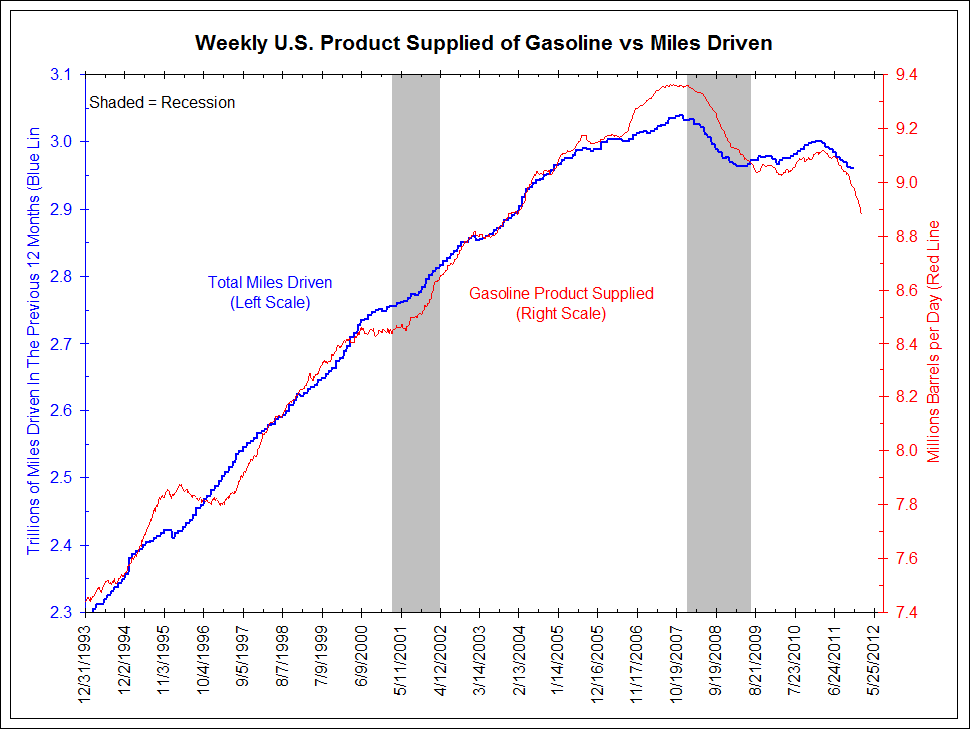
"As the population gets older, there will be more driving going on - not less."
Nope, there's data. Old people drive nearly have as many miles per capita as middle-aged people.
Average Annual Miles per Driver by Age Group
Age Male Female Total
16-19 8,206 6,873 7,624
20-34 17,976 12,004 15,098
35-54 18,858 11,464 15,291
55-64 15,859 7,780 11,972
65+ 10,304 4,785 7,646
Average 16,550 10,142 13,476 -
Re:We'll take them
They're putting an expensive new tolling system on 405's commuter lane that will dynamically increase tolls in response to increases traffic so that it stays clear for busses... Of course, that's actually going to make the normal 405 traffic *worse*, because they're simply pushing the traffic into the normal lanes.
That's most definitely false, and here is proof:
On the S.R. 91 Express Lanes, vehicle throughput during the most congested hours exceeds 1,600 vehicles per lane per hour on the priced lanes, while the adjacent free lanes carry only about 800 vehicles per lane per hour.
So as you can see, the express lanes move twice the auto traffic as the regular lanes, not less.
No, Washington doesn't need more lanes on the 405 at this time. You only need to manage the existing lanes better.
-
Re:Where are the round-abouts
Because roundabouts consume a lot more land and are not that much safer for pedestrians.
Even a little safer is better. Roundabouts generally bring the speed of traffic approaching the intersection down.
How can a circular roadway be smaller than a simple intersection? You can't put a median in the middle of an intersection and force the traffic to go around it without it being bigger than a simple cross.
They put one in by the school near where I live, and the new roundabout doesn't take any more space than the old intersection did.
And that's a residential simple one lane going each way intersection, with parking along the curb. At the roundabout the curbs bulb out preventing parking, and create the room for the circular space.
Previously, there was effectively 2 lanes of room at the intersection, so someone waiting to turn left could be driven around on the right side, or cars could make right turns while people were waiting to go through or turn right. This complexity is what often led to accidents both between vehicles and involving pedestrians.
Now, its always one car entering from each side at a time; and it never really stops except for pedestrians. Honestly its been working well.
It seems to scale well to 2 lanes as well We have several 2 lane round abouts and those also work well.
We're dropping half a million dollars in our area to replace a simple intersection because a few people don't like waiting at the stop signs on the intersection side streets.
Yeah I can't comment on that. The local roundabout only cost $200,000; or about a $5 per household; and that budget was part of larger project that repaved about 2 blocks on either side of the round about along the main road; new sidewalks, and landscaping including midsize trees, shrubs, and planters along the roadway. So... we got a lot more than "just a roundabout" for 200k. Not sure why yours costs 500k. That seems to be the average price for a large non-residential roundabout...
Like the ones shown here... most of the big ones cost ~500k
http://safety.fhwa.dot.gov/int...
I see no obvious benefit to that waste.
-
Re:Tolls?
In recent years, however, it was determined that the relationship between axle weights and pavement damage is complex and varies based on numerous variables, including environmental factors, type of terrain and roadway design. The National Pavement Cost Model (NAPCOM), which is the pavement model currently used by FHWA, estimates that for some types of pavement deterioration, doubling the axle load causes 15 to 20 times as much damage; for other types of deterioration, doubling the load only doubles the damage.
The U.S. Department of Transportation in its most recent Highway Cost Allocation Study estimated that light single-unit trucks, operating at less than 25,000 pounds, pay 150 percent of their road costs while the heaviest tractor-trailer combination trucks, weighing over 100,000 pounds, pay only 50 percent of their road costs.
-
Re:No self driving trains?
Problem is, you'd end up screwing over the poor - that is, all the people who cannot afford a Prius or similar hybrid/electric vehicle.
Don't the poor usually walk, ride bikes, and take mass transit? Did you know that the poor love tolls more than other income classes because tolls displace taxes the poor would otherwise have to pay?
It would also jack up the price of nearly anything that is transported over the roads...
Actually, what jacks up the price is when we don't charge users full price for use of the roads, leading to a distorted, inefficient market for transportation.
-
Re:its all about the $$$
Its been proven time and time again that red light cameras do more harm than good.
If you do nothing but add red light cameras, the intersection tends to become safer.
But inevitably, the government agency which authorized the cameras suddenly realizes it's getting more revenue from traffic violations. And it starts shortening the duration of the yellow lights at the intersections to artificially increase the number of violations, and thus increase its revenue even more. This makes the intersection more dangerous, moreso than the cameras initially made them safer.
I've thought about these types of situations a bit. The best idea I could come up with is that fines for breaking the law should not go to the government. They should go into an escrow account held by the government, which gets equally redistributed to taxpayers when they get their tax refund (or converted to a tax credit if the person owes taxes). The idea behind these fines is that the offender needs to be penalized for the bad behavior. As the public was the party which was harmed by the behavior, and ostensibly the government is acting on behalf of the public, the fine goes to the government. But that leads to a conflict of interest on the part of the government in situations like this. So the best solution is to remove the conflict of interest - if the government makes no money from traffic violations, then its only motive for enacting traffic control is to improve traffic flow and safety. -
Re:its all about the $$$
Its been proven time and time again that red light cameras do more harm than good.
And the opposite has also been proven:
"Crash effects detected were consistent in direction with those found in many previous studies: decreased right-angle crashes and increased rear end ones."
(Right-angle crashes are much more dangerous to the occupants than rear end crashes, so exchanging the former for the latter results in a net improvement in safety.)
To further improve the safety of red-light cameras, consider that almost all rear-end collisions are caused by people tailgating. If each red-light camera were turned into a combination red-light and speed camera, people would slow down when approaching intersections, so someone slamming on their brakes at the last minute would be less likely to be hit from behind.
-
Re: Note that this is a little different from soft
-
Re:Gimme FUD!
http://www.fhwa.dot.gov/policy...
If you can find a newer version of this document, feel free to link it.
It seems we are throwing more and more money into a pit here. What is wrong that we have doubled the amount of adjusted money we throw into DOT, but they still want more money, where is the money going? I would love to see a version of that table with modern numbers, as well as all the way back to the highway system being built.
Now, ignorance is to keep throwing money at a problem that appears to not be a funding issue. Being a douchbag is what your comment is. Stop attacking people and address their comment. People who disagree with you are not automatically douchbags.
Now, as far as I have seen in Maryland, pot holes get fixed every year, as they are generated every year by the salt, ice, snow and shovel trucks. I haven't seen any significant maintenance issues on the roads, the stuff just gets fixed as it does every year. Where is this money going? If the head of DOT is demanding more money, he needs to come up with where the money went he has gotten that keeps going up year on year.
-
Junk Science study debunked
Fun fact: studies have shown that hybrid and electric cars are 37% more likely to hit pedestrians and 66% more likely to hit cyclists than ICE cars at under 35MPH.
Fun fact: the study methodology was deeply flawed, because there was no allowance for the fact that the hybrid/electric cars are primarily urban and sub-urban vehicles, while the population of vehicles they compared it to included plenty of rural drivers. There was also no correction for the differing proportions of private
Unsurprisingly, there are more pedestrian/cyclist collisions in urban and suburban environments... in fact, about 37% more ped collisions and a whopping 66% more cycle collisions! How about that!
Despite these obvious problems with the study, all production electric and hybrid cars now have noisemakers. The Leaf and the Prius are both louder, moving at low speeds, than the quietest gas cars. My Honda mini-van cannot be heard over the sound of my Leaf at anything under 35 mph unless you are totally hammering the gas on the Odyssey.
JUNK SCIENCE.
-
Re:Just give the option to turn it off...
Fun fact: studies have shown that hybrid and electric cars are 37% more likely to hit pedestrians and 66% more likely to hit cyclists than ICE cars at under 35MPH.
You may not THINK you are hearing engine noise, but you are, and it makes a difference.
-
They walled off existing lanes
Don't snark unless you already know the answer.
http://www.dot.gov/policy-initiatives/build-america/i-95-hovhot-lanes-northern-virginia
"The project will convert 20 miles of existing HOV lanes to HOT lanes"
Selling HOV lanes off to a private company that will resell access is pretty popular these days, even if the deals usually require the buyer to extend them for a few extra miles.
-
Re:Fuck the drunks!
In 2012 there were 30,800 fatal motor vehicle crashes.
http://www-fars.nhtsa.dot.gov/...In 2012, 10,322 involved alcohol. (31%)
In 2012 there were 112 million self reported episodes of alcohol-impaired driving.
http://www.cdc.gov/motorvehicl...The population of the US is 316 million.
I think the statistics speak for themselves, drunk driving does not significantly increase the chance for a fatal accident. We just happen to be a nation of drunks.
-
Re:Study financed by
I posted something similar above. NCHRP Report 731 hews pretty closely to the recommendations in the ITE Traffic Engineer's handbook. I'll add that the MUTCD, section 4d.26 refers to that 3 second minimum as guidance, and uses "should," rather than "shall" or "will."
-
Re:Study financed by
In this case, you an believe both, as the statements aren't contradictory, only your misunderstanding of what you read. The law the judge is referring to is Illinois Uniform Vehicle Code, not federal law (though it generally does follow Federal Highway Administration guidelines). But you are more than welcome to keep believing your misconceptions and misunderstandings. Every state has one, btw.
-
Re:"there's a certain logic to doing those in Texa
The port of Houston was ranked 2nd nationally in total tonnage in 2012. The port of Oakland was ranked 34th.
Houston is not far from the Atlantic (via the Gulf of Mexico) or the Pacific (via the Panama Canal).
-
Re:German autobahn is not an example for you guys
Your missing a few stats for a valid comparison. I believe that the miles driver per vehicle and miles driven per person are much higher in the U.S. This is a bit dated but here is fatalities per 100 million vehicle miles:
Japan 2.7
France 3.5
Germany 3.5
Sweden 2.3
UK 1.8
U.S. 1.9And to put bad driving in perspective... Mexico 17.6!!!
-
Re:Stupid, trucks cause the problem
The problem with these proposals is that the "indexed to inflation" idea doesn't actually use inflation to adjust gas prices. It uses an artificial (and experimental) index called the "Producer Price Index” (PPI). Specifically the category that is supposed to track prices for “Other nonresidential construction”. What this means is that taxes for consumers change based on what contractors charge governments for road construction.
The problem with tying tax increases to this type of "inflation" measure is the market itself they are measuring. In basic economics we assume that prices rise and fall based on supply and demand. But the “market” measured in this index is vanishingly small. 13 states currently use the index to adjust their fuel taxes. The “consumers” in the market are exclusively governments, and the producers are exclusively government contractors, often organized using industry groups like the VTCA. So now we have a feedback loop that starts to eliminate downward pressure on prices. And in a closed market such as this, when consumers are provided exactly the amount of funding required for their purchases, we get an ever-spiraling increase in costs, all borne by taxpayers with no recourse except pressuring legislators to take action in repealing a tax. And with powerful lobby groups like the VTCA and the many planning commissions that represent construction contractors, opposing such a reversal it is unlikely to happen. So we end up with a tax that increases perpetually even as relative wage income declines.
-
Way to cherry pick the data
Plus, as fuel efficiency has gotten better and Americans have started driving less, the tax has naturally raised less revenue anyway.
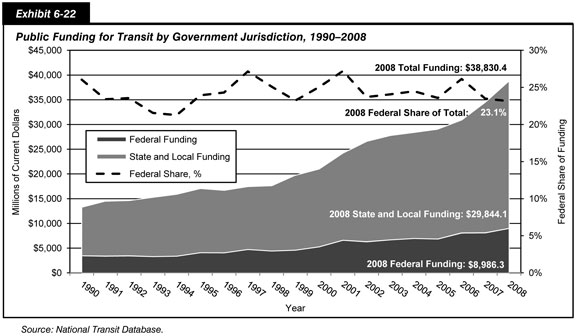
That's only true if you compare to gasoline consumption during the economic bubble from 2003-2008. If you look over a longer period, gas tax revenue is the highest it's been since before 2003 in nominal dollars, and is roughly the average it's been from 1990-2014 in inflation-adjusted dollars. The tax is due for an increase to counter inflation, not because of the reasons TFS cites.
Federal gas tax revenue (fig 6-2) has never been enough to cover highway construction and maintenance expenses (figure 6-3). The gap has always been made up by state fuel taxes and other revenue. -
Re:But DC is different,no?
I worked for an employer that only seemed to drug test those who worked in the warehouse.
I had to get tested for a warehouse job. It wasn't the job that required it, but the government. Working with heavy machinery is a "high risk" position and there were restrictions on some of the equipment. The employer is required by the government to keep records of tests for health and safety reasons. Got tested at another job as part of a CDL program.
"Pre-employment – An employer must receive a negative drug test result before permitting a CDL driver to operate a CMV."
http://www.fmcsa.dot.gov/regul... -
Re:Easy to solve - calibrate them to overestimate
NHTSA has recommendations for lots of traffic factors... why not yellow lights?
Just Googled it and it turns out that there is a manual:
http://mutcd.fhwa.dot.gov/Fact: Yellow light time is set to optimize safety and traffic flow. Federal
guidelines recommend yellow lights last from 3 to 6 seconds. Local authorities
set the duration based on many factors including: traffic volume, speed, roadway
grade and intersection design.
Source: “Manual on Uniform Traffic Control Devices 2009 Edition.” FHWA. Nov. 30, 2010Found this interesting information:
ANSWER: Analysis of data in the most comprehensive study to date (Safety Evaluation of Red-Light Cameras, FHWA HRT-05-048, April 2005) from seven jurisdictions (Baltimore; Charlotte; El Cajon, CA; Howard County, MD; Montgomery County, MD; San Diego; San Francisco) at 132 intersections using red-light cameras found:A 25 percent decrease in total right-angle crashes;
A 16 percent decrease in injury right-angle crashes;
A 15 percent increase in total rear-end crashes; and
A 24 percent increase in injury rear-end crashes.Net result is about a wash with a slight advantage to the cameras.