Slashdot Mirror
Domain: eia.gov
Stories and comments across the archive that link to eia.gov.
Comments · 833
-
Re: Ocean Warming & Acidification
Texas is primarily powered by natural gas and coal, with a bit of highly subsidized wind. However, while gas+wind may reduce emissions some, it is incapable of scaling to replace fossil, and will forever be dependent on it.
Howdy from Texas!
Pardner, you might wanna take a look at this here. It ain't just "a bit" [snort]....we git almost a fifth of our 'lectricity from those big 'ol whirly-gigs and the solars!
YEEE HAW! [gunshots]
-
Re: Ocean Warming & Acidification
Texas is primarily powered by natural gas and coal, with a bit of highly subsidized wind. However, while gas+wind may reduce emissions some, it is incapable of scaling to replace fossil, and will forever be dependent on it. The cost of wind today is deceptively low because it pushes the subsidies and required backup generation into another column. No one is suggesting coal as the alternative; just be realistic about expectations. Nor does most of the world have such conveniently co-located wind+gas resources.
Greens making money isn't the goal; decarbonization is. Germany provides a fine example of how expending enormous resources building renewables is not making effective progress toward this goal.
-
Re:Victors
I have little doubt that most climate scientists are acting in good faith, but the many zealots hawking "solutions" to the problem are not doing the cause any favors. Their primary goal appears to be killing nuclear plants, and inhibiting growth of this invaluable zero-carbon energy source. Working to replace nuclear with gas and limit our available tools exposes the hypocrisy of these self-styled "environmentalists", and calls into question their motivations.
They keep the focus on installing "renewable" capacity, and selling us on the 100% "renewable" dream; never on their progress in lowering carbon emissions, which has been uninspiring. We should be objectively examining the results of our efforts, and not asking "can it be done", but "what is the most effective strategy". Few places have sustained large-scale efforts, but the facts speak for themselves. See the real-time electric power and carbon intensity of Germany, France, Ontario, and Sweden.
-
Re:Everything is possible!
Your source is two years old. https://www.eia.gov/outlooks/a... The cost of solar PV is rapidly decreasing, while advance nuclear projections are nearly static, and the only current nuclear construction project has gone way over budget. Right now storage is mostly infeasible, but long distance transmission lines are quite feasible and being built at a fast pace. If the sun isn't shinning where you are, the wind might be blowing strong two states over.
So yes, all solar and wind is silly given current tech and prices, but "a good bit more" is not, especially compared to currently approved nuclear designs.
-
Re:Our president just congratulated Putin
Then again I've got to drive to work every day the same as everybody else...
Two things:
1) The biggest oil and gas suppliers to the usa are: https://www.eia.gov/dnav/pet/pet_move_impcus_a2_nus_epc0_im0_mbblpd_a.htm
I'll save you some time and tell you that its saudi arabia, canada and mexico2) As a Canadian, I pay $1.55/L for gas today and i still drive, the world didn't end, etc.
Gas in your car has nothing to do with russia. Same as trump, he has nukes so he can do what he wants. You americans elected trump, get used to it and fix your own shit. Way moreso elected trump, than a fixed election in russia (did he even have an opponent who wasnt in jail?).
.
You both just do what you want, shit we just trying to live around here! -
Re:Millions were killed by Tetraethyl Lead
in fact, that was the single largest source of lead to Americans back in the 70s. Next came house paint, which ALL contained lead. Any house made before the 70s, has lead on the walls.
What is interesting is that back then, coal plants were a small % of our electricity and lead as well. But after 3-mile island combined with the china syndrome, Coal plants jumped to 60% of our electricity. Needless to say, by mid 80s, they were #1 source of lead and mercury around our nation. Still far less than in China, but enough to impact us. Now, with the mercury clean-up and shutting down of coal plants, I believe that our #1 emitter of lead/mercury is our steel mills. Thankfully, Project Tim in Michigan will kill that off.
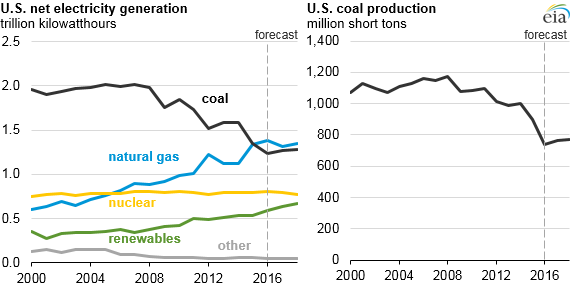
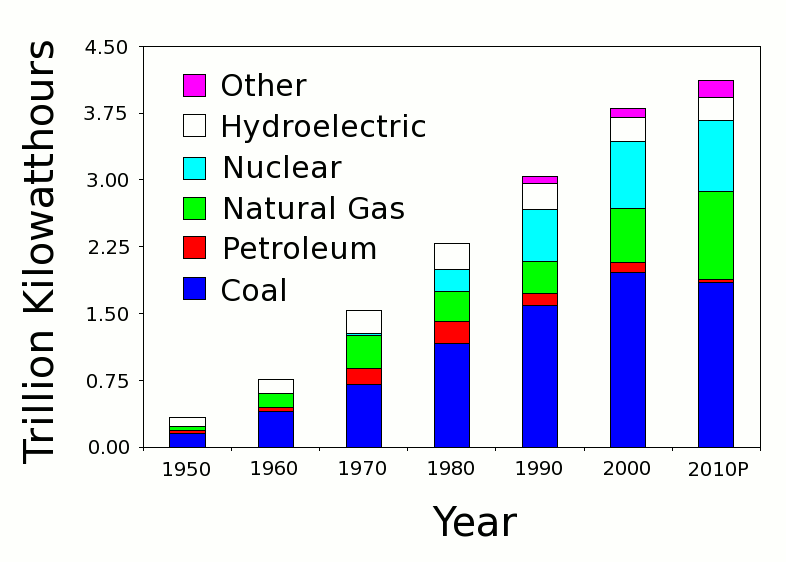
Do you have actual data to back that up? Looking at this graph and this graph, coal generation in the 70's was around 1/2 of the total generating capacity and doesn't seem to have any correlation to Three Mile Island or the release of The China Syndrome (both 1979).
-
Re:NEWSFLASH: WATER IS WET
If you're too lazy to follow the links from the original poster's own page... Here you go - the EIA's own subsidy numbers.
-
NEWSFLASH: Lynnwood is full of shit
Lynnwood liar at it again.
It's fossil fuels that are subsidised 7 times as much. Did you have trouble reading the graph...
Your friends at the EIA tell us that renewables are 15% and coal+gas is 64%. How is that 15x? (even ignoring the fact they only count utility solar and not non utility production.
You're as full of shit as ever. -
And with demand, comes supply
the demand, and thus the generation, and thus the pollution is occurring overseas.
Exactly - and with demand up just where are all these countries getting coal? Why partly from the U.S. of course, which saw an INCREASE in both price and production of coal in 2017.
The summary claim that coal is "headed down the tubes" (much less that it is the "golden child") is sadly yet more Fake News by people who don't understand the modern world economy, they only see things as they wish them to be.
-
Re:NEWSFLASH: WATER IS WET
ROI with subsidization isn't really ROI. Be generous with your figures.
Which form of energy is not subsidized by the government? If you look at fossil fuels and renewal energy, fossil fuels produce about 4 times more energy but enjoy 7 times more subsidies. It takes a lot of government money to keep coal and oil prices so low, almost twice as much money per unit of energy produced than is spent making renewable energy cheaper.
-
Re:And I though the US is a developed country...
Hawaii is in an awkward situation when it comes to power. They only have a population of 1.5 million, 2/3 of whom live on Oahu. That's borderline too small for a nuclear plant. Because it's a remote island, transport costs dominate the price of fuels, so coal ends up being more expensive than oil. Consequently, most of their electricity is generated by burning fuel oil.
This leads to Hawaii having the highest electricity cost of any state, higher than even Alaska. It's what makes alternatives like wind and solar more popular there - their price is more competitive with fossil fuels.
Because of the high price of electricity, you really have to pick and choose when you're going to use electricity. As others have mentioned, most of the state is actually very comfortable despite the heat. The winds are consistent and it's only certain windward sides of the islands where the humidity is high enough to make it uncomfortable. By the time the air has passed over the mountainous areas, the moisture has been squeezed out making it less humid and more comfortable. So you don't actually need to run air conditioners a lot of the time. It's not like the Indian subcontinent or East Asia, where the humidity is absolutely oppressive during the monsoon season and makes the outdoors feel like a sauna.
The point of the Powerwalls is to allow wind-generated electricity at night to be stored for later use during the day. As has been pointed out, it's mostly a PR stunt since the cost of the Powerwalls would make this non-competitive versus even oil-generated electricity in any real cost comparison. But one hopes it will become cost competitive in the future. -
Re:your full of base loadNothing is a complete solution. We need to reduce CO2 emissions by about 30% in order to maintain a stable climate. https://phys.org/news/2016-11-... That doesn't seem terribly impossible.
We use about 30% of energy for transportation. https://www.eia.gov/energyexpl.... In New York, heat pumps aren't very efficient. They all have backup resistive elements that are running every day in winter. Methane looks much more appealing. Again we only need a 30% cut. If we really want to achieve this we could certainly look at heat pumps that use methane as a backup rather than resistive plus some more insulation. That would probably get us there near immediately. But that's also expensive. Adding a resistive element to a heat pump is a couple hundred bucks. Adding a backup methane burner is probably in the thousands (or tens of thousands if you don't already have a chimney)
-
Re:Eletrical grid Energy doesn't come from oil
Well the "oil" used for heating isn't what comes out of the ground. You take the "oil" that comes out of the ground and you refine it into various petroleum products ranging from asphault to diesel fuel aka #2 heating oil. We use way more for cars than we do for heating. If we switch to wind/solar powers and electric vehicles, we can probably meet our petroleum product needs for quite a long time without the need for additional drilling. https://www.eia.gov/energyexpl...
-
Re:Eletrical grid Energy doesn't come from oil
Straight electric resistance heating can be considered 100% efficient.
Wow!
Of course this is wrong due to energy lost in power lines:
http://insideenergy.org/2015/1...
http://large.stanford.edu/cour...
-
Re:Oil will only go out of style when...If you want to argue from an energy efficiency standpoint, gas ICE vehicles are about 20%-25% efficient. That is, 20%-25% of the energy in the gasoline gets to the wheels to push the car forward.
Electric vehicles are almost the same. The average coal plant and gas plant are about 33% and 43% efficient respectively. Power line transmission losses are about 5%. Battery charging efficiency is about 85% (that is, to put 85 kWh into a battery requires about 100 kWh from the wall socket). Electric motor efficiency about 90%. Battery discharge efficiency about 80%. Multiply these together and you get (33% to 43%)*(95%)*(85%)*(90%)*(80%) = 19% to 25%. So just as with ICE vehicles, only about 20%-25% of the energy in the coal or natural gas makes it to the wheels to push the EV forward.
The primary reason EVs are cheaper to operate than ICE vehicles isn't because they're more efficient. It's because gasoline is an order of magnitude more expensive per megajoule than coal or natural gas.- Coal is about $50 per ton, which at 24 GJ/ton works out to 0.21 cents/MJ.
- Natural gas is about $4 per 1000 cubic feet, which at 1.094 GJ per 1000 cubic feet works out to 0.37 cents per MJ.
- Gasoline is about $3 per gallon, which at 130 MJ/gallon works out to 2.3 cents/MJ.
There are good advantages to EVs (concentrates fossil fuel combustion at a few plants which you can equip with super-clean filters, are power source-agnostic so can substitute nuclear or renewables for fossil fuel without any change to the car, recapture about 30% of braking energy via regenerative braking, quieter, produce gobs of torque at a standstill). But the claims of better efficiency and lower (zero) carbon emissions are simply untrue, founded on misconceptions by advocates who either haven't or don't know how to do the math. Measuring EV energy use at the battery is like measuring ICE energy use at the engine shaft. The ICE car gets that shaft energy by burning gasoline in the engine. The EV gets that battery power mostly from a coal or gas plant burning those fuels.
-
Re:Eletrical grid Energy doesn't come from oil
I don't know about the fuel mix in the state of New York (and maybe the headline is a mistake)
I won't claim to be an expert either but I in places like New York oil for heating is still quite common. Here's a somewhat old source on this, and likely still quite relevant:
https://www.eia.gov/todayinene...I still think that Gov. Cuomo is an idiot but he may have been not too far from the truth, likely by accident. Oil heating is on the decline with electric heating in many cases replacing it. Heat pumps are more practical now than they used to be. What's perhaps ironic on this is that the electricity being used to power these heat pumps is increasingly natural gas. If we assume that burning natural gas for electricity is 60% efficient, and a heat pump can produce 3 times the heat energy than the electric energy consumed, then we'll still come out ahead compared to even the most efficient natural gas furnaces. Even using less efficient natural gas turbines, with something like 25% efficiency, and heat pumps still compare well with a furnace in converting natural gas to heat.
Marc Jacobson has done a lot of research into the viability of renewables. He found that using solar and wind are complementary. Wind tends to be highest at night; solar by day.
Jacobson is also an idiot. Maybe he stumbled on some truth by accident but this is not anything near a viable energy plan. Wind and solar take 10x more resources per MW than nuclear, coal, or natural gas. Maybe with access to enough hydro, strong winds, sunlight, and such, a place like New York could have an electric grid that's inexpensive, low carbon, and reliable. This is only going to work until energy demands outgrow the availability of hydro storage. One bad drought during a hot summer can make this all fall apart quickly, and badly. This is also unique to New York. Some other state that lacks access to so much hydro is not going to be able to replicate this plan.
If New York wants to see their economy grow (and with people like Cuomo in charge I'm not sure they do) then they will need nuclear power at some point. And lots of it.
-
Re: Won't work, we're kinda fucked.
and we how that levels aren't going up and down radically over centuries
Assuming that 'how' is a typo for 'know', no we don't. If global warming actually is serious it would be easier to transition away from carbon over much less than a century.
Is it serious now? Not really. January 2018 was 0.26 degrees C warmer than the average for 1979 to 2018. 0.26 degrees C is not a large number.
http://www.drroyspencer.com/la...
Actually regardless of global warming I think we'll see a transition away from carbon intensive fuels. E.g. the UK and US have both seen their carbon emissions drop as they move from coal to gas for power generation.
UK
https://www.newscientist.com/a...
The UK's carbon dioxide emissions have fallen to their lowest level since the 19th century as coal use continues to plummet, analysis suggests.
Emissions of the major greenhouse gas fell almost 6 per cent year-on-year in 2016, after the use of coal for electricity more than halved to record lows, according to the Carbon Brief website, which reports on climate science and energy policy.
The assessment suggests carbon emissions in 2016 were around 381 million tonnes, putting the UK's carbon pollution at its lowest level - apart from during coal mining disputes in the 1920s - since 1894.
Carbon emissions in 2016 are around 36 per cent below the reference year of 1990, against which legal targets to cut climate pollution are measured.
US
https://www.eia.gov/environmen...
Energy-related carbon dioxide (CO2) emissions decreased by 89 million metric tons (MMmt), from 5,259 MMmt in 2015 to 5,170 MMmt in 2016. Although real gross domestic product (GDP) increased 1.5% over that period, other factors contributing to energy-related CO2 emissions more than offset the growth in GDP, leading to a 1.7% decline in energy-related CO2.
These factors include the following:
* A decline in the carbon intensity of the energy supply (CO2/British thermal units [Btu]) of 1.7%
* A 1.4% decline in energy intensity (Btu/GDP)Combining these two factors, the overall carbon intensity of the economy (CO2/GDP) declined by 3.1%.
Emissions have declined in 6 out of the past 10 years, and energyârelated CO2 emissions in 2016 were 823 MMmt (14%) below 2005 levels.
Of course it's worth pointing out that environmentalists have opposed fracking. Are global emissions going to go into decline anytime soon? Probably not, because of China. But in the US, UK and developed world they're already falling. And over centuries it's pretty much certain that new technologies - nuclear and renewable - will produce energy is less carbon intensive ways. In fact as the UK and US example shows it's already possible to produce energy in less carbon intensive ways.
-
Actually it's right
You can back out ICE efficiency from the EVs on the road. Let's use the Nissan Leaf (you'll see why later). EPA rating of 30 kWh per 100 miles. 112 MPGe combined, 101 MPGe.highway. Top speed of 93 MPH.
30 kWh per 100 miles = 108 Megajoules per 100 miles. Since we're trying to do a comparison and ICE cars don't have regenerative braking, we need to compare the highway mileage. Since the Leaf gets 101 MPGe on the highway vs 112 MPGe combined, this works out to (112/101)*(108 MJ) = 119.8 MJ per 100 miles on the highway. Note that this is energy stored in the battery. To do the comparison, we need energy at wheels to the ground.
Electric motor + inverter efficiency is typically about 85%-93% (page 35). That's for a Prius' motor (the only one I could find detailed stats for), but they're all pretty similar at these levels of power output. Since there's no gearing, if you align the Leaf's top speed of 93 MPH with 6000 RPM, then the highway speed of 55 MPH corresponds to (55/93)*(6000 RPM) = 3550 RPM. Which puts us right around 90% efficiency.
I couldn't find any numbers for battery discharge efficiency. Battery charging efficiency for a Tesla with the home charger is about 85%. Battery discharge efficiency is typically a bit worse (even more so at higher loads, which is why jackrabbit or ludicrous mode starts kill your rnage). so go with 80%. (For those of you complaining this is too unfavorable to EVs, a lower discharge efficiency here corresponds to lower ICE efficiency later on.)
So 119.8 MJ from the battery becomes (119.8 MJ)*(90%)*(80%) = 86.3 MJ per 100 miles wheels-to-ground. The extra energy is lost as heat to the battery, wiring, inverter, and motor.
Gasoline has an energy density of 34.2 MJ/L = 129.5 MJ/gallon. To figure out how many gallons were used in 100 miles, we need the MPG of a gas-powered Leaf. Fortunately we have one - the Leaf's aerodynamic and rolling resistance is almost identical to the Versa since it shares the same body and frame (I had to go back to 2014 to get the hatchback version with a regular transmission). Highway mileage is 35 MPG. Meaning (129.5 MJ/gal)*(100 miles)/(35 miles/gal) = 370 MJ worth of gasoline consumed per 100 miles.
Overall highway efficiency of the ICE and drivetrain is then energy wheels-to-ground vs energy in the gasoline. (86.3 MJ)/(370 MJ) = 23.3%. It's rated at 26 MPG city, so overall efficiency in city driving is (26/35)*(23.3%) = 17.3%. A far cry from the 12% you came up with.
We can also calculate overall efficiency for the EV, from energy source to wheels-to-ground, just like we calculated it for the ICE vehicle from energy source (gasoline) to wheels-to-ground. The average efficiency of a coal plant is about 33%. The average efficiency of a natural gas plant is about 43%. Power line transmission losses are about 5%. As mentioned before, charging efficiency (for a home charger) is around 85%, discharge efficiency around 80%, motor efficiency around 90%. To get an overall efficiency of (33% or 43%)*(95%)*(85%)*(80%)*(90%) = 19.2% or 25%. If you use a fast charger like a Supercharger station, it's even worse, since the charging efficiency is even lower (more of the electricity is lost as heat) the more quickly you charge the battery.
So an EV powered by electricity generated from fossil fuels isn't any more energy efficient than an ICE vehicle. The reason it's cheaper to charge an EV is almost entirely because gasoline is damn expensive for an energy source. Coal costs about $50/ton and contains ab -
Re:It's not difficult
We've had the capability to do this for quite a while, at least on the military side.
Can you point to a single electric plane that can carry at least 70 people? The Embraer 175 series is really the airplane of choice for short hop/short-haul planes, and it seats 75 to 85, depending upon configuration. What is out there, electric, that does that?
Remember, without massive tax subsidies and tax exemptions, fossil fuels aren't that cost effective.
Oh, so fossil fuels now get tax exemptions, not just tax subsidies? And solar and wind do not? Wind and solar are massively subsidized, especially when you take into account the much lower amount of energy we get from them. Without the much-more massive subsidies for wind and solar, they would be DOA.
People are just fearful of change: suppliers, operators, capital loans providers, and so on.
Some love change simply because they want to "stick it to the man" and want to "change things up" for no reason other than change. Forcing adoption of electric commercial planes - when there isn't a single, viable plane in existence or even planned - is extremely short sighted. But hey - it gets the no-nukes/hate-fossil-fuel crowd all motivated!
-
Re:Alternative
Sure, see http://e360.yale.edu/features/greenest_place_in_the_us_its_not_where_you_think. Also, see https://www.eia.gov/state/rankings/ for the state-level data. That said, I think that considering this to be something that would constitute a conflict of interest enough to doubt the source is pretty silly.
-
Re:Are you calling USA shady?
And EVs are charged using electricity from coal which is a lot dirtier than ICE so the environmental argument fails too.
This is an outright lie. Here in California, we have exactly one coal-fired plant, providing 55 MW, or 0.2% of our usage. For the US as a whole, less than 30% of our electricity is from coal.
https://en.wikipedia.org/wiki/...
https://en.wikipedia.org/wiki/...
http://www.sandiegouniontribun...
https://www.eia.gov/state/?sid...
https://www.eia.gov/energyexpl... -
Re:Are you calling USA shady?
And EVs are charged using electricity from coal which is a lot dirtier than ICE so the environmental argument fails too.
This is an outright lie. Here in California, we have exactly one coal-fired plant, providing 55 MW, or 0.2% of our usage. For the US as a whole, less than 30% of our electricity is from coal.
https://en.wikipedia.org/wiki/...
https://en.wikipedia.org/wiki/...
http://www.sandiegouniontribun...
https://www.eia.gov/state/?sid...
https://www.eia.gov/energyexpl... -
Re: Easy to do for Net Energy Exporting countriesThats no longer true nowthough.
The U.S. transportation sector was the only consumption sector where CO2 emissions increased in 2016. CO2 emissions from the transportation sector increased by 1.9%, largely reflecting emissions from motor gasoline, which increased 1.8% in 2016. Emissions from the transportation sector surpassed those from the power sector during 2016—a trend that persists through at least 2040 in the Reference case projections in EIA’s 2017 Annual Energy Outlook.
-
Re: Easy to do for Net Energy Exporting countries
It's very close in the link you provided,27% vs 29% but that was a few years ago.
Transportation was not quite the greatest single source in America in 2015. Would have been much more honest reply.
Or you could have just linked here instead and shown that it is true. Since 2016 transportation has been the biggest source of CO2 emissions. Partly because of declining electricity use, due to increasing temperatures.
The U.S. transportation sector was the only consumption sector where CO2 emissions increased in 2016. CO2 emissions from the transportation sector increased by 1.9%, largely reflecting emissions from motor gasoline, which increased 1.8% in 2016. Emissions from the transportation sector surpassed those from the power sector during 2016—a trend that persists through at least 2040 in the Reference case projections in EIA’s 2017 Annual Energy Outlook.
-
Re: Easy to do for Net Energy Exporting countries
Just about everything is cheaper than natural gas.
https://www.eia.gov/electricit...
The table doesn't include solar and wind but the prices on these have dropped to about 3 cents/kwh -
Re:The U.S. isn't a good site for offshore wind
We're talking about electricity.
Most of US municipal electricity is generated using fossil fuels.
Natural gas was the source of about 34% of U.S. electricity generation in 2016. In addition to burning natural gas to heat water for steam, it is also burned to produce hot combustion gases that pass through a gas turbine, spinning the turbine's blades to generate electricity.
-
Re:At what cost?
At what cost? Subsidies for renewables, which far exceed those of fossil fuels, are used to make them appear cost effective.
If you want to end up totally baffled about costs, let me recommend that ultimate source for most of the numbers being batted around. https://www.eia.gov/outlooks/a... Wonderful document. You can cherry pick just about any answer you want from one or another of the tables. The exception being that there is probably not enough lipstick in the world to make Coal with CCS, Solar-Thermal or offshore Wind look attractive.
I'd also point out that the numbers for non-dispatchable sources -- wind, solar, hydro(as they model it) do NOT include the affect on backup facilities operating costs. I'm pretty sure that's not because the affect on backup costs is unimportant. It's because it's too difficult to calculate in a general manner.
-
Re:Seems they import a lot of electricity (1/3).
How about the US Government which states that "California imports about a quarter of its electricity on average"? Do they count? Reading the article you linked, it is clear the LA Times "cherry picked" specific narrow dates to make their claim. On average, CA imports a full 25% of its power needs.
Seems you're a lot better off believing Forbes rather than the LA Times... At least when it comes to truthiness about power imports to California.
-
Re: Well Damm, there goes my life
I'm also basing it on the US dollar cost of common cars, and power. Depending on where you are in the US, even those numbers change. (eg. power in Alaska is rather expensive [link)
-
Re:We should have batteries at every substation.
The resiliency of the power grid would be vastly improved if we put a battery pack (the size of a normal intermodal container) at each substation.
The resilience of the power grid would be vastly improved if we put a battery pack (the size of a normal outdoor dunny) at each house.
At what cost? Is it worth spending billions of dollars to reduce average downtime from 200 minutes a year to some marginally smaller number?
-
Re:"Falling Demand For Fossil Fuel Energy"
What will it do to GE when I implement my program to transition our $2Bn/year Conservation Reserve Program farm subsidies to a Conservation Reserve and Energy Production Program?
I plan to protect our reserve agricultural land--land on which we pay farmers to not farm--by placing non-permanent (no paving, no poured foundation) solar installations. Piles hammered into the ground or footed in concrete piers (removable with a shovel), metal conduit, panels mounted on the racks. We subsidize the farmers now, and I plan to push them to spend (say) 50% of that subsidy on the development of solar capacity. If their reserve land is full, then we give them only half the subsidy.
This will encourage farmers to hire tenant solar management, having generation capacity placed in sunny areas and preventing the permanent destruction of that agricultural land. The farmer profits from this generation, plus receives half the usual subsidy. The American people get something for the money they pour into this subsidy (granted it's like $13 per taxpayer per year), that being cheap renewable energy. If we need the farm land back, we can have a crew yank the poles out of the ground and store the panels and conduit--in such a crisis of farm land shortage, the government would subsidize the change back, of course.
Think of the fossil fuel market, though. With all this new capacity—a billion dollars's worth of installation per year!—we'll be competing against coal, oil, and gas combined cycle. It's under a dollar per megawatt capacity installed, so 1,000 TW or 1 petawatt of generation capacity. The US is already adding wind and retiring coal and natural gas. Our current consumption is about 4 petawatt-hours per year, less than half a TW of continuous generation.
Do you think it's enough solar?
Really, though, I need to think about that. We may need to slow that down. That's a hell of a fast change-over and cutting the rug out from under that many working Americans that fast will make it difficult for them to find new jobs.
-
Re:Bullshit
If you actually do the comparison, you see that bitcoin transaction costs (per $1,000 equivalent) is CHEAPER than dollar. It wouldn't work any other way.
Come again? I don't even understand what the unit of measure you're proposing means, but I can already tell you that if you want to understand the cost of transactions, we don't measure them "per $1,000 equivalent". We measure them per transaction.
According to these researchers, each Bitcoin transaction currently costs the equivalent of 9 days worth of energy for an average US household, with that number growing over time as more resources are added to the system. The average US household consumed 10,766 kWh annually in 2016, which we'll assume hasn't shifted much in the last year. The average residential price was 13.30 cents/kWh in September, which we'll assume is comparable to today. Taken together, they suggest that the average US household pays about $1431.878 annually for electricity, or about $3.92/day. As such, a single Bitcoin transaction currently costs the world $35.28 in electricity to process. Other places put the current cost closer to $72-77 per transaction.
In contrast, the cost to process a cash transaction is the amount of time it takes someone to recognize that the dollar bill is now in the seller's hand instead of mine. Or, put differently, effectively zero. That's why we can use cash to purchase everything from a stick of gum to an entire estate.
From those numbers, we can say a few things:
1) Bitcoin is (currently) unviable for small transactions. In fact, if you look at the average transaction value, you'll see that it correlates to the average transaction fee, suggesting that as fees go up, the system becomes unusable for day-to-day purchases, making it unsuitable as a cash replacement. A system only works as a cash replacement when it is capable of scaling from our smallest purchases to our largest purchases while maintaining a cost per transaction that is FAR less than the value of the transaction.2) Transaction fees don't cover transaction costs. Note that the fees listed in that last chart are far lower than the costs listed in the earlier chart. This is an example of an externalized cost (and explains how the system can work contrary to your claim that it can't work any other way), where someone else is paying for something you're doing. In the case of Bitcoin, it's the miners who are paying the remainder of the costs for each transaction (i.e. their electric bills), but they're paying those electric bills in USD, EUR, GBP, and similar currencies, rather than BTC, which means that their electric bills don't track with fluctuations in the value of BTC. This isn't a problem when BTC valuations are high, since additional miners join in to take advantage of the imbalance (this is more or less a form of arbitrage, exchanging cheap electricity for more valuable BTC). Unfortunately, when BTC valuations slide against the other currencies this becomes a major problem for those miners. Their rigs become sunk costs that are incapable of producing a return on their value and can only be sold for a fraction of what they cost.
3) Transaction costs can exceed their benefits. If you want to buy $15 in groceries and are told every transaction has a $75 fee to confirm your purchase, you won't buy those groceries. You'll wait until you need a lot more before you make the purchase. That's both a good thing (the system discourages wasteful activity) and a bad thing (why are small transactions wasteful in the first place?). If, however, you're told that the cost to confirm the transaction is merely $7.50, you
-
Re:Bullshit
If you actually do the comparison, you see that bitcoin transaction costs (per $1,000 equivalent) is CHEAPER than dollar. It wouldn't work any other way.
Come again? I don't even understand what the unit of measure you're proposing means, but I can already tell you that if you want to understand the cost of transactions, we don't measure them "per $1,000 equivalent". We measure them per transaction.
According to these researchers, each Bitcoin transaction currently costs the equivalent of 9 days worth of energy for an average US household, with that number growing over time as more resources are added to the system. The average US household consumed 10,766 kWh annually in 2016, which we'll assume hasn't shifted much in the last year. The average residential price was 13.30 cents/kWh in September, which we'll assume is comparable to today. Taken together, they suggest that the average US household pays about $1431.878 annually for electricity, or about $3.92/day. As such, a single Bitcoin transaction currently costs the world $35.28 in electricity to process. Other places put the current cost closer to $72-77 per transaction.
In contrast, the cost to process a cash transaction is the amount of time it takes someone to recognize that the dollar bill is now in the seller's hand instead of mine. Or, put differently, effectively zero. That's why we can use cash to purchase everything from a stick of gum to an entire estate.
From those numbers, we can say a few things:
1) Bitcoin is (currently) unviable for small transactions. In fact, if you look at the average transaction value, you'll see that it correlates to the average transaction fee, suggesting that as fees go up, the system becomes unusable for day-to-day purchases, making it unsuitable as a cash replacement. A system only works as a cash replacement when it is capable of scaling from our smallest purchases to our largest purchases while maintaining a cost per transaction that is FAR less than the value of the transaction.2) Transaction fees don't cover transaction costs. Note that the fees listed in that last chart are far lower than the costs listed in the earlier chart. This is an example of an externalized cost (and explains how the system can work contrary to your claim that it can't work any other way), where someone else is paying for something you're doing. In the case of Bitcoin, it's the miners who are paying the remainder of the costs for each transaction (i.e. their electric bills), but they're paying those electric bills in USD, EUR, GBP, and similar currencies, rather than BTC, which means that their electric bills don't track with fluctuations in the value of BTC. This isn't a problem when BTC valuations are high, since additional miners join in to take advantage of the imbalance (this is more or less a form of arbitrage, exchanging cheap electricity for more valuable BTC). Unfortunately, when BTC valuations slide against the other currencies this becomes a major problem for those miners. Their rigs become sunk costs that are incapable of producing a return on their value and can only be sold for a fraction of what they cost.
3) Transaction costs can exceed their benefits. If you want to buy $15 in groceries and are told every transaction has a $75 fee to confirm your purchase, you won't buy those groceries. You'll wait until you need a lot more before you make the purchase. That's both a good thing (the system discourages wasteful activity) and a bad thing (why are small transactions wasteful in the first place?). If, however, you're told that the cost to confirm the transaction is merely $7.50, you
-
Re:Oh NOES!!!
Annual US gas prices https://www.eia.gov/dnav/pet/h...
Annual Canadian Gas Prices https://tradingeconomics.com/c...
Fossil fuel subsidies, which you are ignoring: "https://en.wikipedia.org/wiki/Energy_subsidies#Impact_of_fossil_fuel_subsidies"
http://www.sciencedirect.com/science/article/pii/S0305750X16304867
Roll those into the cost of your Spark or Versa, along with the staggering cost of keeping the US military in the Middle East and Afghanistan, and the picture is very different.
-
Re:Corrects its own headline in the third sentence
Also, more to the point, new electricity generation in the US (and most of the developed world) is a mix of wind, solar and natural gas. Modern natural gas baseload plants (combined cycle), BTW, are around 60% efficient, not 40%. Coal is dying.
When you add new load to the grid, they're not filling that load with coal; they're filling it with renewables.
-
Re:Corrects its own headline in the third sentence
one we promise will go away Real Soon Now.
News flash to Americans: there exists a world outside America.
Meanwhile, let's compare the Tesla Model 3, without any subsidies, to the similarly sized BMW 3-series. First off, which models to compare?
Model 3 SR: 0-60=5,5s; BMW 330i: 0-60=5,4s
Model 3 LR: 0-60=4,8s (Motor Trend)-5,1s(official); BMW 340i: 0-60 various measured at 4,8 and 5,1s.So now we have our comparison points; let's do the comparisons. Note for the below that the 3-series all have a 15,8gal tank, and the Model 3 LR has an EPA-calculated range of 347/334/318mi in city/combined/highway driving, respectively. SR's battery is the same as LR's except 31 cells per brick rather than 46, so its range figures should be 31/46 times as much, plus a bonus for the reduced weight (estimated at 4%/3,2%/2,5% in city/combined/highway, respectively).
Base price (before options):
SR/330i: $35k vs. $40,3k
LR/340i: $44k vs $49kCurb weight:
SR/330i: 3549 lbs vs. 3501lbs (manual) - 3541lbs (auto)
LR/340i: 3814 lbs vs 3675lbs (manual) - 3704lbs (auto)Energy consumption, City/Combined/Highway (Wh/mi or mpg):
SR/330i: 248/260/274 vs 21/25/32(manual), 23/27/34(auto)
LR/340i: 258/267/281 vs 19/23/29(manual), 21/25/32(auto)Annual energy cost, based on US average gasoline $2,561/gal, US average residential electricity $0,1319/kWh, and an average US driving distance of 13476/yr. The difference between the gas and electricity prices is roughly doubled in the EU averages.
SR/330i: $441/$461/$487 vs $1648/$1384/$1081 (manual), $1505/$1282/$1018 (auto)
LR/340i: $459/$476/$499 vs $1821/$1505/$1193 (manual), $1648/$1384/$1081 (auto)Model 3 annual energy cost savings ("combined" is representative of most drivers); again, differences are roughly doubled in the EU:
SR/330i: $1207/$923/$594 (manual), $1064/$820/$531 (auto)
LR/340i: $1363/$908/$582 (manual), $1189/$908/$582 (auto)Vehicle range (mi):
SR/330i: 243/232/220 vs 332/395/506 (manual), 363/427/537 (auto)
LR/340i: 347/334/318 vs 300/363/458 (manual), 332/395/506 (auto)Time stopped for filling on a 100% highway-driving trip (anything less than 100% highway = more EV friendly comparison). Assumed EV driving down to 10% capacity, charging to 60% (unless a small amount more will mean one less stop), with average 7,5mi/min for LR and 6mi/min for SR. 4 min overhead assumed per stop (based on my timing of vehicle stop lengths), minimum 30mi remaining at arrival, gas vehicles filled to full at each stop, 1 minute tank fill time. Assumed half tank starting point for gasoline. Format: "trip length (drive time@70mph): SR LR / 330i-manual
-
Re:Corrects its own headline in the third sentence
one we promise will go away Real Soon Now.
News flash to Americans: there exists a world outside America.
Meanwhile, let's compare the Tesla Model 3, without any subsidies, to the similarly sized BMW 3-series. First off, which models to compare?
Model 3 SR: 0-60=5,5s; BMW 330i: 0-60=5,4s
Model 3 LR: 0-60=4,8s (Motor Trend)-5,1s(official); BMW 340i: 0-60 various measured at 4,8 and 5,1s.So now we have our comparison points; let's do the comparisons. Note for the below that the 3-series all have a 15,8gal tank, and the Model 3 LR has an EPA-calculated range of 347/334/318mi in city/combined/highway driving, respectively. SR's battery is the same as LR's except 31 cells per brick rather than 46, so its range figures should be 31/46 times as much, plus a bonus for the reduced weight (estimated at 4%/3,2%/2,5% in city/combined/highway, respectively).
Base price (before options):
SR/330i: $35k vs. $40,3k
LR/340i: $44k vs $49kCurb weight:
SR/330i: 3549 lbs vs. 3501lbs (manual) - 3541lbs (auto)
LR/340i: 3814 lbs vs 3675lbs (manual) - 3704lbs (auto)Energy consumption, City/Combined/Highway (Wh/mi or mpg):
SR/330i: 248/260/274 vs 21/25/32(manual), 23/27/34(auto)
LR/340i: 258/267/281 vs 19/23/29(manual), 21/25/32(auto)Annual energy cost, based on US average gasoline $2,561/gal, US average residential electricity $0,1319/kWh, and an average US driving distance of 13476/yr. The difference between the gas and electricity prices is roughly doubled in the EU averages.
SR/330i: $441/$461/$487 vs $1648/$1384/$1081 (manual), $1505/$1282/$1018 (auto)
LR/340i: $459/$476/$499 vs $1821/$1505/$1193 (manual), $1648/$1384/$1081 (auto)Model 3 annual energy cost savings ("combined" is representative of most drivers); again, differences are roughly doubled in the EU:
SR/330i: $1207/$923/$594 (manual), $1064/$820/$531 (auto)
LR/340i: $1363/$908/$582 (manual), $1189/$908/$582 (auto)Vehicle range (mi):
SR/330i: 243/232/220 vs 332/395/506 (manual), 363/427/537 (auto)
LR/340i: 347/334/318 vs 300/363/458 (manual), 332/395/506 (auto)Time stopped for filling on a 100% highway-driving trip (anything less than 100% highway = more EV friendly comparison). Assumed EV driving down to 10% capacity, charging to 60% (unless a small amount more will mean one less stop), with average 7,5mi/min for LR and 6mi/min for SR. 4 min overhead assumed per stop (based on my timing of vehicle stop lengths), minimum 30mi remaining at arrival, gas vehicles filled to full at each stop, 1 minute tank fill time. Assumed half tank starting point for gasoline. Format: "trip length (drive time@70mph): SR LR / 330i-manual
-
Re:"2.4 kilowatts per hour"
It turned the USA from an energy importer into an energy exporter.
No it did not: https://www.eia.gov/tools/faqs...
The "shale revolution" merely postpones the withdrawal symptoms, it doesn't help to cure our oil addiction. And it surely doesn't help fighting climate change either.
-
Re: No surprise at all - it's about the stock pri
Thankfully those Tesla's are connected to "clean" energy?
Oh wait, they are connected to fossil fuel plants? Well that doesnt have any carcinogenic exhaust does it?
https://www.eia.gov/energyexpl...
Most of U.S. electricity is generated using fossil fuels
In 2016, natural gas was the largest energy source for the 4 trillion kilowatthours of electricity generated in the United States.Sources of U.S. electricity generation, 2016: Renewables 15%, Petroleum 1%, Nuclear 20%, Coal 30%, Natural Gas 34%
Click to enlarge
More dataNatural gas was the source of about 34% of U.S. electricity generation in 2016. In addition to burning natural gas to heat water for steam, it is also burned to produce hot combustion gases that pass through a gas turbine, spinning the turbine's blades to generate electricity.
Coal was the second-largest energy source for U.S. electricity generation in 2016—about 30%. Nearly all coal-fired power plants use steam turbines. A few coal-fired power plants convert coal to a gas for use in a gas turbine to generate electricity.
Petroleum can be burned to produce hot combustion gases to turn a turbine or to make steam that turns a turbine. Residual fuel oil and petroleum coke, products from refining crude oil, are the main petroleum fuels used in steam turbines. Distillate (or diesel) fuel oil is used in diesel-engine generators. Petroleum was the source of less than 1% of U.S. electricity generation in 2016.
-
Re:Yup, not surprising.
Transportation is your biggest sector...Your biggest sector is increasing... Your second biggest only decreased because of the warmer weather in 2016...
Look at the graph at the bottom, the one predicting the future CO2 emissions. The one where just about every scenario has increases for the next few years.
The only one that doesn't have increases is the high oil price scenario. With all the cheap fracking that is highly unlikely. -
Re:Yup, not surprising.
Here is EPA. We see that from 2008 all through 2016, that CO2 continues to fall. Everything went down, EXCEPT for Transportation, but that was because oil became cheap and ppl bought new big cars. THis is going to change over the next 2 years due to EVs.
OTOH, you have provided no proof that ours continues to climb, even though you make wild claims. -
Re:Climate Change: the debate continues
Here's the deal though.
The deal would be that you start reading up how nuclear power works, what is mined, how it is processed, what the waste is and what the costs are.
It is embarrassing that you post this nonsense since two years, get corrected 100 times per thread, but insist to learn nothing.If I was your son/daughter I would be to embarrassed to go to school. Nobody can be as dumb as you are pretending to be; unless he is a professional troll or payed agitator for nuclear power (the later is unlikely as no power company outside China is anymore investing into nuclear power)
-
Re:Shocking energy usage in the us...
What has the size of the house to do with the needed electricity?
The largest consumer of electricity in a home is the climate control system.
-
Re:EIA DATA problem takes care of itself
Page 18, table B2 shows the LCOE, capacity weighted, with hydro, biomass, and natural gas winning. Solar and wind are well behind. And those are estimates for 23 years in the future at that. You must have a different report than the original link...
-
EIA DATA problem takes care of itself
According to the EIA the cost of most renewable technologies is now lower then many fossil fuel based technologies. Levelized Cost and Levelized Avoided Cost of New Generation Resources in the Annual Energy Outlook 2017
still it is going to take a while to build out, and develop the load following technologies. -
Re:I expect in the comments here
The petroleum subsidies ($3.2 billion), even if you attributed them entirely to just motor vehicle fuel sales, amount to 2.2 cents per gallon. It's dwarfed by the 18.4 cents/gallon federal fuel tax and the average 31 cents/gallon state fuel taxes. Petroleum sales results in a net tax revenue for the U.S. government even after you factor in the subsidy. The government distortion of the petroleum market is to discourage its use, not to subsidize it.
Agricultural subsidies were implemented after the Dust Bowl and the Great Depression, to guarantee the U.S. always has an oversupply of food and food production capacity. Without them, fallow farmland would be sold to be converted to other uses. And a bad cold snap or insect plague would lead to food shortages and starvation. -
Re:Dear CNN.
But if they do release it, it will contribute to global warming.
They won't just release the methane, they will burn it to generate power. The by-products are water and carbon dioxide. In climate terms, this is effectively comparable to fossil fuels, except cleaner due to the absence of particulates. This is most noticeably an improvement over coal.
Per the EIA, natural gas gives off about 1/2 the carbon dioxide of coal for the same amount of energy:
https://www.eia.gov/tools/faqs...Since natural gas is basically methane with some miscellaneous natural contaminants, methane should be approximately the same as natural gas---or slightly better. While it won't eliminate greenhouse gases entirely, methane is preferable to coal, oil, and gasoline.
-
Re:Immpossible!
yes, some 5 percent (f'rom 1 link i googled : https://www.eia.gov/tools/faqs... ) . but LESS than the loss in ICE from engine to wheel. (I heard 15% as a rule of thumb)
-
Re: Great, now it'll ALL be made in CHINA!
The gasoline and oil in the corvette uses, is almost completely produced in the US.
-
Production or capacity?
The Natural Resources Defense Council, an environmental advocacy group, and Statista recently teamed up to analyze the EIA's predictions for energy usage and production. They found that the EIA's 10-year estimates between 2006 to 2016 systematically understated the share of wind, solar and gas. Solar capacity, in particular, was a whopping 4,813% more in 2016 than the EIA had predicted in 2006 it would be.
I see that capacity word in there. Solar generation is less than 1% of total US power generation (lagging behind biomass, and not even 7% of all renewables). Methinks protesting about errors in estimates about capacity, rather than looking at the accuracy of projections of generation, is a big red herring. My bank account has the capacity to hold hundreds of billions of dollars! Unfortunately, the generation side isn't quite so endowed with zeros...

/cdn.vox-cdn.com/uploads/chorus_asset/file/9395827/OCI_US_Fossil_Fuel_Subs_2015_16_comparison.jpg)