Slashdot Mirror
Domain: eia.gov
Stories and comments across the archive that link to eia.gov.
Comments · 833
-
Re:Trump version of...
And the whole vitriol for Trump thing is wearing super thin.
Look, I can sympathize with this. Really I can - I was sick of this shit long before the election. The problem is that all of Trump's political success, such at it is, stems from generating outrage. He's like a political shock-jock, and like a shock-jock he thrives on the attention, but that attention requires constantly one-upping himself.
So this vitriol that you and I and probably everyone else is tired of - it isn't the same vitriol that it was last week. Every fucking few days there's some new outrage coming out of the White House and as tired as we all may be, this is how it's going to go for the next four years. Barring impeachment. Which sounds completely plausible at this point.
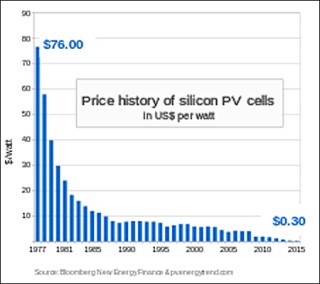
Also, what's this "impossible" business when it comes to renewable energy? I am looking at the numbers and I see exponential growth in renewable power capacity and a rather jaw-dropping drop in cost-per-megawatt for photovoltaics - 96% over the last ten years. And it's still going down. Here. Solar is cheaper than everything save wind, natural gas, and geothermal.
-
Re:at what priceI don't hate birds (with the exception of the one that shat on my lunch that time), but your level of misinformation is astounding. Why don't we break down this bullshit.
Only about 70% of migratory birds are surviving one annual migration at the moment.
In 2003, wind turbines killed 33,000 birds a year. Glass windows killed 97 million.
The mass extinction of birds is currently on the way.
Due to habitat loss. Wind turbines don't even register on the scale.
Loosing large birds gliding magnificently above a town is the same loss as loosing the trees, bees, rivers, etc.
That's "Losing". To your point: trees are necessary for temperature control and erosion resistance. Bees are necessary to pollinate fruit trees. Rivers power dams and harbors fish. Large birds... they eat small animals, just like foxes, cats, snakes, wolves and bears. They're not necessary.
Limiting power consumption via LED lamps,
CFL's, which people already use, are almost as efficient (8-12% vs. 8-15%). Lighting is only 7% of electric usage anyways.
lighter vehicles,
99.85% of cars don't even use electricity.
smaller heated (air-conditioned) areas in houses
Heating is usually natural gas. But even if you include it, residential heating plus air conditioning only accounts for 6% of all energy use.
...could produce more than enough electricity for decades
Yeah no. Not when the world population is set to reach 8 billion by 2025 (a 14% growth).
-
Subsidies
...when you consider that wind/solar are getting something like 400x the subsidies per megawatt hour that coal, oil, and ng are receiving.
Depends on how you count subsidies. Typical subsidies quoted for fossil fuel production are quoted at $27 billion per year (http://priceofoil.org/content/uploads/2014/07/OCI_US_FF_Subsidies_Final_Screen.pdf ), and more for transporting the fuel. Much more, of course, if you count the cost of providing security in the Middle East, which many people think we only do because of the oil. https://www.eia.gov/todayinene...
-
Per unit energy
Basically every carbon atom that goes into your tank comes out the tailpipe as soot, CO2, and a very smalll quantity (these days) of unburned alkanes. Since that means that the CO2 emitted per unit consumed by the engine is approximately constant...
No, it's not constant. Carbon intensity is the amount of carbon emitted per unit energy (not per unit carbon). If you're burning hydrogen, your carbon intensity is zero. If you're burning anthracite, your carbon intensity is 104. If you're burning natural gas, your carbon intensity is halfway in between.
Carbon intensity is a measure of what's in your fuel. Basically, it tells you how much carbon was in the fuel producing your energy.
The reference is seen by clicking the link in Ars Technica article linked in the summary, here: https://www.eia.gov/todayinene...
(as you point out, carbon produced in the supply chain should also, logically, be included).
-
What is carbon intensityIt's not a "retarded" measurement, it just doesn't happen to be a measurement of what you think it should measure.
Carbon intensity is not efficiency, which is what you seem to be interested in.
Carbon intensity is, instead, a measure of where the energy comes from: not how efficiently it is used; but, how much of the energy comes from oxidizing carbon instead of from some other source.
If you divide carbon intensity (carbon per million BTUs of energy) by the efficiency (amount of produce product per million BTUs of energy) you would get a measure of the carbon emitted per unit of product. So the carbon intensity is one factor in the greenhouse emissions, but not the only factor. It's the factor that accounts for the fuel type.
... and, no, don't blame me for the silly units of kilograms of carbon per million BTUs; I didn't invent them.
-
Re:Misleading data
The only reason why it's falling is because they count renewables as "fuel". So of course per unit of "fuel" consumed (and remember, solar radiation count as "fuel"), they emit less CO2. It doesn't mean the process of CO2 emitting thermal power plants actually improved.
If you look at the source, it seems fairly straightforward that they are simply multiplying the amount of fuel used by the amount of CO2 emitted per BTU of that fuel. That analysis if flawed in several ways, but saying that renewables are affecting this in a large way is not correct. Solar + Wind only produced 22,490 Million Kilowatt-hours in January 2017, or 6.5% of the total electricity produced in January 2017. Hydro and Geothermal production rate hasn't increased significantly in decades, so I will exclude them for now.
The big driver of this reduced carbon intensity is the shift from coal to natural gas for electricity production. In 2016, coal produced 1,240,089 Million Kilowatt-hours of electricity, down from a high of around 2,000,000 Million Kilowatt-hours in 2005-2007. The last time coal electricity production was this low was in 1985, and it will probably be even lower in 2018.
Meanwhile, natural gas electricity production was 1,380,293 Million Kilowatt-hours in 2016, the highest ever, and significantly increased from the 291,946 Million Kilowatt-hours produced in 1985. It will probably be even higher in 2018. Natural gas produces less CO2 than coal, so this is the major factor here.
It is worth noting that nuclear power production in January 2017 was 73,121 Million Kilowatt-hours, or 21.2% of total production. Demand has been basically flat at 4 Billion Giga-watt-hours per year since 2004. Natural gas and renewables are slurping up the slack in coal, but natural gas is a much more dominant factor. -
Re:What a retarded measure
You are right - I'm a dunce and did not think the efficiency part of my post through. With that said, burning a gallon of gasoline in 1975 produced about as much carbon as burning a gallon of gasoline does in 2017. It's a constant.
And yes, it's as bad as that. If you open the source website, it even includes a chart with no x axis showing the "trend" of coal and other fuel sources. Why make a graph of constants?
And no, they aren't considering supply chain. Just the average number of CO2 molecules emitted when burning the source fuel. So ethanol consumption has improved the transportation sector's rating despite probably being no better when considering the supply chain.
-
Re:The jobs aren't coming back
In other news, happy 2009!
Meanwhile, up here in the rest of the 21st century, You mined 728 million tons last year, which is about the same level as you did in 1977. Source
-
Um. Not really
The summary is full of misinformation. https://www.eia.gov/outlooks/a... The reason wind and solar look cheaper is that they are subsidized by government tax credits. If you took those away they wouldn't even stand up on their own. And it's not just residential either. There are whole businesses built around creating these "green" projects with government money, the government pays them whether they generate or not, and the utilities have to buy the power from them at the market rate. So as a tax payer you're totally getting the shaft. You're paying for it in taxes and you're paying for it in ever increasing utility bills. Let's face it the utility doesn't absorb that cost, they pass it on.
-
Unstoppable?
Wind accounted for 5.6% of power generation in 2016.
Solar accounted for 0.9%.https://www.eia.gov/tools/faqs...
I'm sure, on a more local level (like Texas), Wind accounts for a more significant portion per-capita. As does solar in areas with lots of sunshine (like Nevada and Hawaii).
But considering that Nuclear, which is essentially stagnant or post-peak due to the way the market's been poisoned against it, is producing over three times the power that Wind and Solar do on an AGGREGATE basis.
And that Coal and Hydro (which is post-peak) EACH produce about five times what Wind and Solar (again aggregate) do.
I'd say calling Wind and Solar "unstoppable" at this point is putting the cart WELL before the horse...as in "What's that out there on the horizon?"
-
Re:Compact, Transportable Energy
Gasoline is one of the most compact and highly useful energy sources available. Coal is also compact and highly useful.
Sun and wind are not. They are a pain to store...
My lawnmower uses a battery pack that stores half a kilowatt hour, enough to mow my entire lawn with power left over. I can carry it around with one hand, safely store it in my kitchen if I so desire[1], and it doesn't stink or dribble corrosive fluids. Sure, that's about an eighth of a pound of coal. But you can only extract that much energy from coal if you have a gigantic boiler being fed powdered coal on a conveyor belt at outrageous speeds, putting steam through a turbine the size of my house. If I wanted to burn an eight of a pound of coal myself to mow my lawn, well, I can't. It's physically impossible. If I want power from the battery, I just plug it in.
...huge losses during transport...
I charge that battery pack from the grid, which averages 5% loss. Your idea of "huge" is weird, and applies equally to coal or nuclear generated power.
...not evenly distributive. Forever the pipe dream of the ideological.
Now you're just spamming word salad. What?
Let me help you with that. In not too many more years, I will have photovoltaic panels on my roof connected to a battery bank in my basement about the size of a washing machine. That will eliminate nearly all of the 5% transmission losses and eliminate my need for grid distribution period. Pipe dream? No. Off the shelf hardware available today which will cost me less than the price of a new car.
---
[1] I don't. I store it in my basement, which is both dangerous and illegal to do with gasoline, and simply unthinkable with coal. What a mess. -
Re:Total regulatory impact 2-3 percent
Coal accounts for over 40% of electric generation in the US
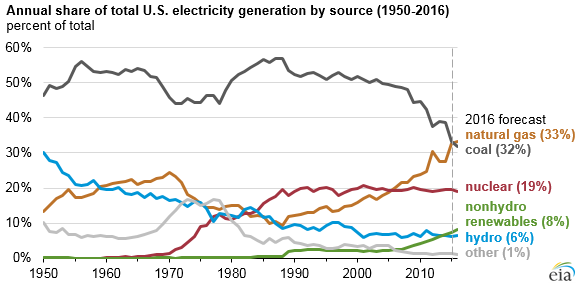
That was once true, but no longer is . "Coal-fired electricity generators accounted for 25% of operating electricity generating capacity in the United States and generated about 30% of U.S. electricity in 2016." - https://www.eia.gov/electricit... . If you look at this graph you can see that coal has been replaced by natural gas and non-hydro renewables. Since the renewables are only getting cheaper as the technology improves, there is no reason to suspect that their trend will not continue to accelerate upwards.
-
Re:Total regulatory impact 2-3 percent
Coal accounts for over 40% of electric generation in the US
That was once true, but no longer is . "Coal-fired electricity generators accounted for 25% of operating electricity generating capacity in the United States and generated about 30% of U.S. electricity in 2016." - https://www.eia.gov/electricit... . If you look at this graph you can see that coal has been replaced by natural gas and non-hydro renewables. Since the renewables are only getting cheaper as the technology improves, there is no reason to suspect that their trend will not continue to accelerate upwards.
-
Re:Total regulatory impact 2-3 percent
Coal accounts for over 40% of electric generation in the US
That was once true, but no longer is . "Coal-fired electricity generators accounted for 25% of operating electricity generating capacity in the United States and generated about 30% of U.S. electricity in 2016." - https://www.eia.gov/electricit... . If you look at this graph you can see that coal has been replaced by natural gas and non-hydro renewables. Since the renewables are only getting cheaper as the technology improves, there is no reason to suspect that their trend will not continue to accelerate upwards.
-
data not opinions
https://www.eia.gov/todayinene...
is one take that is not out of line with most I've seen. Almost all projected growth in CO2 emissions to 2040 is China and India.
-
Re:How fucking dumb can a human be?
Oh, nukes are about 60% capacity
You have nuclear's capacity factor way wrong. According to this report, these are the average capacity factors in the US:
Nuclear–90.3%
Coal–63.8%
Natural Gas Plant–42.5%
Hydroelectric–39.8%
Renewables (Wind/Solar/Biomass)–33.9%
Oil–7.8%If you have different data that shows otherwise, please provide it.
But, unlike nukes, renewables peak when demand is highest
Nope, hydro is the only major renewable that peaks when demand is highest, and that's just because it's dispatchable. Solar peaks earlier in the day than the peak demand and wind has random peaks.
-
Re:Define the TV!
Wowzers, you talked to 5,600 people, out of 320,000,000+ in this country.
You link to EIA info that shows a +4% increase in one-two TV owners.
5000+ is a perfectly fine sample size providing it's a properly randomized sample. Of course it's never a properly randomized sample when it comes to household surveys.
-
Define the TV!
Wowzers, you talked to 5,600 people, out of 320,000,000+ in this country.
You link to EIA info that shows a +4% increase in one-two TV owners.
-
Re:first
From this site, it looks like it would be ~1.7-1.8 times worse if powered by coal (2.07-2.17 #/kWh compared to 1.22 for natural gas).
On a related note, doing the math from the Tesla-provided specs, the car should be using about half the energy/km as stated in the article, where the numbers come from the "United Nations Economic Commission for Europe R101." Sounds like someone's metrics for mileage are not terribly accurate (not picking sides, just noting). -
Re:first
According to this it looks like the vast majority comes from hydro, with nuclear and non-hydro renewables about tied (the nuclear energy being the Columbia Nuclear Generating Station that is only a couple miles from Hanford), with natural gas and coal bringing up the rear, also about tied.
Running electric buses in Seattle, a place that has had electric "bendy" buses using overhead catenary wire for decades, makes a whole lot of sense.
-
Re:But let's dig more coal to burn, right?
Which is why even through most of US power is made by coal we don't have nation wide air quality issues.
That's 2 lies on one thread. Do you have any fucking relationship with reality?
https://www.eia.gov/tools/faqs... -
Re:Looks like "cheap nuclear" is a bit more expens
Let's do a cost comparison as you suggest. Here's a graph of nuclear power generation over the last 45 years. Generation has been about 2300 TWh per year for the last 20 years. The 25 years before that ramped up roughly as a triangle, so call it 2200/2 = 1100 TWh per year average.
This gives us a total of 73,500 TWh generated by nuclear power over the last 45 years. 20*2300 + 25*(2200/2) = 73500.
Using a global average electricity price of $0.20 per kWh, this is $14.7 trillion dollars worth of electricity generated by nuclear over the last 45 years.
Chernoby cleanup costs (current and future) are estimated to total $235 billion, Fukushima is estimated to be around $200 billion. Three Mile Island was about $1 billion. These are the only major commercial nuclear accidents in history, and their total cost is estimated to be $436 billion.
$436 billion / $14.7 trillion = 0.02966. Or about 3%.
So the cleanup costs for nuclear accidents is about 3% of the price of the electricity nuclear generates. Or 0.6 cents per kWh. This is so "excessively more expensive" that it would cost the average American home less than $8/year. (Average American home uses 10,812 kWh/yr * $0.12/kWh average electricity price * 20% of electricity produced by nuclear * 3% cleanup cost = $7.78/yr.)
Insurers refuse to cover nuclear because of how statistics work. The more incidents there are, the narrower the bell curve and the more confident you can be about predicting how many accidents will happen. A 10d50 will be much more likely to yield a result near 55 than a 2d50 is to yield a result near 51. Consequently, even though their long-term mean is almost the same, a bookie will give you better odds on the 10d50 because it's more predictable and thus harder for them to lose money on it.
Nuclear plants generate massive amounts of power. You need about 10 coal plants to equal a single nuclear plant. Several thousand wind turbines. Consequently you need much fewer nuclear plants to meet your energy needs compared to these other power sources. So even though statistically nuclear plants are safer than other power sources (mean accident rate is lower), their small number means there's larger uncertainty about how many accidents will happen. Insurers compensate for this by erring on the safe side (for them) and charging much higher rates. e.g. If there are 100 nuclear plants and the mean says 1 will suffer an accident in 30 years, the insurer may err on the safe side and charge a premium based on, say, 2 or 3 accidents, just in case they get a bad die roll. Whereas if there are 1000 coal plants and the mean says 10 will suffer an accident in 30 years, the insurer can be much more confident that even if they get a bad die roll, they can charge a premium assuming only 15 accidents and still make money. -
Re: Well, once the panels are installed
No sources for your costs?
First, solar panels are under $0.80/watt, so let's call it 5 kW for $5k, and average 4.92 solar hours per day in New Orleans (1795 productive hrs/year), typical 80% inverter efficiency, so 215.6 MWh over 30 years.
Second, a short ton of coal costs on average $45.66 delivered, and generates 1,927 kWh per ton, so $5k will get you 109.5 tons and 211 MWh.
Third, your whole premise of comparison is bogus, because it doesn't include any supporting costs: installation + inverter for the solar, and the entire cost of the power plant for coal, not to mention all the mining and transport infrastructure investment, which makes a pretty dramatic difference to final costs. A more reasonable comparison would be the Lifetime Levelised Cost of Energy of solar PV vs coal - and coal does pretty poorly there.
-
Re: Well, once the panels are installed
No sources for your costs?
First, solar panels are under $0.80/watt, so let's call it 5 kW for $5k, and average 4.92 solar hours per day in New Orleans (1795 productive hrs/year), typical 80% inverter efficiency, so 215.6 MWh over 30 years.
Second, a short ton of coal costs on average $45.66 delivered, and generates 1,927 kWh per ton, so $5k will get you 109.5 tons and 211 MWh.
Third, your whole premise of comparison is bogus, because it doesn't include any supporting costs: installation + inverter for the solar, and the entire cost of the power plant for coal, not to mention all the mining and transport infrastructure investment, which makes a pretty dramatic difference to final costs. A more reasonable comparison would be the Lifetime Levelised Cost of Energy of solar PV vs coal - and coal does pretty poorly there.
-
Re: Well, once the panels are installed
No sources for your costs?
First, solar panels are under $0.80/watt, so let's call it 5 kW for $5k, and average 4.92 solar hours per day in New Orleans (1795 productive hrs/year), typical 80% inverter efficiency, so 215.6 MWh over 30 years.
Second, a short ton of coal costs on average $45.66 delivered, and generates 1,927 kWh per ton, so $5k will get you 109.5 tons and 211 MWh.
Third, your whole premise of comparison is bogus, because it doesn't include any supporting costs: installation + inverter for the solar, and the entire cost of the power plant for coal, not to mention all the mining and transport infrastructure investment, which makes a pretty dramatic difference to final costs. A more reasonable comparison would be the Lifetime Levelised Cost of Energy of solar PV vs coal - and coal does pretty poorly there.
-
Re:Subsidizing dirty energy
"Alternative energy is always better so we should shut down everything else right now"
No, subsidizing dirty sources of energy instead of investing in clean ones is idiotic and short sighted.
Investing in "dirty" sources of energy instead of subsidizing "clean" ones is idiotic and short sighted.
One man's subsidy is usually another man's investment. When you look at subsidies per kWh output, solar and wind exceed "dirty coal" by orders of magnitude. Solar receives 4.5 times the Federal subsidies as coal and we're getting 55 times more energy from coal tha solar, meaning we're spending over 200 times as much subisidizing solar as coal, per kWh.
-
Re: Well, once the panels are installed
While I agree with you about the long term goal, I think the length of that term is highly skewed to try to favor solar and wind and others. The reality is that the US has over 250 years of proven fossil fuels (not including coal) reserves within the US, at current usage rates (just the Green River formation contains approximately 1.5 trillion barrels of oil, and we consume about 19.4 million barrels a day. The math says that's 211 years right there). Yes, we would not need to import a single drop of oil or single cubic meter of gas for the next 280 years if we so chose.
We have the time runway to do it right, we do not have to rush headlong into a wrong solution. Targeted solar works well for some places, but we would be much better off as a species and nation to pursue fusion with most of the money and jobs being spent on solar and wind. Yes, it will take a few decades - maybe a century - to achieve, but the benefits are vastly superior to either solar or wind.
-
Re: Well, once the panels are installed
$5K of coal is in the timezone of 725MW-hr
Since you haven't provided any links to back your data, I have to ask: is that energy value just a conversion of the raw BTUs, or into electricity delivered to end users. It's a really important difference, since most coal plants are only 25-35% efficient in creating electricity from raw heat. If you are quoting the raw energy content as heat, then I'd argue you need to discount it by a factor of 3-4x, since most coal is burned to make electricity, and PV creates electricity directly.
Here's another approach: the wholesale price for electricity is, depending on the region, something like $25-50/MWh [source]. Unfortunately, the breakdown doesn't tell us the cost for each source (coal, nuke, gas, etc.), but let's argue that it's on the low end: $25/MWh. That captures the cost not only of the fuel, but also the operating costs of the plant, profit, paying off the loans to build the plant, etc. On the other hand, a large pile of coal is pretty useless for generating electricity without all the rest of those costs, so I'd say it's fair to include them.
At $25/MWh, a $5k purchase would get you 200 MWh of electricity, which makes PV look much more favorable. -
Re: Well, once the panels are installed
Oh hell why not
https://www.eia.gov/outlooks/a...
Without tax subsidies that expensive solar plant will not pay off against the coal plant. What's more that's from the Obama EIA which was trying to kill off the coal industry.
Hey next time how about doing a little background research for yourself.
-
Coal is a poor option
The U.S. has the largest coal reserves on the planet it's our cheapest and most abundant energy source.
"Most abundant energy source"? Nope. Solar energy is far more abundant and will still be here even if we (foolishly) burn every ounce of coal from the ground. The earth receives more energy in one hour from the sun than all of humanity uses in an entire year. "Cheapest"? Wrong again. Currently natural gas is cheaper in many cases at today's prices. So is on-shore wind, geothermal, and hydro. Nuclear is about equal to coal. Solar PV is competitive even without subsidies and falling fast. If you take into account the full cost of coal (including pollution) then it isn't even close to the cheapest option for power generation. Coal only seems cheap because we don't require coal plants to mitigate the full cost of the pollution (including CO2) that they produce. Yes the US has a lot of coal but the best thing we could possibly do with that is to leave most of it in the ground.
If anything we should be building more coal plants instead of trying to drop our economic growth to zero and surrender comparative advantage.
Why would we do such an idiotic thing? Natural gas plants currently make a lot more economic sense and while not clean are certainly cleaner than coal plants. Perhaps you don't care to actually be able to breathe the air? If you want to see the effects of your suggestion in real life I encourage you to go travel to China and see the results of abundant coal power. Never mind the fact that burning all that sequestered carbon is without question going to wreak havoc with the global climate. What, you thought that putting billions of tons of carbon that is currently buried into the atmosphere would come without consequence? That's a foolish and dangerous thing to believe.
-
Re: Well, once the panels are installed
it's our cheapest and most abundant energy source
Sorry. Not even if you ignore coal's hundreds of billions annually in externalised costs.
It's not even the most abundant. There are roughly 2.4x10^19 BTUs of known coal reserves. We get that much energy from the sun every 8.25 days - just on the land surface alone, not even counting oceans.
-
Re: Well, once the panels are installed
As I said last time, this is not a positive stat for solar. Coal accounts for 33% of U.S. electricity production, vs 0.6% for solar. So if solar employs 2x as many people as coal, that means solar is 2 * 33% / 0.6% = 110x more labor-intensive than coal per kWh of electricity generated. If anything, this is a great argument against solar power. They need to get those labor figures way, way, way down (two orders of magnitude) if they want solar to become an economically viable (without subsidies) source of electricity.
-
So normalized to the percentage of source ...
So the 2015 numbers are 33% coal and 0.6% solar. Or in other words, about 50 times as much coal power nationwide. Normalizing it that way, the solar industry takes 100 times as many workers to produce the same every as coal.
Now, you can argue that solar is a nascent industry and that a lot of the labor is in the build-out. But for now, this is a pretty silly (and expensive) sideshow.
-
Re: Wow!
China has already hit its peak coal consumption and it's now in decline.
https://www.theguardian.com/en...
https://www.carbonbrief.org/an...
https://www.eia.gov/conference... -
Re:Thanks, Obama
Power is in Watts, energy is in Watt-hours.
In 2015, coal was used for about 33% of the 4 trillion kilowatthours of electricity generated in the United States.
So that translates to roughly 4 billion MWhs a year, or 4 million GigaWatt-hours, or 4 thousand TeraWatt-hours.
-
WTF!!!!
From the report it says that it takes 337,807 (page 29) jobs in solar to produce 1% of the power? How is that good?
Using the report and then comparing it to the latest energy source report here: http://www.eia.gov/electricity...
I got the following table of GW produced per employee:
Coal - 13.0
Natural gas - 24.6
Nuclear - 10.8
Hydro - 4.3
Solar - 0.09 (Are you kidding me)
Wind - 2.7
This is good news? This makes solar more attractive? -
So labor intensive is a good thing ?
Why not hook people up to bicycle generators then ?
Solar is
https://www.eia.gov/tools/faqs...extrapolating out, to get all our power from solar it would take half the 100 million people in the labor force
-
Re:Contrast this with the incoming administration
Ok. Good to know. Either way, you are paying that much because your province is choosing to do so with complete disregard for the market. It's a good way to encourage a new industry and FIT programs like these may be partly or largely responsible for the dramatic drop in cost over the last decade. Now that the technology is competitive without the FIT it no longer makes sense to keep the program.
The best way to end fossil fuel use is with a market driven program such as a revenue neutral carbon tax. This allows the market to decide the optimal solution and lets you drop taxes on activities that you ought to be encouraging such as earning and spending. It looks like instead the province has opted to keep the FIT, add cap and trade, and keep the revenue. Not the best. Hopefully Michael Chong will run for Premier and kick the libs to the curb.
-
Re:Contrast this with the incoming administration
Saudi Arabia is modernizing their energy sector. Three years ago, Saudi Arabia announced a goal of building, by 2032, 41 gigawatts of solar capacity, slightly more than the world leader, Germany, has today. According to one estimate, that would be enough to meet about 20 percent of the kingdom’s projected electricity needs
Meanwhile USA is investing in
-
Re:Tables are turning
Actually, a fine of $10 per MWh almost exactly eliminates the disparity in Federal subsidies for renewables (excluding biomass aka burning wood) vs fossil fuels. (Table ES2 divided by Table ES3 to get subsidy dollars per BTU, divide by 293071 to convert trillion BTUs to MWh.)
Coal = $1085 million subsidy / 5923 MWh = $0.18 per MWh
Gas = $2346 million subsidy / 8309 MWh = $0.28 per MWh
Nuclear = $1600 million subsidy / 2379 MWh = $0.70 per MWh
Biomass = $629 million subsidy / 1317 MWh = $0.48 per MWh
Hydro = $395 million subsidy / 756 MWh = $0.52 per MWh
Geothermal = $345 million subsidy / 64.5 MWh = $5.35 per MWh
Wind = $5936 million subsidy / 454 MWh = $13.07 per MWh
Solar = $5328 million subsidy / 83.8 MWh = $65.57 per MWh
Total of above four = $12004 million subsidy / 1358 MWh = $8.84 per MWh
So it's not really an unapologetic subsidy for the coal industry. It's a leveling of the playing field. -
Re:Frank Yu doesn't know what he's talking about.
There will be a shortage if we try to replace coal, nuclear, and natural gas with wind and solar. I have on my desk a report from Morgan Stanley claiming that it would take 10 billion tons of steel and concrete annually to replace coal power.
By when? Next month? Obvious bullshit number is obvious bullshit. Nobody has suggested that replacing coal, nuclear, and natural gas with wind and solar is going to happen overnight. Not even quickly. Coal, nuclear, and natural gas represent large capital investments with long amortization schedules. The power companies will only shut one off short of its design lifespan in extremis, and there has been no spike in fuel cost for any of them. Quite the opposite. Gas is dirt cheap now, but most utility companies have set fees agreed with state PUCs when gas was expensive, which have not been revisited, so they're making money hand over fist on gas power generation.
Imagine that I have a dozen nuclear power plants all humming along at about 80% capacity. Now imagine I have one of those once in a century events that knocks out one of those power plants.
Why imagine, when we have actual numbers? Average capacity factor of nuclear power plants in the US for 2015 was 91.9%, the highest it has ever been. If you follow the link, you'll see that at least the top 10 plants are actually operating at capacity factors in excess of 100% in order to achieve that average. Now consider that, with the shutdown of Vermont Yankee, there are only 99 total nuclear plants in the US. Having not just 10 plants, but 10% of the plants running at over 100% capacity, where they are by definition eating into their safety margin, doesn't seem all that safe, and it means that quite a few of those 99 plants are running at much less than 91.9% capacity factor.
Of those 99 plants, the majority of them are of such an age and design that they're incapable of being throttled, so when they're operating, they're operating at 100% or above. That means out of the 365 days in a year, the average nuclear power plant was offline for 30 of those days, and for every year but 2015, it has been worse than that. So there is no margin to "crank up" to accommodate a plant going offline.
In short, nuclear power plants are just as dependent on the existence of the full grid as wind and photovoltaics are.
This schedule should mean that with a dozen plants and an expected lifespan of 50 years I can expect a new plant to come online about every four years.
Design lifespans were universally 30 years and between 1977 and 2013, there were no new plants started. The Obama administration approved construction of 4 new plants. The US will be transitioning from nuclear to solar and wind by default, simply because those plants are not being replaced fast enough. But it won't happen so fast that Morgan Stanley's nonsense number is even remotely relevant.
-
Re:Conservatives need to realize cheating occurs
Buy a plug-in electric car, SUV, or truck (they sell them for $9000 in China today and in First World nations like Canada) and stick it to the man.
And where do you think that electricity comes from? The vast majority of it is from fossil fuel electric generation plants. Until nuclear takes over fossil fuels in power generation any arguments about the merits of electric vehicles is moot, except maybe, from an economic standpoint, electricity generated from coal plants.
As a side note about your comment about imported Russian gasoline, it appears most of the fossil fuels in the United States is actually imported from Canada.
-
Re:Conservatives need to realize cheating occurs
Buy a plug-in electric car, SUV, or truck (they sell them for $9000 in China today and in First World nations like Canada) and stick it to the man.
And where do you think that electricity comes from? The vast majority of it is from fossil fuel electric generation plants. Until nuclear takes over fossil fuels in power generation any arguments about the merits of electric vehicles is moot, except maybe, from an economic standpoint, electricity generated from coal plants.
As a side note about your comment about imported Russian gasoline, it appears most of the fossil fuels in the United States is actually imported from Canada.
-
Re:But .. but but but. Bullshit.
What is your definition of "highly subsidized"?
If you look at the numbers compiled by the US government for direct subsidies, it is not even close. Natural gas is subsidized at 62 million and Solar is 2.9 billion for 2013. If you include other subsidies such as tax subsidies it is much closer, but still in solar's favor. Natural gas is subsidized at 2.3 billion and Solar is 5.3 billion for 2013. If you consider that natural gas produced was 28,353 Million BTUs versus Solar of 218 Million BTUs, or 130 times as much, your subsidy per BTU is enormous for Solar versus Natural Gas.
https://www.eia.gov/analysis/r...
There is a great deal of debate on what the costs to roads is and how much the industry pays versus the state, but if we take Pendot's 2010 estimate (from this link http://www.naturalgasintel.com...) it said the state was paying 30 to 35 million more than the industry. Pennsylvania was the 2nd biggest producer in natural gas in 2013, producing 12% of the US's natural gas. If you extrapolate that number for the US you get 291 million. If you add that to the 2.3 billion number above, it makes a very little dent in the comparison.
So using government numbers, comparing Solar versus Natural Gas subsidies, solar is at least 130 times more subsidized per BTU than natural gas. -
It's called transmission losses. 5% over 250 miles
> Long distance power transmission works just fine. I don't see any reason why you can't use solar power from the other side of the world
There are five regional power grids in the US, and 7,658 power plants. So most people live within 250 miles of the power plants that provide their power. Over that 250 mile distance, 5% of the power (on average) is lost in the line (source: https://www.eia.gov/tools/faqs... ).
If you want to get electricity from "the other side of the world", that's 12,000 miles, so you lose 48 times as much. 5% loss over 250 miles times 48 times as far = you lose basically all of the power. Practically none makes it to the user.
-
Re:yes, and that's why...
Based on the facts of the system. Fossil fuels are subsidized at rates that no other industry achieves. Oil alone nets close to 5 billion dollars
Sorry, but your math is wonky. $5 billion is a negligible amount of subsidies relative to the amount of energy derived from fossil fuels. In fact, renewables are subsidized at rates about 10x that of renewables.
You can find the numbers here. You need to set that in relationship to the amount of energy delivered by these sources; see here.
-
Re:Bad data: local versus global
And the population in those isolated communities, relative to that of the entire world, is? Yes - local power generation can be cheaper for some populations, but to take those tiny corner cases and extrapolate them over the entire world is incorrect. And you can find the LCOE table right now, you'll find that solar can get competitive with NEW generation coming on-line right now, but still loses to natural gas pretty significantly. Note this is for newly planned plants, and does not include hydro (which cleans everyone's clock).
-
Re:Peak 15% of Denmark's energy from wind, 48% coa
You're confused; you seem to think that wind turbines are designed to bear and generate from the maximum force winds that they experience. They don't. At high wind speeds they're feathered and/or braked. The nameplate capacity is met at about 25mph for a typical turbine. At very high speeds (for example, over 55mph) they outright shut off and don't generate anything, but between that range they generate at their nameplate capacity. At under the base speed (for example, below 25mph) they produce less - but not according to a cubic curve, but slightly steeper than that, as there's a base-level constant drag, which keeps them from turning at very low windspeeds. It's also important to realize that wind turbines experience wind at altitude, not surface winds; they're higher and steadier.
Average capacity factor for wind in the US is over 30% every year. You really do get a large chunk of the nameplate in terms of actual generation.
-
Re:Even without environmental concerns
Petroleum and wind/solar solve two different problems and have nothing to do with one another. Wind and solar will replace nature gas and coal, not petroleum.
What you really want is advances in batteries so that electric cars can take off. Mind you the only thing really keeping them back is mindset. They are perfectly fine for everyday driving for the majority of people. When people want to go on vacation or a longer trip which doesn't happen that often then for the shorter term they should be able to rent a car that runs on gas. For some jobs that require them to be on the road all day then an electric car isn't an option right now.
And as for where the cars are going to get the electricity wind and solar can help. Again the problem is a social one and not technological one. There are some countries in Europe that are getting 30% to 40% of their needs through renewables. Scotland gets 33% of their electricity from renewables. From the US EIA the US gets just 13% of its electricity from renewables in 2015. If the US went up to 33% like Scotland then coal use could be cut in half (and natural gas would probably finish the rest off). The problem is people don't want to see wind turbines that are a couple of miles offshore. Or complain that they will impact whale migration yet oil rigs won't somehow.
-
Re:Total Capacity
Gas plant capacity isn't high.
In 2015 the US had 503963.9 MW of gas generation capacity - http://www.eia.gov/electricity...
Which supplied 1,333,482 thousand MWh of electricity - http://www.eia.gov/electricity...
For a capacity factor of 30.19%.
TL;DR: We have a shit-ton of gas peaker plants that sit around idle most of the time.