Slashdot Mirror
Domain: esa.int
Stories and comments across the archive that link to esa.int.
Comments · 950
-
ah,
found it: http://esamultimedia.esa.int/docs/gsp/Experimenta
l _Detection.pdf both seem to be the case, and/or not adressed - the accelerometers do have metal on them (it does mention wires), and the setup is in a faradey cage (which does not eliminate the Earths magnetic field..um..off course nothing would anyway) -
They're holding out...
I think they've discovered more than they're letting on, as you can clearly see in this picture, they have to hold the testing apparatus down with sandbags to keep the antigravity from floating it away. Don't forget to pay your gravity bill.
-
Re:Not quite.
The claims are disputed and have not been verified by similar experiments.
And your sources ?Similar experiment that disputes results of this one. http://esamultimedia.esa.int/docs/gsp/Experimenta
You should read the article you are citing. That is the exact experiment, that mentioned in TFA - Martin Tajmar et al experiment, which show anomalous gravimagnetic effect in the superconductive niobium ring which can not be explained by General Relativity, but can be explained by analogy between gravitons and photons.l _Detection.pdf -
Not quite.
The claims are disputed and have not been verified by similar experiments.
The paper was released March 9, if it were as important as it would seem at first glance it would have made a huge impact in the physics community. It hasn't.
Nasa paper on alternate propulsion
Similar experiment that disputes results of this one.
Not saying it's not a find of some kind, but you might want to hold off on purchasing that hoverboard.
-
Somewhere on Mars...
...there are robots running wild, overstaying their welcome.
But seriously, they should send the next lander to the highest elevation on Olympus Mons and then take some panoramic shots and see what is in the Caldera. You could get a shot from 22km elevation from Mars' surface, I think this would be very interesting. -
Re:It's not that simple.No need to launch a 100' mirror. The advances in optical interferometery allow the same resolution to be achieved with two much smaller mirrors 100' apart. Obviously you need a lot more than 2 to achieve the same sensitivity as a single 100' mirror.
Such an instrument is already being planned by ESA, called darwin
-
Re:So what do we do about this?
ESA has a good article about the feasibility of deflection located here: http://www.esa.int/gsp/ACT/doc/ACT-RPR-4100-DI-CO
L ORADO2005-OnTheDeflectionOfPotentiallyHazardousObj ects.pdf
I like the notion of impact deflection personally. Flying a rocket full of cement into an asteroid would make great news footage. -
Re:Consequences.
"1) Note every mission is labeled 'under review'.
Well, yah. They're not sure when they'll get the Shuttle back up and running. Thus, the date (y'know, that little header at the top) is under review.
"2) The ISS is not going to be completed. It costs too much for too little science."
Disagree. There's plenty of microgravity experiments which have been waiting for room on the space shuttle.
"ISS costs are not sustainable. Its going to be abandoned."
First, are you talking about building costs or support costs? There are many components of ISS which have already been built and are merely waiting for the Shuttle to return to flight. There's no real gain for abandoning those components already built.
Support costs will probably be considerably less once you're not depending on the Shuttle for supplies. Right now, the Shuttle is mainly being used to transport ISS components and extra people to install them. Don't get me wrong, I agree that the Shuttle is an incredible waste of money to supply ISS. Some Senator remarked that the Shuttle is like an SUV. Yes, it can do anything. But it's pretty wasteful to use it to haul groceries.
"3) Even if they wanted to complete the ISS, the payloads could be delivered with rockets."
Sure they could. But who's gonna attach them?
Keep in mind, when the Shuttle brings some big part up to ISS, who do you think actually installs the thing? Astronauts who have actually trained in simulators to do the job! So you'd also have to send up a few people to do the work. Or do you want to trust your multi-million dollar orbital habitat will be correctly installed by two guys who read the instruction manual?
"On the other hand, for some reason, garbage disposal seems to be a big deal, and the only thing the garbage scow Endeavor and Intrepid seem to be important for the ISS."
NASA likes to see the garbage in order to study it. For example, part of "garbage" of a Shuttle mission are parts that have failed. NASA tries to figure out why this happened so that they can make better parts. I suppose they can also test the garbage for radiation and other environmental factors and compare that with what the instruments told them. Remember that ISS is still new hardware under construction and NASA wants all the data it can get from wherever it can get it.
So, yes, when the Shuttle comes back to Earth, it carries trash for study. By the way, the Shuttle is the only vehicle that can return garbage for study. You can't fit a hell of a lot in a Soyuz.
There've been more than a few times, though, that the astronauts dump the trash into a Progress drone and burn it up in the atmosphere.
"[...] I'm surprised the ISS partners aren't designing payload delivery systems to move the garbage back to Earth."
You seem to be fixated on the garbage. Again, it's only NASA that cares about the garbage. And I'm sure they'll come up with something if they continue to really care about this after the ISS is complete.
Meanwhile, Russia has the Soyuz for manned missions and Progress for supplying the station and dumping trash. Japan's NASDA is developing the HTV for supplying the station and dumping trash. And ESA is developing the ATV for supplying the station and dumping trash. So I think the trash problem is pretty well solved.
And, of course, NASA's CEV will be able to carry astronauts to the station starting in 2014. In fact, supporting ISS is one of the goals for Stage 1 of the CEV. We tend to lose track of that.
So, if anything, Russia gets a four year exclusive for carrying people to ISS. I'm sure they'll be pretty psyched. Maybe they'll have their CEV operating by then.
By the way, to wander back on ta -
My opinion as a physicist
First off, I want to say a few words about dark matter. I think it's kind of irritating when people rant on about how dark matter is ad hoc fudging, etc. etc. Well, "fiddling around with the laws of gravity" isn't any better on that account. The fact of the matter is that all of theoretical physics is creating new models that fit our observations, and both dark matter and MOND fall into that category. The very existence of MOND as a theory shows that it is not easy to distinguish "matter that primarily interacts gravitationally" from "modifications to the laws of gravity". Historically, both "unseen matter" and "modifications to gravity" have been valid solutions to anomalous gravitational behavior (in the cases of Neptune's orbit and the perihelion precession of Mercury, respectively).
As it stands, dark matter models can pass many experimental tests, and they're still the way to bet. That being said, MOND is not a bad idea either. It's not as well supported by dark matter, and it has serious problems with galaxy clusters, but it can still account for a surprising amount of data (for a nonrelativistic theory!). The flaw of non-relativistic has been "corrected" by Bekenstein's TeVeS theory (the one that Zhao and Famaey's work is based on).
Unfortunately, TeVeS appears to be rather ad hoc (even compared to dark matter). Z&F's work does not appear to be much better in this regard. In addition, solar system observations appear to place serious constraints on such MOND-like theories, leading to anomalous non-inverse square forces in the outer solar system (and no, it doesn't seem to be of a form that can be attributed to the Pioneer anomaly, though the jury is still out).
The TeVeS/dark matter debate should be definitively resolved by the Planck mission, which will be capable of resolving the third acoustic peak in the the cosmic microwave background radiation power spectrum. TeVeS and dark matter make very different predictions for the structure of this peak. Of course, if TeVeS fails this test, maybe some other MOND-like theory could be put forward (if the entire class of theories hasn't already been ruled out by other means, such as solar system dynamics, by then). -
I don't get it
I don't get it, why should the ESA care about software piracy, last time I checked they were building rockets, not selling software.
Or are we, by chance, talking about some other, obscure, ESA? -
Re:Quote from TFA:
Dr. Foo: "To prove there is life on a far-off planet would be difficult," Dr Dominik told the BBC News website. "How can we prove there is life on a distant planet when we have problems seeing if there is life on Mars?"
Mr. Bar: Whomever said that hopefully isn't a scientist and/or working on this project.
Indeed. Unfortunately: "Dr Martin Dominik from the University of St Andrews is a co-leader of the PLANET collaboration, one of the microlensing networks used to detect the new planet." Crap.
Frankly, if signs of life on a planet are as scarce as those on Mars, I think it's safe to declare it "dead". If there's no macroscopic life at all, not even a bacterial culture's worth, then it's about as dead as dead can be.
I'm excited about new planets, though, because I'm hoping one of these days they'll run the light through a spectrometer and find unexpected amounts of life-supporting stuff. -
Re:Yes but ...It only works if we find water on the moon and water on mars. Doesn't that mean this plan is science fiction? Or should billions be invested on a maybe?
Clementine indicated that there may be water ice on the moon; however, this was not confirmed by the later impact of Lunar Prospector, so further investigation will be needed. Mars Express indicated that there is very probably water on Mars - in the polar icecaps, and in subsurface permafrost.
Before constructing a manned infrastructure that relies on these supplies, we'd need to confirm their availability by dedicated robot probe, but there's certainly good reason to think that the water is there.
-
EU launches first Galileo navigation satellite.
and no, they are not "geostationary" orbits. Just so ya know
-
Mars debate oddly constrainedA couple of observation related to this running mars debate that bother me.
- I have never seen NASA publications publicly reference the excellent work and results produced by ESA. I follow this discussion with considerable curiosity and have noticed this for a while now. NASA sources and publications seem to debate the topics as if other scientific sources of information were unavailable? This article subtly discusses the debate as if the theories had to be based solely on Mars Rover data, which is bogus. Take a look at the excellent info published openly here:
http://www.esa.int/SPECIALS/Mars_Express/index.ht
m l - The whole debate about standing surface water seems slightly off focus. ESA has lots of evidence now for subsurface water and even standing surface water ice. Lots of life on earth exists in the soil and subsurface, where life can survive hostile surface changes, which is true even on Earth. So thats where we should look... duh. Free standing but transient lakes of meltwater, seem like poor venues for life, given the mars atmosphere and general geological data. IANA Geologist or xenobiologist, but who needs to be, to see that one coming? The NASA spin doctors know that the Mars rovers run around on the surface, so thats where they think the scientific debate must be?
<Swift Wild Ass Speculation>
Nasa Mars articles are subtly and covertly constrained by NASA media censors because of the political and funding sensitivites ?
</SWAS>
If so, thats really bad, and should be stopped.If they are not constrained, then the scientists themselves give the perception of ignoring ESA data or references, which I find impossible to believe.
Are my observations at fault? Is there a pragmatic and reasonable explanation why this debate seems so oddly limited in scope and reference to ESA etc?
- I have never seen NASA publications publicly reference the excellent work and results produced by ESA. I follow this discussion with considerable curiosity and have noticed this for a while now. NASA sources and publications seem to debate the topics as if other scientific sources of information were unavailable? This article subtly discusses the debate as if the theories had to be based solely on Mars Rover data, which is bogus. Take a look at the excellent info published openly here:
http://www.esa.int/SPECIALS/Mars_Express/index.ht
-
Re:Why??The lander's weakest point was the descent system. 3 months before the delivery date they discovered that the parachutes were too small and had to chop more vital kilos off the science mission. They were already aiming for one of the lowest parts of Mars, i.e. longest path and highest atmospheric density. Before Beagle landed, a colleague reported that in a lecture the previous summer, Prof. Pillinger said that the parachute's size wasn't critical as it 'collects air' which helps slow the lander down...
Prof. Pillinger is, understandably, clutching at straws. The science (and academic PR) aspects of Beagle were first class. The engineering (i.e. the expensive bit), was totally underfunded and was eventually overwhelmed. If he can prove that the concept was fine and dandy, but something small went wrong, then he can (with much greater authority) go and ask for money for a new one. However, it's unlikely after ESA's board of inquiry, that Prof. Pillinger will ever be involved at such a senior level again. http://www.esa.int/esaCP/SEMLKAHHZTD_index_0.html
-
Beagle 2 was part of the Mars Express mission
The Beagle 2 lander was part of the very successful European Space Agency (ESA) Mars Express mission.
Mars Express contains 7 different scientific instruments and, amongs other things, it has already:
- discovered aurorae on Mars;
- transmitted back gigabytes of beautiful images with a resolution of up to 2 meters/pixel;
- discovered a huge subsurface water ice lake, with a thickness of 1.8 km and an extension of hundreds of kms;
- collaborated with NASA, receiving data from the Mars rovers and transmitting it back to Earth (yes: they use the same communication protocol!).
-
Beagle 2 was part of the Mars Express mission
The Beagle 2 lander was part of the very successful European Space Agency (ESA) Mars Express mission.
Mars Express contains 7 different scientific instruments and, amongs other things, it has already:
- discovered aurorae on Mars;
- transmitted back gigabytes of beautiful images with a resolution of up to 2 meters/pixel;
- discovered a huge subsurface water ice lake, with a thickness of 1.8 km and an extension of hundreds of kms;
- collaborated with NASA, receiving data from the Mars rovers and transmitting it back to Earth (yes: they use the same communication protocol!).
-
Beagle 2 was part of the Mars Express mission
The Beagle 2 lander was part of the very successful European Space Agency (ESA) Mars Express mission.
Mars Express contains 7 different scientific instruments and, amongs other things, it has already:
- discovered aurorae on Mars;
- transmitted back gigabytes of beautiful images with a resolution of up to 2 meters/pixel;
- discovered a huge subsurface water ice lake, with a thickness of 1.8 km and an extension of hundreds of kms;
- collaborated with NASA, receiving data from the Mars rovers and transmitting it back to Earth (yes: they use the same communication protocol!).
-
Beagle 2 was part of the Mars Express mission
The Beagle 2 lander was part of the very successful European Space Agency (ESA) Mars Express mission.
Mars Express contains 7 different scientific instruments and, amongs other things, it has already:
- discovered aurorae on Mars;
- transmitted back gigabytes of beautiful images with a resolution of up to 2 meters/pixel;
- discovered a huge subsurface water ice lake, with a thickness of 1.8 km and an extension of hundreds of kms;
- collaborated with NASA, receiving data from the Mars rovers and transmitting it back to Earth (yes: they use the same communication protocol!).
-
Beagle 2 was part of the Mars Express mission
The Beagle 2 lander was part of the very successful European Space Agency (ESA) Mars Express mission.
Mars Express contains 7 different scientific instruments and, amongs other things, it has already:
- discovered aurorae on Mars;
- transmitted back gigabytes of beautiful images with a resolution of up to 2 meters/pixel;
- discovered a huge subsurface water ice lake, with a thickness of 1.8 km and an extension of hundreds of kms;
- collaborated with NASA, receiving data from the Mars rovers and transmitting it back to Earth (yes: they use the same communication protocol!).
-
Beagle 2 was part of the Mars Express mission
The Beagle 2 lander was part of the very successful European Space Agency (ESA) Mars Express mission.
Mars Express contains 7 different scientific instruments and, amongs other things, it has already:
- discovered aurorae on Mars;
- transmitted back gigabytes of beautiful images with a resolution of up to 2 meters/pixel;
- discovered a huge subsurface water ice lake, with a thickness of 1.8 km and an extension of hundreds of kms;
- collaborated with NASA, receiving data from the Mars rovers and transmitting it back to Earth (yes: they use the same communication protocol!).
-
Re:Where's Russia, China, India, et al in all this
In the same way that robots have taken over roles on earth in various industries this is a sensible and more effective method of transporting materials to the ISS. The additional costs of life supporting systems and of course the payload space for humans are surely not warranted for this sort of mission. The ATV is one of a number of projects coming out of Europe although there is admittedly a smaller budget over here for space projects than NASA have!
-
Smart move by ESA?
Russia has had quite a good track record with their space program. The ESA wants control over Russia's program and they can't have it, so they're taking their ball and leaving.
Who can blame ESA? Why should they fund Russian technology development to the detriment of their own?
I'm not sure if this is a bad move or a good move, but the motivations as stated sound really stupid. If you can't control it, don't be involved in it? That doesn't make sense. There's got to be more to this. Does anyone know?
Why is refusing to write a blank check for the Russian stupid? Europe has not been served well by Russian launchers lately. Also, Russia is headed in the wrong direction politically. The risk premium of dealing with Russia is increasing. Europe is highly capable of developing its own advanced space infrastructure. The only question is if it becomes a budget priority. The welfare state is expensive.
-
Re:rtfa> Nothing has been decided.
To further support this, from ESA's website.
"The Clipper Preparatory Programme
...
An in-depth investigation of the content and modalities of such cooperation will be performed in a two-year (2006/2007) Clipper Preparatory Programme, with a view to preparing a decision on a joint development and future operations preparation programme at the Council meeting at Ministerial level in 2008." -
Official news from ESA
From ESA:
For the first time in the history of planetary exploration, the MARSIS radar on board ESA's Mars Express has provided direct information about the deep subsurface of Mars.
First data include buried impact craters, probing of layered deposits at the north pole and hints of the presence of deep underground water-ice.
The subsurface of Mars has been so far unexplored territory. Only glimpses of the Martian depths could be deduced through analysis of impact crater and valley walls, and by drawing cross-sections of the crust deduced from geological mapping of the surface.
With measurements taken only for a few weeks during night-time observations last summer, MARSIS - the Mars Advanced Radar for Subsurface and Ionospheric Sounding - is already changing our perception of the Red Planet, adding to our knowledge the missing 'third' dimension: the Martian interior.
First results reveal an almost circular structure, about 250 km in diameter, shallowly buried under the surface of the northern lowlands of the Chryse Planitia region in the mid-latitudes on Mars. The scientists have interpreted it as a buried basin of impact origin, possibly containing a thick layer of water-ice-rich material.
To draw this first exciting picture of the subsurface, the MARSIS team studied the echoes of the radio waves emitted by the radar, which passed through the surface and then bounced back in the distinctive way that told the 'story' about the layers penetrated.
These echo structures form a distinctive collection that include parabolic arcs and an additional planar reflecting feature parallel to the ground, 160 km long. The parabolic arcs correspond to ring structures that could be interpreted as the rims of one or more buried impact basins. Other echoes show what may be rim-wall 'slump blocks' or 'peak-ring' features.
The planar reflection is consistent with a flat interface that separates the floor of the basin, situated at a depth of about 1.5 to 2.5 km, from a layer of overlying different material. In their analysis of this reflection, scientists do not exclude the intriguing possibility of a low-density, water-ice-rich material at least partially filling the basin.
"The detection of a large buried impact basin suggests that MARSIS data can be used to unveil a population of hidden impact craters in the northern lowlands and elsewhere on the planet," says Jeffrey Plaut, Co-Principal Investigator on MARSIS. "This may force us to reconsider our chronology of the formation and evolution of the surface."
MARSIS also probed the layered deposits that surround the north pole of Mars, in an area between 10 and 40 East longitude. The interior layers and the base of these deposits are poorly exposed. Prior interpretations could only be based on imaging, topographic measurements and other surface techniques.
Two strong and distinct echoes coming from the area correspond to a surface reflection and subsurface interface between two different materials. By analysis of the two echoes, the scientists were able to draw the likely scenario of a nearly pure, cold water-ice layer thicker than 1 km, overlying a deeper layer of basaltic regolith. This conclusion appears to rule out the hypothesis of a melt zone at the base of the northern layered deposits.
To date, the MARSIS team has not observed any convincing evidence for liquid water in the subsurface, but the search has only just begun. "MARSIS is already demonstrating the capability to detect structures and layers in the subsurface of Mars which are not detectable by other sensors, past or present," says Giovanni Picardi, MARSIS Principal Investigator.
"MARSIS holds exciting promise to address, and possibly solve, a number of open questions of major geological significance," he concluded. -
Turn your volume up!
This sounds very interesting!
Click here for an audio interview about the finding. -
Herschel to the rescueLuckily ESA's Herschel is still on track to be launched in 2007. It's a similar but somewhat smaller unit, with "only" a 3.5 meter mirror.
-
Re:And that's why Europe uses Russian technology..
Like one that takes pictures like this?
http://sci.esa.int/science-e-media/img/68/DSC7348A 4ok1.jpg
Peppe -
Re:And that's why Europe uses Russian technology..
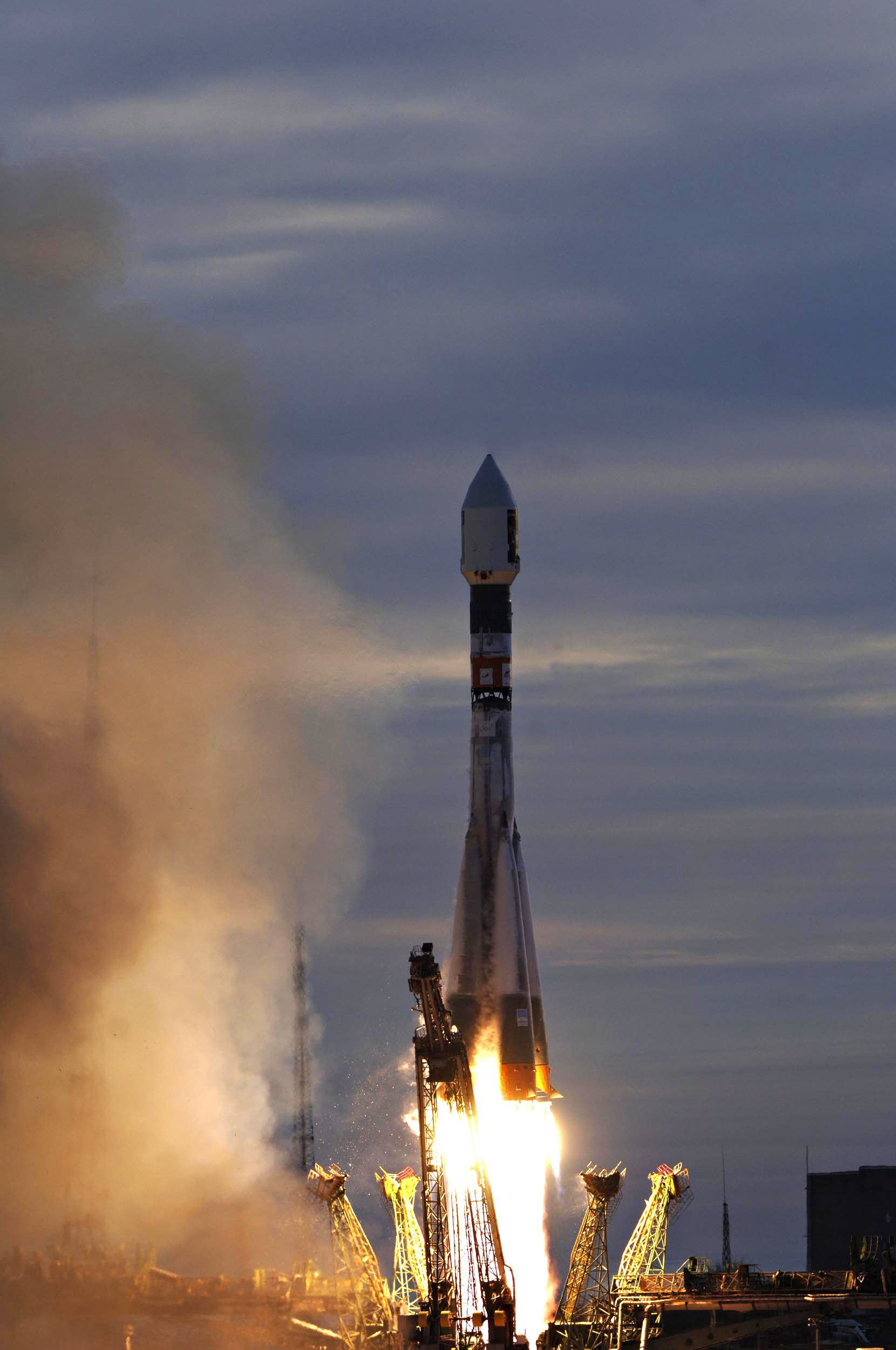
Man, won't someone buy those poor guys at Baikonur a decent camera! What were those shots taken with, a camera phone?
http://esamultimedia.esa.int/images/venusexpress/v ex_launch_H.jpg -
Re:Commercial space race
But it _will_ do images in visible range
Not according to ESA's own page: http://sci.esa.int/science-e/www/object/index.cfm? fobjectid=31361, where it says: Wavelength - Infrared: 60 to 670 microns. That's not visible range. -
And that's why Europe uses Russian technology...
Your point is well taken - and that's why Europe has chosen to use Russian technology:
ESA has entered into a 340 million euro joint venture with the Russian Federal Space Agency over the use of the Soyuz launcher. Under the agreement, the Russian agency will manufacture Soyuz rocket parts for ESA, which will then be shipped to French Guiana for assembly. ESA benefits because it gains a medium payloads launcher, complementing its fleet while saving on development costs. In addition, the Soyuz rocket -- which has been the Russian's space launch workhorse for some 40 years -- is proven technology with a good safety record, which ESA might be happy to use for launching humans into space.
This cooperation is well on it's way - this week they used a Soyuz vehicle to launch the successfull ESA mission "Venus Express". -
And that's why Europe uses Russian technology...
Your point is well taken - and that's why Europe has chosen to use Russian technology:
ESA has entered into a 340 million euro joint venture with the Russian Federal Space Agency over the use of the Soyuz launcher. Under the agreement, the Russian agency will manufacture Soyuz rocket parts for ESA, which will then be shipped to French Guiana for assembly. ESA benefits because it gains a medium payloads launcher, complementing its fleet while saving on development costs. In addition, the Soyuz rocket -- which has been the Russian's space launch workhorse for some 40 years -- is proven technology with a good safety record, which ESA might be happy to use for launching humans into space.
This cooperation is well on it's way - this week they used a Soyuz vehicle to launch the successfull ESA mission "Venus Express". -
Commercial space race
A new Ariane and the Galileo GPS well under way, it seems Europe is into the space race in a very commercial way.
-
Microscopic image of the lichen after the flight
Electron microscopic image of the lichen after the flight.
-
Info from the ESA site
-
Watch the launch!
37 megs, quicktime movie.
The ESA's Venus express portal
And a load of artist impressions, photos and cgi videos are on ESA's site here
A great day for the ESA, the data gathered from this and in comparison to that from the Mars Express is really going to give some good information on planetary warming and cooling. -
Watch the launch!
37 megs, quicktime movie.
The ESA's Venus express portal
And a load of artist impressions, photos and cgi videos are on ESA's site here
A great day for the ESA, the data gathered from this and in comparison to that from the Mars Express is really going to give some good information on planetary warming and cooling. -
Soyuz being used by the European Space Agency now
It's not really news at all - I mean the European Space Agency has understood the value of Russian engineering done decades ago and simply decided that it was the better choice over spending vast sums of money on try-and-fail schemes. Even more interesting is: "In 2007 a Soyuz launcher will take off from Europe's Spaceport in French Guiana (South America). This will be an historic event as it will be the first time that a Soyuz launcher lifts off from a spaceport other than Baikonur or Plesetsk. It will also be a milestone in the strategic cooperation between Europe and Russia in the launcher's sector."
-
Re:Uh...
European Space Administration (name right?)
Wrong. European Space Agency. Makes more sense if you think about it.
http://www.esa.int/esaCP/GGG4SXG3AEC_index_0.html -
The real reason behind the change: Money
Or more specifically, a dramatic change in the distribution of money in the UK/European planetary community.
Britain remains the only country in the world to have developed a working space program and then cancel it. The reason was because of the mantra that has been argued ever since: it is better to develop science-based programs than 'waste' money on putting people in space. If science is your driver, robot missions are much better value for money, which is why you get huge UK involvement in, for example, Cassini, while there remains only one official UK astronaut.
But coming soon is a huge change in the way money is going to be fed into the European space program. It's called Aurora, and it basically says Europe should do what Bush has said the US should do: people going to the Moon, then Mars, and all that entails (tellingly, it said this before Bush).
Many countries in Europe are very positive about a human spaceflight mission, but the current UK position is that we intend to put in money only for the robot mission part of getting to Mars. In the long run, however, joining the club all the way and signing up for the aim to get people to Mars, would allow us to dip into a much larger pot of money. Especially if the scientists convince the politians that they should put up the money for political reasons.
There will be a lower percentage of science for the money, but the gamble is that there'll be enough of an increase in the total funding to mean more money for direct reasearch. As it is, the planetary community is already gambling their current research money to buy into the robotic part of aurora, hoping to get a large return on Mars science (at the cost of a small reduction for research of other planets) by getting more money than they put in back from ESA and the UK government. This is just a radical and markedly different extension of that. -
Re:My question:
Those "signals" are the gravitational waves and the Smart 2 and Lisa (ESA/NASA) missions will search for them and measure their speed, among other things.
More informations from the Wikipedia: gravitational radiation and speed of gravity.
-
Re:My question:
Those "signals" are the gravitational waves and the Smart 2 and Lisa (ESA/NASA) missions will search for them and measure their speed, among other things.
More informations from the Wikipedia: gravitational radiation and speed of gravity.
-
Will Europe get to the moon sonner then U.S ?
I wonder if the EU Countryes (most countryes in europe are part of ESA) are going to get to the moon sonner then the U.S. The main reasion for this is based on the assumsion that the space programs in Europe are picking up the pase and are actually going somewhere. Not being just a dream. The future is going to be intresting.
ESA Link: http://www.esa.int/esaCP/index.html -
Re:Not quite.
The Earth's deviation from a sphere is enough to make a noticeable difference in the ground track of a satellite or spacecraft in all but the very briefest of missions, see here.
-
Re:Fighting windmills?
And they could have spelled it correctly: Don Quixote.
Excuse me Sir. I think you are mistaking here.
It's a Spanish book what you are referring to. The mission was conceived by spaniards, and the main contractor is Spanish. They have chosen to use the Spanish spelling: Don Quijote.
-
Re:How do you compete with vaporware (Galileo)?
Actually it's meant to begin user deployment in 2008. It won't be available to anyone before then. They are not payload testing for fun.
-
Air cooled satellite???
I hope that isn't a fan for air cooling I am seeing in the bottom left corner of the thing in this photo.
-
Oh goody...
I really hate to sound like a party pooper, but can we save space for those doing actual science? Space junk is prevalent enough, and competition for orbit space tight enough without adding more useless stuff to the mix. I mean, the most scientific items in the list of tasks are:
-A camera with a 100m per pixel resolution (ridiculously low res, plenty of other picture taking sats available).
-A Cubesat that will track boats around the Norwegian coastline, and one reindeer (just one reindeer? And can't we track boats with other means?)
- A Cubesat testing new communications protocols (why can't this be done terrestrially or with equipment on the ISS?).
- Another Cubesat that takes pictures and tests some gear (send it to the ISS).
So, we've got 4 satellites up there, doing tasks which we can do via other means, wasting space. Why not send the equipment to the ISS? We did put it up there for a reason, didn't we? -
I'll take your money....Burt Rutan? Never. There's no way he could raise the scratch necessary for such a huge undertaking.
The Chinese are certainly interested in putting men on the moon, however, as is JAXA.
The ESA , on the other hand, is looking to go directly to Mars.
We could do this in a short time frame again, but the projects that we're competing against, namely the Chinese, Japanese, and European, are all operating under longer timescales, making ours the most likely to finish first. Also, the current Lunar exploration budget has been designed to require very little in the way of extra funding. They're cutting out other programs that cost losts of money (read Space Shuttle, ISS, and some exploration missions), but the overall budget is very similar.
For these two reasons, it seems liekly that this will actually work, and that we will land men on the moon again in the very near future.
-
Correction: X28 on 4 Nov 03