Slashdot Mirror
Domain: esa.int
Stories and comments across the archive that link to esa.int.
Comments · 950
-
Re:height
-
Re: 3d map of the galaxy
2) Once we know the diameter of Earth's orbit, we used parallax to determine the distance to nearby stars. Parallax is a process of triangulation, where we use the earth at two extremes and the star we are looking at as the three points of a triangle. Knowing two angles and one side lets us solve for the distance to the star. But the resolution of our telescopes only lets us use this method with any accuracy for stars in our immediate vicinity.
This is where the Gaia mission will step in and improve things drastically.
Using distant quasars as fixed beacons, Gaia will collect paralax data to all of the brightest starts in our galaxy and for a huge number of closer stars. With this data we will be able to produce a precise 3d map of our entire galaxy. We will finally be able to see it as a distant observer will see it. It will revolutionise our knowledge of space. I personally think this is the coolest astrophysics project being developed right now.
-
Poor old Planck
What: no mention of poor old Planck, Herschels tandem partner ?
Or is the measuring of background less "sexy" than looking at galaxies forming ? -
Re:hubble mistakes?
As described in here, the point of putting the observatory in a Lissajous orbit around the Earth-Sun L2 Lagrange point is to have the three nearest and largest sources of infrared light pollution (the earth, the moon, and the sun) sufficiently far away and in the same hemisphere relative to the observatory, allowing for a clear viewing angle anywhere in the other hemisphere.
-
Re:"Best"
[...] they've got things like the unmanned Progress ISS supply ship that we're totally dependent on - something that neither the US, Europe nor anywhere else has to offer.
The ATV must new here.
-
Re:Methane on Mars, 2004
Mars Express article link http://www.esa.int/SPECIALS/Mars_Express/SEMZ0B57ESD_0.html
-
Methane on Mars, 2004
This was reported by Mars Express in 2004.
-
Re:ESA has been doing this for years
-
Alternative link
The article points to the Array Systems Computing Inc. site, which seems to be slashdotted.
Information about the tools is also available from the ESA website.
-
ESA has been doing this for years
ESA has been sponsoring FOSS projects for years; I worked on the GPL'ed BEAT software no less than seven years ago that was commissioned by ESA (disclosure: I am no longer with the company that develops it).
See here for more examples of open source software funded by ESA. They are really ahead of the pack in this respect.
-
re
nothing that new i have been making maps for Celestia for quite a few years and for the most pare the imaging is just NOT available to be able to do this the Japanese craft to the moon can http://www.selene.jaxa.jp/index_e.htm it uses a forward and backward looking cam. to do this the "Mars Express High Resolution Stereo Camera" can http://www.esa.int/esaSC/SEM8Q2PR4CF_index_0.html the mars HIRISE can http://hirise.lpl.arizona.edu/anaglyph/ but in all cases so far only a small patch of ground is able to be maped will get better in time.
-
Other missions in the works, too
I meant to mention that NASA is not the only agency planning future Mars rovers. The European Space Agency is planning the ExoMars mission. (It's facing its own delays, until 2016 in this case.)
-
Re:For the rest of us...
If you want more precision I suggest you check the first hit on Google for "international space station dimensions."
Please note: blog post / Internet press release != engineering documentation.
-
Re:Thoughts
There also doesn't appear to be any redundancy, which has long been a design contention in the US and Russian schools of thoughts. I don't know where the ESA is, philosophically, on this issue.
This is easy: ESA has designed and is building and flying the most redundant and fault-tolerant unmanned spacecraft ever seen on this small planet: the ATV.
In an extreme case these things are able of successfully completing their missions with half of the solar panels and fuel tanks and 2/3 of everything else (including computers, antennas, sensors, fuel lines, thrusters, actuators, electrical lines, etc...) completely damaged. Of course this is theoretical, since they would abort the mission in these circumstances, to keep the ISS safe. But still as demonstrated by the first ATV, the Jules Verne, they can successfully complete a mission with any single failure in any subsystem except the main fuel tanks.
But, the absense of thrusters in the nose leaves few options if the brakes fail or are damaged.
Hmm... I'm not a rocket scientist, but you seem to know even less than me about this. Anyway this is only a technology demonstrator and one-time test.
-
Re:Wow !
The video of the re-entry is just beautiful !
You can see the autofocus struggling about 2/3rds in.
Dude, just set it manually to infinity. If you're thinking you might need to focus somewhere closer, you've got more to worry about than getting a sharp picture.
-
hires video
-
Wow !
The video of the re-entry is just beautiful !
-
Re:Camera phone funding
this is the "Hi res" 28k JPG image on the site. Anyone else get the feeling that they rushed up there to watch it and then someone said "I thought you said you'd bring the cameras" so it was then out with the mobile phones.
Nice speculation, but the image you refer to is probably cut out from a much larger raw image. The URL has something about "800mm" in the name, which probably refers to an already somewhat decent telephoto lens having been in use. Definitely not your mobile phone!
-
Camera phone funding
this is the "Hi res" 28k JPG image on the site. Anyone else get the feeling that they rushed up there to watch it and then someone said "I thought you said you'd bring the cameras" so it was then out with the mobile phones.
The only real surprise is that these clips didn't hit Youtube first with a Tramps "Disco Inferno" sound track. Very cool stuff and it practically demands HD for a fireworks display with a billion dollar budget
-
Re:What a waste
A vacuum pump and a UV lamp are all you need to perform this experiment on Earth... No rockets required. What lame "research".
You do realize that they do a lot of experiments in this mission (Foton-M3) at once.
The animals are only very small and I can't see them taking much room. Why not put them in if they fit?
Plus, on Earth it is hard to simulate near zero-G effects that you can get with a satellite in orbit around Earth (okay it is not really zero-G because it is still near the Earth, but the trajectory induces similar conditions).
-
I ...
.... quite do not understand, why NASA and ESA won t join all their forces to get the ATV and it s planned offsprings running high: http://www.esa.int/SPECIALS/ATV/SEMNFZOR4CF_0.html It still puzzles me, that such closed allies run amok regarding the nationalistic approach inbuilding those technologies. I truly believe that this would speed up the programs schedule by 50% the least. It seems like the best concept out there, in direct comparison to the american proposal and the Kliper/Parom technology not yet developed by the russians due to unsolid fundings.
-
Re:Some Nice pictures
And text to go with the images.
-
Some Nice pictures
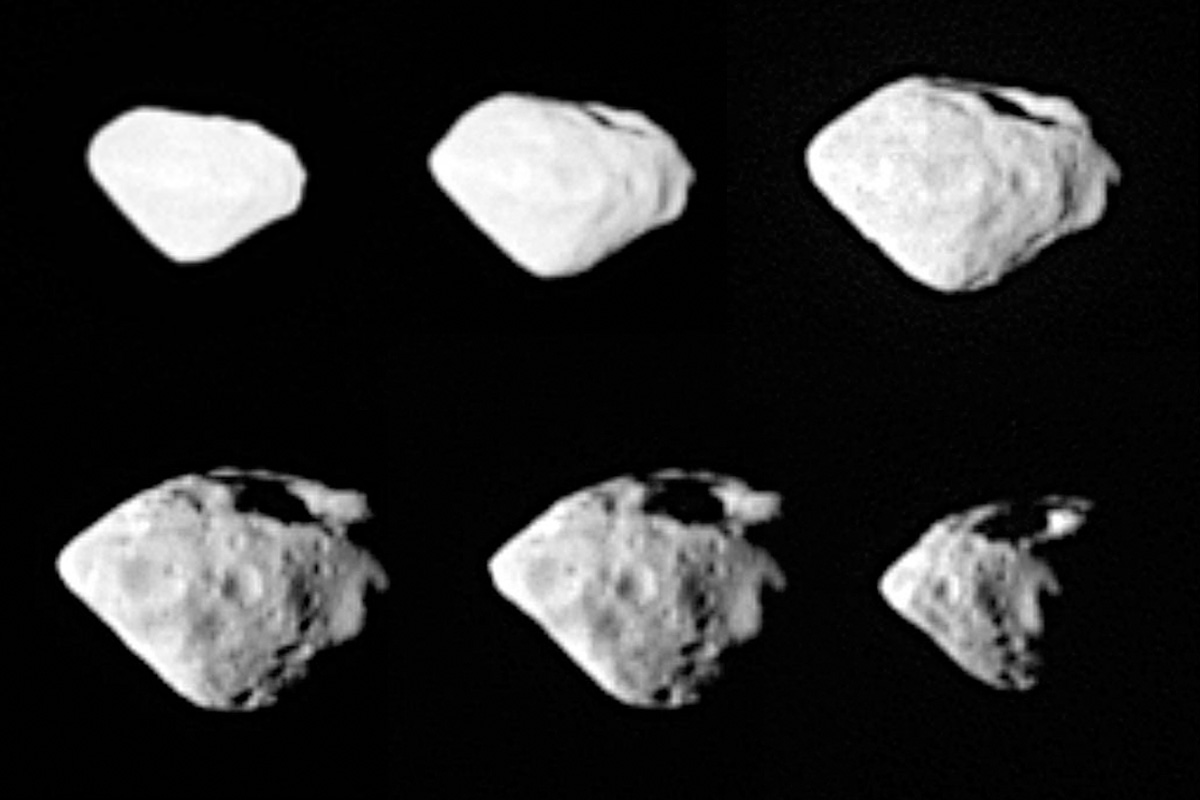
Here are the first results. The asteroid has a nice crater chain on it and looks roughly like a cut diamond.
-
Some Nice pictures
Here are the first results. The asteroid has a nice crater chain on it and looks roughly like a cut diamond.
-
Re:Conformal Coating
I wonder where he could readily get a vacuum chamber big enough to pull the air out.
We have a 2300m3 one at work
-
Space Wire
Don't forget it has a Spacewire interface.
I kindof found the bulky db15 connector on the side funny, but I guess you'd need some sort of adapter anyway. But if you had a lot of them you'd probably use a kvm and at that point you could move to a proprietary, thin, small, light connection.
-
Re:Put it into deep space
An early version of this is already on the Rosetta space probe.
-
Re:Interesting tweak
A quick google search (Ariane 5 vibration dampening) dredged up this from http://www.esa.int/esapub/bulletin/bullet92/b92eaton.htm (emphasis mine):
Active noise and vibration control
An anticipated increase in low-frequency noise within the Ariane-5 payload fairing during launch compared with Ariane-4 led to the successful introduction by Dornier of a passive 'Helmholtz resonator' noise control system, albeit with a sizeable mass penalty. Studies conducted by DASA-Dornier with Contraves and TNO have now examined alternative noise-suppression techniques using novel active noise and vibration control. Initial findings substantiated by scale-model testing have shown encouraging results. Means for generating high-intensity 'counter phase' noise and for achieving a better understanding of the distribution of external noise sources require further investigation. Parallel studies are examining the efficiencies of piezoelectric actuators under space conditions.
Sounds like Ariane-5 had has been down this engineering path and wound up with passive dampeners, but was investigating using active dampeners. No numbers on dampener mass apparent though. Also note they were putting dampeners higher in the stack (the payload fairing). That's worse then building cars with 'secret decoder ring bolts'...no I'm not talking about metric bolts...try using metric tools on a BMW some day...I miss the old
-
Re:Why is this free?
... Millions of American taxpayer dollars have been spent gathering this priceless data that is totally unavailable in any other context
Most space programs are internationally funded and carried out by universities of more than one country these days. Of course the data should be made available.
... I can guarantee you that any other nation's research programmes would not do this
-
Re:The Year Was 1977 ...
Jupiter is a lot closer than Saturn and we just did exactly that with Cassini-Huygens. It'd probably be a few years before we'd be able to but it's certainly possible.
There would definitely be some technological hurdles we'd need to cross but again I can't imagine they would be impossible to get around. -
Re:Big deal...
I always thought it was announced by the european space agency over four years ago
-
Wrong link?
I can't find anything about that in the ESA website
-
Re:Use light, not radio waves
True, but only if you know were you are pointing (they do this with satellites). If ET does not know where we are, and just randomly points his laser in the sky, the detection chance drops enormously, I guess the two effects cancel each other in the detection probability. Also note that any light you sent will might be lost in the background radiation of the star or the planet (I don't know if this is better or worse with radio).
-
Re:Space Madness!
-
Re:What's the flippin' point?Wow, got some abuse there. OK, this time with references:
There ain't much going on there.
Apologies, the Apollo mission did do some great stuff for science but most of it could be done by robot these days. That is progress.
People can't go to Mars, because it would be a one-way trip.
It's just too expensive
With $55 billion you could feed, clothe an educate every man women and child in Rwanda for a decade, assuming their GDP is about $3bn.
and there's nothing to do up there that we couldn't do with robots.
Sample return would be much easier and cheaper without bulky, fragile humans.
Much better to spend the billions and billions of dollars on lots of probes, better very-long-range telescopes
Are we alone in the universe? Manned missions won't tell us, bigger telescopes might.
-
Re:They did
they did strip it of all hydrogen, for example
I don't know if you got that from Wikipedia, but if you did, it's an over-simplification of the linked ESA article. That talks about the solar wind stripping water molecules away before disassociation, not molecular hydrogen.
H2 molecules don't actually need any extra help to escape the atmospheres of Venus or Earth: even at the low temperatures of the very upper atmospheres of those planets, a statistically significant fraction of the molecules have a velocity that exceeds the escape velocity. Over long periods of time, almost all unbonded H2 simply wanders off in to space. This is something you examine if you take a statistical thermodynamics course; it also explains why the Moon has almost no atmosphere, Mars a very thin atmossphere, and why the "gas giants" hang on to all that gaseous hydrogen and helium.
Besides, there is still plenty of hydrogen on Venus: in the sulphuric acid (H2SO4) already discussed. 8) Now, how do we convert sulphuric acid to water... is there any Copper on Venus?
-
Re:What has happened to us?
-
Re:today's NASA kids could learn from this.
ESA says the total cost of Ulysses has been about 1 billion Euro, which is about $1.5 billion US. Might want to try a different example.
-
ice on Mars is nothing new
Finding water was one of the key goals of the Phoenix mission.
That is a bizarre statement. Large quantities of ice have been observed in numerous ways already. Even the Viking lander observed water frost directly in the 1970's:
http://en.wikipedia.org/wiki/Viking_2
http://www.solarviews.com/cap/mars/frost.htm
That frost sublimated just like this ice did.
Here are other observations:
http://science.nasa.gov/headlines/y2002/28may_marsice.htm
Here you can see a frozen crater lake:
http://esamultimedia.esa.int/images/marsexpress/210-010705-1343-6-co-01-CraterIce_H.jpg
http://www.esa.int/SPECIALS/Mars_Express/SEMGKA808BE_0.html
Not only is that ice, it may actually be an outflow.
What makes the results from Phoenix exciting is that the actual experiments that Phoenix is supposed to perform depend on having landed on ice. But finding ice somewhere on Mars is not a surprise.
-
ice on Mars is nothing new
Finding water was one of the key goals of the Phoenix mission.
That is a bizarre statement. Large quantities of ice have been observed in numerous ways already. Even the Viking lander observed water frost directly in the 1970's:
http://en.wikipedia.org/wiki/Viking_2
http://www.solarviews.com/cap/mars/frost.htm
That frost sublimated just like this ice did.
Here are other observations:
http://science.nasa.gov/headlines/y2002/28may_marsice.htm
Here you can see a frozen crater lake:
http://esamultimedia.esa.int/images/marsexpress/210-010705-1343-6-co-01-CraterIce_H.jpg
http://www.esa.int/SPECIALS/Mars_Express/SEMGKA808BE_0.html
Not only is that ice, it may actually be an outflow.
What makes the results from Phoenix exciting is that the actual experiments that Phoenix is supposed to perform depend on having landed on ice. But finding ice somewhere on Mars is not a surprise.
-
Re:NASA-style journalism
Where was it referred to as a "NASA spacecraft"? I looked over the summary and the press release, and it was always referred to as the "Ulysses spacecraft". The closest phrase was "The spacecraft was provided by ESA.", or references to the NASA/ESA "mission" or "project" not "spacecraft".
It's an ESA spacecraft (built by "Dornier Systems, Germany (now Astrium)"), with a mix of US & European instruments, launched by NASA (shuttle + Boeing + McDonnell Douglas), operated from NASA (JPL) by a joint NASA/ESA team.
Most NASA press releases I've seen tend to mention the manufacturer, good or bad, if it's a US company. When it's European, mentions of the contractor are a lot rarer, though Italy seems to be good at getting its name in there (probably because the US has had some construction contracts with them, outside of their ESA agreements). For example, looking over the Mars Polar Lander news release archive, the attributions to NASA vs contractors seem similar to MER and Phoenix press releases. -
Here there's more
The European Space Agency had a press conference about the end of Ulysses on Thursday. Brief note and audio feed. Longer press release.
The video the Ulysses Legacy has a great summary of the mission, and of the problems it now faces.
-
Here there's more
The European Space Agency had a press conference about the end of Ulysses on Thursday. Brief note and audio feed. Longer press release.
The video the Ulysses Legacy has a great summary of the mission, and of the problems it now faces.
-
Here there's more
The European Space Agency had a press conference about the end of Ulysses on Thursday. Brief note and audio feed. Longer press release.
The video the Ulysses Legacy has a great summary of the mission, and of the problems it now faces.
-
Re:viewing angle
The beauty of this is that it lets you get a map of virtually anywhere from the air.
No, that isn't the beauty of "this". These people have done a poor job at 3D rendering from aerial imaging. If you want to see well-rendered photographs based on aerial imaging, have a look at the Mars Express pictures:
http://www.esa.int/SPECIALS/Mars_Express/SEM565R03EF_0.html
That was done 10 years ago, and even then, the underlying technologies weren't new. -
Re:Imagine what *people* could learn?Right now, they wouldn't learn anything, because they would be dead. If NASA is dicking around with anything, it would be the ISS. Haul that low orbit pile of resources into a much more stable orbit, and then use it for parts/construction platform for a station with centrifugal gravity and as close to a closed ecosystem as we can manage. Until we improve those technologies, to the level of near permanent space habitats, then multi-year space exploration will be the sole domain of robots.
...a station with centrifugal gravity... Sorry to be pedantic, but Centifugal Force -
Re:Imagine what *people* could learn?
Right now, they wouldn't learn anything, because they would be dead. If NASA is dicking around with anything, it would be the ISS. Haul that low orbit pile of resources into a much more stable orbit, and then use it for parts/construction platform for a station with centrifugal gravity and as close to a closed ecosystem as we can manage. Until we improve those technologies, to the level of near permanent space habitats, then multi-year space exploration will be the sole domain of robots.
-
Here's the ESA report:
-
ESA Has Done Studies Long AgoThe US is very badly lagging in the international bed rest race! I thought I read somewhere about the ESA doing this two years ago for female astronauts at least. There's some interesting comments on their WISE page such as: All volunteers were surprised how fast the time passed by. I'll bet that month you spend in bed is completely lost with little or no memories for it.
And if you really want to know more, they published all their findings for all their experiments in five hefty PDFs. -
ESA Has Done Studies Long AgoThe US is very badly lagging in the international bed rest race! I thought I read somewhere about the ESA doing this two years ago for female astronauts at least. There's some interesting comments on their WISE page such as: All volunteers were surprised how fast the time passed by. I'll bet that month you spend in bed is completely lost with little or no memories for it.
And if you really want to know more, they published all their findings for all their experiments in five hefty PDFs.