Slashdot Mirror
Domain: eso.org
Stories and comments across the archive that link to eso.org.
Stories · 86
-
About That Monstrous Black Hole We're All Orbiting (theatlantic.com)
Astronomers on Wednesday reported new telescope observations of the environment around the Milky Way's supermassive black hole, named Sagittarius A*, pronounced "a-star," and they transformed the data into a lively animation. From a report: The video is positively ghostly. Clumps of gas swirl around the black hole, traveling at about 30 percent of the speed of light. Astronomers collected the data for the visualization using an instrument on the European Southern Observatory's Very Large Telescope, located in the deserts of northern Chile. The instrument, appropriately named GRAVITY, detected flares of infrared radiation coming from the disk surrounding Sagittarius A*. The researchers believe the bursts originated very close to the black hole, in an incredibly tumultuous region known as the innermost stable orbit. Here, cosmic material is slung around violently, but it remains far away enough that it can circle the black hole safely without getting sucked into the darkness.
If the thought of orbiting a monstrous, star-gobbling black hole spooks you, don't worry. Earth, located about two-thirds out from the center of the Milky Way, is at a very safe distance. The planet is in no danger of being consumed and wiped off the face of the universe. But, like everything else in the galaxy, it has long been subject to the black hole's whims. When black holes belch radiation out into space, the outflow can heat surrounding gas so much that it prevents it from cooling. If cosmic dust can't cool, it can't condense to form individual, brand-new stars, including ones like our sun. Scientists suspect that the fates of galaxies -- whether they produce new stars or stop altogether -- rests with the supermassive black holes at their centers. -
Star's Black Hole Encounter Puts Einstein's Theory of Gravity To the Test (sciencemag.org)
An anonymous reader quotes a report from Science Magazine: For more than 20 years, a team of astronomers has tracked a single star whipping around the supermassive black hole at the center of our galaxy at up to 25 million kilometers per hour, or 3% of the speed of light. Now, the team says the close encounter has put Albert Einstein's theory of gravity to its most rigorous test yet for massive objects, with the light from the star stretched in a way not prescribed by Newtonian gravity. In a study announced today, the team says it has detected a distinctive indicator of Einstein's general theory of relativity called "gravitational redshift," in which the star's light loses energy because of the black hole's intense gravity. The star, called S2, is unremarkable apart from a highly elliptical orbit that takes it within 20 billion kilometers, or 17 light-hours, of the Milky Way's central black hole -- closer than any other known star. A team led by Reinhard Genzel at the Max Planck Institute for Extraterrestrial Physics (MPE) in Garching, Germany, has been tracking S2 since the 1990s, first with the European Southern Observatory's (ESO's) 3.6-meter New Technology Telescope in Chile's Atacama Desert and later with ESO's Very Large Telescope (VLT), made up of four 8-meter instruments. Ghez's team at UCLA also began to observe the star around the same time with the twin 10-meter Keck telescopes in Hawaii. In a paper published today in Astronomy & Astrophysics, Genzel's group reports seeing the combined action of the relativistic effects, with the black hole's gravity redshifting S2's radial velocity by 200 kilometers per second, a small fraction of its overall speed. The results match closely with the predictions of relativity and are inconsistent with Newtonian gravity. -
ESO's Very Large Telescope Now Delivers Images Sharper Than Hubble (eso.org)
ffkom shares an excerpt from a press release via the European Southern Observatory: ESO's Very Large Telescope (VLT) has achieved first light with a new adaptive optics mode called laser tomography -- and has captured remarkably sharp test images of the planet Neptune, star clusters and other objects. The pioneering MUSE instrument in Narrow-Field Mode, working with the GALACSI adaptive optics module, can now use this new technique to correct for turbulence at different altitudes in the atmosphere. It is now possible to capture images from the ground at visible wavelengths that are sharper than those from the NASA/ESA Hubble Space Telescope. The combination of exquisite image sharpness and the spectroscopic capabilities of MUSE will enable astronomers to study the properties of astronomical objects in much greater detail than was possible before. -
First Confirmed Image of a Newborn Planet Revealed (theguardian.com)
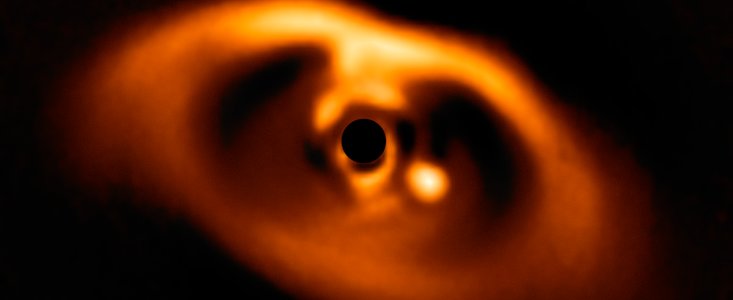
Astronomers say they now have the first confirmed image of the formation of a planet. The Guardian reports: The startling snapshot shows a bright blob -- the nascent planet -- traveling through the dust and gas surrounding a young star, known as PDS70, thought to be about 370 light years from Earth. The black circle in the centre of the image, to the left of the planet, is a filter to block the light from the star, enabling other features of the system to be seen.
"These discs around young stars are the birthplaces of planets, but so far only a handful of observations have detected hints of baby planets in them," said Miriam Keppler of the Max Planck Institute for Astronomy in Germany, a lead author of the research published in the journal Astronomy and Astrophysics. However, other ground-based observations have not yielded conclusive evidence. "The problem is that until now, most of these planet candidates could just have been features in the disc," she said. "The advantage of our detection is that we have detected [the new planet] with several different observing instruments, different filter bands and different years," she added. This research was presented in two papers, entitled "Discovery of a planetary-mass companion within the gap of the transition disk around PDS 70" and "Orbital and atmospheric characterization of the planet within the gap of the PDS 70 transition disk," both to be published in Astronomy & Astrophysics. -
First Confirmed Image of a Newborn Planet Revealed (theguardian.com)
Astronomers say they now have the first confirmed image of the formation of a planet. The Guardian reports: The startling snapshot shows a bright blob -- the nascent planet -- traveling through the dust and gas surrounding a young star, known as PDS70, thought to be about 370 light years from Earth. The black circle in the centre of the image, to the left of the planet, is a filter to block the light from the star, enabling other features of the system to be seen.
"These discs around young stars are the birthplaces of planets, but so far only a handful of observations have detected hints of baby planets in them," said Miriam Keppler of the Max Planck Institute for Astronomy in Germany, a lead author of the research published in the journal Astronomy and Astrophysics. However, other ground-based observations have not yielded conclusive evidence. "The problem is that until now, most of these planet candidates could just have been features in the disc," she said. "The advantage of our detection is that we have detected [the new planet] with several different observing instruments, different filter bands and different years," she added. This research was presented in two papers, entitled "Discovery of a planetary-mass companion within the gap of the transition disk around PDS 70" and "Orbital and atmospheric characterization of the planet within the gap of the PDS 70 transition disk," both to be published in Astronomy & Astrophysics. -
First Confirmed Image of a Newborn Planet Revealed (theguardian.com)
Astronomers say they now have the first confirmed image of the formation of a planet. The Guardian reports: The startling snapshot shows a bright blob -- the nascent planet -- traveling through the dust and gas surrounding a young star, known as PDS70, thought to be about 370 light years from Earth. The black circle in the centre of the image, to the left of the planet, is a filter to block the light from the star, enabling other features of the system to be seen.
"These discs around young stars are the birthplaces of planets, but so far only a handful of observations have detected hints of baby planets in them," said Miriam Keppler of the Max Planck Institute for Astronomy in Germany, a lead author of the research published in the journal Astronomy and Astrophysics. However, other ground-based observations have not yielded conclusive evidence. "The problem is that until now, most of these planet candidates could just have been features in the disc," she said. "The advantage of our detection is that we have detected [the new planet] with several different observing instruments, different filter bands and different years," she added. This research was presented in two papers, entitled "Discovery of a planetary-mass companion within the gap of the transition disk around PDS 70" and "Orbital and atmospheric characterization of the planet within the gap of the PDS 70 transition disk," both to be published in Astronomy & Astrophysics. -
Astronomers Find An Earth-Size World Just 11 Light Years Away (arstechnica.com)
Astronomers have discovered a planet 35 percent more massive than Earth in orbit around a red dwarf star just 11 light years from the Sun. "The planet, Ross 128 b, likely exists at the edge of the small, relatively faint star's habitable zone even though it is 20 times closer to its star than the Earth is to the Sun," reports Ars Technica. "The study in the journal Astronomy & Astrophysics finds the best estimate for its surface temperature is between -60 degrees Celsius and 20 degrees Celsius." From the report: This is not the closest Earth-size world that could potentially harbor liquid water on its surface -- that title is held by Proxima Centauri b, which is less than 4.3 light years away from Earth and located in the star system closest to the Sun. Even so, due to a variety of factors, Ross 128 b is tied for fourth on a list of potentially most habitable exoplanets, with an Earth Similarity Index value of 0.86. In the new research, astronomers discuss another reason to believe that life might be more likely to exist on Ross 128 b. That's because its parent star, Ross 128, is a relatively quiet red dwarf star, producing fewer stellar flares than most other, similar-sized stars such as Proxima Centauri. Such flares may well sterilize any life that might develop on such a world. -
Scientists Discover Ring Around Dwarf Planet Haumea Beyond Neptune
A ring has been discovered around one of the dwarf planets that orbits the outer reaches of the solar system. Until now, ring-like structures had only been found around the four outer planets -- Jupiter, Saturn, Uranus and Neptune. The Guardian reports: "In 2014 we discovered that a very small body in the Centaurs region [an area of small celestial bodies between the asteroid belt and Neptune] had a ring and at that time it seemed to be a very weird thing," explained Dr Jose Ortiz, whose group at the Instituto de Astrofisica de Andalucia in Granada made the discovery described in the journal Nature. "We didn't expect to find a ring around Haumea, but we were not too surprised either." Haumea was recognized by the International Astronomical Union in 2008 and is one of five dwarf planets, alongside Pluto, Ceres, Eris and Makemake. They are located beyond Neptune -- 50 times farther away from the sun than Earth. Haumea, named after the Hawaiian goddess of childbirth, is unusual because of its elongated shape, comparable to a rugby ball, and its rapid rotation, spinning around once every 3.9 hours. Its diameter is approximately a third of the size of Earth's moon. -
Giant Magellan Telescope Set To Revolutionize Ground-Based Astronomy
StartsWithABang writes: If you want to see farther, deeper and at higher resolution than ever before into the Universe, you need four things: the largest aperture possible, the best-quality optical systems and cameras/CCDs, the least interference from the atmosphere, and the analytical techniques and power to make the most of every photon. While the last three have improved tremendously over the past 25 years, telescope size hasn't increased at all. That's all about to change over the next decade, as three telescopes — the Giant Magellan Telescope, the Thirty Meter Telescope and the European Extremely Large Telescope — are set to take us from 8-10 meter class astronomy to 25-40 meter class. While the latter two are fighting over funding, construction rights and other political concerns, the Giant Magellan Telescope is already under construction, and is poised to be the first in line to begin the future of ground-based astronomy. -
Hubble and the VLT Uncover Evidence For Self-Interacting Dark Matter
astroengine writes: A new study carried out by the ESO's Very Large Telescope and the NASA/ESA Hubble Space Telescope has revealed for the first time that dark matter may well interact with itself — a discovery that, at first glance, seems to contradict what we thought we knew about the nature of this invisible mass. "In this study, the researchers observed the four colliding galaxies and found that one dark matter clump appeared to be lagging behind the galaxy it surrounds. The dark matter is currently 5000 light-years (50 000 million million kilometers) behind the galaxy — it would take NASA’s Voyager spacecraft 90 million years to travel that far. A lag between dark matter and its associated galaxy is predicted during collisions if dark matter interacts with itself, even very slightly, through forces other than gravity. Dark matter has never before been observed interacting in any way other than through the force of gravity." -
Hubble and the VLT Uncover Evidence For Self-Interacting Dark Matter
astroengine writes: A new study carried out by the ESO's Very Large Telescope and the NASA/ESA Hubble Space Telescope has revealed for the first time that dark matter may well interact with itself — a discovery that, at first glance, seems to contradict what we thought we knew about the nature of this invisible mass. "In this study, the researchers observed the four colliding galaxies and found that one dark matter clump appeared to be lagging behind the galaxy it surrounds. The dark matter is currently 5000 light-years (50 000 million million kilometers) behind the galaxy — it would take NASA’s Voyager spacecraft 90 million years to travel that far. A lag between dark matter and its associated galaxy is predicted during collisions if dark matter interacts with itself, even very slightly, through forces other than gravity. Dark matter has never before been observed interacting in any way other than through the force of gravity." -
Astronomers Find an Old-Looking Galaxy In the Early Universe
schwit1 tips news that a team of astronomers has studied one of the most distant galaxies ever observed and found puzzling results. The light we're seeing from this galaxy comes from roughly 700 million years after the Big Bang, so on the cosmic scale, it's quite young. But the galaxy appears much older than astronomers expected. Their paper was published today in Nature. At this age it would be expected to display a lack of heavier chemical elements — anything heavier than hydrogen and helium, defined in astronomy as metals. These are produced in the bellies of stars and scattered far and wide once the stars explode or otherwise perish. This process needs to be repeated for many stellar generations to produce a significant abundance of the heavier elements such as carbon, oxygen and nitrogen. Surprisingly, the galaxy A1689-zD1 seemed to be emitting a lot of radiation in the far infrared, indicating that it had already produced many of its stars and significant quantities of metals, and revealed that it not only contained dust, but had a dust-to-gas ratio that was similar to that of much more mature galaxies. -
Astronomers Find an Old-Looking Galaxy In the Early Universe
schwit1 tips news that a team of astronomers has studied one of the most distant galaxies ever observed and found puzzling results. The light we're seeing from this galaxy comes from roughly 700 million years after the Big Bang, so on the cosmic scale, it's quite young. But the galaxy appears much older than astronomers expected. Their paper was published today in Nature. At this age it would be expected to display a lack of heavier chemical elements — anything heavier than hydrogen and helium, defined in astronomy as metals. These are produced in the bellies of stars and scattered far and wide once the stars explode or otherwise perish. This process needs to be repeated for many stellar generations to produce a significant abundance of the heavier elements such as carbon, oxygen and nitrogen. Surprisingly, the galaxy A1689-zD1 seemed to be emitting a lot of radiation in the far infrared, indicating that it had already produced many of its stars and significant quantities of metals, and revealed that it not only contained dust, but had a dust-to-gas ratio that was similar to that of much more mature galaxies. -
Cosmic Mystery Solved By Super-sized Supernova Dust
astroengine writes: 'How cosmic dust is created has been a mystery for some time. Although the textbooks tell us that the dusty stuff that builds the planets — and, ultimately, the complex chemistry that forms life (we are, after all, made of 'star stuff') — comes from supernova explosions, astronomers have been puzzled as to how delicate grains of dust condense from stellar material and how they can possibly survive the violent shock waves of the cataclysmic booms. But now, with the help of a powerful ground-based telescope, astronomers have not only watched one of these supernova 'dust factories' in action, they've also discovered how the grains can withstand the violent supernova shock. "When the star explodes, the shockwave hits the dense gas cloud like a brick wall," said lead author Christa Gall, of Aarhus University, Denmark. "It is all in gas form and incredibly hot, but when the eruption hits the 'wall' the gas gets compressed and cools down to about 2,000 degrees. At this temperature and density elements can nucleate and form solid particles. We measured dust grains as large as around one micron (a thousandth of a millimeter), which is large for cosmic dust grains. They are so large that they can survive their onward journey out into the galaxy (PDF)." The surprising size of the measured dust particles means they can better survive the supernova's shockwave. This research has been published in the journal Nature. -
Cosmic Mystery Solved By Super-sized Supernova Dust
astroengine writes: 'How cosmic dust is created has been a mystery for some time. Although the textbooks tell us that the dusty stuff that builds the planets — and, ultimately, the complex chemistry that forms life (we are, after all, made of 'star stuff') — comes from supernova explosions, astronomers have been puzzled as to how delicate grains of dust condense from stellar material and how they can possibly survive the violent shock waves of the cataclysmic booms. But now, with the help of a powerful ground-based telescope, astronomers have not only watched one of these supernova 'dust factories' in action, they've also discovered how the grains can withstand the violent supernova shock. "When the star explodes, the shockwave hits the dense gas cloud like a brick wall," said lead author Christa Gall, of Aarhus University, Denmark. "It is all in gas form and incredibly hot, but when the eruption hits the 'wall' the gas gets compressed and cools down to about 2,000 degrees. At this temperature and density elements can nucleate and form solid particles. We measured dust grains as large as around one micron (a thousandth of a millimeter), which is large for cosmic dust grains. They are so large that they can survive their onward journey out into the galaxy (PDF)." The surprising size of the measured dust particles means they can better survive the supernova's shockwave. This research has been published in the journal Nature. -
Astronomers Determine the Length of Day of an Exoplanet
The Bad Astronomer writes: "Astronomers have just announced that the exoplanet Beta Pic b — a 10-Jupiter-mass world 60 light years away — rotates in about 8 hours. Using a high-resolution spectrometer and exploiting the Doppler shift of light seen as the planet spins, they measured its rotation velocity as 28,000 mph. Making reasonable assumptions about the planet's size, that gives the length of its day. This is the first time such a measurement has been achieved for an exoplanet." -
Astronomers Determine the Length of Day of an Exoplanet
The Bad Astronomer writes: "Astronomers have just announced that the exoplanet Beta Pic b — a 10-Jupiter-mass world 60 light years away — rotates in about 8 hours. Using a high-resolution spectrometer and exploiting the Doppler shift of light seen as the planet spins, they measured its rotation velocity as 28,000 mph. Making reasonable assumptions about the planet's size, that gives the length of its day. This is the first time such a measurement has been achieved for an exoplanet." -
First Asteroid Discovered Sporting a Ring System
astroengine (1577233) writes "When you think of a celestial ring system, the beautiful ringed planet Saturn will likely jump to mind. But for the first time astronomers have discovered that ring systems aren't exclusive to planetary bodies — asteroids can have them too. Announced on Wednesday, astronomers using several observatories in South America, including the ESO's La Silla Observatory in Chile, have discovered that distant asteroid Chariklo possesses two distinct rings. Chariklo, which is approximately 250 kilometers (155 miles) wide, is the largest space rock in a class of asteroids known as Centaurs that orbit between Saturn and Uranus in the outer solar system. 'We weren't looking for a ring and didn't think small bodies like Chariklo had them at all, so the discovery — and the amazing amount of detail we saw in the system — came as a complete surprise!' said lead researcher Felipe Braga-Ribas, of the Observatório Nacional and MCTI, in Rio de Janeiro, Brazil." -
Monster Hypergiant Star Discovered
astroengine writes "A gargantuan star, measuring 1,300 times the size of our sun, has been uncovered 12,000 light-years from Earth — it is one of the ten biggest stars known to exist in our galaxy. The yellow hypergiant even dwarfs the famous stellar heavyweight Betelgeuse by 50 percent. While its hulking mass may be impressive, astronomers have also realized that HR 5171 is a double star with a smaller stellar sibling physically touching the surface of the larger star as they orbit one another. 'The new observations also showed that this star has a very close binary partner, which was a real surprise,' said Olivier Chesneau, of the Observatoire de la Côte d'Azur in Nice, France. 'The two stars are so close that they touch and the whole system resembles a gigantic peanut.'" -
Weird Asteroid Itokawa Has a Dual Personality
astroengine writes "We care about how asteroids are made, in large part because if one were aiming to smash into us, we'd like to know what we can do about it. The structure of asteroids is also a matter of scientific curiosity, as it tells us a bit about the formation and evolution in our solar system. ... 25143 Itokawa is a relatively small near-Earth asteroid that was visited by the Japanese Habayusa spacecraft in 2005. It has also been monitored by Stephen Lowry of the University of Kent and his colleagues over a twelve year span with the 3.58 meter New Technology Telescope in La Silla, Chile. In that time span, Itokawa has made five near approaches to Earth. And what did they find? The asteroid is composed of two lobes of different densities, suggesting that Itokawa is in fact a merged binary." ESO is hosting a preprint of the paper. -
Weird Asteroid Itokawa Has a Dual Personality
astroengine writes "We care about how asteroids are made, in large part because if one were aiming to smash into us, we'd like to know what we can do about it. The structure of asteroids is also a matter of scientific curiosity, as it tells us a bit about the formation and evolution in our solar system. ... 25143 Itokawa is a relatively small near-Earth asteroid that was visited by the Japanese Habayusa spacecraft in 2005. It has also been monitored by Stephen Lowry of the University of Kent and his colleagues over a twelve year span with the 3.58 meter New Technology Telescope in La Silla, Chile. In that time span, Itokawa has made five near approaches to Earth. And what did they find? The asteroid is composed of two lobes of different densities, suggesting that Itokawa is in fact a merged binary." ESO is hosting a preprint of the paper. -
First Global Map Outside the Solar System
First time accepted submitter Kreuzfeld writes "For many years, astronomers have suspected that brown dwarfs — 'failed stars' with masses between those of planets and stars — have cloudy atmospheres. Our recent paper in Nature presents the first global, 2D map of the patchy clouds in the atmosphere of a brown dwarf: our neighbor, the 6.5 light-years-distant Luhman 16B. Eventually, astronomers will use this technique to make weather movies of global cloud patterns on brown dwarfs and extrasolar planets." -
Very Large Telescope Observes Gas Cloud Being Ripped Apart By Black Hole
An anonymous reader writes "New observations (PDF) from ESO's Very Large Telescope show for the first time a gas cloud being ripped apart by the supermassive black hole at the center of the galaxy. The cloud is now so stretched that its front part has passed the closest point and is traveling away from the black hole at more than 10 million km/h, whilst the tail is still falling towards it." -
3 Habitable-Zone Super-Earths Found Orbiting Nearby Star
astroengine writes "Gliese 667C is a well-studied star lying only 22 light-years from Earth in the constellation of Scorpius, but it appears to have been hiding a pretty significant secret. The star has at least six exoplanets in orbit, three of which orbit within the star's "habitable zone" — the region surrounding a star that's not too hot and not too cold for liquid water to exist on their surfaces. Astronomers already knew that Gliese 667C had three worlds in orbit, one in the star's habitable zone, but the finding of three more exoplanets, two of which are also in the habitable zone is a huge discovery. Finding one small planet in a star's habitable zone is exciting, but finding three is historic. 'The number of potentially habitable planets in our galaxy is much greater if we can expect to find several of them around each low-mass star — instead of looking at ten stars to look for a single potentially habitable planet, we now know we can look at just one star and find several of them,' said Rory Barnes, of the University of Washington, co-author of the study, in an ESO press release Tuesday (June 25)." -
Nearest Alien Planet Gets New Name
SchrodingerZ writes "The nearest planet outside our solar system has recently been named Albertus Alauda. Originally named Alpha Centauri Bb, the planet is the closest known planet not orbiting the Sun, being a mere 4.3 light years away. The name comes from Jay Lark, who won the naming contest held by Uwingu starting last month and ending on April 22. Lark remarks that the name comes from the Latin name of his late grandfather, stating, "My grandfather passed away after a lengthy and valiant battle with cancer; his name in Latin means noble or bright and to praise or extol." The competition for naming the planet came from Uwing, a company which used the buying of name proposals and votes to fund grants for future space exploration ventures. Albertus Alauda won the competition with 751 votes, followed by Rakhat with 684 votes, and Caleo, with 622 votes." -
Possible Baby Picture of a Giant Planet
astroengine writes "Acquired by the European Southern Observatory's Very Large Telescope (VLT), an infrared observation shows a portion of the disk of gas and dust around the star HD 100546, located 335 light-years away in the constellation Musca. By physically blocking out the light from the star itself by means of an opaque screen, the light from the protoplanetary disk around HD 100546 can be seen, revealing a large bright clump that's thought to be a planet in the process of formation (PDF). If it is indeed a baby planet, it's a big one — as large as, or perhaps even larger than, Jupiter." -
Possible Baby Picture of a Giant Planet
astroengine writes "Acquired by the European Southern Observatory's Very Large Telescope (VLT), an infrared observation shows a portion of the disk of gas and dust around the star HD 100546, located 335 light-years away in the constellation Musca. By physically blocking out the light from the star itself by means of an opaque screen, the light from the protoplanetary disk around HD 100546 can be seen, revealing a large bright clump that's thought to be a planet in the process of formation (PDF). If it is indeed a baby planet, it's a big one — as large as, or perhaps even larger than, Jupiter." -
Previously Unseen Stage of Planet Formation Observed
SchrodingerZ writes "Seen from the Atacama Large Millimeter/submillimeter Array (ALMA) in Chile; scientists have detected a gas giant planet focusing material from a gas cloud toward a main star. The star, HD 142527, is a young 2 million years old, and is 450 light-years from Earth. The system has 'A disk of spinning dust and gas left over from its formation... and from this material, planets are being created.' The planetesimals are drawing material from the dust cloud inward, effectively fueling the expansion of the parent star, currently twice the size of our own Sun. 'Theoretical simulations have predicted such bridges between outer and inner portions of disks surrounding stars, but none have been directly observed until now.' Simon Casassus, lead scientist at the University of Chile, said, 'Currently, the only mechanism known to produce such gap-crossing dense molecular flows, with residual carbon monoxide gas more diffusely spread out inside the gap, is planetary formation.' While the planets currently are not visible, their presence is very noticeable. More examination of the dust cloud is needed to precisely pinpoint the planet(s)." -
Odds Favor Discovery of Earth-Like Exoplanet in 2013
Earth-like exoplanets have gotten a lot of attention in the last few years; it's exciting to think that there's life — or even just life-sustaining conditions — on planets other than Earth, whether near by (on Mars) or much farther away (orbiting Vega). Projects like NASA's Kepler, and the ground-based HARPS, attempt to spot planets outside our solar system of all kinds. These exoplanet discoveries have been ramping up lately, and so has sorting of the discovered planets by size and other characteristics; the odds are looking good, say astronomers quoted by Space.com, that an Earth-like planet will be found this year. Abel Mendez runs the Planetary Habitability Laboratory at the University of Puerto Rico at Arecibo, and UC Berkeley astromer Geoff Marcy looks for planets as part of the Kepler team; they explain in the article why they think 2013 is an auspicious one for planet hunters. -
All Systems Go For Highest Altitude Supercomputer
An anonymous reader writes "One of the most powerful supercomputers in the world has now been fully installed and tested at its remote, high altitude site in the Andes of northern Chile. It's a critical part of the Atacama Large Millimeter/submillimeter Array (ALMA), the most elaborate ground-based astronomical telescope in history. The special-purpose ALMA correlator has over 134 million processors and performs up to 17 quadrillion operations per second, a speed comparable to the fastest general-purpose supercomputer in operation today." -
All Systems Go For Highest Altitude Supercomputer
An anonymous reader writes "One of the most powerful supercomputers in the world has now been fully installed and tested at its remote, high altitude site in the Andes of northern Chile. It's a critical part of the Atacama Large Millimeter/submillimeter Array (ALMA), the most elaborate ground-based astronomical telescope in history. The special-purpose ALMA correlator has over 134 million processors and performs up to 17 quadrillion operations per second, a speed comparable to the fastest general-purpose supercomputer in operation today." -
Alpha Centauri Has an Earth-Sized Planet
The Bad Astronomer writes "Astronomers have announced that the nearest star system in the sky — Alpha Centauri — has an Earth-sized planet orbiting one of its stars. Alpha Cen is technically a three-star system: a binary composed of two stars very much like the Sun, orbited by a third, a red dwarf, much farther out. Using the Doppler technique (looking for very small changes in the velocities of the stars) astronomers detected a planet orbiting the smaller of the two stars in the binary, Alpha Centauri B. The planet has a mass only 1.13 times that of the Earth, making it one of the smallest yet detected.However, it orbits the star only 6 million kilometers out, so it's far too hot to be habitable. The signal from the planet is extremely weak but solidly detected (PDF), giving astronomers even greater hope of being able to find an Earth-like planet orbiting a star in its habitable zone." -
Alpha Centauri Has an Earth-Sized Planet
The Bad Astronomer writes "Astronomers have announced that the nearest star system in the sky — Alpha Centauri — has an Earth-sized planet orbiting one of its stars. Alpha Cen is technically a three-star system: a binary composed of two stars very much like the Sun, orbited by a third, a red dwarf, much farther out. Using the Doppler technique (looking for very small changes in the velocities of the stars) astronomers detected a planet orbiting the smaller of the two stars in the binary, Alpha Centauri B. The planet has a mass only 1.13 times that of the Earth, making it one of the smallest yet detected.However, it orbits the star only 6 million kilometers out, so it's far too hot to be habitable. The signal from the planet is extremely weak but solidly detected (PDF), giving astronomers even greater hope of being able to find an Earth-like planet orbiting a star in its habitable zone." -
Dying Star Weaves a Trillion-Mile-Wide Spiral In the Sky
The Bad Astronomer writes "Using the newly-commissioned ALMA radio observatory, astronomers have taken detailed images of one of the most amazing objects in the sky: the red giant R Sculptoris (abstract). As the star dies, it undergoes gigantic seizures beneath its surface that blast out waves of gas and dust from the surface. These normally expand into a spherical shell, but the presence of a nearby companion star changes things. The combined orbits of the two stars fling out the material like a garden sprinkler, forming enormous and incredibly beautiful spiral arms. Measuring the size and shape of the spiral shows the last eruption was 1800 years ago, lasted for nearly two centuries, and expelled enough material to make a thousand earths." -
Vote On What the Very Large Telescope Observes
arisvega writes "The Slashdot crowd may be aware of VLT, the Very Large Telescope array (a collaboration between several European countries). It's located at the Atacama desert in Chile, operating at the visible and infrared wavelengths and producing some very detailed images and exciting new science. It has been significantly boosting astronomy and astrophysics research for the past couple of years without the hassle and the expenses of orbital observatories. Now, and for the first time in its history, there is a public invitation calling you to vote on which of the 16 proposed locations you would like the array to be pointed at, without the need for a scientific proposal. Astronomers are standing by to do your bidding!" -
Vote On What the Very Large Telescope Observes
arisvega writes "The Slashdot crowd may be aware of VLT, the Very Large Telescope array (a collaboration between several European countries). It's located at the Atacama desert in Chile, operating at the visible and infrared wavelengths and producing some very detailed images and exciting new science. It has been significantly boosting astronomy and astrophysics research for the past couple of years without the hassle and the expenses of orbital observatories. Now, and for the first time in its history, there is a public invitation calling you to vote on which of the 16 proposed locations you would like the array to be pointed at, without the need for a scientific proposal. Astronomers are standing by to do your bidding!" -
Survey Finds No Hint of Dark Matter Near Solar System
Eponymous Hero writes "Does dark matter exist or doesn't it? It seems these results don't shed as much light as we'd hoped. 'Moni Bidin says he's not sure whether dark matter exists or not. But he says that his team's survey (PDF) is the most comprehensive of its type ever done, and the puzzling results must be reckoned with. "We don't have a good comprehension of what is going on," he says.' This has the smell of a Neutrinogate scandal, but at least we've been warned about the shoulder shrugging. 'As an example, Newberg notes that the researchers assumed that the group of stars they examined were smoothly distributed above and below the plane of the Milky Way. But if the distribution turns out to be lumpier, as is the case for stars in the outer parts of the galaxy, then the resulting calculations of dark matter density could be incorrect. Flynn agrees that there are a number of ways that the method employed by Moni Bidin and his co-authors "could get it wrong."'" -
Scientists Estimate 40% of Red Dwarfs Have A Rocky Planet
An anonymous reader writes with an excerpt from Science World Report: "Astronomers hunting for rocky planets with the right temperature to support life estimate there may be tens of billions of them in our galaxy alone. A European team said on Wednesday that about 40 percent of red dwarf stars — the most common type in the Milky Way — have a so-called 'super-Earth' planet orbiting in a habitable zone that would allow water to flow on the surface." -
Astronomers Find Gas Cloud About To Fall Into Black Hole
First time accepted submitter pigrabbitbear writes "Black holes are basically celestial Cookie Monsters, gobbling anything and everything in sight. But because that appetite includes light itself, it's incredibly rare for us to actually see a black hole suck back an interstellar treat. Astronomers using the European Southern Observatory's Very Large Telescope have found just that: a mysterious, giant gas cloud that's rapidly been pulled into the maw of a supermassive black hole. The researchers, led by Reinhard Genzel of the Max-Planck Institute for Extraterrestrial Physics in Germany, discovered the cloud as part of a now 20-year ESO program tasked with tracking stars as they whirl around the supermassive black hole, known as Sgr A*, at the center of our galaxy." -
50 New Exoplanets Found, Billions More Await
The Bad Astronomer writes "Astronomers using a sensitive spectrograph have just announced the existence of 50 more planets orbiting nearby Sun-like stars. The important things to note: 1) Sixteen of them are super-Earths, and 2) 40% of all Sun-like stars appear to have at least one planet with less mass than Saturn." -
Astronomers Find Unusual Star
First time accepted submitter JoshuaZ writes "Astronomers have found an unusual small star. SDSS J102915+172927 is a small faint star with very little of any elements other than hydrogen or helium. The star's composition is surprising (Pdf) since standard theories of star formation require heavier elements in small stars in order to allow the stars to be heavy enough to come together. Possibly the most unusual aspect of this star is the complete non-detection of lithium which would be expected in a star of this size. The only elements created shortly after the Big Bang were lithium, hydrogen and helium, and the star should have lithium levels much higher since they should correspond closely with the levels believed to have been formed shortly after the Big Bang." -
Dying Star Betelgeuse Spews Fiery Nebula
astroengine writes "Betelgeuse is dying a nasty death. The star is in the final, violent stages of its life, shedding vast amounts of stellar material into space as it quickly approaches a supernova demise. But now, with the help of the European Southern Observatory's Very Large Telescope, Betelgeuse's extended nebula has come to light. Comprised of silica and alumina dust, ESO astronomers have been able to image the nebula in infrared wavelengths for the first time. This is the most detailed view we've ever had of the imminent death of a titanic red supergiant star." -
Richest Planetary System Discovered With 7 Planets
eldavojohn writes "The European Southern Observatory has announced that with the aid of their 190 HARPS measurements they have found the solar system with the most planets yet. Furthermore they claim 'This remarkable discovery also highlights the fact that we are now entering a new era in exoplanet research: the study of complex planetary systems and not just of individual planets. Studies of planetary motions in the new system reveal complex gravitational interactions between the planets and give us insights into the long-term evolution of the system.' The star is HD 10180, located 127 light-years away in the southern constellation of Hydrus, that boasts at least five planets (with two more expected) that have the equivalent of our own Titius–Bode law (their orbits follow a regular pattern). Their survey of stars also helped reinforce the correlation 'between the mass of a planetary system and the mass and chemical content of its host star. All very massive planetary systems are found around massive and metal-rich stars, while the four lowest-mass systems are found around lower-mass and metal-poor stars.' While we won't be making a 127 light-year journey anytime soon, the list of candidates for systems of interest grows longer." -
Spectrum of Light Captured From Distant World
An anonymous reader writes with this excerpt from Cosmos: "Astronomers have made the first direct capture of a spectrum of light from a planet outside the Solar System and are deciphering its composition. The light was snared from a giant planet that orbits a bright young star called HR 8799 about 130 light-years from Earth, said the European Southern Observatory (ESO). ... The find is important, because hidden within a light spectrum are clues about the relative amounts of different elements in the planet's atmosphere. 'The features observed in the spectrum are not compatible with current theoretical models,' said co-author Wolfgang Brandner. 'We need to take into account a more detailed description of the atmospheric dust clouds, or accept that the atmosphere has a different chemical composition from that previously assumed.' The result represents a milestone in the search for life elsewhere in the universe, said the ESO. Until now, astronomers have been able to get only an indirect light sample from an exoplanet, as worlds beyond our Solar System are called. They do this by measuring the spectrum of a star twice — while an orbiting exoplanet passes near to the front of it, and again while the planet is directly behind it. The planet's spectrum is thus calculated by subtracting one light sample from another." -
Surface Plume On Betelgeuse Imaged
BJ_Covert_Action writes "Astronomy Now is running a piece regarding some new, exquisitely detailed pictures taken of Betelgeuse, a star in the constellation Orion. Betelgeuse is classified as a supergiant star, and its diameter is approximately 1,000 times that of the sun. Two teams of astronomers used ESO's 'Very large Telescope,' its NACO instruments, and an imaging technique known as 'Lucky Imaging' to take some of the most detailed pictures of Betelgeuse to date. The new pictures reveal a gas plume on Betelgeuse which extends from the surface of the star a distance greater than that between our sun and Neptune. The images also show several other 'boiling' spots on the surface of Betelgeuse, revealing the surface to be quite tumultuous. Currently, it is known that stars of Betelgeuse's size eject the equivalent mass of the Earth into space every year. This recent astronomy work will help researchers determine the mechanics behind such ejections." Update — 8/05 at 13:31 by SS: Here's the original press release from the European Southern Observatory, since the Astronomy Now page has slowed to a crawl. -
Scientists Discover Exoplanet Less Than Twice the Mass of Earth
Snowblindeye writes with this excerpt from the European Southern Observatory: "Well-known exoplanet researcher Michel Mayor today announced the discovery of the lightest exoplanet found so far. The planet, 'e,' in the famous system Gliese 581, is only about twice the mass of Earth. The team also refined the orbit of the planet Gliese 581 d, first discovered in 2007, placing it well within the habitable zone, where liquid water oceans could exist. Planet Gliese 581 e orbits its host star — located only 20.5 light-years away in the constellation Libra ('the Scales') — in just 3.15 days. 'With only 1.9 Earth-masses, it is the least massive exoplanet ever detected and is, very likely, a rocky planet,' says co-author Xavier Bonfils from Grenoble Observatory. Being so close to its host star, the planet is not in the habitable zone. But another planet in this system appears to be. ... The planet furthest out, Gliese 581 d, orbits its host star in 66.8 days. 'Gliese 581 d is probably too massive to be made only of rocky material, but we can speculate that it is an icy planet that has migrated closer to the star,' says team member Stephane Udry. The new observations have revealed that this planet is in the habitable zone, where liquid water could exist. '"d" could even be covered by a large and deep ocean — it is the first serious "water world" candidate,' continued Udry." -
100 Hours of Astronomy Webcast Underway
An anonymous reader writes "As part of the International Year of Astronomy, the live video webcast Around the World in 80 Telescopes is taking place now, with fascinating live linkups with the world's leading observatories. The schedule for the webcast is available as a PDF and the recorded videos are available via the 100 hours of astronomy page" -
100 Hours of Astronomy Webcast Underway
An anonymous reader writes "As part of the International Year of Astronomy, the live video webcast Around the World in 80 Telescopes is taking place now, with fascinating live linkups with the world's leading observatories. The schedule for the webcast is available as a PDF and the recorded videos are available via the 100 hours of astronomy page" -
Astronomers Dissect a Supermassive Black Hole
Matt_dk sends along a piece from the European Southern Observatory, which reports on observations of the so-called "Einstein Cross," a fortuitous conjunction of a nearby galaxy and a distant black hole. A team of researchers from Europe and the US combined the effects of macrolensing (from the intervening galaxy) and microlensing (from stars in that galaxy), captured by an earth-bound telescope. "Combining a double natural 'magnifying glass' with the power of ESO's Very Large Telescope, astronomers have scrutinized the inner parts of the disc around a supermassive black hole 10 billion light-years away. They were able to study the disc with a level of detail a thousand times better than that of the best telescopes in the world, providing the first observational confirmation of the prevalent theoretical models of such discs." -
Very Large Telescope Captures New 27-Megapixel Deep Field
xyz writes "European Southern Observatory's Very Large Telescope has captured the deepest ground based U-band image of the universe yet. The image contains more than 27 million pixels and is the result of 55 hours of observations with the VIMOS instrument. 'Galaxies were detected that are a billion times fainter than the unaided eye can see and over a range of colours not directly observable by the eye. This deep image has been essential to the discovery of a large number of new galaxies that are so far away that they are seen as they were when the Universe was only 2 billion years old.'"