Slashdot Mirror
Domain: f2s.com
Stories and comments across the archive that link to f2s.com.
Stories · 23
-
Casting Doubt On the Hawkeye Ball-Calling System
Human judgment by referees is increasingly being supplemented (and sometimes overridden) by computerized observation systems. nuke-alwin writes "It is obvious that any model is only as accurate as the data in it, and technologies such as Hawkeye can never remove all doubt about the position of a ball. Wimbledon appears to accept the Hawkeye prediction as absolute, but researchers at Cardiff University will soon publish a paper disputing the accuracy of the system." -
Hawking Searching For Africa's Einsteins
nuke-alwin writes "Stephen Hawking has traveled to South Africa in search of Africa's Einsteins. The project will create Africa's first post-graduate center for math and physics. The British government has unfortunately decided not to back the project, which is hoping to fight poverty by identifying the kind of talent that can create wealth." Neil Turok is deeply involved as well; he was recently named to head the Perimeter Institute in Canada, whose server we brought to its knees this morning. -
Google To Be Sued in UK For Trademark-Linked Ads
nuke-alwin writes "Channel 4 news in the UK is reporting that Google will be sued by Lastminute.com for the way it sells advertising. Adverts from competitors will now be displayed when searching for some trademarks. Google says consumers will benefit. Some trademarks become so familiar that all similar products are known by the trademark name: Coke and Hoover, for example. I think searching for these kinds of words should allow competitors to advertise their similar products." -
The Orange Box Review
"PC Gaming is dying," the analysts tell us. "The Massive genre is the only viable business model left," websites report. That they're off the mark is obvious to anyone that's actually played a PC game in the last few years; games like Sam and Max , Battlefield 2 , or any of the numerous puzzle titles available online prove the flexibility and strength of the PC platform. Then, every once in a while, you get an offering like the Orange Box. A value-packed storm of content from Valve, this single sku offers five complete games at an amazing price. That would be great, even if the games weren't any good ... but they are. They're very, very, very good. Read on for my impressions of Half-Life 2: Episode 2, Team Fortress 2, and (the cake is a lie) Portal.- Title: The Orange Box
- Developer/Publisher: Valve
- System: PC (360, PS3)
- Genre: Story Based Shooter/Team Multiplayer Shooter/Shooter Puzzler
- Score: 5/5 - These games are all classic titles. They transcend genre, and are worth playing by almost any gamer. Certain to be a part of many serious gamers' collections, definitely worth purchasing, and a great value for your dollar.
Given the amount of time it has taken Valve to release this, the next chapter in the Half-Life saga, it's not surprising that their thinking about episodic content has changed significantly. At this point, rather than being a continuation of Half-Life 2, Valve now effectively sees these episodes combined as Half-Life 3. That new focus is evident in Episode Two, in terms of storytelling and pacing. It picks up just a few moments after Episode One left off, with Gordon and Alyx picking their way out the wreckage of a train in the forest outside of City 17. The story almost immediately kicks into gear, hooking you up with members of the resistance, pitting you against an antlion hive, and forcing you to drive through trackless wastes on the way to your ultimate destination. Though there is plenty of action, the storyline of the Half-Life tale is greatly advanced over the course of the game. There are a few answers handed out but, as with any middle child in a trilogy, there are many more maddening questions raised by the events of the game.
More than a year has passed since the release of Episode One, and as a result numerous promises about Episode Two's gameplay have been muddied as a result. Many of the most-discussed new gameplay elements (Strider-busters, open environments) only come into play at the game's climax. Primarily, you'll be following the same sort of well-crafted (but very much walled-in) path seen in previous entries in the series. For some, this may be a disappointment - a more open environment was a much-discussed element of this title during its development. Personally, I was pleased by the game's focus. A Valve hallmark has always been tightly crafted progress, measurable movement through the gamespace. That focus is sharpened to a knife's point in Episode Two, with the intermingling of action, story-based downtime, and quick puzzles being better than ever before. And that climax ... it's essentially a race against time, putting every skill you've learned over the course of three games to the test. It's fantastic.
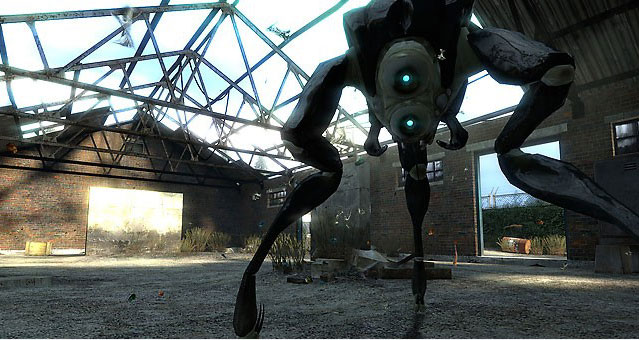
From an audio/visual standpoint, Episode Two more than meets expectations set by the previous chapters in the series. The new Hunter designs are deadly works of art, and carry a sound design to match their menacing appearance. The imagery of the portal storm left in the wake of Episode One dominates the skyline for much of the game, providing not only a visual landmark but a very concrete reminder of what has come before. The voice acting, as always, hits a high water mark for emotional resonance; and there's quite a bit of emotion to convey in this title. Once again, you're left with a very high opinion of Alyx Vance and the other members of the resistance against the combine.
For me, that emotional connection was the takeaway from this chapter in the series. The gameplay is just as solid as it has been in the past (essentially flawless). Other than hunting the Hunters (they don't like tires in the face much), there weren't a lot of stand out combat or puzzle elements. Which was fine, because I very much focused on the storyline as it unfolded around me. Much like Empire Strikes Back Episode Two ends on a down note, making you question what the future will bring in a hard and sometimes confusing world. Unlike that trilogy, though, the end of Gordon Freeman's tale has yet to be told. Just one more game to go before we find out the ultimate fate of the Freeman.
Team Fortress 2
Team Fortress 2 is a substantial redressing of a venerable entry into multiplayer gaming. Built on the original Half-Life engine, the first Team Fortress game was one of the first examples of role-based team play on the PC. The older game, with its own quirks and peculiarities, is still beloved by thousands of FPS gamers; indeed, some of them feel somewhat put off by Valve's re-envisioning of the game. Grenades are no longer a weapon available to every class, each of the classes has undergone significant retooling, and the unique visual aesthetic more resembles a Pixar film than a hardcore multiplayer shooter. What those changes add up to, though, is one of the most approachable online shooters ever released for console or PC.
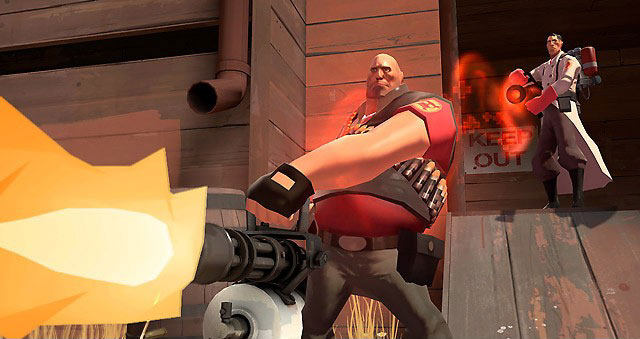
Valve has chosen to apply the same kind of design directives to online combat that it applies to the single-player experience of games like Half-Life 2. Playing the game online (there is no single-player component) is like a moment-to-moment tutorial. Nuances of play become obvious as you progress through a match in your chosen class. The Medic profession is the best example of this philosophy. The character's healing gun links him to a particular character, creating a bond between two players who (in all probability) don't know each other. Learning to play the Medic is an interplay between your positioning vs. your partner, your positioning vs. opponents, and deciding when to use the 'invincibility charge' that slowly builds up as you apply healing. As a member of another class you learn the nuances of keeping your healer protected or (if you're on the opposing team) that shooting the medic first is often the best approach.
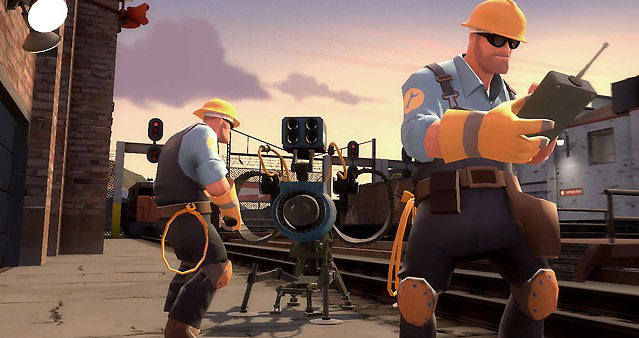
This 'tutorial-as-you-go' experience applies to every one of the nine classes. The complete team roster is a balanced array of strengths and weaknesses. Assuming that your team can agree to not all play the same class, they should allow either effective offense or defense as the scenario allows. The other Valve hallmark shows up in these classes: they're all fun. Each offers a substantially different play experience, but you can have an amazingly good time with each of them. Whether you're dropping turrets into play or wielding a fast-firing heavy machine gun, you'll have the opportunity to participate and make a dent. And if you're not having fun, it's a matter of a few moment to switch to a different class.
TF2 has some weighty competition in the online FPS space this year, but from what I've seen none can compete with it in terms of approachability. Halo 3 played online is fun, to be sure, but the preternatural skills of your opponents gets really old after a while. Team Fortress 2 rewards skill, to be sure, but the shallowness of the learning curve and self-teaching mechanisms means that expertise in TF2 is a much lower piece of fruit. Ultimately, isn't that the sign of a great online game? One that lots of people can participate in?
Portal
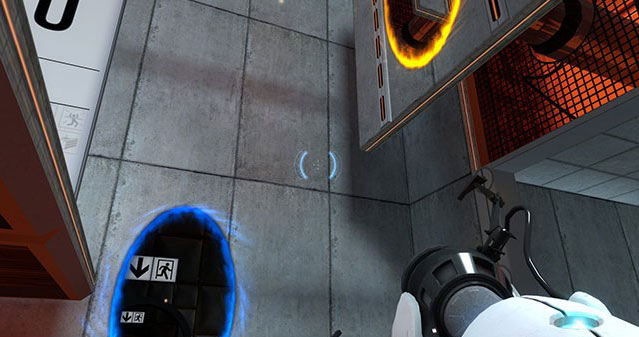
Words are ill-suited tools to describe the sheer amusement value of Portal. At about three hours long, it's one of the shortest games you'll play this year. You have absolutely no offensive weaponry, no special powers, and for most of the game your only real opponent is yourself. It's still, bar none, one of the best games I've ever played. You likely already know the basic premise of the game: you have a gun that makes holes in space. The Portals connect two points in reality and allow movement through them. You'll be using the device to solve puzzles, move through levels, and generally keep yourself alive in the face of the game's environment.
These puzzles are an absolute distillation of the Valve philosophy. Every challenge provides you with all the instruction you need to escape ... though their solutions are not always immediately obvious. Each one is only slightly more difficult than the last, and builds incrementally on every lesson you've previously learned. Portal is not only an excellent game, it's also a microcosmic example of the human learning process. This results, near the end of the game, in astonishing feats you would never have thought possible at the start of your journey. This plottable line of advancement from the simple to the sublime is the core of the game.
That said, more than just fun gameplay makes this title stand out. Aside from the Portal gun, you have but two companions on your journey. The voice from the ceiling, telling you what to do while lying out of one side of her face, is an artificial personality. The other companion is a lifeless cube. If that sounds sort of grimly funny, you're already getting the joke, and the point. Portal is hilarious in an Edward Gorey-meets-Douglas Adams sort of fashion, dark humor mixing with futurism for the sake of futurism.
Portal, then, is funny and intelligent in equal measure. It's wholly unlike anything else released this year, and on its own validates the entry price for Orange Box purchasers. It is, in point of fact, well worth buying all on its lonesome if you are interested by the rest of the offerings Valve has here. It also has the benefit of having the one of the best game songs ever made as its finale track.
Conclusion
Valve's Orange Box is easily one of the best offerings available for any platform this year. It's an amazing value and variety, offering story, online play, and intellectual challenge in equal measure. Every component of the piece is so strong that it could stand on its own - together it's an unstoppable force of gaming goodness. It's worth noting that reality intrudes on every element of perfection - lag has been a problem for Xbox 360 Team Fortress 2 players, but a patch is on the way. Otherwise ... there's really very little to complain about here. It's boring and unfunny to say "the whole thing is terrific" and leave it at that.
But then, I'm a nerd. The whole thing is terrific. In the face of dozens of high-price AAA titles this Christmas season Valve's offering stands out from the crowd with a clusterbomb of content that won't be easily put down. People will be playing TF2 for literally years to come, if you're done with Episode Two you can go back through it gnome-style, and I fully expect Portal to be supported by fan-created rooms for a long, long time. It's well worth buying for anyone that enjoys the first-person perspective on gaming, regardless of what kind of gamer you are. Now if I could only get that song out of my head ...
-
Cheating At Roulette May Be Legal In UK
nuke-alwin writes, "A hidden device that appears to give an advantage to roulette players may be legal in the UK when the gambling industry is deregulated next year. The device — which consists of a small digital time recorder, a concealed computer, and a hidden earpiece — uses predictive software to determine where the ball is likely to land. It has been tested by a government lab, which found that 'the advantage can be considerable.' It will be up to casinos to spot people using such devices." -
15 Websites That Changed the World
nuke-alwin writes "To mark the web's 15th anniversary, The Guardian is reporting on 15 websites that changed the world. Everything from commercial sites like eBay and Amazon to social collaboratives like Wikipedia and Slashdot made the list." From the article's comments on Blogger: "Content was once made by companies for passive consumption by people. After Blogger, people were the content. They wrote about and read about their friends, their opinions, their cats. (There was a lot about cats in the early blogs.) None had a huge audience but collectively they were massive. Now you see TV networks saying: 'We've gotta get on the web because that's where the audience is,' says Williams." -
Installing Wine with DX9
ts1920 writes "WineCVS is an extensive script for automated installation of different versions of wine and Cedega. Today it has been updated to support wine installation with latest DX9 features. The latest patch level of the script now includes a profile for installing Wine with Oliver Stiebers Direct3D 9 patchset. A short installation instruction and some more detailed information can be found at linux-gamers.net." -
Observer Gives Wikipedia Glowing Report
JaxWeb writes "The UK newspaper The Observer is running an article about the open encyclopaedia Wikipedia. The article, 'Why encyclopaedic row speaks volumes about the old guard,' gives Wikipedia a glowing report and mentions some of the issues which have recently occurred regarding the project, including the need to lock the George Bush article in the run up to the election, and Ex-Britannica editor Robert McHenry's comments, as previously mentioned on Slashdot." -
BT Plans Move To IP Telephony, Starting Next Year
pure_equanimity writes "The BBC have published an article saying that BT are planning to migrate from a PSTN to an IP network, a move to cost 3bn. They say that broadband will become ubiquitous, with customers having the ability to plug any device in to get access. They also say that current cheap broadband products will more than likely not be viable in five years time. They plan to start rolling out in 2006, and cover the vast majority of customers by 2009." -
Nigeria Joins the Space Age
nuke-alwin writes "The Age is reporting that Nigeria has joined the space age by sending a satellite into space from Russia. The satellite will be used for environmental monitoring and to keep an eye on oil pipelines." -
World Nuclear University Launched
nuke-alwin writes "The first meeting of the 'academic council' of the newly-launched World Nuclear University (WNU) was held in the UK last week. The mission of the WNU is to strengthen the international community of people and institutions to guide and further develop nuclear power and many other nuclear applications (in agriculture, medicine, environmental protection). As workers in the nuclear industry are aging, organisations have started Young Generation Networks such as the YGN of the British Nuclear Energy Society. The WNU is a further recognition that the nuclear industry needs to educate a new generation of workers, so that nuclear power can continue to provide electricity without the production of greenhouse gases." -
Russian Ship Resupplies Space Station
nuke-alwin writes "The Kansas City Star is reporting that a Russian unmanned space ship has brought fresh supplies to the International Space Station. Since the grounding of the space shuttle fleet the ISS depends on the Russians to get supplies. The crew have also received satellite telephones for the first time." -
Los Alamos to Use AMD's Opteron in Linux Clusters
nuke-alwin writes "eWeek is reporting that Los Alamos National Laboratory announced it will use more than 3,300 Opteron chips in two of its Linux clusters. According to the article 'The key to Opteron, as it tries to gain traction not only against Intel Corp.'s 64-bit Itanium chip but also its 32-bit Xeon offerings, is its ability to run both 32-bit and 64-bit applications equally well.'" -
NASA says Columbia Rescue was Possible
nuke-alwin writes "Apparently NASA is saying that a rescue mission may have been possible for the Columbia crew. I first saw this on TV, but Chicago Sun-Times is also reporting the story. The risks would have been great, and may have endangered more astronaut's lives." -
Using Perl to Automate Exchange 2000 Tasks?
en4ca asks: "We have recently started using Exchange 2000 on a W2k platform with Active Directory at work. Previously, we used a mailsystem that could be easily controlled by command-line paramaters (and hence by perl). What I wanted to ask was, has anyone used perl to automate boring, mundane tasks in Exchange like mass creating mailboxes? What did you use to do this? [code would be very much appreciated] I've tried using Win32::OLE, but havn't had much success" -
2nd Annual Poetry Spam
guidobot writes "Its the time of year for SatireWire's 2nd Annual Poetry Spam, an event where contestants write poetry consisting entirely of quotes from spam e-mail. You can also check out the winner of last year's contest. This could be your only chance to win a contest by writing poems about earning $100,000 in 10 weeks by working at home..." -
Libraries Asked To Destroy Reports, Databases
unix guy writes: "Our good friends and protectors in the U.S. Gov't have decided that what we used to know we can't know any longer. This LA Times story talks about libraries being ordered to destroy existing government reports and data sources in the name of homeland security." Is it really a fair trade to give up readily-available information about "airports, water treatment plants, nuclear reactors and more"? -
Article In The Guardian On Internet2
Sam Halter writes: "The Guardian carries this story about the future of the Internet and the expermental Super high-speed academic networks that are being built in Europe and the U.S." -
NetBSD 1.5.2 Released
KiwiSurfer writes "NetBSD 1.5.2 has been released. Check out the release announcement and the changelog from 1.5.1 to 1.5.2. Grab NetBSD 1.5.2 from ftp.netbsd.org or one of their mirrors." -
New Molecule With Switchable Chirality
Nanotechnology writes: "Available here, The molecule was developed by adding copper ions to a derivative of the amino acid methionine. The investigators were then able to switch the molecule's chirality by the addition or removal of an electron. Furthermore, they found that the molecule's chirality could be switched repeatedly, and that the two forms of the molecules polarized light in opposite directions." Especially interesting is this line from The Canary Lab's home page ("Research"): "We are also scrutinizing other aspects of signal detection technology. We prepared a new polymer very similar in structure to polyaniline ... The new polymer was designed to serve as a molecular wire for attaching electrochemical sensor molecules to electrodes." -
Online Book About Nano/AI
Jonathan Desp writes: "The book is available here, written by Frank Wayne Poley, in the same line as Bill Joy's article, "Why the future don't need us." Here you will learn about "Robo sapiens" vs. "Homo sapiens", Robot as president, Nanotechnology, Nanosystem,Internet robots, Cyborgs, the neurochip, Microsoft, Biomechanics and computing history as well. The book raises some important questions such as: Technology, is it always good? " -
Online Book About Nano/AI
Jonathan Desp writes: "The book is available here, written by Frank Wayne Poley, in the same line as Bill Joy's article, "Why the future don't need us." Here you will learn about "Robo sapiens" vs. "Homo sapiens", Robot as president, Nanotechnology, Nanosystem,Internet robots, Cyborgs, the neurochip, Microsoft, Biomechanics and computing history as well. The book raises some important questions such as: Technology, is it always good? " -
Nanomedicine
ATOMA writes: " The book Nanomedicine from Robert Freitas is now available. And it's free on the Web. With 10 chapters, this is one of the most technical books on nanotechnology, along with Nanosystem from Eric Drexler. But Robert has said it's not his last one; we should expect another two books on Nanomedicine from him. "