Slashdot Mirror
Domain: flightglobal.com
Stories and comments across the archive that link to flightglobal.com.
Comments · 122
-
Re:What about the engines?
In case anybody is unaware, there have been some gruesome accidents trying to get the motors to work including a couple unfortunate deaths at Scaled Composites. Apparently it is perhaps the one major show stopper to getting the vehicle to work out, as scaling the rocket motor from SpaceShip One to the much larger SpaceShip Two size has been a major hurdle.
There was one accident. It was a result of a bad test setup, so I understand. When you use propellants that can explosively decompose as nitrous oxide can (while under enough pressure), you need to put in special protections (such as valves that close under these circumstances) to keep decomposition originating in your test equipment from propagating back into your reservoirs of nitrous oxide. Either they didn't do that, or their valves failed to operate. They were also too close to the test setup.
If my understanding is incorrect, then feel free to correct.
Food manufacturers use nitrous oxide in such things as whipped cream spray cans and it's apparently still occasionally used in medical anesthesia (such as in dentistry), so it's not a particularly hard to handle chemical.
As another replier noted, it's been four years or so. Googling around, I see that they had successful engine fire tests in 2009. -
Re:Wasn't the phone off?
I don't know, why don't you tell us what the reason is if the risk of EMI with avionics systems isn't a concern?
-
Re:Epic Fail
Obviously. The Phase 3 DUs are flawwed.
On a Boeing Business Jet fitted with in-flight connectivity, for instance, there is a note in the log book that says Phase 3 DUs are not to be installed, but that "version 4 is fine and version 2 is fine", says a source.
Wi-Fi is probably one of MANY things that can interfere with flawwed, improperly shielded electronics.
-
Re:No! Lasers don't blind pilots
No, they don't. There has not been a single case of a pilot blinded by lasers, nor is it likely there ever will be.
Strawman argument. The issue is not permanent blindness, but disorientation, temporary blindness, or injury. There are multiple reports of pilots being injured by lasers:
Burned retina: http://www.washingtontimes.com/news/2004/sep/28/20040928-111356-3924r/
Ruptured blood vessels: http://www.marconews.com/news/2011/jan/03/collier-sheriff-helicopter-pilots-injured-laser/?partner=yahoo_feeds
Unspecified possible injury: http://www.flightglobal.com/articles/2008/11/25/319357/pilot-injured-in-american-md-82-laser-incident.html
You might not be impressed because there's no blood, but an eye injury can be a career-ender for a pilot. Disorientation is the most common result of lasing incidents, with some cases of temporary blindness. Reduced vision, even temporarily, is a Big Deal when flying.
-
Oooh goody!
Maybe we can sell them those exploding electrical panels.
-
Re:40 minutes
The thing is a gas-powered ducted fan, and weighs about 20 lb, so it's hard to get both a decent payload fraction and mission endurance out of something that heavy and power hungry. You could add bigger gas tanks, but you quickly reach a point where your useful payload capacity gets too small. (In other words, you can trade radios and cameras for more gas, but it would only add a few more minutes of flight time and then what's the point without getting video back?)
Also, it's ugly as sin and makes quite a racket. Soldiers refer to it as the 'flying trash can' and 'Thunder Hawk' or sometimes 'Thunder Bunny' -- lovingly, of course.
There are much better VTOL UAV implementations coming down the pike (AV's SP2S, for instance) but right now the T-Hawk is the only one with an FAA Certificate of Airworthiness for UAVs, allowing domestic operations by nonmilitary entities, so Miami-Dade has no other options for a UAV that can hover.
-
Re:We have enough airports and airplanes
I was at a Mexican place in Everett when I saw the Dreamlifter bring in the last section for ZA002 in the spring of '09.
Here is a picture of a Dreamlifter, A380 and 747-400 all in the same hanger.
http://www.flightglobal.com/blogs/flightblogger/2010/12/photo-of-note-superjumbo-dream.html
Big damned building.
-
Re:Ramp
Yea, but even with declining numbers of Hornet Cs, the 350+ plus Rhinos make the USN, what, 3rd largest air force in fighter/attack alone?
Boeing's production costs and delivery costs of F-18E/F are actually declining while F-35 costs are spiraling upwards faster than an F-22 can climb.
http://www.flightglobal.com/blogs/the-dewline/2010/09/super-hornet-price-tag-spirali.html
F-35 is going to be too damned expensive for the Navy, Marines and USAF to buy (if they ever get done) and to operate
http://www.flightglobal.com/blogs/the-dewline/2010/01/chart-f-35bc-operating-costs-v.html
USN/USMC are going to have to suck it up and buy alot more Super Hornets, probably finally fund and get those towed decoys and USAF is going to have to suck it up and buy more F-22s and F-15SE and F-16 block 60s
-
Re:Ramp
Yea, but even with declining numbers of Hornet Cs, the 350+ plus Rhinos make the USN, what, 3rd largest air force in fighter/attack alone?
Boeing's production costs and delivery costs of F-18E/F are actually declining while F-35 costs are spiraling upwards faster than an F-22 can climb.
http://www.flightglobal.com/blogs/the-dewline/2010/09/super-hornet-price-tag-spirali.html
F-35 is going to be too damned expensive for the Navy, Marines and USAF to buy (if they ever get done) and to operate
http://www.flightglobal.com/blogs/the-dewline/2010/01/chart-f-35bc-operating-costs-v.html
USN/USMC are going to have to suck it up and buy alot more Super Hornets, probably finally fund and get those towed decoys and USAF is going to have to suck it up and buy more F-22s and F-15SE and F-16 block 60s
-
Re:I Want My Flying Car...
Oh, well why didn't you ask! Here you go, and here and... well, they're working on it.
-
Re:What's the adage?
Except that China already has the capacity to design and build modern aircraft -- acquired from the US, Europe and the Russians. And, no, it won't take them 10-15 years to come up to speed. It might take them 15 years to be regarded as a serious competitor worldwide, but their first sales will surely be domestic. COMAC is scheduled to deliver a Regional airliner ARJ21 in volume next year. The first three planes have already been flown.
COMAC's Boeing-737/Airbus-320 entry the 919 is planned for 2016 delivery.
http://www.flightglobal.com/cgi-bin/mt/mt-search.cgi?blog_id=167&tag=ARJ21&limit=20&IncludeBlogs=167
-
Link to C919 technical details and analysis
There's a lot more info on the C919, for those of us curious about it on the technical level, at http://www.flightglobal.com/articles/2010/11/05/349329/china-special-c919-update.html .
-
Yet more copying-for-traffic BS sites
Why don't the editors just link to the original source rather than sending bucketloads of traffic to these sites?
Even contains MORE information like how it failed (in this case, something caused it to go into autorotation and basically didn't succeed with the landing).
-
Re:Left out the best part
Theres an interesting post about it on the blog DEW Line
http://www.flightglobal.com/blogs/the-dewline/2010/08/iran-uav-bomber-via-south-afri.html
-
Re:Several thoughts
Re "Lifeboat Dragon", see the first two "back up" slides here:
http://www.spacex.com/20090617_Elon_Musk_Augustine_Commission.pdf
There was also some blog discussion of delivering a lifeboat Dragon in the Shuttle cargo bay. But since then, the Shuttle life has shortened and SpaceX's schedule has stretched to the point where that's probably impossible.
Finally, it will costs a great deal of money for NASA to get to the moon. So, why not offer up an X-Prize
Finally, screw the moon. The moon is a trap.
-
Re:Catastrophic failure modes
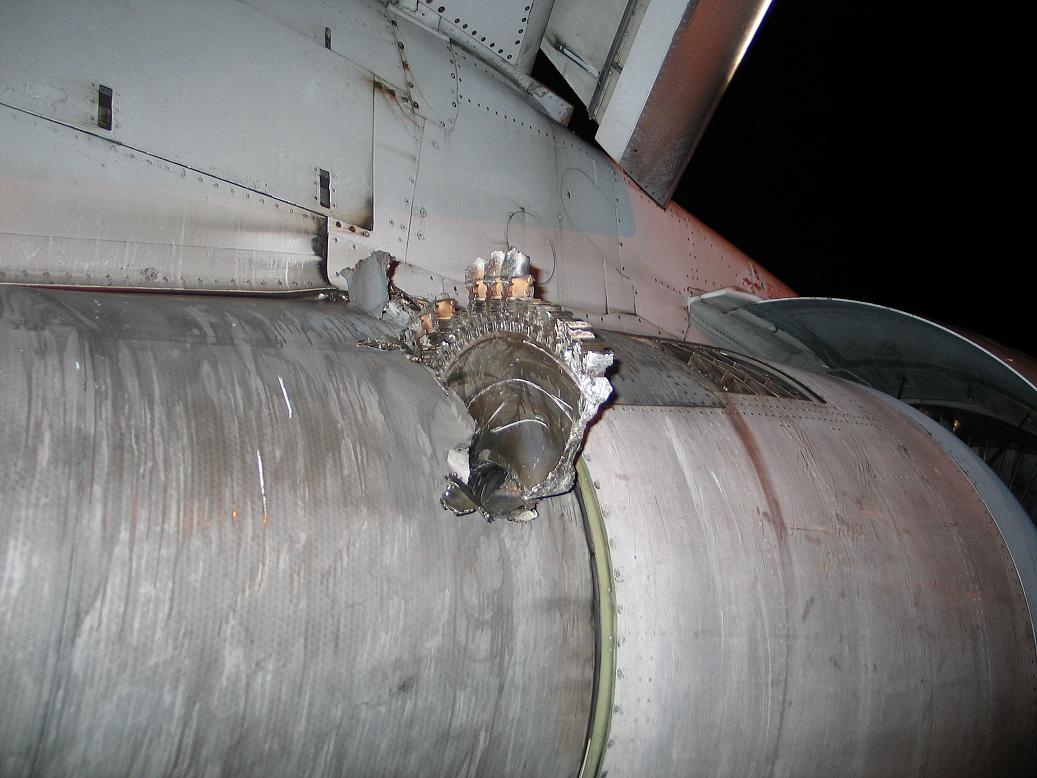
On one hand you say that Compressor blades / turbines are light and fluffy, and then you say that a carbon fibre fly wheel is the stuff of instantaneous death and destruction. I can see that this argument will not be one by words. It is time to resort to pictures.
These are all picture of the effects of parts of the engine flying off and traveling through the housing.
http://consumerist.com/images/resources/2007/12/Bad%20Looking%20Engine-thumb.jpg
http://img406.imageshack.us/i/img0163gu3.jpg/
http://www.iasa-intl.com/folders/belfast/AA763EngineFire-3_files/aa2.jpg
http://www.flightglobal.com/assets/getAsset.aspx?ItemID=16268Wikipedia has an article about a plane that was brought down by one of these fluffy engine parts
http://en.wikipedia.org/wiki/United_Airlines_Flight_232The idea of powering something with a burnable fluid dangersous fluid would not be acceptable today.
Failure of gasoline: Fire.
Failure of a flywheel: Explosion.You really don't notice the difference?
You really have never heard of the Ford Pinto? If you get gasoline and air in the right mixture, you can get an explosion. However, just because something does not EXPLODE holywood style, does not mean it is not dangerous. Ask an someone who has had to watch someone being burned alive in a automobile gasoline fire. It happened quite a lot before proper engineering controls were put in place. The generations before our had to deal with this. It took the previous generation(s) to build the automobile. They were noisy, dangerous, and unreliable, but they built them nonetheless. The truth is that anything powerful enough to power and automobile whether it be a Gasoline, Steam, flywheels or batteries packs enough energy to cause significant loss of life. My point is not that flywheels are necessarily the safest thing around, nor even that flywheels are necessarily the best solution. My point is that in today's political climate new inventions can not be brought to bear unless they are so safe that they are practically useless. Do you really think the lawyers would have allowed automobile / airplanes to be created if they were invented today? Hydrocarbon fuels were grandfathered in from a previous century. As for batteries, the public has the impression that batteries are safe and environmentally friendly. This may change over time when the energy density of batteries starts to compete with fossil fuels, and more laptop batteries start catching fire.
Planes and cars were engineered before during a time when people were willing to live with a little danger
Ah, the old "golden age" myth. The good old days when women weren't even supposed to ride in planes because of the danger.
Just because you scoff at an argument does not mean you actually answered the argument. As for women flying in planes, I don't know what that has to do with the argument. There are plenty of women aviators.
But to be perfectly honest with you I really don't know what you are arguing about, unless you just like arguing.
-
Re:Slingshot?
-
RE: N. Korean technology
'unique thermo-nuclear reaction device.'
-
Re:From what I've heard, it really is that bad...
Interesting... I hadn't seen this before, but here is a link to pics of those Finish engines.
http://www.flightglobal.com/articles/2010/04/16/340727/pictures-finnish-f-18-engine-check-reveals-effects-of-volcanic.html -
Re:What?
There were also all those military flights, especially the Finnish one (pics):
On 15 April, five Finnish Air Force F-18 fighter jets on exercise flew into the ash cloud in northern Finland. Volcanic dust was found on the engines of three of the aircraft and a further inspection revealed extensive damage by molten glass deposits inside the combustion chamber of one of the engines. The engines were sent for disassembly and overhaul. As a result all unnecessary military flights were cancelled except for identification flights to enforce sovereign airspace. Meanwhile a BAE Hawk trainer with special equipment to sample the volcanic dust was being flown from the 41st squadron in Kauhava. Even short test flights with an F-18 revealed engine damage sufficient to destroy engines.
and then also:
On 23 April it was announced that British Royal Air Force training flights had been suspended following volcanic ash damage to the engines of Eurofighter Typhoon aircraft.
Why should I trust commercial airlines which were losing insane money over this, over militaries of several countries?
-
Re:Why can't we do better? Are you fucking kidding
This ash cloud from the Iceland volcano has caused engine damage. I wonder if airlines are throwing caution away to avoid the daily loss in business.
-
Re:Design
Notice that the threat is real - the Finnish air force did get engine damage on their F18:s when they were flying through the cloud. Just take a look here: Finnish F-18 engine check reveals effects of volcanic dust
And we must blame Top Gear for the eruption too.
-
Pictures of Finnish F-18 engines after ash flight
Norway has mostly F-16s.
You may be referring to this incident with Finnish F-18 Hornets vs Ash:
-
Re:UK MET-OFFICE
How do the Finnish airplanes fit in? It's all nice and dinky until an airplane experiences motor failure and it plummets down an urban center, right?
-
Re:The sky over Germany looked clear today
Not directly answering your question, but:
PICTURES: Finnish F-18 engine check reveals effects of volcanic dust
Finnish fighter jets damaged by volcanic cloud
Original article of Finnish Air Force (in Finnish) -
Re:Secretive Space Plane?
So no this project is not secret. It is an USAF project being handled by DARPA, but it is not secret.
There are many different types of secret (and let's not even start on the different types of Secret). In this case, the minimum details are known, but nobody outside of the classified world actually knows what technologies will be tested on the X-37B or what it'll be doing during its up to 270 days in orbit, and no interviews are permitted.
On a side note, another cool semi-secret project is the Lockheed Martin Revolver, which is generally thought to be a prototype of a flyback first-stage booster. This means that the first stage can come back and land after it boosts the rest of the rocket up, allowing for it to be easily reused.
http://www.flightglobal.com/blogs/hyperbola/2010/03/lockheed-trademarks-revolver-f.html
Some interesting patents: http://forum.nasaspaceflight.com/index.php?topic=12755.msg556730#msg556730 -
Re:False Hopes.
...is a friggin' sensationalist claim that has no place in science reporting, either on a primary site or on a news aggregation site. Should the first Falcon 9 fail, they will learn from it and launch better designs in the future. Orbital still is working on its Taurus rocket. The EELV program (Atlas and Delta) are still pushing strong in the commercial market. If the first Falcon 9 flight fails, it will not be the end all be all of either Obama's current NASA vision, nor America's role in the space program. So please, keep the hyperbole out of the damned summaries guys.
I totally agree. I'm a huge fan of SpaceX and have a lot of hope for them, but even if they suddenly disappeared into the ubiquitous ether the new NASA plan would still be going strong. As you mentioned, there's quite a few other companies getting fixed-price milestone-based funding from NASA to develop launch vehicles and spacecraft for crew. A quick summary:
Launch vehicles:
* SpaceX Falcon 9 (vehicle mentioned in summary): medium development risk, low-cost
* Lockheed/ULA Atlas V: low-risk (development risk, that is), high cost, but still drastically lower cost than Space Shuttle or Constellation (has been operating for a number of years now, with all 20 launches so far successful)
* Boeing/ULA Delta IV Heavy: low-risk, high cost (could potentially lift Orion spacecraft)
* Orbital Taurus II: medium-risk, medium-cost, although probably better suited for cargo than crewSpacecraft (potentially launched on a variety of different launch vehicles):
* SpaceX Dragon: capsule is pretty much ready, with a number of test articles, but the development "long pole" is a to-be-developed launch escape system
* Boeing/Bigelow capsule: sometimes termed the "Orion Lite", Bigelow's also interested in this as a way to get to his private space station modules
* Blue Origin: composite capsule, also designing a novel push-based (instead of the traditional tractor-based) escape system adaptable to other capsules
* Sierra Nevada/SpaceDev Dream Chaser: more novel design, using a lifting-body based on the well-tested HL-20; this sort of design provides a gentler reentry from LEO (and potentially upgrades well to lunar/Lagrangian return); the company has already spent at least $10M of its own funds developing the design and building test articles
* Orbital Cygnus: optimized for cargo deliveries to ISS, but can potentially be extended to crewIt's also worth noting that Blue Origin, ULA, Boeing, and Sierra Nevada are all being funded on CCDev contracts (in addition to a certain amount of private funding, which they're all required to have). With these contracts, they only get the full payment if they meet all of their pre-determined milestones (building test articles, performing tests, etc.) by September of 2010. IMHO, this September is when we'll get a better idea of which companies will be competing for crew/cargo delivery in the future, and
-
Pictures of the Airborne laser
-
USAF seeks airborne car-zapperThe contrarian in me read TFA and eventually found the source article:
http://www.flightglobal.com/blogs/the-dewline/2010/01/usaf-seeks-airborne-car-zapper.html
Apparently it's the Air Force that's interested in such a device, which would be used from the air, not via police car.
"The Air Force Air Armament Center (AAC), 308th Armament Systems Wing, Rapid Acquisition Cell is seeking information that could lead to development of an air-delivered capability to disable moving ground vehicles while minimizing harm to occupants. Development schedule is expected to be a critical factor in any potential development effort, so responses should focus on feasibility and maturity of the key technologies. Responses should include candidate integration concepts which take maximum advantage of existing infrastructure in order to minimize cost and development time."
And since I bothered posting I guess I'll add that the comparison to the On-Star solution is bizarre. Obviously the On-Star approach has nothing to do with EMP but instead is a command sent to the on-board computer via satellite. I suppose it's comparable in that both solutions involve things above us adversely affecting motor vehicles (and to that extent I guess it's also like a traffic jam caused by drivers looking at the Goodyear blimp).
-
flightblogger - good news site re boeing/airbus
There's a good industry-news site on the 787 (and its Airbus competitors) that I've been following for a while at http://www.flightglobal.com/blogs/flightblogger/ - there's a lot of background and good technical stuff there.
-
They are already planning Space Ship Three
Some have commented that Space Ship Two is only a thrill ride. That may be so for now but the company is already on record as saying that if SS2 is successful, then there will be a SS3 that will be orbital. There is some speculation that SS3 will be only hypersonic point to point but if there is money in it, I am sure Branson will go for an orbital verson some day.
-
Re:Possible Reasons Why
There are better pictures out there, including one of it on the ground.
At least people think its the RQ-170, if its not, there are two strange planes out there.
http://www.flightglobal.com/blogs/the-dewline/2009/12/kandahars-loch-ness-mystery-pl.html
-
Re:Hello, I am a professional journalist
Quite right - here's a prime example of a story handled two ways, first by a blog, then by a news organization.
(Admittedly it's a stupid story, but it's still a good example.)
This story got rolling by this blog post about a photo of a really big guy not fitting in an airline seat:
http://www.flightglobal.com/blogs/unusual-attitude/2009/11/passenger-creates-big-debate-a.html
The blogger hedges his bets on all the "facts" he proffers, stating the story behind the photo was "sent to me with the absolute assurance" of it's authenticity. But even here he's light on the facts, and throws it open to the great unwashed - the commentators - to fill in the gaps. Which they do, many claiming to know what actually happened on the plane. Whether these claims are true are not is another matter. The individuals cannot be verified to see who they are, were they on the plane, and so on.
Now here's what you get when a newspaper handles the story.
(print view)
http://www.nypost.com/f/print/news/national/should_this_man_be_able_to_fly_on_1NoQ5o620LmpkpXtA7tXSP
(web view)
http://www.nypost.com/p/news/national/should_this_man_be_able_to_fly_on_1NoQ5o620LmpkpXtA7tXSP
Now I make no claim that this is the pinnacle of writing. (The first two sentences - was that really necessary?) And this is the New York Post for fug's sake. But still it has actual facts. Three reporters worked on it. They talked to people. They verified information. They added background. They look things up (presumably not in Wikipedia.)
You can give the blogger some credit for getting this whole mess started, but the photo basically fell in his lap. It took actual journalists to take this thread and turn it into something resembling a rope. -
Re:What's next?
according to wikipedia http://en.wikipedia.org/wiki/List_of_Constellation_missions the next mission is Ares 1-Y, in 2013, a full first stage, a real second stage, testing high altitude abort.
Actually, even prior to the Augustine Committee's report (which suggests using commercial crew instead of the Ares I for most of its options), NASA was already planning to delete the Ares I-Y launch to try to speed up the Ares I development schedule. Also, the table (with NASA-provided figures) in general should be taken with a large grain of salt -- even though NASA's public estimate is that the first Ares I launch will be in 2014, the independent assessment by the Augustine Committee estimated that due to the developmental problems NASA has had (some of them inherent to the design), the Ares I likely wouldn't actually be able to launch until 2017-2019.
-
Re:Taking this seriously...
The reason you haven't seen anything so innovative in 70 years is that the last 70 years have had constant steady progress.
Not to rain on that parade, but in the mid-1930s we had V-8 engines for cars, which could accommodate no more than 6 passengers comfortably and got well under 30 MPG. Airplanes one the other hand had rotary engines a la the Armstrong-Siddeley or Pratt & Whitney, carrying up to 14 passengers and with flight range capabilities of up to 745 miles.
Today we have 4 cylinder engines in cars that can barely accommodate four adults comfortably, let alone six, with a few models sporting MPG ratings in the 40+ range, but with fleet averages still far below that. Contrast that with aircraft, which have enjoyed brutes like this one for decades, and whose carrying capacities have increased geometrically since the 1930's and whose range can extend to the thousands of miles.
Anti-lock brakes, power steering, GPS in-dash navigation, and all the other bells and whistles are all well and good. But aside from computer controls and fuel injection (another technology from the last century), we are still being driven by the same engine Henry Ford used, in little metal (though now increasingly plastic) compartments not radically different from those used in 1930.
If the same attention to innovation and invention had been nurtured in the automotive industry as it was in the aircraft industry who knows what we'd be "driving" now.
-
Re:Interesting stuff
Tornado GR4 it looks like
http://www.flightglobal.com/airspace/photos/berniec/raf-tornado-gr4-23217.aspx
-
Interesting stuff
The end of last year, a couple videos came out with an American F-15 pilot talking about what it was like going up against the Indian Air Force Su-30MKI. It was quite interesting, as the vectored thrust did offer additional maneuverability but it came at a cost. That isn't to say that this new jet and training wont overcome that advantage, but it was a glimpse into the world of air to air combat I don't think makes it out into the civilian world all that often. The clips were put up on youtube - I'll link to both.
http://www.youtube.com/watch?v=WKEa-R37PeU
http://www.youtube.com/watch?v=4ibgAQ7lv0w
Basically if I understand it correctly the vectored thrust allowed them to turn, but they would lose airspeed and altitude in the process. As the fighter types say - speed is life - and once it happened they were apparently easy pickings. This FlightGlobal writeup about it may do a better job of explaining.But I wonder is how much longer this will matter. The Lockheed video on their DAS for the F-35 pretty much asserts that the system makes maneuverability irrelevant. I realize that it's a vendor sales presentation, but at the same time I know off-bore-sight missiles are pretty much a done deal. Stealthiness helps some, but I doubt it would be enough as these systems keep improving. It seems soon the primary factor in air to air combat will be the quality of radar and missiles that are available.
When I bring this up with current military folks, they say they think rules of engagement will keep it from going that far. I can see that in situations where one side has complete air superiority - but if it comes to evenly matched sides, I think ROE will be out the window when sticking to it means losing. The whole thing is rather disconcerting as we seem to be developing better ways to kill just as quickly as all our other tech is advancing but I don't see leaps in our ability to live peacefully or get along keeping up with it all. -
Re:Anyone seeing parallels to IT projects here??
My day job is helping develop a new aircraft. It gives me some insight into what might be happening over there at Boeing. My take on the whole matter:
Boeing's first screwup was an entirely ridiculously aggressive schedule, one far more challenging than any of their previous projects. You'd think they would learn better, but apparently the latest batch of management monkeys figured they could make the impossible happen simply by declaring that it would, and expected the force of their words to be sufficient. (Lesson: things always take longer than you think they will. Use your worst-case estimate, not your best-case one)
Second, the outsourcing. Well, the outsourcing itself was not the problem, but rather it was the way they handled it. They farmed out major assemblies to far-flung companies, and then (here's the important part) didn't supervise them well enough. They simply took everyone's word that the engineering was sound and that they were on schedule with their builds. Everyone was actually late, but nobody wanted to admit it because nobody else was saying they were late. Eventually, they realized what was going on, but not after it was too late to fix it without causing too much of a delay. Boeing also failed to ensure that the fastener manufacturers would have their products ready in time... which would bite them in the ass later. (Lesson: Watch your subcontractors very, very carefully. Supervise their work, check their processes, and double-check their engineering)
Third, marketing. More specifically, the marketing types drove the program management and engineering decisions. Marketing wanted to shoot for a July 8 rollout to get an auspicious date... and thus commanded it to happen. Well, the only problem was that the airplane wasn't ready yet. Not only was it not assembled, but none of the internal systems were installed (they were supposed to be put in by the subcontractors, but everyone was late...). So what did they do? They slapped the empty sections together--with fasteners from Home Depot as a temporary fix, and painted it. That's right, they used ordinary hardware-store bolts in place of flightworthy fasteners because some marketing dweeb wanted to show "visual progress", and they didn't have the time to do it right. And not only did they use non-flightworthy parts, but they lost track of where they put them, meaning they had to go back and check all of the fasteners to make sure the temporary ones were removed. Boeing lost months because they had to go back and redo stuff that wasn't per spec. (Lesson: "visual progress" isn't. Half-assedly slapping something together to make it look like you've accomplished something just costs you more time, effort, and money down the road. Do it right the first time.*)
I don't know enough about the latest delays (structural issues) to be able to comment on them. But the earlier stuff I see parallels to in all kinds of places, even at work.
*Dear God that pisses me off to no end... I can't tell you how many times I've been told just to "hurry up and do it" because my manager wished to show "visual progress", only to have to go back and do it again, correctly. Tape measures and paper flat patterns simply can't be used to install mount points with tolerances in the thousandths... either get the proper tooling support to do it right, or fit the entire thing together before installation. "Visual progress" is right up there with "think of the children" in the "worst phrases of the English language" category...
-
inaccurate
The problems are with barrels that aren't even close to production yet. Boeing (in as much as you can believe them anymore) says that this will not delay the production of the 787 (to first flight) of the 787 any further than it already has been.
This information is out there, is it so difficult to go find it before publishing wrong info instead?
http://www.flightglobal.com/blogs/flightblogger/2009/08/breaking-structural-flaw-halts.html
Oh yeah, and the problem with the sections isn't with the skin, it's with the stringers behind them. It leads to wrinkles in the skin, but the real fix is to not mess up the stringers in the first place.
The statement that this casts even more doubt on the outsourcing model set up at Boeing under Alan Mullaly is most definitely not diminished by the inaccuracies in the reporting of these details.
-
Re:And somewhere across the pond...
No, they're still trying to breath in and out very slowly and deliberately hoping that the A380 will fly financially. With the current economic climate, it will be a awhile before they're laughing again.
-
Flight video; more details
There's some pretty cool video of White Knight Two flying at Oshkosh here:
http://www.flightglobal.com/blogs/hyperbola/2009/08/video-all-the-virgin-galactic.html
There's also some notes from a panel discussion on the craft. Some highlights:
* Production run for the program is set up for 12 WhiteKnightTwo carrier aircraft and 50 SpaceShipTwo crafts;
* This is the first all-composites aircraft, something that the aviation industry needs to embrace more;
* WhiteKnightTwo is not just an aircraft, it is a spacecraft delivery system that is capable of delivering cargo into space cheaply; [orbital microsatellite launch]
* Scaled and Virgin are confident they can build a WhiteKnightThree that will allow they to launch even larger payloads into space;
* Rutan said WhiteKnightTwo is very manueverable, and he expected to put the vehicle through aerobatic manuevers at the Oshkosh show next year;
* Whitehorn didnâ(TM)t seem to like this idea very much, vigorously shaking his head and trying to dissuade the designer from such an idea. -
Re:Obligatory skepticism
Orbital human flights aren't planned for SpaceShipTwo, but they are planning on doing orbital microsatellite launches:
Virgin Galactic will use the cash injection to develop equipment - including a new pylon between the twin hulls of WhiteKnight Two - able to carry a two-stage launcher and satellite weighing up to 200kg (440lb), with a total payload of 17t- into orbit. The aircraft is designed as the mothership for Virgin Galactic's spaceliner SpaceShip Two.
Virgin Galactic's chief executive Will Whitehorn says that the company will begin its space cargo business in about three years time, two years after it expects to carry the first paying space tourists into suborbit. "For the first five or six years, 80% of our business will be tourism, but five to nine years after that it will be 50/50 [between passengers and cargo or training and scientific flights]," he says.
Whitehorn says the company could take the cost of launching a satellite into space using a ground-based launcher from $30 million to "as low as $2 million" using WhiteKnight Two.
He expects the first satellite launchers to be Virgin's own design, either built at its factory in Mojave, California or contracted out to a specialist manufacturer, but eventually the aircraft will be able to carry third-party boosters.
Whitehorn says that Virgin Galactic was approached by Aabar because the latter saw the opportunity beyond space tourism for the Scaled Composites-built WhiteKnight Two.
"This investment now gives us the capital to take us through the commercial launch and build an extra WhiteKnight for the satellite business," he says. -
Pentagon *hates* the Joint Strike Fighter concept
The armed services continually fought the concept for 50 YEARS -- ever since McNamara first pushed for it http://www.flightglobal.com/blogs/the-dewline/2009/07/robert-mcnamara-tfx-the-total.html/
Understand the real reason the F-35 procurement finally happened (and, not coincidentally, probably the reason Lockheed's bid beat out Boeing's) is that Lockheed got smart enough to offer 3 different planes (with the accompanying extra development and maintenance costs) instead of asking the services to live with a "joint" fighter.
The F-35 does have advantages over the F-22, but nothing like what we could have gotten from a Joint Strike Fighter.
-
Re:fed up...
Might have been 2 accidents in 127 missions, but if you look at it in terms of distance it is very safe
Commercial air travel is made to look safe? You seem to imply that commercial air travel is not as safe as one common metric suggests. Just because deaths per million miles travel is used doesn't mean that flights per fatal crash is not. Try this out: as of 2008, only 0.47 hull losses per million commercial flights. Sounds pretty safe to me.
-
Thales Airbus sensors and probes
Yes, they are heated. Here is a brochure: Thales Airbus sensors and probes.
"Or was this an error of the heating system, or what?"
I don't know the answer, and I don't find anyone claiming to know. I'm guessing that there is a subtle design error. If I could hold a Thales pitot in my hand I might be qualified to theorize why it fails. But I would not be qualified to design a better one, although maybe I could help do the design.
Apparently there are no problems with the Goodrich pitot sensors. (PDF file)
I've been studying how the world deals with issues such as this one. There are cover-ups as money is spent to influence and confuse the media. But now there is a huge difference from 20 years ago. Now the pilots, who don't want to lose their lives, have a voice. There are numerous blogs with many interesting comments. For example, now the media is being fed the apparent lie that the problems with the pitot sensors are new. But someone posted this TFU [technical follow-up], showing a report from December of 1995: TFU 34.13.00.005. Here is someone asking a question about that: Question: The problem was known since 1995. Why such long time for correcting the default?
None of the authors of articles for news agencies seem to have any technical knowledge. In the past it didn't matter, since the rich didn't want you to know. In the past people had to accept whatever the news media said.
Since the Thales sensors are being replaced, the smart thing would be to get one that has just been removed and examine it. -
Re:Suspect?....
This is where I got the idea. And everything is filtered through the computer only until the pilots turn the computer off! How hard is this to grasp?
-
Re:Irresponsible headline, summary
Also of interest is the fact that Airbus's software is created by Honewell in the U.S. Not sure if any of their software is European.
-
Affect on Armadillo Aerospace?
I just saw this April 2009 video interview with John Carmack this morning, where he mentions that some of their NASA work is up in the air, pending the budget shakeout. Does this mean no more NASA work for Armadillo Aerospace?
It does emphasize one benefit of private research and development: not subject (as in "we kill you right now") to such political money shuffling.
-Malloc
-
Re:DIY UAV
That's actually not a bad idea. Kinda expensive, but....
I did some quick looking, as I have a splitting headache right now. I found the "Stalker Lidar gun". it advertises a useful range of 5' to 4000', and will report both speed and distance. Those would both be very useful for ground/object avoidance. The stalker doesn't show an external interface, but some others that I glanced at did, but didn't have range specs.
For ground avoidance, assuming maintaining 400' AGL, if you always indicated 0 speed, even though your VSI (calculated from the accelerometers) could show climbing or diving, you would actually be following the terrain very well. With a forward facing one also, you'd have 60 seconds warning (at 60mph) for a forward stationary obstacle. Then again, if your obstacle happens to be something like a commercial airliner, it may be on approach at 135 knots (155mph), you'd be down to a 12 second reaction window at best, assuming a dive to get under his wings. Climb is a bad idea, since you probably don't have the thrust of a fighter jet, and banking to turn would put the UAV near the wing, which could mean your neat little toy could get ingested by his really large engines. in any case, I don't know that 12 seconds would be enough to get you far enough away from his wake turbulence.
But, that whole argument is a good reason to actually read the sectionals, and program in off-limits areas.
Nice clear air is a great thing, but there are other objects besides aircraft and buildings to worry about.
This is a story I can say I actually experienced, rather than hearing 2nd hand. I was on the downwind leg in a Cessna 150, perfectly happy about learning to fly. A turkey buzzard was soaring on a thermal in front of me, so he was effectively standing still. I didn't see him until just a few seconds before he would have impacted my plane. He was more towards the right wing, so I banked hard left, and he went under my right wing. If I had stayed on course, he would have impacted me at about 75mph (65 knots). If he had hit the prop, it would have been real hard to see (bird parts on the windshield), and it may have damaged the prop, but I was already in close enough to make my landing with no power. If he had damaged the wing, it would have been much more difficult. If he had impacted the windshield without hitting the prop, I could have had a dead bird and windshield pieces smack me in the head at 75mph (more or less. There are lots of things that pilots have to look out for. If you look around for bird impacts, you'll see what can happen.
Here's a few.
One of the big questions would be, how secret is your UAV, and where is it flying? An acceptable thing may be a self destruct. Spray fuel from the engine throughout the air frame for 5 seconds, then ignite. If it's done right, there won't be much to find. Civilians can't exactly get a hold of C4 to leave a self-destruct charge by the computers. Ahhh, what a pound of C4 would do to a computer.
-
Re:Make darn sure the Feds don't mind!
The FAA has a page for the Unmanned Aircraft Program Office. I also found an article from December 2, 2007 about regulations on UAVs. It mentions Unmanned Aircraft Systems (UAS) Regulations & Policies which would probably be useful to review.