Slashdot Mirror
Domain: freebsd.org
Stories and comments across the archive that link to freebsd.org.
Comments · 3,599
-
Re:Micro?
Putting pico in front of a unit is simply easier than writing 0.000 000 000 00x (or twelve figures before the decimal point) before your number and putting micro in front of a unit is a short way of writing 0.000 00 (or 6 figures before the decimal point) before your number. So one micro has 1 000 000 or one million pico units in it. [ source]
So as you can see, MicroBSD, referenced in this article, takes 1,000,000 times more space than PicoBSD. Using compiled-assembly
-
Re:FreeBSD 5?
5.0 is supposed to be released November 20, according to the FreeBSD site
but note that that is still a -CURRENT tree. 4.8 is the next -STABLE release after 4.7, planned for February 1. -
Re:Yes yes.
If you would have read the release process document you would have seen the link to the Testing Guide for 4.7 (pre-)release which explains what should be checked carefully in this (pre)-release.
Reading the article doesn't take so long, you probably spend more time in replying to it. -
Re:Yes yes.
If you would have read the release process document you would have seen the link to the Testing Guide for 4.7 (pre-)release which explains what should be checked carefully in this (pre)-release.
Reading the article doesn't take so long, you probably spend more time in replying to it. -
Think different, think LinuxPPCjust to complete the picture: Yellow Dog is not the only Linux distro running on PPC. I've tried successfully: LinuxPPC (now dead, last distro is 2000'Q4), Debian and Gentoo. And I heard about some success of porting of FreeBSD and NetBSD to PPC platform, partiuarly into Mac/PPC.
Why am I telling it? I think Mac OS (including Mac OS X) users should use the same formula as was driving users from PC to Mac - "Think different, think Apple!", but now with a small change: "Think different, think Linux/PPC". Mac/PPC world should not be and is not limited by the dictated choice of the sector monopolist (Apple). And Linux is doing the same great job is it's doing on the PC sector - it's giving the choice for people. The choice of OS.
Seriosly, think about it. What kind of choice Mac gives to people? To spend another $1K for more expensive hardware and then to stick with Mac OS after discovering lots of Mac OS (even OS X) problems? With Linux/PPC people can buy Mac/PPC and use same skills as they have with Linux/x86.
I think that Apple, instead of porting of Mac OS X into PC/x86, should officially support (and contribute!) Linux/PPC. Eventually Apple should either port Aqua to Linux/X11 or to give up Mac OS at all.
-
Comparing Oranges to OrangesWasterDave writes:
They're not the same thing, or at least they shouldn't be. Flash memory is *really* slow, fast random access, but spectacularly slow read/write. And it wears out. A good quality flash drive should be a stack of DRAM, a battery, and some way of backing up the DRAM when the power gets yanked (and vice versa). As you can imagine, this costs a bit and since it has low demand, it is also expensive.
You're thinking of a RAM drive. These usually present a SCSI interface, and are really horrendously expensive. Often used to accelerate database performance on mid-range ($100K) solaris servers.
There are a number of companies selling actual "flash" drives, both as CF-to-IDE harnesses and custom packaged in a laptop-drive form factor.
These are nothing like RAM drives, and in fact are not really any more sophisticated than your standard "Compact Flash" storage card.
Here's an example with some specs:
http://www.acal.be/products/el/active/sandisk/sanc hip.htmI have a couple of 64Mb models, you can often find them on Ebay at reasonable prices. I use them to build Diskless FreeBSD hosts.
-
Use FreeBSD with Soft UpdatesThat'd be my first shot - FreeBSD implements "Soft Updates" (as on OpenBSD) which practically eliminates the need for fsck'ing.
Soft Updates ensure that the filesystem is always in a consistent state. Updates are effectively not marked as complete until they have actually all gotten to disk. This ensures that after a re-boot, the system is consistent, maybe with the disk state as that of a some seconds earlier. The Soft Updates technique is also much faster than journalling, which is your other option (reiserfs, ext3fs etc in Linux).
I said above that fscking is practically eliminated - in fact a fsck task still needs to run to recover sectors that are 'dirty' but the system is stable without it - critically the system boots up without it, and in the background at some point when the system finds time to do so it recovers the sectors marked 'dirty'; the soft update people call this a "background fsck".
Note that this won't stop loss of data - but then nothing will stop loss of data. fsck certainly won't even if it is run properly, because that's not what it does. What it does do is ensure the filesystem metadata is always consistent (i.e. whether a file has been created/deleted, contents of directories etc).
More details on soft updates can be found in the OpenBSD FAQ and also in the FreeBSD handbookFreeBSD handbook.
If you want to get the same kind of disk flushing that you get with DOS, then you can only really do that with a single-tasking operating system (if that's not a contradiction in terms!) which can therefore ensure a minimum of delay between the application generating data and it being flushed to disk. Note this is never perfect, but can be close enough that you'd only notice one in a million power-offs.
-
Re:Does it fit on a floppy?It's been done!
Check out this [freebsd.org] for a floppy based FreeBSD, known as PicoBSD. It includes a few nice little tools, as well; you can have a dialup version, router version or networking version. All in all it's a nice little system!
-
PicoBSD?
I don't know. This seems awfully familiar to PicoBSD. I guess that any "new" implementation of old technology gets press. As the adage goes, everything old is new again.
-
Why not just use IPSec?
I posted this in some other discussion the other day but.........
Why not just use IPSec? My co worker and I have been trying to figure out how to securely deploy 802.11b around the office and I came up with the idea of using IPSec. I'm the lone Macintosh island in a sea of Windows desktops and laptops at the office so I'm waiting for next week(when I get my copy of Jaguar and hence IPSec support) to really get to hack on this but the current plan is use an IPSec VPN(and throw WEP out the f'ing window) to secure the line of communication. I will set up either an OpenBSD, FreeBSD or Linux(preference in that order, yeah I know I've got a BSD partiality) firewall between the AP and the wired LAN and only allow traffic over the IPSec VPN. From my initial research I found some docs on doing wired IPSec communication but in theory that should apply to the wireless as well.
here's some useful links. I hope to be able to adapt some of the information to suit using OS X.
OpenBSD IPSec
FreeBSD IPSec
Windows 2000 to FreeBSD
DaemonNews Article
FreebsdDiary Article
After pondering the "secureness" of using IPSec in lieu of WEP I've come up with one weakness and one side affect since clients get DHCP addresses in the clear and any communication to the wired LAN is encrypted. Say jane sales chick shows up with her personal laptop and tries to use the wireless network in the office she gets a IP address but can't get into the wired net because she can't establish a IPSec VPN. Joe cust service has his laptop in the office too. he get an IP but gets blocked by the IPSec Firewall. as a side affect there is nothing stopping Joe and Jane from swapping music, warez or pr0n. The only weakness I can think of is that Johnny hacker could try to exploit one of the wireless clients(if there are any) and use that as a jumping off point to the LAN or to his/her credentials. Another thing I've given some thought to is depending on the overhead of IPSec you could take the onion skin approach making the side effect a little more difficult to non tech type(we all know how secure WEP is) by also using 64 or 128 bit wep in addition to IPSec.
Since this is all theory until next week when I get Jaguar, feel free to point out any stupid lines off thought, inaccuracies, etc. I've got going on here. If I'm successful I'll probably document it and post on the Web. -
Re:So why no X86?
It was never dropped, it never existed. The rumors that you heard were from columnists, and the occasional person from Apple who thought it would be a cool academic exercise.
OTOH, if you don't like how fragmented Linux is, give BSD a shot. http://www.freebsd.org, http://www.openbsd.org, or http://www.netbsd.org. I personnaly use OpenBSD, and a bit of FreeBSD. But to each his own. Enjoy! -
Re:For starters..
ATI just released binary drivers for Radeon 8500. Feel stupid now?
Who cares. That doesn't change the fact that ATI adequately documents their hardware while NVidia does not. Open Source DRI drivers for the Radeon 8500 have existed for some time now. With NVidia, you're stuck with their binary crap drivers that only support Linux and Windoze. What if I run FreeBSD instead, eh? NVidia cards are totally worthless to me unless I want a GeForce4 Ti4600 that only does 2D. (And yes, there is DRI for BSD. See this page. ). Check your facts before you go around calling people stupid next time. -
Re:BS
No 3D support at *all*.
You're the one full of crap.
From the DRI on BSD page:
However, in the good news, a couple of users have reported success with r200-0-1-branch of DRI CVS with Radeon 8500s on FreeBSD.
Maybe you should do a little research before posting blatant lies.
Dinivin -
Re:IPsec with AirPort
IPSec is really the big thing that got me excited about 10.2(and Windows network browsing and Quartz Extreme and CUPS and PAM blah blah.) My co worker and I were trying to figure out how to securely deploy 802.11b. I'm waiting for next week to really get to hack on this but the current plan is use an IPSec VPN(and throw WEP out the f'ing window) to secure the line of communication. I will set up either an OpenBSD, FreeBSD or Linux(preference in that order, yeah I know I've got a BSD partiality) firewall and only allow traffic over the IPSec VPN. From my inital research I found some docs on doing hardwired IPSec communication but in theory that should apply to the wireless as well.
here's some useful links. I hope to be able to adapt some of the information to suit using OS X.
OpenBSD IPSec
FreeBSD IPSec
Windows 2000 to FreeBSD
DaemonNews Article
FreebsdDiary Article
After pondering the "secureness" of using IPSec in lieu of WEP I've come up with one weakness and one side affect since clients get DHCP addresses in the clear and any communication to the wired LAN is encrypted. Say jane sales chick shows up with her personal laptop and tries to use the wireless network in the office she gets a IP address but can get into the wired net because she can't esablish a IPSec VPN. Joe cust service has his laptop in the office too. he get an IP but gets blocked by the IPSec Firewall. as a side affect there is nothing stopping Joe and Jane from swapping music, warez or pr0n. The only weakness I can think of is that Johnny hacker could try to exploit one of the wireless clients(if there are any) and use that as a jumping off point to the LAN or to his credentials. Another thing I've given some thought to is depending on the overhead of IPSec you could take the onion skin approach making the side effect a little more difficult to non tech type(we all know how secure WEP is) by also using 64 or 128 bit wep in addition to IPSec.
Since this is all theory until next week when I get Jaguar. Feel free to point out any stupid lines off thought I've got going on here. If I'm successful I'll probably document it and post on the Web.
-- -
Re:LICENSE
Conclusion, it's time to make a nice sourceforge page, where are all packages in the correct and demanded form. Make a nice
FreeBSD has just that since 2001/01/20. And it seems, Debian had the same idea, but pulled it out for some reason -- overreaction?
-
Re:LICENSE
Conclusion, it's time to make a nice sourceforge page, where are all packages in the correct and demanded form. Make a nice
FreeBSD has just that since 2001/01/20. And it seems, Debian had the same idea, but pulled it out for some reason -- overreaction?
-
Re:Tracking -RELEASE with cvsupIt's also worth pointing out that anyone tracking -stable should be keeping up with the freebsd-stable mailing list (in order to learn about any problems or incompatible changes, including any requirements to update the kernel or ports/package, which although rare can happen on occasion).
On a colocated box, perhaps it would be wise to cvsup and wait at least a day or two to check for any problems reported to that mailing list before updating the running system.
--
As noted in the History section, one of the biggest problems with sysinstall is its user interface which could only be charitably described as Evil Incarnate. -libh Project -
Re:Tracking -RELEASE with cvsup
Use the RELENG_4_6 tag in your cvsup file to stay on the 4.6-release branch, of which 4.6.2-release is a part.
Be sure to check out Chapter 20 of the FreeBSD Handbook, especially the sections on Synchronizing Your Source and Using make world. Also read the top of
The real trick is going to be doing the upgrade to a remote server. Since you can't really drop to single user mode you'll have to do the installworld, installkernel, and mergemaster on a live system. Make sure your kern.securelevel is at -1 for that (you can always raise it back up afterwards). You may even want to go through the process on a spare box in front of you before attempting to do so remotely.
-
Re:Java???
Even better, here is a recent progress report: report
-
FreeBSD Support for Rio 500
It may not be a Rio 600/800/900, but FreeBSD has support for the Rio 500 MP3 player and the kernel can be built with the driver support. More information about the drive can be found at the project's home page or the urio(4) man page. I'm not sure if the driver will support the newer Rio players, but you might be able to find a decent Rio 500 on eBay or other sites.
-
Re:This is Dell we're talkin about here.
If you're currently a sysadmin in charge of some large corporate network, speak with your dollars, not with your slashdot. Try and talk your company into standardizing on a single platform. Here let me spec out a good standard...
Nvidia may have a unified driver, but they are also closed source. This could cause problems with accelerated video if you want to use something that's not supported by nVidia inc., like FreeBSD for example. (Yes, I know that accelerated drivers for FreeBSD are being worked on, and the unaccelerated "nv" driver works fine, but as long as the drivers are closed source I wouldn't make nVidia cards a "standard"; though I wouldn't mind making it a *personal* choice should nVidia finally have 3D accceleration on FreeBSD.Nvidia video (single unified driver = less driver headaches)
-
A Rebuttal to the ArticleDamn the Constitution: Europe must take back the Web
By Bill Thompson
Posted: 09/08/2002 at 14:01 GMT
Guest Opinion I've had enough of US hegemony. It's time for change -and a closed European network.Today's Internet is a poor respecter of national boundaries, as many repressive governments have found to their cost. Unfortunately this freedom has been so extensively abused by the United States and its politicians, lawyers and programmers that it has become a serious threat to the continued survival of the network as a global communications medium. If the price of being online is to swallow US values, then many may think twice about using the Net at all, and if the only game online follows US rules, then many may decide not to play.
Go ahead and think twice about using the internet, even think about it three times, if you like. I don't think I would even mind all that much if you don't "decide to play."
We have already seen US law, in the form of Digital Millennium Copyright Act, used to persuade hosts in other countries to pull material or limit its availability. US-promoted 'anti-censor' software is routinely provided to enable citizens of other countries to break local laws; and US companies like Yahoo! disregard the judgements of foreign courts at will.
Instead of complaining about the DCMA, why don't you complain about the EUCD, the European Union Copyright Directive, the equivalent EU legislation to the DMCA? Do you believe that it won't be used to persuade hosts in other countries to pull material or limit its availability? And as for the anti-censor software, heaven forbid if a few Chinese are actually able to read the BBC News, in violation of their local laws. You are right, that is a terrible thing.
Congressman Howard Berman's ridiculous proposal to give copyright holders immunity from prosecution if they hack into P2P networks is the latest attempt by the US Congress to pass laws that will directly affect every Internet user, because no US court would allow prosecution of a company in another jurisdiction when immunity is granted by US law.
This isn't law yet, and probably will never get passed, but even if it did, I am sure this power would only be used on machines within the U.S., since those activities would be illegal in those countries.
Unless we can take back the Net from the libertarians, constitutional lawyers and rapacious corporations currently recreating the worst excesses of US political and commercial culture online, we will end up with an Internet which serves the imperial ambitions of only one country instead of the legitimate aspirations of the whole world.
Rapacious corporations? Don't you think that is a slight over-statement of the situation? How would a whole corporation actually rape you anyway, some sort of giant cluster-fuck?
While this would greatly please the US, it would not be in the interests of the majority of Internet users, who want a network that allows them to express their own values, respects their own laws and supports their own cultures and interests.
US domination has been going on for so long that many see it as either inevitable or desirable. 'They may have their problems but at least they believe in democracy, free speech and the market economy', the argument goes. Yet today's United States is a country which respects freedom so much that if I, a European citizen, set foot there I can be interned without any notice or due process, tried by a military tribunal and executed in secret.
Yes, that is our standard operating procedure for handling all European tourists. First, you get to see the Statue of Liberty. Second, you get to go to Disney World. Third, you are interned without any notice or due process, tried by a military tribunal and executed in secret. It is a very popular bundle deal, available from any good travel agent.
It has a government which respects free speech yet tries to persuade postal workers to spy on people as they delivered their mail. Its Chief Executive illegally sold shares when in possession of privileged information about an impending price crash. ICANN, the body it established to manage DNS, had to be ordered by a court to let one of its own directors examine the company accounts for fear he may discover something untoward. And elected representatives -like the aforementioned Howard Berman -are paid vast amounts by firms lobbying for laws which serve their corporate interests.
Heads are rolling from all of the stock market mess, and I am sure many more will. What you accuse Bush of doing, if it is true, will most certianly bring him down. As for ICANN, they were ordered to release the records. If they weren't, then there would be a problem.
These are clearly not the people who should be setting the rules for the Net's evolution. Unfortunately today's Internet, with its permissive architecture and lack of effective boundaries or user authentication, makes it almost impossible to resist this technological imperialism.
Who trusts you, baby?
Fortunately the technology itself - in the form of trusted computer architectures, secure networks and digital rights management - can be used to rescue the Net from US control.
These developments, reviled and criticised by those inside and outside the continental United States who hold on to an outdated and unrealistic view of what the Net was or could become, are the key to its future growth and usefulness. Whatever the libertarians say, they must be defended, promoted - and properly controlled.
You were just complaining about the DMCA, but now you are in support of digital rights management? That is rather contradictory. Something you seem to fail to realize about libertarians is that, above all, the seek personal liberty, hence their name. A popular quote for libertarians that sums up nearly all of their beliefs is "better to die a free man than to live a slave." They will never be "properly controlled".
I believe that the time has come to speak out in favour of a regulated network; an Internet where each country can set its own rules for how its citizens, companies, courts and government work with and manage those parts of the network that fall within its jurisdiction; an Internet that reflects the diversity of the world's legal, moral and cultural choices instead of simply propagating US hegemony; an Internet that is subject to political control instead of being an uncontrolled experiment in radical capitalism. It is time to reclaim the net from the Americans.
For you to reclaim something, you need to have had a claim on it to begin with. The American claim to the Internet (it was developed by the U.S. Advanced Research Projects Administration, originally for the U.S. Department of Defense) is tenous at best, but the European claim is non-existant.
This will not be easy. In order to do this we have to reject two beliefs that underpin our current understanding of the Net, and these beliefs, although wrong, are dear to many.
The first is the idea that the Internet is somehow outside or above the real world and its national boundaries. If I phone someone in Nigeria and suggest a money-laundering fraud then it is obvious to all that I am breaking the law in two countries, not in 'phonespace'. Nobody has ever suggested that the content of the telephone network -all those voice calls -should be somehow privileged and treated as outside the normal world.
Why, then, do we act as if our interactions with screen, mouse and keyboard are different? If I send an email suggesting that I am in possession of $50m and will hand it over in return for your bank details, why can't it just be that I also am breaking the law in two countries, not in some mythical 'cyberspace' with its own legal system?
If you were to do this, even via e-mail, you would be breaking the law in two countries, and if that e-mail message were found, you would be convicted, regardless of the message being e-mail. Where did you get the idea that you wouldn't?
Losing the idea of 'cyberspace' simplifies things greatly.
Quite correct, losing ideas, in general, simplifies things greatly.
The other thing we need to lose is the ridiculous belief that when we are online we are somehow in 'another place' outside the real world. We need to reject the philosophical bullshit which argues that there is an equivalence between being simultaneously a 'citizen' of Maine and of the United States and our co-existence in the real world and the online world *, and accept instead the mundane reality that nobody has any real form of existence online - either now or in the foreseeable future.
How is this idea any different from the first? Idea 1: the Internet is somehow outside or above the real world and its national boundaries. Idea 2: that when we are online we are somehow in 'another place' outside the real world. They sound like the same idea to me.
This makes our discussion a lot simpler because we no longer have to grapple with the idea of having two forms of existence - the one that involves breathing, pissing and fucking and the one that involves typing. We don't have to stretch our legal or constitutional thinking to cope with the apparent contradiction of being in 'two places' with different standards of behaviour at the same time.
We can also deal with the problems of jurisdiction for online activity in the same way as we deal with it elsewhere: in the UK we're perfectly happy to prosecute someone for war crimes committed fifty years ago in another country, so why are there problems if the crime involved the Internet? Under English law a sex tourist can be prosecuted here even if he has sex with a child in Thailand: surely prosecuting someone for promoting racial hatred on a US-hosted website can't be that different?
You were complaining about the possibility of being tried and convicted in the U.S., for committing a capital offense (one great enough to warrant the death penalty), yet you think Americans should be tried and convicted in England for presenting a dissenting viewpoint in a public venue?
This is not to claim that these issues are all simple, resolvable and determinate, just to point out that we already have legal systems - admittedly imperfect - in place that can deal with them mostly adequately, most of the time. In general the few exceptions are not allowed to be used as arguments for making bad law. We must not allow the Net to be the biggest exception, creating the worst law of all.
Brave Old World
This is hard for many old-time Net users to accept, because we like the idea that being online takes us into a new space, a new world. But it is simply not the case: we are not creating a brave new online world out of our electrons and pixels. It is all one world - the only difference is that we currently lack the ability to map our online activity onto our real-world lives with any degree of certainty. The result is that cyberspace appears somehow to be divorced from the physical world - but this is just an artifact of our current technologies and not a fundamental principle.
Actually, the program Xtraceroute can show where a computer is physically (in 3D), and show the route your data is taking to get there, rather easily.
Once we clear our minds of these erroneous beliefs we can see that the US has no right to determine how the whole Internet is run. Each country should decide for itself. All we need to do is to mark out the network, using trusted computers and secure networks to locate servers, hosts, networks and people within geographically-defined areas - or nation states as they are usually known - and let the countries get on with it. We can establish the rule of law, national sovereignty and local values in those parts of the network that fall within the jurisdiction of a particular country, and let normal diplomatic, cultural and commercial channels deal with the interaction between countries.
This would not stop the US treating its Constitution as the only true source of wisdom or framing their discussions in terms that draw only from the US political and economic tradition. But if they decide to run their part of the Net according to the principles laid down two hundred and fifty years ago by a bunch of renegade merchants and rebellious slave owners they would not be able to force the rest of us to follow suit.
My ancestor at the time was both a renegade merchant and a rebellious slave owner, not just one or the other. I guess he was something of an over-achiever.
If they want a First Amendment online, or to let some gun-toting nut argue that writing viruses is the online equivalent of carrying a concealed weapon and so counts as a constitutionally protected right then they can go ahead - the rest of us can do things differently. ('Viruses don't trash hard drives - people trash hard drives.')
Why don't you just use an operating system that doesn't get viruses? I personally recommend FreeBSD. Oh, and that reminds me, I need to clean my rifle.
A cyberspace in which each machine is 'within' a jurisdiction and where actions can be mapped onto physical space will be very different from today's Internet.
In the mapped network we will not have the absolute freedom of speech which cyberlibertarians claim they want, but neither will we get absolute oppression, absolute free market capitalism or even absolute communism. We will instead get compromise, and regional or national variation, just as in the real world.
Heaven forbid an internet with absolute free speech. It is a good thing you came up with a solution to that problem.
Many will see this as a loss of freedom, but the freedom they value so much is also the freedom to act irresponsibly, to undermine civil authorities and to escape liability. It is the freedom to release viruses, abuse personal data, send unlimited spam and undermine the copyright bargain. It is not a freedom we need.
It is easy to see why this approach will be resisted by US activists, of whatever political persuasion, who see the 'one world, one cyberspace' approach as a convenient way to establish an online constitutional hegemony. It will also be resisted by many of those who see any attempt to create trusted software running on secure processors as the network equivalent of the arrival of the black helicopters from the UN World Government Army.
However their position is untenable, because the vast majority of Internet users need and want a secure network where they can use email, look at Websites, shop, watch movies and chat to friends, and they are happy to accept that this is a regulated space just as most areas of life are.
To quote one of those renegade merchants and rebellious slave owners, Ben Franklin, "He who gives up a little liberty in order to gain security, deserves neither liberty nor security." Do you actually think that your ability to shop online is more important than my freedom of speech?
Even if we don't act we will still get a regulated network, because the commercial interests which dominate the US know that it is a prerequisite for a digital economy. However the shape of that network will be entirely determined by US interests, just like today. It is therefore vital that a different approach to the development of the Internet is proposed -and I believe that Europe is the place for it to start.
Bring it back
Europe is the birthplace of the Web, with a wealthy, technically literate population, a network infrastructure that rivals that of the US and a rich cultural and political tradition which can counter US constitutional imperialism.
The U.S. is not under constitutional imperialism, that would require an emperor supported by a constitution, similar to England's constitutional monarchy. However, we dislike monarchs greatly.
An important factor in Europe's favour is that we retain a belief that governments are a good thing, that political control is both necessary and desirable, and that laws serve the people. These beliefs are now lacking in the United States, rendering it incapable of acting to create any sort of civic space online or allowing its government to intervene effectively to regulate the Net.
Does this mean that the broad control of the Internet by the U.S. government that you were talking about earlier will never happen, since we would hang our Senators before even half of it was put in force?
The recently-agreed
It will take political will and technological skill to do this, and it will not be achievable overnight. But if we are to escape a world where corporations build systems which are only capable of supporting US-style online government, or where trusted software is a trojan horse carrying the US constitution into our online life when we neither want nor need it, then we need to act now.
That's right folks, all software written in America secretly contains the entire text of The U.S. Declaration of Independence, Constitution and Bill of Rights. For example, in Microsoft Word you can access this dangerous material by pressing Control-Alt-U, Control-Alt-S, Control-Alt-A.
A trusted network will not stop the Americans - or anyone else - opting out and remaining with their existing unregulated Internet. Just like the survivalists heading out to Oregon with their assault weapons and dried food, those who don't want to be part of the great online civilisation could establish their own enclaves, where they would be free to run the code of their choice.
Do you mean like an isolated enclave from the "great internet civilization" for all of Europe with methods in place to avoid pesky freedoms like freedom of speech?
But inside Europe our values, our principles and our legal system can determine how our part of the Net is run. Personal data would be protected by law, and those who abused the information provided to them by individuals would be prosecuted. Data flows into and out of Europe would be properly regulated and controlled to ensure that neither spam nor viruses came in, and that no personal data went out without explicit consent.
This would, of course, work wonderfully, because there are no spammers or virus-writers in Europe.
In Europe our copyright laws allow lending of material, and so media players licensed for use within the dataspace would not restrict personal copying or lending, although they would respect other rights.
So that you can "lend" American media content to your friends?
In Europe community standards for freedom of speech differ substantially from those of the United States, where any sensible discussion is crippled by the constitution and the continued attempts to decide how many Founding Fathers can stand on the head of a pin.
Yes, standards for freedom of speech do differ substantially in Europe. They apparently seem to be rather lacking. As for Founding Fathers standing on the head of a pin, 27 will fit, exactly.
Over here, human rights legislation, interpreted by judges who are able to use their intelligence instead of just relying on textual analysis of the Bill of Rights, gives us a much better chance of tying online action to the real world and integrating cyberspace with real space in way that benefits both.
In the end, William Gibson was wrong: cyberspace is not another place, it's just part of this space. There is no 'there, there' : in fact, it isn't really there at all. The illusion is, in the end, only an illusion, however consensual it may be. Not only does 'meatspace rule', but 'meatspace rules rule' - the laws and regulations that govern the Net, whether they are legal, social, architectural or code-based, will all come from the real world, where judges, lawyers, programmers, politicians and - in some way -citizens get to decide how our online activities and our real world lives mesh and are linked.
The United States is incapable, for the reasons I've described, of understanding this or of escaping its constitutionally-determined destiny to attempt to establish hegemony over cyberspace.
It cannot be allowed to succeed, and so those of us within Europe need to begin to work now to extend our culture onto the Net in all its complex glory. We need to build our borders online and offer our citizens protection within those borders, and escape from America.
If the U.S. is incapable of achieving it, then why does Europe need to go out of it's way to make sure the U.S. doesn't succeed? Is anyone making Europeans go to American wevsites, or do they just provide better content?
* Much as I like Lessig's work, he just goes too far here. I blame law school. Being a Cambridge philosopher manqué I tend to have a more brutal constructivist approach to this sort of thing.
I am sure Cambridge is real glad that you are serving as an example of what they will let graduate.
© Bill Thompson.
Should that copyright be viable outside of Europe? Can I "lend" your work to others in the U.S.?
-
Re:Ah! Another "Derived" Work by MicrosoftDo you have a reference for this? The Wall Street Journal ran an article a year or so back where they investigated and concluded that the stack in Windows 2000 and XP is BSD-derived. Sadly, it's no longer available online.
Well, some guy on Kuro5hin wrote a rebuttal of that WSJ claim... maybe the guy's just making stuff up, but he says he worked at MS for 10 years, and knows the history of MS's TCP stack.
For one thing, he says that Spider Systems' stack was replaced by one written from scratch in NT 3.5 (which I assume means that Spider's stack was only in NT 3.1).
Now, he does say, "I won't even swear on a stack of bibles that the "new" TCP/IP now shipping in NT/2000/XP and Windows 95/98/Me is completely free of the old code from Spider," but even so, I really doubt if any actual BSD source code made it into Windows' TCP stack. I do think MS used BSD source as a reference to get the details on how things should work, which may explain the similarities and corner-case bugs. However, I don't think it'd be practical to actually lift the source code--the BSD and Windows kernel APIs just differ too much (heck, it's often not worth sharing source code between Linux and BSD drivers, and they're both Unixy... I know both sides look at the others' drivers for reference though). And it's my feeling that even Spider's stack was just based on Net/3; I don't think it contained much, if any, actual Net/3 source. After all, they did make the thing as a STREAMS module (according to the Kuro5hin guy), something pretty foreign to BSD.
But in the end, no, I don't have absolute proof that Windows' TCP stack doesn't have any BSD code in it. However, there's no proof that it does either, and it's annoying when people keep making the claim as if there were. Especially from what I know and what I've heard, I think it's more likely that there isn't any BSD code in there.
-
Re:Yes
I believe the FreeBSD CVSup is written in Modula...further research (Link here shows that it is written in Modula-3. Nevermind.
-
Re:Slashdot Material?
Are tiny Apple security updates really Slashdot material?
The Apple update is not the most interesting part of this article. The most interesting part is what they DO NOT make you do. I'm beginning to really doubt my OS choice for a server. From the FreeBSD update on the same issues:
###
Subject: FreeBSD Security Advisory FreeBSD-SA-02:33.openssl [REVISED]
===
FreeBSD-SA-02:33.openssl Security Advisory The FreeBSD Project
Topic: openssl contains multiple vulnerabilities
2) To patch your present system:
The following patch has been verified to apply to FreeBSD 4.4, 4.5, and 4.6 systems.
c) Recompile the operating system as described in
http://www.freebsd.org/doc/handbook/makeworld.html
###
Recompile THE WHOLE DAMN OS.
To fix your OSX Server... Grab the update from apple and reboot.
I've switched for my desktop - time to think about the server, too. -
Re:PC Weasels are often better than KVM switches.
KVM switches are okay some of the time, but PC Weasels rock!
For remote management (remote=more than 100m) a KVM switch is not an option. The PC Weasel gets around a problem of the consumer PCs, which are not built to be managed remotely. As such, it's clever hard and software.
But IMHO it is more cost effective to get a "server board" instead of the usual consumer parts to build a server. They often have a serial console for BIOS access built in (like those from ex-Compaq or a nice description for another OS here).This solves the BIOS problem. Does anyone need remote controlability for anything else?
-
Re:It wasn't orgianally like that.
It's rumored to be only in Portable releases of openssh. Hence the p1 in 3.4p1. An interesting read is the thread it created on the FreeBSD list
-
Re:hmmm....The trojan executes itself from the Makefile. It compiles a daemon that tries to contact 203.62.158.32 on port 6667 and offers a remote shell for the user compiling the package. After that all files involved are removed and the makefile changed to the original one. The compilied ssh should contain anything from ( this ??? ) trojan.
-
MD5 sumsFrom the newsgroup message:
This is the md5 checksum of the openssh-3.4p1.tar.gz in the FreeBSD
ports system:
MD5 (openssh-3.4p1.tar.gz) = 459c1d0262e939d6432f193c7a4ba8a8
This is the md5 checksum of the trojaned openssh-3.4p1.tar.gz:
MD5 (openssh-3.4p1.tar.gz) = 3ac9bc346d736b4a51d676faa2a08a57 -
Re:BOOT DISK
Check out PicoBSD - its FreeBSD 3.0 that can be booted and run off of a single floppy, no HDD required. Cool, eh?
-
Re:I use Linux AND FreeBSD
5: It is also commercial software not not cheap. I'm not one of your free software religious zealots, I have zero problems with commercial software. The problem is that if Accelerated X is the only X server with 3d support for FreeBSD, then that tips the scales decidedly in the favor of Linux where such support part of the base system.
freeBSD has had support for hardware graphics acceleration for some time. currently it works for native freebsd binaries. support for linux binaries like quake3 and return to castle wolfenstien can be added with the linux_dri package. take a look for your self
http://people.freebsd.org/~anholt/dri/
this is a cool time for dri under freebsd. anholt is currently working with the dri group at sourceforge. in a little while, XFree86 will be able to 'officially' support DRI under freebsd. -
Mandrake all the way.
Although I am a FreeBSD dude, I loved my workstation running Mandrake. I think they do an excellent job by trying to make the system more optimized for an end user, rather than a professional sys. admin. For a while, I thought that RedHat was the most user friendly, but I was wrong. The installation process was very smooth and clean, that's where most of Linux distros lag behind. With this in mind, I am thinking of getting the latest Mandrake release and putting it on my moms computer. I've heard that she is sick of 'those blue screens' -
Re:FreeBSD ~= Security
if you use ext2 or ext3. See chattr(1), options a (append only) and s (secure deletion).
How do you unset them? In FreeBSD the kernel can have a secure level set which can only be raised without rebooting; setting the kernel into a securelevel stops the various immutable/undeletable/etc flags being unset, among other things.
Check security(7) under "SECURING THE KERNEL CORE, RAW DEVICES, AND FILESYSTEMS". -
Re:FreeBSD = Security
None of the FreeBSD releases, or the -STABLE branch were vulnerable to the openssh bug.
ftp://ftp.FreeBSD.org/pub/FreeBSD/CERT/advisories
/ FreeBSD-SA-02:31.openssh.ascNote the absence of any released version of FreeBSD.
-
Re:why write EUR 10000 and not just 10000� ?
Some sucky browsers don't handle it.
If you run FreeBSD, read the following thing to get it going under that lovely OS. -
Yeah right
-
Dummynet
Could such a traffic shaper be built using low powered computers?
Fire up that 90MHz Pentium, install FreeBSD, and build a kernel with bridging and dummynet enabled. Dummynet is an awesome network simulator. Just set up a couple of ipfw rules for the types of traffic you want to limit, and then set the bandwidth parameters in dummynet. It's very easy to do basic stuff like you're describing, but you can do all kinds of other things with dummynet... latecy, loss, queue limits, simulating multiple hops and multipath links with different latencies. There are no tools of this caliber (let alone free!) for Windows.
Next question? -
it's not linux
It's GNU/linux.
Or lunix.
also known as "now where did I put that FreeBSD cd?" -
Re:Why two ethernet controllers?
Well, firewalls are becoming very important as more people get "always on" internet access. In addition the number of people getting a second computer is increasing. Plus, chances are they are going to use some RealTek POS chip on there, so the second controller is only going to cost a few cents.
Also, this might be useful at LAN/fireshare parties where people don't want to saturate the "gaming" network so they set up a second firesharing network. -
Flagpole Sitta - Harvey DangerI had visions, I was in them
I was looking into the mirror
To see a little bit clearer
Rottenness and evil in me
Fingertips have memories
Mine can't forget the curves of your body
And when i feel a bit naughty
I run it up the flagpole and see who salutes
(but no one ever does)
I'm not sick but i'm not well
And I'm so hot cause I'm in hell
Been around the world and found
That only stupid people are breeding
The cretins cloning and feeding
And I don't even own a tv
Put me in the hospital for nerves
And then they had to commit me
You told them all i was crazy
They cut off my legs now I'm an amputee, god damn you
I'm not sick but I'm not well
And I'm so hot cause i'm in hell
I'm not sick but I'm not well
And it's a sin to live so well
I wanna publish zines
And rage against machines
I wanna pierce my tongue
It doesn't hurt, it feels fine
The trivial sublime
I'd like to turn off time
And kill my mind
You kill my mind
Paranoia paranoia
Everybody's coming to get me
Just say you never met me
I'm going underground with the moles
Hear the voices in my head
I swear to god it sounds like they're snoring
But if you're bored then you're boring
The agony and the irony, they're killing me
I'm not sick but I'm not well
And I'm so hot cause i'm in hell
I'm not sick but I'm not well
And it's a sin to live so wellMy first lyrics post. I hope you dont use linux.
-
Re:Showstopper!
-
Re:E-Mail Address[Replying to myself
That last server apparently is non-existant now, sorry. However, this much older page from the FreeBSD mail archives lists his e-mail as eilts@iwte01.dialin.rrze.uni-erlangen.de, which suggests that he went to that university at some point in time. Perhaps you could get contact information from them?
-
point your telescope this way!
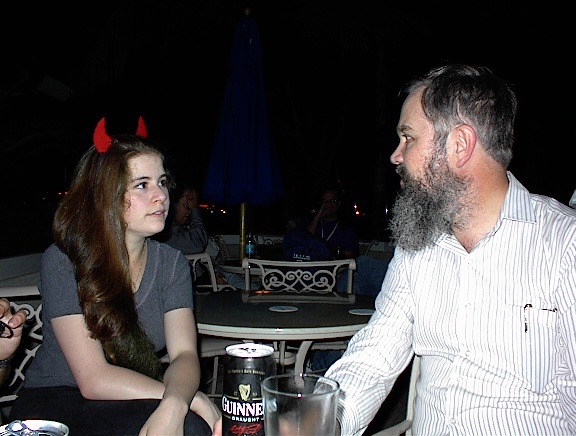
How can BSD be dying when it has girls like this supporting it? The best Linux can come up with is an obese penguin. What are those Linux people smoking?
What we need are more free software babes like her. This guy looks like he is about to cream his pants standing next to such a fox. Even this old Unix guru looks like he's having trouble keeping his wang under control when close to such an amazing babe. This girl has to be one of the hottest ever! I can tell you that I'll be installing BSD after catching sight of her!
Linux will never be able to compete until it ditches the fat arctic birdlife and gets itself a mascot like this little hottie. Let's face it: there's just no way Tux is ever going to compete with the divine Ceren. She is surely the woman of every computer geek's dreams. Wouldn't you kill to get just this close to her.
Join the campaign for more cute open source babes today! -
point your telescope this way!
How can BSD be dying when it has girls like this supporting it? The best Linux can come up with is an obese penguin. What are those Linux people smoking?
What we need are more free software babes like her. This guy looks like he is about to cream his pants standing next to such a fox. Even this old Unix guru looks like he's having trouble keeping his wang under control when close to such an amazing babe. This girl has to be one of the hottest ever! I can tell you that I'll be installing BSD after catching sight of her!
Linux will never be able to compete until it ditches the fat arctic birdlife and gets itself a mascot like this little hottie. Let's face it: there's just no way Tux is ever going to compete with the divine Ceren. She is surely the woman of every computer geek's dreams. Wouldn't you kill to get just this close to her.
Join the campaign for more cute open source babes today! -
Oh, no! What can everybody possibly do now?
www.slackware.com
www.redhat.com
www.debian.org
www.mandrake.org
cm.bell-labs.com/plan9dist/
www.atheos.cx
www.freebsd.org
www.openbsd.org
www.netbsd.org
That's that problem solved, then. Next, please! -
Given your requirements:
I'm building a computer for a friend, who has three major requirements from his system: He wants an Athlon with a 333MHz FSB, he wants absolutely no Microsoft software anywhere near it, and he needs the ability to read and edit Chinese.
Then go DL www.freebsd.org. They have a whole list of Chinese software. -
Re:nope
-
The Best distro?
The Beast is the Best.
-
Linux is not fragmented? That's news to me.
While the Linux kernel itself isn't going to be forking any time soon, I take particular issue with Mandrake's claim that GNU/Linux is unfragmented. Their article seems to downplay 'badly thought out software' linking to libraries which are specific to the structure or filesystem layout of one distribution or another.
Especially in cases such as RedHat, Mandrake, SuSE, one finds that common RPM's are not compatible across distributions. Often commercial software packages must be shipped for many different Linux distributions, and the LSB has been around for a long time. Let's not cop to the old 'well we're trying to form standards!'
UNIX tried copping to that, it got them nowhere. You Linux vendors should take a lesson from FreeBSD, just as Gentoo Linux has; form a filesystem standard, stick with it, and architect a build/installation mechanism that aids all software programs regardless of origin to be able to run.
-
Crying for nothing
I don't understand why anyone cries over this. If you don't like what M$ is doing, screw them and don't use their fscking bugs^H^H software. Here are some hints: FreeBSD RedHat Linux If ze Germans can, so can you!